108 résultats
176592495HB(Lüttich???), (1765). Manuskript: (622) Seiten, 7 Fingerregister, marmorierte Vorsätze (das vordere fliegende Vorsatzblatt verso auch beschrieben), goldgeprägter Lederband der Zeit, Goldschnitt, 18,5 x 11,5 cm.
1775ALDR0301Kempten, Klosterdruckerei 1775. 4°. Titelbl., 7 nn. Bll., 644, CCLXIII S., Titelblatt u. Text in Rot- und Schwarzdruck, mit gestochener Titelblattvignette (I. K. Belling sc), e. ganzseitigen Stich am letzten ungezählten Blatt verso u. einigen Schlussvignetten. Aufwendig gestalteter, sehr gut erhaltener schwarzer Lederband aus jüngerer Zeit, Rückenbeschriftung u. -zierlinien goldgeprägt, Einbanddeckel mit Zierumrandung u. Streicheisenlinien, mit dreiseitiger Innenkantenverzierung in Goldprägung, mit Blattweisern aus Leder u. e. Lesebändchen, Buchschnitt rot gefärbt, minimale Schadstellen auf den Einbanddeckeln. Einige Blätter fachgerecht restauriert. Mit e. Bibliotheksschildchen am vorderen Innendeckel (Bibliothek des Alois Fuchs inf. Propst u. Stadtpfarrer zum heil. Blut in Graz) und e. Exlibris am vorderen fliegenden Vorsatzblatt verso. LGB2 V,457 - Winterteil dieses seltenen Breviers, hergestellt in der Druckerei des Benediktinerklosters von Kempten unter dem Faktor Alois Galler. Das, seit der Reform beim Konzil von Trient ?Breviarum Romanum? benannte, Brevier oder Stundenbuch erschien unter diesem Titel 1568 erstmals in Rom und erfuhr später noch Neubearbeitungen durch die Päpste Clemens VIII. und Urban VIII. Pfarrer Alois Fuchs war von 1879 bis 1889 Propst der Grazer Propsteikirche 'Zum Heiligen Blut'.
1794180341Venetiis, Ex Typographia Balleoniana, 1794. Editio tertia veneta. X, 385 S. mit einigen Notenbeispielen und einigen Holzschnittvignetten. 8°, OPgt. mit goldgepr. Rückentitel.
180060795Genets, Ch. Pougens 1800 In-8 13 x 20 cm. Reliure de l’époque demi-basane fauve, dos lisse, filets dorés, LX + 323 pp. Mouillures en continue en extrême marge de tête des 16 premières pages., coiffes frottées, intérieur frais. Exemplaire en bon état.
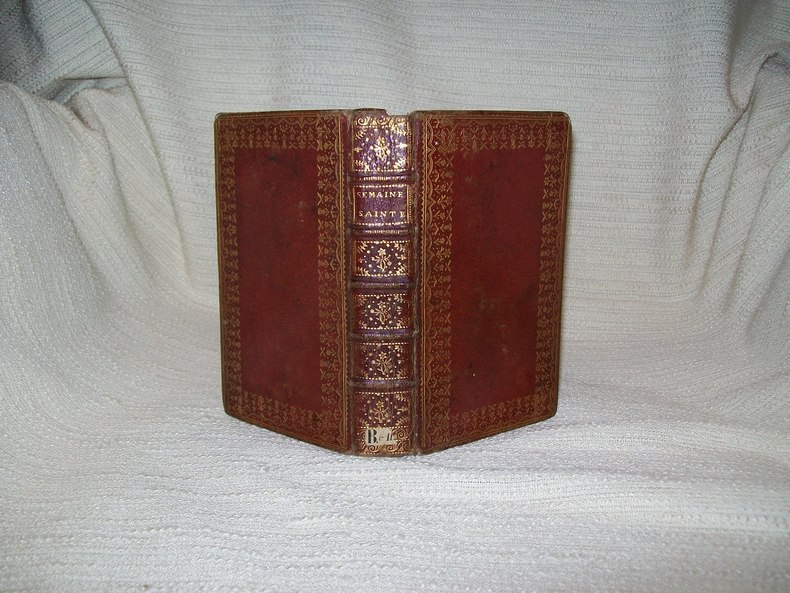
1792GITa714A Paris chez Dehansy 1792. Fort in-8 6ff n ch 2-588pp. Plein maroquin grenat à grains longs, dos à nerfs orné de compartiments dorés, pièce de titre noire, plats encadrés d'une large dentelle dorée, coupes et bordure intérieure guillochées, tranches dorées, rel époque. Orné d'une vignette sur le titre et 1 tête de chapitre, toutes deux de facture naïve. Quelques rousseurs.
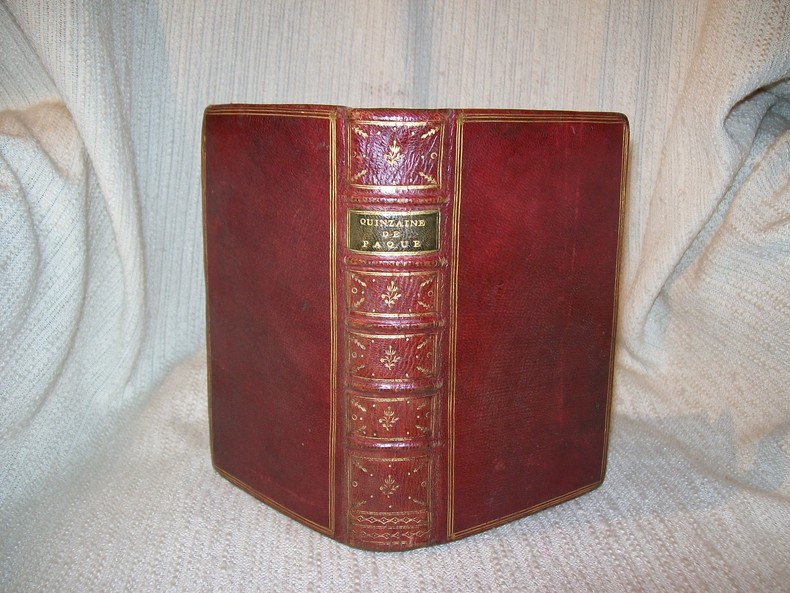
1741GITb470A Paris chez Lambert et Durand 1741. In-12 5ff n ch I-XII 1-544pp imprimées sur 2 colonnes. Plein maroquin grenat, dos à nerfs orné de compartiments dorés, plats encadrés d'une large frise à motif floral, coupes filetées, dentelle dorée sur bordure intérieure, tranches dorées, rel époque. Orné d'un frontispice et 4 gravures hors texte.
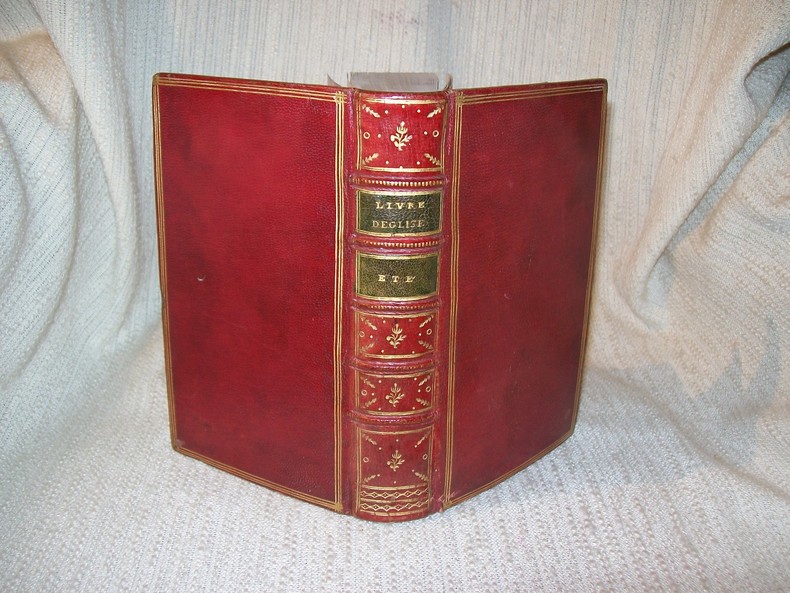
1772GITg753A paris chez les Libraires Associés 1772. In-12 6 feuillets non chiffrés 416pp CCLVIpp 1 feuillet blanc. Plein maroquin rouge, dos à 5 nerfs orné de cadres de filets et fleurons dorés, chaînette dorée en queue, pièces de titre et de tomaison vertes, plats encadrés d'un triple filet doré, coupes en bordures intérieures guillochées, tranches dorées, reliure de l'époque. Intérieur frais et complet. très bel exemplaire, reliure de l'époque solide, de bonne qualité et en très bon état.
178023323Venedig, Pezzana, 1780. 24 SS., Titelseite mit gest. ornamentaler Bordüre und gest. Memento Mori Vignette (drei Totenschädel, Knochen, Rocaillen und Pflanzenwerk), durchgehend rot-schwarzer Zweispaltendruck. Einige Schmuckinitialen, einige Noten in Quadratnotation, ein ganzseitiger Kupferstich (Kreuzigungsszene). Fol., schwarzes Leder der Zeit, beide Deckel mit rautenförmigen Streicheisenlinien, tls. vergoldet, kl. goldgeprägte Totenköpfe in der Mitte der Deckel. 6 Blattweiser aus älterer Pergament-Makulatur. - Der Einband berieben und mit Beschädigungen am Lederbezug.
175122889Augsburg und Würzburg, Martin Veith, 1751. Vortitel: Novum Missale Romanum. 22 Bll., Titel mit großer gestochner Titelvignette von Seb. Walch, 532 Seiten mit 10 ganzseitigen Kupfern von F. A. Zimmermann, CXVIII SS., 18 SS., 6 n.n. Bll., 43 (1) SS., 1 Bl., 4 weiße Bll., 3 Bll. handgeschrieben, lose beigelegt; rote, zeitgen. Blattweiser. Zahlreiche Schmuckinitialen und Schlußvignetten. Fol., Holzdeckelband der Zeit mit braunem Lederbezug, mit reicher floraler und ornamentaler Rücken- und Deckelvergoldung (tls. in Pointillé-Arbeit), Goldschnitt, marmorierte Vorsätze. Einband berieben und bestoßen, Vergoldung stellenweise oxydiert. Beide Kapitale etwas lädiert. Beide Schließen entfernt.
1786GITg750A paris chez les Libraires Associés 1786. In-12 1 feuillet non chiffré III-XXXII 2-664pp. Plein maroquin rouge, dos à 5 nerfs finement doré, pièce de titre verte, plats encadrés d'un triple filet doré, bordure intérieure décorée, tranches dorées, reliure de l'époque. Bel exemplaire complet et bien relié.
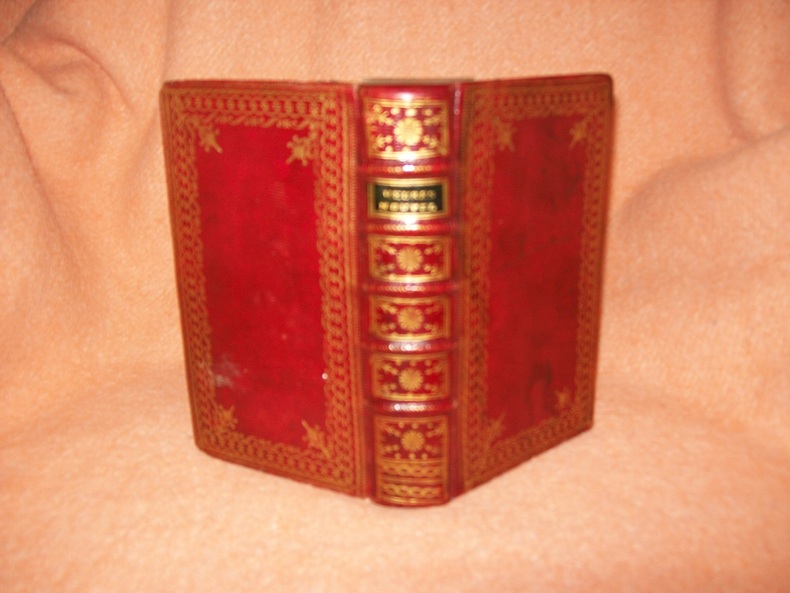
1742230671742 A Paris : chez les Libraires associés, [c. 1742] Approbation datée 15 août 1742. [2-]381[-5] p. ; in-12.reliure plein maroquin,armes sur les plats,filets dorés fleurons en angle, leg.frottées,dos lisse trés orné,tranches dorées,bon état
1725106854BBohne Ort und Jahr (Rastatt ?, um 1725). Imperial-Folio (44 x 30 cm.). [183] S., davon 58 Doppelseiten mit Quadratnoten beschrieben mit lateinischen Stimmen. Schweinslederband der Zeit über Holzdeckeln mit dekorativer Rollen-Kartusche. [10 Warenabbildungen]
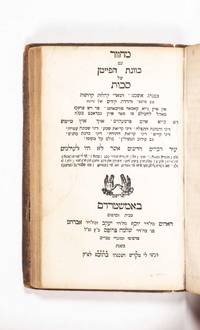
176749301Amsterdam: Ha-Ahim Yosef Ya‘akov and Avraham bene Shlomoh Props 1767. Hardcover. Good. Three parts octavo. 1 title 32; 81; 1 title 51ff. Printers device at titles. Text complete and foliation continuous throughout first part despite apparent irregularities; third part with separate full title identical to that of the first. Vocalized Hebrew text in square characters; Yiddish in German rabbinical faces. Contemporary sheep gilt-tooled border faded; gilt lettering piece at spine; marbled endleaves. Light wear at extremities rear board rubbed dry. Occasional soiling but a good copy in an intact contemporary binding.<br /> <br /> Collation: unsigned leaf aleph-gimel8 he6 vav2; aleph-yud8 yud aleph1; unsigned leaf aleph-vav8 zayin3. Chronogram date: 5528 = 1767.<br /> <br /> Eighteenth-century Jewish festival prayerbook mahazor for Sukkot according to the Ashkenazi tradition accompanied by the Yiddish Judaeo-German commentary Kavanat ha-Paitan. The typography of this prayerbook is notable; according to Fuks/Fuks-Mansfeld "in 1761 the greater part of the Athias printing material came into the possession of Joseph Jacob and Abraham Proops. In their Yiddish Almanac for the year 5523 1762-63 the brothers printed the following notice: . On Wednesday 21 Adar 5521 25th February 1761 we acquired what had long been hidden away as a most precious treasure that is to say the matrices moulds etc. made by those famous printers Joseph Immanuel and Abraham Athias. They are for all manner of square hebrew letters for use with or without vowels and accents and for a number or Rashi and German rabbinical faces large and small" p. 303. References: Vinograd Amsterdam no. 1953 noting nine parts in the complete series of festival prayerbooks. Ha-Ahim Yosef, Ya‘akov, [and] Avraham, bene Shlomoh Props hardcover
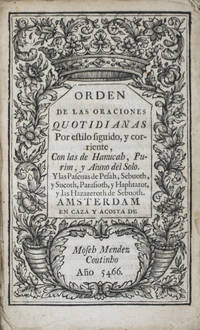
170643961Amsterdam: Moseh Mendez Coutinho 1706. Hardcover. poor to g. Duodecimo. 6.5x4.5". 8 347pp. 1 401-611pp. 8. Jewish year = 5466. Original dark brown pebbled leather boards. Gauffered and gilt edges. Title page illustrated with decorative woodblock floral motifs bordering the text. The publication is an early Spanish-language Jewish daily prayer book siddur which also includes prayers for various Jewish Holidays including the Sabbath Hannukah Purim and the Shalosh Regalim Three Pilgrimage Festivals: Passover Sukkot and Shavuot. Also included are the Torah portions Parshiot and Haftorot to be read on those occasions.<br /> <br /> This prayer book was published by Moseh Mendez Coutinho following a similar title and formatting to a number of other earlier editions dating back to the 1681 publication by David Tartas. Starting with Tartas' subsequent edition from 1690 these book also included the torah portions and haftorot. This and other publications of Jewish liturgy served members of the then sizable Sephardic Jewish community in Amsterdam. A significant portion of the community would have been ex-Marranos Jews who had outwardly converted to Catholicism during the inquisition in Spain who then immigrated and were able to reestablished their Jewish identity and thus were unable to read Hebrew hence the text's publication in Spanish. <br /> <br /> The first section contains a few prayers transliterated into Spanish from the Hebrew followed by daily prayers p.9-134 Sabbath prayers p.134-262 prayers for Rosh-Hodesh Celebration of the new month p.262-309 and Hanukkah Purim and others 309-347. Following an additional title page with decorative woodblock borders is a section containing prayers related to the three festivals Passover Shavuot and Sukkot respectively p.401-611. All text in Spanish. <br /> <br /> BOUND WITH<br /> The final unpaginated eight pages included a table of contents for the various prayers and a six-page Hebrew-Gregorian calendar with tables for tracking the new months festivals and fast days covering the years 1705-1716 including a title page decorated with a woodblock border. Some sections throughout the text with decorative initials. <br /> <br /> Binding with spine and some pieces of the leather on the covers missing. Rubbing scratches and chipping to extremities. Binding loose with starting at endpapers title page and a number of other pages throughout the text. Light sporadic water stains and foxing to some pages throughout. A few small holes on a few pages with minimal loss of text. Binding in poor interior in good condition overall. References: KAYSERLING 1890 p. 60gives 12° PALAU 1923 202353gives 16° SILVARO- SA 1933 48 corrects Kayserling PEETERS 1933 1028. Moseh Mendez Coutinho hardcover
17907749Kaufbeuren, Joseph Dorn, 1790. 8 Bl., 452 S., 1 Bl. 8°. Pappe der Zeit.
170124357Mainz, Mayer, 1701. Titel in Rot-Schwarz-Druck, 3 n.n. Bll., 548 SS., 4 n.n. Bll. Index. Ohne das gestochene Frontispiz! 4° (ca. 21,5 x 18 cm), Pergament der Zeit, Rotschnitt, handschriftl. Rückenschildchen. Der Einband fleckig.
1750D11002Venice: Nella Stamperia Bragadina 1750. Hardcover. Very Good. 2 volumes 8vo 193 x 127mm. Vol. I: 2 224 i. e. 223 16 18; Vol. II: 2 323 1 leaves including engraved additional titles. Full-page engraved title pages of Old Testament history feasts temple scenes by Francesco Griselini 1717-1783 born in Venice who lived as an academic and journalist but later worked as an engraver. Hebrew text. Contemporary red morocco gilt and gilt edges marbled endpapers morocco label on spine MACASOR ITALIANO; corners bumped and light edgewear Vol. 2 joints splitting; Vol. 1 covers warped with light dampstaining to opening leaves additional title partly detached but present scattered light foxing repaired clean tear across leaf 192. An excerpt from Midrash Mishlei the haggadic midrash from the Book of Proverbs in contemporary hand on recto of leaf 20. Bound at the end of Volume 2 are three leaves of contemporary manuscript in Hebrew by Leah Ashkenazi in memory of her deceased husband Yehuda Hayyim Finzi brother-in-law Yosef Hai Finzi sons Nehemya and Meir and brother Shlomo Hai additions later dated 1770 by pencil notes. The Prayer Book has likely been part of the prominent Jewish-Italian Finzi family library since its publication. <br/><br/>According to Sephardic rite the prayers and customs for the New Year festival Rosh ha Shanah must be outlined in liturgical books like these. Venetian Jewish community life prospered in the early modern era despite poor living conditions. As the communities were centered on following ritual and custom Venice became a strong center of Jewish knowledge and learning. The next two centuries saw a fortunate Golden Age for Venetian Jews where commerce and scholarship flourished under their influence. During this period Venice was home to many famous Jewish poets physicians and other personalities. By 1750 the year of this publication the Golden Age for Venetian Jews was just beginning to wane as many prominent families left the city due to new constraints. The Bragadina press renowned Christian printers of Hebrew books was founded by one of the oldest and most influential families in Venice. Despite such sway restrictions owing to the Counter Reformation and Roman Inquisition in Europe meant a ban on the printing of Hebrew books in Venice from 1554 to 1563. The prohibition was eventually lifted in 1575 when printing resumed and business picked up. For the next two centuries the Bragadina publishers enjoyed a relative monopoly of Hebrew printing in Venice where their considerable output spread to customers around Europe and North Africa. Rare find for Judeo-Venetian printing and uncommon edition OCLC locates a copy at the Jewish Theological Seminary of America. Nella Stamperia Bragadina hardcover
174121236291741. Venice: Antonio Bortoli. 15 September 1741. Folio. Contemporary red morocco over wooden boards elaborately tooled in gilt with floral borders and central lozenge around image of Crucifixion on upper board and the Virgin and Child on lower board; floral corner-pieces spine gilt-tooled in compartments with floral tools block-printed decorated pastedowns over marbled pastedowns 6 purple silk fore-edge tabs 2 detached purple silk page-marker; pp. 28 text in Armenian printed throughout in red and black with instructions for the deacon and celebrating clergy in red main text in double columns title page printed within engraved architectural border enclosed within larger border of the figures of the Evangelists the Apostles and the 24 Prophets with their names in Armenian two engraved full-page illustrations in pagination one signed ""Zucchi"" after Peter Paul Rubens the other after Maarten de Vos woodcut initials head- and tailpieces; a few minor scuffs to boards one tiny wormhole to upper board and two to lower extremities and spine lightly rubbed; pin worm-holes to gutter two tiny holes to outer margin of C4-ad finem all far from printed surface light dust-soiling and marginal dampstaining first quire coming loose a few small wax drops but overall a very good fresh copy.Extremely rare Armenian missal according to the rite of the Armenian Catholic Church published in Venice.The long tradition of Armenian printing in Venice dates back to 1512 when the first book ever printed in the Armenian language Urbatagirk ""Friday Book"" was published by the Venice-based Armenian printer Hakob Meghapart. In 1695 Antonio Bortoli obtained from the Venetian authorities an exclusive privilege for all Armenian printing. He retained it until the arrival in Venice of Father Mekhitar of Sebaste 1676-1749 an Armenian scholar and theologian who in 1701 founded the Mekhitarist Order. The Mekhitarists an Armenian Catholic monastic congregation devoted to the revival of Armenian culture and learning have since 1717 been based on the island of San Lazzaro near Venice. One of the great centres of Armenian scholarship and printing in Europe the island soon became home to a flourishing Mekhitarist press. ""In 1788 an agreement between the Mekhitarist fathers and Bortoli's successor Francesco Bortoli reduced the latter to little more than a figurehead"" Zorzi trans.The same engraved title page was used by Bortoli for his 1733 edition of the Bible in Classical Armenian a revised edition of the 1666 Bible published by Oskan Erewants'i. The binding of our copy of the missal matches the one held at Eton College Library.We have not been able to locate any copies in the US. Library Hub records only one copy at Eton College Parikian Collection of early Armenian printing. We can add a copy in Italy Venice San Lazzaro.Voskanyan 465. See Marino Zorzi ""La produzione e la circolazione del libro"" in Storia di Venezia 1997. hardcover
172723272Lugduni Ex officina Valfray 1727 in-12 plein-veau un volume, reliure plein veau havane moucheté (binding full calfskin in-12) in-douze (17 x 10 cm), RELIURE D'EPOQUE, dos 5 nerfs (spine with raised bands), décoré "or" et à froid (gilt and blind stamping decoration), titre frappé "or", pièce de titre sur fond rouge avec 2 filets "or" en encadrement, entre-nerfs à fleuron "soleil" "or" dans un encadrement de 2 filets "or" avec rinceaux "or" aux angles, une roulette à froid de part et d'autre des nerfs, roulette "or" en pied, plats décorés à froid d'un double filet à froid en encadrement, roulette "or" sur les coupes avec léger manque de dorure, toutes tranches lisses rouges, la page de titre manque, texte en latin, Partitions musicales avec musique notée gravée en noir sur toute les pages, sans illustrations (no illustration) excepté un bandeau et un cul-de-lampe historié gravé sur bois en noir, 548 pages + 5 pages d'index (relié sans le privilège in-fine), 1727 Lugduni, Ex officina Valfray, regis & Cleri Typographi, in vico Mercatorio. Cum approbatione et privilegio Editeur,
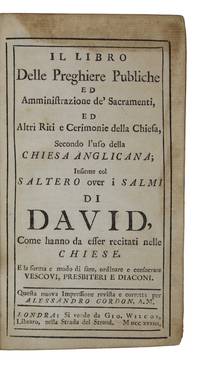
1733AQ27937Londra i.e London: Si vende da Gio. Wilcox 1733. 648 24pp. Contemporary gilt-ruled calf. Extremities worn loss to head- and tail-caps upper board held by cords only. Slight loss to gutter of leaf B1 title browned intermittent light dampstaining. A London-printed Italian translation of the Anglican liturgy a revised and corrected edition edited by antiquary and sometime bookseller Alexander Gordon c. 1692-1754 of Church of Ireland clergyman William Bedell's bap. 1572 d. 1642 translation - the first of its kind - posthumously published in 1685. OCLC and COPAC together record copies at locations BL California Cambridge General Theological Seminary Oxford St. Andrews Strathclyde UoL Wellcome. ESTC T195182 Griffiths 66:3 p.513. 12mo. Si vende da Gio. Wilcox unknown
1780AQ19055A Londres i.e. London: Chez J. Nourse & P. Elmsly 1780. 2 xlix 1 438pp 2. With a half-title and a table. Handsomely bound in contemporary gilt-tooled morocco A.E.G. Very slight rubbing and marking to extremities. Marbled endpapers contemporary armorial bookplate of Richard Langley to FEP recent bookplate of Robert J. Hayhurst to recto of FFEP. A finely bound example of the Anglican Liturgy in French sporadically printed in England for use in parts of Calais the Channel Islands and for French Huguenot refugees from the sixteenth-century onwards. ESTC records copies at five locations in the British Isles BL Cambridge Lambeth Palace NLW and Trinity College and a three in North America General Theological Seminary Harvard and Philadelphia. ESTC T140856. Nouvelle edition i.e. new edition. 12mo. Chez J. Nourse & P. Elmsly unknown
1713AQ15276Londini i.e. London: Apud R. & J. Bonwicke et al. 1713. 38 184pp 148. With an engraved frontispiece. Handsomely bound in contemporary richly gilt-tooled black morocco A.E.G. Lightly rubbed. Marbled endpapers Recent bookplate of Robert J. Hayhurst to FEP loss to upper corner of front blank fly-leaf early inked inscription of 'John Murray / April 1726' to recto. An early eighteenth-century Latin edition of the 1662 Book of Common Prayer. The translation was completed by Jersey-born Anglican clergyman Jean Durel 1625-1683 who had been appointed Chaplain of the Stuart Court's French congregation at the Savoy and also held the monopoly for printing the French translation of the new authorised Liturgy. Considered eminently superior to the latter this translation mined the Sarum Missal and Breviary as a source for amongst others the canticles and psalms included here. The delay of seven years between the passing of the Act of the Uniformity which made use of the Book of Common Prayer compulsory in Anglican church services and the first publication of this translation in 1669 suggests that the demand for Latin editions had waned since Tudor days. ESTC T140407. 12mo. Apud R. & J. Bonwicke et al. unknown
1731AQ24973London: Printed by the Assigns of His Majesty's Printer and of Henry Hills decease'd 1731. Unpaginated. Contemporary gilt-tooled sheep. Extremities heavily worn joints split loss to head of spine. Marbled endpapers contemporary armorial bookplate to FEP and inked ownership inscription to front blank fly-leaf of Cosmo George Duke of Gordon. Cosmo George Gordon third Duke of Gordon 1720-1752 Scottish peer. Gordon was named after his father's close friend Jacobite sympathiser Cosimo III de' Medici 1642-1723. Unlike his father Alexander Gordon second Duke of Gordon c.1678-1728 who fought with the Jacobites at the Battle of Sheriffmuir during the 1715 Rising Cosmo despite the pleas of his younger brother Lord Lewis declined to support the Rising of 1745. ESTC records a single copy of this edition in North America Huntington and none elsewhere. ESTC N67565. 12mo. Printed by the Assigns of His Majesty's Printer, and of Henry Hills, decease'd unknown
1712AQ23533Edinburgh: Printed by James Watson 1712. 30 308 2 309-429pp 1. Title page in red and black. Leaf B1 is a cancellans with 'nople asure' in line eight of text corrected to 'no pleasure'. Some copies have both states of B1 the present copy does not. Handsomely bound in later richly gilt-tooled dark green morocco A.E.G. Lightly rubbed. Elaborate brocade endpapers armorial bookplate of Thomas Maitland Dundrennan to FEP internally clean and crisp. An attractively bound eighteenth-century Edinburgh-printed edition of the controversial ‘Laud’s Prayer book’ an avowedly English-influenced version of the liturgy issued by Robert Young printer to Charles I in 1637. Drafted by the Bishops of Ross and Dunblane John Maxwell d. 1639 and James Wedderburn 1585-1639 the Scottish Book of Common prayer was largely based upon the rite first issued in 1549 during the reign of King Edward VI. Introduced to an unaccepting Scottish population on 23rd July 1637 by Archbishop Laud at the behest of King Charles I it attempted to replace John Knox's Calvinist Book of Common Order and proved the greatest symbol of the unpopular standardisation of Anglican Protestantism throughout the British Isles. The text was one of several triggers of the Covenant movement and the first stages of the War of Three Kingdoms.Despite its unpopularity this historic text influenced the 1662 revision of the English Liturgy the 1789 American Book of Common Prayer and the Scottish Episcopalian Liturgy of 1929. Thomas Maitland Lord Dundrennan 1792-1851 judge and sometime Solicitor General for Scotland. A devotee of antiquarian literature Dundrennan amassed an extensive library - 'a monument' according to Lord Cockburn 'honourable to his taste and judgment'. The contents on which was dispersed by sale over nine days in November 1851. ESTC T138343. 8vo. Printed by James Watson unknown
1772AQ15188Oxford: Printed by T. Wright and W. Gill 1772. 416pp. Contemporary gilt-tooled red morocco 'William Crosbie Esq. Mayor. 1776' stamped in gilt to upper board A.E.G. Extremities rubbed and discoloured loss to gilt tooling joints worn. Marbled endpapers internally clean and crisp but for tear to margin of K2. A handsomely bound eighteenth-century edition of the Church of England liturgy bound for the Mayor of Liverpool and merchant slave trader William Crosbie. ESTC locates three copies of this quarto edition in British libraries BL Bristol and Oxford and a further two in North America Brown and Pennsylvania. ESTC N32792. Quarto. Printed by T. Wright and W. Gill unknown