297 résultats
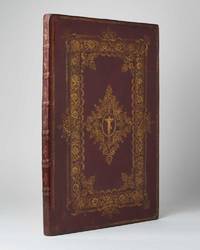
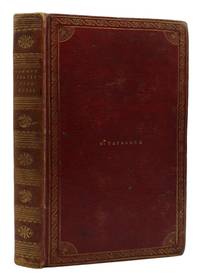
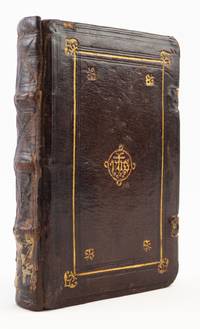
1538ST19567-018Venetiis Venice: in officina heredum Luceantonii Junte hiers of Lucantonio Giunta 1538. 149 x 104 mm. 5 7/8 x 4". 8 143 of 144 leaves lacking leaf p6. <br/> Contemporary Venetian morocco rebacked preserving original blind-ruled spine and corners rounded off and renewed covers each with blind-ruled borders and a gilt- and blind-ruled panel with gilt fleurons in each inner and outer corner central gilt IHS monogram raised bands brass clasps renewed all edges gilt and gauffered lacking final endleaf. Printer's device on title numerous historiated woodcut initials first page of text with woodcut border two full-page woodcut illustrations. Printed in red and black. Essling 181; Sander 5970 under "autres éditions"; EDIT 16 CNCE 11880. Original spine somewhat crackled bottom compartment with slight surface loss perhaps from removal of a label covers with several but insignificant small dings very minor dampstain at extreme top edge of a few leaves other trivial imperfections but a clean fresh and bright copy in an attractive early binding.<br/> <br/> Offered in what is probably its original binding this is a very rare edition of a Psalter done by one of the leading Venetian printing families of the 15th and 16th centuries. A major figure in the Italian book trade Lucantonio Giunta 1457-1538 began his career as a bookseller in Venice in 1477 and became a printer there in 1489. Together with family members and carefully arranged partnerships Giunta expanded his printing empire into numerous cities in Europe including Lyon Lisbon Antwerp Frankfurt and Salamanca. The present book was printed just after the death of Lucantonio whose heirs would continue to run the family business which grew prosperous in part because of its specialty in producing liturgical works such as this. The contents here are routine but the well-preserved decorative period binding makes the volume definitely worth having. in officina heredum Luceantonii Junte [hiers of Lucantonio Giunta] unknown
262664Egypt late 19th century. Lithographic text in Coptic and Arabic. Pp. 2 3-160. 1 vols. 12mo. Nineteenth century red leather. Rubbed recased. Collector's ink stamp dated 1898 on front free endpaper; manuscript note on leaf preceding title. Good. Lithographic text in Coptic and Arabic. Pp. 2 3-160. 1 vols. 12mo. OCLC: 560963678 for an edition of 1603 unknown
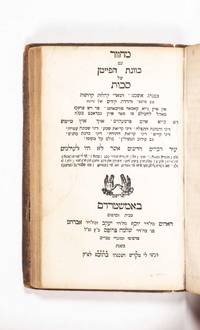
176749301Amsterdam: Ha-Ahim Yosef Ya‘akov and Avraham bene Shlomoh Props 1767. Hardcover. Good. Three parts octavo. 1 title 32; 81; 1 title 51ff. Printers device at titles. Text complete and foliation continuous throughout first part despite apparent irregularities; third part with separate full title identical to that of the first. Vocalized Hebrew text in square characters; Yiddish in German rabbinical faces. Contemporary sheep gilt-tooled border faded; gilt lettering piece at spine; marbled endleaves. Light wear at extremities rear board rubbed dry. Occasional soiling but a good copy in an intact contemporary binding.<br /> <br /> Collation: unsigned leaf aleph-gimel8 he6 vav2; aleph-yud8 yud aleph1; unsigned leaf aleph-vav8 zayin3. Chronogram date: 5528 = 1767.<br /> <br /> Eighteenth-century Jewish festival prayerbook mahazor for Sukkot according to the Ashkenazi tradition accompanied by the Yiddish Judaeo-German commentary Kavanat ha-Paitan. The typography of this prayerbook is notable; according to Fuks/Fuks-Mansfeld "in 1761 the greater part of the Athias printing material came into the possession of Joseph Jacob and Abraham Proops. In their Yiddish Almanac for the year 5523 1762-63 the brothers printed the following notice: . On Wednesday 21 Adar 5521 25th February 1761 we acquired what had long been hidden away as a most precious treasure that is to say the matrices moulds etc. made by those famous printers Joseph Immanuel and Abraham Athias. They are for all manner of square hebrew letters for use with or without vowels and accents and for a number or Rashi and German rabbinical faces large and small" p. 303. References: Vinograd Amsterdam no. 1953 noting nine parts in the complete series of festival prayerbooks. Ha-Ahim Yosef, Ya‘akov, [and] Avraham, bene Shlomoh Props hardcover
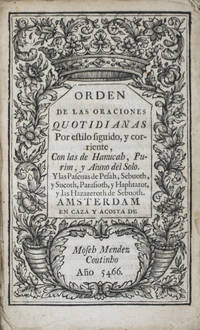
170643961Amsterdam: Moseh Mendez Coutinho 1706. Hardcover. poor to g. Duodecimo. 6.5x4.5". 8 347pp. 1 401-611pp. 8. Jewish year = 5466. Original dark brown pebbled leather boards. Gauffered and gilt edges. Title page illustrated with decorative woodblock floral motifs bordering the text. The publication is an early Spanish-language Jewish daily prayer book siddur which also includes prayers for various Jewish Holidays including the Sabbath Hannukah Purim and the Shalosh Regalim Three Pilgrimage Festivals: Passover Sukkot and Shavuot. Also included are the Torah portions Parshiot and Haftorot to be read on those occasions.<br /> <br /> This prayer book was published by Moseh Mendez Coutinho following a similar title and formatting to a number of other earlier editions dating back to the 1681 publication by David Tartas. Starting with Tartas' subsequent edition from 1690 these book also included the torah portions and haftorot. This and other publications of Jewish liturgy served members of the then sizable Sephardic Jewish community in Amsterdam. A significant portion of the community would have been ex-Marranos Jews who had outwardly converted to Catholicism during the inquisition in Spain who then immigrated and were able to reestablished their Jewish identity and thus were unable to read Hebrew hence the text's publication in Spanish. <br /> <br /> The first section contains a few prayers transliterated into Spanish from the Hebrew followed by daily prayers p.9-134 Sabbath prayers p.134-262 prayers for Rosh-Hodesh Celebration of the new month p.262-309 and Hanukkah Purim and others 309-347. Following an additional title page with decorative woodblock borders is a section containing prayers related to the three festivals Passover Shavuot and Sukkot respectively p.401-611. All text in Spanish. <br /> <br /> BOUND WITH<br /> The final unpaginated eight pages included a table of contents for the various prayers and a six-page Hebrew-Gregorian calendar with tables for tracking the new months festivals and fast days covering the years 1705-1716 including a title page decorated with a woodblock border. Some sections throughout the text with decorative initials. <br /> <br /> Binding with spine and some pieces of the leather on the covers missing. Rubbing scratches and chipping to extremities. Binding loose with starting at endpapers title page and a number of other pages throughout the text. Light sporadic water stains and foxing to some pages throughout. A few small holes on a few pages with minimal loss of text. Binding in poor interior in good condition overall. References: KAYSERLING 1890 p. 60gives 12° PALAU 1923 202353gives 16° SILVARO- SA 1933 48 corrects Kayserling PEETERS 1933 1028. Moseh Mendez Coutinho hardcover
1620257033Lutetiae Parisiorum i.e. Paris: E Typographia Renati Giffart 1620. Title-page printed in red and black with large engraved vignette by Jaspar issac. Printed in red and black throughout illustrated with full-page engravings engraved borders woodcut initial capitals in red and printed music. 1 vols. Folio. Early calf nineteenth century marbled endpapers. Covers much worn joints cracked spine perished. Defective copy lacking numerous leaves but with 17 iinserted leave printed on velllum including the entire "Canon Missae" 8 leaves. Title-page printed in red and black with large engraved vignette by Jaspar issac. Printed in red and black throughout illustrated with full-page engravings engraved borders woodcut initial capitals in red and printed music. 1 vols. Folio. Bbl-7CcDD7-EE6 &HH7-II2 are printed on parchment. OCLC: 633338957 1 copy E Typographia Renati Giffart unknown
1750D11002Venice: Nella Stamperia Bragadina 1750. Hardcover. Very Good. 2 volumes 8vo 193 x 127mm. Vol. I: 2 224 i. e. 223 16 18; Vol. II: 2 323 1 leaves including engraved additional titles. Full-page engraved title pages of Old Testament history feasts temple scenes by Francesco Griselini 1717-1783 born in Venice who lived as an academic and journalist but later worked as an engraver. Hebrew text. Contemporary red morocco gilt and gilt edges marbled endpapers morocco label on spine MACASOR ITALIANO; corners bumped and light edgewear Vol. 2 joints splitting; Vol. 1 covers warped with light dampstaining to opening leaves additional title partly detached but present scattered light foxing repaired clean tear across leaf 192. An excerpt from Midrash Mishlei the haggadic midrash from the Book of Proverbs in contemporary hand on recto of leaf 20. Bound at the end of Volume 2 are three leaves of contemporary manuscript in Hebrew by Leah Ashkenazi in memory of her deceased husband Yehuda Hayyim Finzi brother-in-law Yosef Hai Finzi sons Nehemya and Meir and brother Shlomo Hai additions later dated 1770 by pencil notes. The Prayer Book has likely been part of the prominent Jewish-Italian Finzi family library since its publication. <br/><br/>According to Sephardic rite the prayers and customs for the New Year festival Rosh ha Shanah must be outlined in liturgical books like these. Venetian Jewish community life prospered in the early modern era despite poor living conditions. As the communities were centered on following ritual and custom Venice became a strong center of Jewish knowledge and learning. The next two centuries saw a fortunate Golden Age for Venetian Jews where commerce and scholarship flourished under their influence. During this period Venice was home to many famous Jewish poets physicians and other personalities. By 1750 the year of this publication the Golden Age for Venetian Jews was just beginning to wane as many prominent families left the city due to new constraints. The Bragadina press renowned Christian printers of Hebrew books was founded by one of the oldest and most influential families in Venice. Despite such sway restrictions owing to the Counter Reformation and Roman Inquisition in Europe meant a ban on the printing of Hebrew books in Venice from 1554 to 1563. The prohibition was eventually lifted in 1575 when printing resumed and business picked up. For the next two centuries the Bragadina publishers enjoyed a relative monopoly of Hebrew printing in Venice where their considerable output spread to customers around Europe and North Africa. Rare find for Judeo-Venetian printing and uncommon edition OCLC locates a copy at the Jewish Theological Seminary of America. Nella Stamperia Bragadina hardcover
53102Paris: Boussod Valadon & Cie. in Asni�res-sur-Seine 1895 . Published by Boussod Valadon & Cie. in Asni�res-sur-Seine 1895 � A magnificent copy of this beautiful book of hours illustrated with 20 photogravures after watercolors by Guillaume Dubufe. Elegant full cream morocco binding spine with five raised bands gilt edges charming Art Nouveau gilt decoration on the front cover gilt rolls on the pastedowns gilt rolls at the head and tail silk moir� endpapers. Binding signed Durvand. Paris: Boussod, Valadon & Cie., in Asni�res-sur-Seine, 1895 . hardcover
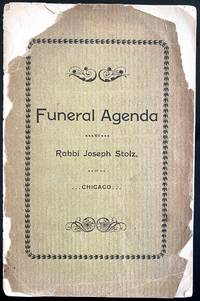
189743201Chicago 1897. 1st edition. Original Wrappers 12mo. 23 pages. Singerman 5280. <br> "Read before the Central Conference of American Rabbis at Montreal Canada July 9 1897." <br> <br> Rabbi Joseph Stolz 1861–1941 was a pioneering Reform rabbi and communal leader primarily in Chicago. He was ordained at Hebrew Union College in 1884 and began his rabbinic career began in Little Rock AR before moving to Chicago in 1887 as assistant to Dr. Bernard Felsenthal at Zion Congregation. In response to demographic shifts Stolz founded Isaiah Congregation one of Chicago’s most prominent Reform synagogues which under his leadership built a major temple at 45th and Vincennes Ave. in 1896.<br> Stolz emphasized traditional observance within Reform delivering biblically rooted ethically driven sermons. His contribution to the 1896 Sermons by American Rabbis reflects his emphasis on “deed over creed.â€<br> He was awarded a Doctor of Divinity by HUC in 1890 and a Doctor of Hebrew Law honoris causa in 1931. He held key roles in the Central Conference of American Rabbis President 1905–07 Chicago Rabbinical Association American Jewish Committee JPS and UAHC and was appointed to the Chicago Board of Education 1899–1905 by Mayor Carter Harrison.<br> Stolz’s legacy remains central to the development of Reform Judaism in Chicago Tobias Schanfarber in AJYB 1942. OCLC: 37779652. <br> Covers detached and edgeworn internal text and paper bright and strong Good Condition thus B kh-2-7-BFCL-CC. [Chicago] unknown
174121236291741. Venice: Antonio Bortoli. 15 September 1741. Folio. Contemporary red morocco over wooden boards elaborately tooled in gilt with floral borders and central lozenge around image of Crucifixion on upper board and the Virgin and Child on lower board; floral corner-pieces spine gilt-tooled in compartments with floral tools block-printed decorated pastedowns over marbled pastedowns 6 purple silk fore-edge tabs 2 detached purple silk page-marker; pp. 28 text in Armenian printed throughout in red and black with instructions for the deacon and celebrating clergy in red main text in double columns title page printed within engraved architectural border enclosed within larger border of the figures of the Evangelists the Apostles and the 24 Prophets with their names in Armenian two engraved full-page illustrations in pagination one signed ""Zucchi"" after Peter Paul Rubens the other after Maarten de Vos woodcut initials head- and tailpieces; a few minor scuffs to boards one tiny wormhole to upper board and two to lower extremities and spine lightly rubbed; pin worm-holes to gutter two tiny holes to outer margin of C4-ad finem all far from printed surface light dust-soiling and marginal dampstaining first quire coming loose a few small wax drops but overall a very good fresh copy.Extremely rare Armenian missal according to the rite of the Armenian Catholic Church published in Venice.The long tradition of Armenian printing in Venice dates back to 1512 when the first book ever printed in the Armenian language Urbatagirk ""Friday Book"" was published by the Venice-based Armenian printer Hakob Meghapart. In 1695 Antonio Bortoli obtained from the Venetian authorities an exclusive privilege for all Armenian printing. He retained it until the arrival in Venice of Father Mekhitar of Sebaste 1676-1749 an Armenian scholar and theologian who in 1701 founded the Mekhitarist Order. The Mekhitarists an Armenian Catholic monastic congregation devoted to the revival of Armenian culture and learning have since 1717 been based on the island of San Lazzaro near Venice. One of the great centres of Armenian scholarship and printing in Europe the island soon became home to a flourishing Mekhitarist press. ""In 1788 an agreement between the Mekhitarist fathers and Bortoli's successor Francesco Bortoli reduced the latter to little more than a figurehead"" Zorzi trans.The same engraved title page was used by Bortoli for his 1733 edition of the Bible in Classical Armenian a revised edition of the 1666 Bible published by Oskan Erewants'i. The binding of our copy of the missal matches the one held at Eton College Library.We have not been able to locate any copies in the US. Library Hub records only one copy at Eton College Parikian Collection of early Armenian printing. We can add a copy in Italy Venice San Lazzaro.Voskanyan 465. See Marino Zorzi ""La produzione e la circolazione del libro"" in Storia di Venezia 1997. hardcover
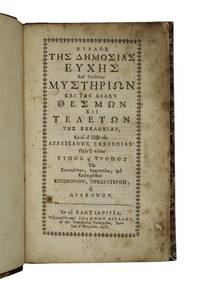
1665AQ25869En te Kantabrigia i.e. Cambridge: Exetypothe par' Ioannou Phieldou. 1665. 36 126pp 2. With a terminal blank leaf. Title and imprint including date are transliterated from the Greek. ESTC R204258 Wing B3632. Bound with: Psalterion tou Dabid. En te Kantabrigia i.e. Cambridge. Exetypothe par' Ioannou Phieldou. 1664. 2 115 3 117-171pp 1. Title and imprint including date are transliterated from the Greek. ESTC R204259 Wing B2720A. 12mo. Recent calf-backed marbled paper boards lettered in gilt to spine. A trifle rubbed spine sunned. Bookplate of King Edward VI School Southampton to FEP Inked notes to recto of front blank fly-leaf title page of first mentioned work marked with small marginal hole scattered spotting. A early edition in Greek of the 1662 revised Anglican Book of Common Prayer together with a contemporary edition of the Psalms of David. . Exetypothe par' Ioannou Phieldou... hardcover
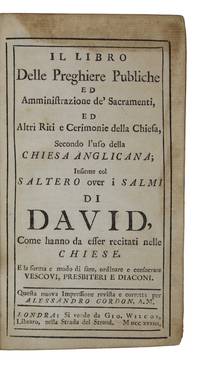
1733AQ27937Londra i.e London: Si vende da Gio. Wilcox 1733. 648 24pp. Contemporary gilt-ruled calf. Extremities worn loss to head- and tail-caps upper board held by cords only. Slight loss to gutter of leaf B1 title browned intermittent light dampstaining. A London-printed Italian translation of the Anglican liturgy a revised and corrected edition edited by antiquary and sometime bookseller Alexander Gordon c. 1692-1754 of Church of Ireland clergyman William Bedell's bap. 1572 d. 1642 translation - the first of its kind - posthumously published in 1685. OCLC and COPAC together record copies at locations BL California Cambridge General Theological Seminary Oxford St. Andrews Strathclyde UoL Wellcome. ESTC T195182 Griffiths 66:3 p.513. 12mo. Si vende da Gio. Wilcox unknown
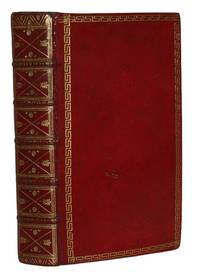
1780AQ19055A Londres i.e. London: Chez J. Nourse & P. Elmsly 1780. 2 xlix 1 438pp 2. With a half-title and a table. Handsomely bound in contemporary gilt-tooled morocco A.E.G. Very slight rubbing and marking to extremities. Marbled endpapers contemporary armorial bookplate of Richard Langley to FEP recent bookplate of Robert J. Hayhurst to recto of FFEP. A finely bound example of the Anglican Liturgy in French sporadically printed in England for use in parts of Calais the Channel Islands and for French Huguenot refugees from the sixteenth-century onwards. ESTC records copies at five locations in the British Isles BL Cambridge Lambeth Palace NLW and Trinity College and a three in North America General Theological Seminary Harvard and Philadelphia. ESTC T140856. Nouvelle edition i.e. new edition. 12mo. Chez J. Nourse & P. Elmsly unknown
1713AQ15276Londini i.e. London: Apud R. & J. Bonwicke et al. 1713. 38 184pp 148. With an engraved frontispiece. Handsomely bound in contemporary richly gilt-tooled black morocco A.E.G. Lightly rubbed. Marbled endpapers Recent bookplate of Robert J. Hayhurst to FEP loss to upper corner of front blank fly-leaf early inked inscription of 'John Murray / April 1726' to recto. An early eighteenth-century Latin edition of the 1662 Book of Common Prayer. The translation was completed by Jersey-born Anglican clergyman Jean Durel 1625-1683 who had been appointed Chaplain of the Stuart Court's French congregation at the Savoy and also held the monopoly for printing the French translation of the new authorised Liturgy. Considered eminently superior to the latter this translation mined the Sarum Missal and Breviary as a source for amongst others the canticles and psalms included here. The delay of seven years between the passing of the Act of the Uniformity which made use of the Book of Common Prayer compulsory in Anglican church services and the first publication of this translation in 1669 suggests that the demand for Latin editions had waned since Tudor days. ESTC T140407. 12mo. Apud R. & J. Bonwicke et al. unknown
1902D16011Moscow: Sinodalnaia tipografiia 1902. Hardcover. Fair. With the blessing of the Most Holy Governing Synod. The Obikhod is the standard liturgical book of the Orthodox Church. Although the words on the title page are mostly in Russian and not in Church Slavonic the script is the old-style Cyrillic in use before Peter I. This is typical of publications of the Russian Orthodox Church to the present day as is the rendition of numbers in this case the year of publication using Cyrillic letters. Old leather binding very worn with piece missing from spine. A good copy internally. <br/><br/> Sinodalnaia tipografiia hardcover
1813AQ30910London: Sold by Otridge and Son et al. 1813. xxvi 482pp. Printed in double columns. Handsomely bound in near contemporary richly gilt-tooled red straight-grain morocco lettered in gilt to upper board 'Wm. Vavasour' A.E.G. Lightly rubbed and marked spine sunned. Marbled endpapers newspaper clipping pasted to FEP extracts of devotional verse in manuscript to blank fly-leaves later newspaper clippings relating to the Vavasour family to front blank fly- leaf very occasional light spotting terminal gathering and rear endpapers dampstained at head. Early inscription to front blank fly-leaf: 'For / Doctor Vavasour L.L. D. / from / The Author / through Doctor Hales' and annotation: 'Judge Baillie / the author'. The first edition of judge and legal writer John Bayley's 1763-1841 explication of the Anglican liturgy. This copy was once the property of Church of England clergyman and sometime minister of Stow-on-the-Wold Richard Frederick Vavasour 1786-1853 and evidently later passed to his son William Thomas Vavasour 1820-1863. OCLC and COPAC together record copies at nine locations BL Cambridge Johns Hopkins NT Nebraska Oxford Pennsylvania RISD and VTS. . First edition. 8vo. Sold by Otridge and Son et al. unknown
1731AQ24973London: Printed by the Assigns of His Majesty's Printer and of Henry Hills decease'd 1731. Unpaginated. Contemporary gilt-tooled sheep. Extremities heavily worn joints split loss to head of spine. Marbled endpapers contemporary armorial bookplate to FEP and inked ownership inscription to front blank fly-leaf of Cosmo George Duke of Gordon. Cosmo George Gordon third Duke of Gordon 1720-1752 Scottish peer. Gordon was named after his father's close friend Jacobite sympathiser Cosimo III de' Medici 1642-1723. Unlike his father Alexander Gordon second Duke of Gordon c.1678-1728 who fought with the Jacobites at the Battle of Sheriffmuir during the 1715 Rising Cosmo despite the pleas of his younger brother Lord Lewis declined to support the Rising of 1745. ESTC records a single copy of this edition in North America Huntington and none elsewhere. ESTC N67565. 12mo. Printed by the Assigns of His Majesty's Printer, and of Henry Hills, decease'd unknown
1712AQ23533Edinburgh: Printed by James Watson 1712. 30 308 2 309-429pp 1. Title page in red and black. Leaf B1 is a cancellans with 'nople asure' in line eight of text corrected to 'no pleasure'. Some copies have both states of B1 the present copy does not. Handsomely bound in later richly gilt-tooled dark green morocco A.E.G. Lightly rubbed. Elaborate brocade endpapers armorial bookplate of Thomas Maitland Dundrennan to FEP internally clean and crisp. An attractively bound eighteenth-century Edinburgh-printed edition of the controversial ‘Laud’s Prayer book’ an avowedly English-influenced version of the liturgy issued by Robert Young printer to Charles I in 1637. Drafted by the Bishops of Ross and Dunblane John Maxwell d. 1639 and James Wedderburn 1585-1639 the Scottish Book of Common prayer was largely based upon the rite first issued in 1549 during the reign of King Edward VI. Introduced to an unaccepting Scottish population on 23rd July 1637 by Archbishop Laud at the behest of King Charles I it attempted to replace John Knox's Calvinist Book of Common Order and proved the greatest symbol of the unpopular standardisation of Anglican Protestantism throughout the British Isles. The text was one of several triggers of the Covenant movement and the first stages of the War of Three Kingdoms.Despite its unpopularity this historic text influenced the 1662 revision of the English Liturgy the 1789 American Book of Common Prayer and the Scottish Episcopalian Liturgy of 1929. Thomas Maitland Lord Dundrennan 1792-1851 judge and sometime Solicitor General for Scotland. A devotee of antiquarian literature Dundrennan amassed an extensive library - 'a monument' according to Lord Cockburn 'honourable to his taste and judgment'. The contents on which was dispersed by sale over nine days in November 1851. ESTC T138343. 8vo. Printed by James Watson unknown
1859AQ28213Oxford: Printed at the University Press. Sold by E. Gardner and Son Oxford Bible Warehouse 1859. Unpaginated. Text within black line border. Contemporary blind-stamped black morocco bevelled edges with brass edge furniture brass clasp A.E.G. A trifle rubbed and marked. An attractively bound example of Victorian devotional book production printed at the Oxford University Press and sold whilst the Oxford Bible Warehouse Paternoster Row was overseen by bookseller Edward Gardner. . 32mo. Printed at the University Press. Sold by E. Gardner and Son, Oxford Bible Warehouse unknown
1772AQ15188Oxford: Printed by T. Wright and W. Gill 1772. 416pp. Contemporary gilt-tooled red morocco 'William Crosbie Esq. Mayor. 1776' stamped in gilt to upper board A.E.G. Extremities rubbed and discoloured loss to gilt tooling joints worn. Marbled endpapers internally clean and crisp but for tear to margin of K2. A handsomely bound eighteenth-century edition of the Church of England liturgy bound for the Mayor of Liverpool and merchant slave trader William Crosbie. ESTC locates three copies of this quarto edition in British libraries BL Bristol and Oxford and a further two in North America Brown and Pennsylvania. ESTC N32792. Quarto. Printed by T. Wright and W. Gill unknown
1780AQ19597Chester: Printed by J. Poole 1780. Unpaginated. 2 b-h2 A-3B4 3C2-Yyy2. With A companion to the altar and Tate and Brady's A new version of the Psalms both with separate title pages but continuous register. Without frontispiece and 10 engraved plates. Contemporary gilt-ruled calf all edges red. Rubbed corners bumped. Occasional light spotting. The sole Chester-printed edition of a devotional vade-mecum for Anglican clergymen issued by prolific Cheshire printer John Poole 1735-1793. Two other equally scarce editions were printed at Manchester and Liverpool likely around the same time. Intriguingly every eighth leaf is numbered sequentially up to 'No. 29' perhaps suggesting that the book was issued in parts as an affordable way acquiring a copy of the liturgy. ESTC records copies at six locations in the British Isles Birkenhead BL Canterbury Cathedral Manchester NLW and Oxford and none elsewhere. ESTC T81411. Quarto. Printed by J. Poole unknown
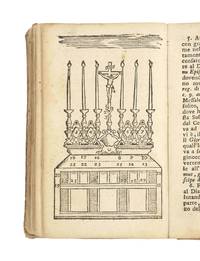
1739H546512mo pp. xii 240; with one full-page woodcut illustration included in pagination and woodcut initials; some spotting and browning in places ownership inscription dated 1775 on front free endpaper and title-page; in contemporary vellum dustsoiled and worn with some loss to spine. <br /><br /><p>As far as we are aware unrecorded edition of this uncommon treatise on the celebration of the mass and its associated rituals. Dealing both with private low masses and with solemn mass and solemn vespers the work explains the meaning and performance of the non-verbal aspects of the liturgy: genuflection the sign of the cross the communion of the faithful the movements of the celebrant's hands the role of acolytes and thurifers also during requiem masses the office of the subdeacon and deacon the use of incense and instructions for serving at the <i>missa private</i>. The woodcut on page 200 depicts the altar annotated with numbers referring to the relevant parts of the text.</p><p>The text itself appears first to have been published around the turn of the century; the earliest issue in SBN is a Naples printing of 1701 but that claims to be 'novamente riviste ed accresciute' and is only of 134 pages in 12s. Other editions appeared in Pavia Turin and Modena while Venetian printings were issued in 1739 and 1750. All seem very scarce.</p><p>Not in OCLC which records only a Venice printing of the same year in the Polish Union Catalogue; SBN does not record this edition.</p> Gianfranco Mairesse hardcover
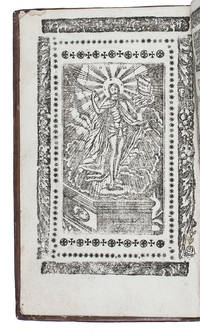
1801EBLBODAMZ2KRKiev 1801. 8vo in 4s 18.5 x 11.5 cm. Pechersk Lavra Monastery of the Caves Contemporary gold-panel-stamped and gold-tooled calf by the Kiev Monastery of the Caves sewn on 4 cords with a panel stamp of Jesus on the front board 9.7 x 4.5 cm perhaps with a name in the left half of the lower border and a panel stamp of Maria with the serpent holding an apple under her feet 9.5 x 4.3 cm each in a gold-tooled border and with another gold-tooled border around the whole board gold-tooled spine with "Kanonu Paskhi" Easter Canon in Old Slavonic capitals in the second of five compartments gilt edges. The endpapers like the paper of the book itself are laid and have a blue-green cast. Easter liturgy in Old Church Slavonic with title-page and about 20 other pages printed in red and black the title in a woodcut border and with a woodcut Paschal lamb a full-page engraving of Jesus's Resurrection 10 x 6 cm on the back of the title-page all pages after the title-page with borders made up of 4 woodcut strips woodcut head- and tailpieces and decorated initials a 17 mm and a 9 mm series and decorations built up from cast fleurons. Set in 3 sizes of Old Slavonic poluustav cyrillic type. Printed on laid paper with a blue-green cast. A Russian Orthodox service book for Easter and the week following it in the Old Church Slavonic language printed published and bound at the Pechersk Lavra Monastery of the Caves in Kiev. The monastery was established in the 11th century. After the fall of Constantinople in 1453 the Orthodox Churches in Russia and Ukraine developed independently. The power of the Czars allowed the Russian Orthodox Church to dominate so that the Ukrainian Church came under the Moscow Patriarchate in 1686. The Monastery of the Caves is therefore now Ukrainian Orthodox but fell under the authority of the Russian Orthodox Church when the present service book was published. It nevertheless had its own traditions and rites so that the present book should be regarded as part of the Ukrainian heritage.The only other copy we have located is at Amsterdam University Library one of three Easter service books by the Kiev Pechersk Lavra recorded on WorldCat all octavos. With a lengthy cyrillic inscription on an endleaf. The sewing is somewhat loose and as a result a few leaves are tattered at the edges. There are occasional minor smudges and drops of candle wax. Much of the gold-tooling has rubbed off the binding and the spine is slightly damaged. In spite of these minor defects the book is in good condition especially for a book of this nature.l For the Kiev bindery: S. A. Klepikov "Historical notes on Ukrainian bookbinding" in: The book collector 15 1966 pp. 135-142. unknown
1896AQ28784Mechliniae i.s. Mechelen: H. Dessain 1896. xli 502 60 24pp 2. With a half tile. Printed in red and black. Elaborately bound in contemporary richly gilt-tooled red morocco device of seated christ proffering book with Greek letters alpha and omega within ornate border to both boards A.E.G. with eight divisional red moire cloth tabs one partially perished gilt dentelles decorated endpapers. Slightest of rubbing to extremities. Internally immaculate. An exquisitely bound late nineteenth-century Continental edition of the Roman Missal. The Roman Missal with origins in the high middle ages is the liturgical book from which the text and rubrics for the celebration of Catholic Mass with both prayers and music. One of the major advances of the Council of Trent the Catholic counter to the Protestant Reformation was to standardise the Missal. Pope Pius V acting on the concilliar deciion formalised this in his Quo Primum on 14 July 1570 - insisting that the standard form of the Missal was used throughout the Church except where a local missal could be proved to be of two centuries antiquity. Perhaps one of the most controversial Counter-Reformation decisions made at Trent the use of a standard Missal prevented the celebration of the Mass in vernacular languages and signified a further strengthening of Papal authority: particularly as all printed editions were prefaced by the Pope's order of standardisation. The Missal of Pius V was further edited by Clement VIII in 1604 and later by Urban VIII in 1634. . Large 8vo. H. Dessain hardcover
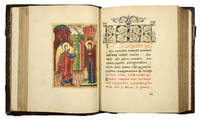
94903Russia 1866. . 4to 23 x 185 cm. Illuminated manuscript on paper ff. 4 index 4 blank 344 17 lines per page alphabetic signatures and pagination of Cyrillic alphabetic numerals 35 full-page illuminations in watercolour 36 headpieces in black and gold with first lines in gilt; occasional light spotting and soiling mostly marginal. Contemporary gilt-stamped red morocco gilt spine with raised bands edges gilt and gauffered gilt endpapers; slightly rubbed lacking both clasps.<br /> An exceptionally fine example of an Old Believer liturgical book beautifully illustrated with 35 full-page illuminations.<br /><br />Created by a skilful master they depict in great detail the most significant events of the New Testament including the Annunciation the Nativity the Baptism of Christ the Ascension the Twelve Apostles and more.<br /><br />This volume was made for and used by Old Believers who separated from the official Russian Orthodox Church as a protest against church reforms introduced by Patriarch Nikon of Moscow between 1652 and 1666. These Old Believers refused to accept alterations and amendments to the Holy texts aimed at bringing their religious practice closer to the 'original' Greek Orthodoxy. They refused to allow sacred texts to be printed instead reproducing them as manuscripts. <br /><br />The large size of this book its high-quality paper neat script very detailed illuminations and attractive gilt binding prove beyond doubt that no expense was spared on its production. As the colophon indicates it was made for Evdokiia Ivanovna Babaeva the wife of a merchant in Kolomna which was then an important trade point near Moscow. There are records of several men with this surname in Kolomna during the mid-XIX century all of them owners of factories in the city and probably members of the same wealthy merchant family. Kolomna was also important as a centre of the Old Believer community. The city's Bishop Paul fiercely opposed Patriarch Nikon's reforms and was consequently stripped of the rank of Bishop exiled and eventually killed in 1656 rendering him a martyr in the view of many Old Believers.A century later 156 Old Believers were officially registered in Kolomna then a city of 5400 inhabitants. Many more practised their beliefs in secret to avoid persecution.<br /><br />This volume later belonged to Cornelius J. Hauck 1893-1967 whose outstanding and somewhat eclectic collection was formed with the help of the well-respected antiquarian bookseller Emil Offenbacher between 1945 and 1965. The collection was given to the Cincinnati Historical Society Library in 1966 where it remained largely unknown to the world until part of it was auctioned by Christie's in New York in 2006.<br /><br />Russian manuscripts of this quality and preserved in such pristine condition are extremely rare.<br /> S.S. Mikhailov Istoriya staroobriadchestva g. Kolomna i ego okrestnostey Kolomna Staroobriadcheskaya obshchina khrama Nikoly na Posade v g. Kolomna 2013. Russia, [1866]. hardcover
0332445585.Gpaperback. Good. Access codes and supplements are not guaranteed with used items. May be an ex-library book. paperback