[RUSSIA]. [SLAVONIC LITURGY].Biblio.com
5 290 résultats
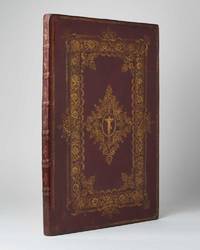
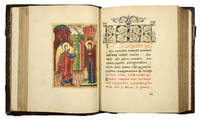
94903Russia 1866. . 4to 23 x 185 cm. Illuminated manuscript on paper ff. 4 index 4 blank 344 17 lines per page alphabetic signatures and pagination of Cyrillic alphabetic numerals 35 full-page illuminations in watercolour 36 headpieces in black and gold with first lines in gilt; occasional light spotting and soiling mostly marginal. Contemporary gilt-stamped red morocco gilt spine with raised bands edges gilt and gauffered gilt endpapers; slightly rubbed lacking both clasps.<br /> An exceptionally fine example of an Old Believer liturgical book beautifully illustrated with 35 full-page illuminations.<br /><br />Created by a skilful master they depict in great detail the most significant events of the New Testament including the Annunciation the Nativity the Baptism of Christ the Ascension the Twelve Apostles and more.<br /><br />This volume was made for and used by Old Believers who separated from the official Russian Orthodox Church as a protest against church reforms introduced by Patriarch Nikon of Moscow between 1652 and 1666. These Old Believers refused to accept alterations and amendments to the Holy texts aimed at bringing their religious practice closer to the 'original' Greek Orthodoxy. They refused to allow sacred texts to be printed instead reproducing them as manuscripts. <br /><br />The large size of this book its high-quality paper neat script very detailed illuminations and attractive gilt binding prove beyond doubt that no expense was spared on its production. As the colophon indicates it was made for Evdokiia Ivanovna Babaeva the wife of a merchant in Kolomna which was then an important trade point near Moscow. There are records of several men with this surname in Kolomna during the mid-XIX century all of them owners of factories in the city and probably members of the same wealthy merchant family. Kolomna was also important as a centre of the Old Believer community. The city's Bishop Paul fiercely opposed Patriarch Nikon's reforms and was consequently stripped of the rank of Bishop exiled and eventually killed in 1656 rendering him a martyr in the view of many Old Believers.A century later 156 Old Believers were officially registered in Kolomna then a city of 5400 inhabitants. Many more practised their beliefs in secret to avoid persecution.<br /><br />This volume later belonged to Cornelius J. Hauck 1893-1967 whose outstanding and somewhat eclectic collection was formed with the help of the well-respected antiquarian bookseller Emil Offenbacher between 1945 and 1965. The collection was given to the Cincinnati Historical Society Library in 1966 where it remained largely unknown to the world until part of it was auctioned by Christie's in New York in 2006.<br /><br />Russian manuscripts of this quality and preserved in such pristine condition are extremely rare.<br /> S.S. Mikhailov Istoriya staroobriadchestva g. Kolomna i ego okrestnostey Kolomna Staroobriadcheskaya obshchina khrama Nikoly na Posade v g. Kolomna 2013. Russia, [1866]. hardcover
1st edition. Period-style gilt tooled Morocco leather. 12mo, various pagination (aprox 475 pages total) . Singerman 1285, Goldman 40. The first Ashkenazi machzor printed in America. Based upon the celebrated Wolf Heidenheim edition, Henry (Chaim) Frank of New York published in 1854 2 prayer-books for the Days of Awe: This volume for the New Year, as well as a volume for Yom Kipur. He issued this set following the Polish tradition and, simultaneously, a set following the German tradition. This enabled the newly rising community of Central European Jews to conduct services according to their own custom, as opposed to that of the Sephardic rite. Frank went on in later years to issue other volumes for other Holidays. A set (New Year and Yom Kipur) of the German tradition set with repairs sold at auction for over $17,000 with commissions in 2012. No copies from the Polish set have ever appeared at major Auction. New Year's Volume has Hebrew title page 1/7 in original in 6/7 in professional facsimile (English title page and all text pages original) in spine professionally repaired with original backstrip attractively laid down; Atonement volume in all original binding with wear, especially at foot of spine. Some foxing as expected. Together a very attractive, very good condition set of this exceedingly rare and important high point in American Jewish liturgical history. (AMR-69-13)
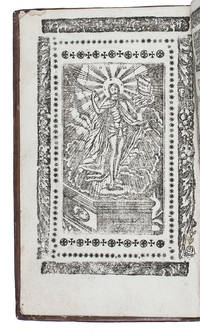
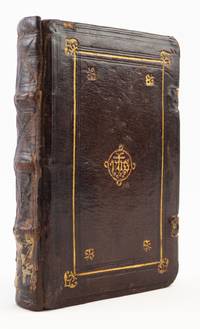
1801EBLBODAMZ2KRKiev 1801. 8vo in 4s 18.5 x 11.5 cm. Pechersk Lavra Monastery of the Caves Contemporary gold-panel-stamped and gold-tooled calf by the Kiev Monastery of the Caves sewn on 4 cords with a panel stamp of Jesus on the front board 9.7 x 4.5 cm perhaps with a name in the left half of the lower border and a panel stamp of Maria with the serpent holding an apple under her feet 9.5 x 4.3 cm each in a gold-tooled border and with another gold-tooled border around the whole board gold-tooled spine with "Kanonu Paskhi" Easter Canon in Old Slavonic capitals in the second of five compartments gilt edges. The endpapers like the paper of the book itself are laid and have a blue-green cast. Easter liturgy in Old Church Slavonic with title-page and about 20 other pages printed in red and black the title in a woodcut border and with a woodcut Paschal lamb a full-page engraving of Jesus's Resurrection 10 x 6 cm on the back of the title-page all pages after the title-page with borders made up of 4 woodcut strips woodcut head- and tailpieces and decorated initials a 17 mm and a 9 mm series and decorations built up from cast fleurons. Set in 3 sizes of Old Slavonic poluustav cyrillic type. Printed on laid paper with a blue-green cast. A Russian Orthodox service book for Easter and the week following it in the Old Church Slavonic language printed published and bound at the Pechersk Lavra Monastery of the Caves in Kiev. The monastery was established in the 11th century. After the fall of Constantinople in 1453 the Orthodox Churches in Russia and Ukraine developed independently. The power of the Czars allowed the Russian Orthodox Church to dominate so that the Ukrainian Church came under the Moscow Patriarchate in 1686. The Monastery of the Caves is therefore now Ukrainian Orthodox but fell under the authority of the Russian Orthodox Church when the present service book was published. It nevertheless had its own traditions and rites so that the present book should be regarded as part of the Ukrainian heritage.The only other copy we have located is at Amsterdam University Library one of three Easter service books by the Kiev Pechersk Lavra recorded on WorldCat all octavos. With a lengthy cyrillic inscription on an endleaf. The sewing is somewhat loose and as a result a few leaves are tattered at the edges. There are occasional minor smudges and drops of candle wax. Much of the gold-tooling has rubbed off the binding and the spine is slightly damaged. In spite of these minor defects the book is in good condition especially for a book of this nature.l For the Kiev bindery: S. A. Klepikov "Historical notes on Ukrainian bookbinding" in: The book collector 15 1966 pp. 135-142. unknown
149033296Northern Italy ca. 1490. Folio. 1 f. 56 x 42 cm; 22" x 16". <br><br>From a large magnificent Benedictine Psalter this is the start of Psalm 1 "Beatus vir . . ." "Blessed is the man who hath not walked in the counsel of the ungodly nor stood in the way of sinners nor sat in the chair of pestilence But his will is in the law of the Lord and on his law he shall meditate day and night. And he shall be like a tree which is planted near the running waters which shall bring forth its fruit in due season. And his leaf shall not fall off: and all whatsoever he shall do shall prosper. . . . ".<br>Â Â Â Â The text appears here in sepia ink in a large Renaissance rotunda hand set forth to the point of our bracket above illuminated and featuring a large miniature of King David filling the center of a large initial B. Along the bottom margin in three medallions are Saints Mark Benedict center bottom and Laurence; the right margin has two additional medallion portraits of unidentified female figures. The margins are garnished with gilt and bright-colored flowers among which hides the small image of a deer; "As a deer pants for flowing streams so pants my soul for you O God" Matted and under glass in an elegant 20th-century gilt frame ready for hanging. We have not opened this to discover whether Psalm 1 continues or Job concludes on the other side of the leaf but the suspicion must be given the beauty and quality of the side showing that this is a leaf that would benefit from double-glazing showcasing both sides. unknown books
71823aafParis, Léon Curmer, 1864, in-4to. Première partie: 6 p. + 171 planches chromolithographiques d’après les enluminures du Moyen-Age / Deuxième partie: 6 p. + 200 planches d’après les enluminures du M-A. / le 3ème volume: Appendice: XXXI + 172 p. + 154 p. + 258 p. richement ill. avec 80 photographies originales contrecollées au milieu des bordures typographiques, reproduisant les peintures. Quelques piqûres et rousseurs, une vignette gravée est appliquée à la page de titre du 3è volume, gravée par Ch. Colin sculp. d’après A. D. Aligny del. avec devise ‘l’or rien ne me cure’. Cette gravure semble être insérée dans tous les livres hors commerce de Curmer. Somptueuses reliures en plein maroquin rouge avec riche décoration en or sur le dos ainsi que sur les plats, dos à 5 nerfs, décoration florale sur fond noir sur les plats, nombreux filets et encadrements, gardes richement ornées en or, tranches dorées, emboîtages quelque peu abîmés.
174121236291741. Venice: Antonio Bortoli. 15 September 1741. Folio. Contemporary red morocco over wooden boards elaborately tooled in gilt with floral borders and central lozenge around image of Crucifixion on upper board and the Virgin and Child on lower board; floral corner-pieces spine gilt-tooled in compartments with floral tools block-printed decorated pastedowns over marbled pastedowns 6 purple silk fore-edge tabs 2 detached purple silk page-marker; pp. 28 text in Armenian printed throughout in red and black with instructions for the deacon and celebrating clergy in red main text in double columns title page printed within engraved architectural border enclosed within larger border of the figures of the Evangelists the Apostles and the 24 Prophets with their names in Armenian two engraved full-page illustrations in pagination one signed ""Zucchi"" after Peter Paul Rubens the other after Maarten de Vos woodcut initials head- and tailpieces; a few minor scuffs to boards one tiny wormhole to upper board and two to lower extremities and spine lightly rubbed; pin worm-holes to gutter two tiny holes to outer margin of C4-ad finem all far from printed surface light dust-soiling and marginal dampstaining first quire coming loose a few small wax drops but overall a very good fresh copy.Extremely rare Armenian missal according to the rite of the Armenian Catholic Church published in Venice.The long tradition of Armenian printing in Venice dates back to 1512 when the first book ever printed in the Armenian language Urbatagirk ""Friday Book"" was published by the Venice-based Armenian printer Hakob Meghapart. In 1695 Antonio Bortoli obtained from the Venetian authorities an exclusive privilege for all Armenian printing. He retained it until the arrival in Venice of Father Mekhitar of Sebaste 1676-1749 an Armenian scholar and theologian who in 1701 founded the Mekhitarist Order. The Mekhitarists an Armenian Catholic monastic congregation devoted to the revival of Armenian culture and learning have since 1717 been based on the island of San Lazzaro near Venice. One of the great centres of Armenian scholarship and printing in Europe the island soon became home to a flourishing Mekhitarist press. ""In 1788 an agreement between the Mekhitarist fathers and Bortoli's successor Francesco Bortoli reduced the latter to little more than a figurehead"" Zorzi trans.The same engraved title page was used by Bortoli for his 1733 edition of the Bible in Classical Armenian a revised edition of the 1666 Bible published by Oskan Erewants'i. The binding of our copy of the missal matches the one held at Eton College Library.We have not been able to locate any copies in the US. Library Hub records only one copy at Eton College Parikian Collection of early Armenian printing. We can add a copy in Italy Venice San Lazzaro.Voskanyan 465. See Marino Zorzi ""La produzione e la circolazione del libro"" in Storia di Venezia 1997. hardcover
In-4°, 4 voll. (XVI, pp. 585, (1); pp.526, (1); pp.492,(1); pp.544 (1)), legatura in mezza pelle, con nervi e titolo al dorso. Langlois, orientalista e traduttore francese venne conosciuto per le sue traduzioni dal sanscrito, particolarmente per la traduzione in francese del Rig-Veda. Le sue traduzioni furono apprezzate più per la loro qualità letteraria che per il rigore scientifico. In-4°, 4 voll. (XVI, pp. 585, (1); pp.526, (1); pp.492,(1); pp.544 (1)), half calf binding, bands and title at the spine. Langlois, a French orientalist and translator, was known for his translations from Sanskrit, particularly for the French translation of the Rig-Veda. His translations were appreciated more for their literary quality than for scientific accuracy.
157866482(Nürnberg, Gedruckt durch Nicolaum Knorrn [Nikolaus Knorr]), 1578. 8° (10,3 x 8 cm). Titel in Rot u. Schwarz m. Holzschn.-Bordüre. Mit 83 etwa halbseitigen Textholzschnitten. 144 nn. Bll. (A-S8), Ldr. m. Bindebändern.
[500 Fig. Religione- Musica - Legatura] (cm. 35 x 24.5) Bella legatura originale (dorso e angoli ben restaurati sec XIX) in pieno vitello marrone, piatti con filetti a secco e in oro, fregi angolari, stemma ecclesiastico (sbiadito) con barra trasversale in oro e sotto, tre losanghe rosse in diagonale entro cartiglio con cappello cardinalizio e nappe. Spellature e lievi difetti. -cc.4 nn., cc.243 (più una ultima bianca che manca). caratteri gotici, doppia colonna, mirabilmente stampato in rosso e nero. Marca dello stampatore all'inizio e in fine. Grande xilografia con la crocifissione all'inizio, altre nel testo e 162 xilografie di (cm. 8x6) circa. Molte pagine con annotazioni musicali. La crocifissione è da un messale dei Giunti del 1562. Le illustrazioni rappresentano Vescovi, cerimonie varie, consacrazioni della chiesa, riti, costumi ecc... L'opera, stampata in due colori, è di una bellezza abbagliante e rappresenta uno dei livelli più alti raggiunti nella decorazione tipografica più lussuosa del 500 italiano. Vedi le note in Mortimer 383 dove si cita la nostra edizione del 1572 con legatura alle armi del cardinal Ugo Buoncompagni (poi Papa Gregorio XIII) fatto papa in questo stesso anno, un pò sbiadite ma sarebbero da confrontare con lo stemma del nostro. Lievi ombreggiature a poche carte all'inizio e minimi segni d'uso, insignificante alone marginale a qualche carta interna, peraltro esemplare bellissimo in carta nitida e croccante e con buoni margini. I tagli conservavano ancora la doratura originale. Provenienza: Asta Sotheby's Milano 1992. * Camerini 755; *Sander 5839 in nota; * Mortimer II 383 in nota ; * Bohatta II 370; *Olschki Cat. 157 "Theology" n°859; *BM.stc. 383. Rarissimo manca a Brunet, Essling, Adams, e a molta bibliografia consultata. [f83] Libro
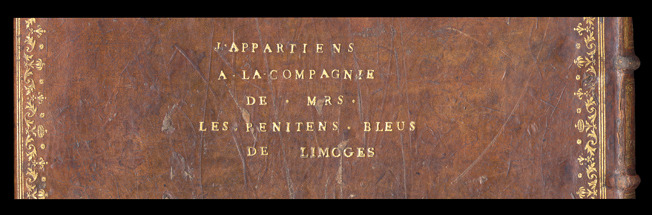
16236Reliés en un volume grand in-folio ; veau fauve marbré, dos à nerfs, caissons décorés et ornés d’une grande fleur de lys, sans titre, trois fleurs de lys (deux et une) au centre du premier plat, dans un demi cercle de guirlande, dentelle d’encadrement des plats et grande fleur de lys aux angles, décor entièrement doré, super-libris au second plat "J’appartiens a . la . compagnie de . Mrs . les . Penitens . Bleus de Limoges", dentelle intérieure (reliure de l’époque) ; (4) et 233, (3) pp., numérotation continue manuscrite ; le premier ouvrage semble avoir été confectionné avec un mélange de caractères au pochoir et manuscrits et donc unique ; les deux autres sont imprimés ; présence de signets de soie verte reliés en tête à une sorte de coussin.
1907R104441Paris, Letouzey et Ané 1907-1953 15 tomes en 30 volumes (ouvrage complet), Edition originale de 1907-1953, ensemble +/- 24000 pages avec 11295 illustrations dans le texte et planches hors texte dont quelques-unes en couleurs, texte imprimé en deux colonnes, reliures cart. uniformes en bon état, dos en cuir noir à 4 nerfs avec titre doré (et argenté pour les trois derniers volumes), brochures originales conservées et reliées, 28cm., texte frais, exemplaire de la collection du prof. et byzantiniste belge Justin Mossay (avec cachet et ex-libris), quelques soulignements en crayon (facilement à éraser), bon ensemble, poids total ca. 68kg., R104441
15 tomes en 30 volumes (ouvrage complet), Edition originale de 1907-1953, ensemble +/- 24000 pages avec 11295 illustrations dans le texte et planches hors texte dont quelques-unes en couleurs, texte imprimé en deux colonnes, reliures cart. uniformes en bon état, dos en cuir noir à 4 nerfs avec titre doré (et argenté pour les trois derniers volumes), brochures originales conservées et reliées, 28cm., texte frais, exemplaire de la collection du prof. et byzantiniste belge Justin Mossay (avec cachet et ex-libris), quelques soulignements en crayon (facilement à éraser), bon ensemble, poids total ca. 68kg., R104441
In-folio, (25cc), 2-1155 col, (80cc); legatura in piena pergamena coeva con nervi e titolo al dorso. Sui piatti anteriore e posteriore sigillo di Minerva Dordracena. Seconda edizione 1. Dedicato a Urbano VIII Barberini, con occhiello, antiporta frontespizio , stampato in rosso e nero. Nel testo numerose incisioni su rame raffiguranti svariate tipologie di lumi e lucerne ad olio di varie epoche, oltre a strumenti tipo piccoli imbuti per il riempimento di questi, a candelabri ebraici e a monete. 2. Dedicato al Cardinale Francesco Barberini, numerose illustrazioni su legno nel testo che rappresentano oggetti cultuali ebraici, cristiani e pagani. 3. Dedicato al Cardinale Antonio Barberini, in cui si tratta diffusamente delle cerimonie pubbliche israelitiche, le adorazioni e le acclamazioni. Fortunato Scacchi, dotto filologo e antiquario, nacque intorno al 1573 a Fano, dove morì nel 1643. La sua opera più importante è proprio la presente, un trattato di profonda erudizione, in cui l’autore raccoglie le notizie e i dati storici sugli aromi impiegati dagli ebrei antichi negli unguenti e nei profumi e sulla loro composizione e utilizzo nelle cerimonie sacre. Il testo è ricco di riferimenti ai libri dell’Antico Testamento e a quelli degli autori del mondo greco e romano antico, ma anche all’Arca Santa e alla ‘menorah’ e alle suppellettili per il culto divino. Scacchi parla di ogni sorta di unzione menzionata nelle Sacre Scritture, dalle lampade degli antichi, all’imbalsamazione, ai bagni. Dal cap. XXX al XXXIV del libro I si tratta diffusamente dei Balnea, delle tipologie degli edifici, distinti tra quelli pubblici e quelli privati, degli effetti benefici sul corpo, dei tipi di acque consigliate per i diversi scopi; il bagno preludeva in particolare, per gli atleti, al rituale dell’unzione del corpo, prima della lotta nella sabbia delle arene, ma in genere era anche praticato dopo ogni tipo di attività fisica, sia il gioco della palla che la corsa, per defatigare il corpo ed eliminare il sudore. Nel libro si trova anche ampio spazio dato ai tipi di essenze e alle fasi della composizione vera e propria di questi olii ed unguenti utilizzati dagli atleti. L’autore riporta a proposito l’abitudine di uomini e giovani di stare nudi nelle palestre e nei ginnasi, alcuni passi in cui si sosteneva che questo fosse un incitamento all’amore omosessuale e un preludio al lupanare. Brunet 662 In-folio, (25cc), 2-1155 col, (80cc); coeval full vellum binding with bands and title on the spine. On the upper and back covers seal of Minerva Dordracena. Second edition. 1. Dedicated to Urban VIII Barberini, with half-title, title page with elegant allegorical border engraved in copper, printed in red and black. In the text, numerous copper engravings depicting various types of lamps and oil lamps of various eras, as well as instruments such as small funnels for filling these, with Jewish candlesticks and coins. 2. Dedicated to Cardinal Francesco Barberini, numerous illustrations on wood in the text representing Jewish, Christian and pagan cult objects. 3. Dedicated to Cardinal Antonio Barberini, in which it deals widely with Jewish public ceremonies, adorations and cheers. Fortunato Scacchi, a expert philologist and antiquarian, was born around 1573 in Fano, where he died in 1643. His most important work is the present one, a treatise of profound erudition, in which the author collects news and historical data on the aromas used by ancient Jews in ointments and perfumes and on their composition and use in sacred ceremonies. The text is full of references to the books of the Old Testament and to those of the authors of the ancient Greek and Roman world, but also to the Holy Ark and the 'menorah' and furnishings for divine worship. Scacchi speaks of all sorts of anointments mentioned in the Holy Scriptures, from the lamps of the ancients, to embalming, to the baths. From chap. XXX to XXXIV of book I, the author deals widely with the Balneas, the types of buildings, distinguished between public and private ones, the beneficial effects on the body, the types of water recommended for the various purposes; the bath preluded in particular, for the athletes, to the body anointing ritual, before the fight in the sand of the arenas, but in general it was also practiced after any type of physical activity, both the game of the ball and the races, to defatigate the body and eliminate the sweat. In the book there is also ample space given to the types of essences and the phases of the actual composition of these oils and ointments used by athletes. By the way, the author reports the habit of men and young people to be naked in gyms and gymnasiums, which was claimed as an incitement to homosexual relations and a prelude to brothels. Brunet 662
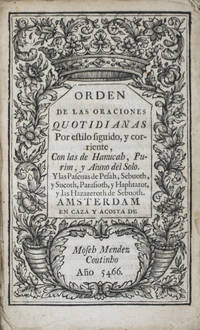
170643961Amsterdam: Moseh Mendez Coutinho 1706. Hardcover. poor to g. Duodecimo. 6.5x4.5". 8 347pp. 1 401-611pp. 8. Jewish year = 5466. Original dark brown pebbled leather boards. Gauffered and gilt edges. Title page illustrated with decorative woodblock floral motifs bordering the text. The publication is an early Spanish-language Jewish daily prayer book siddur which also includes prayers for various Jewish Holidays including the Sabbath Hannukah Purim and the Shalosh Regalim Three Pilgrimage Festivals: Passover Sukkot and Shavuot. Also included are the Torah portions Parshiot and Haftorot to be read on those occasions.<br /> <br /> This prayer book was published by Moseh Mendez Coutinho following a similar title and formatting to a number of other earlier editions dating back to the 1681 publication by David Tartas. Starting with Tartas' subsequent edition from 1690 these book also included the torah portions and haftorot. This and other publications of Jewish liturgy served members of the then sizable Sephardic Jewish community in Amsterdam. A significant portion of the community would have been ex-Marranos Jews who had outwardly converted to Catholicism during the inquisition in Spain who then immigrated and were able to reestablished their Jewish identity and thus were unable to read Hebrew hence the text's publication in Spanish. <br /> <br /> The first section contains a few prayers transliterated into Spanish from the Hebrew followed by daily prayers p.9-134 Sabbath prayers p.134-262 prayers for Rosh-Hodesh Celebration of the new month p.262-309 and Hanukkah Purim and others 309-347. Following an additional title page with decorative woodblock borders is a section containing prayers related to the three festivals Passover Shavuot and Sukkot respectively p.401-611. All text in Spanish. <br /> <br /> BOUND WITH<br /> The final unpaginated eight pages included a table of contents for the various prayers and a six-page Hebrew-Gregorian calendar with tables for tracking the new months festivals and fast days covering the years 1705-1716 including a title page decorated with a woodblock border. Some sections throughout the text with decorative initials. <br /> <br /> Binding with spine and some pieces of the leather on the covers missing. Rubbing scratches and chipping to extremities. Binding loose with starting at endpapers title page and a number of other pages throughout the text. Light sporadic water stains and foxing to some pages throughout. A few small holes on a few pages with minimal loss of text. Binding in poor interior in good condition overall. References: KAYSERLING 1890 p. 60gives 12° PALAU 1923 202353gives 16° SILVARO- SA 1933 48 corrects Kayserling PEETERS 1933 1028. Moseh Mendez Coutinho hardcover
1759108420Venice: for Giambattista Albrizzi 1759. Prettily bound liturgical devotion A very attractive Venetian printing of the Little Office of Our Lady in the reformed Breviary of Pius V the text in French and Latin prettily bound. This edition is rare no copy being located in institutional holdings worldwide. Giambattista Albrizzi is best known as the printer of a monumental edition of Gerusalemme liberata 1745. Octavo 205 x 134 mm. Engraved title vignette and 3 full-page engravings all with contemporary hand-colouring. Contemporary calf sides with wide decorative borders in gilt with central circular black morocco onlays decorated in gilt marbled endpapers gilt edges. Housed in a contemporary mottled calf pull-off slipcase lined with decorative paper gilt rules. A little rubbed but a very handsome copy of this illustrated prayer book. unknown
1907R95473Paris, Letouzey et Ané 1907-1953 15 tomes en 30 volumes (ouvrage complet), édition originale de 1907-1953, ensemble +/- 24000 pages avec 11295 illustrations dans le texte et planches hors texte dont quelques-unes en couleurs, texte imprimé en deux colonnes, reliures cart. uniformes (plats marbrés, dos en toile bleue), 28cm., exemplaire de bibl. (quelques cachets sur les premières pages de garde et un sur les pages de titre, étiquette plastifiée en bas des dos), p.d.t. de tome V-1 manque, texte et pages sont très frais et en bon état, poids total: ca. 70kg., R95473
15 tomes en 30 volumes (ouvrage complet), édition originale de 1907-1953, ensemble +/- 24000 pages avec 11295 illustrations dans le texte et planches hors texte dont quelques-unes en couleurs, texte imprimé en deux colonnes, reliures cart. uniformes (plats marbrés, dos en toile bleue), 28cm., exemplaire de bibl. (quelques cachets sur les premières pages de garde et un sur les pages de titre, étiquette plastifiée en bas des dos), p.d.t. de tome V-1 manque, texte et pages sont très frais et en bon état, poids total: ca. 70kg., R95473
1986wx269Belser Verlag Relié 1986 In-folio (33,7 x 47,5 cm), reliure pleine peau, dos à nerfs, fermoirs en laiton, fers dorés et filets estampés à froid aux plats, exemplaire numéroté (ici le numéro 104), fac-similé du Missel de Noël d'Alexandre VI, Borg. lat. 425, l'un des plus importants manuscrits liturgiques réalisés au XVe siècle en l'honneur du pape Alexandre VI, reproduction rehaussées à l'or ; quelques incidents et frottements aux plats, bord supérieur du premier plat un peu décoloré suite à une mouillure, traces d'humidité sur les deux premiers feuillets, deux épidermures papier sur les deux derniers feuillets où les pages ont adhéré entre elles, par ailleurs bon état général. Livraison a domicile (La Poste) ou en Mondial Relay sur simple demande.
1538ST19567-018Venetiis Venice: in officina heredum Luceantonii Junte hiers of Lucantonio Giunta 1538. 149 x 104 mm. 5 7/8 x 4". 8 143 of 144 leaves lacking leaf p6. <br/> Contemporary Venetian morocco rebacked preserving original blind-ruled spine and corners rounded off and renewed covers each with blind-ruled borders and a gilt- and blind-ruled panel with gilt fleurons in each inner and outer corner central gilt IHS monogram raised bands brass clasps renewed all edges gilt and gauffered lacking final endleaf. Printer's device on title numerous historiated woodcut initials first page of text with woodcut border two full-page woodcut illustrations. Printed in red and black. Essling 181; Sander 5970 under "autres éditions"; EDIT 16 CNCE 11880. Original spine somewhat crackled bottom compartment with slight surface loss perhaps from removal of a label covers with several but insignificant small dings very minor dampstain at extreme top edge of a few leaves other trivial imperfections but a clean fresh and bright copy in an attractive early binding.<br/> <br/> Offered in what is probably its original binding this is a very rare edition of a Psalter done by one of the leading Venetian printing families of the 15th and 16th centuries. A major figure in the Italian book trade Lucantonio Giunta 1457-1538 began his career as a bookseller in Venice in 1477 and became a printer there in 1489. Together with family members and carefully arranged partnerships Giunta expanded his printing empire into numerous cities in Europe including Lyon Lisbon Antwerp Frankfurt and Salamanca. The present book was printed just after the death of Lucantonio whose heirs would continue to run the family business which grew prosperous in part because of its specialty in producing liturgical works such as this. The contents here are routine but the well-preserved decorative period binding makes the volume definitely worth having. in officina heredum Luceantonii Junte [hiers of Lucantonio Giunta] unknown
156658276Venedig, L. A. Giunta Erben, 1566. 8°. Titel m. Holzschn.-Druckermarke in Rot. Mit einem fast blattgr. Textholzschnitt u. 3 Holzschn.-Initialen. Text u. Noten durchg. in Rot u. Schwarz gedruckt. 8 nn., 104 num. Bll., Ldr. d. Zt. a. 4 Bünden m. reicher Deckel- u. Rückenvergoldung im Fanfare-Stil.
90828aafParis, Lesort, éditeurs relieurs, 15 mai 1881, pt. in-8vo, 76 ff., dont 5 vides et 71 écrites en français sur le recto. Textes richement ornés en couleurs et en or, suivant le style des livres d’heures du XVe / XVIe siècle, reliure en maroquin brun, avec une plaque armoriale métallique avec devise “Dieu aide!” sur le 1er plat, tranches dorées, fermoirs, dans un petit emboîtage en carton. Exemplaire en bel état.
178112406Romae: A. Galler 1781. 8vo 18 cm 7.1". 4 vols. I: 20 632 cclxxxviii 19 1 pp.; illus. II: 18 646 ccliv 21 1 pp.; 1 plt. III: 54 566 cclxxvi 26 pp.; 1 plt. IV: 20 608 cclxx 15 1 pp.; illus. <br><br>Beautifully printed and handsomely bound set of the Roman Breviary. The text is printed in double-column format in black and red with a vignette on each title-page and an engraving in each volume.<br>Â Â Â Â Binding: Contemporary's black goat sides with simple roll gilt border and gilt corner devices spines gilt extra. The top panel of each volume indicates contents with abbreviation: P. V. "Pars Vernalis" P. AE. "Pars Aestivalis" etc. Block-printed decorated endpapers; all edges gilt. Silk place markers. <br>Â Â Â Â <br>Â Â Â Â Not in Weale & Bohatta. Bindings as above edges and extremities rubbed spine leather with tiny cracks one spine head chipped one joint starting. Ex-library with bookplates rubber-stamp on lower edges of pages of the closed volumes. One volume with text block separating from spine and sewing loosening; this with the most leather rubbed away and the darkest instances of the usually-light waterstaining and spots of foxing seen occasionally throughout. Endpapers bear early inked ownership inscriptions and annotations. => An elegant quartet. A. Galler hardcover books
In-8°; cc.(8), pp. 81-244(1). Caratteri rossi e neri sul front. e nel testo, capilettera xilografati. Marca al front. e vignetta xilografata, rappresentante s. Benedetto, all’ottava carta. Estratto del Breviarium monasticum dello stesso anno con conforme numerazione delle carte. Legatura in cartonato. Presenti ancuni fori di tarli.
1725106854BBohne Ort und Jahr (Rastatt ?, um 1725). Imperial-Folio (44 x 30 cm.). [183] S., davon 58 Doppelseiten mit Quadratnoten beschrieben mit lateinischen Stimmen. Schweinslederband der Zeit über Holzdeckeln mit dekorativer Rollen-Kartusche. [10 Warenabbildungen]
Beautiful original tooled red publishers morocco leather, all edges gilt. 20 cm. Published just after the Civil War, a complete set. Dual Hebrew-English. SUBJECT (S) : Liturgy -- Texts. Mahzorim -- Judaism Liturgy. OCLC lists the volumes individually, with at most 5 sets listed. Some sunning to spines, some wear to crowns and feet of spines, but an attractive complete set in gorgeous original tooled leather bindings. Scarce, especially complete and in this condition (kh-9-11)