BOERO, GiuseppeMareMagnum

2 694 résultats
In-8°, 135 pp, antiporta calcografica illustrata da L. Banzo, ai piatti legatura in pelle alle armi di papa Pio IX con stemma centrale entro doppia cornice riccamente decorata, titolo in oro al dorso, tagli in oro. Buona copia. Prima edizione. La vita di questo avventuroso missionario portoghese (João de Brito) viene descritta da padre Boero, gesuita che dedicò molta parte della sua vita alla compilazione delle biografie di martiri missionari con uno stile che travalica definitivamente l’agiografia barocca e trionfalista. I suoi lavori sono importanti anche per la descrizione dei luoghi in cui si svolge l’operato del padre missionario. João de Brito svolse il suo ministero in India, nella provincia del Marava, dove ritornò dopo esserne stato cacciato. Venuto in insanabile contrasto con il principe locale, subì il martirio a Oriyur il 4 febbraio 1693. Fu beatificato da Pio IX nel 1859 e canonizzato da Pio XII nel 1947. In-8 °, 135 pp, chalcographic frontispiece engraved by L. Banzo, calf covers with the coat of arms of Pope Pius IX with central coat of arms within a richly decorated double frame, gilt title on the back, gilt edges. Good copy. First edition. The life of this adventurous Portuguese missionary (João de Brito) is described by Father Boero, a Jesuit who devoted much of his life to compiling the biographies of missionary martyrs with a style that definitively goes beyond Baroque and triumphalist hagiography. His works are also important for the description of the places where the missionary father's work takes place. João de Brito carried out his ministry in India, in the province of Marava, where he returned after being expelled. Coming into irremediable conflict with the local prince, he suffered martyrdom in Oriyur on February 4, 1693. He was beatified by Pius IX in 1859 and canonized by Pius XII in 1947.
1561372709Venice: apud Iuntas heirs of Luca Antonio Giunta 1561. Title page with small woodcut of pope and six bishops; Giunta printer's device in red on title and at end; one full-page woodcut of Crucifixion third-page woodcuts at head of each of three parts 162 woodcuts of liturgical scenes woodcut initials. Text printed in two columns in red and black throughout musical notation in black on staves of four red lines. 4 243 ff. 1 vols. Folio. Contemporary Italian orange morocco gilt boards ruled in gilt central panels in double gilt rule with floral corner tools upper board with cardinal's hat lower board with sunburst initials in central cartouches effaced a.e.g. Spine dark some soiling and rubbing light traces of worming at back. Title page with small woodcut of pope and six bishops; Giunta printer's device in red on title and at end; one full-page woodcut of Crucifixion third-page woodcuts at head of each of three parts 162 woodcuts of liturgical scenes woodcut initials. Text printed in two columns in red and black throughout musical notation in black on staves of four red lines. 4 243 ff. 1 vols. Folio. Liturgical work including the music of the chants and hymns to accompany the services. Adams L1241; EDIT16 CNCE 11860. Provenance: early ownership signature of Joanis Ant. S- on pastedown. General Theological Seminary bookplates and stamps apud Iuntas [heirs of Luca Antonio Giunta] unknown
In-4°, (2cc), 63cc, (1), rilegato con Declamationes Evangelicae Quadragesimales, authore Bobio, 10cc, legatura in pergamena, buono stato. L’Albani nacque il 3 gennaio 1509 a Bergamo Dopo gli studi di retorica e giurisprudenza scrisse il De donatione Constantini Magni del 1535, in cui difendeva l'autenticità della celebre donazione, cui seguì il De cardinalatu nel 1541; quindi il De potestate Papae et Concilii, pubblicato nel 1544. Quest'ultimo trattatello, che si riconnette alla lunga polemica del secolo precedente sulla preminenza del papa o del concilio nella Chiesa, vuole confutare esplicitamente le affermazioni di parte protestante e si preoccupa di dimostrare, con l'apporto di argomenti soprattutto giuridici, come possa salvarsi il primato del pontefice anche nei casi del papa supposto eretico o colpevole. Al colmo degli onori e della potenza, nel 1556 accolse il giovinetto Torquato Tasso - anche in seguito confortato e protetto dall'Albani, nelle dolorose vicende della sua vita - mandato a Bergamo presso i parenti dal padre Bernardo, che a Roma era caduto in sospetto di ribellione al governo napoletano. Nel 1559 uscivano ancora dell'Albani le Lucubrationes in Bartoli lecturas. Quando nel gennaio 1566 il cardinale Ghislieri fu eletto papa col nome di Pio V, volle chiamare presso di sé a Roma l'Albani, l'antico suo esperto consigliere e benefattore. Fattosi ecclesiastico con le dovute dispense, venne subito insignito della dignità di protonotario apostolico e di governatore della Marca di Ancona; e il 17 maggio 1570 fu creato cardinale del titolo di S. Giovanni a Porta Latina. Bibl.: G. M. Mazzuchelli, Gli Scrittori d'italia, I, 1,Brescia 1753, pp. 272-274; J. F. v. Schulte, Die Geschichte der Quellen und Literatur des canonischen Rechtes, III, Stuttgart p. 880, pp. 448 s.; A. Solerti, Vita di Torquato Tasso, I-Il, Torino-Roma 1895, passim (il II vol. di docc.); L.v. Pastor, Storia dei Papi, VI, Roma 1922, p. 232; VIII, ibid. 1924, p. 116; IX, ibid. 1925, pp. 13, 257, 875 s., 885; X, ibid. 1928, pp. 10, 14, 17, 58, 506, 508, 576, 594; B. Belotti, Storia di Bergamo e dei Bergamaschi, II, Milano 1940, pp. 190, 232, 299, 326; Dict. de Théol. Cath., I, coll. 659 s.; Dict. d'Hist. et de Géogr. Ecclés., I, col. 1372. Ludovico Bobbio fu uno scrittore romano del XVI secolo autore di “Exortatio ad Christianorum principes, de armis aduersus orthodoxae fidei hostes, arripiendis”del 1550. In-4°, (2cc), 63cc, (1), bound with con Declamationes Evangelicae Quadragesimales, authore Bobio, 10cc, vellum binding, good copy. Albani was born on 3 January 1509 in Bergamo. After studying rhetoric and jurisprudence he wrote the De donatione Constantini Magni of 1535, in which he defended the authenticity of the famous donation, which was followed by De cardinalatu in 1541; then the De potestate Papae et Concilii, published in 1544. This last treatise, which reconnects to the long polemic of the previous century on the pre-eminence of the pope or of the council in the Church, wants to explicitly refute the claims of the Protestant party and is concerned with demonstrating, with the contribution of mainly legal arguments, how it can be saved the primacy of the pontiff also in the cases of the pope supposedly heretical or guilty. At the height of honors and power, in 1556 he welcomed the young Torquato Tasso - also later comforted and protected by Albani, in the painful events of his life - sent to Bergamo with his relatives by his father Bernardo, who had fallen in suspicion in Rome of rebellion against the Neapolitan government. In 1559 the Lucubrationes in Bartoli lecturas still came out of Albani. When in January 1566 Cardinal Ghislieri was elected pope with the name of Pius V, he wanted to call Albani, his former expert adviser and benefactor, in Rome. Having become ecclesiastical with the necessary dispensations, he was immediately awarded the dignity of apostolic protonotary and governor of the Marca of Ancona; and on May 17, 1570 he was created cardinal of the church of S. Giovanni in Porta Latina. Bibl .: G. M. Mazzuchelli, The Writers of Italy, I, 1, Brescia 1753, pp. 272-274; J. F. v. Schulte, Die Geschichte der Quellen und Literatur des canonischen Rechtes, III, Stuttgart p. 880, pp. 448 s .; A. Solerti, Vita di Torquato Tasso, I-Il, Turin-Rome 1895, passim (2nd vol. Of doc.); I.V. Pastor, History of the Popes, VI, Rome 1922, p. 232; VIII, ibid. 1924, p. 116; IX, ibid. 1925, pp. 13, 257, 875 s., 885; X, ibid. 1928, pp. 10, 14, 17, 58, 506, 508, 576, 594; B. Belotti, History of Bergamo and the Bergamaschi, II, Milan 1940, pp. 190, 232, 299, 326; Dict. de Théol. Cath., I, coll. 659 s .; Dict. of Hist. et de Géogr. Ecclés., I, col. 1372. Ludovico Bobbio was a 16th-century Roman writer author of "Exortatio ad Christianorum principes, de armis aduersus orthodoxae fidei hostes, arripiendis" of 1550.
[20], 644 pages. Index. Twenty-six black and white photographic plates. Leather binding. "Comprising a history of Egypt, with a comprehensive and authentic account of the antiquity of masonry resulting from many years of personal investigation and exhaustive research in India, Persia, Syria and the Valley of the Nile." - title page. After first receiving the Light in India, the author was moved to "investigate, to the fullest extent, the meaning and purport of the numerous hieroglyphic inscriptions, symbols and characters found upon the ancient tombs and temples, so that the Masonic Fraternity might understand, appreciate and apply the teachings of the hierophants and sages of bygone days." - Preface. Chapters: Alexandria - the Antiquity of Masonry; Ruined Temples - Masonry and Masonic Symbols; Ancient Cities - Soirian Myth - Karma; the Nile - Origin of the Name Free Mason - Scottish Rite Philosophy; Ancient Mysteries - Scottish Rite philosophy; Suez Canal - The Druses, Their Manners and Customs; Agriculture - Irrigation - Lotus - Papyrus; The Supreme Architect of the Universe; Mosques - Tombs - Massacre of Mamelukes - Heliopolis; Esoteric Teaching of the Scottish Rite - Brain and Thought; Pyramids - Sphinx - Tombs; Solomon - Death of Hiram - Cross - Swastica; Mummification - Transmigration - Re-incarnation; Sixteen Saviours - Lost Knowledge; The Golden Fleece - Roman Eagle - Masonic Apron - What it Teaches; Pyramids of Sakkarah - Lisht - Medum - The Fayum - Labyrinth; Sun Worship - Zodiac - Masonic Allegories; A Voyage up the Nile - Description of Tombs and Temples - Pro Doric Columns; Ineffable degrees - Thoughts on Ecclesiastes - I.N.R.I. - Voyaging up the Nile - examining Tombs and Temples - Paintings - Sculptures; Masonic teachings - Hindu beggar - Roman Catholicism; Thebes - Colossi - Der-El-Bahari - Luxor - Karnak; Ceremonies - Initiation - Blue Lodge - Transmigration - Mystery Language; The Gawazee - exploring Temples and tombs - Philae and its ruins - Nubia; Jewish Traditions and customs - Cable tow - Ceremonies of ancient Initiation - book of the Law; Circumsision - upon what the Ancient Craftsmen were obligated - the lost word. All edges gilt. Protected frontis portrait of author. Ornately embossed boards. Raised bands to spine. Partially rubbed gilt lettering and decoration upon back strip. Marbled endpapers. Hinges intact internally, open or opening externally. Front board partially detached. Somewhat above-average wear to boards. Unmarked. A worthy original copy of this monumental work. 12" x 9.5" x 2.5". 11 pounds. Book
In-4°, (12cc), 512pp, 48cc., buone condizioni restauri al frontespizio, numerosissime note manoscritte, legatura in pergamena coeva. Personalità di spicco della scolastica spagnola del Cinquecento, Luis de Molina fu anche uno dei più controversi pensatori della storia del cattolicesimo. Sulla base di precise tesi teologiche e filosofiche, elaborò una sua propria dottrina che puntava alla conciliazione del libero arbitrio con la prescienza divina e la predestinazione. Oltre al lavoro in campo teologico, dedicò molto tempo anche a temi politici e morali, interrogandosi in particolare sulla legittimazione del potere e dell’autorità politica, sulla schiavitù e su questioni economiche. Nel 1584 si ritirò definitivamente dall’insegnamento e si trasferì a Lisbona, per occuparsi della composizione delle sue opere: in questo periodo, scrisse la notissima Concordia, titolo con cui solitamente si indica lo scritto Liberi arbitrii cum gratiae donis, divina praescientia, providentia, praedestinatione et reprobatione concordia. Questo lavoro, uscito nel 1588, è in realtà solo una parte di un’opera maggiore, intitolata Commentaria in primam divi Thomae partem e pubblicata solo nel 1592 a Cuenca, città dove Molina aveva fatto ritorno dal Portogallo l’anno precedente. Nel 1600, ricevette un incarico come professore al Colegio Imperial di Madrid, città dove morì il 12 ottobre dello stesso anno. In-4°, (12cc), 512pp, 48cc., good condition, title page repaired, manuscript notes, vellum binding. Prominent personality of the Spanish school of the sixteenth century, Luis de Molina was also one of the most controversial thinkers in the history of Catholicism. On the basis of precise theological and philosophical theses, he developed his own doctrine which aimed at reconciling free will with divine foreknowledge and predestination. In addition to his work in the theological field, he also devoted a lot of time to political and moral issues, in particular questioning the legitimacy of power and political authority, slavery and economic issues. In 1584 he definitively withdrew from teaching and moved to Lisbon, to take care of the composition of his works: in this period, he wrote the well-known Concordia, a title that usually indicates the writing Liberi arbitrii cum gratiae donis, divina praescientia, providentia, praedestinatione et reprobatione concord. This work, released in 1588, is actually only a part of a major work, entitled Commentaria in primam div Thomae partem and published only in 1592 in Cuenca, the city where Molina had returned from Portugal the previous year. In 1600, he received an assignment as professor at the Colegio Imperial in Madrid, the city where he died on October 12 of the same year.
208 pages. "The numbers of Brutus, originally published in the New-York Observer Revised and Corrected by the Author" - subtitle. "The public mind is awake far and wide to the fact, that Popery is a political as well as a religious system, nor will freemen be lulled to sleep by the popish anodyne of no controversy; they will not rest till these more than suspicious manoeuverings of Jesuit intriguers; of Austrian conspirators against their liberties, shall have been searched to the bottom." - Preface. Backstrip missing its lower half as well as a chip from top end. Original pasted label still present and clearly legible upon backstrip. Maroon boards faded with average wear. Presentation plate and few library markings inside front board. Minimal additional library markings to contents which have darkened with age. Binding tight and square. Lower corner of pages ix through 42 rumpled. Foxing to endpapers. Author invented the telegraph and its code which bears his name. Book
[48] + 587 + [62] (= i.e. 52) pp., original and only edition (1648), the title page mentions 1668 though this is a misprint corrected by a contemporary handwritten note (most probably by the author Rovenius himself: see here below), title in red and black, contemporary full vellum, 23cm., text clean and bright, good condition, rare, [Philippus Rovenius 1574-1651, catholic priest and archbishop of Philippi (1620), who played an important role in the propagation of Roman Catholic faith in the 17th cy. Dutch protestant Republic, donated this present copy to Cornelis Cats in Haarlem. Cats (Catzius), Gorcum 1613 - 3 January 1671, was appointed in 1645 by Rovenius as one of the four chaplains of the Saint Bavo Church in Haarlem, and in 1654 Cats became pastor of the Beguinage in Haarlem. The following dedication (most probably by Rovenius himself) is handwritten on the French title page: "Admodum R[everend]o D[omi]no ac M[a]g[ist]ro Cornelio Catzio pastori Beginagii Harlemensis Author dono dedit" meaning that this copy was donated personally by Rovenius to Cats. This copy belonged to the collection of p. Gerlach O.F.M.Cap., a well-known 20th cy. Dutch scholar, who wrote a short comment on this copy on the French title page, mentioning a.o. that the author himself corrected the date of publication (1648 instead of 1668). The "Reipublicae christianae" is considered to be the most important work by Rovenius, in which he develops a theory on the social position of men "or a doctrine of religious and social duties establishing a complete christian moral". The first book deals with rules for all kinds of religious persons (priests, monks, clerics, etc.) and the second book concerns the rules for layman. The last part of this book (52 pages) is a third edition of Rovenius' treatise "Tractatus de missionibus" which was first published in 1625. Ref.: NNBW VII col.285, Visser's Rovenius und seine Werke, etc.], R95564
Modern brown boards. 64mo (2x3, miniature), [8]+252+[14] pages. In Latin. Divided into 37 chapters, (oratios), each with its own heading in large type with decorated initial letter. Giovanni Battista Ferrari was born into a prosperous Sienese family in 1583 and entered the Jesuit Order in Rome in 1602. His subsequent career included a Professorship of Hebrew and Rhetoric at the Jesuit College in Rome, a position as horticultural advisor to the papal family, and the authorship of a number of important books. He also became a close associate of the scholar Cassiano dal Pozzo who was an advisor to the Barberini family. Through this connection, Ferrari joined an important circle of men of science in Rome, and was appointed to manage the new garden at the Barberini Palace which was unique as a showplace for the newest and rarest plants from the distant regions of Asia, Africa, and America. The cultivation of new specimens led Ferrari to the subject of botanical nomenclature, and he became a leading 17th century source for nomenclatural definition. Ferraris first book was a Syriac Lexicon, and he also published a series of Orationstreatises on Rhetoric which emphasized good Latin usage. His last publication was a book on Sienese saints. (illustratedgarden.org) OCLC: 797749225, OCLC-Worldcat lists only 8 copies of any early editions worldwide, none in North America. Title page is illustrated, showing a woman holding a rose. Very slight corner rounding, bit of spotting, period 2-word notation on title page, paper and binding remain very nice, about Very Good Condition Overall. Very Rare (AC-22-3)
[48] + 587 + [62] (= i.e. 52) pp., original and only edition (1648), the title page mentions 1668 though this is a misprint and should be 1648, title in red and black, contemporary full vellum, 23cm., text clean and bright, good condition, rare, [Philippus Rovenius 1574-1651, catholic priest and archbishop of Philippi (1620) played an important role in the propagation of Roman Catholic faith in the 17th cy. Dutch protestant Republic. The "Reipublicae hristianae" is considered to be his most important work, in which he develops a theory on the social position of men "or a doctrine of religious and social duties establishing a complete christian moral". The first book deals with rules for all kinds of religious persons (priests, monks, clerics, etc.) and the second book concerns the rules for layman. The last part of this book (52 pages) is a third edition of Rovenius' treatise "Tractatus de missionibus" which was first published in 1625. Ref.: NNBW VII col.285, Visser's Rovenius und seine Werke, etc.], R95875
Ouvrage complet en 30 tomes: ensemble plus de 20000 pages, texte imprimé en deux colonnes, 28cm., reliures cartonnées uniformes avec dos en cuir rouge (titres et faux nerfs dorés ausx dos), qqs.cachets, bel exemplaire, [contient également: LOTH Bernard, Dictionnaire de théologie catholique: Table analytique des tomes I à IX (1e partie) (A à L inclus), 144 colonnes, texte imprimé en 2 colonnes, relié ensemble avec tome IX.2], R76961
1649004150Antwerp: Iacobum Meursium 1649. New Editions. Hardcover. Very Good. Folio. full pigskin embossed covers with impressed Jesuit insignia; ex libris St. Ignatius College Chicago; lacks the clasps numerals on spine tight. <br/><br/>Book 2 is 1650; Book 3 is 1649. Lapide wrote commentaries on all of the books of the Old Testament with the possible exception of two. "All these commentaries are on a very large scale. They explain not only the literal but also the allegorical tropological and anagogical sense of the sacred text and furnish a larg number of quotations from the Fathers and the later interpreters of Holy Writ during the Middle Ages. . Lapide intended to serve not only the historical and scientific study of the Bible but even more the purposes of pious meditation and especially of pulpit exposition. . His numerous editions show ho highly these works are estimated by Catholics. But Protestant voices have joined in the appreciation. G. H. Goetzius Leipzig 1699 wrote an academical dissertation . in which he praises the Jesuit author as THE MOST IMPORTANT OF CATHOLIC SCRIPTURAL WRITERS emphasis added - THE CATHOLIC ENCYCLOPEDIA." Iacobum Meursium hardcover
Dictionnaire complet en 30 tomes reliés en 30 volumes physiques (ca. 20000 pp.), illustré de quelques cartes hors-texte, texte imprimé en deux colonnes, 28cm., reliures cartonnées très solides et en bon état (sauf le plat inférieur du t.21 peu tachée), peu de soulignements en crayon dans quelques volumes, [joint: 1) LOTH Bernard: Table analytique des tomes I à IX (1e partie) (A à L inclus), 140 colonnes, relié) // 2) LOTH Bernard & MICHEL Albert, Tables générales, de "Aaron" à "Essence", 1951-1956, en 5 fascicules, 1264 colonnes. (les tables générales sont incomplètes donc, il y manque les tables après le mot "essence" jusqu'à la fin "Z")], bon ensemble, poids total: ca. 65kg., R95312
191 pages. "The numbers under the signature of Brutus, originally published in the New-York Observer. Revised and Corrected, with notes by the Author" - subtitle. "The public mind is awake far and wide to the fact, that Popery is a political as well as a religious system, nor will freemen be lulled to sleep by the popish anodyne of no controversy; they will not rest till these more than suspicious manoeuverings of Jesuit intriguers; of Austrian conspirators against their liberties, shall have been searched to the bottom." - from preface to the first edition. Contemporary gift greetings inside front board. Moderate foxing throughout. Average external wear and soiling. Binding sound. Embossed olive-coloured boards. Gilt lettering legible upon backstrip. Author invented the telegraph and its code which bears his name. Book
[vi +] 212pp.+ [iii] pp. de tables, reliure cart.d'époque, dos en cuir (titre et fleuron doré), 19cm., bel état, [l'avant-propos par A.J., Ev. Comte de Chaalons, finit par: "Donné à Gémert en Hollande, où la persécution contre l'Eglise de France & son Clergé nous a forcés de nous retirer. Ce 6 Juillet 1793"]
In-8°, 171pp, (1); 152pp, (2), legatura in pergamena coeva, buone condizioni. Oliver Maillard (1430-1502) era un predicatore francescano bretone. Per i suoi sermoni di digiuno sia nelle chiese che nei luoghi pubblici è stato celebrato come potente e popolare. Dal 1493 al 1530, l'editore Jean Petit (anche: Ioannis Parvus) stampò circa un decimo di tutte le pubblicazioni a Parigi, oltre 10.000 volumi. Fu uno dei quattro maggiori rivenditori di libri all'Università di Parigi e contribuì molto alla diffusione del Rinascimento e dell'Umanesimo a Parigi. In-8°, 171pp, (1); 152pp, (2), vellum binding. Oliver Maillard (1430-1502) was a Breton Franciscan preacher. For his fasting sermons in both churches and public places he was celebrated as powerful and popular. From 1493 to 1530, the publisher Jean Petit (also: Ioannis Parvus) printed about a tenth of all publications in Paris, over 10,000 volumes. He was one of the four major book retailers at the University of Paris and contributed greatly to the spread of the Renaissance and Humanism in Paris.
8vo., First Edition; original maroon cloth, boards framed and blocked in blind, gilt back, chocolate endpapers (label scar on front free endpaper), all edges uncut, expertly rebacked with old backstrip laid down, a very good, bright, clean copy. A PRESENTATION COPY FROM THE AUTHOR WITH HIS UNSIGNED HOLOGRAPH INSCRIPTION ON FRONT FREE ENDPAPER VERSO. With institutional bookplate on front paste-down and 32pp publisher's catalogue bound in at rear. This copy was presented by Newman to Pro-Cathedral Library, Clifton. COPIES INSCRIBED BY NEWMAN ARE EXTREMELY SCARCE.
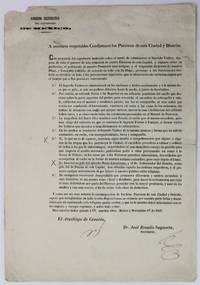
18472345Mexico City: November 17 1847. About very good. Broadside approximately 12 x 8.5 inches. Previously folded two small tape repairs on blank verso. Small chip at upper left corner. Contemporary manuscript rubrics. Light toning and dust soiling. This scarce order was issued by the Archbishop of Mexico two months after the capture of Mexico City by the United States Army. It contains six articles that detail instructions for administering the last rites and orders for several other difficult matters in the occupied city. The extreme unction is to be performed secretly only in the mornings and at night unless the physician believes it is not possible to wait and further instructions are given on how to proceed secretly but properly with the ritual. The fifth article states that that if the American troops insult the residents the clergy should try to restore calm to obtain assistance from the local guards and to inform the American garrison commanders. The final article states that parish priests should "Proceder con la mayor prudencia y usar de los medios y vias mas suaves á fin de evitar toda clase de disturbios." An interesting reflection of the official fear of American distaste for Catholicism; we locate only one example at Yale. November 17 unknown
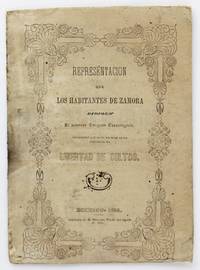
18564156Mexico City: Imprenta de M. Murguia 1856. Good plus. 28pp. Original printed wrappers stitched. Paper reinforcement on blank verso of front wrapper. Some edge wear; moderate dust soiling and toning. Scarce plea by the inhabitants of Zamora directed to the Constituent Congress asking it not to allow in the Republic the freedom of worship proposed mid-1850s revision of the Mexican Constitution. The liberal constitution re-established a parliamentary federal government and formally enshrined the abolition of slavery and important civil rights but it also ended Catholicism as the official religion of Mexico and sought to remove much of the Church's power by establishing secular public education forcing the sale of church property and ending its legal privileges under the guise of freedom of religion. The petition which was written in response to the appearance of the proposed reform in a local newspaper begs the congress to preserve "la religion de sus padres" and recites a veritable litany of historical societal and cultural contributions of the Catholic Church to Mexico. The document is signed in print by hundreds of Zamora residents. Tensions over the role of Catholicism in Mexico and many other reforms effected by the Constitution of 1857 eventually led to the outbreak of the Reform War in 1858. Published in attractive printed wrappers; we locate an example only at the Bibliotheca Nacional de España. Imprenta de M. Murguia unknown
18th century tooled green morocco armorial binding with tooled edges; all edges glit. 12 mo, [18]+214 pages. In French. Title translates as The Golden Legend; Summary of the History of the Mendian Brothers of the Order of St. Dominique and St. Francis, Explaining Briefly and Honestly the Origin, the Progress, the Doctrine, and the Struggles of the People, As Much Against the Gallican Church Principally, as Against the Popes, and Among Themselves for Four Hundred Years. work, directed against the order of the mendicant brothers of Saint Dominic and Saint Francis. A rare anticlerical booklet against the Franciscans and the Dominicans, initially published in 1608 in Leyden. The autho, Nicolas Vignier, was a Protestant theologian born around 1575, a minister of the Reformed Church in Blois, where he died around 1645.The title page features a copper engraved vignette of the arms and motto of the Regiment de la Calotte. Brunet, I, col. 152.- Caillet, nº 11164: A curious and violent pamphlet, which has become very rare [...] which in a way forms the counterpart of the Alcoran des Cordeliers.Subjects: Monasticism and religious orders. Gorgeous 18th Century Green morocco binding with gilded details. Repair to crown of spine. Previous owners bookplate on front pastedown, notes on front blank endpaper. Very Good Condition. (MED-1-2)
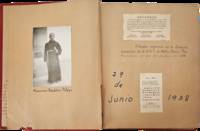
1960List3032Ciudad Juárez Mexico 1960. Scrapbook in album with string binding; twenty-two double-sided pages measuring 9 ¾ x 12 ¼ inches with some items not affixed. Pages delicate with marginal damage; items very good plus to excellent. Overall very good plus. A scrapbook containing photographs sacramental cards programs and clippings relating to various church functions at the Catedral de Nuestra Señora de Guadalupe in Ciudad Juárez Mexico between the 1930s and 1960s. The church was built next to the original Franciscan mission built im the mid-1600s. Most of the events are various years’ feasts of St. Francis and of Our Lady of the Angels of Portiuncula as the parish is Franciscan. Many of its parishioners seem to have been members of the Third Order of St. Francis; one photograph shows a number of men women and children wearing the scapular and cord of the Order posed around the church’s Monseñor Baudelio Pelayo. Other photos show a festival for the children the priest receiving a medal and a retreat at Senecú a small village outside Juárez. Clippings and flyers concern various Franciscan conferences and a visit to Juárez by Franciscan leader Augustin-Joseph Sépinski. unknown
1967BOOKS028045INY:: McGraw-Hill. Spine lettering somewhat worn esp. vols. 1 4 7 else G VG. c. 1967. ISBN: Hardback set; sturdy bindings convent name in each vol.; no DJs. Catalogs: CATHOLIC. Keywords: CATHOLIC REFERENCE ENCYCLOPEDIA. McGraw-Hill hardcover
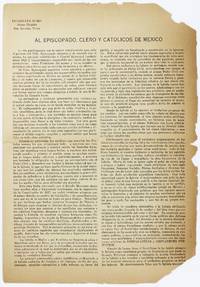
19345345San Antonio Tx: Incarnate Word 1934. Good. 4pp. Folio. Previously folded with some separation at fore-edge from central horizontal fold. Chipping at edges affecting some text at corners and fore-edge. Browned and a somewhat brittle. A scarce diatribe against the secular Mexican government issued by Leopoldo Ruiz the Archbishop of Morelia from the safety of the Catholic University of the Incarnate Word in San Antonio during late 1934. The text demonstrates the ongoing tensions and conflict between religious and government authorities in Mexico following the Cristero War in the late 1920s the period of greatest violence between the two sides after the adoption of the Constitution of 1917. Ruiz was Pope Pius XI's direct representative in negotiations with the Mexican government to resolve their disagreements but such was the animus of the parties that he was exiled in 1932 after which he settled in San Antonio whence he published this screed addressed to the "bishopry clergy and Catholics of Mexico" in which accused the government of "revolutionary Socialism" that obligated the dutiful opposition of the Church. A very scarce San Antonio Spanish-language imprint; OCLC locates only a pair of microfiched copies of this text at Emory and BYU with the origin of the original unclear. Incarnate Word unknown
Reliure pleine basane. Quelques ?pidermures. Dos ? nerfs et caissons d?cor?s. Page d'envoi r?par?e. 574 + 15 pages. 23,5 x 36,5 cm. Rousseurs.