CHEVILLARD (Jacques).Livre Rare Book

12 795 résultats
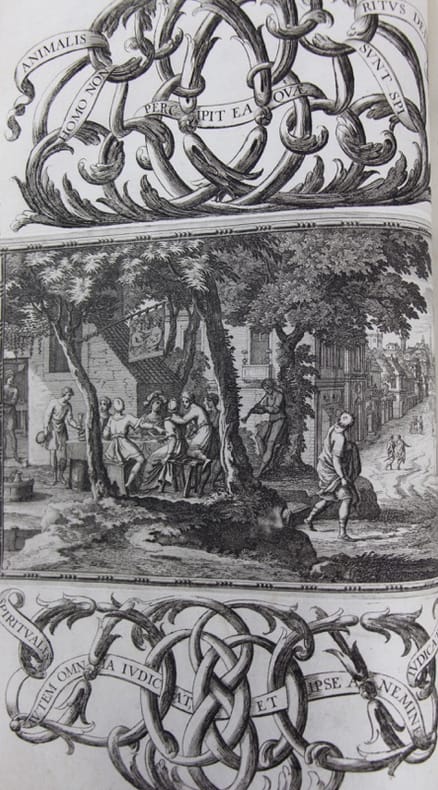
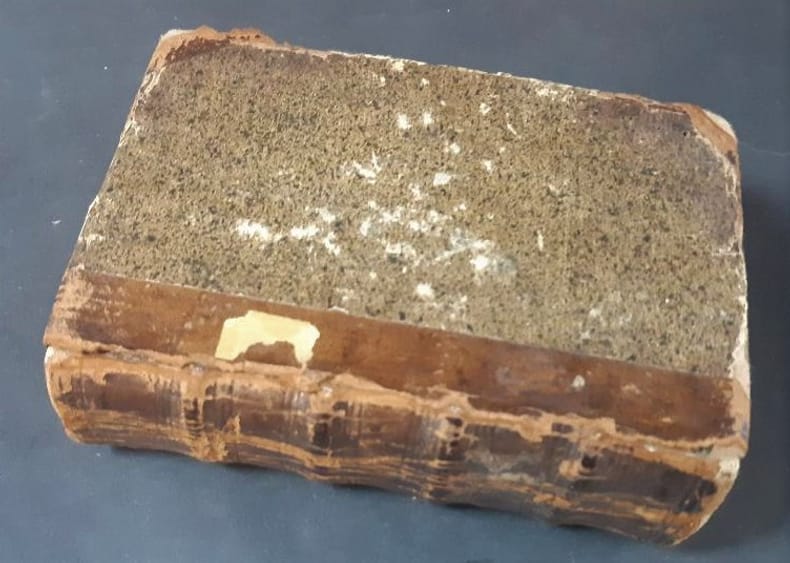
166415206A Paris, chez Michel Vaugon, 1664. 3 parties en 3 vol. in-4 de (18)-319-(13) pp. ; (12)-501-(47) pp. ; (10)-480-(32) pp. ; (16)-1036-(40) pp., vignettes gravées in-texte, veau brun granité, dos orné à nerfs (reliure de l'époque).
1561372709Venice: apud Iuntas heirs of Luca Antonio Giunta 1561. Title page with small woodcut of pope and six bishops; Giunta printer's device in red on title and at end; one full-page woodcut of Crucifixion third-page woodcuts at head of each of three parts 162 woodcuts of liturgical scenes woodcut initials. Text printed in two columns in red and black throughout musical notation in black on staves of four red lines. 4 243 ff. 1 vols. Folio. Contemporary Italian orange morocco gilt boards ruled in gilt central panels in double gilt rule with floral corner tools upper board with cardinal's hat lower board with sunburst initials in central cartouches effaced a.e.g. Spine dark some soiling and rubbing light traces of worming at back. Title page with small woodcut of pope and six bishops; Giunta printer's device in red on title and at end; one full-page woodcut of Crucifixion third-page woodcuts at head of each of three parts 162 woodcuts of liturgical scenes woodcut initials. Text printed in two columns in red and black throughout musical notation in black on staves of four red lines. 4 243 ff. 1 vols. Folio. Liturgical work including the music of the chants and hymns to accompany the services. Adams L1241; EDIT16 CNCE 11860. Provenance: early ownership signature of Joanis Ant. S- on pastedown. General Theological Seminary bookplates and stamps apud Iuntas [heirs of Luca Antonio Giunta] unknown
In-4°, (2cc), 63cc, (1), rilegato con Declamationes Evangelicae Quadragesimales, authore Bobio, 10cc, legatura in pergamena, buono stato. L’Albani nacque il 3 gennaio 1509 a Bergamo Dopo gli studi di retorica e giurisprudenza scrisse il De donatione Constantini Magni del 1535, in cui difendeva l'autenticità della celebre donazione, cui seguì il De cardinalatu nel 1541; quindi il De potestate Papae et Concilii, pubblicato nel 1544. Quest'ultimo trattatello, che si riconnette alla lunga polemica del secolo precedente sulla preminenza del papa o del concilio nella Chiesa, vuole confutare esplicitamente le affermazioni di parte protestante e si preoccupa di dimostrare, con l'apporto di argomenti soprattutto giuridici, come possa salvarsi il primato del pontefice anche nei casi del papa supposto eretico o colpevole. Al colmo degli onori e della potenza, nel 1556 accolse il giovinetto Torquato Tasso - anche in seguito confortato e protetto dall'Albani, nelle dolorose vicende della sua vita - mandato a Bergamo presso i parenti dal padre Bernardo, che a Roma era caduto in sospetto di ribellione al governo napoletano. Nel 1559 uscivano ancora dell'Albani le Lucubrationes in Bartoli lecturas. Quando nel gennaio 1566 il cardinale Ghislieri fu eletto papa col nome di Pio V, volle chiamare presso di sé a Roma l'Albani, l'antico suo esperto consigliere e benefattore. Fattosi ecclesiastico con le dovute dispense, venne subito insignito della dignità di protonotario apostolico e di governatore della Marca di Ancona; e il 17 maggio 1570 fu creato cardinale del titolo di S. Giovanni a Porta Latina. Bibl.: G. M. Mazzuchelli, Gli Scrittori d'italia, I, 1,Brescia 1753, pp. 272-274; J. F. v. Schulte, Die Geschichte der Quellen und Literatur des canonischen Rechtes, III, Stuttgart p. 880, pp. 448 s.; A. Solerti, Vita di Torquato Tasso, I-Il, Torino-Roma 1895, passim (il II vol. di docc.); L.v. Pastor, Storia dei Papi, VI, Roma 1922, p. 232; VIII, ibid. 1924, p. 116; IX, ibid. 1925, pp. 13, 257, 875 s., 885; X, ibid. 1928, pp. 10, 14, 17, 58, 506, 508, 576, 594; B. Belotti, Storia di Bergamo e dei Bergamaschi, II, Milano 1940, pp. 190, 232, 299, 326; Dict. de Théol. Cath., I, coll. 659 s.; Dict. d'Hist. et de Géogr. Ecclés., I, col. 1372. Ludovico Bobbio fu uno scrittore romano del XVI secolo autore di “Exortatio ad Christianorum principes, de armis aduersus orthodoxae fidei hostes, arripiendis”del 1550. In-4°, (2cc), 63cc, (1), bound with con Declamationes Evangelicae Quadragesimales, authore Bobio, 10cc, vellum binding, good copy. Albani was born on 3 January 1509 in Bergamo. After studying rhetoric and jurisprudence he wrote the De donatione Constantini Magni of 1535, in which he defended the authenticity of the famous donation, which was followed by De cardinalatu in 1541; then the De potestate Papae et Concilii, published in 1544. This last treatise, which reconnects to the long polemic of the previous century on the pre-eminence of the pope or of the council in the Church, wants to explicitly refute the claims of the Protestant party and is concerned with demonstrating, with the contribution of mainly legal arguments, how it can be saved the primacy of the pontiff also in the cases of the pope supposedly heretical or guilty. At the height of honors and power, in 1556 he welcomed the young Torquato Tasso - also later comforted and protected by Albani, in the painful events of his life - sent to Bergamo with his relatives by his father Bernardo, who had fallen in suspicion in Rome of rebellion against the Neapolitan government. In 1559 the Lucubrationes in Bartoli lecturas still came out of Albani. When in January 1566 Cardinal Ghislieri was elected pope with the name of Pius V, he wanted to call Albani, his former expert adviser and benefactor, in Rome. Having become ecclesiastical with the necessary dispensations, he was immediately awarded the dignity of apostolic protonotary and governor of the Marca of Ancona; and on May 17, 1570 he was created cardinal of the church of S. Giovanni in Porta Latina. Bibl .: G. M. Mazzuchelli, The Writers of Italy, I, 1, Brescia 1753, pp. 272-274; J. F. v. Schulte, Die Geschichte der Quellen und Literatur des canonischen Rechtes, III, Stuttgart p. 880, pp. 448 s .; A. Solerti, Vita di Torquato Tasso, I-Il, Turin-Rome 1895, passim (2nd vol. Of doc.); I.V. Pastor, History of the Popes, VI, Rome 1922, p. 232; VIII, ibid. 1924, p. 116; IX, ibid. 1925, pp. 13, 257, 875 s., 885; X, ibid. 1928, pp. 10, 14, 17, 58, 506, 508, 576, 594; B. Belotti, History of Bergamo and the Bergamaschi, II, Milan 1940, pp. 190, 232, 299, 326; Dict. de Théol. Cath., I, coll. 659 s .; Dict. of Hist. et de Géogr. Ecclés., I, col. 1372. Ludovico Bobbio was a 16th-century Roman writer author of "Exortatio ad Christianorum principes, de armis aduersus orthodoxae fidei hostes, arripiendis" of 1550.
153439568Leipzig, Michael Blum, 1534. In-4 de (61) ff. (sign. A4, A-Q4). Petite mouillure sur la page de titre.ISIDORE DE SÉVILLE. De Officiis ecclesiasticis libri duo ante annos DCCCC ab eo editi et nunc ex vetusto codice in lucem restituti. Leipzig, Michael Blum, 1534. In-4 de (47) ff. 1 f. bl. (sign. A-M ). INNOCENT III. Libri sex, de sacro Altaris mysterio, ex vetusto Codice nuper excripti, et nunc per Typographos excusi. Leipzig, Faber, 1534. In-4 de (6)-91 ff., 5 feuillets censurés (sign. b3, b4, A1, A2, A3) ont été retirés de l'exemplaire et remplacés par des feuillets blancs.3 pièces reliées en 1 vol. petit in-4 (20 x 15 cm) maroquin fauve, dos à nerfs, armes au centre des plats répétées sur le dos, fermoirs, tranches jaspées (reliure de la fin du XVIe siècle).
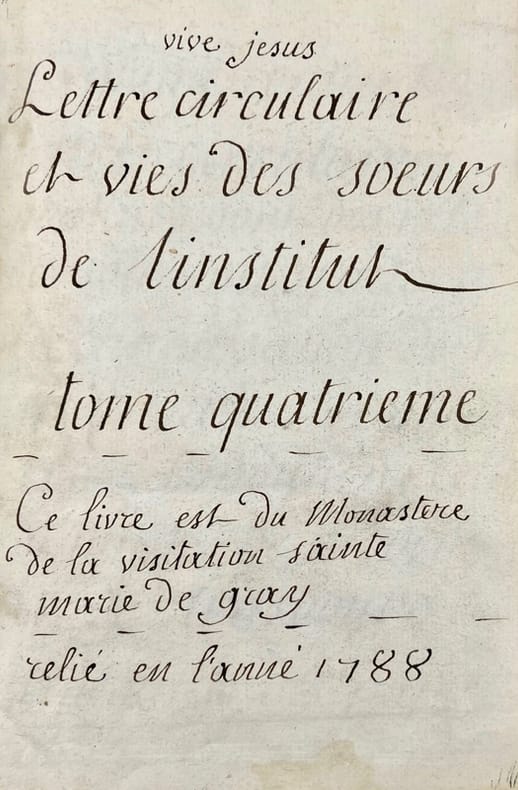
166243249, , 1662-1710. 33 circulaires reliées en 1 vol. petit in-4, vélin rigide moucheté, dos à trois nerfs, pièce de titre (relié en 1788).
169143484A Paris, chez Pere Peters, à l'Enseigne de Louis le Grand, [1691]. In-4 (243 x 160 mm) de 1 titre gravé, 24 vignettes en noir (14,5 x 10,5 cm) et 1 sonnet gravé, demi-maroquin vert à coins, dos orné à nerfs, tranches dorées (reliure du XIXe siècle).
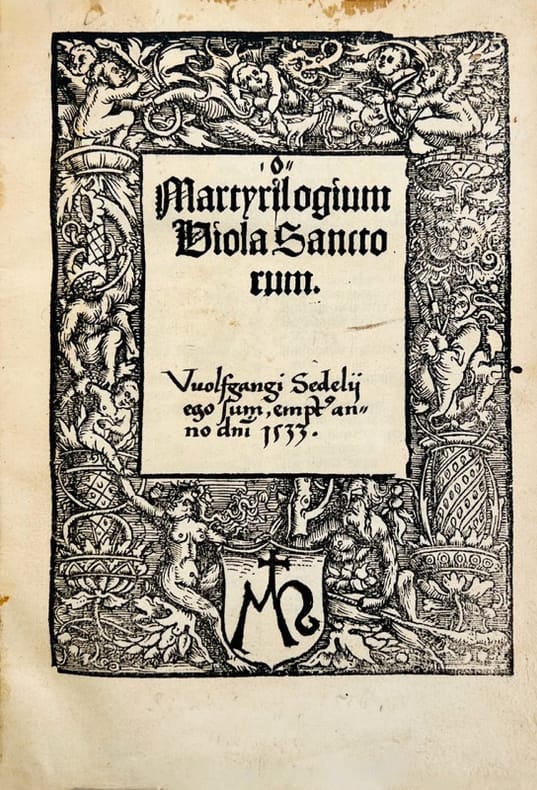
151644353Strasbourg, Mathis Hupfuff, 1516. Petit in-4 gothique (149 x 205 mm) de (6)-XCIX ff. 1 f.bl. (sig. (*)6a4 b8, c-d4 e8 f-g4 h8 i-k4 l8 m-n4, o8 p4 q8 r4 s8, le dernier blanc), titre à encadrement gravé sur bois, veau brun estampé à froid orné de rinceaux, fleurs de lys et figures de martyrs, dos à trois nerfs, traces de lacet (reliure de l'époque).
152216229Basileae, ex officina nostra, pridie Calendas septembreis, 1522. In-folio de (22)-787-(1) pp. (signatures : aa12, a-z6, A-Z6, Aa-Rr6, Ss-Tt8), sans le dernier feuillet blanc aa12, peau de truie estampé sur ais de bois, traces de fermoirs, dos à nerfs (reliure de l'époque).
17348863Amsterdam, J. Frédéric Bernard, 1734-1739. 2 volumes in-8 (196 x 242 mm), 2 ff. n. ch., LXXVI pp., 594 pp. ; VIII pp., XXXIV pp., 806 pp. Maroquin rouge, triple filet d'encadrement avec fers, dos à nerfs orné, pièce de titre en maroquin citron, filet sur les coupes et les coiffes, roulette intérieure, tranches dorées sur marbrure, rares rousseurs (reliure de l'époque).
153042765Paris, François Regnault (Nicolas Savetier), 1530. Petit in-8 (16 x 10,5 cm) de (8)-258-(1) ff. (sign. a8, 2a8, b-z8, A-I8, K3) veau fauve, dos à nerfs orné de fleurons, armes dorées sur les plats dans un double encadrement de filets à froid, fleurons dans les angles (reliure de l'époque).
[20], 644 pages. Index. Twenty-six black and white photographic plates. Leather binding. "Comprising a history of Egypt, with a comprehensive and authentic account of the antiquity of masonry resulting from many years of personal investigation and exhaustive research in India, Persia, Syria and the Valley of the Nile." - title page. After first receiving the Light in India, the author was moved to "investigate, to the fullest extent, the meaning and purport of the numerous hieroglyphic inscriptions, symbols and characters found upon the ancient tombs and temples, so that the Masonic Fraternity might understand, appreciate and apply the teachings of the hierophants and sages of bygone days." - Preface. Chapters: Alexandria - the Antiquity of Masonry; Ruined Temples - Masonry and Masonic Symbols; Ancient Cities - Soirian Myth - Karma; the Nile - Origin of the Name Free Mason - Scottish Rite Philosophy; Ancient Mysteries - Scottish Rite philosophy; Suez Canal - The Druses, Their Manners and Customs; Agriculture - Irrigation - Lotus - Papyrus; The Supreme Architect of the Universe; Mosques - Tombs - Massacre of Mamelukes - Heliopolis; Esoteric Teaching of the Scottish Rite - Brain and Thought; Pyramids - Sphinx - Tombs; Solomon - Death of Hiram - Cross - Swastica; Mummification - Transmigration - Re-incarnation; Sixteen Saviours - Lost Knowledge; The Golden Fleece - Roman Eagle - Masonic Apron - What it Teaches; Pyramids of Sakkarah - Lisht - Medum - The Fayum - Labyrinth; Sun Worship - Zodiac - Masonic Allegories; A Voyage up the Nile - Description of Tombs and Temples - Pro Doric Columns; Ineffable degrees - Thoughts on Ecclesiastes - I.N.R.I. - Voyaging up the Nile - examining Tombs and Temples - Paintings - Sculptures; Masonic teachings - Hindu beggar - Roman Catholicism; Thebes - Colossi - Der-El-Bahari - Luxor - Karnak; Ceremonies - Initiation - Blue Lodge - Transmigration - Mystery Language; The Gawazee - exploring Temples and tombs - Philae and its ruins - Nubia; Jewish Traditions and customs - Cable tow - Ceremonies of ancient Initiation - book of the Law; Circumsision - upon what the Ancient Craftsmen were obligated - the lost word. All edges gilt. Protected frontis portrait of author. Ornately embossed boards. Raised bands to spine. Partially rubbed gilt lettering and decoration upon back strip. Marbled endpapers. Hinges intact internally, open or opening externally. Front board partially detached. Somewhat above-average wear to boards. Unmarked. A worthy original copy of this monumental work. 12" x 9.5" x 2.5". 11 pounds. Book
170310645Paris, André Pralard, 1703 In-8 (188 x 122 mm), 8 ff. n. ch., 732 pp., 6 ff. n. ch., 4 cartons reliés tous ensemble à la fin avec annotation manuscrite sur un carton et soulignage au crayon sur un autre. Maroquin vieux rouge, triple filet d'encadrement doré sur les plats, armoiries au centre, dos à nerfs, caissons décorés de fleurons dorés et pièces d’arme dorées, auteur et titre dorés, filet doré sur les coupes, roulette dorée intérieure, tranches dorées sur marbrure, légère fente en tête des mors avec petite restauration, tache angulaire en partie inférieure, petit trou dans la marge inférieure des premiers feuillets, petite tache brune marginale pp. 85-86 (reliure de l’époque).
16882Paris, Tresse & Stock, 1891. In-12, 441 pp., broché, couverture originale imprimée, chemise et étui de papier marbré (légère insolation à la chemise et l'étui, couverture légèrement empoussiérée).
150441988Lyon, Claude Davost, Étienne Gueynard, 1504. In-4 gothique à deux colonnes de (12)-217 ff. mal chiffré 215 (sign. aa bb a-z π-ƒ A9), index, veau marbré, dos orné à nerfs, pièce de titre en maroquin rouge, tranches rouges (reliure XVIIIe).
164219929Lyon, Jean Caffin et F. Plaignard, 1642 ; in 8, vélin rigide de l’époque ; [8], 299 pp, [5] pp. bl., (signatures : â4, A-T8) le dernier f. blanc est collé au contreplat de la reliure.
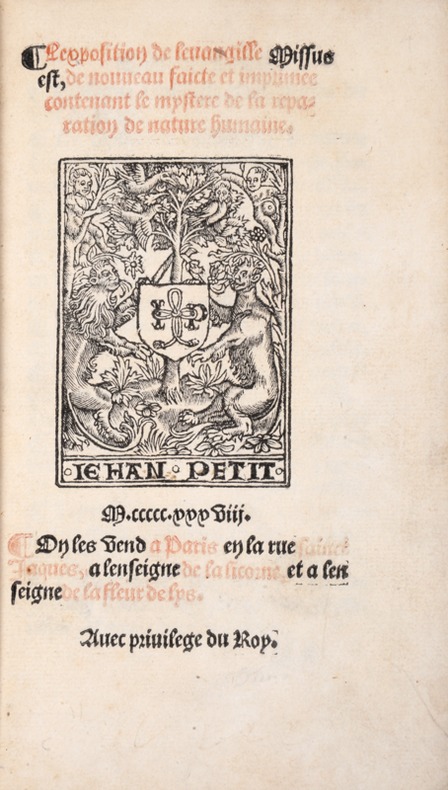
153816626Paris, Yolande Bonhomme pour Jean Petit, 1538-1539. In-8 gothique (16 x 10 cm) de (8)-CLXX-(1) ff., (sign. A8, A-X8, Y3), maroquin brun, dos à nerfs, dentelle intérieure, tranches dorées (Petit).
In-4°, (12cc), 512pp, 48cc., buone condizioni restauri al frontespizio, numerosissime note manoscritte, legatura in pergamena coeva. Personalità di spicco della scolastica spagnola del Cinquecento, Luis de Molina fu anche uno dei più controversi pensatori della storia del cattolicesimo. Sulla base di precise tesi teologiche e filosofiche, elaborò una sua propria dottrina che puntava alla conciliazione del libero arbitrio con la prescienza divina e la predestinazione. Oltre al lavoro in campo teologico, dedicò molto tempo anche a temi politici e morali, interrogandosi in particolare sulla legittimazione del potere e dell’autorità politica, sulla schiavitù e su questioni economiche. Nel 1584 si ritirò definitivamente dall’insegnamento e si trasferì a Lisbona, per occuparsi della composizione delle sue opere: in questo periodo, scrisse la notissima Concordia, titolo con cui solitamente si indica lo scritto Liberi arbitrii cum gratiae donis, divina praescientia, providentia, praedestinatione et reprobatione concordia. Questo lavoro, uscito nel 1588, è in realtà solo una parte di un’opera maggiore, intitolata Commentaria in primam divi Thomae partem e pubblicata solo nel 1592 a Cuenca, città dove Molina aveva fatto ritorno dal Portogallo l’anno precedente. Nel 1600, ricevette un incarico come professore al Colegio Imperial di Madrid, città dove morì il 12 ottobre dello stesso anno. In-4°, (12cc), 512pp, 48cc., good condition, title page repaired, manuscript notes, vellum binding. Prominent personality of the Spanish school of the sixteenth century, Luis de Molina was also one of the most controversial thinkers in the history of Catholicism. On the basis of precise theological and philosophical theses, he developed his own doctrine which aimed at reconciling free will with divine foreknowledge and predestination. In addition to his work in the theological field, he also devoted a lot of time to political and moral issues, in particular questioning the legitimacy of power and political authority, slavery and economic issues. In 1584 he definitively withdrew from teaching and moved to Lisbon, to take care of the composition of his works: in this period, he wrote the well-known Concordia, a title that usually indicates the writing Liberi arbitrii cum gratiae donis, divina praescientia, providentia, praedestinatione et reprobatione concord. This work, released in 1588, is actually only a part of a major work, entitled Commentaria in primam div Thomae partem and published only in 1592 in Cuenca, the city where Molina had returned from Portugal the previous year. In 1600, he received an assignment as professor at the Colegio Imperial in Madrid, the city where he died on October 12 of the same year.
166160406P., Florentin Lambert 1661 In-folio, plein veau époque, dos à nerfs, caissons ornés, roulettes sur les coupes, [24]- 125- [9] ; [2]- 63- [7]- [18]- 195- [15]; [8]- 241- [27] ; 75- [8] pp. Ex-libris manus. et tampon au titre. Une brunissure au pied des premiers ff., quelques feuillets brunis, quelques marques d’humidité marginale éparses en fin de volume. Petit accroc de coiffe de tête, restauration en pied et à un coin en second plat.
119484Venetiis, S. Bevilaqua 1495 In-16 15,5 x 10 cm. Reliure postérieure, début XIXe siècle, demi-basane havane, dos à nerfs muet, non paginé [30]-[648] pp. Reliure sensiblement frottée, coiffes arasées, coins usés, marges rognées, annotations manuscrites et réparations marginales, corps de l’ouvrage frais, manque 5 pp. in fine. Incunable d’une relative rareté.
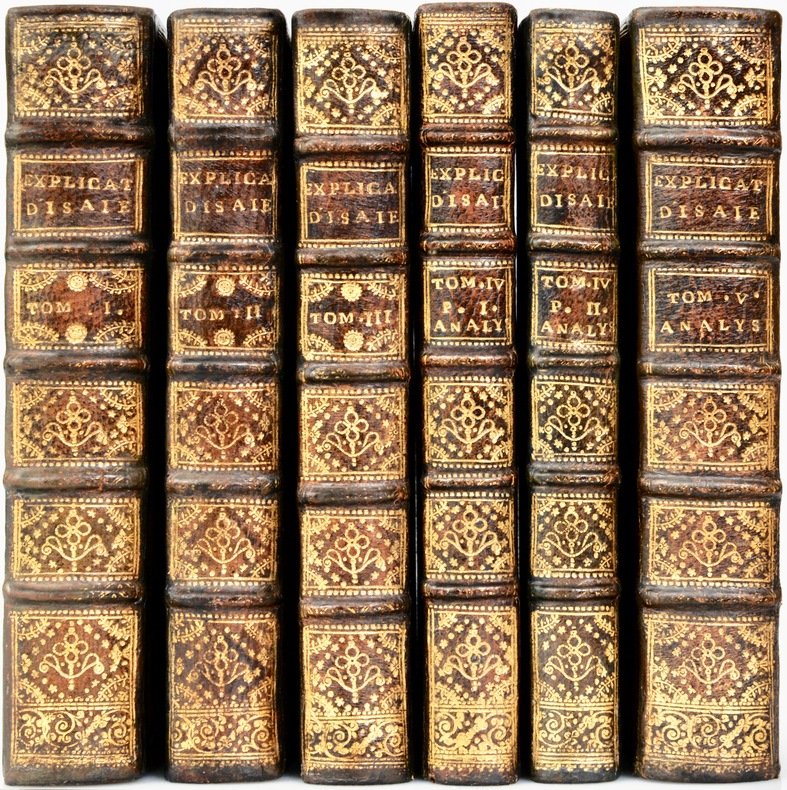
173442175Paris, François Babuty, 1734. 5 tomes en 6 vol. in-12 de XII-599 pp. 8 pp. de catalogue ; (4)-472 pp. ; (4)-451 pp. ; [tome IV en 2 vol. à pagination continue] (8)-710 pp. ; (8)-606-(1) pp., maroquin bleu nuit, dos à nerfs orné à petit fers, triple filet doré d’encadrement sur les plats, fleuron répété aux angles, roulette intérieure, tranches dorées (reliure de l'époque).
180412547A Paris, Imprimerie de Crapelet, 1804. 2 vol. in-4 de (4)-VIII-514 pp. 1 frontispice et 38 planches ; (4)-534 pp., 1 carte gravée dépliante, 1 frontispice et 34 planches, maroquin rouge à grains longs, dos à cinq nerfs minces orné de pointillés et feuilles, cadre à une roulette aux volutes florales sur les plats, filet strié sur les coupes et les coiffes, doublures et gardes de tabis bleu, tranches dorées (Rel. P. Bozerian jeune).
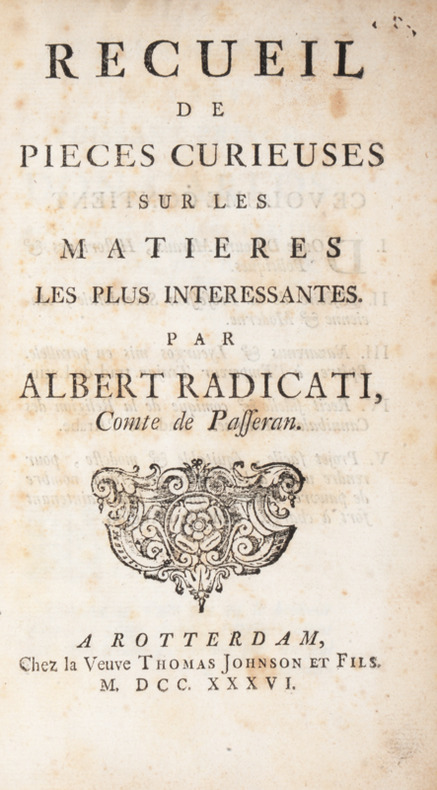
173641056Rotterdam, Veuve Thomas Johnson et fils, 1736. In-8 de X-384 pp., maroquin rouge, dos orné à nerfs, blason à froid et triple filet doré d'encadrement sur les plats, tranches dorées (reliure de l'époque).
187443785, Onze décembre, 1874. Manuscrit in-8 de 140 pp., demi-basane rouge, dos orné à nerfs (reliure de l'époque).
165343711Parisiis, , Typographia Regia, 1653. In-4 à deux colonnes de (64)-884-(58) pp., frontispice, maroquin rouge, dos orné à la grotesque, double encadrement doré à la Du Seuil sur les plats avec fleurons dorés dans les angles, coupes décorées, tranches dorées sur marbrure (reliure de l'époque).
158743366Venetiis, [Hieronymus Polus], 1587. In-4 (150 x 200 mm) à deux colonnes de (24)-1126 pp. (signatures: † , A-Z , Aa-Zz , Aaa-Zzz , Aaaa , Bbbb ), tables, texte encadré, titre-frontispice, vignettes gravées sur bois dans le texte, vélin souple, dos lisse avec titre manuscrit, tranches dorées guillochées (reliure de l’époque).