[Jesuites de France]Biblio.com

2 541 résultats
174158184Paris: Le Mercier & Boudet 1741. First edition 12mo pp. xxxii 8 486 2; contemporary full calf gilt-decorated spine in 6 compartments morocco labels in 2 red speckled edges; ex-St. Stanislaus Novitiate House Library Guelph Ont. closed in 1971 with labels and a bookplate on upper pastedown and shelf label on spine light wear to boards very good. Volume XXV contains letters on: Missions to Paraguay including comment on the language of the Chiquites; Nicobar and Carnate India; Vietnam; trials of the Missionaries to China; and the revolutions of Thamas Koulikan Nadir Shah of Iran. One volume of the 34-volume collection of Jesuit Relations and Allied Documents 1703-1776. "These volumes issued regularly by the Society of Jesus presented selections from correspondence and reports written by Jesuit missionaries then scattered around the globe" and reflected "the continued interest in France in the progress of the Jesuit missions in various parts of the world. The termination of the series reflects the suppression of the Society of Jesus by papal decree" James Ford Bell Catalogue L-368. Howes L 299; James Ford Bell Catalogue L-368. Le Mercier & Boudet unknown
1945List2748Philippines 1945. Single letter; five 8.5 x 11†pages. Pinhole at top of first page missing final pages overall fine. The unknown author of this letter was an American Jesuit missionary in the Philippines who before the war was a novice living in Novaliches just outside Manila. He apparently had not written a significant letter home for a long time: in this letter written in April of what is likely 1945 he recounts his experiences from between December 8 1941 and early January of 1945 shortly before the civilian POW camp in which he was interned was liberated.<br /> <br /> After the “Nips†bomb Pearl Harbor “A feverish month ensuedâ€:<br /> <br /> “We proceeded to put the Community on ‘war-time alert’ with all hands occupied in digging air-raid trenches camouflaging our fortress-like house with a garlanded roof and mud-daubed walls; grain supplies were rushed in against the hour of need. We felt that all it might take Uncle Sam all of six months to put an end to the efforts of the pretender.â€<br /> Around Christmas they evacuated to the Jesuit Ateneo Grade School then in Intramuros as the Japanese were advancing quickly towards Novaliches. Of course this did not prove to be much safer:<br /> <br /> “When darkness came the Japs began their bombing of the Port Area. The bombs began to bounce off the pavement; bombers just skimming our roof-top on their way. We spent the night on our tummies and how we prayed. We thought that each decade of the beads would be our last this side of Purgatory. . When the church sto Domingo was hit the floor beneath us did some tricks and we were lifted up a bit and let down amidst the dust and smoke that poured in from above.â€<br /> <br /> The missionaries try to “salvage important papers and other valuables from the Mission House prior to abandoning it to the fire which threatened the entire Walled City.†During this time they and “a thousand refugees†live in the Ateneo while “Dawn and night raids were supplied by the Japs with nary an American plane to say to them no†– American forces had taken a serious hit and withdrawn outside Manila. It was declared an open city before “the little scrawny but arrogant Japs came into the city and took over†in January of 1942.<br /> <br /> The missionaries persuade the Japanese to let them stay in the Ateneo:<br /> <br /> “We convinced them that it was impossible for us to give up the building because it belonged to the Pope and the Vatican State would hold us responsible. This argument with many ingenious trimmings enabled us to hold on to the Ateneo until June ‘43 when the main building was taken for a military hospitalâ€.<br /> <br /> The author describes how despite what he calls his “partial internment†in Manila he is able to get around checkpoints by pretending to be Belgian. He finishes his studies and begins work at a Belgian convent in Paranaque in February of 1943 living between there and Manila:<br /> <br /> “Incidentally none of this would have been possible if the Japs had gumption enough to find out that I was one of the hated Americans. . All vehicles were obliged to stop here a checkpoint at Baclaran and all passengers get down and file between a Jap sentry and a Filipino constabulary soldier to be searched for hidden arms etc. Since several Belgian Fathers not considered enemy aliens frequently passed this way I was able to walk through unmolested as an unoffending Belgian. . I carefully kept my helmet covering the tell-tale red arm-band which was worn on the arm furtherest away from the Jap. The Filipino would do no more than give me a knowing grin.â€<br /> <br /> On July 10 1944 all of the American civilian POWs are taken to internment camps in Santo Tomas and then Los Baños. In Los Baños the POWs cut wood repair roads and farm. Los Baños would be liberated in February of 1945; the author paints a slightly confusing picture of the leadup to this:<br /> <br /> “Conditions generally ‘worsened’ when on Jan. 8th about the time that the American troops landed at Mindero an island just across from Batangas the Japs got jittery believing that the Yanks were going to do the obvious and cross over the bay to Batangas and they the Japs at Batanga decamped! ‘You are free but remain in camp until the Americans come. Outside your camp Japanese troops will shoot any who leave.’ Great was the joy in Mudville. From nowhere came flag poles on which we quickly unfurled American and British flags .; a short-wave radio was set up and we enjoyed daily Frisco broadcasts .â€<br /> <br /> It sounds as if the missionary was reporting contrary to the usual narrative of the Los Baños raid that the Japanese had essentially given up control of the camp and were like the prisoners simply waiting for the Americans to come get their people. Perhaps something further happened in the nearly two intervening months; however the remainder of the letter is missing.<br /> <br /> Of interest to scholars of modern Jesuit history and of the civilian POW experience during the Second World War. unknown
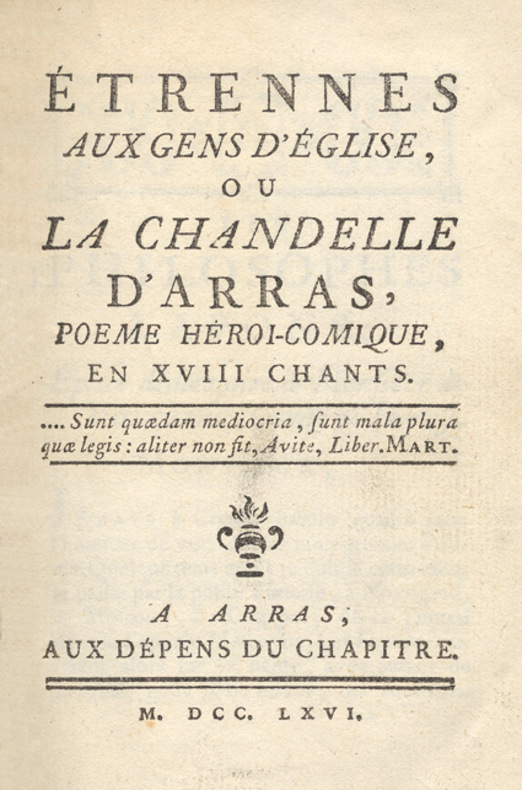
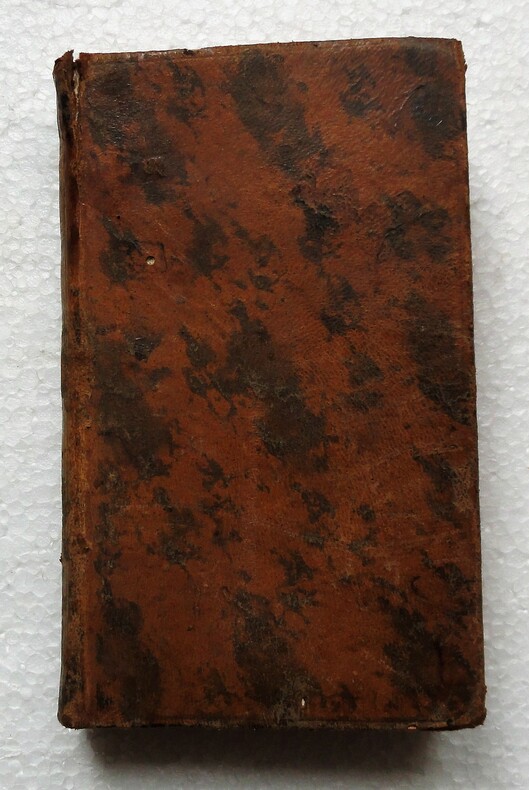
17661321A Arras, aux dépens du Chapître, 1766, in-12 carré ; plein veau fauve marbré glacé, dos à nerfs décoré, tranches tachetées (rel. de l'époque) ; XXII pp., 199 pp.Rare.
2 parts in 1 vol., 12mo., on laid paper, part II with 8 full-page tables in the text, wanting title to first part and part II E6-7, part 1 R3 with small marginal tear (not affecting text or marginalia), neat early eighteenth century ex libris inscription on blank preliminary verso, some negligible age-staining; original full vellum, yapped edges, backstrip lettered in MS, a remarkably bright, clean, tight copy in wholly unrestored contemporary binding. This is the complete work, comprising Part I Books 1-IX and Part II Books 1-IV, thirteen books in all. The two parts are separately titled and paginated, and each has its own (extensive) index. Part I retains the dedication to D. Ludovico Borbonio, ad Lectorem, indiculus auctorum, and the two 'summa' leaves. Part I pagination is mis-numbered from p.443 onwards. Effectively an abridgement of the great Jesuit scholar's masterpiece 'Opus de doctrina temporum' (1627). Denis [Denys] Petau (1583-1652) studied in Paris under Scaliger and later resigned his lectureship at Bourges to join the Society of Jesus. He spent the majority of his academic career as Master of Divinity at the College de Clermont, the chief Jesuit establishment in Paris. A splendid, if predictably imperfect, copy in wonderful contemporary binding. EXTREMELY SCARCE.
1889R118582Le Mans, Leguicheux 1889 Complet en 4 tomes, iv,312 + 332,[i] + 356,[i] + 444pp. + 13 planches hors-texte dont 8 dépliantes, 23cm., reliures uniformes solides d'époque (plats marbrés, dos en cuir vert avec titre et faux-nerfs dorés), feuilles de garde marbrées, cachet sur la page de titre, qqs. rousseurs (texte toujours bien lisible), bon état, peu commun, poids: 3.3 kg., R118582
In-12, pleine basane d'époque, dos à 5 nerfs orné de compartiments fleuronnés, pièce de titre de maroquin rouge, roulette dorée sur les coupes, roulette intérieure (reliure frottée, pet. accrocs aux coins), (1) f., (6), 281 p., (18) p. d'index des livres cités, table et privilège. Edition originale. "Divisé en cinq parties : ‘Doutes sur les mots - sur les phrases - sur la construction - sur la netteté - sur ce qui regarde l’exactitude du style’. Il s’agit de relever des emplois dans des textes des bons auteurs, de vérifier ce qu’en disent les contemporains, de rechercher dans l’usage des formes attestées" (Claude Cortier, 'Les qualités de la langue française d’après les grammairiens contemporains de Fénelon', D.H.F. [En ligne], 30 | 2003. "Défendant les positions de Vaugelas en s'affranchissant cependant des aspects didactiques et pesants, Bouhours devint, à la suite de cet ouvrage, le plus connu des mondains défenseurs du bel usage qui contribuèrent à épurer la langue française" (C. Biet). Voltaire l'inclut dans son 'Temple du goût'. (Kerviler, ‘Bibliographie raisonnée de l'Académie française’, n°351. Sommervogel, 'Anonymes', 241). Bon exemplaire.
240643Villefranche, Guillaume Grenier, 1599 petit in-8, [4] ff. n. ch., pp. 9-238, vélin rigide granité et rubriqué, dos à nerfs, pièce de titre cerise (reliure de l'époque). Rousseurs.
240612Mayence, Johann Weiss, 1612 2 parties en un vol. in-8, 104 pp., 208 pp., vélin rigide, dos lisse, traces de signets (reliure de l'époque). Rousseurs.
3668Parisiis, apud Georgium Colombier, Typographum, 1900 27 x 40, cartes: 45 doubles planches couleurs, demi-reliure (dos usé, coins légèrement abîmés), bon état d'ensemble, pas de rousseurs (page de garde et de titre, 3 cachets de la bibliothèque du Collège Jésuite Saint-Stanislas à Mons)
1765ZNC-520Par un auteur désintéressé. Sans lieu et sans nom d'imprimeur (Geneve, Cramer), 1765, in-12°, 235 pages, plein veau d'époque, dos lisse orné de filets et de fleurons orés, tranches rouges, mors supérieur fendu.
1593350931593 Petit in-4, plein vélin ancien, dos doublé, (8), 184 p., vignette de titre, bandeaux, lettrines sur fond criblé et sceau du pape Sixtus V gravé sur bois. Romae, Typographia Gabiana, 1593.
2318A Amsterdam. Herman Uytwere, libraire. 1754. XLIV + 407 pp. 97 x 168 mm. Reliure d'époque en plein veau blond, fleurons dorés au dos, pièce de titre en maroquin rouge, tranches jaspées. Bel exemplaire.
1956R105802Sao Paulo, Comissao do IV centenario da cidade de Sao Paulo 1954 1956-1958 Complete in 3 volumes: 47,577 + 88,519 + 120,619,xxi pp., with frontispiece in each volume, 25cm., original softcovers, pages still uncut, good condition, weight: 3.8kg., R105802
Complete in 3 volumes: 47,577 + 88,519 + 120,619,xxi pp., with frontispiece in each volume, 25cm., original softcovers, pages still uncut, good condition, weight: 3.8kg., R105802
1919R49810Romae, Apud Curiam Praepositi Generalis 1919-19 10 volumes, each volume bound in cart.cover (with spine in red cloth), 24cm., text in latin, volume I (1919-1922) 780pp., vol.II (1923-1926) 750pp., (III, 1927-1930:) 849pp., (IV, 1931-1933:) 807pp., (V, 1934-1936:) 895pp., (VI, 1937-1938:) 869pp., (VII, 1939-1948:) 222 + 449pp., (VIII, 1948-1951:) 560pp., (IX, 1952-1956:) 681pp., (X, 1957-1959:) 393pp., with some illustrations out-of-text, nice condition
10 volumes, each volume bound in cart.cover (with spine in red cloth), 24cm., text in latin, volume I (1919-1922) 780pp., vol.II (1923-1926) 750pp., (III, 1927-1930:) 849pp., (IV, 1931-1933:) 807pp., (V, 1934-1936:) 895pp., (VI, 1937-1938:) 869pp., (VII, 1939-1948:) 222 + 449pp., (VIII, 1948-1951:) 560pp., (IX, 1952-1956:) 681pp., (X, 1957-1959:) 393pp., with some illustrations out-of-text, nice condition
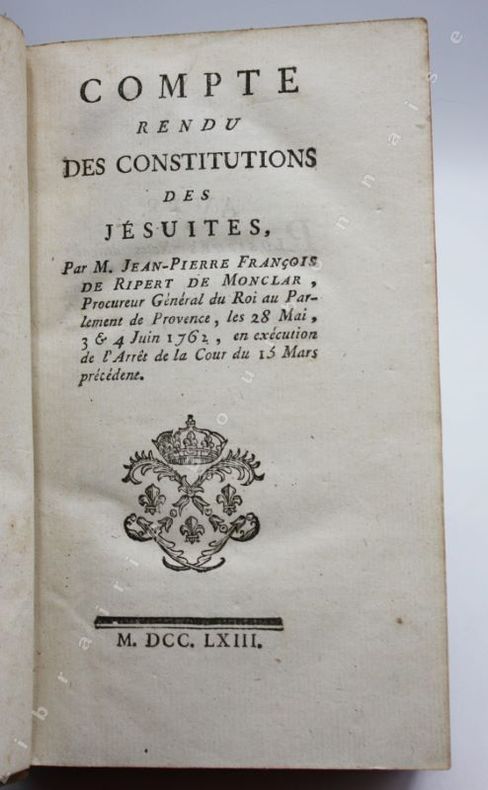
11544S.l., s.n., 1763 ; in-12. 546pp. Veau brun marbré, dos lisse orné, pièce de titre en maroquin rouge. Trous de vers au dos et à la charnière du plat sup. Coiffe inférieure légèrement frottée. Intérieur très frais.
1767(LCPCLUM-0010)(Une très rare contrefaçon d'un célèbre conte philosophique de Voltaire. Un exemplaire tel que paru, non rogné et dans sa brochure de l'époque) VOLTAIRE François-Marie AROUET (dit). (Paris, 1694-1778) "LE HURON OU L'INGENU...". 1767, Lausanne (Paris). 2 tomes en 2 volumes in-12° (180x120 mm) (dmensions pages 180x120 mm) I : (2) ff. (faux-titre et titre), 102 pp., (1) f. b. ; II : (2) ff., (faux-titre et titre), 96 pp. (I : A-F8, G4 ; II : A-F8) Brochure grise de l'époque. Très rare contrefaçon de la seconde édition, celle de Lausanne, à la date de l'originale de Genève. Rares et infimes brunissures, des pages écornées, mais bel exemplaire tel que paru, à toutes marges, non rogné. Ce roman philosophique est l'histoire d'un jeune homme élévé en Amérique, chez le peuple indien des Hurons. Après des années d'apprentissage, il débarque en Bretagne. Le contact d'un ésprit libre avec la société et les moeurs français permet à Voltaire de dénoncer les conventions, les corruptions, l'obscurantisme religieux, l'impossibilité du vrai bonheur pour l'homme, les limitations et les atteintes à la liberté individuelle dues à l'absolutisme et à la réligion, aux jésuites et aux jansenistes en particulier. L'ouvrage fut saisi quelques semaines après sa parution. "La lecture agrandi l'ame, & un ami éclairé la console". "La verité luit de sa lumière, & on n'éclaire pas les esprits avec les flammes des buchers". (LCPCLUM-0010) (350,00 €)
Very Good Greek, Modern (post 1453) Contemporary fine leather bdg. Demy 8vo. (22 x 15 cm). In Greek. 1118 p., richly illustrated (b/w ills.). Period bindery label of E. Watson in London. Ex-library copy on fourth blank page. Otherwise a very good copy. First and extremely rare translation into Greek of Taxil's 'Myste`res de la Franc-Mac?onnerie'. Mysteries of Freemasonry. Marie Joseph Gabriel Antoine Jogand-Pagès, better known by the pen name Léo Taxil was a French writer and journalist who became known for his strong anti-Catholic and anti-clerical views. He is also known for the Taxil hoax, a spurious expose of Freemasonry and the Roman Catholic Church's opposition to it. Marie Joseph Gabriel Antoine Jogand-Pagès was born in Marseille, and at the age of five, he was placed into a Jesuit seminary. After spending his childhood years in the seminary, he became disillusioned with the Catholic faith and began to see the religious ideology as socially harmful. Taxil first became known for writing anti-Clerical or anti-Catholic books, notably "La Bible amusante" (The Amusing Bible) and "La Vie de Jesus" (The Life of Jesus), in which Taxil satirically pointed out inconsistencies, errors, and false beliefs presented in these religious works. In his other books Les Debauches d'un confesseur (with Karl Milo), Les Pornographes sacrés: la confession et les confesseurs, and Les Maîtresses du Pape, Taxil portrays leaders of the Catholic Church as hedonistic creatures exploring their fetishes in the manner of the Marquis de Sade. In 1879, he was tried at the Seine Assizes for writing a pamphlet A Bas la Calotte ("Down with the Cloth"), which was accused of insulting a religion recognized by the state, but he was acquitted. In 1885, he professed conversion to Catholicism, was solemnly received into the church, and renounced his earlier works. In the 1890s, he wrote a series of pamphlets and books denouncing Freemasonry, charging their lodges with worshiping the devil and alleging that Diana Vaughan had written for him her confessions of the Satanic "Palladist" cult. The book had great sales among Catholics, although Diana Vaughan never appeared in public. In 1892, Taxil also began to publish a paper, La France chrétienne anti-maçonnique (Christian Antimasonic France), with his staunch anti-Masonic publishing friend, Abel Clarin de la Rive. In 1887, he had an audience with Pope Leo XIII, who rebuked the bishop of Charleston for denouncing the anti-Masonic confessions as a fraud and, in 1896, sent his blessing to an anti-Masonic Congress of Trent. Doubts about Vaughan's veracity and even her existence began to grow, and finally, Taxil promised to produce her at a lecture to be delivered by him on 19 April 1897. To the amazement of the audience (which included a number of priests), he announced that Diana was one of a series of hoaxes. He had begun, he said, by persuading the commandant of Marseille that the harbor was infested with sharks, and a ship was sent to destroy them. Next, he invented an underwater city in Lake Geneva, drawing tourists and archaeologists to the spot. He thanked the bishops and Catholic newspapers for facilitating his crowning hoax, namely his conversion, which had exposed the anti-Masonic fanaticism of many Catholics. Diana Vaughan was revealed to be a simple typist in his employ, who laughingly allowed her name to be used by him.The audience received these revelations with indignation and contempt. Afterwards, Taxil left the hall, where policemen escorted him to a neighboring café. He then moved away from Paris. He died in Sceaux in 1907. First Greek Edition. Rare. Only one copy in OCLC: 758917323.
056907Paris Chez P. Alex. Le Prieur 1761 in 12 (17x10) 1 volume reliure plein veau fauve écaille de l'époque, dos à nerfs orné de caissons dorés, pièce de titre de maroquin rouge, tranches teintées rouge, 531 pages. Edition originale. Très bel exemplaire ( Photographies sur demande / We can send pictures of this book on simple request )
1761GITaz170(1)sans lieu de l'Imprimerie de P Alex Le Prieur 1761 / (2)A Paris de l'Imprimerie de D'Houry 1761. 2 ouvrages en 1vol in-12 531 24pp. Pleine basane havane, dos à nerfs orné de compartiments dorés, pièce de titre grenat, tranches brique, rel époque. Coins et coiffes usés, 1 charnière fendue, manque à la pièce de titre, travail de vers en bordure de quelques feuillets. Peu courant.
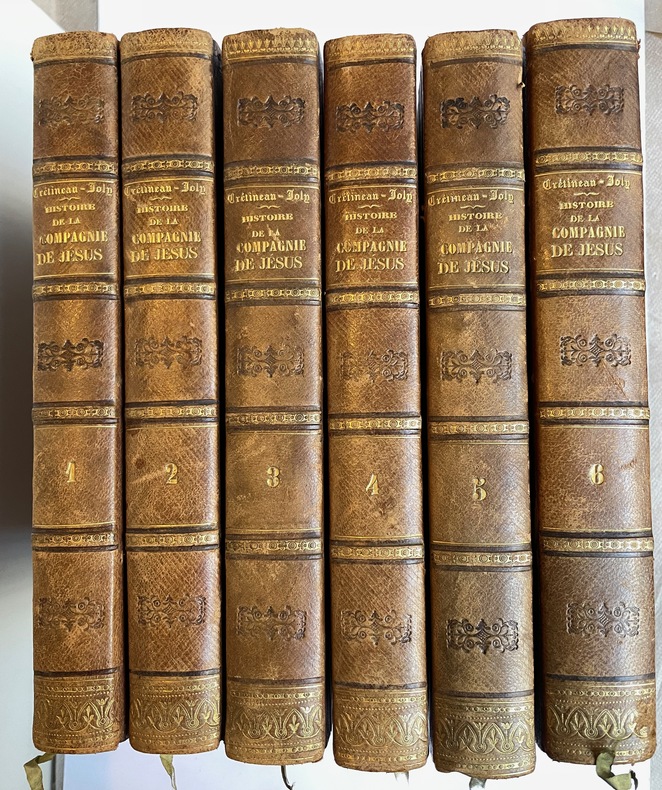
1844ARC-1731844 Paris. 1844. 6 volumes in 8°, demi basane prune, dos à nerfs orné, première édition illustrée de 12 portraits, 26 fac simile de lettres et une planche dépliante représentant l'arbre géographique des implantations jésuites dans le monde (tome 5).
1892R58326Florentiae [Firenze, Florence], Ex typographia a SS.Conceptione 1892-1893 Complete in 3 volumes: xvi,684 + xiv,622 + xi,739pp., text in latin, 31cm., cart.cover with leather spines (engilded title on spine), few foxing, VG
Complete in 3 volumes: xvi,684 + xiv,622 + xi,739pp., text in latin, 31cm., cart.cover with leather spines (engilded title on spine), few foxing, VG
055828Le Mans Leguicheux, imprimeur-libraire 1889 in 8 (22x14,5) 4 volumes reliures demi chagrin bleu de l'époque, dos à nerfs soulignés de filets à froid, IV et 312 pages [1], 332 pages [1], 356 pages [1], 444 pages, avec 13 planches hors-texte dont 8 dépliantes. Rare. Très bel exemplaire ( Photographies sur demande / We can send pictures of this book on simple request )

_3.jpg)