2 540 résultats
17184988Turin ie Paris: Jacques Daniel 1718. Soft cover. Very Good. Small 8vo. 2 ff 66 pp 1 ff. Title page printed in red and black. Bound in contemporary marbled wrappers. Slightly dog-eared otherwise a very good copy. Rare compilation of anti-Jesuit apocrypha: the famous 'Monita secreta' is found here alongside a purported condemnation of the Jesuits by the Faculty of Theology in Paris in 1554 as well as a translation of a prophecy of Saint Hildegaarde commonly seen as fortelling the fall of the Order. The present work bears a transparently false imprint "chez Jacques Daniel a good subject of the Prince at the Sign of Truth"; we have been unable to trace any other record of the publisher Daniel in Turin. While the place of printing was almost certainly Paris the foreign imprint corroborates the polemicist's allegation that France had become such a Jesuit stronghold that the work could not be published there. The Monita Secreta was a guide allegedly written by the Jesuits explaining how to gain riches and make influential friends; bibliographers often attribute it to a Pole Jerome Zaorowsky exiled from the Society in 1611. The work was first printed in 1614 and enjoyed numerous printing couched under various suggestive titles - 'Jesuit intrigues' 'the cabinet of the Jesuits secrets opened' etc. As a forged work of slander for both its widespread dissemination and influence it may be compared to the anti-Semitic Protocols of the Elders of Zion. The editor of the present edition again introduces the work as a clandestine publication - "I do not know by what means it fell into the hands of Printers". The work is written in a straightforward and factual way and instructs members of the Order to court wealthy widows gain promotions and discredit members of other orders. Alexandre Brou for example attributes the printings of the late 17th century to the Jansenists in their ongoing political struggle against the Order; whether the present 'Turin' printing falls into that category remains to be determined. 1708 saw the forced dissolution of the Jansenist stronghold Port-Royal; in the years which followed many Jansenists were excommunicated by Papal bulls for their beliefs. The remarkable rise of the Jesuit Order from its founding in 1540 provoked both suspicion and envy in the religious world: as the editor of the present edition states "the rise of the Jesuits is the object of admiration of the entire world. One cannot understand precisely how in less than two centuries these clerics have managed to become so powerful making themselves formidable to all other Orders and wielding influence in both the Old and New Worlds. It is a mystery for many people." OCLC shows no US copies of this title which appeared again in 1729 without an imprint. OCLC 459214162. Cf De Backer-Sommervogel V: 491-5 p 493 for this edition on the Monita secreta. Cf also Brou Les Jesuites de la Legende I: 290 1906. Jacques Daniel paperback
17184988Turin ie Paris: Jacques Daniel 1718. Soft cover. Very Good. Small 8vo. 2 ff 66 pp 1 ff. Title page printed in red and black. Bound in contemporary marbled wrappers. Slightly dog-eared otherwise a very good copy. Rare compilation of anti-Jesuit apocrypha: the famous 'Monita secreta' is found here alongside a purported condemnation of the Jesuits by the Faculty of Theology in Paris in 1554 as well as a translation of a prophecy of Saint Hildegaarde commonly seen as fortelling the fall of the Order. The present work bears a transparently false imprint "chez Jacques Daniel a good subject of the Prince at the Sign of Truth"; we have been unable to trace any other record of the publisher Daniel in Turin. While the place of printing was almost certainly Paris the foreign imprint corroborates the polemicist's allegation that France had become such a Jesuit stronghold that the work could not be published there. The Monita Secreta was a guide allegedly written by the Jesuits explaining how to gain riches and make influential friends; bibliographers often attribute it to a Pole Jerome Zaorowsky exiled from the Society in 1611. The work was first printed in 1614 and enjoyed numerous printing couched under various suggestive titles - 'Jesuit intrigues' 'the cabinet of the Jesuits secrets opened' etc. As a forged work of slander for both its widespread dissemination and influence it may be compared to the anti-Semitic Protocols of the Elders of Zion. The editor of the present edition again introduces the work as a clandestine publication - "I do not know by what means it fell into the hands of Printers". The work is written in a straightforward and factual way and instructs members of the Order to court wealthy widows gain promotions and discredit members of other orders. Alexandre Brou for example attributes the printings of the late 17th century to the Jansenists in their ongoing political struggle against the Order; whether the present 'Turin' printing falls into that category remains to be determined. 1708 saw the forced dissolution of the Jansenist stronghold Port-Royal; in the years which followed many Jansenists were excommunicated by Papal bulls for their beliefs. The remarkable rise of the Jesuit Order from its founding in 1540 provoked both suspicion and envy in the religious world: as the editor of the present edition states "the rise of the Jesuits is the object of admiration of the entire world. One cannot understand precisely how in less than two centuries these clerics have managed to become so powerful making themselves formidable to all other Orders and wielding influence in both the Old and New Worlds. It is a mystery for many people." OCLC shows no US copies of this title which appeared again in 1729 without an imprint. OCLC 459214162. Cf De Backer-Sommervogel V: 491-5 p 493 for this edition on the Monita secreta. Cf also Brou Les Jesuites de la Legende I: 290 1906. Jacques Daniel paperback books
Very Good Arabic Original cloth bdg. Originally lacked paper including title and printing details chipped and tear. Interior very good. Otherwise a good copy. [14], 378 p. Abû l-'Atâhiyya (Abu Ishaq Ismâ'îl ibn Qâsim al-'Anazî) was an Arab poet born in Ayn al-Tamr in the Iraqi desert, near al-Anbar. His ancestors were of the tribe of 'Anaza. His youth was spent in Kufa, where he was engaged for some time in selling pottery. During the time when he took the occupation of selling pottery, he saw the assembly of poets in a competition and he participated in it. Thus he became famous for his poetry. For uplifting his poetry he reached to Baghdad. Moving to Baghdad, he continued his business there, but became famous for his verses, especially for those addressed to 'Utba, a concubine of the Abbasid Caliph al-Mahdi. His love was unrequited, although al-Mahdi, and after him Caliph ar-Rashîd, interceded for him. Having offended the caliph, he was imprisoned for a short time. He died in 828 in the reign of Caliph al-Ma'mûn. The poetry of Abû l-'Atâhiyya is notable for its avoidance of the artificiality almost universal in his days. The older poetry of the desert had been constantly imitated up to this time, although it was not natural to town life. Abû l-'Atâhiyya was one of the first to drop the old qasîda (elegy) form. He was very fluent and used many metres. He is also regarded as one of the earliest philosophical poets of the Arabs. Much of his poetry is concerned with the observation of common life and morality, and at times is pessimistic. Thus he was strongly suspected of heresy. Compiled and prepared by Louis Cheikho. Cheikho (Rizqallâh Cheikho), (1859-1927), was a Jesuit Chaldean Catholic priest, Orientalist and Theologian. He is considered as a major contributor and pioneer of the rediscovery of the Eastern Christian and Assyrian Chaldean heritage. Louis Cheikho was born in Mardin, Turkey on February 5, 1859. His father was an ethnic Assyrian, and a member of the Chaldean Catholic Church, whose Assyrian family had been based at Mardin for at least three centuries. His mother was an Armenian named Elizabeth Schamsé, who took him on pilgrimage to the Holy Land when he was 9 years old. In 1868, Cheikhô joined his brother at the Maronite Jesuit Seminary in Ghazîr, Lebanon. At this date, the seminary was not merely preparing young men for the priesthood, but also acted as a secondary college for young Christian and especially Assyrian Chaldean men. Both groups followed a similar syllabus. There, he learned both ancient and modern European and Semitic languages. In 1874 he entered the Jesuit Order and started his novitiate training at Lons-le-Saunier, France. He adopted at that time the name of 'Louis' out of devotion for the young Jesuit saint Louis Gonzaga. In 1878, he returned to Lebanon and taught Arabic Literature at the Jesuit Saint Joseph College in Beirut for 10 years. During this period, Cheikho continued his studies of philosophy at Université Saint-Joseph, Beirut. In 1888, Cheikho travelled to Great Britain for theological studies in preparation for the priesthood. He was ordained priest by the Chaldean Church of the East on 8 September 1891. He then spent one year in Austria and another year in Paris. Those extended European stays allowed him to acquire the academic methodologies that helped him in his later works. Finally in 1894, he settled in Beirut, Lebanon, where he continued his academic career at Université Saint-Joseph. Cheikho died in Beirut in 1927. Cheikho is perhaps the founder of modern publications of unpublished Eastern Christian texts, especially Christian Arabic texts. He also founded, in 1898, the journal Al-Machriq, and contributed many articles and publications to its pages. His work was an inspiration for CEDRAC. (Wikipedia). First Edition. Extremely rare. This edition not in OCLC; for late editions see OCLC 404750229.
1764316736Rouen; Paris: s.n. 1764. viii. 499 6; vi 516 4; vi 447 3; vi 509 5; viii 4 311; 4 309-688 pp. 12mo. First four volumes in decorative brown paste-paper boards and sheep backs and corners other 2 volumes in full stained sheep with paste-paper endpapers backs of all six volumes uniform and richly gilt. A fine set in attractive dress. viii. 499 6; vi 516 4; vi 447 3; vi 509 5; viii 4 311; 4 309-688 pp. 12mo. Volumes I-III contain the history of the Society of Jesus from its origin until the end of the eighteenth century and the first analysis of its constitutions and privileges. Volume IV continues that analysis and has an index of the four-volume set. Barbier assigns the analysis chapters to Lois-Adrien Le Paige. Christophe Coudrette 1701-1774 was a Jansenist and the author of several anti-Jesuit works. Cioranesco 21317. Provenance: Fürstlich-Starhemberg'sche Familien Bibliothek Schloss Eferding ink stamp on front endpapers off all volumes; Loyola Reference Library stamp on lower edges call numbers in pencil on title-pages s.n. unknown
1761TSUtaJES99Rome: Printed by Salomoni 1761. 1761. 8vo. pp. 96. 11pp. of ms. additions at end. woodcut title vignette & tailpiece. contemporary vellum some foxing throughout. Listing of the scholars professors coadjutors in the various Jesuit colleges and houses under the jurisdiction of the Province of Rome. An alphabetical index of priests and scholars giving dates of admission and rank is provided at the end and is followed by eleven pages of additional manuscript additions for 1761 and 1762. Not found in NUC. Rome: Printed by Salomoni, [1761]. hardcover
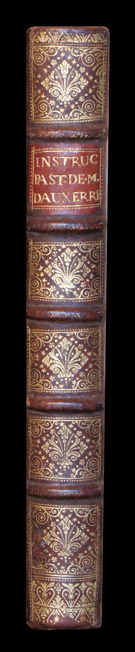
172616476en un volume in-4 ; dos à nerfs très décoré et doré, pièce de titre grenat, roulette sur les coupes et d’intérieur (reliure de l’époque).1- Ordonnance et instruction pastorale de Mgr l’évesque d’Auxerre, portant condamnation de plusieurs Propositions extraites des cahiers dictez au Collège d’Auxerre, par le frère Le Moyne de la Compagnie de Jésus. Paris, Delespine, 1726 ; 40, (2) pp. 2- Instruction pastorale de Mgr l’évêque d’Auxerre, au sujet de la Remontrance que les Jésuites lui ont adressée, pour la défense des Propositions extraites des Cahiers dictez au Collège d’Auxerre, par le frère Le Moyne de leur compagnie, que ce Prélat a condamnées par son Ordonnance du 18 décembre 1795. S.l., s.n., 1727 ; 110, (2) pp. 3- Recueil des principales censures des archevêques et évêques de France, contre le livre intitulé : Apologie pour les Casuistes, contre les calomnies des Jansénistes, publié en 1657. 50 pp. 4- Dénonciation faite à tous les évêques de l’Église de France, par le corps des Pasteurs et des autres ecclésiastiques du Second Ordre, zélés pour la "Conservation du Dépôt de la Foi, et l’honneur de l’épiscopal", des Jésuites, et de leur doctrine. Paris, s.n., 1727 ; XII, 282 pp., (1) f. blanc.
158665712Tübingen bzw. ohne Ort, Georg Gruppenbach bzw. ohne Verlag, 1585-1586. 4°. Flex. Manuskript-Pgmt. d. Zt. m. (tlw. gekürzten) Bindebändern.
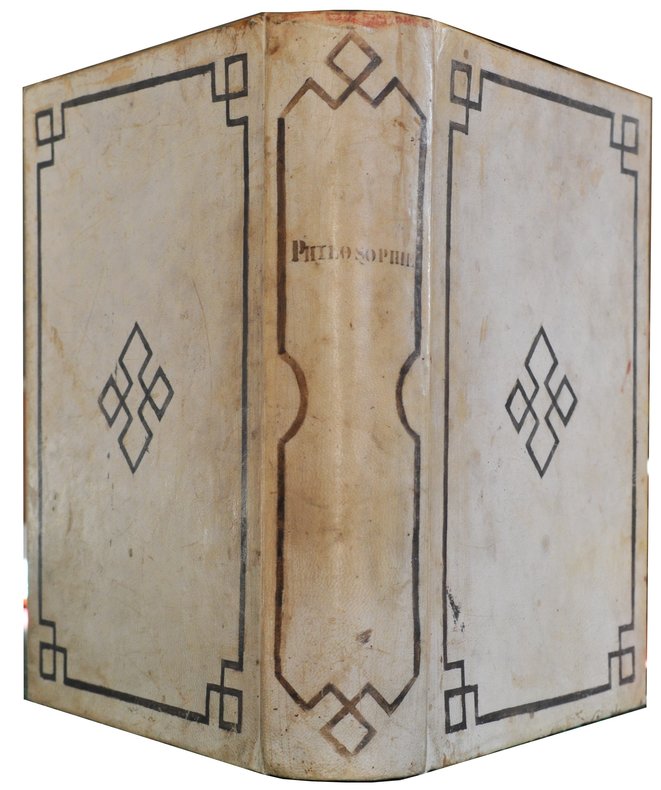
188046405259s. l. n. d., (vers 1880) ; in-4, plein vélin, encadrement et décor central géométrique à l’encre noire, dos orné du même motif, tranches rouges. (Reliure de l’époque) faux-titre, titre et 812 pp. (mal chiffrées.)Manuscrit soigneusement calligraphié, chaque page dans un encadrement réglé à la plume. 3 illustrations montrant sous la forme d’arbres les dépendances entre les différents domaines de la philosophie. Le texte semble inédit.PROLÉGOMÈNESPHILOSOPHIE EN GÉNÉRAL : De l’origine de la philosophie - Du sujet ou de la division de la philosophie - De l’objet de la philos.PHILOSOPHIE EN SES PARTIES : Logique : - Entendement - Jugement - Raisonnement - MéthodeETHIQUE, MétaphisiqueMORALEHISTOIRE DE LA PHILOSOPHIEPremière époque, philosophie orientale - Deuxième époque, philosophie grecque - Troisième époque, philosophie des cinq premiers siècles de l’ère chrétienne - Quatrième époque, philosophie du Moyen Âge - Cinquième époque, philosophie moderneLe titre de l’ouvrage “Philosophie” porte le monogramme A. M. D. G. indiquant que l’auteur du cours est probablement un jésuite. La signature Balincourt figure sur le premier feuillet de texte et un feuillet à l’intérieur du volume. L’ouvrage provient de la bibliothèque de la famille Testu de Balincourt.
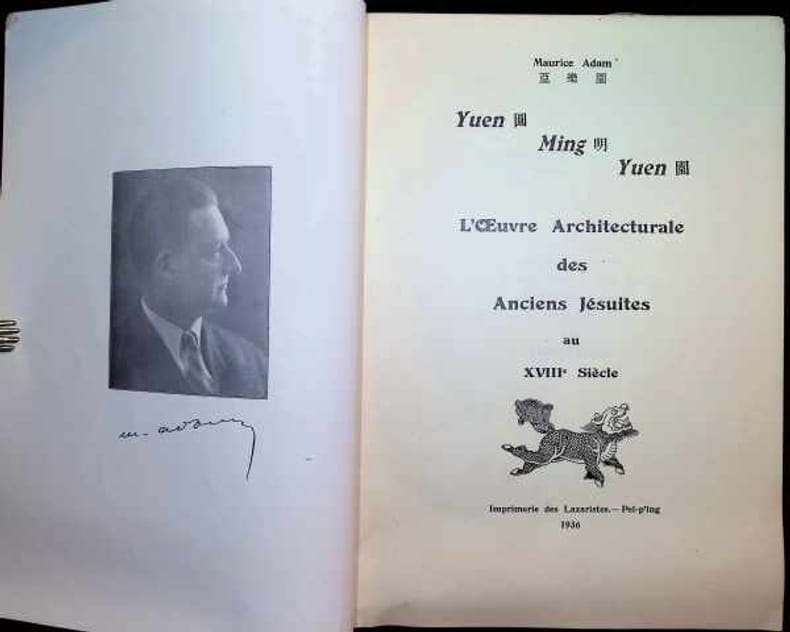
1936030110Pei-p'ing 1936 imprimerie des Lazaristes Soft cover 1st Edition
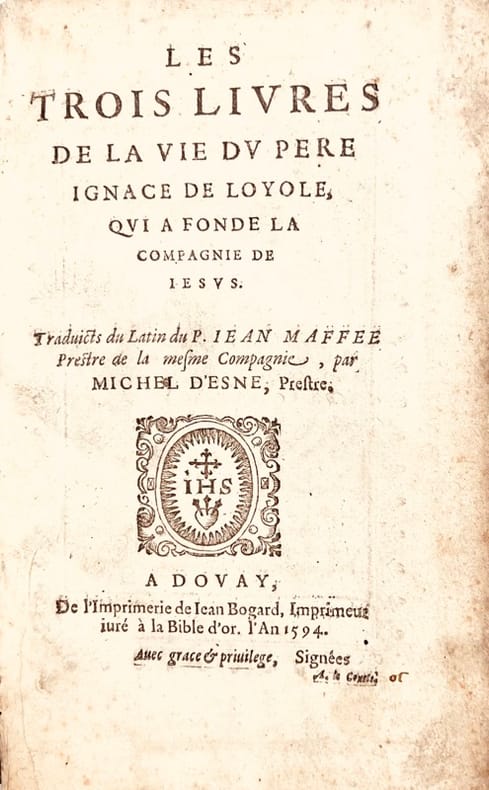
159443513A Douay, De l'imprimerie de Jean Bogard, 1594. Petit in-8 de (4)-298-(2) pages, vélin souple de l'époque.
226129Vienne et Augsbourg, 1763 8 parties en 4 vol. in-8, veau fauve, dos à nerfs cloisonnés et fleuronnés, pièces de titre et de tomaison cerise et bouteille, tranches rouges (reliure de l'époque). Petites usures.
In-8° 4 volumi. 1) pp. (4), 34, 721 piccola lacuna a p. 75. 2) pp. (2), 392. 3) pp. (2), 270, 1 cb., una piccola gora di inchiostro alle prime due carte. 4)pp. (2), XVIII, 748, LXXXV, 86-116, Queste ultime carte contengono le Costituzioni di Benedetto XIV del 1744. legature con tracce d’uso. L’opera affronta la annosa questione dei riti malabarici, cosiddetti dalla regione indiana di Malabar: i Gesuiti, missionari nelle Indie orientali, avevano autorizzato una pericolosa e non ortodossa commistione di cerimonie cristiane e riti pagani. Il cappuccino Norberto, (1697-1770), pseudonimo dell’abate Platel, offre una descrizione storica molto dettagliata e critica delle missioni gesuite in Malabar, arricchita da molte notizie circa la cultura e costumi degli indiani. Il legato pontificio de Tournon promulgò nel 1704 la prima condanna dei riti malabarici, e con Benedetto XIV si ebbe la normativa in 16 punti che definiva il comprtamento dei missionari cattolici. missioni mission viaggi India malabar riti rites customs indians jesuits gesuiti cappuccini
In -4°, pp. (40), 146, (6), pergamena coeva, difetti al dorso. Prima edizione. Nato a Saragozza, l’autore insegnò a Napoli e Roma prima di partire per Cuba, dove avrebbe passato la vecchiaia. Il libro, interessante e curioso, si occupa di prostituzione e della sua accettabilità dottrinaria, argomento rispetto al quale l’autore è fortemente contrario. Lo scritto replica a un manoscritto (poi stampato a Catania, “Resolutio theologica moralis in qua occasione cuiusdam casus occurrentis afferitur et propugnatur, licite permitti posse Meretrices”, 1677) del francescano Giovanni dell’Olmo, che difendeva il diritto delle prostitute a entrare nelle dimore nobiliari napoletane. La polemica svela molto sui costumi del sesso a pagamento all’epoca. Born in Saragoza, the author was a professor in Naples and Rome before leaving to Cuba. This curious book deals with prostitution and its doctrinaire acceptability (that the author is strongly against to). This work replies to a manuscript (then printed in Catania, “Resolutio theologica moralis in qua occasione… licite permitti posse meretrices”, 1677) of a franciscan preacher, Giovanni dell’Olmo, who supports permission to prostitutes to enter in neapolitan noble palaces. This controversy reveals many facts about prostitution at time.
83398aafFreiburg (Schweiz), Ex officina Typographica Abrahami Gemperlini (Abraham Gemperlin), 1593, in-4to, 12 Bl. (Titel mit Holzschnittdruckermarke, kaiserliches Privileg, Dedicatio, Festtagsordnung) + 848 S. + 4 Bl. (Sachindex), mit zahlreichen Holzschnittzierleisten im Text, fast durrchgehend schwacher Wasserfleck im Fusssteg, teils stockfleckig und etwas gebräunt, wenige Marginalien von alter Hand, hs. Besitzervermerke auf vord. Innendeckel u. Vorsatz, Stempel u. Nummer auf dem Titel, Papieretiquett auf Titelbl. verso, Schweinslederband d. Z. über Holzdeckeln mit reicher Rollen- und Plattenstempelprägung und 2 intakten Messing-Lederschliessen, Einband berieben, vorderes Scharnier etwas über die Hälfte angeplatzt, Spuren von Wurmfrass an Vordervorsatz u. Titel, kleine Fehlstelle an unterer Vorderecke, schönes festes Exemplar.
165799081657 veau brun, dos à n., tr. dorées. pet. in-12, (12ff.), 396pp., 108pp., Cologne chés Pierre de La Vallée 1657, (Amsterdam Louis et Daniel Elzévier),
1758317<p>FIRST EDITION. 12mo. bound in full havanan speckled calf smooth back decorated with golden fillets and florins title piece red slices binding of the time XXVI 588 pp. An excellent copy. Original edition of this anonymous charge against the Society of Jesus proposing to expose "the seditious doctrine of the Jesuits that authorizes attacks on the sacred person of kings. The author trumps up a global conspiracy theory in which Jesuits murdered kings and emperors including an organized plot to kill King Henry IV and the execution of Emperor Kangxi of China by missionaries. The text systematically moves from one country to the next reporting on the supposed crimes that Jesuit residents or visitors committed there: seduction fraud homicide theft & libel. Bibliotheca Brasiliense 1316; see Goldsmiths' -Kress 9442.</p> La Haye chez les frères Vaillant hardcover
1957108152Institut Supérieur de Théologie, Enghein (Belgique), Imprimerie de Meester Frères, Wettern (Belgique) 1957 Introduction de Pierre Delattre. 19 fascicules reunis en 17 tomes In-4 broché 30 cm sur 23. Texte sur deux colonnes. Fascicules 1-5 :XX-1566pp, fasc 6-9 :1606pp, fasc 10-13 :1607, fasc 14-17 :1627pp, fasc 18-19 :674pp. Pages non massicotées. Couvertures ternies, dos fragilisés effrangés et rousseurs sur les tranches sinon corps du livre bon état d’occasion.
35561Rome - Imprimerie de la Chambre apostolique - 1715 - [puis] - A Liège - Chez Daniel Moumal - 1700 - [puis] - sn - 1702 - [puis] - Paris - 1702 - ensemble de 6 ouvrages ou plaquettes réunies en un volume in12 - Reliure pleine basane d'époque - dos cinq nerfs orné de fleurons - Bon état intérieur mais reliure usagée, solide cependant -
236395Cologne [Hollande], héritiers de Corneille d'Egmond, 1700 2 tomes en un fort vol. in-12, 378 pp., [2] ff. n. ch. de table, [3] ff. n. ch. (titre du tome II, table), 366 pp., [4] ff. n. ch. de permissions et d'index, veau fauve granité, dos à nerfs cloisonné et fleuronné, pièce de titre, encadrement de simple filet doré sur les plats, tranches mouchetées de rouge (reliure de l'époque). Restaurations aux coiffes et coins.
240269Paris, Pierre-Guillaume Simon, 1772 in-4, 42 pp., titre intermédiaire, 396 pp., 22 pp. de table alphabétique, veau fauve marbré, dos à nerfs cloisonné et fleuronné, pièce de titre, encadrement de triple filet doré sur les plats, double filet doré sur les coupes, tranches marbrées (reliure de l'époque).
215552Lille, Nicolas de Rache, 1667 in-4, [17] ff. n. ch. (titre, dédicace, avertissement), [457] pp. mal chiffrées 459 (il y a saut de chiffrage de 136 à 139), [11] pp. n. ch. (poésies, table des chapitres, privilège, errata), avec un portrait-frontispice, 3 grandes compositions à pleine page dans le texte, et 3 planches dépliantes hors texte "in fine" (la chapelle ardente), vélin souple granité, dos muet, tranches mouchetées de rouge (reliure de l'époque). Petite tache angulaire.
1612001041S.l. s.n. 1612
1688PHO-1323Paris ,Claude Barbin, 1688. Un volume in-4°. Reliure de l’époque ,plein veau havane, dos à nerfs orné de caissons de double filet doré fleuronnés, pièce de titre en maroquin, roulette dorée sur coupes, tranches mouchetées rouges , début de fente , des frottements, manque en queue, auréole en marge supérieure de quelques feuillets , petites taches au titre .
In-12°, raccolta di dieci opuscoli, legatura in pelle coeva, nervature e tassello e titolo in oro al dorso, tagli in rosso, buona copia, ex libris alla carta di guardia di contropiatto superiore. 1) Relaçaõ abbreviada da Republica, que os Religiosos Jesuitas das Provincias de Portugal, e Hespanha, estabeleceraõ nos Dominios Ultramarinos das Duas Monarchias...Relation abregée concernant la République...pp.68 2) Recueil de pièces, pour servir d’addition & de preuve à la Relation abregée concernant la République établie par les Jésuites dans les Domaines d’outre mer...XV, 91; 3) Second recueil de pieces, concernant les usurpations des Jésuites dans l’Amérique espagnole & portugaise...40pp; 4) Mémoires pour servir d’addition & d’éclaircissement à la relation abregée, &c. qu’on vient de donner au public, sur l’abominable conduite des Jésuites, dans les pays & domaines d’outre-mer dépendans des Royaumes d’Espagne & de Portugal...30pp; 5) Lettres en forme de bref, de N.S. P. le Pape Benoist XIV, par lesquelles, de son propre mouvement, il établit & constitue l’Eminentissime et Reverendissime François de Saldanha, Cardinal Diacre de la Sainte Eglise Romaine...(1), 24pp; 6) Decret du Card. Saldanha, pour la réforme des Jésuites de Portugal & des domaines qui en dépendent. Du 15 mai 1758 (trad. Pierre Olivier Pinault) (1), V, 2-17; 7) Lettre de Monsieur l’Archevêque d’Utrecht à un ecclésiastique de France: au sujet des affaires présentes de l’Eglise...31pp; 8) Très-humbles et très-respectueuses remontrances que présentent au Roi, notre très-honoré & Souverain Seigneur, le gens tenans sa Cour de Parlement de Normandie...42pp; 9) Très-humbles et très-respectueuses remontrances que présentent au Roi, notre très-honoré & Souverain Seigneur, le gens tenans sa Cour de Parlement à Rouen...34pp; 10) Discours prononces dans l’Academie Françoise, le lundi 10 Mars 1760 a la reception de M. Le Franc de Pompignan...27pp Si tratta di una raccolta di opuscoli di vario soggetto, i primi sei dei quali riguardano la cattiva gestione dei gesuiti nei territori spagnoli e portoghesi d’oltremare e le relative lettere di lagnanze dirette alle autorità ecclesiastiche, l’intervento di Benedetto XIV in proposito con la nomina di Francisco De Saldanha a cardinale di Lisbona e la riforma della Compagnia di Gesù in Portogallo ad opera di questi. Il settimo opuscolo è una lettera scritta dall’Arcivescovo di Utrecht ad un ecclesiastico francese ignoto, in cui il prelato tratta delle questioni correnti nella Chiesa, tra cui il giansenismo. Gli opuscoli ottavo e nono sono rimostranze che il Parlamento normanno indirizzò a Luigi XVI riguardo l’imposizione di nuove imposte, mentre l’ultimo opuscolo è il discorso d’insediamento tenuto da Monsignor Le Franc de Pompignac davanti all’Accademia di Francia e il discorso in risposta a questo tenuto da M. Dupré de Saint Maure, Presidente dell’Accademia. In-12 °, collection of ten pamphlets, contemporary calf binding, bands, label and gilt title on the spine, red edges, good copy, ex libris on the endpaper (back side). It is a collection of pamphlets of various subjects, the first six of which concern the mismanagement of the Jesuits in the Spanish and Portuguese overseas territories and the related letters of complaints addressed to the ecclesiastical authorities, the intervention of Benedict XIV in this matter with the appointment of Francisco De Saldanha as cardinal of Lisbon and the reform of the Society of Jesus in Portugal made by him. The seventh pamphlet is a letter written by the Archbishop of Utrecht to an unknown French clergyman, in which the prelate deals with current issues in the Church, including Jansenism. The eighth and ninth pamphlets are grievances that the Norman Parliament addressed to Louis XVI regarding the imposition of new taxes, while the last pamphlet is the inauguration speech given by M. Le Franc de Pompignac before the French Academy and the speech in response to this given by M. Dupré de Saint Maure, President of the Academy.
In-8 (114 x 175 mm), demi-basane fauve à la Bradel, dos lisse orné d’une guirlande dorée répétée en place des nerfs, pièce de titre de veau noir (reliure du XVIIIe), 309, (71) p., page de titre entièrement gravée dans un encadrement architectonique. Importante édition des Constitutions de la Société de Jésus, l’acte fondateur et le texte de base de l'organisation de la Compagnie, rédigé en espagnol par Ignace de Loyola et traduit en latin par Juan de Polanco, son secrétaire et assistant. Cette édition de 1583 est la première à contenir le dernier état du texte révisé en latin par Ignace de Loyola avant sa mort ainsi que ses notes et commentaires, disposés en marge ou intégrés dans des blocs de texte en caractères italiques. Ces commentaires avaient été d’abord publiés séparément. Elle est également la première à contenir, en pagination continue, "L’examen général", soit les conditions requises pour être admis au sein de la Société ("Primum ac generale examen iis omnibus qui in Societatem Iesu admitti petent proponendum" : p. [3]-48) ainsi qu'un index général. (Olschki, II, 2499: "Edition fort bien imprimée et peu commune". Backer-Sommervogel, V, 77. Manque à Palau. A.F. Johnson, ‘Catalogue of Italian engraved title pages in the 16e c.’, 19, 20). Petit cachet ex-libris de bibliothèque jésuite. Mors et dos frottés. Bon exemplaire, frais, assez grand de marges, bien conservé.