2 540 résultats
Petit in-12, plein veau de l'époque, dos à nerfs orné, pièce de titre de maroquin, tranches rouges (importantes épidermures au dos), petite galerie de vers aux prem. cahiers de la deuxième partie. 1- Edition originale, "véritable Elzevier d'Amsterdam" selon Willems, n°1421 de ce violent pamphlet dirigé contre les jésuites. Les pages 214 à 217 concernent l'activité des Jésuites au Japon ("Jésuites en preschant l'Evangile au Jappon sement les seditions & la guerre…". 2- Cet ouvrage parut également sous le titre de "Le Bouclier de la France, ou les Sentimens de Gerson et des canonistes, touchant les différens des rois de France avec les papes". "Ouvrage écrit à propos de l'affaire des franchises de quartier à Rome" ('Sources de l'Histoire de France', n°3033).
7 ouvrages reliés en un volume in-12, plein veau marbré de l'époque, dos à nerfs orné de caissons fleuronnés et cloisonnés, pièce de titre de veau vert. Recueil de sept pamphlets et essais concernant "l’affaire des Jésuites" et les questions religieuses les plus controversées du temps, à la suite du scandale provoqué par l’exécution du prêtre italien Gabriel Malagrida. Missionnaire au Brésil, celui-ci fut livré au bûcher à Lisbonne le 21 septembre 1761 après un procès inique. "L'affaire des Jésuites" débuta en 1761 au parlement de Paris. Considérée dans toute l'Europe comme le principal soutien de l'Église romaine ultramontaine, la compagnie de Jésus avait de nombreux ennemis au sein du jansénisme parlementaire et gallican français, mais aussi du "parti philosophique". Diderot, d'Alembert et Voltaire se mirent rapidement de la partie, dans la marge étroite qui leur était allouée dans le combat contre les Jésuites, sans pour autant adhérer aux thèses des parlementaires ni, encore moins, accorder leur sympathie envers les jansénistes. Par l'édit du novembre 1764, Louis XV supprima la Compagnie du royaume. Petit accroc à la coiffe inférieure. Très bon exemplaire, frais, bien relié à l’époque.
2004100151628Bialec 2004 in4. 2004. Cartonné jaquette. Ouvrage collectif retraçant l'histoire du Collège royal fondé par Henri IV en 1604 devenu Prytanée national militaire en 1808 à l'occasion de son 400e anniversaire. Le livre couvre les périodes jésuite (1604-1762) la transition (1762-1808) et l'époque moderne avec des contributions de plusieurs auteurs
197390004-88 pages. Etat correct. Dim 11x19 cm. Edition Paulinus-Druckerei, Trèves, 1973. Portrait et photos. Imprimatur de J. Thomas, Vicaire général à Tournay (Belgique)
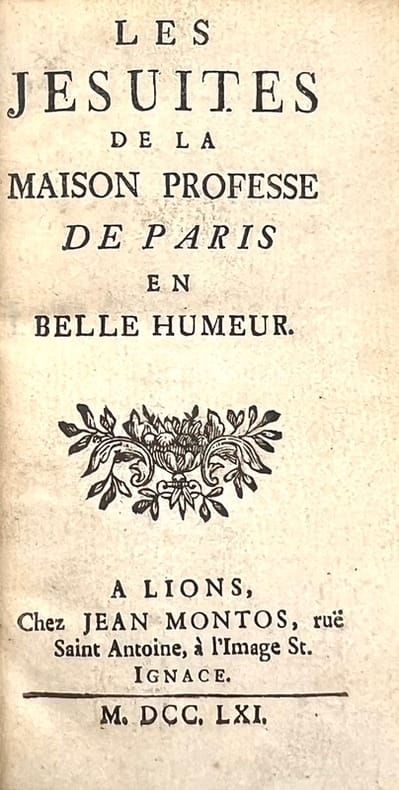
176143276Lions, Jean Montos, 1761. In-16 (6)-180 pp., 1 figure hors texte, demi-maroquin chagriné aubergine à coins, dos lisse orné, tranches rouges (reliure du XIXe siècle).
Very Good Arabic Original cloth bdg. Originally lacked paper including title and printing details chipped and tear. Interior very good. Otherwise a good copy. [14], 378 p. Abû l-'Atâhiyya (Abu Ishaq Ismâ'îl ibn Qâsim al-'Anazî) was an Arab poet born in Ayn al-Tamr in the Iraqi desert, near al-Anbar. His ancestors were of the tribe of 'Anaza. His youth was spent in Kufa, where he was engaged for some time in selling pottery. During the time when he took the occupation of selling pottery, he saw the assembly of poets in a competition and he participated in it. Thus he became famous for his poetry. For uplifting his poetry he reached to Baghdad. Moving to Baghdad, he continued his business there, but became famous for his verses, especially for those addressed to 'Utba, a concubine of the Abbasid Caliph al-Mahdi. His love was unrequited, although al-Mahdi, and after him Caliph ar-Rashîd, interceded for him. Having offended the caliph, he was imprisoned for a short time. He died in 828 in the reign of Caliph al-Ma'mûn. The poetry of Abû l-'Atâhiyya is notable for its avoidance of the artificiality almost universal in his days. The older poetry of the desert had been constantly imitated up to this time, although it was not natural to town life. Abû l-'Atâhiyya was one of the first to drop the old qasîda (elegy) form. He was very fluent and used many metres. He is also regarded as one of the earliest philosophical poets of the Arabs. Much of his poetry is concerned with the observation of common life and morality, and at times is pessimistic. Thus he was strongly suspected of heresy. Compiled and prepared by Louis Cheikho. Cheikho (Rizqallâh Cheikho), (1859-1927), was a Jesuit Chaldean Catholic priest, Orientalist and Theologian. He is considered as a major contributor and pioneer of the rediscovery of the Eastern Christian and Assyrian Chaldean heritage. Louis Cheikho was born in Mardin, Turkey on February 5, 1859. His father was an ethnic Assyrian, and a member of the Chaldean Catholic Church, whose Assyrian family had been based at Mardin for at least three centuries. His mother was an Armenian named Elizabeth Schamsé, who took him on pilgrimage to the Holy Land when he was 9 years old. In 1868, Cheikhô joined his brother at the Maronite Jesuit Seminary in Ghazîr, Lebanon. At this date, the seminary was not merely preparing young men for the priesthood, but also acted as a secondary college for young Christian and especially Assyrian Chaldean men. Both groups followed a similar syllabus. There, he learned both ancient and modern European and Semitic languages. In 1874 he entered the Jesuit Order and started his novitiate training at Lons-le-Saunier, France. He adopted at that time the name of 'Louis' out of devotion for the young Jesuit saint Louis Gonzaga. In 1878, he returned to Lebanon and taught Arabic Literature at the Jesuit Saint Joseph College in Beirut for 10 years. During this period, Cheikho continued his studies of philosophy at Université Saint-Joseph, Beirut. In 1888, Cheikho travelled to Great Britain for theological studies in preparation for the priesthood. He was ordained priest by the Chaldean Church of the East on 8 September 1891. He then spent one year in Austria and another year in Paris. Those extended European stays allowed him to acquire the academic methodologies that helped him in his later works. Finally in 1894, he settled in Beirut, Lebanon, where he continued his academic career at Université Saint-Joseph. Cheikho died in Beirut in 1927. Cheikho is perhaps the founder of modern publications of unpublished Eastern Christian texts, especially Christian Arabic texts. He also founded, in 1898, the journal Al-Machriq, and contributed many articles and publications to its pages. His work was an inspiration for CEDRAC. (Wikipedia). First Edition. Extremely rare. This edition not in OCLC; for late editions see OCLC 404750229.
Very Good Turkish, Ottoman (1500-1928) Original illustrated and decorative wrappers. Pages are untrimmed and not opened. 12mo. (16 x 12 cm). In Ottoman script. 104 p. Hejra-Hijri: 1311 = Gregorian: 1894. Early edition of this rare Turkish book with Arabic script about the Jesuits' society, the most influential community of the Catholic Church, their activities and formations from the 16th to the late 19th century. It was a translation from German, but it's not written original title in the book. Kaymakam Mehmed Tahir was a late Turkish martry who was a district governor of Yozgat city. He died in the War of Independence (1919-1922). Extremely rare. Özege 3085 / 2.; TBTK 7602. Second Edition.
Very Good Turkish, Ottoman (1500-1928) Original wrappers. 12mo. (16 x 12 cm). In Ottoman script. 44 p. Hejra-Hijri: 1304 = Gregorian: 1887. Extremely rare first edition of this Ottoman edition of 'history of the Jesuits'. This book has been abridged and translated from Taxil's work. Marie Joseph Gabriel Antoine Jogand-Pagès, better known by the pen name Léo Taxil was a French writer and journalist who became known for his strong anti-Catholic and anti-clerical views. He is also known for the Taxil hoax, a spurious expose of Freemasonry and the Roman Catholic Church's opposition to it. Marie Joseph Gabriel Antoine Jogand-Pagès was born in Marseille, and at the age of five, he was placed into a Jesuit seminary. After spending his childhood years in the seminary, he became disillusioned with the Catholic faith and began to see the religious ideology as socially harmful. Taxil first became known for writing anti-Clerical or anti-Catholic books, notably "La Bible amusante" (The Amusing Bible) and "La Vie de Jesus" (The Life of Jesus), in which Taxil satirically pointed out inconsistencies, errors, and false beliefs presented in these religious works. In his other books Les Debauches d'un confesseur (with Karl Milo), Les Pornographes sacrés: la confession et les confesseurs, and Les Maîtresses du Pape, Taxil portrays leaders of the Catholic Church as hedonistic creatures exploring their fetishes in the manner of the Marquis de Sade. In 1879, he was tried at the Seine Assizes for writing a pamphlet A Bas la Calotte ("Down with the Cloth"), which was accused of insulting a religion recognized by the state, but he was acquitted. In 1885, he professed conversion to Catholicism, was solemnly received into the church, and renounced his earlier works. In the 1890s, he wrote a series of pamphlets and books denouncing Freemasonry, charging their lodges with worshiping the devil and alleging that Diana Vaughan had written for him her confessions of the Satanic "Palladian" cult. The book had great sales among Catholics, although Diana Vaughan never appeared in public. In 1892, Taxil also began to publish a paper, La France chrétienne anti-maçonnique (Christian Antimasonic France), with his staunch anti-Masonic publishing friend, Abel Clarin de la Rive. In 1887, he had an audience with Pope Leo XIII, who rebuked the bishop of Charleston for denouncing the anti-Masonic confessions as a fraud and, in 1896, sent his blessing to an anti-Masonic Congress of Trent. Doubts about Vaughan's veracity and even her existence began to grow, and finally, Taxil promised to produce her at a lecture to be delivered by him on 19 April 1897. To the amazement of the audience (which included a number of priests), he announced that Diana was one of a series of hoaxes. He had begun, he said, by persuading the commandant of Marseille that the harbor was infested with sharks, and a ship was sent to destroy them. Next, he invented an underwater city in Lake Geneva, drawing tourists and archaeologists to the spot. He thanked the bishops and Catholic newspapers for facilitating his crowning hoax, namely his conversion, which had exposed the anti-Masonic fanaticism of many Catholics. Diana Vaughan was revealed to be a simple typist in his employ, who laughingly allowed her name to be used by him. The audience received these revelations with indignation and contempt. Afterward, Taxil left the hall, where policemen escorted him to a neighboring café. He then moved away from Paris. He died in Sceaux in 1907. An extremely rare first translation in Ottoman Turkish. Özege 9775. First Edition.
Very Good Greek, Modern (post 1453) Contemporary fine leather bdg. Demy 8vo. (22 x 15 cm). In Greek. 1118 p., richly illustrated (b/w ills.). Period bindery label of E. Watson in London. Ex-library copy on fourth blank page. Otherwise a very good copy. First and extremely rare translation into Greek of Taxil's 'Myste`res de la Franc-Mac?onnerie'. Mysteries of Freemasonry. Marie Joseph Gabriel Antoine Jogand-Pagès, better known by the pen name Léo Taxil was a French writer and journalist who became known for his strong anti-Catholic and anti-clerical views. He is also known for the Taxil hoax, a spurious expose of Freemasonry and the Roman Catholic Church's opposition to it. Marie Joseph Gabriel Antoine Jogand-Pagès was born in Marseille, and at the age of five, he was placed into a Jesuit seminary. After spending his childhood years in the seminary, he became disillusioned with the Catholic faith and began to see the religious ideology as socially harmful. Taxil first became known for writing anti-Clerical or anti-Catholic books, notably "La Bible amusante" (The Amusing Bible) and "La Vie de Jesus" (The Life of Jesus), in which Taxil satirically pointed out inconsistencies, errors, and false beliefs presented in these religious works. In his other books Les Debauches d'un confesseur (with Karl Milo), Les Pornographes sacrés: la confession et les confesseurs, and Les Maîtresses du Pape, Taxil portrays leaders of the Catholic Church as hedonistic creatures exploring their fetishes in the manner of the Marquis de Sade. In 1879, he was tried at the Seine Assizes for writing a pamphlet A Bas la Calotte ("Down with the Cloth"), which was accused of insulting a religion recognized by the state, but he was acquitted. In 1885, he professed conversion to Catholicism, was solemnly received into the church, and renounced his earlier works. In the 1890s, he wrote a series of pamphlets and books denouncing Freemasonry, charging their lodges with worshiping the devil and alleging that Diana Vaughan had written for him her confessions of the Satanic "Palladist" cult. The book had great sales among Catholics, although Diana Vaughan never appeared in public. In 1892, Taxil also began to publish a paper, La France chrétienne anti-maçonnique (Christian Antimasonic France), with his staunch anti-Masonic publishing friend, Abel Clarin de la Rive. In 1887, he had an audience with Pope Leo XIII, who rebuked the bishop of Charleston for denouncing the anti-Masonic confessions as a fraud and, in 1896, sent his blessing to an anti-Masonic Congress of Trent. Doubts about Vaughan's veracity and even her existence began to grow, and finally, Taxil promised to produce her at a lecture to be delivered by him on 19 April 1897. To the amazement of the audience (which included a number of priests), he announced that Diana was one of a series of hoaxes. He had begun, he said, by persuading the commandant of Marseille that the harbor was infested with sharks, and a ship was sent to destroy them. Next, he invented an underwater city in Lake Geneva, drawing tourists and archaeologists to the spot. He thanked the bishops and Catholic newspapers for facilitating his crowning hoax, namely his conversion, which had exposed the anti-Masonic fanaticism of many Catholics. Diana Vaughan was revealed to be a simple typist in his employ, who laughingly allowed her name to be used by him.The audience received these revelations with indignation and contempt. Afterwards, Taxil left the hall, where policemen escorted him to a neighboring café. He then moved away from Paris. He died in Sceaux in 1907. First Greek Edition. Rare. Only one copy in OCLC: 758917323.
Very Good Turkish, Ottoman (1500-1928) Contemporary red cloth bdg. 16mo. (15 x 11 cm). Text in Ottoman script; some terminological words in French in text. 80 p. First, only, and early Turkish Edition of this extremely rare tractate on Jesuit instructions. There's a description on verso of imprint page like: "Memanat yoktur; J. B. Kosta J. T.'den 23 Kanun-u Sâni 1926'da tâb olunmustur"; means it's printed from [original title] 'J. B. Kosta J. T.' in 1926, January 23. 'J. B.' should be Jerusalem Bible. This note is written by A. Rota according to the descriptive continuing text, and it goes on as 'Hasmetlü Papa hazretleri Dersaadet vekili, 25 Mart 1927' means 'The Pope the Great, his majesty, Dersaadet (Constantinople) delegate; 1927, 25 March'. This tractate was translated from the early Jesuit Christian instructions according to the Paris bishopric during the 17th century. It's printed by Jesuit Monks' Church in Beyoglu, Ayazpasa, in Constantinople. Just one copy in Bogaziçi University Library in OCLC: 949501963. Not in Özege. Extremely rare book on Jesuit literature in Turkey.
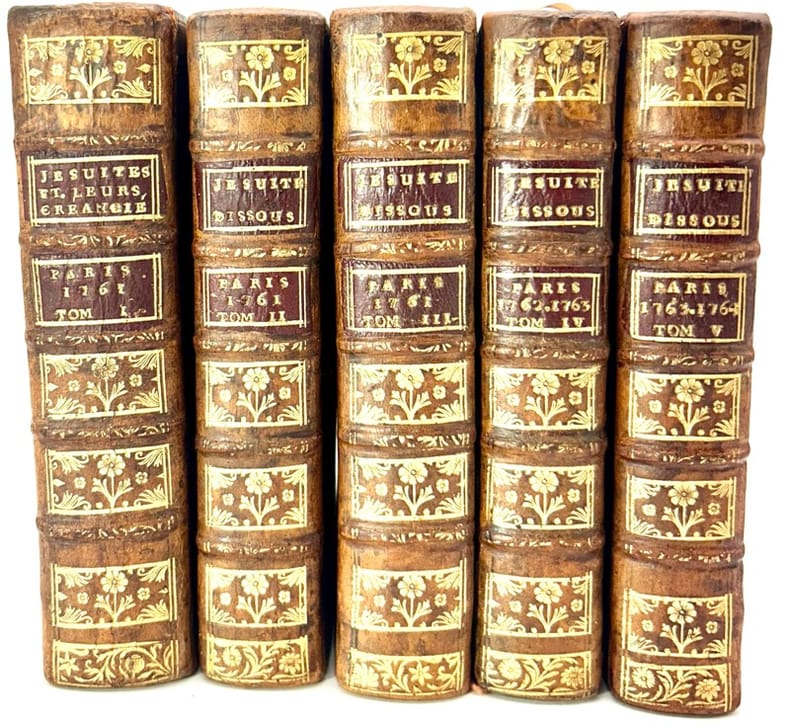
176110626, , 1761-1764. 37 pièces reliées en 5 vol. in-12, basane havane marbrée, dos orné à nerfs, pièces de titre et de tomaison en maroquin rouge, tranches marbrées (reliure de l'époque).
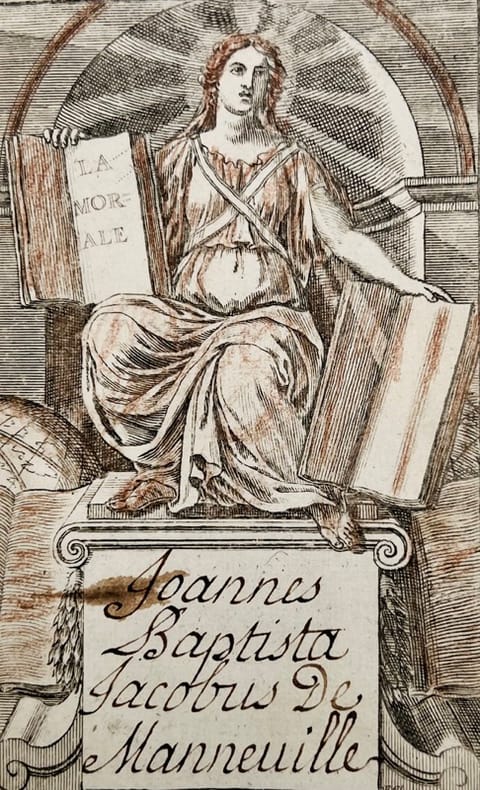
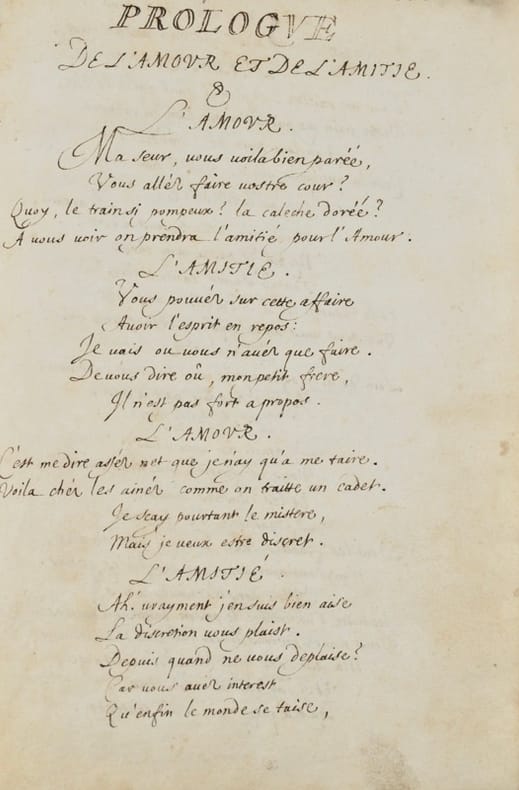
172343837, , 1723. Manuscrit in-12 de 207 pp., frontispice, table, basane brune, dos à nerfs orné à froid, trace de pièce de titre (reliure de l'époque).
437716Paris, J.-G. Dentu, 1827-1828. In-8, rel. de l'époque pleine basane brune granitée, dos lisse à faux nerfs formés de quadruples filets dorés bordés de roulettes dorées, petits fers spéciaux dorés, palette dorée en queue, plats ornés d'un encadrement ornementé doré, tranches cailloutées, VII-96, IV-202, IV-208, X-88pp.
185453664Poussielgue-Rusand - Sagnier & Bray - Plancher 1854 In-8, demi-basane grenat ép., dos lisse orné de filets dorés, 32- 62- 166- 188- 44- XVI- 336 pp. Dos insolé, menus frottements.
176215661Amsterdam, chez Ray, libraire, Iver, graveur, sur le Dam, 1762. Suite de 22 figures dont 1 titre gravé.Événemens mémorables, Déclaration du Roi. Arrêts du Parlement contre le Schisme. Les Sacremens administrés. Au Législateur Pacifique, 1755. Suite de 12 figures dont 1 titre gravé.Les deux suites reliées en 1 vol. in-4 (25 x 19 cm), demi-vélin souple, dos lisse, pièce de titre en maroquin rouge, tranches rouges (reliure de l'époque).
167742685S.l.n.d. (Paris, , c.1677). Manuscrit petit in-4 (16 x 23 cm) de 91 pp., veau brun, dos orné à nerfs (reliure de l’époque).
19063Montréal Eusèbe Senécal & Fils
xii + 578pp., Revised edition, 23cm., softcover, very good condition, ISBN 0-912422-74-2, R101219
OTF-S-9781532613593Wipf and Stock. New. BRAND NEW GIFT QUALITY! NOT OVERSTOCKS OR MARKED UP REMAINDERS! DIRECT FROM THE PUBLISHER! Wipf and Stock unknown
2017x-153261358XWipf & Stock Pub 2017. Paperback. New. 393 pages. 8.25x5.75x1.00 inches. Wipf & Stock Pub paperback
174966262Couverture rigide. Reliure défraîchie, sans coiffe, dos pratiquement manquant, nombreux manques et épidermures. Intérieur en bon état. 376 pages.
H97655Lille, Desclée, de Brouwer s.d. [ca. fin 19e siècle] 100pp.+ frontispice, illustré de quelques figures dans le texte, 18cm., reliure cart. (plats marbrés, dos en cuir avec titre doré), feuilles de garde marbrées, bon état, H97655
100pp.+ frontispice, illustré de quelques figures dans le texte, 18cm., reliure cart. (plats marbrés, dos en cuir avec titre doré), feuilles de garde marbrées, bon état, H97655
1884R121123s.l. [Milano or Roma], s.n. [1884] [6] + 110 + [4bl.] pp., Manuscript of the contributions made on the occasion of the commemoration in Rome in 1884 of the 300th anniversary of the death of Carolus Borromeus S.J. (1538-1584), organised by the occasional Accademia di Poesia e di Musica. This Academy of Poetry and Music was composed of students from Roman seminaries and church colleges. For this event a leaflet of 18pp. was published : S. Carlo Borromeo modello proposto agli ecclesiastici nel terzo centenario dalla beata sua morte. Accademia di poesia e di music ache offrono al pubblico gli alunni de seminari e collegi di Roma il giorno 25 Novembre 1884 containing the program and some excerpts of the contributions. The manuscript here on offer is most probably the only existing copy containing the complete poems and songs, handwritten by the different contributors in different languages (Italian, French, Hebrew, Armenian, Polish, German, Portuguese, etc.) and making it an important document for Jesuite and Italian church history, very neat handwriting throughout, text and interior are clean and bright, bound in contemporary red cloth binding with gilt ornamentations, some stains on lower end of both covers, all edges gilt, marbled endpapers, ownership stamp on first page, [Content: PARTE I, Il Sacerdote di Dio : S. Carlo e I Seminari Prolusione Latina (pp.1-6, text in Latin), AGRESTI Michele, Cantata S. Carlo e la musica sacra (pp.7-8, text in Italian), I: MASIGI Paolo (Colleg. Urbano de Prop. Fide), LEletto del Signore Poesia Ebraica (pp.11-14, text in Hebrew), HAELTERMANN Benedetto (alunno del collegio belga), Fiammingo: Leletto del Signore (parafrasi della Poesia ebraica, pp.15-18, text in Dutch), II: HELLO Enrico (Alunno del Seminario Francese), Il Divoto di Maria Poesia Francese (pp.19-22, text in French), III: GASPAROLO Francesco (alunno del Sem. De SS. Ambrogio e Carlo), Il Pellegrino ai Santuari Canzone (pp.23-26, text in Italian), IV: CHAPMAN Giovanni (alunno del Collegio Inglese), LAmico dei Santi Poesia Inglese (pp.27-30, text in English), V: RYCHLAK Giuseppe (Alunno del Collegio Polacco), S. Carlo Campione della Fede Poesia Polacca (pp.31-34, text in Polish), VI: OFLYNN Cornelio (alunno del Collegio Irlandese), San Carlo Zelatore della casa di Dio Poesia Irlandese (pp.35-38, text in Irish), VII: PAPI Ettore (alunno dellAlmo Collegio Capranica), S. Carlo Mecenate delle lettere Ode Italiana (pp.39-41, text in Italian), VIII: BERGAMASCHI Pietro (alunno del Sem. de SS. Ambrogio e Carlo), S. Carolo Iuventutis Patri (pp.43-48), // PARTE II: Il Cardinale Arcivescovo : Cantata S. Carlo e la peste di Milano (pp.51-53, text in Italian), LANZONI Francesco (Alunno del Pont. Sem. Pio), Prolusione Italiana: S. Carlo e I Romani Pontefici (pp.57-62, text in Italian), I: TERSIBASCIAN Giorgio (Alunno del Collegio Armeno), LUmile esaltato Poesia Armena (pp.63-66, text in Armenian) & MACKENZIE Colino Cameron, LUmile esaltato parafrasi in versi asclepiadei (pp.67-70, text in Latin), II: TEDESCA Antonio (Alunno del Collegio Germanico-Ungarico), Carlo Borromeo Procuratore del Concilio di Trento Poesia Tedesca (pp.71-74, text in German), III: DE PAUL MORAES Evaristo (Alunno del Collegio Pio-Latino-Americano), Il Preside dei Sinodi Milanesi Poesia Portoghese (pp.75-78, text in Portuguese), IV: DRUMOFF Giovanni (alunno del Collegio Greco), Il Pastor Buono Poesia Greca (pp.79-81, text in Greek) & KANNA Eduardus (e collegio Stat. Foederatorum Americas Borealis), Bonus Pastor parafrasi ex graeca Esametri (pp.83-86, text in Latin), V: PTACEK Giuseppe (alunno del Collegio Boemo), S. Carlu Burrum Elemosiniere Poema Boema (pp.87-89, text in Czech?), VI: OSES Aurelio (alunno del Collegio Spagnuolo), Fondador de pias Instituciones Poesia Spagnuola (pp.91-94, text in Spanish), VII: RAVAGLIA Giovanni (alunno del Pontif. Sem. Pio), LEroe della Carita Terzine (pp.95-98, text in Italian), VIII: GIAMMARIA Oreste (alunno del Sem. Vaticano), Carolus Borromeus ecclesiasticae libertatis vindex (pp.99-102, text in Latin), IX: VALLI Adolfo (alunno del Pont. Sem. Romano), Il comprensore celeste Ottave (pp.103-105, text in Italian), // Cantata S. Carlo e Leone XIII (p.107), Indice (pp.109-110)], R121123