2 540 résultats
106pp., 2e édition, 16cm., brochure originale, rousseurs (texte toujours bien lisible), bon état, R96047
198pp. + frontispice (portrait de Clément XIV), 23cm., reliure cart., dos en cuir vert avec titre doré (bout supérieur peu abimé), texte frais et sans rousseurs, bon état, R104283
Tome 2 seul (des 2): vi + 582pp., br.orig., non coupé, bel état, in-8, [Mémoire couronné par l'Académie Royale de Belgique]
2 tomes en 1 volume: 356 + 362pp., 1e éd., reliure cart. (dos en cuir avec titre doré), qqs.rousseurs, cachet, 18cm., bon état, R51692
2 tomes: 364 + 354pp.+ quelques planches hors-texte (portraits), 2e éd., reliures en toile (avec titre et décorations dorés), 18cm.
236pp.+ 2 cartes dépliantes, dans la série "Museum Lessianum. Section missiologique" no.19, brochure originale, 23cm., ex. bibl. (qqs. cachets et étiquette sur le premier plat), pages toujours non coupées, R100077
236pp.+ 2 cartes dépliantes, dans la série "Museum Lessianum. Section missiologique" no.19, brochure originale, 23cm., pages toujours non coupées, cachet, bon état, R50045
2 tomes en 1 volume: 364 + 334pp., ("4e édition revue corrigée et augmentée de documents nouveaux"), reliure cart.avec dos en toile (titre doré au dos, plats marbrés), 18cm., bel état
viii + 459pp., reliure cart. (dos en cuir avec titre et faux-nerfs dorés), 18cm.
462pp., 4e édition revue et corrigée, 18cm., reliure toile (dos en cuir avec titre doré), qqs.rousseurs, bel état
150pp. avec illustrations de L. Tobb, 28cm., br.orig., page de titre gravée, pages non coupées, peu de rousseurs, texte imprimé en 2 colonnnes, bon état, R92517
v + 386pp., 18cm., br.muet (dos restauré), Nouvelle édition revue corrigée & augmentée, [ce 2e tome (des deux) de la nouvelle édition contient le 3e et 4e volume de l'Edition de Paris, avec quelques additions, e.a. les 2 deniers articles du VIII.Livre]
Sans lieu, 1696. In-12 relié plein cuir (reliure d'époque), 108-117-21-11-24-20 pp.. Manque de cuir aux angles et sur les coupes, coiffes arasées, rousseurs. On trouve les textes suivants : - Défense du discours de Monsieur de Gaufridy, avocat général du parlement d'Aix du 221 may dernier, des arrest des Parlemnts de Paris, d'Aix, de Dijon, de Douay, et de la conduite de la Sorbonne ou, Réfutation de la Lettre du prétendu Abbé provençal. Adressée aux RR.PP Jésuites. 1716 -Sentence de Messieurs les vicaires généraux de l'Archeveché de Tours, au sujet d'un sermon prononcé par le P.J. B. Hervieux dans l'Eglise des Jacobins de la dite ville, le 4 aout 1716 -Lettre écrite à M. Ravachet docteur et syndic de Sorbonne 1716 -Réponse à la lettre de Mr l'Eveque de Chalons sur Saone à Monsieur de Cruge avocat général du Parlement de Dijon -Seconde lettre de Mr l'Eveque de Chalons sur Saone à Monsieur de Cruge avocat général du Parlement de Dijon avec la Réponse
vii + 643pp., reliure cart. (dos en toile), qqs.rousseurs, bel état
vii + 643pp., br.orig. (dos peu restauré), qqs.rousseurs, bon état
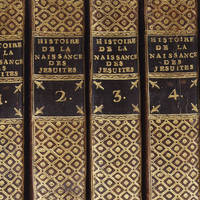
1764316736Rouen; Paris: s.n. 1764. viii. 499 6; vi 516 4; vi 447 3; vi 509 5; viii 4 311; 4 309-688 pp. 12mo. First four volumes in decorative brown paste-paper boards and sheep backs and corners other 2 volumes in full stained sheep with paste-paper endpapers backs of all six volumes uniform and richly gilt. A fine set in attractive dress. viii. 499 6; vi 516 4; vi 447 3; vi 509 5; viii 4 311; 4 309-688 pp. 12mo. Volumes I-III contain the history of the Society of Jesus from its origin until the end of the eighteenth century and the first analysis of its constitutions and privileges. Volume IV continues that analysis and has an index of the four-volume set. Barbier assigns the analysis chapters to Lois-Adrien Le Paige. Christophe Coudrette 1701-1774 was a Jansenist and the author of several anti-Jesuit works. Cioranesco 21317. Provenance: Fürstlich-Starhemberg'sche Familien Bibliothek Schloss Eferding ink stamp on front endpapers off all volumes; Loyola Reference Library stamp on lower edges call numbers in pencil on title-pages s.n. unknown
6 volumes: 532 + 570 + 562 + 552 + 592 + 628pp.orné de portraits & lettres in facsimile dépliantes (hors-texte), 19x12cm., 2e édition, reliure cart.avec dos en cuir, cachet de bibl., qqs.rousseurs, bon état, R34742
Paris /Lyon, Poussielgue-Rusand /Pélagaud, 1851, ensemble 2624pp. + 28 ill.hors texte et lettres in facsimile dépliantes, 3e éd. revue augmentée et enrichie d'une table alphabétique des matières, couv.cart. avec dos en cuir, bel état
6 volumes: 532 + 570 + 562 + 552 + 592 + 628pp.orné de portraits & lettres in facsimile dépliantes (hors-texte), feuilles de garde marbrées, 19cm., 1e édition, reliure cart.avec dos en cuir (plats marbrés, titre et faux-nerfs dorés au dos, qqs.traces d'usage ; petits trous de ver aux qqs.dos), rousseurs, bon état
xvii + 744pp., 25cm., original softcover with some minor defects, few annotations in margin of text of p.739, good condition, rare, weight: 1.4kg., R106417
xi + 863pp., 25cm., original softcover with some minor defects, most pages are still uncut, some occasional foxing, overall in good condition, rare, weight: 1.4kg., R106561
102pp.+ 56pp. (Appendices), 34cm., original softcover (some loss of paper at ends of spine), text clean and bright with only few foxing, cfr. De Backer & Sommervogel vol.VIII p.958 no.4, R23336
In-8°, 16 cc, pp. 327, più errata, c. di tav. ripiegata (Situs provinciarum imperii Sinici), occhietto, vignetta calcografica sul frontespizio, illustrazioni calcografiche. Rilegatura in pergamena con nervi e titolo al dorso. ROUGEMONT (Franciscus de), b. a Maastricht il 2 aprile 1624, d. a Chang-chu (Cina) il 4 novembre 1676. Nelle scuole dei gesuiti a Bruxelles e Anversa fece i suoi studi inferiori con risultati brillanti e nel1641entrò nella Compagnia di Gesù. All'assedio di Kortrijk nel 1646 si distinse, sebbene non fosse ancora un sacerdote, per il suo zelo nella cura dei soldati feriti. Nel 1654 ricevette la consacrazione del sacerdote e, quando padre Martino Martini, procuratore della missione cinese in Europa, venne a cercare missionari per questo lavoro, riuscì a convincere i suoi genitori a richiedere quella missione a favore del figlio dal Generale dell'Ordine. L'anno seguente partì da Amsterdam per Lisbona con il gesuita di Amsterdam Ignazio Hartoghvelt. Dopo un ritardo a Coimbra, lasciarono Lisbona il 30 marzo 1656 e arrivarono il 6 novembre a Coa. A piedi, continuò il suo viaggio lungo la costa di Malabar, Visschersen Transvancore, e poi attraversò il Siam, dove il suo compagno Hartoghvelt morì a Yoethia nel 1658. Nello stesso anno, de Rougemont raggiunse Macao, e nel 1659, raggiunse la corte imperiale, in Cina. I cristiani da lui formati sono stati riconosciuti per il loro zelo e conoscenza della religione. In seguito a una violenta persecuzione dei cristiani durante la minore età dell'imperatore Kang-hi i missionari furono portati prigionieri a Pechino, poi esiliati nel Canton e imprigionati nella chiesa per 6 anni. R. capì che questa persecuzione aveva la sua ragione principale nella nazionalità straniera dei missionari. Per togliere quest'arma dalle mani degli avversari, pensò di addestrare un clero nativo e pensò che consentire una liturgia della chiesa in lingua cinese avrebbe promosso questo piano. Nel 1667 inviò un dettagliato memorandum al generale dell'ordine Oliva (stampato in Analecta Bollandiana XXXIII (1914), 279-93). Solo nel 1671, quando l'imperatore Kang-hi fu convinto dell'innocenza dei missionari, questi tornarono alle loro congregazioni cristiane. Il Rougemont ha continuò il lavoro interrotto per altri 5 anni. Durante un viaggio verso l'isola di Tsong-ming, si ammalò a Tsang-chu e morì tra le braccia di Padre Couplet. I suoi fedeli cristiani vennero per raccogliere il corpo del loro padre spirituale e dopo due giorni di cammino lo seppellirono solennemente sul Monte Voxan fuori dalla città di Changsho. Egli aveva usato il tempo della sua disoccupazione forzata per compilare la sua Historia Tartaro-Sinica nova (Lovanii 1673), in cui racconta ampiamente la persecuzione subita. Il Rougemont ha dato un ottimo contributo alla conoscenza della letteratura cinese. Con i padri Intorcetta, Herdrich e Couplet, intraprese l'importante lavoro: Confucius Sinarum philosophus, messo in stampa nel 1687 per ordine di Luigi XIV a Parigi. In-8 °, 16 cc, pp. 327, plus errata, folded table (Situs provinciarum imperii Sinici), half-title, woodcut on the title page. ROUGEMONT (Franciscus de), b. in Maastricht on April 2, 1624, d. in Changchu (China) on November 4, 1676. In Jesuit schools in Brussels and Antwerp he made his lower studies with brilliant results and in 1641 he entered the Society of Jesus. At the siege of Kortrijk in 1646 he distinguished himself, even if he was not yet a priest, for his zeal in caring for wounded soldiers. In 1654 he received the priest's consecration and, when Father Martino Martini, procurator of the Chinese mission in Europe, came to look for missionaries for this job, he managed to convince his parents to carry out that mission in favor of his son by the General of the Order. The following year he left Amsterdam for Lisbon with the Jesuit of Amsterdam Ignazio Hartoghvelt. After a delay in Coimbra, they left Lisbon on 30 March 1656 and arrived on 6 November in Coa. On foot, he continued his journey along the coast of Malabar, Visschersen Transvancore, and then he crossed Siam, where his companion Hartoghvelt died in Yoethia in 1658. In the same year, Rougemont reached Macau, and in 1659, he reached the imperial court , in China. The Christians he trained were listed for their zeal and knowledge of religion. Following a violent persecution of Christians during the minor age of Emperor Kang-hi, the missionaries were taken prisoner to Beijing, then exiled to the Canton and imprisoned in the church for 6 years. R. understood that this persecution had its main reason in the foreign nationality of the missionaries. To remove this weapon from the hands of opponents, he thought of training a native clergy and thought that allowing a Chinese-language church liturgy would promote this plan. In 1667 he sent a detailed memorandum to the general of the order Oliva (printed in Analecta Bollandiana XXXIII (1914), 279-93). Only in 1671, when Emperor Kang-hi was convinced of the innocence of the missionaries, did they return to their Christian congregations. Rougemont continued the interrupted work for another 5 years. During a trip to Tsong-ming Island, a Tsang-chu fell ill and died in the arms of Father Couplet. His faithful Christians came to collect the body of their spiritual father and after two days of walking they saw him solemnly on Mount Voxan outside the city of Changsho. He had used the time of his forced unemployment to compile his Historia Tartaro-Sinica nova (Lovanii 1673), in which he widely recounts the persecution he endured. Rougemont made an excellent contribution to the knowledge of Chinese literature. With his fathers Intorcetta, Herdrich and Couplet, he undertook the important work: Confucius Sinarum philosophus, printed in 1687 by order of Louis XIV in Paris.
2 works (pars 3 & 4) bound in 1 volume; I: [ii bl.] + [iv] 452 [xxxi, index] & II: [iv] 510 [xxi, index] pp., text in latin, cart.cover with leather spine, 32cm., [cfr. De Backer-Sommervogel: III-812-4 & IV-1252-3]
In -8°, pp. (88), 763, 5 pp. bb. Legatura in pelle di scrofa coeva con fregi ai piatti e nervi al dorso. Terza edizione, dopo quella di Firenze dell’88 e la prima di Colonia dell’89. Il libro, celebre e ampiamente ristampato, contiene la prima descrizione mai pubblicata della pianta del tè. Fine binding in contemporary pigskin. The third edition, after the Florence’s one and the first, from Cologne. The book, widely reprinted, contains the first description of the tea plant ever published in Europe.