2 541 résultats
346331 page in-folio - format 32 x 20,5 cm - adresse au dos- bon état -
1757381651757 In-12, broché, couverture de papier gris ancien de livraison, 61 p. S.l.n.d. [1757].
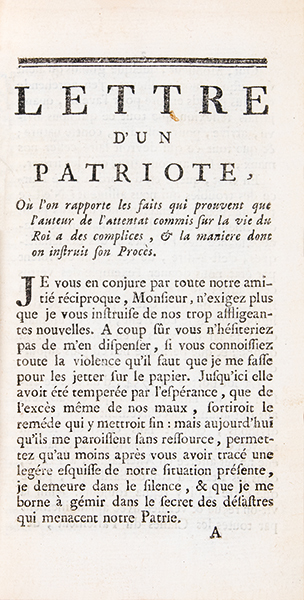
In-12, broché, couverture de papier gris ancien de livraison, 61 p. Edition originale de ce document relatif au procès à l'attentat perpétré par Damiens contre Louis XV et à la question de sa responsabilité. Savant champenois, biographe, collaborateur de l'Encyclopédie, historien et avocat, l'auteur Pierre-Jean Grosley (1718-1785) était attaché à sa ville de Troyes, à ses traditions gallicanes et de fronde janséniste. Il développe la thèse que Damiens, simple valet, très médiocre intellectuellement, ne pouvait pas avoir, par lui-même, des mobiles politiques et qu'il ne fut que l'instrument d'une vaste conspiration. Il cherche à écarter tous soupçons qui pourraient peser sur les milieux parlementaires pour charger les jésuites dont il récapitule le rôle dans les différents régicides. L'auteur laisse planer le soupçon du manque de partialité des magistrats instructeurs du procès, étant donné leur proximité supposée avec les jésuites. L'auteur arriva second au concours de l’Académie de Dijon de 1750 que remporta Jean-Jacques Rousseau. Il a collaboré aux volumesIV et XIV de l’Encyclopédie Diderot-D’Alembert. Le pamphlet fut condamné au feu par arrêt de la cour du 30 mars 1757. (Conlon, Siècle des Lumières, 57:817). Bon exemplaire, frais, bien conservé.
In-8°; pp. 16, montate su fogli in-4°; senza legatura. Relazione sulle vicende della casa dei GESUITI a Frascati, utilizzata come alloggio delle vacanze per i seminaristi; la citta di Frascati successivamente stipulò con i Gesuiti un contratto affiché vi fosse realizzato un Convitto; il testo segue le vicende complicate che questo bene ebbe nel tempo. gesuiti compagnia di gesù jesuits frascati lazio orsini scuole
In- 8°; pp. 36, Pagine montate su foglio in-4° Senza legatura.un capolettera, una testatina e un finalino incisi su legno. roma compagnia di gesù eredità diritto law heritage jesuit
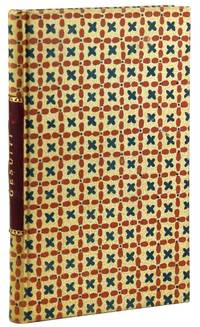
176031129Lugano CH: A Spese di Giuseppe Bettinelli di Venezia / Nella Stamperia Privilegiata della Suprema Superiorita' Elvetica nelle Prefetture Italiane 1760. Near Fine. Lugano CH: A Spese di Giuseppe Bettinelli di Venezia / Nella Stamperia Privilegiata della Suprema Superiorita' Elvetica nelle Prefetture Italiane 1760. First Edition. Two octavo volumes bound together. 44; 94pp. 20th-century binding with patterned paper-covered boards and red leather spine label; top edge stained red; new endpapers. Touch of edgewear with toning to spine. Binding sound and interior unmarked. A Near fine copy of two uncommon Swiss Jesuit-related tracts the former appearing more densely theological and the latter discussing the work and thoughts of Plato Seneca and Lucretius among other ancients. A Spese di Giuseppe Bettinelli di Venezia / Nella Stamperia Privilegiata della Suprema Superiorita' Elvetica nelle Prefetture It unknown
In -8°, pp. 77, (B); cartonato, tagli rossi. Prima edizione. Pasio (1551-1612) fu il primo provinciale gesuita in Giappone, residente a Nagasaki. La lettera compendia le attività dei Gesuiti in Giappone a cavallo dei due secoli, descrive le condizioni di vita in diverse città e si impegna nel racconto delle condizioni culturali del Giappone a quel tempo. First edition. Pasio (1551-1612) was the first Jesuit Provincial in Japan: he resided in Nagasaki. This letter outlines the Jesuits’ activities in Japan, between XVI and XVII century, also giving descriptions of the various life conditions in many cities, and more widely of the Japan culture at that time.
15854676Venice: I Gioliti 1585. Hardcover. Very Good. 8vo - over 7¾ - 9¾" tall. 8vo. 103 pp. Bound in old vellum. Discrete former ownership stamp on title. Gutter margin of title reinforced; inconsequential toning otherwise excellent. Rare early edition of this Jesuit letter containing news of missions and activity in Japan from the year 1582 the only edition of 5 printed that year to contain a title-page advertising the famous Japanese embassy of 1584-86. Significantly the work also discusses the embassy the participants and their noble lineage and expresses the hope that the embassy will prove a convincing sign of the Jesuit's spectacular success in Japan p. 7. The present imprint of this edition comprises the first entry in Boscaro's bibliography of printed works related to the embassy. It thus stands at the head of nearly 50 works printed in 1585 alone to record and commemmorate an event that-in addition to providing a public relations coup for the Jesuits-became a watershed moment in cross-cultural exchange between the Orient and the West: "no Japanese emissaries to Europe either before or since aroused comparable interest or enthusiasm" Lach. In the annals of international relations between Europe and Japan in the 16th C it is particularly noteworthy "how the physical presence of the Japanese in Europe stimulated an unexpected number of typographical presentations" Boscaro of which this particular Gioliti edition with the titlepage advertising the embassy-Portata de Novo Dal Giapone Dai Signori Ambasciatori-is the very first. Boscaro notes that there were four other editions of Coehho's letter published in Italy in 1585 around the time the embassy arrived in Venice on June 25 including another by Gioliti but none of these uses the embassy as a way to market itself.The report itself is also a significant document of the embassy's genesis: Coelho composed it in February 1582 the month that the embassy of four Japanese Christian converts departed from Nagasaki. In it he describes the ongoing missionary activity across the country: e.g. in Hirado Amasuka Bungo and especially Funai Oita City the home of a thriving Jesuit college. Presumably the contents of this letter as the title suggests were "brought from Japan by the eminent ambassadors" as the latest news on the Jesuits current success in that faraway land.Though the embassy did not reach Lisbon until August 1584 it eventually was as Coelho had hoped a resounding success: from 1584-86 the four young Japanese nobles were the object of intense curiosity wherever they traveled and they were treated to lavish receptions in Lisbon Madrid Florence Rome Venice and other cities throughout Catholic Europe.OCLC: Cornell NYPL HU and Newberry. Boscaro 1; Alt-Japan 812; Sommervogel II.1267; Cordier 78; Laures 169; Pagès 22; Lach I.2.690. I Gioliti hardcover books
15854676<p>ENTRY NO. 1 IN BOSCARO<br />THE FIRST REFERENCE TO THE JAPANESE EMBASSY OF 1585 PRINTED ON THE TITLE-PAGE</p><p>Venice I Gioliti 1585.</p><p>Small 8vo 15.3 x 10 cm 103 pp. Bound in old vellum. Discrete former ownership stamp on title. Gutter margin of title reinforced; inconsequential toning otherwise excellent.</p><p>Rare early edition of this Jesuit letter containing news of missions and activity in Japan from the year 1582 the only edition of 5 printed that year to contain a title-page advertising the famous Japanese embassy of 1584-86. Significantly the work also discusses the embassy the participants and their noble lineage and expresses the hope that the embassy will prove a convincing sign of the Jesuit's spectacular success in Japan p. 7. The present imprint of this edition comprises the first entry in Boscaro's bibliography of printed works related to the embassy. It thus stands at the head of nearly 50 works printed in 1585 alone to record and commemmorate an event that-in addition to providing a public relations coup for the Jesuits-became a watershed moment in cross-cultural exchange between the Orient and the West: "no Japanese emissaries to Europe either before or since aroused comparable interest or enthusiasm" Lach.</p><p>In the annals of international relations between Europe and Japan in the 16th C it is particularly noteworthy "how the physical presence of the Japanese in Europe stimulated an unexpected number of typographical presentations" Boscaro of which this particular Gioliti edition with the titlepage advertising the embassy-Portata de Novo Dal Giapone Dai Signori Ambasciatori-is the very first. Boscaro notes that there were four other editions of Coehho's letter published in Italy in 1585 around the time the embassy arrived in Venice on June 25 including another by Gioliti but none of these uses the embassy as a way to market itself.</p><p>The report itself is also a significant document of the embassy's genesis: Coelho composed it in February 1582 the month that the embassy of four Japanese Christian converts departed from Nagasaki. In it he describes the ongoing missionary activity across the country: e.g. in Hirado Amasuka Bungo and especially Funai Oita City the home of a thriving Jesuit college. Presumably the contents of this letter as the title suggests were "brought from Japan by the eminent ambassadors" as the latest news on the Jesuits current success in that faraway land.</p><p>Though the embassy did not reach Lisbon until August 1584 it eventually was as Coelho had hoped a resounding success: from 1584-86 the four young Japanese nobles were the object of intense curiosity wherever they traveled and they were treated to lavish receptions in Lisbon Madrid Florence Rome Venice and other cities throughout Catholic Europe.</p><p>Provenance: Alfred Hamy 1838-1904 French Jesuit historian and prolific author of books relating to the history of the members of the Company of Jesus.</p><p>OCLC: Cornell NYPL HU and Newberry. Boscaro 1; Alt-Japan 812; Sommervogel II.1267; Cordier 78; Laures 169; Pagès 22; Lach I.2.690.</p><p> Boscaro 1; Alt-Japan 812; Sommervogel II.1267; Cordier 78; Laures 169; Pagès 22; Lach I.2.690.</p> I Gioliti
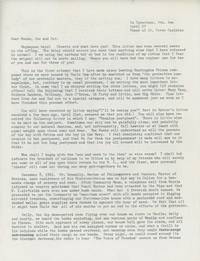
1945List2748Philippines 1945. Single letter; five 8.5 x 11†pages. Pinhole at top of first page missing final pages overall fine. The unknown author of this letter was an American Jesuit missionary in the Philippines who before the war was a novice living in Novaliches just outside Manila. He apparently had not written a significant letter home for a long time: in this letter written in April of what is likely 1945 he recounts his experiences from between December 8 1941 and early January of 1945 shortly before the civilian POW camp in which he was interned was liberated.<br /> <br /> After the “Nips†bomb Pearl Harbor “A feverish month ensuedâ€:<br /> <br /> “We proceeded to put the Community on ‘war-time alert’ with all hands occupied in digging air-raid trenches camouflaging our fortress-like house with a garlanded roof and mud-daubed walls; grain supplies were rushed in against the hour of need. We felt that all it might take Uncle Sam all of six months to put an end to the efforts of the pretender.â€<br /> Around Christmas they evacuated to the Jesuit Ateneo Grade School then in Intramuros as the Japanese were advancing quickly towards Novaliches. Of course this did not prove to be much safer:<br /> <br /> “When darkness came the Japs began their bombing of the Port Area. The bombs began to bounce off the pavement; bombers just skimming our roof-top on their way. We spent the night on our tummies and how we prayed. We thought that each decade of the beads would be our last this side of Purgatory. . When the church sto Domingo was hit the floor beneath us did some tricks and we were lifted up a bit and let down amidst the dust and smoke that poured in from above.â€<br /> <br /> The missionaries try to “salvage important papers and other valuables from the Mission House prior to abandoning it to the fire which threatened the entire Walled City.†During this time they and “a thousand refugees†live in the Ateneo while “Dawn and night raids were supplied by the Japs with nary an American plane to say to them no†– American forces had taken a serious hit and withdrawn outside Manila. It was declared an open city before “the little scrawny but arrogant Japs came into the city and took over†in January of 1942.<br /> <br /> The missionaries persuade the Japanese to let them stay in the Ateneo:<br /> <br /> “We convinced them that it was impossible for us to give up the building because it belonged to the Pope and the Vatican State would hold us responsible. This argument with many ingenious trimmings enabled us to hold on to the Ateneo until June ‘43 when the main building was taken for a military hospitalâ€.<br /> <br /> The author describes how despite what he calls his “partial internment†in Manila he is able to get around checkpoints by pretending to be Belgian. He finishes his studies and begins work at a Belgian convent in Paranaque in February of 1943 living between there and Manila:<br /> <br /> “Incidentally none of this would have been possible if the Japs had gumption enough to find out that I was one of the hated Americans. . All vehicles were obliged to stop here a checkpoint at Baclaran and all passengers get down and file between a Jap sentry and a Filipino constabulary soldier to be searched for hidden arms etc. Since several Belgian Fathers not considered enemy aliens frequently passed this way I was able to walk through unmolested as an unoffending Belgian. . I carefully kept my helmet covering the tell-tale red arm-band which was worn on the arm furtherest away from the Jap. The Filipino would do no more than give me a knowing grin.â€<br /> <br /> On July 10 1944 all of the American civilian POWs are taken to internment camps in Santo Tomas and then Los Baños. In Los Baños the POWs cut wood repair roads and farm. Los Baños would be liberated in February of 1945; the author paints a slightly confusing picture of the leadup to this:<br /> <br /> “Conditions generally ‘worsened’ when on Jan. 8th about the time that the American troops landed at Mindero an island just across from Batangas the Japs got jittery believing that the Yanks were going to do the obvious and cross over the bay to Batangas and they the Japs at Batanga decamped! ‘You are free but remain in camp until the Americans come. Outside your camp Japanese troops will shoot any who leave.’ Great was the joy in Mudville. From nowhere came flag poles on which we quickly unfurled American and British flags .; a short-wave radio was set up and we enjoyed daily Frisco broadcasts .â€<br /> <br /> It sounds as if the missionary was reporting contrary to the usual narrative of the Los Baños raid that the Japanese had essentially given up control of the camp and were like the prisoners simply waiting for the Americans to come get their people. Perhaps something further happened in the nearly two intervening months; however the remainder of the letter is missing.<br /> <br /> Of interest to scholars of modern Jesuit history and of the civilian POW experience during the Second World War. unknown
1957108152Institut Supérieur de Théologie, Enghein (Belgique), Imprimerie de Meester Frères, Wettern (Belgique) 1957 Introduction de Pierre Delattre. 19 fascicules reunis en 17 tomes In-4 broché 30 cm sur 23. Texte sur deux colonnes. Fascicules 1-5 :XX-1566pp, fasc 6-9 :1606pp, fasc 10-13 :1607, fasc 14-17 :1627pp, fasc 18-19 :674pp. Pages non massicotées. Couvertures ternies, dos fragilisés effrangés et rousseurs sur les tranches sinon corps du livre bon état d’occasion.
1961R118579Roma, Institutum Historicum S.I. 1961 357pp., 20cm., br.orig., dans la série "Subsidia ad Historiam S.I." volume 3, bon état, R118579
663639Paris, Dentu, Avril 1827 in-8, IV-202 pp., dérelié, tranches marbrées.
41853Paris.1827.Seconde édition.In-8 br.202 p. BE.Couv.légèrement cornée.
1827R81291Paris, J.G. Dentu 1827 iv + 202pp., 20cm., reliure cart., feuilles de garde marbrées, quelques rousseurs, cachet sur la page de titre, bon état, R81291
iv + 202pp., 20cm., reliure cart., feuilles de garde marbrées, quelques rousseurs, cachet sur la page de titre, bon état, R81291
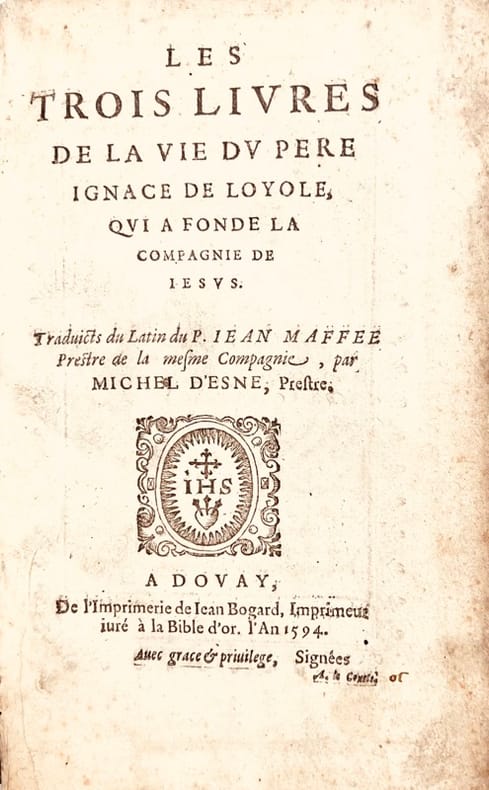
159443513A Douay, De l'imprimerie de Jean Bogard, 1594. Petit in-8 de (4)-298-(2) pages, vélin souple de l'époque.
27618Sans lieu, sans date, 190x120mm, 10pages, broché. Petites taches sur couverture, cachet de bibliothèque.Feuillet répondant à une polémique anti-jésuites déclanchée par l’Ami du Progrès.
ORD-8122Par le R. P. Parvilliers, de la Compagnie de Jesus, qui a tout vérifié sur les lieux. Nouvelle édition. Augmentée d'un Dialogue sur l'Oraison Mentale. Lyon. Veuve d'Antoine Boudet. 1721. In-16 (84 x 130mm) pleine basane brune, dos à 4 nerfs entièrement orné or, gardes peignées, 1f., 210, (6) pages, 19 gravures non signées hors texte dont le titre-frontispice et Dialogue ou Entretien sur l'Oraison Mentale, Ecrit par un Religieux à deux personnes qui le prioient de leur apprendre à méditer. Suite des Stations de Jerusalem. Nlle édition, Revûë & corrigée, même lieu, même date, 4ff., 85, (12) pages. Petits défauts à la reliure mais plutôt bon exemplaire.
200210062Les Presses de l'Université de Montréal Couverture souple Montréal 2002
1893R36291Lille-Paris, Société de saint Augustin 1893 484pp. avec illustrations dans le texte et 20 illustrations hors-texte, reliure cart.avec dos en cuir rouge (titre et nerfs dorés, charnières peu cassées et restaurées, intérieur en bel état, R36291
1893R92061Lille-Paris, Société de saint Augustin 1893 484pp. avec illustrations dans le texte et 20 illustrations hors-texte, belle reliure cart. (plats marbrés, dos en cuir avec titre doré), qqs. cachets, peu de rousseurs, bon état, R92061
484pp. avec illustrations dans le texte et 20 illustrations hors-texte, reliure cart.avec dos en cuir rouge (titre et nerfs dorés, charnières peu cassées et restaurées, intérieur en bel état, R36291
484pp. avec illustrations dans le texte et 20 illustrations hors-texte, belle reliure cart. (plats marbrés, dos en cuir avec titre doré), qqs. cachets, peu de rousseurs, bon état, R92061
20592Paris, Degorge-Cadot, 1869. demi basane, dos orné, petite étiquette au bas. in-8, faux-titre, titre, VI-373 pages, ex-dono manuscrit, légères rousseurs sur quelques feuillets.