CALVIN Jean:Livre Rare Book
34 résultats
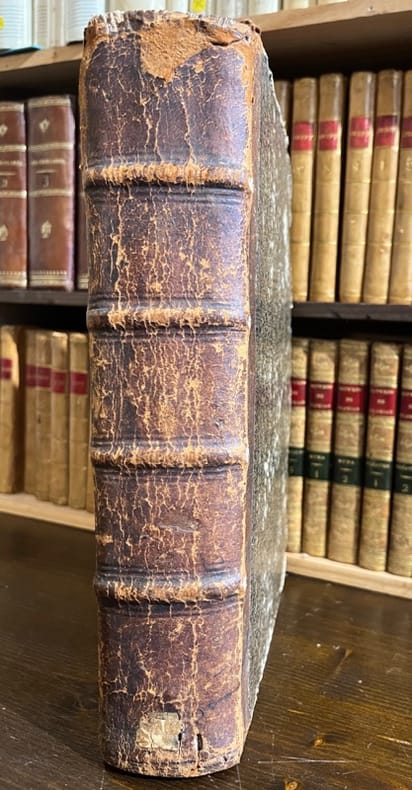
155020091Genevae, ex officina Joannis Gerardi typographi, 1550. In-4 de [32]-735-[81] pages [(alpha-delta)4; a-z8; A-Z8; Aa-Kk4] demi-basane brune, dos muet à nerfs.
15601560GEN<p>PRESENTING FOR YOUR CONSIDERATION EXQUISITE GENUINE 465 YEAR OLD FIRST EDITION OF THE HISTORIC GENEVA BIBLE PRINTED BY ROULAND HALL AT GENEVA SWITZERLAND IN 1560. Quarto 9 3/4" x 7" x 2 1/2" HERBERT #107 D & M #77 STC # 2093. Known as the Breeches Bible for its rendering of Genesis 3:7 </p><p><em><strong>" Then the eyes of them both were opened and they knewe that they were naked and they sewed figge tree leaues together and made them selues breeches. "</strong></em></p><p><strong>SHORT DESCRIPTION</strong></p><p>The General title supplied in fine facsimile lacks all three leaves of the preliminaries has all 26 engravings within the text and <strong>all 5 maps</strong> Old Testament and Apocrypha are complete without facsimiles. New Testament Title page dated 1560 is original and the New Testament is complete without facsimiles both tables at the end are incomplete and defective.</p><p><strong>COLLATION AND CONDITION</strong> </p><p><strong><em>GENERAL TITLE PAGE</em></strong> 1 page supplied in fine facsimile on sympathetically aged cotton linen paper. Imprinted at Geneva by Rouland Hall MDLX. Features a wonderful engraving of the scene at the Red Sea surrounded with the passages Exodus 14:14 Psalm 34:19 and Exodus 14:13. Verso is blank.</p><p>lacking the following three leaves of the preliminaries</p><p><strong><em>THE OLD TESTAMENT</em></strong> foliated 1- 385b 63 lines of Roman type to the full page in double columns. Beautiful floriated and historiated initials begin each book along with the arguments. Within the text features the full complement of 26 engravings such as: The situation of the Garden of Eden The flood The crossing of the Red Sea the Tabernacle and the Temple with their furniture Solomon's throne and Ezekiel's vision. Also found here are <strong>3 maps as called for at: Numbers 23 Joshua 15 and the end of Ezekiel. </strong> the remaining 2 maps are listed below where they are found in the n.t. Leaves 1 & 2 with repaired blank outer margins resulting in the loss of a few letters of the printed notes only. Leaves 196-202 with quarter sized stains to the blank footer margins. Leaf 217 stained to the upper half most likely from an ancient floral pressing. Top and bottom of the verso of leaf 238 is smudged. Leaf 263 has a stain in the center approx. 1" x 2" Leaf 286 has a stain in the lower left column approx. 1" x 2". The paper is clean crisp and bright with only very minor staining and soiling. There are no loose missing or torn pages. The edges are straight the gutters are clean the corners are strong. The footer and fore edge margins are excellent while the occasional header margins are trimmed touching and also into the running headlines but without obscuring the words. A Very Good example <strong><em>.</em></strong><strong><em>COMPLETE.</em></strong></p><p><strong><em>THE APOCRYPHA</em></strong> foliated 386-474 63 lines of Roman type to the full page in double columns.Beautiful floriated and historiated initials begin each book. The paper is clean crisp and bright with only very minor staining and soiling. There are no loose missing or torn pages. The edges are straight the gutters are clean the corners are strong. The margins are very good all around. A Very Good example <strong><em>.</em></strong><strong><em>COMPLETE.</em></strong></p><p><strong><em>THE NEW TESTAMENT TITLE PAGE</em></strong> 1 page folio #1. Imprinted at Geneva by Rouland Hall MDLX. Features a wonderful engraving of the scene at the Red Sea surrounded with the passages Exodus 14:14 Psalm 34:19 and Exodus 14:13. Verso is blank. Lightly stained Good. <strong><em>COMPLETE.</em></strong></p><p><strong><em>THE DESCRIPTION OF THE HOLIE LAND </em></strong>3 pages The double page map of the places found in the four evangelists. <strong>Map #4 </strong>of five found in this edition. Clean and crisp verso is blank. Very Good <strong><em>COMPLETE.</em></strong></p><p><strong><em>THE NEW TESTAMENT</em></strong> foliated 2- 122 63 lines of Roman type to the full page in double columns.Beautiful floriated and historiated initials begin each book along with the arguments. Leaf 7 has a somewhat crudely repaired tear without loss of the text Leaves 50-63 have minor chipping to the upper blank corner tips. <strong>Map # 5 </strong>the description of the countries and places mentioned in Acts bound at the end of the text. Leaf 74 has the lower blank corner repaired with loss to a few letters of the notes. Leaf 91 printed slightly skewed. Leaf 94 misnumbered as 84 without a break in the collation. Leaves 120-122 faintly stained. The paper is clean crisp and bright with only very minor staining and soiling. There are no loose missing or torn pages. The edges are straight the gutters are clean the corners are strong. The footer and fore edge margins are excellent while the occasional header margins are trimmed touching the running headlines. A Very Good example <strong><em>COMPLETE.</em></strong></p><p>The following two tables concordances are incomplete. The first table lacks the last page. The second table lacks the first page the next two leaves the final four leaves and all thereafter. Their condition is fair to poor with various faults including tear outs with loss cropped outer margins chipped corners and edges etc.</p><p><strong>ABOUT THE BINDING</strong></p><p>This Bible is bound in a full brown leather Victorian binding that has been neatly rebacked featuring a new burgundy morocco label. All joints are unsplit uncracked and holding firmly. The plain end papers appear to be 18th century and features the inscription of Jacob Elton who was possibly a British Naval Captain. The text block is firm square and unshaken with its fore edges dyed red as was the practice of Victorian binders. The custom fitted brown half leather clamshell case was recently made and features a maroon morocco label and is titled directly to the foot "1560 GENEVA".</p><p><strong>ABOUT THE GENEVA BIBLE</strong></p><p>The Geneva Bible is one of the most historically significant translations of the Bible into English preceding the King James Version by 51 years. It was the primary Bible of 16th-century English Protestantism and was the Bible used by William Shakespeare Oliver Cromwell John Knox John Donne and John Bunyan author of Pilgrim's Progress 1678. It was one of the Bibles taken to America on the Mayflower Pilgrim Hall Museum and Dr. Jiang have collected several bibles of Mayflower passengers. The Geneva Bible was used by many English Dissenters and it was still respected by Oliver Cromwell's soldiers at the time of the English Civil War in the booklet "Cromwell's Soldiers' Pocket Bible".</p><p>This version of the Bible is significant because for the very first time a mechanically printed mass-produced Bible was made available directly to the general public which came with a variety of scriptural study guides and aids collectively called an apparatus which included verse citations that allow the reader to cross-reference one verse with numerous relevant verses in the rest of the Bible introductions to each book of the Bible that acted to summarize all of the material that each book would cover maps tables woodcut illustrations and indices.</p><p>Because the language of the Geneva Bible was more forceful and vigorous most readers strongly preferred this version to the Great Bible. In the words of Cleland Boyd McAfee "it drove the Great Bible off the field by sheer power of excellence".</p><p>During the reign of Queen Mary I of England 1553–58 a number of Protestant scholars fled from England to Geneva Switzerland which was then ruled as a republic in which John Calvin and later Theodore Beza provided the primary spiritual and theological leadership. Among these scholars was William Whittingham who supervised the translation now known as the Geneva Bible in collaboration with Myles Coverdale Christopher Goodman Anthony Gilby Thomas Sampson and William Cole; several of this group later became prominent figures in the Vestments controversy. Whittingham was directly responsible for the New Testament which was complete and published in 1557 while Gilby oversaw the Old Testament.</p><p><em><strong>The first full edition of this Bible with a further revised New Testament appeared in 1560</strong> </em>but it was not printed in England until 1575 New Testament and 1576 complete Bible. Over 150 editions were issued; the last probably in 1644. The very first Bible printed in Scotland was a Geneva Bible which was first issued in 1579. In fact the involvement of Knox and Calvin in the creation of the Geneva Bible made it especially appealing in Scotland where a law was passed in 1579 requiring every household of sufficient means to buy a copy.</p><p>Some editions from 1576 onwards included Laurence Tomson's revisions of the New Testament. Some editions from 1599 onwards used a new "Junius" version of the Book of Revelation in which the notes were translated from a new Latin commentary by Franciscus Junius.</p><p>The annotations which are an important part of the Geneva Bible were Calvinist and Puritan in character and as such they were disliked by the ruling pro-government Anglicans of the Church of England as well as King James I who commissioned the "Authorized Version" or King James Bible in order to replace it. The Geneva Bible had also motivated the earlier production of the Bishops' Bible under Elizabeth I for the same reason and the later Rheims-Douai edition by the Catholic community. The Geneva Bible remained popular among Puritans and remained in widespread use until after the English Civil War. The Geneva notes were surprisingly included in a few editions of the King James version even as late as 1715</p> Rouland Hall
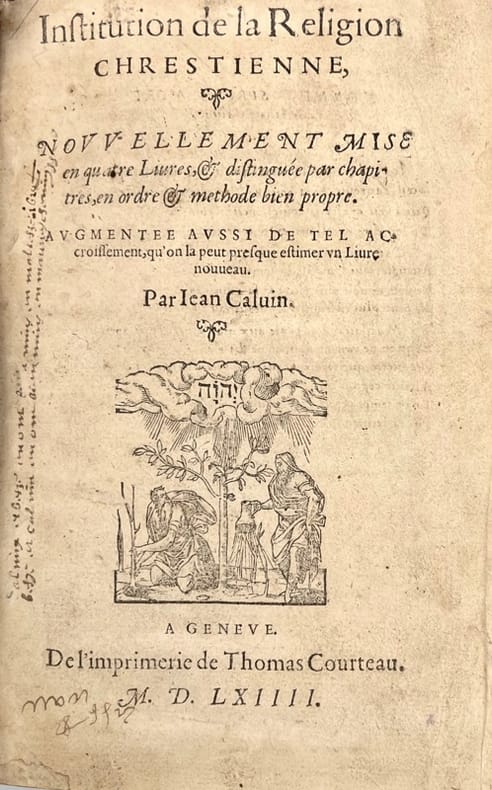
156441843Genève, Thomas Courteau, 1564. In-8 (159 x 179 mm) à deux colonnes de (32)-904-(55) pp. 3 pp.bl. 152 pp. (signatures *-**8 a-z8 A-Z8 aa-oo8 a-i8 k4), erreurs de pagination sans manque, veau brun, dos orné à quatre nerfs, double filet doré d'encadrement sur les plats (reliure du début XVIIe siècle).
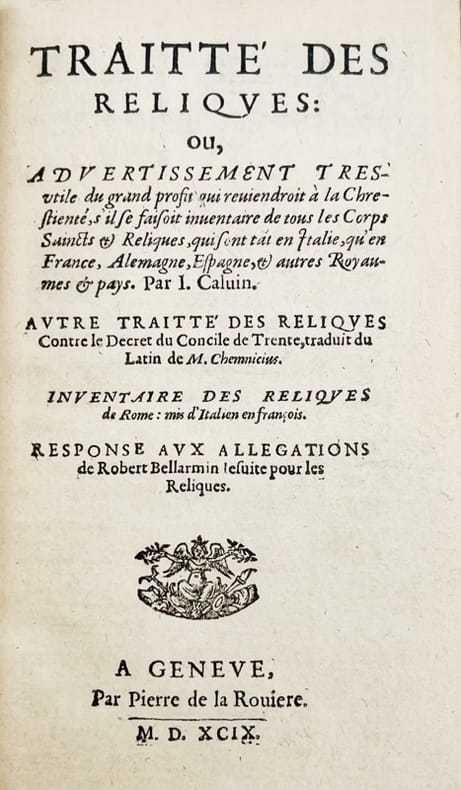
159944595Genève, Pierre de La Rovière, 1599. In-12 de (24)-208 pp., table alphabétique, maroquin bleu, dos orné à nerfs, triple filet doré d'encadrement sur les plats, large roulette dorée sur les chasses et double filet doré sur les coupes, guillochis dorés sur les coiffes, double signet de soie verte, rouge et jaune, tranches dorées sur marbrure (Chambolle Duru).
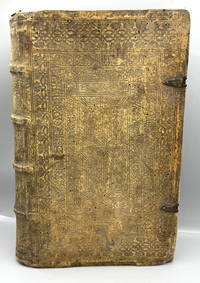
1545314899Argentorati Strasbourg: Vuendelinus Rihelius Wendelin Rihel 1545. Fourth edition of the Calvin; second Froben folio edition of the Erasmus. Collation alpha-gamma6 delta4 A-Z6 a-s6 t-v4 v4 blank present. Pp. 431 505 3 blank. Errata at foot of index p. 43. 1 vols. Folio 11-3/4 x 8 inches. Contemporary blindstamped pigskin over wooden boards with metal clasps. With 8 pages of contemporary Latin notes loosely inserted; contemporary marginalia throughout second work. L2 in Calvin with old ink stains not affecting legibility; some wear along one bottom edge of binding. Manuscript prayer in Latin on lower pastedown. Small later paper label on upper cover "Bibliothèque de Spietz". A handsome copy. Fourth edition of the Calvin; second Froben folio edition of the Erasmus. Collation alpha-gamma6 delta4 A-Z6 a-s6 t-v4 v4 blank present. Pp. 431 505 3 blank. Errata at foot of index p. 43. 1 vols. Folio 11-3/4 x 8 inches. Calvin's 'Instutitio': Cornerstone of Liberty. "Calvin's 'Institution of the Christian Religion' was the first systematic statement of a Reformed Church. It is the most important doctrinal work of the Reformation as a whole and provided a comprehensive theological system rivaling those of the Middle Ages . Calvinism's most important role despite Calvin's authoritarian influences was to support the movement for liberty and independence in many parts of the world" Printing and the Mind of Man 65. First published in Basel in 1536 the "Institutio was much revised taking its final form in 1559" PMM. Calvin understood the importance of vernacular translations in the transmission of ideas made possible by the printing press and prepared a French edition in 1541. This fourth edition follows closely and corrects the third edition printed in 1543. All early editions are uncommon.<br/><br/>Calvin 1509-64 drew upon St. Augustine and Luther as well as upon classical sources including Plato and Seneca; his work addressed theological issues and also notably the relations between ecclesiastical and civil government. The contemporary annotations often callouts of classical authors and shoulder notes with a few pointing hands are most extensive in the first six chapters again in chapter sixteen on the Lord's Prayer where Melanchthon is cited but appear throughout. <br/><br/>The first work in this well preserved contemporary binding is the second Froben folio edition of Erasmus Ecclesiastes Basel: Froben 1539. OCLC 632887280 BSB Augsburg Univ. Basel. Collation a-z6A-M6N4O-Q6. Pp. 439 1 blank 18 index imprint date 1540 1 blank 1 Froben's device. This was first published in Basel in 1535. The manuscript notes refer to in the early passages of this work. The Bibliotheque de Spietz was dispersed at auction in 1874. The von Erlach family had been established at Bern since the early sixteenth century. Calvin: PMM 65; Adams C357; VD16 C 291; Peter & Gilmont Bib. Calviniana 45/5; En français dans le texte 59 for 1560 ed. Erasmus: Bezzel 823 Adams E632; VD16 E 2723 Vuendelinus Rihelius [Wendelin Rihel] unknown books
1585D8191London: Printed by Thomas Dawson Impensis George Bishop 1585. Hardcover. Very Good. 4to 180 x 130mm. 16 298pp. i.e. 598 34 P. 598 misnumbered 298. Signatures: A-2P8; 2Q-2V4. Edited by Henry Beveridge Esq. Period calf rebacked with five raised bands modern morocco label; hinge splitting affecting first gathering title in facsimile slightly browned lacking final blank. Period pen trials on the final verso leaf varying the phrase For if thou possibly beginning proverb. <br/><br/>1585 English translation of Calvins Commentary on the Acts of the Apostles; plentiful in spiritual gifts for the common good. Calvins Commentary was faithfully translated into English by Christopher Fetherstone a student of Divinity; this forms the basis of the Calvin Translation Societys edition. John Calvin the father of modern reformed theology was after Martin Luther a premiere leader in the Protestant movement. One of the goals of Calvins reformed thought was to unite a people with a sense of community and concern for one another he did especially by commenting on the imperative parts of the Gospel which motivated readers to contribute generously to common interest. The present commentary on the Acts of the Apostles is more historical than doctrinal; and hence does not contain so much profound theological discussion as some of Calvins other Commentaries. The leading topic is the progress of the Gospel under the inspired teachers to whom its first propagation was entrusted and the Constitution of the Apostolic Church including privileges enjoyed by its members. To this latter point the controversy is especially directed. From Spurgeons Commenting and Commentaries 1876 quoting Arminius I affirm that he excels beyond comparison in the interpretation of Scripture and that his commentaries ought to be more highly valued than all that is handed down to us by the Library of the Fathers; so that I acknowledge him to have possessed above most others or rather above all other men what may be called an eminent gift of prophecy The Translation appears to be well executed. It is perhaps not so strictly literal as that of the Commentary on the Romans which the Calvin Society has already published; but any difference in this respect is more than compensated by the general superiority of its style. There are occasional obscurities or mistranslations which the editor has endeavored as in the Commentary on the Romans to remove by footnotes; but on the whole it is believed that the present Translation will not suffer by comparison with that of any Theological Translation of the same period. ESTC locates 13 copies in North America institutions and 12 in the United Kingdom. STC 2nd ed. 4398. [Printed by Thomas Dawson] Impensis George Bishop hardcover books
157796188London: Imprinted by Thomas Dawson for John Harison and George Byshop 1577. First edition in English of John Calvin's commentaries on the Pauline Epistles. Octavo bound in full speckled calf with raised bands to the spine all edges red rebacked. Title within architectual woodcut border woodcut initials. In very good condition. First editions are rare. One of the earliest extant Christian documents the Pauline Epistles constitute thirteen books of the New Testament and are largely attributed to Paul the Apostle. As part of the canon of Christian theology and ethics the Epistles offer an unprecedented insight into the beliefs and controversies of early Christianity. The Pauline epistles are usually placed between the Acts of the Apostles and the general epistles in modern editions of the New Testament. Most Greek manuscripts however place the General epistles first and a few minuscules place the Pauline epistles at the end of the New Testament. French theologian and reformer John Calvin produced commentaries on most of the books of the Bible. He devoted four years in compiling his commentaries on the Pauline epistles before turning his attention to the general epistles which he dedicated to Edward of England. Imprinted by Thomas Dawson for John Harison and George Byshop hardcover books
159290388Geneva: Apud Iohannem le Preux 1592. Rare early printing of Calvin's seminal work on systematic theology and one of the most influential works of Protestant theology. Folio bound in full contemporary vellum with a burgundy spine label lettered in gilt elaborate woodcut printer's device to the title page woodcut headpiece and initial to the first page of text. In near fine condition with ownership inscriptions to the front free endpaper. An exceptional example. One of the most influential works of Protestant theology John Calvin's Institutes of the Christian Religion was first published in Latin in 1536 at the same time as Henry VIII of England's Dissolution of the Monasteries and soon in his native French language in 1541 with the definitive editions appearing in 1559 Latin and in 1560 French. Calvin published the work with the intention of publishing an introductory textbook on the Protestant creed covering a broad range of theological topics from the doctrines of church and sacraments to justification by faith alone and Christian liberty. Throughout the work Calvin vigorously attacked the religious teachings he considered unorthodox particularly Roman Catholicism which he was previously strongly devoted to before his conversion into Protestantism. Institutes in its first form was not merely an exposition of Reformation doctrine; it proved the inspiration to a new form of Christian life for many. It is indebted to Martin Luther in the treatment of faith and sacraments to Martin Bucer in what is said of divine will and predestination and to the later scholastics for teaching involving unsuspected implications of freedom in the relation of church and state. Apud Iohannem le Preux hardcover books
1576cmd41<p><strong>CALVIN Jean</strong></p><p><strong> <em>Tractatus theologici omnes</em> </strong></p><p><strong> Geneva Pierre de Saint-André 1576. </strong>Folio 8 1168 numbered as "1188" pages: XLIII <br />1 leaves. 3 leaves are missing: OO3 OO4 in <em>Excusatio in Pseudonicodemos</em> and leaf D2 in<br /><em>De Clementia</em>. Contemporary blind-stamped pigskin over wooden boards.</p><p><strong> Important copy of Calvin's works annotated by a Reformed reader contemporary of Calvin and present in Cologne in 1562 . </strong>In a fascinating marginal note p. 348 in the <em>Treatise on Relics</em> which denounces the superstitions surrounding saintly relics in Cologne the annotator refers to his own presence in the city in 1562: <em>"This hyperbole is nevertheless acceptable<strong> for I myself saw in Cologne in 1562 such a quantity of bones </strong>that many carts would have been needed to carry them away."</em> p. 410 <em>Est quidem hyperbole haec sed tolerabilis.</em>. <strong>Our reader is also regularly denouncing ecclesiastical abuses blasphemies and "dissident Calvinists"</strong></p><p>In a passage from <em>De scandalis</em><strong> he notes Calvin's negative reference to François Rabelais </strong>who was accused of having profaned the Gospel & adds an additional reference from the Reformed historian Johannes Sleidanus about the author of <em>Gargantua</em> : <em>"François Rabelais. Jean Sleidan in book 15 fol. 360 verso makes mention of a certain Deperius." "Franciscus Rabelaesus. Deperii cujusdam meminit Sleidanus."</em>. Our reader also adds numerous marginal references: for example to Molina or to Theodore Beza.<strong>A precious Calvin annotated by a Reformed reader in the 16th century. </strong></p> Pierre de Saint-André