OZERAY (Michel Jean-François)Livre Rare Book

35 926 résultats
39363In-8 (203 x 125 mm), demi-veau fauve de lépoque, dos lisse orné de compartiments garnis dun fleuron répété au centre et cloisonnés dune roulette dorée en place des nerfs, pièce de titre de maroquin vert, tranches mouchetées de rouge, xxxv, (1), 137 et (2) pages derrata (faux-titre et titre compris). Paris, Brunot-Labbe, 1817.
1891F92326Parisiis [Paris], Ludovicus Vives 1891-1895 Complete set in 26 volumes, together 18.236 pages, text printed in 2 columns, nice uniform hardcover bindings in very good condition (marbled boards, spines in black leather with gilt lettering), 28cm., some foxing at fore edges, stamp at first title page and at verso of title page, text in Latin, pages clean with only few occasional foxing, with an index at the end of each volume, good condition, [Content: Volume 1: De modis significandi sive grammatica speculativa etc. (vi,608pp.) // 2: Quaestiones super libros Elenchorum Aristotelis, super lib. I-II Priorum-posteriorum, in libros I, II et III Physicorum (685pp.) // 3: Quaestiones in libros IV, V, VI, VII, VIII Physicorum Aristotelis, In libros Aristotelis de Anima (782pp.) // 4: Quaestiones Meteorologicae, de rerum principio, De primo rerum omnium Principio (807pp.) // 5: Theoremata, Collationes, Tractatus imperfectus de cognitione Dei, Quaestiones Miscellaneae de formalitatibus, Metaphysicae textualis libri I, II, III, IV (732pp.) // 6: Metaphysicae textualis libri V-XII, Conclusiones Metaphysicae (672pp.) // 7: Quaestiones subtilissime super libros Metaphysicorum Aristotelis (711pp.) // 8: Quaestiones in primum librum sententiarum distinctio prima et secunda (650pp.) // 9: Id. distinctio 3 usque ad 13 (916pp.) // 10: Id. a distinctione 14 usque ad 48 (789pp.) // 11: Quaestiones in secundum librum sententiarum a distinctione prima usque ad secundam (569pp.) // 12: id. a distinctione 3 usque ad 14 (683pp.) // 13: id. a distinctione 15 usque ad 44 (506pp.) // 14: Quaestiones in tertium Librum Sententiarum a distinctione prima usque ad vigesimam secundam (785pp.) // 15: id. a distinctione 23 ad 40 (1104pp.) // 16: Quaestiones in quartum librum sententiarum a distinctione prima usque ad septimam (712pp.) // 17: id. a distinctione 8 usque ad 13 (779pp.) // 18: Id. a distinctione 14 usque ad 22 (830pp.) // 19: Id. a distinctione 23 usque ad 42 (570pp.) // 20: Id. a distinctione 43 usque ad 48 (544pp.) // 21: Id. a distinctione 49 usque ad 50 (575pp.) // 22: Reportata Parisiensia Liber primus dist.1-48, liber secundus dist.1-11 (692pp.) // 23: Id. liber secundus dist.12-44, Liber tertius dist.1-35, Liber quartus dist.1-6 (674pp.) // 24: Id. liber quartus a dist. 7 usque ad 49 (696pp.) // 25: Quaestiones Quodlibetales, a quaestione prima usque ad tertiam decimam (588pp.) // 26: Quaestiones quodlibetales XIV-XXI, Concilationes, Opusculum de contradictionibus, De perfectione statuum (571pp.)], F92326
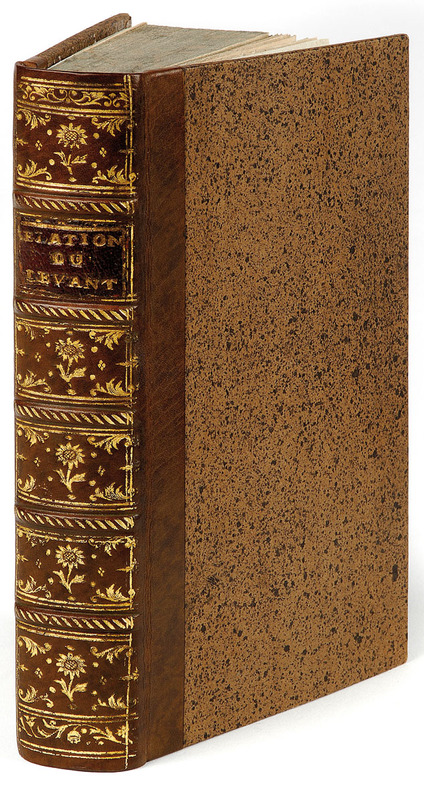
167116086Lyon, Jean Thioly, 1671 ; in-12 ; demi-veau havane pastiche du XVIIIe, tranches marbrées, dos décoré et doré, pièce de titre ; (28), titre, Épître, Préface, 481, (17) pp.
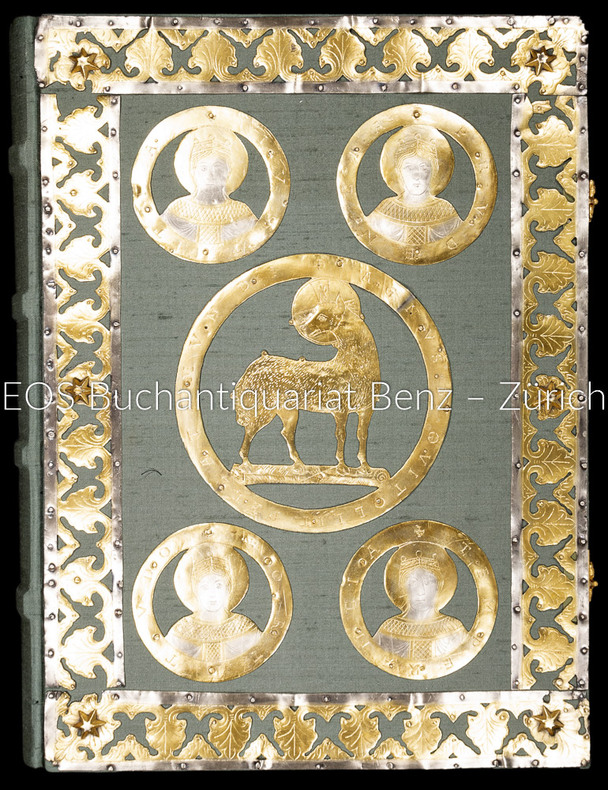
199431128AB2 Bände. Stuttgart und Frankfurt, Verlag Müller und Schindler, S. Fischer 1994. Folio. 203 Blatt mit vielen Initialen und 40 ganzseitigen Miniaturen in Blattgold, 148 Seiten (Kommentar). Seideneinband auf Holzdeckel. Auf dem Vorderdeckel wurde die Goldschmiedearbeit des Original-Buchdeckels mit 23-Karat-Vergoldung kopiert. Mit zwei Schliessen. In schwarzem Samtsack. Halblederband (Kommentar) in Pappschuber.
29532aafAmsterdam, Michel Charles Le Cene, 1741, in-folio, frontispice gravé + 1 f. + 6 p. + 4 p. + 110 p. + 3 ff. + 83 p. (Projet...); XVI + 698 p. + 1 f. + 136 p. (Ancien Testament); 2 ff. + 235 p. (Nouveau Testament), quelques cahiers un peu brunis, solide et élégante reliure en maroquin rouge, dos à nerfs muet, roulettes dorées encadrant les plats, coupes et bordures dorées, tranches dorées, bon exemplaire.
25790Leipzig, Verlag von C.G. Naumann, (1888.) Two works in one volume. (8), 144 pp.; (8), 57, (1) pp. 8vo. Contemporary half cloth, spine lettered gilt, marbled boards, corners. First work: Schaberg 56. First edition of the "Twilight of the Gods" and written during an incredibly productive six month period before Nietzsche's collapse in Turin. It was also the last book published during his lifetime. The title refers to an image in the preface: idols "are touched with a hammer and a tuning fork to determine whether they are hollow", which is of course a sarcastic allusion to Wagner, both personally and as a symbol of the German spirit. Nietzsche had 1,000 copies of this work privately printed. Originally to be called "A Psychologist at Leisure," Nietzsche changed the title at the suggestion of his friend, Gast and the book was released a few weeks after Nietzsche collapsed in Turin. The "Idols" that Nietzsche singles out here are those of the philosophers and the moralists. The Preface clearly states that the work at hand is to be "the revaluation of all values". Socrates and Christianity are particular targets although modern Germany and other contemporary ideas are also taken to task in the normally acerbic style of the author. (This book also contains some of Nietzsche's most frequently quoted phrases beginning with Aphorism #8: "What does not kill me only makes me stronger".)Second work: Schaberg 54.First edition, second issue. The book was published on 22 September 1888. Five hundred copies were printed, but 500 additional copies were printed at this time and falsely marked as second edition by the addition of "Zweite Auflage" in the middle of the ornamental rule and the deletion of the publication date. The true second edition of a 1000 copies was printed in October of 1891.The book is a critique of Richard Wagner and the announcement of Nietzsche's rupture with the German artist, who had involved himself too much, in Nietzsche's eyes, in the Völkisch movement and antisemitism. His music is no longer represented as a possible "philosophical affect," and Wagner is ironically compared to Georges Bizet. However, Wagner is presented by Nietzsche as only a particular symptom of a broader "disease" which is affecting Europe, that is nihilism. The book shows Nietzsche as a capable music-critic, and provides the setting for some of his further reflections on the nature of art and on its relationship to the future health of humanity.This work is in sharp contrast with the second part of Nietzsche's The Birth of Tragedy, wherein he praised Wagner as fulfilling a need in music to go beyond the analytic and dispassionate understanding of music. Nietzsche also praised Wagner effusively in his essay 'Wagner at Bayreuth' (part of the Untimely Meditations), but his disillusion with Wagner the composer and the man was first seen in his 1878 work Human, All Too Human. One of the last works that Nietzsche wrote returned to the critical theme of The Case of Wagner. In Nietzsche contra Wagner, Nietzsche pulled together excerpts from his works to show that he consistently had the same thoughts about music, only that he had misapplied them to Wagner in the earliest works. - First and last leaves a bit foxed, some scattered annotations in blue pencil and lead pencil.Provenance: from the library of A. Diepenbrock, with his signature on the first free endpaper (and date Jan. 1889) and second title-page (with the date Sept. 1888.) Alphons Diepenbrock was a Dutch composer, essayist and classicist. Although he showed musical ability he studied classics at the University of Amsterdam, gaining his doctorate cum laude in 1888 with a dissertation in Latin on the life of Seneca. The same year he became a teacher, a job which he held until 1894, when he retired from that position and decided to devote himself to music. As a composer, he had been completely self-taught from an early age. He created a musical idiom which, in a highly personal manner, combined 16th-century polyphony with Wagnerian chromaticism, to which in later years was added the impressionistic refinement that he encountered in Debussy's music. His predominantly vocal output is distinguished by the high quality of the texts used. Apart from the Ancient Greek dramatists and Latin liturgy, he was inspired by, among others, Goethe, Novalis, Vondel, Brentano, Hölderlin, Heine, Nietzsche, Baudelaire and Verlaine. As a conductor, he performed many contemporary works, including Gustav Mahler's Fourth Symphony (at the Concertgebouw) as well as works by Fauré and Debussy. Throughout his life, Diepenbrock continued his interests in the wider cultural sphere, remaining a classics tutor and publishing works on literature, painting, politics, philosophy and religion. Indeed during his lifetime his musical skills were often overlooked. Nonetheless, Diepenbrock was very much a respected figure within musical circles. He counted amongst his friends Mahler, Richard Strauss and Arnold Schoenberg.
1856R66464Parisiis [Paris] / Petit-Montrouge, apud Ludovicum Vivès / J.-P. Migne 1856-1878 (1963) / 1858 'Opera omnia' complete in 28 volumes: 26 volumes + 2 volumes of indices, text in latin, original 1856-1878-edition (except 'Indices'), Editio nova (second edition, the first of which was printed in 1740-1751 in Venice), 27cm., text printed in 2 columns, all vols. including the compendium are uniformely bound (cart.cover with marbled plates, gilt lettering & decorations on leather spines, marbled endpapers) except for the indices (vols.27-28, anastatic reprint of the Paris 1878-edition: Bruxelles, Culture et civilisation, 1963, 29cm., full cloth), few foxing, small library stamp at titlepages, nice set in a beautiful binding, to which is added: 'Summa seu Compendium' by Fr.Noel (complete in 2 volumes, original Migne-edition of 1858), [Opera omnia: cfr. De Backer & Sommervogel, VII col.1680 no.24, Suarez Franciscus S.J., Grenada 1548 - Lisbon 1617 / Compendium: cfr. De Backer & Sommervogel V col.1793 no.12, Franciscus Noel, Hestrud 1651 -Lille 1729], R66464
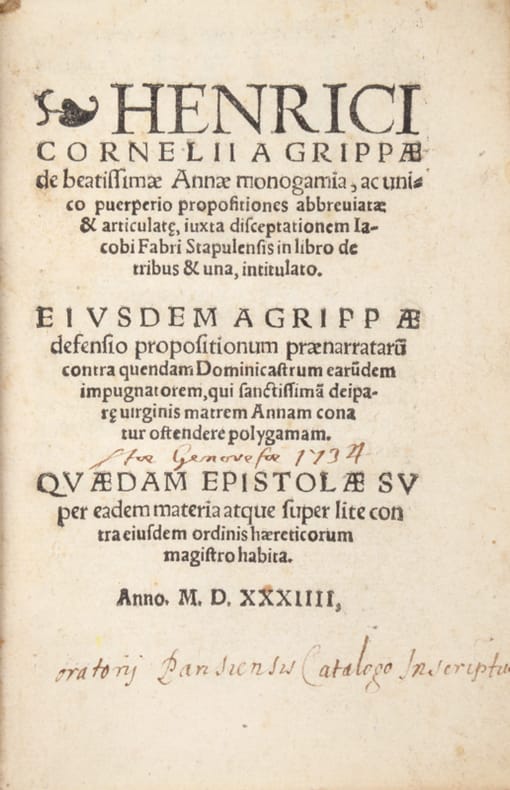
153442216Sans lieu (Cologne, Johann von Aich), 1534. In-12 de (144) ff. (sign. A-S8), maroquin rouge, dos lisse orné, pièces de titre en maroquin olive, triple filet doré d'encadrement sur les plats, tranches dorées (reliure du XVIIIe siècle).
1783002461Paris, Bastien, 1783
49240aafColoniae Agrippinae (= Köln), sumptibus Viduae Wilh. Metternich & filii, 1731, gr. in-folio, 6 Bl. + 757 S. / 2 Bl. + 751 S. / 2 Bl. + 266 S., mit je 1 wh. Titelblattvignette, Titelblatt von Bd. 1 in rot und schwarz, am Schluss des ersten Bandes etwas tintenfleckig am Rande, Stempel und Besitzvermerk a.T. und V., Prgt., stellenweise leicht fleckig, Bd. 1 zu Beginn oben mit kleinen Wurmspuren ohne Textverlust. - Im Ganzen gut erhaltenes Exemplar.
15424110DBGetruckt zuo Zürych, bey Christoffel Froschouer, im Jar 1542. 2°. (33) Bl., DLXVIII, (1) Bl. (unbedruckt). Geprägter Lederband über Holzdeckeln mit 5 Bünden.
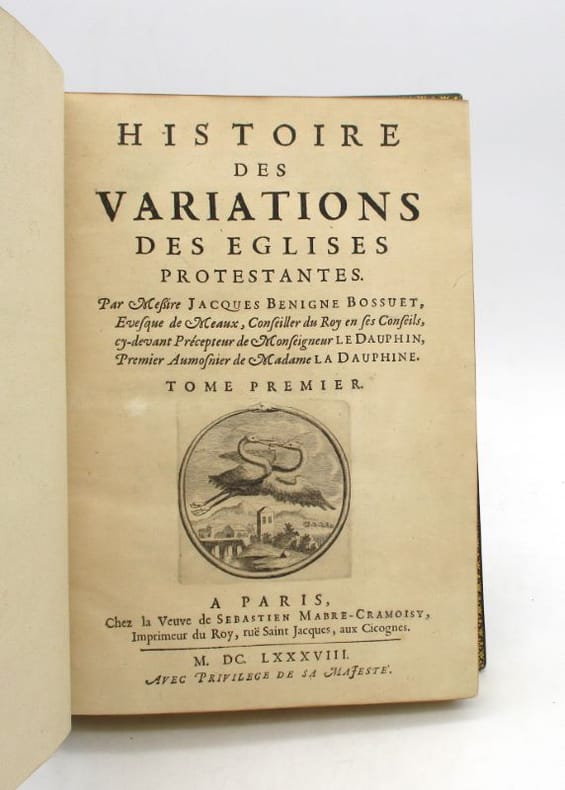
22064Paris, Veuve de Sébastien Mabre-Cramoisy, 1688. 2 vol. in-4, [40]-506-[33] pp. + [8]-680-[42] pp., maroquin janséniste brun d'Allô, dos à nerfs, importante bordure intérieure ornée de dentelle dorée, tranches dorées (dos légèrement éclaircis, quelques minuscules épidermures).
1856R67192Parisiis, apud Ludovicum Vivès 1856-1878 complete in 28 volumes: 26 volumes + 2 volumes of indices, text in latin, original 1856-1878-edition, Editio nova (second edition, the first of which was printed in 1740-1751 in Venice), 27cm., text printed in 2 columns, all vols. are uniformely bound in hardcover (marbled plates, spine in cloth, with marginal spots), few library stamps, good set [cfr. De Backer & Sommervogel, VII col.1680 no.24, Suarez Franciscus S.J., Grenada 1548 - Lisbon 1617], R67192
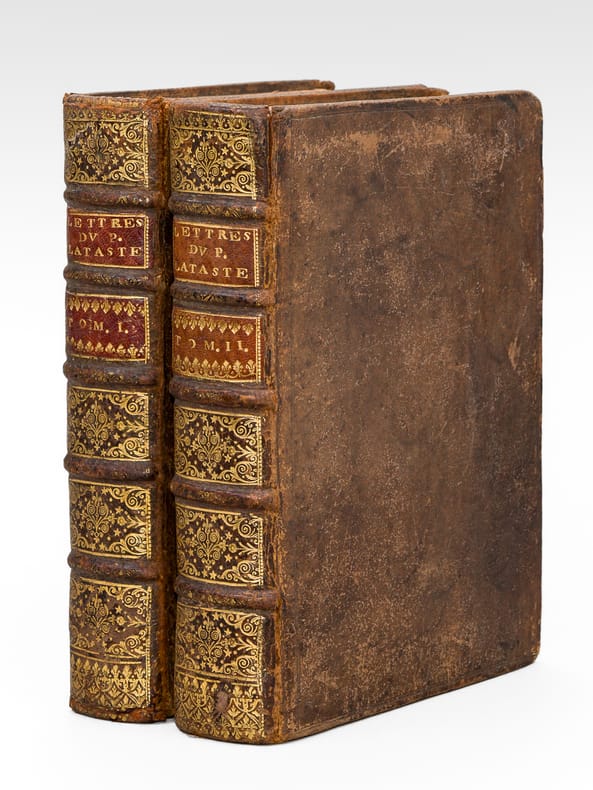
173968147Par le Reverend Pere Dom Louis Lataste, Religieux Benedictin de la Congregation de Saint Maur, Assistant du Très Reverend Pere Superieur General de ladite Congregation,. A present Evêque de Bethleem & Abbé de Moirmont Diocèse de Châlon sur Marne, 2 vol. in-4 reliure de l'époque pleine basane brune, dos à 5 nerfs orné, De l'Imprimerie de Marc Chave, Marchand Libraire, à Avignon, 1739, 1 f., 15-878 pp. ; 1 f., pp. 903-1298 et 1305-1644, 4 ff., 101-18-lxiiij pp.
395232 volumes in-folio (305 x 215 mm). Pour le volume fac-similé: reliure de maroquin rouge reproduisant la reliure d'origine, dos à 5 faux-nerfs orné de compartiments cloisonnés et fleuronnés, plats ornés d'armes dorées au centre dans un large encadrement de roulettes, tranches dorées, 207 feuillets. Pour le volume de commentaires: demi-maroquin rouge, dos lisse, titre doré, 435 pages. Feuillets de certificat signé et de table des illustrations conservés. Ensemble protégé sous coffret de plexiglas d'origine. Faksimile-Verlag, Luzern, Editions Fac-similés Lucerne, 1984
20155126DBohne Ortsangabe, Oris Mediaevalis, Editoria Internacional de Facsimiles. 2015. 8° (130 x 95 mm). 150 Blatt. Alles Seiten mit Miniaturen von Jean Colombe. Roter Lederband mit reicher Goldverzierung in Acryl-Box.
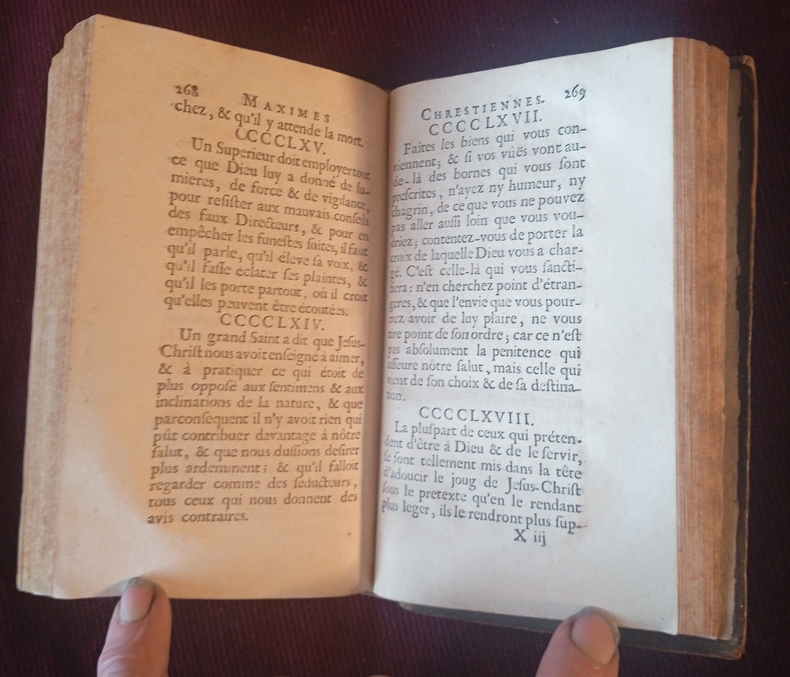
1698LR19-HN7Rare exemplaire de l'édition originale, 2 volumes, in 12, veau fauve d'époque, 5 nerfs, dos orné, approbation et privilège, 384 p. et 375 p. + table, beaux exemplaires, coiffe de tête du premier volume coupée, celle de pied du second frottée, manques de cuir sur 3 coins. Bien que réalisées à l'époque, les reliures sont légèrement différentes par leurs ornements, celle du tome 1 à une armoirie d'alliance sous couronnes ducales à ce qu'il me semble, celle de gauche portant une fleur de lys, celle de droite illisible). Je reprend le descriptif collé à l'intérieur du premier plat du T. 1 provenant du catalogue d'un vendeur de la fin du dix-neuvième siècle ou du début du vingtième : Première édition de ce recueil de plus de treize cent maximes de l'illustre Armand-Jean du Rancé le réformateur de la Trappe. On y trouve l'"Approbation de Monseigneur Jacques Bénigne, évêque de Meaux, conseiller d'Etat ordinaire et devant précepteur de Monseigneur le Dauphin", donnée à Meaux, en son palais épiscopal le 28 septembre 1697. Ouvrage très rare, qui n'est pas mentionné par les biographes malgré la célébrité de son auteur. (N'auraient-ils pas reconnu dans le "R.P. Dom Armand-Jean" l'illustre Rancé ?). Il semble que Chateaubriand, lui aussi, ait ignoré cet ouvrage, car il ne le mentionne pas dans sa Vie de Rancé.
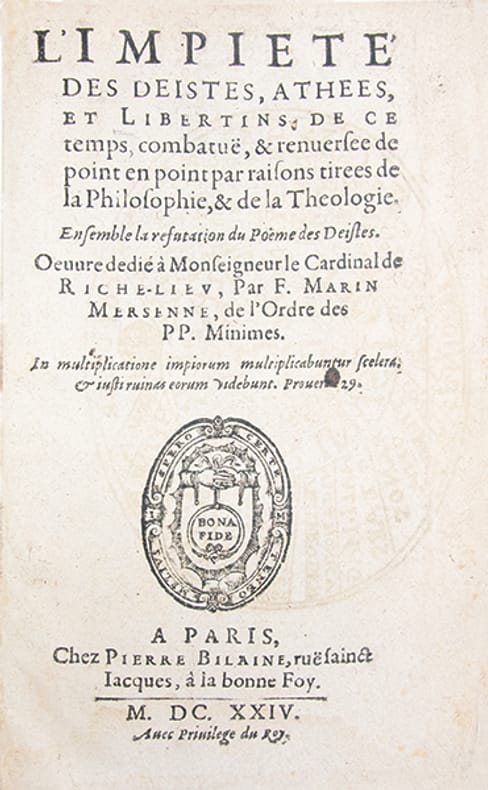
39349In-8 (170 x 117 mm), parchemin teinté havane, dos lisse orné de compartiments cloisonnés garnis dun fer spécial répété, palette en pied, plat encadré dune roulette de palmettes à froid, tranches marbrées (reliure vers 1800). (52), 834, (10) pages, gravures sur bois dans le texte. A Paris, chez Pierre Bilaine, 1624.
155530476DBBasel, Henripetri, 1555. Folio. 48 n.n. Bl., 1499 (recte 1503) S., 1 S. Druckermarke. Schweinslederband der Zeit über Holzdeckeln mit handschriftlichem Rückentitel und Rollstempelverzierung.
15817696BBTiguri, excudebat Christophorus Froschouerus, anno 1581. 4°. (18), 432, (1) Bl. (leer). Mit Holzschnittdruckermarke (Titelblatt) und 1 Wappenholzschnitt. Schweinslederband mit Platten- und Rollstempelprägung (2 Schliessen ausgerissen).
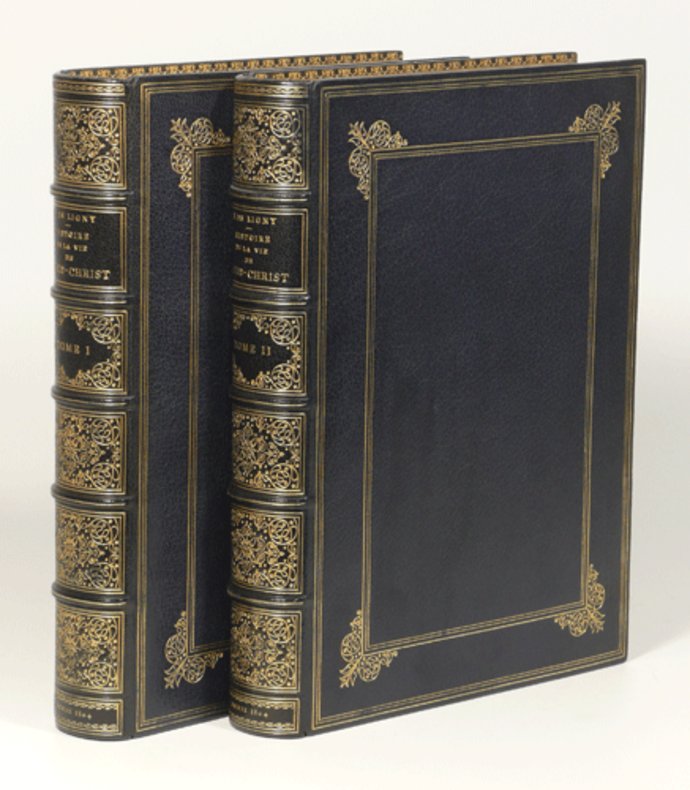
18040030451804 Paris, Imprimerie de Crapelet, 1804. Deux volumes in-quarto (188 X 244 mm) maroquin bleu de Prusse, dos cinq nerfs filetés, caissons dorés entièrement ornés aux petits fers, auteur, titre et tomaison dorés, lieu et année d'édition en queue, roulette dorée en queue et tête, deux encadrements triple filet doré sur les plats avec écoinçons au second, coupes filetées, coiffes ornées, tranches dorées sur marbrure, large dentelle dorée en bordure intérieure (BELZ suc Niédrée). Tome I : (2) ff. de faux-titre et titre, frontispice, VIII-514 pages, 39 planches - Tome II : (2) ff. de faux-titre et titre, frontispice, 534 pages, 34 planches, une carte gravée dépliante.
191216644London, New-York HARRAP & CO 1912 1 IN-8 Dessins et mise en page de Will Pogany. Londres, Harrap & Co, 1912, grand in-8, plein vélin blanc estampé doré, dos titré doré, tête dorée.
19934197DB4 Faksimile mit jeweils einem Kommentarheft und einem Kommentarband. Luzern, Faksimile-Verlag, 1993-1995 696 Seiten mit faksimilierten illustrieren Miniaturen. Samteinbände mit Metallschliessen in Samtkassetten.
17904056DBVenezia, Typographia Balleoniana, 1790. 43x29,5 cm. 4 Bl., 140 S. Mit 15 ganzseitigen Kupfern, einer gestochenen Titelvignette und 12 Vignetten im Text. Roter Lederband der Zeit mit reicher Gold- und Blindprägung sowie Ganzgoldschnitt.
20125132DB2 Bände. Simbach, Il Bulino - edizione d'arte / Verlag Müller und Schindler. 2012/20. Folio 835 Bl. Mit vielen farbigen, goldigen, teils ganzseitigen Miniaturen und Initialen. Samteinband mit Medaillon aus Messing mit einem Halbedelstein auf dem Vorderdeckel und Acrylglas-Box. Broschur (Kommentarband).