Timothy DwightBiblio.com
1 132 résultats
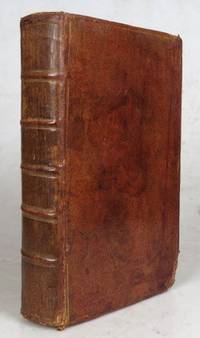
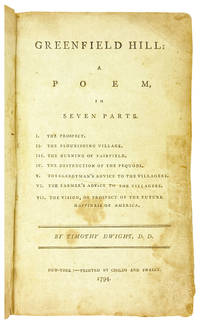
179427215New-York: v.p. 1794. Very Good-. Two volumes in one; octavo 20.5cm.; quarter contemporary calf over recent boards typescript label mounted to upper cover. Boards a bit discolored textblock quite toned and brittle with rather extensive old tape repair throughout 20th century ownership rubberstamp to front pastedown occasional contemporary corrections to text of both titles else a Good or better quite serviceable copy.<br /> <br /> Two publications from 1794 by Timothy Dwight 1752-1817 dating from his tenure as headmaster of the Greenfield Academy. Dwight grandson of Jonathan Edwards founded the school shortly after his arrival in Greenfield Hill Fairfield Connecticut defying educational norms by admitting both boys and girls teaching them the same curriculum and doing away with corporal punishment. A year after the publication of these works Dwight left the Academy to assume the role of President of Yale University. Contents as follows:<br /> <br /> 1. Greenfield Hill: A poem in seven parts. New-York: Childs and Swaine 1794. First Edition. 1831pp. A4 B4 C-2L4. BAL 5048; ESTC W20423; EVANS 29625; SABIN 21554. <br /> <br /> 2. A Discourse on the Genuineness and Authenticity of the New-Testament: Delivered at New-Haven September 10th 1793 at the annual lecture appointed by the General Association of Connecticut: on the Tuesday before the public commencement. New-York: George Bunce & Co. 1794. First Edition. 78pp. A2 K4 L2. BAL 5047; ESTC W20199; EVANS 26924. v.p. unknown
2651752London: SCM Press. GOOD in VERY GOOD jacket. Scattered marginalia. Binding sound but first endpaper removed. 1968. Cloth hardcover. Dust jacket now in clear plastic BRODART protector. Original price Sterling to front endflap. 300pp. Index. London: SCM Press hardcover
ria9780198852469_inpHardback. New. New Book; Fast Shipping from UK; Not signed; Not First Edition; Christiane Tietz relates Karl Barth's fascinating life in conflict - conflict with the theological mainstream against National Socialism and privately under one roof with his wife and his mistress in conflict with himself. hardcover
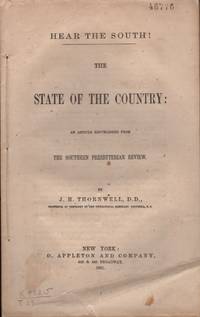
186132863New York: D. Appleton and Company 1861. Wraps. Good. Stitched wraps. Approx. 9.25" x 6". 30 pages. Original outer front wrap is missing. Title on page 1. Rear wrap has publisher advertisements. Institutional number stamp on the top edge of the title page. Edge chips and tears to the covers. Contents in good condition. D. Appleton and Company unknown
ria9781394202881_inpPaperback / softback. New. New Book; Fast Shipping from UK; Not signed; Not First Edition; N/A paperback
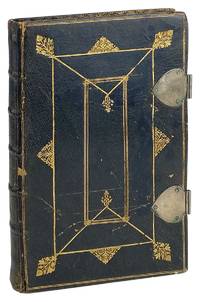
171331386London: William Pearson for the Company of Printers 1713. Very Good . London: William Pearson for the Company of Stationers 1713. Octavo 20cm.; full contemporary black gilt-tooled morocco spine in six compartments preserving both steel clasps all edges gilt marbled endpapers; 304pp. A few faint surface scratches to leather spine gilt a bit dulled else a wonderfully preserved copy in Very Good or better condition.<br /> <br /> Front front flyleaf verso adorned with four ownership inscriptions: "For my Daughter Susan Morley the Gift of Her Affectionate Father / Octr. 22 1720"; D. Harvey undated; "Bridges Harvey's from his Mother / 1812"; and Charles H. Vickermore 1877. <br /> <br /> OCLC locates one copy of this edition as of December at the National Library of Wales described as having 350pp. possibly in error. William Pearson, for the Company of Printers unknown
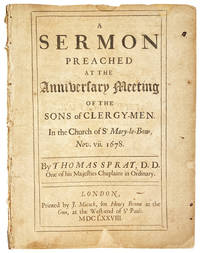
167829601London: J. Macock for Henry Brome 1678. Good. London: Printed by J. Macock for Henry Brome at the Gun at the West-end of St. Pauls 1678. First Edition. Octavo; removed; 4471pp. A2 B-G4 collated complete. Title page serving as upper wrapper separated with a few small losses to margins none approaching text textblock uniformly toned most noticeably title page else a Good complete copy overall. Contemporary ownership signature at head of leaf A2 of an Alicia Ross whom a previous owner has noted in faint pencil was the author's niece. <br /> <br /> ESTC R16678; WING S50555. J. Macock, for Henry Brome unknown
2565524 February 1836. A document of some historical significance. The context of is described in Chalmers' entry in the Oxford DNB: 'In 1835 the whig government of Viscount Melbourne appointed a royal commission of inquiry to investigate church accommodation in Scotland but the commission moved slowly about its work and angered Chalmers and the church extensionists by what they perceived as stalling methods and a bias towards the dissenters.' Lister's entry explains his involvement stating that on 19 July 1835 'he was one of those commissioned to investigate the opportunities for religious worship and the means of religious instruction in Scotland.' From the papers of Lister's wife the future Lady Theresa Lewis 1803-1865. 4pp 12mo. Forty-five lines. On bifolium. In good condition lightly aged. Folded for postage. Signed ‘Thos Chalmers. / With Dr Chalmers most respectful acknowledgments to Mr Lister.’ Dated in pencil by Lister ‘Feb 24. 1836.’ Chalmers dives straight in without a salutation: ‘1. It is most desired that an interim report on the Statistics of those localities for which New Churches are now in preparation and their claims to an endowment - should be completed as soon as possible.’ In the second point Chalmers states ‘That an endowment should in every instance be accompanied by the enactment of a low rent rent and a district be assigned to the place of worship with a preference to its sittings in favour of the people who reside in that district.’ The third and last point covers two pages of close text. It goes into greater detail about ‘a low-rent rent and a territorial district’ with respect to ‘dissenting ministers’ ‘established church’ ‘Legislature’ and ‘meeting-houses’. [24 February 1836.] unknown
1989biblio7253<p>Sewn binding. Cloth over boards. 208 p. Classical Pastoral Care Series 3. Audience: General/trade.</p> Crossroad Pub Co hardcover
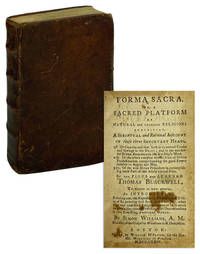
177425835Boston: William M'Alpine for the Rev. Mr. Williams of Windham 1774. Very Good. Boston: Printed by William M'Alpine for the Rev. Mr. Williams of Windham 1774. Presumed First American Edition. 16mo; full contemporary calf unadorned spine in six compartments; xvii1xviiivii.e. vii8-3391pp. B8 2B8 C-P8 Q4 R-2A8 collated complete. Leather a bit scuffed at extremities a few surface scratches to boards lacking endpapers contemporary ownership signature to front pastedown else a Very Good copy overall.<br /> <br /> Treatise first published in 1710 under the title "Schema Sacra" to accompany the author's text "Ratio Sacra." This the first appearance in the American colonies though another state provides the imprint "Printed and sold by William M'Alpine at his printing-office in Marlborough-Street" no priority. This copy includes the list of subscribers as well as the publisher's advertisement on p. 340. The list of subscribers includes by our count thirty-five women and a guy named "Mr. Life Night." The N.B. at the end of the publisher's advertisement assures the reader "As the above Books are mostly printed and bound by said M'Alpine he is determined to sell at the lowest Prices and will warrant all such to be neatly bound &c."<br /> <br /> EVANS 13155; ESTC W23140. William M'Alpine, for the Rev. Mr. Williams, of Windham unknown
167630876Paris: Edme Couterot 1676. Very Good. Paris: Edme Couterot 1676. Two volumes bound in one; 12mo 16 cm; xx4751; 12394pp. Collated complete. Boards full bound in contemporary mottled calf with gilt stamping to spine. Edges speckled red. Front board corners worn shelfwear to bottom margin and tail of spine has minor loss and is pulling away from book block. General scuffing and scratching to boards with creases to spine. Generally dust soiled. No front endsheets. Pasted contemporary manuscript to first pastedown and bottom of page xx and contemporary manuscript to last free endsheet. Piece cut away from title page which also has a library stamp brief pencil and a small paper repair. Pages lightly foxed throughout with some corners torn but overall a Very Good copy. <br /> <br /> The Spiritual Works of Mr. Thomas Becasse Prior of Chapelle-la-Reyne to help guide good Christians in their faith. Two volumes bound as one. Edme Couterot unknown
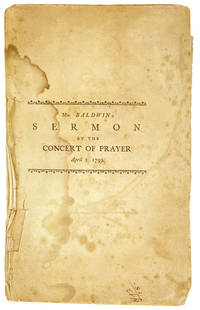
179927927Boston: Manning & Loring 1799. Good. Boston: Manning & Loring 1799. First Edition. Octavo; stitched self-wrappers; 24pp. A-C4 collated complete with half title page. Spine margins quite curled first signature badly dampstained and browned brief contemporary note to half title page serving as upper wrapper and very occasional marginalia in the same hand final leaf separated but present. A Good only copy overall. "Published by desire of many who heard." <br /> <br /> EVANS 35144; SABIN 2917. Manning & Loring unknown
BOOKS019914ITurin:: Marietti. 1/2" tear in Vol. 6 Index hinge cloth. Fair/Good unmarked. 1932. ISBN: Hardback set; cheaply produced originally; paper yellowing & binding. ISBN: fragile; no DJ 768; 732; 700; 819; 824; 479 pp. Catalogs: THEOLOGY. Keywords: LATIN AQUINAS MEDIEVAL THEOLOGY. Marietti hardcover
1980S7845<p>Series: <em>Analecta Vlatadon</em> No. 30. In Greek. Hard cover 24 cm 556 pp.</p> Patriarchal Institute of Patristic Studies hardcover
1355759919.Ghardcover. Good. Access codes and supplements are not guaranteed with used items. May be an ex-library book. hardcover
DADAX1619708299Hendrickson Publishers 2016-08-01. Volume Boxed Set ed. paperback. New. 6.20x3.30x9.50. Buy with confidence. Excellent Customer Service & Return policy. Hendrickson Publishers paperback
DADAX1619708604Hendrickson Publishers 2016-09-01. Reprint. hardcover. New. 6.00x1.80x9.10. Buy with confidence. Excellent Customer Service & Return policy. Hendrickson Publishers hardcover
20161-1619708604Hendrickson Pub 2016. Hardcover. New. reprint edition. 978 pages. 9.25x6.50x2.25 inches. Hendrickson Pub hardcover
20161-1619708299Hendrickson Pub 2016. Paperback. New. box edition. 1128 pages. 9.00x6.00x3.00 inches. Hendrickson Pub paperback
nosku915the hardcover stated Bobbs First Edition from 1967. Other than a clipped back cardholder flyleaf ex libris both the mylar-covered DJ and the book are in positively excellent condition. There are no rips tears etc. and the pages and binding are tight as a drumVery Good hardcover
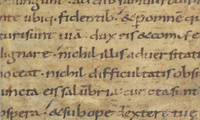
3504801/01/1025. <blockquote><p>It is fascinating to think that the men and women who said this prayer lived early enough to have perhaps lived concurrently with Charlemagne himself who died in 814 but almost ertainly with his son Louis who lived into the 840s.</p><p> </p><p>Documents of any import or interest from this early era are very uncommon</p><p> </p><p>The Rise of Charlemagne</p></blockquote><p>The late eighth century saw a new power rising in Europe in the form of the empire of Charlemagne 747-814. Originally from the region of north-eastern France and the adjacent territories of the Low Countries within a few decades most of Europe from the Channel to the Pyrenees eastwards into much of Germany and downwards into Italy had fallen under his sway. It is clear that he saw the correct fostering of religion writing reading and learning in general as a vehicle to give this unit a collective identity remaking the Roman Empire as he saw it out of the fragmented and disparate communities left behind when that power structure fell in the fifth century.</p><p>In 800 Charlemagne was crowned Emperor of the Romans by Pope Leo III reviving the ancient imperial title in the West.</p><p>Charlemagne’s only surviving legitimate son Louis the Pious inherited the entire empire. Louis was deeply religious and capable but lacked his father’s political and military authority. He ruled as Emperor 814–840 and sought to maintain unity but his own reforms and family disputes soon undermined that goal.</p><p>These conflicts ended with the Treaty of Verdun 843 which permanently divided Charlemagne’s empire into three main kingdoms: West Francia ruled by Charles the Bald became the foundation of modern France; East Francia ruled by Louis the German evolved into Germany; Middle Francia ruled by Lothair I included northern Italy Burgundy and the Low Countries; this area later fractured further.</p><p>Louis the German ruled East Francia from 843-876 followed by Carloman of Bavaria Louis the Younger and Charles the Fat.</p><p>Although politically divided Charlemagne’s empire left a lasting legacy. The idea of a Christian emperor ruling Europe persisted inspiring the later Holy Roman Empire begun in 962 under Otto I. His reforms in education administration and law profoundly shaped medieval Europe.</p><p>The Sacramentary was one of the oldest tools of the Western clergy. It combined the various readings needed for Masses and the liturgy in a single convenient volume for use by a bishop or a priest. The earliest examples to survive are the Leonine and Gelasian Sacramentaries both with origins in the seventh century but as with the Bible and other key Christian books the careful reform and correction of such texts was at the forefront of the earliest waves of the Carolingian renaissance. Between 781 and 791 Charlemagne wrote to Pope Hadrian I asking him for an approved copy of the service-book of the Roman Church. That was examined added to on numerous occasions and disseminated and became the Gregorian Sacramentary. It is likely to have been further added to in the provinces of Europe and the text dominated liturgical practice for the next three centuries.</p><p>Votive Masses for those on voyages and at sea for one’s enemies and for the Bishop and congregation. Reading in part: ""Almighty and everlasting God who alone work great marvels stretch forth upon your servant N. Bishop and upon all the peoples committed to him the spirit of saving grace; and that they may truly be pleasing to you pour upon them the continual dew of your blessing. O God Who didst bring our fathers through the Red Sea and didst guide them in safety through the overflowing waters whilst they sang praises to Thy name we humbly pray that Thou wouldst keep in safety Thy servants on board ship and grant them a calm voyage to the haven they desire. O God of infinite mercy and immeasurable majesty whom neither the expanse of places nor the intervals of times separate from those whom you protect be present to your servants who everywhere place their trust in you and deign to be for them—through the whole journey they are about to undertake—a guide and a companion. Let nothing of adversity harm them; let nothing difficult stand in their way. Let all things be healthful for them all things prosperous; and under the help of your right hand may they swiftly obtain with effect whatever they seek with just desire.â€</p><p><strong>Leaf</strong> measuring 230 x 99 mm blind-ruled for two columns of 27 lines written in large and rounded Carolingian minuscule rubrics in orange-red recovered from reuse in a later binding.</p><p>It is fascinating to think that the men and women who said this prayer lived early enough to have perhaps lived concurrently with Charlemagne who died in 814 but certainly with his son Louis. These changes would have been uttered at a time when the consolidation of their empire was a recent and not distant event and Charlemagne’s grandchild was on the throne. These were events of real import to them and had daily consequences.</p><p>Our gratitude to manuscript expert Dr. Timothy Bolton who aided in the research of this document.</p><p>PROVENANCE</p><p>Produced in an abbey within the Holy Roman Empire</p><p>Cut up for use in a binding probably in the 16th century</p><p>Maggs Bros Catalogue 1002 1980</p><p>Mark Lansburgh 1925–2013 teacher hand-press printer and book collector on whom see Dutschke 2024; presumably sold by him to:</p><p>Neil F. Phillips 1924–1997 QC of Montreal New York and Virginia: his MS 698; sold at Sotheby's 2 December 1997 lot 42; bought by:</p><p>The Boehlen Collection Bern MS 804.</p><p><img class=""alignnone wp-image-25018 size-post-window"" src=""https://cdn.raabcollection.com/wp-content/uploads/20231204144051/Folder-site-11-1600x1327.jpg"" alt="""" width=""1600"" height=""1327"" /></p> unknown
14502626101/01/1450. <blockquote><p>Records show only a small number of such mathematical devices having reached the public market</p><p> </p><p>The manuscript bears markings of subsequent owners including a poem from the 16th century to Saint Basil normally associated with the East</p></blockquote><p>video width=""1920"" height=""1080"" mp4=""https://cdn.raabcollection.com/wp-content/uploads/20231204130536/Computus-Youtube-Template-1.mp4""/video</p><p> </p><p>Prior to 1420 devotional books such as Books of Hours or Breviaries were made to order and reflected the particular interests of the patron. A breviary usually formatted in a writing block of two columns as opposed to its single column relative the Book of Hours contains excerpts of psalm gospel hymns and prayers to guide the reader in his or her daily prayer at the fixed Canonical Hours. Because these books were created at this time for a specific use they could be catered to that use including the use of alternate texts. This would also be the case for clergymen.</p><p>One of the most important branches of medieval learning was computus the science of calculating times and dates using a combination of mathematics and astronomy. The use of poetry to transmit scientific material would have made it easier for students to memorize. These calculations were often applied to the tricky and at times controversial calculation of the date of Easter a highly variable and occasionally contentious date relying on lunar calendars the date of the Jewish celebration of Passover and whether or not the observer is on the Julian or Gregorian calendar. Easter remains celebrated on different days in the West than the East.</p><p><img class=""alignnone wp-image-26267 size-post-window"" src=""https://cdn.raabcollection.com/wp-content/uploads/20231204133327/Medieval-cipher-4-1600x1105.jpg"" alt="""" width=""1600"" height=""1105"" /></p><p>In 1408 a Yorkshire man named John de Foxton ca. 1369-1450 wrote an encyclopaedic work called Liber Cosmographiae now housed at Cambridge Trinity College MS. R.15.21. John’s extensive work includes a poem on fol. 19v. The poem includes the line “Quaerit amor Christi multos dum regnat iniqus†The love of Christ seeks many while the unjust reign. It appears in a very limited number of other manuscripts. It is a cipher. The poem also includes seemingly unrelated letters written in red above each of the words. These letters would accompany the poetic text making the poem into a memory-based mnemonic device to figure out the date of Easter John de Foxton’s Liber Cosmographiae: An Edition and Codicological Study 1988 p. xxiii-xxiv.</p><p>Such computational texts which can combine a description of the calculation process along with the paired poetic text / letters are occasionally found in texts of this period but finding them on the market would be very uncommon.</p><p>Within the first decade of the fifteenth century an ecclesiastical man a member of the clergy had a breviary commissioned for him.</p><p>Breviary in Latin ca. 1410 Flanders or Luxembourg 2- 3- and 4- line initials in blue and pink with white penwork shellgold illumination; 23 partial borders consisting of a pink and blue bar extending the length of the text illuminated with gold and often terminating in penwork floral sprays.</p><p>Within this book which he would use for his daily prayers he had an unusual selection incorporated — a paraphrase of a computus text along with the Foxton poetic mnemonic computistical text to further solidify his study and understanding of the dating of Easter. The letters of the Foxton text were added though in a slightly different structure.</p><p><img class=""alignnone wp-image-26269 size-post-window"" src=""https://cdn.raabcollection.com/wp-content/uploads/20231204133315/Medieval-cipher-3-1-1-1600x746.jpg"" alt="""" width=""1600"" height=""746"" /></p><p>Combined these instructions describe the dating of easter and include an alphabet written out to help the ciphering. The text also mentions a Charles Karolus who says or teaches on the matter in “m cccc lvxxiiiâ€. The year 1478 is a scribal error inserting an extra century for what should have been m ccc lvxxiii. On November 29 1378 Charles of Luxembourg better known as the Holy Roman Emperor died. This portion of text of the ecclesiastic’s breviary is a paraphrase and therefore not published as is in any source we could determine.</p><p>A curious manuscript likely refering to the computistical ideas of Charles IV the Holy Roman Emperor influenced by the English cultural diffusion of John de Foxton’s mnemonic and cipher a bespoke production for a clergy man interested in this complex medieval science of dating Easter. A later 16th century prayer to Saint Basil has been added in space left after the text on fol. 399v by a reader.</p><p><img class=""alignnone wp-image-26333 size-post-window"" src=""https://cdn.raabcollection.com/wp-content/uploads/20231204132843/Medieval-cipher-1-2-1600x224.jpg"" alt="""" width=""1600"" height=""224"" /></p><p>A note on location and paleography</p><p>Several of the saints’ names in the liturgy have been copied with the French spelling conventions. While the illumination in the later liturgical portion of the text appear at first glance to be French— for example the pale yellow touches to capitals to draw the readers eyes— the hand lacks some of the sophistication of French manuscript production one would expect. In a Book of Hours the blue tipped three-petalled flowers would certainly indicate Bruges but this gets diffused further away from the city in other liturgical books. The spiky seed pods that flourish the borders are indicative of Flanders and were often emulated by English artists. During this time books were commonly being produced in the Low Countries for English audiences creating a fusion of paleographic and illustration styles. The paleography and orthography reveal the mystery. The hook-like descenders on the letter h go far beyond the baseline which is a distinctly Flemish feature. The spelling of “ewangelia†on the verso of the folio numbered in modern pencil as 367 proves the Germanophone claim moving the manuscript firmly into the liminal sphere of BeNeLux Belgium Netherlands Luxembourg region with its changing boarders and political statuses.</p><p><img class=""alignnone wp-image-26270 size-post-window"" src=""https://cdn.raabcollection.com/wp-content/uploads/20231204133310/Medieval-cipher-2-1-1600x600.jpg"" alt="""" width=""1600"" height=""600"" /></p><p>See also:</p><p>Neues Archiv der Gesellchaft für ältere deutsche Geshichtskunde: zur Beförderung einer Gesammtausgabe der Quellenschriften deutscher Geschichten des Mittelalters Sechster Band Vol. 6 Hannover: Hahnsche Buchhandlung 1881.</p><p>J. Van den Gheyn Catalogue des manuscrits de la Bibliothèque Royale de Belgique: Tome Deuxieme Vol. 2 Bruxelles: Henri Lamertin 1902.</p><p>Friedman John “John Siferwas and the Mythological Illustrations in the Liber Cosmographiae of John de Foxton†Speculum 58:2 1983. Pp. 391-418.</p><p>Friedman John “The Cipher Alphabet of John de Foxton’s Liber Cosmographiae†Scriptorium 36:2 1982. Pp. 219-235.</p><p><img class=""alignnone wp-image-25018 size-post-window"" src=""https://cdn.raabcollection.com/wp-content/uploads/20231204144051/Folder-site-11-1600x1327.jpg"" alt="""" width=""1600"" height=""1327"" /></p> unknown
19931-0664219918Westminster John Knox Pr 1993. Hardcover. New. sixth printing edition. 1107 pages. 9.50x6.50x1.75 inches. Westminster John Knox Pr hardcover
235221075. <p><strong>This document survives in part because it was later used as a binding from another book; a handful of other segments of this manuscript appear in book bindings now at the National Library of Naples</strong></p><p><strong>""Rightly then is the soul restored thither since He has come who will undo the treacherous knot and reestablish righteousness.""</strong></p><p>The 1000s AD was a period of great tumult and transformation in Europe. In England the Norman Invasion took place resulting in the crowning of William the Conqueror. Around this time the Papal States led by the Pope created an alliance with the Normans and acquired from the Byzantines the Duchy of Beneveto around and south of Rome. This all took place in the late 11th century.</p><p><a href=""https://cdn.raabcollection.com/wp-content/uploads/20231204153804/Beneventan-1B-wide.jpg""><img class=""alignnone size-post-window wp-image-23523"" src=""https://cdn.raabcollection.com/wp-content/uploads/20231204153804/Beneventan-1B-wide-1600x433.jpg"" alt="""" width=""1600"" height=""433"" /></a></p><p>In Benevento in the 8th century great monks and scholars were doing fascinating work. A particular kind of handwriting had emerged which we now refer to as Beneventan script. It was the result of work by monks in a handful of monasteries in the region most notably that of Monte Casino. It is beautiful sometimes inscrutable and unique in form.</p><p>Ambrose of Milan later Saint Ambrose was Bishop of Milan in the 4th century. He was a fierce promoter of the church and left a substantial collection of writings and sermons with his views on Christianity set against a backdrop that included paganism.</p><p>Leo the Great was a Roman aristocrat and was the first pope to have been called ""the Great"". He is perhaps best known for having met Attila the Hun in 452 and persuaded him to turn back from his invasion of Italy.</p><p><strong>Two 11th century Southern Italian medieval manuscripts</strong> Beneventan scrit likely from near Naples consisting of explanations of the gospels homilies originally written by Ambrose of Milan and Pope Leo the Great.</p><p> </p><p>These documents were handled by the Quaritch firm in 1990 and Sothebys in 1994. Other fragments of the same parent manuscript can be found in the bindings of Naples Biblioteca Nazionale.</p><p><strong>More details</strong></p><p>From a Homiliary with parts of Ambrose of Milan Expositio Evangelii Secundum Lucam and Leo the Great Tractatus 76 in Beneventan minuscule decorated manuscript in Latin on parchment Italy perhaps Naples late eleventh century. Two cuttings from a single parent manuscript with some Bari-type features capitals touched in red and iridescent yellow wash the second cutting with remnants of a large initial 'P' in red with leaf flourishing. Size: 100 by 170mm. and 85 by 130mm.</p> unknown
174450111London: Edward Wicksteed 1744. 8vo ii x 540 10 pp. Frontispiece lacking front endpapers and with some loss to those at the rear. Contemporary calf some marks corners and spine ends worn otherwise sound. The second part "Private Devotions" is dated 1759. Many editions were published in the mid-18th century all anonymous. London: Edward Wicksteed unknown