CS Lewis; Pauline Baynes [illus] C SBiblio.com

1 132 résultats
195047634London: Geoffrey Bles / The Bodley Head 1950. Very Good/Very Good. London: Geoffrey Bles / The Bodley Head 1950-6. First Editions First Printings. Seven octavo volumes; illustrated dust jackets over cloth boards. Frontispieces some color; black and white in-text illustrations; map endpapers. All jackets unclipped except for Horse and His Boy; repair with paper fill-ins to Lion and Silver Chair; discrete professional repair to Dawn Treader; mild chipping closed tears and general rubbing and soiling. Boards with varying degrees of shelfwear sunning and rubbing. Bindings sound; foxing to edges of text block and endpapers; contemporary ownership inscriptions to preliminaries; slight musty odor; pages unmarked. <br /> <br /> A Very Good and sound set of Lewis's fantasy series continually praised and scrutinized for its blend of magic and mythology as well as philosophy and theology all taking place in what Lewis called "a supposition." Full sets of first printings in jacket uncommon in retail.<br /> <br /> Currey pp. 310-311. Geoffrey Bles / The Bodley Head unknown
14502626101/01/1450. <blockquote><p>Records show only a small number of such mathematical devices having reached the public market</p><p> </p><p>The manuscript bears markings of subsequent owners including a poem from the 16th century to Saint Basil normally associated with the East</p></blockquote><p>video width=""1920"" height=""1080"" mp4=""https://cdn.raabcollection.com/wp-content/uploads/20231204130536/Computus-Youtube-Template-1.mp4""/video</p><p> </p><p>Prior to 1420 devotional books such as Books of Hours or Breviaries were made to order and reflected the particular interests of the patron. A breviary usually formatted in a writing block of two columns as opposed to its single column relative the Book of Hours contains excerpts of psalm gospel hymns and prayers to guide the reader in his or her daily prayer at the fixed Canonical Hours. Because these books were created at this time for a specific use they could be catered to that use including the use of alternate texts. This would also be the case for clergymen.</p><p>One of the most important branches of medieval learning was computus the science of calculating times and dates using a combination of mathematics and astronomy. The use of poetry to transmit scientific material would have made it easier for students to memorize. These calculations were often applied to the tricky and at times controversial calculation of the date of Easter a highly variable and occasionally contentious date relying on lunar calendars the date of the Jewish celebration of Passover and whether or not the observer is on the Julian or Gregorian calendar. Easter remains celebrated on different days in the West than the East.</p><p><img class=""alignnone wp-image-26267 size-post-window"" src=""https://cdn.raabcollection.com/wp-content/uploads/20231204133327/Medieval-cipher-4-1600x1105.jpg"" alt="""" width=""1600"" height=""1105"" /></p><p>In 1408 a Yorkshire man named John de Foxton ca. 1369-1450 wrote an encyclopaedic work called Liber Cosmographiae now housed at Cambridge Trinity College MS. R.15.21. John’s extensive work includes a poem on fol. 19v. The poem includes the line “Quaerit amor Christi multos dum regnat iniqus†The love of Christ seeks many while the unjust reign. It appears in a very limited number of other manuscripts. It is a cipher. The poem also includes seemingly unrelated letters written in red above each of the words. These letters would accompany the poetic text making the poem into a memory-based mnemonic device to figure out the date of Easter John de Foxton’s Liber Cosmographiae: An Edition and Codicological Study 1988 p. xxiii-xxiv.</p><p>Such computational texts which can combine a description of the calculation process along with the paired poetic text / letters are occasionally found in texts of this period but finding them on the market would be very uncommon.</p><p>Within the first decade of the fifteenth century an ecclesiastical man a member of the clergy had a breviary commissioned for him.</p><p>Breviary in Latin ca. 1410 Flanders or Luxembourg 2- 3- and 4- line initials in blue and pink with white penwork shellgold illumination; 23 partial borders consisting of a pink and blue bar extending the length of the text illuminated with gold and often terminating in penwork floral sprays.</p><p>Within this book which he would use for his daily prayers he had an unusual selection incorporated — a paraphrase of a computus text along with the Foxton poetic mnemonic computistical text to further solidify his study and understanding of the dating of Easter. The letters of the Foxton text were added though in a slightly different structure.</p><p><img class=""alignnone wp-image-26269 size-post-window"" src=""https://cdn.raabcollection.com/wp-content/uploads/20231204133315/Medieval-cipher-3-1-1-1600x746.jpg"" alt="""" width=""1600"" height=""746"" /></p><p>Combined these instructions describe the dating of easter and include an alphabet written out to help the ciphering. The text also mentions a Charles Karolus who says or teaches on the matter in “m cccc lvxxiiiâ€. The year 1478 is a scribal error inserting an extra century for what should have been m ccc lvxxiii. On November 29 1378 Charles of Luxembourg better known as the Holy Roman Emperor died. This portion of text of the ecclesiastic’s breviary is a paraphrase and therefore not published as is in any source we could determine.</p><p>A curious manuscript likely refering to the computistical ideas of Charles IV the Holy Roman Emperor influenced by the English cultural diffusion of John de Foxton’s mnemonic and cipher a bespoke production for a clergy man interested in this complex medieval science of dating Easter. A later 16th century prayer to Saint Basil has been added in space left after the text on fol. 399v by a reader.</p><p><img class=""alignnone wp-image-26333 size-post-window"" src=""https://cdn.raabcollection.com/wp-content/uploads/20231204132843/Medieval-cipher-1-2-1600x224.jpg"" alt="""" width=""1600"" height=""224"" /></p><p>A note on location and paleography</p><p>Several of the saints’ names in the liturgy have been copied with the French spelling conventions. While the illumination in the later liturgical portion of the text appear at first glance to be French— for example the pale yellow touches to capitals to draw the readers eyes— the hand lacks some of the sophistication of French manuscript production one would expect. In a Book of Hours the blue tipped three-petalled flowers would certainly indicate Bruges but this gets diffused further away from the city in other liturgical books. The spiky seed pods that flourish the borders are indicative of Flanders and were often emulated by English artists. During this time books were commonly being produced in the Low Countries for English audiences creating a fusion of paleographic and illustration styles. The paleography and orthography reveal the mystery. The hook-like descenders on the letter h go far beyond the baseline which is a distinctly Flemish feature. The spelling of “ewangelia†on the verso of the folio numbered in modern pencil as 367 proves the Germanophone claim moving the manuscript firmly into the liminal sphere of BeNeLux Belgium Netherlands Luxembourg region with its changing boarders and political statuses.</p><p><img class=""alignnone wp-image-26270 size-post-window"" src=""https://cdn.raabcollection.com/wp-content/uploads/20231204133310/Medieval-cipher-2-1-1600x600.jpg"" alt="""" width=""1600"" height=""600"" /></p><p>See also:</p><p>Neues Archiv der Gesellchaft für ältere deutsche Geshichtskunde: zur Beförderung einer Gesammtausgabe der Quellenschriften deutscher Geschichten des Mittelalters Sechster Band Vol. 6 Hannover: Hahnsche Buchhandlung 1881.</p><p>J. Van den Gheyn Catalogue des manuscrits de la Bibliothèque Royale de Belgique: Tome Deuxieme Vol. 2 Bruxelles: Henri Lamertin 1902.</p><p>Friedman John “John Siferwas and the Mythological Illustrations in the Liber Cosmographiae of John de Foxton†Speculum 58:2 1983. Pp. 391-418.</p><p>Friedman John “The Cipher Alphabet of John de Foxton’s Liber Cosmographiae†Scriptorium 36:2 1982. Pp. 219-235.</p><p><img class=""alignnone wp-image-25018 size-post-window"" src=""https://cdn.raabcollection.com/wp-content/uploads/20231204144051/Folder-site-11-1600x1327.jpg"" alt="""" width=""1600"" height=""1327"" /></p> unknown
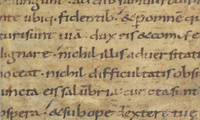
251671050. <blockquote><p>The important messages Gregory spoke nearly 500 years before the manuscript was made—that he spoke during the aftermath of a plague and collapse of an empire—were still relevant to the scribe who carefully copied out the homilies</p><p>“Earthly substance compared to heavenly happiness is a weight not a support.â€</p></blockquote><p>Modernity’s view of Pope Gregory the Great derives from his own words and from an imaging of the zeitgeist of the 6th century that the saint navigated. One early 20th century historian wrote of Pope Gregory that:</p><p>Growing up amid the relics of a greatness that had passed daily reminded by the beautiful broken marbles of the vanity of things he Gregory was accustomed to look on the world with sorrowful eyes. The thrill the vigour the joy of life were not for him.…He never attained a perfect sanity of view. From his birth he was sick—a victim of the malady of the Middle Ages. Dudden</p><p>Though this description may be consistent with the romanticized view of the 18th century antiquarian Edward Gibbon more than it accurately depicts Gregory Leyser the tumult and transition of the era must have impacted Gregory.</p><p>Born around 540 C.E. Gregory was immediately thrust into a world stricken with plague. This pestilence which would be known as the Black Death in the later Middle Ages was at this time called the Plague of Justinian due to the Emperor’s recovery from it and was the first occurrence of this strain of Yersinia pestis in Europe. In 590 Pope Pelagius II was not as fortunate as Emperor Justinian and succumbed to the disease— leaving the Holy See open for Gregory to assume as the natural successor to Pelagius Leyser.</p><p>From 590 until his death in 604 Pope Gregory achieved his appellation of “the Great.†During his papacy he began to shift the power centre back from Constantinople to Rome. He reformed and reshaped liturgy and arguably the most well known style of music from the Middle Ages the Gregorian chant described as such in the 9th century took his name because of his impact on plainchant centuries earlier. His influence was felt both on the Italic peninsula and in the far flung reaches of Germany and Britain.</p><p>While a unified Italy would not be achieved for another nearly 13 centuries the battle for a unified Christian theology across boundaries had already begun. With some groups still rejecting Christianity wholesale other groups believed different dogmas of the religion. One particularly popular version was Arianism which did not believe in the equality of the Holy Trinity rather that Jesus born of a human woman could not be of the same status as God and the Holy Spirit. As the Germanic Lombards amassed their kingdom in the North of Italy they staked out their Arian belief system. Gregory however befriended the Lombard Queen-by-marriage the Bavarian Theoldelinda who became a follower; she in turn influenced her husband Autori to adopt a Romanitas and convert to Nicean Christianity.</p><p>In 596 the Gregorian mission— the pope’s effort to convert the Anglo-Saxon peoples in Britain— was under way. Though after the Romans withdraw from Britain in 410 a good portion of the population remained Christian the Anglo-Saxon peoples were still practicing pagans and the separation from Rome led to distinct differences between Continental and Insular Christianity. Gregory saw an opportunity to complete the conversion of the British peoples in the Kentish King Æthelberht’s marriage to the Frankish and Christian Bertha. Thus he sent Augustine of Canterbury and Paulinus of York to the Islands and the conversion was under way.</p><p>Shortly before his mission efforts to Britain in 592-593 or 590-592 C.E. Pope Gregory delivered the Holimiae in Euangelia Homily on the Evangelists. These sermons would have been preached by Gregory and written down by scribes who were also able to read the sermons for him if need be Markus 16. These homilies come to us through an extant collection of around 400 still extant manuscripts Judic p. 233 n. 2.</p><p>Medieval manuscript Two vellum leaves from Books 1 and 2 of Gregory the Great’s Homiliae in Evangelia Italy 11th century written in beautiful Romanesque script.</p><p>The text of these folios are primarily from Book 2 Homily 27 and 37 with one section from Book 1 Homily 4 explaining the works of Evangelists John Matthew and Luke. In these sermons he expounds how to be a good Christian and the heavenly promises awaiting. In one exemplary passage from these leaves Gregory combines his passionate description of the kingdom of heaven with his acute sense of the Apocalyptic return of Christ as well as providing guidance for becoming more spiritually worthy. He writes:</p><p>“If we consider dearest brothers what and how great things are that are promised to us in the heavens we despise in our hearts all that is held on earth. For earthly substance compared to heavenly happiness is a weight not a support. The temporal life compared to the eternal life is rather to be said to be death than life. For what is the daily lack of corruption but a kind of prolongation of death But what language is sufficient to say or what understanding is sufficient to comprehend the joys of the heavenly city to participate in the choir of angels to assist with the most blessed spirits of the glory of the founder to behold the present face of God to see the uncircumscribed light to be affected by no fear of death to rejoice in the gift of perpetual incorruption But when he heard these things his heart was inflamed and he now desired to attend there where he hoped to rejoice without end. But great rewards cannot be attained except through great labors.†fol. 2 r.</p><p>This set of manuscript leaves lets us glimpse into the world immediately following the turn of the first millennium. The human touch behind the production of the manuscript comes to the fore through the unusual remains of the note from the scribe to his rubricator to add the section heading in red. The important messages Gregory spoke nearly 500 years before the manuscript was made—that he spoke during the aftermath of a plague and collapse of an empire—were still relevant to the scribe who carefully copied out the homilies paying attention to add delicate serifs on the feet of the descending strokes to make the physical manifestation of the words as impactful as their message.</p><p><strong>More details:</strong></p><p>Two vellum bifolium with sections from Books 1 and 2 of Gregory the Great’s Homiliae in Evangelia Italy 11th century second half in Latin four leaves two sets of two leaves conjoint 364 x 265 written space: 288 x 188 mm with double columns of 38 lines in fine Romanesque script Æ in ligature prepositions joined to the words they govern. Both tall & uncial-type d; ampersand for et. Consistent use of common abbreviations. Brown ink for main text headings in rubrication red with letters beginning sections tipped in red. Two and three-line initials in red.</p><p>These leaves demonstrate the production process of the manuscript. The leaves would have been folded in the centre leaving two columns of text on each side and stacked into each other and sewn to create packets called quires or gatherings of leaves. Thus the front and back recto/verso of the leaves are consecutive text but the leaves themselves are non-consecutive reflecting the stacking. Further remnants of the production process can be seen: the scribe’s directions to his rubricator— the person in charge of adding in the red letters— can be seen on the extreme edge of fol. 1 v beginning with “audio merit orare.â€. The letters written perpendicular to the main text correspond with the red letters on Column B reading in abbreviated letters “Lectio sancti evangelii secundum Matthaeum.†These types of directions are usually trimmed off during either the first stage of contemporary book production or in subsequent bindings making the finding of one highly unusual.</p><p><strong>Text Description:</strong></p><p>All from Gregory the Great’s Homiliae in Evangelia Homilies on the Evangelists</p><p>Fol. 1:</p><p>Book 2 Homily 27 sections 5- 8 “Addressed to the people in the Basilica of St. Pancratius the Martyr on the Day of his birthâ€</p><p>Fol. 1v:</p><p>Continued from recto Book 2 Homily 27 sections 8- 9.</p><p>Book 1 Homily 4 section 1 “Addressed to the people in the Basilica of Saint Stephan the Martyr on the Apostlesâ€</p><p>Fol. 2:</p><p>Book 1 Homily 17 section 18 “Addressed to the Bishops in the Lateran Baptistryâ€</p><p>Book 2 Homily 37 sections 1-2 “Addressed to the people in the Basilica of the Blessed Saint Sebastian the Martyr on the day of his birthâ€</p><p>Fol. 2v:</p><p>Continued from recto Book 2 Homily 37 sections 2- 6.</p><p><strong>Provenance:</strong></p><p>Ex Bruce Ferrini accompanied by a document prepared by Prof. Martin Colker of the University of Virginia.</p><p><strong>Further reading:</strong></p><p>Dudden F. Homes Gregory the Great: His Place in History and Thought 2 vols. London 1905 i. 15.</p><p>Leyser Conrad Authority and Asceticism from Augustine to Gregory the Great Oxford UP 2000.</p><p>Markus R.A. Gregory the Great Cambridge UP 2012.</p><p><img class=""alignnone wp-image-25018 size-post-window"" src=""https://cdn.raabcollection.com/wp-content/uploads/20231204144051/Folder-site-11-1600x1327.jpg"" alt="""" width=""1600"" height=""1327"" /></p> hardcover
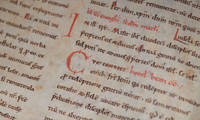
3504801/01/1025. <blockquote><p>It is fascinating to think that the men and women who said this prayer lived early enough to have perhaps lived concurrently with Charlemagne himself who died in 814 but almost ertainly with his son Louis who lived into the 840s.</p><p> </p><p>Documents of any import or interest from this early era are very uncommon</p><p> </p><p>The Rise of Charlemagne</p></blockquote><p>The late eighth century saw a new power rising in Europe in the form of the empire of Charlemagne 747-814. Originally from the region of north-eastern France and the adjacent territories of the Low Countries within a few decades most of Europe from the Channel to the Pyrenees eastwards into much of Germany and downwards into Italy had fallen under his sway. It is clear that he saw the correct fostering of religion writing reading and learning in general as a vehicle to give this unit a collective identity remaking the Roman Empire as he saw it out of the fragmented and disparate communities left behind when that power structure fell in the fifth century.</p><p>In 800 Charlemagne was crowned Emperor of the Romans by Pope Leo III reviving the ancient imperial title in the West.</p><p>Charlemagne’s only surviving legitimate son Louis the Pious inherited the entire empire. Louis was deeply religious and capable but lacked his father’s political and military authority. He ruled as Emperor 814–840 and sought to maintain unity but his own reforms and family disputes soon undermined that goal.</p><p>These conflicts ended with the Treaty of Verdun 843 which permanently divided Charlemagne’s empire into three main kingdoms: West Francia ruled by Charles the Bald became the foundation of modern France; East Francia ruled by Louis the German evolved into Germany; Middle Francia ruled by Lothair I included northern Italy Burgundy and the Low Countries; this area later fractured further.</p><p>Louis the German ruled East Francia from 843-876 followed by Carloman of Bavaria Louis the Younger and Charles the Fat.</p><p>Although politically divided Charlemagne’s empire left a lasting legacy. The idea of a Christian emperor ruling Europe persisted inspiring the later Holy Roman Empire begun in 962 under Otto I. His reforms in education administration and law profoundly shaped medieval Europe.</p><p>The Sacramentary was one of the oldest tools of the Western clergy. It combined the various readings needed for Masses and the liturgy in a single convenient volume for use by a bishop or a priest. The earliest examples to survive are the Leonine and Gelasian Sacramentaries both with origins in the seventh century but as with the Bible and other key Christian books the careful reform and correction of such texts was at the forefront of the earliest waves of the Carolingian renaissance. Between 781 and 791 Charlemagne wrote to Pope Hadrian I asking him for an approved copy of the service-book of the Roman Church. That was examined added to on numerous occasions and disseminated and became the Gregorian Sacramentary. It is likely to have been further added to in the provinces of Europe and the text dominated liturgical practice for the next three centuries.</p><p>Votive Masses for those on voyages and at sea for one’s enemies and for the Bishop and congregation. Reading in part: ""Almighty and everlasting God who alone work great marvels stretch forth upon your servant N. Bishop and upon all the peoples committed to him the spirit of saving grace; and that they may truly be pleasing to you pour upon them the continual dew of your blessing. O God Who didst bring our fathers through the Red Sea and didst guide them in safety through the overflowing waters whilst they sang praises to Thy name we humbly pray that Thou wouldst keep in safety Thy servants on board ship and grant them a calm voyage to the haven they desire. O God of infinite mercy and immeasurable majesty whom neither the expanse of places nor the intervals of times separate from those whom you protect be present to your servants who everywhere place their trust in you and deign to be for them—through the whole journey they are about to undertake—a guide and a companion. Let nothing of adversity harm them; let nothing difficult stand in their way. Let all things be healthful for them all things prosperous; and under the help of your right hand may they swiftly obtain with effect whatever they seek with just desire.â€</p><p><strong>Leaf</strong> measuring 230 x 99 mm blind-ruled for two columns of 27 lines written in large and rounded Carolingian minuscule rubrics in orange-red recovered from reuse in a later binding.</p><p>It is fascinating to think that the men and women who said this prayer lived early enough to have perhaps lived concurrently with Charlemagne who died in 814 but certainly with his son Louis. These changes would have been uttered at a time when the consolidation of their empire was a recent and not distant event and Charlemagne’s grandchild was on the throne. These were events of real import to them and had daily consequences.</p><p>Our gratitude to manuscript expert Dr. Timothy Bolton who aided in the research of this document.</p><p>PROVENANCE</p><p>Produced in an abbey within the Holy Roman Empire</p><p>Cut up for use in a binding probably in the 16th century</p><p>Maggs Bros Catalogue 1002 1980</p><p>Mark Lansburgh 1925–2013 teacher hand-press printer and book collector on whom see Dutschke 2024; presumably sold by him to:</p><p>Neil F. Phillips 1924–1997 QC of Montreal New York and Virginia: his MS 698; sold at Sotheby's 2 December 1997 lot 42; bought by:</p><p>The Boehlen Collection Bern MS 804.</p><p><img class=""alignnone wp-image-25018 size-post-window"" src=""https://cdn.raabcollection.com/wp-content/uploads/20231204144051/Folder-site-11-1600x1327.jpg"" alt="""" width=""1600"" height=""1327"" /></p> unknown
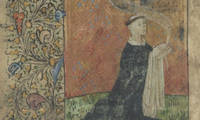
1420254921420. <blockquote><p>It is unusual to find an English example particularly one which so well demonstrates the unique factors at play in such pieces at the time</p></blockquote><p>Throughout the Middle Ages true visionaries put into place systems of intellectual and social organisation. Saint Dominic’s foundation of the Dominican Order responded to a need for a new kind of monasticism as Medieval Europe shifted towards an increased urbanisation which would give rise to the great cities that we now know. In the city of Toulouse France Dominic based his Order on the Rule of Saint Augustine— a system of tenets to organize the lives of the monks which focused heavily on salvation through preaching. Dominic’s order valued education as the vehicle for effective preaching and therefore effective saving of souls. Dominic’s vision saw his followers establishing schools alongside newly burgeoning universities in Paris and Bologna and later in Palencia Montpellier and even Oxford within his lifetime. Members of the Dominican Order took their message of educated understanding of God from the continent to the British Isles settling in Oxford by 1221.</p><p>Thomas Aquinas and Albertus Magnus were also of the Dominican Order.</p><p>Given the wealth of expressions of interiority that arise in later Medieval arts . scholars philosophers and ideologues have often turned to this era when seeking the putative origins of modern selfhood"" Sands 1; the inclusion of patron portraits acts as a reflection of the self reflecting on the divine personalizes the book. After book productions shifted towards catering to the wealthy rather than the monastic lay-patrons were able to emulate ""monastic patterns of reading prayer and meditation"" Sands 15. Rather than allowing a wealthy lay patron to emulate the monastic way of life the patron portrait of this Dominican monk is a glimpse into the monastic way of life and an individual's development of his sense of self.</p><p>This leaf from a Dominican’s personal prayer book features a portrait of the owner himself. This little peak into a 15th century private sphere shows the book’s owner depicted in his traditional black cloak— which gave rise to the appellation of the Dominicans as “the Black Friarsâ€â€” over top his white habit and his tonsure to better allow God to see his thoughts and to demonstrate his renunciation of worldly aesthetics. From his outstretched hands a banderole twirls upwards around a now faded woman’s face framed in the blue associated with the Virgin. The leaf is blank on the back. These two features— the heavy fading in a specific area and the blank verso— make suggestions about the production and the reception of the book.</p><p>This portrait leaf was likely a bespoke product that was tipped into an on-spec ready-to-buy book. That is to say at this point books were no longer being made entirely to the patron’s demand; books had become commodities that more people could afford so a stationer would have books ready made with minor customization available such as the addition of a patron portrait. This addition without text on the back would not interrupt the flow of the set selection of prayers in the Book of Hours. With this customization the owner literally sees himself in his daily worship of the Virgin Mary. Here is where the importance of the fading comes into play.</p><p>This is likely not just the wear and tear of history but the toll of the owner’s ritual touching of the Virgin’s face in conjunction with his portrait. This action is called ‘affective piety’ and though chiefly associated with women’s rituals it was not uncommon for men particularly those aligned with mysticism to engage in this method of worship. In the same way that Saint Dominic’s Order responded to the rise of cities in the thirteenth century affective piety provides a new way of interacting with Christianity. As people moved towards understanding Christ as a man and through his bodily identity they also moved towards an “emotional understanding of Christ as accessible through his humanity and imitable through affective piety and the new ways of thinking feeling and imitating Christ that it fostered resulted in innovative modes of individual and communal devotion through prayer reading and liturgy†Zimbalist. We notice on this leaf that the border the background the grass even the Friar’s own body and face are not as faded as the banderole of holy words and the image of the holy face now nearly imperceivable. This suggests that the wear was focused on these significant areas and were likely touched rubbed even cried upon frequently during his reverent worship. The size of the folio also underscores its use as a personal devotional item indicating a book small enough to fit in the hand and be carried discreetly.</p><p>London was the capital of fashion for manuscripts in England in the 1300 and 1400s. Trends from the Continent would arrive in London and be incorporated into newly made manuscripts and these trends would radiate outwards to other centers of manuscript production. The border around the Dominican friar demonstrates the transition of preference for curving rather than straight borders occurring from 1405 to the end of the century; the incorporation of several specific styles of foliage indicate that this manuscript was on the cutting edge of fashion fairly early on and therefore likely made in London.</p><p>This book owner whose name is now lost to us but whose face remains in this miniature tells the story of an Order who rode the tide of urbanisation through a devotion to God and education and who saw the destruction of Europe and its own numbers during the Black Death. The owner living circa 1420 likely in London based on the style of background and border of this leaf would be heartened to know that his Order endured further European upheavals from the Early Modern to the Modern Period just like this piece of his book.</p><p>While patron portraits have made their way to the market particularly in bound books it is unusual to have an English example particularly one which so well demonstrates the production process of creating a bespoke product from an on-spec liturgical book.</p><p>Further details:</p><p><strong>Leaf from an English Book of Hours</strong> Use of Sarum with a miniature of a Dominican friar in prayer in Latin illuminated manuscript on parchment England probably London c. 1420 104 by 69mm. Single leaf with a large rectangular miniature of a tonsured friar in Dominican robes kneeling in a grassy area as a banderole emerges from his hands and curves upwards to enclose a woman's face most probably the Virgin the whole before a tessellated background decorated with red and blue dots within a full border of rinceaux foliage terminating in gold ivy leaves and coloured seed pods and acanthus leaves reverse blank signs of water damage to top of reverse slight scuffing and fading.</p><p>See also:</p><p>Hamburger Jeffrey. The Visual and the Visionary: Art and Female Spirituality in Late Medieval Germany New York N.Y.: Zone Books 1998</p><p>Zimbalist Barbara. ""Chapter 10: Medieval Affective Piety and Christological Devotion: Juliana of Mont Cornillon and the Feast of Corpus Christi"". Illuminating Jesus in the Middle Ages. Leiden The Netherlands: Brill 2019.</p><p>Sands Alex Vision Devotion and Self-Reprsentation in Late Medieval Art Cambridge University Press 2014</p><p><img class=""alignnone wp-image-25018 size-post-window"" src=""https://cdn.raabcollection.com/wp-content/uploads/20231204144051/Folder-site-11-1600x1327.jpg"" alt="""" width=""1600"" height=""1327"" /></p> unknown
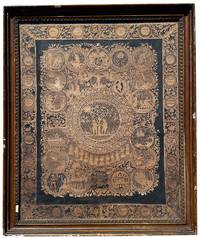
174131833Midhurst West Sussex England 1741. Very Good. Midhurst West Sussex England 1741. Original large example of "Scherenschnitte" or scissor art depicting scenes predominantly from the Old Testament 41x32cm.; mounted within a scherenschnitte paper frame 51x43cm. The entire display is laid down on black mat in a 19th-century frame not examined out of frame. <br /> <br /> Scherenschnitte is the folk art tradition of cutting paper designs often incorporating rotational symmetry and silhouettes. A treasured Chinese art dating back to the invention of paper the tradition was adopted in Europe in the 16th century before making its way to Colonial America primarily the Pennsylvania region two centuries later.<br /> <br /> This is a stunning English example in which the plethora of intricate detail can take some time to take in. The interior centerpiece depicts Adam and Eve under the forbidden apple tree. They and their furry friends are surrounded by an intricate floral border. Below: the twelve Apostles; above: Mary in the manger Christ on the cross and Jesus ascending to Heaven. <br /> <br /> Radiating outward lie what are to us the most impressive part of this piece - eighteen vignettes sixteen from the Old Testament each admirable for their skillful artistry and execution. Jonah and the Whale Cain slaying Abel Death and Time the Last Judgment and Hell are all depicted the latter in the form of a fire-breathing monster. Happily for the historian the British royal arms are depicted as well as a circular lozenge stating the date and a name: "January 1741" and "James Cox" presumably the artist.<br /> <br /> Around the whole is a splendid 4cm-wide border executed in eight scissor-cut strips glued together and each with two or three cut circles within which the artist has written the titles of each Bible scene. Each circle has its own surrounding design with only a couple examples repeated. Though we don't know when it arrived in America this piece was found in a Lancaster Pennsylvania house. A truly superb example of this traditional folk art and a lovely survival. . unknown
1673373863N.p. England 1673. Manuscript on paper with more than four dozen floral and ornamental head- and tailpieces. Text in an elegant hand within ruled borders 28 lines per page. 2 172 6 pp. Small folio. Eighteenth century vellum backed boards. Bookplate of the Duke of Sussex. Front inner hinge starting some dampstaining at top of leaves throughout the text. Manuscript on paper with more than four dozen floral and ornamental head- and tailpieces. Text in an elegant hand within ruled borders 28 lines per page. 2 172 6 pp. Small folio. From the Library of Augustus Frederick Duke of Sussex 1773-1843 younger son of George III. His brothers were George IV and WIlliam IV<br /> <br /> An unsigned manuscript compendium of devotional prompts and theological texts in a legible and well formed hand including discourses expositions of Bible verses and a more substantial rebuttal of Thomas Tillam's book The Seventh-day Sabbath sought out and celebrated 1657.<br /> <br /> The manuscript is adorned with finely executed drawings of stylized flowers and architectural classical or heraldic ornaments. The headpiece of the rebuttal of the Seventh-day Sabbath is a nest of snakes.<br /> <br /> AN ATTRACTIVE MANUSCRIPT WITH DISTINGUISHED PROVENANCE. Provenance: from the Library of Augustus Frederick Duke of Sussex 1773-1843 bookplate; General Theological Seminary unknown
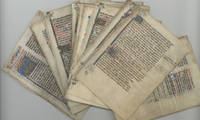
235221075. <p><strong>This document survives in part because it was later used as a binding from another book; a handful of other segments of this manuscript appear in book bindings now at the National Library of Naples</strong></p><p><strong>""Rightly then is the soul restored thither since He has come who will undo the treacherous knot and reestablish righteousness.""</strong></p><p>The 1000s AD was a period of great tumult and transformation in Europe. In England the Norman Invasion took place resulting in the crowning of William the Conqueror. Around this time the Papal States led by the Pope created an alliance with the Normans and acquired from the Byzantines the Duchy of Beneveto around and south of Rome. This all took place in the late 11th century.</p><p><a href=""https://cdn.raabcollection.com/wp-content/uploads/20231204153804/Beneventan-1B-wide.jpg""><img class=""alignnone size-post-window wp-image-23523"" src=""https://cdn.raabcollection.com/wp-content/uploads/20231204153804/Beneventan-1B-wide-1600x433.jpg"" alt="""" width=""1600"" height=""433"" /></a></p><p>In Benevento in the 8th century great monks and scholars were doing fascinating work. A particular kind of handwriting had emerged which we now refer to as Beneventan script. It was the result of work by monks in a handful of monasteries in the region most notably that of Monte Casino. It is beautiful sometimes inscrutable and unique in form.</p><p>Ambrose of Milan later Saint Ambrose was Bishop of Milan in the 4th century. He was a fierce promoter of the church and left a substantial collection of writings and sermons with his views on Christianity set against a backdrop that included paganism.</p><p>Leo the Great was a Roman aristocrat and was the first pope to have been called ""the Great"". He is perhaps best known for having met Attila the Hun in 452 and persuaded him to turn back from his invasion of Italy.</p><p><strong>Two 11th century Southern Italian medieval manuscripts</strong> Beneventan scrit likely from near Naples consisting of explanations of the gospels homilies originally written by Ambrose of Milan and Pope Leo the Great.</p><p> </p><p>These documents were handled by the Quaritch firm in 1990 and Sothebys in 1994. Other fragments of the same parent manuscript can be found in the bindings of Naples Biblioteca Nazionale.</p><p><strong>More details</strong></p><p>From a Homiliary with parts of Ambrose of Milan Expositio Evangelii Secundum Lucam and Leo the Great Tractatus 76 in Beneventan minuscule decorated manuscript in Latin on parchment Italy perhaps Naples late eleventh century. Two cuttings from a single parent manuscript with some Bari-type features capitals touched in red and iridescent yellow wash the second cutting with remnants of a large initial 'P' in red with leaf flourishing. Size: 100 by 170mm. and 85 by 130mm.</p> unknown
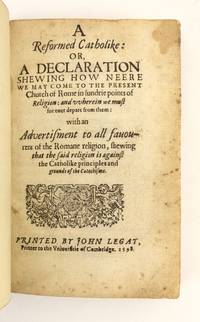
1598ST16441Cambridge: John Legat 1598. Second Printing. 153 x 98 mm. 6 x 3 7/8". 4 p.l. 375 1 pp. <br/> Modern sprinkled calf blind-ruled covers raised bands flanked by double gilt rules brown morocco label remnants of paper library shelf label at tail of spine. Printer's device on title page. Front pastedown with bookplate of the Fox Pointe Collection; rear pastedown with deaccession stamp of Bradford City Libraries. STC 19736; ESTC 19736. ◆Spine just faintly sunned leaves lightly browned due to paper quality and trimmed a bit close at head grazing headline on a couple of leaves isolated marginal stains or tiny rust spots but an excellent copy fresh and clean in a sympathetic binding with few signs of wear.<br/> <br/> This was an important work in establishing distinctions in liturgy and doctrine between the Catholic Church and the Church of England written by a moderate puritan whom DNB considers "perhaps the most significant English theologian of his age." Perkins 1558-1602 was one of the most popular voices of his time speaking from a Calvinist puritan point of view; while he could be virulently anti-Catholic he did not believe in repudiating the English church only in reforming it. According to DNB "The genius of Perkins's work did not lie in its originality—his theology represents a conventional recital of Calvinist scholasticism in virtually every respect. His gift lay rather in bringing to a broad audience a variety of theological and moral issues popularizing essentially technical discussions and therefore as Fuller observed humbling 'the towering speculations of philosophers into practice and morality.'" The present work spread his polemical influence beyond England to the Continent; even the Catholic bishop William Bishop admitted he had "not seene any book of like quality published by a Protestant to contain either more matter or delivered in better method." Both the 1597 first edition and our 1598 second printing are rare: no other copies of either edition are recorded at auction by RBH or ABPC in the past 50 years. John Legat unknown
1586000013413Venetiis; Romae: Haeredem Hieronymi Scoti; Iulium Accoltum 1586. Later editions. Hardcover. Very Good. 2 vol. Folio. 12 1-149 foliated leaves; 12 1-269 foliated leaves pp. Later full parchment with manuscript hand on the spines; all edges decoratively stained blue. Later endpapers though volume two retains an original rear endpaper. This is a married set with volume two likely from a larger set of the complete works of St. Thomas Aquinas. Text in Latin. A few woodcut publisher's devices and woodcut initials illustrate this set. Adams 1454. Aertsen "Aquinas' Philosophy in its Historical Setting" Cambridge Companion to Aquinas 16. Encyclopedia Britannica "Peter Lombard: French bishop". Graesse 139. Stanford Encyclopedia of Philosophy "Thomas Aquinas". We could not locate the 1570 volume in Adams or Graesse. It is highly difficult to find all four books of this early work of St. Thomas Aquinas. Composed from 1252 until 1256 these commentaries are dense and systematic. They were written while Aquinas held the position of bachelor of theology and continued into his first term as master of theology. This work constitutes what we would think of today as Aquinas' Ph.D.: thus it is his first major text. The organizational scheme of Aquinas' commentaries on Lombard differs from what Lombard set down in his own work: Aertsen argues that Aquinas' circular notion of reality and existential beings has its origins in Neoplatonism a contrast to St. Augustine's influence on Lombard. Several theologians wrote commentaries on the writings of Peter Lombard but Aquinas' is special because it helped to elevate his reputation in the church and in the academic sphere. Aquinas' perspective on Lombard's theology comes from 100 years later though both men wrote these works in France and it demonstrates his own early theological ideas and notions. Lombard's work discusses topics like God the Trinity divine guidance evil predestination angels demons the Fall of man grace sin the Incarnation of Jesus Christ the redemption of sins virtues the Ten Commandments the sacraments and many other weighty questions of Christian doctrine. The reception of Lombard's work on the sacraments was especially warm. Taken together these commentaries represent the work of two scholars one in conversation with the other. These books are the product of two medieval writers who grappled with ponderous questions and debates that raged in the most powerful institution of medieval Europe. The two title pages in volume one each have repairs to them a previous owner from long ago may have excised library stamps and then mended the leaves. Eight or so other leaves of the set have repairs to a margin or a corner different from the title page mends. Volume two's front hinge gently cracked but holding its title page and next few leaves have minor worming. The set with a few unobtrusive historical ink marks from private owners. Overall the parchment bindings are beautiful and these volumes represent a lovely example of early printing in Europe. Haeredem Hieronymi Scoti; Iulium Accoltum hardcover
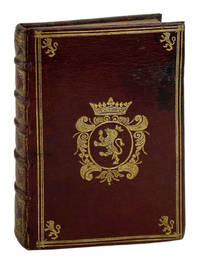
169021373Paris: N. Bonnart 1690. Very Good. Paris: N. Bonnart ca. 1690. First Edition. 12mo 15.5cm.; armorial binding of Madame de Maintenon full crimson morocco adorned with her coat-of-arms on both covers triple-ruled in gilt with diminutive repeating rampant lions at each corner elaborate gilt spine in six compartments all edges gilt marbled endpapers; 100pp.; illus. and calligraphic text printed entirely from copper-plates this copy featuring the more often-found depiction of an empty cross within a crown of thorns printed on title page verso. Light rubbing to extremities brief discoloration to upper cover from exposure to damp inoffensive surface abrasion to front pastedown from previously-removed ex libris slightly later ink note in Latin to front flyleaf else a Very Good or better copy of an exquisite production in a desirable presentation binding. Though dedication signed in text "N.D.T." a sermon of this title can be found in the complete works of Jacques Bénigne Bossuet 1627-1704 tutor of the same children to whom Maintenon had served as governess.<br /> <br /> Small and beautifully-produced prayer book dedicated to Madame de Maintenon 1635-1719 by then the morganatic not-so-secret second wife of Louis XIV published for the use of the Maison Royale de Saint-Louis a boarding school Maintenon founded in St. Cyr for the education of the orphans and children of the poorer French nobility. The text printed entirely from copper-plates is interspersed with delicate vignettes of flowers views of the French countryside and soothing religious imagery the lamb asleep on the cross details presumably dotting the text to keep Maintenon's wards engaged while deep in prayer.<br /> <br /> Volumes bound in the Maintenon armorial bindings are relatively scarce their owner having not organized any semblance of a personal library until quite late in life. Though married to the king of France for over thirty years Madame de Maintenon née Françoise d'Aubigné later Madame Scarron came from a modest background she never forsook. Raised in the Calvinist church the young Aubigné was orphaned at an early age and subsequently educated in an Ursuline convent where she converted to Catholicism her devotion to the Church one of her most notable qualities throughout her long and increasingly illustrious career. By the time she reached womanhood her straitened circumstances led her to marry the significantly older and paralytic author Monsieur Scarron noting that "I have entered a union in which the heart requires little and the body in truth nothing at all" my translation. Widowed within less than a decade the beautiful and pious Madame Scarron had by now seduced the French nobility at court and was quickly summoned by the Marquise de Montespan to be governess to the children she had borne Louis XIV out of wedlock. It was in this role that she caught the king's attention who bestowed upon her the money which she used to purchase the Chateau de Maintenon as well as the title of Marquise de Maintenon. During the decade of the 1670s the king spent more and more of his time with his children's governess causing a predictable rupture between her and the Marquise de Montespon though Maintenon forever avowed that she never stooped to the level of mistress. In 1683 Louis XIV and Madame de Maintenon were married in a secret ceremony and while she never filled the role of Queen of France she was the king's chief advisor until the end of his days. See Ernest Quentin-Bauchart "Les Femmes Bibliophiles de France" 1886 pp. 269-272.<br /> <br /> A note about the binding: The example of the Maintenon coat-of-arms depicted on this volume not listed in Olivier-Hermal-Roton presumably having been produced specially for this the dedication copy--the British Library notes a similar example of another unique cut on their dedication copy of Cordemoy's "Divers Traitez de Controverse" 1701. N. Bonnart unknown
S6964<p>In Greek. Eighteen 18 volumes > 15000 pages.</p><p>Τα <em>Άπαντα</em> του ΑÏχιεπισκόπου ΜακαÏίου Γ΄ καλÏπτουν την πεÏίοδο 1948-1977 Η αφετηÏία συμπίπτει με την εκλογή του ΜακαÏίου στο αξίωμα του ΜητÏοπολίτη Κιτίου ενώ το Ï„Îλος με τον θάνατό του. Βάσει των εξελίξεων στο ΚυπÏιακό zήτημα στα διαδοχικά στάδιά του και της σχετικής δÏάσης του ΜακαÏίου</p><p>Α΄: Î Ïοσπάθειες για διεθνοποίηση του ΚυπÏÎ¹Î±ÎºÎ¿Ï Î–Î·Ï„Î®Î¼Î±Ï„Î¿Ï‚ και εξεÏÏεση λÏσης μÎσω του ΟÏÎ³Î±Î½Î¹ÏƒÎ¼Î¿Ï Î—Î½Ï‰Î¼Îνων Εθνών.</p><p>Β΄-Δ΄: ΑπελευθεÏωτικός Αγώνας της Ε.Ο.Κ.Α. και ίδÏυση της ΚυπÏιακής ΔημοκÏατίας.</p><p>Ε΄-Ζ΄: Τα Ï€Ïώτα βήματα της ΚυπÏιακής ΔημοκÏατίας και οι δικοινοτικÎÏ‚ ταÏαχÎÏ‚.</p><p>Η΄-ΙΒ΄: ΣχÎδια λÏσης του ΚυπÏιακοÏ. ΧοÏντα των Αθηνών. Εθνικό ÎœÎτωπο.</p><p>ΙΓ΄-ΙΕ΄: Ε.Ο.Κ.Α. Β΄. Î Ïαξικόπημα. ΤουÏκική Εισβολή.</p><p>ΙΣΤ΄-ΙΗ΄: ΕπαναλειτουÏγία του κÏάτους και Ï€ÏοσωÏινή αποκατάσταση των εκτοπισθÎντων. Î ÏοσφυγÎÏ‚ στον ΟÏγανισμό ΗνωμÎνων Εθνών. Συμφωνία ΚοÏυφής ΜακαÏίου και Îτενκτάς. Θάνατος του ΜακαÏίου.</p><p><strong>Additional shipping cost applies.</strong></p> Archbishop Macarios III Foundation hardcover
174946215Romae Rome: Typis Antonii de Rubeis apud Pantheon in via Seminarii Romani 1749. Very Good. Romae Rome: Typis Antonii de Rubeis apud Pantheon in via Seminarii Romani 1749. First Edition. Four folio volumes 41x28cm bound in two; full contemporary calf with seven raised bands gilt decoration and leather title labels to spine; sponge painted edges; marbled endpapers; half titles; titles in red and black; 96; DLXXII; 3 pp.; 14; DCXXXIV pp. 19 plates 5 of which are folding collated presumed complete. Wear to boards with exposure to edges; surface scraping and flaking; binding sound. Engraved armorial bookplate of Bartholdi Nicolai Krohn of Hamburg to front pastedowns; old notes to preliminaries; else unmarked; a Very Good set of Bianchini's collation of the Vercellensis Veronensis Corbeiensis and Brixianus codices. Complete sets uncommon in retail.<br /> <br /> Brunet II. Typis Antonii de Rubeis, apud Pantheon, in via Seminarii Romani unknown
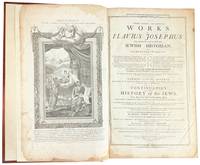
179433926New-York: Printed and Sold by William Durell at his Book Store and Printing Office No. 19 Queen-Street Near the Fly Market 1794. Very Good. New-York: Printed and Sold by William Durell at his Book Store and Printing Office No. 19 Queen-Street Near the Fly Market 1792-1794. First American Edition. Folio. 723pp.; directions to the binder; 2pp. list of subscribers; 57 plates; 3 maps including fold-out of Jerusalem collated complete. Bound in full modern speckled calf; six raised bands; original red morocco label laid to spine; new endpapers. Tight in binding; marginal staining and spotting; Very Good in a handsome binding.<br /> <br /> The Maynard Josephus is not only a fascinating illustrated tour of the ancient world but per Sabin it is "worthy of notice for the specimens of early engraving in the United States." Tiebout and Anderson the latter responsible for the fold-out map of Jerusalem in this volume were barely 20 years old at the time. An impressive and striking production. <br /> <br /> Sabin 3666; Evans 27174. Printed and Sold by William Durell, at his Book Store and Printing Office, No. 19, Queen-Street, Near the Fly Market unknown
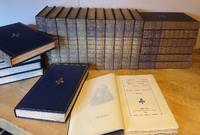
190432385New York: Charles Scribner's Sons 1904 Tolstoy's Works in 24 Volumes in gilt-stamped navy blue cloth with elaborate gilt scrollwork & decoration to spines with stylized St Peter's cross to front panels First Printing Thus no markings NOT ex-lib t.e.g. deckle-edged to bottom and foredge page blocks all volumes tightly bound with bright unfoxed pages each volume 300-400 pages per volume with frontispieces and captioned tissue guards all volumes VG to Fine with varied slight wear/soil to boards & sunning to spines all spine titles clear & legible an exemplary unread complete set quite scarce as such; 24 8vos; cumulative index in Vol 24. Extra shipping charge REQUIRED for shipment of this heavy set additional charge WILL BE SUBSTANTIAL for overseas shipment. First Edition. Hard Cover. Near Fine. Charles Scribner's Sons hardcover
195557912<p>The Church of Greece begun publishing the works of the Fathers in 1955 in a multi-volume series under the general title <strong><em>"ΒΙΒΛΙΟΘΗΚΗ ΕΛΛΗÎΩΠΠΑΤΕΡΩΠΚΑΙ ΕΚΚΛΗΣΙΑΣΤΙΚΩΠΣΥΓΓΡΑΦΕΩÎ"</em></strong>; it contains the original texts in biblical or mediaeval Greek. The Series counts a total of 99 clothbound volumes with golden stamping on the spine but only 60 volumes are currently available. Separate volumes are also available at 27.25 EUR each. Ask for the availability of specific volumes and the actual shipping cost at: demmath@hotmail.com -</p><p><strong>CONTENTS:</strong></p><p>VOL. 1 - Clement of Rome Ι VOL. 2 - Clement of Rome ΙΙ & Ignatius of Antioch VOL. 6 - Hippolytus of Rome VOL. 7 - Clement of Alexandria Ι VOL. 8 - Clement of Alexandria ΙΙ VOL. 9 - Origen I VOL. 10 - Origen II VOL. 11 - Origen III VOL. 12 - Origen IV VOL. 13 - Origen V VOL. 16 - Origen VΙΙΙ VOL. 17 - Origen IX Julius Africanus Dionysius of Alexandria & Gregorius of Neocaesarea VOL. 18 - Μεθόδιος Î ÎÏ„Ïος ΑλεξανδÏείας ΑλÎξανδÏος ΑλεξανδÏείας Ευστάθιος Αντιοχείας VOL. 19 - Titus of Bostra Theodorus of Heraclea Alexander of Lycopolis & Eusebius of Caesarea I VOL. 20 - Eusebius Bishop of Caesarea VOL. 22 - Eusebius of Caesarea IV VOL. 23 - Eusebius of Caesarea V VOL. 24 - Eusebius of Caesarea VI VOL. 25 - Eusebius of Caesarea VII VOL. 26 - Eusebius of Caesarea VIII VOL. 27 - Eusebius of Caesarea IX VOL. 28 - Eusebius of Caesarea X VOL. 29 - Eusebius of Caesarea XI Marcellus of Ancyra & Basil of Ancyra VOL. 30 - Athanasius of Alexandria I VOL. 31 - Athanasius of Alexandria II VOL. 32 - Athanasius of Alexandria III VOL. 33 - Athanasius of Alexandria IV VOL. 34 - Athanasius of Alexandria V VOL. 35 - Athanasius of Alexandria VI VOL. 36 - Athanasius of Alexandria VII VOL. 37 - Athanasius of Alexandria VIII & Asterius the Sophist I VOL. 38 - Asterius the Sophist Acacius of Caesarea Eusebius of Emesa Nemesius of Emesia VOL. 39 - Gelasius of Caesarea & Cyril of Jerusalem VOL. 40 - Anthony the Great Ammonas or Ammun Ammonius Pachomius the Great I VOL. 41 - Pachomius the Great II Orsisius Monk Theodorus & Macarius of Egypt I VOL. 42 - Macarius of Egypt ΙΙ Macarius of Alexandria Pope Peter B' of Alexandria Timotheus A' of Alexandria VOL. 43 - Saint Serapion of Thmuis & Didymus of Alexandria I VOL. 44 - Didymus of Alexandria II VOL. 45 - Didymus of Alexandria III VOL. 46 - Didymus of Alexandria IV VOL. 47 - Didymus of Alexandria V VOL. 48 - Didymus of Alexandria VI VOL. 49 - Didymus of Alexandria VII VOL. 50 - Didymus of Alexandria VIII VOL. 51 - Basil of Caesarea I VOL. 52 - Basil of Caesarea II VOL. 54 - Basil of Caesarea IV VOL. 57 - Basil of Caesarea VII VOL. 58 - Gregory of Nazianzus I VOL. 59 - Gregory of Nazianzus II VOL. 60 - Gregory of Nazianzus III VOL. 61 - Gregory of Nazianzus IV VOL. 62 - Gregory of Nazianzus V VOL. 63 - Gregory of Nazianzus VI VOL. 64 - Gregory of Nazianzus VII VOL. 65 - Gregory of Nyssa I VOL. 65A - Gregory of Nyssa II VOL. 66 - Gregory of Nyssa III VOL. 67 - Gregory of Nyssa IV VOL. 69 - Gregory of Nyssa VI VOL. 70 - Gregory of Nyssa VII VOL. 71 - Amphilochius of Iconium & Asterius of Amasea VOL. 72 - Apollinarius Bishop of Laodicea I VOL. 73 - Apollinarius Bishop of Laodicea II VOL. 74 - Epiphanius Bishop of Salamis Cyprus I VOL. 75 - Epiphanius Bishop of Salamis Cyprus II VOL. 76 - Epiphanius Bishop of Salamis Cyprus III VOL. 77 - Epiphanius Bishop of Salamis Cyprus IV VOL. 79 - Evagrius Ponticus ca. 345-400 A.D. II VOL. 80 - Evagrius Ponticus ca. 345-400 A.D. III VOL. 81 - Diodorus of Tarsus I VOL. 82 - Diodorus of Tarsus II VOL. 83 - Theodorus of Mopsuestia or Theodore the Interpreter I VOL. 84 - Theodorus of Mopsuestia or Theodore the Interpreter II VOL. 85 - Theodorus of Mopsuestia or Theodore the Interpreter III VOL. 86 - Theodorus of Mopsuestia or Theodore the Interpreter IV VOL. 87 - Theodorus of Mopsuestia or Theodore the Interpreter V VOL. 88 - Polychronius of Apamea I VOL. 89 - Polychronius of Apamea II VOL. 90 - John Chrysostom I Ομιλίαι εις την ΓÎνεσιν Α΄ -Θ΄ VOL. 91 - John Chrysostom II Ομιλίαι εις την ΓÎνεσιν Ι΄-ΚΔ΄ VOL. 92 - John Chrysostom III Ομιλίαι εις την ΓÎνεσιν ΚΕ΄-ΜΕ΄ VOL. 93 - John Chrysostom IV Ομιλίαι εις την ΓÎνεσιν ΜΣΤ΄-ΞΣΤ΄ Λόγοι εις την Άνναν Ομιλίαι εις τον Δαβίδ και τον ΣαοÏλ VOL. 94 - John Chrysostom V ΕÏμηνεία εις τους ΨαλμοÏÏ‚ Α΄-ΜΔ΄ VOL. 95 - John Chrysostom VI ΕÏμηνεία εις τους ΨαλμοÏÏ‚ ΜΕ΄-ΡΚΒ΄ VOL. 96 - John Chrysostom VII ΕÏμηνεία εις τους ΨαλμοÏÏ‚ ΡΚΓ΄-ΡÎ΄ και Ομιλίες σε ΨαλμοÏÏ‚ VOL. 97 - John Chrysostom VIII Υπόμνημα - ΕÏμηνευτικά αποσπάσματα εις τον Ιώβ VOL. 98 - John Chrysostom IX VOL. 99 - John Chrysostom X.</p><p>.</p><p>.</p><p><strong><em><strong>The shipping cost is not included in the price; a surcharge depending on the actual weight and destination applies.</strong></em></strong></p> Apostolike Diaconia tes Ecclesias tes Hellados hardcover
194533150Los Angeles: Philosophical Research Society Press 1945 Gilt and red-stamped full blue cloth Seventh Edition in reduced Facsimile of the First Edition SIGNED by Manly P. Hall with non-personalized inscription "Very Sincerely" to front endpaper boards sharp binding tight pages clean & unmarked minor shelf rubbing & slight dulling to the heavy blue buckram boards mild foxing to page block edges & endpapers & occasionally internally else a bright tight very early printing of Manly Hall's magnum opus; folio; 245pp in roman numerals indexed & fully illus some in foldout. THERE WILL BE A SHIPPING CHARGE OF 25 USD REQUIRED TO SHIP AND INSURE THIS LARGE HEAVY RARE BOOK additional charge MAY BE SUBSTANTIAL for expedited or overseas shipment . Signed by Author. Hard Cover. Very Good. Philosophical Research Society Press hardcover
1927S7746Auguste Picard 1927-1932. Good. In French. Six volumes. Auguste Picard unknown
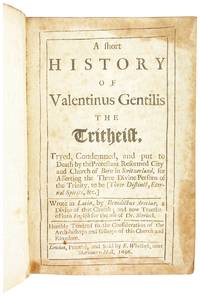
169631015London: E. Whitlock 1696. Very Good. London: Printed and Sold by E. Whitlock near Stationers-Hall 1696. First English Edition. Small octavo 17cm.; full contemporary speckled paneled calf spine in five compartments; 161342pp. collated complete. Leather quite dried especially at margins and spine with exposure at corners and top spine chord textblock a bit toned and foxed two early leaves with recent blue pencil underlining 20th-century ex libris of the Hope Trust Edinburgh to front pastedown else a Very Good internally clean and sound example. The work is dotted throughout with small woodcut manicules and printed marginal text sometimes chattily addressed to Dr. Sherlock. <br /> <br /> The Swiss Protestant theologian Benedictus Aretius's defense of the execution of Valentinus Gentilis in Bern in 1566 where Aretius himself was serving as professor of theology at the time of the trial. Originally written in Latin this edition was translated "for the use of Dr. Sherlock. Humbly Tendered to the Consideration of the Arch-bishops and Bishops of this Church and Kingdom." The translation has been attributed to English theologian Robert South 1634-1716.<br /> <br /> ESTC R006675; WING A-3629. E. Whitlock unknown
180833579Mexico: Per Don Mariano de Zuniga y Ontiveros 1808. Very Good. Mexico: Per Don Mariano de Zuniga y Ontiveros 1808. First Edition. Small quarto. 20; 153; 11pp. Engraving by Jose Maria Montes de Oca. Full calf binding with leather spine label. Worn along edges; brief exposure; chipping; split to bottom of front joint. Binding sound; a few marks and staining to endpapers; else unmarked and Very Good. <br /> <br /> History and artistic description of the Virgin of Los Remedios including an extensive description of the Spaniards led by Hernan Cortes imposing Christianity on the Native Americans and supplanting their religion as part of their conquest. The Templo Mayor of Tenochtitlan was dedicated to Huitzilopochtli god of war and Tlaloc god of rain and agriculture. The Spaniards "purified" the temple with a crucifix and an image of the Virgin Mary leading to arguments over the competing faiths tensions rose and Cortes promised rain would fall as a demonstration of his god's power. According to the legend rain unexpectedly fell the next day was interpreted as a miracle and strengthened the conqueror's position among the indigenous people. An uncommon narrative by a native Mexican on the power of story relics and iconography spanning the colonial period of Mexico's history. <br /> <br /> Sabin 11056. Per Don Mariano de Zuniga y Ontiveros unknown
186047825New York: American Bible Society 1860. Very Good. New York: American Bible Society 1860 but ca. 1861-62. First Edition. Octavo; bound in black cloth with spine stamped in gilt; edges sprayed red; new endpapers; 408pp. collated and complete. Corners bumped; minor shelfwear and rubbing; binding sound; tape remnants to front endpapers; minor creasing; a Very Good or better copy. <br /> <br /> First Edition of the first complete New Testament published in the Cherokee language. Individual books and portions had been printed from the 1820s onward primarily by Cherokee printer and journalist Elias Boudinot and missionary Samuel Worcester. This edition nearly entirely in the Cherokee alphabet with English titles at the foot of the first page of each book. Uncommon in retail. <br /> <br /> Pilling pp. 40 - 41; Darlow & Moule 2448. American Bible Society unknown
175026970Boston: Printed and Sold by John Draper in Cornhil 1750. Very Good. Boston: Printed and Sold by John Draper in Cornhil 1750. First Edition. Octavo. 20 370 pp. 1 page errata. Contemporary calf boards recased with new leather spine repair to tips and new endpapers likely 19th century. Boards bumped and worn with signs of repair along edges and joints. Binding sound and endpapers rubbed and faded. Likely contemporary ownership inscription "Mrs. Braughton" to front flyleaf. Very mild toning to pages else unmarked. Very Good.<br /> <br /> Quincy set off from his hometown of Boston for a missionary position in Georgia in 1734. Records are vague but it appears his stay was tumultuous at one point reporting he had performed thirty-four christenings thirty-eight marriages and 156 burials — a less-than-uplifting picture is painted. Quincy was then elected rector of St. John's in Colleton South Carolina and later St. Philip in Charleston where he served for two years before returning to Boston. A scarce colonial imprint with the subscriber list which includes many individuals residing in South Carolina. <br /> <br /> Sabin 67275; Pennington The Georgia Historical Quarterly Vol. 11 No. 2 JUNE 1927 pp. 156-165. Printed and Sold by John Draper, in Cornhil unknown
K80290Manuscript on laid paper with watermark from around 1490: Zwolle Deventer or Antwerp: letter p quatrefoil lily to left. Total pagesize 27 x 185 cm. Middle age Dutch Middelnederlandse tekst.NL Getranscribeerde tekst van linker kolom eerste regels: . Ende als die enghel die herdekijns die boetsca ghebracht hadde. Quam daer een grote scare van enghelen bi hem danckeden ende loveden gode ende songhen desen sanck Gloria in excelsis deo. Dat is al dus vele te segghen in Dietsche Lof ende ere sy hier boven inden oversten. Ende vrede moet sijn in eertrike den menschen die daer sijn van goede wille. Al dus dan so hebben alle creaturen Christus Jesus gheert doen hi wert gheboren.Verder in de tekst: god zoen heiligen kerst menschelike natuer onboet onse moeder evengelium evangelist Matheus beschrijft heilighe kerke Blijscap ewighen levens johannis primo licht der menschen duisternis donkerheden evangelie domicianus padmos bidden biscopen fonteynen dorstich Coninc III honger sterven ongelovige mensen Dabelius Duvel sint Jan epistelen canoniken kersten Sint Marcus Matheus Lucas vander menscheit sermoen Domicianus Jan die met droefenisse in ellende tot padmos Patmos gezend wasdaar mede te vesten en te sterken ende die onghelove daer mede moghen weder staen out en cranc was sprac hem Sint Jan toe drie daghen vasten etc. <em>Patmos</em>. rotsachtig eil. a/d W.-kust v. Kl.-Azië waar de apostel Johannes op hoogen leeftijd verblijf zou hebben gehouden. unknown
182647071Salem Ohio: Re-Published by Joshua Shinn. Robert Fee printer 1826. Very Good -. Salem O.: Re-Published by Joshua Shinn. Robert Fee printer 1826. Later Edition. 12mo; contemporary calf over paper-covered boards; 120pp. collated and complete. Cracked along front joint and front board just holding; light general wear and rubbing; contemporary scribblings to preliminaries; female ownership inscription to rear free endpaper; mild spotting throughout; Good to Very Good. <br /> <br /> The first Ohio edition of God's Protecting Providence originally published in 1699. The work was one of the most popular 18th-century captivity narratives describing a party of Quakers who were shipwrecked near present-day West Palm Beach robbed and both abused and fed by the local Jobe Indians before eventually being allowed to pass on to St. Augustine. The text concludes with later religious testimonies from the likes of David Brainerd Thomas Chalkley and Francis Guy. We locate only four titles under the Shinn imprint in OCLC this being the first. <br /> <br /> Ayer 72; see also Sabin 20015 though this edition not mentioned. Re-Published by Joshua Shinn. Robert Fee, printer unknown
200733713New York: Twelve 2007. Very Good/Very Good. New York: Twelve 2007. Later printing. Signed by Christopher Hitchens without inscription at title page. Octavo. 307pp. Printed dust jacket; white cloth boards stamped in silver. Price-clipped dust jacket worn along edges with sunning and rubbing along spine; minor general smudging. Slight lean to boards; shelfwear; bumps to spine ends. Binding sound; previous owner's gift inscription to half title else unmarked. A Very Good copy of Hitchens' erudite screed. Twelve unknown