(Bible: Illustrated; Dutch)Biblio.com
21 006 résultats
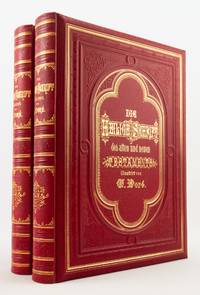
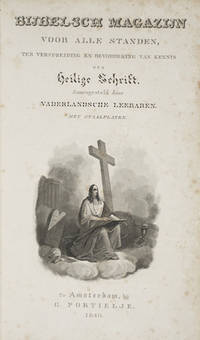
184018858Amsterdam: G. Portielje 1840. First edition. Hardcover. g to vg. Two volumes quarto published between 1840 and 1848. 1242pp. 207 x 6. Comtemporary full calf with gold-stamped borders on covers and gold lettering and gilt lettering pieces on spines. Additional steel-engraved title page in each title-page. This striking collection of Bible stories is divided into 2 volumes Old and New Testaments and is profusely illustrated with a total of 312 in-text steel engravings. Minor edge wear on bindings with moderate rubbing along joints and on corners. Sporadic foxing throughout. Text in Dutch. Bindings and interior in overall good to very good condition. G. Portielje hardcover
186230751Leipzig; Dresden: A. H. Payne 1862. First edition. Hardcover. g to g. Folio. XII 1588 8pp. Original 3/4 morocco over cloth with gold lettering on spine. Engraved frontispiece in each volume. Decorative initials. Exquisite 19th-century German Bible magnificently illustrated with hundreds of in-text and full-page woodcuts. Moderate rubbing along edges of binding. Pages moderately foxed throughout. Text in German Gothic script. Binding and interior in overall good to good condition. A. H. Payne hardcover
196252438Graz: Akademische Druck-u.Verlagsanstalt 1962. Hardcover. Very good. Two volumes large 8vo: pp. 16 966 6; 2 920 42. Publisher’s light blue cloth. A nearly fine clean set with some slight erosion/scuffing at the covers of the second volume. <br /> <br /> Modern photo-reprint of this celebrated work of early modern biblical scholarship. First published in 1752 it was until the twentieth century regarded as "the most elaborate and valuable of all the critical editions of the New Testament" Orme. Edited by the scholar Johann Jakob Wetstein 1693-1754 a scion of the Amsterdam printing family who produced Gerhard von Maestricht's New Testament of 1711 the original edition includes the editio princeps of two pseudepigraphic works ascribed to Saint Clement of Rome which survive in Syriac. At his native city of Basel in 1713 Wetstein defended a thesis on the various readings of the New Testament. "After collating MSS. in various libraries he at length obtained in 1733 a professorship in the Remonstrants’ college at Amsterdam in succession to Le Clerc. In 1730 the Wettstein press published his Prolegomena anonymously and in 1735 he edited for the same firm a revision of G. v. Maestricht’s Testament. At length in 1751-2 he produced the critical edition at which he had been labouring for many years. Perhaps in deference to the opinions of his friends Wettstein did not print in his edition the text of Codex A as he seems at first to have intended or a recension of his own but merely reproduced the Elzevir text with very few variations. Immediately below however he indicated the changes which he considered absolutely necessary from which it is easy to construct ‘Wettsteins’s text.’ Nearly all these proposed changed -- which according to Reuss number 159 -- had appeared in previous editions and are generally accepted do-day. . Below this matter stands the critical apparatus the most elaborate which had yet been published giving innumerable variants and citing as authorities for and against these a vast body of witnesses -- MSS. versions early fathers and printed editions. Wettstein introduced the practice of indicating uncial MSS. by roman letters and cursive MSS. by arabic numerals. In the revised and enlarged Prolegomena preceding the text which give some account of his labours and controversies Wettstein displays a marked antipathy to all the earliest MSS. which he suspected of having been corrupted by the Latin versions. The Animadversiones at the end of vol. 2 are more temperate and possess higher value. A distinctive feature of the book is the commentary printed at the foot of the page. This forms a curious treasury of notes illustrating both the matter and the language of the inspired writers by copious extracts from all kinds of authors -- classical patristic and rabbinicâ€. References for the original edition: Dibdin 4th ed. 1: 156. Le Long/ Masch 1 1778: 243-46. Orme Bibliotheca Biblica 465: “Wetsteins’s merits as a critic’ says Dr. Marsh “undoubtedly surpass the merits of his predecessors: he alone contributed more to advance the criticism of the Greek Testament than all who had gone before him: and this task he performed not only without support either public or private but during a series of severe trials under which a mind of less energy than Wetstein’s would infallibly have sunk.†Full title and imprint: He Kaine Diatheke Novum Testamentum Graecum editionis receptae cum lectionibus variantibus codicum mss. editionum aliarum versionum et patrum nec non commentario pleniore ex scriptoribus veteribus Hebraeis Graecis et Latinis historiam et vim verborum illustrante Joannis Jacobi Wetstenii. Tomus I -II. Continens quatuor Evengelia. . Epistolas Pauli Acta Apostolorum Epistolas canonicas et Apocalypsin. Amstelaedami ex officinia Dommeriana. MDCCLI. Akademische Druck-u.Verlagsanstalt hardcover
163249165Paris: J. Wuensel 1632. First edition. Hardcover. Nearly Fine. Octavo. Collation: á4 é4 A-T4 = 84 leaves. 16 149 i.e. 145; error in pagination: pp. 81-84 skipped in numbering sequence register continuous 7 pp. Woodcut title page vignette; head- and tail-pieces initials. Contemporary limp vellum. Title a bit dusty and lightly stained else a nearly fine clean copy.<br /> <br /> Rare first edition by the French jurist Edmond Mérille 1579-1647 of these notes on the passion accounts in each of the four Gospels: John Matthew Mark and Luke.<br /> <br /> Provenance and annotations: Entry at title copy from the library of the Oratorians. Errors corrected throughout per errata at a4 verso in an an old hand. J. Wuensel hardcover
154049324Paris: F. Gryphius 1540. Two parts in one volume 16mo in 8s. 199 1 blank; 136 16 indexff. "Novvm testamentum" in cartouche vignette at title-page along with Gryphius' griffin device Renouard 413; 90 three-quarter page including repeats and 15 smaller woodcut illustrations including repeats; 21 historiated initials and woodcut lettrines; cartouche vignettes with book titles; printed marginalia; half-title for the second part Epistles and the Book of Revelation. Text not divided into verses; occasional quotations in Greek. Later vellum over boards; manuscript title at the spine faded; speckled paper endleaves; edges stained red. Light dampstain at bottom margins extending up into text and gutter at the later leaves; small puncture at leaf 140 resulting in slight loss of text. A good complete copy of a very scarce illustrated New Testament with clean woodcut illustrations throughout.<br /> <br /> Collation: a-z8 &8 Aa8 A-T7 blank leaf 200; lacks final blank T8.<br /> <br /> Third Gryphius New Testament in 16mo format. Arranged in two parts with the Epistles and the Book of Revelation presented separately it reproduces the Vulgate text edited by Robert I Estienne for his Latin Bible edition of 1532. While some of the woodcuts appear in Gryphius' complete octavo Bible of 1541 this separate Testament is even more lavishly illustrated. Based upon Mortimer's description of the 1541 Bible we can ascertain that at least some of the Apocalypse woodcuts in the present volume are based on Holbein while most of the other illustrations whose blocks had been completed by 1539 "are relatively independent of earlier sets" Mortimer.<br /> <br /> An important shift in Bible illustration occured in the Netherlands in the late 1520s as printers began to focus on copiously illustrated small format editions of the New Testament to better explain the text and assist private devotion. The subtitle in our volume "cum ad ueritatem historiae tum ad uenustatem singulari artificio expressis" with the truth of history as well as beauty expressed by a singular artifice is clearly suggestive of this shift. Adopting this new format François Gryphius became the "first Paris printer to illustrate a Bible in the Renaissance style" Johnson quoted in Mortimer. These illustrations first appeared in the Acts of the Apostles and the Book of Revelation in Gryphius' pocket New Testament edition of 1537 Novum Testamentum additis picturis in Acta Apost. et Apocalipsin quibus miracula et visiones exprimuntur The New Testament with added illustrations in the Acts of the Apostles and the Book of Revelation depicting miracles and visions. Subsequent editions would include an expanding suite of woodcuts and were published at Paris by Gryphius under the present title in 1539 1540 1541 and 1542; Antwerp editions appeared in 1542 and 1545. The suite of illustrations in the present work is identical in placement and inventory with the data cited by Mortimer for the 1541 edition 90 cuts by repetition of 58 blocks from the larger set and 15 cuts by repetition of 6 small blocks and confirmed by inspection of the digitized version of the 1541 edition at the Bibliothèque de la Ville de Lyon. The only notable differences in graphic materials between the two editions appears occasionally in the selection of woodcut initials; the later edition also has several more unset initials indicated by guide letters than appear in our 1540 edition. <br /> <br /> All editions are quite scarce with only a handful of copies of each surviving.<br /> <br /> Provenance and annotations: Old entries at paste-down and front endleaf of George Woodhouse with his note about prior provenance dated May 1875; E. Holwell noting "This curious edition published in A.D. 1540" References: Cf. Deleveau & Hillard Bibles imprimées Paris 1539 and 1542; Antwerp 1542; Le Long/Masch 2.3 1783 p.279 Paris ed. 1542; R. Mortimer French 16th Century Books no.70 ed. 1541 illustrating woodcuts on a3 recto and P3 recto as per our copy and no. 69 8vo Bible 1541. For a discussion of the development of the woodcut series in these Gryphius pocket bibles see: A.F. Johnson "Some French Bible illustrations" Gutenberg Jahrbuch 1935 p.190.<br /> <br /> Full title and imprint: Novvm testamentum illvstratum insignium simulacris cum ad ueritatem historiae tum ad uenustatem singulari artificio expressis. Excudebat Fran. Gryphius An. M.D.XL. Cum priuelegio Regio.<br /> <br /> Typeface: Gryphius's own Brevier Roman or Petite-Text with scattered Greek. U. Aberdeen note via OCLC. F. Gryphius unknown
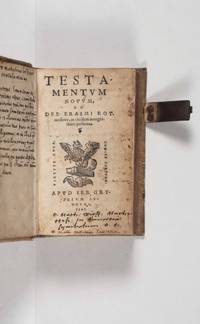
152253365Mainz: J. Schöffer 1522. First Mainz edition. Octavo. 562 2: colophon blankpp. Collation: A-Z8 Mm8 chi2 O4/O5 reversed complete. Title within historiated woodcut border. Woodcut initials throughout. Text in italics. Printed side-glosses. Errata at final text leaf. Contemporary beveled wooden boards backed in tooled pigskin; spine with raised bands. Brass catch and clasp with expert restoration of leather thong. Contemporary manuscript musical scores used as pastedowns at front and back. Seven leather stubbs affixed at front edge as indexes. Occasional faint smudging mostly at margins else text crisp and fresh. A very good copy in a well-preserved sixteenth-century binding with a notable provenance.<br /> <br /> Scarce very early collective edition of the Latin "Paraphrases" of the Pauline Epistles prepared by the celebrated humanist scholar theologian and educational writer Desiderius Erasmus of Rotterdam 1466-1536. Preceded by the Froben collective editions of 1520 and 1521 this first and only edition of the Pauline Epistle Paraphrases to be printed at Mainz was issued by Schöffer in two parts each with full title and separate register and pagination; our volume contains the first part only: the Epistles to the Romans; Corinthians 2; Galatians; Ephesians; Philippians; Colossians; and Thessalonians 2.<br /> <br /> "In the vast and sustained labour he devoted to the New Testament Erasmus saw the culmination of his commitment to scholarship. and nothing else he wrote not even the Moriae encomium was to have so great an influence on posterity. The first edition of the New Testament appeared in 1516 and was followed in his lifetime by four more 1518/10 1522 1527 1535 each newly revised. Each consisted of the Greek text Erasmus' translation thereof and a copious apparatus of notes Annotations published as a separate volume. Beginning in 1517 he also published a Paraphrase of all parts of the New Testament save Revelation. Written in smooth and comprehensible Latin it was usually fuller than the original text. If offered his own interpretatiton but often avoided the provocative statements found in the Annotations. From the outset the translation the Annotations and to a lesser degree the Paraphrases drew criticism originally from conservative theologians who found heresies in his humanist philology but soon also from Lutherans and Catholics who denounced him for departures from their respective doctrines" Bietenholz. The Paraphrases were composed between May 1517 and January 1524. "Erasmus began with the Pauline Epistles. The paraphrase of Romans was published in quarto by Dirk Martens in Louvain in November 1517 and reprinted by Erasmus's friend Johann Froben in January of the following year; it sold well and was soon reprinted in octavo. Corinthians was published by Martens in February 1519 and reprinted in Basel by Froben in March; Galatians appeared later that year with editions from both publishers. The remaining Epistles followed in 1520 and 1521 the last to appear being Hebrews. In the autumn of 1521 Erasmus moved from Louvain to Basel and from that time Froben published the first editions of the remaining Paraphrases" Mynors. <br /> <br /> Our edition was printed by Johann Schöffer the son of Peter Schöffer who was the principal workman of Johannes Gutenberg. Apart from those of the Pauline Epistles the only other complete Paraphrase of Erasmus to be published by Schöffer was that on the Gospel of Matthew also in 1522. He did in 1521 however issue a series of four brief excerpts from the Paraphrases in German translation which appear to highlight provocative exegesis by the great scholar of Rotterdam concerning for example the hypocracy of the Pharisees Matthew 23 or the exhortation to "Take My yoke upon you and learn from Me" Matthew 11.29.<br /> <br /> Provenance and annotations: Contemporary manuscript entry at the title-page of the Benedictine monastery library at Amorbach; contemporary 50-word manuscript note in Latin at the free endleaf facing the title which discusses the present work. Early manuscript note in German at the final blank endleaf. Early leaves with light rubrication in red ink; about twenty leaves with contemporary annotations throughout. Later stamps of the Leiningen Palace Library at the bottom margin of the title and very faintly at the pigskin covers. Bookplate of United Theological Seminary Dayton Ohio noting the gift of Dr. Walter N. Roberts with their vertical entry stamp Mar 28 1963 at the dedication leaf lightly over the left-hand edge of the text but not impairing legibility. Full title and imprint: Paraphrases Eras. Rot. In omnes epistolas Pauli apostoli germanas : et in eam quae est ad Hebraeos incerti autoris cum ijs quae Canonicae uocantur diligenter recognitae excusaeque & ita binos in tomos digestae ut cuique secare in formam enchiridij siuelit liberum sit.<br /> <br /> References: P.G. Bietenholz Encounters with a Radical Erasmus Univ. Toronto 2009 p.13; R.A.B. Mynors "The Publication of the Latin Paraphrases" in: R.D. Sider ed. New Testament Scholarship: Paraphrases on Romans and Galatians University of Toronto Press 1984 pp. xx-xxix; USTC 682534; Vander Haeghen p.145: Paraphrases in omnes epistolas Pauli. Moguntiae Io. Schoeffer m. augusto 1522 octavo; VD16 E-3379 Berlin; Halle; Leipzig; Wittenberg; Wolfenbüttel. This first part not in Adams but cf. E-795 the second part 378pp. J. Schöffer unknown
154749141Lyon: Sebastian Gryphius 1547. Hardcover. Very Good-. 16mo in 8s: a-z8 A-Z8 aa8 bb8 =384 leaves; blank bb7-8. 763 5 blankpp. Printer’s device at title woodcut lettrines. Text in italic headlines and chapter headings in roman; printed marginalia. Later pigskin over bevelled boards tooled in blind brass clasps one of two and catches manuscript title at spine. Extensive old manuscript notes at front endleaf and four blank leaves at the end including the two integral blanks; occasional marginalia and underlining. Title soiled with some slight erosion at margin from oxidation of the clasps else a very good copy with clean fresh text throughout. Complete with the two final blank leaves.<br /> <br /> Second Gryphius edition and a rather uncommon early sixteenth-century printing of Erasmus’ Latin translation of the New Testament first published at Basel in 1516. According to Baudrier Ly. V. 804101/Cat. de Lignerolles Paris Porquet 1894 no. 48 Gryphius first published this translation in 1542 and 1543 as a 16mo of 847 pages; neither of these issues appear in Deleveau & Hillard. Like the present edition these early Gryphius printings of the Erasmus New Testament survive in only a handful of copies. The text opens with Erasmus' dedication to pope Leo X followed by his preface to the reader a general index of the New Testament corpus a listing of the chapters of the four Gospels and a brief passage from Jerome's catalogue of ecclesiastical writings. The editor's introductions precede each book. The text concludes with Erasmus' translation of a brief discussion of apocryphal literature partly from Athanasius though Erasmus questions the attribution: "De libris utriusque testamenti partim reiectus aut non sine contradictione admissis partim apocryphis ex Athanasio tametsi mihi suspectus est titulus." <br /> <br /> Provenance and annotations: Extensive early annotations in more than one hand appear throughout the book; many marginal notes have been added throughout the Gospel of Matthew. At the front of the book beginning with the free endleaf: "Poeta de Pythogora" several stanzas in Latin and Greek; facing the title: A morning prayer "Oro matutina lecturis oracula divina" 11 lines; an accounting of biblical eras 10 lines since Abraham David and the Babylonian Exile appears at the verso of the title leaf. The final blank page the two intergral blank leaves and two additional blanks added by the binder are filled with notes in several different hands including: a passage from Augustine's De doctrina christianae 14 lines; noted as book 2 chapters 11 and 12 along with four lines about Tertullian; four pages of notes on the twelve disciples numbered; a Greek text discussing the divine names in which the tetragrammaton is written in Hebrew letters; a passage from a letter of Basilius Magnus in Greek with Latin translation.<br /> <br /> Printed label of Edward Davis Hoblyn 1809-1881 and his manuscript entry dated 1831 at the free endleaf. Edward was likely related to the renowned book collector Robert Hoblyn 1710-1756 of Cornwall. A catalogue of Robert’s collection was printed in 1768 as Bibliotheca Hobliniana and reissued by Murray in 1769 with a new titlepage. The library remained with Robert’s widow and was sold in 1778. The present work is not listed in the Bibliotheca though no fewer than nineteen 16th-century Latin Bibles and Testaments appear in the catalogue. Gift inscription of D. N. Goodman of San Francisco California to Father J. L. Damas at front pastedown dated 1935. References: Baudrier 8 217. Baumgarten Nach. v. merkw. Büchern 8 1755 206 noting that this and the later Gryphius edition which Le Long assigns to the master printer’s workshop are in fact identical and notable examples of elegant typography. Deleveau & Hillard 4407 BNF. Le Long Leipzig 1709 1:751 & 2:478 Bibl. Colbertina - the earlier Gryphius edition of 1542/43 is not cited in either part. Le Long-Masch 2.3 p. 599 noted as the first New Testament ex. Erasmi to appear at Lyon. Sebastian Gryphius hardcover
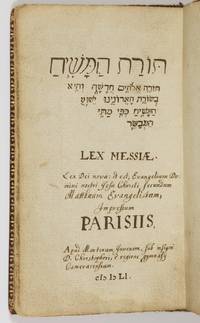
1700557661700. Very good-. Small octavo 14.1 by 8.5 cm. Manuscript in black and brown ink; 18-20 lines per page; text in vocalized Hebrew. 6 title and editor's preface 146 12 blank 10 notes. Lacks the first leaf which has been supplied in manuscript by a later owner. 19th-century limp morocco rubbed at extremities gilt dentelles marbled endleaves. Faint dampstain along bottom margin occasional smudges and mild stains else very good with crisp text.<br /> <br /> Early modern transcription of the Hebrew version of the Gospel of Matthew published in 1551 at Paris by Martin le Jeune with notes at the rear likely the work of a student. This edition was prepared by Jean Cinqarbres Quinquarboreus; 1514-1587 who jointly held the chair of King's Professor of Hebrew Literature at the University of Paris with Jean Mercier d. 1570. Lapide describes this as a "literal" edition and notes that the learned French bibliographer and father of the Oratory Jacques Le Long regarded it as the "true and authentic Gospel of Matthew." Like many of the surviving copies it lacks the Appendix which comprised the Seven Penetential Psalms Psalm CXIX Daniel's Prayer and the Ten Commandments. Apart from minor formatting changes e.g. breaks between chapters the text appears to be a faithful copy including vowel points and some of the additional cantillation marks the printed marginalia new Hebrew page numbers and Cinqarbres's dated preface. As the original version contains only 17 lines of text per page the transcription is not a page-for-page copy. Here the copiest appears quite fastidious in providing appropritate new catchwords! The Latin portion of the title however differs notably from the original which reads: Sanctum Domini nostri Iesu Christi Hebraicum Evangelium secundum Matthaeum.<br /> <br /> "In 1537 Sebastian Münster published his Hebrew version of the Gospel of Matthew at Basel the first printed edition of the New Testament in the so-called 'mother tongue of the evangelist' as he states in his preface" Lapide. Like the Paris edition of Hebrew Matthew upon which the present copy is based Münster entitled his version Torat ha-Mashiah The Teaching of the Messiah. While Münster's version of Matthew was long believed to be based on the 14th-century Hebrew translation by the Jewish polemicist Shem Tov ben Isaac ibn Shaprut more recent scholarship has called this attribution into question. "There are medieval Hebrew forms of Matthew that most scholars think of as retroversions from the Greek of canonical Matthew often made to serve in arguments between Christians and Jews. However some claim that these texts are a guide to the original Hebrew of Matthew French scholars like J. Carmignac and M. Dubarle have contributed to this thesis. Still other scholars think they can reconstruct the original Hebrew or Aramaic underlying the whole or parts of the Greek text of canonical Matthew on the assumption that the original was in Semitic. The vast majority of scholars however contend that the Gospel we know as Matthew was composed originally in Greek and is not a translation of a Semitic original" Brown.<br /> <br /> Provenance and annotations: The copiest has added notes following the main text comprising a Seder shel Miqra / Ordo Bibliorum in which the tripartite division of the Scriptures according to Jewish tradition is described. Then follows several pages of Hebrew terminology with biblical references and definitions in Latin. Along with one or two references to rabbinic literature an erudite reference to the Passover Haggadah notes Rabbi Judah's grouping of the ten plagues into three acronyms.<br /> <br /> At the head of the leaf inserted after Cinqarbres' preface is the note "When I bought this Mss. the first chapter from verse one unto verse 14 and part of verse 15. I filled in the missing verses. May. 18th. 1901. Llewellyn Saunderson 10 De Vesse Terrace Kingstown Co. Dublin" References: R. Brown Introduction to the New Testament 1997 p. 210; P. Lapide Hebrew in the Church Grand Rapids 1984 see Chap. IV "Modern Christian Hebraica" esp. pp. 53-58. Cf. Adams B1890 wanting the appendix; Darlow & Moule 5095: An independent edition of Shem Tob's version see no. 5088 which notes: The editor S. Münster obtained an imperfect MS. copy of St. Matthew's Gospel in Hebrew which had been made as early as 1385 for polemical purposes by Shem Tob b. Shaprut a Jew of Tudela in Castile. He revised and completed this for the press Basel: H. Petri 1537 adding a Latin translation of the Hebrew.; Delaveaux & Hillard 4644 noting Ibn Shaprut as the ulitmate source; Le Long/Masch 2 1781 p. 10. Schwarzfuchs Paris 212. Steinschneider 6591.26 under Münsterus.<br /> <br /> Full title noting original imprint: תורת המשיח תורת ××œ×”×™× ×—×“×©×” ×•×”×™× ×‘×©×™×¨×ª ×”××“×•× ×™× ×• ישוע המשיח כפי מתי המבשר <br /> Lex Messiae. Lex Dei nova: id est Evangelium Domini nostri Iesu Christi secundum Matthaeum Evangelistam Impressum Parisiis: apud Martinum Iuvenem sub insigni D. Christophori è regione gymnasii Cameracensium M.D.LI. 1551. unknown
179318880Leipzig: I. G. I. Breitkopf and Associates 1793. First edition. Hardcover. Good. Two volumes octavo 18.1 by 10.6 cm. xii 6 360 302; 352 404 pp. Title-pages and first-volume preface in Latin; half-titles for the Pentateuch Former Prophets Latter Prophets and Hagiographa. Main text in Hebrew. Contemporary green paper boards with title-labels edges stained red. Illustrated head pieces such as the heavens before Genesis and King David at prayer before Psalms. First volume covers slightly warped. Spines sunned. Library stamp on title and back pages. Minor worm tracing at first the 32 leaves vol. 2 resulting in the loss of a word or two along the line else a good or better ex-library copy.<br /> <br /> Complete Old Testament in Hebrew with traditional cantillation marks and scholarly footnotes indicating varying textual readings. Latin chapter headings summarize content. Preface in Latin by Johann Heinrich Meisner offers a history of the project. In the back is an appendix showing variant readings from the De Rossi Codex. There is also a chart giving the weekly readings from the Pentateuch and prophets. This Bible exemplifies early modern Protestant interest in being able to read the Old Testament in the original Hebrew. This was a product of their belief in sola scriptura that only the basis for religious authority was the Bible. <br /> <br /> Provenance: Stamps of the Franciscan monastery at Eggenfelden in Bavaria. References: Darlow & Moule 5163; Orme Bibl. Biblica pp. 238-9.<br /> <br /> Full title and imprint: Biblia Hebraica olim a B. Christiano Reineccio edita et ad optimorum codicum et editionum fidem recensita et expressa nunc denuo ad fidem recensionis Masoreticae cum variis lectionibus ex ingenti codicum copia a B. Kennicotto et I. B. de Rossi collatorum ediderunt D. Io. Christoph. Doederlein. et Joannes Henricus Meisner. Lipsiae: impensis I. G. I. Breitkopfii et Soc. MDCCXCIII. I. G. I. Breitkopf and Associates hardcover
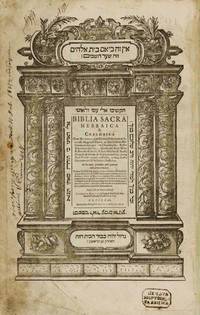
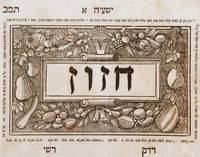
161948847Basel: Ludwig König 1619. First editions. Hardcover. Good. Seven parts in two volumes folio biblical texts and commentary in four parts continuously foliated; two supplemental sections each with separate foliation; Tiberias 1620 with separate pagination here bound after the second part - Vol. 1: 6 title and prelims 1-228 1 sect. title 234-441 1 blankff.; 6 sect. title and prelims 2 blank 114 2 blankpp. Vol. 2: 442-946; 8 Targum Yerushalmi; last leaf unfoliated; 67 Masora 1 blankff. Largely arranged in two columns of biblical texts in square font surrounded by commentaries in rabbinic Rashi font; text reads from right to left. This copy with collective Latin title surrounded by biblical quotations in Hebrew set within elaborate woodcut architectural borders. Hebrew sectional titles set within the same woodcut borders for the second and fourth parts with a plain letterpress half-title for the Five Megillot. The third sectional title for the Latter Prophets is lacking as are the Ashkenazi Haftarot readings not found in all copies. Apart from these lacks the Rabbinic Bible collates complete despite numerous errors in foliation throughout as per the detailed notes in Prijs Die Basler hebräischen Drucke. Opening word of each biblical book set in large one-third to one-half page cartouche vignettes with elaborate woodcut borders and surrounding letterpress Hebrew text. Main Latin title dated 1619 with the editor's Latin preface to the reader appearing at the verso. Jewish date chronogram for the second section Former Prophets dated 5378 1618/1619. Early twentieth-century black cloth boards worn at extremities gilt-lettered spine. Title moderately soiled re-inforced at gutter; neat old repairs to corners and fore-edge of title and next three leaves; old Russian stamp at bottom margin title manuscript entry in Russian along fore-edge dated 1837; intermittent mild to moderate marginal dampstains largely confined to corners and embrowning throughout both volumes somewhat more heavily in the first especially throughout Tiberias; top right corner of the opening leaf in vol. 2 repaired with loss of about 12 words surrounding title cartouche recto and some text in 9 lines of the commentary at the verso. Overall a good set with a notable chain of provenance. <br /> <br /> Sixth Rabbinic Bible in Hebrew: Mikra'ot Gedolot edited by Johann Buxtorf I 1565-1629 professor of Hebrew at the University of Basel and the foremost Christian Hebraist of his era with the assistance of the Jewish scholars Abraham Braunschweig who served as the principal corrector and Mordechai Gumplin of Posen. This was "a truly audacious undertaking for his time" Burnett From Christian Hebraism to Jewish Studies as no Christian scholar had yet attempted to edit the entire biblical corpus including the Aramaic versions Targumim and masoretic notes. Based mainly on the third Rabbinic Bible published by Daniel Bomberg at Venice in 1546-1548 the editor has carefully incorporated elements from two other Venetian editions. At the verso of the Latin title Buxtorf provides a detailed bibliographical excursus on the earlier Venetian editions and offers a tribute to Bomberg's industry by reprinting the colophon of the second Venetian Rabbinic Bible 1524-1525 at the conclusion of the masoretic appendix with text by the Hebrew grammarian and lexicographer Elijah Levita 1468 or 1469-1549 and a new introduction by Abraham Braunschweig. The design of the sectional titles and separate book title vignettes closely model those of the Venetian editions. "Buxtorf did not plan simply to reprint one of the existing Venice editions but rather to assemble the best features of them all into one work" and "to provide theologians with what he considered the most important tools for interpreting the Old Testament" Burnett. Buxtorf served in an official capacity as Basel's Hebrew censor charged with the oversight of all Jewish printing in the city and insuring that "no 'blasphemies' or slurs against Christians or Christianity appear in any book printed in Basel" Burnett. He carefully edited the Jewish commentaries in the Rabbinic Bible in accordance with this mandate "and removed many words and phrases which had escaped the attention of earlier censors" Burnett. <br /> <br /> The Rabbinic Bible contains the vocalized Masoretic text of the Hebrew Scriptures with accents and a vocalized Targum an Aramaic paraphrase of the biblical text: Onkelos for the Pentateuch; Jonathan b. Uzziel for the Prophets; and Targum Hagiographa for the Writings. The Hebrew and Aramaic versions are printed in square characters and presented in facing columns at the center of each page. The Jerusalem Targum of the Pentateuch appears as an appendix. In addition to the Aramaic paraphrases the Rabbinic Bible includes a massive scholarly apparatus of biblical commentaries by Rashi Ibn Ezra Baal ha-Turim Jacob b. Asher R. David Kimchi Radak R. Levi b. Gershon Ralbag Saadia Gaon and R. Isaiah along with the Masora a corpus of critical notes on the external form of the Biblical text compiled by Jewish scholars from late antiquity through the medieval era. As frequently occurs a copy of Buxtorf's work on the textual history of the Hebrew Bible Tiberias the 1620 first edition is bound-in. This work was made possible by the publication in 1538 of Elijah Levita's Masoret ha-Masoret a commentary on the Masora which Buxtorf translated into Latin for his own private use in 1593. "Buxtorf was concerned with the integrity of the consonantal text and the origin and integrity of the vowel points and accents of the Hebrew Bible from the very beginning of his scholarly career" and while he had earlier published a long excursus on the age of the vowel points and accents in his 1609 Thesaurus Grammaticus "Tiberias is Buxtorf's fullest and most impressive work on the history of the biblical text" Burnett. Intended as a reference work for Christian students and scholars interested in studying the Masora Buxtorf was also keen to refute the view advanced by Levita that the Hebrew vowel points were early medieval innovations. Our folio version of Tiberias was intended to accompany the Rabbinic Bible and has the same architectural borders at the title. König also published a quarto edition in the same year but only the folio version includes a critical commentary on the Masora in which Buxtorf proposes various corrections to the Masoretic notes. <br /> <br /> As noted at the title Buxtorf's faithful study and tireless labor studio fido et labore indefesso yielded notably long-lasting results: "The Basel rabbinical Bible became a standard tool for research among Christian scholars and would remain so. until the end of the nineteenth century" Burnett. A vast array of early modern scholars including Protestants like Johannes Drusius and John Selden as well as Roman Catholics like Robert Bellarmine and Andreas Masius owned a copy or two of the Rabbinic Bible. "Johannes Buxtorf's thoroughly censored "Christian" version of the Rabbinic Bible Basel 1618-19 only made it easier for Hebraists to own copies of their own" Burnett Christian Hebraism in the Reformation Era p.163.<br /> <br /> A note on the date of publication: "The actual printing began between the mid-August and mid-September of 1618. According to the colophon production ended on the 24 of Ab 5379 = August 4 1619 but since this date also appeared on the colophon of the Bomberg Biblia rabbinica edition of 1524-25 reprinted unchanged in the 1546-48 and 1568 editions it is suspect. Prijs suggested that the probable completion date was sometime during Ab of 5379 between July 12 and August 10 of 1619" Burnett. <br /> <br /> Provenance: from the library of acclaimed theologian and biblical scholar Brevard Childs with his entry at the free endpaper in the second volume. The earlier bookplate of judge Samuel Heller with his motto in Hebrew: Mi-kol melamdai hiskalti from all my teachers I have learned appears at the front paste-down. An old blue ink-stamp in Hebrew characters makes occasional appearances the text: Bet ha-Midrash ha-Gadol Minsk The Great Synagogue of Minsk. A Russian entry dated 1837 appears at the fore-margin of the main title along with an old ink stamp in Russian at the bottom margin the last word of which reads "Rabbina" References: Biblia Sacra: Burnett 7. Cowley 87. Darlow & Moule 5120 bound with the 1665 second edition of Tiberias cf. 5093. Davidson Otsar ha-shirah vol.1 p.406 no.8954. Prijs 219. Steinschneider 423 423b. VD17 23:675325G. S. Burnett Christian Hebraism in the Reformation Era Leiden: Brill 2012 p.163. Tiberias: Burnett 111. Prijs 222a. For detailed analyses of both works see: S. Burnett From Christian Hebraism to Jewish Studies Leiden: Brill 1996 pp.169-239 chaps. 6 & 7.<br /> <br /> Full Latin title: Biblia Sacra Hebraica & Chaldaica cum Masora quae critica Hebraeorum sacra est Magna & Parva ac selectissimis Hebraeorum interpretum commentariis Rabbi Salomonis Jarchi R. Abrahami Aben Esrae R. Davidis Kimchi R. Levi Gerson R. Saadie Gaon R. Jeschajae & Notis ex authore quem Baal Turim vocant collectis quibus textus grammaticè & historicè illustratur. In his nunc primum post quatuor editiones Venetas textus Chaldaicus qui Targum dicitur à deformitate punctationis & pravitate vocum innumeratum vindicatus; loca in Masora transposita deficientia pugnantia numeris depravata subsidio diversorum exemplarium & Concordantiarum Hebraicarum quantum fieri potuit reposita restituta & conciliata sunt ut in praefatione amplius declarabitur. Studio fido & labore indefesso Johannis BuxtofI linguae sanctae in Academia Basileensi Professoris Ord. Basileae: Sumptibus & typis Ludovici König 1619.<br /> <br /> Collation vol. 1 Rabbinic Bible: ital.a6 a-z8 A-E8 F4 G-Z8 Aa-Hh8 Ii9 Ii10 blank; 1 blank :3 1 blank A-N4 O5.<br /> <br /> Collation vol. 2 Rabbinic Bible: Kk-Rr8 Kk1 lacks Ss6 Tt10 Vv-Zz8 AA-PP8 QQ-TT6 VV9 VV10 blank XX-ZZ8 Aaa-Nnn8 Ooo3 Ooo4 blank PppTtt8 Vuu3 Vuu4 blank Xxx-Zzz8 AAaa-EEee8 8 A-G8 H6 I5 I6 blank. Ludwig König hardcover
161952679Basel: Ludwig König 1619. First edition in part. Hardcover. Good. Eight parts in three volumes folio biblical texts and commentary in four parts continuously foliated; three supplemental sections each with separate foliation; Tiberias 1655 with separate pagination here bound after the Haftarot - Vol. 1: 6 title and prelims 1-228 1 sect. title 234-441 1 blank ff. Vol. 2: 1 sect. title 442-705 3 blank 707 sect. title-837 1 blank ff. Vol. 3: 839 half-title-881 1 blank 883-946; 8 Targum Yerushalmi; last leaf unfoliated; 67 Masorah 1 blank; 1 title 2-36 Haftarot ff.; 8 title and prelims 108pp. Despite the gap in foliation between the first and second parts and numerous errors in foliation throughout the Rabbinic Bible collates complete with all blanks noted in Prijs Die Basler hebräischen Drucke and the Haftarot bound at the end. Largely arranged in two columns of biblical texts in square font surrounded by commentaries in rabbinic Rashi font; biblical texts read from right to left. This copy with collective Hebrew title surrounded by biblical quotations in Hebrew set within elaborate woodcut architectural borders; brief preface in Hebrew by Abraham Braunschweig at the verso. Hebrew sectional titles set within the same woodcut borders for the three other biblical sections and the Haftarot with a plain letterpress half-title for the Five Megillot. Opening word of each biblical book set in large one-third to one-half page cartouche vignettes with elaborate woodcut borders and surrounding letterpress Hebrew text. Main title Jewish date chronogram = 5378 1618-1619. Near-contemporary half calf over speckled boards worn and rubbed; spines with raised bands gilt morocco lettering pieces and old paper labels heavily faded. About two-thirds of the text embrowned ranging from minimal to moderately heavy; worm tracing in a 1- by 2-inch section at leaves 541-553 affecting text. A good complete set notably containing the Ashkenazi Haftarot readings not found in all copies.<br /> <br /> Sixth Rabbinic Bible in Hebrew: Mikra'ot Gedolot edited by Johann Buxtorf I 1565-1629 professor of Hebrew at the University of Basel and the foremost Christian Hebraist of his era with the assistance of the Jewish scholars Abraham Braunschweig who served as the principal corrector and Mordechai Gumplin of Posen. This was "a truly audacious undertaking for his time" Burnett as no Christian scholar had yet attempted to edit the entire biblical corpus including the Aramaic versions Targumim and masoretic notes. Based mainly on the third Rabbinic Bible published by Daniel Bomberg at Venice in 1546-1548 the editor has carefully incorporated elements from two other Venetian editions. At the verso of the Latin title Buxtorf provides a detailed bibliographical excursus on the earlier Venetian editions and offers a tribute to Bomberg's industry by reprinting the colophon of the second Venetian Rabbinic Bible 1524-1525 at the conclusion of the masoretic appendix with text by the Hebrew grammarian and lexicographer Elijah Levita 1468 or 1469-1549 and a new introduction by Abraham Braunschweig. The design of the sectional titles and separate book title vignettes closely model those of the Venetian editions. "Buxtorf did not plan simply to reprint one of the existing Venice editions but rather to assemble the best features of them all into one work" and "to provide theologians with what he considered the most important tools for interpreting the Old Testament" Burnett. Buxtorf served in an official capacity as Basel's Hebrew censor charged with the oversight of all Jewish printing in the city and insuring that "no 'blasphemies' or slurs against Christians or Christianity appear in any book printed in Basel" Burnett. He carefully edited the Jewish commentaries in the Rabbinic Bible in accordance with this mandate "and removed many words and phrases which had escaped the attention of earlier censors" Burnett. <br /> <br /> The Rabbinic Bible contains the vocalized Masoretic text of the Hebrew Scriptures with accents and a vocalized Targum an Aramaic paraphrase of the biblical text: Onkelos for the Pentateuch; Jonathan b. Uzziel for the Prophets; and Targum Hagiographa for the Writings. The Hebrew and Aramaic versions are printed in square characters and presented in facing columns at the center of each page. The Jerusalem Targum of the Pentateuch appears as an appendix. In addition to the Aramaic paraphrases the Rabbinic Bible includes a massive scholarly apparatus of biblical commentaries by Rashi Ibn Ezra Baal ha-Turim Jacob b. Asher R. David Kimchi Radak R. Levi b. Gershon Ralbag Saadia Gaon and R. Isaiah along with the Masora a corpus of critical notes on the external form of the Biblical text compiled by Jewish scholars from late antiquity through the medieval era. As frequently occurs a copy of Buxtorf's work on the textual history of the Hebrew Bible Tiberias the 1655 revised edition is bound-in. This work was made possible by the publication in 1538 of Elijah Levita's Masoret ha-Masoret a commentary on the Masora which Buxtorf translated into Latin for his own private use in 1593. While "Buxtorf was concerned with the integrity of the consonantal text and the origin and integrity of the vowel points and accents of the Hebrew Bible from the very beginning of his scholarly career." While he had earlier published a long excursus on the age of the vowel points and accents in his 1609 Thesaurus Grammaticus "Tiberias is Buxtorf's fullest and most impressive work on the history of the biblical text" Burnett. Intended as a reference work for Christian students and scholars interested in studying the Masora Buxtorf was also keen to refute the view advanced by Levita that the Hebrew vowel points were early medieval innovations. Our folio version of Tiberias was intended to accompany the Rabbinic Bible and has the same architectural borders at the title. König also published a quarto edition in the same year but only the folio version includes a critical commentary on the Masora in which Buxtorf proposes various corrections to the Masoretic notes. <br /> <br /> As noted at the title Buxtorf's faithful study and tireless labor studio fido et labore indefesso yielded notably long-lasting results: "The Basel rabbinical Bible became a standard tool for research among Christian scholars and would remain so. until the end of the nineteenth century" Burnett. A vast array of early modern scholars including Protestants like Johannes Drusius and John Selden as well as Roman Catholics like Robert Bellarmine and Andreas Masius owned a copy or two of the Rabbinic Bible. "Johannes Buxtorf's thoroughly censored "Christian" version of the Rabbinic Bible Basel 1618-19 only made it easier for Hebraists to own copies of their own" Burnett Christian Hebraism in the Reformation Era p.163.<br /> <br /> A note on the date of publication: "The actual printing began between the mid-August and mid-September of 1618. According to the colophon production ended on the 24 of Ab 379 = August 4 1619 but since this date also appeared on the colophon of the Bomberg Biblia rabbinica edition of 1524-25 reprinted unchanged in the 1546-48 and 1568 editions it is suspect. Prijs suggested that the probable completion date was sometime during Ab of 379 between July 12 and August 10 of 1619" Burnett. References: Biblia Sacra: Burnett 7. Cowley 87. Darlow & Moule 5120 like our copy bound with the 1665 second edition of Tiberias cf. 5093. Davidson Otsar ha-shirah vol.1 p.406 no.8954. Prijs 219. Steinschneider 423 423b. VD17 23:675325G. S. Burnett Christian Hebraism in the Reformation Era Leiden: Brill 2012 p.163. Tiberias: Burnett 114. Prijs 272a. For detailed analyses of both works see: S. Burnett From Christian Hebraism to Jewish Studies Leiden: Brill 1996 pp.169-239 chaps. 6 & 7. Ludwig König hardcover
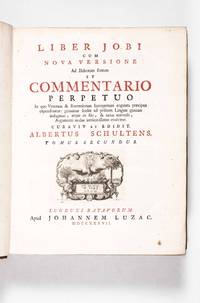
173749261Leiden: Jean Luzac 1737. First edition. Two volumes large quarto. 52 544; 2 545-1232 63 indices 1 corrigendapp. Text in two columns with Hebrew text and facing Latin translation interspersed with commentary. Titles in red and black with engraved vignettes. Contemporary speckled calf; gilt-tooled spine with raised bands and morocco lettering pieces; gilt dentelles; edges daubed in red and green. Light scuffing to boards and fading to spines. A very good set with crisp clean text throughout.<br /> <br /> First edition of this comprehensive commentary to the biblical Book of Job by the Dutch scholar of Semitic languages Albert Schultens 1686-1750 who maintained "that the true nature of the Hebrew language and the meaning of many of its words and idioms are to be found chiefly in the Arabic" Orme. Fifty-five pages of the indices constitute a brief lexicon and provide Latin as well as Arabic equivalents for more than 1000 Hebrew words. Schultens studied theology and eastern languages at Groningen where he received his degree in theology in 1709. After a brief career as a preacher in Wassenaar he was nominated professor of Hebrew and Jewish antiquities at Franeker in 1713. In 1729 he decamped for Leiden were he was first appointed reader in eastern languages and finally full professor in 1732.<br /> <br /> At this time a chief concern of Calvinist theologians was to liberate Old Testament exegesis from the Jewish Rabbinic as well as Catholic traditions. Schultens' influential and controversial solution was revealed as early as 1706 in his first public thesis Disputatio theologico philologica de utilitate linguae Arabicae in interpretanda S. Scriptura A Theologico-Philosophical Dissertation on the Utility of the Arabic Language for the Interpretation of the Holy Scriptures "a forceful attack" Brugman & Schröder on the Protestant sola scriptura methodology of Biblical exegesis. "With the help of Jacobus Golius' Arabic dictionary he perused with zeal and fervour the Old Testament and wrote prolifically. The lexical superiority of Arabic had led him to a reconsideration of the position of Hebrew: at first he had called Arabic 'the most splendid daughter of mother Hebrew' but in his oration of 1729 he proclaimed Hebrew and Arabic cognate twin sisters. This shocked conservative theologians as an outright profanation of God's Word" Brugman & Schröder. "In 1737 he applied his theories in his bilingual edition of the book of the prophet Job whom he regarded as an Arab. The Hebrew text and the Latin translation are all but totally submerged by the extensive commentary in which Schultens draws abundantly on Arabic texts such as the Hamasa an anthology of early Arabic poetry by the ninth-century poet Abu Tammam" Vrolijk & van Leeuwen. Schultens was not without his critics and by 1824 William Orme notes a turning of the tide: "Different opinions are entertained of the correctness of his views and also of his success in applying them; but it is now generally admitted that he carries his notions of the advantage of Arabic learning to the interpretation of the Scriptures too far." <br /> <br /> Jean Luzac 1728-1777 was a member of a well-known Huguenot family of printers; he published many works for the University of Leiden including three Hebrew books of Albert Schultens. Isaac van der Mijn is noted as the printer at the colophon of the second volume.<br /> <br /> Provenance: printed label of the Bibliotheca Seminarii Warmondani at the front endleaf of the first volume. Full title: Liber Jobi cum nova versione ad Hebraeum fontem et commentario perpetuo in quo Veterum et Recentiorum Interpretum cogitata præcipua expenduntur: genuinus sensus ad priscum Linguae genium indagatur atque ex filo et nexu universo Argumenti nodus intricatissimus evolvitur. Curavit et editit. Albertus Schultens. Tomus Primus. -Tomus Secundus<br /> <br /> References: J. Brugman & F. Schröder Arabic Studies in the Netherlands Leiden: E.J. Brill 1979 p.26f. Fuks/Fuks-Mansfeld 78. Orme Bibl. Biblica p. 390. A. Vrolijk & R. van Leeuwen Arabic Studies in the Netherlands a Short History in Portraits 1580-1950 Leiden: E.J. Brill 2014 pp. 73-79. Jean Luzac unknown
172949183Paris: Rollin 1729. First edition. Hardcover. Fine. Two works jointly issued 12mo 16.2 cm x 9.9 cm: 24 102 2; 32 311 9 table approbation and erratapp. Each work with full dated title-page. Roman italic and Hebrew letter; printed side-glosses in Latin; woodcut decorations and initials. Contemporary green morocco covers and spine elaborately tooled in gilt red morocco gilt label marbled pastedowns and endleaves all edges gilt. A touch of rubbing at the extremities else fine copies handsomely bound.<br /> <br /> First editions of these French-language paraphrases of the books of Ecclesiastes and Job. It includes an essay on the urim and thummim the Hebrew terms first appearing in the biblical book of Exodus that had been and are interpreted to refer to elements of the breastplate of the High Priest. Hardouin argues that the words refer to nothing material and solid and mean ‘lights’ and ‘perfections’. The text of the Latin Vulgate is printed at the side-margins alongside Hardouin’s French-language versions of the biblical texts with notes in French below. The chapters of Ecclesiastes also have French-language introductions. The French Jesuit Hardouin 1646-1729 who was the son of a bookseller is a very interesting scholar because he developed an extreme view on literary forgery. He held for example that most of the Greco-Roman classics had been written in the thirteenth century. References: Conlon 29: 531; 530. De Backer & Sommervogel 4:104 nos. 85; 86. Uncommon in libraries of mainland Europe OCLC shows no copies outside. Rollin hardcover
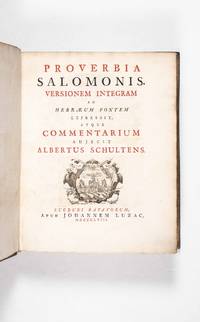
174849255Leiden: Jean Luzac 1748. First edition. Hardcover. Very Good. Quarto. 8 cviii 522 60 indices & corrigendapp. Text in two columns with Hebrew text and facing Latin translation interspersed with commentary. Title in red and black with engraved vignette; woodcut ornaments. Contemporary Dutch paneled vellum with blind-stamped vignettes and ruled borders; manuscript title at spine. Covers lightly soiled. Occasional touches of soiling and some leaves with mild embrowning. A very good copy generally crisp and clean.<br /> <br /> First edition of this comprehensive commentary to the biblical Book of Proverbs by the Dutch semitic language scholar Albert Schultens 1686-1750 who maintained "that the true nature of the Hebrew language and the meaning of many of its words and idioms are to be found chiefly in the Arabic" Orme. Forty-one pages of the indices constitute a brief lexicon and provide Latin as well as Arabic equivalents for more than 1000 Hebrew words. Schultens studied theology and eastern languages at Groningen where he received his degree in theology in 1709. After a brief career as a preacher in Wassenaar he was nominated professor of Hebrew and Jewish antiquities at Franeker in 1713. In 1729 he decamped for Leiden were he was first appointed reader in eastern languages and finally full professor in 1732.<br /> <br /> At this time a chief concern of Calvinist theologians was to liberate Old Testament exegesis from Jewish Rabbinic as well as Catholic traditions. Schultens' influential and controversial solution was revealed as early as 1706 in his first public thesis Disputatio theologico philologica de utilitate linguae Arabicae in interpretanda S. Scriptura A Theologico-Philosophical Dissertation on the Utility of the Arabic Language for the Interpretation of the Holy Scriptures "a forceful attack" Brugman & Schröder on the Protestant sola scriptura methodology of Biblical exegesis. "With the help of Jacobus Golius' Arabic dictionary he perused with zeal and fervour the Old Testament and wrote prolifically. The lexical superiority of Arabic had led him to a reconsideration of the position of Hebrew: at first he had called Arabic 'the most splendid daughter of mother Hebrew' but in his oration of 1729 he proclaimed Hebrew and Arabic cognate twin sisters. This shocked conservative theologians as an outright profanation of God's Word" Brugman & Schröder. <br /> <br /> Like his earlier commentary on the Biblical Book of Job one here finds that the "Hebrew text and the Latin translation are all but totally submerged by the extensive commentary in which Schultens draws abundantly on Arabic texts such as the Hamasa an anthology of early Arabic poetry by the ninth-century poet Abu Tammam" Vrolijk & van Leeuwen. Schultens was not without his critics and by 1824 William Orme notes a turning of the tide: "Different opinions are entertained of the correctness of his views and also of his success in applying them; but it is now generally admitted that he carries his notions of the advantage of Arabic learning to the interpretation of the Scriptures too far." <br /> <br /> Jean Luzac 1728-1777 was a member of a well-known Huguenot family of printers; he published many works for the University of Leiden including three Hebrew books of Albert Schultens. Isaac van der Mijn is noted as the printer at the colophon of the second volume.<br /> <br /> Provenance: bookplate of the Crozer Theological Seminary - Bucknell Library; bookseller's ticket of Librairie Ancienne et Moderne de Frederik Muller Amsterdam at the front paste-down. References: J. Brugman & F. Schröder Arabic Studies in the Netherlands Leiden: E.J. Brill 1979 p.26f. Fuks/Fuks-Mansfeld 78. Orme Bibl. Biblica p. 390. A. Vrolijk & R. van Leeuwen Arabic Studies in the Netherlands a Short History in Portraits 1580-1950 Leiden: E.J. Brill 2014 pp. 73-79. Jean Luzac hardcover
183952150Philadelphia: Bagster & Marshall 1839. First American edition. Hardcover. Good . Octavo. 6 10 778pp. Pointed Hebrew text in two columns the New Testament with only vocal marks. Continuous pagination in Arabic numerals; but separate Hebrew pagination for the Old and New Testaments. Contemporary three-quarter calf over pebbled cloth boards; spine with raised bands ruled and lettered in gilt. Decorative endleaves. Covers rubbed with wear at spine caps and corners. Library pressure stamp at title bookplate and pocket at paste-downs. A good ex-library copy with very clean fresh text throughout.<br /> <br /> First American edition of this Hebrew Bible earlier published by Samuel Bagster at London in 1835; it contains the first printing of the New Testament in Hebrew translation to appear in the United States. That translation was prepared by the philologist William Greenfield 1799-1831 the editorial superintendent of the British and Foreign Bible Society and first published by Samuel Bagster at London in 1831 D&M no. 5186. In preparing his revised Hebrew version Greenfield was allowed to utilise the London Jews' Society Hebrew New Testament published at London between 1813 and 1817 D&M no. 5170. Among the earliest publications of the society founded in 1809 this version was itself based upon Elias Hutter's Hebrew translation of the New Testament published at Nuremberg in 1599 D&M no. 5111. Prepared by a group of scholars under the supervision of Thomas Fry and William Bengo Collyer this London Jews’ Society edition employed only biblical words and translated Old Testament quotations from the Greek not citing them directly from the Hebrew Scriptures.<br /> <br /> The editor of the New Testament version in the present work appears to have had a notable gift for languages. William Greenfield began his Hebrew studies as a young man while apprenticed to a bookbinder taking lessons from one of his co-workers a Jew with some learning who had been described as "a reader of the law in the synagogue" ODNB. Greenfield subsequently left the business in 1824 in order to devote himself to languages and biblical criticism. His defence of the Serampore Mahratta version of the New Testament in response to an 1829 article in the Asiatic Journal brought him to the attention of the British and Foreign Bible Society who then hired him to superintend their editiorial department. "During his nineteen months in the society's service Greenfield wrote on twelve European five Asiatic one African and three American languages and acquired considerable knowledge of Peruvian African-English Chippeway and Berber" ODNB. His revision of the Hebrew New Testament earlier published by the London Jews' Society was among the last works he undertook for the British and Foreign Bible Society along with the revision of the Modern Greek Psalter as it went through the press.<br /> <br /> Provenance: Bookplate and other markings including withdrawal stamp of the Library of the Garrett Theological Seminary Evanston Illinois. Full title in Hebrew: ספר הקדש ×•×”×•× ×ª×•×¨×” × ×‘×™××™× ×•×›×ª×•×‘×™× ×’× ×›×ª×‘×™ ברית החדשה × ×¢×ª×§ מלשון ×™×•× ×™×ª ×ל לשון עברית <br /> Philadelphiae: Sumptibus Bagster et Marshall in via vulgo dicta Chestnut Street ad Repositorium Bibliorum Sacrorum etc. quae in linguis antiquis et hodiernis edita sunt. Anno erae Judaicae I rev. C; rev. C DXCIX.<br /> <br /> References: Goldman Hebrew Printing in America no. 6: "This was the first New Testament published in Hebrew in America." ODNB: "Greenfield William" Gordon Goodwin revised by H. C. G. Matthew. J. R. Marcus "Jewish Americana a Supplement to A. S. W. Rosenbach An American Jewish Bibliography" in: Monographs of the American Jewish Archives 1954 no. 1 no. 164. Cf. Darlow & Moule nos. 5111; 5170; 5186. Bagster & Marshall hardcover
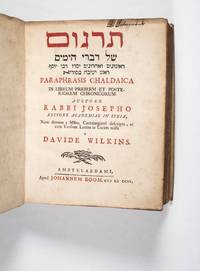
171549239Amsterdam: Jan Boom 1715. First edition. Hardcover. Very Good. Small quarto. asterisk4 a-f4 -blank f4 A-3F4 = 235 leaves. 54 415 1 blankpp. Contemporary vellum with exposed thongs boards somewhat bowed spine darkened early manuscript title in Hebrew and Latin at spine. Old owner entry at top margin title memorial label at front paste-down. A very good copy amply-margined with fine crisp text throughout.<br /> <br /> Important edition of this Aramaic version of the biblical books of Chronicles attributed to Joseph ben Hiyya d. 333 a Babylonian amora and head of the Pumbedita academy near present-day Falluja Iraq. "Ben Hiyya was also distinguished in biblical exegesis and left an Aramaic translation of parts of the Bible which is often quoted. It is not to be assumed however that Joseph translated the whole Bible though the Aramaic translation of the Books of Chronicles is ascribed to him. Enc. Jud. The editio princeps edited from an Erfurt manuscript by Matthias Frederick Beck and accompanied by substantial annotations was published at Augsburg in 1680. "After this David Wilkins gave the public an edition from a Cambridge manuscript of which the text was more pure and more complete. The critic should unite both these editions the former for the value of its learned notes and the latter for its full and accurate text†The Biblical Repertory. <br /> <br /> The Coptic scholar David Wilkens 1685–1745 was born of Prussian parentage in Memel Lithuania. Little is known about his education in Germany probably in Berlin or how he acquired his knowledge of ancient and Semitic languages which was extensive rather than profound. He referred to the antiquarian Ezechiel Spanheim the elector of Brandenburg's ambassador in England from 1701 to 1710 as his former teacher. By 1707 Wilkins was studying at the Bodleian Library in Oxford and had encountered a group of clerical protectors in London. In 1709 engaged in preparing a history of the patriarchs of Alexandria which remained in manuscript and the editio princeps of the Coptic Bohairic New Testament the Novum Testamentum Aegyptium 1716 he left for the continent. He called on scholars examined manuscripts in Vienna Rome and Paris and stopped in Amsterdam in 1714 to see to the publication of his first works -- an edition of the Aramaic paraphrasis of the books of Chronicles and an Armenian version of the apocryphal third epistle to the Corinthians 1715 -- and of John Chamberlayne's polyglot edition of the Lord's prayer to which he contributed. Wilkins was an industrious scholar. In the three years he spent as librarian at Lambeth he made important contributions to the cataloguing of manuscripts. In 1721 he edited the Anglo-Saxon laws in 1725–6 the complete works of John Selden and in 1731 the Coptic Pentateuch. His main work was his Concilia Magnae Britanniae et Hiberniae an account of British church councils from 446 to 1717. Wilkins had many detractors -- John Gagnier the professor of Arabic at Oxford who deplored his incompetence in Arabic and Hebrew Edward Harley who described him as ‘a very great scoundrel’ and the cantankerous Thomas Hearne who as librarian at the Bodleian had watched him turn from a young man ‘of a civil Courteous and modest behaviour’ into ‘a vain ambitious man of little judgement tho' great industry’ ready to ‘do anything in the World for a little Money’ Alastair Hamilton: "Wilkens David" -- ODNB online.<br /> <br /> Provenance: From the library of G.H.A. Juynboll 1935-2010 the celebrated scholar of Islamic Hadith literature with his printed memorial label at front paste-down. Hebrew title: ×ª×¨×’×•× ×©×œ דברי ×”×™×ž×™× ×¨××©×•× ×™× ×•××—×¨×•× ×™× ×™×¡×“×• ר×ש ישיבה בסורי×<br /> <br /> References: The Biblical Repertory 1834 6:248-249. Brunet 3:574 - "Livre recherché et peu commun". Enc. Jud. 10:229. Le Long Bibliotheca sacra 1723 1:92B. Le Long-Masch 2.1 p. 48: “Multo correctior est editio ac praecedens Beckiana.†long note in which the relation with the never published version by Clarke is discussed. Cf. D&M 2416: The editio princeps of the Targum on Chronicles printed from an Erfurt MS. and edited with a Latin translation by M. F. Beck Augsburg 1680-3 2 vols 4to. The present edition is “a more complete form of the text from a Cambridge MS. . edited with a Latin translation by D. Wilkins. Jan Boom hardcover
177653321Oxford: The Clarendon Press 1776. First edition. Hardcover. Near fine. Two volumes folio published in 1776 and 1780. xxiii title and subscribers' list 1 blank VIII preface 684 1 catalogue of manuscripts 1 blank; 4 title and subscribers' list 732 129 1 blank 6 indicespp. Expertly rebound in modern quarter vellum over marbled boards spines titled in gilt. Titles darkened and dusty; very occasional light foxing or oxidation spots; dampstain at bottom quarter of the first twenty and final four leaves in the first volume else a nearly fine wide-margined set crisp and uncut.<br /> <br /> First edition and the "earliest attempt to provide a critical edition of the Hebrew Scriptures on a large scale†D&M and a notable early example of a large-scale scholarly project which attracted international financial and scholarly support. The biblical scholar Benjamin Kennicott 1718-1783 was educated at Oxford and "instructed in Hebrew by Professor Thomas Hunt and the greater part of his life was spent in the collation of Hebrew manuscripts with the object of producing a definitive original text of the Old Testament. Robert Lowth always his major patron first inspired him with a desire to test the accuracy of the Hebrew text of the Old Testament. With his formidable knowledge of Syriac early Latin the Septuagint and the Samaritan Pentateuch it was recognized that he was very well qualified for the task. His critical examination of manuscripts initially in the British Museum and the libraries of Oxford and Cambridge began in 1751 and when Thomas Secker then bishop of Oxford and also a member of Exeter College urged him in March 1758 to undertake their collation he agreed to the request. In return Secker when archbishop of Canterbury gave Kennicott his unstinting support and friendship when for a time he nurtured a project for producing a revised Authorized Version of the Bible. Meanwhile in 1753 Kennicott issued The State of the Printed Hebrew Text of the Old Testament Considered: a Dissertation and in 1759 he brought out a second dissertation on the same subject. He identified his object thus: to compare Scripture with itself to explain a difficult phrase or passage by a clear one that bears some relation to it to consider the natural force of the Original Words the tendency of the Context and the Design of the Writer; to compare the most ancient editions of the Original with one another and with the best copies of the most celebrated versions vol.1 p.12. These volumes were translated into Latin by W. A. Teller and published at Leipzig the first in 1756 the second with additions in 1765.<br /> <br /> Kennicott's scholarly endeavours attracted support in Britain and beyond. In England subscriptions amounted to £9119 7s. 6d.; in France the duc de Nivernois a former French ambassador to the court of St James patronized him and helped him to gain access to Parisian manuscript collections in 1767; the king of Denmark offered him the use of six ancient manuscripts; four quarto volumes of variant readings were sent to him on the king of Sardinia's orders; and the stadholder of the Netherlands made an annual donation of 30 guineas. His first report On the Collation of the Hebrew Manuscripts of the Old Testament was forwarded to the subscribers in December 1760 and a similar statement appeared each year until 1769. This annual summary afforded him an opportunity to defend the accuracy of his own collations the Hebraic scholarship of the staff assisting him and to print lists of subscribers. A copy of the entire work was personally presented by Kennicott to George III. Lowth called the 1776 variorum Old Testament 'a work the greatest and most important that has been undertaken and accomplished since the Revolution of Letters' B. Hepworth Robert Lowth p. 145" Nigel Aston ODNB. An early judgement on this seminal edition is provided by William Orme in his 1824 Bibliotheca Biblica: “This is beyond all comparison the most splendid edition of the Hebrew Scriptures ever published. It was patronized by most of the crowned heads of Europe. It occupied its learned editor in preparation or actual labour more than thirty years. More than six hundred MSS. and editions were collated for it in all parts of Europe. The text is that of Vander Hooght without the points. The Samaritan Pentateuch where it differs from the Hebrew text is printed in parallel columns in the Hebrew character. The various readings are almost innumerable and occupy in general the largest half of every page. The Dissertatio Generalis annexed to the second volume is invaluable for the information which it contains respecting the state of the original text and the sound principles of criticism which it exhibits." The final leaf lists 312 manuscripts and some printed editions which provided the various readings noted throughout the apparatus. The concluding Dissertatio Generalis was republished separately at Braunschweig in 1783 by professor Paul Jakob Bruns who assisted Kennicott in his collations.<br /> <br /> Provenance: Engraved bookplate of the Parochial Library of St Phillips Birmingham in the County of Warwick at front endleaf in both volumes. References: N. Aston "Benjamin Kennicott" in: ODNB. Darlow & Moule 5160. ESTC T147508. Orme Bibl. Biblica 238. For a notable recent discussion see J. Turner Philology: The Forgotten Origins of the Modern Humanities Princeton Univ. Press 2014 77f. An earlier assessment of the critical endeavors of Kennicott and De Rossi appears in N. P. Wiseman's 1836 Twelve Lectures on the Connexion between Science and Revealed Religion pp.368-371 ed. Dublin 1866. The Clarendon Press hardcover
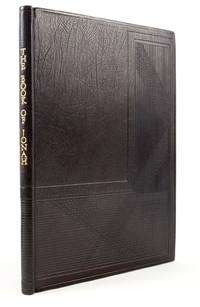
1926ST20084Waltham St. Lawrence: Golden Cockerel Press 1926. No. 48 OF CLXXV COPIES. 258 x 195 mm. 10 1/4 x 7 3/4". 15 3 pp. <br/> Understated black crushed morocco by J. Franklin Mowery stamp-signed "JFM 94" on rear turn-in wraparound design of blind-stamped L-shaped panels of intersecting lines smooth spine with vertical gilt lettering leather hinges edges untrimmed. Original illustrated upper cover of dust jacket repaired at one corner bound in at rear. In a matching morocco-lipped slipcase. Title page with large woodcut of the risen Christ four large vignettes in the text four pictorial half borders and four full-page woodcuts all by David Jones printer's device in colophon. Front pastedown with bookplate of Jan van der Marck. Chanticleer 40. A pristine copy.<br/> <br/> This is a wonderfully--if understatedly--bound copy of one of the most strictly limited Golden Cockerel Press productions. The binding is the work of J. Franklin Mowery retired Head of Conservation at the Folger Shakespeare Library and past president of the Guild of Book Workers. Mowery studied bookbinding under Professor Kurt Londenberg at the Staatliche Hochschule für bildende Künste Academy of Art in Hamburg and trained as a paper conservator under Otto Wächter in Vienna before returning to the U.S. to work at the Huntington Library. According to his article "A Binder's Training" Guild of Book Workers' Journal XX 1981-82 the blind-stamping technique seen here was "particularly favored by Professor Londenberg" and often employed by Mowery for the range of design possibilities it offers. The method uses dies to stamp the patterns: "a photographic process can transfer any black and white image onto zinc plates that are deeply etched and mounted onto type-high metal blocks for heated impressions or onto wood for cold embossing." Mowery stated that lines of the design here represent the driving rain of the storm that struck Jonah's ship. Founded in 1920 with the intention to print fine editions of important well-known books as well as new literary works of merit from young authors the Golden Cockerel Press was purchased in 1924 by the illustrator and wood-engraver Robert Gibbings. "Under his direction" says Cave the Press was "transformed into the principal vehicle for the renaissance of wood-engraved book illustration that took place in the years between the wars." In addition to doing wood engravings himself Gibbings employed a stable of eminent artists including among others Eric Gill Blair Hughes-Stanton John Nash John Farleigh Eric Ravilious and David Jones. The memorable woodcuts are the work of Jones 1895-1974 who had a brief but impressive career as an illustrator before eye strain forced him to abandon engraving in 1930. In his published study of Jones' work Douglas Cleverdon says that in the short time Jones was engraving "he produced a remarkable amount of work of great variety; some witty some mystical; some boldly cut some delicately shaded; some simple to print some virtually impossible. Although he never attained . . . the greatest technical mastery in the conventional sense his prints are nearly always distinguished by their excellence of design personal commitment and absolute individuality." Our binding was commissioned by collector and self-described "radical" museum administrator Jan van der Marck 1929-2010 who championed artists that pushed boundaries--often to the consternation of the museum boards who employed him. Golden Cockerel Press unknown
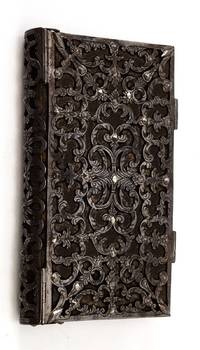
1738ST20149Zürich: David Geßner 1738. 162 x 88 mm. 6 3/8 x 3 1/2". 272 pp.; 192 pp.; 8 leaves; 64 pp. <br/> BEAUTIFUL ENGRAVED STEEL FILIGREE OVER BLACK VELVET each cover with swirling foliage studded with 37 pointed bosses and four oblique lozenge bosses at corners smooth spine in a similar design with nine studs binding with a total of 83 sharp studs two fore-edge clasps one broken off. Housed in a brown buckram chamois-lined chemise and matching slipcase. New Testament with extra engraved title page with image of St. John his eagle and a lamb printer's device on printed title tailpiece at end of text; Psalms with extra engraved title page depicting David with his harp printed title with small vignette of the same scene; Festivals with engraved title page showing the Last Supper. Nap of velvet mostly gone except down the middle of the spine endpapers and the edges of first and last few leaves with numerous small rust spots apparently caused by the covers' metal frame and studs otherwise fine inside and out. An excellent example of a very unusual binding.<br/> <br/> With distinguished provenance this is a dramatic binding that makes a memorable display with engraved and pierced steel strapwork forming a lace-like pattern studded with faceted bosses that at first glance appear to be gems. Our volume has a general resemblance to the best of the small silver bindings produced during the Baroque period; its wonderfully executed foliate scrolls are reminiscent of a German binding described and pictured as item #15 in Hayward's "Silver Bindings from the J. R. Abbey Collection." However we have been unable to locate another example that strongly resembles ours. While not silver it is nevertheless a luxury binding--the engraving with its exquisite detail was done by a skilled hand and the materials themselves would have come at a price since before the Bessemer process of the 1850s steel was difficult to produce and consequently expensive. We do not know for whom this remarkable binding was originally made but we do know that it has more recently resided in two important American collections. Prior to 1955 it was in the library of Saul Cohn whose collection was sold at Parke-Bernet on April 26 of that year this was lot #67. Following that it was part of the illustrious collection of Cincinnati businessman arborist and philanthropist Cornelius J. Hauck 1893-1967 whose fortune was made in the family brewery; the auction of his library at Christie's in 2006 totaled more than $12.4 million this was lot #362 selling for $3120. David Geßner unknown
1738ST20462Zurich: David Gessner 1740 1738 1738. 162 x 90 mm. 6 3/8 x 3 1/2". 270 pp.; 192 16 pp.; 64 pp. <br/> LOVELY PIERCED VERMEIL SILVER BINDING over dark brown sharkskin the metalwork with intricately twining strapwork accented with acanthus leaves a basket of flowers and two eagles elongated vermeil head and tail caps over spine two fore-edge clasps gilt patterned paper pastedowns all edges gilt. Housed in a fine modern brown morocco felt-lined clamshell box. First two works with extra engraved illustrated title page. Ink gift inscription on front flyleaf: "Helen McDowell/ from her/ affectionate/ illegible/ with sincere/ good wishes/ for her future/ happiness/ August 1864." For the binding: Hayward "Silver Bindings from the J. R. Abbey Collection" 14. Sharkskin with just a hint of chafing occasional mild browning or foxing to leaves but QUITE A FINE COPY clean and fresh internally and the binding shining and unworn.<br/> <br/> Beautifully executed and wonderfully preserved this New Testament is an excellent example of the vermeil bindings--that is silver-gilt or gilded/gilt silver--produced in Switzerland and southern Germany during the Baroque period. As is typical this binding is without a hallmark but it closely resembles another New Testament bound in shagreen and vermeil described and pictured as item #14 in Hayward's "Silver Bindings from the J. R. Abbey Collection" which Hayward indicates was produced in Zurich in the early 18th century. These intricate silver bindings were popular for religious works presenting what Hayward calls a "combination of ostentatious wealth and piety" and this one was executed with great skill featuring graceful lines and delicately rendered details. There are two main types of silver bindings from the period: engraved and pierced bindings like the present example which were especially popular in the 17th century; and embossed or repoussé bindings which came into fashion in the late 17th and early 18th century. Of the two the engraved and pierced bindings are generally valued more highly because they required more time and skilled labor. David Gessner unknown
1768ST12938Zurich: David Gessner 1768. 169 x 94 mm. 6 1/2 x 3 3/4". 272 64 214 of 215 pp. <br/> CONTEMPORARY PAINTED AND BLIND-TOOLED VELLUM DECORATED IN AN ELABORATE AND QUAINT STYLE covers with black and red starburst at center in a lobed red and green frame stamped with stars and tulips yellow cornerpieces stamped with a floral design smooth spine painted red and tooled in blind with flowers Dutch gilded endpapers all edges gilt. ◆Covers faintly soiled extremities lightly rubbed one leaf with two-inch portion torn away at fore margin costing small parts of five closely spaced staves of music occasional foxing of no great consequence; with some serious condition issues internally but an extremely pleasing example of a binding representing German folk art of the period.<br/> <br/> Although lacking the final leaf of text this volume is of considerable interest as an expertly made and decorated so-called "Peasant Binding" a colorful binding style that began in Hungary and spread through Germany the Netherlands and Scandinavia in the 18th century. The use of the word "peasant" in this context is a reference to the obvious influence of folk art on this decoration rather than to the clientele for which it was intended. Bibles prayer books and hymnals in the brightly painted and exuberantly decorated vellum bindings were popular wedding gifts among the bourgeoisie who were both literate and sufficiently affluent to afford such luxuries. David Gessner unknown
1768ST19422Nuremberg: Johann Andrea Endterischen 1768. 460 x 295 mm. 18 1/4 x 11 1/2". 17 p.l. 11 48 2 2 3-8 3 9-190 2 191-740 pp.; 512 pp.; 2 2 3-190 2 191-480 18 pp. Three parts bound in one volume. <br/> STRIKING CONTEMPORARY SMOOTH CALF LAVISHLY GILT in the entrelac style covers with frame and compartments formed by gilt-ruled strapwork and filled with floral designs and lace-like ornaments of massed volutes and small tools raised bands spine compartments with central bouquet of pomegranate and flowers with massed floral tools on either side gilt lettering brass clasps featuring images of King David and St. Paul gilt-tooled turn-ins marbled endpapers all edges gilt and gauffered with pomegranates and flowers older repair to front joint alongside top compartment. Extra engraved title page woodcut headpieces and historiated initials 47 engraved plates comprised of: copperplate portraits of Luther and 11 Electors; 11 section titles each with 11 vignettes; nine full-page engraved depictions of Moses the Prophets and the Evangelists; seven full-page plates engraved with 12 vignettes six double-page maps and two double-page engravings. Front pastedown with ornate heart-shaped bookplate of Adam Melchior Dæumer dated 1784. ◆Two-inch crack to head of rear joint a bit of rubbing to joints and extremities a handful of quite minor dark spots to boards isolated trivial smudges or stains internally other insignificant imperfections but still a fine specimen--THE CONTENTS EXCEPTIONALLY CLEAN BRIGHT AND FRESH and the remarkable binding entirely solid and bright with gilt.<br/> <br/> This is an especially pleasing copy of the last and most extensive edition of the very popular and sumptuously illustrated Weimar Electors' Bible offered here in an impressive contemporary binding. Known as the "Kurfürstenbibel" because of its portraits of the Electoral Princes called "Kurfürsten" in German it was originally prepared for Ernst I Duke of Saxe-Gotha and Altenburg as a celebration of Martin Luther's Bible translation. Editions were issued by the Endters one of the prominent German printing families beginning in 1641. In addition to portraits of Luther and the Protestant princes of Germany the present edition contains the maps views and illustrated half-titles by Jacob van Sandrart and others first used in the edition of 1686. Our copy contains four maps and views not found in other copies of this edition showing the eastern Mediterranean and Palestine as well as both a map and a view of Jerusalem. The size of our volume puts a great strain on the binding which has nevertheless stood the test of time remarkably well. The overall decoration is exuberant the delicate gauffering lovely and the original straps remarkably well preserved. Johann Andrea Endterischen unknown
1877ST20670Stuttgart: Edward Hallberger ca. 1877. Fourth Edition. 430 x 315 mm. 16 3/4 x 12 1/4". Two volumes. Translated into German by Dr. Joseph Franz Allioli. <br/> PUBLISHER'S SPLENDID RED CLOTH VERY ELABORATELY STAMPED IN GILT AND BLIND covers with bevelled edges thick and thin gilt-rule border enclosing ornate blind-stamped frame large central oval containing a lobed gilt frame with gilt lettering inside spine divided into blind-stamped panels by decorative and plain gilt rules two large panels with gilt lettering and volume number original cloth hinges white moiré paper endpapers all edges gilt. IN THE ORIGINAL PRINTED GRAY DUST JACKETS jacket of second volume with small very expert repairs at bottom and the original black cardboard clamshell boxes solidly reinforced with black tape. WITH 230 DRAMATIC PLATES BY GUSTAVE DORÉ. Volume I with four leaves for recording family members marriages births and deaths each with a decorative frame all unused. Malan "Doré" p. 85. Isolated spots of minor foxing due to paper content one cover of the very rarely seen dust jackets with red offsetting from the frame on the cover but AN UNSURPASSABLE COPY--clean fresh and bright internally the bindings and jackets IN SPARKLING CONDITION.<br/> <br/> This is a time-capsule copy of perhaps the most popular illustrated Bible ever issued and one of the very few Bibles which has always been known by the name of its illustrator. According to his biographer the artist was excited by the "almost endless series of intensely dramatic events" he would get to portray; the results originally created for the 1866 Grand Bible of Tours are so evocative that the critic Bouchot called them "the terror of frail readers." Doré 1832-83 makes remarkable use of light shadow and composition to convey the full range of splendor horror pathos and ecstasy contained in the Scriptures. Because he was so prolific it is estimated that he made more than 100000 designs in his lifetime Doré inevitably had his detractors but Ray says simply that he was "one of the greatest of all illustrators." Taine says that "every imagination appeared languid in comparison with his. For energy force superabundance originality sparkle and gloomy grandeur I know of only one equal to his--that of Tintoretto." The Doré Bible was translated into at least 24 languages; ours is the German version by Catholic theologian Joseph Franz Allioli 1793-1873. According to Malan "The Roman Catholic Church has never diminished its praise of these illustrations." And these illustrations endured in many Catholic and Protestant Bibles especially during the last third of the 19th century but actually until the present. The Bible was such a cultural phenomenon that Mark Twain even mentioned it in “Tom Sawyer†as a motivating prize for students to learn Scripture. The Bible’s success prompted Doré to reinterpret his illustrations in huge paintings that were displayed at Doré Gallery in London. Malan says that the exhibition “was considered the greatest collection of religious paintings in the world." The boxes that were issued with our set have clearly weathered some blows over the years but they did their job perfectly as the volumes they protected hardly seem to have been opened in their lifetime and their dust jackets even considering the minor repair are also in a breathtaking state of preservation. Edward Hallberger unknown
1890ST16866bCambridge: Printed by C. J. Clay & Sons at the University Press ca. 1890. 203 x 133 mm. 8 x 5 3/8". 998 pp. <br/> MOST ATTRACTIVE HAZEL BROWN CRUSHED MOROCCO GILT BY STOAKLEY LATE HAWES stamp-signed on verso of front free endpaper covers framed by gilt rules and guilloche tooling central panel with delicately tooled cornerpieces featuring grapevines on a stippled background raised bands spine compartments densely gilt with grapevine motif turn-ins with richly gilt frame leather hinges all edges gilt gutter at front flyleaf expertly reinforced with tissue. With presentation inscription on front flyleaf: "Herbert Gardner Travers / from his Godmother / A. S. Burn / August 1891"; below this the ink-inscribed record of the recipient's marriage and the births of his children. Spine gently and uniformly sunned a shade lighter two hardly noticeable small abrasions to rear cover offsetting from turn-ins to free endpapers as almost always but still a fine copy in a remarkably handsome binding with few signs of use.<br/> <br/> The appealing binding on this treasured family Bible was created in Cambridge by Vere Stoakley who took over the workshop of J. Hawes on that craftsman's death in the late 1880s; he signed his work "Stoakley Late Hawes" to acknowledge this connection. The firm specialized in academic bindings to supply scholars from the university and continued in business until the 1920s. The present binding clearly is much more elaborate and beautiful than a simple scholar's binding and this is because it was a special gift presented to a beloved godson probably for his christening. Recipient Herbert Gardner Travers 1891-1958 grew up to be a decorated World War I flying ace who was awarded the Distinguished Service Cross for his five aerial victories. After the Great War he worked in the airplane industry as a test pilot and flying instructor then became a commercial pilot in 1935. He returned to the Royal Air Force at the outset of World War II and was an acting squadron leader. As recorded on the flyleaf of his Bible he married Hermia Edith Margaretta Fraser in August 1919 and over the next 12 years they welcomed children Daphne 1920 Eva 1921 Elizabeth 1924 Christina 1926 and Edward 1931. Printed by C. J. Clay & Sons at the University Press unknown
1800ST20221aLondon: T. Bensley for T. Macklin final volume Bensley for T. Cadell & W. Davies 1800 for the six volumes of the Bible 1816 for the Apocrypha. First Printing of this Edition. 480 x 385 mm. 19 x 15 1/8". One leaf in the Apocrypha 3P2 comprising two prologues of Ecclesiasticus invisibly inserted from another copy. Seven volumes comprising the regular Bible in six volumes and the Apocrypha usually not included as a seventh volume. <br/> ABSOLUTELY MAGNIFICENT CONTEMPORARY RED NEOCLASSICAL-STYLE STRAIGHT-GRAIN MOROCCO SUMPTUOUSLY GILT AND ONLAID WITH BLUE BY GEORG FRIEDRICH KRAUSS done for Prince Albert Casimir Duke of Saxe-Teschen with repeated "AST" monogram covers with very elaborate frames incorporating 11 plain and decorative gilt rules four onlaid borders of blue morocco and very elegant swirling foliate ornamentation around the central scalloped panel six pairs of raised bands each pair flanking a recessed gilt and blue metope and pentaglyph rule very handsome spine compartments with blue fan-shaped cornerpieces and central gilt-decorated blue medallions within sunburst gilt collars turn-ins with Greek key pattern in gilt striking endleaves of turquoise and green watered silk the Apochrypha endleaves slightly different. With more than 100 allegorical headpieces and tailpieces and some 70 SPLENDID LARGE-FOLIO-SIZE COPPER PLATES after Fuseli Reynolds West and others most plates printed before letters. Tissue guards perhaps later. Herbert 1442 and 1651. First volume with about 30 leaves noticeably foxed the majority of plates offset onto previous and following pages consistent inoffensive offsetting of text on facing pages other trivial imperfections but still a very impressive copy internally with the luxurious paper used for the text both fresh and clean and the engravings richly impressed and with very little foxing. Some unimportant scuffing and rubbing to the leather but all defects minor THE MAGNIFICENT BINDINGS REMARKABLY WELL PRESERVED the heavy volumes completely solid with only insignificant signs of use and THE MOROCCO AND LAVISHLY GILT DECORATION EXTREMELY BRIGHT. AN ALTOGETHER MEMORABLE COPY.<br/> <br/> The most prodigious form of Scripture in English ever published the Macklin Bible was often put into ornate bindings especially by London binders like Staggemeier and his contemporaries. But however much other sets may glisten the present magnificent example surely stands at or near the front of the line as one of the most lavishly decorated and arresting copies in existence. Its decorative extravagance also testifies to the fact that Macklin's publication was sufficiently admired outside of England to warrant the finest workmanship and the expenditure of great sums of money on artistic resources. The very large and bold type the fine Whatman paper and the series of engravings by some of the most celebrated artists of the period make this an item that is already very desirable. Like the Boydell "Shakespeare Gallery" also printed by Bensley our Macklin Bible is a vast picture book with illustrations that are grand both in size and emotional impact. But it is of course the bindings here that matter the most. Francesco Piranesi is generally given credit for inventing the Neoclassical style when he designed volumes presented to Gustavus III of Sweden during this monarch's visit to Rome in 1783-84. Quickly popular the Neoclassical style was imitated and developed by Staggemeier & Welcher in London by F. W. Standlander in Stockholm and by Georg Friedrich Krauss in Vienna. Krauss was the most prominent Continental binder working in this style of the day and Saxe-Teschen was perhaps his most important client. Products of the Krauss bindery have passed through some of the most distinguished collections over the years particularly those of Fürstenberg and Schäfer; and his bindings have consistently brought remarkable sums of money at auction. It is sufficient to say that the present group of bindings represents the most impressive collection of decorative volumes we have ever offered for sale. The collector for whom these bindings were originally executed Duke Albert of Saxe-Teschen 1738-1822 was the son of Friedrich August II of Saxony and the son-in-law of the empress Maria Theresa. After providing important military and civil service to the Habsburg empire he retired to Vienna in 1795 and afterward devoted himself to the fine arts. He founded the Albertina which now houses the greatest collection of prints in the world and he put together a great library distinguished by the highest taste and most exacting standards. The present copy has the additional distinction of containing what amounts to an extra volume: the Macklin Bible however it is bound most often appears in the marketplace without the Apocrypha appearing here as Volume VII which was not issued until 16 years after the others. It is also of some interest that the bindings of our seven volumes were decorated in an entirely uniform fashion as a close inspection shows something not typical of a set with volumes published so many years apart. The non-uniform endleaves in the final volume here may have resulted from the fact that given the physical size of the books the binder simply ran out of the cloth he had used for lining the first six volumes. The present set was offered though unsold at Sotheby's in 2003 with an estimate of £40-50000 approximately $64000-80000 and in 2005 for £30-40000 approximately $54000-72000. T. Bensley for T. Macklin [final volume Bensley for T. Cadell & W. Davies] unknown