20 544 résultats
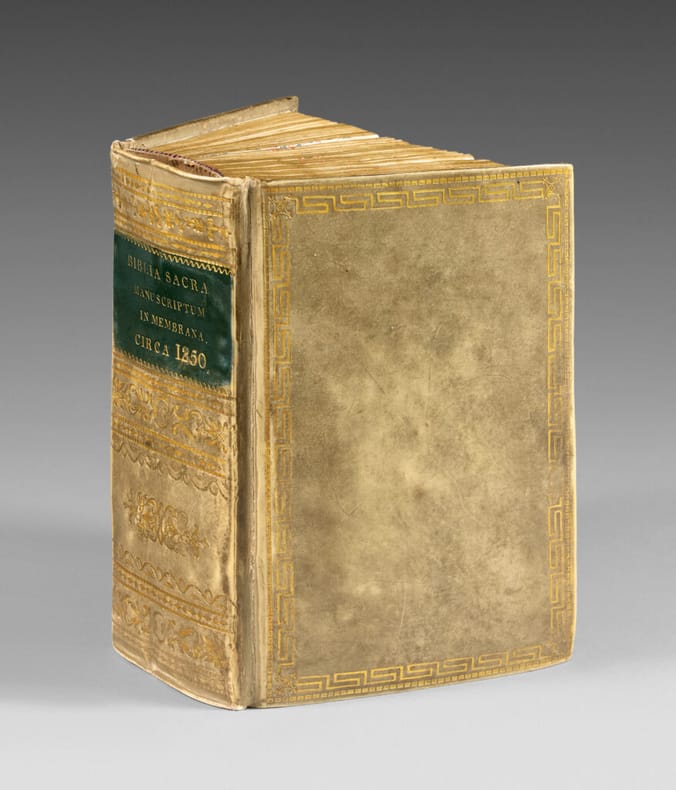
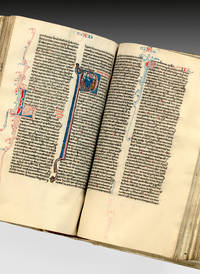
ABAA25-1<p>Northern France probably Paris 1230-1250.</p><p>12mo 140 x 93 mm of 1 658 ll.: 1-1524 1620 17-2224 2310 24-2524 2617 without the bl. l. xviii 2726 2828 295 without the bl. l. vi. <strong>Thus complete</strong>.</p><p>Double column of 47 lines written in brown ink in a very fine Gothic writing.</p><p>Justification: 92 x 60 mm.</p><p><strong>78 historiated initials</strong>. Quires numbered in Roman numerals at the foot of the back of the last ll. and signatures at the bottom corner of the text on each recto of the first half of a quire headings in red initials in red letters of running titles and chapters numbers alternately in red or blue initials of chapters on 2 lines alternately in red or blue with a decor of the opposite color initials of 5 to 7 lines at the beginning of the prologues of the same type but with decoration in two colors opening the prologues 78 historiated initials most decorated with foliage and dragons the extension of 29 of them forming borders decorating the margin painted in blue pink orange-red and yellow a few wormholes in the first l. a few running titles cropped last l. restored in the outer margin.</p><p>Stiff vellum gilt Greek roll-stamp around the covers flat spine decorated green morocco lettering piece gilt edges from the 19th century.</p><p>Superb Capetian manuscript from the School of Paris complete and of perfect freshness handwritten on vellum skin and illuminated with exquisite finesse between 1230 and 1250.</p><p><u>Text</u>: List of Books of the Bible: recto and verso of the first endpaper; the Vulgate with the preamble: ll. 1-599v; Interpretation of the Hebrew names: ll. 600-658.</p><p>Superb example of the small vulgate bibles produced in Paris in the 13th century.</p><p>It was in the 13th century in Paris that the masters of theology of the University established what was to become the standard form of the Latin Bible: the selection of the books their order and their division into chapters established by Stéphane Laugton still universally employed the insertion of the forewords of St Jerome and the interpretation of the Hebrew names.</p><p>All these characteristics are present in this very elegant Bible on very thin vellum skin.</p><p><u>Illuminations</u>: A masterpiece from Pierre de Bar's workshop active in Paris between 1230 and 1250 distinguishes itself by the particularly colored and bright shades of its illuminations; the usual whites pinks and blues are enriched with red orange and even more surprisingly by large areas of yellow.</p><p>This Bible contains 78 illuminations of great beauty and of amazing freshness.</p><p>The repertoire of decorative details is peculiar compared to other French illuminations of the time and the foliage contains small clover leaves.</p><p>Branner attributed the illustration of the manuscript to the Parisian workshop that illustrated the most outstanding illuminated manuscripts of the first half of the 13th century Bar's workshop with reference to Cardinal Pierre de Bar 1252 who gave to the Abbey of Clairvaux a Bible in four volumes issued from this workshop and preserved today under the reference Troyes Bibliothèque municipale ms. 106 108 110 and 111.</p><p>This manuscript can be dated from 1230-1250. Remarkable for its large and well-formed heads; the bodies are robust and covered with clothes with deep and dark folds R. Branner <em>Manuscript Painting in Paris during the Reign of Saint Louis</em> 1977 pp. 70-71. He dates the activity of Pierre de Bar's workshop between 1230-1250 and explains its specificities by suggesting the development of its style outside Paris.</p><p>The decoration of the manuscript consists of 78 historiated illuminated initials and a great number of capital letters rubricated in red or blue.</p><p>This very attractive bible seems to have been made in Paris; it represents an interesting addition to the production of a workshop producing according to Branner some of the most beautiful and refined Parisian illuminations of the first half of the 13th century.</p><p>We witness from the years 1220-1230 under the reign of Queen Blanche of Castile a concentration of illuminators in Paris at the expense of abbeys and provincial capitular schools. We can indeed attribute several manuscripts to Blanche of Castile who inaugurated the tradition of female patronage in the royal family. But the peak of these famous small Capetian bibles happened during the reign of Saint Louis.</p><p>The subjects of the historiated initials are the following:</p><p>l. l St Jerome Prologue; l. 4 The 7 days of Creation Genesis; l. 27 Moses leading his people across the Red Sea Exodus; l. 43 the Jews offering a sacrifice; l. 54 Moses preaching; l. 72 Moses receiving the Tablets of Stone; l. 89 God talking to Joshua; l. 99 Gideon holding his sword; l. 110 Elimelech and Naomi migrating to Moab Ruth; l. 112v Beheading of Eli; l. 128 Beheading of Amalekite before David; l. 141 David's servant bringing Abishag to him; l. 155v Ahaziah falling from a tower; l. 170v the Patriarchs; l. 185 Solomon enthroned; l. 202 The Construction of the Temple; l. 207 Nehemiah presenting the golden cup to Artaxerxes; l. 213v Spraying of the Temple; l. 220v Tobias; l. 225v Judith beheading Holofernes; l. 232 Ahasuerus being merciful to Esther; l. 238v Job on the manure heap; l. 251 David playing the harp; l. 256 anointing of David by Samuel; l. 258v David showing his mouth; l. 261 madman holding the stick and the bread Psalm 52; l. 264 God above David below in the water Psalm 68; l. 268 David ringing the bells Psalm 80; l. 271v Two Singers Psalm 97; l. 275 The Trinity Psalm 109; l. 283v Solomon whipping a young man; l. 294v Solomon teaching to a young man; l. 298 Madonna and Child Enthroned; l. 299v Solomon and a young man carrying a sword; l. 307v Ecclesia; l. 328 Isaiah being sawn in half; l. 353 Stoning; l. 381 Baruch writing; l. 384v Ezekiel in bed with the Tetramorph; l. 412 Daniel in the lions' den; l. 423v Hosea and Gomer; l. 427v Joel preaching to a group of Jews; l. 429v Amos offering the sheep; l. 432v God appearing to Obadiah; l. 433v Jonah in the mouth of the whale; l. 434v the teaching Prophet; l. 437 Nahum lamenting about the fall of Nineveh; l. 438v Habakkuk and the stones; l. 440 the Prophet with his scroll; l. 441v Two Prophets; l. 442v Prophet; l. 447 Two men talking; l. 449 Beheading of the idolatrous Jew; l. 466 the Messenger delivering the letter; l. 478v the Tree of Jesse; l. 494v Saint Mark with the lion; l. 505 Saint Luke with the angel; l. 521v Saint John; l. 535 Saint Paul carrying the cross; l. 541 Saint Paul carrying a sword; l. 546v Saint Paul carrying a sword and a scroll; l. 551 Saint Paul carrying a sword and a book; l. 555 Saint Paul carrying a sword; l. 556v Saint Paul carrying a sword and a book; l. 558 Saint Paul carrying a sword; l. 559 Saint Paul carrying a sword; l. 560 Saint Paul carrying a sword; l. 561v Saint Paul carrying a sword; l. 562v Saint Paul carrying a sword; l. 561v Saint Paul carrying a sword; l. 562v Saint Paul carrying a sword; l. 563v Saint Paul carrying a sword; l. 564 Two men talking; l. 568v. Ascension; l. 585 Jacob holding a book; l. 586v Saint Peter seated holding a book; l. 588 Saint Peter holding a key; l. 589 Saint John writing; l. 590v Saint John; l. 591 Saint John; f. 591 Saint Jude; l. 592 Saint John writing.</p><p>This complete bible dated from 1230-1250 is a masterpiece of Capetian illumination produced under the reign of Saint Louis.</p><p>Provenance:</p><p>- <em>Jean Tornone</em>: doctor from Burgundy: inscription on the verso of the endpaper mentioning his gifting of the book to <em>Stroyff</em>.</p><p>- <em>Assuerus Stroyff</em>: inscription mentioning his reception of the book by Tornone then his gift to <em>Johan Baron de Bronckhorst.</em></p><ul><li><em>Johan Baron de Bronckhorst</em> and <em>Batenburg de Guelders</em>: inscription dated from 1574 mentioning his receipt of the book.</li></ul><p><strong>FR</strong></p><p>Nord de la France probablement Paris 1230-1250.</p><p>In-12 de 1 658 ff. : 1-1524 1620 17-2224 2310 24-2524 2617 sans le f. blanc xviii 2726 2828 295 sans le f. blanc vi. <strong>Ainsi complet</strong>.</p><p>Double colonne de 47 lignes écrites à l'encre brune dans une très fine écriture gothique.</p><p>Justification : 92 x 60 mm.</p><p><strong>78 initiales historiées</strong>. Cahiers numérotés en chiffres romains au pied des versos des derniers ff. et signatures au pied du coin inférieur du texte sur chaque recto de la première moitié d'un cahier rubriques en rouge initiales en rouge lettres des titres courants et numéros des chapitres alternativement en rouge ou bleu initiales des chapitres sur 2 lignes alternativement en rouge ou bleu avec un décor de la couleur opposée initiales de 5 à 7 lignes au début des prologues du même type mais avec des décors des deux couleurs ouvrant les prologues 78 initiales historiées la plupart ornées de feuillage et de dragons le prolongement de 29 d'entre elles formant des bordures décorant la marge peintes en bleu rose orange-rouge et jaune qq. trous de vers ds. le premier f. atteinte à qq. titres courants dernier f. restauré ds. la marge extérieure.</p><p>Vélin rigide du XIXe siècle encadrement d'une roulette grecque dorée autour des plats dos lisse orné pièce de titre de maroquin vert tranches dorées.</p><p>140 x 93 mm.</p><p><strong>Superbe manuscrit capétien de l'école de Paris complet et de parfaite fraicheur calligraphié sur peau de vélin et enluminé avec une exquise finesse entre 1230 et 1250.</strong></p><p><u>Texte</u> : Liste des Livres de la Bible : recto et verso de la première garde ; la Vulgate avec le préambule : ff. 1-599v ; Interprétation des noms hébreux : ff. 600-658.</p><p><strong>Superbe exemple des petites bibles vulgates produites à Paris au XIIIe siècle.</strong></p><p>C'est au XIIIe siècle à Paris que les maîtres de théologie de l'Université établirent ce qui devait devenir la forme standard de la Bible latine : la sélection des livres et de l'ordre de ceux-ci et leur division en chapitres établies par Stéphane Laugton et encore universellement employée l'insertion des prologues de St Jérôme et l'interprétation des noms hébreux.</p><p>Toutes ces caractéristiques sont bien présentes dans cette très élégante Bible sur peau de vélin très fine.</p><p><u>Enluminures</u> : Chef-d'œuvre de l'atelier de Pierre de Bar actif à Paris entre 1230 et 1250 il se distingue par les teintes de ses enluminures particulièrement colorées et vives ; les habituels blancs roses et bleus sont enrichis de rouge orange et de manière plus surprenante encore par de larges zones de jaune.</p><p><strong>Cette Bible possède 78 enluminures d'une grande beauté et d'une étonnante fraicheur.</strong></p><p>Le répertoire de détails décoratifs est particulier en comparaison des autres enluminures françaises de cette époque et le feuillage comporte des petites feuilles de trèfle.</p><p><strong>Branner a attribué l'illustration du manuscrit à l'atelier parisien qui a illustré les plus remarquables manuscrits enluminés de la première moitié du XIIIe siècle l'atelier de Bar</strong> par référence au cardinal Pierre de Bar 1252 qui donna à l'abbaye de Clairvaux une Bible en quatre volumes provenant de cet atelier et conservés aujourd'hui sous les cotes Troyes Bibliothèque municipale ms. 106 108 110 et 111.</p><p>On peut dater le présent manuscrit de 1230-1250. Remarquable par ses têtes larges et bien formées ; les corps sont robustes et recouverts de draperies aux plis profonds et sombres. R. Branner <em>Manuscript Painting in Paris during the Reign of Saint Louis</em> 1977 pp. 70-71. Il date l'activité de l'atelier de Pierre de Bar entre 1230-1250 et explique ses spécificités en suggérant la formation se son style en dehors de Paris.</p><p><strong>La décoration du manuscrit comprend 78 initiales historiées enluminées et d'innombrables capitales rubriquées en rouge ou bleu.</strong></p><p>Cette bible très séduisante semble avoir été réalisée à Paris ; elle représente un ajout intéressant à la production d'un atelier considéré par Branner comme produisant certaines des enluminures parisiennes les plus belles et les plus raffinées de la première moitié du XIIIe siècle.</p><p>On assiste à partir des années 1220-1230 sous le règne de la reine Blanche de Castille à une concentration des artistes enlumineurs à Paris au détriment des abbayes et des écoles capitulaires de province. On peut en effet imputer plusieurs manuscrits à Blanche de Castille qui inaugura la tradition du mécénat féminin dans la famille royale. Mais l'apogée de ces célèbres petites bibles capétiennes se situe sous le règne de Saint Louis.</p><p>Les sujets des initiales historiées sont les suivants :</p><p>f. l St Jerome Prologue ; f. 4 Les 7 jours de la Création Genèse ; f. 27 Moïse conduit son peuple à travers la Mer Rouge Exode ; f. 43 les Juifs offrent un sacrifice ; f. 54 Moïse preche ; f. 72 Moise reçoit les tables de la Loi ; f. 89 Dieu s'adresse à Joshua ; f. 99 Gédéon tient son épée ; f. 110 Elimelech et Naomi migrent à Moab Ruth ; f. 112v Décapitation d'Eli ; f. 128 Décapitation d'Amalekite devant David ; f. 141 le serviteur de David lui amène Abishag ; f. 155v Ahaziah tombe d'une tour ; f. 170v Les trois juifs patriarches ; f. 185 Salomon intronisé ; f. 202 La Construction du Temple ; f. 207 Néhémie présentant la coupe d'or à Artaxerxès ; f. 213v Aspersion du Temple ; f. 220v Tobias ; f. 225v Judith décapitant Holopherne ; f. 232 Assuérus se montre clément envers Esther ; f. 238v Job sur le tas de fumier ; f. f. 251 David joue de la harpe ; f. 256 onction de David par Samuel ; f. 258v David montre sa bouche ; f. f. 261 fou tenant le bâton et le pain psaume 52 ; f. 264 Dieu au-dessus David dans l'eau dessous Psaume 68 ; f. 268 David sonnant les cloches Psaume 80 ; f. 271v Deux chanteurs Psaume 97 ; f. 275 La Trinité Psaume 109 ; f. 283v Salomon fouette un jeune ; f. 294v Salomon enseigne à un jeune ; f. 298 La Vierge et l'Enfant intronisé ; f. 299v Salomon et un jeune portant une épée ; f. 307v Ecclésia ; f. 328 Isaïe est scié en deux ; f. 353 Lapidation ; f. 381 Baruch écrivant ; f. 384v Ezéchiel au lit avec le Tétramorphe ; f. 412 Daniel dans la fosse aux lions ; f. 423v Osée et Gomer ; f. 427v Joel prechant à un groupe de juifs ; f. 429v Amos offre le mouton ; f. 432v Dieu apparait à Obadiah ; f. 433v Jonas dans la bouche de la baleine ; f. 434v le Prophète enseignant ; f. 437 Nahum se lamente sur la chute de Nineveh ; f. 438v Habakuk et les pierres ; f. 440 le Prophète avec son rouleau ; f. 441v Deux Prophètes ; f. 442v Prophète ; f. 447 Deux hommes en discussion ; f. 449 Décapitation du juif idolâtre ; f. 466 le Messager livre la lettre ; f. 478v l'Arbre de Jessé ; f. 494v Saint Marc avec le lion ; f. 505 Saint Luc avec l'ange ; f. 521v Saint Jean ; f. 535 Saint Paul portant la croix ; f. 541 Saint Paul portant une épée ; f. 546v Saint Paul portant une épée et un rouleau ; f. 551 Saint Paul portant une épée et un livre ; f. 555 Saint Paul portant une épée ; f. 556v Saint Paul portant une épée et un livre ; f. 555 Saint Paul portant une épée ; f. 556v Saint Paul portant une apée et un livre ; f. 558 Saint Paul portant une épée ; f. 559 Saint Paul portant une épée ; f. 560 Saint Paul portant une épée ; f. 561v Saint Paul portant une épée ; f. f. 562v Saint Paul portant une épée ; f. 561v Saint Paul portant une épée ; f. 562v Saint Paul portant une épée ; f. 563v Saint Paul portant une épée ; f. 564 Deux hommes en discussion ; f. 568v. Ascension ; f. 585 Jacob tenant un livre ; f. 586v Saint Pierre assis tenant un livre ; f. 588 Saint Pierre tenant une clef ; f. 589 Saint Jean écrivant ; f. 590v Saint Jean ; f. 591 Saint Jean ; f. 591 Saint Jude ; f. 592 Saint Jean écrivant.</p><p><strong>Cette bible complète datée de 1230-1250 est un chef-d'œuvre de l'enluminure capétienne réalisée sous le règne de Saint Louis.</strong></p><p>Provenance :</p><p>- <em>Jean Tornone</em> : docteur bouguignon : inscription au verso de la garde mentionnant son présent du livre à Stroyff.</p><p>- <em>Assuerus Stroyff</em> : inscription mentionnant sa réception du livre par Tornone puis son présent à Johan Baron de Bronckhorst.</p><p>- <em>Johan Baron de Bronckhorst</em> et <em>Batenburg de Guelders</em> : inscription datée de 1574 mentionnant sa réception du livre.</p> hardcover
LCS-18358Un chef-d’œuvre de l’enluminure capétienne orné de 78 miniatures d’une finesse exquise réalisé sous le règne de Saint Louis. Bible en latin, avec le Prologue attribué à St Jérôme et l’interprétation des noms hébreux. Nord de la France, probablement Paris, 1230-1250. In-12 de 1 + 658 ff.: 1-1524, 1620, 17-2224, 2310, 24-2524, 2617 (sans le f. blanc xviii), 2726, 2828, 295 (sans le f. blanc vi). Ainsi complet. Double colonne de 47 lignes écrites à l’encre brune dans une très fine écriture gothique. Justification: 92 x 60 mm. 78 initiales historiées. Cahiers numérotés en chiffres romains au pied des versos des derniers ff. et signatures au pied du coin inférieur du texte sur chaque recto de la première moitié d’un cahier, rubriques en rouge, initiales en rouge, lettres des titres courants et numéros des chapitres alternativement en rouge ou bleu, initiales des chapitres sur 2 lignes alternativement en rouge ou bleu avec un décor de la couleur opposée, initiales de 5 à 7 lignes au début des prologues du même type mais avec des décors des deux couleurs ouvrant les prologues, 78 initiales historiées, la plupart ornées de feuillage et de dragons, le prolongement de 29 d’entre elles formant des bordures décorant la marge, peintes en bleu, rose, orange-rouge et jaune (qq. trous de vers ds. le premier f., atteinte à qq. titres courants, dernier f. restauré ds. la marge extérieure). Vélin rigide du XIXe siècle, encadrement d’une roulette grecque dorée autour des plats, dos lisse orné, pièce de titre de maroquin vert, tranches dorées. 140 x 93 mm.
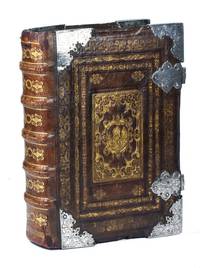
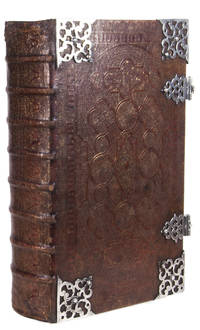
147725127Nuremberg: Anton Koberger 30 July 1477. Very Early Printing of the Bible and only the second Latin Bible printed by Koberger 51 lines and headline double column canon marginalia in the Gospels. With manuscript headlines in red a beautiful opening initial of 10 lines with elaborate flourishes that flow from the very top to very bottom of the page in red blue and green numerous 6 line initials in red and blue some with much longer extensions or flourishes a profusion of 3 line initials in red or blue red paragraph marks and additional rubricating throughout primarily in red. Royal folio 375 x 265mm approx in contemporary German blind-stamped pigskin over thick wood boards probably a Nuremberg binding the boards center-paneled and decorated in blind with a central tool within multiple borders remnants of brass catches on the fore-edge. Manuscript lettering to the spine with wide tall bands. 468 leaves complete. An unusually fine copy especially well preserved and very handsome indeed. An important copy with full contemporary binding intact and in great likelihood coming directly from Koberger’s workshop. A RARE AND EXTREMELY HANDSOME COPY ESPECIALLY WELL PRESERVED. THIS BOOK REPRESENTS ONLY THE SECOND TIME THAT KOBERGER PRINTED THE LATIN BIBLE. This printing was issued in the second year after the first printing of 1475. Anton Koberger was for a number of years the leading publisher/printer of his time. The total list of his printings for the forty years from 1473 to 1513 when he died comprises no less than two-hundred and thirty-six separate works including fifteen impressions of the Biblia Latina eight of which presented material differences of notes and commentaries which entitled them to be considered as distinct editions. "In the actual number of separate works issued Koberger was possibly equaled by one or more of his contemporaries but in respect to literary importance and costliness and in the beauty and excellence of the typography the Koberger publications were not equaled by any books of the time excepting the issues of Aldus in Venice" Putnam II p. 150.<br> This printing of Koberger’s Latin Bible was printed again in 1478 and is largely based on the Fust and Schoeffer edition of 1462. The tractate of Menardus is included which is a summary of the books of the Bible with a guide on how to best study them. It was first printed not after 1474. A beautiful example of the magnificent productions during the first generation of printed Bibles the state of preservation and the impressive German binding making it all the more so. Anton Koberger hardcover
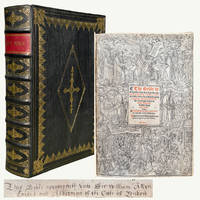
1613145500London: Robert Barker Printer to the Kings Most Excellent Majestie 1613. Rare 1613 folio edition of the great King James "She" Bible" "the true 1613 folio edition of King James' Bible; easily distinguishable from the other large folio editions by its smaller type. The preliminary leaves are set up as in the other large folio editions but the text is printed in smaller type with 72 instead of 59 lines to the full column" Herbert; Darlow & Moule. From the library of famed collector Alfred Sutro and decorated with a large fore-edge painting by John T. Beer. Folio bound in full 19th century paneled calf rebacked with older spine labels preserved gilt tiles and ruling to the spine in seven compartments within raised banes gilt ruling to the front and rear panels inner dentelles elaborately stamped in blind marbled endpapers text in two columns 72 lines black letter titles within elaborate historiated woodcut borders featuring the twelve tribes woodcut initials & headpieces with the opening calendar printed in red and black the genealogies and apocrypha engraved double-page map of the Holy Land by More & Speed extra-illustrated with 43 engravings by Beilby & Bewick from Ostervald's Bible Newcastle 1782 bound at the appropriate chapter and verse. A4 B4 C6 D4 2A-4M6 4N4 plus A-C6 Speed's Genealogies inserted before OT. Decorated with a large disappearing fore-edge painting by John T. Beer depicting two scenes: "Caleb's daughter pleading for a watered land" and "Christ at the Well of Sychar." With the erroneous phrase found in the first issue “and he went into the citie†in Ruth 3:15 corrected to “…she went…†Provenance: John T. Beer 1826-1903 fore-edge painting and his sale Nov 12 1903 lot 249 sold to William Ridler bookseller; Alfred Sutro 1869-1945 bookplate; sold to another private collection 1976. Exhibition: Museum and Gallery Bob Jones University Greenville SC 2016-2023. Noted collector and early President of the Book Club of California Alfred Sutro commissioned a pamphlet from the Grabhorn Press in 1938 to celebrate this volume. Darlow & Moule 249; Herbert 322; Weber Beer 29. In very good condition with corner repairs to first 15 and final 4 leaves incl. loss of 2 letters on A2v corner creasing and a small ink stain to OT title map laid down and with losses along edges and of lower corners final leaf trimmed laid down and with loss of a few letters front free endpaper started gift inscription. An exceptionally rare complete and unique example of perhaps the most influential text in the English language. "From about the middle of the seventeenth century until the appearance of the Revised Bible of 1881-5 the King James version reigned without rival" Herbert 319. One of the most influential texts in the English language Thomas Macaulay anointed it "a book which if everything else in our language should perish would alone suffice to show the whole extent of its beauty and power" PMM 114. The official work of translation was undertaken by nearly 50 scholars over the span of 1604 to 1611 but it can be seen as the culmination of nearly a century of work beginning with William Tyndale's New Testament translations and including the bibles of Coverdale and Whitchurch the Bishops' Bible the Geneva Bible and the Rheims New Testament. "Appointed to be read in Churches" the Great "He" Bible was exposed to public usage on lecterns and almost all surviving copies have suffered some manner of damage or loss. Robert Barker, Printer to the Kings Most Excellent Majestie unknown
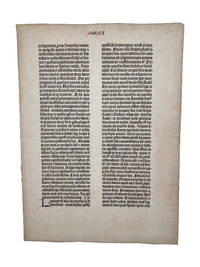
001592Mainz: Gutenberg Johannes and Fust Johann Single leaf from the Gutenberg Bible the first substantial book printed with moveable type in Europe "justifiably treated as Europe's 'editio princeps'" White 'Editio Princeps' page 45 c.1455 approximately 285mm x 390mm in size. Lightly browned and lightly foxed central horizontal fold minor loss to top corner a couple of pin holes remnants of guard to one side but generally fairly clean. Forty-two lines in double column with Lombardic initials in red and blue and title letters NU and MERI alternating in red and blue. Latin text in Gothic script this leaf is from 'Numbers' partial 8:13 to partial 10:23 The purification dedication and setting apart of the Levites; Passover; the Lord instructing Moses to make two silver trumpets; Moses and Aaron set out the tribes of Israel on their journey; the Israelites follow the Cloud of the Lord; and the Ark of the Covenant is carried. Preserved in a vellum folder inside a leather drop back box with onlays. With the 1921 essay by A. Edward Newton about the Gutenberg bible though this is now loose leaves with the margins heavily cropped also contained in a vellum folder. We are unable to state for certain that this leaf is one of the so-called 'Noble Fragments' which were the leaves from the incomplete Gutenberg broken by the bookseller Gabriel Wells and sold off with in a portfolio by Stikeman with the essay by Newton but this seems the most likely provenance with this example also sharing the "neatly executed alternating red and blue lombard headlines" White 'Editio Princeps' page 135. See Chalmers in de Hamel and Silver 'Disbound and Dispersed' 18; PMM 1; White 'Editio Princeps - A History of the Gutenberg Bible' passim. First Edition. Unbound. Good. Folio. Gutenberg, Johannes and Fust, Johann Paperback
161116409London: Robert Barker 1611. A3 bound backwards. Title page the 2 leaves of the engraved map and the final 2 leaves in excellent facsimile. Additional title page from a later edition bound in behind the facsimile. Gothic and Roman types text double column with 59 lines per column and printed within woodcut rule-border calendar and almanac printed in red and black. General title-page within engraved border by Christian Boel and section title for the New Testament dated 1611 within woodcut border. Full-sheet engraved map of the Holy Land by John Speed after Dr John More 17 leaves of genealogical tables incorporating woodcut illustrations of Adam and Eve Noah’s Ark the Tower of Babel and other Biblical subjects numerous woodcut head- and tail-pieces historiated and ornamental initials. Contemporary calf boards rebacked spine labels; some staining a few leaves with small holes or edges torn away but generally a very good copy. With a notation on the paste-down that the book was “received of William Biggs for the sum of 5 shillings . by me John Lang. Ford Warminster†dated 1747 and with a small but elaborate bookplate of William Thomas Smedley 1858-1920 the noted collector of Elizabethaniana and Bacon; his library was sold in 1924 to Henry Clay Folger and the Folger library collection today includes nearly 1500 volumes formerly owned by Smedley. First edition second issue/state called the “she†Bible because of the reading of Ruth III 15: “she went into the citieâ€. In addition because of the small hole in C6 Matthew 26:36 it is impossible to tell whether the word Judas or Jesus is printed. The King James version of the Holy Bible is arguably the most important book ever published in English. Preparation of the Royal Version took more than 5 years and was laboriously attended to by over 50 translators and researchers. The final translations were then exchanged and reviewed reaching a final committee of six. Supervision of the printing was carried out by Miles Smith and Thomas Bilson. Although the Royal Version appropriates much from the Tyndale Coverdale Geneva and Bishops’ Bibles it is unquestionably regarded as the greatest literary translation of the Bible ever produced. Herbert 309; Pforzheimer 62; PMM 114; STC 2217. Robert Barker unknown
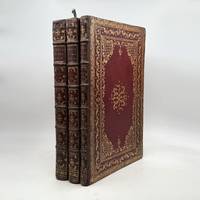
1590371036Rome: Ex Typographia Apostolica Vaticana 1590. First edition of the Sixtine Vulgate Bible large paper copy. Engraved illustrated title-page. Title in red and black text in double columns. 3 vols. Folio. Italian full red morocco binding of the seventeenth or early eighteenth century elaborately gilt with triple floral scrollwork borders stars in cornerpieces about a central motif stencilled paste paper endsheets a.e.g. Boxed. First edition of the Sixtine Vulgate Bible large paper copy. Engraved illustrated title-page. Title in red and black text in double columns. 3 vols. Folio. The engraved title reads: Biblia sacra vulgatae editionis ad concilii Tridentini praescriptum emendata et a Sixto V.P.M. recognata et approbata.<br /> With the preliminary document the Bull of Sixtus V beginning 'Aeternus ille caelestium terrestriumq. rerum omnium conditr ac moderator Deus .". This is often lacking.<br /> <br /> An extraordinary copy of the Sixtine Bible containing the Vulgate text as edited by Pope Sixtus V intended as the first ecclesiastically authorized text to be used throughout Christendom. "In its text it comes closer to R. Stephanus' Bible of 1538-40 than to the Louvain editions" Darlow & Moule who discuss the textual variations. This copy includes examples of the printed overslips required to correct hurried printing. The association with Aldus II suggested by Renouard and lasting long thereafter is spurious.<br /> Pope Sixtus V died soon after the book was printed and was followed by three short-lived popes. The Sixtine Bible had "aroused antagonism among both clergy and laity" and was swiftly condemned; the edition was withdrawn by Pope Clement VIII soon after his elevation to the papal throne in 1592 and many copies were destroyed. Preparations began in 1591 for a new edition of the Vulgate printed in 1592 and known as the Clementine Bible which long remained the standard Vulgate text.<br /> <br /> The ordinary issue of this printing measures 13-3/8 inches tall as in the Brooker copy sold 2024; the present copy measures 15-3/4.<br /> <br /> AN OUTSTANDING LARGE PAPER COPY OF A NOTABLE EDITION. Copinger 521; Darlow & Moule 6181; Adams B1098; BM STC Italian 1465-1600 p. 93; EDIT 16 CNCE 5805. Provenance: Vincenzo Maria Carafa 1739-1814 Prince of Roccella and Duke of Bruzzano engraved bookplates MS shelfmark :H 5; Douglas Maxwell Moffat bought of Quaritch in Dec. 1939; General Theological Seminary Ex Typographia Apostolica Vaticana unknown
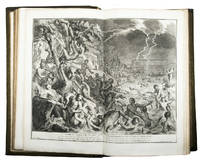
16632167Leiden: widow and heirs of Johannes Elzevier 1663. Richly gold-tooled black goatskin morocco ca. 1725 over bevelled wooden boards sewn on 6 double cords each board with a double frame cornerpieces and large lozenge centrepiece all built up from hundreds of impressions of about 40 tools including a birds-in-vines roll for the inner frame with large built-up cornerpieces inside and smaller ones outside the centrepiece with a quartered square central field each quarter with a courant running stag and with a small 6-pointed sun with a face in the centre each of the 7 spine compartments with a double frame of double fillets with small fleurs-de-lis as cornerpieces the 2nd and 3rd with the title and volume number and each of the others with a centrepiece 4 cornerpieces and 2 small fleurs-de-lis; richly gold-tooled turn-ins gilt edges headbands in yellow and reddish-gold the so-called STAG BINDERY Rotterdam. From the collection of Hendrik Adriaan or Hendricus Hadrianus vander Marck ca. 1667-1726. Large folio 44.5 x 28 cm. The Elzevier Bible with an engraved allegorical frontispiece 3 letterpress title pages the general title page in red and black the others for the New Testament and Apocrypha each with the same Elzevier woodcut tree device Rahir M. 9. Picart's wholly engraved print-Bible with an allegorical frontispiece a half-title and 209 finely engraved Bible scenes 29 double-page by Gerard Hoet Bernard Picart etc. Further with a series of 6 double-page engraved plates namely 5 maps plus a plan of Jerusalem all by Nicolaas I Visscher. Below the privilege from the city of Leiden the city secretarys clerk Jacob vander Werve has authenticated the book by stamping the Leiden coat of arms and signing his name below it. 3 volumes bound as 2 with the prints and maps bound in. The famous and magnificent 1663 Elsevier edition of the 1637 authorized Dutch States translation of the Bible Old and New Testament plus the Apocrypha the only early edition of the Dutch States translation with the text in roman type instead of the traditional textura gothic. With Picart's folio print-Bible Figures de la Bible 1720 the most sumptuous pictorial bible published in the Netherlands here in the rare first edition published by the artist himself and the series of 6 maps and plans by Nicolaas I Visscher 1618-1679. The prints and maps are inserted in the relevant places in the Old Testament New Testament and Apocrypha with the New Testament and Apocrypha bound together to make the second volume. The whole is most luxuriously and splendidly produced and bound by the so-called "stag bindery" active in Rotterdam at least 1693-1743 the most important eighteenth-century bindery in Rotterdam and . one of the most distinguished Dutch workshops in the first half of that century Storm van Leeuwen IIA p. 432. A truly unique piece combining the best of all aspects of Dutch book production Elzevier's printing excellent presswork Picart's engravings and a binding by a Rotterdam workshop undoubtedly the equal of Magnus.Storm van Leeuwen notes that the book comes from the library of the great Dutch book collector Hendrik Adriaan vander Marck ca. 1667-1726 though we do not find it in the 1727 auction catalogue of his library. It descended to the Tjeenk Willink collection. In very good condition with some of the inserted prints and maps slightly browned and an occasional minor marginal defect. The bindings with a few minor scratches a few scuffs on the board edges and the spines slightly worn but still very good most of the tooling fine. Magnificent set complete with the two integral blank leaves.l Biblia sacra 1663.B.dut.JElwidandheirs.a; Bijbel-tentoonstelling 1914 no. 653; Darlow & Moule 3321; Poortman Bijbel en prent I p. 154; Rahir 885; STCN 840822693; Willems 884; for the print-Bible: Poortman II pp. 140-145; STCN 274059983 4 copies; for the maps: Poortman & Augusteijn chapter 27 maps 118-123; for the binding: Jan Storm van Leeuwen Dutch decorated bookbinding L805 & vol. IIA p. 433 438 ill. fig. 178. widow and heirs of Johannes Elzevier, hardcover
16603641Amsterdam: widow of Paulus Aertsz. van Ravesteyn 1660. 18th-century black so-called sharkskin over bevelled wooden boards ca. 1770 sewn on 8 double supports with 8 large silver corner-pieces and 2 large silver clasps with catchplates and anchorplates all with matching stamped relief decoration scallop shells/fans scrollwork and fields of suares with crosses at the intersections or diamonds with 's at the intersections gilt and gauffered edges. The silver furnishings bear Amsterdam city hallmarks with year letter C crown above XXX above C and master's mark DF. Rebacked with most of the original backstrip mounted on the spine. Large folio 47.5 x 32 cm. With an integral engraved general title page architectural portico with a book above illuminated by the sun the crowned arms of the States General below and a large biblical scene at the foot: Elijah and the ravens alluding to Van Ravesteyn's name 2 letterpress title pages for the New Testament and Apocrypha each with Van Ravesteyn's woodcut device Elijah and the ravens a divisional title for the Prophets 6 double-page engraved maps by Nicolaas Visscher I including a world map and a plan of Jerusalem and 336 Bible-illustrations 6.5 x 10 cm by Claes Jansz. Visscher after Matthäus Merian on 42 numbered single-page plates plate size 35 x 24 cm with 8 illustrations per plate. Further with 9 woodcut tailpieces one at the end with a different Van Ravesteyn device inserted in the middle plus dozens of repeats about 50 woodcut decorated initials at least 8 series the 36 mm series opening most books of the Bible having 2 different blocks for at least some letters plus more than a hundred repeats. Set in textura types with incidental roman. The maps and illustrations coloured by an early hand with extensive use of gold. 3 parts in 1 volume. Extra-illustrated large folio edition of the Dutch Statenbijbel States Bible with 6 maps and 336 illustrations hand-coloured the translation officially authorized by the Dutch Reformed Church and published with a privilege from the States General of the Dutch Republic. The 1619 Synod of Dordrecht established a committee to prepare the new translation and leading Dutch scholars worked on it for nearly twenty years before Paulus Aertsz. van Ravesteyn ca. 1586-1655 published the first edition in 1637. The 6 maps and the engraved illustrations were produced to be inserted into Van Ravesteyn's folio editions. The series of 336 illustrations by Claes Jansz. Visscher with eight to one leaf are engraved by Cornelis Danckerts. With some browning but still generally in good condition and with large margins. The binding has been rebacked as noted and the "sharkskin" on the boards has some cracks and wear but the silver furnishings and gauffered edges are well-preserved. A stunning large States Bible with 6 maps and 336 illustrations coloured by an early hand with extensive gold.l Poortman Bijbel en prent I p. 233 cf. pp. 147 151; STCN 094500975 9 copies; cf. Darlow & Moule 3315 1657 ed.; for the maps: Poortman & Augusteijn 27.1-6 all in first states; the prints not in Hollstein; Poortman Bijbel en prent; for the zilver furnishings: Voet Amst. zilversmeden 448-449. widow of Paulus Aertsz. van Ravesteyn, hardcover
186249952Glasgow Edinburgh and London: William Mackenzie 1862. Deluxe Edition. Two volumes folio 450 x 330 mm published between 1862 and 1863. 16 1344pp. 57 unnumbered leaves of albumin prints 230 x 160mm mounted on card stock. Crimson morocco over wooden boards elaborately tooled in gilt and blind; edges mounted in brass double brass clasps with thistle motif; covers with a broad blind-stamped border around a recessed central panel with the crowned cipher of Queen Victoria in gilt; gilt tooled spine with 5 raised bands; a.e.g. marbled endleaves with gilt dentelles. Covers with some mild traces of use; single crease in each marbled endleaf partially detached in second volume; occasional light to moderate foxing mostly confined to the plate mounts; albumin prints in fine condition often with foxing extending about 5mm from the edges into the mount. Overall a very good set with a fine series of photographs notable for their technical achievment.<br /> <br /> Deluxe edition one of 170 copies complete with all 57 albumen prints. Produced for the 1862 International Exhibition and dedicated to Queen Victoria then recently in mourning for the death of Prince Albert this work appeared at a time when photography though still a laborious and expensive process was just beginning to become a popular activity. Victoria herself was an amateur photographer and "the royal couple had been enthusiastic supporters of photography in England from the beginning; in 1853 they became founding patrons of the Photographic Society Club" K. Fiedorek. Francis Frith 1822-1898 the devout Quaker whose photographic images grace the present work was one of the best-known photographers to work in the Near East and the most commercially successful photographer of the nineteenth century. Finding his elementary studies tedious Frith left school at the age of ten apprenticed with a grocer and eventually started his own business. He later went into printing sold the grocery business to a competitor at a substantial profit and went on to devote himself to photography. "The growing Victorian interest in the East and its exotic and historic attractions caught the attention of this astute businessman" Perez. Between 1856 and 1860 Frith made three photographic expeditions to Egypt Ethiopia Sinai and the Levant accompanied by the engineer Francis Herbert Wenham who provided technical assistance in mechanics and optics. While Perez notes that Frith's "approach was always a strictly commercial one and his concern was to make truthful and accurate views of the area" he readily concedes that "the technical quality of Frith's photographs is superior." Frith employed the new wet collodion process in which glass plate negatives were sensitized exposed and developed while still wet. While technically demanding the process yielded rich detail and broad tones. "Frith's were the first original wet-plate photographs of Jerusalem and the Holy Land to reach a wide English-speaking audience and his pictures of the small Palestinian towns were most likely the first published anywhere" Nir p.66.<br /> <br /> Perhaps the most novel aspect of this celebrated edition of the Bible and certainly a harbinger of things to come was the way in which the photographer "presented the radical possibility of seeing photographs of the biblical sites alongside related verses of scripture. he sought to defend and promote his faith by conscripting the veracity of science and materialism to his cause and considered photography to be the most effective medium for his campaign" Foster et al. This vision is manifest even in such details as the re-captioning of prints previously offered for sale so that the new descriptions would more clearly reference the King James text. It should be noted that while the printing was still done by hand this was one of the earliest books for which machinery was used for composing. Original publisher's price = 50 guineas. Another version of this work was published at London in 1860-1862 by Eyre & Spottiswoode; sometimes confused with the present work it was issued in 20 parts each containing a single photographic print by Frith.<br /> <br /> K. Fiedorek A Photographic Bible Fit for a Queen NYPL Blog 2014. Foster Heiting and Stuhlman Imagining Paradise pp. 68-69. Gernsheim Incunabula of British Photographic Literature 1839-1875 p.36 no.184. Herbert The English Bible 1940 1217. Y. Nir The Bible and the Image The History of Photography in the Holy Land 1939-1899 esp. chap. 3: "Early Traveling Landscape Photographers". N. Perez Focus East: Early Photography in the Near East 1838-1885 pp.163-165. William Mackenzie unknown
1790ST19326Amsterdam: H. Keyzer H. Gartman en W. Vermandel 1790. 555 x 345 mm. 21 7/8 x 13 3/4". 2 p.l. 62 folding plates. <br/> Attractive late 19th or early 20th century retrospective polished brown calf by L. Guétant stamp-signed in gilt on tail of spine double gilt-ruled border floral cornerpieces raised bands spine panels with scrolling floral borders and central flower ornament gilt titling. With title vignette and 62 ENGRAVED FOLDING PLATES ALL WITH BEAUTIFUL HAND COLORING AND HIGHLIGHTED WITH GOLD depicting Bible scenes from the Old and New Testament 61 of which are by Jan Luyken. A Large Paper Copy. For earlier editions: Graesse IV p. 308; Brunet III 1245-46; Klaversma & Hannema 159-164. Light rubbing to joints and edges boards just a little marked trivial foxing and faint spots here and there but A REMARKABLY FINE COPY the binding lustrous and showing little wear the paper extremely bright and fresh the margins immense and the paint and gold unusually vibrant.<br/> <br/> The marvelous illustrations of Dutch engraver and poet Jan Luyken comprise this collection of "remarkable stories" from the Bible each depicted with panoramic grandeur and enhanced with a wide range of finely applied colors and gold. Luyken 1649-1712 had written and illustrated erotic poetry as a young man but later became a devout Pietist after reading the works of German mystic Jakob Böhme. He became a member of the Baptist Church in 1673 and thereafter devoted his talents to producing religious works. The vast scenes here are notable in their scale detail and animation. There are a number of battle scenes from the Old Testament as well as dramatic depictions of the plagues and a fascinating episode from the histories of Josephus depicting Herod's soldiers being lowered down the side of a cliff in large boxes suspended from chains in order to attack the thieves hiding in caverns on the cliffside. There is a majestic portrayal of the Queen of Sheba arriving at the court of Solomon a peaceful scene of Adam naming the beasts in the Garden of Eden and a festive celebration of the Feast of Tabernacles. New Testament scenes include a terrifying final judgment a blinding conversion of St. Paul and scenes from that Apostle's travels. The engravings have one common trait: they are heavily populated whether by men or beasts and one of Luyken's special gifts is to render every person in the crowd as an individual with his own concerns and reactions to the events at hand. The engravings while already greatly pleasing in black and white are even more stirring and memorable when seen in the full color and gold used here. Expansive tableaus are given greater definition and clarity and events such as Noah’s flood and the destruction of Sodom and Gomorrah are rendered even more successful in expressing the awesome powers of the Almighty. The illustrations are quite definitely Protestant in point of view: there are no depictions of the Virgin Mary not even a Nativity scene. Except for engravings of the Annunciation to the Shepherds and the Massacre of the Holy Innocents the illustrations focus on Jesus as an adult and on the work of his Apostles spreading the gospel. There were earlier editions containing Luyken's 62 large plates which originally appeared without text as here in 1708 and they appeared again with a text in Dutch in 1729 and in French in 1732. Copies of these editions appear with some regularity in the marketplace but are usually not colored and are often found incomplete or with other major condition issues. We can trace no record in RBH or OCLC of a copy of our 1790 edition and we can find nothing that compares with the quality of coloring and grand height attained by the monumental margins seen here. H. Keyzer, H. Gartman en W. Vermandel unknown
191754<p>Very rare first edition. Bible for the Lisu nationality who are a minority living in a southwestern mountain area in China. This book is of very interesting because Lisu has only oral language but not written language. This Lisu written language was invented and designed by the missionary writer of this book for the nationality by combining both oriental and western languages. However this written language disappear after Chinese Communist Government got power in 1949 when they began to spread Chinese Characters in the area.</p><p>Title from verso t.p. Has also a Chinese title page as shown because it is published in Shanghai China.<br /></p><p>136 pages ; 20 cm. A little wear on covers near fine in total. </p><p><br /></p> Shanghai : British and Foreign Bible Society, 1917. paperback
1590A27E2B01U79ODelft: Bruyn Harmansz. Schinckel colophon: printed by Aelbrecht Heyndricksz. 1590. Contemporary gold panel-stamped and gold-tooled calf over wooden boards sewn on 5 supports with spectacular finely engraved silver furnishings: 8 corner pieces 2 clasps 2 catch plates and 2 anchor plates the catch and anchor plates with four female virtues: Justice/Justitia with sword and scales Faith/Fides praying toward the light of the sun Charity or Love/Caritas with 2 children and Hope/Spes holding a cross and treading on a snake; the corner pieces engraved with winged heads that appear to represent the four compass winds Boreas Notus Euros Zephyrus each of the 8 different also with engraved decoration on their edges; and each clasp with an oval martyrdom scene flanked by birds with the feet toward the foot of the book: 2 men tied to a tree and being stoned in the upper clasp and a women being accosted by 2 men in the lower all 14 pieces of silverwork with floral and other decoration and with their edges cut to decorative shapes. Each board has the same central rectangular panel-stamp 98 x 61 mm with an oval scene of Charity or Love/Caritas with 3 children and with castle towers in the background on either side that on the viewers right on a mountain with strapwork decoration around the oval containing the makers initials B and H and inside the rectangle the two decorations linked at the sides; with 2 gold-tooled double fleurs-de-lis above the panel-stamp and 2 below the whole enclosed by three gold-tooled frames each made with a different decorated roll separated by blind-tooled multiple fillets; gilt and elaborately gauffered edges. Rebacked in gold-tooled calf each compartment with a decorated oval with a decoration on either side but with the original endpapers. 4to 23.5 x 17.5 cm. With a general title-page and three part-titles each with the same woodcut device oval Biblical emblem with a quotation from Matthew 13:44 a mirror image copy of that in the 1562 first edition in a separate elaborately decorated cartouche signed AvL the combination: Dutch printers devices 0671 p. 970; 3 engraved folding maps plate size 23.5 x 17 & 29.5 x 17 cm drawn by Petrus Plancius and executed by Baptista van Doetecum for the present Bible and the folio edition of the same year showing Eden the route of the Exodus and the Holy Land; ca. 20 woodcut illustrations in the text mostly about 4 x 5 cm but the largest 10 x 6 cm a woodcut arabesque tailpiece about 21 woodcut decorated initials 3 series plus more than 50 repeats. Printed mostly in 2 columns with shoulder notes set in textura gothic types with incidental roman and with diamond-head musical notes for the metrical Psalms and a small 3.2 mm vine-leaf ornament preceding many chapter headings not in Vervliet but similar to Vervliet 112 & 133. 4 parts in 1 volume. An unrecorded issue 1 of at least 7 of a rare and important 1590 Bible edition the corrected "deux aes" Bible based on the first edition of 1562 New Testament 1559 which remained the standard Dutch Reformed Bible until the official Dutch States translation published in 1637. It was translated from Luther's German by Godfried van Wingen the New Testament by Johannes Dyrkinus after comparison with several other versions and includes many notes some also taken from Luther and some by Augustin Marlorat as well as Petrus Danthenus's metric psalms with music notes. The Amsterdam bookseller Laurens Jacobsz. initiated the publication of the present corrected text of the "deus aes" Bible and the maps to accompany it publishing the folio edition with maps himself but sharing the quarto edition with four other publishers. Although Jacobsz.'s name does not appear in the present issue he was originally trained as a binder operated his shop at the sign of the gold-tooled Bible and Fontaine Verwey gives evidence to link him with the panel stamp on the present binding. He may therefore have bound copies or had them bound for the other publishers. Bibliasacra Typ. Batava and the STCN together record only 8 copies of all issues combined at least half of those lack leaves and some of the copies with all leaves have defective leaves or lack the maps so that they record at most 2 other complete copies with maps.With a few leaves slightly browned a water stain in the second half and the first preliminary quire of part 1 faint outside a few quires small tears in the maps and a few worm holes or other defects in the paper mostly in the margins of the last few leaves but still in good condition. The binding has been skilfully re-backed probably in the early 19th-century and is slightly rubbed with a crack along the edge of the panel-stamp on the front board and a few minor cuts and scrapes but also still in good condition and only slightly trimmed. A very rare complete copy of an important Dutch Reformed Bible in an unrecorded issue and in a stunning contemporary gold panel-stamped and gold-tooled binding with engraved silver furnishings.l Bibliasacra 1590.B.dut.BHS.c & AHa b & c; Le Long p. 748; Poortman Bijbel en prent I pp. 112-119 184-187 & 215; STCN 336510985 & 054873002 334453534; Typ. Batava 602; cf. Darlow & Moule 3293; for the panel-stamp: H. de la Fontaine Verwey "Amsterdamse uitgeversbanden van Cornelis Claes en Laurens Jacobsz" in: Uit de wereld van het boek II pp. 33-48 at pp. 41-43. Bruyn Harmansz. Schinckel (colophon: printed by Aelbrecht Heyndricksz.), hardcover
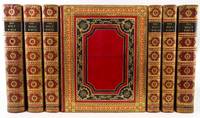
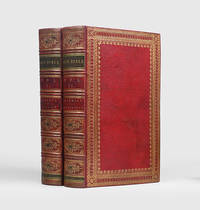
1800ST20221aLondon: T. Bensley for T. Macklin final volume Bensley for T. Cadell & W. Davies 1800 for the six volumes of the Bible 1816 for the Apocrypha. First Printing of this Edition. 480 x 385 mm. 19 x 15 1/8". One leaf in the Apocrypha 3P2 comprising two prologues of Ecclesiasticus invisibly inserted from another copy. Seven volumes comprising the regular Bible in six volumes and the Apocrypha usually not included as a seventh volume. <br/> ABSOLUTELY MAGNIFICENT CONTEMPORARY RED NEOCLASSICAL-STYLE STRAIGHT-GRAIN MOROCCO SUMPTUOUSLY GILT AND ONLAID WITH BLUE BY GEORG FRIEDRICH KRAUSS done for Prince Albert Casimir Duke of Saxe-Teschen with repeated "AST" monogram covers with very elaborate frames incorporating 11 plain and decorative gilt rules four onlaid borders of blue morocco and very elegant swirling foliate ornamentation around the central scalloped panel six pairs of raised bands each pair flanking a recessed gilt and blue metope and pentaglyph rule very handsome spine compartments with blue fan-shaped cornerpieces and central gilt-decorated blue medallions within sunburst gilt collars turn-ins with Greek key pattern in gilt striking endleaves of turquoise and green watered silk the Apochrypha endleaves slightly different. With more than 100 allegorical headpieces and tailpieces and some 70 SPLENDID LARGE-FOLIO-SIZE COPPER PLATES after Fuseli Reynolds West and others most plates printed before letters. Tissue guards perhaps later. Herbert 1442 and 1651. First volume with about 30 leaves noticeably foxed the majority of plates offset onto previous and following pages consistent inoffensive offsetting of text on facing pages other trivial imperfections but still a very impressive copy internally with the luxurious paper used for the text both fresh and clean and the engravings richly impressed and with very little foxing. Some unimportant scuffing and rubbing to the leather but all defects minor THE MAGNIFICENT BINDINGS REMARKABLY WELL PRESERVED the heavy volumes completely solid with only insignificant signs of use and THE MOROCCO AND LAVISHLY GILT DECORATION EXTREMELY BRIGHT. AN ALTOGETHER MEMORABLE COPY.<br/> <br/> The most prodigious form of Scripture in English ever published the Macklin Bible was often put into ornate bindings especially by London binders like Staggemeier and his contemporaries. But however much other sets may glisten the present magnificent example surely stands at or near the front of the line as one of the most lavishly decorated and arresting copies in existence. Its decorative extravagance also testifies to the fact that Macklin's publication was sufficiently admired outside of England to warrant the finest workmanship and the expenditure of great sums of money on artistic resources. The very large and bold type the fine Whatman paper and the series of engravings by some of the most celebrated artists of the period make this an item that is already very desirable. Like the Boydell "Shakespeare Gallery" also printed by Bensley our Macklin Bible is a vast picture book with illustrations that are grand both in size and emotional impact. But it is of course the bindings here that matter the most. Francesco Piranesi is generally given credit for inventing the Neoclassical style when he designed volumes presented to Gustavus III of Sweden during this monarch's visit to Rome in 1783-84. Quickly popular the Neoclassical style was imitated and developed by Staggemeier & Welcher in London by F. W. Standlander in Stockholm and by Georg Friedrich Krauss in Vienna. Krauss was the most prominent Continental binder working in this style of the day and Saxe-Teschen was perhaps his most important client. Products of the Krauss bindery have passed through some of the most distinguished collections over the years particularly those of Fürstenberg and Schäfer; and his bindings have consistently brought remarkable sums of money at auction. It is sufficient to say that the present group of bindings represents the most impressive collection of decorative volumes we have ever offered for sale. The collector for whom these bindings were originally executed Duke Albert of Saxe-Teschen 1738-1822 was the son of Friedrich August II of Saxony and the son-in-law of the empress Maria Theresa. After providing important military and civil service to the Habsburg empire he retired to Vienna in 1795 and afterward devoted himself to the fine arts. He founded the Albertina which now houses the greatest collection of prints in the world and he put together a great library distinguished by the highest taste and most exacting standards. The present copy has the additional distinction of containing what amounts to an extra volume: the Macklin Bible however it is bound most often appears in the marketplace without the Apocrypha appearing here as Volume VII which was not issued until 16 years after the others. It is also of some interest that the bindings of our seven volumes were decorated in an entirely uniform fashion as a close inspection shows something not typical of a set with volumes published so many years apart. The non-uniform endleaves in the final volume here may have resulted from the fact that given the physical size of the books the binder simply ran out of the cloth he had used for lining the first six volumes. The present set was offered though unsold at Sotheby's in 2003 with an estimate of £40-50000 approximately $64000-80000 and in 2005 for £30-40000 approximately $54000-72000. T. Bensley for T. Macklin [final volume Bensley for T. Cadell & W. Davies] unknown
1549T61<p>London: By S. Mierdman for John Daye and William Seres 1549. Folio 11.75 x 7.75 in. </p><p><strong>Collation:</strong> Aa2 Bb6 Cc8 D-R6 S4 First Part: Gen-Deut; Aa-Tt6 Second Part: Josh-Job; Aa-Gg6 Hh8 Ii-Zz6 AAa8 Third Part: Psalms-Malachi; Aaa-Mmm6 Nnn4 Fourth Part: Apocrypha; A-T6 V8 Fifth Part: New Testament. <strong><em>Lacks</em></strong> D1 Gen 1-2 provided in good facsimile. </p><p><strong>Description: </strong>General title page 1549 surrounded by a border comprised of 14 woodcuts. Title and Almanacke printed in red and black. Two large half-page engravings before Psalms and Isaiah. Many woodcuts throughout the text. Text in black letter double columns with 65 lines to the full column. Text is ruled in red from Genesis through 2 Samuel and again throughout the New Testament. Text divided into five parts with divisional title pages to each part surrounded by two ornamental blocks and two woodcuts above and below depicting narrative scenes. This Bible contains the famous note in 1 Peter 3: "And yf she be not obedient and healpfull unto hym endevevoureth to beate the feare of God into her heae that thereby she maye be compelled to learne her duitie and do it" and is sometimes referred to as the "wife-beater Bible." The text includes Tyndale's chapter summaries and prologues including his notes in Revelation where he refers to the Pope as the antichrist.</p><p><strong>Binding:</strong> Contemporary brown calf over beveled oak boards. Covers featuring a mid-sixteenth century blind roll design within concentric frames. All metal corner- and centerpieces intact. Clasps and hasps were likely added later. Plain endpapers. Extremities lightly rubbed and scuffed but wonderfully preserved overall.</p><p><strong>Condition:</strong> Clean and bright with good margins; some of the red rules slightly faded; a few leaves with lower corner repair O4 R2 fore-margin repair Ee5-6 none of which impact the text; I45 in New Testament with small repair reducing one letter to headline; some thumbsoiling to edges; A near complete copy in a stunning contemporary binding and in far better condition than typically seen. </p><p><strong>Provenance: </strong>"David K. Parsons 2005" to front pastedown; laid down copperplate engraving depicting the final interview of John Rogers with his wife and eleven children just prior to his burning at the stake by Bloody Mary; birth records of James and Elizabeth Sage to blank leaf before Apocrypha; ex-libris stamp of David Parsons to final blank leaf. </p><p><strong>Note:</strong> The Matthew's Bible also referred to as the Matthew's-Tyndale Bible was printed in 1537 1549 two editions and 1551. Copies of the 1537 first edition are very difficult to find and rarely complete. The text was reprinted twice in 1549: one edition with the notes slightly revised by Edmund Becke and the "wife-beater" note at 1 Peter 3 this copy and the other edition being a straight reprint of the 1537 text without woodcuts and a notoriously bad printing. This edition boasts numerous woodcuts in the text especially the Pentateuch the gospels and Revelation. </p><p>John Rogers was a central figure in the history of the English Bible. Best known as the editor of the Matthew's Bible Rogers deliberately worked under the pseudonym "Thomas Matthew" to distance the volume from the condemned and dangerous name of William Tyndale. This strategic choice allowed the Bible to circulate more freely at a time when Tyndale's translations were officially banned. In reality roughly two thirds of the Matthew's Bible consists of Tyndale's work including Genesis through 2 Chronicles and the entire New Testament. Rogers helped preserve and disseminate Tyndale's translation during a period when doing so openly could invite severe punishment.</p><p>Rogers' faithfulness to Scripture ultimately cost him his life. During the reign of Queen Mary I when she sought to return England to Catholicism Rogers was arrested for heresy and became the first Protestant martyr of Mary's persecution. In 1555 he was burned at the stake at Smithfield reportedly in the presence of his wife and children bearing witness to his convictions to the end. The Matthew's Bible is considered to be the primary version of our English Bible.</p><p><strong>References:</strong> Herbert 74; Harold H. Hutson and Harold R. Willoughby "Decisive Data on Thomas Matthew Problems" <em>Journal of Bible and Religion</em> Vol. 6 No. 2 Spring 1938 77-82 121-128.</p> (S. Mierdman for) John Daye, and William Seres hardcover
1663ABC_48446Leiden 1663. Large folio 44.5 x 28 cm. widow and heirs of Johannes Elzevier Contemporary elaborately gold-tooled red morocco over bevelled wooden boards sewn on 8 supports with corresponding raised bands on the spine with grand silver fittings with the hallmarks of an unknown silversmith dated on the inside of one of the clasps "1665" gold-tooled board edges and turn-ins. Further with gilt painted and elaborately gauffered and decorated edges; the fore edge shows the coat-of-arms of Jeremias de Bont with some floral decorations these floral decorations can also be found on the top and bottom edges. The boards show a very intricate gold-tooled symmetric design of ribbons with small geometric stamps and with ornamental curling stamps - better known as "petit fers" - within the different parts of the bigger pattern. The binding contains 4 ornamental corner pieces on each board and two catch plates front board and two hinge plates back board connected by two decorated massive silver clasps engraved on the inside "Ieremias de Bont top and "1665" bottom. With 3 letterpress title-pages the first in red and black and each with the same Elzevier woodcut tree device with non solus a complete series of 6 double-page engraved maps the Nicolaes Visscher maps 5 published ca. 1657 and including the world map added ca. 1663 without the engraved title-page as usual. Further with numerous woodcut initials and tailpieces. 3 parts in 1 volume. 22 "368" = 370; 13 "167" = 168; 2 77 ll. The first Dutch "States Bible" to be printed in roman type printed by the famous Leiden printers publishers and booksellers Elzevier. The present copy in the splendid binding was made for a high official within the Dutch Republic Jeremias de Bont. His family's coat-of-arms can be found on the gauffered painted and gilt fore edge and Jeremias' name is engraved in the inside of the top silver clasp the bottom one shows a date "Anno 1665". The "States Bible" is the first officially authorized translation of the Bible into Dutch the Statenvertaling commissioned during the Synod of Dordrecht 1618-1619. The States General of the United Provinces of the Netherlands were asked to pay for it hence its name. The translation was completed in 1635 and approved authorized and published in 1637 in Leiden. For the present 1663 edition the Elzeviers followed the text of the 1657 revised and corrected edition. In a sense it could be seen as a revolutionary publication even though it still is an authorised version of the Bible; the present copy contains the live signature of a Leiden city clerk - as usual - to indicate its authorization. The decision to set the main text in roman type rather than the conventional gothic textura was unprecedented in such publications and not only contributed to the spread of roman type in Dutch-language printed matter generally works in Latin were often set in roman more than a century earlier but also contributed to the prolonged popularity of the authorised translation itself and of the present edition.The present copy is illustrated with 6 double-page maps published by Nicolaes Visscher; this series includes 5 maps of Jerusalem and the Holy Land published ca. 1657 and 1 world map published ca. 1663 as usual all in their first state.Jeremias de Bont -1687 was 17th-century politician in the Dutch Republic. He was a member of the "Vroedschap van Gorinchem" in/since 1674 city council of Gorinchem in the present-day province of South Holland burgomaster in Gorinchem in 1679 and 1681-1683 and member of the Dutch "Raad van State" Council of State of Holland on behalf of the city of Gorinchem.We thank dr. J. Storm van Leeuwen for his in-depth analysis of the present binding. Through his findings we know that the present binding is contemporary to the work 1663 and judging by the style of the decorations possibly produced by a German binder in the Netherlands Amsterdam or The Hague. In his research Storm van Leeuwen came across 3 other bindings in the same style and all produced around the 1660s. These bindings cannot be ascribed to a hitherto known 17th-century Dutch bindery thus - for ease of reference - Storm van Leeuwen named the bindery after the present binding: "De-Bont Binderij".With the signature of J. van der Werve a city clerk below the coat of arms of the city of Leiden on the verso of the first title-page below the privileges. The binding shows slight signs of wear browned and foxed throughout the edges are slightly dust-soiled but still showing the highly detailed decorations. Without the engraved title-page as usual. Otherwise in good condition a splendidly bound copy for Jeremias de Bont of the famous Elzevier Dutch States Bible.l Bijbel tentoonstelling statenvertaling Amsterdam 1937 105; Darlow & Moule II 3321; Delaveau & Hillard Bibles imprimées 1200; Le Long Boekzaal der Nederduytsche Bybel p. 821; STCN 840822693; Willems 884; for the maps: Poortman & Augusteijn Kaarten in Bijbels 27-pp. 179-185; for Jeremias de Bont and his positions within Gorinchem: C. van Zomeren Beschryvinge der stadt van Gorinchem en landen van Arkel Gorinchem Teunis Horneer 1755; for the De Bont family: De Nederlandsche Leeuw 40 1992 cols 121-122 "Bondt de". ABE CAT Bibles Sermons & Psalmbooks hardcover
1660J6OH1B1XFXOGAmsterdam: widow of Paulus Aertsz. van Ravesteyn 1660. Later ca. 1800 blind-tooled calf sewn on 7 supports 3 cut flush with the bookblock each board with a small central flower in a double frame with corner diagonals made with 2 rolls and another flower inside each corner of the inner frame 2 pair of brass fastenings. Modern ca. 1900 endpapers. Large folio 45 x 30 cm. With an integral engraved general title-page architectural portico with a book above illuminated by the sun the crowned arms of the States General below and a large biblical scene at the foot: Elijah and the ravens alluding to Van Ravesteyn's name 2 letterpress title-pages for the New Testament and Apocrypha each with Van Ravesteyns woodcut device Elijah and the ravens a divisional title for the Prophets 6 double-page engraved maps by Nicolaas Visscher I including a world map and a plan of Jerusalem and 96 Bible illustrations 7 x 8.5 cm: 64 for the Old Testament and 32 for the New Testament published by Frederick de Wit engraved by Cornelis Danckerts after Matthäus Merian on 6 double-page plates plate size 28.5 x 38 cm with 16 illustrations per plate. Further with 9 woodcut tailpieces one at the end with a different Van Ravesteyn device inserted in the middle plus dozens of repeats about 50 woodcut decorated initials at least 8 series the 36 mm series opening most books of the Bible having 2 different blocks for at least some letters plus more than a hundred repeats. Set in textura types with incidental roman. The engraved title-page devices on the letterpress title-pages maps illustrations and many of the woodcut decorations and initials including all those on the back of the maps coloured by a contemporary hand with extensive use of gold. 3 parts in 1 volume. Extra-illustrated and hand-coloured large folio edition of the Dutch Statenbijbel States Bible the translation officially authorized by the Dutch Reformed Church and published with a privilege from the States General of the Dutch Republic. The 1619 Synod of Dordrecht established a committee to prepare the new translation and leading Dutch scholars worked on it for nearly twenty years before Paulus Aertsz. van Ravesteyn ca. 1586-1655 published the first edition in 1637. The 6 maps and the 96 engraved illustrations were produced for insertion in folio editions of the States Bible but in Van Ravesteyn's 1657 edition maps 2-6 by Nicolaas Visser I were originally accompanied by an older world map by his father Claes Jansz. Visser. The younger Visser's present new world map replaced it ca. 1663. De Wit's series of illustrations seems to be quite rare.With owners inscriptions. The tattered margins of the half-title and title-page were reinforced and extended with slips of paper at an early date there are tears repaired into two maps and one text leaf and other leaves have marginal defects some repaired. The paper shows some browning and foxing. Still generally in good condition and with large margins. The binding is scuffed but structurally sound and most of the tooling remains clear. A stunning large States Bible with 6 maps 96 illustrations and many decorations and initials coloured by a contemporary hand with extensive gold.l Poortman Bijbel en prent I p. 233 cf. pp. 147 151; cf. Darlow & Moule 3315; for the maps: Poortman & Augusteijn 27.1-6; for the prints: Poortman Bijbel en prent 30.A.3. widow of Paulus Aertsz. van Ravesteyn, unknown
1763184488Cambridge: printed by John Baskerville 1763. An outstanding synthesis of fine printing illustration and binding First Baskerville edition: a spectacular copy of one of the greatest English Bibles and a crowning achievement of English printing in a magnificent Staggemeier and Welcher binding and abundantly extra-illustrated with 287 Old Master engravings. The copy adorned two of the greatest book collections of the last two centuries: the library of the Dukes of Marlborough at Blenheim Palace and of Estelle Doheny in California. Friedrich Leberecht Staggemeier 1759-1827 was esteemed for his elaborately decorated neoclassical bindings. He partnered with Samuel Welcher from 1799 to 1810 and the pair catered to the highest echelons of the market. Extra-illustration was a distinguishing feature of this market: here 171 of the illustrations are from Bernard Picart and Gerard Hoet's Figures de la Bible The Hague 1728 and 58 are from Pierre Mortier's Bible Amsterdam and Antwerp 1700 while others are from Jan Luyken's Icones Biblica Veteris et N. Testamenti Amsterdam 1729 and other sources. The extravagant binding and extra-illustration were commissioned by the first owner the collector and scholar Jacob Bryant. In 1804 he bequeathed the Bible to his patron George Spencer 4th Duke of Marlborough. It remained in the duke's collection at Blenheim Palace until 1881 when it passed to Fanny Octavia Louisa daughter of the 7th duke. Her descendants sold the book and it passed via Dawson's Book Shop to Estelle Doheny one of the greatest collectors of the 20th century where it joined her Gutenberg Bible and other landmarks of printing history. She bequeathed it to St. John's Seminary which sold it and the rest of Doheny's collection in 1988 where it realized $11000. Bound in 2 vols large folio 518 x 343 mm pp. 1146. Extra-illustrated with 287 Old Master engravings of which 198 are single page and 84 double each mounted mostly within a black ink and pale yellow wash frame. Late 18th- or early 19th-century red straight-grain morocco by L. Staggemeier & Welcher of London binder's ticket green morocco labels richly gilt in compartments wide gilt borders to covers gilt Greek-key turn-ins green watered-silk linings with gilt grapevine borders all edges gilt. Joints and extremities restored scattered light offsetting from plates and foxing else contents fresh very minor worming to front endpapers of first volume: a beautiful copy. ESTC T93106; Gaskell 26; Herbert 1146. unknown
16604440Cambridge: Printed by John Field Printer to the Universitie 1660 1660. First Ogilby edition 2 works; 2 vols; large folio 51 x 34.5 cm; 110 double-page engraved plates including a large double-folding plan of Jerusalem captions in Latin some masked at time of printing engraved general title New Testament title dated 1659 ruled in red throughout wide margined on thick paper armorial bookplate to front pastedown of each vol. ownership inscription in pencil to front free endpaper a few tears mostly affecting margins 4N2 verso stained minor colour-run from fore-edge throughout some minor offsetting and ink smudges prelims a little spotted otherwise internally very clean; near-contemporary straight-grained red morocco armorial device supralibros to upper boards obscured by later blue morocco panel set within gilt meander border gilt spine in 8 compartments alternating lettering and cross-hatch design all edges gilt over earlier fore-edge painting of meandering vines joints and corners expertly restored; 140 16 806; 2 807-1103 1 258 4 338pp. Herbert 668; ESTC R17044; Wing B2258; Lowndes 1367; Griffiths 8. An exceptional well-margined copy of John Ogilby's imaginative reissue of the Field large folio bible published for the Restoration of King Charles II on 29th May 1660. Magnificently illustrated with 110 double-page engraved plates of biblical scenes after paintings by Rubens Tintoretto de Vos de Bruyn and other old masters including Wenceslaus Hollar's impressive double-folding-page view of Jerusalem his Chorographica Terra Sanctae of the Holy Lands and the engraved general title by Lombart after Diepenbeeck depicting Solomon enthroned. The work was originally illustrated with just 8 plates by Lombart and Hollar which had been intended for the London Polyglot bible published in 1657 but Ogilby soon offered the option of embellishing the work with a choice of engravings from the Amsterdam publisher Nicolaes Visscher. The number of plates is known to vary but ESTC calls for a total of 102 only. The text was first published the previous year by John Field printer to the University of Cambridge who had been commissioned to supply a lectern bible for use in churches and libraries. The work was well-received with the former university Vice-Chancellor John Worthington noting that 'For a fair large letter large paper with fair margin &c. there was never such a Bible in being'. In the event however most of the edition was bought-up by Ogilby for his own project. Variously called 'Ogilby's Bible' or 'The Restoration Bible' the result was a truly luxurious production with well-margined copies such as this costing upwards of £25 in sheets alone. The finished work was presented to Charles II to whom the work is dedicated when the restored monarch first visited the Royal Chapel in Whitehall. An 'unrivalled specimen of the press of the time' the finest edition of the Holy Bible then extant Lowndes. Provenance: Sir William Halsey Gaddesden Library bookplate and ownership inscription. Cambridge: Printed by John Field, Printer to the Universitie 1660 hardcover
1566U07<p><strong>Summary</strong></p><p>Quarto 8.5" x 6.25". An attractive and profusely illustrated quarto Tyndale New Testament. This is the third edition of Jugge's revision and the final Tyndale New Testament. A scarce book in a beautifully executed period-appropriate binding with nearly one hundred woodcuts.</p><p><strong>Description </strong></p><p>General title page in expert color facsimile. Calendar printed in red and black. Eighty-three woodcuts in ninety-four occurrences including a map of Palestine and a map of St. Paul's journeys. Text in single column black letter type in paragraph format. This handsomely printed revision by Jugge is lavishly illustrated combining the woodblocks from the two previous editions with the blocks by Virgil Solis that were later used in the Bishops' Bible. The large title-page portrait features young king Edward who awarded Jugge a license to print the first edition. First chapter woodcut initials cover eleven lines of text. Divisional printed title to the Epistles of St. Paul and Revelation. Text presented with 38 lines to the full column. Jugge's revision served as an effort to bring the English translation closer to the original Greek. The last of the over forty editions of Tyndale's New Testament with the headlines in Roman type.</p><p><strong>Collation</strong></p><p>flueron8 -fleuron1-3 par10 A-Y8 -S1 Aa-Pp8 Qq4. 312 ff. <strong><em><u>Lacks</u></em></strong> 4 leaves altogether title page dedication first leaf of calendar John 21 – <strong>all provided in color facsimile</strong>.</p><p><strong>Binding</strong></p><p>Beautifully rebound in black calf. Covers with central gilt arabesque design featuring flowers and swirls surrounded by small circles within a triple paneled border with corner fleurons. Spine with five raised bands and elaborate gilt tooling to compartments. Plain endpapers.</p><p><strong>Condition</strong></p><p>par4 lower marginal repair; E5 marginal repair; M8 N1 marginal loss with a few missing letters in facsimile; trimmed and cropped to fore-edge reducing marginal notes and cross references; final leaf of Tables stained; infrequent light toning occasional staining but overall clean and crisp.</p><p><strong>Provenance </strong></p><p>par4 with "Edmund Barber" to top of page. The previous owner reports that the Bible fell out of a wall of a cottage during demolition in the 1960s somewhere in West London.</p><p><strong>Note </strong></p><p>William Tyndale's translation of the New Testament was the first to be printed in the English language. The father of the modern English language and the father of the English Reformation Tyndale was spurred on by the desire to "cause a boy that driveth the plow to know more of the Scripture" than the clergy of the day. He would be killed for this cause in 1536. The translation was bitterly opposed by Bloody Mary and many copies of Tyndale's Bibles were burned. Research has shown that at least eighty percent of the King James Version is Tyndale's.</p><p><strong>Scarcity</strong></p><p>USTC records 21 copies in holding with most copies lacking the title page. RBH records only 1 copy at auction since 1936 with that copy lacking over 200 leaves.</p><p><strong>References</strong></p><p>Herbert 121; STC 2873; ESTC S122998; USTC 506525; Luborsky 2873; PMM 58 1526 edition.</p> Richard Jugge hardcover
162718927Frankfurt: Matthaeus Merian 1627. First edition. Hardcover. Very good. Matthaeus Merian. Oblong folio leaves: 20.6 by 31.2 cm; plates: 10 to 11.5 by 14.5 to 15.5 cm. Engraved titlepage borders without letterpress; 231 of 233 engraved plates printed on the rectos with no printed text depicting biblical scenes from the Old and New Testaments lacks Gen. XIX: Lot and his daughters after the destruction of Sodom and Gomorrah; Exod. VIII & IX: The plague of frogs. Recent marbled calf lightly rubbed at extremities bordered in blind; gilt-tooled spine with raised bands gilt lettering pieces. Occasional light stains and smudges especially at the outermost leaves and almost entirely restricted to the blank margins; old mostly marginal repairs and reinforcement of tears to about 30 leaves Matt. IV plate with loss of about 10 words of manuscript text. Protected by wide margins the plates are clean fresh and bright with relatively few minor blemishes. Housed and protected in a custom luxurious modern leather clamshell box.<br /> <br /> Rare suite of biblical illustrations printed before letter perhaps as proofs comprising 231 of 233 engraved plates from the Icones Biblicae of Matthaeus Merian the elder 1593-1650. The engravings are printed on large paper and lack any printed text. They are preceded by a leaf of the engraved title borders to the first part in which the central cartouche which would have contained a letterpress title and imprint is here blank. Neat manuscript annotations appear throughout: atop each engraving is a brief title along with a notation of the biblical book and chapters; beneath each engraving are six-lines of rhyming verse in German; at the top corners are leaf numbers in Arabic numerals. All are penned in black ink in the same old cursive German hand. The engraved title leaf is not included in the manuscript foliation. The first three leaf numbers and several others among the first 23 leaves are obscured by wear or later marginal repairs. The foliation ends at leaf 233 and is discontinuous where one would expect to find numbers 15 and 38 corresponding to the missing plates noted above. As noted by Wütrich only four of the 233 plates are signed by Merian all in the New Testament series. Each of these signed plates appears in our suite: Matthaei I. - page 7; Johannis VIII. - page 65; Matthaei XXVII. - page 101; Apocalyps. IX. - page 145 header titles and page numbers from the first edition.<br /> <br /> The first editions were published at Frankfurt in four parts between 1625 and 1627. The Pentateuch series was published in 1625. The second part illustrating the Old Testament books from Joshua to Kings appeared in 1626. These first two series were published under the name of Merian's father-in-law the printer and bookseller Johann Theodor de Bry 1561-1623 whose heirs retained title to the business. The third part illustrates the remainder of the Old Testament and Apocrypha; the fourth the New Testament. These last two parts were published in 1627 under the engravers's own name. Verses in Latin German and French accompany each plate in the three Old Testament series the French verses being omitted in the 1627 New Testament series.<br /> <br /> While the eminent Swiss draughtsman and engraver Matthaeus Merian is best known for his topographical depictions of the German speaking lands which appeared in the Theatrum Europaeum his novel selection of biblical stories and innovative stylistic approach revealed in the present series of plates proved highly influential ushering in a new age of copperplate engraving in Bible illustration. Merian broke with the century-long tradition of woodcuts which had accompanied countless editions of Luther's German Bible. Even as he drew on the Bible illustrations of Jost Amman Hans Holbein Virgil Solis and Tobias Stimmer Merian greatly expanded the traditional iconographic and compositional repertoire. The Old Testament alone contains 23 prints depicting stories that had never before been the subject of an engraver. While earlier New Testament woodcuts focused on the Book of Revelation Merian now provided a rich series of plates to illustrate the Gospels and Acts of the Apostles as well.<br /> <br /> Merian had an obvious preference for crowd scenes and battles along with some of the novelistic features of the Old Testament such as Jacob's lentil dish Solomon and Shulamit in the Song of Songs or the apocryphal story of the Dragon in Babylon. Merian sometimes provides local color from his home town of Basel as in his depiction of Solomon's Temple Consecration in which despite the baroque redesign the Basel Cathedral with the old choir is easily recognizable. The costumes and gestures of Merian's biblical characters display a baroque fantasy of the ancient Near East as reflected in the theater of his day; in depicting cities and buildings however Merian generally prefers to follow contemporary models. In individual cases such as Bathsheba's Bath he succumbed to the temptation as an engraver and artist to show off his skills in a magnificent fashionable palace and garden complex. All-in-all Merian's engravings initiated a development in Bible illustration "that led further and further away from the didactic Reformation purpose of Bible pictures to purely artistic-representational purposes and finally ended in the well-known pathos of the German Romantic Nazarenes" Schmidt.<br /> <br /> In the first few decades after their appearance these Bible plates were widely copied throughout Europe especially in the Netherlands and France Poortman. The first folio Bible to use Merian's copper plates to illustrate the text was published by the heirs of Lazarus Zetzner at Strasbourg in 1630. Subsequent editions of the "Merian Bible" were published at Frankfurt where Merian had taken over his father-in-law Johann de Bry's business. For over a century as Merian's heirs continued to publish new editions this would become "the most widespread German illustrated Bible in southern Germany Basel and Alsace primarily in wealthy households" Schmidt. After the demise of the Merian publishing house in 1727 the bookseller Philip Heinrich Hütter acquired the copper plates which he used to illustrate a Catholic Bible edition published at Frankfurt in 1740 Poortman.<br /> <br /> A very notable instance of transposing Merian's biblical engravings into another context occurs in the famous and oft-reprinted Amsterdam Haggadah the ritual for the Jewish Passover meal first published in 1695. The engravings were made by Abraham ben Jacob a former Protestant preacher who converted to Judaism. Introducing skills he had earlier acquired when working outside the Jewish community Abraham ben Jacob "widened the scope of Jewish book illustration" Rosenau and introduced new elements into the traditional iconography of the Haggadah. "He chose many of the same incidental scenes as had appeared in the Venice Haggadot 1599-1604 but he drew them afresh basing his work on the biblical pictures in the Icones Biblicae by Matthew Merian" EJ. Among them was the image of the Temple of Solomon in Jerusalem. As Merian used a wide variety of prototypes Rosenau suggests that the two free-standing columns Jachin and Boaz depicted at the front porch of the Temple in Merian's engraving and Abraham ben Jacob's adaptation may have ultimately been derived from the woodcuts which accompany Estienne's Bible Paris 1540 based upon the scholarship of Franciscus Vatablus.<br /> <br /> In Das druckgraphische Werk von Matthaeus Merian d. Ae. 1993 L. H. Wüthrich describes a "Spezialausgabe ohne Drucktext" complete with 233 biblical engravings located in Darmstadt at the Hessische Landesbibliothek 31/643. This "separate edition without text or a series of proofs" which he describes has three notable features: 1 an undated first edition title page of the second part Pars II of the Old Testament which has been "corrected. by crossing out or shaving" to read "Pars I"; 2 the first edition title page of the New Testament series dated 1627; 3 an engraving of the The Fall of Man probably after Johann Theodor de Bry which later appears in Gottfried's Chronicle part 1 1629/1630 but which differs from that found in most copies of the first edition Wütrich 1a. The copies containing this plate after de Bry Wütrich 1aa. were likely printed in 1626. Further research perhaps locates only one other suite of Merian plates without text at the Herzog August Bibliothek Wolfenbüttel catalogued under two call numbers: the Old Testament series dated 1626-1627 comprising 157 leaves including an engraved title A: 30.1 Geom. 2 "Ausg. ohne Text von Ps. 1 und 2." = VD17 23:289608V and the New Testament series dated 1627 comprising 78 leaves including an engraved title A: 30.1 Geom. 3 "Ausg. ohne Text" = VD17 23:655618H. The catalogue entry for the Old Testament series references Wütrich's "Spezialausgabe ohne Drucktext." Surprisingly the key images provided for this entry illustrate the same three notable features of the "Spezialiausgabe" which Wütrich located at Darmstadt !. Our suite of plates is provided with a single blank engraved title leaf the one used for the first series of the Old Testament plates which lacks any letterpress. The third plate which depicts the Fall of Man is here in Merian's style and is the image more commonly found in the first printings Wütrich 1a.<br /> <br /> In the first edition of the Icones Biblicae the title page notes "Mit Versen und Reymen in dreien Sprachen geziert und erkläret Durch Johann Ludwig Gottfried" decorated and described with verses and rhymes in three languages by Johann Ludwig Gottfried. In the first three parts of Icones Biblicae Gottfried's German verses are in four lines with a rhyme scheme of ABBA. In the fourth part the New Testament the German verses are modified to six lines with a rhyme scheme of AABCCB. The manuscript verses in German which accompany each of the 231 plates in our suite differ from both of these formats being composed in six lines of iambic hexameter with a rhyme scheme of ABABCC. To give a sense of how these versions differ the four lines of the German printed verses which accompany the first plate The Creation may be compared with the following transcript of the written verses which describe this scene in our set.<br /> <br /> in the first edition of Merian's Bilderbibel<br /> <br /> Im Anfang Gott Erschuff den Himmel und die Erden<br /> Die Wasser und das Meer das Liecht der Sternenschein<br /> Die Vögel Fisch Gewürm alle Thier groß und klein<br /> Warauß sein Gütigkeit und Kraft erkant mag werden.<br /> <br /> the hand of anonymous versifier<br /> <br /> Im Anfang schuff der Herr den Himmel und die Erden<br /> Das Licht die Sonn den Mond die Sternen und das Meer<br /> Gras Bäume Laub und Kraut und was genannt mag werden<br /> Von Thieren Vögel Fisch in ihrem grosen Heer<br /> Nur durch ein einig Wort: Ich kan hieraus erkennen<br /> O Gott! dein ew'ge Krafft und dich den Schöpffer nennen.<br /> <br /> Watermark: flambeau surrounded by garland<br /> <br /> Provenance: laid-in typed description on a half-sheet bearing the early twentieth-century letterhead of Harry A. Levinson Rare Books: "There appears to be no record of another such copy of proofs before letter." References: L. H. Wüthrich Das druckgraphische Werk von Mattaeus Merian d. Ae. Basel: Bärenreiter 1993 vol. 3 p.16: "Spezialausgabe ohne Drucktext;" Enc. Jud. 2nd ed. 8:215; W. C. Poortman Bijbel en Prent 's-Gravenhage 1986 2:56-59; H. Rosenau Vision of the Temple London: Oresko 1979 pp. 135; 146f. Ph. Schmidt Die Illustration der Lutherbibel Birsfelden/Basel 1977 pp. 304-329; VD17 23:289608V and 23:655618H. [Matthaeus Merian] hardcover
1540T75<p><strong>Summary</strong></p><p>Pulpit Folio 14.25" x 10.25". An early folio of the second edition of the Great Bible with all five title pages. A beautifully rebound copy with first ownership provenance of a famous knight merchant and mayor of the city of London.</p><p><strong>Description </strong></p><p>General title page 1541 printed in red and black featuring Henry VIII above distributing his <em>Verbum Dei</em> to Cromwell and Cranmer God barely squeezed in among the clouds at the top. Archbishop Cranmer on the left distributing the Bible to the clergy and the Cromwell on the right is distributing the Bible to the nobility. Below the people are without Bibles as the Great Bible was chained to pulpits and proclaim only <em>Vivat Rex</em> aside from the few who are imprisoned on the bottom right. Calendar also printed in red and black. Text in two column black letter with 62 lines to the full column. The beginning of each chapter features a floriated or historiated woodcut initial with occasional metal cast capitals. Title pages to the second third and fourth parts also printed in red and black bordered by the relevant woodcuts to that section. The New Testament title page n.d. in red and black like the general title except that Cromwell's arms are removed. Concludes with <em>The Table.</em></p><p><strong>Collation</strong></p><p>6 a-k8 l4 first part A-N8 O4 second part Aa-Pp8 Qq4 third part Aaa-Hhh8 Iii6 fourth part Aa-Nn8 -Nn6-8 New Testament. <strong><em>Lacks</em></strong> the final leaf of Revelation and two leaves of the Tables provided in expert facsimile. All titles are present.</p><p><strong>Binding</strong></p><p>Rebound in period appropriate back calf. Boards paneled in gilt with gilt rolls and corner fleurons around a central arabesque design. Spine with six blind-lined raised bands and elaborate gilt tooling to compartments. A red gilt-lined morocco label with the words "Holy Bible" and a date of 1540 lettered in gilt to the foot. Endpapers renewed.</p><p><strong>Condition</strong></p><p>Intermittent staining to lower gutter and head; trimmed at head with headlines cropped in Pentateuch and just touching a few sidenotes; 3 reinforced and remargined; 4 Kk1 lower corner repair without loss; h45 lower margin reinforced; l4 Rr6 laid down; Nn5 repair to lower gutter without loss; a well-preserved copy of an important early Bible.</p><p><strong>Provenance </strong></p><p>Early ownership inscription to foot of first Calendar leaf reading "This Bible apertayneth unto Sir William Allyn Knight and Alderman of the City of London." William Allyn 1515-1586 was a prominent London merchant and Lord Mayor 1555–56. The location where Cromwell's arms are removed on the NT title bears a merchant's device dated 1574.</p><p><strong>Note</strong></p><p>An impressive copy of the scarce Great Bible so called due to its imposing size. This copy like many from the first seven editions is issued in a mixed state. The general title is from April 1540 but Genesis 1 and Matthew 1 from May 1541. The New Testament title page is also from a 1541 copy as Cromwell's arms are removed. The few small flaws notwithstanding this is an attractive copy of an almost complete early Great Bible that is becoming increasingly scarce in commerce.</p><p><strong>References</strong></p><p>Herbert 53; STC 2070; Luborsky and Ingram 2070.</p> Edward Whytchurche hardcover
1516371021Genoa: Petrus Paulus Porrus 1516. Title printed in red and black within woodcut arabesque border printer's device on final leaf. Parallel text in Hebrew Latin Greek Arabic and Chaldaean Aramaic 4 columns to a page 41 lines. 13 woodcut floriated initials. A10 B-Z8 &8 con6; 200 leaves complete. Folio 13-1/8 x 9-3/8 inches. Contemporary blind tooled pigskin over bevelled wooden boards boards with repeated roll of hound hunter and stag spine with floral tools. Clasps perished early repairs with vellum at lower corners; spine darkened with chip at foot joint starting wormholes to the covers. Toning throughout worm holes throughout but heavier to the preliminary and terminal leaves paper loss not affecting text at the lower outer corners of the first 3 leaves minor dampstaining at the lower corners of most leaves and extending from the top inner margin. Scattered early marginalia. Title printed in red and black within woodcut arabesque border printer's device on final leaf. Parallel text in Hebrew Latin Greek Arabic and Chaldaean Aramaic 4 columns to a page 41 lines. 13 woodcut floriated initials. A10 B-Z8 &8 con6; 200 leaves complete. Folio 13-1/8 x 9-3/8 inches. The Genoa Psalter also known as the Octaplum or Quadruplex Psalter was the first polyglot psalter to be published and the first polyglot edition of any part of the Bible. Financed by the Oriental language scholar Bishop Agostino Giustiniani and printed in Genoa in 1516 it presents the psalms laid out in eight columns i.e. four per page on double-page spreads: in Hebrew a Latin paraphrase the Vulgate Latin the Septuagint Greek Arabic Chaldean Aramaic a Latin paraphrase and the editor's notes. "A monument of Renaissance typography this Psalter was linguistically the most ambitious work attempted to date and the first Polyglot work ever published. It provides the Psalms in five languages as well as a marginal scholarship based largely on rabbinic sources. The Arabic text is one of the first two texts and the first biblical text ever printed in this language. The Hebrew types used in this book were apparently never used again" B. Sabin Hill Hebraica from the Valmadonna Trust The Piermont Morgan Library 1989 no. 18.<br /> <br /> Notably within a lengthy editor's note to Psalm XIX is what is considered the first printed biography of Christopher Columbus along with a very early description of his voyage. A native son of Genoa Giustiniani presents the discovery of the new world as a fulfilment of Biblical prophecy appropriately glossing verse four of Psalm XIX to include his biography of Columbus: "Their sound is gone out through all the earth and their words to the end of the world." <br /> <br /> The text of the biography of Columbus written a decade after his death includes a brief account of his childhood and continues at length on his discovery of America. Translated from the Latin it begins: "And so their words have reached unto the ends of the earth at least in our own times in which by the marvelous daring of Christopher Columbus of Genoa almost another world was discovered and joined to the community of Christians. And since Columbus often declared that he was chosen by God so that through him this prophecy would be fulfilled I did not consider it unsuitable to include his life here. Therefore Christopher surnamed Columbus a Genoese by birth . lived in our age and through his own efforts explored more lands and seas in a few months than almost all other mortals had done throughout all previous ages . More swiftly than the Portuguese had done he approached new lands and new peoples and at last penetrated regions unknown before now. The news of this matter quickly reached the King who - both out of rivalry with the Portuguese kings and a desire for such new marvels and glory that might accrue to him and his descendants - after long discussions with Columbus finally ordered two ships to be outfitted. With these Columbus set sail from the Fortunate Islands directing his course slightly off the western line . After many days of sailing they had covered great distances. While the others having lost all hope urged a change in course Columbus persisted asserting by reason and conjecture that continuing but a little longer might lead them to discover continents or islands. Nor was he wrong. On the following dawn they sighted land. From this event immense confidence arose in human minds. Later it was learned that these were islands and observations were made of certain peoples there uncultivated and prone to raids on their neighbors even devouring human flesh like wolves. There were violent encounters yet eventually some of these islanders were brought safely to Spain astonishing and delighting all who saw them because they were at first timid unfamiliar with approach easy to persuade and marveling at everything as new."<br /> <br /> An important and desirable work from a liturgical linguistic and historical perspective. Adams B1370; BM STC Italian p. 97; Darlow & Moule 1411; Sabin 66468; European Americana 516/4; Harrisse BAV 88; JCB 3 I:64; Smitskamp 236; Roper Early Arabic Printing in Europe in Sprachen des Nahen Ostens und die Druckrevolution p. 132; Vinograd Genoa 1. Provenance: Cenobii Alois 1570 inscription below title; Bibliotheca Regia Monacensi pencil inscription on the inside front board identifying it as a duplicate; General Theological Seminary ink and blindstamps and other markings Petrus Paulus Porrus unknown
1480254000Ulm: Johann Zainer 1480. 293 of 296 leaves; lacking first 2 leaves of the Calendar and final blank. •6 ••8 a-x8 y12 z8 A-L8 M3. 1 vols. 8vo; 111 x 90 mm. Bound in 18th-century paper boards with remnant of morocco spine label edges stained red. Spine defective and covers rubbed but binding is sound; several leaves bear stubs at outer edge from former index tabs; first leaf of Psalter extended at inner margin; final two leaves slightly waterstained; some browning and occasional stains; text block seriously trimmed but never into text. Notes on front endpapers and a presentation inscription in 1826 from a member of the German Methodist Episcopal Church U.S. In a custom half-morocco slipcase and chemise. 293 of 296 leaves; lacking first 2 leaves of the Calendar and final blank. •6 ••8 a-x8 y12 z8 A-L8 M3. 1 vols. 8vo; 111 x 90 mm. Johann Zainer the Elder fl. 1472-93 established the first printing press at Ulm where his first book is dated 1473. This pocket psalter by Zainer is undated; the colophon gives only the printer's name and the city in which it was printed. ISTC gives a conjectural date of around 1480. <br /> <br /> The book's handy but fragile format a thick octavo that would have been easily portable for late fifteenth-century users doubtless guaranteed a low survival rate. Indeed the few copies which have survived are often incomplete fragments or in poor condition.<br /> <br /> ISTC gives the following locations: France: Strasbourg BNU imperfect wanting Commune sanctorum; Germany: Bamberg SB; Berlin SB; Fulda HLB; Leipzig DB/Buch fragment missing; München BSB 2 imperfect; Stuttgart WLB 3; U.S.A: Washington DC Washington Cathedral Library this copy<br /> <br /> The present copy - the only copy in America - is complete save for the first two leaves of the Calendar and the blank leaf at the end. Goff Suppl. P1041a; H 13475; C 4927; GW M36206; ISTC No.: ip01041500 Johann Zainer unknown
1611H2543London: Robert Barker 1611. First printing. Hardcover. Fine. First edition taken from the 'He' version of the entire APOCRYPHA Authorized Version known as the King James Bible 1611. Folio finely bound in full morocco gilt with printed title page and preface by the New York bookseller Charles Hamilton probably early 1960s where he attests that the text is from the 'He' version taken from an error in Ruth III.15 corrected to 'she' shortly after and thus much more desirable. Fine. 104 leaves 208 pp. from the most famous book in the English language. The 1611 King James Apocrypha contained the following books: 1 Esdras 2 Esdras Tobit Judith Additions to Esther Wisdom of Solomon Ecclesiasticus Baruch Letter of Jeremiah Prayer of Azariah Susanna Bel and the Dragon Prayer of Manasseh 1 Maccabees and 2 Maccabees. In 2016 a copy of the complete Bible sold at Sotheby's for $320000 plus the hammer: nearly $400000. Robert Barker hardcover