6 582 résultats
192950946London: Faber & Gwyer Limited 1929. Tall 8vo. xiv 2 397 1 pp. Woodcut decoration on title. Quarter-vellum over burgundy-coloured cloth gilt decoration on front cover gilt lettering on spine t.e.g minor spotting to spine slight sunning to upper front cover VG copy signed & numbered on verso of half-title. First edition signed & numbered 221 of 300 copies printed of this adaptation of the first nine books of the Bible from Genesis to David slaying Goliath by the noted author and poet. De La Mare states in his introduction that the very simplicity and austerity of the Old Testament stories and their English translators can lead to misunderstandings. Striving to communicate the meaning of the text to children he creates scenes that add emotional texture to the stories. This volume was printed on handmade laid paper by Butler & Tanner Ltd. See; Russell Dalton Children’s Bibles in America: A Reception History of the Story of Noah’s Ark pp. 39-42. Faber & Gwyer Limited, hardcover
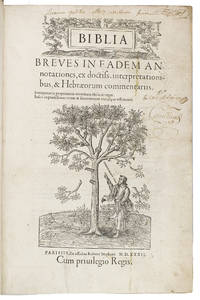
1532ABC_49016Paris: Roberti Stephani = Robert Estienne 1532. Modern gold-tooled brown calf with the title lettered in gold on the spine red sprinkled edges. Folio. With Estienne's large olive-tree device on the general title page and the divisional titles of parts 3 interpretatio and 4 index a woodcut decorative border around the word "Biblia" on the general title page and 79 decorated metalcut criblé initials. 4 parts in 1 volume. Including: - Hebraica Chaldaea Graecáque & Latina nomina virorum .- Index rerum et sentiarum quae in Veteris & novi testamenti libris continentur. Second enlarged and first fully glossed edition of the famed Estienne Bible. The work is "considered the earliest genuine attempt at a critical edition of the Vulgate text. it became practically the foundation of the official Roman Vulgate" Schreiber. The first edition of this Bible was Estienne's first major work and "immediately established him as the most outstanding figure in the Paris book trade at the time" Schreiber. The present copy is complete with the glossary and index which appear as parts 3 and 4. It also includes the beautiful criblé initials by engraver Geoffroy Tory 1480-1533.Robert Estienne 1503-1559 acquired Vulgate manuscripts during his years in Paris and printed numerous editions throughout his career beginning in 1528. Unlike the first edition the present edition includes marginal references concise notes and an extensive index of significant Hebrew words. It also contains Estiennes distinctive typographical symbols indicating words present in the Hebrew text but omitted from the Latin version and vice versa. Notably this edition is the first in which Estienne placed the Acts of the Apostles between the Gospels and the Pauline Epistles rather than at the end of the volume as was then customary.With an annotation at the top of the title page another in the middle of the title page and a signature below. The front and back board are somewhat scratched. The title page has been reinforced in the margins likely with the final blank of the second part which is missing to repair the tear in the bottom half large ink stains in the inner margin of leaves 243-244 and 306-307 of the first part a tear in the outer margin of leaf 7 of part 3 minor ink thumb prints on some of the leaves each leaf has been ruled in reddish-brown ink with manicules on some of the leaves. Otherwise in very good condition.l Darlow & Moule 6112; Renouard p. 35.1; USTC 181366; cf. Schreiber The Estiennes 37 other ed. Roberti Stephani [= Robert Estienne], unknown
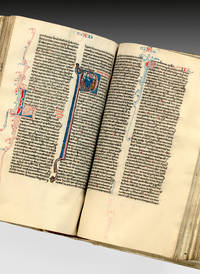
ABAA25-1<p>Northern France probably Paris 1230-1250.</p><p>12mo 140 x 93 mm of 1 658 ll.: 1-1524 1620 17-2224 2310 24-2524 2617 without the bl. l. xviii 2726 2828 295 without the bl. l. vi. <strong>Thus complete</strong>.</p><p>Double column of 47 lines written in brown ink in a very fine Gothic writing.</p><p>Justification: 92 x 60 mm.</p><p><strong>78 historiated initials</strong>. Quires numbered in Roman numerals at the foot of the back of the last ll. and signatures at the bottom corner of the text on each recto of the first half of a quire headings in red initials in red letters of running titles and chapters numbers alternately in red or blue initials of chapters on 2 lines alternately in red or blue with a decor of the opposite color initials of 5 to 7 lines at the beginning of the prologues of the same type but with decoration in two colors opening the prologues 78 historiated initials most decorated with foliage and dragons the extension of 29 of them forming borders decorating the margin painted in blue pink orange-red and yellow a few wormholes in the first l. a few running titles cropped last l. restored in the outer margin.</p><p>Stiff vellum gilt Greek roll-stamp around the covers flat spine decorated green morocco lettering piece gilt edges from the 19th century.</p><p>Superb Capetian manuscript from the School of Paris complete and of perfect freshness handwritten on vellum skin and illuminated with exquisite finesse between 1230 and 1250.</p><p><u>Text</u>: List of Books of the Bible: recto and verso of the first endpaper; the Vulgate with the preamble: ll. 1-599v; Interpretation of the Hebrew names: ll. 600-658.</p><p>Superb example of the small vulgate bibles produced in Paris in the 13th century.</p><p>It was in the 13th century in Paris that the masters of theology of the University established what was to become the standard form of the Latin Bible: the selection of the books their order and their division into chapters established by Stéphane Laugton still universally employed the insertion of the forewords of St Jerome and the interpretation of the Hebrew names.</p><p>All these characteristics are present in this very elegant Bible on very thin vellum skin.</p><p><u>Illuminations</u>: A masterpiece from Pierre de Bar's workshop active in Paris between 1230 and 1250 distinguishes itself by the particularly colored and bright shades of its illuminations; the usual whites pinks and blues are enriched with red orange and even more surprisingly by large areas of yellow.</p><p>This Bible contains 78 illuminations of great beauty and of amazing freshness.</p><p>The repertoire of decorative details is peculiar compared to other French illuminations of the time and the foliage contains small clover leaves.</p><p>Branner attributed the illustration of the manuscript to the Parisian workshop that illustrated the most outstanding illuminated manuscripts of the first half of the 13th century Bar's workshop with reference to Cardinal Pierre de Bar 1252 who gave to the Abbey of Clairvaux a Bible in four volumes issued from this workshop and preserved today under the reference Troyes Bibliothèque municipale ms. 106 108 110 and 111.</p><p>This manuscript can be dated from 1230-1250. Remarkable for its large and well-formed heads; the bodies are robust and covered with clothes with deep and dark folds R. Branner <em>Manuscript Painting in Paris during the Reign of Saint Louis</em> 1977 pp. 70-71. He dates the activity of Pierre de Bar's workshop between 1230-1250 and explains its specificities by suggesting the development of its style outside Paris.</p><p>The decoration of the manuscript consists of 78 historiated illuminated initials and a great number of capital letters rubricated in red or blue.</p><p>This very attractive bible seems to have been made in Paris; it represents an interesting addition to the production of a workshop producing according to Branner some of the most beautiful and refined Parisian illuminations of the first half of the 13th century.</p><p>We witness from the years 1220-1230 under the reign of Queen Blanche of Castile a concentration of illuminators in Paris at the expense of abbeys and provincial capitular schools. We can indeed attribute several manuscripts to Blanche of Castile who inaugurated the tradition of female patronage in the royal family. But the peak of these famous small Capetian bibles happened during the reign of Saint Louis.</p><p>The subjects of the historiated initials are the following:</p><p>l. l St Jerome Prologue; l. 4 The 7 days of Creation Genesis; l. 27 Moses leading his people across the Red Sea Exodus; l. 43 the Jews offering a sacrifice; l. 54 Moses preaching; l. 72 Moses receiving the Tablets of Stone; l. 89 God talking to Joshua; l. 99 Gideon holding his sword; l. 110 Elimelech and Naomi migrating to Moab Ruth; l. 112v Beheading of Eli; l. 128 Beheading of Amalekite before David; l. 141 David's servant bringing Abishag to him; l. 155v Ahaziah falling from a tower; l. 170v the Patriarchs; l. 185 Solomon enthroned; l. 202 The Construction of the Temple; l. 207 Nehemiah presenting the golden cup to Artaxerxes; l. 213v Spraying of the Temple; l. 220v Tobias; l. 225v Judith beheading Holofernes; l. 232 Ahasuerus being merciful to Esther; l. 238v Job on the manure heap; l. 251 David playing the harp; l. 256 anointing of David by Samuel; l. 258v David showing his mouth; l. 261 madman holding the stick and the bread Psalm 52; l. 264 God above David below in the water Psalm 68; l. 268 David ringing the bells Psalm 80; l. 271v Two Singers Psalm 97; l. 275 The Trinity Psalm 109; l. 283v Solomon whipping a young man; l. 294v Solomon teaching to a young man; l. 298 Madonna and Child Enthroned; l. 299v Solomon and a young man carrying a sword; l. 307v Ecclesia; l. 328 Isaiah being sawn in half; l. 353 Stoning; l. 381 Baruch writing; l. 384v Ezekiel in bed with the Tetramorph; l. 412 Daniel in the lions' den; l. 423v Hosea and Gomer; l. 427v Joel preaching to a group of Jews; l. 429v Amos offering the sheep; l. 432v God appearing to Obadiah; l. 433v Jonah in the mouth of the whale; l. 434v the teaching Prophet; l. 437 Nahum lamenting about the fall of Nineveh; l. 438v Habakkuk and the stones; l. 440 the Prophet with his scroll; l. 441v Two Prophets; l. 442v Prophet; l. 447 Two men talking; l. 449 Beheading of the idolatrous Jew; l. 466 the Messenger delivering the letter; l. 478v the Tree of Jesse; l. 494v Saint Mark with the lion; l. 505 Saint Luke with the angel; l. 521v Saint John; l. 535 Saint Paul carrying the cross; l. 541 Saint Paul carrying a sword; l. 546v Saint Paul carrying a sword and a scroll; l. 551 Saint Paul carrying a sword and a book; l. 555 Saint Paul carrying a sword; l. 556v Saint Paul carrying a sword and a book; l. 558 Saint Paul carrying a sword; l. 559 Saint Paul carrying a sword; l. 560 Saint Paul carrying a sword; l. 561v Saint Paul carrying a sword; l. 562v Saint Paul carrying a sword; l. 561v Saint Paul carrying a sword; l. 562v Saint Paul carrying a sword; l. 563v Saint Paul carrying a sword; l. 564 Two men talking; l. 568v. Ascension; l. 585 Jacob holding a book; l. 586v Saint Peter seated holding a book; l. 588 Saint Peter holding a key; l. 589 Saint John writing; l. 590v Saint John; l. 591 Saint John; f. 591 Saint Jude; l. 592 Saint John writing.</p><p>This complete bible dated from 1230-1250 is a masterpiece of Capetian illumination produced under the reign of Saint Louis.</p><p>Provenance:</p><p>- <em>Jean Tornone</em>: doctor from Burgundy: inscription on the verso of the endpaper mentioning his gifting of the book to <em>Stroyff</em>.</p><p>- <em>Assuerus Stroyff</em>: inscription mentioning his reception of the book by Tornone then his gift to <em>Johan Baron de Bronckhorst.</em></p><ul><li><em>Johan Baron de Bronckhorst</em> and <em>Batenburg de Guelders</em>: inscription dated from 1574 mentioning his receipt of the book.</li></ul><p><strong>FR</strong></p><p>Nord de la France probablement Paris 1230-1250.</p><p>In-12 de 1 658 ff. : 1-1524 1620 17-2224 2310 24-2524 2617 sans le f. blanc xviii 2726 2828 295 sans le f. blanc vi. <strong>Ainsi complet</strong>.</p><p>Double colonne de 47 lignes écrites à l'encre brune dans une très fine écriture gothique.</p><p>Justification : 92 x 60 mm.</p><p><strong>78 initiales historiées</strong>. Cahiers numérotés en chiffres romains au pied des versos des derniers ff. et signatures au pied du coin inférieur du texte sur chaque recto de la première moitié d'un cahier rubriques en rouge initiales en rouge lettres des titres courants et numéros des chapitres alternativement en rouge ou bleu initiales des chapitres sur 2 lignes alternativement en rouge ou bleu avec un décor de la couleur opposée initiales de 5 à 7 lignes au début des prologues du même type mais avec des décors des deux couleurs ouvrant les prologues 78 initiales historiées la plupart ornées de feuillage et de dragons le prolongement de 29 d'entre elles formant des bordures décorant la marge peintes en bleu rose orange-rouge et jaune qq. trous de vers ds. le premier f. atteinte à qq. titres courants dernier f. restauré ds. la marge extérieure.</p><p>Vélin rigide du XIXe siècle encadrement d'une roulette grecque dorée autour des plats dos lisse orné pièce de titre de maroquin vert tranches dorées.</p><p>140 x 93 mm.</p><p><strong>Superbe manuscrit capétien de l'école de Paris complet et de parfaite fraicheur calligraphié sur peau de vélin et enluminé avec une exquise finesse entre 1230 et 1250.</strong></p><p><u>Texte</u> : Liste des Livres de la Bible : recto et verso de la première garde ; la Vulgate avec le préambule : ff. 1-599v ; Interprétation des noms hébreux : ff. 600-658.</p><p><strong>Superbe exemple des petites bibles vulgates produites à Paris au XIIIe siècle.</strong></p><p>C'est au XIIIe siècle à Paris que les maîtres de théologie de l'Université établirent ce qui devait devenir la forme standard de la Bible latine : la sélection des livres et de l'ordre de ceux-ci et leur division en chapitres établies par Stéphane Laugton et encore universellement employée l'insertion des prologues de St Jérôme et l'interprétation des noms hébreux.</p><p>Toutes ces caractéristiques sont bien présentes dans cette très élégante Bible sur peau de vélin très fine.</p><p><u>Enluminures</u> : Chef-d'œuvre de l'atelier de Pierre de Bar actif à Paris entre 1230 et 1250 il se distingue par les teintes de ses enluminures particulièrement colorées et vives ; les habituels blancs roses et bleus sont enrichis de rouge orange et de manière plus surprenante encore par de larges zones de jaune.</p><p><strong>Cette Bible possède 78 enluminures d'une grande beauté et d'une étonnante fraicheur.</strong></p><p>Le répertoire de détails décoratifs est particulier en comparaison des autres enluminures françaises de cette époque et le feuillage comporte des petites feuilles de trèfle.</p><p><strong>Branner a attribué l'illustration du manuscrit à l'atelier parisien qui a illustré les plus remarquables manuscrits enluminés de la première moitié du XIIIe siècle l'atelier de Bar</strong> par référence au cardinal Pierre de Bar 1252 qui donna à l'abbaye de Clairvaux une Bible en quatre volumes provenant de cet atelier et conservés aujourd'hui sous les cotes Troyes Bibliothèque municipale ms. 106 108 110 et 111.</p><p>On peut dater le présent manuscrit de 1230-1250. Remarquable par ses têtes larges et bien formées ; les corps sont robustes et recouverts de draperies aux plis profonds et sombres. R. Branner <em>Manuscript Painting in Paris during the Reign of Saint Louis</em> 1977 pp. 70-71. Il date l'activité de l'atelier de Pierre de Bar entre 1230-1250 et explique ses spécificités en suggérant la formation se son style en dehors de Paris.</p><p><strong>La décoration du manuscrit comprend 78 initiales historiées enluminées et d'innombrables capitales rubriquées en rouge ou bleu.</strong></p><p>Cette bible très séduisante semble avoir été réalisée à Paris ; elle représente un ajout intéressant à la production d'un atelier considéré par Branner comme produisant certaines des enluminures parisiennes les plus belles et les plus raffinées de la première moitié du XIIIe siècle.</p><p>On assiste à partir des années 1220-1230 sous le règne de la reine Blanche de Castille à une concentration des artistes enlumineurs à Paris au détriment des abbayes et des écoles capitulaires de province. On peut en effet imputer plusieurs manuscrits à Blanche de Castille qui inaugura la tradition du mécénat féminin dans la famille royale. Mais l'apogée de ces célèbres petites bibles capétiennes se situe sous le règne de Saint Louis.</p><p>Les sujets des initiales historiées sont les suivants :</p><p>f. l St Jerome Prologue ; f. 4 Les 7 jours de la Création Genèse ; f. 27 Moïse conduit son peuple à travers la Mer Rouge Exode ; f. 43 les Juifs offrent un sacrifice ; f. 54 Moïse preche ; f. 72 Moise reçoit les tables de la Loi ; f. 89 Dieu s'adresse à Joshua ; f. 99 Gédéon tient son épée ; f. 110 Elimelech et Naomi migrent à Moab Ruth ; f. 112v Décapitation d'Eli ; f. 128 Décapitation d'Amalekite devant David ; f. 141 le serviteur de David lui amène Abishag ; f. 155v Ahaziah tombe d'une tour ; f. 170v Les trois juifs patriarches ; f. 185 Salomon intronisé ; f. 202 La Construction du Temple ; f. 207 Néhémie présentant la coupe d'or à Artaxerxès ; f. 213v Aspersion du Temple ; f. 220v Tobias ; f. 225v Judith décapitant Holopherne ; f. 232 Assuérus se montre clément envers Esther ; f. 238v Job sur le tas de fumier ; f. f. 251 David joue de la harpe ; f. 256 onction de David par Samuel ; f. 258v David montre sa bouche ; f. f. 261 fou tenant le bâton et le pain psaume 52 ; f. 264 Dieu au-dessus David dans l'eau dessous Psaume 68 ; f. 268 David sonnant les cloches Psaume 80 ; f. 271v Deux chanteurs Psaume 97 ; f. 275 La Trinité Psaume 109 ; f. 283v Salomon fouette un jeune ; f. 294v Salomon enseigne à un jeune ; f. 298 La Vierge et l'Enfant intronisé ; f. 299v Salomon et un jeune portant une épée ; f. 307v Ecclésia ; f. 328 Isaïe est scié en deux ; f. 353 Lapidation ; f. 381 Baruch écrivant ; f. 384v Ezéchiel au lit avec le Tétramorphe ; f. 412 Daniel dans la fosse aux lions ; f. 423v Osée et Gomer ; f. 427v Joel prechant à un groupe de juifs ; f. 429v Amos offre le mouton ; f. 432v Dieu apparait à Obadiah ; f. 433v Jonas dans la bouche de la baleine ; f. 434v le Prophète enseignant ; f. 437 Nahum se lamente sur la chute de Nineveh ; f. 438v Habakuk et les pierres ; f. 440 le Prophète avec son rouleau ; f. 441v Deux Prophètes ; f. 442v Prophète ; f. 447 Deux hommes en discussion ; f. 449 Décapitation du juif idolâtre ; f. 466 le Messager livre la lettre ; f. 478v l'Arbre de Jessé ; f. 494v Saint Marc avec le lion ; f. 505 Saint Luc avec l'ange ; f. 521v Saint Jean ; f. 535 Saint Paul portant la croix ; f. 541 Saint Paul portant une épée ; f. 546v Saint Paul portant une épée et un rouleau ; f. 551 Saint Paul portant une épée et un livre ; f. 555 Saint Paul portant une épée ; f. 556v Saint Paul portant une épée et un livre ; f. 555 Saint Paul portant une épée ; f. 556v Saint Paul portant une apée et un livre ; f. 558 Saint Paul portant une épée ; f. 559 Saint Paul portant une épée ; f. 560 Saint Paul portant une épée ; f. 561v Saint Paul portant une épée ; f. f. 562v Saint Paul portant une épée ; f. 561v Saint Paul portant une épée ; f. 562v Saint Paul portant une épée ; f. 563v Saint Paul portant une épée ; f. 564 Deux hommes en discussion ; f. 568v. Ascension ; f. 585 Jacob tenant un livre ; f. 586v Saint Pierre assis tenant un livre ; f. 588 Saint Pierre tenant une clef ; f. 589 Saint Jean écrivant ; f. 590v Saint Jean ; f. 591 Saint Jean ; f. 591 Saint Jude ; f. 592 Saint Jean écrivant.</p><p><strong>Cette bible complète datée de 1230-1250 est un chef-d'œuvre de l'enluminure capétienne réalisée sous le règne de Saint Louis.</strong></p><p>Provenance :</p><p>- <em>Jean Tornone</em> : docteur bouguignon : inscription au verso de la garde mentionnant son présent du livre à Stroyff.</p><p>- <em>Assuerus Stroyff</em> : inscription mentionnant sa réception du livre par Tornone puis son présent à Johan Baron de Bronckhorst.</p><p>- <em>Johan Baron de Bronckhorst</em> et <em>Batenburg de Guelders</em> : inscription datée de 1574 mentionnant sa réception du livre.</p> hardcover
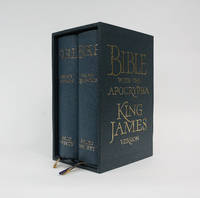
22173London: The Folio Society. 2011. Limited edition. Limited edition. Publisher's original full blue goatskin blocked in gold after a design by Stephen Raw. All edges gilt. Printed on Abbey Wove paper. Two silk ribbon bookmarks in gold and blue to each volume. Housed in the original dark blue cloth covered wooden tray pull slipcase with titles in gilt to one side. A fine copy the bindings square and tight and without fading or wear. The contents are clean and bright throughout. The slipcase with just the slightest of rubbing at the extremities is in every respect sound. Limited to 1000 numbered copies for sale and 20 lettered copies not for sale of which this is number 303. Further details and images for any of the items listed are available on request. Lucius Books welcomes direct contact with our customers. London: The Folio Society. 2011 hardcover
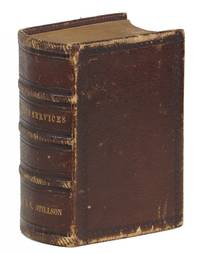
187000009868New York: Oxford: Printed at the University Press 1870. Early Reprint. Hardcover. Very Good. Pot 128mo or Minion 48mo according to Griffiths. 39 40-414 5 4-334 4 pp. 10 cm x 7 cm. Full sheep with gold lettering on the spine spine in four compartments; all edges gilt. Marbled endpapers and pastedowns. Griffiths 34. An early reprint of this edition first published in 1867. A charming pocket-sized Book of Common Prayer nicely bound. A Very Good copy with the rear hinge slightly strained binding tight and secure a touch of rubbing to the boards' edges. Oxford: Printed at the University Press hardcover
154355533Paris: Simon de Colines and Galliot du Pré 1543. Very good. Benedictine" edition of the New Testament in Latin edited through careful comparison of multiple medieval manuscript sources. An important New Testament edition in the Latin history of the Bible for which Benoît collated "most of the then known" medieval manuscripts Schreiber 149 seeking the most accurate readings and correcting transcription errors. Produced in the midst of the foment about translations spurred partly by the Reformation this translation did not seek novelty but rather a refinement of the established tradition. First issued as part of the complete Bible also by Colines in 1541 this is the first independent printing of the translation. Two years after its publication the Council of Trent would affirm the doctrinal preference for Latin editions in the Catholic Church. Octavo 6.5'' x 4.25''. 18th-century full speckled calf raised bands red goatskin spine label gilt-stamped spine compartments. Marbled endpapers all edges stained red two silk ribbon markers. Index at rear. 183 1; 140; 8 ff. 18th-century ink notes to rear fly leaf listing the order of Epistles according to Fleury; later ink annotation to front fly leaf "très rare" and noting it was published two years before the Council of Trent. Cracking to front hinge still firm; light chipping and wear to boards. Faint dampstaining to text block. Simon de Colines and Galliot du Pré unknown
188650292Tokyo: Tokiwaya 1886. Very good. Scarce and exceptional first edition thus a light-hearted illustrated adaptation of the Creation and story of Adam and Eve from the Book of Genesis into Japanese. The story of Bible editions in Japan reflects the country's fraught history with Christianity; after the religion was banned in the early 17th century the portions printed by Catholic missionaries were lost. The ban on Christianity lifted only in the Meiji era first partially in 1873 then enshrined in the Constitution 1889 by means of an article on the freedom of religion. <br /> <br /> The post-Meiji Restoration translation effort of the Hebrew Bible began in 1882 and was finally completed in 1887. Books were completed and issued in parts with Genesis first issued in 1883. This heavily illustrated and lighthearted version of the two most famous stories from Genesis adapts the text to a well-established literary genre of Meiji Japan: KusazÅshi a forerunner of manga popular illustrated works in which the text weaves around the illustrations that dominate most spreads. Because they were meant for a popular audience the text is often primarily in hiragana or kanji with furigana; here the text is shown in three writing styles: kanji hiragana and romaji with furigana glosses. <br /> <br /> This presentation suggests how Christian mythology must have appeared to Japanese readers much as say Greek mythology seems to modern American readers of Homer. God is depicted as a mustachioed wise man while the serpent approaches Eve on legs. Most charmingly one spread depicts God spying on Adam and Eve with a pair of binoculars. <br /> <br /> While listed as the "first part" it is all published with no second volume ever appearing. We find only two copies at the National Diet Library and at Waseda University. 7.75'' x 5.25''. Original printed wrappers. Woodblock printed and illustrated including 16 double-page spreads. Title page matching illustrated cover printed on red metallic-speckled paper. 39 1 pages. Some staining and wear to wrappers with 2.5'' paper repair to rear wrapper verso. Black ink calligraphy to versos of both wrappers. Housed in custom blue cloth chemise. [Tokiwaya] unknown
1949CNJL314Cleveland and New York: The World Publishing Company 1949. Limited First Edition. Hardcover. Very good. Rogers Bruce. Two volumes the Bible one of 975 copies elephant folio size 942 pp. and Making of the Bible number 178 of 1875 copies quarto size 41 pp. The second folio Bible designed by Bruce Rogers this time for an American publisher his first was the "Oxford Lectern Bible" published in 1935 using the King James Version. No other book designer / typographer from the history of printing can claim to have designed two complete folio Bibles each one highly regarded. Bruce Rogers 1870-1957 American typographer who invented the "Centaur" tyepface based on the Renaissance-period printing of Nicolas Jenson is considered by many to be one of the greatest book designers of the twentieth century. He designed books for the Riverside Press Cambridge when he cut his first typeface "Montaigne" named for the first book it appeared in "The Essays of Montaigne" 1903; he designed "Centaur" while working as house designer for the Metropolitan Museum of Art. In 1916 he worked for the Cambridge University Press and a few years later returned to the U.S. where he met William Edwin Rudge and was employed by him at his Mount Vernon Press. During this time he also designed books for Harvard University Press and served as typographic advisor to Lanston Monotype. In 1928 Rogers returned to England where he produced what many have called "the most important and notable typographic achievement of the twentieth century" being his Oxford Lectern Bible. The present work was done during his later years but is no less formidable in both size and scope and essential to any collection of his work.<br /> <br /> ___DESCRIPTION: Original publisher's red cloth with gilt-stamped illustration to upper board lettered in gilt to backstrip top-edge gilt quarto volume in matching red cloth with similar gilt motif to upper board and gilt lettering to backstrip with original glassine jacket and housed in a blue paper slipcase numerous flourishes and initials vintage bookseller ticket on rear pastedown; types used include Fred Goudy's Deepdene Italic Forum and Oldstyle type paper is 74 lb. 75 percent white linen rag paper from Barcham Green Mill in England elephant folio size 19.25" by 14"; "Making of the Bible" quarto size 11.5" by 8.5" pagination: Bible i-vi vii-xxii xxiii-xxiv 1-941 942 1 colophon; Making of the Bible 1-4 5-19 20-41 limited first editions of both volumes with the folio being one of 975 copies and the accompanying quarto being number 178 of 1875 copies.<br /> <br /> ___CONDITION: A very good copy of the folio with some professional restoration to the backstrip/joints some minor rubbing at edges the binding with only light dustiness gilt is bright with a few rubbed spots and the interior clean other than some minor soiling to the endpapers free of prior owner markings one very short closed tear to the upper margin of the dedication page to King James; quarto fine overall with some extremely light wear to the joints at the head and tail of the spine its glassine wrapper alas fair only as the spine has perished and we only have the panels/flaps its slipcase very good plus sturdy with some overall wear.<br /> <br /> ___POSTAGE: Please note that this is an extremely large and heavy book and therefore additional postage will apply as the standard shipping charge will not cover costs; please inquire for details.<br /> <br /> ___Swan's Fine Books is pleased to be a member of the ABAA ILAB and IOBA and we stand behind every book we sell. Please contact us with any questions you may have we are here to help. The World Publishing Company hardcover
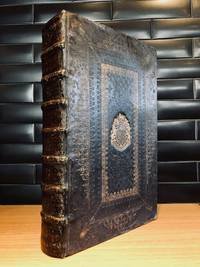
17177186Oxford: John Baskett 1717. First Edition Thus. Royal binding in full morocco. Very Good. John Sturt. Two volumes in one. Large stout folio. Double column with columns separated by double rule. Text ruled in red and title pages printed in red and black. Engraved vignette title pages for Old and New Testaments the latter dated 1716. With the engraved additional general title page by cartographer and renowned illustrator John Sturt 1658–1730. With striking copper-engraved vignette head- and tail-pieces and many engraved historiated initials. Complete with Apocrypha.<p>Marbled endpapers. All edges gilt. Bound in contemporary full black morocco rebacked with original elaborate gilt-tooled spine neatly laid-down gilt-tooled arms of King George II featuring the motto "Most Noble Order of the Garter" as centerpieces and his monogram in spine compartments raised bands and gilt-decorated borders. Only moderate wear to the splendidly complete royal binding. First edition of the monumental illustrated "Vinegar Bible" with additional title page engraved by John Sturt including the vignette of a church interior featuring the figures of Moses Aaron et al. per Darlow and Moule. According to the DNB Sturt "specialized in miniature work and it was said that he could engrave the creed on a silver penny but could also work on a large scale and in 1692 he produced a notable engraving of Britannia the royal first capital ship of England printed on four sheets". Presented in a handsome King George II armorial binding. Carter notes that " . Bibles with the royal arms may have come from one of the Royal Chapels - but they may equally have come from any loyal parish church" ABC p. 157. That said a limited print run coupled with the high cost of Baskett's elaborate opus would suggest the former.<p>In 1709 printer John Baskett secured the exclusive royal patent to print Bibles in England. Of those he and his family published this is the most magnificent being a triumph of legible elegant type that contributes to an easy readability accessible today. Alas a typographical error in the running head of Luke XX among other typos rendered the parable of the vineyard as the "parable of the vinegar" overshadowing Baskett's magnificent achievement.<p>A scarce and stately copy of a high spot in 18th-century printing. DARLOW & MOULE 736-B "the engravings differ considerably from those in A". John Baskett unknown
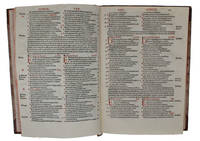
151359254Paris Henricus Stephanus 1513. Folio. Bound in a nice 18th century brown half calf with six raised bands to richly gilt spine. Corners slightly bumped and capitals worn especially the lower one where the capital band is showing and has loosened a bit. Inner hinge slightly weak. Front free end-paper with 18th century ink-annotation title year etc. A very light damp stain top the last portion of leaves a bit heavier to the last two leaves. Otherwise internally very nice and clean. All in all a very nice copy with only very light scattered brownspotting. Beautifully printed in two columns and in red and black throughout. Pp. 233-294. <br/><br/><em>Second edition following the original of 1509 of the final two parts of Estienne's typographic masterpiece "Quincuplex Psalterium" also known as the "First book of French Protestantism". These two final parts which make up complete works in themselves consist in the "Psalterium Vetus" - the Old Latin Psalter i.e. the version used by the churches before Jerome's revisions and the "Psaltarium Conciliatum" consisting in Lefevre's own version based on the Vulgate text corrected according to the Hebrew text and using the Aristarchian signs. This spledid publication had an immense impact upon protestantism early bible-scholarship and theology in general and is famed because of its beauty elegance and typographical excellence along with its immense importance historically speaking. "Lefèvre's epoch-making work was awaited impatiently by the learned world and is the topic of many a letter among the extant humanist correspondence of the period: thus Cardinal Ximeèz the future editor of the first polyglot Bible in a letter to Charles de Bovelles praises Lefèvre's scholarship and the usefulness of his "Psalterium". This famous volume is also Henri Estienne's typographical masterpiece and is commonly singled out as one of the outstanding monuments of early 16th-century French typography." Schreiber. "Lefèvre agreed with Erasmus that theology must be based on accurate texts and translations of the Scriptures; as the title of the volume indicates Lefèvre presents five different versions of the psalms" Schreiber. As described the present copy contains the final two. The three parts that were printed before those two were all printed in three columns and consisted in the three versions of St Jerome namely the "Psalterium Romanum" Jerome's first version of the Old Latin Psalter according to the Septuagint the "Psalterium Gallicum" Jerome's second revision first adopted by the churches of Gaul and the "Psalterium Hebraicum" Jerome's translation directly from the Hebrew. Schreiber nr. 8 1509 ed.; Renouard 1509 nr. 1.; Mortimer 1 nr. 62 present edition. </em> hardcover
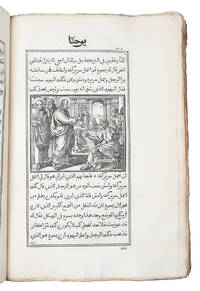
159062507Rome Typographia Medicea 1590 -1591. Folio. Completely uncut in the original blank interim wrappers with slight offsetting to verso of front wrapper. Newer paper backstrip matching the paper of the wrappers. Some leaves browned. Occasional brownspotting. An overall excellent copy. Housed in a old vellum chemise with ties and handwritten title EVANGELIUM to spine. Old amorial vague red stamp to title-page colophon and p. 97 from the Bibliotheque Impériale now Bibliotheque Nationale with a small deaccession-stamp to title-page. Magnificently illustrated with 149 large woodcut engravings in the text. 368 pp. Arabic text within double-frame border througout. Beautifully printed on very heavy paper. <br/><br/><em>The scarce editio princeps of the Arabic translation of the New Testament magnificently printed in Granjon's famous font considered the first satisfactory Arabic printing type appearing here for the first time and beautifully illustrated with 149 woodcut illustrations in the text. This work constitutes the very first printing by the Typographia Medicea-press a printing-house set up by Pope Gregor XIII and Cardinal Ferdinando de Medici in order to promote and distribute Christian scriptures to the East. This splendid work is considered the first successful printing of Arabic. Apart from the Latin part of the title-page and the colophon the book is in Arabic throughout. Two issues of the work were printed almost simultaneously the Arabic-only text which has the year 1590 on the title-page and 1591 on the colophon and the interlenear Arabic-Latin edition which has 1591 on the title-page. The Arab-only edition with 1590 on the title-page is generally considered the first. "Its first great Arabic publication was this edition of the Gospels bearing the date 1590 on the title page and 1591 at the end. Two versions appeared one solely in Arabic and one with an interlinear Latin translation." Library of Congress.The work was edited by Giovanni Battista Raimondi 1536-1614 a renowned Orientalist and professor of mathematics at the College of the Sapienza in Rome. Raimondi had travelled extensively in the Middle East and had thorough knowledge of Arabic Armenian Syrian and Hebrew. He is however most famous for being the editor at the Typographia Medicea-press; together with French engraver Robert Granjon who also created the Arabic typography of the present work "bettered all previous attempts to print in Arabic in Europe and would remain unsurpassed long after the press had closed. Boogert "Medici Oriental Press Rome 1584-1614"."Antonio Tempesta the engraver cutter: Leonardo Parasole had studied under Santi di Tito and Joannes Stradanus at the Accademia del Disegno in Florence later working with Stradanus and Vasari on the interior decoration of the Palazzo Vecchio in Florence before travelling to Rome where he executed various commissions including frescos for Pope Gregory XIII in the Vatican and decorations for the Villa Farnese. Simultaneously with his frescos and panel paintings he executed a large number of engravings. The illustrations for the present work are remarkable examples of Tempesta's work noteworthy for their clear composition and narrative of the episodes depicted. Despite the extremely high quality of the prints the press never became an economic success and it went bankrupt in 1610. Scholars have noticed that presenting a work with beautiful scriptural illustrations as the present to Arabic-speaking Muslims when Islam forbids religious illustration showed little understanding of the culture and almost certainly hindered Pope Gregory XIII's missionary efforts."The press was not only an intellectual enterprise; it was also a commercial one. Raimondi clearly hoped to sell his books in the East rather than the West because the selection of the works he produced showed little consideration with the type of material European scholars in this period needed. While the works failed to sell in the Ottoman Empire however they did significantly stimulate the study of the Middle East in Europe.Ferdinando de' Medici had ordered Raimondi to print 'all available Arabic books on permissible human sciences which had no religious content in order to introduce the art of printing to the Mohamedan community.' Only more than a century after the Medici Press in Rome had closed did it finally have the envisaged impact in the Levant; Ibrahim Müteferrika the first Muslim printer referring to it in his plea to the sultan to allow him to open his own printing house at Istanbul which happened in 1729." Boogert "Medici Oriental Press Rome 1584-1614".The copy was previously in the Bibliothèque Nationale in Paris at the time when it was entitled "Bibliothèque Imperiale" which was its name inbetween from 1849 to 1871. Thus the book entered the library in Napoleonic times and was later deaccessioned. Brunet II 1122-23Schnurrer 318Adams: B:1822 </em> hardcover
149521234141495. Venice: Paganino Paganini. 18 April 1495. Folio. 16th-century vellum over boards manuscript title in ink to spine; ff. 237-470 gg1-kkk8 only of 1512 Gothic type 83 lines of gloss woodcut in-text illustrations first initial of text ""T"" in red and blue and heightened with gilt rubricated in red throughout; binding a little stained head of spine worn with traces of glue joints splitting but holding firm early stitched repair to lower cover; occasional mostly marginal dampstaining light variable spotting but generally a very good clean copy; early ink ownership inscription ""Hic Liber est conventus Sancte Catherine de neapoli ordinis pre: read: praedicatorum congregationis Lombardiae"" and shelfmark to final verso see below.The second part only of four of an important incunable edition of the Bible containing Nicholas of Lyra's commentaries on Jerome Brito on Joshua through to the Book of Hester with contemporary rubrication.Paganino Paganini's comprehensive edition of the Bible combines the usual Glossa Ordinaria - including commentaries of Walafrid Strabo Anselm of Laon and William Brito - with the Postillae of Nicolaus of Lyra. Earlier Bible editions had contained one or the other but this was the first to unite both establishing a new editorial model soon imitated by other presses.The text edited by Bernardinus Gadolus Eusebius Hispanus and Secundus Contarenus is laid out in the manner of a legal text with multiple glossing layers and marginal apparatus. According to Paganino's own account the production of this edition cost him a total of 4000 ducats a conspicuous sum though this may be ""an exaggeration"" Bajetta pp. 3-4.Provenance: From the library of the Dominican convent of Santa Caterina a Formiello in Naples. Originally linked to the Celestine order the convent passed to friars of the Observant Dominican Congregation of Lombardy in 1499. It remained active until 1806 when it was expropriated and eventually converted into a wool factory: likely the period when its library was dispersed.ISTC ib00608000. See Bajetta Some Notes on Printing & Publishing in Renaissance Venice 2000. hardcover
117343Amsterdam Theuni Iacob & Ian Frederick Stam 1639-40. 8vo. Engr. title 15 310 2 104 4 66 40 ff. 40 pp. Bound together with:GEROBULUM Johannes. Kalendier der Bybelen. Amsterdam Morten Iansz. Brandt 1637. 8vo. 16 pp. Contemporary black blind stamped morocco over wooden boards spine with raised bands two preserved metal clasps. From the library of bishop Eric Waller with its book plate. Darlow & Moule 3309. USTC 1030400. The â€Kalendier†not in USTC but compare STCN ID 084277114 for edition 1628. Second edition of the so called States-General version first publised in 1637. The Synod of Dordrecht in 1618-19 decided to prepare a new Dutch translation from the original languages and six translators were appointed. This became the standard Bible of the Dutch Reformed Church. â€Even the Remonstantes the bitter theological opponens of the translators after a careful official examination of the version adopted it for their own useâ€. It includes â€Apocryphia†and â€De psalmen de Davidis†and â€Cathechismusâ€. The last is not present in Darlow & Moule. Eric Waller 1732-1811 was bishop in VästerÃ¥s and built a large library. hardcover
15847235Salamanca: Gasparem à Portonariis suis & Gulielmi Rouillii Benedictique Boierii expensis 1584. First Edition Primera edición. Hardcover Tapa dura. 297x210mm. 11¾x8¼". Salamanca Gasparem à Portonariis suis & Gulielmi Rouillij Benedictique Boierij expensis 1584-1585. 3 tomos en un volumen. En folio 297 x 210mm. 14 366 1 h.; 72 214 30 138 hojas 42 pp. Importante encuadernación mudéjar de época en piel sobre tabla planos ricamente gofrados lomera restaurada en cabeza y pie sin los broches. La Biblia de Salamanca con la traducción y notas de Francisco Vatablo publicada por primera vez en París en 1545 e impresa en España en 1554 con atribución a fray Domingo de Soto de la revisión del texto prohibida y mandada retirar por la Inquisición entre los años 1554 y 1559 pero que finalmente pudo ser publicada en Salamanca en 1584. Se conoce como <em>Biblia de Vatablo</em> a la edición preparada por Robert Estienne de la versión <em>Vulgata</em> de las Sagradas Escrituras junto con la traducción latina de Sanctes Pagnino y las anotaciones y correcciones de François Vatable profesor de hebreo del Collège de France; fue impresa en París en 1545. Se trata de una Biblia única ya que contiene 2 textos en latín de la Sagrada Escritura y no uno como es común. A la primera traducción se la denomina como la traducción vieja y se trata de la primera traducción de la Biblia realizada al latín desde el hebreo y griego llamada <em>Vulgata</em>; la segunda traducción se la denomina como traducción nueva y contiene las ideas renacentistas. Ambas traducciones confrontan el pensamiento de la <em>Vulgata</em> y las correcciones de ésta entre lo antiguo y lo nuevo. La primera impresión de la Biblia de Vatablo en España fue realizada en 1554 por Andrea de Portonaris en Salamanca; fue considerada ilegal un año más tarde y se dice de ella que no hay ejemplar conocido. Esta segunda impresión de 1584 la única que pudo ver la luz fue publicada después de ser cuidadosamente revisada y expurgada por la Inquisición y un grupo de teólogos de la universidad de Alcalá llamados los <em>hebraizantes</em> a los que le costó la cárcel y la muerte y entre los que se encontraba Fray Luis de León. Esta Biblia editada por Gaspar de Portonaris hermano del impresor de la primera y desconocida primera versión comenzó su andadura en 1569 en un proceso de más de 100 juntas reuniendo a gran número de teólogos y que se extendió por varios años. Contiene para el Antiguo Testamento la versión de San Jerónimo y Pagnini y para el Nuevo Testamento la versión de San Jerónimo y la traducción de Erasmo junco con ciertas revisiones de Teodoro de Beza. Durante los debates hubo momentos de mucha tensión. Especialmente furibundos fueron los enfrentamientos entre Fray Luis de León profesor de Teología Prima y León de Castro profesor de Griego experto acusador de judíos y judaizantes y abiertamente enemigo de todo aquello que tuviera que ver con los textos en hebreo donde las amenazas con denunciarse mutuamente ante el Tribunal del Santo Oficio fueron constantes durante estos años de deliberaciones. En las juntas se enfrentaron dos tendencias irreconciliables lo que iba a desencadenar las persecución de los hebraístas. Finalmente Fray Luis de León y sus otros compañeros hebraístas fueron llevados ante la Inquisición encarcelados y llevados a juicio. Es precisamente durante este largo cautiverio cuando Fray Luis realiza algunas traducciones de libros y escribe varias poesías y una de sus obras más significativas<em> De los nombres de Cristo</em>. Finalmente en 1575 el Tribunal reconociendo el valor y la energía impuesta por Fray Luis en su defensa oral le creyó exento de toda culpa y sospecha. Gasparem à Portonariis suis & Gulielmi Rouillii Benedictique Boierii expensis hardcover
118076Leiden Joh: Mulleri 1717. 4to. 10 749 pp. Title printed in red and black. Contemporary blind stampd vellum spine with raised bands and hand written title. Owner’s signature of S. Brandell 1857 and with his ink note: â€Denna upplaga är den s.k. Peschitoâ€. Fine copy. Darlow and Moule 8969 note. Second and improved edition of Johannes Leusden’s and Carolus Schaaf’s critical edition of the New Testament in ancien Syriac and Latin first published in 1708. Leusden died in 1699 when they had reached Luke xviii.26 and Schaaf had to complete the task alone. â€The editors had disagreed about the system of pointing voicing to be adopted. Accordingly up to Luke xviii.26 they give the Chaldean system used by Tremellius and others which J. Leusden preferred. Thereafter the pointing follows the Syrian system used in the Paris and London Polyglots and approved by C. Schaaf. The Latin version is C. Schaaf's revision of Tremellius' translation.†The preface that is dated 1708 gives the history of the printed editions of the New Testament in Syriac from 1555 and forward.The â€Peshitta†is the standard Syriac edition of the Bible for the Syriac churches and one of the earliest translations. hardcover
155063242No place no date ca. 1550. 12mo 87 x 63 mm. 19th century brown half calf with raised bands and richly gilt spine. Upper capital is significantly worn lackking small pieces of leather. Front hinge worn. Binding solif and tight. Titlle-page a little soiled and with a closed tear restored from verso no loss. A smal tear t A2 no loss of paper. Occasional brownspotting but overall very nice. Ink scribbles to verso of title-page and a few marginal notes and underlinings in brown ink. Woodcut illustration to title-page and title printed in red; verso of A2 with a large woodcut illustrated initial in red. Occasional large red initials. 190 ff. no final blank. <br/><br/><em>Exceedingly scarce printing of this Enchiridion Graecum - a liturgical handbook containing the Greek texts of the Sunday Gospels and Epistles as well as the principal feasts designed for private devotion. We have only been able to locate merely two copies of this printing - in Mainz and in Geneva. </em> hardcover
1574P37<p><strong>Summary:</strong> London: Richard Jugge 1574. Folio 13 x 9 in. The third folio edition of the Bishops' Bible with a fold-out map. Text in attractive black letter and a good number of woodcuts and four titles.</p><p><strong>Description:</strong> 26 out of 28 preliminary leaves present with Calendar printed in red and black. Lacks general title but all four other title pages are present. Printed in smaller type than the 1572 folio but still contains woodcuts as chapter summaries Genesis Exodus Numbers Matthew Mark Luke John etc. and an additional full-page composite cut before Revelation and a few maps. First chapter initials and decorated head and tailpieces throughout.</p><p><strong>Collation:</strong> A-M8 N6 Gen-Deut; Aa-Ss8 Tt6 Joshua-Job; Aaa-Sss8 T6 V6 Psalms-Mal; Aaaa-Mmmm8 Nnnn6 Apocrypha; A-Q8 R6 New Testament. <u>Lacks</u> general title and R4-R6 last three leaves. With two page fold-out map of <em>New Map of Places Mentioned in the New Testament </em>bound at front but <u>lacks</u> the two page fold-out maps in Exodus and Joshua.</p><p><strong>Binding:</strong> Rebacked in marbled calf with old marbled sheep covers laid on. Front cover with some surface loss. Spine with four raised bands and a red gilt-lined label with the words "Bishop's Bible." Plain endpapers.</p><p><strong>Condition:</strong> Generally a very good copy with marginal notes occasionally shaved; Occasional staining to the top and bottom margins e.g. D3-D6 K6-K8; some browning; Aii Matt 1 piece torn from inner column with loss of a few verses; B4 closed tear to outer edge just touching the text and through several notes; C1 long closed tear through most of the inner portion of the leaf without loss; G7 closed tear to bottom of inner column through 18 lines; M7 closed tear with loss to the first several lines of text to both columns; ex-library bookplate of Zion Research Library on front pastedown.</p><p><strong>Note:</strong> The third folio edition of the Bishops' Bible. Printed in smaller type with 63 lines to the column. After the first folio which contains over 120 woodcuts the number of woodcuts in the Bishops' Bible gradually decreases. The third folio still contains a good number of cuts and the fold-out map at the beginning of this copy is quite nice.</p><p><strong>References:</strong> Herbert 137; STC 2109; ESTC S107032; Luborsky & Ingram 2109.</p> Richard Jugge hardcover
1591P36<p><strong>Summary:</strong> London: Deputies of Christopher Barker 1591. Pulpit Folio 15 x 9.75 in. A later pulpit folio Bishops' Bible with attractive black letter text. Textually complete with a portion of the general title the New Testament title and in very good condition.</p><p><strong>Description:</strong> Includes nine preliminary leaves with the <em>Kalendar</em> ending on the full-page Adam and Eve engraving. The general title page 1591 in red and black is laid down. Text is in two column black letter. The New Testament title page 1591 within architectural border. First chapter initials and decorated head and tailpieces throughout.</p><p><strong>Collation:</strong> A-Z6 Aa-Zz6 Aaa-Zzz6 Aaaa-Zzzz6 Aaaaa6 Bbbbb4. Complete.</p><p><strong>Binding:</strong> Rebound in modern brown calf with original covers laid down. Covers within double blind-rolled border and fleurons at corners. Spine with six blind-lined bands and blind rolls to compartments. A dark red gilt-lined label with the words "Holy Bible 1591" in gilt. Plain endpapers.</p><p><strong>Condition:</strong> The text is generally in very good condition with good margins throughout. Occasional staining mostly marginal and a few minor marginal tears. General title is missing 60 percent with the bottom portion mounted an inserted on the verso of a leaf before the prelims. Below the title is a slip of paper with "William Ingham and Richard Weles bought this booke." On the front free endpaper is a large inscription 'John Smeeton His Book" and at the top are records of the births of five children 1658-1661. On the recto of the following leaf is a bookplate that reads "in the Savoy John Smeeton August 20 1675."; inserted after the title are two slightly defective leaves of the <em>Proper Lessons</em> in manuscript; Prelims include the<em> Almanacke</em> and <em>Kalenda</em>r about one third of June/July is missing and the whole is a bit worn; the final preliminary leaf with some paper repairs to the top edge reducing the border of the Adam and Eve engraving; bottom corner of Genesis 2 is torn away and replaced in manuscript; G1-N3 Ex-Num worm hole to the top inner margin not impacting text; Kk4 paper flaw removing some letters of sidenote on verso; Tt3 paper flaw without loss; Tt6 Bbb2 Yyyy3 with closed tears into the text; Uu1 piece torn from margin just touching the text and removing a couple of word from the sidenote; Xx2-Zz6 slight marginal worming; Qqqq6 possibly a paper flaw with old repair slightly obscuring some letters of text; final leaf bound slightly askew with some lower marginal repair.</p><p><strong>Note:</strong> One of a series of large folio black letter Bishops' Bibles. These Bibles were often used in parish churches but people of means bought them for private us as was apparently the case in this copy. The folio Bishops' Bibles that have survived are frequently imperfect as is the copy described in Herbert's catalog.</p><p><strong>References:</strong> Herbert 209; STC 2156; ESTC S121300.</p> Deputies of Christopher Barker hardcover
202382842br<p>The Netherlands: Cambridge University Press 2023. Book. Fine. Soft cover. 8vo - over 7¾ - 9¾" tall. Bound in navy blue limp goatskin with silver titles and blue under silver edges. Page-markers bound in. Clean tight and unmarked and apparently unused in original clamshell box. .</p> Cambridge University Press paperback
1965513160Cambridge University Press 1965. Leather. NEAR FINE. A very nice mid-century printing of the coveted Turquoise setting on India Paper printed at the Bentley House in London. vi 1184 361pp.; 125 concordance color lithograph maps and gazeteer. Large 8vo Smyth-sewn binding with overcast stitching in hand-grained Morocco goatskin leather with leather liner; all edges gilt gilt stamped spine lettering two place ribbons. Owner's imprinted name scratched off; some trivial scuffing to the gilt very faint dampstains to just a few pages; otherwise an uncommonly nice copy with little evidence of use--no markings blank dedication pages very clean and bright pages and tight sound binding. One of the most sought-after settings of the KJV the Cambridge Turquoise is prized for its boldness and clarity of it's large font especially when printed on the older 'India Paper' makes for one of the most eminently legible personal Bibles -- readable from a distance of several feet. While the goatskin leather is very nice the key to the value of this printing is the paper. The excellence of the India Paper of this era the likes of which has not been produced since the 70's is hard to overstate. Decades of research and development by Oxford and Cambridge went into producing this astounding combination of thinness strenght and opacity. Cambridge University Press unknown
1974201Toronto: Canadian Bible Society 1974. Softcover. Unpaginated pp. 173 21 cm. 8vo. Black and white maps illustrations. Light rubbing to covers contents clean and unmarked with tight sound binding; very good. Text is in both English and Syllabics. Scarce. <br/><br/> Canadian Bible Society paperback
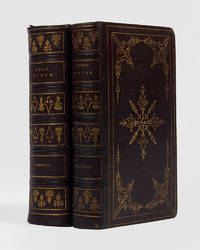
123613London Printed by George E. Eyre and Andrew Spottiswoode Printers to the Queen's Most Excellent Majesty c.1841. . 2 vols; 12mo 13.5 x 9 cm; CP a little toned; uniformly bound in contemporary purple morocco covers tooled in gilt with lozenge-shaped centrepieces formed of floral sprays and floral cornerpieces all within gilt filet borders spines lettered and tooled in gilt all edges gilt spine of CP a little faded houses in the original purple morocco case with brass clasp.<br /> A handsome two-volume set comprising the King James Bible and Book of Common Prayer uniformly bound in gilt-tooled purple morocco and housed in the original case with brass clasp.<br /> London, Printed by George E. Eyre and Andrew Spottiswoode, Printers to the Queen's Most Excellent Majesty, [c.1841]. unknown
1994022619Wichita Kansas: Catholic Bible Publishers 1994. 1994-95 Edition. NAB Catholic Parish Edition. Attractive volume in burgundy faux leather with bright gilt lettering and decoration all edges gilt 2.25 inches thick. Illustrated with color plates including a portait of Pope John Paul II many pages with color decorated borders at the front to record family events unused encyclopedic dictionary at the back. Also includes a papal succession table desciptions of the Vatican the Dogmatic Constitution on Divine Revelation a Synchronous History of the Nations Harmony of the Gospels History of the Bible Life of the Blessed Virgin with Story of the Rosary and more along with the Old and New Testaments. Very very minor bump to the lower spine end otherwise looks and feels new no names or other markings. Hard Cover. Fine. 4to - over 9¾" - 12" tall. Catholic Bible Publishers Hardcover
172755069London: printed by John Baskett. and by the Assigns of Henry Hills decease'd 1727. Later edition. Hardcover. Very good. Three parts folio in fours 38 by 24 cm. 380 23 3 table pp; text in two columns. Additional engraved title page; main title in red and black; woodcut initials and ornaments. Contemporary two-tone paneled calf triple-ruled in gilt; spine with raised bands elaborately tooled in gilt morocco lettering piece; gilt inner dentelles; marbled endleaves; all edges gilt. Covers very lightly scuffed with mild traces of wear at extremities; upper joint just starting at top; occasional touches of mild mostly marginal foxing. A very good or better copy complete and handsomely bound.<br /> <br /> An uncommon and beautifully printed edition of the Book of Common Prayer "the first single manual of worship in a vernacular language directed to be used universally by and common to both priest and people" Carter and Muir. Despite early revisions and some major alterations following the Restoration the original simplicity of the language has been presevered the text remaining substantially unaltered since 1662. References: ESTC N67554 locates only 4 copies. Cf. Carter & Muir Printing and the Mind of Man 75 ed. 1549. Collation: pi1 a-c4 A-Aaa4 Bbb2 = 203 leaves. printed by John Baskett... and by the Assigns of Henry Hills, decease'd hardcover
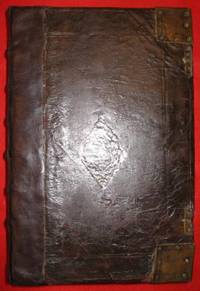
1611805London: Robert Barker 1611. Leather Bound. Very Good . 9 x 13 1/4 inches. Folio. 78 of 80 pages. Lacking title page. Griffiths 1611/2. Bound with: The Bible: That is The holy Scriptures contained in the Old & New Testament. London: Robert Barker 1612. 4 362 OT 361-444 Apocrypha 135 NT 7 tables leaves. Collates as A 4 leaves A-Lll in 6s Mmm - Ooo in 8s Ppp - Eeee in 6s Ffff 4 leaves. Engraved title page with old repair to closed tear at bottom. Full page woodcut of Garden of Eden presentwith loss to lower outer corner of image. B6 with old manuscript repair to loss at outer corner. Lacks 2Z3.4 Isaiah 17:13-24:18. Herbert 312. STC 2218. NT with separate title page dated 1611. Printed in two column Roman type. Bound with: Sternhold Thomas and John Hopkins. The Whole Booke of Psalmes: Collected into English Meeter. London: Printed for the Company of Stationers 1612. 114 6 of 8 pages. Collates as A-K in 6s L 1 of 2 leaves lacking index. STC 2539. Endpapers with 17th and 18th Century owners' inscriptions. Some marginal soiling and minor dampstains. Bound in contemporary brown calf with blindstamped arabesque centerpiece on covers brass corner pieces catches and clasps now lacking. Covers with old repairs and modern professional rebacking. A very good collection of the BCP of James I with the Geneva/Breeches Bible and Psalmes in folio with brass hardware. More complete than the copy located in Hills. Robert Barker unknown