179 résultats
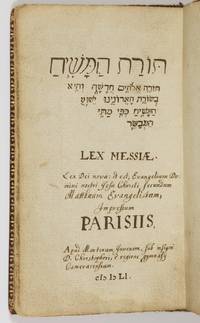
1700557661700. Very good-. Small octavo 14.1 by 8.5 cm. Manuscript in black and brown ink; 18-20 lines per page; text in vocalized Hebrew. 6 title and editor's preface 146 12 blank 10 notes. Lacks the first leaf which has been supplied in manuscript by a later owner. 19th-century limp morocco rubbed at extremities gilt dentelles marbled endleaves. Faint dampstain along bottom margin occasional smudges and mild stains else very good with crisp text.<br /> <br /> Early modern transcription of the Hebrew version of the Gospel of Matthew published in 1551 at Paris by Martin le Jeune with notes at the rear likely the work of a student. This edition was prepared by Jean Cinqarbres Quinquarboreus; 1514-1587 who jointly held the chair of King's Professor of Hebrew Literature at the University of Paris with Jean Mercier d. 1570. Lapide describes this as a "literal" edition and notes that the learned French bibliographer and father of the Oratory Jacques Le Long regarded it as the "true and authentic Gospel of Matthew." Like many of the surviving copies it lacks the Appendix which comprised the Seven Penetential Psalms Psalm CXIX Daniel's Prayer and the Ten Commandments. Apart from minor formatting changes e.g. breaks between chapters the text appears to be a faithful copy including vowel points and some of the additional cantillation marks the printed marginalia new Hebrew page numbers and Cinqarbres's dated preface. As the original version contains only 17 lines of text per page the transcription is not a page-for-page copy. Here the copiest appears quite fastidious in providing appropritate new catchwords! The Latin portion of the title however differs notably from the original which reads: Sanctum Domini nostri Iesu Christi Hebraicum Evangelium secundum Matthaeum.<br /> <br /> "In 1537 Sebastian Münster published his Hebrew version of the Gospel of Matthew at Basel the first printed edition of the New Testament in the so-called 'mother tongue of the evangelist' as he states in his preface" Lapide. Like the Paris edition of Hebrew Matthew upon which the present copy is based Münster entitled his version Torat ha-Mashiah The Teaching of the Messiah. While Münster's version of Matthew was long believed to be based on the 14th-century Hebrew translation by the Jewish polemicist Shem Tov ben Isaac ibn Shaprut more recent scholarship has called this attribution into question. "There are medieval Hebrew forms of Matthew that most scholars think of as retroversions from the Greek of canonical Matthew often made to serve in arguments between Christians and Jews. However some claim that these texts are a guide to the original Hebrew of Matthew French scholars like J. Carmignac and M. Dubarle have contributed to this thesis. Still other scholars think they can reconstruct the original Hebrew or Aramaic underlying the whole or parts of the Greek text of canonical Matthew on the assumption that the original was in Semitic. The vast majority of scholars however contend that the Gospel we know as Matthew was composed originally in Greek and is not a translation of a Semitic original" Brown.<br /> <br /> Provenance and annotations: The copiest has added notes following the main text comprising a Seder shel Miqra / Ordo Bibliorum in which the tripartite division of the Scriptures according to Jewish tradition is described. Then follows several pages of Hebrew terminology with biblical references and definitions in Latin. Along with one or two references to rabbinic literature an erudite reference to the Passover Haggadah notes Rabbi Judah's grouping of the ten plagues into three acronyms.<br /> <br /> At the head of the leaf inserted after Cinqarbres' preface is the note "When I bought this Mss. the first chapter from verse one unto verse 14 and part of verse 15. I filled in the missing verses. May. 18th. 1901. Llewellyn Saunderson 10 De Vesse Terrace Kingstown Co. Dublin" References: R. Brown Introduction to the New Testament 1997 p. 210; P. Lapide Hebrew in the Church Grand Rapids 1984 see Chap. IV "Modern Christian Hebraica" esp. pp. 53-58. Cf. Adams B1890 wanting the appendix; Darlow & Moule 5095: An independent edition of Shem Tob's version see no. 5088 which notes: The editor S. Münster obtained an imperfect MS. copy of St. Matthew's Gospel in Hebrew which had been made as early as 1385 for polemical purposes by Shem Tob b. Shaprut a Jew of Tudela in Castile. He revised and completed this for the press Basel: H. Petri 1537 adding a Latin translation of the Hebrew.; Delaveaux & Hillard 4644 noting Ibn Shaprut as the ulitmate source; Le Long/Masch 2 1781 p. 10. Schwarzfuchs Paris 212. Steinschneider 6591.26 under Münsterus.<br /> <br /> Full title noting original imprint: תורת המשיח תורת ××œ×”×™× ×—×“×©×” ×•×”×™× ×‘×©×™×¨×ª ×”××“×•× ×™× ×• ישוע המשיח כפי מתי המבשר <br /> Lex Messiae. Lex Dei nova: id est Evangelium Domini nostri Iesu Christi secundum Matthaeum Evangelistam Impressum Parisiis: apud Martinum Iuvenem sub insigni D. Christophori è regione gymnasii Cameracensium M.D.LI. 1551. unknown
1693000166Franeker: Jacobum Horreum 1693. Hardcover. See Description. 4to. pp. 12 768 28. Half title for each section. Bound in quarter vellum with paste paper boards - well rubbed. Library book plate on inside front cover. Title page displays a large woodcut device. Pages are clean overall with occasional spotting and age toning; faint inscription above title page device; outer margin of pp.735-6 reinforced with contemporary paper. Fore edge of the text block is a bit rubbed. The bottom edge is stamped with a library name. Board corner tips neatly repaired. Johann Van der Waeyen 1639-1701 was a Frisian Minister scholar and controversialist. In 1677 he was forced to leave his position in Middelburg and move to Franeker. See M'Clintock Cyclopaedia of Biblical Lit. Among his better known works is a commentary on Balthasar Bekker's book on witchcraft. Van der Waeyen's interest in demonology is also apparent in this collection of tracts which contains two essays 485 pages on the demon AZAZEL who was associated with the Israelite scape-goat ritual. The book also contains a commentary on Paul's Epistle to the Galatians and several other essays. <br/> <br/> Jacobum Horreum hardcover
1653255179Londoni: Excudebat Rogerus Daniel: prostat autem venale apud Joannem Martin & Jacobum Allestrye sub signo Campanae in Cometerio D. Pauli 1653. The first edition of the Septuagint printed in England. 8 1279 1; 186 2 pp. plus terminal blank. 1 vols. 4to signed in 8's 195 x 143mm. Old vellum titled and dated in manuscript on the spine. Terminal leaves slightly soiled two ownership inscriptions on front endsheets and small Lincoln's Inn release/sale stamp vellum a bit handsoiled occasional modest foxing and dusting along upper margins but a very good copy. The first edition of the Septuagint printed in England. 8 1279 1; 186 2 pp. plus terminal blank. 1 vols. 4to signed in 8's 195 x 143mm. The first edition of the Septuagint printed in England with the Scholia the scarce printing in quarto format. The text is derived from the Sixtine text and edited by John Biddle 1615-1662 the Unitarian controversialist who was imprisoned by the Parliamentary Commissioners for his religious views. <br /> The SCHOLIA . has a separate title-leaf register and pagination. The same setting was imposed in both quarto and octavo formats the latter with rules separating the columns of text. In regard to institutional representation the edition in quarto is much more uncommon than that in octavo: ESTC locates 4 copies of the quarto printing in North America as opposed to 19 of the octavo printing. Occasionally Daniel's reprint of the New Testament is bound up with the octavo printings to form a complete Bible. Brunet cites that format but notes the sale of a copy on "Gr. Pap." presumably a copy in this format. Over the last 35 years ABPC records sale of one copy in quarto 1999 and four in octavo. ESTC R12599 & R236817; Wing B2718 octavo edition only; Darlow & Moule 4692; Brunet I:863 Excudebat Rogerus Daniel: prostat autem venale apud Joannem Martin & Jacobum Allestrye, sub signo Campanae in Cometerio D. Pauli unknown

