9 732 résultats
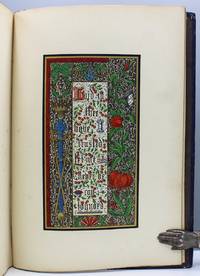
186817465<p>London: Emily Faithfull Victoria Press n.d. 1868 First edition. Original blue cloth stamped in gilt. . Twenty-nine chromolithograph plates each with a blank protective page plus 9 pages of descriptions of the plates. The plates include depictions of the Ark of the Covenant with cherubim enclosed in a 15th century-style border plate #4; the emblems of 12 saints including Saint Peter's keys plate #7; and church windows with the cross anchor and heart symbols worked into the glass plate #10. Some soiling and wear to cloth. All edges gilt. Dark brown endpapers. Contemporary ink ownership signature to front flyleaf. Some foxing to blanks as usual. A very good clean copy of a beautiful book. Emily Faithfull 1835 - 1895 was Queen Victoria's official printer the founder of Victoria Press a founding member of the Society for Promoting the Employment of Women and a popular novelist and memoirist. Upon establishing the Victoria Press in 1860 she provided training for women interested in printing and employed mostly women as typesetters and proofreaders. Other important Victoria Press publications included The Victoria Regia 1861 which earned Faithfull her position as the official printer to Queen Victoria and A Welcome a collection of poetry edited by Isa Craig that included the first appearances of poems by D.G. Rosetti Harriet Martineau and more. Faithfull also published the periodical Victoria Magazine which ran from 1863 to 1880 and often featured Faithfull's own writing on the importance of employment opportunities for women. Esther Faithfull Fleet 1823 - 1908 was also the illustrator of 38 Texts 1872 which was published by her younger sister Emily and included contributions by their father Ferdinand 1789 – 1871; Roses With and Without Thorns 1878; and The Dayspring from on High 1904.</p> Emily Faithfull, Victoria Press, hardcover
1936LFA-126721058Une revue de 80 pages, format 165 x 250 mm, brochée, Académie Florimontane (Annecy) paraissant depuis 1860, rare
198062971Seattle WA: Ananse Press 1980. 8vo. 235 1 pp. w/ very scarce inserted errata slip. With numerous photo illustrations text illustrations maps. Illustrated printed softcovers cover art of Victorian African-American family front cover minor scuffing edgewear some rubbing a couple leaves w/ underlining still G- copy w/ ownership date marking on ffep. of 1987. First edition of this very uncommon and significant local history of African-Americans in Seattle Washington Territory and then Washington State from before the Civil War until the dawn of the 20th-Century at the height of the Progressive Era. Heavily drawn from Oral-Aural History Program interviews Mumford after graduating from the U of W devoted extensive time to searching through newspapers census records property transactions bills of sale chattel mortgage records church registers and family scrapbooks and photo albums in order to recreate the largely forgotten Black experience in Seattle. In addition this was the first book she published as well as the first printed and issued from her own “Ananse Press†imprint. Mumford b. 1941 is one of the most important historians and authors on African-Americans in the Pacific Northwest and most publications will include references to her work. Ananse Press, paperback
8774Paris, Editions du Seuil, 1985. In-8, broché, 283 pp.
Paris, Editions du Seuil, 1985. In-8, broché, 283 pp.
38409Paris, Seuil, 1985. In-8°, 283p. Broché, couverture illustrée.
1919D5213Urban, s.e., 1919 ; 153 x 229 mm, 28 pp., doubles-feuilles agrafées. En langue anglaise. University of Illinois: Agricultural Experiment Station. Bulletin No. 220. Bon état.
201002690Paris, Editions G.P., 1961 ; in-12, 251 pp., cartonnage de l'éditeur. Illustrations de Gilles Valdès- 44e vol de la collection.
201709571Ingersheim, Editions saep, 1984 ; petit in-4, 114 pp., cartonnage de l'éditeur. Très bon état dédicacé des deux auteurs.
201015389Ingersheim, Editions saep, 1984 ; petit in-4, 114 pp., cartonnage de l'éditeur - .
200818666Ingersheim, Editions saep, 1984 ; petit in-4, 114 pp., cartonnage de l'éditeur - reliés toile numéroté. Exemplaire n°486/500 qui constituent l'édition originale.
201003067Ingersheim colmar, Edition saep, 1984 ; in-8, 113 pp., cartonnage de l'éditeur. N 378/500.
201808431Colmar, Musée d'Unterlinden, 1990 ; grand in-8, 357-12 pp., br. Couverture illustrée - broché bon état.
201701386Colmar, Musée d'Unterlinden, 1990 ; grand in-8, 357-12 pp., br. Couverture illustrée broché très bon état.
201216672Colmar, Musée d'Unterlinden, 1990 ; grand in-8, 357-12 pp., br. Couverture illustrée.
1968219077New York: Walker and Company 1968. First edition first printing. Hardcover in dust jacket. General wear and toning to extremities boards with a slight bow very good in near fine price-clipped dust jacket in mylar cover. 9.25" x 9.75". 155pp. Briefly inscribed by Craig Ellwood. Walker and Company hardcover
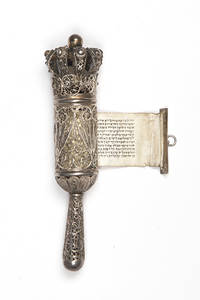
117058Jerusalem Bezalel Circa 1920. . Original manuscript on vellum text arranged in 11 lines in Hebrew script scroll housed in an elaborately decorated silver filigree case unstamped scroll height 310 mm case height 140 mm engraved with 'Bezalel Jerusalem' signature in Hebrew.<br /> A beautiful example of a Bezalel Megillah housed in a silver case with elaborate filigree surmounted by a crown.<br /><br />The Bezalel school was founded in 1906 in Jerusalem by the artist and professor Boris Schatz and was the first art school to be established in the Holy Land in the 20th century. Schatz who discussed his vision of opening an art school in the Land of Israel with Herzl when the two met in Vienna<br />in 1903 chose to call the school Bezalel after the biblical artist Bezalel ben Uri ben Hur mentioned in the book of Exodus as the artist chosen by God to build the Tabernacle HaMishkan in Hebrew. According to the scripture this artist worked in silver gold copper stone and wood. By founding the school Schatz aimed to establish a national style of art blending classical Jewish European and Middle-Eastern traditions. <br /><br />In addition to traditional sculpture and painting training the school ran craft workshops that produced<br />decorative objects in silver leather wood brass and fabric which were sold at exhibitions in Europe and the United States. Schatz's school was closed in 1929 and then reopened in the mid 1930s as the New Bezalel. In 1955 the school received its official academic acclaim and today the Bezalel Academy of Art and Design is Israel's national school of art as well as its oldest higher education institution. The art created by Bezalel's students and professors in the first decades of the 20th century is considered the stepping stone for Israeli visual arts.<br /><br />The Book of Esther is part of Ketuvim Writings the third section of the Hebrew Bible. It tells the story of a Jewish girl named Esther who became queen of Persia and thwarted a plan by Haman to commit genocide against her people. Also called The Megillah the book is the basis and an integral part of the Jewish celebration of Purim. Its full text is read aloud twice during the celebration in the evening and again the following morning. Besides Song of Songs it is the only book in the Bible that does not explicitly mention God.<br /><br />'Since the Talmudic period it has been customary to write the Book of Esther on parchment in the form of a scroll and the rules governing its production and<br />writing are basically the same as those for a traditional Torah scroll. It is not known when and under what circumstances artistic embellishment of Esther scrolls<br />began. The earliest extant illuminated examples emanate from 16th-century Italy commissioned by well-to-do Italian Jews.' Encyclopaedia Judaica<br /> Jerusalem, Bezalel, [Circa 1920]. hardcover
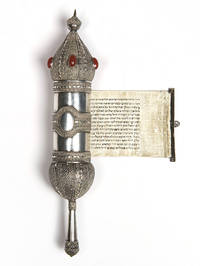
117059Jerusalem Bezalel Circa 1920. . Original manuscript on vellum text arranged in 14 lines in Hebrew script scroll housed in an elaborately decorated silver filigree case stamped 'Made in Palestine 935' set with five semiprecious stones presumed Carnelian stone; scroll height 600 mm case height 220 mm engraved with 'Jerusalem' signature in Hebrew.<br /> A beautiful example of a Bezalel Megillah housed in a silver case with elaborate filigree and semiprecious stones.<br /><br />The Bezalel school was founded in 1906 in Jerusalem by the artist and professor Boris Schatz and was the first art school to be established in the Holy Land in the 20th century. Schatz who discussed his vision of opening an art school in the Land of Israel with Herzl when the two met in Vienna<br />in 1903 chose to call the school Bezalel after the biblical artist Bezalel ben Uri ben Hur mentioned in the book of Exodus as the artist chosen by God to build the Tabernacle HaMishkan in Hebrew. According to the scripture this artist worked in silver gold copper stone and wood. By founding the school Schatz aimed to establish a national style of art blending classical Jewish European and Middle-Eastern traditions. <br /><br />In addition to traditional sculpture and painting training the school ran craft workshops that produced<br />decorative objects in silver leather wood brass and fabric which were sold at exhibitions in Europe and the United States. Schatz's school was closed in 1929 and then reopened in the mid 1930s as the New Bezalel. In 1955 the school received its official academic acclaim and today the Bezalel Academy of Art and Design is Israel's national school of art as well as its oldest higher education institution. The art created by Bezalel's students and professors in the first decades of the 20th century is considered the stepping stone for Israeli visual arts.<br /><br />The Book of Esther is part of Ketuvim Writings the third section of the Hebrew Bible. It tells the story of a Jewish girl named Esther who became queen of Persia and thwarted a plan by Haman to commit genocide against her people. Also called The Megillah the book is the basis and an integral part of the Jewish celebration of Purim. Its full text is read aloud twice during the celebration in the evening and again the following morning. Besides Song of Songs it is the only book in the Bible that does not explicitly mention God.<br /><br />'Since the Talmudic period it has been customary to write the Book of Esther on parchment in the form of a scroll and the rules governing its production and<br />writing are basically the same as those for a traditional Torah scroll. It is not known when and under what circumstances artistic embellishment of Esther scrolls<br />began. The earliest extant illuminated examples emanate from 16th-century Italy commissioned by well-to-do Italian Jews.' Encyclopaedia Judaica<br /> Jerusalem, Bezalel, [Circa 1920]. hardcover
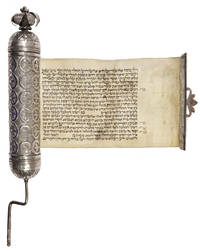
97796Balkan early 19th century. . Scroll on parchment housed in a silver case unstamped cast hammered and engraved with floral decorations and geometric patterns. Scroll height 15 cm case height 34.5 cm; some staining to parchment.<br /> Esther scroll housed in an elaborately decorated silver case.<br /><br />Manuscript on vellum text arranged in 19 lines in Hebrew Sephardic Script. An ornamentation of an attractive multilayered flower to the top of the case. <br /><br />The Book of Esther is part of the Ketuvim The Writings the third section of the Hebrew Bible. It tells the story of a Jewish girl named Esther who became queen of Persia and thwarted a plan by Haman to commit genocide against her people. Also called The Megillah the book is the basis and an integral part of the Jewish celebration of Purim. Its full text is read aloud twice during the celebration in the evening and again the following morning. Besides Song of Songs it is the only book in the Bible that does not explicitly mention God.<br /><br />'Since the Talmudic period it has been customary to write the Book of Esther on parchment in the form of a scroll and the rules governing its production and writing are basically the same as those for a traditional Torah scroll. It is not known when and under what circumstances artistic embellishment of Esther scrolls began. The earliest extant illuminated examples emanate from 16th-century Italy<br />commissioned by well-to-do Italian Jews' Encyclopaedia Judaica.<br /> Balkan, early 19th century. hardcover
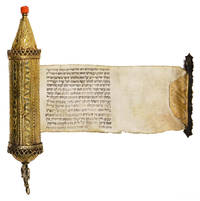
98168Balkan 19th century. . Scroll on parchment housed in a silver gilt case unstamped; scroll height 7 cm. case height 19 cm.<br /> Original manuscript on vellum text arranged in 15 lines in Hebrew Sephardic Script. A red bead decorating the top of the case. <br /><br />The Book of Esther is part of the Ketuvim The Writings the third section of the Hebrew Bible. It tells the story of a Jewish girl named Esther who became queen of Persia and thwarted a plan by Haman to commit genocide against her people. Also called The Megillah the book is the basis and an integral part of the Jewish celebration of Purim. Its full text is read aloud twice during the celebration in the evening and again the following morning. Besides Song of Songs it is the only book in the Bible that does not explicitly mention God.<br /><br />'Since the Talmudic period it has been customary to write the Book of Esther on parchment in the form of a scroll and the rules governing its production and writing are basically the same as those for a traditional Torah scroll. It is not known when and under what circumstances artistic embellishment of Esther scrolls began. The earliest extant illuminated examples emanate from 16th-century Italy<br />commissioned by well-to-do Italian Jews' Encyclopaedia Judaica.<br /> Balkan, 19th century. hardcover
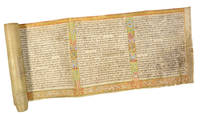
91530Central Italy early 19th century. . Illuminated scroll on parchment 3 spliced sheets 25.5 x 202.7 cm.; hand-coloured decorations possibly later some wear and loss of colour small tears; repairs to the back of first sheet.<br /> Italian Esther scroll beautifully illuminated in colour.<br /><br />Text divided into 11 parshiyot of 28 lines each and a compartment dedicated to the schematic drawing of the hanging of Haman's 10 sons. The decoration is composed of colourful ornamental borders on an ochre-yellow background: upper border with intertwining green branches lower border with a white vine-stem and crowns large flowers and medallions depicting the zodiac signs in the columns that separate the compartments.<br /><br />The Book of Esther is part of the Ketuvim The Writings the third section of the Hebrew Bible. It tells the story of a Jewish girl named Esther who became queen of Persia and thwarted a plan by Haman to commit genocide against her people. Also called The Megillah the book is the basis and an integral part of the Jewish celebration of Purim. Its full text is read aloud twice during the celebration in the evening and again the following morning. Besides Song of Songs it is the only book in the Bible that does not explicitly mention God.<br /><br />'Since the Talmudic period 70-640 AD it has been customary to write the Book of Esther on parchment in the form of a scroll and the rules governing its production and writing are basically the same as those for a traditional Torah scroll. It is not known when and under what circumstances artistic embellishment of Esther scrolls began. The earliest extant illuminated examples emanate from 16th-century Italy<br />commissioned by well-to-do Italian Jews' Encyclopaedia Judaica.<br /> Central Italy, early 19th century. unknown
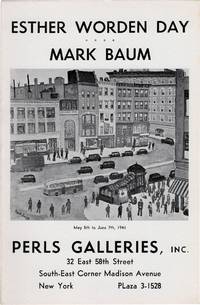
1941170066New York: Perls Galleries 1941. Vintage bi-fold brochure for the May 5 to June 7 1941 joint exhibition at Perls Galleries New York.<br /> <br /> 6.25 x 9.25 inches Bi-fold. Near Fine. Perls Galleries unknown
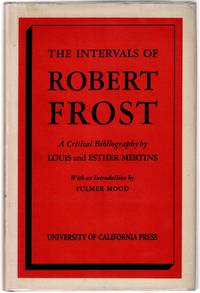
1947304815<p>First edition. Octavo. Introduction "Robert Frost and the Mertins Collection" by Fulmer Mood. Frontispiece b/w portrait photograph with facsimile autograph 1 facsimile reproduction. Dust jacket price clipped; few nicks. Very good. 91 pages. No other signatures or bookplates. Chronology of the composition of Frost's poems with an annotated bibliography. Signed and inscribed by Louis Mertins to Florence Fisk White on front free endpaper; also signed and dated by Esther Mertins on front free endpaper August 7 1947. With a one-page TLS of Louis Mertins Riverside CA August 6 1947 laid in loose. Crane p.261; one of 1500 unnumbered copies.</p> University of California Press hardcover
200705254Paris, Robert Laffont collection vecu, 1974 ; in-8, 345 pp., broché, couverture illustr.
69852Kingston Jamaica BWI: Arawak Press 1955. Travel REVISED EDITION third overall. Octavo 21 x 14cm pp.316; 1. Illustrated throughout with photographs and a colour map. Publisher's clothbound hardcovers in illustrated dust-wrapper priced at 21s. A clean fine copy in a gently used jacket with one tear at crown. James Bond novelist Ian Fleming refers to this book and borrowed the title in his travel article 'Pleasure Islands' Spectator 4th July 1952. He also reviewed it for The Sunday Times 1st June 1952 under the heading 'West Indian'. Fleming who is mentioned in person on p.142 was a prominent resident of the island and set several of his thrillers there. This particular example is from the comprehensive archive assembled by Jon Gilbert pencil signature within. His encyclopaedic guide to the works of Ian Fleming 2012 won the 16th Breslauer Prize for bibliography. See Gilbert C31. Kingston, Jamaica, BWI: Arawak Press, 1955 unknown