NEWTON, ISAAC, EDITORBiblio.com

140 résultats
168118283Cantabrigiæ: Ex Officina Joann. Hayes Sumptibus Henrici Dickinson 1681 1681. Second English edition; the first was published in 1672 also by Hayes. ESTC R9979; Wing V107; Honeyman Sale Catalogue 3029. Edges and hinges repaired; prelims a little foxed; a very good copy. 8vo contemporary panelled calf rebacked raised bands. Five folding plates. Title-page printed in red and black. The celebrated treatise on scientific and comparative geography by the German geographer Bernhardus Varenius 1622-1650 first published in Amsterdam in 1650. It became the standard textbook on the subject for a century. Isaac Newton edited and revised this edition for his students at Cambridge; it was Newton's first published work. Small bookplate of Johann Lawrence on the front paste-down. Cantabrigiæ: Ex Officina Joann. Hayes, Sumptibus Henrici Dickinson, 1681 unknown
168511590Londini London Londres London: Apud Robertum Scott 1685. Fine. Apud Robertum Scott Londini London Londres London 1685 23.50 x 18.50 cm relié First edition. With some illustrations. Brunet V 1374. Contemporary vellum. Faint spotting to title. Vossius 1618-1689 was one of the learned Huguenots who emigrated to England where he became Canon of Windsor and had the finest private library in the world. He also provided books for Queen Christina of Sweden. This work presents the results of his research in a number of fields most notably the Classical world on which Vossius was a noted authority. These include observations on Rome Alexandria Babylon and so on as well as writers such as Virgil and Tertullian but also subjects like travel to the Indies and Japan Jews among others. Apud Robertum Scott hardcover
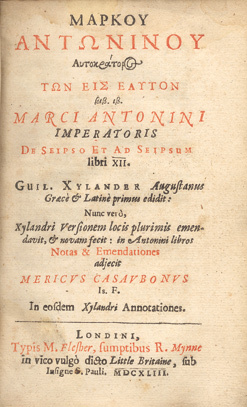
16436506London, Flesher, R. Mynne, 1643 ; petit in-8 ; plein veau glacé havane, dos à nerfs richement décoré et doré, titre doré, double filet doré d'encadrement des plats avec au centre les armes de Louis-Urbain Le Fevre, seigneur de Caumartin, marquis de Saint-Ange, comte de Moret (OHR, 651), roulette sur les coupes (reliure fin du XVIIe - déb. XVIIIe) ; (56), 343, (1 bl.), 148, (4) pp. (bien complet du feuillet blanc qui suit le feuillet de titre).
168358073London:: Printed by M. Fletcher for Brabazon Aylmer 1683-1687. Volume II states second edition on the title page. old full calf. Old ink signature at head of title page in Vol. I; bindings scuffed and worn at extremities with a few short splits at joints; contents very nice with all volumes tight and sound. Additional postage charge applicable. Folio. Engraved frontispiece portrait in each volume. Published by the Reverend Dr. Tillotson. Printed by M. Fletcher, for Brabazon Aylmer, unknown
168118283Cantabrigiæ: Ex Officina Joann. Hayes Sumptibus Henrici Dickinson 1681 1681. Second English edition; the first was published in 1672 also by Hayes. ESTC R9979; Wing V107; Honeyman Sale Catalogue 3029. Edges and hinges repaired; prelims a little foxed; a very good copy. 8vo contemporary panelled calf rebacked raised bands. Five folding plates. Title-page printed in red and black. ¶ The celebrated treatise on scientific and comparative geography by the German geographer Bernhardus Varenius 1622-1650 first published in Amsterdam in 1650. It became the standard textbook on the subject for a century. Isaac Newton edited and revised this edition for his students at Cambridge; it was Newton's first published work. <br/><br/> Cantabrigiæ: Ex Officina Joann. Hayes, Sumptibus Henrici Dickinson, 1681 unknown books
169745644Leipzig, Grosse & Gleditsch, 1697. 4to. No wrappers. In: ""Acta Eruditorum Anno MDCXCVII"", No V, May-issue. Pp. 193-240 (entire issue offered). With titlepage to the volume 1697. Leibniz: pp. 201-205. Johann Bernoulli: pp. 206-211. Jacob Bernoulli: pp. 211-214. Newton: pp. 223-224. As usual, some leaves with browning.
169745644Leipzig Grosse & Gleditsch 1697. 4to. No wrappers. In: "Acta Eruditorum Anno MDCXCVII" No V May-issue. Pp. 193-240 entire issue offered. With titlepage to the volume 1697. Leibniz: pp. 201-205. Johann Bernoulli: pp. 206-211. Jacob Bernoulli: pp. 211-214. Newton: pp. 223-224. As usual some leaves with browning. <br/><br/><em>First appearance of the famous issue of Acta Eruditorum in which the 4 solutions by the 4 most eminent mathematicians at the time were printed together. There were in all 5 solutions to the posed problem and Newton's solution was first printed in the Philosophical Transactions January 1697 and reprinted here. The solution proposed by L'Hopital not printed here was not published until 1988.The brachistochrone problem was posed by Johann Bernoulli in Acta Eruditorum in June 1696. He introduced the problem as follows: "I Johann Bernoulli address the most brilliant mathematicians in the world. Nothing is more attractive to intelligent people than an honest challenging problem whose possible solution will bestow fame and remain as a lasting monument. Following the example set by Pascal Fermat etc. I hope to gain the gratitude of the whole scientific community by placing before the finest mathematicians of our time a problem which will test their methods and the strength of their intellect. If someone communicates to me the solution of the proposed problem I shall publicly declare him worthy of praise." Johann Bernoulli and Leibniz deliberately tempted Newton with this problem. It is not surprising given the dispute over the calculus that Johann Bernoulli had included these words in his challenge:- ."there are fewer who are likely to solve our excellent problems aye fewer even among the very mathematicians who boast that they. have wonderfully extended its bounds by means of the golden theorems which they thought were known to no one but which in fact had long previously been published by others."According to Newton's biographer Conduitt he solved the problem in an evening after returning home from the Royal Mint. Newton: . "in the midst of the hurry of the great recoinage did not come home till four in the afternoon from the Tower very much tired but did not sleep till he had solved it which was by four in the morning."Newton send his solution to his friend Charles Montague and Montague published anonymously in the Transactions. Newton's solution presented here in the Acta is also anonymous. The episode did not please Newton as he later wrote: "I do not love to be dunned pestered and teased by foreigners about mathematical things ." After the competition Johann Bernoulli said ". my elder brother made up the fourth of these after Leibniz himself and Newton that the three great nations Germany England and France each one of their own to unite with myself in such a beautiful search all finding the same truth."Struik Edt. "A Source Book in Mathematics 1200-1800 pp. 391 ff. </em> unknown
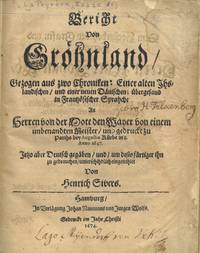
167476658Hamburg 1674. Liten 4to. Nyere shirtingryggbind. 8 70 s. Med et foldet kart. In Verlägung Johan Naumans und Jürgen Wolfs. Tysk. <br/><br/><em>Mangler tre plansjer. Tittelbladet restaurert. </em> unknown
168452496London: J. Playford pro Georgio Wells in Coemeterio D. Pauli 1684-1685. Full leather fully restored. Title page 388 pp. title page 4xxxviii152 pp. with figures; 16 × 10.5 cm. previous owners name some spots foxing paper browned some pages restored although good copy of this rare work. See picture. More pictures on request cat amst 2020 J. Playford, pro Georgio Wells in Coemeterio D. Pauli hardcover
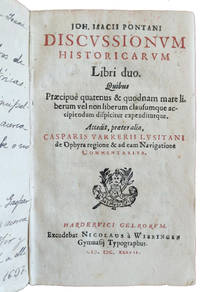
16377249Hardervici Gelrorum: Nicolaus Wieringen 1637. First Edition — Primera edición. Hardcover — Tapa dura. Hardervici Gelrorum Nicolaus Wieringen 1637. En 8º. 16 431 1 pp. Encuadernación de época en pergamino tÃtulo rotulado en la lomera. Primera edición de este tratado de derecho marÃtimo internacional y la libertad en los mares. Al fin incluye un texto dedicado a la navegación "<em>De Ophyra</em>" de Gaspar Barreiros y la "<em>Problemata nautica</em>" de Bartholomaus Keckermann. El danés Joannes Isaac Pontanus 1571-1639 discÃpulo de Thyco Brahe se trasladó primero a Francia y luego a Holanda donde percibió el clima polÃtico cultural que llevó a la elaboración de las teorÃas del derecho internacional expresadas en esta obra una viva refutación de las teorÃas de John Selden sobre el mar cerrado. Buen ejemplar. Nicolaus Wieringen hardcover
16633201<p>First edition of the report on Iceland by the French diplomat Isaac de la Peyrère 1596-1676.</p><p>Condition:</p><p>Vellum Binding in Fair Condition. Top right corner with extensive damage but does not affect any of the text block throughout. Paper yellowed uniformly with age. Light marginalia throughout. Previous ownership marks. Map is excellent and in quite clean/bright condition</p><p>Deals in particular with history population geography and trade. With a general map of Iceland by Pierre Duval. - Through his acquaintance with Christina of Sweden and the Danish scientist Ole Worm La Peyrère gained access to numerous old manuscripts and chronicles. From 1644 to 1646 he traveled to Scandinavia on diplomatic mission. He subsequently published in addition to a work on Greenland first edition 1647 the present description of Iceland both of which he wrote in letter form to F. de la Mothe le Vayer.</p><p>BINDING: Contemporary parchment. 16 x 11.5 cm. - ILLUSTRATION: With one folded copperplate map.</p><p>BIBLIOGRAPHY: Chavanne 2138. - Alden/Landis 663/80. - Lerclerc 658. - Klose 571. - Cioranescu 40042.</p><p>Rare first edition of La Peyrère's geographical and historical account of Iceland. With 1 engr. map. Contemp. vellum.</p> Louis Billaine hardcover
1697020472Paris: Imprimerie Royale 1697. Early Edition. Hardcover. Lacking the frontispiece; owner names on front blanks; title page to first volume with short stitched repair of a tear; contents clean with dark impressions of the plates. Bindings solid with light wear and short splits along the joints with covers firm. Near Fine. Two small quarto 6-1/4" x 8-1/4" volumes bound in full mottled calf leather with marbled endpapers and gilt-lettered contrasting morocco spine labels: x 243 1; 220 4 pages. Text in French translation by Issac de Benserade who was commissioned by Louis XIV to make this translation for the education of his son Louis -- Le Grand Dauphin of France. Illustrated with title vignettes and 226 half-page engravings by Francois Chauveau and Sebastien Le Clerc; lacking the frontispiece. The plates are copies mostly reversed and unsigned of the original etchings by Chauveau and Leclerc; they were first published in 1679 Amsterdam: Abraham Wolfgang. Philip Hofer in BAROQUE BOOK ILLUSTRATION refers to the illustrations as prefigurements of the "grace and elegance of the best French rococo" page 14. Bookplate of Mr. Edward F. Starbuck on the front pastedown of each volume with ink presentation on the bookplates. <br/><br/> Imprimerie Royale hardcover
1618ABC_45668The Netherlands 1618. ca. 22 x 295 cm. In passe-partout. Engraved print on paper. Rare allegorical print perhaps by Zacharias Dolendo: Exposition of the present state of the free Netherlands a satire against the Remonstrants and supporting Prince Mauritss suppression of them presented as their failed attempt to undo the unanimity within the Republic of the Seven United Provinces. It caricatures waardgelders mercenaries hired by cities in this case to defend the freedom of the dissenting Remonstrants against attacks by Counterremonstrants.The print seems to be the second state of a print of Dolendo after a painting by Isaac Claesz. Swanenburgh. The first state of this print an allegory on the siege and relief of Leiden was printed in 1574. Our copy would be the second state of this 1574-print with another text.At left the Dutch maiden is assailed and driven from her safe seat Christ by Discord Death and Violence. At right Neptune tries to stop a soldier from attacking her. Utrecht appears on the soldiers helmet and the names of the Remonstrant cities on a flap of his trousers: Alkmaar Rotterdam Leiden etc. characterizing him as a waardgelder. With a minor stain on the back faintly visible on the front and 3 barely visible folds. Otherwise in very good condition.l Atlas van Stolk 1320 1337; D.R. Horst De opstand in zwart-wit: propagandaprenten uit de Nederlandse opstand 2003 p. 151 fig. 47 p. 334; Knuttel 2769; Muller Historieplaten 1313 "very rare. unknown
16243619<p>Compendium on Alchemy Medicine and Science A-2S8 2S8 blank present. 34 598 24 pages. Title-page in red and black. Worming to inner margin of first gathering with some minor affects; browning some old underlining partially in red and marginal notes some minor stains. Overall a good copy in the original full yapped vellum. This volume contains:1 Basilius Valentinus:Triumphwagen des Antimonii.2 Roger Bacon: Von der Medicin und Artzney/ oder Tinctur des Antimonii oder Spieglases Beydes in den Menschlichen Crpern zu erhaltung desselben Gesundheit und abwendung aller auch unheilbaren Kranckheiten und Seuchen Und unvollkommenen Metallen ihren Aussatz heilen sie zu clarificiren und in das beste Gold zuverse.3 Ein kurtz rundes und wolgegründtes Tractätlein Von den Particular und Universal-Tincturen.4 Vom Stein der Weisen Theoria. Und Practica Des Edlen . Georgii Phaedronis Rodocheri.5 Uhralter Ritterkrieg Das ist Ein alchymistisch kürtzliches Gäsprech. Unsers Steins/ des Golds und des Mercuii .6 Opus Saturni M. Johannis Isaaci Hollandi.7 Consideratio Oder Philosophische Betrachtung Von der Materia Lapidis Philosophici.8 Von der Occulta Chemicorum Philosophia Ein kurtzer Tractat.Basilius Valentinus also known under the Anglicized version of his name Basil Valentine was a fifteenth-century alchemist & the Canon of the Benedictine Priory of Saint Peter in Erfurt Germany. Krown & Spellman HA 45215; 18 mo 4 x 6.4 in; xxxviv 59824 pages; All shipments through USPS insured Priority Mail. .</p> Friedrich Lanckisch for Bartholmaeus Voigt hardcover
1680D18688London: M.C. for Henry Brome 1680. First Edition. Hardcover. Very Good. 4to. Uncut; light browning. Modern calf gilt. 40pp. Letters signed "R.W." but usually attributed to Walton. Wing W673; ESTC R8226. provenance: J. Chamberlain; J.C. Lynn. Robert S Pirie; with their three bookplates. Pencil notes from Pirie at the front indicate the rarity of the item. He states that only 2 or 3 copies are known of this the first edition. <br/><br/> M.C. for Henry Brome hardcover
1688002823Paris, Estienne Michallet, 1688
1665D18691London: J. G. for Rich. Marriott 1665. First Edition. Hardcover. Near Fine. 8vo. Original calf. Wing W670; ESTC T10749. Provenance: Robert S Pirie bookplate. An exceptionally handsome copy in its original binding. "Thick paper " asks Pirie in pencil at the front. Rare. <br/><br/> J. G. for Rich. Marriott hardcover
165565643[Louys & Daniel Elzevier] | [Amsterdam] 1655 | 14.50 x 19.50 cm | 3 textes reliés en 1 volume
16094708Full ruled contemporary vellum; red morocco label to spine. Gilt armorial 'Martis et artis honos' to boards. 60 1080 32 151 pages. Wear to fore edge of rear board. Dibdin p. 350: "A most excellent edition". Typis Wechelianis apud Claudium Marnium & haeredes Iohannis Aubrii hardcover
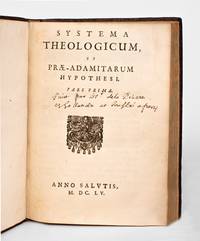
165565643Amsterdam: Louys & Daniel Elzevier 1655. Fine. ""the school of Biblical interpretation of which he was perhaps the first founder"" before Spinoza Louys & Daniel Elzevier Amsterdam 1655 14.50 x 19.50 cm 3 textes reliés en 1 volume Rare first edition of a work that was controversial from the moment of its publication. Baruch Spinoza a contemporary of the author owned a copy in his personal library. Our copy is complete with its folding map of the Holy Land and its three texts here bound in an order inverse to the usual: the Præadamitæ bound at rear is in fact the first text. Contemporary full brown calf spine with five raised bands decorated with double gilt fillets and gilt fleurons boards twice framed in gilt all edges marbled. Spine-ends very skilfully restored otherwise a very fine copy. Dry stamp of the Gianni de Marco library on the first flyleaf. Early manuscript annotation on the title page: ""Fait par le Sr de la Pebere en Hollande et bruslé à Paris"" Written by the Sr de la Pebere in Holland and burned in Paris. Provenance: armorial bookplate of Balthazar-Henri de Fourcy 1669-1754 Abbé of Saint-Sever in the diocese of Coutances subsequently of Saint-Wandrille and of the Priory of the Bons-Hommes. « ""Dubitare possumus num apostoli tanquam prophetæ ex revelatione et expresso mandato ut Moses Jeremias et alii an vero ut privati vel doctores Epistolas scripserint. We may fairly inquire whether the Apostles wrote their Epistles as prophets by revelation and express mandate as Moses Jeremiah and others did or whether only as private individuals or teachers"" Spinoza ""Tractatus Theologico-Politicus"" c. XI edit. 1674 p. 198. . The ""Tractatus Theologico-Politicus"" was published in 1670. Fifteen years earlier a French Protestant Isaac de la Peyrère 1594-1676 had published ""Præadamitæ sive Exercitatio super versibus"" . 1655. He admits miracles but reduces their number as far as possible; Adam is not the father of all mankind but only of the Jews; other men the Pre-Adamites existed before him; Moses is not the author of the Pentateuch etc. La Peyrère converted more or less sincerely to Catholicism in 1656. Mr. Lecky in his ""History of the Rise and Influence of the Spirit of Rationalism in Europe"" 4th ed. 1870 vol. I p. 297 regards him as having been perhaps the founder of the rationalist interpretation of the Bible ""the school of Biblical interpretation of which he was perhaps the first founder."" In reality his influence was virtually nil; the same cannot be said of Spinoza whose ideas later exercised a profound influence. Cf. Lecky ibid. p. 299. » Fulcran Vigouroux ""La Bible et les découvertes modernes en Égypte et en Assyrie"" 1877 our own translation [Louys & Daniel Elzevier] hardcover
1655673Amsterdam: Elzevir 1655. First Edition. vellum. Very good. LA PEYRERE Isaac Praeadamitae sive Exercitatio super Versibus <br />duodecimo decimotertio & decimoquarto capitis quinti Epistolae D. Pauli ad Romanos. And 2nd part Systema Theologicum ex Prae-adamitarum Hypothesi. And final section called: Synagogis Iudaeorum universis. Elzevir Amsterdam 1655. TP 1 leaf = Elenchus Capitum 1 52 TP 2 leaves = Prooemium 4 leaves = Argumenta Capitum Systematis & errata 1 297 1 8 1 leave with engraved map of the Terra Sanctae. 4to. First Edition. <br /><br />An anonymous Dutch edition of Philosophia appeared in 1667 and new Latin editions in 1673 and 1674. Evidence for the staying power of the work and the controversies which surrounded it is found in <br /> the fact that it underwent a fourth edition long after Meyer's death in 1776. <br /><br />Rare Quarto edition which preceded the 12mo of the same year. <br /><br />La Peyrere is considered to be the father of Biblical criticism. He asserted in Praeadamitae that there were human beings before Adam. His approach to Biblical scholarship argued that the Bible was just the story of the Jewish people not all of humanity. His book and heretical views were quickly banned. La Peyrere was eventually arrested but offered a half-hearted renunciation of his views to escape punishment. La Peyrere went on to engage in polemics with Richard Simon famous defender of the Bible. A rare and important book in the Radical Enlightenment identified as one of the wicked books of the late 17th century. .the wicked sedition which commenced with La Peyreres Prae-Adamitae gained impetus with the utterly licentious dissipated dictionary of Koerbagh that shameless book the Philosophai S. Scripturae and Hobbes Leviathan and culminated in the Tractatus- Theologico-Politicus and Ethics of Spinoza Israel 367. <br /><br />CONDITION: Very Good in slightly soiled contemporary vellum over boards. Contemporary handwriting on titlepage. Dampstaining in corner of first pages causing ruff edges. Small repair in corner title. Some slight dampstaining in corner map. First edition. Spinoza had a copy of this edition in his library. <br /><br />PHOTOS AVAILABLE UPON REQUEST Elzevir hardcover
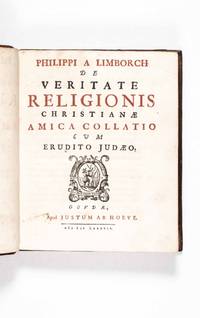
168748832Gouda: Justus van der Hoeve 1687. First edition. Hardcover. Fine. Three parts quarto. asterisk-2 asterisk4 A-3A4 3B = 197 leaves; K2 signed H2. 16 364 14 indexpp. Title in red and black printed marginalia woodcut tailpieces. Contemporary paneled calf expertly rebacked to style gilt lettering piece. Occasional touch of mild foxing else a fine crisp amply-margined copy. <br /> <br /> First edition of this remarkable collection modeled on a work of Hugo Grotius with the same title including the transcription of an epistolary debate between the Dutch theologian Phillip van Limborch 1633-1712 and the Jewish scholar Isaac Orobio de Castro ca.1617-1687. Jonathan Israel views the work as "a key exemplum of the new 'enlightened' method of upholding Christianity." Limborch was a leading Dutch theologian aligned with the Arminians and professor in the Seminary of the Remonstrants at Amsterdam. Orobio de Castro had been Professor of Theology at Salamanca who was imprisoned by the Inquisition on account of his sympathy with the Jews of Spain. He fled the country going first to France and then to Holland where he abjured Christianity and became deeply involved in the philosophico-religious controversies in the Low Countries. In the present work Limborch publishes three letters written by Orobio de Castro along with his own detailed responses. In arguing against the "truth" of the Christian religion "Orobio retorted that the advent of Christ has done nothing to render mankind less sinful or to lessen suffering that the rise of Christianity far from being unparalleled was surpassed by the expansion of Islam. and that far from being unchallengeable Christ's miracles had not been performed publicly like the miracle at Mount Sinai but virtually in secret a circumstance which renders them entirely dubious. These responses and his further claims that the New Testament is unreliable providing no basis for trust in Christ's miracles since the text exists only in Greek a language neither Jesus nor the Apostles had the slightest knowledge of. made no impact on Limborch Le Clerc or Locke who were convinced of their triumph over Orobio. Nevertheless Orobio's arguments were fully and objectively reported in the text and subsequently widely read across Europe and some of those who read it were not so sure that Orobio was 'vanquished'. Boulainvilliers who meticulously examined the text concluded that Limborch's arguments were less securely grounded on reason than he and his allies supposed and that even without their realizing it it was Orobio who won the contest a verdict echoed in other anti-Christian clandestine philosophical literature of the early eighteenth century" Israel.<br /> <br /> Edited from a manuscript formerly in the possession of the Leiden professor of theology Simon Episcopius and now in the University Library Amsterdam the Exemplar Humanae Vitae is the autobiography of the Portuguese Jew Uriel da Costa ca.1585-1640 who was excommunicated from the Sephardi Jewish community of Hamburg in 1618 after addressing a polemical broadside to the leaders of the Sephardi congregation of Venice in which he criticized rabbinic Judaism as incompatible with the Torah. He later settled in Amsterdam where he submitted to a public recantation of his views before the Portuguese Jewish congregation and committed suicide shortly thereafter. A radical freethinker who here makes an imposing plea against dogmatics da Costa may be viewed as a forerunner of Spinoza. An English translation was published at London in 1740; a complete edition of his few works was edited in 1922 by Carl Gebhardt Schriften des Uriel da Costa and published as the second volume of the Bibliotheca Spinozana. At the conclusion Limborch offers his refutation of da Costa's challenge to revealed religion. References: Bamberger no. 67. Fürst 1:17. De Graaf Cat. 70: Spiritualists Nonconformists & Dissenters no. 360. J. Israel Radical Enlightenment OUP 2001 esp. pp. 464-466. Oscott Catalogues: Recusant Books part 2 no. 2286; The Old Library part 2: Bible Collections no. 895. For Da Costa's Exemplar cf. Roth B18.30 citing the English version of 1740. The work was already scarce and much sought after in the early modern era as evidenced by: DeBure Theology no. 583: “ouvrage estime & recherche les exemplaires en sont peu communs†and Osmont Dictionnaire vol. 1 p.406: “rare et estimé.†In his 1694 catalogue of Christian Hebraic works Bibliotheca Latino-Hebraica Carlo Imbonati offers a surprisingly long discussion of De Veritate on pp. 201-209. Justus van der Hoeve hardcover
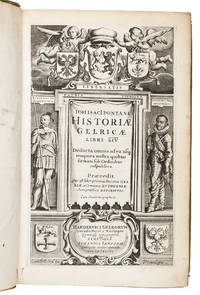
16394113Harderwijk and Amsterdam: Nicolaes van Wieringen and Johannes Janssonius 1639. Contemporary blind-tooled vellum with the manuscript author and title on the spine a lozenge-shaped ornament on both boards surrounded by a single and a double fillet border remnants of two leather closing ties densely red sprinkled edges. Folio. With a richly engraved title a full-page engraved portrait of the author by J. van Velde 5 double-page engraved maps of Gelderland 4 double-page engraved plans of Nijmegen Arnhem Zutphen and Harderwijk all with a view in profile at the top and 3 full-page engraved portraits of Arnold van Egmond Karel van Egmond and Maarten van Rossem by H.L. Roghman and Retter. First edition of the first extensive history of the duchy of Gelre present day Gelderland in the Netherlands beautifully illustrated with large maps and plans. The work consists of fourteen books. The first contains a historical-topographical description of the region while the other thirteen tell the history of Gelre in chronological order from the time of the Batavi until 1581 when the Plakkaat van Verlatinghe Act of Abjuration was signed. The maps shows various parts of Gelre in detail and the plans depict the four main towns: Nijmegen Arnhem Zutphen and Harderwijk.Johannes Isaac Pontanus 1571-1639 a historian and medical doctor from Harderwijk was commissioned to write the history of Gelre in 1621. The local government het Hof van Gelre and Zutphen had already asked for this history in 1597 but the other historians they had commissioned Paulus Merula 1558-1607 and Johannes Lontius -1621 had both passed away before they were able to complete the work. Pontanus used their notes for his history together with various other manuscripts and finished it shortly before his own death. The work was translated into Dutch by Arend van Slichtenhorst in 1653 using the same maps and plans but in a reduced size.With a later manuscript index on the second free flyleaf and a contemporary inscription on the back pastedown. The edges and corners of the boards are slightly scuffed the vellum is slightly rubbed with a brown ink stain on the front. The work is lightly browned and finger soiled throughout with an occasional small tear of water stain in the margins. Otherwise in good condition.l Bodel Nijenhuis 581; Nijhoff-Van Hattum 254; STCN 830964118 22 copies of which 5 incomplete; Wittop Koning p.78. Nicolaes van Wieringen and Johannes Janssonius, hardcover
1679032848<p>A Paris: De L'Imprimerie Royale 1679 A fair copy of the 1st edition of the Description de la Grotte de Versailles bound with a very good copy of the 2nd edition of Labyrinte de Versailles in contemporary elephant folio full leather binding. La Grotte has had 5 of the 20 plates cut out but Labyrinte is complete. The binding is sound with raised bands and title label to spine. It is very worn with a lot of wear to corners with leather loss and to spine joints spine ends and edges. The surface of the boards is a little rough. All page edges red. There is an old bookplate to the front pastedown endpaper - Earl Vane from the Library of the Rev. John Vane. Contents: 3 blanks; title 1679; blank verso; Description pp 1-11; Imprimerie to verso p 11; plates 13 single and 2 double; title to Labyrinte 1697; blank verso; Description pp 3-34; blank recto with Explication du Plan du Labyrinte to verso; plate 1; fables quatrains by Isaac Benserade and plates Sebastien Leclerc on opposing pages - 78 pp 39 plates; table 3 pp with L'Imprimerie to verso final leaf; 4 x final blanks. The binding is 50 cm x 35 cms; the page size in Labyrinte matches that of the Grotte but the actual text and plate size is 15.8 x 10.2 cm. Contents are in very good clean condition. Please enquire if you would like to see further images.</p> De L'Imprimerie Royale hardcover
16962447Leipzig: Gross & Fritsch 1696. First edition. vellum marbled boards. Very Good. FIRST PRINTINGS OF THE PAPERS DOCUMENTING THE PROPOSAL AND SOLUTION OF THE "BRACHISTOCHRONE PROBLEM" ONE OF THE MOST FAMOUS MATHEMATICAL CHALLENGES AND ONE OF THE EARLIEST PROBLEMS POSED IN THE CALCULATION OF VARIATIONS. The challenge of the brachistochrone "began in June of 1696 when Johann Bernoulli published a challenge problem in Leibniz's journal Acta Eruditorum. Obviously a legacy of public challenge remained from the days of Fior and Tartaglia. Although contests were now conducted in the sedate pages of scholarly journals they retained their power to make or break reputations as Johann himself observed:<br /> <br /> '. it is known with certainty that there is scarcely anything which more greatly excites noble and ingenious spirits to labors which lead to the increase of knowledge than to propose difficult and at the same time useful problems through the solution of which as by no other means they may attain to fame and build for themselves eternal monuments among posterity.'<br /> <br /> "Johann's particular challenge was a good one. He imagined points A and B at different heights above the ground and not lying one directly above the other. There is certainly an infinitude of different curves connecting these two points from a straight line to an arc of a circle to any number of other wavy undulating paths. Now imagine a ball rolling from A down to B along such a curve. The time it take to complete the trip depends of course on the curve's shape. Bernoulli challenged the mathematical world to find that one particular curve AMB along which the ball will roll the shortest time. He called this curve the 'brachistochrone' from the Greek words for 'shortest' and 'time'.<br /> <br /> "An obvious first guess is to take AMB as the straight line joining A and B. But Johann cautioned against this simplistic approach:<br /> <br /> '. to forestall hasty judgment although the straight line AB is indeed the shortest between the points A and B it nevertheless is not the path traversed in the shortest time. However the curve AMB whose name I shall give if no one else discovered it before the end of this year is one well-known to geometers.'<br /> <br /> "Johann gave the mathematical world until January 1 1697 to come up with a solution. However when his deadline arrived he had received but one solution from the 'celebrated Leibniz' who:<br /> <br /> 'has courteously asked me to extend the time limit to next Easter in order than in the interim the problem might be made public . that no one might have cause to complain of the shortness of the time allotted. I have not only agreed to this commendable request but I have decided to announce myself the prolongation and shall now see who attacks this excellent and difficult question and after so long a time finally masters it.'"<br /> <br /> At this point Johann and others were surprised and perhaps a little delighted that they had not received a solution from their English rival Sir Isaac Newton. Wondering if Newton has not noticed the challenge Johann sent Newton directly a personal letter outlining the problem. When Newton received the letter he did not disappoint. As Newton's niece Catherine Conduitt explained:<br /> <br /> "When the problem in 1697 was sent by Bernoulli - Sir I.N. was in the midst of the hurry of the great recoinage and did not come home till four from the Tower very much tired but did not sleep till he had solved it which was by four in the morning."<br /> <br /> "Even late in life and tired from a hectic day's work Isaac Newton triumphed where most of Europe had failed! It was a remarkable display of the powers of the great British genius. He had clearly felt his reputation and honor were on the line; after all both Bernoulli and Leibniz were waiting in the wings to publish their own solutions. So Newton rose to the occasion and solved the problem in a matter of hours. Somewhat exasperated he is reported at one point to have said 'I do not love . to be . teezed by foreigners about Mathematical things.'<br /> <br /> "Back in Europe as Easter neared a few solutions came into the hands of Johann Bernoulli. The curve that everyone was seeking - one that 'is well-known to geometers' - was none other than an upside-down cycloid. This important curve was studied by Pascal and Huygens but neither of these mathematicians had realized that it would also serve as the curve of quickest descent. Johann wrote with characteristic hyperbole '. you will be petrified with astonishment when I say that precisely this cycloid . of Huygens is our required brachistochrone.'<br /> <br /> "On Easter the challenge period had expired. All together Johann had received five solutions. There was his own and the one from Leibniz. His brother Jakob came through perhaps to Johann's dismay with a third and the Marquis de l'Hospital added a fourth. Finally there was a submission bearing an English postmark. Opening it Johann found the solution correct although anonymous. He clearly had met his match in the person of Isaac Newton. Although unsigned the solution bore the unmistakable signs of supreme genius.<br /> <br /> "There is a legend - probably of dubious authenticity but nonetheless of great charm - that Johann partially chastened partially in awe put down the unsigned document and knowingly remarked 'I recognize the lion by his claw.'" Quoted from William Dunham Journey Through Genius: The Great Theorems of Mathematics Wiley 1990 page 199-202.<br /> <br /> The Brachistochrone Papers - the proposal and the solutions included:<br /> <br /> Johann: Supplementum defectus geometria cartesianae circa inventionem locorum; 2. Leibniz: Communicatio suae pariter duarumque alienarum ad edendum sibi primum a Dn. Joh. Bernoullio; 3. Johann: Curvatura radii in diaphanis non uniformibus . ; 4. Jakob: Solutio problematum fraternorum . ; 5. L'Hospital: Solutio problematis de linea celerrimi descensus; 6. Tschirnhaus: De methodo universalia theoremata eruendi . ; 7. Newton: Epistola missa ad praenobilem virum D. Carolum Mountague .<br /> <br /> Note: Newton's solution original appeared in the Philosophical Transactions.

<br /> <br /> Provenance With stamps and withdrawal markings 7-3-1984 from the famous John Crerar Library Chicago. <br /> <br /> In: Acta Eruditorum vol. 15 and 16: no.1 in 15:264-69 1 plate; no. 2 in 16:201-5 1 plate; no. 3 in 16: 206-11; no. 4 in 16:211-17; no. 5 in 16: 217-20; no. 6 in 16: 220-23; no. 7 in 16: 223-24. Leipzig: Gross & Fritsch 1696-1697. The two entire volumes offered. Quarto 208x170 mm. Two volumes in uniform contemporary three-quarter vellum over marbled boards. pp 2 604 and 9 plates; 8 594 and 8 plates. Some heavy worming to pp 324-42 and plate vi of volume 15 which is not part of any of the above mentioned articles. 1697 volume with repaired gutter tear to plate 8; reinforcement to p.449/50 and minor restoration to binding. Some toning throughout as usual with the Acta. In all a very good set. Gross & Fritsch unknown books