140 résultats
1674000030London: William Godbid 1674. 3rd Printing. 1/2 Vellum. Very Good. 1st Edition 3rd Issue. 4to 19.6 x 15.9 cm. 2 Volumes in one. Bound in later half vellum on early marble boards. Collation: Vol. 1 - vi 127 15 folding engraved plates; Vol 2- viii 151 14 12 folding engraved plates. Plate 13 is duplicated. There are 3 leaves preceding the second part that are misplaced and should be at the front of the first section after the title page. This rebound copy has original marble boards and later vellum. The title page is reduced along the fore edge by 1.1 cm not affecting printed area. Text and plates in very good condition with only occasional minor spotting and dusting. This is a complete copy despite the misplaced pages during rebinding. <br/><br/>This first edition of Barrow's lectures on geometry and optics were given at Cambridge where he was Lucasian professor of mathematics. Newton was one of his students and "is known to have helped in preparing Barrow's Lectiones XVIII 1669 and Lectiones geometricae 1670 for publication and even to have added one or two small improvements. As a mathematician Barrow is well-known as a pioneer in the development of calculusÂ…Barrow also presented although in geometrical form the fundamental theorem of the calculus in which integration and differentiation are shown to be inverse operations. His preferenceÂ…for geometrical proofs over algebraic manipulationsÂ…could well have had some influence on the young Newton who later expressed his own distaste for the new techniques introduced into mathematics by Descartes and his followers." Gjertsen p. 55. Babson 249; Graesse I p. 299; Wallis 358.4; Wing B945 William Godbid hardcover books
165189641Pierre DAVID | Paris 1651 | 10.6 x 16.8 cm | 4 volumes reliés en 1
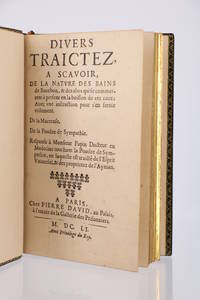
165189641Paris: Pierre DAVID 1651. Fine. Pierre DAVID Paris 1651 10.6 x 16.8 cm 4 volumes reliés en 1 Second edition. Full forest-green morocco binding spine with five raised bands framed with gilt dotted lines and decorated with double gilt panels gilt rolls at head and tail triple gilt fillets bordering the covers marbled paper endpapers and doublures gilt dentelle frame on the inside covers all edges gilt double gilt fillets along the edges an elegant binding signed by Krafft. Bound following it are: - Nicolas Papins De pulvere sympathico dissertatio printed in Paris by Siméon Piget in 1650 8 unnumbered leaves the last blank and 40 pp. - By the same author La poudre de sympathie deffendue contre les objections de Mr. Cattier médecin du Roy printed in Paris by Siméon Piget in 1651 4 unnumbered leaves and 56 pp. - Isaac Cattiers Response à Monsieur Papin Docteur en Medecine touchant la poudre de sympathie printed in Paris by Edme Martin in 1651 87 pp. A fine copy beautifully preserved in a splendid binding signed by Krafft. The treatise on the Scoter occupies pp. 119 of the second part. This exquisite duck has been the subject of numerous and lengthy controversies The history of the scoter deserves our attention as it holds both gastronomic and theological interest. Because of the peculiar beliefs surrounding their origin these birds were considered lean meat and therefore permitted during Lent. This curious privilege arose from the fact that they appeared suddenly in countless flocks upon the waters surface and aided by a taste for the marvellous people imagined that they were born from seaweed decayed wood or shells. The poet Du Bartas echoed this notion in his Création du Monde when he celebrated this strange creature: Ainsi le vieil fragment d'une barque se change En des canards volants ô changement étrange Même corps fut jadis arbre verd puis vaisseau Naguère champignon et maintenant oyseau! It is easy to see how such a belief could reassure the most timid consciences; it thus required Pope Innocent III to issue an explicit prohibition placing the flesh of the scoter among forbidden meats. In vain did he launch his prohibitions for enthusiasts continued to eat them; and when the truth about these birds became known thanks to Graindorge and the accounts of navigators other pretexts were sought to preserve the old regulations. It was suggested that the scoters blood was cold even claimed that its fat resembled fish oil and the custom which lasted into the nineteenth century of eating scoters during Lent was extended to other waterfowl such as brant geese coots and teal which were conveniently confused with the species sanctioned by the councils. Cf. G. Oberlé Les Fastes de Bacchus et de Comus no. 869 concerning Graindorges Traité de lorigine des macreuses 1680. Pierre DAVID hardcover
169555262Amsterdam: Be-veit ha-meshutafim Asher Anshil ben Eliezer ve-Yisakhar Ber ben Avraham Eliezer/ Moses Wiesel 1695. First edition. Hardcover. fair. Small folio 29 by 18.5 cm. Collation: aleph-vav4 zayin2 = 26 numbered leaves. Additional engraved title page engraved folding map at rear; main title with woodcut vignette; 14 half-page engraved illustrations in the text. Contemporary quarter calf over dark brown pastepaper boards skilfully rebacked. Images of Moses and Aaron at engraved title excised the seven small engraved vignettes along with letterpress text of engraved title and imprint mounted on old paper. Old marginal repairs at main title resulting in slight loss of initial letters along right margin and several leaves; slight strictly marginal worming and occasional tears. Stained throughout sometimes heavily though not impairing legibility. Map mounted to reinforce tears with virtually no loss of text or engraved imagery apart from printed border at right side. A fair copy at best; despite all defects the half-page engraved illustrations have survived intact with minimal staining. Housed in new maroon buckram slipcase.<br /> <br /> First edition of this gorgeously illustrated work now referred to simply as the Amsterdam Haggadah. The first such work to be illustrated with copperplate engravings it ranks among the most imitated of the Jewish manuals for the Passover seder. The popularity of these illustrations can be attested by the huge number of reprint editions over the centuries. Fourteen finely printed half-page engravings appear throughout the text. Some of these images illustrate the traditional content of the Passover seder or the Exodus story while others reference other biblical tales. Images include: the Rabbis of Bene Brak discussing the Passover story the four sons Abraham smashing the idols of his father Abraham welcoming the three angels Moses slaying the Egyptian overseer the rescuing Moses from the river Moses and Aaron coming to Pharaoh w/ staves turning to snakes the ten plagues the Egyptian army drowning in the Red Sea the Exodus the receiving of the Ten Commandments at Mt. Sinai the eating of the Pascal Lamb King David composing his psalms and finally an exterior view of the Jewish Temple with the cityscape of Jerusalem in the background. All images are captioned with relevant passages in Hebrew. The engravings were all created by Abraham ben Jacob a German convert to Judaism who had moved to Amsterdam although some sources over the years misattributed them to financier Moses Wiesel 6 of which were adaptations and/or modifications of previous images by Swiss artist Matthäus Merian 1593-1650 from his original work "Icones Biblicae" 1625-30.<br /> <br /> In addition to the in text engravings there is famously fold-out engraved biblical map of the Holy Land in a notable format. Measuring a total of 19.5 by 11.5" the map shows the land of Israel the Wilderness of Sinai and Egypt in landscape orientation looking eastward towards the top of the map. It traces the journey of the Israelites starting with the Exodus from Egypt through the Sinai and into the Land of Israel. The map is detailed showing the areas of the twelve tribes important locations and cities as well as geographic features including the Red Sea Mount Sinai the Dead Sea the Sea of Galilee and many others. Additional illustrations appear near the bottom along with a legend. This beautiful work also by Abraham ben Jacob is considered among the earliest if not the first map of its kind to be printed within a Hebrew publication. It is now known to have been heavily based on the previously printed 1620 map in Hebrew by Jacob ben Abraham Zaddiq and Abraham Goos 1590 - ca. 1643 which itself was based on the map of 1590 by Christian Kruik van Adrichom Adrichem printed in Latin.<br /> <br /> Text throughout is printed in Hebrew with smaller text in Rashi script underneath containing famous commentary on the Passover Haggadah by acclaimed Portuguese Rabbi and scholar Isaac ben Judah Abarbanel 1437-1508. The verso of the title page contains the order of the Passover seder with brief instructions in both Ladino Judeo-Spanish and Yiddish Judeo-German a nod to the subtitle which references both the Ashkenazi and Sephardi traditions.<br /> <br /> Provenance and annotations: Full page of text appx. 1500 words in neat Hebrew cursive at front endleaf which discusses aspects of the Haggadah text; inscription in German at front endleaf by Isidor Adler who mentions his friend Hermann Mechlenburg dated March 1906; old annotations throughout in at least two hands. In one notable instance the Hebrew phrase l'shana ha-ba'ah be-hamburg next year in Hamburg! has been added in fine block characters above the traditional phrase l'shana ha-ba'ah bi-yerushalayim next year in Jerusalem. Hebrew title: סדר הגדה של פסח ×›×ž× ×”×’ ××©×›× ×– וספרד <br /> Alternate transliterations: Seder Hagadah shel Pesah Seder Hagadah sel Pesah<br /> <br /> References: Friedberg 278 Fuks HTN II 521; Yudlov Haggadah 93; Vinograd Amsterdam 627; Ya'ari no. 59; Laor 876 Map; Nebenzahl pp.138-1389 Map; Yerushalmi plate 59-62; Rosenau "Vision of the Temple" p.135 146-7. Be-veit ha-meshutafim [Asher Anshil ben Eliezer ve-Yisakhar Ber ben Avraham Eliezer]/ Moses Wiesel hardcover
1700000819Boston Massachusetts MA 1700. On offer is a superb and important piece of Americana specifically a handwritten deed concerning the very important geographic area of Fort Warren which defends the harbor in Boston Massachusetts and has done so from 1861 through the end of World War II. To buffs of the Civil War it was also the location where the famous Union marching anthem 'John Brown' was written using a tune from an old Methodist camp song 'Glory Glory Hallelujah!' and signed by Isaac Addington who served on the Salem Witch Trial Grand Jury and Adam Winthrop the son of John Winthrop First Governor of Massachusetts. John Winthrop 1588-1649 is perhaps best remembered for the famous sermon in which he likened the Massachusetts Bay Colony to a 'city upon a hill' a model to the world of social and religious order." Ref: Wikipedia. This manuscript document is dated Boston 27 Dec 1700. Folded into thirds Calligraphic initials. SIGNED BY ADAM WINTHROP son of John Winthrop First Governor of Massachusetts and ISAAC ADDINGTON clerk of the Grand Jury during the Salem Witch Trials. This is the original deed referenced by Holmes Abiel 1763-1837. Cambridge : Hilliard and Brown 1829. from the Coll. Mass. HiM. Soc. iii. 299. which states: "In 1700 Adam conveyed the island to his son-in-law and daughter to be transmitted to their descendants. The Indenture handsomely written on parchment is now before me. It covenants and grants the island to "John Wainwright and to Ann his wife during the term of their natural lives and afterward to the use and behoof of the heires of their two body. begotten or to be begotten forever." The island was next owned by their son John Winthrop Professor of Mathematics and Natural Philosophy In Harvard College; and next by his sons Hines and William of Cambridge lately deceased. James purchased of William his share and a few years since sold to the United States about five acres in two parcels at the east and west end of the island with a passage way rota the one to the other for the purpose of fortifications. On the west end has been erected Fort Warren which defends the entrance of the harbour." CONDITION: signatures are strong and legible majority of the deed legible though with age-wear sometimes serious rubbing and fading discoloration some holes; certainly not in the presumed fine condition when Abiel Holmes held the document in 1829 but certainly very presentable with the red wax seal still intact. This document is a wonderful tapestry comprised of the strands of early Colonial history. Inherited by his son Adam it links the famous Winthrop name from his namesake Grandfather Adam Winthrop 1548-1623 an English lawyer and famous Puritan reformer in the Elizabethan and Jacobean periods through his great grandson Professor John Winthrop who was intimately connected to Harvard University's early history. The document is also witnessed and signed by Isaac Addington the first Secretary of the Mass. Bay Colony from 1692 to 1714 who additionally served on the grand jury in the Salem witch trials. The trials famously resulted in the executions of 20 people 14 women 6 men. PROVENANCE: Most recently from a private collector the present condition suggests this deed has long been in private hands and not an institutional archive. While in the 1820s the deed was possibly present in the archives of the Mass Historical Society it did not remain in the archives long thereafter and entered less protected private circulation. That stated Mr. Jeremy B. Dibbell of the Massachusetts Historical Society has kindly confirmed that this document like others that have entered private hands is not the property of the Massachusetts Historical Society. . Good. Atlas Folio - over 23" - 25" tall. Manuscript. unknown
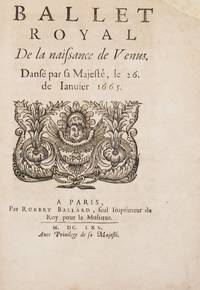
16653806A Paris: Par Robert Ballard seul Imprimeur du Roy pour la Musique 1665. First edition. Later green half morocco over marbled paper boards spine lettered in gilt. Italian provenance: early manuscript ownership inscription on the first leaf dated 30 Genn.o 1665 30 January 1665 partly torn and restored; later engraved armorial bookplate on the inner front panel. Paper tanned as usual; early folds and handling marks; otherwise clean and well preserved. First edition. Later green half morocco over marbled paper boards spine lettered in gilt. 52 2 p. <p><br /> Scarce first edition of the libretto of Lully's Naissance de Vénus a key work in the development of the French court-ballet tradition in a copy preserving a contemporary inscription dated only days after the premiere.<br /> <p><p><br /> First edition printed for the premiere of the libretto for the court ballet performed on 26 January 1665 at the Palais-Royal. The text was written by Isaac de Benserade and the music composed principally by Jean-Baptiste Lully at the request of Louis XIV and in honour of the king's sister-in-law Henrietta of England who appeared in the performance as Venus.<br /> <p><p><br /> The copy preserves an early Italian inscription dated 30 January 1665 only four days after the premiere suggesting that it may have been received in connection with the performance possibly by someone present at the court spectacle.<br /> <p><p><br /> The ballet belongs to the tradition of the French ballet de cour one of the principal ceremonial theatrical forms cultivated at the court of Louis XIV. The libretto presents a large mythological spectacle in two parts comprising twelve entrées. Conceived on an exceptional scale the production involved 96 performers representing 106 roles accompanied by 20 musicians and 14 singers with Louis XIV himself appearing in the final scene as Alexander the Great.<br /> <p><p><br /> Printed libretti of this type formed part of the broader genre of festival books ephemeral publications describing royal festivities and spectacles staged for political and ceremonial display. The present libretto is accordingly included in the Oxford "Early Modern Festival Books" collection which documents printed accounts of court celebrations and theatrical spectacles across Europe. <br /> <p><p><br /> A rare printed witness preserving a contemporary inscription to one of the most elaborate court ballets of Louis XIV's reign and an important document of early French operatic culture marking the culmination of the ballet tradition from which Lully would soon develop the tragédie en musique.<br /> <p><p><br /> LWV 27 <br /> <p>. Par Robert Ballard, seul Imprimeur du Roy pour la Musique unknown
169555736Amsterdam: Be-veit ha-meshutafim Asher Anshil ben Eliezer ve-Yisakhar Ber ben Avraham Eliezer/ Moses Wiesel 1695. First edition. Hardcover. g to near fine. Small folio 30 by 18.8 cm. Collation: aleph-vav4 zayin2 = 26 numbered leaves. Full period brown paper boards re-backed with a brown leather spine with raised bands.<br /> <br /> Letterpress title-page with ornate floral woodcut device; additional engraved title-page mounted depicting Moses and Aaron along with six small biblical scenes within round borders all against an architectural background. Engraved folding map at rear mounted; main title with woodcut vignette; 14 half-page engraved illustrations in the text.<br /> <br /> This gorgeously illustrated work is the first edition of the famous and highly influential Passover Haggadah printed in Amsterdam in 1695. Simply known as the Amsterdam Haggadah this edition stands as among the most imitated and copied haggadahs in history and was the first to be illustrated with copperplate engravings. Previous illustrated haggadahs had used woodcuts. The popularity of these illustrations can be attested by the huge numbers of reprint editions over the centuries. There are 14 finely printed large in-text engravings plus the full page engraved title page showing Moses Aaron and Adam in the Garden of Eden. Some of these images illustrate the traditional content of the Passover seder and/or the exodus story while some are other biblical stories less directly related. Images include: the Rabbis of Bene Brak discussing the Passover story the four sons Abraham smashing the idols of his father Abraham welcoming the three angels Moses slaying the Egyptian overseer the rescuing Moses from the river Moses and Aaron coming to Pharaoh w/ staves turning to snakes the ten plagues the Egyptian army drowning in the Red Sea the Exodus the receiving of the Ten Commandments at Mt. Sinai the eating of the Pascal Lamb King David composing his psalms and finally an exterior view of the Holy Temple with the cityscape of Jerusalem in the background. All images are captioned underneath with relevant passages in Hebrew. The engravings were all created by Abraham ben Jacob a German convert to Judaism who had moved to Amsterdam although some sources over the years misattributed them to financier Moses Wiesel 6 of which were adaptations and/or modifications of previous images by Swiss artist Matthäus Merian 1593-1650 from his original work "Icones Biblicae" 1625-30.<br /> <br /> In addition to the in text engravings there is famously a phenomenal fold-out engraved biblical map of the holy land. Measuring a total of 19.5x11.5" the map shows the land of Israel the Sinai desert and Egypt in landscape orientation looking eastward towards the top of the map. It traces the journey of the Israelites starting with the Exodus from Egypt through the desert and into the Land of Israel. The map is detailed showing the areas of the twelve tribes important locations and cities as well as geographic features including the Red Sea Mount Sinai the Dead Sea the Sea of Galilee and many others. The map is decorated with additional illustrations near the bottom and includes a key. This beautiful work also by Abraham ben Jacob is considered among the earliest if not the first map of its kind to be printed within a Hebrew publication. It is now known to have been heavily based on the previously printed 1620 map in Hebrew by Jacob ben Abraham Zaddiq and Abraham Goos 1590 - ca. 1643 which itself was based on the map of 1590 by Christian Kruik van Adrichom Adrichem printed in Latin.<br /> <br /> Text throughout is printed in Hebrew with smaller text in Rashi script underneath containing famous commentary on the Passover Haggadah by acclaimed Portuguese Rabbi and scholar Isaac ben Judah Abarbanel 1437-1508. The verso of the title page contains the order of the Passover seder with brief instructions in both Ladino Judeo-Spanish and Yiddish Judeo-German a nod to the subtitle of Haggadah which references the both Ashkenazi and Sephardic traditions.<br /> <br /> This copy with binding in beautiful condition with being professionally restored includining spine re-backed to style. Book block tight. Interior with some staining to pages throughout from use. Binding in very good to near fine inteiror in good condition overall. Hebrew title: סדר הגדה של פסח ×›×ž× ×”×’ ××©×›× ×– וספרד <br /> Alternate transliterations: Seder Hagadah shel Pesah Seder Hagadah sel Pesah<br /> <br /> References: Friedberg 278 Fuks HTN II 521; Yudlov Haggadah 93; Vinograd Amsterdam 627; Ya'ari no. 59; Laor 876 Map; Nebenzahl pp.138-1389 Map; Yerushalmi plate 59-62; Rosenau "Vision of the Temple" p.135 146-7. Be-veit ha-meshutafim [Asher Anshil ben Eliezer ve-Yisakhar Ber ben Avraham Eliezer]/ Moses Wiesel hardcover
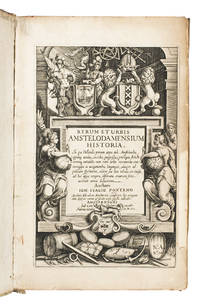
161121770Amsterdam: Jodocus Hondius 1611. Contemporary limp vellum sewn on 4 supports laced through the joints with the manuscript title and author on the spine. Folio. With an engraved title 7 engraved maps and plates 5 folding 2 double-page and 50 engraved maps and views in the text. First edition of the first objective description of Amsterdam and its history with extensive accounts of Dutch East India Company's VOC maritime trade exploration and navigation. It contains the report of Willem Barentsz' voyages to the Arctic region in search of a North-East passage to Asia 1594-1597 the accounts of the two first Dutch voyages to the East Indies including the voyage of Cornelis de Houtman 1595-1597 and the account of the Dutch exploration of Greenland 1594-1596. The work is also important as an Americanum as it gives the results of Henry Hudsons first two voyages to the Arctic 1607-1608 for the Muscovy Company of London. These reports are beautifully illustrated by large maps and views including a famous map of the North Pole region.Johannes Isaac Pontanus 1571-1639 was a physician and historian who was a professor at the University of Harderwijk for most of his life. He wrote several important historical works such as the history of Denmark of the Duchy of Gelre and of Amsterdam. His work on Amsterdam far exceeds the limits of the usual town descriptions elaborately incorporating the history of the voyages of exploration and commerce undertaken by the enterprising citizens of Amsterdam. Pontanus also describes in detail the activities on the Amsterdam stock and commodity markets which were among the earliest of the world and at the time the most important. The extent of the citys trading activities by this time is shown by illustrations of scenes from Indonesia and India to the Arctic.The binding is somewhat stained and soiled with a restoration at the foot of the spine and along the fore and foot edge of the back board. The work is lightly browned and foxed throughout a faint water stain in the margin of the last 11 leaves. Otherwise in good condition.l Alden & Landis II 611/91; V. Gestel-Van het Schip Maps in books of Russia and Poland 218; JCB II p. 78; JFB p. 369; Nijhoff & V. Hattum 252; Sabin 64002; STCN 850336392 19 copies; Tiele Bibl. 876. Jodocus Hondius, hardcover
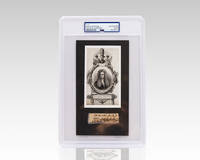
1700151722ca. 1700-1708. Autograph manuscript fragment on the Newton family lineage. England undated. A single leaf bearing autograph text in the hand of Sir Isaac Newton on both sides. 2.25 x 0.75 inches approx. 5.7 x 1.9 cm. Transcription recto: "Of the older family I am . whom I take to be my . of William Newton baptized 1541 whom ." Transcription verso: "for had by a . was next heir at law . infants and to that purpose . of her daughter with his ." A working genealogical note in Newton's hand evidently drawn from a longer document in which he traces a line of descent through one William Newton baptized 1541. The verso references questions of heirship and minor children suggesting the fragment formed part of Newton's private inquiry into the legal and lineal standing of the Newton family. Newton's documented genealogy situates him within the rural gentry of early modern England. He was born at Woolsthorpe Manor Lincolnshire to Isaac Newton a yeoman farmer who died before his son's birth and Hannah Ayscough daughter of a local clergyman. The paternal line can be traced to his grandfather Robert Newton also of Woolsthorpe indicating a family of modest landholding status. The maternal Ayscough line connected Newton to the educated clerical class a milieu that may have shaped his early intellectual formation. The present fragment though brief offers direct testimony of Newton's own engagement with the question of his ancestry and joins the small body of surviving manuscript material in which he records personal and familial concerns rather than scientific or theological matters. Condition: In good condition; minor wear consistent with age. The fragment has been archivally encapsulated by PSA/DNA together with a portrait of Newton and the corresponding authentication with the verso of the autograph remaining visible for examination. Authentication: PSA/DNA. Sir Isaac Newton 1642–1727 widely regarded as one of the most influential scientists in history established the foundational principles of classical mechanics in his Philosophiæ Naturalis Principia Mathematica wherein he articulated the three laws of motion and formulated the law of universal gravitation including the inverse-square relationship governing gravitational force. In addition to these achievements Newton independently developed the mathematical framework of calculus providing essential tools for the advancement of physics and mathematics. His extensive investigations into light and optics grounded in original experimentation significantly advanced contemporary understanding of the nature of light and color. Rejecting the long-standing authority of Aristotelian philosophy Newton instead championed an empirical experiment-based approach to scientific inquiry thereby helping to define the methodological foundations of modern science. unknown
16661299Nurnberg 1666. Houzeau & Lancaster 3039; Zimmer 5089 1628 Strasbourg ed.; Poggendorff 1984. Warner The Sky Explored pp. 104-5. Extremely rare German edition a Latin edition was published the same year of Sturms enlargement of Habrechts famous treatise on the making of celestial and terrestrial globes published in 1628. The Habrecht family of clock and instrument makers were famous throughout Europe from the last quarter of the sixteenth century to the end of the seventeenth century. The authors father also called Isaac was responsible for making the monumental second Strasbourg clock which was one of the mechanical wonders of its time on the Continent. Isaac Habrecht 1589-1633 was a Strasbourg physician mathematician and maker of globes. He was much influenced by Blaeu and Hondius and his globes were highly regarded. J. C. Sturm was Habrechts student and a scientist of vision. He organized the first scientific academy in Germany the Collegium Curiosum sive Experimentale at Altdorf in 1672 and introduced the first course in experimental physics in a German university. In 1666 he undertook the task of augmenting Habrechts original text and adding a number of folding plates. The plates include two handsome polar projections of the world two polar stereographic celestial charts of the northern and southern constellations and ten folded engravings showing the various parts of his planiglobiums.The fourteen folded engravings superbly executed by Jacob von der Heyden were probably intended to be mounted and assembled to form several instruments each with a revolving plate measuring 27 cm in diameter and a movable pointer. Each was to be supported on an approximately 12-cm base. The work is one of the most beautiful instrument books published in the seventeenth century and certainly one of the rarest particularly with the full complement of plates. Despite being an obvious Americanum see pp. 205 228 231 and America pictured on one of the maps it is not in Sabin JCB Palmer and other standard bibliographies. Houzeau & Lancaster lists a 1650 edition that is clearly an error as Sturm would have been 15 years old at the time.OCLC lists Yale for the German and Chicago for the Latin editions. unknown books
16661299Nurnberg 1666. Houzeau & Lancaster 3039; Zimmer 5089 1628 Strasbourg ed.; Poggendorff 1984. Warner The Sky Explored pp. 104-5. Extremely rare German edition a Latin edition was published the same year of Sturms enlargement of Habrechts famous treatise on the making of celestial and terrestrial globes published in 1628. The Habrecht family of clock and instrument makers were famous throughout Europe from the last quarter of the sixteenth century to the end of the seventeenth century. The authors father also called Isaac was responsible for making the monumental second Strasbourg clock which was one of the mechanical wonders of its time on the Continent. Isaac Habrecht 1589-1633 was a Strasbourg physician mathematician and maker of globes. He was much influenced by Blaeu and Hondius and his globes were highly regarded. J. C. Sturm was Habrechts student and a scientist of vision. He organized the first scientific academy in Germany the Collegium Curiosum sive Experimentale at Altdorf in 1672 and introduced the first course in experimental physics in a German university. In 1666 he undertook the task of augmenting Habrechts original text and adding a number of folding plates. The plates include two handsome polar projections of the world two polar stereographic celestial charts of the northern and southern constellations and ten folded engravings showing the various parts of his planiglobiums.The fourteen folded engravings superbly executed by Jacob von der Heyden were probably intended to be mounted and assembled to form several instruments each with a revolving plate measuring 27 cm in diameter and a movable pointer. Each was to be supported on an approximately 12-cm base. The work is one of the most beautiful instrument books published in the seventeenth century and certainly one of the rarest particularly with the full complement of plates. Despite being an obvious Americanum see pp. 205 228 231 and America pictured on one of the maps it is not in Sabin JCB Palmer and other standard bibliographies. Houzeau & Lancaster lists a 1650 edition that is clearly an error as Sturm would have been 15 years old at the time.OCLC lists Yale for the German and Chicago for the Latin editions. unknown
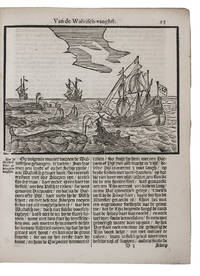
166598MCBSHUHD3NAmsterdam 1665. 4to. Gillis Joosten Saeghman Late 19th-century vellum with the title stamped on the spine with black foil a black single fillet border on both boards. With a woodcut vignette of ships on the title page 16 further woodcuts on integral leaves 1 full-page signed by Christoffel van Sichem IV and 9 half-page and smaller with his monogram and a woodcut ship in a cartouche plus 1 repeat woodcut decorated initials and decorative bands built up from cast fleurons. Set in textura types with incidental roman and italic. 32 pp. First Dutch translation of the accounts of three voyages to Greenland by Jens Munk John Monck Martin Frobisher and Godske Lindenau searching for a passage to the East Indies through the Hudson Strait. Also containing a description of Greenland and an account of whaling including an unsigned illustration of a beached sperm whale with new illustrations by Christoffel van Sichem IV 1642-1693. It is a Dutch translation of La Peyrère's 1647 Relation du Groenland 1647 via the somewhat abbreviated German translation published in Hulsius's 1650 collection which contains the additional description of Spitsbergen and a discourse on whaling. La Peyrère included revised versions of Jens Munk's account of his voyage to Hudson Bay originally published in Navigatio septentrionalis 1624 and the accounts of voyages by Martin Frobisher and Godske Lindenau. Red armorial library stamp of the Forschungsstelle Volk und Raum on the title page: this was a research institute active at The Hague during the occupation of The Netherlands by Nazi Germany. Good copy.l Alden & Landis 663/79; Gosch Danish Arctic expeditions II pp. lxii-lxiii; JCB III pp. 98-99; Tiele Mém. 256; Sabin 28641 & 51334; STCN 4 copies; cf. Howgego to 1800 F80-F81 L128 and M180. ABE CAT Alaska Canada & Greenland hardcover
16932188Oxford: Oxford University Press 1693. First collected edition. Contemporary calf. Very Good. SCARCE FIRST EDITION OF THE COLLECTED WORKS of one of Newton's most important precursors John Wallis Savilian Professor 1649-1703 containing the first printed appearance of Newton's ideas on fluxions. A staunch promoter of English mathematicians Wallis repeatedly urged Newton to publish his theories before others laid claim to he work for the sake of "your Reputation & that of the nation" Gjertsen Newton Handbook 605. While Newton resisted for many years in 1693 Wallis published several letters from Newton in Vol. II of his Opera thereby introducing the concept of fluxional notation-pricked and dotted letters. In the preface to Vol. I 1695 Wallis refers briefly to Newton's claim to the discovery of Fluxions while Vol II 1693 has the first full account of Newton's invention of calculus. The third volume of Wallis's Opera contains previously unpublished correspondence between Newton and Leibniz the most important items of which are Newton's Epistola prior and Epistola posterior. "These two lengthy letters were sent to Leibniz in 1676 to acquaint him with the main lines of Newton's mathematical development. Epistola prior beginning with the binomial theorem went on to describe Newton's work on series. The second letter also contains much discussion on infinite series. It is best known however for Newton's reference to powerful and general methods he had developed for the drawing of tangents the determination of maxima and minima and the quadrature of curves. These he added he preferred to conceal within a quite insoluble anagram. A second and even longer anagram concealed Newton's claim to be able to solve fluxional equations. The solutions to both were publicly disclosed by Wallis 1699" ibid 189. Vol. 2 of the Opera also contains pp. 669-78 De Postulato Quinto; et Definitione Quinta; Lib. 6. Euclidis; disputatio geometrica Wallis's important attempt to prove the parallel postulate of Euclid also published here for the first time. "John Wallis gave a lecture on this topic. on the evening of 11 July 1663. He had been inspired by Nasr-Eddin's attempt on it which he referred to in his lecture to examine the question himself and his analysis is remarkable both for its originality and its caution. Indeed his view of the matter was to be much more profound than many a later writer's" Fauvel & Gray The History of Mathematics 510. This magnificent and comprehensive edition of Wallis's collected works was financed by and printed at Oxford University. In addition to several 'firsts' including those described above these volumes contain reprints of virtually all of Wallis's great books including the Arithmetica infinitorum and Mechanica Vol. 1 an augmented Latin edition of the Treatise of Algebra Vol. II and bilingual editions of a number of ancient Greek texts including Ptolemy's Harmonics Aristarchus's On the magnitudes and distances of the sun and moon and Archimedes's Sand-reckoner Vol. III. In addition to numerous other mathematical works the four volumes include his most popular work Grammaticae lingua anglicanae his "Treatise of Speech which formed a useful theoretical foundation for his pioneering attempts to teach deaf-mutes how to speak" DSB as well as an important tract on cryptography in which he records the methods he developed while deciphering for Cromwell the coded messages of Charles I. Wing W596 W566 W597. Babson 184. Roberts and Trent 345. see J.F. Scott The Mathematical Work of John Wallis London 1938; M. Baron The Origins of the Infinitesmal Calculus Oxford 1969 205-213; Richard Westfall The Life of Isaac Newton Cambridge 1993 207-209ff. Opera Mathematica. Volumen primum -Tertium - Opera quaedam miscellanea. Oxford: Sheldonian Theatre University Press 1695 1693 1699. Four volumes bound in three. Folio contemporary full paneled calf rebacked to style. Complete with four engravings on three leaves and three portraits Vols. I & II with the same portrait by Loggan dated 1678 and engraved by Burghers; Vol 3 by Sonmans dated 1698 and engraved by Burghers. With large bookplate inside each front cover reading "The Gift of Mr. Thomas Heatley Citizen and Iron-monger of London to the Mathematical School in Christ's Hospital Anno Dom. 1700". A very clean copy with only occasional light browning and foxing very handsomely bound. ONE OF THE MONUMENTS IN THE HISTORY OF MATHEMATICS. RARE. . Oxford University Press unknown books
1646ABC_50158Amsterdam: Johannes Janssonius 1646. Modern vellum sewn on 4 supports laced through the joints with the title volume number and year of publication lettered in gold on the spine. Oblong 4to. With a richly engraved allegorical frontispiece in each volume one by J. van Meurs the other unsigned and 229 engraved maps views and plates illustrating the voyages several double-page or folding including a large folding map of the world. 21 parts in 2 volumes. First edition second issue with a newly engraved title page of the most important collection of Dutch voyages to the North around the world and to the East Indies undertaken between 1595 and 1640. Widely regarded as one of the greatest voyage collections published in any language the work assembles journals drawn from original editions autograph manuscripts supplied to the editor and first-hand narratives. Compiled by Isaac Commelin 1598-1676 a prominent Amsterdam bookbinder and scholar the collection is also celebrated for its extensive corpus of maps and plates carefully copied either from the original editions or the navigators own manuscript charts.The work was originally published by Johannes Janssonius in Amsterdam under the title Oorsprongh ende Voortgangh der Nederlantsche Oost-Indische Compagnie. It first appeared in 1645 and following its immediate success was reissued in 1646. Divided into twenty-one parts each section comprises multiple travel accounts which are supplemented by official documents and editorial commentaries by Commelin under the heading "Inworp" intended to update and contextualise the reports. Twelve of the travel accounts appear here for the first time including expeditions to the East Indies by Pieter Both Jacob van Neck Steven van der Hagen Wolphert Hermansz Van Warwijck and De Weert Cornelis Matelief Paul van Caerden Wybrant Schram H. Hagenaer and the voyages to the East Indies China and the Philippines by P. Verhoeven. Particularly significant are the preliminary sections which include the full text of the Dutch East India Company's VOC founding charter of 1602 the revised charter of 1622 and other key documents relating to the establishment and governance of the company up to 1631. As such the collection is one of the most important sources for the early history of the VOC. An extensive list of contents is available upon request.With a faded library stamp on the title page of the first part. One outer edge on the binding has been nibbled at by mice. The frontispiece in the first volume has been mounted onto a blank leaf lacking a plate in part 10 several margins have been strengthened a few professional restorations and a few minor marginal defects. Otherwise in good condition.l Alt-Japan-Kat. 370; Cox I p. 9; Landwehr VOC 250; Mendelssohn I 603; Sabin 14959; Tiele 82; Tiele Mémoire pp. 13-14; vol. 1: STCN 305246402; USTC 1022633; vol. 2: STCN 189559209; USTC 1019655; cf. Sabin 14959. Johannes Janssonius], hardcover
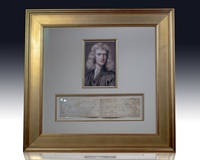
1698149618January 25 1698-1699. Rare vellum manuscript signed by Sir Isaac Newton as Warden of the Royal Mint in which he makes a case against his nemesis coin counterfeiter William Chaloner soon to be hanged for high treason. One page vellum manuscript document signed by Isaac Newton  “Is. Newton†January 25 1698-1699. Recognizance bond issued by Isaac Newton as Warden of the Royal Mint to ensure the future appearance of Nathaniel Peck as a witness against Newton’s nemesis the counterfeiter William Chaloner. The document reads in part "Nathanl Peck de Black Fryars London…Thos Worley de St Sepulchres London Glover…Symon Cross de east Aurifaber…Upon Condition the said Peck do personally appear at the next Genll Sessions of the peace …in St John str for the County aforesaid Then and there to answer…objected agt him touching his packing away Counterfeit money for advantage." Appointed as Warden of the Mint in 1696 upon the recommendation of Charles Montagu Chancellor of the Exchequer Isaac Newton ascended to the role of Master of the Mint the following year—a position he would retain for the remainder of his life. Prioritizing his duties at the Mint over his academic commitments he relinquished his responsibilities at Cambridge in 1701 to devote himself fully to the office. As Master Newton spearheaded significant currency reforms and pursued counterfeiters with unwavering diligence wielding the full force of the law as exemplified by the fate of William Chaloner. On the very day Newton signed this bond he received a formal statement from Nathaniel Peck who attested that seven years prior Chaloner had commissioned him to modify two iron pieces which were subsequently used to produce counterfeit French pistoles. Additionally Peck admitted to purchasing counterfeit pistoles from Chaloner at a rate of eight shillings per coin and reselling them for eleven shillings. Some months later Chaloner provided Peck with forged guineas which he likewise circulated before Chaloner turned to Thomas Holloway as his preferred distributor. By early 1699 Newton had compiled a formidable body of evidence against Chaloner consisting of 44 depositions. Chaloner had been apprehended in November 1698 on charges of forging lottery tickets though those specific allegations were ultimately dismissed. Nevertheless Newton proceeded to indict him on three separate counts securing a conviction for high treason on March 3 1699. Mere weeks later on March 22 Chaloner met his end at the gallows of Tyburn. In good condition fold at center scattered toning. Archivally mounted matted and framed with a portrait of Newton. The document measures 12.25 inches by 3 inches. The entire piece measures 23.5 inches by 23 inches. Signed documents by Newton are exceptionally rare. Isaac Newton 1643–1727 was an English mathematician physicist and astronomer widely regarded as one of the most influential scientists in history. His groundbreaking work Philosophiæ Naturalis Principia Mathematica 1687 laid the foundation for classical mechanics introducing the laws of motion and universal gravitation. However beyond his scientific achievements Newton played a crucial role in England’s financial and legal system. In 1696 he was appointed Warden of the Royal Mint largely due to the recommendation of Charles Montagu Chancellor of the Exchequer. A few years later in 1699 he became Master of the Mint a position he held until his death. Newton took his role seriously overseeing the recoinage of England’s currency implementing measures to stabilize the economy and aggressively pursuing counterfeiters. His meticulous investigations led to the conviction of notorious forgers like William Chaloner demonstrating his unwavering commitment to upholding the integrity of England’s monetary system. hardcover