NEWTON IsaacABAA

114 résultats
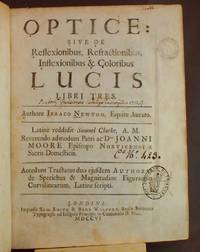
17045582London: Sam. Smith and Benj. Walford Printers to the Royal Society 1704. Hardcover. Near Fine. 4to. 24.2 x 18.8 cm. 2 ff. 144 pp. 211 pp 1 pp. with 19 folding engraved plates. Bound in contemporary English paneled calf. Minor ribbing to binding. Only very minor marginal traces of use. Very genuine. Excellent. First edition first issue of this landmark in science by Sir Isaac Newton 1642-1727 here in a remarkably well preserved unrestored example. "The work summarized Newton's discoveries and theories concerning light and color: the spectrum of the sunlight the degrees of refraction associated with different colors the color circle the first in the history of color theory the invention of the reflecting telescope the first workable theory of the rainbow and experiments on what would later be called 'interference effects' in conjunction with Newton's rings . . . The first edition of the Opticks ends with two mathematical treatises in Latin written to establish his priority over Leibnitz in the invention of the calculus" Norman 1588. Babson 132; Dibner 148; Horblit 79b; PMM 172; Norman 1588; Wallis 174. <br/> <br/> Sam. Smith and Benj. Walford, Printers to the Royal Society hardcover books
1704157612London: Smith & Walford 1704. First. hardcover. very good. Also Two Treatises of the Species and Magnitude of Curvilinear Figures. 4 parts in 1 volume. Title page printed in red & black within a double-ruled border. Illustrated with 19 folding copperplate engravings.4 144 211 1pp. In the second sequence p. 120 is marked 112 and there are blank pages between 137-8 and 138-9. Thick 4to contemporary blind-tooled panelled calf expertly rebacked in matching leather contemporary signature on title dated 1704; last several pages have marginal dampstains otherwise a remarkably clean crisp copy. London: Smith & Walford 1704.<br/><br/> First edition first issue - with the author not named on title page. The work contains: The First Book of Opticks The Second Book of Opticks The Thrid Book of Opticks Tertii Ordinis: Enumeratio Linearum Tractatus de Quadratura Curvarum. The main work is in English the 2 treatises pages 138-211 are in Latin. Babson 132; Gray 174; Horblit 79b; PMM 172; Norman 1588; Dibner 148; Wallis 174.<br/><br/> Smith & Walford unknown books
17262210London: Guil. & Joh. Innys Regiae Societatis typographos 1726. Third Edition. contemporary full vellum. RARE 1726 THIRD EDITION OF NEWTON'S PRINCIPIA THE LAST EDITION EDITED BY NEWTON AND THE BASIS FOR ALL SUBSEQUENT EDITIONS. ONE OF ONLY 1250 COPIES PRINTED. "The Principia is generally described as the greatest work in the history of science. Copernicus Galileo and Kepler had certainly shown the way; but where they described the phenomena they observed Newton explained the underlying universal laws. The Principia provided the great synthesis of the cosmos proving finally its physical unity. Newton showed that the important and dramatic aspects of nature that were subject to the universal law of gravitation could be explained in mathematical terms within a single physical theory. With him the separation of natural and supernatural of sublunar and superlunar worlds disappeared. The same laws of gravitation and motion rule everywhere; for the first time a single mathematical law could explain the motion of objects on earth as well as the phenomena of the heavens. The whole cosmos is composed of inter-connecting parts influencing each other according to these laws. It was this grand conception that produced a general revolution in human thought equalled perhaps only by that following Darwin's Origin of Species. It was the final irrevocable break with a medieval conception based on Greek and Roman cosmology and a scholastic system derived from the medieval interpretation of Aristotle. Newton's universe almost independent of the spiritual order ushered in the age of rationalism scientific determinism and the acceptance of a mechanistic view of nature" Printing and the Mind of Man 161. On the history and importance of the third edition: Towards the end of his life Newton "gave one last effort to the Principia. It is clear that he regarded the Principia rather than the Opticks as his masterwork. He worked over the Principia without end to hone its language to a perfect expression of his ideas. Perhaps the appearance of a reprint of the second edition in Amsterdam in 1723 stimulated Newton to put his plan for a new edition into action. Perhaps a serious illness in 1722 reminded him that he could not delay forever. We know only that printing of an edition more sumptuous than either of the others began in the fall of 1723. As editor Newton had the services of a young member of the Royal Society Henry Pemberton. In the fall of 1723 Pemberton addressed to him the first of thirty-one communications which stretched over the following two-and-a-half years while the edition passed through the press. Through 1724 and 1725 the edition made its slow but steady progress toward completion with none of the delays that stopped the press during the second edition. Newton dated the preface 12 January 1726. It was the last day of March when Martin Folkes presented a copy 'richly Bound in morocco Leather' to the Royal Society in Newton's name. In all 1250 copies were printed." Westfall The Life of Isaac Newton. The third edition "contains a new preface by Newton and a large number of alterations" Babson 13. With portrait engraving by Vertue bound before first text leaf and numerous illustrations in text. Complete with the privilege leaf half-title dedication leaf index and ad leaf. London: Guil. & Joh. Innys Regiae Societatis typographos 1726. Quarto 186x241 mm contemporary full Dutch vellum; custom half-leather box. Unidentified early signatures on front pastedown half-title and ad leaf verso. Mild scuffing to binding boards a little bowed. Text with occasional light soiling and scattered foxing but generally clean. A beautiful copy. SCARCE IN AN UNRESTORED CONTEMPORARY BINDING. Guil. & Joh. Innys, Regiae Societatis typographos unknown books
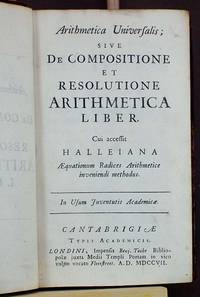
17076325Cambridge and London: Typis Academicis; Benj. Tooke 1707. First edition. Very Good/William Whiston the successor to Newton's chair at Cambridge "extracted from Newton a somewhat reluctant permission to print" this remarkable "schoolbook" based on Newton's lecture notes Babson Catalogue. So reluctant in fact that Newton kept his name out of it and supposedly considered purchasing the press run in order to destroy it! He later republished it himself. Several new theorems are laid out including a formula to determine the number of imaginary roots of any equation. The rule is complicated and is offered without proof. Yet 180 years later the rule was proven by rigorous analysis. The text also includes Edmond Halley's "Aequationum radices arithmetice inveniendi methodus. Octavo 19cm; 8 343 1 pages the last page blank . Figure and diagrams in text. Running-title: Algebrae elementa. Editor's preface signed: G.W. i.e. William Whiston. In contemporary paneled calf rebacked with new burgundy morocco spine label. Edges of boards rubbed. Early ink ownership inscriptions on blank endleaves the contemporary autograph of Edward Harington and the 19th-century mathematician William Fleetwood Sheppard. Half-title present. References: Babson Newton Collection; 199; ESTC; T018645; Bowes and Bowes 277. Typis Academicis; Benj. Tooke hardcover books
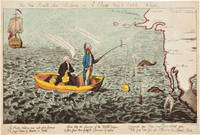
1791WRCAM51520London: H. Humphreis sic 1791. Handcolored etching 14 x 21 inches. Cropped within plate borders with no loss to image or text. Remnants of older paper pasted to verso. Color bright and fresh. Near fine. In 1789 and 1790 Nootka Sound in the Pacific Northwest looked to be the spur of a major conflict between the kingdoms of Britain and Spain. The inlet was an important outpost for maritime fur trading and had therefore become the focus of the centuries-old struggle for advantage in the New World. Courtesy of explorer and trader John Meares news of Spanish indiscretions reached Britain in 1790 and intensified the growing anti- Spanish rhetoric and call for war. Meares whose credibility was famously contested in two remarkable pamphlets by George Dixon claimed not only that the Spanish had seized British ships but that they had removed his settlement at Nootka and replaced it with their own. After debate in the House of Commons it was decided the British Navy would be mobilized. <br> <br> While Spain initially sought to go to war they could not attain the essential support of France and thus required a diplomatic solution to the problem. This came in the form of the first Nootka Convention which was signed on Oct. 28 1790. The convention guaranteed Britain the right to have outposts on Nootka Sound and to practice whaling in waters beyond the "Ten-League Line" off the coast. The Convention eventually resulted in the seminal voyage of George Vancouver to survey the Pacific Northwest. <br> <br> This print is a satire on the British Tory government's handling of the crisis. Its central critical point attacks part of the convention concerning fishing rights which Pitt's opposition latched onto as evidence of underhanded dealings. They noted that the original importance of Nootka Sound was not for whaling but rather for fur trading and that the whaling industry had surely redirected political attention toward their interests. Thus the print shows Pitt and Henry Dundas in the Pacific off the west coast of North America hopelessly fishing with millions from the treasury. As Pitt expresses worry over the spending Dundas soothes him with the knowledge that "the Gudgeons we caught in England will pay for it all." In saying so Dundas declares the Britons who supported the war to have been bait for his and Pitt's political maneuvering. The coastline is shown from southern Alaska to Mexico likewise making this an early map of California Alaska and the west coast. <br> <br> In all it is a lively expression of disbelief and anger at the amount expended on preparing for war set against the eventual prize - namely the indeterminate profitability of whaling. H. Humphreis [sic] unknown books
174595840London: Printed by James Bettenham for the Society for the Encouragement of Learning 1745. First edition in English of the mathematical appendixes to <span class="match">Newton</span>'s fundamental 1704 Opticks one of the greatest works of science ever published. Translated from the Latin by James Bettenham Professor of Mathematics at the University of Aberdeen. Quarto bound in contemporary calf gilt titles to the spine burgundy morocco spine label rebacked woodcut diagrams throughout the text engraved tailpiece. In very good condition with some light wear and browning to the text with wide margined text. Exceptionally rare and desirable first editions are scarce with only four appearing at auction in the last 90 years. English mathematician astronomer theologian author and physicist Sir Isaac Newton is widely considered one of the most influential scientists of all time and a key figure in the scientific revolution. In one of his most important works Philosophiae Naturalis Principia Mathematica Newton formulated the the laws of motion and universal gravitation that formed the dominant scientific viewpoint until being superseded by the theory of relativity. Considered one of the greatest works of science ever published Newton's second major book Opticks analyzes the fundamental nature of light by means of the refraction of light with prisms and lenses the diffraction of light by closely spaced sheets of glass and the behavior of color mixtures with spectral lights or pigment powders. Printed by James Bettenham for the Society for the Encouragement of Learning unknown books
17422085Edinburgh: T.W. and T. Ruddimans 1742. First edition. Contemporary calf gilt. Fine. FIRST EDITION of MacLaurin's most important work including a strong defense of Isaac Newton and the first full presentation and development of Newton's calculus. The William Jones- Macclesfield copy. "Colin MacLaurin was a younger contemporary and to some extent a protégé of Isaac Newton and he wrote the first thorough systematic axiomatic development of the method of fluxions the Newtonian version of the calculus. MacLaurin's magnum opus the Treatise of Fluxions published in 1742 was begun as a response to Berkeley's Analyst. MacLaurin founded the method of fluxions on a limit concept drawn from the method of exhaustions in classical geometry avoiding the use of infinitesimals infinite processes and actually infinite quantities and avoiding any shifting of the hypothesis. In addition he went on in this treatise of over 760 pages to demonstrate that the method so founded would support the entire received structure of fluxions and the calculus and could deal effectively with all of the challenge problems then being exchanged between British and continental mathematicians" Oxford National Biography. Provenance: Williams Jones the great mathematician and champion and publisher of Newton with his signed manuscript note on p. 621: "His collection of some 15000 books was considered to be the most valuable mathematical library in England and was bequeathed to George Parker the second earl of Macclesfield." The Macclesfield copy with Macclesfield bookplates and embossed stamps in each volume. Edinburgh: T.W. and T. Ruddimans 1742. Quarto 234x175mm contemporary full calf with elaborately gilt-decorated spines. With half-title in volume 1. A little worming in lower margins of first few leaves of volume 2. An outstanding set with a distinguished provenance. T.W. and T. Ruddimans unknown books
173943292London: printed for John Wilcox 1739. First edition 12mo pp. xii 88; 5 engraved folding plates of diagrams; contemporary parchment-backed marbled boards manuscript titling on spine; very good and sound. With the South Library bookplate Earls of Macclesfield and 3 small Macclesfield pressure stamps in the preliminaries. In a new maroon cloth clamshell box. This is apparently the first of two issues without the canceled title page. Both are very rare ESTC locating only one copy of each at the Bodleian and the British Library respectively. OCLC adds LC Berkeley and University of Leiden. <br/><br/> printed for John Wilcox hardcover books
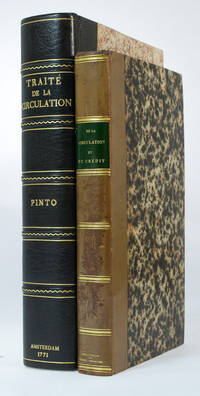
177166800The Very Scarce First Edition of "TraitÈ de la Circulation et du CrÈdit" PINTO Isaac De. TraitÈ de la Circulation et du CrÈdit. Contenant une Analyse raisonnÈe des Fonds d'Angleterre & de ce qu'on appelle Commerce ou Jeu d'Actions; un Examen critique de plusieurs TraitÈs sur les ImpÙts les Finances l'Agriculture la Population le Commerce &c. PrÈcÈdÈ de l'Extrait d'un Ouvrage initulÈ Bilan sur la Jalousie du Commerce o˘ l'on prouve que l'intÈrÃt des Puissances commerÃantes ne se croise point &c. avec un Tableau de ce qu'on appelle Commerce ou plutÙt Je d'Actions en Hollande. Par l'auteur de l'Essai sur le Luxe & de la Lettre sur le Jeu des Cartes qu'on a ajoutÈs ‡ la fin. Amsterdam: Chez Marc Michel Rey 1771. The very scarce first edition. xvi 368 with additional 8 pp. sheet H inserted before gathering I: entitled Etat des Finances en Angleterre a la fin de la session du Parlement en 1770. Nineteenth-century half calf over marbled boards spine ruled in gilt with green label and gilt lettering: at foot of spine in gilt lettering 'BibliothËque de Michel Chevalier' spine head slightly frayed. Occasional spotting and staining but a very good copy and with the bookplate of Michel Chevalier 1806-1879 follower of Saint-Simon author of the Cours d'…conomie Politique and co-architect of the Anglo-French 'Cobden-Chevalier' commercial treaty of 1860. Housed in a quarter brown morocco clamshell. "Economique. Sur le commerce l'agriculture les finances; passages pp. 70-72 sur la populatin anglaise; pp. 183-196 et 216-335 sur la population en France et en Angleterre. En particulier nÈcessitÈ d'augmenter Ègalement la population dans les villes et danse les campagnes pout Èviter les dÈsÈquilibres sociaux et Èconomiques. Analyse de plusieurs ouvrages dont un livre qualifiÈ de rare: 'Le dÈtail de la France' part Boisguilbert" INED. Pinto admired the Physiocrats but disagreed with them. "Pinto's TraitÈ is written from a national as well as an international perspective. Pinto's experience as a merchant and financier in the Republic along with his knowledge of French and English economic thought laid the foundations for his European economic model. Pinto wanted above all to convince his readers of hte soundness of the British system of public debt. With the adoption of improvements in the redemption policy proposed in his book the system would achieve a high degree of perfection. In France the physiocratic opinions of the elder Mirabeau in particular required Pinto to respond and in England the otherwise admiring Hume was in disagreement. By means of a critical discussion of the work of these and other authors Pinto propagated a financial policy that he thought would benefit both the State and the individual" I.J.A. Nijenhuis Een Joodse Philosophe. Isaac de Pinto 1717-1787 Amsterdam NEHA 1992. Goldsmiths' 10791. Higgs 5282. Kress 6811. Palgrave III pp. 109-110. HBS 66800. $8500 Chez Marc Michel Rey hardcover books
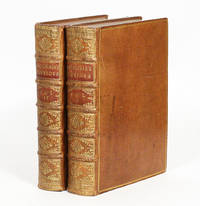
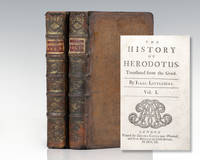
170996521London: Printed for Edward Castle and Sam Buckley 1709. First complete edition in English of Littlebury's translation of the histories of Herodotus also the first appearance in English since Thomas Marshe's 1584 incomplete translation of only the first two books. Octavo two volumes. Bound in full contemporary calf with gilt titles and tooling to the spine in six compartments within raised bands red morocco spine labels stamped ruling all edged speckled red woodcut ornaments to the title pages and colophon of volume II index. From the library of George Paterson of Castle Huntly with his armorial bookplates to the pastedowns. After amassing a large fortune with the East India Company Paterson purchased the famed Scottish Castle Huntly in 1770. In very good condition. Rare and with noted provenance. Herodotus is generally considered 'the father of history'. Departing from the Homeric chronicle 'he was the first to collect his materials systematically to test their accuracy as far as he could and arrange his story in such a way as to appeal to as well as inform his readers' PMM. His main theme which is also the subject of the present work was the struggle between Persia and Greece. Printed for Edward Castle and Sam Buckley hardcover books
17066324London: Samuel Smith & Benjamin Walford 1706. First Latin edition. Very Good/The Latin edition of Newton's 1704 Opticks was intended for the broader pan-European "Republic of Letters" and it was the first printing to carry Newton's name on the title. This is the edition that inspired Emelie du Chatelet and Voltaire and through them the whole of Europe. It is a compendium of Newton's main discoveries concerning light and color including the spectrum of sunlight the color circle the reflecting telescope and interference effects that is the so-called 'Newton's rings'. In expansion of the 1704 English text the Latin edition presents seven added "Quaestiones" which are partly devoted to Newton's support for the "corpuscular" or particle theory of light. The collation of this copy corresponds to the copy in the Babson Collection catalogue with "Pp" consisting of a single leaf and with pages 21-24 repeated in the Tractatus. . Quarto 26 cm; 14 348 2 24 2 24 21-43 1 pages 19 folded leaves of engraved plates with errata corrigenda and addenda. Ss1 a cancel. In original calf with blind-ruled border rebacked with corners built up. Spine with gilding and leather title label. Speckled edges. Old library stamps on title page along with early ownership inscriptions. References: Bowes and Bowes #179; Babson Collection 137; Norman 1589. Samuel Smith & Benjamin Walford, hardcover books
1744109523Lausanne and Geneva: Aoud Marcum-Michaelem Bousquet & Socios 1744. First edition of the first collected edition of <span class="match">Newton</span>'s writings which has been hailed as "a fine piece of bookmaking" Babson. Quarto bound in contemporary velum contains 64 folding engraved plates; 2 folding letterpress tables. In very good condition. Small stamps to the spine and title pages. Rare in contemporary binding. English mathematician astronomer theologian author and physicist Sir Isaac Newton is widely considered one of the most influential scientists of all time and a key figure in the scientific revolution. In one of his most important works Philosophiae Naturalis Principia Mathematica Newton formulated the the laws of motion and universal gravitation that formed the dominant scientific viewpoint until being superseded by the theory of relativity. Aoud Marcum-Michaelem Bousquet & Socios unknown books
174492332Lausanne and Geneva: Aoud Marcum-Michaelem Bousquet & Socios 1744. First edition of the first collected edition of <span class="match">Newton</span>'s writings which has been hailed as "a fine piece of bookmaking" Babson. Quarto bound in contemporary velum contains 64 folding engraved plates; 2 folding letterpress tables. In very good condition wide margins. Rare in contemporary binding. English mathematician astronomer theologian author and physicist Sir Isaac Newton is widely considered one of the most influential scientists of all time and a key figure in the scientific revolution. In one of his most important works Philosophiae Naturalis Principia Mathematica Newton formulated the the laws of motion and universal gravitation that formed the dominant scientific viewpoint until being superseded by the theory of relativity. Aoud Marcum-Michaelem Bousquet & Socios unknown books
1719SS13189London:: Printed for B. Creake . . . J. Sackfield . . .; And sold by W. Mears . . . 1719. 1719. Sm. 4to. xxii 201 5 pp. 10 folding engraved copperplates 5 figs. pp. 24 54 75 112 half-title is a publisher's ad for Boerhaave rear publisher's ads 2 ff. head and tail-pieces; title edges chipped. With errata. Title p.101 perforated stamp and with a rubber stamp on verso of the John Crerar Library eight plates with the ex-library rubber stamp on versos; waterstained throughout. WITH FREQUENT EARLY INK CORRECTIONAL NOTES. Modern half blind-stamped dark calf gilt spine title raised bands marbled paper over boards new endleaves bindery ticket at rear: Pat M. Bruno. Inscription on recto of front blank verso is ad for Boerhaave book "W. --- 1720 Power." SPURIOUS EDITION OF DESAGULIERS' FAMOUS PRIVATE LECTURES CONTAINING NOTES ON BOYLE'S AIR PUMP AND NEWTON ON COLOR THEORY. FIRST ENLARGED EDITION early issue without "All carefully Examined and Corrected by Mr. Desaguliers" on title which otherwise is re-titled "Lectures of Experimental Philosophy". Includes: Sir Isaac Newton's Colours. Proposition. Lights which differ in Colour differ also in Degrees of Refrangibility. Initially published without the author's permission and then by evidence of the printed Preface agreed to issue the book with an erratum. / There are multiple forms of this edition as different copies collate differently Andrade Kenney Honeyman copies. The Honeyman copy called a second edition has two title-pages and the Preface by Desaguliers with an imprint of 1719. There are also differences in the title-pages. The fiasco of the unauthorized edition is the cause of the various issue differences. "Perhaps Dawson hoped . . . to ingratiate himself with his patron but instead he incurred the wrath of the lecturer. Immediately Desaguliers became aware of the book which he called 'ill put together sadly transcrib'd and worse corrected' he approached the booksellers. He found that two-thirds of the imprint had already been sold by Messrs Mears Creake and Sackfield but they paid him ten guineas 'to pacifie me'. They also promised to insert into all remaining copies a preface that Desaguliers would write together with a substantial errata. The preface follows the Dawson dedication in some copies of the book entitled A System of Experimental Philosophy but precedes it in another version called Lectures in Experimental Philosophy." See: Carpenter pp. 34-5 119. / Contents: Mechanical experiments Mechanical powers & definitions; How to make a heavy Body seem to rise it self; gravity balance leaver pulley wheel axle wedge screw laws of nature hydrostatics; Description of Robert Boyle's Air-Pump uses & experiments; How to make an air vacuum; Barometers Thermometers Hydrometers; Catoptrichs; Dioptrichs; Sir Isaac Newton's Colours; Condensing Engine; "Rowley's Horary being a machine to represent the Motion of the Moon about the Earth and the Earth Venus and Mercury about the Sun." / The preface written by Desaguliers himself explains that this volume of lectures was released "before I designed to publish them." He then retells how Paul Dawson "took a copy of the lectures . . . that they may be service to him when he went thro' my courses and they were afterwards sold and published without my knowledge." He obtained a copy of the text and made numerous corrections :: thus the micro-print 1 ½ page errata. The he invites the owner to annotate the book throughout "before he begins to read the lectures." And indeed the owner named Powers did annotate this copy :: clear evidence he read that Preface. A2-3. / The DNB asserts that Desaguliers "held in great esteem by Sir Isaac Newton" "is said to have been the first to deliver learned lectures to general audiences. Lectures by him at his London house were widely attended and were made attractive by experiments." In addition it mentions that Paul Dawson was responsible for the work and that Desaguliers himself "disavowed" himself of the edition. :: DNB pp. 850-1. / Nicholas A Hans describes the types of persons attending Desaguliers' lectures: "merchants craftsmen and clerks and his private audiences consisted of gentlemen and courtiers and included ladies as well." :: Nicholas A Hans New Trends in Education in the Eighteenth Century 1951 p. 141. / Westfall says of Desaguliers he "became a fixture at the meetings of the Royal Society where he carried out sets of experiments intimately related to various aspects of Newtonian natural philosophy. Some of his experiments such as the transmission of heat through a vacuum influenced Newton's views and other found their way into the third edition of the Principia." :: Never at Rest pp. 685-6. / Writing for the DSB A. Rupert Hall points out that Desaguliers did not produce his own version of these lectures until 1734 "when he took occasion to denounce this unauthorized version. . ." :: DSB IV pp. 43-6. / John Theophilus Desaguliers 1683-1744 born at La Rochelle emigrated to England in 1685 as a Huguenot refugee hidden in a tub at 2-years of age studied at Oxford he became a Fellow of the Royal Society in 1714. As the Society's experimenter and a close friend of Newton he often verified Newton's theories through experimentation. "In 1717 he published Physico-Mechanical Lectures an eighty-page abstract of the twenty-two lectures of his course. Although not authorized by Desaguliers the present work is the first full account of his lectures edited by his student Paul Dawson. Primarily of interest as a textbook of Newtonian physics many chemical topics are included. The first issue appeared with the title A System of Experimental Philosophy." / REFERENCES: Bakken title: "Lectures of experimental philosophy . . . 1719" pp. 52-3; Goodison English Barometers 1680-1860 p. 369; Keynes Boyle 366 pp. 122-9; Roy G. Neville I p. 354 second issue; Poggendorff I 554; Wellcome II p. 451; Wheeler 249. Not in Babson Barchas Gray or Verne L. Roberts catalogues. See: DSB IV p. 45; Taylor Mathematical Practitioners 1714-1840 35; Audrey T. Carpenter John Theophilus Desaguliers: A Natural Philosopher Engineer and Freemason in Newtonian England Bloomsbury Academic 2011. FULL TITLE: A System of Experimental Philosophy Prov'd by Mechanicks wherein the principles and laws of Physicks Mechanicks Hydrostaticks and Opticks are demonstrated and explained at large by a great number of curious experiments. . . To which is added Sir Isaac Newton's colours: the description of the condensing engine with its apparatus: and Rowley's Horary; a machine representing the motion of the Moon about the Earth; Venus and Mercury about the Sun according to the Copernican System. Printed for B. Creake, . . . J. Sackfield . . .; And sold by W. Mears, . . . 1719. hardcover books
1732D427Amsterdam: R. en J. Wetstein en W. Smith 1732. Hardcover. Very Good. 2 volumes Elephant folio 445 x 296mm. 16 524pp. 4. Title-page in black and red with engraved vignettes. Text in Dutch and Latin parallel. Contemporary vellum with central medallion stamped in blind; occasional spotting and marginal dampstaining; vellum soiled and covers somewhat bowed corners bumped. A fine two volume set of the Metamorphoses illustrated with in-text copper-engravings by Bernard Picart Charles le Brun and several other artists. The translator of this edition Isaac Verburg was born in Leiden around the year 1684. He was Rector of the Latin schools in Amsterdam and author and translator of several books; he died in 1745 in Amsterdam. Rare copy of the popular Dutch translation of Ovids masterpiece in prose Metamorphoses with clean bright and large illustrations. <br/><br/> R. en J. Wetstein, en W. Smith hardcover books
1778001367London: J. W. Parsham 1778. Hand-Painted Vellum; With Full Morocco Box. Near Fine. 2 volumes in one. 12mo 4.75 by 3" 12 by 7 cm. 4 240 20 4 216 26 pp. Above all else this is a beautifully painted vellum binding in the style of the Edwards of Halifax a family of bookbinders in the late 18th century who developed a process of producing painting on vellum or parchment. The painting would actually lie under the surface giving it a greater permanence as well as a subtle glassy aura. On the front of this particular binding is a lady in late Georgian attire playing an organ with a cherub at her side and a lute at her feet. The rear board has a tinted illustration of a castle in a park-like setting. The spine is divided into five compartments four of which have a lyre ornament. Gilt ornamental borders and other detail work add further refinement to the binding. This comes with a brown levant gilt folding case shaped like book octavo in size and with plush interior with resting compartment for book itself by Sangorski & Sutcliffe. The joints of the book are partly cracked. The first title page has some light soilage. There is a small tear partially repaired on pp 1/2 of the second work. The vellum has light soilage and wear. Front joint of box repaired. Some minor scuffs and rubbing along edges. Notwithstanding these issues the book remains a highly attractive work of book art. <br/><br/> J. W. Parsham hardcover books
170208586Oxoniae Oxford: Sheldonian Theatre 1702. First Edition. The first astronomical book on gravitational principles; important because it contains the first publication of Isaac Newton's Lunar Theory "Lunae Theoria" pp. 332-336. The rather lengthy Preface contains Newton's Classical Scholia." Folio 14 1/8" x 9 1/2" 124942. bound in contemporary full paneled calf rebacked to style with red leather label on spine; with a plethora of diagrams in the text and a fine engraving on the title page. A lovely wide-margined copy printed on laid paper. First several leaves with light marginal dampstain affecting only a few words of text; small chip at foot of FFEP; discreet archival repair to gutter and lower part of title page; page 237 with light marginal soiling. David Gregory 1659 - 1708 was a close friend and associate of Isaac Newton. Babson 71. <br/><br/> Sheldonian Theatre hardcover books
1760RW1581Geneva:: Sumptibus Cl. & Ant. Philibert 1760. 1760. 3 volumes. 4to. xxxii 548; viii 422; 8 xxviii 703 1 pp. Half-titles woodcut title vignettes title printed in red & black woodcut head & tail pieces numerous mathematical figs. index. Contemporary mottled calf raised bands gilt-stamped spines maroon & green spine labels; occasional browning. Ownership signature "Nolland avocat"auvcat. An excellent set. Very good . Second Jesuit edition emended and corrected based on the text of the third London edition of the Principia. This version is valued for its excellent annotations and copious commentary which is nearly the same length as the Principia itself. It contains Newton's Dedication to the Royal Society; Prefaces to the first second and third editions and Roger Cotes's Preface. In addition the Jesuits' edition of the Principia is prized for the inclusion of the important treatises on the theory of the tides: Daniel Bernoulli's Traite sur le Flux et Reflux de la Mer Colin MacLaurin's De Causa Physica Fluxus et Refluxus Maris and Leonardo Euler's Inquisitio Physica in causam Fluxus ac Refluxus Maris. These three works gained the prize given by the Royal Academy of Sciences in 1724 for resolving tidal problems relating to the theory of gravity. They represent the most significant discovery concerning tidal mechanics between the publication of the Principia and the discoveries of Laplace. REFERENCES: Babson 31; Gray 14; Wallis 14. Sumptibus Cl. & Ant. Philibert, 1760. hardcover books
1760SW1581Geneva:: Sumptibus Cl. & Ant. Philibert 1760. 1760. 3 volumes. 4to. xxxii 548; viii 422; 8 xxviii 703 1 pp. Half-titles woodcut title vignettes title printed in red & black woodcut head & tail pieces numerous mathematical figs. index. Contemporary mottled calf raised bands gilt-stamped spines maroon & green spine labels; occasional browning. Ownership signature "Nolland avocat"auvcat. An excellent set. Very good . Second Jesuit edition emended and corrected based on the text of the third London edition of the Principia. This version is valued for its excellent annotations and copious commentary which is nearly the same length as the Principia itself. It contains Newton's Dedication to the Royal Society; Prefaces to the first second and third editions and Roger Cotes's Preface. In addition the Jesuits' edition of the Principia is prized for the inclusion of the important treatises on the theory of the tides: Daniel Bernoulli's Traite sur le Flux et Reflux de la Mer Colin MacLaurin's De Causa Physica Fluxus et Refluxus Maris and Leonardo Euler's Inquisitio Physica in causam Fluxus ac Refluxus Maris. These three works gained the prize given by the Royal Academy of Sciences in 1724 for resolving tidal problems relating to the theory of gravity. They represent the most significant discovery concerning tidal mechanics between the publication of the Principia and the discoveries of Laplace. REFERENCES: Babson 31; Gray 14; Wallis 14. Sumptibus Cl. & Ant. Philibert, 1760. hardcover books
1740S13116Lausannae & Geneva: Marci-Michaelis Bousquet & Sociorum 1740. 1740. 4to. iv xxxii 363 1 pp. Half-title engraved frontispiece portrait of Newton engr. Jean-Louis Daudet after Vanderbank 12 engraved folding plates title vignette of 4 cherubs and a female figure each using an optical instrument representing learning optics/perspective drawn by Delamoncein and engraved by Daudet head & tail pieces and woodcut initial letters drawn by Papillon index; first 11 leaves browned. Contemporary full vellum green leather gilt-stamped spine label edges with decorative red freckling as designed by the binder; foot of spine with faint ink marking "11-". Paper unevenly browned. Verso of title with small ink annotation "=1135="; rear pastedown with another notation "á 20.Luglio 1801." Very good. Third Latin edition edited by Bousquet with a dedication to Joannes Bernoulli. This edition contains the full array of 31 querries. / "Newton's contributions to the science of optics :: his discovery of the unequal refractions of rays of different color his theory of color and his investigations of 'Newton's rings' to mention only a few of the most noteworthy :: place him among the premier contributors to that science. . . . Today we recognize that his work on optics offers unique rewards in its exciting innovative conjunction of physical theory experimental investigation and mathematics and in the revealing glimpse that it provides of a crucial period in the evolution of experimental science." :: Alan E. Shapiro The Optical Papers of Isaac Newton: Volume 1 1984 p. xi. / Jean-Louis Daudet 1695-1756 who made the frontispiece and title vignette was an engraver and print publisher active in Lyon inherited business from his father Etienne Joseph Daudet. He flourished from 1722 till his death in 1756. Thereafter the business continued by his widow in association with his son-in-law Louis Martin Roch Joubert until 1773. / "Newton famously declared that it is not the business of science to make hypotheses. However it's well to remember that this position was formulated in the midst of a bitter dispute with Robert Hooke who had criticized Newton's writings on optics when they were first communicated to the Royal Society in the early 1670's. The essence of Newton's thesis was that white light is composed of a mixture of light of different elementary colors ranging across the visible spectrum which he had demonstrated by decomposing white light into its separate colors and then reassembling those components to produce white light again. However in his description of the phenomena of color Newton originally included some remarks about his corpuscular conception of light perhaps akin to the cogs and flywheels in terms of which James Maxwell was later to conceive of the phenomena of electromagnetism. Hooke interpreted the whole of Newton's optical work as an attempt to legitimize this corpuscular hypothesis and countered with various objections." / "Newton quickly realized his mistake in attaching his theory of colors to any particular hypothesis on the fundamental nature of light and immediately back-tracked arguing that his intent had been only to describe the observable phenomena without regard to any hypotheses as to the cause of the phenomena. Hooke and others continued to criticize Newton's theory of colors by arguing against the corpuscular hypothesis causing Newton to respond more and more angrily that he was making no hypothesis he was describing the way things are and not claiming to explain why they are. This was a bitter lesson for Newton and in addition to initiating a life-long feud with Hooke went a long way toward shaping Newton's rhetoric about what science should be. . ." / "The first edition of The Opticks 1704 contained only 16 queries but when the Latin edition was published in 1706 Newton was emboldened to add seven more which ultimately became Queries 25 through 31 when in the second English edition he added Queries 17 through 24. Of all these one of the most intriguing is Query 28 which begins with the rhetorical question "Are not all Hypotheses erroneous in which Light is supposed to consist of Pression or Motion propagated through a fluid medium" In this query Newton rejects the Cartesian idea of a material substance filling in and comprising the space between particles. Newton preferred an atomistic view believing that all substances were comprised of hard impenetrable particles moving and interacting via innate forces in an empty space as described further in Query 31." :: Newton's Cosmological Queries :: MathPages. / Grace K. Babson Sir Isaac Newton 1950 141; George J. Gray A Bibliography of the Works of Sir Isaac Newton 182; Wallis 182. See: Printing and the Mind of Man 172. Marci-Michaelis Bousquet & Sociorum, 1740. hardcover books
1740012680Lausanne & Geneve.: Marci-Michaelis Bousquet & Sociorum 1740. All edges stained red. Spine labelled near top. Half-title page present. Portrait frontispiece. Title-page with vignette printed in red and black. Errata page at end of text. Engraved head and tail pieces. Illuminated first letters of sections. Front free endpaper has missing piece at top corner. Endpaper are browned. Very faint suggestion of erasure at top of title-page. Wide margins and clean text throughout. Old water-staining to bottom of first 30 pages See photo. Twelve fold-out plates all intact and clean. This treatise on optics was first published in English in 1704 the first Latin edition published in 1706. Sir Isaac Newton 1643-1727 was an English physicist mathematician astronomer alchemist philosopher and theologian. He is most well-known for his "Philosophiae Naturalis Principia Mathematica" published in 1687 laying the ground work for most classical mechanics. He built the first practical reflecting telescope and he developed a theory of color based on the observation that a prism decomposes white light into many colors that form the visible light spectrum. He expanded on these theories in "Opticks". We find 20 libraries worldwide holding the book. ABPC shows a total of 7 copies sold at auction in the past 32 years. ii half-title blank frontispiece and title-page xxxii 1-363 errata 12 folding plates ii. Collated complete 10 May 2011. See "Printing And The Mind Of Man" 172. New Edition. Full Vellum. Moderate General Soiling. Quarto. Marci-Michaelis Bousquet & Sociorum Hardcover books
1747RW1580London:: Printed by W. Innys T. Longman and T. Shewell C. Hitch and M. Senex 1747. 1747. 2 volumes. 4to. 4 lxxv 1 475 1; ii 389 33 pp. Original full calf raised bands calf gilt-stamped red & brown spine labels; joints cracked. Small rubberstamp on title. Very good. NICE CLEAN COPY. Sixth edition "greatly improved by the author" of 'sGravedande's extensive experimentation and instruction in Newtonian physics. The experiments range from basic physics to hydraulics optics electricity and astronomy. The entire work is profusely illustrated with folding engraved plates detailing among many other experiments and apparatuses a steam-powered Hero's Engine plate 78 a static electricity generator plate 79 the first magic lantern slide projector plate 109 the prismatic effect of a rainbow plate 120 and the known solar system plate 122. 'sGravesande "is the author of Elements de physique demonstres mathematiquement. . . ou introduction a la philosophie Newtonienne which was translated from the Latin and published at Leyden in 1746. In the second volume he gives a description of an electrical machine constructed on the plan of that of Hauksbee. It consisted merely of a crystal globe which was mounted upon a copper stand and against which was pressed the hand of the operator while it was made to revolve rapidly by means of a large wheel." Mottelay. / Willem Jacob 'sGravesande was a Dutch philosopher and mathematician. Born in 's-Hertogenbosch he studied law in Leiden and wrote a thesis on suicide. In 1715 he visited London and King George I. He became a member of the Royal Society. In 1717 he became professor in physics and astronomy in Leiden and introduced the works of his friend Newton in the Netherlands. He was ardently opposed to fatalists like Hobbes and Spinoza. In 1724 Peter the Great offered him a job in Saint Petersburg but 'sGravesande did not accept. His best remembered work is Physices elementa mathematica experimentis confirmata sive introductio ad philosophiam Newtonianam or Mathematical Elements of Natural Philosophy Confirm'd by Experiments Leiden 1720 in which he laid the foundations for teaching Newtonian physics. / 'sGravesande's chief original contribution to physics involved an experiment in which brass balls are dropped with varying velocity onto a soft clay surface. This demonstrated that a ball with twice the velocity of another would leave an indentation four times as deep that three times the velocity yielded nine times the depth and so on. He shared these results with Emilie du Châtelet who subsequently corrected Newton's formula E = mv to E = mv2. / 'sGravesande was also the owner of the oldest known magic lantern which was built around 1720 by Jan van Musschenbroek and is currently housed at the Museum Booerhave in Leiden. / "From the outset of his teaching both physics and astronomy 'sGravesande modeled his lectures on the example of Newton in the Principia and Opticks although in later years they incorporated other influences especially that of Boerhaave. Moreover he adopted from Keill and Desaguliers the notion of demonstrating to his classes the experimental proof of scientific principles accumulating an ever larger collection of apparatus as may be seen from successive editions of his Physics elementa mathematica experimentis confirmata. Sive introductio ad philosophiam Newtonianam Leiden 1720 1721. The scientific reputation of 'sGravesande is enshrined in this book which he constantly corrected and amplified in later editions. An 'official' English translation prepared by Desaguliers to whom copies of the Latin original were sent in haste was also issued in 1720 and 1721 and it passed through six editions. The booksellers Mears and Woodward printed a rival version under the name of John Keill. French translations appeared only in 1746 and 1747 but a critical review by L. B. Castel was published in the Memoires de Trevoux in May and October 1721. The book was at once welcomed by British and a number of German scholars." – DSB V p. 510. References: Babson 70; Mottelay p. 181. Printed by W. Innys, T. Longman and T. Shewell, C. Hitch, and M. Senex, 1747. hardcover books
1732285967Leyden: Verbeek 1732. Third. hardcover. very good. Title page in red & black with engraved vignette; illustrated with 13 folding copperplates. 344 pages short 4to bound in 19th century leather-backed marbled boards lightly edge-rubbed; new end-leaves. Lugduni Batavorum: Joh. et Herm. Verbeek 1732.<br/><br/> Third Latin edition of his professorial lectures on mathematics mostly on algebra and analytic geometry given at Cambridge during 1673-83. Some of this material was incorporated into the Principia. Babson no. 204. Lowndes 1674. Some browning to the pages and light staining in top gutter but a very good copy.<br/><br/> Verbeek unknown books
1740D4441Paris: Chez de Bure l'aine 1740. First Edition in French. Hardcover. Very Good. xxx 2 148 2 pp. With diagrams in the text. 4to 9¾ x 7½ period paneled calf spine tooled in gilt raised bands morocco label. First French Edition of Newton's important work the most extensive description of the mathematical method he used in his "Principia" the method of infinitesimals which was already written about 1671 but not published until 1736 with the title "Method of Fluxions and Infinite Series." Extensive notes in French on the title-page in a contemporary hand along with 3 wax seals which affect the top of the first three letters of METHODE. Additional ink notes some crossed out in margins of the first two pages of the preface. Two ink ownership signatures on front flyleaf. Spine scuffed label chipped rubbing to cover edges; pp. xix-xx of preface partially detached with edge wear as also final errata leaf; else very good. <br/><br/> Chez de Bure l'aine hardcover books
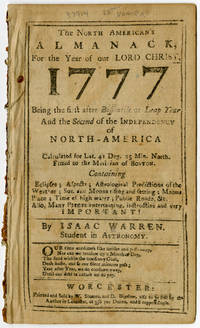
1776WRCAM37914Worcester: Printed and sold by W. Stearns and D. Bigelow 1776. 24pp. 12mo. Printed self-wrappers stitched. Lower half and upper outer corner of title-leaf lacking with text supplied in manuscript. Second and third leaves torn from fore-edge to spine repaired; upper outer corner of second leaf lacking with text supplied in manuscript. Eleventh leaf over-trimmed at fore-edge affecting some text. Several additional leaves chipped and torn at margins with repair. Rubbed and worn. A fair copy. Revolutionary-era almanac by Isaac Warren featuring a map of the forts at New York. Also included are lists of roads pieces of verse an account of Peter the Great and the "Celebrated Speech of Galgacus.worthy of the attention of all officers and soldiers in the American Army" p.17. The North AMERICAN IMPRINTS Project notes that while Evans is correct in calling the almanac "essentially the same" as Samuel Stearns' NORTH-AMERICAN'S ALMANACK for the same year with regard to the prose matter and the map of the New york forts the calendar is entirely different from that of Stearns. DRAKE 3269. EVANS 15212. ESTC W25152. NEBENZAHL BATTLE PLANS OF THE AMERICAN REVOLUTION 98 variant. Printed and sold by W. Stearns and D. Bigelow unknown books