NEWTON IsaacABAA

1 504 résultats
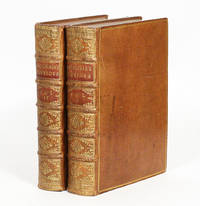
17045582London: Sam. Smith and Benj. Walford Printers to the Royal Society 1704. Hardcover. Near Fine. 4to. 24.2 x 18.8 cm. 2 ff. 144 pp. 211 pp 1 pp. with 19 folding engraved plates. Bound in contemporary English paneled calf. Minor ribbing to binding. Only very minor marginal traces of use. Very genuine. Excellent. First edition first issue of this landmark in science by Sir Isaac Newton 1642-1727 here in a remarkably well preserved unrestored example. "The work summarized Newton's discoveries and theories concerning light and color: the spectrum of the sunlight the degrees of refraction associated with different colors the color circle the first in the history of color theory the invention of the reflecting telescope the first workable theory of the rainbow and experiments on what would later be called 'interference effects' in conjunction with Newton's rings . . . The first edition of the Opticks ends with two mathematical treatises in Latin written to establish his priority over Leibnitz in the invention of the calculus" Norman 1588. Babson 132; Dibner 148; Horblit 79b; PMM 172; Norman 1588; Wallis 174. <br/> <br/> Sam. Smith and Benj. Walford, Printers to the Royal Society hardcover books
1704157612London: Smith & Walford 1704. First. hardcover. very good. Also Two Treatises of the Species and Magnitude of Curvilinear Figures. 4 parts in 1 volume. Title page printed in red & black within a double-ruled border. Illustrated with 19 folding copperplate engravings.4 144 211 1pp. In the second sequence p. 120 is marked 112 and there are blank pages between 137-8 and 138-9. Thick 4to contemporary blind-tooled panelled calf expertly rebacked in matching leather contemporary signature on title dated 1704; last several pages have marginal dampstains otherwise a remarkably clean crisp copy. London: Smith & Walford 1704.<br/><br/> First edition first issue - with the author not named on title page. The work contains: The First Book of Opticks The Second Book of Opticks The Thrid Book of Opticks Tertii Ordinis: Enumeratio Linearum Tractatus de Quadratura Curvarum. The main work is in English the 2 treatises pages 138-211 are in Latin. Babson 132; Gray 174; Horblit 79b; PMM 172; Norman 1588; Dibner 148; Wallis 174.<br/><br/> Smith & Walford unknown books
16932188Oxford: Oxford University Press 1693. First collected edition. Contemporary calf. Very Good. SCARCE FIRST EDITION OF THE COLLECTED WORKS of one of Newton's most important precursors John Wallis Savilian Professor 1649-1703 containing the first printed appearance of Newton's ideas on fluxions. A staunch promoter of English mathematicians Wallis repeatedly urged Newton to publish his theories before others laid claim to he work for the sake of "your Reputation & that of the nation" Gjertsen Newton Handbook 605. While Newton resisted for many years in 1693 Wallis published several letters from Newton in Vol. II of his Opera thereby introducing the concept of fluxional notation-pricked and dotted letters. In the preface to Vol. I 1695 Wallis refers briefly to Newton's claim to the discovery of Fluxions while Vol II 1693 has the first full account of Newton's invention of calculus. The third volume of Wallis's Opera contains previously unpublished correspondence between Newton and Leibniz the most important items of which are Newton's Epistola prior and Epistola posterior. "These two lengthy letters were sent to Leibniz in 1676 to acquaint him with the main lines of Newton's mathematical development. Epistola prior beginning with the binomial theorem went on to describe Newton's work on series. The second letter also contains much discussion on infinite series. It is best known however for Newton's reference to powerful and general methods he had developed for the drawing of tangents the determination of maxima and minima and the quadrature of curves. These he added he preferred to conceal within a quite insoluble anagram. A second and even longer anagram concealed Newton's claim to be able to solve fluxional equations. The solutions to both were publicly disclosed by Wallis 1699" ibid 189. Vol. 2 of the Opera also contains pp. 669-78 De Postulato Quinto; et Definitione Quinta; Lib. 6. Euclidis; disputatio geometrica Wallis's important attempt to prove the parallel postulate of Euclid also published here for the first time. "John Wallis gave a lecture on this topic. on the evening of 11 July 1663. He had been inspired by Nasr-Eddin's attempt on it which he referred to in his lecture to examine the question himself and his analysis is remarkable both for its originality and its caution. Indeed his view of the matter was to be much more profound than many a later writer's" Fauvel & Gray The History of Mathematics 510. This magnificent and comprehensive edition of Wallis's collected works was financed by and printed at Oxford University. In addition to several 'firsts' including those described above these volumes contain reprints of virtually all of Wallis's great books including the Arithmetica infinitorum and Mechanica Vol. 1 an augmented Latin edition of the Treatise of Algebra Vol. II and bilingual editions of a number of ancient Greek texts including Ptolemy's Harmonics Aristarchus's On the magnitudes and distances of the sun and moon and Archimedes's Sand-reckoner Vol. III. In addition to numerous other mathematical works the four volumes include his most popular work Grammaticae lingua anglicanae his "Treatise of Speech which formed a useful theoretical foundation for his pioneering attempts to teach deaf-mutes how to speak" DSB as well as an important tract on cryptography in which he records the methods he developed while deciphering for Cromwell the coded messages of Charles I. Wing W596 W566 W597. Babson 184. Roberts and Trent 345. see J.F. Scott The Mathematical Work of John Wallis London 1938; M. Baron The Origins of the Infinitesmal Calculus Oxford 1969 205-213; Richard Westfall The Life of Isaac Newton Cambridge 1993 207-209ff. Opera Mathematica. Volumen primum -Tertium - Opera quaedam miscellanea. Oxford: Sheldonian Theatre University Press 1695 1693 1699. Four volumes bound in three. Folio contemporary full paneled calf rebacked to style. Complete with four engravings on three leaves and three portraits Vols. I & II with the same portrait by Loggan dated 1678 and engraved by Burghers; Vol 3 by Sonmans dated 1698 and engraved by Burghers. With large bookplate inside each front cover reading "The Gift of Mr. Thomas Heatley Citizen and Iron-monger of London to the Mathematical School in Christ's Hospital Anno Dom. 1700". A very clean copy with only occasional light browning and foxing very handsomely bound. ONE OF THE MONUMENTS IN THE HISTORY OF MATHEMATICS. RARE. . Oxford University Press unknown books
1827305824Charleston: James S. Burges 1827. First and only edition. 18 2 blank pp. 12mo. Modern pale yellow wrappers. Custom chemise and quarter morocco slipcase. Some pale foxing to title otherwise clean. First and only edition. 18 2 blank pp. 12mo. Rarity of American Judaica. A rare pamphlet issued by the first Jewish Reform movement in the United States the Sephardic Reformed Society of Israelites in Charleston South Carolina recording an address by one of the movement's leaders. The Reformed Society of Israelites formed in 1824 when it split off from the Kahal Kadosh Beth Elohim KKBE synagogue in Charleston seeking to implement a number of reforms it deemed crucial to engaging the rising generation. In the process the Society posited a distinctly American form of practice. <br/>Led by Isaac Harby Abraham Moise and David Nunes Carvalho the Reformed Society of Israelites reflected the fact that as Jonathan Sarna has phrased it: "Jews who did not feel at home in synagogue no longer had to compromise their principles for the sake of consensus; they felt free to withdraw and start their own congregations. In free and democratic America congregational autonomy became the rule resulting in a new American Judaism - a Judaism of diversity and pluralism."<br/><br/><br/>The present address was delivered on the third anniversary of the Society by Isaac Cardozo 1786-1855 who served as the group's Vice-President from 1828-1832. Cardozo invokes a "spirit of reform in all existing institutions which is abroad" and reminds the group of its origin as "a society that was instituted mainly for effecting the observance of order and decorum in Hebrew worship: for adapting it to the feelings and propensities of the enlightened Israelite of the present day; and for endeavoring to bring about by argument and petition what neither necessity nor persuasion could before accomplish" before he goes on to defend the mission against various critiques. <br/> <br/>Apart from being a leader within Charleston's Sephardic Jewish community Cardozo was also the patriarch of an important southern African-American family. He had six children with his common-law wife Lydia Weston a free black woman from a prominent Charleston family--one of a number of openly mixed-race households in antebellum Charleston. One of their sons was Francis Cardozo 1836-1903 who became the first African-American to hold statewide office in the United States serving as Secretary of State in South Carolina from 1868 to 1872. Another son Thomas served as State Superintendent of Education from 1873 to 1876. <br/><br/>RARE: OCLC reports only two institutional copies and A.S.W. Rosenbach in his American Jewish Bibliography located only one copy in a private collection. Rosenbach 289 locating one copy in a private collection; OCLC USC Presbyterian College; American Imprints 28385; Singerman 0442 James S. Burges unknown books
17262210London: Guil. & Joh. Innys Regiae Societatis typographos 1726. Third Edition. contemporary full vellum. RARE 1726 THIRD EDITION OF NEWTON'S PRINCIPIA THE LAST EDITION EDITED BY NEWTON AND THE BASIS FOR ALL SUBSEQUENT EDITIONS. ONE OF ONLY 1250 COPIES PRINTED. "The Principia is generally described as the greatest work in the history of science. Copernicus Galileo and Kepler had certainly shown the way; but where they described the phenomena they observed Newton explained the underlying universal laws. The Principia provided the great synthesis of the cosmos proving finally its physical unity. Newton showed that the important and dramatic aspects of nature that were subject to the universal law of gravitation could be explained in mathematical terms within a single physical theory. With him the separation of natural and supernatural of sublunar and superlunar worlds disappeared. The same laws of gravitation and motion rule everywhere; for the first time a single mathematical law could explain the motion of objects on earth as well as the phenomena of the heavens. The whole cosmos is composed of inter-connecting parts influencing each other according to these laws. It was this grand conception that produced a general revolution in human thought equalled perhaps only by that following Darwin's Origin of Species. It was the final irrevocable break with a medieval conception based on Greek and Roman cosmology and a scholastic system derived from the medieval interpretation of Aristotle. Newton's universe almost independent of the spiritual order ushered in the age of rationalism scientific determinism and the acceptance of a mechanistic view of nature" Printing and the Mind of Man 161. On the history and importance of the third edition: Towards the end of his life Newton "gave one last effort to the Principia. It is clear that he regarded the Principia rather than the Opticks as his masterwork. He worked over the Principia without end to hone its language to a perfect expression of his ideas. Perhaps the appearance of a reprint of the second edition in Amsterdam in 1723 stimulated Newton to put his plan for a new edition into action. Perhaps a serious illness in 1722 reminded him that he could not delay forever. We know only that printing of an edition more sumptuous than either of the others began in the fall of 1723. As editor Newton had the services of a young member of the Royal Society Henry Pemberton. In the fall of 1723 Pemberton addressed to him the first of thirty-one communications which stretched over the following two-and-a-half years while the edition passed through the press. Through 1724 and 1725 the edition made its slow but steady progress toward completion with none of the delays that stopped the press during the second edition. Newton dated the preface 12 January 1726. It was the last day of March when Martin Folkes presented a copy 'richly Bound in morocco Leather' to the Royal Society in Newton's name. In all 1250 copies were printed." Westfall The Life of Isaac Newton. The third edition "contains a new preface by Newton and a large number of alterations" Babson 13. With portrait engraving by Vertue bound before first text leaf and numerous illustrations in text. Complete with the privilege leaf half-title dedication leaf index and ad leaf. London: Guil. & Joh. Innys Regiae Societatis typographos 1726. Quarto 186x241 mm contemporary full Dutch vellum; custom half-leather box. Unidentified early signatures on front pastedown half-title and ad leaf verso. Mild scuffing to binding boards a little bowed. Text with occasional light soiling and scattered foxing but generally clean. A beautiful copy. SCARCE IN AN UNRESTORED CONTEMPORARY BINDING. Guil. & Joh. Innys, Regiae Societatis typographos unknown books
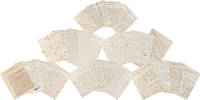
1827WRCAM55911Various locations mostly Valparaiso Chile; Callao and Lima 1827. Forty-six autograph letters signed or manuscript letters signed totaling 103pp. some with integral address leaf. All docketed at the top right edge of the verso of the last leaf likely by William Tudor himself. Original mailing folds light toning occasional short tears from opened wax seals. Overall very good. In a cloth chemise and half morocco and cloth folding case spine gilt. An important historical archive of letters received by William Tudor almost all while he was serving as United States Consul to Peru in Lima. The letters from a breadth of correspondents reveal the range of political cultural military and legal issues faced by an American diplomat serving in a South America during a politically volatile period and are especially interesting for detailing American diplomatic actions in South America in the years just after the issuance of the Monroe Doctrine. The letters are particularly notable for demonstrating the views and actions of the United States during the Peruvian independence struggle and showing the extent of the cooperation between the U.S. and Great Britain less than a decade after the conclusion of the War of 1812. They also paint a picture of the revolutionary actions of Simón BolÃÂvar in Peru the tight grip on the port of Callao by Spanish stalwart José Ramón Rodil and the interplay of American British Spanish Chilean and Peruvian officials in the region. <br> <br> William Tudor 1779-1830 was a leading citizen of Boston and the son of the first judge advocate of the Continental Army. Tudor was a founder and first editor of the NORTH AMERICAN REVIEW and helped found the Boston Athenaeum. He was the first Boston citizen to refer to the city as "The Athens of America" in an 1819 letter. Tudor was the U.S. Consul to Peru from 1824 to 1827 and Chargé d'Affaires at Rio de Janeiro from 1827 until his death there in 1830. <br> <br> The most prominent correspondent in this archive is Commodore Isaac Hull 1773-1843 represented by twelve letters to William Tudor. The Hull letters are a mixture of seven autograph letters signed from Hull and five manuscript letters in a secretarial hand but signed by the Commodore. Hull's letters report on the naval blockade of Peru American movements around South America and the struggles of Simón BolÃÂvar's South American independence movement and also touch on the ultimate defeat of the Spanish in Peru. At the time these letters were written Hull was commander of the United States Pacific Squadron and the letters emanate from Hull's flagship the USS United States positioned in Callao Bay as part of a joint American-British blockade. Hull had a long and distinguished career in the United States Navy beginning during the Quasi War with France battling Barbary pirates and commanding the USS Constitution during the War of 1812. He went on to serve as commandant of the Washington Navy Yard and as commander of the Mediterranean Squadron. Letters by Hull are scarce on the market especially in the quantity quality and intimacy of content seen here. <br> <br> In his first letter on May 28 1824 Hull writes about meeting British naval figure Martin Guise who was at this time serving with the Chilean Navy during the Peruvian War of Independence from Spain. Hull mentions the current blockade in his first two letters writing in the first: "I fear that they will not go all length with me in the blockade; they appear disposed to allow something like a coast blockade." His second letter of June 8 includes more details on the efforts during the blockade namely that Guise is "doing what he has the authority to do from Bolivar" and Captain Prescott "has in great measure made up his mind to submit to the blockade of Guise even in its present form." <br> <br> Hull's communications increase beginning in August and he writes to Tudor on August 21 that he must refuse his request to land U.S. Marines in Lima for the protection of American officials but agrees to send a "sea officer with arms" and as many seamen as necessary "for the protection of American Citizens only" but that they "must be kept within their houses or yards." <br> <br> In his next few letters Hull reports on the ships Dolphin and Peacock being routed to Valparaiso to provide strategic defense to American shipping vessels in the region and asks for more information and communications from Tudor regarding the ships Carington and Nancy condemned by Spanish General José Ramón Rodil. In a September 11 letter Hull states that Rodil intends to sell the two ships and that "it may be necessary for me to take measures that will not please his excellency as I consider his conduct is and has been for some time hostile towards us and cannot much longer be submitted to." Hull also invites Tudor to his ship to "spend the day with your friends Capt. and Mrs. Maling" who were onboard Hull's ship the previous night. Hull and Thomas James Maling were fellow commanders of the American and British forces respectively during this period around Peru. Maling commanded the British ship the Cambridge which is referenced in some of the letters here. José Ramón Rodil was commander of the port of Callao for the Spanish government and one of the last remaining Spanish officials to surrender to BolÃÂvar; he stubbornly refused to officially cede control of Callao until 1826 when he finally gave up and returned to Spain. <br> <br> On October 15 Hull writes to Tudor about the attitudes of the Spanish government "towards our commerce." Hull fears that should the Spanish invoke "the laws of the Indies" against American officials in Peru then Hull and Tudor "shall be in a bad way." The Laws of the Indies were a series of Spanish laws dealing with the relationship between Spain and her colonies in America; Hull is perhaps worried here that if the Spanish government invokes these laws as a sovereign nation then the activities of the American government in South America would stand in violation of that sovereignty. <br> <br> Hull's troubles with Rodil continue in November when he informs Tudor that "the crew of the China had complained to Captain Maling of the bad treatment they had received from General Rodil stating that they were compelled to work and that some of them had been severely punished." Hull writes that he plans to demand the release of these sailors and the ship and if Rodil does not acquiesce he would "resort to reprisal and let the consequence be what it may." <br> <br> In Hull's next letter the true nature of the extreme treatment suffered by some Americans under Rodil is described. Hull writes a lengthy and passionate letter decrying the "injustice and cruelty of all the proceedings" which took place during the Spanish seizure of the China. Hull can no longer "remain inactive or insensible to the repeated wrongs of my countrymen." He then relates how some seamen were threatened with swords muskets or gallows. Hull thinks that "my government will justify me in any measures which I shall be compelled to take to obtain redress for the insults and wrongs which my countrymen have received and to prevent a repetition of them" After all claims Hull "there is not an American in this country knowing all things which have taken place who would not be willing to sacrifice every feeling of interest to have their rights respected." <br> <br> Hull's last two letters come after the decisive battle at Ayacucho in early December 1824 which effectively ended the Peruvian War of Independence in favor of BolÃÂvar's forces. On December 18 Hull transmits his original correspondence with Rodil to Tudor presumably so that Tudor can consolidate communications between American and Spanish officials now that Peru has won the war. Hull's final letter touches on duties owed by American vessels at Ancon; Hull recuses himself from the issue in favor of Tudor as such issues "should more properly come before you as consul or the merchants to whom he consigned and I consider any interference on my part would be improper and that it is a case entirely distinct from my duties." After all as a naval commander Hull is not responsible for imposing import and export duties related to commerce in newly-independent ports. Hull closes by writing that the news of Peruvian independence will be "such glorious news to the United States. It will be received with sincere pleasure by our government and every lover of freedom and humanity." <br> <br> Also present here are seven letters from the aforementioned Thomas James Maling plus one from his wife Harriet to William Tudor all of which were written between August and December 1824. Captain Thomas Maling was the scion of the Maling pottery family in England. He was commissioned into the Royal Navy in 1791 rising to vice admiral in 1830. During his time in Peru Maling was captain in charge of the HMS Cambridge which was stationed in Callao for most of Maling's time there. He married Harriet Darwin daughter of Erasmus Darwin and niece to Charles who accompanied him to South America. Sadly Harriet would die in 1825 in Valparaiso Chile. The Malings were very friendly with William Tudor as evidenced in the present correspondence which includes a friendly partial note from Harriet to Tudor in which she chides Tudor for not visiting their ship and offers to share with him "a good private and confidential letter". <br> <br> In his first letter dated August 18 Captain Maling agrees to take aboard his ship one of Tudor's friends and hopes "you are all made safe & happy by the party I have sent to guard you all at Lima." In his second letter on August 24 Maling mentions that "Guise is sending another Blockading Squadron" but that this will be "of insufficient force to stop the trade of Europe and North America." Maling hopes "your Commodore" meaning Hull agrees with him; blockades were prevalent during this time around Peru and Chile as the various revolutions led by and inspired by Simón BolÃÂvar took root. <br> <br> Maling's letter of September 4 concentrates on battle news in Peru reading in part: "Kelly who I believe you know of returned from the Liberator's Army and I believe brings us good news but he is still with Guise.There has been no second battle but Cantera's army dispersed after the 6th leaving him with only 2000 men with which he is hastening back to Cusco. It is supposed for the purpose of raising the Indians in favor of the Young Inca they have been keeping in reserve. The Commodore Hull has thought this information & what else Kelly may bring of sufficient importance to detain the Dolphin another day." <br> <br> Three days later Maling writes Tudor about a recent naval issue that prompted him to write to the commanding officer of the ship "to tell him he will be made responsible in future for the conduct or his officers & men and I hope we shall hear of no other instance of such impropriety but it is by no means thought here to be ours." This is followed by a mention of the ship China. Maling invites Tudor to his ship for a visit and tells him he may have the "opportunity of seeing a naval fight." This letter is likely concerned with the aforementioned troubles with the China in which American and British sailors were mistreated by Spanish authorities. <br> <br> Maling's October 15 letter is especially interesting as he mentions yet another blockade-related event: "There is an embargo on all vessels at Quilea & no communication permitted with the shore a pretty conclusive hint where our friends will go to when they sail from hence if Guise who is again sailing close in ever suffers them to depart in peace." <br> <br> Maling's last two letters date from December 1824 after BolÃÂvar's victory in Peru. In his December 8 communication he reports that "England has acknowledged the independence of those parts of America which actually form free states." The implication here is clear in that England is ready to recognize democratic regimes and nothing less. In his final letter Maling writes about the slowness in receiving news from the Peruvian government on naval matters though he allows for the "intoxication of success" felt by those in Peru who had just won their independence from Spain. Maling wishes them "so well to their cause that I shall not quarrel with them." <br> <br> Maling's penultimate letter alludes to the recent death of British Consul General Thomas Edward Rowcroft. The present archive includes two letters to Tudor from Rowcroft who was essentially Tudor's British counterpart in Peru. In his first letter dated June 19 1824 Rowcroft writes to Tudor about the "dispositions of the Viceroy on the appointment of Consuls in this Country" and on the importance of maintaining "mutual confidential communications" between himself and Tudor. Towards the end of 1824 on December 2 Rowcroft writes again to Tudor this time to ask about two English Navy vessels allegedly captured by a ship flying "Spanish Colours" and then recaptured by Tudor's brother-in-law Commodore Stewart. This last letter would have been among Rowcroft's final communications as he was gunned down a few days later while traveling back from Lima after delivering letters to Thomas Maling. Rowcroft supposedly held a pass that should have taken him safely through both the loyalist-held sections and the Bolivar-held areas of the city. As he presented his pass to authorities loyal to Bolivar at a checkpoint his coach was met with a hail of bullets as it rolled away. Rowcroft was shot in the hand and the torso and died on December 7; his death is now considered an unfortunate accident perhaps precipitated by a "death sentence" purposely written on his pass by loyalist officials hoping to get Rowcroft in trouble. If this was indeed their plan it worked. <br> <br> Other letters to Tudor here include a February 20 1824 note from John Dorr to Tudor in which Dorr discusses his ship Esther which was seized by the revolutionary government in Callao Peru. Dorr indicates that General BolÃÂvar is willing to "do what is possible to recover that valuable Ship & freight or ample indemnity." On April 18 1824 French Dr. A.V. Brandin writes to Tudor from Lima informing him of a shipment of quinine for Commodore Hull and his wife aboard the USS Franklin. Brandin allegedly founded the first medical journal in Peru and was apparently the first doctor to introduce quinine to South America. <br> <br> In other letters in this archive American ship captain Samuel C. Erwin writes to Tudor on April 22 1824 with regard to the seizure of a "case of Linnens" by the new Peruvian government along with a request to write directly to the governor in Lima for relief and for a "Certificate of American Property for my whole cargo which I have repeatedly applied for without being able to get it." American merchant seaman Thomas R. Gerry son of Elbridge Gerry writes to Tudor from Quilca Peru on August 18 1824 reporting on various business matters and providing a blistering description of Quilca which he sums up as a "miserable hole." Gerry also reports on two American prisoners of war taken by the Chilean government one of whom he currently has on his ship the Tartar while the other is still held at Arica. <br> <br> The present collection also includes a handful of letters from Michael Hogan U.S. Consul and Navy Agent at Valparaiso Chile from 1823 until his death in 1833. Hogan's first communication to Tudor is dated the day after Tudor took over as consul in Peru; Hogan is "anxious" but "hopes for the best" for Tudor in his new position. In June 1824 Hogan sends a short report to Tudor on political maneuverings in Valparaiso where General Pinto was to be appointed "supremo." One of his letters from July 28 1824 reports on political struggles within Chile where a Constitution had just been "amicably" voted down the Senate dissolved General Wager appointed director and General Pinto as prime minister until a new Congress was convened in three months. Another letter from Hogan dated August 9 1824 includes information on the Chilean government's efforts to sell church property "for the publick good." This was a standard practice in the post-colonial governments in South America who often converted church artifacts of silver and gold into new coinage. In this same letter Hogan reports that Chilean officials will soon forbid the importation of flour in favor of the "great landholders" in Chile who plan to produce their own "breadstuffs." <br> <br> Other communications to Tudor involve letters of introduction for new merchant ship captains an appeal by William Wetmore regarding shipping declarations made to General Rodil in Callao two short letters from U.S. consul to Peru James Prevost in Callao regarding permissions from the new Peruvian government Prevost would die in Lima on March 5 1825 and a handful of letters in Spanish from local officials one of which dated Feb. 12 1826 mentions mining in Lima "metales de plata" and "metales ricos un espia". <br> <br> There are also two letters written to Tudor before his time in Peru. One dated July 7 1822 from Thomas Dawes in Boston relates to a pamphlet Tudor wrote on Thomas Paine. The other is an October 30 1822 "Declaration and Protest" from a U.S. schooner called the Dolphin claiming unlawful seizure and false imprisonment by Peruvian officials in Callao; this document was perhaps inherited by Tudor when he arrived in Lima. There is even an intriguing partial manuscript which seems to be part of a confidential report on English government and their public attitudes towards the United States mentioning a debate in the House of Commons regarding "peace or war with America." <br> <br> In total these to William letters shine a rare spotlight on the American intervention in Peru and on the international political and economic machinations in South America during the 1820s. The archive provides a stark picture of American enforcement of the Monroe Doctrine which President Monroe had just elucidated in his State of the Union Address on December 2 1823. Spanish actions in Peru in the 1820s were seen as a violation of this new foreign policy stance by the United States particularly the tenet covering European colonial involvement in the Western Hemisphere. Of course the Monroe Doctrine also served American economic interests in South America which certainly motivated events such as the American blockade of Callao and the dispersal of the Dolphin and the Peacock to other South American ports. <br> <br> An outstanding collection of American diplomatic correspondence from an important moment in South American history. hardcover books
18481803065Daniel Adee 1848. 1st Edition. Hardcover. Near Fine/No Jacket. Near fine TRUE first American edition 1st issue as stated on the title page. Some water stains on page edges. Previous owner's bookplate on front pastedown. Rubbing on outside spine and corners and at bottom of spine. Tape at endpapers and pastedowns along gutters. Housed in custom-made slip case. Daniel Adee hardcover books
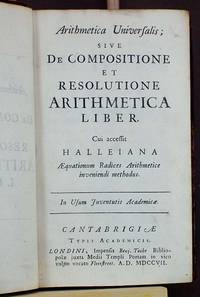
17076325Cambridge and London: Typis Academicis; Benj. Tooke 1707. First edition. Very Good/William Whiston the successor to Newton's chair at Cambridge "extracted from Newton a somewhat reluctant permission to print" this remarkable "schoolbook" based on Newton's lecture notes Babson Catalogue. So reluctant in fact that Newton kept his name out of it and supposedly considered purchasing the press run in order to destroy it! He later republished it himself. Several new theorems are laid out including a formula to determine the number of imaginary roots of any equation. The rule is complicated and is offered without proof. Yet 180 years later the rule was proven by rigorous analysis. The text also includes Edmond Halley's "Aequationum radices arithmetice inveniendi methodus. Octavo 19cm; 8 343 1 pages the last page blank . Figure and diagrams in text. Running-title: Algebrae elementa. Editor's preface signed: G.W. i.e. William Whiston. In contemporary paneled calf rebacked with new burgundy morocco spine label. Edges of boards rubbed. Early ink ownership inscriptions on blank endleaves the contemporary autograph of Edward Harington and the 19th-century mathematician William Fleetwood Sheppard. Half-title present. References: Babson Newton Collection; 199; ESTC; T018645; Bowes and Bowes 277. Typis Academicis; Benj. Tooke hardcover books
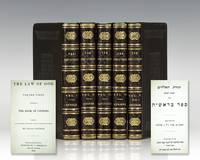
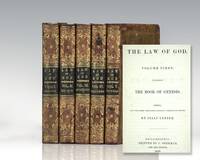
39481Philadelphia: Printed by C. Sherman 5605. 8vo 5 volumes. 8 7/8 x 5 1/2 inches. Hebrew and English text on facing pages. Each volume inscribed at the head of the English-language title "To my beloved wife from her affectionate husband" the first volume with a later family annotation. Contemporary purple morocco spine in six compartments with raised bands lettered in gilt in the second and fourth repeating gilt decoration in others marbled edges marbled endpapers.<br/> <br/>Provenance: Solomon Nunes Carvalho each cover stamped in gilt<br/> <br/>Rare large-paper association copy of the first Jewish translation of the Pentateuch into English.<br/> <br/>More than any other person of his time Isaac Leeser 1806-1868 envisioned the development of a major center of Jewish culture and religious activity in the United States. He single-handedly provided American Jews with many of the basic religious texts institutions and conceptual tools they needed to construct the cultural foundation of what would later emerge as the largest Jewish community in the history of the Jewish people. Printed in 1845 this edition of the Pentateuch in five volumes included a vocalized Hebrew text of each of the Five Books of Moses together with an English translation and notes as well as the haftarot prophetic readings. Leeser actually began working on The Law of God in 1838. Among the factors involved in his decision to begin systematically working on a translation was the recent opening of Rebecca Gratz's Sunday School which met for the first time in March 1838 in Philadelphia and was desperately in need of appropriate study material. Students were compelled to use the King James Bible for want of a Jewish alternative. Religiously objectionable passages in other texts provided by Protestant organizations were either pasted over or torn out by Gratz's staff. Leeser who supported the Sunday School and was its chief academic resource person felt compelled to find more suitable texts for the students. The impetus for Leeser throughout was always his desire to provide the Jews of America with an English text of the Bible that was produced by one of their own and was not tainted by conversionist motivations. This copy with provenance to Solomon Nunes Carvalho who was a noted American painter photographer writer and inventor best known for traveling with John C. Fremont on his fifth expedition through Kansas Colorado and Utah. He published an account of that journey titled "Incidents of Travel and Adventure in the Far West; with Colonel Fremont's Last Expedition" 1860 and was considered a pioneer in travel photography. Isaac Leeser the hazzan of Congregation K.K. Mikveh Israel married Carvalho and his wife Sarah Miriam Solis on October 15 1845 in Philadelphia where Carvalho's father had a workshop.<br/> <br/>Rosenbach 569; Singerman 884; Goldman 7; Lance J. Sussman "Another Look at Isaac Leeser and the First Jewish Translation of the Bible in the United States" Modern Judaism Vol. 5 No. 2 Gershom Scholem Memorial Issue. May 1985 pp. 159-190. Printed by C. Sherman unknown books
184549020Philadelphia: C. Sherman 5605 1845-46. First edition of the "first English translation of the Pentateuch in America" the 1845 Hebrew-English Bible by one of the most prominent and influential figures in American Jewish history. Octavo 5 volumes. Translated by Isaac Leeser. Bound in contemporary polished calf gilt titles and tooling to the spine rebacked. Lightly rubbed moderate wear. A very nice example of a scarce and important work. Previous editions published by Jews in England had simply utilized the King James translation. The translator was Isaac Leeser 1806-1868 who worked without assistance. In his preface he apologizes for any errors: "How can it be expected that I should escape when I have no Jewish compositors and have necessarily to be often away when the work goes to press" Despite these obstacles Leeser doubted that "the precious word of God ever appeared among us in a more beautiful form than the volumes in which I am now engaged." Leeser avoided reliance on earlier English translations though he made some use of German translations and noted that "the arrangement is strictly Jewish. My intention was to furnish a book for the service of the Synagogue both German and Portuguese." Leeser's "contributions to every area of Jewish culture and religion made him a major builder of American Judaism." The publication of his Pentateuch was the first time that any portion of the Bible was published in America under Jewish auspices. "The translation of the Bible was Leeser's great literary achievement and represented many years of patient labor and devotion to a task which he considered sacred. He made good use of the various German translations by Jews of the collective commentary known as the Biur and of other Jewish exegetic works. As a result his translation though based in style upon the King James version can be considered an independent work for the changes he produced are numerous and great. until the new Jewish Publication Society version was issued in 1917 it was the only source from which many Jews not conversant with Hebrew derived their knowledge of the Bible in accordance with Jewish tradition" Waxman 1090. C. Sherman, 5605 unknown books
1951006743New York: Gnome Press 1951. An exceptional and RARE set all three books having been SIGNED AND INSCRIBED BY AUTHOR Isaac Asimov to the same lady in the most intriguing and charming manner - "Foundation" SIGNED AND INSCRIBED "For Laura Jean a passionate Southern gal Isaac Asimov" "Foundation and Empire" SIGNED AND INSCRIBED "For Laura Jean a persistent Southern gal Isaac Asimov" and "Second Foundation " SIGNED AND INSCRIBED "For Laura Jean a married Southern gal Isaac Asimov". Ah to have been a witness to THAT book signing where the sparks were obviously flying ! All three books stated Gnome Press First Editions "Foundation" in dark blue boards with red lettering at spine thinner and narrower paper and with dust jacket too large for this thinner book although stating First Edition 1951 on CP is actually the 1954 2nd Edition. Book is Very Good pages browning slight toning to edges of end pages top edge dusty in a Very Good dust jacket priced $2.75 front flap small chips at spine ends and flap fold tips. "Foundation and Empire" 1952 is First Edition First State in original red cloth in Second Issue dust jacket in blue tones. Book is Very Good pages uniformly browning. In Near Fine dust jacket small chips top and bottom edges rear panel at spine. "Second Foundation" 1953. is First Edition First State in original light blue boards spine stamped in brown Very Good cloth a bit rubbed at spine ends light toning to end pages at edges top edge soiled in a Very Good dust jacket 1/2" chip top edge front panel at spine light edge wear and soiling. Overall a Very Good set with unique Asimov inscriptions of this towering classic of the science fiction genre that continues to remain fresh and current. . SIGNED AND INSCRIBED BY AUTHOR. First Editions. Cloth. Very Good/Very Good. Illus. by David Kyle Edd Carter and Ric Binkley . 8vo - over 7¾" - 9¾" tall. Presentation Copy. Gnome Press Hardcover books
38544Philadelphia: Printed by C. Sherman for the Editor 5605. Five volumes 8vo. 7 1/2 x 4 3/4 inches. Hebrew and English text on facing pages. Contemporary black morocco covers elaborately tooled in gilt spine gilt with raised bands in six compartments yellow endpapers gilt edges expert repairs to joints and tops of spines.<br/> <br/>Provenance: M. Nathans name in gilt on the upper covers<br/> <br/>The first Jewish translation of the Pentateuch into English: in an elaborate contemporary binding.<br/> <br/>More than any other person of his time Isaac Leeser 1806-1868 envisioned the development of a major center of Jewish culture and religious activity in the United States. He single-handedly provided American Jews with many of the basic religious texts institutions and conceptual tools they needed to construct the cultural foundation of what would later emerge as the largest Jewish community in the history of the Jewish people. Printed in 1845 this edition of the Pentateuch in five volumes included a vocalized Hebrew text of each of the Five Books of Moses together with an English translation and notes as well as the haftarot prophetic readings. Leeser actually began working on The Law of God in 1838. Among the factors involved in his decision to begin systematically working on a translation was the recent opening of Rebecca Gratz's Sunday School which met for the first time in March 1838 in Philadelphia and was desperately in need of appropriate study material. Students were compelled to use the King James Bible for want of a Jewish alternative. Religiously objectionable passages in other texts provided by Protestant organizations were either pasted over or torn out by Gratz's staff. Leeser who supported the Sunday School and was its chief academic resource person felt compelled to find more suitable texts for the students. The impetus for Leeser throughout was always his desire to provide the Jews of America with an English text of the Bible that was produced by one of their own and was not tainted by conversionist motivations. This binding is consistent with similar bindings on gift books of the era published and bound by Lippincott. This example with provenance to M. Nathans likely Moses Nathans 1811-1873 a prominent congregant of Philadelphia's Congregation Mikveh Israel.<br/> <br/>Rosenbach 569; Singerman 884; Goldman 7; Lance J. Sussman "Another Look at Isaac Leeser and the First Jewish Translation of the Bible in the United States" Modern Judaism Vol. 5 No. 2 Gershom Scholem Memorial Issue. May 1985 pp. 159-190. Printed by C. Sherman for the Editor unknown books
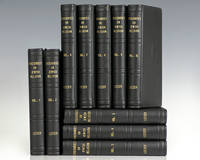
1866107732Philadelphia: Sherman & Co 1866-68. First editions of one of the 'major builders of American Judaism' Isaac Leeser's Discourses on the Jewish Religion. Octavo 10 volumes bound in full leather gilt titles to the spine raised bands. In near fine condition. Complete sets are of the utmost rarity. American Jewish lay minister author translator and publisher Issac Leeser's "contributions to every area of Jewish culture and religion made him a major builder of American Judaism." In addition to his influence on the Jewish pulpit in the United States Leeser became the first American Jewish publisher and produced the first Jewish translation of the bible into English. "The translation of the Bible was Leeser's great literary achievement and represented many years of patient labor and devotion to a task which he considered sacred.until the new Jewish Publication Society version was issued in 1917 it was the only source from which many Jews not conversant with Hebrew derived their knowledge of the Bible in accordance with Jewish tradition" Waxman 1090. Sherman & Co hardcover books
1803122898London: Printed for H.D. Symonds 1803. First complete edition in English of Sir Isaac Newton's Principia the greatest work of physics in the exceedingly rare original boards. Octavo 3 volumes bound in original boards uncut 54 folding copper-engraved plates of diagrams and figures all but one folding; 2 folding tables. with 22 folding. In near fine condition with light toning to the text. An exceptional example rare and desirable in the original boards. Housed in a custom clamshell box. "Newtons Principia is generally described as the greatest work in the history of science. Copernicus Galileo and Kepler had certainly shown the way; but where they described the phenomena they observed Newton explained the underlying universal laws. The Principia provided the greatest synthesis of the cosmos proving finally its physical unity. Newton showed that the important and dramatic aspects of nature that were subject to the universal law of gravitation could be explained in mathematical terms with a single physical theory. With him the separation of the natural and supernatural of sublunar and superlunar worlds disappeared. The same laws of gravitation and motion rule everywhere; for the first time a single mathematical law could explain the motion of objects on earth as well as the phenomena of the heavens. The whole cosmos is composed of inter-connecting parts influencing each other according to these laws. It was this grand conception that produced a general revolution in human thought equaled perhaps only by that following Darwins Origin of Species Newton is generally regarded as one of the greatest mathematicians of all time and the founder of mathematical physics" PMM 161. "It is perhaps the greatest intellectual stride that it has ever been granted to any man to make" Einstein. Printed for H.D. Symonds hardcover books
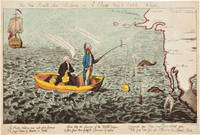
1791WRCAM51520London: H. Humphreis sic 1791. Handcolored etching 14 x 21 inches. Cropped within plate borders with no loss to image or text. Remnants of older paper pasted to verso. Color bright and fresh. Near fine. In 1789 and 1790 Nootka Sound in the Pacific Northwest looked to be the spur of a major conflict between the kingdoms of Britain and Spain. The inlet was an important outpost for maritime fur trading and had therefore become the focus of the centuries-old struggle for advantage in the New World. Courtesy of explorer and trader John Meares news of Spanish indiscretions reached Britain in 1790 and intensified the growing anti- Spanish rhetoric and call for war. Meares whose credibility was famously contested in two remarkable pamphlets by George Dixon claimed not only that the Spanish had seized British ships but that they had removed his settlement at Nootka and replaced it with their own. After debate in the House of Commons it was decided the British Navy would be mobilized. <br> <br> While Spain initially sought to go to war they could not attain the essential support of France and thus required a diplomatic solution to the problem. This came in the form of the first Nootka Convention which was signed on Oct. 28 1790. The convention guaranteed Britain the right to have outposts on Nootka Sound and to practice whaling in waters beyond the "Ten-League Line" off the coast. The Convention eventually resulted in the seminal voyage of George Vancouver to survey the Pacific Northwest. <br> <br> This print is a satire on the British Tory government's handling of the crisis. Its central critical point attacks part of the convention concerning fishing rights which Pitt's opposition latched onto as evidence of underhanded dealings. They noted that the original importance of Nootka Sound was not for whaling but rather for fur trading and that the whaling industry had surely redirected political attention toward their interests. Thus the print shows Pitt and Henry Dundas in the Pacific off the west coast of North America hopelessly fishing with millions from the treasury. As Pitt expresses worry over the spending Dundas soothes him with the knowledge that "the Gudgeons we caught in England will pay for it all." In saying so Dundas declares the Britons who supported the war to have been bait for his and Pitt's political maneuvering. The coastline is shown from southern Alaska to Mexico likewise making this an early map of California Alaska and the west coast. <br> <br> In all it is a lively expression of disbelief and anger at the amount expended on preparing for war set against the eventual prize - namely the indeterminate profitability of whaling. H. Humphreis [sic] unknown books
184578547Philadelphia: C. Sherman 5605 1845-46. First edition of the "first English translation of the Pentateuch in America" the 1845 Hebrew-English Bible by one of the most prominent and influential figures in American Jewish history. Octavo 5 volumes. Translated by Isaac Leeser. Bound in full contemporary calf gilt titles and tooling to the spine. In near fine condition. A nice example rare in contemporary binding. Previous editions published by Jews in England had simply utilized the King James translation. The translator was Isaac Leeser 1806-1868 who worked without assistance. In his preface he apologizes for any errors: "How can it be expected that I should escape when I have no Jewish compositors and have necessarily to be often away when the work goes to press" Despite these obstacles Leeser doubted that "the precious word of God ever appeared among us in a more beautiful form than the volumes in which I am now engaged." Leeser avoided reliance on earlier English translations though he made some use of German translations and noted that "the arrangement is strictly Jewish. My intention was to furnish a book for the service of the Synagogue both German and Portuguese." Leeser's "contributions to every area of Jewish culture and religion made him a major builder of American Judaism." The publication of his Pentateuch was the first time that any portion of the Bible was published in America under Jewish auspices. "The translation of the Bible was Leeser's great literary achievement and represented many years of patient labor and devotion to a task which he considered sacred. He made good use of the various German translations by Jews of the collective commentary known as the Biur and of other Jewish exegetic works. As a result his translation though based in style upon the King James version can be considered an independent work for the changes he produced are numerous and great. until the new Jewish Publication Society version was issued in 1917 it was the only source from which many Jews not conversant with Hebrew derived their knowledge of the Bible in accordance with Jewish tradition" Waxman 1090. C. Sherman, 5605 unknown books
16661299Nurnberg 1666. Houzeau & Lancaster 3039; Zimmer 5089 1628 Strasbourg ed.; Poggendorff 1984. Warner The Sky Explored pp. 104-5. Extremely rare German edition a Latin edition was published the same year of Sturms enlargement of Habrechts famous treatise on the making of celestial and terrestrial globes published in 1628. The Habrecht family of clock and instrument makers were famous throughout Europe from the last quarter of the sixteenth century to the end of the seventeenth century. The authors father also called Isaac was responsible for making the monumental second Strasbourg clock which was one of the mechanical wonders of its time on the Continent. Isaac Habrecht 1589-1633 was a Strasbourg physician mathematician and maker of globes. He was much influenced by Blaeu and Hondius and his globes were highly regarded. J. C. Sturm was Habrechts student and a scientist of vision. He organized the first scientific academy in Germany the Collegium Curiosum sive Experimentale at Altdorf in 1672 and introduced the first course in experimental physics in a German university. In 1666 he undertook the task of augmenting Habrechts original text and adding a number of folding plates. The plates include two handsome polar projections of the world two polar stereographic celestial charts of the northern and southern constellations and ten folded engravings showing the various parts of his planiglobiums.The fourteen folded engravings superbly executed by Jacob von der Heyden were probably intended to be mounted and assembled to form several instruments each with a revolving plate measuring 27 cm in diameter and a movable pointer. Each was to be supported on an approximately 12-cm base. The work is one of the most beautiful instrument books published in the seventeenth century and certainly one of the rarest particularly with the full complement of plates. Despite being an obvious Americanum see pp. 205 228 231 and America pictured on one of the maps it is not in Sabin JCB Palmer and other standard bibliographies. Houzeau & Lancaster lists a 1650 edition that is clearly an error as Sturm would have been 15 years old at the time.OCLC lists Yale for the German and Chicago for the Latin editions. unknown books
84308102London 1822 Ackermann. Red original cloth very goodsmall folio gold stamped 325p. 25 aquatint illustrations on 13 hand colored copper etched plates many color foldouts 25 x 32.3 cm. THE FIRST & ONLY EDITION. Q U I T E R A R E . . . ONE OF THE MOST IMPORTANT HAND-COLORED BOOKS . . . ON JAPAN OF THE 19 CENTURY. . SUBTITLE: continued: "And of the Ceremonies Customary Marriages and Funerals: to Which are Subjoined Observations of the Legal Suicide of the Japanese Remarks on their Poetry an Explanation of their Mode of Reckoning time Particulars Respecting the Dosia Powder the Preface of a Work by Confoutzee Confucius on Filial Piety &c. &c. Translated from the French by Frederic Shoberl." . THE SUPERB COLOR COPPER-ETCHED ENGRAVINGS: Magnificently copper-engraved color plates showing illustrations of early 19th century Japan which at that time was still closed to Foreigners. Titsingh was chief agent for the Dutch East India Company stationed in Nagasaki. He described feasts & ceremonies of the Japanese court a color foldout plate 98 cm. long ! marriages funerals law poetry chronology furniture earthquakes &c. . TITSINGH'S PRIMARY OBSERVATIONS: He also gave valuable and new first-hand information on Japan based on his personal observations which otherwise were not available elsewhere. The most important book of the time period because Japan was essentially closed to the rest of the world. With lavish hand-colored plates. A treasure & superb addition to any collection and library. . By and large the most important and most valuable small folio color plate book published on Japan in English of the time. . DESHIMA ISLAND: A marvelous primary resource and historic work ! Titsingh was the chief for the Dutch East India Company and was stationed in at Deshima a tiny island reserved for the Dutch in the Nagasaki harbour. Deshima was closed off of to the rest of Japan. . REFERENCES: H. Cordier: Japonica 450 Abbey Travel 557 Tooley 489 . hardcover books
174595840London: Printed by James Bettenham for the Society for the Encouragement of Learning 1745. First edition in English of the mathematical appendixes to <span class="match">Newton</span>'s fundamental 1704 Opticks one of the greatest works of science ever published. Translated from the Latin by James Bettenham Professor of Mathematics at the University of Aberdeen. Quarto bound in contemporary calf gilt titles to the spine burgundy morocco spine label rebacked woodcut diagrams throughout the text engraved tailpiece. In very good condition with some light wear and browning to the text with wide margined text. Exceptionally rare and desirable first editions are scarce with only four appearing at auction in the last 90 years. English mathematician astronomer theologian author and physicist Sir Isaac Newton is widely considered one of the most influential scientists of all time and a key figure in the scientific revolution. In one of his most important works Philosophiae Naturalis Principia Mathematica Newton formulated the the laws of motion and universal gravitation that formed the dominant scientific viewpoint until being superseded by the theory of relativity. Considered one of the greatest works of science ever published Newton's second major book Opticks analyzes the fundamental nature of light by means of the refraction of light with prisms and lenses the diffraction of light by closely spaced sheets of glass and the behavior of color mixtures with spectral lights or pigment powders. Printed by James Bettenham for the Society for the Encouragement of Learning unknown books
84308103London 1822 Ackerman. Dark purple tooled leather raised bands 25 hand colored aquatint copper etchings in 13 plates many fold-outs very clean 325p. small folio 24 x 31.5 cm all edge gilt gold stamped. VERY NICE COPY. QUITE RARE ! . . . ONE OF THE MOST IMPORTANT HAND-COLORED BOOKS . . . ON JAPAN OF THE 19 CENTURY. . SUBTITLE: continued: "And of the Ceremonies Customary Marriages and Funerals: to Which are Subjoined Observations of the Legal Suicide of the Japanese Remarks on their Poetry an Explanation of their Mode of Reckoning time Particulars Respecting the Dosia Powder the Preface of a Work by Confoutzee Confucius on Filial Piety &c. &c. Translated from the French by Frederic Shoberl." . THE SUPERB COLOR COPPER-ETCHED ENGRAVINGS: Magnificently copper-engraved color plates showing illustrations of early 19th century Japan which at that time was still closed to Foreigners. Titsingh was chief agent for the Dutch East India Company stationed in Nagasaki. He described feasts & ceremonies of the Japanese court a color foldout plate 98 cm. long ! marriages funerals law poetry chronology furniture earthquakes &c. . TITSINGH'S PRIMARY OBSERVATIONS: He also gave valuable and new first-hand information on Japan based on his personal observations which otherwise were not available elsewhere. The most important book of the time period because Japan was essentially closed to the rest of the world. With lavish hand-colored plates. A treasure & superb addition to any collection and library. . By and large the most important and most valuable small folio color plate book published on Japan in English of the time. . DESHIMA ISLAND: A marvelous primary resource and historic work ! Titsingh was the chief for the Dutch East India Company and was stationed in at Deshima a tiny island reserved for the Dutch in the Nagasaki harbour. Deshima was closed off of to the rest of Japan. . REFERENCES: H. Cordier: Japonica 450 Abbey Travel 557 Tooley 489 . hardcover books
17422085Edinburgh: T.W. and T. Ruddimans 1742. First edition. Contemporary calf gilt. Fine. FIRST EDITION of MacLaurin's most important work including a strong defense of Isaac Newton and the first full presentation and development of Newton's calculus. The William Jones- Macclesfield copy. "Colin MacLaurin was a younger contemporary and to some extent a protégé of Isaac Newton and he wrote the first thorough systematic axiomatic development of the method of fluxions the Newtonian version of the calculus. MacLaurin's magnum opus the Treatise of Fluxions published in 1742 was begun as a response to Berkeley's Analyst. MacLaurin founded the method of fluxions on a limit concept drawn from the method of exhaustions in classical geometry avoiding the use of infinitesimals infinite processes and actually infinite quantities and avoiding any shifting of the hypothesis. In addition he went on in this treatise of over 760 pages to demonstrate that the method so founded would support the entire received structure of fluxions and the calculus and could deal effectively with all of the challenge problems then being exchanged between British and continental mathematicians" Oxford National Biography. Provenance: Williams Jones the great mathematician and champion and publisher of Newton with his signed manuscript note on p. 621: "His collection of some 15000 books was considered to be the most valuable mathematical library in England and was bequeathed to George Parker the second earl of Macclesfield." The Macclesfield copy with Macclesfield bookplates and embossed stamps in each volume. Edinburgh: T.W. and T. Ruddimans 1742. Quarto 234x175mm contemporary full calf with elaborately gilt-decorated spines. With half-title in volume 1. A little worming in lower margins of first few leaves of volume 2. An outstanding set with a distinguished provenance. T.W. and T. Ruddimans unknown books
1950140940769New York: Gnome Press 1950. First Edition. Fine/Near Fine. First edition first printing of this science fiction classic. Signed by Isaac Asimov on the front free endpaper. Quite the superlative copy bound in publisher's red cloth stamped in black. About Fine with bumping to bottom corners of boards and tape ghosts to front and rear endsheets affecting Asimov's signature and previous owner name to ffep as well. In a Near Fine unclipped dust jacket with faint fading to the spine small spot of discoloration near top of spine panel faint rubbing and faint edge wear; light offsetting from red boards to blank verso of the dust jacket. A total knock-out. Gnome Press unknown books
182325085Philadelphia: H.C. Carey & I. Lea 1823. Folio. 17 1/2 x 11 7/8 inches. Mounted on guards throughout letterpress title copyright notice on verso 1p. Advertisement verso blank 1p. Contents verso blank 46 double-page hand-coloured engraved maps of the United States all but one with borders of letterpress descriptive text 1 uncoloured double-page engraved view showing the comparative heights of mountains throughout the world 1 hand-coloured double-page engraved table showing the comparative lengths of the principal rivers worldwide 5 letterpress tables 4 double-page 3 of these hand-coloured 18pp. of letterpress text. Expertly bound to style in half calf over contemporary marbled paper covered boards flat spine in six compartments divided by gilt roll tools red morocco label in the second compartment the others with a repeat decoration in gilt.<br/> <br/>One of the most important early atlases printed in the United States: a handsome atlas of the Americas with individual colour maps of each state in the Union including a seminal map of the West by Stephen H. Long.<br/> <br/>At the time of publication this was the best and most detailed atlas to be produced in the United States. Fielding Lucas the major Baltimore printer was the principal engraver and substantial historical background text accompanies each map. Among the most noted maps in the atlas is Major Stephen H. Long's "Map of Arkansa and other Territories of the United States." That map which depicts the Missouri basin between Nashville in the east the Mandan villages in the north and the Rocky Mountains in the west was based on the surveys conducted by Long on his expeditions of 1819 and 1820. The map published in Carey & Lea's atlas preceded the official account of that expedition by expedition botanist Edwin James which included a smaller map with similar detail titled "Country drained by the Mississippi Western Section". Carey and Lea's 1823 publication of James Account perhaps explains the prior inclusion of this map with Long expedition information in their atlas. On this famous map is the printed legend which would perpetuate a myth for many years to come identifying the high plains as the "Great American Desert." Carey and Lea's atlas was first issued in 1822; this is the 1823 second issue substantially the same as the first but with a new title and revised states of several maps and text leaves generally minor revisions including additional shading to maps and improved resetting of several text leaves though this copy with first state settings of the Maryland and Virginia text leaves.<br/> <br/>Howes C133 "aa"; Phillips 1373a; Sabin 15055; Wheat Transmississippi West 348 and 352. H.C. Carey & I. Lea unknown books
84308101London 1822 Ackerman. Red tooled morocco leather 325p. 25 hand-colored aquatint copper etchings in 13 plates several fold-outs very clean x-library copy perforations on title & illustrations else clean small folio 22.7 x 29.5 cm.RARE . . . ONE OF THE MOST IMPORTANT HAND-COLORED BOOKS . . . ON JAPAN OF THE 19 CENTURY. . SUBTITLE: continued: "And of the Ceremonies Customary Marriages and Funerals: to Which are Subjoined Observations of the Legal Suicide of the Japanese Remarks on their Poetry an Explanation of their Mode of Reckoning time Particulars Respecting the Dosia Powder the Preface of a Work by Confoutzee Confucius on Filial Piety &c. &c. Translated from the French by Frederic Shoberl." . THE SUPERB COLOR COPPER-ETCHED ENGRAVINGS: Magnificently copper-engraved color plates showing illustrations of early 19th century Japan which at that time was still closed to Foreigners. Titsingh was chief agent for the Dutch East India Company stationed in Nagasaki. He described feasts & ceremonies of the Japanese court a color foldout plate 98 cm. long ! marriages funerals law poetry chronology furniture earthquakes &c. . TITSINGH'S PRIMARY OBSERVATIONS: He also gave valuable and new first-hand information on Japan based on his personal observations which otherwise were not available elsewhere. The most important book of the time period because Japan was essentially closed to the rest of the world. With lavish hand-colored plates. A treasure & superb addition to any collection and library. . By and large the most important and most valuable small folio color plate book published on Japan in English of the time. . DESHIMA ISLAND: A marvelous primary resource and historic work ! Titsingh was the chief for the Dutch East India Company and was stationed in at Deshima a tiny island reserved for the Dutch in the Nagasaki harbour. Deshima was closed off of to the rest of Japan. . REFERENCES: H. Cordier: Japonica 450 Abbey Travel 557 Tooley 489 . hardcover books
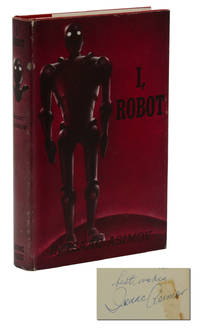
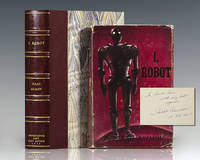
1950125007New York: Gnome Press Inc. Publishers 1950. First edition of this groundbreaking collection of stories. Octavo original cloth. Presentation copy inscribed by the author on the front free endpaper "To Bruce Lane with very best regards Isaac Asimov 26 Feb. 1951." Near fine in a very good dust jacket with a small chip to the spine. Housed in a custom half morocco clamshell box. Signed first editions are uncommon. In this collection one of the great classics of science fiction Asimov set out the principles of robot behavior that we know as the Three Laws of Robotics. Here are stories of robots gone mad mind-reading robots robots with a sense of humor robot politicians and robots who secretly run the world all told with Asimov's trademark dramatic blend of science fact and science fiction. It includes "The Evitable Conflict." in which machines that have made the world of the twenty-first century an economic utopia take control of Mankind's future moving it "toward an unknown and happy destiny" Berger Science Fiction and the New Dark Age. It is the basis for the 2004 film starring Bridget Moynahan Bruce Greenwood James Cromwell Chi McBride and Alan Tudyk. Gnome Press, Inc. Publishers hardcover books