29 551 résultats
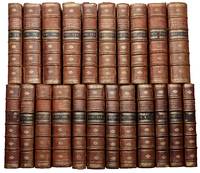
17326441London: Various printers to the Royal Society 1732. 1665-1732. <p>First edition of the first 426 issues an unbroken run from March 1665 to December 1732 of the world's oldest continuous scientific journal and the single most important record of the first announcement and communication of scientific discoveries and inventions PMM. It contains groundbreaking research by Newton - all 17 of his optical papers and therefore his first printed contribution to science - and by Halley Hooke Boyle Flamsteed Leeuwenhoek Cassini Hevelius Huygens and many others across astronomy physics chemistry mathematics medicine and natural history. Through Newton's optical papers of 1672-1676 the Transactions saw the first experimentally grounded proposal for the radical reform of a scientific theory to be advanced through a technical journal - a proposal that became the first to arouse international discussion and debate in print and within the pattern of public announcement discussion and professional consensus then established science has advanced ever since. Provenance: armorial bookplate of Sir Marcus Beresford 1st Earl of Tyrone 1694-1763; contemporary inscription at the end of one issue January 1692/3 noting its donation by Robert Hooke; manuscript corrections and notes on more than eighty pages with eight further pages on the measurement of the Earth bound in at the end.</p>. The World's Oldest Continuous Scientific Journal. <p>First edition of the first 426 issues an unbroken run from March 1665 to December 1732 of the world's oldest continuous scientific journal and the single most important record of the first announcement and communication of scientific discoveries and inventions PMM. It contains groundbreaking research by Newton - all 17 of his optical papers and therefore his first printed contribution to science - and by Halley Hooke Boyle Flamsteed Leeuwenhoek Cassini Hevelius Huygens and many others in astronomy physics chemistry mathematics medicine and natural history. Thomas Henry Huxley observed in his 1866 address On the Advisableness of Improving Natural Knowledge that if every book in the world apart from the Philosophical Transactions were destroyed the foundations of physical science would remain secure and the intellectual progress of the last two centuries largely recoverable. Long unbroken runs of the first four-and-a-half decades are now of the greatest rarity. ABPC and RBH record only two comparable sets at auction in the last three decades - Norman 1694 Christie's New York 15 June 1998 lot 716 $112500 and Macclesfield 1782 Sotheby's 25 October 2005 lot 1782 £96000 = $171400 - and a set of just the seven volumes containing Newton's papers on light realised $75600 at Christie's in October 2022.</p> <br /> <br /> <p>Provenance: armorial bookplate of Sir Marcus Beresford 1st Earl of Tyrone 1694-1763 Anglo-Irish peer and politician on the front pastedowns; contemporary inscription at the end of one issue January 1692/3 noting its donation by Robert Hooke; numerous manuscript corrections on more than sixty pages additional notes on about twenty pages and eight pages of manuscript notes on the measurement of the Earth bound in at the end.</p> <br /> <br /> <p>In November 1660 members of the Oxford Philosophical Club - John Wilkins John Wallis Robert Boyle Christopher Wren Robert Hooke among them - met a group of London natural philosophers at Gresham College and agreed to form a philosophical society that would meet weekly to exchange information and to conduct experiments. The society received its charter from the newly restored Charles II in 1662 and Henry Oldenburg a German-English diplomat and friend of Boyle was installed as one of its two secretaries. One of the charter's terms called for the exchange of information with other learned societies and Oldenburg almost at once began a sustained correspondence - with the Cimento Academy in Florence the Montmor Academy in Paris and after its foundation in 1666 the Académie Royale des Sciences - and with hundreds of working natural philosophers in places that had no scientific society of their own. Oldenburg was fluent in German Dutch French English and Latin and he was able to translate most foreign correspondence himself including Antoni van Leeuwenhoek's letters on his microscopical investigations and the communications of Johannes Hevelius of Gdansk and Marcello Malpighi of Bologna. After some years writing letters without salary Oldenburg decided to compile a monthly newsletter summarising a month's Royal Society activities and send it out to his correspondents in a single printing. On 6 March 1665 Old Style; 16 March by the Gregorian calendar then in use on the continent the first issue of the Philosophical Transactions appeared. It consisted of letter-excerpts reviews and summaries of recently published books and accounts of observations and experiments from European natural philosophers. Some of the pieces Oldenburg wrote himself summarising the minutes of Society meetings; others he translated or adapted from printed sources; still others were composite pieces assembled from the letters of several correspondents on a common subject. After his death in 1677 the journal passed through the hands of a succession of editors frequently also Secretaries of the Society - Edmond Halley and Hans Sloane the best-known among them - and through a succession of printers its form and content broadly reflecting the priorities of the current editor and to a degree of the Society. The Royal Society assumed financial responsibility for the journal only in 1752.</p> <br /> <br /> <p>Until the last third of the seventeenth century most original contributions to science appeared in books in which an author's own findings were embedded within a systematic exposition of a larger subject. The chartering of the Royal Society in 1662 and of the Académie Royale des Sciences in 1666 and the launching in 1665 of the Journal des Sçavans at Paris and the Philosophical Transactions at London gave institutional expression to a new conception of science as a cooperative enterprise: the immediate objective of the individual scientist became the experimental contribution to an eventual system of nature rather than the construction of the system itself and the journal article began to replace the book as the unit in which that contribution was made. Newton was the first to advance through this new medium an experimentally grounded proposal for the radical reform of a scientific theory and his proposal was the first to arouse international debate within the columns of a scientific journal. Through that exchange - in which all the participants modified their positions - a consensus of scientific opinion was produced; and within the same pattern of public announcement discussion and professional consensus science has advanced ever since Kuhn in Cohen Isaac Newton's Papers and Letters on Natural Philosophy 2nd ed. 1978 pp. 27-29.</p> <br /> <br /> <p>Newton's seventeen optical papers comprising his entire published optical contribution to the journal across the 1670s run as a single intellectual sequence: the seminal 1672 New Theory paper No. 80 pp. 3075-3087 introducing the prism experiment and the spectral analysis of white light; the catadioptrical-telescope paper No. 81; a series of exchanges with the French Jesuit Pardies Nos. 82 84 85 with Christiaan Huygens via an 'ingenious person from Paris' Nos. 96 97 and with the Liège Jesuits Linus and Lucas Nos. 110 121 123 128 - together more than half of the seventeen papers all responding to objections raised against the New Theory. Newton's answer to Hooke's objections No. 88 is the most polemical of the set prefiguring the priority dispute that would dominate the Principia years; the answer to Sir Robert Moray on behalf of the Royal Society No. 83 the most measured. Across the seven volumes containing them the papers transformed optics from a body of empirical reports into a quantitative experimental science driven by decisive testing among hypotheses and supplied the methodological core that Newton would eventually assemble decades later into the Opticks of 1704.</p> <br /> <br /> <p>These papers together constitute the first major contribution to science made through a technical journal - the medium that rapidly became the standard mode of communication among scientists - and as Christianson puts it if Newton had published nothing else the optical papers alone would guarantee him a place among the immortals of modern science Christianson In the Presence of the Creator 1984 p. 150. They yield further an insight into Newton's mental processes that the Principia and the Opticks - formal impersonal Olympian - conceal; it is in these early brief sometimes hasty letters to Oldenburg as in his notebooks and unpublished manuscripts that the creative scientist is to be found Kuhn in Cohen pp. 27-29.</p> <br /> <br /> <p>When Newton was first appointed Lucasian Professor at Cambridge in 1669 he chose optics for the subject of his first lectures and researches and by the end of that year he had worked out in detail the decomposition of a beam of white light into rays of different colours by means of a prism the complete explanation of the rainbow following from this discovery. These results formed the subject of his Lucasian lectures in 1669 1670 and 1671 and their principal conclusions were communicated to the Royal Society in February 1672 and printed soon afterwards in the Transactions No. 80. Before Newton light had been believed to be a homogeneous substance and colour was held to be produced by the mixture of light with darkness - the prism in the standard account supplying the darkness that coloured the light with all rays of white light striking the prism at the same angle being equally refracted. Newton's experiments led him to the radically different conclusion that white light is a mixture of rays of many distinct types each refracted at a slightly different angle and each responsible for producing one spectral colour. He set up a prism near his window at Trinity College and projected the spectrum onto a wall twenty-two feet away; to prove that the prism refracted light rather than colouring it he refracted the beam a second time back to white. The crucial experiment that confirmed the theory was to isolate a narrow ray of a single colour from the first spectrum and pass it through a second prism where no further elongation or separation occurred - a demonstration that each spectral ray was itself unmixed and uniformly refrangible. The reception of the paper was mixed. Many contemporaries simply ignored it; Mariotte in 1679 Pardies 1672 and Linus 1675 all claimed to have failed to replicate the basic experiments described. Rather than argue with them in detail Newton invited his critics to repeat his experiments with greater care; they did so without success. Others - Hooke among them who confirmed the experiments himself before a committee of the Royal Society in April 1676 - conceded the results but held that they could be accommodated by minor modification of existing theories making Newton's radical interpretation unnecessary. The controversy lasted six years after the paper's first appearance and left Newton conspicuously wary of publication.</p> <br /> <br /> <p>Newton's invention of the reflecting telescope reported in the issue immediately following his first optical paper No. 81 had in fact prompted the optical work rather than the other way round: the chromatic aberration of refracting lenses - their inability to bring different colours of light to a single focal point - was the original stimulus for Newton's investigation of the nature of light. Newton had sent Oldenburg his letter describing the telescope before his letter describing the new theory and had hoped to present the telescope as a practical test-piece for the theory. Oldenburg however printed the material in the reverse order the theory first followed by the description of the instrument. The telescope made a considerable impression at the Royal Society which promptly elected Newton a Fellow; a corresponding notice appeared in the Journal des Sçavans in February 1672 with emphasis on the instrument's compactness and it was the telescope rather than the theory of light that first made Newton's name known on the Continent Dilaura Bibliotheca Opticoria 1475-1925 2019 pp. 235-236.</p> <br /> <br /> <p>Newton published three non-optical papers in his lifetime all anonymously. His only published paper on chemistry Scala Graduum Caloris No. 270 April 1701 pp. 824-829 states what has since become known as Newton's law of cooling - that the rate at which a hot body loses heat is proportional to the difference between its temperature and that of its surroundings - and describes the construction of a thermometer capable of measuring temperatures up to almost 1000 °C. An Account of the Book entituled Commercium Epistolicum Collinii & Aliorum De Analysi promota No. 342 February 1715 pp. 173-224 is Newton's anonymous review of the Commercium epistolicum the official report of the committee appointed by the Royal Society to adjudicate in the dispute between Newton and Leibniz over priority in the invention of calculus - the most bitter and consequential priority dispute in the history of science; the Account purports to be impartial but was in fact written like the Commercium epistolicum itself by Newton. In the same volume No. 347 March 1716 pp. 399-400 appeared Newton's Problematis Mathematicis Anglis Nuper Propositi Solutio Generalis his response to a challenge problem set by Johann Bernoulli to the English mathematicians; tradition has it that Newton solved it in a single evening after returning from a day's work at the Mint. With the exception of this minor paper none of Newton's original work on gravitation or on mathematics was published in the Transactions. Edmond Halley's review of the Principia however appeared soon after its publication No. 186 pp. 291-297 - Halley was then the journal's editor - and is prefaced by an advertisement apologising for the fact that the Transactions had been delayed for some months because Halley had had the entire care of the Principia's own edition and had therefore as he put it been more serviceable to the Commonwealth of Learning in seeing Newton's book into print than he would have been in issuing his own periodical on time. Halley pointed out with justice that one of the most striking features of the Principia was Newton's great skill in using the new mathematics - by which Halley meant Newton's own method of infinite series.</p> <br /> <br /> <p>Edmond Halley 1656-1742 was one of the most original minds of his time and he made a long series of important contributions of his own to the Transactions. The best-known of them is Astronomiae cometicae synopsis No. 297 March 1705 pp. 1882-1899 the first printing of the theory according to which comets belong to the solar system and move in eccentric elliptical orbits; it was here that Halley set out his method of computing the motion of comets of establishing their periodicity in elliptical orbits and of identifying the comet that would bear his name DSB. The confirmation of the comet's return - in 1759 after Halley's death - was the first time that a body other than a planet had been shown to orbit the Sun the earliest successful observational test of Newtonian physics and a vivid demonstration of its explanatory power; the comet was named after Halley by the French astronomer Nicolas-Louis de Lacaille in 1759. Halley's other major contributions to the journal include his Methodus singularis No. 348 June 1716 pp. 454-464 in which he challenged the international astronomical community to use the transits of Venus across the Sun predicted for 1761 and 1769 to transform astronomy into a fully empirical science by measuring the Earth-Sun distance - a challenge that astronomers took up organising expeditions to the farthest corners of the globe and overcoming obstacles of every kind; A short History of the several New-Stars No. 346 December 1715 pp. 354-356 in which he observed that the new stars of 1572 and 1604 Tycho's and Kepler's stars were not the only changing stars on record that others had been observed in 1596 1600 1670 and 1686 some of them fading and reappearing and one of them - Mira - appearing to wax and wane with a regular 330-day period; An Account of several Nebulae or lucid Spots like Clouds No. 347 March 1716 pp. 390-392 in which Halley assembled the first list of known nebulae with their discoverers crediting the Great Nebula in Orion to Huygens the Andromeda nebula to Boulliau and the two spherical nebulae in Centaurus and Hercules to himself; 'Of the infinity of the sphere of fix'd stars & Of the number order and light of the fix'd stars' No. 364 April 1720 pp. 22-26 in which Halley posed what later generations would call Olbers's paradox a century before Olbers did; and outside astronomy his paper on the Breslaw life table No. 196 January 1692/3 pp. 596-610 which produced the first life table based on sound demographic data and gave the first correct calculation of annuities using essentially the methods still in use today - a paper of first importance in the history of statistics.</p> <br /> <br /> <p>John Flamsteed 1646-1719 was with Halley the most important English astronomer of his generation; his major works are the Historiae coelestis first published in 1712 without his consent by Halley and Newton and the Atlas coelestis published posthumously in 1729 but he also contributed more than thirty articles to the Transactions chiefly on observational astronomy. No other Astronomer Royal before Airy displayed anything like Flamsteed's concern for the reduction and manipulation of his own data: far from bequeathing the mass of raw observations that Bradley would he reduced and applied them himself DSB.</p> <br /> <br /> <p>Robert Boyle 1627-1691 contributed some thirty-seven papers to the Transactions Fulton p. 138 among them his influential questionnaire General Heads for the Natural History of a Country a number of major experimental essays that sometimes filled a whole issue and most revealingly An Experimental Discourse of Quicksilver growing hot with Gold No. 122 February 1675/6 pp. 515-533 - a paper on a kind of mercury that would incalesce when amalgamated with gold suggesting that Boyle had achieved the long-sought alchemical philosophical mercury capable of transmuting base metals. Boyle's trials went back to 1652 when he had received the recipe from his American mentor George Starkey; his decision to go public in 1676 signalled a newly intense period of alchemical activity on his part. The paper drew from Newton - himself a committed alchemical enthusiast - a letter to Oldenburg urging that such matters were not to be communicated without immense damage to the world if there should be any truth in the Hermetic writers; Oldenburg took the hint and the incalescence paper remained a one-off in the Transactions Hunter Alchemy in the Transactions Royal Society blog 1 July 2015.</p> <br /> <br /> <p>The Dutch microscopist Antoni van Leeuwenhoek 1632-1723 contributed 116 articles to the Transactions over the half-century 1673-1723; the most famous of them the letter on the protozoa No. 133 March 1677 pp. 821-831 gives the first detailed description of protists and bacteria in a range of environments. Leeuwenhoek is universally acknowledged as the father of microbiology: he discovered both protists and bacteria but more than being the first to see the microscopic world of his animalcules he was the first even to think of looking - certainly the first with the power to see. Using his own deceptively simple single-lensed microscopes he did not merely observe but conducted ingenious experiments exploring and manipulating his microscopic universe with a curiosity that belied his lack of any map or bearings. The verification of Leeuwenhoek's new world by the natural philosophers of the Royal Society set out the ground rules that still define experimental science today Lane The unseen world: reflections on Leeuwenhoek 1677 Philosophical Transactions B370 2015 pp. 1-10.</p> <br /> <br /> <p>Martin Lister 1639-1712 contributed in 1673 what is now regarded as the earliest journal article on palaeontology: A description of certain stones figured like plants No. 100 pp. 6181-6191 on the preservation of St Cuthbert's beads - crinoid remains - in the approximately 350-million-year-old Carboniferous limestones of northern England. The biological nature of fossils was then controversial: Kircher had argued that they formed by abiogenic plastic forces within the rock while Hooke and Steno had suggested they were the remains of living organisms. Lister was the first to explore how direct observation could decide between the two making observations about what modern geobiology calls taphonomy and biogenicity criteria - observations that presage current debates about the earliest signs of life on Earth and Mars Brasier Philosophical Transactions A373 2015 pp. 1-16. Other natural-historical papers scattered through the journal's first century - Account of a very odd monstrous calf Some experiments and observations on May-dew Some observations on strange swarms of insects - are in places fanciful but in many others acute; Hooke's own contributions which began in the very first issue March 1665 with A spot in one of the belts of Jupiter are sometimes held to include the first observation of the Great Red Spot still visible on Jupiter today.</p> <br /> <br /> <p>The early volumes also contain the record of the world's first experiments with blood transfusion conducted in England in the mid-1660s. The procedure - gruesome - was first carried out between dogs with arteries and veins in the animals' necks opened and blood transferred from one to another through quills most likely of goose feather inserted into the vessels and clamped with running knots; in the physician Richard Lower's account No. 20 pp. 353-358 the transfusion came to an end when the emittent dog fell into convulsions and died. Shortly afterwards Boyle published a remarkable set of questions about the likely effects of transfusion on the animal receiving blood No. 22 pp. 385-388 asking whether transfusion might change a dog of one breed into another alter its temperament render a fierce dog cowardly transmit satiety or hunger obliterate learned behaviours or make a dog forget its master - a sequence of questions which as recent commentators have noted read like an alchemical programme turned inward upon the living body. Researchers soon proposed transfusion into a human subject. Since the procedure generally killed the emittent a human-to-human transfusion was thought impossible and a sheep was settled upon as donor. The choice of human recipient fell in 1667 upon Arthur Coga - mentally unstable but sufficiently educated to report in Latin on the effects of the procedure - and the operation was performed by Lower and the physician Edmund King No. 30 pp. 557-559 who judged that Coga had received nine or ten ounces of sheep's blood. A few days afterwards Coga reported back to the Society in Latin and Samuel Pepys meeting him at a dinner party shortly thereafter found him to speak very reasonably though cracked a little in his head.</p> <br /> <br /> <p>Other contributors in these decades include Cassini on the satellites of Jupiter Huygens on mechanics and optics Malpighi Swammerdam Borelli Steno Fahrenheit and Redi whose experimental refutation of spontaneous generation appeared in the journal alongside a steady stream of domestic material from Harvey Wren Ray Petty Locke Wallis Winthrop Tyson Lancisi Leibniz and Hales. To turn the pages of these thirty-seven volumes is to watch the first two generations of a new scientific public discover how to work together - how to record observation propose hypothesis invite replication agree or disagree in print and build by open argument the provisional consensus that is the hallmark of modern science.</p> <br /> <br /> <p>References: Grolier/Horblit 95b - Macclesfield 1782 - Norman 1694 - PMM 148 Vol. 1 - Brasier Deep questions about the nature of early-life signals: a commentary on Lister 1673 Philosophical Transactions A373 2015 pp. 1-16 - Christianson In the Presence of the Creator 1984. Cohen ed. Isaac Newton's Papers and Letters on Natural Philosophy 2nd ed. 1978 - Dilaura Bibliotheca Opticoria 1475-1925 2019 - Fulton A Bibliography of the Honourable Robert Boyle 1932 - Lane The unseen world: reflections on Leeuwenhoek 1677 Philosophical Transactions B370 2015 pp. 1-10.</p> <br /> <br/> <br/> 37 vols. bound in 22 4to 215 × 165 mm containing all issues from March 1665 No. 1 through December 1732 No. 426 with 380 engraved plates 306 folding 176 woodcut illustrations and diagrams and 7 folding tables occasional damp-staining a few tears and small holes occasionally affecting a word or two a few headlines shaved the plate in No. 56 map of part of Languedoc with a 7 cm tear that in No. 60 apparatus shaved at head and that in No. 196 with bottom corner repaired with loss of about a quarter of the plate relating to the dissection of a rat. Uniformly bound in eighteenth-century probably mid-1730s sprinkled calf spines ruled and tooled in gilt in compartments with title and volume-number labels some joints cracking but firm a few labels missing slightly rubbed. Generally very clean and well-preserved. Various printers to the Royal Society unknown
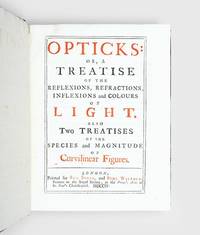
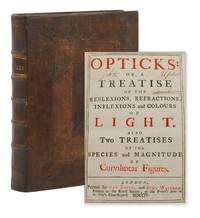
1704189050London: Printed for Sam Smith and Benj. Walford 1704. From the family library of a founding member of the Royal Society First edition first issue an exceptionally fresh and unrestored example. This copy comes from the family library of John Evelyn a fellow of the Royal Society alongside Newton for more than 30 years and the author of its first published book. As with many books from the Evelyn family library this copy bears an ink pressmark on the front pastedown in an early 18th-century hand. Evelyn was generally fastidious about annotating the books he acquired and this pressmark bears calligraphic similarities to one found in his copy of Taylor's Symbolon 1674 which he also annotated with his signature and motto. This copy remained in the Evelyn family library until the late 20th century: it entered the private market during the 1977-78 Christie's sales. Evelyn and Newton are among the most famous fellows of the early Royal Society. By 1704 the 84-year-old Evelyn had moved from Deptford to his ancestral home at Wotton in Surrey although his work as a treasurer for the new Greenwich Hospital brought him regularly back to London. A younger generation was now in charge of the Society's direction: in 1703 Newton assumed the presidency and gradually reshaped its work in line with Newtonian science. Evelyn continued to contribute to the Royal Society's intellectual life on his terms well into his 80s: in 1702 he published a paper in the Philosophical Transactions discussing his anatomical tables and he later attended two of the experimental sessions held under Newton's presidency. This first issue of the Opticks lacks Newton's name on the title page. Quarto 241 x 186 mm pp. iv 114 211 = 213 two blank pages left unnumbered. With 19 folding engraved plates tables and diagrams in text title page lettered in red and black. Contemporary panelled calf spine ruled in blind red morocco label to style edges sprinkled red. With custom cloth box. Late 18th-century engraved armorial bookplate of Frederick Evelyn 1734-1812 along with the Christie's sale bookplate. Light rubbing calf smooth and bright slight loss to head of spine and tiny wormhole to foot damp staining to upper margin of several leaves and plates a couple of tiny ink splashes contents otherwise generally crisp: a fresh copy. This copy: lot 1078 The Evelyn Library Part III: M-S Christie's March 1978 p. 62. Babson 132 1; Dibner Heralds of Science 148; ESTC T82019; Gray 174; Grolier/Horblit 79b; Norman 1588; Printing and the Mind of Man 172; Wallis 174. hardcover
17045582London: Sam. Smith and Benj. Walford Printers to the Royal Society 1704. Hardcover. Near Fine. 4to. 24.2 x 18.8 cm. 2 ff. 144 pp. 211 pp 1 pp. with 19 folding engraved plates. Bound in contemporary English paneled calf. Minor ribbing to binding. Only very minor marginal traces of use. Very genuine. Excellent. First edition first issue of this landmark in science by Sir Isaac Newton 1642-1727 here in a remarkably well preserved unrestored example. "The work summarized Newton's discoveries and theories concerning light and color: the spectrum of the sunlight the degrees of refraction associated with different colors the color circle the first in the history of color theory the invention of the reflecting telescope the first workable theory of the rainbow and experiments on what would later be called 'interference effects' in conjunction with Newton's rings . . . The first edition of the Opticks ends with two mathematical treatises in Latin written to establish his priority over Leibnitz in the invention of the calculus" Norman 1588. Babson 132; Dibner 148; Horblit 79b; PMM 172; Norman 1588; Wallis 174. <br/> <br/> Sam. Smith and Benj. Walford, Printers to the Royal Society hardcover books
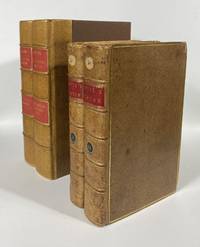
17294526London: For Benjamin Mott 1729. first Edition in English. Two vols. 8vo. 19 x 11 cm. Paginated: 36 320; 2 393 13; viii 3 4-71 1 pp. Collation = Ad 1: pi1 A2 2A8 a8 B-X8. Ad 2: pi1 B-Z8 Aa-Cc8 Dd3 lacking blank leaf Dd4 as commonly; a4 A-D8 E4 with cancel C1 headling = "Gentium"; stain on fols. b7-8 and c1-2. Lacking engraved allegorical frontispiece to each volume not unusually. With 47 engraved folding plates numbered 1-25 and 1-19 with 3 unnumbered plates at rear of volume 2 2 folding letterpress tables 3 engraved headpieces. Bound in contemporary English sprinkled calf very minor wear wear along binding extremities spines with red morocco lettering pieces gilt black oval volume numbers gilt old shelf labels in MS on paper circles "30". BEAUTIFUL COPY OF THE FIRST ENGLISH-LANGUAGE EDITION OF THE GREATEST WORK IN THE HISTORY OF SCIENCE "PERHAPS THE GREATEST INTELLECTUAL STRIDE THAT IT HAS EVER BEEN GRANTED TO ANY MAN TO MAKE" EINSTEIN. <br /> <br /> "The Principia is generally described as the greatest work in the history of science. These provided the great synthesis of the cosmos proving finally its physical unity. Newton showed that the important and dramatic aspects of nature that were subject to the universal law of gravitation could be explained in mathematical terms within a single physical theory. With him the separation of natural and supernatural of sublunar and superlunar worlds disappeared" Bernard Cohen Introduction in The Mathematical Principles of Natural Philosophy 1968.<br /> <br /> PMM: "Copernicus Galileo and Kepler had certainly shown the way; but where they described the phenomena they observed Newton explained the underlying laws." Originally published in Latin in 1687 the Principia "marked the culmination of the scientific revolution . ushered in modern science and through its legacy the work may have done more to shape the modern world than any other ever published" ODNB. Newton here laid the foundation for classical mechanics establishing the three laws of motion and universal gravitation. It is universally considered a masterpiece that unified physical laws of the heavens and earth. <br /> <br /> This finely printed translation into English by Mott made the work available to a wider lay audience. This edition also contains John Machin's attempt to rectify Newton's lunar theory "The Laws of the Moon's Motion according to Gravity." Most copies have an engraved frontispiece in each volume although some have only one Ransom Center etc. while a surprising number have neither of them as here including the Gonville and Caius copy at Cambridge University M.26.7-8. Because the book has been of enduring interest for almost 300 years with commensurately heavy use copies as fresh as this in contemporary bindings are of genuine rarity.<br /> <br /> Babson 20. Wallis 23. PMM 161. For Benjamin Mott unknown
1704157612London: Smith & Walford 1704. First. hardcover. very good. Also Two Treatises of the Species and Magnitude of Curvilinear Figures. 4 parts in 1 volume. Title page printed in red & black within a double-ruled border. Illustrated with 19 folding copperplate engravings.4 144 211 1pp. In the second sequence p. 120 is marked 112 and there are blank pages between 137-8 and 138-9. Thick 4to contemporary blind-tooled panelled calf expertly rebacked in matching leather contemporary signature on title dated 1704; last several pages have marginal dampstains otherwise a remarkably clean crisp copy. London: Smith & Walford 1704.<br/><br/> First edition first issue - with the author not named on title page. The work contains: The First Book of Opticks The Second Book of Opticks The Thrid Book of Opticks Tertii Ordinis: Enumeratio Linearum Tractatus de Quadratura Curvarum. The main work is in English the 2 treatises pages 138-211 are in Latin. Babson 132; Gray 174; Horblit 79b; PMM 172; Norman 1588; Dibner 148; Wallis 174.<br/><br/> Smith & Walford unknown books
1704157612London: Smith & Walford 1704. First. hardcover. very good. 4 parts in 1 volume. Title page printed in red & black within a double-ruled border. Illustrated with 19 folding copperplate engravings.4 144 211 1 pages. In the second sequence p. 120 is marked 112 and there are blank pages between 137-8 and 138-9. Thick 4to contemporary blind-tooled paneled calf well-worn and now expertly re-backed in sympathetic leather; last several pages have marginal dampstains otherwise a remarkably clean crisp copy. London: Smith & Walford Printers to the Royal Society 1704. First edition first issue - with the author not named on title page.<br/> <br/> "Newton's Opticks expounds his corpuscular theory of light and summarizes his experiments concerning light and colour. It also prints two important mathematical treatises omitted in later editions describing his invention of the fluxional calculus the grounds for his claim of priority over Leibniz. Newton arrived at most of his unconventional ideas on colour by about 1668 and Opticks was largely complete by 1692. However when he first partially expressed his theories in public in 1672 and 1675 they provoked hostile criticism especially on the continent. As a result Newton delayed the publication of Opticks until his most vociferous critics - especially Robert Hooke - were dead. Unusually for Newton and in what was probably a further defensive move the work was first published in English rather than Latin becoming a major contribution to the development of vernacular scientific literature. By about 1715 Opticks established itself as a model for interweaving theory with quantitative experimentation. Newton's aim was not to "explain the properties of light by hypotheses but to propose and prove them by reason and experiments" p. 1. The great achievement of the work was to show that colour was a mathematically definable property."<BR> <BR> The work contains: The First Book of Opticks The Second Book of Opticks The Thrid Book of Opticks Tertii Ordinis: Enumeratio Linearum Tractatus de Quadratura Curvarum. The main work is in English the 2 treatises pages 138-211 are in Latin. Babson 132; Gray 174; Horblit 79b; PMM 172; Norman 1588; Dibner 148; Wallis 174.Provenance: Signature of Francis Cremer the initial owner & contemporary of Newton's dated 1704 is on the title page with the price he paid of 12 shillings. Another ownership signature "Gul Bryant" also a sudent at Cambridge some decades later is on the rear flyleaf and the library label of Francis E. Nipher 1847- 1926 the American physicist on the front paste-down.<br/> <br/> Smith & Walford unknown
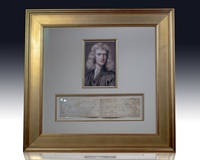
1698149618January 25 1698-1699. Rare vellum manuscript signed by Sir Isaac Newton as Warden of the Royal Mint in which he makes a case against his nemesis coin counterfeiter William Chaloner soon to be hanged for high treason. One page vellum manuscript document signed by Isaac Newton  “Is. Newton†January 25 1698-1699. Recognizance bond issued by Isaac Newton as Warden of the Royal Mint to ensure the future appearance of Nathaniel Peck as a witness against Newton’s nemesis the counterfeiter William Chaloner. The document reads in part "Nathanl Peck de Black Fryars London…Thos Worley de St Sepulchres London Glover…Symon Cross de east Aurifaber…Upon Condition the said Peck do personally appear at the next Genll Sessions of the peace …in St John str for the County aforesaid Then and there to answer…objected agt him touching his packing away Counterfeit money for advantage." Appointed as Warden of the Mint in 1696 upon the recommendation of Charles Montagu Chancellor of the Exchequer Isaac Newton ascended to the role of Master of the Mint the following year—a position he would retain for the remainder of his life. Prioritizing his duties at the Mint over his academic commitments he relinquished his responsibilities at Cambridge in 1701 to devote himself fully to the office. As Master Newton spearheaded significant currency reforms and pursued counterfeiters with unwavering diligence wielding the full force of the law as exemplified by the fate of William Chaloner. On the very day Newton signed this bond he received a formal statement from Nathaniel Peck who attested that seven years prior Chaloner had commissioned him to modify two iron pieces which were subsequently used to produce counterfeit French pistoles. Additionally Peck admitted to purchasing counterfeit pistoles from Chaloner at a rate of eight shillings per coin and reselling them for eleven shillings. Some months later Chaloner provided Peck with forged guineas which he likewise circulated before Chaloner turned to Thomas Holloway as his preferred distributor. By early 1699 Newton had compiled a formidable body of evidence against Chaloner consisting of 44 depositions. Chaloner had been apprehended in November 1698 on charges of forging lottery tickets though those specific allegations were ultimately dismissed. Nevertheless Newton proceeded to indict him on three separate counts securing a conviction for high treason on March 3 1699. Mere weeks later on March 22 Chaloner met his end at the gallows of Tyburn. In good condition fold at center scattered toning. Archivally mounted matted and framed with a portrait of Newton. The document measures 12.25 inches by 3 inches. The entire piece measures 23.5 inches by 23 inches. Signed documents by Newton are exceptionally rare. Isaac Newton 1643–1727 was an English mathematician physicist and astronomer widely regarded as one of the most influential scientists in history. His groundbreaking work Philosophiæ Naturalis Principia Mathematica 1687 laid the foundation for classical mechanics introducing the laws of motion and universal gravitation. However beyond his scientific achievements Newton played a crucial role in England’s financial and legal system. In 1696 he was appointed Warden of the Royal Mint largely due to the recommendation of Charles Montagu Chancellor of the Exchequer. A few years later in 1699 he became Master of the Mint a position he held until his death. Newton took his role seriously overseeing the recoinage of England’s currency implementing measures to stabilize the economy and aggressively pursuing counterfeiters. His meticulous investigations led to the conviction of notorious forgers like William Chaloner demonstrating his unwavering commitment to upholding the integrity of England’s monetary system. hardcover
1704140946960London: Printed for Sam. Smith and Benj. Walford Printers to the Royal Society at the Prince's Arms in St. Paul's Church-Yard 1704. First Edition. Very Good. First edition first issue of this foundational work in the field of optics in which Isaac Newton explores the nature of light and color presenting his experiments and theories on how light behaves. Title printed in red and black within a double-rule border and without author's name. Bound in contemporary paneled calf boards sympathetically rebacked; with 19 engraved folding plates. <p>Very Good. Soiling to textblock and endsheets bookplate of Irish naturalist John Vandeleur Stewart affixed to the front pastedown ownership signature to title page. Amateur repair to gutter at title page. Numerous pencil notations throughout though mostly confined to the margins or blank areas. Plate 5 is torn at the fold plate 6 with corner loss affecting the image several shaved. Second book with page 120 misnumbered as 112. <p>A lovely copy of Newton's second major book on physical science considered one of the Scientific Revolution's three major works on optics. It overturned centuries of thinking attributed to Aristotle or Theophrastus and accepted by scholars in Newton's time that "pure" light such as the light attributed to the Sun is fundamentally white or colorless and is altered into color by mixture with darkness caused by interactions with matter. Here Newton shows the opposite was true: light is composed of different spectral hues he describes seven – red orange yellow green blue indigo and violet and all colors including white are formed by various mixtures of these hues. He demonstrates that color arises from a physical property of light – each hue is refracted at a characteristic angle by a prism or lens – but he clearly states that color is a sensation within the mind and not an inherent property of material objects or of light itself. <p>Unlike his earlier work Philosophiae Naturalis Principia Mathematica which took a more deductive approach Opticks is largely experimental and inductive. Newton's study includes detailed descriptions of his experiments with prisms and lenses leading to the conclusion that white light is composed of a spectrum of colors. The work also delves into the phenomena of diffraction and interference which were crucial to the development of wave theory in later years. The work is notable for containing Newton's first mathematical papers in print and for giving the first full explanation of the rainbow complete with related diagrams. Like Galileo Newton decided to publish this text in his native English rather than Latin the language of scholarship; an enlarged Latin edition would be published two years later. Printed for Sam. Smith and Benj. Walford, Printers to the Royal Society, at the Prince's Arms in St. Paul's Church-Yard unknown
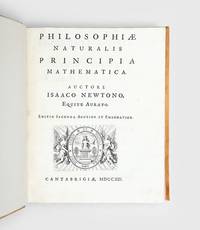
1713181514Cambridge: Printed by Cornelius Crownfield at the University Press 1713. I feign no hypotheses Second edition extensively revised by Newton himself and including the first appearance of the General Scholium: among his last discussions of scientific enquiry and the source of his famed principle "Hypotheses non fingo" "I feign no hypotheses" - p. 484. "The Principia that has shaped Western scientific tracition is substantially the second edition" ODNB. Together with Roger Cotes 1682-1716 Cambridge's Plumian Professor of Astronomy Newton extensively overhauled the Principia over a period of four years: almost 400 of the first edition's 494 pages have been revised here. Alongside the Scholium the pair made particularly extensive annotations to the sections on lunar theory comets and fluid dynamics. Cotes was a gifted mathematician in his own right: after his early death Newton commented that "if he had lived we might have learned something". Cotes's lengthy preface together with Newton's Scholium and the revisions to the text itself helped to fashion the second edition of the Principia into a key text in the lengthy debate between Newton and continental philosophy most particularly that of Leibniz. The "Hypotheses non fingo" principle is directly framed to emphasize Newton's focus on descriptive analysis in contrast to continental speculation over causes. This is one of 750 copies printed at the Cambridge university press under the supervision of Richard Bentley the famed and feared master of Trinity College. Quarto 233 x 191 mm pp. xxviii 484 8. Leaf 3Q2 cancelled. Folding engraved plate facing p. 465 engraved Cambridge University Press printer's device on title page extensive wood-engraved diagrams in text. Recent vellum spine with red morocco label covers with yapp edges edges sprinkled red. With 20th-century engraved bookplate of the noted science collectors Peter and Margarethe Braune. Light finger soiling infrequent minor browning and foxing running wormhole throughout with discreet infill to most leaves and marginal repair to title and leaf b1 contents otherwise crisp and clean: a very good copy indeed. Babson 12; Dibner 11 note; ESTC T93210; Gray 8; Wallis 8. hardcover
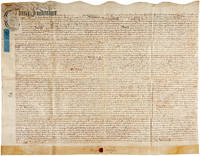
1719146958November 11 1719. Rare and unrecorded 18th century legal document signed twice at the conclusion by Sir Isaac Newton as a witness to a land indenture. Manuscript document signed twice on the verso "Isaac Newton" one vellum membrane dated 11 November 1719 signed by Thomas Sturgess and with his seal witnessed twice on the dorse the sealing of the document and the payment of the PS270 witnessed separately by Newton and also by Richard Cox and James Weston and also signed again by Sturgess. The document records an indenture by which Thomas Sturgess of the parish of St Martin's in the Fields sells to Robert Newton of Colsterworth Lincs for the sum of PS270 a messuage or tenement in Colsterworth in the tenure of William Bulliner and also around 70 acres of arable land and pasture in Colsterworth and Woolsthorpe "Woollstrop" also occupied by the Bulliner family William Joan and son John also one rood i.e. quarter acre of land previously belonging to John Storey of Kneeton Notts and other lands. Newton was in his mid-70s when he witnessed this deed and was living in London as Master of the Mint. He almost certainly knew both parties to this transaction. His home in St Martin's Street was in the parish of St Martin's in the Fields which was also the home of Thomas Sturgess who was selling the land in this transaction. The buyer was his first cousin once removed Robert Newton of Colsterworth d.1734. Isaac Newton would also have been familiar with the fields and houses that his cousin was buying: the property in question included land in Newton's native hamlet of Woolsthorpe as well as in the adjacent village of Colsterworth. In near fine condition. The piece measures 20 inches by 23. Documents signed by Sir Isaac Newton are rare and most relate to his work as Master of the Mint. A document closely related to this one was however sold at auction in 2015. Dated one day before the current document that deed recorded the sale of land by Sturgess to Robert Newton for the nominal sum of 5 shillings. It was similarly signed only once by Isaac Newton as a witness. English mathematician astronomer theologian author and physicist Sir Isaac Newton is widely considered one of the most influential scientists of all time and a key figure in the scientific revolution. In one of his most important works Philosophiæ Naturalis Principia Mathematica Newton formulated the laws of motion and universal gravitation that formed the dominant scientific viewpoint until being superseded by the theory of relativity. Considered one of the greatest works of science ever published Newton’s second major book Opticks analyzes the fundamental nature of light by means of the refraction of light with prisms and lenses the diffraction of light by closely spaced sheets of glass and the behavior of color mixtures with spectral lights or pigment powders. hardcover
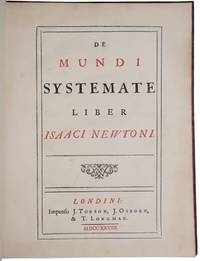
17286610London: J. Tonson J. Osborn & T. Longman 1728. First edition. <p>First edition an extraordinary Newtonian association copy of Newton's rarest book inscribed by James Stirling recording the gift from Abraham de Moivre "Ja: Stirling Ex Dono Dni De Moivre". Drafted in the mid-1680s as the liber secundus of the earliest Principia the text differs substantially from the published Book III. Among its non-Principia contents are the thought-experiment of the orbiting cannonball anticipating the artificial satellite the first acceptable photometric determination of a stellar distance and passages that point to terrestrial tides Michelson 1919 and to the existence of the planet Uranus Herschel 1781. OCLC lists six copies worldwide; no copy in Cambridge.</p>. An Exceptional Newtonian Association Copy. <p>First edition of Newton's rarest book - the discarded first draft of what would become Book III of Principia posthumously published in the year following his death - and an extraordinary association copy in contemporary panelled calf inscribed on the front pastedown by James Stirling: "Ja: Stirling Ex Dono Dni De Moivre". The inscription records the gift in the year of publication from Abraham de Moivre to Stirling his junior by twenty-five years. The two men were the foremost mathematicians at work in London at Newton's death and the leading contemporary proponents of Newtonian mathematics; both had been part of Newton's personal circle for decades both were Fellows of the Royal Society in his lifetime and within two years of the present gift their joint correspondence on the asymptotic behaviour of the binomial coefficient would yield what is now known as Stirling's formula. Of de Moivre the ODNB remarks that he was the man "whose early investigations led Stirling into this topic". The book passed with the rest of Stirling's mathematical library into the family seat at Garden House in Stirlingshire where it remained for nearly three centuries until the dispersal at Lyon & Turnbull Edinburgh on 23 October 2025. No comparable association copy of the Latin first edition is recorded in the modern trade.</p> <br /> <br /> <p>The text Conduitt brought through the press in 1728 had been written in 1685 in the same Cambridge year as the first two books of Principia and was originally intended to constitute the second of two books under the title De motu corporum liber secundus. By the summer of 1685 Newton had expanded the design of Principia to three books with the original second book becoming the third; at the same moment he reconsidered the character of the new Book III. He had at first envisaged a popular treatment that as he noted in the introduction to the published Book III 'might be read by many'; but fearing the controversies such a work would invite he replaced the popular draft with a strictly mathematical exposition that could be read only by those who had mastered the first two books Gjertsen p. 573. Having no immediate use for the rejected version Newton had Humphrey Newton no relation his Cambridge amanuensis make a fair copy of part of the manuscript and on 29 September 1687 deposited it in the Cambridge University Library in the supposed fulfilment of his obligations as Lucasian Professor: that deposit mostly in Humphrey's hand is now ULC MS Add. 3990. A further copy by Roger Cotes is preserved at Trinity College Cambridge and a third copy is held at Clare College; Ernst Weil offered a fourth in his Catalogue 27 no. 152. Newton's distaste for controversy precluded the printing of any of these copies in his lifetime.</p> <br /> <br /> <p>The 1728 publication was arranged by John Conduitt the husband of Newton's half-niece Catherine Barton and his successor as Master of the Mint who had taken charge of Newton's manuscripts after his death in March 1727. Conduitt sold the deposit copy to the bookseller Jacob Tonson for thirty-one pounds and ten shillings and Tonson published in partnership with John Osborn and Thomas Longman. It was almost certainly Conduitt who substituted the title De mundi systemate for Newton's own De motu corporum liber secundus - a definite improvement corresponding much more closely to the content but one that has caused enduring confusion with the title of the published Book III of Principia from which the present text differs sharply in style and method.</p> <br /> <br /> <p>What is published here differs from the printed Book III of 1687 not only in style but in substance. The first part offers a non-mathematical account of centripetal force; the next turns to the dynamics of the solar system; two long discussions then follow on the theory of tides and the nature and dynamics of comets the work closing with the inverse problem of recovering a comet's orbit from its observed velocity and distance from the Sun. Several discoveries and observations preserved in the rejected text never reached the printed Principia at all. Pages 3-4 contain Newton's thought-experiment of the orbiting cannonball with an accompanying diagram here Tab. I Fig. 1 showing that there is no kind-difference between projectile and orbital motion: a ball fired from the top of a mountain with progressively greater velocity falls further and further from the base of the mountain until at length it never reaches the ground at all and enters into orbit. Ernst Weil regarded this as "the anticipation of an artificial satellite 270 years before its advent". The discussion and diagram do not appear in the 1687 Principia in any form.</p> <br /> <br /> <p>More substantial still is the discussion of stellar distances on which the printed Principia is virtually silent. Newton had investigated the question in 1685 by a method devised by James Gregory in 1668: comparing the brightness of the Sun by way of its reflection from Saturn with that of a fixed star and then applying the inverse-square law of photometry. With assumptions about the nature of reflection the absence of light-loss in interstellar space and the equality of intrinsic brightness between the Sun and the comparison star Newton found Sirius to lie at a distance of about a million astronomical units. The figure is too great by an order of magnitude but as J. D. North has argued this can be counted as "the first acceptable determination of a star's distance" Cosmos p. 418. Newton's motivation was theological as much as astronomical: he had been perplexed by the question why the cosmos did not collapse upon itself under the action of universal gravitation and the immense interstellar distances supplied a workable answer.</p> <br /> <br /> <p>The text further records in advance of their observational confirmation two phenomena that would not be detected for another two centuries. Newton points to the possibility of terrestrial tidal effects; these were observed by Albert A. Michelson and Henry G. Gale at Yerkes Observatory in 1919 by the application of monochromatic interference fringes to a determination of the rigidity of the Earth and reported in Science 50 pp. 327-8. In another passage first identified by J. Ph. Wolfers in his German Principia of 1872 Newton indicates the possible existence of a planet beyond Saturn ultimately observed by Herschel in 1781 and named Uranus - ironically Herschel himself on first observation took it to be a comet the very class of body that Newton throughout the present work regards as continuous with the planets and as moving on closely related orbits.</p> <br /> <br /> <p>The publication history of 1728 is further complicated by the simultaneous appearance of an anonymous English translation A Treatise of the System of the World sometimes attributed to Andrew Motte the translator of Principia in 1729; its translator has never been certainly identified. The Latin and English texts diverge in important respects and it is unclear whether the Treatise is a translation of a different and now-lost manuscript or whether the differences reflect interpolations by the translator. The Latin version is unambiguously based on the manuscript in Humphrey's hand: the compositor uses a half-square bracket in the margins to mark the end of one page and the beginning of another in the manuscript and to flag in some places the start of a manuscript signature Cohen p. xii. The translator additionally suppressed Newton's many citations to specific propositions in the original-draft Principia sometimes adversely affecting the readability of the result; in the Latin the citations have been preserved but updated to correspond to the proposition numbering of the third edition of Principia London 1726 which makes the present Latin text the more informative scientifically and historically. The citations were restored only in the second English edition of 1731 an edition that I. B. Cohen accordingly considered "of far more value . than the first" English version Cohen p. xiii. The Treatise is much more frequently encountered in commerce: OCLC lists more than fifty copies of the English first edition and twenty-five or more have appeared at auction. The Latin first edition presents a quite different picture.</p> <br /> <br /> <p>The Latin De mundi systemate is exceptionally rare. OCLC lists only six copies worldwide three of them in North America Chicago the Huntington Library - the Babson copy - and Yale and no copy is recorded in either the Cambridge College libraries or the Cambridge University Library despite Newton's manuscript residing on the same site. The Cambridge Digital Library editorial note to MS Add. 3990 states in a small error perhaps connected to the Cambridge gap that the work was first published in 1731 - the year of the second edition. Auction appearances over the last fifty years have been restricted to two recorded copies: the Honeyman copy rebacked and damp-stained and the Macclesfield copy from the Earls of Macclesfield's celebrated mathematical library at Shirburn Castle. The present copy is the third copy to come to public sale in that period and is the first to be offered with a contemporary presentation inscription linking it directly to two of Newton's closest mathematical contemporaries. The Latin text was reprinted in London in 1731 and again in Amsterdam in 1742; it was incorporated into Johannes Castillioneus's Isaaci Newtoni Opuscula at Lausanne in 1744 and into Samuel Horsley's five-volume Isaaci Newtoni Opera at London in 1779-85; none of these later printings carries the textual authority of the 1728 first edition prepared in the immediate aftermath of Newton's death from the manuscript his executors retained.</p> <br /> <br /> <p>James Stirling 1692-1770 to whom the present copy was given was born at Garden House in Stirlingshire on 11 May 1692 the third son of Archibald Stirling and Anna Hamilton into a Scottish family with deep Jacobite sympathies. He matriculated at Balliol College Oxford on 18 January 1711 as a Snell Exhibitioner from the University of Glasgow and held a Bishop Warner Exhibition from October of the same year. His Jacobite associations cost him both scholarships and his place at Oxford in 1715 when he refused to swear the oaths of allegiance and abjuration following the rising of 1715. Stirling travelled to the Continent - reaching Venice by 1717 - where he supported himself by teaching mathematics and where in the same year he published his first major work Lineae Tertii Ordinis Neutonianae a treatise on the cubic curves that completed and extended Newton's classification appended to Opticks in 1704. The book was dedicated to Newton with whom Stirling had begun corresponding from Venice through Newton's Royal Society colleagues and it secured Stirling's standing in the British mathematical community despite his political exile.</p> <br /> <br /> <p>By 1725 Stirling had returned to London with Newton's personal assistance and was appointed to the staff of William Watts's Academy in Little Tower Street off Covent Garden - one of the leading commercial training schools of the city where Stirling's 1727 syllabus advertised lectures on mechanical and experimental philosophy spanning mechanics hydrostatics optics and astronomy. Newton proposed Stirling for fellowship of the Royal Society; he was elected on 3 November 1726 four months before Newton's death. Throughout his London decade Stirling was a frequent visitor to the aged Newton at his country house at Kensington: "Sr Isaac Newton lives a little way off in the country" he wrote to Maclaurin in 1725 finding Newton kind and serviceable but much enfeebled. The fruit of these London years was Stirling's second and most famous work Methodus Differentialis London 1730 the early classic of numerical analysis containing what are now known as Stirling numbers Stirling's interpolation formula and the asymptotic formula for the logarithm of the factorial that bears his name.</p> <br /> <br /> <p>Abraham de Moivre 1667-1754 the donor had reached England as a Huguenot refugee in 1685 following the Revocation of the Edict of Nantes and supported himself in London by tutoring the sons of the gentry and by giving mathematical lessons in the coffee-houses of St Martin's Lane. He had become a friend of Newton by about 1692 and was elected Fellow of the Royal Society in 1697. He saw Samuel Clarke's Latin Optice through the press in 1706 the year following Opticks in English; in 1712 he served on the Royal Society's commission alongside Halley Arbuthnot Jones Machin and others that arbitrated the priority dispute between Newton and Leibniz over the calculus and adjudicated in Newton's favour. De Moivre's own publications - De Mensura Sortis 1711; The Doctrine of Chances in three editions 1718 1738 1756; Miscellanea Analytica 1730; the formula linking complex exponentials to trigonometry and the early statement of the central limit theorem - placed him among the foremost probabilists of his century. The story preserved by his Royal Society colleagues that the aged Newton would direct mathematical questioners to him with the words "he knows all these things better than I do" was already current in his lifetime.</p> <br /> <br /> <p>The friendship between Stirling and de Moivre was the closest mathematical relationship of the older man's last decades and the most consequential of Stirling's. Stirling's letter to de Moivre of 19 June 1729 preserved in the Royal Society archives and reproduced in Ian Tweddle's annotated translation of Methodus Differentialis Springer 2003 illustrates how Stirling had calculated the coefficient of the middle term of the binomial expansion a bn for large n by means of a logarithmic series; de Moivre who had pursued the same problem for some years was able to extend his earlier results using Stirling's ideas and shortly afterwards published a Supplement to his Miscellanea Analytica. By September 1730 Stirling was relating the new exchange to Gabriel Cramer at Geneva. The joint provenance of the asymptotic formula for n! named after Stirling but resting on de Moivre's earlier "Approximatio ad summam terminorum binomii" has its origin in this exchange. The Methodus Differentialis of 1730 which states the formula in 'Example 2 to Proposition 28' was published two years after the present gift; the book Stirling received from de Moivre in 1728 carried the work of their common master the rejected first draft of Principia into the next mathematical generation.</p> <br /> <br /> <p>The dating of the inscription is precise. The Latin De mundi systemate published in London in the second half of 1728 would have come into the hands of the leading London mathematicians within weeks of issue; de Moivre's presentation to Stirling recorded in Stirling's own hand on the front pastedown can therefore be placed in the closing months of 1728 or in early 1729 in the year following Newton's death and within two years of Stirling's election to the Royal Society. The form of the inscription is the recipient's record of the gift not the donor's presentation: it is unsigned by de Moivre and the courtesy form "Dni De Moivre" Domini De Moivre is the standard early-eighteenth-century Latin used between Fellows. The hand is the same as that of Stirling's 1729 letter to de Moivre and of his autograph manuscript of Methodus Differentialis both preserved at Garden House until the same dispersal of October 2025.</p> <br /> <br /> <p>The book is in entirely original condition in the contemporary panelled calf binding it received in London in 1728: the covers framed by double gilt fillets enclosing a recessed central panel the spine in compartments separated by raised bands the red morocco lettering-piece preserving the gilt label 'DE MUNDI SYSTE MAT' with characteristic compartment dotted ornament and the edges sprinkled red. It travelled with Stirling from London to Garden House in or about 1735 when he relinquished his London teaching to take up the management of the Scots Mining Company at Leadhills in Lanarkshire an appointment he held until his retirement; the books and instruments he had assembled in his London years went with him were preserved by his collateral heirs Stirling died unmarried in Edinburgh on 5 December 1770 and remained at Garden House through nine generations of the Stirling family until the dispersal at Lyon & Turnbull on 23 October 2025. In the same sale Stirling's autograph Methodus Differentialis manuscript brought £50400 his own annotated copy of Principia £42840 and the Edinburgh silver pocket microscope by John Clark used in his Leadhills assays a further £42840: the present De mundi systemate stands within the same archive of working tools by which one of Newton's leading disciples carried his mathematics into the next century.</p> <br /> <br /> References: Babson 16 - Wallis 19 - Norman 1593 English translation only - Gray 19 1731 reprint only - Cohen I. B. introduction to A Treatise of the System of the World London & Berkeley 1969 - Gjertsen D. The Newton Handbook London 1986 p. 573 - North J. D. Cosmos: An Illustrated History of Astronomy and Cosmology Chicago 2008 p. 418 - Tweddle I. James Stirling's Methodus Differentialis: An Annotated Translation of Stirling's Text London 2003 - Hoskin M. A. 'Newton Providence and the Universe of Stars' Journal for the History of Astronomy 8 1977 pp. 77-101 - Walker H. M. Studies in the History of Statistical Method Baltimore 1929 - The Library of James Stirling Mathematician Lyon & Turnbull Edinburgh 23 October 2025 lot 9.<br /> <br/> <br/> <br /> <p>4to 231 × 177 mm pp. iv 108 with two folding engraved plates of geometrical diagrams Tab. I and Tab. II title printed in red and black with engraved typographic ornament. Contemporary panelled calf covers framed by double gilt fillets enclosing a recessed central panel spine in six compartments with five raised bands red morocco lettering-piece preserving gilt 'DE MUNDI SYSTE MAT' edges sprinkled red. Covers rubbed with surface wear to the recessed central panels spine and joints sound lettering-piece intact.</p> . J. Tonson, J. Osborn & T. Longman unknown
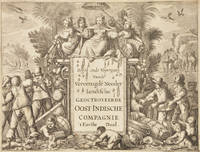
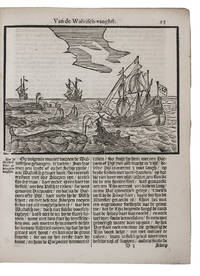
1646ABC_50158Amsterdam: Johannes Janssonius 1646. Modern vellum sewn on 4 supports laced through the joints with the title volume number and year of publication lettered in gold on the spine. Oblong 4to. With a richly engraved allegorical frontispiece in each volume one by J. van Meurs the other unsigned and 229 engraved maps views and plates illustrating the voyages several double-page or folding including a large folding map of the world. 21 parts in 2 volumes. First edition second issue with a newly engraved title page of the most important collection of Dutch voyages to the North around the world and to the East Indies undertaken between 1595 and 1640. Widely regarded as one of the greatest voyage collections published in any language the work assembles journals drawn from original editions autograph manuscripts supplied to the editor and first-hand narratives. Compiled by Isaac Commelin 1598-1676 a prominent Amsterdam bookbinder and scholar the collection is also celebrated for its extensive corpus of maps and plates carefully copied either from the original editions or the navigators own manuscript charts.The work was originally published by Johannes Janssonius in Amsterdam under the title Oorsprongh ende Voortgangh der Nederlantsche Oost-Indische Compagnie. It first appeared in 1645 and following its immediate success was reissued in 1646. Divided into twenty-one parts each section comprises multiple travel accounts which are supplemented by official documents and editorial commentaries by Commelin under the heading "Inworp" intended to update and contextualise the reports. Twelve of the travel accounts appear here for the first time including expeditions to the East Indies by Pieter Both Jacob van Neck Steven van der Hagen Wolphert Hermansz Van Warwijck and De Weert Cornelis Matelief Paul van Caerden Wybrant Schram H. Hagenaer and the voyages to the East Indies China and the Philippines by P. Verhoeven. Particularly significant are the preliminary sections which include the full text of the Dutch East India Company's VOC founding charter of 1602 the revised charter of 1622 and other key documents relating to the establishment and governance of the company up to 1631. As such the collection is one of the most important sources for the early history of the VOC. An extensive list of contents is available upon request.With a faded library stamp on the title page of the first part. One outer edge on the binding has been nibbled at by mice. The frontispiece in the first volume has been mounted onto a blank leaf lacking a plate in part 10 several margins have been strengthened a few professional restorations and a few minor marginal defects. Otherwise in good condition.l Alt-Japan-Kat. 370; Cox I p. 9; Landwehr VOC 250; Mendelssohn I 603; Sabin 14959; Tiele 82; Tiele Mémoire pp. 13-14; vol. 1: STCN 305246402; USTC 1022633; vol. 2: STCN 189559209; USTC 1019655; cf. Sabin 14959. Johannes Janssonius], hardcover
16932188Oxford: Oxford University Press 1693. First collected edition. Contemporary calf. Very Good. SCARCE FIRST EDITION OF THE COLLECTED WORKS of one of Newton's most important precursors John Wallis Savilian Professor 1649-1703 containing the first printed appearance of Newton's ideas on fluxions. A staunch promoter of English mathematicians Wallis repeatedly urged Newton to publish his theories before others laid claim to he work for the sake of "your Reputation & that of the nation" Gjertsen Newton Handbook 605. While Newton resisted for many years in 1693 Wallis published several letters from Newton in Vol. II of his Opera thereby introducing the concept of fluxional notation-pricked and dotted letters. In the preface to Vol. I 1695 Wallis refers briefly to Newton's claim to the discovery of Fluxions while Vol II 1693 has the first full account of Newton's invention of calculus. The third volume of Wallis's Opera contains previously unpublished correspondence between Newton and Leibniz the most important items of which are Newton's Epistola prior and Epistola posterior. "These two lengthy letters were sent to Leibniz in 1676 to acquaint him with the main lines of Newton's mathematical development. Epistola prior beginning with the binomial theorem went on to describe Newton's work on series. The second letter also contains much discussion on infinite series. It is best known however for Newton's reference to powerful and general methods he had developed for the drawing of tangents the determination of maxima and minima and the quadrature of curves. These he added he preferred to conceal within a quite insoluble anagram. A second and even longer anagram concealed Newton's claim to be able to solve fluxional equations. The solutions to both were publicly disclosed by Wallis 1699" ibid 189. Vol. 2 of the Opera also contains pp. 669-78 De Postulato Quinto; et Definitione Quinta; Lib. 6. Euclidis; disputatio geometrica Wallis's important attempt to prove the parallel postulate of Euclid also published here for the first time. "John Wallis gave a lecture on this topic. on the evening of 11 July 1663. He had been inspired by Nasr-Eddin's attempt on it which he referred to in his lecture to examine the question himself and his analysis is remarkable both for its originality and its caution. Indeed his view of the matter was to be much more profound than many a later writer's" Fauvel & Gray The History of Mathematics 510. This magnificent and comprehensive edition of Wallis's collected works was financed by and printed at Oxford University. In addition to several 'firsts' including those described above these volumes contain reprints of virtually all of Wallis's great books including the Arithmetica infinitorum and Mechanica Vol. 1 an augmented Latin edition of the Treatise of Algebra Vol. II and bilingual editions of a number of ancient Greek texts including Ptolemy's Harmonics Aristarchus's On the magnitudes and distances of the sun and moon and Archimedes's Sand-reckoner Vol. III. In addition to numerous other mathematical works the four volumes include his most popular work Grammaticae lingua anglicanae his "Treatise of Speech which formed a useful theoretical foundation for his pioneering attempts to teach deaf-mutes how to speak" DSB as well as an important tract on cryptography in which he records the methods he developed while deciphering for Cromwell the coded messages of Charles I. Wing W596 W566 W597. Babson 184. Roberts and Trent 345. see J.F. Scott The Mathematical Work of John Wallis London 1938; M. Baron The Origins of the Infinitesmal Calculus Oxford 1969 205-213; Richard Westfall The Life of Isaac Newton Cambridge 1993 207-209ff. Opera Mathematica. Volumen primum -Tertium - Opera quaedam miscellanea. Oxford: Sheldonian Theatre University Press 1695 1693 1699. Four volumes bound in three. Folio contemporary full paneled calf rebacked to style. Complete with four engravings on three leaves and three portraits Vols. I & II with the same portrait by Loggan dated 1678 and engraved by Burghers; Vol 3 by Sonmans dated 1698 and engraved by Burghers. With large bookplate inside each front cover reading "The Gift of Mr. Thomas Heatley Citizen and Iron-monger of London to the Mathematical School in Christ's Hospital Anno Dom. 1700". A very clean copy with only occasional light browning and foxing very handsomely bound. ONE OF THE MONUMENTS IN THE HISTORY OF MATHEMATICS. RARE. . Oxford University Press unknown books
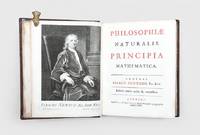
1726188378London: William & John Innys printers to the Royal Society 1726. The final lifetime edition Third edition revised by Newton himself; the final and most lavish edition to appear in his lifetime. The revisions include a new preface by Newton and one of his final statements on the nature of philosophy. By 1726 the 83-year-old Newton was making a sustained effort to tidy up his scientific legacy. For the Principia that meant adapting his arguments in light of his many disputes with continental philosophers following the first edition of 1687. The third edition is perhaps most notable for the new Rule IV of Book III in which Newton codifies his contention that hypotheses and particularly Leibnizian aether hypotheses have no place in true philosophy. Newton also adds extensive revisions to the sections on fluxions and lunar motion. Henry Pemberton 1694-1771 a 30-year-old physician and correspondent of the Oxford Newtonian John Keill was selected as the co-editor although Newton remained the primary force shaping the edition. A contemporary reader has made four ink annotations throughout this copy on pages 388 414 416 and 465 along with a handful of underlinings. The reader is particularly interested in Newton's treatment of lunar theory: the annotation on page 414 observes that "faciliùs multò polest hic calculus perfici ope motûs lunaris" "this calculation could be completed much more easily with the help of the lunar movement". Quarto 240 x 188 mm pp. xxxiv 530 8. Engraved portrait frontispiece after George Vertue engraved illustration by John Senex at p. 506 woodcut tables diagrams headpiece and initial within the text. Title page lettered in red and black. Contemporary mottled calf spine rebacked to style and with later red morocco label covers with double-fillet panel in gilt. With December 1922 signature of one Herbert Brittain possibly the Treasury official and mathematics graduate 1894-1961 to front pastedown. Light rubbing extremities restored infrequent foxing to contents: a very good copy. Babson 13; ESTC T98375; Gray 9; Wallis II.9. unknown
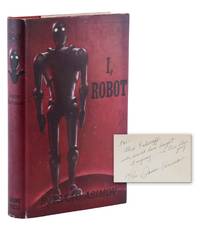
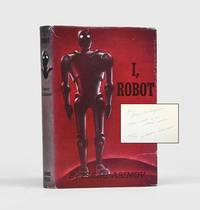
1950140948961New York: Gnome Press Inc 1950. First Edition. Near Fine/Near Fine. First edition first printing. Presentation copy signed by Isaac Asimov on the front free endpaper the day after publication and inscribed: "For: Alex Osheroff who would have bought it anyway—a true blue guy. 12/3/50." 253 pp. Bound in publisher's red cloth boards stamped in black. Near Fine with short tear and accompanying dent to spine light foxing to textblock edges and light foxing and offsetting to endpapers. In a Near Fine unclipped dust jacket with light rubbing and edgewear several shallow scratches and light foxing to upper and lower edges and verso.<br /> <br /> <p>A superb copy of Isaac Asimov's short story collection exploring the ethical implications of programming robots. He signed the fresh-off-the-press copy to Alex Osheroff a science fiction fan who published the single issue cardzine Robot in 1937 and co-edited the first issue of the fanzine Helios with Sam Moskowitz that same year. Osheroff retained his interest in speculative fiction after serving in the Second World War and joined the Fantasy Veterans Association which held several conventions in the 1950s. He would have treasured the warm inscription in this book. Gnome Press, Inc unknown
1827305824Charleston: James S. Burges 1827. First and only edition. 18 2 blank pp. 12mo. Modern pale yellow wrappers. Custom chemise and quarter morocco slipcase. Some pale foxing to title otherwise clean. First and only edition. 18 2 blank pp. 12mo. Rarity of American Judaica. A rare pamphlet issued by the first Jewish Reform movement in the United States the Sephardic Reformed Society of Israelites in Charleston South Carolina recording an address by one of the movement's leaders. The Reformed Society of Israelites formed in 1824 when it split off from the Kahal Kadosh Beth Elohim KKBE synagogue in Charleston seeking to implement a number of reforms it deemed crucial to engaging the rising generation. In the process the Society posited a distinctly American form of practice. <br/>Led by Isaac Harby Abraham Moise and David Nunes Carvalho the Reformed Society of Israelites reflected the fact that as Jonathan Sarna has phrased it: "Jews who did not feel at home in synagogue no longer had to compromise their principles for the sake of consensus; they felt free to withdraw and start their own congregations. In free and democratic America congregational autonomy became the rule resulting in a new American Judaism - a Judaism of diversity and pluralism."<br/><br/><br/>The present address was delivered on the third anniversary of the Society by Isaac Cardozo 1786-1855 who served as the group's Vice-President from 1828-1832. Cardozo invokes a "spirit of reform in all existing institutions which is abroad" and reminds the group of its origin as "a society that was instituted mainly for effecting the observance of order and decorum in Hebrew worship: for adapting it to the feelings and propensities of the enlightened Israelite of the present day; and for endeavoring to bring about by argument and petition what neither necessity nor persuasion could before accomplish" before he goes on to defend the mission against various critiques. <br/> <br/>Apart from being a leader within Charleston's Sephardic Jewish community Cardozo was also the patriarch of an important southern African-American family. He had six children with his common-law wife Lydia Weston a free black woman from a prominent Charleston family--one of a number of openly mixed-race households in antebellum Charleston. One of their sons was Francis Cardozo 1836-1903 who became the first African-American to hold statewide office in the United States serving as Secretary of State in South Carolina from 1868 to 1872. Another son Thomas served as State Superintendent of Education from 1873 to 1876. <br/><br/>RARE: OCLC reports only two institutional copies and A.S.W. Rosenbach in his American Jewish Bibliography located only one copy in a private collection. Rosenbach 289 locating one copy in a private collection; OCLC USC Presbyterian College; American Imprints 28385; Singerman 0442 James S. Burges unknown books
1953140948512New York: Gnome Press 1953. First Edition. Near Fine/Near Fine. Three volumes all first edition first printings all uniformly signed by Isaac Asimov directly on the title pages. Foundation is in Currey's A binding; Foundation and Empire is in Currey's A binding and A dust jacket state; Second Foundation is in Currey's B binding. Laid in is an additional autographed typed postcard addressed to Golden Atom fanzine founder editor and early sci-fi fan Larry Farsace postmarked 10 May 1983. <p>All volumes are Near Fine with light wear to corners and spine ends. Foundation and Foundation and Empire in Near Fine unclipped jackets. Rear board of Second Foundation faintly stained with a corresponding dampstain to dust jacket more pronounced on the blindside; unclipped dust jacket is Very Good with several short closed tears and associated creasing shallow chipping along the top edge of the rear panel and flap though still presents very well. A handsome set of this epic science-fiction trilogy which was awarded a special Hugo in 1966 for best all-time series. Very scarce with all three volumes directly signed. Gnome Press unknown
98479Amsterdam J. Janssonius 1646 & 1645. . Third edition; 21 separately paginated parts in 2 vols landscape folio 20 x 26 cm first title-page re-margined on lower edge beneath date no loss complete with 2 engraved frontispieces and 230 engraved plates some folding in vol. I slight loss to fore-edge pl. 16 Houtman De Eerste Schipvaerd; also to plates 2 & 8 Van Noort Beschrijvinge van de Schipvaerd; plate 5 Neck Tweede Schipvaert possibly supplied small margins; expert paper restoration to a strip of lower margin 6 cm x 1 cm at greatest extent and similar repair to fold pl. 6 Spilbergen 't Historiael Journael; in vol. II Van Den Broecke Historische ende Journaelesche plates short on lower margin as issued; neat restoration to plates 3 & 10 Oost ende West-Indische Navigatien later vellum to style lettered in gilt yapp edges occasional light dampstaining nothing untoward a very good set.<br /> The definitive edition of the great early Dutch voyages of exploration. This collection of voyages many undertaken by the Dutch East India Company VOC ranks as a record of some of the most important mercantile adventures in the history of European expansion. Complete sets are rarely found today many having being split into their constituent parts. <br /><br />This finely illustrated work is one of the great voyage collections and ranks alongside those of Hakluyt and Purchas. It includes accounts of all the voyages on which the Duyfken captained by William Jansz sailed of great importance as it was the Duyfken which would make the first sighting of the Australian coast. <br /><br />This is the preferred edition of the work two editions far less complete had previously appeared with a preface by Commelin a summary of pre-1631 Dutch voyages and is superbly illustrated with maps charts views of the early settlements indigenous people animals and natural history subjects. <br /><br />The collection includes: De Veer Voyages to the North; Houtman Voyage to the East Indies; Neck Voyage to the East Indies; Van Noort Voyage round the World; Neck Second Voyage; Spilbergen Voyage to the East Indies; Van Caerden Voyage to the East Indies; Spilbergen Voyage round the World; and others. Of particular interest may be mentioned the world voyage of Jacques l'Hermite which includes the famous Quirós Memorial.<br /><br />No other work gives such a complete view of the Dutch voyages and the plethora of engraved illustrations really brings these truly extraordinary tales of adventure alive.<br /> Bell C443; Landwehr VOC 250 listing three editions 1644 only 2 copies known 1645 & 1646; Mendelssohn 1603; Tiele 82; Tiele Mémoire pp.13-15; Sabin 14959. [Amsterdam, J. Janssonius], 1646 & 1645. hardcover
197600670THE BICENTENNIAL MAN / ORIGINAL CARBON TYPESCRIPT being 50 pages approximately 15000 words fine in custom tray-case. Accompanied by a 200 word plus TYPED LETTER SIGNED by Asimov dated July 12th 1974 to his long time friend and fellow science fiction personage Forrie Ackerman mentioning that he cannot promise a science fiction story to a deadline but since the proposed anthology title is to be THE BICENTENNIAL MAN there were 4 previously published items in The Saturday Evening Post that might be possibly utilized revolving around Benjamin Franklin which could be had for a small royalty. Along with copies of three other letters to Ackerman which yield yet more information regarding the specifics of this eventual typescript. Which goes like this: Sometime in 1974 a woman by the name of Naomi Gordon approached Forrest Ackerman with an idea for a science fiction anthology for the upcoming Bicentennial of the U.S. Projected writers for this undertaking were to be Ray Bradbury Arthur C. Clarke Fred Pohl Ursula Le Guin Robert Heinlein Philip Jose Farmer Larry Niven A. E. Van Vogt Jack Williamson and of course Isaac Asimov. While this project never fully materialized with some authors agreeing to the project and others not and some producing an actual typescript and again others not Isaac obviously opted in thereby producing this novella. When the anthology finally and officially became a lost cause the story was then immediately published when submitted elsewhere and went on to win not only the prestigious NEBULA award but the highly coveted HUGO award as well. Asimov's typescripts are very rarely offered on the open market or the private market for that matter with most if not all of them going to the Boston University Library and the opportunity to purchase the second of only three of his fictional works to win a HUGO award the final being another short story entitled GOLD published much later in 1991 which was written on a computer and thus never a true and proper typescript and the second to win the NEBULA award not too mention a "ROBOT STORY" to boot and the source work for the film of the same name with Robin Williams in the lead should prove a temptation most difficult to ignore. First option of refusal to purchase the rest of the THE BICENTENNIAL MAN file consisting of all remaining authorial typescripts and correspondence will be tendered to the purchaser of this item. N. p. unknown
1827305824Charleston SC: James S. Burges 1827. First and only edition. 18 2 blank pp. 1 vols. 12mo. Modern pale yellow wrappers. Custom chemise and quarter morocco slipcase. Some pale foxing to title otherwise clean. First and only edition. 18 2 blank pp. 1 vols. 12mo. A rare pamphlet issued by the first Jewish Reform movement in the United States the Sephardic Reformed Society of Israelites in Charleston South Carolina recording an address by one of the movement's leaders. The Reformed Society of Israelites formed in 1824 when it split off from the Kahal Kadosh Beth Elohim KKBE synagogue in Charleston seeking to implement a number of reforms it deemed crucial to engaging the rising generation. In the process the Society posited a distinctly American form of practice. <br /> Led by Isaac Harby Abraham Moise and David Nunes Carvalho the Reformed Society of Israelites reflected the fact that as Jonathan Sarna has phrased it: "Jews who did not feel at home in synagogue no longer had to compromise their principles for the sake of consensus; they felt free to withdraw and start their own congregations. In free and democratic America congregational autonomy became the rule resulting in a new American Judaism - a Judaism of diversity and pluralism."<br /> <br /> The present address was delivered on the third anniversary of the Society by Isaac Cardozo 1786-1855 who served as the group's Vice-President from 1828-1832. Cardozo invokes a "spirit of reform in all existing institutions which is abroad" and reminds the group of its origin as "a society that was instituted mainly for effecting the observance of order and decorum in Hebrew worship: for adapting it to the feelings and propensities of the enlightened Israelite of the present day; and for endeavoring to bring about by argument and petition what neither necessity nor persuasion could before accomplish" before he goes on to defend the mission against various critiques. <br /> <br /> Apart from being a leader within Charleston's Sephardic Jewish community Cardozo was also the patriarch of an important southern African-American family. He had six children with his common-law wife Lydia Weston a free black woman from a prominent Charleston family--one of a number of openly mixed-race households in antebellum Charleston. One of their sons was Francis Cardozo 1836-1903 who became the first African-American to hold statewide office in the United States serving as Secretary of State in South Carolina from 1868 to 1872. Another son Thomas served as State Superintendent of Education from 1873 to 1876. <br /> <br /> RARE: OCLC reports only four institutional copies and A.S.W. Rosenbach in his American Jewish Bibliography located only one copy in a private collection. Rosenbach 289 locating one copy in a private collection; OCLC Princeton Am. Jewish Hist. Soc. USC Presbyterian College; American Imprints 28385; Singerman 0442 James S. Burges unknown
05625London: G. Humphrey 1821. Queen Caroline Sliced And Diced By Satirists' Blade<br /> Fifty Devastating Hand-Colored Caricatures Directed Against the British Monarchy<br /> <br /> CRUIKSHANK George illustrator. CRUIKSHANK I.R. illustrator. LANE Theodore illustrator. <br /> The Attorney-General's Charges Against The Late Queen brought forward in the House of Peers on Saturday <br /> August 19 1820. Illustrated with Fifty Coloured Engravings. London: G. Humphrey 1821. <br /> <br /> First edition. Folio 18 13/16 x 13 inches; 478 x 330 mm. 2 title imprint on verso. 20 pp. by Robert Gifford Attorney-General. Hand colored frontispiece and forty-nine hand colored etched plates the majority being by Theodore Lane. Six of the plates are by George Cruikshank; one is after George Cruikshank; three are by Isaac Robert Cruikshank. All plates with interleaves. The text & plates are watermarked "J. Whatman 1821"<br /> <br /> Handsomely bound by Sangorski & Sutcliffe ca. 1960 in three-quarter dark blue morocco over marbled boards ruled in gilt. Spine with five raised bands elaborately tooled and lettered in gilt in compartments marbled endpapers all edges gilt.<br /> <br /> A fine well margined copy of this series of devastating caricatures directed against the British monarchy including the republication of the charges brought by the Attorney-General Robert Baron Gifford 1779-1826 against Queen Caroline and in support of the Pains and Penalties Bill of 1820 by which George IV who had only just inherited the throne in 1820 and who hated his wife sought to remove her title and dissolve their marriage. The volume begins with a view of Humphrey's shop-window where 42 of these prints are on view. The focus of these caricatures is Caroline of Brunswick 1768-1821 and her alleged affair with Bartolommeo Bergami. She renamed him Pergami as being more aristocratic and appointed him Grand Master of the Order of St Caroline. Queen Caroline on the whole elicited a great deal of public support and as a result the Bill had to be subsequently abandoned. However the following year in July 1821 Caroline was barred from the coronation fell ill and died three weeks later. <br /> <br /> After the fall of Napoleon in 1815 George Cruikshank's attention was largely turned towards highlighting the decadence of Britain's Regency monarchy which was epitomised by George IV while still the Prince Regent. In this collection six of the plates are by George or Isaac Robert Cruikshank or both the remainder are by Theodore Lane 1800-1828 a painter and engraver who frequently worked on sporting material especially in partnership with Pierce Egan. It was after this period that George Cruikshank became progressively more sober and serious.<br /> <br /> This scarce collection of caricatures sharply lampooning Queen Caroline to delightfully deadly effect is not found in the British Museum. Indeed BM Satires refers to the copy at the Bibliothéque National France one of only six copies in institutional holdings worldwide.<br /> <br /> Theodore Lane 1800-1828 was a political lampoonist and in 1820 created a series of satirical images of Queen Caroline at the time of her return to England to claim her rights as consort to George IV. Lane caricatured the queen as a grotesque overdressed and overweight accompanied by her Italian lover Bartolomeo Pergami and the then Lord Mayor of London Matthew Wood. <br /> <br /> The Plates:<br /> 1. Design for a New Coat of Arms Frontispiece<br /> 2. Humphrey Printseller & Publisher.<br /> 3. Bergami's Little Darling.<br /> 4. A Pas de Deux or Love at First Sight.<br /> 5. The Choice of Hercules.<br /> 6. An Arm-Full of Love<br /> 7. The Como-cal Hobby.<br /> 8. Winding up to a pitch the Automaton Scaramouch or Harlequin Courier's Delight<br /> 9. The Long & the Short of the Tale - or the whole of the concern.<br /> 10. Modesty!<br /> 11. The Modern Genius of History at her Toilet.<br /> 12. National Love!<br /> 13. Dignity!<br /> 14. A gentle jog into Jerusalem.<br /> 15. The Saint!<br /> 16. Tent-ation.<br /> 17. Installation of a Knight Companion of the Bath.<br /> 18. Travelling Tete à Tete!!<br /> 19. A R_Y_L Visit to a Foreign Capital or The Ambassador not at home!! George Cruikshank Cohn 1934<br /> 20. R_y_l Condescension - or a Foreign Minister Astonished! George Cruikshank Cohn 1914<br /> 21. Bat Cat and Mat.<br /> 22. A parting Hug at St. Omer!<br /> 23. A Wooden Substitute or Any Port in a Storm.<br /> 24. A late Arrival at Mother Wood's. George Cruikshank Cohn 1307<br /> 25. Mother Wood the Popular Procuress! Robert Cruikshank Cohn 1763<br /> 26. Mother Cole.<br /> 27. Grand Entrance to Bamboozl 'Em.<br /> 28. Steward's Court of the Manor of Torre Devon.<br /> 29. The Time Piece! & Canning Jack o' both sides. Robert Cruikshank<br /> 30. The Radical Ladder. After George Cruikshank<br /> 31. The C-R-L-E Column.<br /> 32. Delicious Dreams!<br /> 33. The Effusions of a Troubled Brain.<br /> 34. Caroline Fair or Mat Pudding and his Mountebank<br /> 35. The Mother Red-Cap Public House in opposition to the King's Head. George Cruikshank Cohn 1761<br /> 36. Carrying Coals to Newcastle!!<br /> 37. Moments of Pleasure.<br /> 38. The Man of the Woods & the Cat-o'-mountain.<br /> 39. The Q-n's Ass in a Band-box.<br /> 40. An Old Friend with a New Face or the Baron in Disguise.<br /> 41. Meditations at Brandyburgh; or an address to the Sun.<br /> 42. Dido in Despair.<br /> 43. The whole Truth or John Bull with his eyes opened.<br /> 44. A Going! A Going! the last time A Going!______Down!!! George Cruikshank Cohn 876<br /> 45. Returning Justice lifts aloft her Scale.<br /> 46. Lucifera's Procession. Fairy Queen.<br /> 47. The Royal Extinguisher or the King of Brobdingnag & the Lilliputians. I.R. & George Cruikshank Cohn 1919<br /> 48. The Grand Coronation of Her Most Graceless Majesty C-R-L-E Columbina the first Queen of all the Radicals.<br /> 49. A Coronation Stool.<br /> 50. The Armorial Bearings of the White Cat. cut and mounted.<br /> <br /> Bobins IV 1329; BM Satires 14206 note. London: G. Humphrey, [1821] unknown
1950174492New York: Gnome Press Inc. 1950. A rare and early presentation copy inscribed to a fellow science fiction writer First edition presentation copy inscribed by the author on the front free endpaper "For Dean McLaughlin where would we be without readers 12/2/50 Isaac Asimov". Dean Benjamin McLaughlin Jr. b. 1931 is an American science fiction author whose novels include Hawk Among the Sparrows 1968 which was nominated for the Hugo and Nebula awards for Best Novella and Dawn 1980 inspired by Asimov's own Nightfall 1941. This landmark collection of short stories includes "Liar" in which the author coined the term "robotics" and "Runaround" in which he sets out for the first time his Three Laws of Robotics. "Upon realizing he had coined a new and lasting word Asimov recognized the uniquely profitable position he had created for himself and along with the successful prediction of space travel self-driving cars and war-computers among others would go on to position himself as a sort of friendly-but-rough-around-the-edges technological herald someone entertaining trustworthy and often right" Jung. The nine stories collected here were originally printed in the magazines Super Science Stories and Astounding Science Fiction between 1940 and 1950. Octavo. Original red cloth spine lettered in black robot design to front cover in black. With dust jacket. Housed in a burgundy quarter morocco solander box by the Chelsea Bindery. Lightly bumped; jacket slightly creased spine sunned as usual else bright and unclipped: a near-fine copy in near-fine jacket. Gia Jung "Our AI Overlord: The Cultural Persistence of Isaac Asimov's Three Laws of Robotics in Understanding Artificial Intelligence" Emergence 5 June 2018. hardcover
166598MCBSHUHD3NAmsterdam 1665. 4to. Gillis Joosten Saeghman Late 19th-century vellum with the title stamped on the spine with black foil a black single fillet border on both boards. With a woodcut vignette of ships on the title page 16 further woodcuts on integral leaves 1 full-page signed by Christoffel van Sichem IV and 9 half-page and smaller with his monogram and a woodcut ship in a cartouche plus 1 repeat woodcut decorated initials and decorative bands built up from cast fleurons. Set in textura types with incidental roman and italic. 32 pp. First Dutch translation of the accounts of three voyages to Greenland by Jens Munk John Monck Martin Frobisher and Godske Lindenau searching for a passage to the East Indies through the Hudson Strait. Also containing a description of Greenland and an account of whaling including an unsigned illustration of a beached sperm whale with new illustrations by Christoffel van Sichem IV 1642-1693. It is a Dutch translation of La Peyrère's 1647 Relation du Groenland 1647 via the somewhat abbreviated German translation published in Hulsius's 1650 collection which contains the additional description of Spitsbergen and a discourse on whaling. La Peyrère included revised versions of Jens Munk's account of his voyage to Hudson Bay originally published in Navigatio septentrionalis 1624 and the accounts of voyages by Martin Frobisher and Godske Lindenau. Red armorial library stamp of the Forschungsstelle Volk und Raum on the title page: this was a research institute active at The Hague during the occupation of The Netherlands by Nazi Germany. Good copy.l Alden & Landis 663/79; Gosch Danish Arctic expeditions II pp. lxii-lxiii; JCB III pp. 98-99; Tiele Mém. 256; Sabin 28641 & 51334; STCN 4 copies; cf. Howgego to 1800 F80-F81 L128 and M180. ABE CAT Alaska Canada & Greenland hardcover
17262210London: Guil. & Joh. Innys Regiae Societatis typographos 1726. Third Edition. contemporary full vellum. RARE 1726 THIRD EDITION OF NEWTON'S PRINCIPIA THE LAST EDITION EDITED BY NEWTON AND THE BASIS FOR ALL SUBSEQUENT EDITIONS. ONE OF ONLY 1250 COPIES PRINTED. "The Principia is generally described as the greatest work in the history of science. Copernicus Galileo and Kepler had certainly shown the way; but where they described the phenomena they observed Newton explained the underlying universal laws. The Principia provided the great synthesis of the cosmos proving finally its physical unity. Newton showed that the important and dramatic aspects of nature that were subject to the universal law of gravitation could be explained in mathematical terms within a single physical theory. With him the separation of natural and supernatural of sublunar and superlunar worlds disappeared. The same laws of gravitation and motion rule everywhere; for the first time a single mathematical law could explain the motion of objects on earth as well as the phenomena of the heavens. The whole cosmos is composed of inter-connecting parts influencing each other according to these laws. It was this grand conception that produced a general revolution in human thought equalled perhaps only by that following Darwin's Origin of Species. It was the final irrevocable break with a medieval conception based on Greek and Roman cosmology and a scholastic system derived from the medieval interpretation of Aristotle. Newton's universe almost independent of the spiritual order ushered in the age of rationalism scientific determinism and the acceptance of a mechanistic view of nature" Printing and the Mind of Man 161. On the history and importance of the third edition: Towards the end of his life Newton "gave one last effort to the Principia. It is clear that he regarded the Principia rather than the Opticks as his masterwork. He worked over the Principia without end to hone its language to a perfect expression of his ideas. Perhaps the appearance of a reprint of the second edition in Amsterdam in 1723 stimulated Newton to put his plan for a new edition into action. Perhaps a serious illness in 1722 reminded him that he could not delay forever. We know only that printing of an edition more sumptuous than either of the others began in the fall of 1723. As editor Newton had the services of a young member of the Royal Society Henry Pemberton. In the fall of 1723 Pemberton addressed to him the first of thirty-one communications which stretched over the following two-and-a-half years while the edition passed through the press. Through 1724 and 1725 the edition made its slow but steady progress toward completion with none of the delays that stopped the press during the second edition. Newton dated the preface 12 January 1726. It was the last day of March when Martin Folkes presented a copy 'richly Bound in morocco Leather' to the Royal Society in Newton's name. In all 1250 copies were printed." Westfall The Life of Isaac Newton. The third edition "contains a new preface by Newton and a large number of alterations" Babson 13. With portrait engraving by Vertue bound before first text leaf and numerous illustrations in text. Complete with the privilege leaf half-title dedication leaf index and ad leaf. London: Guil. & Joh. Innys Regiae Societatis typographos 1726. Quarto 186x241 mm contemporary full Dutch vellum; custom half-leather box. Unidentified early signatures on front pastedown half-title and ad leaf verso. Mild scuffing to binding boards a little bowed. Text with occasional light soiling and scattered foxing but generally clean. A beautiful copy. SCARCE IN AN UNRESTORED CONTEMPORARY BINDING. Guil. & Joh. Innys, Regiae Societatis typographos unknown books
1789184162Mostly at sea: 8 June 1786 - 31 March 1789. The last surviving crew member of Cook's Endeavour A window onto the later career of Isaac Manley 1755-1837 mourned on his death as the last remaining participant in Cook's historic first voyage. Manley joined Cook's crew aged only 13 and was promoted to midshipman on 5 February 1771 during the journey home. He rose to the rank of admiral of the red becoming one of the fifteen most senior officers in the Royal Navy. On the Endeavour Manley acted as servant to the master Robert Molineux. The ravages of disease in the later part of the voyage offered opportunities for advancement. Molineux died off Cape Town in April 1771 and Manley was promoted a day either side of the deaths of midshipmen John Bootie and Jonathan Monkhouse. "The Muster Rolls show Isaac being charged £3.13.2 for slops at this time and £15.18.6 for dead men's clothes presumably he was buying the dead middies' uniforms. And his tobacco charge which began at 19/- in September 1769 also increased to £1.8.6" Hill. Writing to the First Secretary of the Admiralty on his return to England Cook gave Manley his endorsement in typically reserved fashion: "Midshipmen Mr Isaac Smith and Mr Isaac Manly both too young for the preferment yet their behaviour merits the best recommendation" quoted by Hill. Manley signed up for Cook's second voyage but was discharged for still unknown reasons in April 1772 before the Resolution sailed. He was commissioned lieutenant in May 1777 serving with the Channel Fleet and in North America and the West Indies and fought in the Battle of the Saintes. In 1786 at the rank of commander he was appointed to HMS Fairy - the service covered by this log - and ended his active duties in 1790. While living the life of a landed gentleman he continued to earn promotion reaching flag rank in 1809. He was promoted to admiral of the red a few months before his death. The daily log commences on 8 June 1786: "Came on board and took the command of Her Majesty's Sloop Fairy by virtue of a commission dated the 17th May 1786." The ship is tasked with patrolling the Channel and cracking down on smugglers seizing spirits tobacco and other contraband. There are also references to punishing sailors for drunkenness and mutinous behaviour. In late 1787 Manley was also occupied with naval impressment and was ruthlessly effective recording ships stopped and men pressed-ganged. In 1788 the ship is ordered to Africa the log ending in media res on 31 March 1789 near the equator. a By family descent; b Sold at Sotheby's London "Atlases Maps Topographical Prints and Travel Books" 2 May 1985 Lot 220 buyer: Quaritch; c Sold by Quaritch c.1987 to Cecil George Whitmont 1912-1991 Australian collector with his bookplate and a selection of paperwork formerly in an improvised acetate rear pocket. Quarto 245 x 195 mm. With 182 leaves all but 3 pages filled in neat manuscript. Original quarter calf parchment sides. Housed in custom green cloth solander box green spine label. Wear from shipboard use contents clean: very good. Anthony Hill "Isaac Manley - Servant on Endeavour to Admiral" Captain Cook Society. hardcover