Cardozo Isaac N.ABAA

312 résultats
1827305824Charleston: James S. Burges 1827. First and only edition. 18 2 blank pp. 12mo. Modern pale yellow wrappers. Custom chemise and quarter morocco slipcase. Some pale foxing to title otherwise clean. First and only edition. 18 2 blank pp. 12mo. Rarity of American Judaica. A rare pamphlet issued by the first Jewish Reform movement in the United States the Sephardic Reformed Society of Israelites in Charleston South Carolina recording an address by one of the movement's leaders. The Reformed Society of Israelites formed in 1824 when it split off from the Kahal Kadosh Beth Elohim KKBE synagogue in Charleston seeking to implement a number of reforms it deemed crucial to engaging the rising generation. In the process the Society posited a distinctly American form of practice. <br/>Led by Isaac Harby Abraham Moise and David Nunes Carvalho the Reformed Society of Israelites reflected the fact that as Jonathan Sarna has phrased it: "Jews who did not feel at home in synagogue no longer had to compromise their principles for the sake of consensus; they felt free to withdraw and start their own congregations. In free and democratic America congregational autonomy became the rule resulting in a new American Judaism - a Judaism of diversity and pluralism."<br/><br/><br/>The present address was delivered on the third anniversary of the Society by Isaac Cardozo 1786-1855 who served as the group's Vice-President from 1828-1832. Cardozo invokes a "spirit of reform in all existing institutions which is abroad" and reminds the group of its origin as "a society that was instituted mainly for effecting the observance of order and decorum in Hebrew worship: for adapting it to the feelings and propensities of the enlightened Israelite of the present day; and for endeavoring to bring about by argument and petition what neither necessity nor persuasion could before accomplish" before he goes on to defend the mission against various critiques. <br/> <br/>Apart from being a leader within Charleston's Sephardic Jewish community Cardozo was also the patriarch of an important southern African-American family. He had six children with his common-law wife Lydia Weston a free black woman from a prominent Charleston family--one of a number of openly mixed-race households in antebellum Charleston. One of their sons was Francis Cardozo 1836-1903 who became the first African-American to hold statewide office in the United States serving as Secretary of State in South Carolina from 1868 to 1872. Another son Thomas served as State Superintendent of Education from 1873 to 1876. <br/><br/>RARE: OCLC reports only two institutional copies and A.S.W. Rosenbach in his American Jewish Bibliography located only one copy in a private collection. Rosenbach 289 locating one copy in a private collection; OCLC USC Presbyterian College; American Imprints 28385; Singerman 0442 James S. Burges unknown books
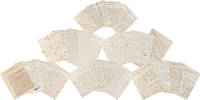
1827WRCAM55911Various locations mostly Valparaiso Chile; Callao and Lima 1827. Forty-six autograph letters signed or manuscript letters signed totaling 103pp. some with integral address leaf. All docketed at the top right edge of the verso of the last leaf likely by William Tudor himself. Original mailing folds light toning occasional short tears from opened wax seals. Overall very good. In a cloth chemise and half morocco and cloth folding case spine gilt. An important historical archive of letters received by William Tudor almost all while he was serving as United States Consul to Peru in Lima. The letters from a breadth of correspondents reveal the range of political cultural military and legal issues faced by an American diplomat serving in a South America during a politically volatile period and are especially interesting for detailing American diplomatic actions in South America in the years just after the issuance of the Monroe Doctrine. The letters are particularly notable for demonstrating the views and actions of the United States during the Peruvian independence struggle and showing the extent of the cooperation between the U.S. and Great Britain less than a decade after the conclusion of the War of 1812. They also paint a picture of the revolutionary actions of Simón BolÃÂvar in Peru the tight grip on the port of Callao by Spanish stalwart José Ramón Rodil and the interplay of American British Spanish Chilean and Peruvian officials in the region. <br> <br> William Tudor 1779-1830 was a leading citizen of Boston and the son of the first judge advocate of the Continental Army. Tudor was a founder and first editor of the NORTH AMERICAN REVIEW and helped found the Boston Athenaeum. He was the first Boston citizen to refer to the city as "The Athens of America" in an 1819 letter. Tudor was the U.S. Consul to Peru from 1824 to 1827 and Chargé d'Affaires at Rio de Janeiro from 1827 until his death there in 1830. <br> <br> The most prominent correspondent in this archive is Commodore Isaac Hull 1773-1843 represented by twelve letters to William Tudor. The Hull letters are a mixture of seven autograph letters signed from Hull and five manuscript letters in a secretarial hand but signed by the Commodore. Hull's letters report on the naval blockade of Peru American movements around South America and the struggles of Simón BolÃÂvar's South American independence movement and also touch on the ultimate defeat of the Spanish in Peru. At the time these letters were written Hull was commander of the United States Pacific Squadron and the letters emanate from Hull's flagship the USS United States positioned in Callao Bay as part of a joint American-British blockade. Hull had a long and distinguished career in the United States Navy beginning during the Quasi War with France battling Barbary pirates and commanding the USS Constitution during the War of 1812. He went on to serve as commandant of the Washington Navy Yard and as commander of the Mediterranean Squadron. Letters by Hull are scarce on the market especially in the quantity quality and intimacy of content seen here. <br> <br> In his first letter on May 28 1824 Hull writes about meeting British naval figure Martin Guise who was at this time serving with the Chilean Navy during the Peruvian War of Independence from Spain. Hull mentions the current blockade in his first two letters writing in the first: "I fear that they will not go all length with me in the blockade; they appear disposed to allow something like a coast blockade." His second letter of June 8 includes more details on the efforts during the blockade namely that Guise is "doing what he has the authority to do from Bolivar" and Captain Prescott "has in great measure made up his mind to submit to the blockade of Guise even in its present form." <br> <br> Hull's communications increase beginning in August and he writes to Tudor on August 21 that he must refuse his request to land U.S. Marines in Lima for the protection of American officials but agrees to send a "sea officer with arms" and as many seamen as necessary "for the protection of American Citizens only" but that they "must be kept within their houses or yards." <br> <br> In his next few letters Hull reports on the ships Dolphin and Peacock being routed to Valparaiso to provide strategic defense to American shipping vessels in the region and asks for more information and communications from Tudor regarding the ships Carington and Nancy condemned by Spanish General José Ramón Rodil. In a September 11 letter Hull states that Rodil intends to sell the two ships and that "it may be necessary for me to take measures that will not please his excellency as I consider his conduct is and has been for some time hostile towards us and cannot much longer be submitted to." Hull also invites Tudor to his ship to "spend the day with your friends Capt. and Mrs. Maling" who were onboard Hull's ship the previous night. Hull and Thomas James Maling were fellow commanders of the American and British forces respectively during this period around Peru. Maling commanded the British ship the Cambridge which is referenced in some of the letters here. José Ramón Rodil was commander of the port of Callao for the Spanish government and one of the last remaining Spanish officials to surrender to BolÃÂvar; he stubbornly refused to officially cede control of Callao until 1826 when he finally gave up and returned to Spain. <br> <br> On October 15 Hull writes to Tudor about the attitudes of the Spanish government "towards our commerce." Hull fears that should the Spanish invoke "the laws of the Indies" against American officials in Peru then Hull and Tudor "shall be in a bad way." The Laws of the Indies were a series of Spanish laws dealing with the relationship between Spain and her colonies in America; Hull is perhaps worried here that if the Spanish government invokes these laws as a sovereign nation then the activities of the American government in South America would stand in violation of that sovereignty. <br> <br> Hull's troubles with Rodil continue in November when he informs Tudor that "the crew of the China had complained to Captain Maling of the bad treatment they had received from General Rodil stating that they were compelled to work and that some of them had been severely punished." Hull writes that he plans to demand the release of these sailors and the ship and if Rodil does not acquiesce he would "resort to reprisal and let the consequence be what it may." <br> <br> In Hull's next letter the true nature of the extreme treatment suffered by some Americans under Rodil is described. Hull writes a lengthy and passionate letter decrying the "injustice and cruelty of all the proceedings" which took place during the Spanish seizure of the China. Hull can no longer "remain inactive or insensible to the repeated wrongs of my countrymen." He then relates how some seamen were threatened with swords muskets or gallows. Hull thinks that "my government will justify me in any measures which I shall be compelled to take to obtain redress for the insults and wrongs which my countrymen have received and to prevent a repetition of them" After all claims Hull "there is not an American in this country knowing all things which have taken place who would not be willing to sacrifice every feeling of interest to have their rights respected." <br> <br> Hull's last two letters come after the decisive battle at Ayacucho in early December 1824 which effectively ended the Peruvian War of Independence in favor of BolÃÂvar's forces. On December 18 Hull transmits his original correspondence with Rodil to Tudor presumably so that Tudor can consolidate communications between American and Spanish officials now that Peru has won the war. Hull's final letter touches on duties owed by American vessels at Ancon; Hull recuses himself from the issue in favor of Tudor as such issues "should more properly come before you as consul or the merchants to whom he consigned and I consider any interference on my part would be improper and that it is a case entirely distinct from my duties." After all as a naval commander Hull is not responsible for imposing import and export duties related to commerce in newly-independent ports. Hull closes by writing that the news of Peruvian independence will be "such glorious news to the United States. It will be received with sincere pleasure by our government and every lover of freedom and humanity." <br> <br> Also present here are seven letters from the aforementioned Thomas James Maling plus one from his wife Harriet to William Tudor all of which were written between August and December 1824. Captain Thomas Maling was the scion of the Maling pottery family in England. He was commissioned into the Royal Navy in 1791 rising to vice admiral in 1830. During his time in Peru Maling was captain in charge of the HMS Cambridge which was stationed in Callao for most of Maling's time there. He married Harriet Darwin daughter of Erasmus Darwin and niece to Charles who accompanied him to South America. Sadly Harriet would die in 1825 in Valparaiso Chile. The Malings were very friendly with William Tudor as evidenced in the present correspondence which includes a friendly partial note from Harriet to Tudor in which she chides Tudor for not visiting their ship and offers to share with him "a good private and confidential letter". <br> <br> In his first letter dated August 18 Captain Maling agrees to take aboard his ship one of Tudor's friends and hopes "you are all made safe & happy by the party I have sent to guard you all at Lima." In his second letter on August 24 Maling mentions that "Guise is sending another Blockading Squadron" but that this will be "of insufficient force to stop the trade of Europe and North America." Maling hopes "your Commodore" meaning Hull agrees with him; blockades were prevalent during this time around Peru and Chile as the various revolutions led by and inspired by Simón BolÃÂvar took root. <br> <br> Maling's letter of September 4 concentrates on battle news in Peru reading in part: "Kelly who I believe you know of returned from the Liberator's Army and I believe brings us good news but he is still with Guise.There has been no second battle but Cantera's army dispersed after the 6th leaving him with only 2000 men with which he is hastening back to Cusco. It is supposed for the purpose of raising the Indians in favor of the Young Inca they have been keeping in reserve. The Commodore Hull has thought this information & what else Kelly may bring of sufficient importance to detain the Dolphin another day." <br> <br> Three days later Maling writes Tudor about a recent naval issue that prompted him to write to the commanding officer of the ship "to tell him he will be made responsible in future for the conduct or his officers & men and I hope we shall hear of no other instance of such impropriety but it is by no means thought here to be ours." This is followed by a mention of the ship China. Maling invites Tudor to his ship for a visit and tells him he may have the "opportunity of seeing a naval fight." This letter is likely concerned with the aforementioned troubles with the China in which American and British sailors were mistreated by Spanish authorities. <br> <br> Maling's October 15 letter is especially interesting as he mentions yet another blockade-related event: "There is an embargo on all vessels at Quilea & no communication permitted with the shore a pretty conclusive hint where our friends will go to when they sail from hence if Guise who is again sailing close in ever suffers them to depart in peace." <br> <br> Maling's last two letters date from December 1824 after BolÃÂvar's victory in Peru. In his December 8 communication he reports that "England has acknowledged the independence of those parts of America which actually form free states." The implication here is clear in that England is ready to recognize democratic regimes and nothing less. In his final letter Maling writes about the slowness in receiving news from the Peruvian government on naval matters though he allows for the "intoxication of success" felt by those in Peru who had just won their independence from Spain. Maling wishes them "so well to their cause that I shall not quarrel with them." <br> <br> Maling's penultimate letter alludes to the recent death of British Consul General Thomas Edward Rowcroft. The present archive includes two letters to Tudor from Rowcroft who was essentially Tudor's British counterpart in Peru. In his first letter dated June 19 1824 Rowcroft writes to Tudor about the "dispositions of the Viceroy on the appointment of Consuls in this Country" and on the importance of maintaining "mutual confidential communications" between himself and Tudor. Towards the end of 1824 on December 2 Rowcroft writes again to Tudor this time to ask about two English Navy vessels allegedly captured by a ship flying "Spanish Colours" and then recaptured by Tudor's brother-in-law Commodore Stewart. This last letter would have been among Rowcroft's final communications as he was gunned down a few days later while traveling back from Lima after delivering letters to Thomas Maling. Rowcroft supposedly held a pass that should have taken him safely through both the loyalist-held sections and the Bolivar-held areas of the city. As he presented his pass to authorities loyal to Bolivar at a checkpoint his coach was met with a hail of bullets as it rolled away. Rowcroft was shot in the hand and the torso and died on December 7; his death is now considered an unfortunate accident perhaps precipitated by a "death sentence" purposely written on his pass by loyalist officials hoping to get Rowcroft in trouble. If this was indeed their plan it worked. <br> <br> Other letters to Tudor here include a February 20 1824 note from John Dorr to Tudor in which Dorr discusses his ship Esther which was seized by the revolutionary government in Callao Peru. Dorr indicates that General BolÃÂvar is willing to "do what is possible to recover that valuable Ship & freight or ample indemnity." On April 18 1824 French Dr. A.V. Brandin writes to Tudor from Lima informing him of a shipment of quinine for Commodore Hull and his wife aboard the USS Franklin. Brandin allegedly founded the first medical journal in Peru and was apparently the first doctor to introduce quinine to South America. <br> <br> In other letters in this archive American ship captain Samuel C. Erwin writes to Tudor on April 22 1824 with regard to the seizure of a "case of Linnens" by the new Peruvian government along with a request to write directly to the governor in Lima for relief and for a "Certificate of American Property for my whole cargo which I have repeatedly applied for without being able to get it." American merchant seaman Thomas R. Gerry son of Elbridge Gerry writes to Tudor from Quilca Peru on August 18 1824 reporting on various business matters and providing a blistering description of Quilca which he sums up as a "miserable hole." Gerry also reports on two American prisoners of war taken by the Chilean government one of whom he currently has on his ship the Tartar while the other is still held at Arica. <br> <br> The present collection also includes a handful of letters from Michael Hogan U.S. Consul and Navy Agent at Valparaiso Chile from 1823 until his death in 1833. Hogan's first communication to Tudor is dated the day after Tudor took over as consul in Peru; Hogan is "anxious" but "hopes for the best" for Tudor in his new position. In June 1824 Hogan sends a short report to Tudor on political maneuverings in Valparaiso where General Pinto was to be appointed "supremo." One of his letters from July 28 1824 reports on political struggles within Chile where a Constitution had just been "amicably" voted down the Senate dissolved General Wager appointed director and General Pinto as prime minister until a new Congress was convened in three months. Another letter from Hogan dated August 9 1824 includes information on the Chilean government's efforts to sell church property "for the publick good." This was a standard practice in the post-colonial governments in South America who often converted church artifacts of silver and gold into new coinage. In this same letter Hogan reports that Chilean officials will soon forbid the importation of flour in favor of the "great landholders" in Chile who plan to produce their own "breadstuffs." <br> <br> Other communications to Tudor involve letters of introduction for new merchant ship captains an appeal by William Wetmore regarding shipping declarations made to General Rodil in Callao two short letters from U.S. consul to Peru James Prevost in Callao regarding permissions from the new Peruvian government Prevost would die in Lima on March 5 1825 and a handful of letters in Spanish from local officials one of which dated Feb. 12 1826 mentions mining in Lima "metales de plata" and "metales ricos un espia". <br> <br> There are also two letters written to Tudor before his time in Peru. One dated July 7 1822 from Thomas Dawes in Boston relates to a pamphlet Tudor wrote on Thomas Paine. The other is an October 30 1822 "Declaration and Protest" from a U.S. schooner called the Dolphin claiming unlawful seizure and false imprisonment by Peruvian officials in Callao; this document was perhaps inherited by Tudor when he arrived in Lima. There is even an intriguing partial manuscript which seems to be part of a confidential report on English government and their public attitudes towards the United States mentioning a debate in the House of Commons regarding "peace or war with America." <br> <br> In total these to William letters shine a rare spotlight on the American intervention in Peru and on the international political and economic machinations in South America during the 1820s. The archive provides a stark picture of American enforcement of the Monroe Doctrine which President Monroe had just elucidated in his State of the Union Address on December 2 1823. Spanish actions in Peru in the 1820s were seen as a violation of this new foreign policy stance by the United States particularly the tenet covering European colonial involvement in the Western Hemisphere. Of course the Monroe Doctrine also served American economic interests in South America which certainly motivated events such as the American blockade of Callao and the dispersal of the Dolphin and the Peacock to other South American ports. <br> <br> An outstanding collection of American diplomatic correspondence from an important moment in South American history. hardcover books
18481803065Daniel Adee 1848. 1st Edition. Hardcover. Near Fine/No Jacket. Near fine TRUE first American edition 1st issue as stated on the title page. Some water stains on page edges. Previous owner's bookplate on front pastedown. Rubbing on outside spine and corners and at bottom of spine. Tape at endpapers and pastedowns along gutters. Housed in custom-made slip case. Daniel Adee hardcover books
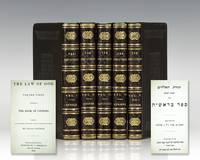
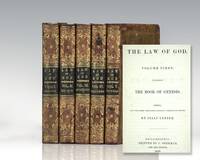
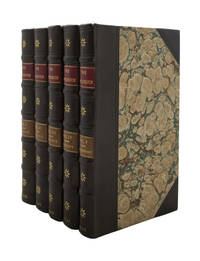
184549020Philadelphia: C. Sherman 5605 1845-46. First edition of the "first English translation of the Pentateuch in America" the 1845 Hebrew-English Bible by one of the most prominent and influential figures in American Jewish history. Octavo 5 volumes. Translated by Isaac Leeser. Bound in contemporary polished calf gilt titles and tooling to the spine rebacked. Lightly rubbed moderate wear. A very nice example of a scarce and important work. Previous editions published by Jews in England had simply utilized the King James translation. The translator was Isaac Leeser 1806-1868 who worked without assistance. In his preface he apologizes for any errors: "How can it be expected that I should escape when I have no Jewish compositors and have necessarily to be often away when the work goes to press" Despite these obstacles Leeser doubted that "the precious word of God ever appeared among us in a more beautiful form than the volumes in which I am now engaged." Leeser avoided reliance on earlier English translations though he made some use of German translations and noted that "the arrangement is strictly Jewish. My intention was to furnish a book for the service of the Synagogue both German and Portuguese." Leeser's "contributions to every area of Jewish culture and religion made him a major builder of American Judaism." The publication of his Pentateuch was the first time that any portion of the Bible was published in America under Jewish auspices. "The translation of the Bible was Leeser's great literary achievement and represented many years of patient labor and devotion to a task which he considered sacred. He made good use of the various German translations by Jews of the collective commentary known as the Biur and of other Jewish exegetic works. As a result his translation though based in style upon the King James version can be considered an independent work for the changes he produced are numerous and great. until the new Jewish Publication Society version was issued in 1917 it was the only source from which many Jews not conversant with Hebrew derived their knowledge of the Bible in accordance with Jewish tradition" Waxman 1090. C. Sherman, 5605 unknown books
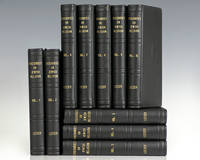
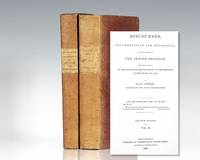
1866107732Philadelphia: Sherman & Co 1866-68. First editions of one of the 'major builders of American Judaism' Isaac Leeser's Discourses on the Jewish Religion. Octavo 10 volumes bound in full leather gilt titles to the spine raised bands. In near fine condition. Complete sets are of the utmost rarity. American Jewish lay minister author translator and publisher Issac Leeser's "contributions to every area of Jewish culture and religion made him a major builder of American Judaism." In addition to his influence on the Jewish pulpit in the United States Leeser became the first American Jewish publisher and produced the first Jewish translation of the bible into English. "The translation of the Bible was Leeser's great literary achievement and represented many years of patient labor and devotion to a task which he considered sacred.until the new Jewish Publication Society version was issued in 1917 it was the only source from which many Jews not conversant with Hebrew derived their knowledge of the Bible in accordance with Jewish tradition" Waxman 1090. Sherman & Co hardcover books
1803122898London: Printed for H.D. Symonds 1803. First complete edition in English of Sir Isaac Newton's Principia the greatest work of physics in the exceedingly rare original boards. Octavo 3 volumes bound in original boards uncut 54 folding copper-engraved plates of diagrams and figures all but one folding; 2 folding tables. with 22 folding. In near fine condition with light toning to the text. An exceptional example rare and desirable in the original boards. Housed in a custom clamshell box. "Newtons Principia is generally described as the greatest work in the history of science. Copernicus Galileo and Kepler had certainly shown the way; but where they described the phenomena they observed Newton explained the underlying universal laws. The Principia provided the greatest synthesis of the cosmos proving finally its physical unity. Newton showed that the important and dramatic aspects of nature that were subject to the universal law of gravitation could be explained in mathematical terms with a single physical theory. With him the separation of the natural and supernatural of sublunar and superlunar worlds disappeared. The same laws of gravitation and motion rule everywhere; for the first time a single mathematical law could explain the motion of objects on earth as well as the phenomena of the heavens. The whole cosmos is composed of inter-connecting parts influencing each other according to these laws. It was this grand conception that produced a general revolution in human thought equaled perhaps only by that following Darwins Origin of Species Newton is generally regarded as one of the greatest mathematicians of all time and the founder of mathematical physics" PMM 161. "It is perhaps the greatest intellectual stride that it has ever been granted to any man to make" Einstein. Printed for H.D. Symonds hardcover books
184578547Philadelphia: C. Sherman 5605 1845-46. First edition of the "first English translation of the Pentateuch in America" the 1845 Hebrew-English Bible by one of the most prominent and influential figures in American Jewish history. Octavo 5 volumes. Translated by Isaac Leeser. Bound in full contemporary calf gilt titles and tooling to the spine. In near fine condition. A nice example rare in contemporary binding. Previous editions published by Jews in England had simply utilized the King James translation. The translator was Isaac Leeser 1806-1868 who worked without assistance. In his preface he apologizes for any errors: "How can it be expected that I should escape when I have no Jewish compositors and have necessarily to be often away when the work goes to press" Despite these obstacles Leeser doubted that "the precious word of God ever appeared among us in a more beautiful form than the volumes in which I am now engaged." Leeser avoided reliance on earlier English translations though he made some use of German translations and noted that "the arrangement is strictly Jewish. My intention was to furnish a book for the service of the Synagogue both German and Portuguese." Leeser's "contributions to every area of Jewish culture and religion made him a major builder of American Judaism." The publication of his Pentateuch was the first time that any portion of the Bible was published in America under Jewish auspices. "The translation of the Bible was Leeser's great literary achievement and represented many years of patient labor and devotion to a task which he considered sacred. He made good use of the various German translations by Jews of the collective commentary known as the Biur and of other Jewish exegetic works. As a result his translation though based in style upon the King James version can be considered an independent work for the changes he produced are numerous and great. until the new Jewish Publication Society version was issued in 1917 it was the only source from which many Jews not conversant with Hebrew derived their knowledge of the Bible in accordance with Jewish tradition" Waxman 1090. C. Sherman, 5605 unknown books
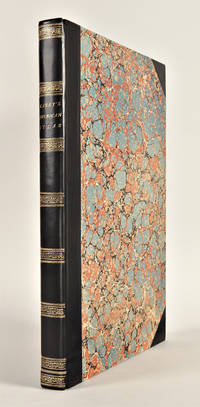
182325085Philadelphia: H.C. Carey & I. Lea 1823. Folio. 17 1/2 x 11 7/8 inches. Mounted on guards throughout letterpress title copyright notice on verso 1p. Advertisement verso blank 1p. Contents verso blank 46 double-page hand-coloured engraved maps of the United States all but one with borders of letterpress descriptive text 1 uncoloured double-page engraved view showing the comparative heights of mountains throughout the world 1 hand-coloured double-page engraved table showing the comparative lengths of the principal rivers worldwide 5 letterpress tables 4 double-page 3 of these hand-coloured 18pp. of letterpress text. Expertly bound to style in half calf over contemporary marbled paper covered boards flat spine in six compartments divided by gilt roll tools red morocco label in the second compartment the others with a repeat decoration in gilt.<br/> <br/>One of the most important early atlases printed in the United States: a handsome atlas of the Americas with individual colour maps of each state in the Union including a seminal map of the West by Stephen H. Long.<br/> <br/>At the time of publication this was the best and most detailed atlas to be produced in the United States. Fielding Lucas the major Baltimore printer was the principal engraver and substantial historical background text accompanies each map. Among the most noted maps in the atlas is Major Stephen H. Long's "Map of Arkansa and other Territories of the United States." That map which depicts the Missouri basin between Nashville in the east the Mandan villages in the north and the Rocky Mountains in the west was based on the surveys conducted by Long on his expeditions of 1819 and 1820. The map published in Carey & Lea's atlas preceded the official account of that expedition by expedition botanist Edwin James which included a smaller map with similar detail titled "Country drained by the Mississippi Western Section". Carey and Lea's 1823 publication of James Account perhaps explains the prior inclusion of this map with Long expedition information in their atlas. On this famous map is the printed legend which would perpetuate a myth for many years to come identifying the high plains as the "Great American Desert." Carey and Lea's atlas was first issued in 1822; this is the 1823 second issue substantially the same as the first but with a new title and revised states of several maps and text leaves generally minor revisions including additional shading to maps and improved resetting of several text leaves though this copy with first state settings of the Maryland and Virginia text leaves.<br/> <br/>Howes C133 "aa"; Phillips 1373a; Sabin 15055; Wheat Transmississippi West 348 and 352. H.C. Carey & I. Lea unknown books
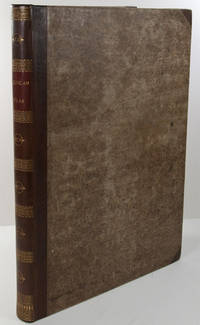
1823WRCAM43415APhiladelphia: H.C. Carey & I. Lea 1823. Letterpress title copyright notice on verso 1p. advertisement verso blank 1p. table of contents verso blank. Forty-six double-page handcolored engraved maps of the United States all but one with borders of letterpress descriptive text; uncolored double-page engraved view showing the comparative heights of mountains throughout the world; handcolored double-page engraved table showing the comparative lengths of the principal rivers worldwide; five letterpress tables four double-page three of these handcolored; 18pp. of letterpress text. Mounted on guards throughout. Modern half calf and marbled boards spine gilt leather label. Dampstaining along lower edge causing chipping to initial leaves. Closed tear in bottom margin of first map repaired with tissue. Very light offsetting from maps. Some dust soiling light tanning and foxing. Good plus. A handsome atlas of the Americas with individual color maps of each state in the Union including a seminal map of the West by Stephen H. Long. At the time of publication this was the best and most detailed atlas to be produced in the United States with substantial historical background text accompanying each map. Fielding Lucas the major Baltimore printer was the principal engraver. <br> <br> Among the most noted maps in the atlas is Major Stephen H. Long's "Map of Arkansa and other Territories of the United States." That map which depicts the Missouri basin between Nashville in the east the Mandan villages in the north and the Rocky Mountains in the west was based on the surveys conducted by Long on his expeditions of 1819 and 1820. The map published in Carey & Lea's atlas preceded the official account of that expedition by expedition botanist Edwin James which includes a smaller map with similar detail titled "Country drained by the Mississippi Western Section." Carey & Lea's 1823 publication of James' ACCOUNT perhaps explains the prior inclusion of this map with Long expedition information in their atlas. <br> <br> On this famous map is the printed legend which would perpetuate a myth for many years to come identifying the high plains as the "Great American Desert." Carey & Lea's atlas was first issued in 1822; this is the second issue with revised states of three maps Maine North Carolina and Louisiana with the same printing of the remaining maps and a cancel title. HOWES C133 "aa." PHILLIPS ATLASES 1373a. SABIN 15055. WHEAT TRANSMISSISSIPPI 348 352. H.C. Carey & I. Lea hardcover books
184568182The First English Translation of the Pentateuch in America LEESER Isaac translator editor. BIBLE IN HEBREW. The Law of God. In Five Volumes. The Pentateuch Philadelphia: C. Sherman 1845. First edition of the first English translation of any part of the Hebrew Bible in America the Pentateuch. The Pentateuch means the first five books of the Bible. These books comprise Genesis Exodus Leviticus Numbers and Deuteronomy. Complete with five octavo volumes 7 1/2 x 4 5/8 inches; 189 x 118 mm. With text in Hebrew and the corresponding English on the facing page. Generally the Hebrew is on the recto English on the verso. Modern half calf over marbled boards. Calf ruled in blind. Spines with red and brown calf spine labels lettered in gilt. Spines stamped in gilt. Some unobtrusive creasing to upper corner of final three leaves of volume I. A tiny dampstain to top of text block of volume I not affecting leaves. Edges very slightly trimmed as shown by remnants of gilt but still with large margins. Some minor foxing and toning mainly to preliminary leaves most of text is very clean. Overall a near fine copy. "Leeser's career as a translator also began in Philadelphia in 1830 with the publication of his rendering from German of J. Johlson's Instruction in the Mosaic Religion. Leeser as part of his ongoing efforts to contribute to the development of Jewish education and culture in America translated a number of important works into English from German Spanish French and Hebrew. Among his most important translations were Moses Mendelssohn's Jerusalem Joseph Schwartz' Descriptive Geography and Brief Historical Sketch of Palestine as well as his renowned Bible translations first of the Pentateuch and later of the entire Hebrew Bible. Leeser continued to play an unceasing role in creating the cultural foundations of Jewish life in Philadelphia and throughout North America. In 1845 Leeser founded the first American Jewish Publication Society and in the same year published his translation of the Pentateuch entitled The Law of God a bi-lingual edition which included the unpointed unvocalized Hebrew text. " Penn Libraries; Biographical Sketch of Isaac Leeserby Arthur Kiron Schottenstein-Jesselson Curator of Judaica Collections. "The translator of the first American Jewish Bible Isaac Leeser 1806-68 was a modern Orthodox German Jew who immigrated to America in 1822. Leeser 'was the most important Jewish religious leader in the United States during the Ante-bellum Period.' In 1830 Leeser published an English translation of Johlson's catechism Instructions in the Mosaic Religion in Philadelphia another English edition appeared in 1867. However his major work was a Bible translation for American Jews the authoritative English translation until the first Jewish Publication Society translation appeared in 1917." A History of German Jewish Bible Translation Abigail Gillman pg 126. "The translation of the Bible was Leeser's great literary achievement and represented many years of patient labor and devotion to a task which he considered sacred. Leeser was not fully equipped for this work for he was no specialist in Hebrew philology nor a master if Jewish learning in general and he was quite conscious of his shortcomings but he was inspired. He says in his preface: 'I thought in all due humility that I might safely go to task confidently relying upon that superior aid which is never withheld from the inquirer after truth.' He made good use of the various German translations by Jews of the collective commentary known as the Biur vol. III sec. 81 and of other Jewish exegetic works. As a result his translation though based in style upon the King James version can be considered an independent work for the changes he produced are numerous and great. His prime consern was to supply the traditional interpretation when necessary and the retention of the Jewish spirit at times even at the expense of beauty of style. The translation went through numerous editions and until the new Jewish Publication Society version was issued in 1917 it was the only source from which many Jews not conversant with Hebrew derived their knowledge of the Bible in accordance with Jewish tradition" Waxman History of Jewish Literature 1090. HBS 68182. $11500 C. Sherman hardcover books
182729764Philadelphia: H.C. Carey & I. Lea 1827. Folio. Mounted on guards throughout. Letterpress title copyright notice on verso 1p. "Advertisement" to Third Edition dated "January 1827" verso blank 1p. "Contents" and "Index" verso blank plus forty-six double-page handcolored copper engraved maps most with descriptive letterpress in margins and many with supplementary text pages following; one double-page engraved plate of mountains uncolored; and one double-page colored plate of river lengths. Titlepage remargined minor foxing some faint staining along bottom edge. Later 19th-century three-quarter calf and original plain paper boards later gilt morocco label. Boards slightly rubbed.<br/> <br/>One of the most important early atlases printed in the United States: a handsome atlas of the Americas with individual colour maps of each state in the Union including a seminal map of the West by Stephen H. Long.<br/> <br/>At the time of publication this was the best and most detailed atlas to be produced in the United States. Fielding Lucas the major Baltimore printer was the principal engraver and substantial historical background text accompanies each map. Among the most noted maps in the atlas is Major Stephen H. Long's "Map of Arkansa and other Territories of the United States." That map which depicts the Missouri basin between Nashville in the east the Mandan villages in the north and the Rocky Mountains in the west was based on the surveys conducted by Long on his expeditions of 1819 and 1820. On this famous map is the printed legend which would perpetuate a myth for many years to come identifying the high plains as the "Great American Desert." The 1827 edition "Third edition Corrected and Improved" of Carey & Lea's historic atlas first published in 1822 includes much new material with all the maps and text updated except for the Washington D.C. and Michigan maps. This was the first American atlas that was modeled on Le Sage's plan of having explanatory text surrounding the maps. The maps for the most part by Fielding Lucas are beautifully drawn and colored.<br/> <br/>Howes C133 "aa"; Phillips 1373a; Sabin 15055; Wheat Transmississippi West 348 and 352. H.C. Carey & I. Lea unknown books
182229763Philadelphia: H.C. Carey & I. Lea 1822. Folio. Mounted on guards throughout. Letterpress title copyright notice on verso 1p. 'Advertisement' dated 'June 21 1822' verso blank 1p. 'Contents' and 'Index' verso blank. 46 double-page hand-coloured engraved maps of America all but one with borders of letterpress descriptive text 1 uncoloured double-page engraved view showing the comparative heights of mountains throughout the world 1 hand-coloured double-page engraved table showing the comparative lengths of the principal rivers worldwide 5 letterpress tables 4 double-page 3 of these hand-coloured 18pp. of uncoloured letterpress text. Contemporary half black morocco over plain paper boards rebacked with original spine laid down and corners renewed. Housed in a cloth clamshell case leather label.<br/> <br/>First edition of one of the most important early atlases printed in the United States: a handsome atlas of the Americas with individual hand-coloured maps of each state in the Union including a seminal map of the West by Stephen H. Long.<br/> <br/>At the time of publication this was the best and most detailed atlas to be produced in the United States. Fielding Lucas the major Baltimore printer was the principal engraver and substantial historical background text accompanies each map. Among the most noted maps in the atlas is Major Stephen H. Long's "Map of Arkansa and other Territories of the United States." That map which depicts the Missouri basin between Nashville in the east the Mandan villages in the north and the Rocky Mountains in the west was based on the surveys conducted by Long on his expeditions of 1819 and 1820. The map published in Carey & Lea's atlas preceded the official account of that expedition by expedition botanist Edwin James which included a smaller map with similar detail titled "Country drained by the Mississippi Western Section". Carey and Lea's 1822 publication of James Account perhaps explains the prior inclusion of this map with Long expedition information in their atlas. On this famous map is the printed legend which would perpetuate a myth for many years to come identifying the high plains as the "Great American Desert." Carey and Lea's atlas was first issued as here in 1822; an 1823 second issue followed substantially the same as the first but with a new title and revised states of several maps and text leaves generally minor revisions including additional shading to maps and improved resetting of several text leaves.<br/> <br/>Phillips 1373a; Howes C133 "aa"; Sabin 15055; Wheat Transmississippi West 348 and 352. H.C. Carey & I. Lea unknown books
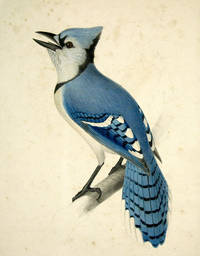
1850WRCAM39961United States 1850. Four individual sheets three matted and one mounted on card. Some scattered foxing affecting two of the watercolors. Generally very good. Isaac Sprague 1811-95 was one of the most prolific and well-known illustrators of flora and fauna in 19th-century America. Stafleu & Cowan lists seven composite works ranging from 1848 to 1891 that included Sprague's illustrations in addition to his WILD FLOWERS OF AMERICA and FLOWERS OF THE FIELD AND FOREST both published in 1882. He is particularly remembered for accompanying John James Audubon on his expedition up the Missouri River in 1843 aiding the master painter with ornithological sketches and drawings. The two first met on August 19 1840 when Audubon admired the young artist's bird drawings. Audubon recorded the meeting in a journal entry: <br> <br> "Saw some very remarkable drawings of birds far better than any ever made by the immortal Alexr- Wilson by a young man named Sprague. Truly wonderful drawings my dearest friends. But this person was out shooting and I did not see him. I however wrote a few lines on several of them the purports of which I trust will not displease him." <br> <br> The diary Sprague kept on this trip in which he gives useful accounts of the settlements and topography of the Missouri River valley is now held by the Boston Athenaeum. <br> <br> Sprague also illustrated several works by important naturalist Asa Gray including Gray's BOTANICAL TEXT-BOOK and MANUAL OF BOTANY OF THE NORTHERN UNITED STATES. Gray's wife the editor of his letters wrote the following description cited in McKelvey's BOTANICAL EXPLORATION: <br> <br> "President then Professor Felton.knowing Dr. Gray was looking for someone for his scientific drawings recommended Mr. Sprague and he began with the illustrations for the Lowell lectures and the new edition of the BOTANICAL TEXT-BOOK. Dr. Gray was delighted with his gift for beauty his accuracy his quick appreciation of structure and his skill in making dissections. Mr. Sprague was from that time his chief and almost only illustrator for his books both educational and purely scientific." <br> <br> The drawings are as follows: <br> <br> 1 "Blue Jay." Original watercolor 12 x 9 3/4 inches. Matted. In very good condition. Depicts a blue jay beak open perched on a branch with a focus on the detailing of the head and feathers. Light foxing but colors remain quite strong. A fine precise work. <br> <br> 2 "Robin and Holly." Original watercolor 12 x 9 3/4 inches. Matted. Marginal chipping and tape stains not visible under mat. Tanned. Good condition and quite visually appealing. Depicts an American Robin perched on a holly branch with holly leaves and berries in the background. <br> <br> 3 "Pine Grosbeak." Pencil drawing 15 x 11 inches. Matted. In fine condition. A fine sketch of this western bird labeled in pencil at lower left corner. <br> <br> 4 "Savannah Sparrow." Original watercolor 5 x 4 1/4 inches. Mounted on card. Some soiling and foxing. Good. A beautifully detailed small drawing with particular attention paid to the mottled coloration of the feathers. <br> <br> Although none of the works is signed each has a provenance connecting it either to a Sprague descendant or to an early owner in Sprague's native Hingham Massachusetts. The pieces were eventually sold through Goodspeed's Book Shop in the 1960s. <br> <br> On the whole a remarkable group of original works by an important ornithological and botanical illustrator acclaimed by no lesser contemporary naturalists than Audubon and Gray. McKelvey BOTANICAL EXPLORATION pp.834-36. STAFLEU & COWAN 12.635 12.636 ref. BM NATURAL HISTORY V:1993 ref. unknown books
183682404Philadelphia: C. Sherman and Co 1836-1841. First editi<span class="match">on</span> <span class="match">of</span> "<span class="match">the</span> first anthology <span class="match">of</span> <span class="match">Jewish</span> serm<span class="match">on</span>s in America" which "marked <span class="match">the</span> coming <span class="match">of</span> age <span class="match">of</span> <span class="match">the </span>American synagogue and ministry"Goldman. Association copy linking <span class="match">the</span> two most prominent and influential figures in <span class="match">Jewish</span> America and England <span class="match">of</span> this era Issac Leeser and Moses Montefiore. American Jewish lay minister author translator and publisher Issac Leeser revolutionized <span class="match">the</span> format of the early American <span class="match">Jewish</span> sermon by preaching in English helping to establish regular serm<span class="match">on</span>s as a central part <span class="match">of</span> the American rabbi's work. Aspiring to make his influence international <span class="match">Leeser</span> corresp<span class="match">on</span>ded regularly with <span class="match">Jewish</span> leaders in England most notably philanthropist and activist Sir Moses M<span class="match">on</span>tefiore who played a pivotal role in the development of Proto-Zionism. Goldman 687; Rosenbach 413 479 476; Singerman 0632 0748. Octavo four volumes bound in two original cloth paper spine labels from the library of Moses Montefiore with his bookplate to the pastedown of each volume. In good condition with some dampstaining and moderate toning to Volume I. Bound with Leeser's The Claims of the Jews to an Equality of Rights as issued. A rare and desirable piece of American Jewish history. American Jewish lay minister author translator and publisher Issac Leeser's "contributions to every area of Jewish culture and religion made him a major builder of American Judaism." In addition to his influence on the Jewish pulpit in the United States Leeser became the first American Jewish publisher and produced the first Jewish translation of the bible into English. "The translation of the Bible was Leeser's great literary achievement and represented many years of patient labor and devotion to a task which he considered sacred.until the new Jewish Publication Society version was issued in 1917 it was the only source from which many Jews not conversant with Hebrew derived their knowledge of the Bible in accordance with Jewish tradition" Waxman 1090. C. Sherman and Co hardcover books
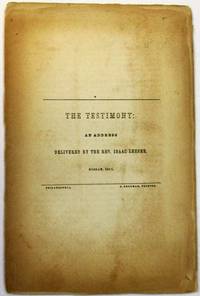
185136329Philadelphia: C. Sherman Printer 1851. Original front title wrapper stitched. 2 19 1 blank pp lacking the rear wrapper. Toned some shallow blank edge chipping and light wear. Good with some Hebrew printing in text. The caption title reads: 'An Address Delivered at the Schoolhouse of the Hebrew Education Society of Philadelphia at the First Opening of Their School on Sunday the 4th of Nissan 5611 April 6th 1851 by Isaac Leeser.'<br/><br/> "This address celebrated the opening of the day school launched by the Hebrew Education Society of Philadelphia the first of its kind in the city. 'It has always been to me a subject of profound astonishment and deep regret that there was not a single school all over the country until very lately where a Jewish child could obtain any information on his religion' Swann Catalog September 2019 Lot 120.<br/> "Leeser was the driving force behind the founding in 1846 of the Hebrew Education Society of Philadelphia chartered for 'the establishment of a school or schools within . Philadelphia in which are to be taught the elementary branches of education together with the sciences and modern and ancient languages always in combination with instruction in Hebrew language literature and religion.' In his address at its official opening delivered at the Society's schoolhouse on Sunday the 4th of Nissan 5611 April 6th 1851 Leeser expressed great hopes for the new Philadelphia Day School. 'We propose to combine elementary and afterwards scientific education with a gradual and progressive acquirement of Hebrew Hebrew literature and religion. It is not to be as in other schools a secondary matter whether the children learn Hebrew and religion or not but they are to acquire these even if nothing else can be imparted' p. 12." Sotheby catalog 2014 09239-20. <br/>Singerman 1195. Not in Goldman. OCLC 21968696 5- JTS U PA AJHS Hebrew Union College Princeton as of October 2019. C. Sherman, Printer unknown books
185982600Cincinnati: Bloch & Co 1859. First edition of American Reform Rabbi Isaac Mayer Wise's historical account of the era of Herod I. Octavo contemporary cloth over boards lacking the front free endpaper library bookplate to the front pastedown later collector's stamps to the title page with some rubbing and wear to the extremities. In good condition. Rare. American reform rabbi editor and author Isaac Mayer Wise established the first synagogue in the United States to include a mixed-gender choir family pews and count women in forming a quorum. Published in 1847 his Manhag American prayer-book was adopted and became the standard prayer book in most congregations throughout the Western and Southern states. He additionally published over two dozen works on the history of Judaism and Christianity including The Martyrdom of Jesus of Nazareth Judaism and Christianity: Their Agreements and Disagreements and The Cosmic God. Bloch & Co hardcover books
1815275647New York: New-York Courier 1815. First. pamphlet. 21 pages printed with text in double columns. Original pamphlet sewn dampstain at upper corner and rough at edges but well inside the ample margins; some pages still un-opened. New York: At the Office of the New-York Courier 1815. First edition. A very good copy of this exceedingly scarce pamphlet. OCLC lists only 13 copies including those at Columbia Cornell Yale Harvard and the New York Historical Society.<br/><br/> Attributed to Isaac Bronson by F. Redlich in "The Molding of American Banking" 1868 volume 1 page 308. "Isaac Bronson was a highly successful financier of the Jacksonian era who was also one of the period's most original and influential banking theorists. Bronson accumulated his very considerable fortune in New York primarily by judicious personal money-lending operations on long-term bonds and mortgages at a cautious 7 per cent annual return supplemented by successful ventures in land speculation. In addition to wealth he had by the 1830's acquired a weighty reputation for sober financial conservatism and was regarded as an authoritative exponent of sound banking principles. Prominent in the financial community he had long thrown his weight as a sound banking theorist against the "wild-cat" practices of the then rampant state banks." --Venit A. 1945. The Journal of Economic History<br/><br/> New-York Courier unknown books
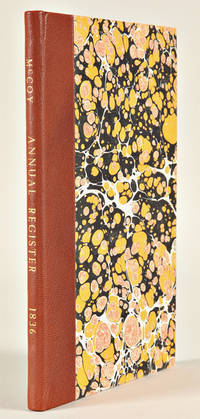
1836WRCAM43669Shawanoe Baptist Mission Ind. Ter. Ks.: J. Meeker 1836. 88pp. Modern half morocco and marbled boards spine gilt. A bit of light foxing. Very good. The second number of McCoy's THE ANNUAL REGISTER. of which only four numbers were ever printed containing valuable first-hand particulars regarding the western Indian tribes. McCoy first visited the Prairies in 1828 with follow-up tours during the next three years. In 1831 he settled at the Shawanoe Mission in 1831 which had been founded by Lykins earlier that year. During the following years McCoy travelled widely in the western country. In 1835 he had Jothan Meeker who had established a press at the Mission a year earlier print the initial number of THE ANNUAL REGISTER. McCoy's works are full of information regarding the Indian emigrant's introduction into the new country and provide details concerning many tribes e.g. Pawnee Otoe Omaha Cherokee Delaware Kickapoo Osage Kansas etc. Also included are descriptions of the military posts within Indian Territory conditions of various tribes etc. Complete sets of the four numbers are rarely met with - even the Streeter set lacked the first number. Printing began in Kansas in 1834 and McCoy's ANNUAL REGISTERs are the first works of any substance printed in the state. SABIN 43111. HOWES M67 "aa." FIELD 983. GRAFF 2586. STREETER SALE 544 ref. McMURTRIE & ALLEN Meeker 41. J. Meeker hardcover books
189917557Barcelona: Universo Musical Antes J. Bta. Pujol y Ca. ca. 1899. Used; Like New/Used; Like New. Espagne Souvenirs. Åuvres nouvelles pour le piano . N° 1 Prélude. Signed and inscribed presentation copy of the Spanish virtuoso pianist and composer's Prelude. He has penned on the first page of music translated from the French: "To Madame Henry Lerolle in sincere friendship and affection. I. Albeniz Paris January 6 1906." 7 pp. PN U.336.M.1. Rather heavily toned pages largely detached; front wrapper with multiple tears and losses. Stamped on the front wrapper by the bookseller L. E. Dotésio. Overall good with the inscription in fine condition. 9.5 x 12.5 inches 24.3 x 31.5 cm.<br style="">Madeleine Escudier Lerolle 1856â1937 was the sister-in-law of Ernest Chausson and moved in the musical circles of Paris. Her husband was the painter and and art collector Henry Lerolle 1848â1929.<br style=""><br style="">Albeniz's Prelude part of his piano suite Espagne Souvenirs evokes the sunrise on the "poetic plain of Granada."<br style="">Autograph material by Albeniz is seldom offered for sale. We have traced only two other inscribed scores from the composer on the market in over 50 years of records. Universo Musical Antes J. Bta. Pujol y Ca. unknown books
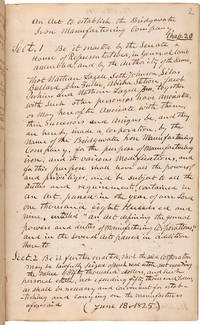
1887WRCAM55893Bridgewater Ma 1887. 364 i.e. 368pp. 91pp. blank. Broadside 11 1/4 x 4 3/4 inches laid in. Folio. Contemporary paneled reverse calf red morocco gilt labels on both boards and spine. Boards lightly worn front joint starting but still strong. Light tideline to outer margin throughout slight tanning. Overall very good. An impressive manuscript copy book documenting the rise and development of Bridgewater Iron Manufacturing Company of Massachusetts one of the largest iron works in the United States in the 19th century and a vital industrial partner during the Civil War under the direction of Nahum Stetson. These records chart the huge growth of the company as it purchased land and competing mills diversified its products building not only nails but large castings for military and commercial vessels and forming and utilizing railroads to quickly and efficiently expand their markets. <br> <br> Completed entirely in manuscript on hand- ruled paper this volume records the company's acts of incorporation minutes from stockholder and other important meetings directors' records by-laws and other important records relating to the growth of the company. The first page features a list of acts establishing and incorporating the company with relevant page numbers in the hand of Stetson: "An Act to Establish the Bridgewater Iron Manufacturing Company" 1825; "An Act to increase the Capitol Stock of the Bridgewater." 1846; "An Act to Amend an Act to Incorporate the Bridgewater." 1866; "An Act to Incorporate the Bridgewater & Taunton Rail Road Company" 1867; and additional acts. Among these are the general Massachusetts incorporation laws 1808-21 that required corporations to have a clerk keep a record book such as this one and that said clerk was designated an official justice of the peace who would record company stock votes and business decisions and maintain records of by-laws and changes to by-laws. <br> <br> Early entries include a vote in 1827 approving the company investigate the land below the existing furnace to potentially erect a new mill; examine Nippenicket Pond to improve water flow to the mills; and how with these improvements the company was able to pay dividends of $100 per share on the $16000 profits in 1830. In subsequent years minutes reference land purchases as they expand mill operations; and then adding a counting room next to the safe in 1835 after the death of Nathan Lazell Jr. along with notes about the company helping with funeral expenses for Lazell. Records show the company beginning to expand rapidly in hardware manufacturing in the 1840s thanks in large part to the Fall River Railroad reaching Bridgewater in 1845 and connecting to Boston the following year allowing the company much easier access to these markets. They greatly increased production of "American iron nails" in 1842; erected a "steam engine to drive our Rolling Mill when the water fails" in 1845; paid assessments on $16500 in stocks owned by the company in the "Fall River Middleboro Bridgewater & Randolph Rail Road Company" and incurred minor losses building a new rolling mill and rebuilding and expanding the forge in 1847. By the 1850s the company employed nearly 250 men working ten acres of manufacturing space supervised by legendary machinist James Ferguson. <br> <br> With the outbreak of the Civil War Bridgewater was on its way to becoming the largest iron works in the country. Specializing in heavy castings and forgings including key components for large ships they supplied the iron plate and fittings for the U.S.S. Monitor U.S.S. New Ironsides and all other iron-clad warships as well as the large forgings for every steamer for the Pacific Mail Steamship Company. The company's profits grew accordingly the ledgers reporting over $350000 in 1863 $450000 in 1864 and over $500000 in 1867. By 1868 the company had expanded to nearly 600 men and a manufacturing space of almost seventy acres. <br> <br> The "Directors' Records" start at the rear of the volume inverted. This portion is briefer and primarily discusses balloting for company officer elections dispersing and paying out shares in subsidiary operations such as the Providence Iron Company which Stetson purchased in 1854 and sales of land in Massachusetts and Rhode Island owned by the company and its subsidiaries including the Weymouth Iron Company. <br> <br> In 1694 David Perkins received permission from the colonial government of Massachusetts to construct a dam across the Town River and by 1707 Perkins had a working blacksmith shop at the site. In 1785 Nathan and Isaac Lazell built a slitting mill on the site to expand the blacksmithing operation. They added a second slitting mill in 1793. In time the company came to be known as Lazell Carey & Company and produced cannons during the War of 1812 and iron pots for the whaling industry along with cut nails and barrel hoops. In 1825 the company formally incorporated as the Bridgewater Iron Manufacturing Company but continued doing business as Lazell Perkins & Company for many years after. <br> <br> Nathan Lazell Jr. 1796-1835 was the first company clerk and many of the early records and acts copied into this volume are in his hand. Nahum Stetson 1807-1894 joined the company as a clerk in 1825 and was selected as treasurer effectively CEO when Lazell Jr. died in 1835. Stetson led the company for over half a century overseeing tremendous growth. In addition to acquiring Weymouth and Providence Iron companies Bridgewater also acquired Parker Iron Mills Wareham Massachusetts and helped form several railroads including the Fall River and Cape Cod railroads. In 1899 the site was purchased by the Stanley Works of New Britain Connecticut for the manufacture of machinery and tool production until 1928 when production shifted to New Britain. Between 1946 and 1988 part of the site was operated by the Bridgewater Foundry Company which produced grey iron castings. The property was donated to the Town of Bridgewater in 1994 by the Brousseau and Landner families the last owners of the foundry. Much of the site has been converted into Iron Works Park. <br> <br> The accompanying small broadsheet is caption titled LIST OF STOCKHOLDERS IN THE BRIDGEWATER IRON CO. and dated "May 1 1885." It has marginal annotations in Stetson's hand as well as a small slip of paper pasted to the bottom of the sheet with an additional seven shareholders added in manuscript. The total voting shares are 480 for a total capital value of $480000. <br> <br> A fascinating look into the development of industrialization in the Northeast through the eye of the company that led the charge. J. Leander Bishop A HISTORY OF AMERICAN MANUFACTURES FROM 1608 TO 1860. Vol. 3 Philadelphia: Edward Young & Co. 1868 pp.488-91. hardcover books
183067190Leeser's First Issued Work LEESER Isaac translator. JOHLSON Joseph author. Instruction in the Mosaic Religion. Translated from the German of J. Johlson Teacher of an Israelitish School at Frankford on the Maine. By Isaac Leeser Reader of the Portuguese Jewish Congregation in Philadelphia. Philadelphia: Adam Walde 5590 1830. First American edition and first edition in English. Octavo 8 1/4 x 5 1/8 inches; 210 x 131 mm. viii 139 1 blank pp. Full contemporary sheep. Red morocco spine label. Marbled endpapers. Page 35 with a large closed tear professionally repaired with no loss of text. Internally very clean. Overall a very good copy. "Leeser brought with him to Philadelphia his translation of J. Johlson's Instruction in the Mosaic Religion. He had it published there in 1830 appropriately dedicated to his uncle Zalman Rehine. The book is a catechism published in Germany and translated and adapted by Leeser for "the instruction of the younger . of Israelites of both sexes who have previously acquired some knowledge of the fundamental part . of their religion." Leeser undertook its publication because there was a great scarcity of elementary textbooks for Jewish children. It is significant that this Instruction in the Mosaic Religion Leeser's first issued work is a textbook of religious instruction for the young for though Leeser attained distinction as an author translator editor and a national leader of the American Jewish community he considered himself first and foremost an educator." The Jewish Virtual Library "Leeser's career as a translator also began in Philadelphia in 1830 with the publication of his rendering from German of J. Johlson's Instruction in the Mosaic Religion. Leeser as part of his ongoing efforts to contribute to the development of Jewish education and culture in America translated a number of important works into English from German Spanish French and Hebrew. " Penn Libraries. Rosenbach 321. HBS 67190. $3000 Adam Walde unknown books
184832879from the added title-page in English: Philadelphia: Printed by G. Sherman for the editor 1848. 8vo. viii 242 2243 1 pp. <br><br>This Siddur in Hebrew and English was => the first Ashkenazic prayer book edited and printed in America. Its editor Isaac Leeser 180668 was a towering figure in American Jewry in the 19th century: writer educator and hazan of the Mikveh Israel congregation in Philadelphia.<br>Â Â Â Â The English-language title-page reads "The book of daily prayers for every day in the year. According to the custom of the German and Polish Jews." The text is presented with the original Hebrew and English translation on opposite pages.<br>Â Â Â Â Provenance: 19th-century ownership stamp of "Mme. Bernheim 603 Magazine St. New-Orleans. <br>Â Â Â Â <br>Â Â Â Â Rosenbach Jewish 636; Singerman Judaica Americana 1024; Goldman 37. Contemporary full plain treed calf with a black leather spine label; expectable wear to spine from use. Scattered light foxing. A good copy with a provenance worthy of research. Printed by G. Sherman, for the editor hardcover books
1886D7497Pennsylvania 1886. Hardcover. Very Good. Contemporary quarter sheep marbled paper over boards; 112 x 176 mm; with 123 numbered and lined leaves mostly filled. Rather early American railroad treatise by Isaac Dox chief engineer in the building of a rail line from Delano to Hazelton Pennsylvania 1886-1887. Covers all aspects of railroad construction and the working of railroads accomplished in a small precise hand with frequent illustrations and diagrams done in pen and ink. Spine chipped and scuffed; edges of boards scuffed. <br/><br/> hardcover books
1820220481London 1820. A meticulous rendering of an old woman seated smoking among her pets and surrounded by a circular frieze of 30 heads of highly diverse individuals plus a full-length Cupid: young lovers soldier miser judge mortician farmer sailor squire singing lady scold dandy toper etc. as well as several attractive young women. There is also a "temple of love" and a lovers' maze. In the corners are elaborate curtains a decorated confection decanters of spirits and a display of fruits. Across the top is the legend lightly sketched in pencil CAFE BURNS CHARACTERS. 1 vols. Image 7 x 7-3/4 inches matted and framed to 11-3/4 x 12-1/2 inches overall. Some light soiling mostly marginal otherwise fine and attractive. A meticulous rendering of an old woman seated smoking among her pets and surrounded by a circular frieze of 30 heads of highly diverse individuals plus a full-length Cupid: young lovers soldier miser judge mortician farmer sailor squire singing lady scold dandy toper etc. as well as several attractive young women. There is also a "temple of love" and a lovers' maze. In the corners are elaborate curtains a decorated confection decanters of spirits and a display of fruits. Across the top is the legend lightly sketched in pencil CAFE BURNS CHARACTERS. 1 vols. Image 7 x 7-3/4 inches matted and framed to 11-3/4 x 12-1/2 inches overall. A Superb Social Satire by Robert Cruikshank Ca. 1820. Isaac Robert Cruikshank son of Isaac and elder brother of the more famous George was a caricaturist illustrator and particularly apropos of the picture offered here portrait miniaturist. His first caricatures appeared around 1810 and were often produced in conjunction with his brother Geroge with whom he shared a studio. Notes Bryant and Heneage "Of his Robert's social satires those he made of the dandies and the fashion for 'hobby horses' in the early 1820s are among the most attractive." We are pleased to be able to offer a fine example of this genre. Bryant & Heneage Dictionary of British Cartoonists and Caricaturists p. 52 unknown books
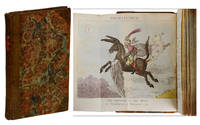
1811180405005London: Printed for J. Johnston 1811. First Edition. Hardcover. Very Good. First edition. xi 1 Reference to Plates 180 pp. With five color plates including fold-out frontispiece by George Cruikshank"The Journey to the Moon or Munchausen on Mahomet's Ass." Period half speckled calf and marbled boards gilt decorated spine with red morocco label lettered in gilt. Very Good worn along edges front hinge a little free three bookplates at front faint foxing to prelims. Second to last plate printed off center.<p>A satirical novel directed at Sir William Curtis and a continuation of the adventures of Baron von Munchausen with all its rare color plates present two of which were illustrated by English caricaturist and illustrator George Cruikshank and the others at least partially by his father Issac. Harry Elkins Widener Collection p. 20. Printed for J. Johnston hardcover books