470 résultats
17943000561Dublin: E Lynch and others 1794. Book. Good. Quarter Leather. Second. 8vo - over 7¾" - 9¾" tall. pp x 2 31 791 62 Sound with later cover / endpapers could be early 20th cent signature 1809 on title page significant browning throughout A working copy. E Lynch and others hardcover
1796117833London: A. Strahan 1796. Leatherbound. Fair. viii 500 p. 24 cm. Leather binding. From our As Is shelf. Spine deteriorated and torn front board detached rear board loose corners and edges worn. Some foxing. Tear in title page and front free endpaper. <br/><br/> A. Strahan hardcover
1789373872Boston: John W. Folsom 1789. 31711; 265 1 xii pp. 12mo. Contemporary calf minor wear. Provenance: Anna Duryee inscription on front endpaper dated 1791. 31711; 265 1 xii pp. 12mo. The Psalms unrecorded by Evans are an edition of Mycall's revision with all references to Great Britain and the King removed to make it more palatable to the nascent United States first printed in 1781. A scarce edition with only a handful of institutional holdings of either the Psalms or Hymns printed by Folsom here bound together. Evans 21687 Hymns; ESTC W4418 Psalms and W25174 Hymns John W. Folsom unknown
171538967Amsterdam: David Mortier. Very Good- with no dust jacket. 1715. 1st Thus. Hardcover. History Roman; Engravings; 12mo 7" - 7½" tall; HISTOIRE DES DEUX TRIUMVIRATS DEPUIS LA MORT DE CATILINA NOUVELLE EDITION AUGMENTEE DE L'HISTOIRE D'AUGUSTE DE LARREY. 3 VOLS IN 2 CT as published. New edition. Two Triumvirate History since the death of Catiline up to that of Caesar. Since that of Caesar to that of Brutus. Since than that of Brutus to Antony. New expanded edition of the history of Augustus of Larrey. 3 frontises. TPs in red and black. Contemporary decorated calf leather. All dated 1715. Vol I 20 1-286; 289-494; 215. 3 vols in 2 each with frontis. Contents clean with brief aging. Cracked hinges binding solid. Five years later a fourth volume made it's appearance. . David Mortier hardcover
1781C210025London: John Bell 1781. Hardcover Hardcover. Very Good. 5 operas bound in one. Contemporary leather somewhat worn front board detached spine and backstrip cracked otherwise a good copy suitable for rebinding. John Bell, hardcover
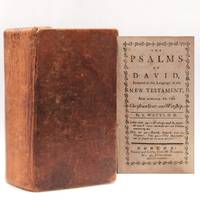
17928953Newburyport MA: John Mycall 1792. Hard Cover. Good binding. 12mo. 288 pp. Early printing. Originally issued with Watts's "Hymns and Spiritual Songs" not present here though the Psalms are complete. In recent cloth with tasteful printed paper label. Only light soiling to the binding; contents toned and foxed; a few leaves with some wear and chipping to the margins or corners; a solid copy with an illegible early owner name "Burlington August 1818 / University of Vermont." <br /> <br /> Mycall's revision of Watts's psalter was first issued in 1781. In it Mycall removed all references to Great Britain and King George exchanging them with references to the nascent United States—a significant declaration in its own right and one that really captures the fervor of the revolutionary American. Ezra Stiles that monumental American theologian and president of Yale describes Mycall's edition in his diary entry for 8 December 1781 calling it "well adapted to the Church in America." Though there are several psalms that were revised by Mycall Stiles specifically points to 75th Psalm titled: "Power and government from God alone Applied to the glorious revolution in America July 4th 1776." Verse 2 reading: "America was was sic doom'd a slave / Her frame dissolv'd her fears were great; / When God a right'ous Council gave / To bear the pillars of the State." An early but post-revolution imprint of this important revolutionary psalter. Evans 23106; ESTC W4416; The Literary Diary of Ezra Stiles. New York 1901. Vol II p. 571. John Mycall unknown
175458056Londini: impensis J. & R. Tonson & S. Draper 1754. 4to pp. 4 40; modern boards gilt lettering on spine; some toning of the text and the textblock trimmed to 23.5 x 18.5 cm; all else very good. This is the variant with the price 1 s. 6 d. on the title page. Painfully common but Browne's best known work a poem on the immortality of the soul. impensis J. & R. Tonson & S. Draper unknown
173031377AB1730. The Fifth Edition. London Printed for Emanuel Matthews 1730. Small Octavo. 5 156 1 pages. Hardcover / Original early 18th century full-leather with armorial embossing to both boards. New spine-label. Ruth Corker's Library-stamp verso the titlepage. This used to be Ruth Corker's mother's book prior to her own and the name Mary Falkiner is written in ink on top of the Preface-page. Manuscript entry "Ruth Corker Her Book 1731" on halftitle with several entries informing on marriages and relationships within the Falkiner and Corker and Robinson - family added obviousy by a later relative Ruth Robinson who was married to Robert Robinson. Excellent condition with only minor signs of wear. Armorial Bindings held in University of Toronto Libraries: Corker Ruth 1693 -1760 Mrs Ruth Corker of 41 St Stephen's Green Dublin was born Ruth Falkiner the only daughter of Richard Falkiner and Mary Mason of Dublin. She married Thomas Corker 1700-1772 merchant of Dublin. She died in 1760. Her name appears as one of the subscribers to Oldmixons The history of England during the reigns of King William and Queen Mary London 1735. Stamp Information of the Armorial Binding of Ruth Corker: Monogram: R R C Source: utoronto.ca Isaac Watts 17 July 1674 25 November 1748 was an English Congregational minister hymn writer theologian and logician. He was a prolific and popular hymn writer and is credited with some 750 hymns. His works include "When I Survey the Wondrous Cross" "Joy to the World" and "Our God Our Help in Ages Past". He is recognized as the "Godfather of English Hymnody"; many of his hymns remain in use today and have been translated into numerous languages. Wikipedia hardcover
179423985London: Printed for C. and J. Kearsley Fleet Street 1794. First Edition with half-title. 1 vols. 8vo. Bound in contemporary half calf front joint weak else a very nice copy. Bookplate of John Humphrey Austen. First Edition with half-title. 1 vols. 8vo. The author states that the Revolution was on its way for many years and there should be no surprise that it came when it did. Roth Bibliotheca Anglo-Judaica B20; CBEL III 1278 Printed for C. and J. Kearsley, Fleet Street unknown
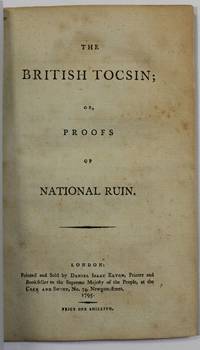
179539807London: Printed and Sold by Daniel Isaac Eaton Printer and Bookseller to the Supreme Majesty of the People at the Cock and Swine 1795. Modern plain wrappers and stitching. 54pp. Light browning Very Good.<br /> <br /> The publisher Daniel Eaton was a persistent challenger of British efforts to curtail speech critical of the Crown and government. He had been arrested and acquitted for publishing Paine's 'Rights of Man" and then for publishing a comparison of the King of England to a Game Cock. <br /> This pamphlet's thesis is that "Britain is on the brink of ruin. . . Corruption and distress walking hand in hand through the country; and war eternally compleating the triumvirate of despotism. . . That government is near its end when having once depended upon the free temper of the people they endeavor to reign by their own extent of power." The author writes "on the extravagance of the present reign" and its corrupting effects. He predicts "commercial bankruptcy! a national famine! and an unavoidable Revolution!" <br /> OCLC 221410570 4- Columbia Baylor two in England as of January 2024. Printed and Sold by Daniel Isaac Eaton, Printer and Bookseller to the Supreme Majesty of the People, at the Cock and Swine unknown
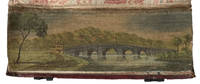
1784FF2537London:: Printed for J. F. and C. Rivington . . . 1784. 1784. 16mo. 80 x 140 mm. viii 317 23 pp. Original full crimson turkey morocco with massed gilt stamping on both covers and spine all edges gilt two clasps black leather spine label; head of spine a bit chipped at corner clasps missing the movable element pages trimmed closely with occasional loss but a very good copy with a lovely period binding. Bookplate of Oscar Ehrhardt Lancaster. Good. With a fore-edge painting of Richmond Bridge Surrey. Painted circa 1948-60 by Samuel E. Stevens. PROVENANCE: Pre-fore-edge: Mary Strand 1790 – Mary S. Partridge 1792; After fore-edge: Oscar Ehrhardt Lancaster 1887- Lancaster collected fore-edge paintings. Printed for J. F. and C. Rivington . . ., 1784. hardcover
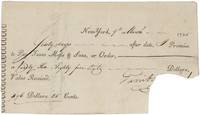
179542478New York 1795. paperback. Single leaf 4x7 inches. Printed on one side with blanks filled in in manuscript and signature obscured by cancellation tear-off; “Isaac Moses & Sons†penned on blank side in period hand. Early American Jewish merchants Isaac Moses & Sons operated on Greenwich Street.Isaac Moses 1742-1818 was born in Giessen Germany but moved to New York in 1764 and in 1766 he became a “freeman†of New York City. He became a prominent businessman and American patriot. He worked in his uncle's Hayman Levy's mercantile firm until he established Isaac Moses & Company with two new business partners in 1775. This firm supported the revolutionary army by accepting $20000 in Continental paper dollars in exchange for $20000 in hard currency thereby financing the war effort. The firm also traded for military supplies internationally and sold guns and ammunition to the army. When the British occupied New York Isaac Moses left for Philadelphia and ran the firm from there. In 1783 he returned to New York City and continued his commercial enterprises. He was generally financially successful establishing Isaac Moses & Sons an international trading company. He was also a founder and major stockholder in the Bank of New York  a Mason in New York City's Union Lodge and an important member of the New York City Chamber of Commerce. Isaac Moses was also president of Congregation Shearith Israel in New York the oldest Synagogue in American and the only Jewish congregation in New York City until 1820. He was also one of the principle organizers of the Congregation Mikveh Israel in Philadelphia. His descendants were prominent Jewish businessmen in New York who traveled internationally and served in the Union Army during the Civil War AJHS & Wikipedia. For more on Isaac Moses see the JTA’s report on the donation of his portrait by John Wesley Jarvis to the Museum of the City of New York in 1934 https://www.jta.org/archive/painting-of-isaac-moses-patriot-of-revolution- given-to-museum. Portraits of Moses can be viewed online at https://loebjewishportraits.com/portrait/isaac-moses/ and https://loebjewishportraits.com/portrait/isaac-moses-2/. An indenture signed by his heirs after his death in 1818 sold for $3500 plus commissions at auction in 2019 https://www.sothebys.com/en/auctions/ecatalogue/2019/fine-manuscripts-prin ted-americana-n10002/lot.2180.html. Promiser’s signature torn of as cancellation as often found otherwise Very Good Condition BK5 AMR-67-39. New York unknown
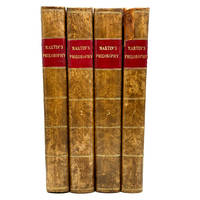
17715136166113<p><strong>NEWTON MARTIN Benjamin</strong><strong>.</strong> <em>Philosophia Britannica: Or A New and Comprehensive System of the Newtonian Philosophy Astronomy and Geography; In a Course of Twelve Lectures; With Notes; Containing the Physical Mechanical Geometrical and Experimental Proofs and Illustrations of All the Principal Propositions in Every Branch of Natural Science: Also a Particular Account of the Invention Structure Improvement and Uses of All the Considerable Instruments Engines and Machines; With New Calculations Relating to Their Nature Power and Operation.</em></p><p>London: Printed for W. Strahan; J. & F. Rivington; W. Johnston; Hawes & Co.; T. Carnan and F. Newbery; B. Collins; W. Frederick; and sold by the Author at his House in Fleet-Street 1771. Third edition. Complete in four volumes. Three text volumes plus a separate atlas volume of plates. Quarto. Approximately 8.5" x 5.5". Vol. I: xxx 333pp 3 ads; Vol. II: xiv 390pp 2 ads; Vol. III: x 405pp index. Atlas volume with 81 engraved copperplates the majority folding. Contemporary or near-contemporary half marbled calf over marbled boards with one repair to the upper spine of Vol. IV. Bindings sound and well-aligned. Engraved plates clean and strong with no losses; folds supple and correctly opening. Text generally clean throughout with manuscript annotations on the versos of the plates linking them to the relevant portions of text. Overall Very Good to Very Good.</p><p>Third and expanded edition of Benjamin Martin's monumental exposition of Newtonian natural philosophy combining physics astronomy geography mechanics and experimental science into a single unified system. The work includes extensive treatment of optics celestial motion gravitation hydrostatics pneumatics electricity and the mechanical powers alongside detailed explanations of contemporary scientific instruments and experimental apparatus. The separate atlas volume contains 81 finely engraved plates illustrating astronomical systems orreries telescopes microscopes air pumps electrical machines engines survey instruments and mechanical demonstrations.</p><p>This third edition represents the fully mature state of Martin's project as a practical synthesis of Newtonian science for broad professional use in the later eighteenth century. Unlike earlier editions which often survive without the full engraved apparatus this issue consolidates the theoretical text and the mechanical-visual program into a coherent instructional system. The separate atlas format allows for larger clearer mechanical and astronomical engravings than the inline plates of earlier printings making this edition particularly well suited for institutional reference in the history of science technology and scientific pedagogy.</p> Printed for W. Strahan; J. & F. Rivington; W. Johnston; Hawes & Co.; T. Carnan and F. Newbery; B. Collins; W. Frederick hardcover
179931012Baltimore 1799. Letter. Very good. Paper. Approx. 4.5" x 8" sheet of paper . Light toning to the paper. Contents reads: This may certify that I inspected Six Barrels flour Baranded on the end E. KREMER four of Which was condemn'd to Midlings Middlings being too course and Shky the other two had too much rye in the flour and could not be pass'd and branded for Merchantable Wheat Flour of any Quality signed Isaac Trimble Balt 12th of 3 mo 1799." From wikipedia:<br /> <br /> Wheat middlings also known as millfeed wheat mill run or wheat midds are the product of the wheat milling process that is not flour. A good source of protein fiber phosphorus and other nutrients they are used to produce foods like pasta breakfast cereals puddings and couscous for humans as well as fodder for livestock and pets. 1 They are also being researched for use as a biofuel. unknown
17521862Spain 1752. 18th-century manuscript. Text in Spanish. 24 handwritten pages in ink in three different hands. Later binding of blank paper using old material. Tiny wormholes at the lower edge of the pages on the first 7 leaves not affecting the legibility. Occasional foxing ink ghosting. Water stains on the last 2 leaves. Overall in fine condition. 18th-century manuscript. Text in Spanish. 24 handwritten pages in ink in three different hands. ff 12. <p><br /> 18th-Century Spanish manuscript about the Spanish involvement in the French Geodesic Mission of 1735 and the Ellipsoid Model of the Earth.<br /> <p><p><br /> The manuscript is an interesting collection of contemporary reports proving the importance of the Spanish role performed by Jorge Juan y Santacilia and Antonio de Ulloa in the so-called French Geodesic Mission 1735 with a particular focus on the polemic over the shape of the Earth. The quotations are conjugated with connecting texts by an anonymous author.<br /> <p><p><br /> One of the important scientific disputes of the late 17th early 18th century was the debate on the shape of the Earth. The assumption of the spherical shape was dominating until the late 17th century when Sir Isaac Newton determined that the Earth was oblate a spheroid stretched over the Equator however at the same time Giovanni Domenico Cassini and his son Jacques supposed that the Earth was prolate stretched along the poles. Eventually in 1735 two expeditions were sent by Louis XV and the French Academy to the Arctic Circle Lapland and to the Equator Ecuador and Peru to gain certainty by measuring the meridian arcs at polar and equatorial latitudes. The equatorial mission was accompanied by two Spanish geographers Jorge Juan y Santacilia and Antonio de Ulloa thus it became the first major international scientific expedition. The findings of the missions confirmed Newton’s hypothesis that the Earth was oblate a rotational ellipsoid.<br /> <p><p><br /> The first part of the manuscript is a lengthy citation of an early Spanish report on the equatorial mission published in the Mercurio histórico y político February 1745; pp. 99–107 which is followed by further references and quotations related to the geographer’s their work and the figure of the Earth such as Benito Jerónimo Feijóo y Montenegro’s Theatro critico universal 1751 Bernardo’s de Ulloa’s Antonio’s father Restablecimento de las fabricas y comercio español 1749 and articles from the Journal de Trévoux or the Gaceta de Zaragoza. The second part is Diego de Torres Villarroel’s 1693–1770 study Prevenciones in: Libros en que estan reatados. Vol. IV.; 1752 in which de Torres the almanac writer and professor of mathematics of a dubious repute opposes the findings of the missions and Newton’s hypothesis of the oblate Earth.<br /> <p><p><br /> Antonio de Ulloa 1716–1795 was a Spanish scientist and explorer the first Spanish governor of Louisiana who is also credited as the discoverer of the element platinum. De Ulloa was a Fellow of the Royal Society and a foreign member of the Royal Swedish Academy of Sciences. His associate Spanish scientist in the Geodesic Mission to Peru was Jorge Juan y Santacilia 1713–1773 who during the mission also measured the heights of the mountains of the Andes. Jorge Juan was the founder of the Real Observatorio de Madrid Royal Observatory of Madrid and he became a Fellow of the Royal Society too. Their co-written memoirs were published in Spanish from 1748 on and their books were very soon translated into French English and German.<br /> <p><p><br /> Literature: Lafuente A.; Mazuecos A.: Gentlemen of the Fixed Point: Science Politics and Adventure in the Geodesic Expedition to the Viceroyalty of Peru in the XVIII Century. pp. 171–203. Retrieved on July 8 2020 from Mayboudi L. S.: chapter 5.1 In: Geometry Creation and Import With COMSOL Multiphysics. Dulles VA USA: Mercury Learning & Information 2019.; Richardson D.; et al: The International Encyclopedia of Geography People the Earth Environment and Technology: Chichester UK; Hoboken NJ: John Wiley & Sons 2017.<br /> <p>. unknown
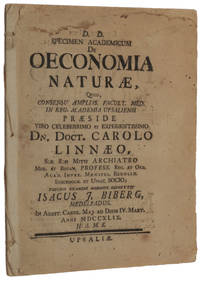
17495245Uppsala: np 1749. First edition. <p>First edition extremely rare. "This essay was the first sketch of a science of ecology. Linnaeus used his economy-of-nature concept as an organising principle to unify an important but previously amorphous part of natural history. In so doing he was also attempting to transform an important background concept into the central theory of a new science" Egerton. "In regard to Linnaeus' concepts of an economy of nature Darwin used these ideas as major explanations of the workings of natural selection. So Linnaeus supplied major assistance for Darwin's arriving at his theory of evolution" Stauffer.</p>. THE BIRTH OF THE SCIENCE OF ECOLOGY. <p>First edition extremely rare of Linnaeus' pioneer dissertation which created the science of ecology. "This essay was the first sketch of a science of ecology. Linnaeus used his economy-of-nature concept as an organising principle to unify an important but previously amorphous part of natural history. In so doing he was also attempting to transform an important background concept into the central theory of a new science . The term 'economy of nature' bore an obvious similarity to the contemporary term for animal physiology 'animal economy' which involved studying how the parts contributed to the functioning of the whole. Linnaeus may indeed have had in mind an analogy between the organs in an animal and the species in a habitat because his analysis of the interrelations between the plants and animals in nature implied a close and well-defined interaction for the good of the whole: 'To perpetuate the established course of nature in a continued series the divine wisdom has thought fit that all living creatures should constantly be employed in producing individuals that all natural things should contribute and lend a helping hand towards preserving every species and lastly that the death and destruction of one thing should always be subservient to the restitution of another' . The Oeconomia naturae begins with the above-quoted definition and then explains how that concept can be used to interpret phenomena in inanimate nature and in the plant and animal kingdoms. For both the plant and animal kingdoms Linnaeus considered propagation preservation and destruction as the phenomena which maintained the economy of nature" Egerton p. 335. "The phrase 'Oeconomy of Nature' "should be familiar to readers of Darwin for he claims in the Origin p. 102 that 'all organic beings are striving it may be said to seize on each place in the economy of nature.' When the work 'economy' appears in Darwin's texts there is a tendency to look to political economy for precursors . but concepts like the animal economy and the economy of nature debatable belonged to intellectual lineages that were relatively independent of their social and political context . I will argue that Darwin's idea of a place in the economy of nature stems from the work of previous naturalists like Carl Linnaeus and Charles Lyell and that it played a key role in the development of his evolutionary ideas. . Darwin read translations of Linnaeus' dissertations Oeconomia naturae 1749 and Politia naturae 1760 in May 1841. Although the phrase 'economy of nature' appears only once in Darwin's notebooks of the late 1830s it can be found throughout his first sketches on transmutation in 1842 and 1844. Given this chronology it is likely that the idea came to play a greater role in Darwin's work because of his encounter with these Linnaean texts" Pearce pp. 494-6. The dissertation was dictated by Linnaeus in Swedish to Isaac Biberg a doctoral candidate who translated it into Latin and defended it according to the academic custom of the eighteenth century. ABPC/RBH lists no copy in the last 80 years. OCLC lists 5 copies in US Madison Wisconsin; Kansas; Harry Ransom Texas; Minnesota; Huntington.</p> <br /> <p>"Like most naturalists of his time Linnaeus was trained in medicine and thus would have been familiar with the term 'oeconomia animalis' as employed by Charleton Hermann Boerhaave and others. However Linnaeus set his sights higher - what he wanted to describe was not the animal economy but the economy of nature as a whole. Of course others had used the term 'economy of nature' e.g. Sir Kenelm Digby in a variety of works but only as a brief metaphor. For example Digby writes in 1644 that natural motion 'hath its birth from the universall oeconomy of nature here among us.' What Linnaeus did instead was extend the physiological idea of the animal economy to nature in its entirety. In his eyes the economy of nature deserved a description just as detailed and rational as that of the animal economy.</p> <br /> <p>"In the dissertation 'Oeconomia Naturae' defended by his student Isaac Biberg in 1749 Linnaeus defines his title as follows: 'By the oeconomy of nature we understand the all-wise disposition of the creator in relation to natural things by which they are fitted to produce general ends and reciprocal uses.' The 'reciprocal uses' are the key to the whole idea for 'the death and destruction of one thing should always be subservient to the restitution of another;' thus mould spurs the decay of dead plants to nourish the soil and the earth then 'offers again to plants from its bosom what it has received from them.' Linnaeus points out that natural processes always follow a certain order with each stage dependent on the previous. A fallen tree for instance does not go to waste but is colonized and eliminated by an ordered series of creatures: liverworts mushrooms beetles caterpillars and woodpeckers. Just as the respiratory cardiovascular lymphatic and digestive systems play different functional roles in the economy of the human body different species play different functional roles in the economy of nature as a whole. For example each kind of insect lays its eggs on a particular kind of plant:</p> <br /> <p>'. every different tribe chooses its own species of plant. Nay there is scarce any plant which does not afford nourishment to some insect; and still more there is scarcely any part of a plant which is not preferred by some of them. Thus one insect feeds upon the flower; another upon the trunk another upon the root; and another upon the leaves.'</p> <br /> <p>"Each type of organism therefore according to Linnaeus has its special function in nature's economy. Just as the animal economy ensures the health and well-being of the animal body the economy of nature ensures the health and well-being of the natural world. Linnaeus discusses the many creatures that help cleanse and purify nature's body without which the 'whole earth would be overwhelmed with carcases and stinking bodies.' Thus if a horse dies near a roadway its body will 'be filled with innumerable grubs of carniverous flies by which he is entirely consumed and removed out of the way that he may not become a nuisance to passengers by his poisonous stench.' Likewise specialized aquatic predators like the thornback the hound fish or the conger eel consume fish carcasses near the shore. Linnaeus even suggests an experiment to prove the purifying potential of insects:</p> <br /> <p>'. knats lay their eggs in stagnant putrid and stinking waters and the grubs that arise from these eggs clear away all the putrefaction; and this will easily appear if any one will make the experiment by filling two vessels with putrid water leaving the grubs in one and taking them all out of the other. For then he will soon find the water that is full of grubs pure and without any stench while the water that has no grubs will continue stinking.' </p> <br /> <p>"Thus for Linnaeus even scavengers and grubs the lowest of all species play an essential role in the economy of nature" Pearce pp. 497-8.</p> <br /> <p>"Oeconomia Naturae is both the culmination of a great tradition - that of Christian natural theology and the starting point of a new science the one that Ernst Haeckel named 'ecology' in 1866. In accordance with the natural theology and the 'age of optimism' celebrated in the works of William Derham John Ray Bernhard Nieuwentyt Gottfried von Leibniz and Christian von Wolff Linnaeus defines 'the economy of nature' as the Creator's wise arrangement and deposition of all things according to which they fulfil their purpose for the glory of God and the happiness of Man.</p> <br /> <p>"And although individuals perish their roles persist . The roles in Linnaean nature are what today's ecologists call 'niches': a multidimensional 'space' defined by the abilities of the species and their interactions with the environment - their physiology and habitat preferences position in food chains and ecosystem structure. Although the Oeconomia Naturae reads like an ecology textbook it also sparkles with the eroticism of the Baroque. Like a voluptuous painter Linnaeus revels in the splendour of life in its beautiful 'costumes' its sensual appeal and showy extravagance the delightful colours forms and adaptations the impressive devices for preservation survival defence attack sex and propagation mating and pollination the means of dispersal and child-rearing .</p> <br /> <p>"Between 1743 and 1776 Linnaeus wrote more than 180 such academic theses. But few achieved the instant success of the Oeconomia Naturae. A Swedish translation was produced within a year. English and German versions soon appeared. It was also reprinted in Latin in the many editions of Linnaeus's Amoenitates academicae published in Amsterdam Leyden Erlangen and Graz through the second half of the eighteenth century. New translations continue to appear today" Hestmark.</p> <br /> <p>"Darwin's influence on the history of ecology resulted in the very christening of the science itself by Ernst Haeckel who once explained that 'By ecology we mean the body of knowledge concerning the economy of nature' and who concluded 'in a word ecology is the study of all those complex interrelationships referred to by Darwin as the conditions of the struggle for existence' .</p> <br /> <p>"When we come to consider the sources of Darwin's ecological insight the importance of his personal experience is obvious . Besides the influence of Darwin's field observations there was the influence of his reading . The importance for Darwin of Lyell's discussion of the economy of nature and allied topics in his Principles of Geology is very clear . Lyell's references in regard to the economy of nature point directly back to the major earlier source: the writings of Carl Linnaeus. The importance of Linnaeus in the evolution of ecology is very great and it is striking that among the naturalists writing after Linneaus and before Darwin it is the geologist Charles Lyell who shows the clearest grasp of Linnaeus' ideas on the economy of nature and who makes the fullest use of them in his own work . After coming to know in the pages of Lyell's Principles ideas and facts from a number of these Linnaean essays Darwin encountered Linnaeus himself in English translation in May of 1841 . From this year of 1841 on Darwin made increasing use of the phrases 'economy of nature' and 'polity of nature' .</p> <br /> <p>"The conventional wisdom is that Darwin overthrew the work of Linnaeus in so far as he replaced the orthodox dogma of fixity of species by his theory of evolution. But in regard to Linnaeus' concepts of an economy of nature Darwin used these ideas as major explanations of the workings of natural selection. So Linnaeus supplied major assistance for Darwin's arriving at his theory of evolution" Stauffer.</p> <br /> <p>"In German and Swedish universities in the eighteenth century the serious test of the student was the skill with which he conducted his oral defence of the thesis he presented. His major professor who presided at the disputation was often the author of the thesis to be defended. At Uppsala Linnaeus generally dictated the essays which his students published and paid the printer's bill for. He quite naturally regarded these dissertations as his own work. In a letter to his friend the English naturalist John Ellis he wrote:</p> <br /> <p>'The fourth volume of my Amoenitates Academicae is very nearly printed . Among the dissertations I am about to publish are Genera morborum Aer habitabilis Flora Jamaicensis Sus porcus Anthropomorpha & Generatio ambigens. In the last of these I shall show that the brain and spinal marrow only proceed from the mother and the rest of the body from the father.'</p> <br /> <p>"Nowadays unless there is direct evidence to the contrary it is customary to regard Linnaeus as the author of all these dissertations" ibid.</p> <br /> <p>Soulsby Catalogue of the works of Linnaeus 2nd ed. 1933 1514. Egerton 'Changing concepts of the balance of nature' The Quarterly Review of Biology 48 1973 pp. 322-50. Hestmark 'Oeconomia Naturae L' Nature 405 2000 p. 19. Pearce 'A great complication of circumstances - Darwin and the Economy of Nature' Journal of the History of Biology 43 2010 pp. 493-528. Stauffer 'Ecology in the long manuscript version of Darwin's 'Origin of Species' and Linnaeus' 'Oeconomy of Nature'' Proceedings of the American Philosophical Society 104 1960 pp. 235-41.</p> <br /> <br/> <br/> 4to pp. viii 48 woodcut initials head- and tail-pieces first and last pages tanned spotted water stain to upper edge of the first two leaves. String bound. A very good copy in original state of this extremely rare dissertation. np unknown
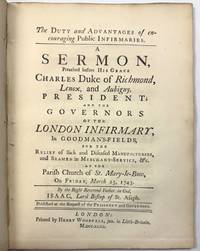
174341756London: Printed by Henry Woodfall jun. in Little-Britain 1743. 4to. 4 36 pp as issued with the half title. Disbound else Very Good.<br /> <br /> This is one of seven 1743 printings all by Woodfall at London and each with slightly different imprint. ESTC calls ours and three others the second edition. ESTC locates copies only at the University of Cambridge and UCLA. Pages 25-36 present a detailed account of the London Infirmary including patient accounts donors and governors. <br /> Maddox's text elaborates on Psalm xli: "Blessed is the man that provideth for the sick and needy. . ." Wikipedia's entry for Maddox notes his interest in promoting medical care and other charitable endeavors.<br /> ESTC N9048 2. Printed by Henry Woodfall, jun. in Little-Britain unknown
180033248BB1800 . Paris: Brunot um 1800 16°. 208 S. 4 Tafeln Pappband Rücken beschabt; Ecken leicht bestossen; gut erhalten unknown
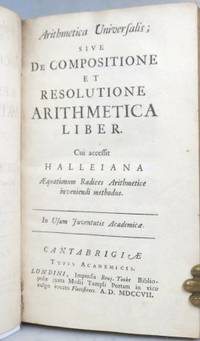
170751058Cantabrigiæ Cambridge: Typis academicis; Londini London impensis Benj. Tooke 1707. First edition. 8vo. viii 343 1 pp. 19th century full diced calf spine with raised bands gilt lettered black label blind tooled borders to the boards ownership inscription of a William Fitton dated June 1800 to the half title another contemporary owner's inscription - that of a Philip Crampton the date cropped "180" mathemetical annotations to the front and rear leaves and in the margins at intervals within. Joints skilfully repaired some mild soiling to the front and rear leaves an attractive copy. A mathemetical text composed entirely in Latin by Newton and edited by William Whiston who had succeeded him as the Lucasian professor of Mathematics at Cambridge University in 1702. The two had become acquainted during the previous decade and Newton was impressed enough with his acolyte that he invited him to lecture at the university when he was occupied with his other work. It was Whiston who persuaded Newton to publish some of his lectures on algebra but Newton was dissatisfied with Whiston's editing and additions to the text - to the extent that he considered buying the entire stock of the book to prevent its appearance in public. That clearly didn't happen although Newton succeeded in having the book published anonymously and its relative scarcity in commerce suggests a truncated print run. The first ownership inscription is that of the Irish geologist William Fitton 1780-1861. The son of a Dublin lawyer his paternal grandfather had been a mathematical instrument maker. Fitton began his studies at Trinity College Dublin in 1794 and earned his B.A. in 1799 but continued studying there until 1803. He went on to study medicine at Edinburgh University becoming a doctor in 1810 and continued his medical studies in London and Cambridge during the following six years. Fitton's interest in geology and mineralogy were his true passions and after marrying into a wealthy family he was able to devote his studies exclusively to these subjects. He subsequently served as secretary and later as president of the Geological Society published numerous reviews and papers plus a small number of books including 'A Geological Sketch of the Vicinity of Hastings' in 1833. Fitton was awarded the Wollaston Medal the society's highest prize in 1852. The other inscription is almost certainly that of Sir Philip Crampton 1777-1858 an Irish surgeon who awarded many honours and held various senior positions in a long and illustrious career: "elected FRS in 1812. In 1813 he was appointed surgeon-general to the forces in Ireland and he was surgeon to the queen in Ireland a member of the senate of the Queen's University of Ireland and four times president of the Royal College of Surgeons in Ireland in 1811 1820 1844 and 1855. In 1839 he was created baronet" ODNB. Cantabrigiæ [Cambridge]: Typis academicis; Londini [London], impensis Benj. Tooke unknown
174731752AB1747. First English Edition. London Printed for R.Dodsley 1747. Octavo. 72 pages. Modern cloth. The bookblock with signs of stitching to the inner margin possibly used to be part of a Sammelband. Last three leaves with paper-restoration and manuscript inscription to last page looks like a 18th century gift-inscription. With numerous manuscript - annotations in the tracts of George Berkeley namely in "A Word to the Wise" "Farther Thoughts on Tar-Water" "The Querist". From the library of Daniel Conner Manch House County Cork. Bound with: "Berkeley George Bishop of Coyne - "A Miscellany Containing Several Tracts on Various Subjects. By the Bishop of Cloyne. London Printed for J. and R. Tonson and S.Draper 1752. VI 267 1 pages. Title-page witme minor paper-restoration. This wonderful collection by the eminent ANglo-Irish Philosopher includes the following Pamphlets / Tracts as called for: 1. Farther Thoughts on Tar-Water 2. An Essay towards preventing the Ruin of Great-Britain 3. A Discourse addressed to Magistrates and Men in Authority. Occasioned by the enormous Licence and Irreligion of the Times. 4. A Word to the Wise - Or an Exhortation to the Roman Catholic Clergy of Ireland This section "A Word to the Wise" includes several interesting annotations: a. an underlining of the sentence: "Seeing you are obnoxious of the Law" with a comment "Oh! infamous" b. annotation: "the catholic clergy cannot be accused even by there greatest enemies of having been influenced by interested motives therefore this hint of his lordship was not of much avail" 5. A Letter to the Roman Catholics of the Diocese of Cloyne 6. Maxims concerning Patriotism 7. The Querist - Containing several Queries proposed to the Consideration of the Public 8. Verses on the Prospect of Planting Arts and Learning in America 9. A Proposal for the better supplying of Churches in our Foreign Plantations and for converting the Savage Americans to Christianity by a College to be erected in the Summer Islands otherwise called The Isles of Bermuda 10. A Sermon preached before the Incorporated Society for the Propagation of the Gospel in Foreign Parts; at their Anniversary Meeting in the Parish-Church of St.Mary-le-Bow in 1731 11. De Motu ; sive de motus principio & natura & de causa communicationis motuum ______________________________________________________________________________ hardcover
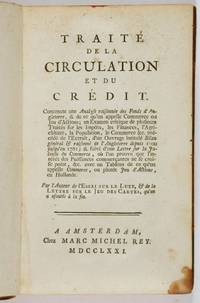
177153117Amsterdam: Marc Michel Rey 1771. First Edition. Very Good. Octavo. xvi 128 8: "Etat des Finances en Angleterre" 129-384 2: errata; blankpp. Woodcut ornaments; 4 half-titles. Collation: 8 A-H8 H4 I-Z8 Aa8 chi1 = 205 leaves. Contemporary marbled calf lightly rubbed at extremities gilt-tooled spine with raised bands gilt morocco lettering piece; edges stained red; marbled endleaves. Small patch of marginal damp staining to bottom corner of first 15 and final 10 leaves; signature Aa mildly embrowned else text crisp and clean throughout. Overall a very good copy.<br /> <br /> Rare complete first edition of "one of the great documents in the history of political economy" EJ. In addition to the brief discursus on English finances inserted between the second and third parts of the main treatise our copy includes the usually missing supplement pp. 369-384 "Addition au Traité de la Circulation et du Crédit. Mémoire pour la suppression du Belasting" along with the concluding errata leaf.<br /> <br /> The present Treatise is a refutation of the physiocrats who had advocated a primarily agricultural economy. Arguing against Hume de Pinto seeks to defend the economically productive role of the national debt which he sees exemplified in the current British system. While Marx notoriously described de Pinto as "the Pindar of the Amsterdam stock exchange" for his advocacy of speculation Werner Sombart regarded him as the "beginner of the modern age of economics and the first to understand the growth of credit" EJ. De Pinto's other works include Essai sur le luxe and Du jeu de cartes both reprinted in the present work and the later Precis de arguments contre les matérialistes The Hague 1774.<br /> <br /> The main treatise is divided into four parts followed by six brief works: 1. Lettre sur la jalousie du commerce Letter on the Jealousy of Commerce; 2. Tableau ou Exposé de ce qu'on appelle le Commerce ou plutôt le Jeu d'Actions en Hollande A Presentation of What is Called Commerce or the Game of Actions in Holland; 3. Methode dont on se sert en Hollande pour faire la perceptions des taxes & des impôts sur les biens fonds; & comment on en verse le provenu dans la Caisse de l'Etat The Method Used in Holland to Collect Duties and Real Estate Taxes and How the Proceeds Are Payed into the State Treasury; 4. Essai sur le luxe An Essay on Luxury first printed at Amsterdam 1762; 5. Lettre de l'autheur à Mr. D. sur le jeu des cartes The Author's Letter to Mr. Diderot on Card Playing first printed at London 1768; 6. Mémoire pour la suppression du Belasting ou Impôt sur les Actions de Compagnie des Indes Orientales A Memorandum for the Suppression of the "Belasting" or Tax on the East India Company Shares. The final opuscule which appears in relatively few copies of the Traité is published here for the first time.<br /> <br /> Isaac de Pinto 1717-1787 was the scion of a wealthy Sephardic family which traced their origins back to Portugal and had emigrated to the Dutch Republic. "He had a broad education and had mastered many languages in which he corresponded with famous philosophers and maintained contact with the European elite of his day including the court of the Dutch stadholder. In 1748 he helped to finance Stadholder William IV's war against France" Bernfeld & Wallet. "For his services in arranging favorable terms for English trade in India at the Treaty of Paris which ended the Seven Years' War 1756-63 Pinto was lavishly rewarded by the East India Company a few years later 1767" EJ. His correspondents included David Hume and Denis Diderot. De Pinto made a name for himself when he responded to Voltaire's mocking article on the Jews which appeared in the latter's Dictionnaire Philosophique with his Apologie pour la nation juive Amsterdam 1762. Presenting himself as a proud Portuguese he argued that "Voltaire had neglected to draw a distinction between the often wealthy Sephardim with their refined manners and the Ashkenazim whom he regarded as far poorer and sometimes unprincipled as a result of persecution and economic misery" Bernfeld & Wallet. Barbier 4: 752; T. L. Bernfeld & B. Wallet Jews in the Netherlands: A Short History Amsterdam Univ. Press 2023 p. 89; Enc. Jud. 13: 553-554; Goldsmiths' 10792; Kress 6812.<br /> <br /> Full title and Imprint: Traité de la Circulation et du Crédit. Contenant une Analyse raisonnée des Fonds d'Angleterre & de ce qu'on appelle Commerce ou Jeu d'Actions ; un Examen critique de plusieurs Traités sur les Impôts les Finances l'Agriculture la Population le Commerce &c. précédé de l'Extrait d'un Ouvrage intitulé Bilan général & raisonné de l'Angleterre depuis 1600 jusqu'en 1761 ; & Suivi d'une Lettre sur la Jalousie du Commerce où l'on prouve que l'intérêt des Puissances commerçantes ne se croise point &c. avec un Tableau de ce qu'on appelle Commerce ou plutôt Jeu d'Actions en Hollande. Par l'auteur de l'Essai sur le Luxe & de la Lettre sur le Jeu des Cartes qu'on a ajoutés à la fin. A Amsterdam chez Marc Michel Rey. MDCCLXXI. Marc Michel Rey unknown
1744L57-1626London 1744. Hardcover. Very Good. Speckled calf gilt-stamped lettering and ornament on spine. Both volumes a little rubbed along spine and edges of boards with small chips at head of spine and numbered stickers affixed to tail of spine. Some faint browning along edges of paste-down prelims and terminals -- but overall a nice clean text block. <br/><br/>Includes an interesting bookplate on the front paste-down engraved by Benjamin Levi for Isaac Mendes in London 1746 the earliest known bookplate made for a Jew. hardcover
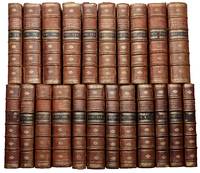
17326441London: Various printers to the Royal Society 1732. 1665-1732. <p>First edition of the first 426 issues an unbroken run from March 1665 to December 1732 of the world's oldest continuous scientific journal and the single most important record of the first announcement and communication of scientific discoveries and inventions PMM. It contains groundbreaking research by Newton - all 17 of his optical papers and therefore his first printed contribution to science - and by Halley Hooke Boyle Flamsteed Leeuwenhoek Cassini Hevelius Huygens and many others across astronomy physics chemistry mathematics medicine and natural history. Through Newton's optical papers of 1672-1676 the Transactions saw the first experimentally grounded proposal for the radical reform of a scientific theory to be advanced through a technical journal - a proposal that became the first to arouse international discussion and debate in print and within the pattern of public announcement discussion and professional consensus then established science has advanced ever since. Provenance: armorial bookplate of Sir Marcus Beresford 1st Earl of Tyrone 1694-1763; contemporary inscription at the end of one issue January 1692/3 noting its donation by Robert Hooke; manuscript corrections and notes on more than eighty pages with eight further pages on the measurement of the Earth bound in at the end.</p>. The World's Oldest Continuous Scientific Journal. <p>First edition of the first 426 issues an unbroken run from March 1665 to December 1732 of the world's oldest continuous scientific journal and the single most important record of the first announcement and communication of scientific discoveries and inventions PMM. It contains groundbreaking research by Newton - all 17 of his optical papers and therefore his first printed contribution to science - and by Halley Hooke Boyle Flamsteed Leeuwenhoek Cassini Hevelius Huygens and many others in astronomy physics chemistry mathematics medicine and natural history. Thomas Henry Huxley observed in his 1866 address On the Advisableness of Improving Natural Knowledge that if every book in the world apart from the Philosophical Transactions were destroyed the foundations of physical science would remain secure and the intellectual progress of the last two centuries largely recoverable. Long unbroken runs of the first four-and-a-half decades are now of the greatest rarity. ABPC and RBH record only two comparable sets at auction in the last three decades - Norman 1694 Christie's New York 15 June 1998 lot 716 $112500 and Macclesfield 1782 Sotheby's 25 October 2005 lot 1782 £96000 = $171400 - and a set of just the seven volumes containing Newton's papers on light realised $75600 at Christie's in October 2022.</p> <br /> <br /> <p>Provenance: armorial bookplate of Sir Marcus Beresford 1st Earl of Tyrone 1694-1763 Anglo-Irish peer and politician on the front pastedowns; contemporary inscription at the end of one issue January 1692/3 noting its donation by Robert Hooke; numerous manuscript corrections on more than sixty pages additional notes on about twenty pages and eight pages of manuscript notes on the measurement of the Earth bound in at the end.</p> <br /> <br /> <p>In November 1660 members of the Oxford Philosophical Club - John Wilkins John Wallis Robert Boyle Christopher Wren Robert Hooke among them - met a group of London natural philosophers at Gresham College and agreed to form a philosophical society that would meet weekly to exchange information and to conduct experiments. The society received its charter from the newly restored Charles II in 1662 and Henry Oldenburg a German-English diplomat and friend of Boyle was installed as one of its two secretaries. One of the charter's terms called for the exchange of information with other learned societies and Oldenburg almost at once began a sustained correspondence - with the Cimento Academy in Florence the Montmor Academy in Paris and after its foundation in 1666 the Académie Royale des Sciences - and with hundreds of working natural philosophers in places that had no scientific society of their own. Oldenburg was fluent in German Dutch French English and Latin and he was able to translate most foreign correspondence himself including Antoni van Leeuwenhoek's letters on his microscopical investigations and the communications of Johannes Hevelius of Gdansk and Marcello Malpighi of Bologna. After some years writing letters without salary Oldenburg decided to compile a monthly newsletter summarising a month's Royal Society activities and send it out to his correspondents in a single printing. On 6 March 1665 Old Style; 16 March by the Gregorian calendar then in use on the continent the first issue of the Philosophical Transactions appeared. It consisted of letter-excerpts reviews and summaries of recently published books and accounts of observations and experiments from European natural philosophers. Some of the pieces Oldenburg wrote himself summarising the minutes of Society meetings; others he translated or adapted from printed sources; still others were composite pieces assembled from the letters of several correspondents on a common subject. After his death in 1677 the journal passed through the hands of a succession of editors frequently also Secretaries of the Society - Edmond Halley and Hans Sloane the best-known among them - and through a succession of printers its form and content broadly reflecting the priorities of the current editor and to a degree of the Society. The Royal Society assumed financial responsibility for the journal only in 1752.</p> <br /> <br /> <p>Until the last third of the seventeenth century most original contributions to science appeared in books in which an author's own findings were embedded within a systematic exposition of a larger subject. The chartering of the Royal Society in 1662 and of the Académie Royale des Sciences in 1666 and the launching in 1665 of the Journal des Sçavans at Paris and the Philosophical Transactions at London gave institutional expression to a new conception of science as a cooperative enterprise: the immediate objective of the individual scientist became the experimental contribution to an eventual system of nature rather than the construction of the system itself and the journal article began to replace the book as the unit in which that contribution was made. Newton was the first to advance through this new medium an experimentally grounded proposal for the radical reform of a scientific theory and his proposal was the first to arouse international debate within the columns of a scientific journal. Through that exchange - in which all the participants modified their positions - a consensus of scientific opinion was produced; and within the same pattern of public announcement discussion and professional consensus science has advanced ever since Kuhn in Cohen Isaac Newton's Papers and Letters on Natural Philosophy 2nd ed. 1978 pp. 27-29.</p> <br /> <br /> <p>Newton's seventeen optical papers comprising his entire published optical contribution to the journal across the 1670s run as a single intellectual sequence: the seminal 1672 New Theory paper No. 80 pp. 3075-3087 introducing the prism experiment and the spectral analysis of white light; the catadioptrical-telescope paper No. 81; a series of exchanges with the French Jesuit Pardies Nos. 82 84 85 with Christiaan Huygens via an 'ingenious person from Paris' Nos. 96 97 and with the Liège Jesuits Linus and Lucas Nos. 110 121 123 128 - together more than half of the seventeen papers all responding to objections raised against the New Theory. Newton's answer to Hooke's objections No. 88 is the most polemical of the set prefiguring the priority dispute that would dominate the Principia years; the answer to Sir Robert Moray on behalf of the Royal Society No. 83 the most measured. Across the seven volumes containing them the papers transformed optics from a body of empirical reports into a quantitative experimental science driven by decisive testing among hypotheses and supplied the methodological core that Newton would eventually assemble decades later into the Opticks of 1704.</p> <br /> <br /> <p>These papers together constitute the first major contribution to science made through a technical journal - the medium that rapidly became the standard mode of communication among scientists - and as Christianson puts it if Newton had published nothing else the optical papers alone would guarantee him a place among the immortals of modern science Christianson In the Presence of the Creator 1984 p. 150. They yield further an insight into Newton's mental processes that the Principia and the Opticks - formal impersonal Olympian - conceal; it is in these early brief sometimes hasty letters to Oldenburg as in his notebooks and unpublished manuscripts that the creative scientist is to be found Kuhn in Cohen pp. 27-29.</p> <br /> <br /> <p>When Newton was first appointed Lucasian Professor at Cambridge in 1669 he chose optics for the subject of his first lectures and researches and by the end of that year he had worked out in detail the decomposition of a beam of white light into rays of different colours by means of a prism the complete explanation of the rainbow following from this discovery. These results formed the subject of his Lucasian lectures in 1669 1670 and 1671 and their principal conclusions were communicated to the Royal Society in February 1672 and printed soon afterwards in the Transactions No. 80. Before Newton light had been believed to be a homogeneous substance and colour was held to be produced by the mixture of light with darkness - the prism in the standard account supplying the darkness that coloured the light with all rays of white light striking the prism at the same angle being equally refracted. Newton's experiments led him to the radically different conclusion that white light is a mixture of rays of many distinct types each refracted at a slightly different angle and each responsible for producing one spectral colour. He set up a prism near his window at Trinity College and projected the spectrum onto a wall twenty-two feet away; to prove that the prism refracted light rather than colouring it he refracted the beam a second time back to white. The crucial experiment that confirmed the theory was to isolate a narrow ray of a single colour from the first spectrum and pass it through a second prism where no further elongation or separation occurred - a demonstration that each spectral ray was itself unmixed and uniformly refrangible. The reception of the paper was mixed. Many contemporaries simply ignored it; Mariotte in 1679 Pardies 1672 and Linus 1675 all claimed to have failed to replicate the basic experiments described. Rather than argue with them in detail Newton invited his critics to repeat his experiments with greater care; they did so without success. Others - Hooke among them who confirmed the experiments himself before a committee of the Royal Society in April 1676 - conceded the results but held that they could be accommodated by minor modification of existing theories making Newton's radical interpretation unnecessary. The controversy lasted six years after the paper's first appearance and left Newton conspicuously wary of publication.</p> <br /> <br /> <p>Newton's invention of the reflecting telescope reported in the issue immediately following his first optical paper No. 81 had in fact prompted the optical work rather than the other way round: the chromatic aberration of refracting lenses - their inability to bring different colours of light to a single focal point - was the original stimulus for Newton's investigation of the nature of light. Newton had sent Oldenburg his letter describing the telescope before his letter describing the new theory and had hoped to present the telescope as a practical test-piece for the theory. Oldenburg however printed the material in the reverse order the theory first followed by the description of the instrument. The telescope made a considerable impression at the Royal Society which promptly elected Newton a Fellow; a corresponding notice appeared in the Journal des Sçavans in February 1672 with emphasis on the instrument's compactness and it was the telescope rather than the theory of light that first made Newton's name known on the Continent Dilaura Bibliotheca Opticoria 1475-1925 2019 pp. 235-236.</p> <br /> <br /> <p>Newton published three non-optical papers in his lifetime all anonymously. His only published paper on chemistry Scala Graduum Caloris No. 270 April 1701 pp. 824-829 states what has since become known as Newton's law of cooling - that the rate at which a hot body loses heat is proportional to the difference between its temperature and that of its surroundings - and describes the construction of a thermometer capable of measuring temperatures up to almost 1000 °C. An Account of the Book entituled Commercium Epistolicum Collinii & Aliorum De Analysi promota No. 342 February 1715 pp. 173-224 is Newton's anonymous review of the Commercium epistolicum the official report of the committee appointed by the Royal Society to adjudicate in the dispute between Newton and Leibniz over priority in the invention of calculus - the most bitter and consequential priority dispute in the history of science; the Account purports to be impartial but was in fact written like the Commercium epistolicum itself by Newton. In the same volume No. 347 March 1716 pp. 399-400 appeared Newton's Problematis Mathematicis Anglis Nuper Propositi Solutio Generalis his response to a challenge problem set by Johann Bernoulli to the English mathematicians; tradition has it that Newton solved it in a single evening after returning from a day's work at the Mint. With the exception of this minor paper none of Newton's original work on gravitation or on mathematics was published in the Transactions. Edmond Halley's review of the Principia however appeared soon after its publication No. 186 pp. 291-297 - Halley was then the journal's editor - and is prefaced by an advertisement apologising for the fact that the Transactions had been delayed for some months because Halley had had the entire care of the Principia's own edition and had therefore as he put it been more serviceable to the Commonwealth of Learning in seeing Newton's book into print than he would have been in issuing his own periodical on time. Halley pointed out with justice that one of the most striking features of the Principia was Newton's great skill in using the new mathematics - by which Halley meant Newton's own method of infinite series.</p> <br /> <br /> <p>Edmond Halley 1656-1742 was one of the most original minds of his time and he made a long series of important contributions of his own to the Transactions. The best-known of them is Astronomiae cometicae synopsis No. 297 March 1705 pp. 1882-1899 the first printing of the theory according to which comets belong to the solar system and move in eccentric elliptical orbits; it was here that Halley set out his method of computing the motion of comets of establishing their periodicity in elliptical orbits and of identifying the comet that would bear his name DSB. The confirmation of the comet's return - in 1759 after Halley's death - was the first time that a body other than a planet had been shown to orbit the Sun the earliest successful observational test of Newtonian physics and a vivid demonstration of its explanatory power; the comet was named after Halley by the French astronomer Nicolas-Louis de Lacaille in 1759. Halley's other major contributions to the journal include his Methodus singularis No. 348 June 1716 pp. 454-464 in which he challenged the international astronomical community to use the transits of Venus across the Sun predicted for 1761 and 1769 to transform astronomy into a fully empirical science by measuring the Earth-Sun distance - a challenge that astronomers took up organising expeditions to the farthest corners of the globe and overcoming obstacles of every kind; A short History of the several New-Stars No. 346 December 1715 pp. 354-356 in which he observed that the new stars of 1572 and 1604 Tycho's and Kepler's stars were not the only changing stars on record that others had been observed in 1596 1600 1670 and 1686 some of them fading and reappearing and one of them - Mira - appearing to wax and wane with a regular 330-day period; An Account of several Nebulae or lucid Spots like Clouds No. 347 March 1716 pp. 390-392 in which Halley assembled the first list of known nebulae with their discoverers crediting the Great Nebula in Orion to Huygens the Andromeda nebula to Boulliau and the two spherical nebulae in Centaurus and Hercules to himself; 'Of the infinity of the sphere of fix'd stars & Of the number order and light of the fix'd stars' No. 364 April 1720 pp. 22-26 in which Halley posed what later generations would call Olbers's paradox a century before Olbers did; and outside astronomy his paper on the Breslaw life table No. 196 January 1692/3 pp. 596-610 which produced the first life table based on sound demographic data and gave the first correct calculation of annuities using essentially the methods still in use today - a paper of first importance in the history of statistics.</p> <br /> <br /> <p>John Flamsteed 1646-1719 was with Halley the most important English astronomer of his generation; his major works are the Historiae coelestis first published in 1712 without his consent by Halley and Newton and the Atlas coelestis published posthumously in 1729 but he also contributed more than thirty articles to the Transactions chiefly on observational astronomy. No other Astronomer Royal before Airy displayed anything like Flamsteed's concern for the reduction and manipulation of his own data: far from bequeathing the mass of raw observations that Bradley would he reduced and applied them himself DSB.</p> <br /> <br /> <p>Robert Boyle 1627-1691 contributed some thirty-seven papers to the Transactions Fulton p. 138 among them his influential questionnaire General Heads for the Natural History of a Country a number of major experimental essays that sometimes filled a whole issue and most revealingly An Experimental Discourse of Quicksilver growing hot with Gold No. 122 February 1675/6 pp. 515-533 - a paper on a kind of mercury that would incalesce when amalgamated with gold suggesting that Boyle had achieved the long-sought alchemical philosophical mercury capable of transmuting base metals. Boyle's trials went back to 1652 when he had received the recipe from his American mentor George Starkey; his decision to go public in 1676 signalled a newly intense period of alchemical activity on his part. The paper drew from Newton - himself a committed alchemical enthusiast - a letter to Oldenburg urging that such matters were not to be communicated without immense damage to the world if there should be any truth in the Hermetic writers; Oldenburg took the hint and the incalescence paper remained a one-off in the Transactions Hunter Alchemy in the Transactions Royal Society blog 1 July 2015.</p> <br /> <br /> <p>The Dutch microscopist Antoni van Leeuwenhoek 1632-1723 contributed 116 articles to the Transactions over the half-century 1673-1723; the most famous of them the letter on the protozoa No. 133 March 1677 pp. 821-831 gives the first detailed description of protists and bacteria in a range of environments. Leeuwenhoek is universally acknowledged as the father of microbiology: he discovered both protists and bacteria but more than being the first to see the microscopic world of his animalcules he was the first even to think of looking - certainly the first with the power to see. Using his own deceptively simple single-lensed microscopes he did not merely observe but conducted ingenious experiments exploring and manipulating his microscopic universe with a curiosity that belied his lack of any map or bearings. The verification of Leeuwenhoek's new world by the natural philosophers of the Royal Society set out the ground rules that still define experimental science today Lane The unseen world: reflections on Leeuwenhoek 1677 Philosophical Transactions B370 2015 pp. 1-10.</p> <br /> <br /> <p>Martin Lister 1639-1712 contributed in 1673 what is now regarded as the earliest journal article on palaeontology: A description of certain stones figured like plants No. 100 pp. 6181-6191 on the preservation of St Cuthbert's beads - crinoid remains - in the approximately 350-million-year-old Carboniferous limestones of northern England. The biological nature of fossils was then controversial: Kircher had argued that they formed by abiogenic plastic forces within the rock while Hooke and Steno had suggested they were the remains of living organisms. Lister was the first to explore how direct observation could decide between the two making observations about what modern geobiology calls taphonomy and biogenicity criteria - observations that presage current debates about the earliest signs of life on Earth and Mars Brasier Philosophical Transactions A373 2015 pp. 1-16. Other natural-historical papers scattered through the journal's first century - Account of a very odd monstrous calf Some experiments and observations on May-dew Some observations on strange swarms of insects - are in places fanciful but in many others acute; Hooke's own contributions which began in the very first issue March 1665 with A spot in one of the belts of Jupiter are sometimes held to include the first observation of the Great Red Spot still visible on Jupiter today.</p> <br /> <br /> <p>The early volumes also contain the record of the world's first experiments with blood transfusion conducted in England in the mid-1660s. The procedure - gruesome - was first carried out between dogs with arteries and veins in the animals' necks opened and blood transferred from one to another through quills most likely of goose feather inserted into the vessels and clamped with running knots; in the physician Richard Lower's account No. 20 pp. 353-358 the transfusion came to an end when the emittent dog fell into convulsions and died. Shortly afterwards Boyle published a remarkable set of questions about the likely effects of transfusion on the animal receiving blood No. 22 pp. 385-388 asking whether transfusion might change a dog of one breed into another alter its temperament render a fierce dog cowardly transmit satiety or hunger obliterate learned behaviours or make a dog forget its master - a sequence of questions which as recent commentators have noted read like an alchemical programme turned inward upon the living body. Researchers soon proposed transfusion into a human subject. Since the procedure generally killed the emittent a human-to-human transfusion was thought impossible and a sheep was settled upon as donor. The choice of human recipient fell in 1667 upon Arthur Coga - mentally unstable but sufficiently educated to report in Latin on the effects of the procedure - and the operation was performed by Lower and the physician Edmund King No. 30 pp. 557-559 who judged that Coga had received nine or ten ounces of sheep's blood. A few days afterwards Coga reported back to the Society in Latin and Samuel Pepys meeting him at a dinner party shortly thereafter found him to speak very reasonably though cracked a little in his head.</p> <br /> <br /> <p>Other contributors in these decades include Cassini on the satellites of Jupiter Huygens on mechanics and optics Malpighi Swammerdam Borelli Steno Fahrenheit and Redi whose experimental refutation of spontaneous generation appeared in the journal alongside a steady stream of domestic material from Harvey Wren Ray Petty Locke Wallis Winthrop Tyson Lancisi Leibniz and Hales. To turn the pages of these thirty-seven volumes is to watch the first two generations of a new scientific public discover how to work together - how to record observation propose hypothesis invite replication agree or disagree in print and build by open argument the provisional consensus that is the hallmark of modern science.</p> <br /> <br /> <p>References: Grolier/Horblit 95b - Macclesfield 1782 - Norman 1694 - PMM 148 Vol. 1 - Brasier Deep questions about the nature of early-life signals: a commentary on Lister 1673 Philosophical Transactions A373 2015 pp. 1-16 - Christianson In the Presence of the Creator 1984. Cohen ed. Isaac Newton's Papers and Letters on Natural Philosophy 2nd ed. 1978 - Dilaura Bibliotheca Opticoria 1475-1925 2019 - Fulton A Bibliography of the Honourable Robert Boyle 1932 - Lane The unseen world: reflections on Leeuwenhoek 1677 Philosophical Transactions B370 2015 pp. 1-10.</p> <br /> <br/> <br/> 37 vols. bound in 22 4to 215 × 165 mm containing all issues from March 1665 No. 1 through December 1732 No. 426 with 380 engraved plates 306 folding 176 woodcut illustrations and diagrams and 7 folding tables occasional damp-staining a few tears and small holes occasionally affecting a word or two a few headlines shaved the plate in No. 56 map of part of Languedoc with a 7 cm tear that in No. 60 apparatus shaved at head and that in No. 196 with bottom corner repaired with loss of about a quarter of the plate relating to the dissection of a rat. Uniformly bound in eighteenth-century probably mid-1730s sprinkled calf spines ruled and tooled in gilt in compartments with title and volume-number labels some joints cracking but firm a few labels missing slightly rubbed. Generally very clean and well-preserved. Various printers to the Royal Society unknown
1731EAHll[SA32Stockholm: Benjamin Gottlieb Schneider 1731. 1731. 2 Volumes in 1. pp. 8 p.l. 398 2; 1 p.l. 88 64 90 72. first title in red & black. woodcut ornaments. contemporary sprinkled calf gilt back rubbed spine & label bit chipped. old inscription on front free-endpaper: "Till Advocat Fisalen George Adolf Rutenschiöd". First Edition. "A survey of Dutch commercial affairs with considerable emphasis on its overseas companies and alliances." Bell Large sections are devoted to the Dutch East and West India Companies and their activities in Africa India south-east Asia and America. The engraved frontispiece to Volume II announced on the last page of Volume I was never published. Rare: two copies cited in NUC Harvard and Bell Library. Bell S35. Kress S.3380. Not in Sabin. Signed by Authors. F. Hardcover. Stockholm: Benjamin Gottlieb Schneider, 1731. Hardcover
176429779AB1764. Four Volumes complete set. London Printed for J. and R. Tonson J.Buckland H. Woodfall etc. 1764. Small Octavo 11 cm x 17 cm. Frontispiece 2 300 14 Frontispiece 3 336 13 Frontispiece 5 318 16 Frontispiece 7 320 12 pages. Hardcover / Oiginal 18th century full leather with original spinelabels and gilt lettering on spine. All four Volumes complete and in protective Mylar. Housed in a wonderful bespoke Solander-Box. Excellent condition with some minor signs of wear only. From the library of Daniel Conner Connerville / Manch House with his Exlibris / Bookplate to pastedown of each Volume. Includes wonderful and bizarre articles of 18th-century literature: Earthquakes Pills against them / Education Proposals for reforming the education of Females / Wax-work in Germany / Wine-Brewers / Instructions to unmarried women / Women the happiness or misfortunes of mankind depend on them / Women have ill fancies in their dress / Machiavel author of a mischievous sect / Xerxes why he burst into tears / Mr.Walpole going to England with the Preliminaries of Peace / Witchcraft described and explained / Women natural to talk to themselves / Women More understanding than men in their own affairs / etc. The Tatler was a British literary and society journal begun by Richard Steele in 1709 and published for two years. It represented a new approach to journalism featuring cultivated essays on contemporary manners and established the pattern that would be copied in such British classics as Addison and Steele's Spectator Samuel Johnson's Rambler and Idler and Goldsmith's Citizen of the World. The Tatler would also influence essayists as late as Charles Lamb and William Hazlitt. Addison and Steele liquidated The Tatler in order to make a fresh start with the similar Spectator and the collected issues of Tatler are usually published in the same volume as the collected Spectator. Tatler was founded in 1709 by Richard Steele who used the nom de plume "Isaac Bickerstaff Esquire". This is the first known such consistently adopted journalistic persona which adapted to the first person as it were the 17th-century genre of "characters" as first established in English by Sir Thomas Overbury and then expanded by Lord Shaftesbury's Characteristicks 1711. Steele's conceit embodied in the title "Tatler" was to publish the news and gossip heard in various London coffeehouses in reality he mixed real gossip with invented stories of his own and so he declared in the opening paragraph to leave the subject of politics to the newspapers while presenting Whiggish views and correcting middle-class manners while instructing "these Gentlemen for the most part being Persons of strong Zeal and weak Intellects.what to think." To assure complete coverage of local gossip he pretended to place a reporter in each of the city's four most popular coffeehouses and the text of each issue was subdivided according to the names of these four: accounts of manners and mores were datelined from White's; literary notes from Will's; notes of antiquarian interest were dated from the Grecian Coffee House; and news items from St. James's Coffee House. The journal was originally published three times a week and Steele eventually brought in contributions from his literary friends Jonathan Swift and Joseph Addison though both of them pretended to be writing as Isaac Bickerstaff and authorship was revealed only when the papers were collected in a bound volume. The original Tatler was published for only two years from 12 April 1709 to 2 January 1711. A collected edition was published in 171011 with the title The Lucubrations of Isaac Bickerstaff Esq. In 1711 Steele and Addison decided to liquidate The Tatler and co-founded The Spectator magazine which used a different persona than Bickerstaff. Wikipedia hardcover