529 résultats
1787CLL-730sans lieu, 1787 In-8 de IV, 96 pp., broché, non rogné sous couverture d'attente de papier moucheté vert (reliure de l'époque).
170247776Oxoniae (Oxford), E Theatro Sheldoniano, 1702. Folio. Contemporary full calf, raised bands, rectangular blindtooled frames and central panel ""mirror"" on covers, Cambridge-style binding. leather at joints cracked, but cords intact so that covers not loose. Corners a bit bumped. Light wear to spine ends. Spine a bit rubbed. Pastedowns and flyleaves with browning. Title-page with large engraved vignette (Sheldon Theater). (12),494,(2) pp. With numerous textdiagrams. Very light browning to titlepage and a few marginal brownspots to last leaf, a fine clean copy, printed on good paper with wide margins.On the verso of the title-page is pasted the book plate of Sir William Baird of Newbaith. He habitually pasted his armorial bookplate on the verso of the title-pages of the books in his large and fine library.
174039297Paris, De Bure, 1740. 4to. Contemporary half calf, raised bands, richly gilt spine and and red speckled edges. Leather title-label to spine. Corners neatly repaired. Title in red/black. (2), III-XXX, (2) Errata, 148 pp., many diagrams. The ""Preface"" and the first 18 leaves of the text with a foxing to lower margin and right corners. The ""Preface"" is an historical account of Newton's method ""la sublime méthode"", written by Buffon. Without the leaf ""Extrait des Registres"".
171938274London, Impensis Gul. & Joh. Innys, 1719 (colophon: Londini: Ex Officina Gulielmi Bowyer, 1718). 8vo. Contemp. full calf. Corners, fronthinge and spineends professionally repaired. Inner hinges reinforced. Gilt lineborders on back. Titlelabel in red leather with gilt lettering. Old owners name stamped on titlepage (small).Instead of htitle is bound ""Catalogus Librorum prostantium apud Gul. & Joh. Innys"" (1 leaf), the Cataloque is furthermore bound at end, but with a different typography. (2),XI,(1),415 pp. and 12 folded engraved plates. Very light brownning to a few margins. Printed on good paper, in general fine and clean internally.
17943000561Dublin: E Lynch and others 1794. Book. Good. Quarter Leather. Second. 8vo - over 7¾" - 9¾" tall. pp x 2 31 791 62 Sound with later cover / endpapers could be early 20th cent signature 1809 on title page significant browning throughout A working copy. E Lynch and others hardcover
1796117833London: A. Strahan 1796. Leatherbound. Fair. viii 500 p. 24 cm. Leather binding. From our As Is shelf. Spine deteriorated and torn front board detached rear board loose corners and edges worn. Some foxing. Tear in title page and front free endpaper. <br/><br/> A. Strahan hardcover
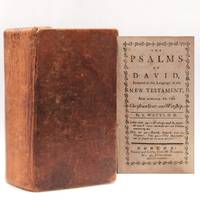
1789373872Boston: John W. Folsom 1789. 31711; 265 1 xii pp. 12mo. Contemporary calf minor wear. Provenance: Anna Duryee inscription on front endpaper dated 1791. 31711; 265 1 xii pp. 12mo. The Psalms unrecorded by Evans are an edition of Mycall's revision with all references to Great Britain and the King removed to make it more palatable to the nascent United States first printed in 1781. A scarce edition with only a handful of institutional holdings of either the Psalms or Hymns printed by Folsom here bound together. Evans 21687 Hymns; ESTC W4418 Psalms and W25174 Hymns John W. Folsom unknown
171538967Amsterdam: David Mortier. Very Good- with no dust jacket. 1715. 1st Thus. Hardcover. History Roman; Engravings; 12mo 7" - 7½" tall; HISTOIRE DES DEUX TRIUMVIRATS DEPUIS LA MORT DE CATILINA NOUVELLE EDITION AUGMENTEE DE L'HISTOIRE D'AUGUSTE DE LARREY. 3 VOLS IN 2 CT as published. New edition. Two Triumvirate History since the death of Catiline up to that of Caesar. Since that of Caesar to that of Brutus. Since than that of Brutus to Antony. New expanded edition of the history of Augustus of Larrey. 3 frontises. TPs in red and black. Contemporary decorated calf leather. All dated 1715. Vol I 20 1-286; 289-494; 215. 3 vols in 2 each with frontis. Contents clean with brief aging. Cracked hinges binding solid. Five years later a fourth volume made it's appearance. . David Mortier hardcover
1781C210025London: John Bell 1781. Hardcover Hardcover. Very Good. 5 operas bound in one. Contemporary leather somewhat worn front board detached spine and backstrip cracked otherwise a good copy suitable for rebinding. John Bell, hardcover
17928953Newburyport MA: John Mycall 1792. Hard Cover. Good binding. 12mo. 288 pp. Early printing. Originally issued with Watts's "Hymns and Spiritual Songs" not present here though the Psalms are complete. In recent cloth with tasteful printed paper label. Only light soiling to the binding; contents toned and foxed; a few leaves with some wear and chipping to the margins or corners; a solid copy with an illegible early owner name "Burlington August 1818 / University of Vermont." <br /> <br /> Mycall's revision of Watts's psalter was first issued in 1781. In it Mycall removed all references to Great Britain and King George exchanging them with references to the nascent United States—a significant declaration in its own right and one that really captures the fervor of the revolutionary American. Ezra Stiles that monumental American theologian and president of Yale describes Mycall's edition in his diary entry for 8 December 1781 calling it "well adapted to the Church in America." Though there are several psalms that were revised by Mycall Stiles specifically points to 75th Psalm titled: "Power and government from God alone Applied to the glorious revolution in America July 4th 1776." Verse 2 reading: "America was was sic doom'd a slave / Her frame dissolv'd her fears were great; / When God a right'ous Council gave / To bear the pillars of the State." An early but post-revolution imprint of this important revolutionary psalter. Evans 23106; ESTC W4416; The Literary Diary of Ezra Stiles. New York 1901. Vol II p. 571. John Mycall unknown
1701182441701 un volume, reliure plein-veau moucheté havane in-octavo (binding full calfskin in-8) (18 x 11,5 cm), reliure d'époque, dos à nerfs (spine with raised band), décoration or (gilt decoration) à filets or (gilt lines) et à froid (blind-stamping decoration), entre-nerfs à compartiments à fleurons (compartment with floweret) avec rinceaux aux angles, titre frappé or (gilt title), pièce de titre sur fond marron avec roulettes or (label of title with gilt fillets) , filet à froid de part et d'autre des nerfs, léger manque de cuir en pied (légers trous de vers), toutes tranches lisses (all smooth edges) jaspées rouges (red edges), les gardes volantes manquent, étiquette EX-LIBRIS imprimée en noir sur fond blanc dans un encadrement gravé : "Bibliotheca Capucinorum Conventus Camberiensis" (Couvent des Capucins de Chambéry) + tampon encre bleueen bas de la page de titre, sans illustrations (no illustration) excepté une marque "à la Foi" au titre + une vignette bandeau gravés sur bois en noir, [8]-526-[1] pages, 1701 Paris, chez Guillaume Desprez Editeur,
174820909Paris GABRIEL MARTIN, J. B. COIGNARD & ANT. BOUDET, PIERRE-JEAN MARIETTE, HIPPOLYTE-LOUIS GUERIN 1748-1750 -in-4 plein-veau 14 volumes, reliure plein veau havane marbré in-quarto (binding full calfskin in-4) (26 x 20,3 cm), RELIURE D'EPOQUE, dos à nerfs (spine with raised bands) décoré "or" et à froid (gilt and blind stamping decoration), titre et tomaisons frappés "or", pièce de Titre et de Tomaison sur fond bordeaux foncé avec filet "or" et filet perlé "or" en encadrement, (avec en plus pour la tomaison une roulette "fleur de lys" "or" de part et d'autre de la tomaison), roulette "or" en place des nerfs avec un filet à froid de part et d'autre, entre-nerfs à fleuron central "or"au fer évidé (between the raised bands floweret with hollowed out blocking stamp) dans un encadrement d'un filet "or" et un filet perlé "or" avec rinceaux "or" aux angles, roulette "fleur de lys" "or" avec filet "or" et filet perlé "or" en tête et en pied, plats ornés d'un double filet à froid en encadrement, double filets "or" aux coupes avec manque de dorure (blurred gilding), toutes tranches lisses rouges, ETAT DE LIVRES : TOME I : coiffes de tête et de pied manquantes, mors haut et bas de la 1ère et 4ème de couverture fendus sur 2 cm, TOME II : mors haut et bas du 1er plar fendus sur 4 cm, TOME III : léger manque de cuir à la coiffe inférieure (angle) et tache brune légère au 1er plat, TOME IV : légère tache brune au 4ème plat (1 cm2), léger manque de cuir en tête (moins de 1/5 cm 2), petit accident à la coiffe de tête à l'angle, TOME V : légers accidents à la coiffe de tête et de pied, TOME VI : léger accident à la coiffe de tête, TOME VII : petite tache brune en haut du 1er plat (2cm2), TOME VIII : mors haut du 1er plat fendu sur 1,5 cm, pièce de tomaison manquante (à restaurer), TOME IX : léger accident à la coiffe de tête, mors haut du 1er et 4ème plats fendus sur 2,5 cm, TOME X : coiffe de tête manquante, angle gauche bas de la pièce de titre et de la pièce de tomaisons épidermés, TOME XI : coiffes de tête et de pied manquantes, petit manque de cuir en têt et en pied (moins de 1/2 cm2), tache brune en haut du 1er plat (2 cm2), TOME XII : la coiffe de tête manque, épidermures à la pièce de titre, de tomaison et en pied, TOME XIII : coiffe de pied accidentée, épidermure à la pièce de titre et à la pièce de tomaison, mors haut et bas fendus du 1er plat sur 4 cm, mors haut du 4ème plat fendu sur 4 cm, TOME XIV : coiffes de tête et de pied accidentées, 2 épidermures à la pièce de tomaison, mors tachés (tache brune sur toute la longueur), Titre orné d'une vignette gravée sur bois en noir "branches de gui de part et d'autre avec fleur de lys au centre" en bas de la page de titre, orné de 46 planches dépliantes hors-texte gravées sur bois en noir (gravures, cartes, tableaux et plans) , TOME I : (X + 957) + TOME II ((2) + II + 781) + TOME III ((4) + 184 + 592) + TOME IV ((4) + 789) + TOME V((2) +V + 753) + TOME VI((4) + 680) + TOME VII((4) + 924) + TOME VIII((2) + II + 841) + TOME IX (VI + 929) + TOME X ((6) + 110 + 653) + TOME XI(192 + 614) + TOME XII (IV + 248 + 448) + TOME XIII(VIII + 927) + TOME XIV (232 + 187) Pages, 1748-1750 à Paris CHEZ GABRIEL MARTIN, J. B. COIGNARD & ANT. BOUDET, PIERRE-JEAN MARIETTE, HIPPOLYTE-LOUIS GUERIN Editeurs,
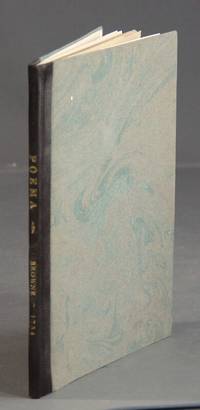
175458056Londini: impensis J. & R. Tonson & S. Draper 1754. 4to pp. 4 40; modern boards gilt lettering on spine; some toning of the text and the textblock trimmed to 23.5 x 18.5 cm; all else very good. This is the variant with the price 1 s. 6 d. on the title page. Painfully common but Browne's best known work a poem on the immortality of the soul. impensis J. & R. Tonson & S. Draper unknown
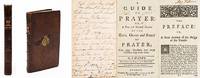
173031377AB1730. The Fifth Edition. London Printed for Emanuel Matthews 1730. Small Octavo. 5 156 1 pages. Hardcover / Original early 18th century full-leather with armorial embossing to both boards. New spine-label. Ruth Corker's Library-stamp verso the titlepage. This used to be Ruth Corker's mother's book prior to her own and the name Mary Falkiner is written in ink on top of the Preface-page. Manuscript entry "Ruth Corker Her Book 1731" on halftitle with several entries informing on marriages and relationships within the Falkiner and Corker and Robinson - family added obviousy by a later relative Ruth Robinson who was married to Robert Robinson. Excellent condition with only minor signs of wear. Armorial Bindings held in University of Toronto Libraries: Corker Ruth 1693 -1760 Mrs Ruth Corker of 41 St Stephen's Green Dublin was born Ruth Falkiner the only daughter of Richard Falkiner and Mary Mason of Dublin. She married Thomas Corker 1700-1772 merchant of Dublin. She died in 1760. Her name appears as one of the subscribers to Oldmixons The history of England during the reigns of King William and Queen Mary London 1735. Stamp Information of the Armorial Binding of Ruth Corker: Monogram: R R C Source: utoronto.ca Isaac Watts 17 July 1674 25 November 1748 was an English Congregational minister hymn writer theologian and logician. He was a prolific and popular hymn writer and is credited with some 750 hymns. His works include "When I Survey the Wondrous Cross" "Joy to the World" and "Our God Our Help in Ages Past". He is recognized as the "Godfather of English Hymnody"; many of his hymns remain in use today and have been translated into numerous languages. Wikipedia hardcover
179423985London: Printed for C. and J. Kearsley Fleet Street 1794. First Edition with half-title. 1 vols. 8vo. Bound in contemporary half calf front joint weak else a very nice copy. Bookplate of John Humphrey Austen. First Edition with half-title. 1 vols. 8vo. The author states that the Revolution was on its way for many years and there should be no surprise that it came when it did. Roth Bibliotheca Anglo-Judaica B20; CBEL III 1278 Printed for C. and J. Kearsley, Fleet Street unknown
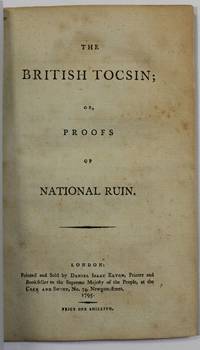
179539807London: Printed and Sold by Daniel Isaac Eaton Printer and Bookseller to the Supreme Majesty of the People at the Cock and Swine 1795. Modern plain wrappers and stitching. 54pp. Light browning Very Good.<br /> <br /> The publisher Daniel Eaton was a persistent challenger of British efforts to curtail speech critical of the Crown and government. He had been arrested and acquitted for publishing Paine's 'Rights of Man" and then for publishing a comparison of the King of England to a Game Cock. <br /> This pamphlet's thesis is that "Britain is on the brink of ruin. . . Corruption and distress walking hand in hand through the country; and war eternally compleating the triumvirate of despotism. . . That government is near its end when having once depended upon the free temper of the people they endeavor to reign by their own extent of power." The author writes "on the extravagance of the present reign" and its corrupting effects. He predicts "commercial bankruptcy! a national famine! and an unavoidable Revolution!" <br /> OCLC 221410570 4- Columbia Baylor two in England as of January 2024. Printed and Sold by Daniel Isaac Eaton, Printer and Bookseller to the Supreme Majesty of the People, at the Cock and Swine unknown
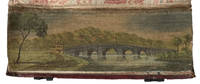
1784FF2537London:: Printed for J. F. and C. Rivington . . . 1784. 1784. 16mo. 80 x 140 mm. viii 317 23 pp. Original full crimson turkey morocco with massed gilt stamping on both covers and spine all edges gilt two clasps black leather spine label; head of spine a bit chipped at corner clasps missing the movable element pages trimmed closely with occasional loss but a very good copy with a lovely period binding. Bookplate of Oscar Ehrhardt Lancaster. Good. With a fore-edge painting of Richmond Bridge Surrey. Painted circa 1948-60 by Samuel E. Stevens. PROVENANCE: Pre-fore-edge: Mary Strand 1790 – Mary S. Partridge 1792; After fore-edge: Oscar Ehrhardt Lancaster 1887- Lancaster collected fore-edge paintings. Printed for J. F. and C. Rivington . . ., 1784. hardcover
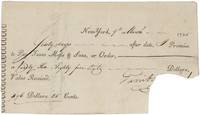
179542478New York 1795. paperback. Single leaf 4x7 inches. Printed on one side with blanks filled in in manuscript and signature obscured by cancellation tear-off; “Isaac Moses & Sons†penned on blank side in period hand. Early American Jewish merchants Isaac Moses & Sons operated on Greenwich Street.Isaac Moses 1742-1818 was born in Giessen Germany but moved to New York in 1764 and in 1766 he became a “freeman†of New York City. He became a prominent businessman and American patriot. He worked in his uncle's Hayman Levy's mercantile firm until he established Isaac Moses & Company with two new business partners in 1775. This firm supported the revolutionary army by accepting $20000 in Continental paper dollars in exchange for $20000 in hard currency thereby financing the war effort. The firm also traded for military supplies internationally and sold guns and ammunition to the army. When the British occupied New York Isaac Moses left for Philadelphia and ran the firm from there. In 1783 he returned to New York City and continued his commercial enterprises. He was generally financially successful establishing Isaac Moses & Sons an international trading company. He was also a founder and major stockholder in the Bank of New York  a Mason in New York City's Union Lodge and an important member of the New York City Chamber of Commerce. Isaac Moses was also president of Congregation Shearith Israel in New York the oldest Synagogue in American and the only Jewish congregation in New York City until 1820. He was also one of the principle organizers of the Congregation Mikveh Israel in Philadelphia. His descendants were prominent Jewish businessmen in New York who traveled internationally and served in the Union Army during the Civil War AJHS & Wikipedia. For more on Isaac Moses see the JTA’s report on the donation of his portrait by John Wesley Jarvis to the Museum of the City of New York in 1934 https://www.jta.org/archive/painting-of-isaac-moses-patriot-of-revolution- given-to-museum. Portraits of Moses can be viewed online at https://loebjewishportraits.com/portrait/isaac-moses/ and https://loebjewishportraits.com/portrait/isaac-moses-2/. An indenture signed by his heirs after his death in 1818 sold for $3500 plus commissions at auction in 2019 https://www.sothebys.com/en/auctions/ecatalogue/2019/fine-manuscripts-prin ted-americana-n10002/lot.2180.html. Promiser’s signature torn of as cancellation as often found otherwise Very Good Condition BK5 AMR-67-39. New York unknown
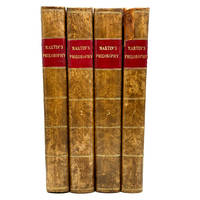
17715136166113<p><strong>NEWTON MARTIN Benjamin</strong><strong>.</strong> <em>Philosophia Britannica: Or A New and Comprehensive System of the Newtonian Philosophy Astronomy and Geography; In a Course of Twelve Lectures; With Notes; Containing the Physical Mechanical Geometrical and Experimental Proofs and Illustrations of All the Principal Propositions in Every Branch of Natural Science: Also a Particular Account of the Invention Structure Improvement and Uses of All the Considerable Instruments Engines and Machines; With New Calculations Relating to Their Nature Power and Operation.</em></p><p>London: Printed for W. Strahan; J. & F. Rivington; W. Johnston; Hawes & Co.; T. Carnan and F. Newbery; B. Collins; W. Frederick; and sold by the Author at his House in Fleet-Street 1771. Third edition. Complete in four volumes. Three text volumes plus a separate atlas volume of plates. Quarto. Approximately 8.5" x 5.5". Vol. I: xxx 333pp 3 ads; Vol. II: xiv 390pp 2 ads; Vol. III: x 405pp index. Atlas volume with 81 engraved copperplates the majority folding. Contemporary or near-contemporary half marbled calf over marbled boards with one repair to the upper spine of Vol. IV. Bindings sound and well-aligned. Engraved plates clean and strong with no losses; folds supple and correctly opening. Text generally clean throughout with manuscript annotations on the versos of the plates linking them to the relevant portions of text. Overall Very Good to Very Good.</p><p>Third and expanded edition of Benjamin Martin's monumental exposition of Newtonian natural philosophy combining physics astronomy geography mechanics and experimental science into a single unified system. The work includes extensive treatment of optics celestial motion gravitation hydrostatics pneumatics electricity and the mechanical powers alongside detailed explanations of contemporary scientific instruments and experimental apparatus. The separate atlas volume contains 81 finely engraved plates illustrating astronomical systems orreries telescopes microscopes air pumps electrical machines engines survey instruments and mechanical demonstrations.</p><p>This third edition represents the fully mature state of Martin's project as a practical synthesis of Newtonian science for broad professional use in the later eighteenth century. Unlike earlier editions which often survive without the full engraved apparatus this issue consolidates the theoretical text and the mechanical-visual program into a coherent instructional system. The separate atlas format allows for larger clearer mechanical and astronomical engravings than the inline plates of earlier printings making this edition particularly well suited for institutional reference in the history of science technology and scientific pedagogy.</p> Printed for W. Strahan; J. & F. Rivington; W. Johnston; Hawes & Co.; T. Carnan and F. Newbery; B. Collins; W. Frederick hardcover
179931012Baltimore 1799. Letter. Very good. Paper. Approx. 4.5" x 8" sheet of paper . Light toning to the paper. Contents reads: This may certify that I inspected Six Barrels flour Baranded on the end E. KREMER four of Which was condemn'd to Midlings Middlings being too course and Shky the other two had too much rye in the flour and could not be pass'd and branded for Merchantable Wheat Flour of any Quality signed Isaac Trimble Balt 12th of 3 mo 1799." From wikipedia:<br /> <br /> Wheat middlings also known as millfeed wheat mill run or wheat midds are the product of the wheat milling process that is not flour. A good source of protein fiber phosphorus and other nutrients they are used to produce foods like pasta breakfast cereals puddings and couscous for humans as well as fodder for livestock and pets. 1 They are also being researched for use as a biofuel. unknown
17521862Spain 1752. 18th-century manuscript. Text in Spanish. 24 handwritten pages in ink in three different hands. Later binding of blank paper using old material. Tiny wormholes at the lower edge of the pages on the first 7 leaves not affecting the legibility. Occasional foxing ink ghosting. Water stains on the last 2 leaves. Overall in fine condition. 18th-century manuscript. Text in Spanish. 24 handwritten pages in ink in three different hands. ff 12. <p><br /> 18th-Century Spanish manuscript about the Spanish involvement in the French Geodesic Mission of 1735 and the Ellipsoid Model of the Earth.<br /> <p><p><br /> The manuscript is an interesting collection of contemporary reports proving the importance of the Spanish role performed by Jorge Juan y Santacilia and Antonio de Ulloa in the so-called French Geodesic Mission 1735 with a particular focus on the polemic over the shape of the Earth. The quotations are conjugated with connecting texts by an anonymous author.<br /> <p><p><br /> One of the important scientific disputes of the late 17th early 18th century was the debate on the shape of the Earth. The assumption of the spherical shape was dominating until the late 17th century when Sir Isaac Newton determined that the Earth was oblate a spheroid stretched over the Equator however at the same time Giovanni Domenico Cassini and his son Jacques supposed that the Earth was prolate stretched along the poles. Eventually in 1735 two expeditions were sent by Louis XV and the French Academy to the Arctic Circle Lapland and to the Equator Ecuador and Peru to gain certainty by measuring the meridian arcs at polar and equatorial latitudes. The equatorial mission was accompanied by two Spanish geographers Jorge Juan y Santacilia and Antonio de Ulloa thus it became the first major international scientific expedition. The findings of the missions confirmed Newton’s hypothesis that the Earth was oblate a rotational ellipsoid.<br /> <p><p><br /> The first part of the manuscript is a lengthy citation of an early Spanish report on the equatorial mission published in the Mercurio histórico y político February 1745; pp. 99–107 which is followed by further references and quotations related to the geographer’s their work and the figure of the Earth such as Benito Jerónimo Feijóo y Montenegro’s Theatro critico universal 1751 Bernardo’s de Ulloa’s Antonio’s father Restablecimento de las fabricas y comercio español 1749 and articles from the Journal de Trévoux or the Gaceta de Zaragoza. The second part is Diego de Torres Villarroel’s 1693–1770 study Prevenciones in: Libros en que estan reatados. Vol. IV.; 1752 in which de Torres the almanac writer and professor of mathematics of a dubious repute opposes the findings of the missions and Newton’s hypothesis of the oblate Earth.<br /> <p><p><br /> Antonio de Ulloa 1716–1795 was a Spanish scientist and explorer the first Spanish governor of Louisiana who is also credited as the discoverer of the element platinum. De Ulloa was a Fellow of the Royal Society and a foreign member of the Royal Swedish Academy of Sciences. His associate Spanish scientist in the Geodesic Mission to Peru was Jorge Juan y Santacilia 1713–1773 who during the mission also measured the heights of the mountains of the Andes. Jorge Juan was the founder of the Real Observatorio de Madrid Royal Observatory of Madrid and he became a Fellow of the Royal Society too. Their co-written memoirs were published in Spanish from 1748 on and their books were very soon translated into French English and German.<br /> <p><p><br /> Literature: Lafuente A.; Mazuecos A.: Gentlemen of the Fixed Point: Science Politics and Adventure in the Geodesic Expedition to the Viceroyalty of Peru in the XVIII Century. pp. 171–203. Retrieved on July 8 2020 from Mayboudi L. S.: chapter 5.1 In: Geometry Creation and Import With COMSOL Multiphysics. Dulles VA USA: Mercury Learning & Information 2019.; Richardson D.; et al: The International Encyclopedia of Geography People the Earth Environment and Technology: Chichester UK; Hoboken NJ: John Wiley & Sons 2017.<br /> <p>. unknown
173028563Saint-André (des Eaux) 1730 une renonciation de succession, de 12 pages manuscrites à l'encre brune sur papier vergé ligné et filigrané, format : 33 cm de haut par 22 cm de large, 1 cachet fiscal en haut de 1ère page, en noir : "generalité de LA ROCHELLE" trois sols , RENONCIATION DE LA SUCCESSION DE JACQUES RASTEAU L'AINÉ PAR LA FAMILLE RASTEAU AU PROFIT DES DIVERS CRÉANCIERS DEVANT LE LIEUTENANT GÉNÉRAL DE LA SÉNÉCHAUSSÉE DE LA ROCHELLE, FAIT A LA ROCHELLE LE 17 MAI 1769, COPIE DE LA RENONCIATION EXPÉDIÉE EN JUILLET 1769,
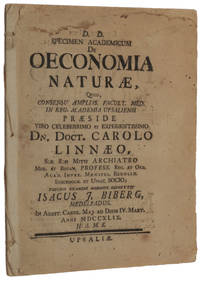
17495245Uppsala: np 1749. First edition. <p>First edition extremely rare. "This essay was the first sketch of a science of ecology. Linnaeus used his economy-of-nature concept as an organising principle to unify an important but previously amorphous part of natural history. In so doing he was also attempting to transform an important background concept into the central theory of a new science" Egerton. "In regard to Linnaeus' concepts of an economy of nature Darwin used these ideas as major explanations of the workings of natural selection. So Linnaeus supplied major assistance for Darwin's arriving at his theory of evolution" Stauffer.</p>. THE BIRTH OF THE SCIENCE OF ECOLOGY. <p>First edition extremely rare of Linnaeus' pioneer dissertation which created the science of ecology. "This essay was the first sketch of a science of ecology. Linnaeus used his economy-of-nature concept as an organising principle to unify an important but previously amorphous part of natural history. In so doing he was also attempting to transform an important background concept into the central theory of a new science . The term 'economy of nature' bore an obvious similarity to the contemporary term for animal physiology 'animal economy' which involved studying how the parts contributed to the functioning of the whole. Linnaeus may indeed have had in mind an analogy between the organs in an animal and the species in a habitat because his analysis of the interrelations between the plants and animals in nature implied a close and well-defined interaction for the good of the whole: 'To perpetuate the established course of nature in a continued series the divine wisdom has thought fit that all living creatures should constantly be employed in producing individuals that all natural things should contribute and lend a helping hand towards preserving every species and lastly that the death and destruction of one thing should always be subservient to the restitution of another' . The Oeconomia naturae begins with the above-quoted definition and then explains how that concept can be used to interpret phenomena in inanimate nature and in the plant and animal kingdoms. For both the plant and animal kingdoms Linnaeus considered propagation preservation and destruction as the phenomena which maintained the economy of nature" Egerton p. 335. "The phrase 'Oeconomy of Nature' "should be familiar to readers of Darwin for he claims in the Origin p. 102 that 'all organic beings are striving it may be said to seize on each place in the economy of nature.' When the work 'economy' appears in Darwin's texts there is a tendency to look to political economy for precursors . but concepts like the animal economy and the economy of nature debatable belonged to intellectual lineages that were relatively independent of their social and political context . I will argue that Darwin's idea of a place in the economy of nature stems from the work of previous naturalists like Carl Linnaeus and Charles Lyell and that it played a key role in the development of his evolutionary ideas. . Darwin read translations of Linnaeus' dissertations Oeconomia naturae 1749 and Politia naturae 1760 in May 1841. Although the phrase 'economy of nature' appears only once in Darwin's notebooks of the late 1830s it can be found throughout his first sketches on transmutation in 1842 and 1844. Given this chronology it is likely that the idea came to play a greater role in Darwin's work because of his encounter with these Linnaean texts" Pearce pp. 494-6. The dissertation was dictated by Linnaeus in Swedish to Isaac Biberg a doctoral candidate who translated it into Latin and defended it according to the academic custom of the eighteenth century. ABPC/RBH lists no copy in the last 80 years. OCLC lists 5 copies in US Madison Wisconsin; Kansas; Harry Ransom Texas; Minnesota; Huntington.</p> <br /> <p>"Like most naturalists of his time Linnaeus was trained in medicine and thus would have been familiar with the term 'oeconomia animalis' as employed by Charleton Hermann Boerhaave and others. However Linnaeus set his sights higher - what he wanted to describe was not the animal economy but the economy of nature as a whole. Of course others had used the term 'economy of nature' e.g. Sir Kenelm Digby in a variety of works but only as a brief metaphor. For example Digby writes in 1644 that natural motion 'hath its birth from the universall oeconomy of nature here among us.' What Linnaeus did instead was extend the physiological idea of the animal economy to nature in its entirety. In his eyes the economy of nature deserved a description just as detailed and rational as that of the animal economy.</p> <br /> <p>"In the dissertation 'Oeconomia Naturae' defended by his student Isaac Biberg in 1749 Linnaeus defines his title as follows: 'By the oeconomy of nature we understand the all-wise disposition of the creator in relation to natural things by which they are fitted to produce general ends and reciprocal uses.' The 'reciprocal uses' are the key to the whole idea for 'the death and destruction of one thing should always be subservient to the restitution of another;' thus mould spurs the decay of dead plants to nourish the soil and the earth then 'offers again to plants from its bosom what it has received from them.' Linnaeus points out that natural processes always follow a certain order with each stage dependent on the previous. A fallen tree for instance does not go to waste but is colonized and eliminated by an ordered series of creatures: liverworts mushrooms beetles caterpillars and woodpeckers. Just as the respiratory cardiovascular lymphatic and digestive systems play different functional roles in the economy of the human body different species play different functional roles in the economy of nature as a whole. For example each kind of insect lays its eggs on a particular kind of plant:</p> <br /> <p>'. every different tribe chooses its own species of plant. Nay there is scarce any plant which does not afford nourishment to some insect; and still more there is scarcely any part of a plant which is not preferred by some of them. Thus one insect feeds upon the flower; another upon the trunk another upon the root; and another upon the leaves.'</p> <br /> <p>"Each type of organism therefore according to Linnaeus has its special function in nature's economy. Just as the animal economy ensures the health and well-being of the animal body the economy of nature ensures the health and well-being of the natural world. Linnaeus discusses the many creatures that help cleanse and purify nature's body without which the 'whole earth would be overwhelmed with carcases and stinking bodies.' Thus if a horse dies near a roadway its body will 'be filled with innumerable grubs of carniverous flies by which he is entirely consumed and removed out of the way that he may not become a nuisance to passengers by his poisonous stench.' Likewise specialized aquatic predators like the thornback the hound fish or the conger eel consume fish carcasses near the shore. Linnaeus even suggests an experiment to prove the purifying potential of insects:</p> <br /> <p>'. knats lay their eggs in stagnant putrid and stinking waters and the grubs that arise from these eggs clear away all the putrefaction; and this will easily appear if any one will make the experiment by filling two vessels with putrid water leaving the grubs in one and taking them all out of the other. For then he will soon find the water that is full of grubs pure and without any stench while the water that has no grubs will continue stinking.' </p> <br /> <p>"Thus for Linnaeus even scavengers and grubs the lowest of all species play an essential role in the economy of nature" Pearce pp. 497-8.</p> <br /> <p>"Oeconomia Naturae is both the culmination of a great tradition - that of Christian natural theology and the starting point of a new science the one that Ernst Haeckel named 'ecology' in 1866. In accordance with the natural theology and the 'age of optimism' celebrated in the works of William Derham John Ray Bernhard Nieuwentyt Gottfried von Leibniz and Christian von Wolff Linnaeus defines 'the economy of nature' as the Creator's wise arrangement and deposition of all things according to which they fulfil their purpose for the glory of God and the happiness of Man.</p> <br /> <p>"And although individuals perish their roles persist . The roles in Linnaean nature are what today's ecologists call 'niches': a multidimensional 'space' defined by the abilities of the species and their interactions with the environment - their physiology and habitat preferences position in food chains and ecosystem structure. Although the Oeconomia Naturae reads like an ecology textbook it also sparkles with the eroticism of the Baroque. Like a voluptuous painter Linnaeus revels in the splendour of life in its beautiful 'costumes' its sensual appeal and showy extravagance the delightful colours forms and adaptations the impressive devices for preservation survival defence attack sex and propagation mating and pollination the means of dispersal and child-rearing .</p> <br /> <p>"Between 1743 and 1776 Linnaeus wrote more than 180 such academic theses. But few achieved the instant success of the Oeconomia Naturae. A Swedish translation was produced within a year. English and German versions soon appeared. It was also reprinted in Latin in the many editions of Linnaeus's Amoenitates academicae published in Amsterdam Leyden Erlangen and Graz through the second half of the eighteenth century. New translations continue to appear today" Hestmark.</p> <br /> <p>"Darwin's influence on the history of ecology resulted in the very christening of the science itself by Ernst Haeckel who once explained that 'By ecology we mean the body of knowledge concerning the economy of nature' and who concluded 'in a word ecology is the study of all those complex interrelationships referred to by Darwin as the conditions of the struggle for existence' .</p> <br /> <p>"When we come to consider the sources of Darwin's ecological insight the importance of his personal experience is obvious . Besides the influence of Darwin's field observations there was the influence of his reading . The importance for Darwin of Lyell's discussion of the economy of nature and allied topics in his Principles of Geology is very clear . Lyell's references in regard to the economy of nature point directly back to the major earlier source: the writings of Carl Linnaeus. The importance of Linnaeus in the evolution of ecology is very great and it is striking that among the naturalists writing after Linneaus and before Darwin it is the geologist Charles Lyell who shows the clearest grasp of Linnaeus' ideas on the economy of nature and who makes the fullest use of them in his own work . After coming to know in the pages of Lyell's Principles ideas and facts from a number of these Linnaean essays Darwin encountered Linnaeus himself in English translation in May of 1841 . From this year of 1841 on Darwin made increasing use of the phrases 'economy of nature' and 'polity of nature' .</p> <br /> <p>"The conventional wisdom is that Darwin overthrew the work of Linnaeus in so far as he replaced the orthodox dogma of fixity of species by his theory of evolution. But in regard to Linnaeus' concepts of an economy of nature Darwin used these ideas as major explanations of the workings of natural selection. So Linnaeus supplied major assistance for Darwin's arriving at his theory of evolution" Stauffer.</p> <br /> <p>"In German and Swedish universities in the eighteenth century the serious test of the student was the skill with which he conducted his oral defence of the thesis he presented. His major professor who presided at the disputation was often the author of the thesis to be defended. At Uppsala Linnaeus generally dictated the essays which his students published and paid the printer's bill for. He quite naturally regarded these dissertations as his own work. In a letter to his friend the English naturalist John Ellis he wrote:</p> <br /> <p>'The fourth volume of my Amoenitates Academicae is very nearly printed . Among the dissertations I am about to publish are Genera morborum Aer habitabilis Flora Jamaicensis Sus porcus Anthropomorpha & Generatio ambigens. In the last of these I shall show that the brain and spinal marrow only proceed from the mother and the rest of the body from the father.'</p> <br /> <p>"Nowadays unless there is direct evidence to the contrary it is customary to regard Linnaeus as the author of all these dissertations" ibid.</p> <br /> <p>Soulsby Catalogue of the works of Linnaeus 2nd ed. 1933 1514. Egerton 'Changing concepts of the balance of nature' The Quarterly Review of Biology 48 1973 pp. 322-50. Hestmark 'Oeconomia Naturae L' Nature 405 2000 p. 19. Pearce 'A great complication of circumstances - Darwin and the Economy of Nature' Journal of the History of Biology 43 2010 pp. 493-528. Stauffer 'Ecology in the long manuscript version of Darwin's 'Origin of Species' and Linnaeus' 'Oeconomy of Nature'' Proceedings of the American Philosophical Society 104 1960 pp. 235-41.</p> <br /> <br/> <br/> 4to pp. viii 48 woodcut initials head- and tail-pieces first and last pages tanned spotted water stain to upper edge of the first two leaves. String bound. A very good copy in original state of this extremely rare dissertation. np unknown
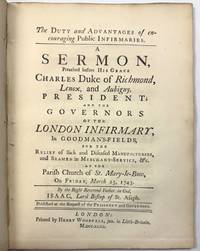
174341756London: Printed by Henry Woodfall jun. in Little-Britain 1743. 4to. 4 36 pp as issued with the half title. Disbound else Very Good.<br /> <br /> This is one of seven 1743 printings all by Woodfall at London and each with slightly different imprint. ESTC calls ours and three others the second edition. ESTC locates copies only at the University of Cambridge and UCLA. Pages 25-36 present a detailed account of the London Infirmary including patient accounts donors and governors. <br /> Maddox's text elaborates on Psalm xli: "Blessed is the man that provideth for the sick and needy. . ." Wikipedia's entry for Maddox notes his interest in promoting medical care and other charitable endeavors.<br /> ESTC N9048 2. Printed by Henry Woodfall, jun. in Little-Britain unknown
180033248BB1800 . Paris: Brunot um 1800 16°. 208 S. 4 Tafeln Pappband Rücken beschabt; Ecken leicht bestossen; gut erhalten unknown