[JACKSON, Isaac Rand]Biblio.com
26 496 résultats
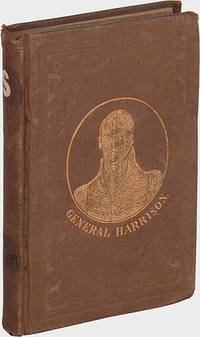
1840369343Philadelphia: W. Marshall & Co 1840. Hardcover. Very Good. Second edition. 12mo. 218pp. Publisher's brown cloth with gilt-stamped portrait of General Harrison on the front cover. Ex-library copy with spine lettering bookplate perforated stamp on the title paper shelf label on the rear free endpaper else a very good sound copy. Sabin 30586. W. Marshall & Co hardcover
16243619<p>Compendium on Alchemy Medicine and Science A-2S8 2S8 blank present. 34 598 24 pages. Title-page in red and black. Worming to inner margin of first gathering with some minor affects; browning some old underlining partially in red and marginal notes some minor stains. Overall a good copy in the original full yapped vellum. This volume contains:1 Basilius Valentinus:Triumphwagen des Antimonii.2 Roger Bacon: Von der Medicin und Artzney/ oder Tinctur des Antimonii oder Spieglases Beydes in den Menschlichen Crpern zu erhaltung desselben Gesundheit und abwendung aller auch unheilbaren Kranckheiten und Seuchen Und unvollkommenen Metallen ihren Aussatz heilen sie zu clarificiren und in das beste Gold zuverse.3 Ein kurtz rundes und wolgegründtes Tractätlein Von den Particular und Universal-Tincturen.4 Vom Stein der Weisen Theoria. Und Practica Des Edlen . Georgii Phaedronis Rodocheri.5 Uhralter Ritterkrieg Das ist Ein alchymistisch kürtzliches Gäsprech. Unsers Steins/ des Golds und des Mercuii .6 Opus Saturni M. Johannis Isaaci Hollandi.7 Consideratio Oder Philosophische Betrachtung Von der Materia Lapidis Philosophici.8 Von der Occulta Chemicorum Philosophia Ein kurtzer Tractat.Basilius Valentinus also known under the Anglicized version of his name Basil Valentine was a fifteenth-century alchemist & the Canon of the Benedictine Priory of Saint Peter in Erfurt Germany. Krown & Spellman HA 45215; 18 mo 4 x 6.4 in; xxxviv 59824 pages; All shipments through USPS insured Priority Mail. .</p> Friedrich Lanckisch for Bartholmaeus Voigt hardcover
17521862Spain 1752. 18th-century manuscript. Text in Spanish. 24 handwritten pages in ink in three different hands. Later binding of blank paper using old material. Tiny wormholes at the lower edge of the pages on the first 7 leaves not affecting the legibility. Occasional foxing ink ghosting. Water stains on the last 2 leaves. Overall in fine condition. 18th-century manuscript. Text in Spanish. 24 handwritten pages in ink in three different hands. ff 12. <p><br /> 18th-Century Spanish manuscript about the Spanish involvement in the French Geodesic Mission of 1735 and the Ellipsoid Model of the Earth.<br /> <p><p><br /> The manuscript is an interesting collection of contemporary reports proving the importance of the Spanish role performed by Jorge Juan y Santacilia and Antonio de Ulloa in the so-called French Geodesic Mission 1735 with a particular focus on the polemic over the shape of the Earth. The quotations are conjugated with connecting texts by an anonymous author.<br /> <p><p><br /> One of the important scientific disputes of the late 17th early 18th century was the debate on the shape of the Earth. The assumption of the spherical shape was dominating until the late 17th century when Sir Isaac Newton determined that the Earth was oblate a spheroid stretched over the Equator however at the same time Giovanni Domenico Cassini and his son Jacques supposed that the Earth was prolate stretched along the poles. Eventually in 1735 two expeditions were sent by Louis XV and the French Academy to the Arctic Circle Lapland and to the Equator Ecuador and Peru to gain certainty by measuring the meridian arcs at polar and equatorial latitudes. The equatorial mission was accompanied by two Spanish geographers Jorge Juan y Santacilia and Antonio de Ulloa thus it became the first major international scientific expedition. The findings of the missions confirmed Newton’s hypothesis that the Earth was oblate a rotational ellipsoid.<br /> <p><p><br /> The first part of the manuscript is a lengthy citation of an early Spanish report on the equatorial mission published in the Mercurio histórico y político February 1745; pp. 99–107 which is followed by further references and quotations related to the geographer’s their work and the figure of the Earth such as Benito Jerónimo Feijóo y Montenegro’s Theatro critico universal 1751 Bernardo’s de Ulloa’s Antonio’s father Restablecimento de las fabricas y comercio español 1749 and articles from the Journal de Trévoux or the Gaceta de Zaragoza. The second part is Diego de Torres Villarroel’s 1693–1770 study Prevenciones in: Libros en que estan reatados. Vol. IV.; 1752 in which de Torres the almanac writer and professor of mathematics of a dubious repute opposes the findings of the missions and Newton’s hypothesis of the oblate Earth.<br /> <p><p><br /> Antonio de Ulloa 1716–1795 was a Spanish scientist and explorer the first Spanish governor of Louisiana who is also credited as the discoverer of the element platinum. De Ulloa was a Fellow of the Royal Society and a foreign member of the Royal Swedish Academy of Sciences. His associate Spanish scientist in the Geodesic Mission to Peru was Jorge Juan y Santacilia 1713–1773 who during the mission also measured the heights of the mountains of the Andes. Jorge Juan was the founder of the Real Observatorio de Madrid Royal Observatory of Madrid and he became a Fellow of the Royal Society too. Their co-written memoirs were published in Spanish from 1748 on and their books were very soon translated into French English and German.<br /> <p><p><br /> Literature: Lafuente A.; Mazuecos A.: Gentlemen of the Fixed Point: Science Politics and Adventure in the Geodesic Expedition to the Viceroyalty of Peru in the XVIII Century. pp. 171–203. Retrieved on July 8 2020 from Mayboudi L. S.: chapter 5.1 In: Geometry Creation and Import With COMSOL Multiphysics. Dulles VA USA: Mercury Learning & Information 2019.; Richardson D.; et al: The International Encyclopedia of Geography People the Earth Environment and Technology: Chichester UK; Hoboken NJ: John Wiley & Sons 2017.<br /> <p>. unknown
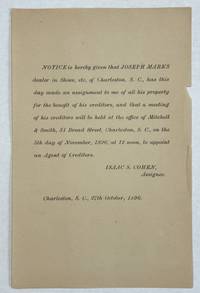
189641088Charleston S.C. 1896. Broadside 5-1/2" x 8-1/2". This small broadside is printed in a pleasant font and signed in type by Isaac S. Cohen. Minor wear large chip of top right corner of blank margin no text loss. Good.<br /> <br /> Isaac S. Cohen 1871-1915 was a Jewish businessman in Charleston. He worked for First National Bank after high school then worked as a cashier and later president for twenty years of Charleston Savings Bank. He was the son of Louis Cohen 1833-1914 a Polish Jew who came to Charleston in 1850 and became a successful tailor and later the owner of a large and well-known clothing store in Florence. "Charleston Banker Died In Asheville" Columbia Record June 23 1915 page 8; Find A Grave website accessed July 2025.<br /> Joseph Marks 1858-1935 was the president of M. Marks & Sons for many years a business started by his father Moses Marks 1833-1911 a Russian Jew who came to the United States in 1850 settled in Charleston and became a successful merchant. Moses opened the large and very successful M. Marks & Sons in 1891 as a dry goods emporium and clothing business. The business ran until about 1930. Moses Marks' obituary says the business was "probably the first 5 and 10 cents store in the United States." "M. Marks & Sons" The Jewish Merchant Project website accessed July 2025; "Moses Marks" The State Newspaper April 22 1911 page 9.<br /> Mitchell & Smith was a law firm in Charleston active from about 1877-1919. unknown
198886183San Diego CA: Wizards Bookshelf 1988. First Thus. Octavo. 22cm. Publisher's grey leather grain rexine titled in gilt to spine and front board. xxii; 1; 499pp.; 1. Very light wear to corners and spine ends strong and handsome; internally clean and fresh. A near fine copy.<br /> <br /> Part of the Wizards Bookshelf "Secret Doctrine Reference Series." Myer was an American scholar and Egyptologist of the late 19th century one of those learned men to whom every mystery is a source of fascination and research in this case his area of study was the writings of Solomon ben Yehuda Ibn Gebirol the 11th century Spanish poet and philosopher who amongst other mystical acts was reputed to have created a female Golem for the purpose of performing his household chores. Wizards Bookshelf unknown
1816ABC_50110Paris 1816. 4to. Imprimerie Royale 19th-century purple-ish cloth with the title lettered in gold on the spine. The cloth around the spine is faded and browned. 2 parts in 1 volume. 2 VIII 140; 8 315 1 pp. The complete text of the Arabic version by Ibn al Muqaffa of this collection of animal fables with didactic overtones designed to illustrate wise conduct printed in the beautiful types of the "Imprimerie Royale" with an introduction and critical notes in French. The typeface based on Arab or Turkish specimens of calligraphy and cut in Rome in the early 17th century for Savary "was the mainstay of Arabic typography in France until the late 19th century; it also provided a model for others" Roper p. 145.The spine is sunned occasional browning and foxing. Otherwise in good condition.l Blois "Kalila wa-Dimna" in: Meisami & Starkey Enyclopedia of Arabic literature pp. 423-425; Chauvin II p. 11f. no. 17; Keith-Falconer Kalilah and Dimnah pp. xvi-xvii; cf. G. Roper Early Arabic Printing in Europe in: Middle Eastern Languages and the Print Revolution. A Cross-Cultural Encounter Westhofen 2002 pp. 129-150. hardcover
116947London Printed for J. Brotherton at the Bible next Tom's Coffee-House; and T. Cox at the Lamb under the Royal-Exchange both in Cornhill 1741. . Fourth edition; 8vo 20.5 x 13 cm; engraved portrait frontispiece ad. f. following p.vi woodcut initials head and tailpieces the odd mark but generally internally clean split to front hinge and first 3 quires a little loose but holding; contemporary sprinkled calf gilt spine in 6 compartments brown morocco lettering-piece a little rubbed with minor loss small area of repair to upper joint very good; xxii 408pp.<br /> An early life of the English Civil War leader Oliver Cromwell 1599-1658 who went on to serve as Lord Protector of the nascent Commonwealth from 1653 until his death.<br /><br />From 'a private gentleman of no considerable fortune Cromwell raised himself to the highest pitch of power and grandeur obtain'd the supreme authority and command over three nations and over-aw'd the most powerful Princes and States about us' Preface.<br /> London, Printed for J. Brotherton, at the Bible, next Tom's Coffee-House; and T. Cox, at the Lamb, under the Royal-Exchange, bot unknown
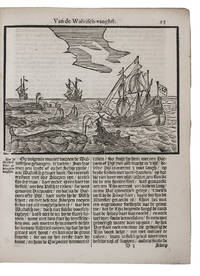
166598MCBSHUHD3NAmsterdam 1665. 4to. Gillis Joosten Saeghman Late 19th-century vellum with the title stamped on the spine with black foil a black single fillet border on both boards. With a woodcut vignette of ships on the title page 16 further woodcuts on integral leaves 1 full-page signed by Christoffel van Sichem IV and 9 half-page and smaller with his monogram and a woodcut ship in a cartouche plus 1 repeat woodcut decorated initials and decorative bands built up from cast fleurons. Set in textura types with incidental roman and italic. 32 pp. First Dutch translation of the accounts of three voyages to Greenland by Jens Munk John Monck Martin Frobisher and Godske Lindenau searching for a passage to the East Indies through the Hudson Strait. Also containing a description of Greenland and an account of whaling including an unsigned illustration of a beached sperm whale with new illustrations by Christoffel van Sichem IV 1642-1693. It is a Dutch translation of La Peyrère's 1647 Relation du Groenland 1647 via the somewhat abbreviated German translation published in Hulsius's 1650 collection which contains the additional description of Spitsbergen and a discourse on whaling. La Peyrère included revised versions of Jens Munk's account of his voyage to Hudson Bay originally published in Navigatio septentrionalis 1624 and the accounts of voyages by Martin Frobisher and Godske Lindenau. Red armorial library stamp of the Forschungsstelle Volk und Raum on the title page: this was a research institute active at The Hague during the occupation of The Netherlands by Nazi Germany. Good copy.l Alden & Landis 663/79; Gosch Danish Arctic expeditions II pp. lxii-lxiii; JCB III pp. 98-99; Tiele Mém. 256; Sabin 28641 & 51334; STCN 4 copies; cf. Howgego to 1800 F80-F81 L128 and M180. ABE CAT Alaska Canada & Greenland hardcover
1655673Amsterdam: Elzevir 1655. First Edition. vellum. Very good. LA PEYRERE Isaac Praeadamitae sive Exercitatio super Versibus <br />duodecimo decimotertio & decimoquarto capitis quinti Epistolae D. Pauli ad Romanos. And 2nd part Systema Theologicum ex Prae-adamitarum Hypothesi. And final section called: Synagogis Iudaeorum universis. Elzevir Amsterdam 1655. TP 1 leaf = Elenchus Capitum 1 52 TP 2 leaves = Prooemium 4 leaves = Argumenta Capitum Systematis & errata 1 297 1 8 1 leave with engraved map of the Terra Sanctae. 4to. First Edition. <br /><br />An anonymous Dutch edition of Philosophia appeared in 1667 and new Latin editions in 1673 and 1674. Evidence for the staying power of the work and the controversies which surrounded it is found in <br /> the fact that it underwent a fourth edition long after Meyer's death in 1776. <br /><br />Rare Quarto edition which preceded the 12mo of the same year. <br /><br />La Peyrere is considered to be the father of Biblical criticism. He asserted in Praeadamitae that there were human beings before Adam. His approach to Biblical scholarship argued that the Bible was just the story of the Jewish people not all of humanity. His book and heretical views were quickly banned. La Peyrere was eventually arrested but offered a half-hearted renunciation of his views to escape punishment. La Peyrere went on to engage in polemics with Richard Simon famous defender of the Bible. A rare and important book in the Radical Enlightenment identified as one of the wicked books of the late 17th century. .the wicked sedition which commenced with La Peyreres Prae-Adamitae gained impetus with the utterly licentious dissipated dictionary of Koerbagh that shameless book the Philosophai S. Scripturae and Hobbes Leviathan and culminated in the Tractatus- Theologico-Politicus and Ethics of Spinoza Israel 367. <br /><br />CONDITION: Very Good in slightly soiled contemporary vellum over boards. Contemporary handwriting on titlepage. Dampstaining in corner of first pages causing ruff edges. Small repair in corner title. Some slight dampstaining in corner map. First edition. Spinoza had a copy of this edition in his library. <br /><br />PHOTOS AVAILABLE UPON REQUEST Elzevir hardcover
1836254301836. S.l. s.ÂŽ. s.d. Paris Guilaudet et Jouaust 1836. Un vol. au format pt in-4 277 x 183 mm de 59 planches gravÂŽes et 1 f. bl. Reliure de l'ÂŽpoque de demi-chagrin glacÂŽ acajou dos lisse ornÂŽ de doubles filets dorÂŽs titre dorÂŽ tranches mouchetÂŽes. Ensemble renfermant 59 jolies planches gravÂŽes dans un bel encadrement. Elles sont signÂŽes Skelton Rouargue Colin Laliasse Branche PÂŽronard Morinet Mondain Gossard Giroux Buzet etc. Angles et coupes ÂŽlimÂŽs. Dos passÂŽ. Papier parfois lÂŽgÂrement oxydÂŽ. Rousseurs dans le corps d'ouvrage; Infime dÂŽchirure en marge de deux planches. Du reste belle condition. b42961 unknown
187653982Philadelphia: Collins printer 1876. First edition 8vo pp. 22 2; removed from stabbed binding; very good. Based on the imperfect and incomplete list issued in the Royal Society of London's Catalogue of Scientific Papers. Lea 1792-1886 was an American conchologist geologist and publisher Carey & Lea Lea & Blanchard. Collins, printer unknown
191312450New York: Isaac Markens 1913. FIRST EDITION. Original printed heavy wrappers with red string tie wrappers soiled with a couple tiny tears. First edition number 100 of 100 inscribed by Markens. A complete review of Lincoln's Gettysburg Address written on the occasion of the fiftieth anniversary of its delivery. Monaghan 2096. Isaac Markens unknown
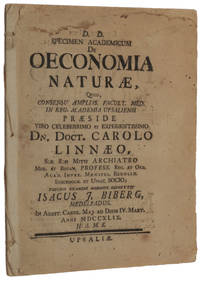
17495245Uppsala: np 1749. First edition. <p>First edition extremely rare. "This essay was the first sketch of a science of ecology. Linnaeus used his economy-of-nature concept as an organising principle to unify an important but previously amorphous part of natural history. In so doing he was also attempting to transform an important background concept into the central theory of a new science" Egerton. "In regard to Linnaeus' concepts of an economy of nature Darwin used these ideas as major explanations of the workings of natural selection. So Linnaeus supplied major assistance for Darwin's arriving at his theory of evolution" Stauffer.</p>. THE BIRTH OF THE SCIENCE OF ECOLOGY. <p>First edition extremely rare of Linnaeus' pioneer dissertation which created the science of ecology. "This essay was the first sketch of a science of ecology. Linnaeus used his economy-of-nature concept as an organising principle to unify an important but previously amorphous part of natural history. In so doing he was also attempting to transform an important background concept into the central theory of a new science . The term 'economy of nature' bore an obvious similarity to the contemporary term for animal physiology 'animal economy' which involved studying how the parts contributed to the functioning of the whole. Linnaeus may indeed have had in mind an analogy between the organs in an animal and the species in a habitat because his analysis of the interrelations between the plants and animals in nature implied a close and well-defined interaction for the good of the whole: 'To perpetuate the established course of nature in a continued series the divine wisdom has thought fit that all living creatures should constantly be employed in producing individuals that all natural things should contribute and lend a helping hand towards preserving every species and lastly that the death and destruction of one thing should always be subservient to the restitution of another' . The Oeconomia naturae begins with the above-quoted definition and then explains how that concept can be used to interpret phenomena in inanimate nature and in the plant and animal kingdoms. For both the plant and animal kingdoms Linnaeus considered propagation preservation and destruction as the phenomena which maintained the economy of nature" Egerton p. 335. "The phrase 'Oeconomy of Nature' "should be familiar to readers of Darwin for he claims in the Origin p. 102 that 'all organic beings are striving it may be said to seize on each place in the economy of nature.' When the work 'economy' appears in Darwin's texts there is a tendency to look to political economy for precursors . but concepts like the animal economy and the economy of nature debatable belonged to intellectual lineages that were relatively independent of their social and political context . I will argue that Darwin's idea of a place in the economy of nature stems from the work of previous naturalists like Carl Linnaeus and Charles Lyell and that it played a key role in the development of his evolutionary ideas. . Darwin read translations of Linnaeus' dissertations Oeconomia naturae 1749 and Politia naturae 1760 in May 1841. Although the phrase 'economy of nature' appears only once in Darwin's notebooks of the late 1830s it can be found throughout his first sketches on transmutation in 1842 and 1844. Given this chronology it is likely that the idea came to play a greater role in Darwin's work because of his encounter with these Linnaean texts" Pearce pp. 494-6. The dissertation was dictated by Linnaeus in Swedish to Isaac Biberg a doctoral candidate who translated it into Latin and defended it according to the academic custom of the eighteenth century. ABPC/RBH lists no copy in the last 80 years. OCLC lists 5 copies in US Madison Wisconsin; Kansas; Harry Ransom Texas; Minnesota; Huntington.</p> <br /> <p>"Like most naturalists of his time Linnaeus was trained in medicine and thus would have been familiar with the term 'oeconomia animalis' as employed by Charleton Hermann Boerhaave and others. However Linnaeus set his sights higher - what he wanted to describe was not the animal economy but the economy of nature as a whole. Of course others had used the term 'economy of nature' e.g. Sir Kenelm Digby in a variety of works but only as a brief metaphor. For example Digby writes in 1644 that natural motion 'hath its birth from the universall oeconomy of nature here among us.' What Linnaeus did instead was extend the physiological idea of the animal economy to nature in its entirety. In his eyes the economy of nature deserved a description just as detailed and rational as that of the animal economy.</p> <br /> <p>"In the dissertation 'Oeconomia Naturae' defended by his student Isaac Biberg in 1749 Linnaeus defines his title as follows: 'By the oeconomy of nature we understand the all-wise disposition of the creator in relation to natural things by which they are fitted to produce general ends and reciprocal uses.' The 'reciprocal uses' are the key to the whole idea for 'the death and destruction of one thing should always be subservient to the restitution of another;' thus mould spurs the decay of dead plants to nourish the soil and the earth then 'offers again to plants from its bosom what it has received from them.' Linnaeus points out that natural processes always follow a certain order with each stage dependent on the previous. A fallen tree for instance does not go to waste but is colonized and eliminated by an ordered series of creatures: liverworts mushrooms beetles caterpillars and woodpeckers. Just as the respiratory cardiovascular lymphatic and digestive systems play different functional roles in the economy of the human body different species play different functional roles in the economy of nature as a whole. For example each kind of insect lays its eggs on a particular kind of plant:</p> <br /> <p>'. every different tribe chooses its own species of plant. Nay there is scarce any plant which does not afford nourishment to some insect; and still more there is scarcely any part of a plant which is not preferred by some of them. Thus one insect feeds upon the flower; another upon the trunk another upon the root; and another upon the leaves.'</p> <br /> <p>"Each type of organism therefore according to Linnaeus has its special function in nature's economy. Just as the animal economy ensures the health and well-being of the animal body the economy of nature ensures the health and well-being of the natural world. Linnaeus discusses the many creatures that help cleanse and purify nature's body without which the 'whole earth would be overwhelmed with carcases and stinking bodies.' Thus if a horse dies near a roadway its body will 'be filled with innumerable grubs of carniverous flies by which he is entirely consumed and removed out of the way that he may not become a nuisance to passengers by his poisonous stench.' Likewise specialized aquatic predators like the thornback the hound fish or the conger eel consume fish carcasses near the shore. Linnaeus even suggests an experiment to prove the purifying potential of insects:</p> <br /> <p>'. knats lay their eggs in stagnant putrid and stinking waters and the grubs that arise from these eggs clear away all the putrefaction; and this will easily appear if any one will make the experiment by filling two vessels with putrid water leaving the grubs in one and taking them all out of the other. For then he will soon find the water that is full of grubs pure and without any stench while the water that has no grubs will continue stinking.' </p> <br /> <p>"Thus for Linnaeus even scavengers and grubs the lowest of all species play an essential role in the economy of nature" Pearce pp. 497-8.</p> <br /> <p>"Oeconomia Naturae is both the culmination of a great tradition - that of Christian natural theology and the starting point of a new science the one that Ernst Haeckel named 'ecology' in 1866. In accordance with the natural theology and the 'age of optimism' celebrated in the works of William Derham John Ray Bernhard Nieuwentyt Gottfried von Leibniz and Christian von Wolff Linnaeus defines 'the economy of nature' as the Creator's wise arrangement and deposition of all things according to which they fulfil their purpose for the glory of God and the happiness of Man.</p> <br /> <p>"And although individuals perish their roles persist . The roles in Linnaean nature are what today's ecologists call 'niches': a multidimensional 'space' defined by the abilities of the species and their interactions with the environment - their physiology and habitat preferences position in food chains and ecosystem structure. Although the Oeconomia Naturae reads like an ecology textbook it also sparkles with the eroticism of the Baroque. Like a voluptuous painter Linnaeus revels in the splendour of life in its beautiful 'costumes' its sensual appeal and showy extravagance the delightful colours forms and adaptations the impressive devices for preservation survival defence attack sex and propagation mating and pollination the means of dispersal and child-rearing .</p> <br /> <p>"Between 1743 and 1776 Linnaeus wrote more than 180 such academic theses. But few achieved the instant success of the Oeconomia Naturae. A Swedish translation was produced within a year. English and German versions soon appeared. It was also reprinted in Latin in the many editions of Linnaeus's Amoenitates academicae published in Amsterdam Leyden Erlangen and Graz through the second half of the eighteenth century. New translations continue to appear today" Hestmark.</p> <br /> <p>"Darwin's influence on the history of ecology resulted in the very christening of the science itself by Ernst Haeckel who once explained that 'By ecology we mean the body of knowledge concerning the economy of nature' and who concluded 'in a word ecology is the study of all those complex interrelationships referred to by Darwin as the conditions of the struggle for existence' .</p> <br /> <p>"When we come to consider the sources of Darwin's ecological insight the importance of his personal experience is obvious . Besides the influence of Darwin's field observations there was the influence of his reading . The importance for Darwin of Lyell's discussion of the economy of nature and allied topics in his Principles of Geology is very clear . Lyell's references in regard to the economy of nature point directly back to the major earlier source: the writings of Carl Linnaeus. The importance of Linnaeus in the evolution of ecology is very great and it is striking that among the naturalists writing after Linneaus and before Darwin it is the geologist Charles Lyell who shows the clearest grasp of Linnaeus' ideas on the economy of nature and who makes the fullest use of them in his own work . After coming to know in the pages of Lyell's Principles ideas and facts from a number of these Linnaean essays Darwin encountered Linnaeus himself in English translation in May of 1841 . From this year of 1841 on Darwin made increasing use of the phrases 'economy of nature' and 'polity of nature' .</p> <br /> <p>"The conventional wisdom is that Darwin overthrew the work of Linnaeus in so far as he replaced the orthodox dogma of fixity of species by his theory of evolution. But in regard to Linnaeus' concepts of an economy of nature Darwin used these ideas as major explanations of the workings of natural selection. So Linnaeus supplied major assistance for Darwin's arriving at his theory of evolution" Stauffer.</p> <br /> <p>"In German and Swedish universities in the eighteenth century the serious test of the student was the skill with which he conducted his oral defence of the thesis he presented. His major professor who presided at the disputation was often the author of the thesis to be defended. At Uppsala Linnaeus generally dictated the essays which his students published and paid the printer's bill for. He quite naturally regarded these dissertations as his own work. In a letter to his friend the English naturalist John Ellis he wrote:</p> <br /> <p>'The fourth volume of my Amoenitates Academicae is very nearly printed . Among the dissertations I am about to publish are Genera morborum Aer habitabilis Flora Jamaicensis Sus porcus Anthropomorpha & Generatio ambigens. In the last of these I shall show that the brain and spinal marrow only proceed from the mother and the rest of the body from the father.'</p> <br /> <p>"Nowadays unless there is direct evidence to the contrary it is customary to regard Linnaeus as the author of all these dissertations" ibid.</p> <br /> <p>Soulsby Catalogue of the works of Linnaeus 2nd ed. 1933 1514. Egerton 'Changing concepts of the balance of nature' The Quarterly Review of Biology 48 1973 pp. 322-50. Hestmark 'Oeconomia Naturae L' Nature 405 2000 p. 19. Pearce 'A great complication of circumstances - Darwin and the Economy of Nature' Journal of the History of Biology 43 2010 pp. 493-528. Stauffer 'Ecology in the long manuscript version of Darwin's 'Origin of Species' and Linnaeus' 'Oeconomy of Nature'' Proceedings of the American Philosophical Society 104 1960 pp. 235-41.</p> <br /> <br/> <br/> 4to pp. viii 48 woodcut initials head- and tail-pieces first and last pages tanned spotted water stain to upper edge of the first two leaves. String bound. A very good copy in original state of this extremely rare dissertation. np unknown
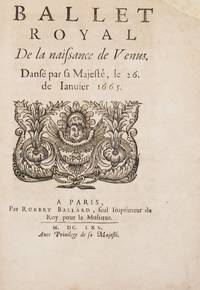
16653806A Paris: Par Robert Ballard seul Imprimeur du Roy pour la Musique 1665. First edition. Later green half morocco over marbled paper boards spine lettered in gilt. Italian provenance: early manuscript ownership inscription on the first leaf dated 30 Genn.o 1665 30 January 1665 partly torn and restored; later engraved armorial bookplate on the inner front panel. Paper tanned as usual; early folds and handling marks; otherwise clean and well preserved. First edition. Later green half morocco over marbled paper boards spine lettered in gilt. 52 2 p. <p><br /> Scarce first edition of the libretto of Lully's Naissance de Vénus a key work in the development of the French court-ballet tradition in a copy preserving a contemporary inscription dated only days after the premiere.<br /> <p><p><br /> First edition printed for the premiere of the libretto for the court ballet performed on 26 January 1665 at the Palais-Royal. The text was written by Isaac de Benserade and the music composed principally by Jean-Baptiste Lully at the request of Louis XIV and in honour of the king's sister-in-law Henrietta of England who appeared in the performance as Venus.<br /> <p><p><br /> The copy preserves an early Italian inscription dated 30 January 1665 only four days after the premiere suggesting that it may have been received in connection with the performance possibly by someone present at the court spectacle.<br /> <p><p><br /> The ballet belongs to the tradition of the French ballet de cour one of the principal ceremonial theatrical forms cultivated at the court of Louis XIV. The libretto presents a large mythological spectacle in two parts comprising twelve entrées. Conceived on an exceptional scale the production involved 96 performers representing 106 roles accompanied by 20 musicians and 14 singers with Louis XIV himself appearing in the final scene as Alexander the Great.<br /> <p><p><br /> Printed libretti of this type formed part of the broader genre of festival books ephemeral publications describing royal festivities and spectacles staged for political and ceremonial display. The present libretto is accordingly included in the Oxford "Early Modern Festival Books" collection which documents printed accounts of court celebrations and theatrical spectacles across Europe. <br /> <p><p><br /> A rare printed witness preserving a contemporary inscription to one of the most elaborate court ballets of Louis XIV's reign and an important document of early French operatic culture marking the culmination of the ballet tradition from which Lully would soon develop the tragédie en musique.<br /> <p><p><br /> LWV 27 <br /> <p>. Par Robert Ballard, seul Imprimeur du Roy pour la Musique unknown
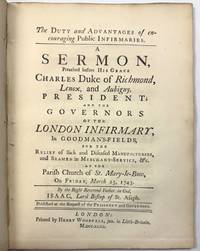
174341756London: Printed by Henry Woodfall jun. in Little-Britain 1743. 4to. 4 36 pp as issued with the half title. Disbound else Very Good.<br /> <br /> This is one of seven 1743 printings all by Woodfall at London and each with slightly different imprint. ESTC calls ours and three others the second edition. ESTC locates copies only at the University of Cambridge and UCLA. Pages 25-36 present a detailed account of the London Infirmary including patient accounts donors and governors. <br /> Maddox's text elaborates on Psalm xli: "Blessed is the man that provideth for the sick and needy. . ." Wikipedia's entry for Maddox notes his interest in promoting medical care and other charitable endeavors.<br /> ESTC N9048 2. Printed by Henry Woodfall, jun. in Little-Britain unknown
183425246Baltimore: Sands & Neilson 1834. 30 1 1 blank pp. Stitched untrimmed and partly uncut. Last two leaves foxed. Else Very Good with the ink ownership signature of 'Hon. Nathaniel Silsbee' a Massachusetts Whig who when this pamphlet was printed was a United States Senator.<br /> <br /> A rare pamphlet criticizing McKim a Baltimore Jacksonian Congressman for rejecting his constituents' instructions that he oppose Jackson's removal of the federal deposits from the Bank of the United States. McKim refused on the ground that about half the names of the alleged constituents did not appear on the rolls of qualified voters. <br /> R.D. Milholland Matthew Kelly George Thomae Aaron Clapp and Alexan. Kirkland representatives of each of the five wards in McKim's district angrily rebut McKim's assertion. They present a 20-page "List of Signers to the instructions to the Hon. Isaac McKim whose names are found on the poll-books of the first five wards of the city of Baltimore"; a List of Signers to the Instructions whose names were rejected by McKim although they were in fact legal and qualified voters; and another list of 205 names voters who would have signed the instructions but had been unable to do so in timely fashion.<br /> OCLC records copies of this pamphlet only at the Boston Athenaeum and Temple University. American Imprints adds the Boston Public Library and the Peabody Institute in Baltimore. <br /> AI 22849 2. OCLC 66290907 2 as of April 2020. Not in Sabin Eberstadt Decker. Sands & Neilson unknown
185027696New York: H. Ludwig & Co. 1850. First printing. Pamphlet. Fine. This address was delivered upon Valentine Mott's 1785 - 1865 departure as President of the New York Academy of Medicine. Mott was a well known American surgeon working on the staff of Columbia College as Professor of Surgery. He went on to be one of the founders of Rutgers Medical College and of the Medical Department at the State University of New York. <br /> <br /> Isaac Wood 1793 - 1868 was consulting physician to the New York Dispensary and Bellevue Hospital; consulting surgeon to the New York Ophthalmic Hospital; member of the American Geographical Society and fellow of the College of Physicians and Surgeons. American Medical Biographies Wikisource <br /> <br /> 8vo 26pp pamphlet title on tan front stiff paper wrapper cover dusty internally clean. OCLC: 22216316 8 copies. H. Ludwig & Co. unknown
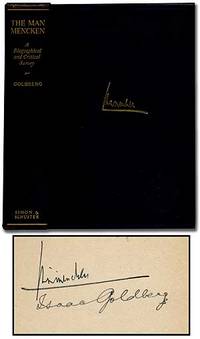
1925311165New York: Simon & Schuster 1925. Hardcover. Near Fine. First edition. Light stain on rear board else near fine lacking the dustwrapper. Signed by both Mencken and Goldberg on the front free endpaper. Schrader B58. Simon & Schuster hardcover
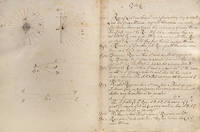
115619England late 18th century. . 100-leaf manuscript rectos and most versos filled wax seal remnants to front pastedown leaves wavy at the edges some spotting and marks to contents; contemporary calf-backed blue paper boards gilt floral tools to spine compartments binding marked and worn with spine cords partially exposed and loss of the blue paper morocco label lacking naphthalene smell good condition housed in a black cloth folding case.<br /> An unusual late 18th century manuscript on classical physics that cites Isaac Newton Blaise Pascal William Harvey Henry Power and others.<br /><br />The text approximately 200 pages presents an ordered and detailed account of a number of related topics: optics; hydrostatics and pneumatics; mechanics including simple machines such as the lever and screw the behaviour of descending bodies and pendulums; phosphorus and its chemical transformations; and fortifications and architecture. The notes are dense but generally neat and legible with carefully prepared diagrams so this seems to be a fair copy rather than a working notebook. <br /><br />Newton is cited in the section on light and colour: 'What Sir I.N. has said by way of in the last edit of his Opticks will appear to be an established truth from most if not all the following examples some of which he mentions himself". And Harvey in a short section on chemical transformations: "Harvey had says he the opportunity as well as the curiosity upon several occasions to examine the weight of when some of them taken up in places very distant from one another.'.<br /><br />The origin of much of the material is unclear though the long section on hydrostaticks was taken from Hydrostatical and Pneumatical Lectures by Roger Cotes 1682-1716 originally published privately in 1738 and with a second edition at Cambridge in 1747. <br /><br />Cotes was 'probably the most talented British mathematician of the generation after Newton'. He was nominated as the first Plumian professor of astronomy at Cambridge in 1706 and 'his appointment was favoured by his influential mentor Richard Bentley master of Trinity; by Newton's successor as Lucasian professor William Whiston who claimed to be in mathematics "a child to Mr Cotes" Whiston 133; and by Newton himself. In 1709 Cotes became heavily involved in the work for which he is best remembered namely the revisions for the second edition of Newton's Philosophia naturalis principia mathematica the first being out of print' Oxford Dictionary of National Biography. Cotes died young and Newton was reported to have said that 'if he had lived we might have known something'. A number of Cotes's lectures and mathematical analyses were published posthumously by his executor Robert Smith the Hydrostatical and Pneumatical Lectures being one of them. It is tempting to question whether other portions of the present manuscript are also based on Cotes's work and further academic scrutiny might be fruitful.<br /> England, late 18th century. hardcover
195011613New York: Herbert Reichner 1950 One of 750 copies printed by the Anthoensen Press. . Terra cotta cloth with front cover and spine stamped in gilt. Octavo. Frontisportrait ten plates one folding. Light shelfwear. Near fine. Without the very scarce second volume. Herbert Reichner, hardcover
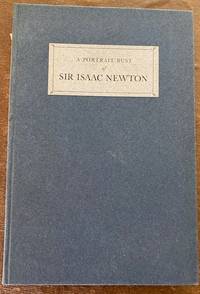
19261312<p><b>NEWTON Isaac. ADAMS Edward Dean. </b><i>A Portrait Bust of Sir Isaac Newton by Josiah Wedgwood the English Potter. </i>12mo original blue boards paper label frontispiece half-title title pp. 10 1 plate uncut. New York: Privately Printed by Bartlett Orr Press for the Engineering Foundation January 1926. <br /></p><p>Only Edition. Presented by Adams a noted engineer to great American mechanical engineer Ambrose Swasey see <b>DAB</b>: "To Ambrose Swasey. This record of a search in hopes that it may be as interesting to him as it was in its conduct to his sincere friend and well wisher. Edward Dean Adams June 10 1927." Frontispiece of the Newton bust which had been in the possession of Adams for over sixty years. With large Swasey ex-libris on rear pastedown depicting the "36 inch Lick Telescope" the observatory having been built by him. Not in <b>Babson</b>. <b>OCLC </b>locates four copies. No copies for sale online as of this date 1/28/22. Fine.</p> Engineering Foundation hardcover
199843806AB1998. First US Edition. Reading Addison-Wesley 1998. Octavo. 402 pages. Original Hardcover with dustjacket in protective Mylar. Excellent close to new condition. Michael White is a British writer based in Sydney Australia. Born in 1959 he studied at King's College London 1977-1982 and was a Chemistry lecturer at d'Overbroeck's College Oxford 1984-1991. He has been a science editor of British GQ a columnist for the Sunday Express in London and 'in a previous incarnation' he was a member of Colour me Pop. Colour Me Pop featured on the "Europe in the Year Zero" EP in 1982 with Yazoo and Sudeten Creche and he was then a member of the group The Thompson Twins 1982. He moved to Australia in 2002 and was made an Honorary Research Fellow at Curtin University in 2005. He is the author of thirty-five books: these include the international best-sellers Stephen Hawking: A Life in Science; Leonardo: The First Scientist; Tolkien: A Biography; and C. S. Lewis: The Boy Who Chronicled Narnia. His first novel Equinox - thriller an occult mystery reached the Top Ten in the bestseller list in the UK and has been translated into 35 languages. A recent non-fiction book is Galileo: Antichrist a biography of the great scientist and religious radical. Novels following Equinox include: The Medici Secret The Borgia Ring and The Art of Murder. Wikipedia. hardcover
180033248BB1800 . Paris: Brunot um 1800 16°. 208 S. 4 Tafeln Pappband Rücken beschabt; Ecken leicht bestossen; gut erhalten unknown
1970S10566Cambridge MA:: MIT Press 1970. 1970. 8vo. viii 351 pp. Index. Metallic silver cloth white-stamped spine dust-jacket; front jacket torn spine ends chipped. Ownership signature. Near fine in good jacket. ISBN: 0262160358 MIT Press, (1970). hardcover
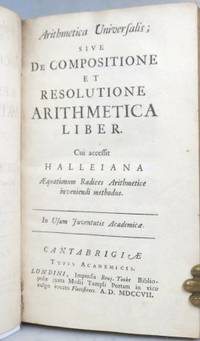
170751058Cantabrigiæ Cambridge: Typis academicis; Londini London impensis Benj. Tooke 1707. First edition. 8vo. viii 343 1 pp. 19th century full diced calf spine with raised bands gilt lettered black label blind tooled borders to the boards ownership inscription of a William Fitton dated June 1800 to the half title another contemporary owner's inscription - that of a Philip Crampton the date cropped "180" mathemetical annotations to the front and rear leaves and in the margins at intervals within. Joints skilfully repaired some mild soiling to the front and rear leaves an attractive copy. A mathemetical text composed entirely in Latin by Newton and edited by William Whiston who had succeeded him as the Lucasian professor of Mathematics at Cambridge University in 1702. The two had become acquainted during the previous decade and Newton was impressed enough with his acolyte that he invited him to lecture at the university when he was occupied with his other work. It was Whiston who persuaded Newton to publish some of his lectures on algebra but Newton was dissatisfied with Whiston's editing and additions to the text - to the extent that he considered buying the entire stock of the book to prevent its appearance in public. That clearly didn't happen although Newton succeeded in having the book published anonymously and its relative scarcity in commerce suggests a truncated print run. The first ownership inscription is that of the Irish geologist William Fitton 1780-1861. The son of a Dublin lawyer his paternal grandfather had been a mathematical instrument maker. Fitton began his studies at Trinity College Dublin in 1794 and earned his B.A. in 1799 but continued studying there until 1803. He went on to study medicine at Edinburgh University becoming a doctor in 1810 and continued his medical studies in London and Cambridge during the following six years. Fitton's interest in geology and mineralogy were his true passions and after marrying into a wealthy family he was able to devote his studies exclusively to these subjects. He subsequently served as secretary and later as president of the Geological Society published numerous reviews and papers plus a small number of books including 'A Geological Sketch of the Vicinity of Hastings' in 1833. Fitton was awarded the Wollaston Medal the society's highest prize in 1852. The other inscription is almost certainly that of Sir Philip Crampton 1777-1858 an Irish surgeon who awarded many honours and held various senior positions in a long and illustrious career: "elected FRS in 1812. In 1813 he was appointed surgeon-general to the forces in Ireland and he was surgeon to the queen in Ireland a member of the senate of the Queen's University of Ireland and four times president of the Royal College of Surgeons in Ireland in 1811 1820 1844 and 1855. In 1839 he was created baronet" ODNB. Cantabrigiæ [Cambridge]: Typis academicis; Londini [London], impensis Benj. Tooke unknown