[NEWTON, Sir Isaac]Biblio.com
26 496 résultats
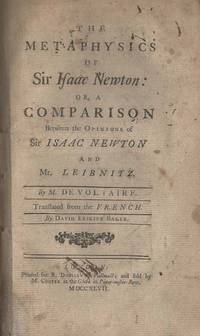
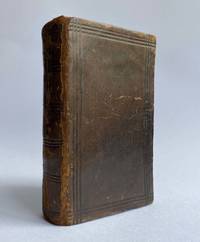
116359Cambridge & London Typis Academicis; Benj. Tooke 1707. . First edition; 8vo 20 x 12.5 cm; contemporary ownership inscription in ink to front endpapers contents fresh; contemporary sprinkled calf ruled in blind with floral tools in the corners red speckled edges spine lettered in gilt but rubbed with loss of the gilt joints ends of spine and hinges professionally conserved very good condition; 343 pp.<br /> First edition of Newton's treatise on algebra his 'most often read and republished mathematical work' Whiteside.<br /><br />'Sometime between the autumn of 1683 and early winter of 1684 Newton according to the statues of the Lucasian Chair deposited with the university his Lucasian Lectures on Algebra. The lectures bear dates from 1673 to 1683 but these were added in retrospect and it is highly unlikely that they were ever delivered to Cambridge students. From one point of view Arithmetica Universalis can be seen as a fulfilment of the program outlined by Descartes in Géometrie because it teaches how problems especially geometrical problems but also arithmetical and mechanical ones can be translated into the language of algebra which is here seen as the tool for problematic analysis; on the other hand Arithmetica Universalis contains two criticisms directed at Descartes' those being the preference for Apollonian geometry over Cartesian algebra in solving indeterminate problems and the argument that Descartes relied too heavily on algebraic criteria Guicciardini Isaac Newton on Mathematical Certainty and Method pp 61-62.<br /><br />By 1707 Newton had moved to London and his successor mathematician William Whiston took it upon himself to edit and publish the text. It is unclear how much say Newton had in this but he was unhappy with various aspects of the editing and typesetting and refused to have his name on the title page though in the end most of Whiston's changes would be retained in the 1722 edition seen through the press by Newton himself Cohen 'The Case of the Missing Author' in Isaac Newton's Natural Philosophy pp. 35-38.<br /> Cambridge & London, Typis Academicis; Benj. Tooke, 1707. unknown
174731752AB1747. First English Edition. London Printed for R.Dodsley 1747. Octavo. 72 pages. Modern cloth. The bookblock with signs of stitching to the inner margin possibly used to be part of a Sammelband. Last three leaves with paper-restoration and manuscript inscription to last page looks like a 18th century gift-inscription. With numerous manuscript - annotations in the tracts of George Berkeley namely in "A Word to the Wise" "Farther Thoughts on Tar-Water" "The Querist". From the library of Daniel Conner Manch House County Cork. Bound with: "Berkeley George Bishop of Coyne - "A Miscellany Containing Several Tracts on Various Subjects. By the Bishop of Cloyne. London Printed for J. and R. Tonson and S.Draper 1752. VI 267 1 pages. Title-page witme minor paper-restoration. This wonderful collection by the eminent ANglo-Irish Philosopher includes the following Pamphlets / Tracts as called for: 1. Farther Thoughts on Tar-Water 2. An Essay towards preventing the Ruin of Great-Britain 3. A Discourse addressed to Magistrates and Men in Authority. Occasioned by the enormous Licence and Irreligion of the Times. 4. A Word to the Wise - Or an Exhortation to the Roman Catholic Clergy of Ireland This section "A Word to the Wise" includes several interesting annotations: a. an underlining of the sentence: "Seeing you are obnoxious of the Law" with a comment "Oh! infamous" b. annotation: "the catholic clergy cannot be accused even by there greatest enemies of having been influenced by interested motives therefore this hint of his lordship was not of much avail" 5. A Letter to the Roman Catholics of the Diocese of Cloyne 6. Maxims concerning Patriotism 7. The Querist - Containing several Queries proposed to the Consideration of the Public 8. Verses on the Prospect of Planting Arts and Learning in America 9. A Proposal for the better supplying of Churches in our Foreign Plantations and for converting the Savage Americans to Christianity by a College to be erected in the Summer Islands otherwise called The Isles of Bermuda 10. A Sermon preached before the Incorporated Society for the Propagation of the Gospel in Foreign Parts; at their Anniversary Meeting in the Parish-Church of St.Mary-le-Bow in 1731 11. De Motu ; sive de motus principio & natura & de causa communicationis motuum ______________________________________________________________________________ hardcover
15678Gebonden in halfleer; 8 555 p. ill. Lit: Tiele 810 Bodel Nijenhuis 594. De auteur wordt in de voorrede genoemd. Zeldzaam werk waarin een uitvoerige aardrijkskundige beschrijving van de provincie. Van de vierde afdeling “Toestand van den landbouw en der landhuishoudkunde” is een facsimile-reprint gemaakt. De overige afdelingen handelen over: ligging natuurlijke gesteldheid bevolking nijverheid en koophandel godsdienstige gezindheden school- en armwezen en zeden. Het boek heeft twee uitvouwbare platen B.W. Dietz scup. met aanzichten en plattegronden van Gelderse boerderijen. unknown
#[15673]Gebonden in modern kunstleer; 8164 p. ill. De eerste paginas en de plaat gerestaureerd. Lit: Saalmink p. 1382. l Nadat in 1821 een door C.A.A. Buddingh vermeerderde tweede druk met illustratie was verschenen kwam in 1824 de derde druk van de persen. Het boekje is geïllustreerd met een gravure door J.C. Bendorp naar A. Schelfhout Gezigt op den Rijn van de hoogte unknown
15672Gebonden in later halfleer; 8 151 p. Rug ontbreekt. Lit: Bodel Nijenhuis 766 Saalmink p. 1382. Eerste druk van een succesvol gidsje voor de omstreken van Arnhem. In 1814 kreeg I.A. Nijhoff 1795-1863 van de gouverneur van Gelderland consent voor het vervaardigen van een topografische kaart van de streek rond Arnhem. Deze aldus het juni 1820 gedateerde voorbericht van het boekje zou in 1820 het licht zien getekend door G.J. Dibbets en gegraveerd door Van Baarsel. De kaart was aanleiding tot het schrijven van dit boekje zodat men met kaart en boekje de “meest aanlokkende wandelingen” zou kunnen maken. unknown
15674Origineel karton; 8 167 p. ill. De prent met foxing. Lit: Saalmink p. 1383. Opnieuw herziene druk vooral in verband met het verleggen van wegen het uitbreiden van sommige plaatsen en andere veranderingen. unknown
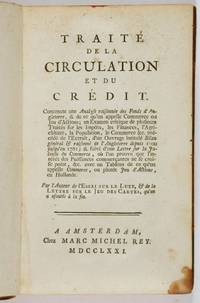
177153117Amsterdam: Marc Michel Rey 1771. First Edition. Very Good. Octavo. xvi 128 8: "Etat des Finances en Angleterre" 129-384 2: errata; blankpp. Woodcut ornaments; 4 half-titles. Collation: 8 A-H8 H4 I-Z8 Aa8 chi1 = 205 leaves. Contemporary marbled calf lightly rubbed at extremities gilt-tooled spine with raised bands gilt morocco lettering piece; edges stained red; marbled endleaves. Small patch of marginal damp staining to bottom corner of first 15 and final 10 leaves; signature Aa mildly embrowned else text crisp and clean throughout. Overall a very good copy.<br /> <br /> Rare complete first edition of "one of the great documents in the history of political economy" EJ. In addition to the brief discursus on English finances inserted between the second and third parts of the main treatise our copy includes the usually missing supplement pp. 369-384 "Addition au Traité de la Circulation et du Crédit. Mémoire pour la suppression du Belasting" along with the concluding errata leaf.<br /> <br /> The present Treatise is a refutation of the physiocrats who had advocated a primarily agricultural economy. Arguing against Hume de Pinto seeks to defend the economically productive role of the national debt which he sees exemplified in the current British system. While Marx notoriously described de Pinto as "the Pindar of the Amsterdam stock exchange" for his advocacy of speculation Werner Sombart regarded him as the "beginner of the modern age of economics and the first to understand the growth of credit" EJ. De Pinto's other works include Essai sur le luxe and Du jeu de cartes both reprinted in the present work and the later Precis de arguments contre les matérialistes The Hague 1774.<br /> <br /> The main treatise is divided into four parts followed by six brief works: 1. Lettre sur la jalousie du commerce Letter on the Jealousy of Commerce; 2. Tableau ou Exposé de ce qu'on appelle le Commerce ou plutôt le Jeu d'Actions en Hollande A Presentation of What is Called Commerce or the Game of Actions in Holland; 3. Methode dont on se sert en Hollande pour faire la perceptions des taxes & des impôts sur les biens fonds; & comment on en verse le provenu dans la Caisse de l'Etat The Method Used in Holland to Collect Duties and Real Estate Taxes and How the Proceeds Are Payed into the State Treasury; 4. Essai sur le luxe An Essay on Luxury first printed at Amsterdam 1762; 5. Lettre de l'autheur à Mr. D. sur le jeu des cartes The Author's Letter to Mr. Diderot on Card Playing first printed at London 1768; 6. Mémoire pour la suppression du Belasting ou Impôt sur les Actions de Compagnie des Indes Orientales A Memorandum for the Suppression of the "Belasting" or Tax on the East India Company Shares. The final opuscule which appears in relatively few copies of the Traité is published here for the first time.<br /> <br /> Isaac de Pinto 1717-1787 was the scion of a wealthy Sephardic family which traced their origins back to Portugal and had emigrated to the Dutch Republic. "He had a broad education and had mastered many languages in which he corresponded with famous philosophers and maintained contact with the European elite of his day including the court of the Dutch stadholder. In 1748 he helped to finance Stadholder William IV's war against France" Bernfeld & Wallet. "For his services in arranging favorable terms for English trade in India at the Treaty of Paris which ended the Seven Years' War 1756-63 Pinto was lavishly rewarded by the East India Company a few years later 1767" EJ. His correspondents included David Hume and Denis Diderot. De Pinto made a name for himself when he responded to Voltaire's mocking article on the Jews which appeared in the latter's Dictionnaire Philosophique with his Apologie pour la nation juive Amsterdam 1762. Presenting himself as a proud Portuguese he argued that "Voltaire had neglected to draw a distinction between the often wealthy Sephardim with their refined manners and the Ashkenazim whom he regarded as far poorer and sometimes unprincipled as a result of persecution and economic misery" Bernfeld & Wallet. Barbier 4: 752; T. L. Bernfeld & B. Wallet Jews in the Netherlands: A Short History Amsterdam Univ. Press 2023 p. 89; Enc. Jud. 13: 553-554; Goldsmiths' 10792; Kress 6812.<br /> <br /> Full title and Imprint: Traité de la Circulation et du Crédit. Contenant une Analyse raisonnée des Fonds d'Angleterre & de ce qu'on appelle Commerce ou Jeu d'Actions ; un Examen critique de plusieurs Traités sur les Impôts les Finances l'Agriculture la Population le Commerce &c. précédé de l'Extrait d'un Ouvrage intitulé Bilan général & raisonné de l'Angleterre depuis 1600 jusqu'en 1761 ; & Suivi d'une Lettre sur la Jalousie du Commerce où l'on prouve que l'intérêt des Puissances commerçantes ne se croise point &c. avec un Tableau de ce qu'on appelle Commerce ou plutôt Jeu d'Actions en Hollande. Par l'auteur de l'Essai sur le Luxe & de la Lettre sur le Jeu des Cartes qu'on a ajoutés à la fin. A Amsterdam chez Marc Michel Rey. MDCCLXXI. Marc Michel Rey unknown
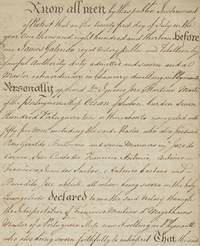
1813List1947Plymouth 1813. Plymouth Devon England: 21st July 1813. Folio 7 pages 13 1/8 x 8 ¼ inches duty blindstamp small ink stamp to upper inner margin of the first page two seals to the last page signed twice by Galindo. Toned some small repaired tears using reversible archival ph-neutral paper-repair tape very good to near fine. Very Good. An interesting document of privateering in the Peninsular war this ‘Public Instrument of Protest‘ documents a Portuguese captain and crew complaint in detail to an English notary. After sailing from Calcutta to Brazil and then from Rio to just outside of Lisbon their ship the 700-ton ‘Oceano’ was seized and comprehensively ransacked by a French privateer the ‘Lion’ out of Lorient. Most of the crew and passengers were offloaded onto a passing American vessel the ‘Leda’ bound for Lisbon. Meanwhile the ‘Lyon’ escorted her prize towards the nearest French port but before a friendly haven was reached they were both set upon by the brigantine HMS ‘Achates’. The ‘Lyon’ escaped but the ‘Ocean’ was captured by Commander Morrison and the ‘Achetes’. The ’Ocean’ was taken to Plymouth and moored in the Hamoaze. The remaining Portuguese crew who had been forced to remain aboard the ‘Ocean’ by the French got a message to the ‘Ocean’s Master Dn. Ignacio Joze Martins and he and the boatswain made their way to Plymouth as quickly as possible. The sworn statement presented here is in English thanks to the translation given by Francisco Martins d' Magalhaens master of a Portuguese ship “now dwelling in Plymouthâ€<br /> <br /> The ’Oceano’ sailed from Calcutta to Brazil arriving 10th February 1813. She left Rio on 4th April all was plain sailing until the afternoon of the 7th June off the Rock of Lisbon when the ‘Lion’ showed up first under false British colors then French. The fighting was fierce the privateer was driven off once but eventually the ‘Oceano’ was taken. The night of the 7th June was spent by the French ‘conveying everything Moveable and Valuable from the Ocean to the Privateer’. The ‘Leda’ the US vessel landed the majority of the ‘Ocean’s crew including the Master in Lisbon on the evening of the 9th June.Monday 14th June the ‘Lyon’ engaged in a running battle with HMS ‘Achates’ and escaped but the ‘Achates’ did capture the ‘Ocean’. Wednesday 16th June the ‘Ocean’ arrived in Plymouth under the watchful eye of the ‘Achates’. Receiving the crew’s message the Captain of the ‘Ocean’ left Lisbon for Falmouth and then Plymouth arriving on the 20th July. The document was dated 21st July 1813.<br /> <br /> Full transcription available. unknown
184553859Boston: S. P. Andrews 1845. Stereotype broadside 7.5" x 10"; printed on blue paper chart of shorthand forms transcription of Psalm 100 and a brief overview of the Pitman system meant to introduce readers to it and to advertise shorthand publications. Light creases from previous folds near fine. An early advertisement for what was to become one of the most popular English shorthands in history. S. P. Andrews unknown
58318Sir Isaac Pitman & Sons Ltd. London; Phonetic Institute Bath. Union Square New York. No date. 16 cards printed rectos only within a printed envelope this now dusty and worn with an old ink blot the cards in very good condition. Not in COPAC. Sir Isaac Pitman & Sons, Ltd. London; Phonetic Institute, Bath. Union Square, New York. No date. unknown
elala6168New York: Stringer and Townsend 1855. First Edition. Bennett was the founder editor and publisher of the New York Herald. Bennett conducted the first ever exclusive interview with a sitting US President Martin Van Buren. “Bennett and the Herald used racist language advocated for Southern secession attacked Lincoln for trying to keep the Union together and generally opposed the American Civil War. In June 1863 the Herald supported a mass anti-war rally in New York City where the war was denounced as an unconstitutional crusade that would lead to freed Blacks flooding North and competing for white jobs.†Wikipedia Howes P-562. Sabin 64994. 12mo. pp. 2 p.l. ix-xxiv 25-488. engraved frontis. portrait. engraved frontis. portrait. original blind & gilt-stamped cloth head of spine chipped crack in upper front joint some foxing to frontis. 1 gathering sprung. elala6168 New York: Stringer and Townsend, 1855 hardcover
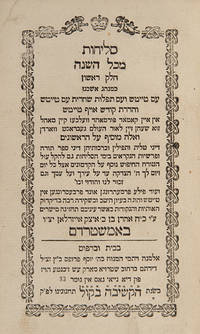
109036Amsterdam Widow and Orphans of Joseph Proops 1800. . 8vo two vols; publishers embossed leather boards with gilt ornamental borders to front and back and decorations to spine red morocco pastedowns to spine with gilt title in Hebrew spine corners rubbed and chipped with a piece missing from the top of the spine of vol. I hinges cracked but holding; all edges gilt contemporary Dutch marbled endpapers leaves clean; 1 52 120; 1 52 186 ll.<br /> Ashkenazic rite prayer-book with Judeo-German translation and commentary by Hadrath Kodesh edited by Aaron ben Isaac Eizerlohn. Title with ornamental border with atypical cupids to the top.<br /><br />The Proops family were a dynasty of well known Hebrew printers publishers and booksellers in Amsterdam. Solomon Ben Yosef d. 1734 whose father may have been a Hebrew printer as well was an established bookseller in Amsterdam and in 1704 had set up his own Hebrew press which produced mainly liturgical books as well as works on halakhah Kabbalah Jewish ethics and history. From 1715 productions by Proops carried advertisements of books he had published and in 1730 he issued a sales catalogue the first such Hebrew publication. <br />After his death appointed guardians continued to operate the press and even when his three sons took over they continued trade under the old name until 1751 and later - under their own names. In 1785 Joseph Proops sold most of his work to Kurzbeck of Vienna and when Proops died a year later his widow and sons continued printing on a small scale with various partners until 1812. Solomon ben Abraham Proops grandson of Solomon Ben Yosef split from the family printing house in 1797 and continued to work alone until 1827.<br /> Vinograd Amsterdam 2293. Amsterdam, Widow and Orphans of Joseph Proops, 1800. hardcover
19609593Moscow: Sovetskii khudozhnik. Good in Good dust jacket. 1960. Hardcover. 20 pp text 36 ff of plates many in colour which are tipped in. In Russian with text duplicated in French and German. White dust jacket with one of Levitan's landscapes to the front cover dust jacket is a bit grubby with losses at the spine tail. Linen look paper boards are clean bit of rubbing at extremities. Interior of the book is clean and unmarked. Errata slip at the rear. Because this is a Soviet production the book is bound using heavy staples at a number of points. Still very lovely and not easy to find. ; Folio 13" - 23" tall . Sovetskii khudozhnik, hardcover
1744L57-1626London 1744. Hardcover. Very Good. Speckled calf gilt-stamped lettering and ornament on spine. Both volumes a little rubbed along spine and edges of boards with small chips at head of spine and numbered stickers affixed to tail of spine. Some faint browning along edges of paste-down prelims and terminals -- but overall a nice clean text block. <br/><br/>Includes an interesting bookplate on the front paste-down engraved by Benjamin Levi for Isaac Mendes in London 1746 the earliest known bookplate made for a Jew. hardcover
16213503<p>A scarce pocket edition of this popular compendium of the lives of the Roman emperors modelled on Suetonius and said to be the work of the six authors on the title-page. Numerous scholalarly editions have been published over the centuries but the original authorship remains an enigma. The present edition is an amalgamated text combining Isaac Casaubon's original edition of 1603 with notes by Janus Gruterus and Claude de Saumaise.</p><p>OCLC lists Bodleian Amsterdam Chicago Illinois Chapel Hill and Concordia University.</p><p><em>12mo 123 x 65mm pp. 8 3-450 A1 pp.1-2 cancelled as usual woodcut title vignette very light water stain to lower outer corner outer edge trimmed minor toning </em> <em>bound in contemporary polished calf triple blind ruled a little wear to extremities early casemarks inked to front pastedown and title ownership inscription of M. Hapylton and purchase note dated 1733 on front endpaper printer's waste used for rear endpaper early bibliographical notes on rear pastedown. </em></p> Iacob Marcus
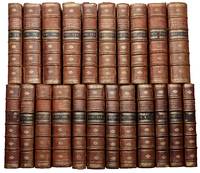
17326441London: Various printers to the Royal Society 1732. 1665-1732. <p>First edition of the first 426 issues an unbroken run from March 1665 to December 1732 of the world's oldest continuous scientific journal and the single most important record of the first announcement and communication of scientific discoveries and inventions PMM. It contains groundbreaking research by Newton - all 17 of his optical papers and therefore his first printed contribution to science - and by Halley Hooke Boyle Flamsteed Leeuwenhoek Cassini Hevelius Huygens and many others across astronomy physics chemistry mathematics medicine and natural history. Through Newton's optical papers of 1672-1676 the Transactions saw the first experimentally grounded proposal for the radical reform of a scientific theory to be advanced through a technical journal - a proposal that became the first to arouse international discussion and debate in print and within the pattern of public announcement discussion and professional consensus then established science has advanced ever since. Provenance: armorial bookplate of Sir Marcus Beresford 1st Earl of Tyrone 1694-1763; contemporary inscription at the end of one issue January 1692/3 noting its donation by Robert Hooke; manuscript corrections and notes on more than eighty pages with eight further pages on the measurement of the Earth bound in at the end.</p>. The World's Oldest Continuous Scientific Journal. <p>First edition of the first 426 issues an unbroken run from March 1665 to December 1732 of the world's oldest continuous scientific journal and the single most important record of the first announcement and communication of scientific discoveries and inventions PMM. It contains groundbreaking research by Newton - all 17 of his optical papers and therefore his first printed contribution to science - and by Halley Hooke Boyle Flamsteed Leeuwenhoek Cassini Hevelius Huygens and many others in astronomy physics chemistry mathematics medicine and natural history. Thomas Henry Huxley observed in his 1866 address On the Advisableness of Improving Natural Knowledge that if every book in the world apart from the Philosophical Transactions were destroyed the foundations of physical science would remain secure and the intellectual progress of the last two centuries largely recoverable. Long unbroken runs of the first four-and-a-half decades are now of the greatest rarity. ABPC and RBH record only two comparable sets at auction in the last three decades - Norman 1694 Christie's New York 15 June 1998 lot 716 $112500 and Macclesfield 1782 Sotheby's 25 October 2005 lot 1782 £96000 = $171400 - and a set of just the seven volumes containing Newton's papers on light realised $75600 at Christie's in October 2022.</p> <br /> <br /> <p>Provenance: armorial bookplate of Sir Marcus Beresford 1st Earl of Tyrone 1694-1763 Anglo-Irish peer and politician on the front pastedowns; contemporary inscription at the end of one issue January 1692/3 noting its donation by Robert Hooke; numerous manuscript corrections on more than sixty pages additional notes on about twenty pages and eight pages of manuscript notes on the measurement of the Earth bound in at the end.</p> <br /> <br /> <p>In November 1660 members of the Oxford Philosophical Club - John Wilkins John Wallis Robert Boyle Christopher Wren Robert Hooke among them - met a group of London natural philosophers at Gresham College and agreed to form a philosophical society that would meet weekly to exchange information and to conduct experiments. The society received its charter from the newly restored Charles II in 1662 and Henry Oldenburg a German-English diplomat and friend of Boyle was installed as one of its two secretaries. One of the charter's terms called for the exchange of information with other learned societies and Oldenburg almost at once began a sustained correspondence - with the Cimento Academy in Florence the Montmor Academy in Paris and after its foundation in 1666 the Académie Royale des Sciences - and with hundreds of working natural philosophers in places that had no scientific society of their own. Oldenburg was fluent in German Dutch French English and Latin and he was able to translate most foreign correspondence himself including Antoni van Leeuwenhoek's letters on his microscopical investigations and the communications of Johannes Hevelius of Gdansk and Marcello Malpighi of Bologna. After some years writing letters without salary Oldenburg decided to compile a monthly newsletter summarising a month's Royal Society activities and send it out to his correspondents in a single printing. On 6 March 1665 Old Style; 16 March by the Gregorian calendar then in use on the continent the first issue of the Philosophical Transactions appeared. It consisted of letter-excerpts reviews and summaries of recently published books and accounts of observations and experiments from European natural philosophers. Some of the pieces Oldenburg wrote himself summarising the minutes of Society meetings; others he translated or adapted from printed sources; still others were composite pieces assembled from the letters of several correspondents on a common subject. After his death in 1677 the journal passed through the hands of a succession of editors frequently also Secretaries of the Society - Edmond Halley and Hans Sloane the best-known among them - and through a succession of printers its form and content broadly reflecting the priorities of the current editor and to a degree of the Society. The Royal Society assumed financial responsibility for the journal only in 1752.</p> <br /> <br /> <p>Until the last third of the seventeenth century most original contributions to science appeared in books in which an author's own findings were embedded within a systematic exposition of a larger subject. The chartering of the Royal Society in 1662 and of the Académie Royale des Sciences in 1666 and the launching in 1665 of the Journal des Sçavans at Paris and the Philosophical Transactions at London gave institutional expression to a new conception of science as a cooperative enterprise: the immediate objective of the individual scientist became the experimental contribution to an eventual system of nature rather than the construction of the system itself and the journal article began to replace the book as the unit in which that contribution was made. Newton was the first to advance through this new medium an experimentally grounded proposal for the radical reform of a scientific theory and his proposal was the first to arouse international debate within the columns of a scientific journal. Through that exchange - in which all the participants modified their positions - a consensus of scientific opinion was produced; and within the same pattern of public announcement discussion and professional consensus science has advanced ever since Kuhn in Cohen Isaac Newton's Papers and Letters on Natural Philosophy 2nd ed. 1978 pp. 27-29.</p> <br /> <br /> <p>Newton's seventeen optical papers comprising his entire published optical contribution to the journal across the 1670s run as a single intellectual sequence: the seminal 1672 New Theory paper No. 80 pp. 3075-3087 introducing the prism experiment and the spectral analysis of white light; the catadioptrical-telescope paper No. 81; a series of exchanges with the French Jesuit Pardies Nos. 82 84 85 with Christiaan Huygens via an 'ingenious person from Paris' Nos. 96 97 and with the Liège Jesuits Linus and Lucas Nos. 110 121 123 128 - together more than half of the seventeen papers all responding to objections raised against the New Theory. Newton's answer to Hooke's objections No. 88 is the most polemical of the set prefiguring the priority dispute that would dominate the Principia years; the answer to Sir Robert Moray on behalf of the Royal Society No. 83 the most measured. Across the seven volumes containing them the papers transformed optics from a body of empirical reports into a quantitative experimental science driven by decisive testing among hypotheses and supplied the methodological core that Newton would eventually assemble decades later into the Opticks of 1704.</p> <br /> <br /> <p>These papers together constitute the first major contribution to science made through a technical journal - the medium that rapidly became the standard mode of communication among scientists - and as Christianson puts it if Newton had published nothing else the optical papers alone would guarantee him a place among the immortals of modern science Christianson In the Presence of the Creator 1984 p. 150. They yield further an insight into Newton's mental processes that the Principia and the Opticks - formal impersonal Olympian - conceal; it is in these early brief sometimes hasty letters to Oldenburg as in his notebooks and unpublished manuscripts that the creative scientist is to be found Kuhn in Cohen pp. 27-29.</p> <br /> <br /> <p>When Newton was first appointed Lucasian Professor at Cambridge in 1669 he chose optics for the subject of his first lectures and researches and by the end of that year he had worked out in detail the decomposition of a beam of white light into rays of different colours by means of a prism the complete explanation of the rainbow following from this discovery. These results formed the subject of his Lucasian lectures in 1669 1670 and 1671 and their principal conclusions were communicated to the Royal Society in February 1672 and printed soon afterwards in the Transactions No. 80. Before Newton light had been believed to be a homogeneous substance and colour was held to be produced by the mixture of light with darkness - the prism in the standard account supplying the darkness that coloured the light with all rays of white light striking the prism at the same angle being equally refracted. Newton's experiments led him to the radically different conclusion that white light is a mixture of rays of many distinct types each refracted at a slightly different angle and each responsible for producing one spectral colour. He set up a prism near his window at Trinity College and projected the spectrum onto a wall twenty-two feet away; to prove that the prism refracted light rather than colouring it he refracted the beam a second time back to white. The crucial experiment that confirmed the theory was to isolate a narrow ray of a single colour from the first spectrum and pass it through a second prism where no further elongation or separation occurred - a demonstration that each spectral ray was itself unmixed and uniformly refrangible. The reception of the paper was mixed. Many contemporaries simply ignored it; Mariotte in 1679 Pardies 1672 and Linus 1675 all claimed to have failed to replicate the basic experiments described. Rather than argue with them in detail Newton invited his critics to repeat his experiments with greater care; they did so without success. Others - Hooke among them who confirmed the experiments himself before a committee of the Royal Society in April 1676 - conceded the results but held that they could be accommodated by minor modification of existing theories making Newton's radical interpretation unnecessary. The controversy lasted six years after the paper's first appearance and left Newton conspicuously wary of publication.</p> <br /> <br /> <p>Newton's invention of the reflecting telescope reported in the issue immediately following his first optical paper No. 81 had in fact prompted the optical work rather than the other way round: the chromatic aberration of refracting lenses - their inability to bring different colours of light to a single focal point - was the original stimulus for Newton's investigation of the nature of light. Newton had sent Oldenburg his letter describing the telescope before his letter describing the new theory and had hoped to present the telescope as a practical test-piece for the theory. Oldenburg however printed the material in the reverse order the theory first followed by the description of the instrument. The telescope made a considerable impression at the Royal Society which promptly elected Newton a Fellow; a corresponding notice appeared in the Journal des Sçavans in February 1672 with emphasis on the instrument's compactness and it was the telescope rather than the theory of light that first made Newton's name known on the Continent Dilaura Bibliotheca Opticoria 1475-1925 2019 pp. 235-236.</p> <br /> <br /> <p>Newton published three non-optical papers in his lifetime all anonymously. His only published paper on chemistry Scala Graduum Caloris No. 270 April 1701 pp. 824-829 states what has since become known as Newton's law of cooling - that the rate at which a hot body loses heat is proportional to the difference between its temperature and that of its surroundings - and describes the construction of a thermometer capable of measuring temperatures up to almost 1000 °C. An Account of the Book entituled Commercium Epistolicum Collinii & Aliorum De Analysi promota No. 342 February 1715 pp. 173-224 is Newton's anonymous review of the Commercium epistolicum the official report of the committee appointed by the Royal Society to adjudicate in the dispute between Newton and Leibniz over priority in the invention of calculus - the most bitter and consequential priority dispute in the history of science; the Account purports to be impartial but was in fact written like the Commercium epistolicum itself by Newton. In the same volume No. 347 March 1716 pp. 399-400 appeared Newton's Problematis Mathematicis Anglis Nuper Propositi Solutio Generalis his response to a challenge problem set by Johann Bernoulli to the English mathematicians; tradition has it that Newton solved it in a single evening after returning from a day's work at the Mint. With the exception of this minor paper none of Newton's original work on gravitation or on mathematics was published in the Transactions. Edmond Halley's review of the Principia however appeared soon after its publication No. 186 pp. 291-297 - Halley was then the journal's editor - and is prefaced by an advertisement apologising for the fact that the Transactions had been delayed for some months because Halley had had the entire care of the Principia's own edition and had therefore as he put it been more serviceable to the Commonwealth of Learning in seeing Newton's book into print than he would have been in issuing his own periodical on time. Halley pointed out with justice that one of the most striking features of the Principia was Newton's great skill in using the new mathematics - by which Halley meant Newton's own method of infinite series.</p> <br /> <br /> <p>Edmond Halley 1656-1742 was one of the most original minds of his time and he made a long series of important contributions of his own to the Transactions. The best-known of them is Astronomiae cometicae synopsis No. 297 March 1705 pp. 1882-1899 the first printing of the theory according to which comets belong to the solar system and move in eccentric elliptical orbits; it was here that Halley set out his method of computing the motion of comets of establishing their periodicity in elliptical orbits and of identifying the comet that would bear his name DSB. The confirmation of the comet's return - in 1759 after Halley's death - was the first time that a body other than a planet had been shown to orbit the Sun the earliest successful observational test of Newtonian physics and a vivid demonstration of its explanatory power; the comet was named after Halley by the French astronomer Nicolas-Louis de Lacaille in 1759. Halley's other major contributions to the journal include his Methodus singularis No. 348 June 1716 pp. 454-464 in which he challenged the international astronomical community to use the transits of Venus across the Sun predicted for 1761 and 1769 to transform astronomy into a fully empirical science by measuring the Earth-Sun distance - a challenge that astronomers took up organising expeditions to the farthest corners of the globe and overcoming obstacles of every kind; A short History of the several New-Stars No. 346 December 1715 pp. 354-356 in which he observed that the new stars of 1572 and 1604 Tycho's and Kepler's stars were not the only changing stars on record that others had been observed in 1596 1600 1670 and 1686 some of them fading and reappearing and one of them - Mira - appearing to wax and wane with a regular 330-day period; An Account of several Nebulae or lucid Spots like Clouds No. 347 March 1716 pp. 390-392 in which Halley assembled the first list of known nebulae with their discoverers crediting the Great Nebula in Orion to Huygens the Andromeda nebula to Boulliau and the two spherical nebulae in Centaurus and Hercules to himself; 'Of the infinity of the sphere of fix'd stars & Of the number order and light of the fix'd stars' No. 364 April 1720 pp. 22-26 in which Halley posed what later generations would call Olbers's paradox a century before Olbers did; and outside astronomy his paper on the Breslaw life table No. 196 January 1692/3 pp. 596-610 which produced the first life table based on sound demographic data and gave the first correct calculation of annuities using essentially the methods still in use today - a paper of first importance in the history of statistics.</p> <br /> <br /> <p>John Flamsteed 1646-1719 was with Halley the most important English astronomer of his generation; his major works are the Historiae coelestis first published in 1712 without his consent by Halley and Newton and the Atlas coelestis published posthumously in 1729 but he also contributed more than thirty articles to the Transactions chiefly on observational astronomy. No other Astronomer Royal before Airy displayed anything like Flamsteed's concern for the reduction and manipulation of his own data: far from bequeathing the mass of raw observations that Bradley would he reduced and applied them himself DSB.</p> <br /> <br /> <p>Robert Boyle 1627-1691 contributed some thirty-seven papers to the Transactions Fulton p. 138 among them his influential questionnaire General Heads for the Natural History of a Country a number of major experimental essays that sometimes filled a whole issue and most revealingly An Experimental Discourse of Quicksilver growing hot with Gold No. 122 February 1675/6 pp. 515-533 - a paper on a kind of mercury that would incalesce when amalgamated with gold suggesting that Boyle had achieved the long-sought alchemical philosophical mercury capable of transmuting base metals. Boyle's trials went back to 1652 when he had received the recipe from his American mentor George Starkey; his decision to go public in 1676 signalled a newly intense period of alchemical activity on his part. The paper drew from Newton - himself a committed alchemical enthusiast - a letter to Oldenburg urging that such matters were not to be communicated without immense damage to the world if there should be any truth in the Hermetic writers; Oldenburg took the hint and the incalescence paper remained a one-off in the Transactions Hunter Alchemy in the Transactions Royal Society blog 1 July 2015.</p> <br /> <br /> <p>The Dutch microscopist Antoni van Leeuwenhoek 1632-1723 contributed 116 articles to the Transactions over the half-century 1673-1723; the most famous of them the letter on the protozoa No. 133 March 1677 pp. 821-831 gives the first detailed description of protists and bacteria in a range of environments. Leeuwenhoek is universally acknowledged as the father of microbiology: he discovered both protists and bacteria but more than being the first to see the microscopic world of his animalcules he was the first even to think of looking - certainly the first with the power to see. Using his own deceptively simple single-lensed microscopes he did not merely observe but conducted ingenious experiments exploring and manipulating his microscopic universe with a curiosity that belied his lack of any map or bearings. The verification of Leeuwenhoek's new world by the natural philosophers of the Royal Society set out the ground rules that still define experimental science today Lane The unseen world: reflections on Leeuwenhoek 1677 Philosophical Transactions B370 2015 pp. 1-10.</p> <br /> <br /> <p>Martin Lister 1639-1712 contributed in 1673 what is now regarded as the earliest journal article on palaeontology: A description of certain stones figured like plants No. 100 pp. 6181-6191 on the preservation of St Cuthbert's beads - crinoid remains - in the approximately 350-million-year-old Carboniferous limestones of northern England. The biological nature of fossils was then controversial: Kircher had argued that they formed by abiogenic plastic forces within the rock while Hooke and Steno had suggested they were the remains of living organisms. Lister was the first to explore how direct observation could decide between the two making observations about what modern geobiology calls taphonomy and biogenicity criteria - observations that presage current debates about the earliest signs of life on Earth and Mars Brasier Philosophical Transactions A373 2015 pp. 1-16. Other natural-historical papers scattered through the journal's first century - Account of a very odd monstrous calf Some experiments and observations on May-dew Some observations on strange swarms of insects - are in places fanciful but in many others acute; Hooke's own contributions which began in the very first issue March 1665 with A spot in one of the belts of Jupiter are sometimes held to include the first observation of the Great Red Spot still visible on Jupiter today.</p> <br /> <br /> <p>The early volumes also contain the record of the world's first experiments with blood transfusion conducted in England in the mid-1660s. The procedure - gruesome - was first carried out between dogs with arteries and veins in the animals' necks opened and blood transferred from one to another through quills most likely of goose feather inserted into the vessels and clamped with running knots; in the physician Richard Lower's account No. 20 pp. 353-358 the transfusion came to an end when the emittent dog fell into convulsions and died. Shortly afterwards Boyle published a remarkable set of questions about the likely effects of transfusion on the animal receiving blood No. 22 pp. 385-388 asking whether transfusion might change a dog of one breed into another alter its temperament render a fierce dog cowardly transmit satiety or hunger obliterate learned behaviours or make a dog forget its master - a sequence of questions which as recent commentators have noted read like an alchemical programme turned inward upon the living body. Researchers soon proposed transfusion into a human subject. Since the procedure generally killed the emittent a human-to-human transfusion was thought impossible and a sheep was settled upon as donor. The choice of human recipient fell in 1667 upon Arthur Coga - mentally unstable but sufficiently educated to report in Latin on the effects of the procedure - and the operation was performed by Lower and the physician Edmund King No. 30 pp. 557-559 who judged that Coga had received nine or ten ounces of sheep's blood. A few days afterwards Coga reported back to the Society in Latin and Samuel Pepys meeting him at a dinner party shortly thereafter found him to speak very reasonably though cracked a little in his head.</p> <br /> <br /> <p>Other contributors in these decades include Cassini on the satellites of Jupiter Huygens on mechanics and optics Malpighi Swammerdam Borelli Steno Fahrenheit and Redi whose experimental refutation of spontaneous generation appeared in the journal alongside a steady stream of domestic material from Harvey Wren Ray Petty Locke Wallis Winthrop Tyson Lancisi Leibniz and Hales. To turn the pages of these thirty-seven volumes is to watch the first two generations of a new scientific public discover how to work together - how to record observation propose hypothesis invite replication agree or disagree in print and build by open argument the provisional consensus that is the hallmark of modern science.</p> <br /> <br /> <p>References: Grolier/Horblit 95b - Macclesfield 1782 - Norman 1694 - PMM 148 Vol. 1 - Brasier Deep questions about the nature of early-life signals: a commentary on Lister 1673 Philosophical Transactions A373 2015 pp. 1-16 - Christianson In the Presence of the Creator 1984. Cohen ed. Isaac Newton's Papers and Letters on Natural Philosophy 2nd ed. 1978 - Dilaura Bibliotheca Opticoria 1475-1925 2019 - Fulton A Bibliography of the Honourable Robert Boyle 1932 - Lane The unseen world: reflections on Leeuwenhoek 1677 Philosophical Transactions B370 2015 pp. 1-10.</p> <br /> <br/> <br/> 37 vols. bound in 22 4to 215 × 165 mm containing all issues from March 1665 No. 1 through December 1732 No. 426 with 380 engraved plates 306 folding 176 woodcut illustrations and diagrams and 7 folding tables occasional damp-staining a few tears and small holes occasionally affecting a word or two a few headlines shaved the plate in No. 56 map of part of Languedoc with a 7 cm tear that in No. 60 apparatus shaved at head and that in No. 196 with bottom corner repaired with loss of about a quarter of the plate relating to the dissection of a rat. Uniformly bound in eighteenth-century probably mid-1730s sprinkled calf spines ruled and tooled in gilt in compartments with title and volume-number labels some joints cracking but firm a few labels missing slightly rubbed. Generally very clean and well-preserved. Various printers to the Royal Society unknown
1731EAHll[SA32Stockholm: Benjamin Gottlieb Schneider 1731. 1731. 2 Volumes in 1. pp. 8 p.l. 398 2; 1 p.l. 88 64 90 72. first title in red & black. woodcut ornaments. contemporary sprinkled calf gilt back rubbed spine & label bit chipped. old inscription on front free-endpaper: "Till Advocat Fisalen George Adolf Rutenschiöd". First Edition. "A survey of Dutch commercial affairs with considerable emphasis on its overseas companies and alliances." Bell Large sections are devoted to the Dutch East and West India Companies and their activities in Africa India south-east Asia and America. The engraved frontispiece to Volume II announced on the last page of Volume I was never published. Rare: two copies cited in NUC Harvard and Bell Library. Bell S35. Kress S.3380. Not in Sabin. Signed by Authors. F. Hardcover. Stockholm: Benjamin Gottlieb Schneider, 1731. Hardcover
197362750Chicago IL: Follett Publishing Co. 1973. 8vo. 381 1 pp. Blue publisher’s cloth silver lettering on spine w/ d.j. cover art by Franz Altschuler proted by the “Aldine†lamination process as issued very slight sunning to spine tiny chip at foot of spine still F/NF copy. First edition of this excellent 24-story anthology drawing upon 100 years of science fiction literature including first time stories specifically written for each of the categories: Robots Monstrosities Machines Mutants Time Travel & Space Travel by authors Rachel Cosgrove Payes William F. Temple Richard Posner Robert Silverberg Jeff Sutton and Dean Koontz respectively. Follett Publishing Co., hardcover
194162808Chicago & New York: Fictioneers 1941. 4to. 112 pp. Text illustrations by Kyle Thorp et al. Colour-illustrated softcovers cover art w/ initials R.C.S. yapp fore-edges as issued uniform interior toning as usual minor edgewear 1 very small closed tear VG copy. First edition of this installment in the 2nd year of the pulp magazine edited by Pohl which would only run until 1943 and featured Asimov’s 23rd science fiction short story “Heredity†examining the results of twins subjected to a psychological study. Fictioneers, paperback
194162881New York: Street & Smith Publications Inc. 1941. 4to. 162 pp. Text illustrations by Kramer Rogers & Schneeman. Colour-illustrated softcovers cover art by Hubert Rogers uniform light interior toning as usual slight shelfwear slight rubbing front cover 1 small closed tear at upper left corner slight bumping head of spine still VG- bright copy. First edition of this installment in Astounding Stories considered Campbell’s “Golden Age†and which here featured two stories from Heinlein including “Universe†and “Solution Unsatisfactory†under his Anson MacDonald pen-name. Also included are Asimov’s “Liar!†and the conclusion of De Camp’s “The Stolen Dormouse.†Street & Smith Publications, Inc., paperback
194062877New York: Street & Smith Publications Inc. 1940. 4to. 162 pp. Text illustrations by M. Isip R. Isip Kramer & Schneeman. Colour-illustrated softcovers cover art by Hubert Rogers uniform light interior toning as usual slight shelfwear slight dustsoiling front cover still VG bright copy. First edition of this installment in Astounding Stories considered Campbell’s “Golden Age†and which here featured the debut of Van Vogt’s “Slan†part 1 Heinlein’s “Blowups Happen†Asimov’s “Homo Sol†and others. Street & Smith Publications, Inc., paperback
196662730Boston: Houghton Mifflin Co. 1966. 8vo. 10 239 1 pp. Gray boards pink lettering slight shelfwear w/ d.j. cover art by Dale Hennesy minor scuffing to upper front cover shelfwear scuffing at foot of spine from removed label still a NF/G copy. Early Houghton edition $ 3.95 price front flap of this Nebula nominee science fiction adventure and movie tie-in released six months before the movie opened August 16 1966 and starred Stephen Boyd Raquel Welch Edmond O’Brien Donald Pleasence and others. Contracted to write the novelization of the script Asimov rewrote a number of plot holes and due to his speed was published prior to the film and won Academy Awards for Best Visual Effects and Best Art Direction in Color. Houghton Mifflin Co., hardcover
195163041New York: Stadium Publishing Corporation 1951. 8vo. 129 1 pp. Text illustrations. Colour-illustrated softcovers cover art by Hannes Bok slight interior toning very minor shelfwear slight creasing still VG bright copy. First edition of this installment of this early issue after the pulp was re-established in digest quarterly following World War II. Science fiction greats’ Bradbury Asimov Matheson and others are all featured. Stadium Publishing Corporation, paperback
194162909Chicago IL: Fictioneers Inc. 1941. 4to. 144 pp. Text illustrations by Morey G. Thorp. Colour-illustrated softcovers yapp fore-edges uniform light interior toning as usual minor shelfwear couple very minor closed tears still VG- bright copy. First edition of this installment in Super Science Stories launched as a cheaper companion to Astonishing Stories and which here features an an early Asimov short story “History†De Camp’s & Miller’s “Genus Homo†and jones’s “Captives of the Durna Rangue.†Fictioneers, Inc., paperback
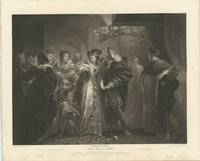
61396London: John and Josiah Boydell 1798 1803. Original copper engraving 44 x 60 cm overall sheet 55 x 68 cm. Light foxing to lower margin not affecting plate. From "A Collection of Prints. Illustrating the Dramatic Works of Shakespeare." published by Boydell London 1803. In 1789 the publisher John Boydell opened the Shakespeare Gallery an exhibition space in London's Pall Mall showcasing paintings that exclusively represented scenes from Shakespeare's plays. The Gallery was a bid to revive 'history painting' the practice of depicting scenes from the Bible mythology or the classics in contemporary British art a genre thought to be of great public benefit because of its morally instructive messages. What better unifying theme for such a project than the works of Shakespeare which had become so popular and so integral to British identity by the mid-18th century The Gallery opened in May 1789 with 34 canvases by 18 British artists. By the next year there were 55 paintings and in 1796 the total was 84 along with dozens of 'Small Pictures'. Once the exhibition was mounted reproductive engravings of the paintings produced by an in-house team of 46 printmakers were available to purchase either as a large portfolio of 90 prints or as a luxurious illustrated edition of the plays. The British Library London: John and Josiah Boydell, 1798 [1803]. unknown