1 504 résultats
1958Embry 96011Harvard U. Press 1958. First edition first printing. Inked date else fine in near fine dust jacket with a tiny chip to head of spine. Harvard U. Press, 1958. First edition, first printing. unknown books
1946S2624Berkeley:: University of California Press 1946. 1946. Second printing. 261 x 178 mm. 8vo. xxxv 680 pp. Frontis. port. title in red and black illus. Brown cloth. Very good. University of California Press, 1946. hardcover books
1970RH1293Cambridge:: MIT Press 1970. 1970. 8vo. viii 351 pp. Illus. index; pen mark on fore-edge. White stamped spine over silver cloth dust jacket; jacket torn corners nicked. Very good. MIT Press, (1970). hardcover books
1964S2618New York:: Citadel 1964. 1964. Series: The Science Classics Library. Reprint. 209 x 141 mm. 8vo. 447 pp. Illus. tables. Printed wrappers. Fine. Citadel, (1964). unknown books
1984S11195Cambridge:: Cambridge University Press 1984. 1984. Volume I only. Large 8vo. xix 627 pp. 3 plates figures bibliography index. Navy blue cloth gilt-stamped spine dust-jacket. Fine in near fine jacket. ISBN: 0521252482 Cambridge University Press, (1984). hardcover books
1984Embry 186093Cambridge U. Press 1984. First printing thus. Spine with slight lean else fine in fine faintly rubbed dust jacket in mylar cover. Cambridge U. Press, 1984. First printing thus. unknown books
1973BL3318Cambridge:: University Library 1973. 1973. 4to. x 129 pp. Illus. Gilt-stamped brown cloth. Burndy bookplate. Fine. ISBN: 0902205056 University Library, 1973. hardcover books
1978S10564Cambridge UK:: Cambridge University Press 1978. 1978. 8vo. xxi 415 pp. Frontispiece 4 plates index. Printed wrappers; spine creased. Very good. ISBN: 0521294363 Cambridge University Press, 1978. unknown books
1950BL3721New York AND Babson Park MASS:: Herbert Reichner AND Babson Institute 1950 AND 1955. 1950. 2 volumes. 8vo. xiv 228; xiii 91 pp. Illus. including folding plate frontis. index. Gilt-stamped pale red cloth. Burndy bookplates. Fine. Limited editions of 750 copies and 450 for second title printed by The Anthoensen Press. Herbert Reichner [AND] Babson Institute, 1950 [AND] 1955. hardcover books
1977BL3514Kent:: Dawson 1977. 1977. Large 8vo. xxiv 362 pp. Indices. Gilt-stamped navy cloth. Burndy bookplate. Near fine. ISBN: 0712907696 Dawson, (1977). hardcover books
1970S10566Cambridge MA:: MIT Press 1970. 1970. 8vo. viii 351 pp. Index. Metallic silver cloth white-stamped spine dust-jacket; front jacket torn spine ends chipped. Ownership signature. Near fine in good jacket. ISBN: 0262160358 MIT Press, (1970). hardcover books
1968RH1173London:: The Royal Society 1968. 1968. 8vo. 119-262 pp. Illustrated figs. and plates. Cream blue stamped printed wrappers; creased. Very good. Whole volume offered several other articles make up the full issue. The Royal Society, 1968. unknown books
1958S10196Garden City NY:: Doubleday Anchor Books 1958. 1958. Thin 8vo. 140 pp. 6 figures. Printed wrappers; front cover creased. Ownership signature. Very good. Doubleday Anchor Books, 1958. unknown books
1942Z1806Offprint from:: Proceedings of the American Philosophical Society 1942. 1942. Vol. 86 No. 1 September 1942. 265 x 205 mm. 12 pp. Illustrations. Printed wrappers; bisected fold with marginal tearing. Rubber stamp on front cover. Very good. Frederick E. Brasch was educated at Stanford University 1899 the University of California 1901 and Harvard 1916. He worked as a librarian at Stanford in Chicago St. Paul MN and in Washington D.C. before becoming chief of the Library of Congress scientific collection in 1925. He served as corresponding secretary of the history of science section of the American Association for the Advancement of Science from 1920 through 1928. "In 1941 Frederick E. Brasch Chief of the Smithsonian Division of the Library of Congress generously donated to Stanford his remarkable collection of books and manuscripts relating to Isaac Newton and the development of the physical sciences in the 17th century." Lowood Proceedings of the American Philosophical Society, 1942. unknown books
1972S11511Cambridge MA:: Harvard University Press 1972. 1972. Series: Russian Research Center Studies No. 69. 240 x 162 mm. 8vo. xviii 309 pp. Frontis. port. 47 figs. bibliog. index. Maroon cloth dust-jacket. Fine. Harvard University Press, 1972. hardcover books
1960S2628London etc.:: Abelard-Schuman 1960. 1960. FIRST EDITION. 223 x 145 mm. 8vo. 223 pp. Frontis. 4 plates bibliog. index. Original light green cloth dust-jacket. Fine. Abelard-Schuman, (1960). hardcover books
1740S13116Lausannae & Geneva: Marci-Michaelis Bousquet & Sociorum 1740. 1740. 4to. iv xxxii 363 1 pp. Half-title engraved frontispiece portrait of Newton engr. Jean-Louis Daudet after Vanderbank 12 engraved folding plates title vignette of 4 cherubs and a female figure each using an optical instrument representing learning optics/perspective drawn by Delamoncein and engraved by Daudet head & tail pieces and woodcut initial letters drawn by Papillon index; first 11 leaves browned. Contemporary full vellum green leather gilt-stamped spine label edges with decorative red freckling as designed by the binder; foot of spine with faint ink marking "11-". Paper unevenly browned. Verso of title with small ink annotation "=1135="; rear pastedown with another notation "á 20.Luglio 1801." Very good. Third Latin edition edited by Bousquet with a dedication to Joannes Bernoulli. This edition contains the full array of 31 querries. / "Newton's contributions to the science of optics :: his discovery of the unequal refractions of rays of different color his theory of color and his investigations of 'Newton's rings' to mention only a few of the most noteworthy :: place him among the premier contributors to that science. . . . Today we recognize that his work on optics offers unique rewards in its exciting innovative conjunction of physical theory experimental investigation and mathematics and in the revealing glimpse that it provides of a crucial period in the evolution of experimental science." :: Alan E. Shapiro The Optical Papers of Isaac Newton: Volume 1 1984 p. xi. / Jean-Louis Daudet 1695-1756 who made the frontispiece and title vignette was an engraver and print publisher active in Lyon inherited business from his father Etienne Joseph Daudet. He flourished from 1722 till his death in 1756. Thereafter the business continued by his widow in association with his son-in-law Louis Martin Roch Joubert until 1773. / "Newton famously declared that it is not the business of science to make hypotheses. However it's well to remember that this position was formulated in the midst of a bitter dispute with Robert Hooke who had criticized Newton's writings on optics when they were first communicated to the Royal Society in the early 1670's. The essence of Newton's thesis was that white light is composed of a mixture of light of different elementary colors ranging across the visible spectrum which he had demonstrated by decomposing white light into its separate colors and then reassembling those components to produce white light again. However in his description of the phenomena of color Newton originally included some remarks about his corpuscular conception of light perhaps akin to the cogs and flywheels in terms of which James Maxwell was later to conceive of the phenomena of electromagnetism. Hooke interpreted the whole of Newton's optical work as an attempt to legitimize this corpuscular hypothesis and countered with various objections." / "Newton quickly realized his mistake in attaching his theory of colors to any particular hypothesis on the fundamental nature of light and immediately back-tracked arguing that his intent had been only to describe the observable phenomena without regard to any hypotheses as to the cause of the phenomena. Hooke and others continued to criticize Newton's theory of colors by arguing against the corpuscular hypothesis causing Newton to respond more and more angrily that he was making no hypothesis he was describing the way things are and not claiming to explain why they are. This was a bitter lesson for Newton and in addition to initiating a life-long feud with Hooke went a long way toward shaping Newton's rhetoric about what science should be. . ." / "The first edition of The Opticks 1704 contained only 16 queries but when the Latin edition was published in 1706 Newton was emboldened to add seven more which ultimately became Queries 25 through 31 when in the second English edition he added Queries 17 through 24. Of all these one of the most intriguing is Query 28 which begins with the rhetorical question "Are not all Hypotheses erroneous in which Light is supposed to consist of Pression or Motion propagated through a fluid medium" In this query Newton rejects the Cartesian idea of a material substance filling in and comprising the space between particles. Newton preferred an atomistic view believing that all substances were comprised of hard impenetrable particles moving and interacting via innate forces in an empty space as described further in Query 31." :: Newton's Cosmological Queries :: MathPages. / Grace K. Babson Sir Isaac Newton 1950 141; George J. Gray A Bibliography of the Works of Sir Isaac Newton 182; Wallis 182. See: Printing and the Mind of Man 172. Marci-Michaelis Bousquet & Sociorum, 1740. hardcover books
1984S13602Cambridge UK:: Cambridge University Press 1984. 1984. Royal 8vo. xix 627 pp. 3 full-page black-and-white plates bibliography index. Navy blue cloth gilt-stamped spine label dust-jacket. SIGNED AND INSCRIBED by Shapiro. Fine. ISBN: 0521252482 Alan E. Shapiro's research is on Newton and his optical research and he is the editor of The Optical Papers of Isaac Newton. Most of the book presents the Lectiones Opticae and the Optica with the original Latin on the left and the translation duly annotated and cross referenced on the right. Cambridge University Press, (1984). hardcover books
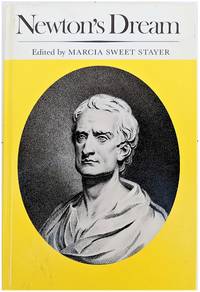
1988SS12721Montreal:: McGill-Queen's University Press 1988. 1988. Queen's Quarterly. 8vo. 135 pp. Illus. Pictorial boards. Fine. ISBN: 0773506896 Based on lectures and papers given at a conference held at Queen's University in 1987 and celebrating the tercentenary of the publication of Newton's Principia Mathematica--Cf. pref. "This lively collection of lectures presented at the symposium by prominent scholars was collected and edited by Marcia Stayer with the assistance of Boris Castel. The chapters outline the influence of the "Principia" on the work of Newton's contemporaries - such as Adam Smith - and on many areas of present-day science: particle physics optics astronomy and non-mechanical fields such as computer theory. Contributors include A.P. French Werner Israel W.H. Newton-Smith David Raphael Stephen Smale Steven Weinberg Richard S. Westfall and Denys Wilkinson. This book will be of interest to both general readers and students of science." CONTENTS: Newton and the Scientific Revolution; Science Rationality and Newton; Newton and Adam Smith; Isaac Newton Explorer of the Real World; From White Dwarfs to Black Holes: The History of a Revolutionary Idea; The Newtonian Contribution to Our Understanding of the Computer; Newton's Dream; Symmetry in Art and Nature; Contributors; Organizing Committee. McGill-Queen's University Press, (1988). hardcover books
1963S13609Cambridge:: Harvard University Press 1963. 1963. 8vo. viii 328 pp. 12 illus. pls. index. Cloth dust-jacket. Ownership ink signature of David C. Lindberg. Fine. First edition. Frank Edward Manuel was an American historian Kenan Professor of History emeritus at New York University and Alfred and Viola Hart University Professor emeritus at Brandeis University. Frank Edward Manuel was among the most respected European intellectual historians of the twentieth century. "Manuel's wide-ranging scholarly interests inspired groundbreaking works on utopias Christian Hebraism historiography and philosophers such as Isaac Newton Karl Marx and Henri Saint- Simon. A prolific author he wrote co-wrote or edited 20 books. His most popular work Utopian Thought in the Western World written with his wife won the American Book Award. Other notable publications included The Politics of Modern Spain 1938 The Age of Reason 1951 The New World of Henri Saint-Simon 1956 The Eighteenth Century Confronts the Gods 1959 Shapes of Philosophical History 1965 A Portrait of Isaac Newton 1968 Freedom from History 1971 The Changing of the Gods 1983 The Broken Staff: Judaism Through Christian Eyes 1992 A Requiem for Karl Marx 1995 and Scenes from the End: The Last Days of World War II in Europe 2000. Even as he approached age 90 Manuel remained active. Shortly before his death he was near completion on the book Varieties of Historical Experience and in 2004 his wife published their coauthored work James Bowdoin and the Patriot Philosophers. / Manuel was the recipient of numerous awards. He was a Guggenheim Fellow in 1957-58 a Center for Advanced Study in the Behavioral Sciences Fellow in 1962-1963 and a Phi Beta Kappa visiting scholar in 1978. He was also a member of the Institute for Advanced Study at Princeton University and a Fellow of the American Academy of Arts and Sciences. Along with the American Book Award Utopian Thought in the Western World won the Melcher Prize and the Phi Beta Kappa Ralph Waldo Emerson Award. Manuel received honorary degrees from the following institutions: Union Theological Seminary 1979; Brandeis University 1986; and the Hebrew-Union College-Jewish Institute of Religion 1998." Brandeis Harvard University Press, 1963. hardcover books
1995S13612New Jersey:: Humanities Press 1995. 1995. 8vo. ix 139 pp. Illus. index. Printed wrappers. Fine. ISBN: 039103877X Published posthumously as the author passed in 1994 while visiting the Grand Canyon. Dobbs was a prominent University of California Davis history professor known for her scholarship on Sir Isaac Newton. Professor Dobbs taught and researched the history of science specializing in early modern science and the history of alchemy and chemistry. Jacobs is History Professor Emeritus at UCLA. Humanities Press, (1995). unknown books
1747RW1580London:: Printed by W. Innys T. Longman and T. Shewell C. Hitch and M. Senex 1747. 1747. 2 volumes. 4to. 4 lxxv 1 475 1; ii 389 33 pp. Original full calf raised bands calf gilt-stamped red & brown spine labels; joints cracked. Small rubberstamp on title. Very good. NICE CLEAN COPY. Sixth edition "greatly improved by the author" of 'sGravedande's extensive experimentation and instruction in Newtonian physics. The experiments range from basic physics to hydraulics optics electricity and astronomy. The entire work is profusely illustrated with folding engraved plates detailing among many other experiments and apparatuses a steam-powered Hero's Engine plate 78 a static electricity generator plate 79 the first magic lantern slide projector plate 109 the prismatic effect of a rainbow plate 120 and the known solar system plate 122. 'sGravesande "is the author of Elements de physique demonstres mathematiquement. . . ou introduction a la philosophie Newtonienne which was translated from the Latin and published at Leyden in 1746. In the second volume he gives a description of an electrical machine constructed on the plan of that of Hauksbee. It consisted merely of a crystal globe which was mounted upon a copper stand and against which was pressed the hand of the operator while it was made to revolve rapidly by means of a large wheel." Mottelay. / Willem Jacob 'sGravesande was a Dutch philosopher and mathematician. Born in 's-Hertogenbosch he studied law in Leiden and wrote a thesis on suicide. In 1715 he visited London and King George I. He became a member of the Royal Society. In 1717 he became professor in physics and astronomy in Leiden and introduced the works of his friend Newton in the Netherlands. He was ardently opposed to fatalists like Hobbes and Spinoza. In 1724 Peter the Great offered him a job in Saint Petersburg but 'sGravesande did not accept. His best remembered work is Physices elementa mathematica experimentis confirmata sive introductio ad philosophiam Newtonianam or Mathematical Elements of Natural Philosophy Confirm'd by Experiments Leiden 1720 in which he laid the foundations for teaching Newtonian physics. / 'sGravesande's chief original contribution to physics involved an experiment in which brass balls are dropped with varying velocity onto a soft clay surface. This demonstrated that a ball with twice the velocity of another would leave an indentation four times as deep that three times the velocity yielded nine times the depth and so on. He shared these results with Emilie du Châtelet who subsequently corrected Newton's formula E = mv to E = mv2. / 'sGravesande was also the owner of the oldest known magic lantern which was built around 1720 by Jan van Musschenbroek and is currently housed at the Museum Booerhave in Leiden. / "From the outset of his teaching both physics and astronomy 'sGravesande modeled his lectures on the example of Newton in the Principia and Opticks although in later years they incorporated other influences especially that of Boerhaave. Moreover he adopted from Keill and Desaguliers the notion of demonstrating to his classes the experimental proof of scientific principles accumulating an ever larger collection of apparatus as may be seen from successive editions of his Physics elementa mathematica experimentis confirmata. Sive introductio ad philosophiam Newtonianam Leiden 1720 1721. The scientific reputation of 'sGravesande is enshrined in this book which he constantly corrected and amplified in later editions. An 'official' English translation prepared by Desaguliers to whom copies of the Latin original were sent in haste was also issued in 1720 and 1721 and it passed through six editions. The booksellers Mears and Woodward printed a rival version under the name of John Keill. French translations appeared only in 1746 and 1747 but a critical review by L. B. Castel was published in the Memoires de Trevoux in May and October 1721. The book was at once welcomed by British and a number of German scholars." – DSB V p. 510. References: Babson 70; Mottelay p. 181. Printed by W. Innys, T. Longman and T. Shewell, C. Hitch, and M. Senex, 1747. hardcover books
195526903New York: Herbert Reichner 1955. First editions limited to 750 and 450 copies respectively 8vo together 2 volumes: pp. xiv 228; and pp. viii 91; frontis portrait and 19 illus. on rectos and versos of 10 plates in main volume; supplement with one-page "Errata in Original Catalogue;" light wear and soiling main volume a little shaken but still overall a very good sound set. <br/><br/> Herbert Reichner unknown books
168118283Cantabrigiæ: Ex Officina Joann. Hayes Sumptibus Henrici Dickinson 1681 1681. Second English edition; the first was published in 1672 also by Hayes. ESTC R9979; Wing V107; Honeyman Sale Catalogue 3029. Edges and hinges repaired; prelims a little foxed; a very good copy. 8vo contemporary panelled calf rebacked raised bands. Five folding plates. Title-page printed in red and black. ¶ The celebrated treatise on scientific and comparative geography by the German geographer Bernhardus Varenius 1622-1650 first published in Amsterdam in 1650. It became the standard textbook on the subject for a century. Isaac Newton edited and revised this edition for his students at Cambridge; it was Newton's first published work. <br/><br/> Cantabrigiæ: Ex Officina Joann. Hayes, Sumptibus Henrici Dickinson, 1681 unknown books
195036261New York: Reichner 1950. In spite of its limitations this is still the best annotated bibliographical catalogue of Newton's writings. Reichner unknown books