1 504 résultats
186437372New York: Hurd & Houghton 1864. "A New Edition". Original publisher's tan half-leather bindings with marbled paper boards eps & edges. Gilt decorated spines. Average wear. Armorial bookplate of Henry T. Babcock. A VG set. 2 volumes: viii 9 - 419 3 blank; iv 5 - 453 5 blank pp. Index Vol II. Crown 8vo. 7-3/8" x 4-7/8" <br/><br/> Hurd & Houghton hardcover books
186621279NY: Widdleton 1866. A new edn. 2 Vols. 8vo pp. 419 453. Ex library. hinges tender. o/w VG. Essays on English literature criticism public opinion concerning literature etc. Widdleton unknown books
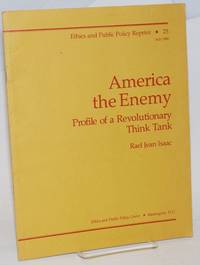
1980233705Washington DC: Ethics and Public Policy Center 1980. Pamphlet. 18p. wraps slightly worn else very good condition 8.5x11 inches. Ethics and Public policy reprint no. 25 July 1980. Right-wing attack on the Institute for Policy Studies. Ethics and Public Policy Center unknown books
184855074Boston: Oakes & Solomons 1848. First edition 16mo pp. 43 3; original purple cloth gilt spine sunned corner of upper cover stained; binding cracked at the end of the second gathering; all else good or better. The box was used for "revolving and sliding motions in the various kinds of machinery where great weight or speed are applied." Especially mentioned are railroad and steamboat uses. A notice that Babbitt's's interest in his Boston shop has been sold to William A. Pierpoint. <br/><br/> Oakes & Solomons hardcover books
009866Philadelphia: Blanchard & Lea 1853. First Edition. Cloth. Poor. Octavo 7¾" - 9¾" tall. 562 pp. George M. Grant's article on the sanitary conditions in Memphis Tennessee in the early 1850's open piles of excrement left as food for dogs and hogs; He has also contributed an article on a new obstetric forcebs with a folding plate Lower right front board gnawed with damage to corners of opening pages not affecting text. Otherwise volume is clean and good. Philadelphia: Blanchard & Lea, 1853 unknown books
009827Philadelphia: Lea & Blanchard 1841. Cloth. Fair. Octavo 7¾" - 9¾" tall. Limited. 535 pp. Moderate foxing in text. Philadelphia: Lea & Blanchard, 1841 unknown books
009873Philadelphia: Blanchard & Lea 1858. First Edition. Cloth. Very Good. Octavo 7¾" - 9¾" tall. 586 pp. Very clean text. Some rubbing on boards. Philadelphia: Blanchard & Lea, 1858 unknown books
009867Philadelphia: Blanchard & Lea 1852. First Edition. Cloth. Good. Octavo 7¾" - 9¾" tall. Slight dent in front board at upper corner light browning through text. Blake on California illness; Porter on US-Mexican War. Philadelphia: Blanchard & Lea, 1852 unknown books
009871Philadelphia: Blanchard & Lea 1860. Cloth. Very Good. Octavo 7¾" - 9¾" tall. 582 pp. Corners lightly turned light rubbing on boards text clean. Philadelphia: Blanchard & Lea, 1860 unknown books
009868Philadelphia: Lea & Blanchard 1845. First Edition. Cloth. Good. Octavo 7¾" - 9¾" tall. 532 pp. Sporadic browning and foxing in text. M.H. Houston's article on treating gunshot wounds to the chest. Graphic pictures on p. 99 of huge tumors also dislocation with twisted rope on p 355. Philadelphia: Lea & Blanchard, 1845 unknown books
009841Philadelphia: Lea & Blanchard 1845. First Edition. Cloth. Fair. Octavo 7¾" - 9¾" tall. 548 pp. Moderate foxing throughout. small tear at corner of p. 261-261 on American intelligence with about 20 words missing. Plates woodcuts of Uterus. Philadelphia: Lea & Blanchard, 1845 unknown books
009865Philadelphia: Blanchard & Lea 1851. A good copy with some rubbing. J. Mason Warren's "Occlusion of the Vagina" with wood cut. William Maxwell Wood Navy Surgeon's account of two suits of malpractice in Erie County PA; Henry H. Smith on Molluscum and Medullary cancer. Philadelphia: Blanchard & Lea, 1851 unknown books
009842Philadelphia: Lea & Blanchard 1844. First Edition. Cloth. Poor. Octavo 7¾" - 9¾" tall. One colored plate pages wavy and water damaged edges stained. Spotting on lower cover boards bowed. Scarce in any condition. Article on colored insane of the free states with chart comparing insane African-Americans in the North and South. Philadelphia: Lea & Blanchard, 1844 unknown books
181556657Providence: published by Isaac Bailey near the Turk's Head H. Mann & Co. printers 1815. First edition 12mo pp. iv 1 5-257 1; contemporary and likely original full calf red morocco label on spine; lightly rubbed the text a bit foxed else generally very good and sound. Bailey was a Providence author and publisher and was the first husband of Jane Angell grand-daughter of James Angell. The book is concerned almost wholly with the War of 1812 and presents memoirs of officers often not included in other compilations. Biographies of Thomas Truxton Edward Preble Alexander Murray John Rodgers Isaac Hull Stephen Decatur Jacob Jones James Lawrence William Bainbridge John Barry Nicholas Biddle David Porter Charles Morris William Henry Allen Oliver Hazard Perry William Burrows John Cushing Alywin and Thomas MacDonough. American Imprints 33904; Sabin 2732. <br/><br/> published by Isaac Bailey, near the Turk's Head, H. Mann & Co., printers unknown books
1828WRCAM49598Concord N.H. 1828. 44pp. Original red printed wrappers bound into later three-quarter calf and cloth gilt. Front cover detached moderate edge wear corners worn. Modern bookplate on rear pastedown. Moderate dampstain to the titlepage and first several leaves. Good. A commemorative address celebrating Andrew Jackson's victory at the Battle of New Orleans by Isaac Hill author of a biography of Jackson published by the same printers in the same year. Clearly intended as a Presidential campaign event the program includes short speeches in praise of Jackson from three other New Hampshire locals J.B. Thornton Nathan B. Felton and J.M. Harper. Scarce. SABIN 31829. hardcover books
124596hardcover. Illus. with b/w photos. 8vo cloth. N.Y. 1921.<br/><br/> unknown books
198248417Ocoee: Anna Publishing Inc. 1982. Hardcover. Very good. 317pp. Spine lightly sunned else very good paperback. <br/><br/> Anna Publishing, Inc. hardcover books
18086671New York: Printed for the Author by G. J. Hunt 1808. Full Calf. Very Good. 12mo. 90pp. including a 9pp. list of subscribers. Illus. with a woodcut headpiece and a hand-colored woodcut frontispiece. Modern calf gilt over boards. Occasional light water stains at various blank margins. Top blank margin of title with the cont. ownership signature of the lawyer James Woods who was one of the original subscribers. Austin #101; AMER. BIBLIOG. #14403. Printed for the Author by G. J. Hunt unknown books
1815275647New York: New-York Courier 1815. First. pamphlet. 21 pages printed with text in double columns. Original pamphlet sewn dampstain at upper corner and rough at edges but well inside the ample margins; some pages still un-opened. New York: At the Office of the New-York Courier 1815. First edition. A very good copy of this exceedingly scarce pamphlet. OCLC lists only 13 copies including those at Columbia Cornell Yale Harvard and the New York Historical Society.<br/><br/> Attributed to Isaac Bronson by F. Redlich in "The Molding of American Banking" 1868 volume 1 page 308. "Isaac Bronson was a highly successful financier of the Jacksonian era who was also one of the period's most original and influential banking theorists. Bronson accumulated his very considerable fortune in New York primarily by judicious personal money-lending operations on long-term bonds and mortgages at a cautious 7 per cent annual return supplemented by successful ventures in land speculation. In addition to wealth he had by the 1830's acquired a weighty reputation for sober financial conservatism and was regarded as an authoritative exponent of sound banking principles. Prominent in the financial community he had long thrown his weight as a sound banking theorist against the "wild-cat" practices of the then rampant state banks." --Venit A. 1945. The Journal of Economic History<br/><br/> New-York Courier unknown books
1875S8774London:: Macmillan 1875. 1875. 8vo. viii 348 pp. First few leaves with minor worming. Original maroon half calf gilt spine raised bands maroon cloth boards. Early ownership rubber stamp of J. O'Kinealy. A FINE COPY. FIRST EDITION. Todhunter was one of the most influential figures in mathematical education in the 19th century. Macmillan, 1875. hardcover books
179523991London: T. Cadell and W. Davies 1795. First Edition. 1 vols. 8vo. Bound in half later blue morocco and marbled boards all edges uncut. First Edition. 1 vols. 8vo. Very scarce. Roth Bibliotheca Anglo-Judaica B20; CBEL III 1278 T. Cadell and W. Davies unknown books
173123751London: E. Matthews R. Ford & R. Hett 1731. 12mo. 2 ix 1 360 pp. <br><br>First edition and scarce in commerce: Not in the CBEL list of his writings. Watts 16741748 an Independent minister wrote this as a response to a Strickland Gough essay and believed "the essence of religion as the dissenters' puritan fathers had known it lay in the proper relationship between minister and congregation" DNB online. <br>Â Â Â Â <br>Â Â Â Â ESTC T81766. Contemporary brown leather worn dry flaking; top of spine pulled with loss. Ex-library: bookplate on front pastedown rubber-stamps pencilling. Waterstaining and other stains; pages cockled. Hinges inside open. A poor scholar's copy. E. Matthews, R. Ford & R. Hett hardcover books
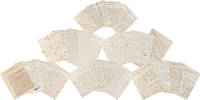
1827WRCAM55911Various locations mostly Valparaiso Chile; Callao and Lima 1827. Forty-six autograph letters signed or manuscript letters signed totaling 103pp. some with integral address leaf. All docketed at the top right edge of the verso of the last leaf likely by William Tudor himself. Original mailing folds light toning occasional short tears from opened wax seals. Overall very good. In a cloth chemise and half morocco and cloth folding case spine gilt. An important historical archive of letters received by William Tudor almost all while he was serving as United States Consul to Peru in Lima. The letters from a breadth of correspondents reveal the range of political cultural military and legal issues faced by an American diplomat serving in a South America during a politically volatile period and are especially interesting for detailing American diplomatic actions in South America in the years just after the issuance of the Monroe Doctrine. The letters are particularly notable for demonstrating the views and actions of the United States during the Peruvian independence struggle and showing the extent of the cooperation between the U.S. and Great Britain less than a decade after the conclusion of the War of 1812. They also paint a picture of the revolutionary actions of Simón BolÃÂvar in Peru the tight grip on the port of Callao by Spanish stalwart José Ramón Rodil and the interplay of American British Spanish Chilean and Peruvian officials in the region. <br> <br> William Tudor 1779-1830 was a leading citizen of Boston and the son of the first judge advocate of the Continental Army. Tudor was a founder and first editor of the NORTH AMERICAN REVIEW and helped found the Boston Athenaeum. He was the first Boston citizen to refer to the city as "The Athens of America" in an 1819 letter. Tudor was the U.S. Consul to Peru from 1824 to 1827 and Chargé d'Affaires at Rio de Janeiro from 1827 until his death there in 1830. <br> <br> The most prominent correspondent in this archive is Commodore Isaac Hull 1773-1843 represented by twelve letters to William Tudor. The Hull letters are a mixture of seven autograph letters signed from Hull and five manuscript letters in a secretarial hand but signed by the Commodore. Hull's letters report on the naval blockade of Peru American movements around South America and the struggles of Simón BolÃÂvar's South American independence movement and also touch on the ultimate defeat of the Spanish in Peru. At the time these letters were written Hull was commander of the United States Pacific Squadron and the letters emanate from Hull's flagship the USS United States positioned in Callao Bay as part of a joint American-British blockade. Hull had a long and distinguished career in the United States Navy beginning during the Quasi War with France battling Barbary pirates and commanding the USS Constitution during the War of 1812. He went on to serve as commandant of the Washington Navy Yard and as commander of the Mediterranean Squadron. Letters by Hull are scarce on the market especially in the quantity quality and intimacy of content seen here. <br> <br> In his first letter on May 28 1824 Hull writes about meeting British naval figure Martin Guise who was at this time serving with the Chilean Navy during the Peruvian War of Independence from Spain. Hull mentions the current blockade in his first two letters writing in the first: "I fear that they will not go all length with me in the blockade; they appear disposed to allow something like a coast blockade." His second letter of June 8 includes more details on the efforts during the blockade namely that Guise is "doing what he has the authority to do from Bolivar" and Captain Prescott "has in great measure made up his mind to submit to the blockade of Guise even in its present form." <br> <br> Hull's communications increase beginning in August and he writes to Tudor on August 21 that he must refuse his request to land U.S. Marines in Lima for the protection of American officials but agrees to send a "sea officer with arms" and as many seamen as necessary "for the protection of American Citizens only" but that they "must be kept within their houses or yards." <br> <br> In his next few letters Hull reports on the ships Dolphin and Peacock being routed to Valparaiso to provide strategic defense to American shipping vessels in the region and asks for more information and communications from Tudor regarding the ships Carington and Nancy condemned by Spanish General José Ramón Rodil. In a September 11 letter Hull states that Rodil intends to sell the two ships and that "it may be necessary for me to take measures that will not please his excellency as I consider his conduct is and has been for some time hostile towards us and cannot much longer be submitted to." Hull also invites Tudor to his ship to "spend the day with your friends Capt. and Mrs. Maling" who were onboard Hull's ship the previous night. Hull and Thomas James Maling were fellow commanders of the American and British forces respectively during this period around Peru. Maling commanded the British ship the Cambridge which is referenced in some of the letters here. José Ramón Rodil was commander of the port of Callao for the Spanish government and one of the last remaining Spanish officials to surrender to BolÃÂvar; he stubbornly refused to officially cede control of Callao until 1826 when he finally gave up and returned to Spain. <br> <br> On October 15 Hull writes to Tudor about the attitudes of the Spanish government "towards our commerce." Hull fears that should the Spanish invoke "the laws of the Indies" against American officials in Peru then Hull and Tudor "shall be in a bad way." The Laws of the Indies were a series of Spanish laws dealing with the relationship between Spain and her colonies in America; Hull is perhaps worried here that if the Spanish government invokes these laws as a sovereign nation then the activities of the American government in South America would stand in violation of that sovereignty. <br> <br> Hull's troubles with Rodil continue in November when he informs Tudor that "the crew of the China had complained to Captain Maling of the bad treatment they had received from General Rodil stating that they were compelled to work and that some of them had been severely punished." Hull writes that he plans to demand the release of these sailors and the ship and if Rodil does not acquiesce he would "resort to reprisal and let the consequence be what it may." <br> <br> In Hull's next letter the true nature of the extreme treatment suffered by some Americans under Rodil is described. Hull writes a lengthy and passionate letter decrying the "injustice and cruelty of all the proceedings" which took place during the Spanish seizure of the China. Hull can no longer "remain inactive or insensible to the repeated wrongs of my countrymen." He then relates how some seamen were threatened with swords muskets or gallows. Hull thinks that "my government will justify me in any measures which I shall be compelled to take to obtain redress for the insults and wrongs which my countrymen have received and to prevent a repetition of them" After all claims Hull "there is not an American in this country knowing all things which have taken place who would not be willing to sacrifice every feeling of interest to have their rights respected." <br> <br> Hull's last two letters come after the decisive battle at Ayacucho in early December 1824 which effectively ended the Peruvian War of Independence in favor of BolÃÂvar's forces. On December 18 Hull transmits his original correspondence with Rodil to Tudor presumably so that Tudor can consolidate communications between American and Spanish officials now that Peru has won the war. Hull's final letter touches on duties owed by American vessels at Ancon; Hull recuses himself from the issue in favor of Tudor as such issues "should more properly come before you as consul or the merchants to whom he consigned and I consider any interference on my part would be improper and that it is a case entirely distinct from my duties." After all as a naval commander Hull is not responsible for imposing import and export duties related to commerce in newly-independent ports. Hull closes by writing that the news of Peruvian independence will be "such glorious news to the United States. It will be received with sincere pleasure by our government and every lover of freedom and humanity." <br> <br> Also present here are seven letters from the aforementioned Thomas James Maling plus one from his wife Harriet to William Tudor all of which were written between August and December 1824. Captain Thomas Maling was the scion of the Maling pottery family in England. He was commissioned into the Royal Navy in 1791 rising to vice admiral in 1830. During his time in Peru Maling was captain in charge of the HMS Cambridge which was stationed in Callao for most of Maling's time there. He married Harriet Darwin daughter of Erasmus Darwin and niece to Charles who accompanied him to South America. Sadly Harriet would die in 1825 in Valparaiso Chile. The Malings were very friendly with William Tudor as evidenced in the present correspondence which includes a friendly partial note from Harriet to Tudor in which she chides Tudor for not visiting their ship and offers to share with him "a good private and confidential letter". <br> <br> In his first letter dated August 18 Captain Maling agrees to take aboard his ship one of Tudor's friends and hopes "you are all made safe & happy by the party I have sent to guard you all at Lima." In his second letter on August 24 Maling mentions that "Guise is sending another Blockading Squadron" but that this will be "of insufficient force to stop the trade of Europe and North America." Maling hopes "your Commodore" meaning Hull agrees with him; blockades were prevalent during this time around Peru and Chile as the various revolutions led by and inspired by Simón BolÃÂvar took root. <br> <br> Maling's letter of September 4 concentrates on battle news in Peru reading in part: "Kelly who I believe you know of returned from the Liberator's Army and I believe brings us good news but he is still with Guise.There has been no second battle but Cantera's army dispersed after the 6th leaving him with only 2000 men with which he is hastening back to Cusco. It is supposed for the purpose of raising the Indians in favor of the Young Inca they have been keeping in reserve. The Commodore Hull has thought this information & what else Kelly may bring of sufficient importance to detain the Dolphin another day." <br> <br> Three days later Maling writes Tudor about a recent naval issue that prompted him to write to the commanding officer of the ship "to tell him he will be made responsible in future for the conduct or his officers & men and I hope we shall hear of no other instance of such impropriety but it is by no means thought here to be ours." This is followed by a mention of the ship China. Maling invites Tudor to his ship for a visit and tells him he may have the "opportunity of seeing a naval fight." This letter is likely concerned with the aforementioned troubles with the China in which American and British sailors were mistreated by Spanish authorities. <br> <br> Maling's October 15 letter is especially interesting as he mentions yet another blockade-related event: "There is an embargo on all vessels at Quilea & no communication permitted with the shore a pretty conclusive hint where our friends will go to when they sail from hence if Guise who is again sailing close in ever suffers them to depart in peace." <br> <br> Maling's last two letters date from December 1824 after BolÃÂvar's victory in Peru. In his December 8 communication he reports that "England has acknowledged the independence of those parts of America which actually form free states." The implication here is clear in that England is ready to recognize democratic regimes and nothing less. In his final letter Maling writes about the slowness in receiving news from the Peruvian government on naval matters though he allows for the "intoxication of success" felt by those in Peru who had just won their independence from Spain. Maling wishes them "so well to their cause that I shall not quarrel with them." <br> <br> Maling's penultimate letter alludes to the recent death of British Consul General Thomas Edward Rowcroft. The present archive includes two letters to Tudor from Rowcroft who was essentially Tudor's British counterpart in Peru. In his first letter dated June 19 1824 Rowcroft writes to Tudor about the "dispositions of the Viceroy on the appointment of Consuls in this Country" and on the importance of maintaining "mutual confidential communications" between himself and Tudor. Towards the end of 1824 on December 2 Rowcroft writes again to Tudor this time to ask about two English Navy vessels allegedly captured by a ship flying "Spanish Colours" and then recaptured by Tudor's brother-in-law Commodore Stewart. This last letter would have been among Rowcroft's final communications as he was gunned down a few days later while traveling back from Lima after delivering letters to Thomas Maling. Rowcroft supposedly held a pass that should have taken him safely through both the loyalist-held sections and the Bolivar-held areas of the city. As he presented his pass to authorities loyal to Bolivar at a checkpoint his coach was met with a hail of bullets as it rolled away. Rowcroft was shot in the hand and the torso and died on December 7; his death is now considered an unfortunate accident perhaps precipitated by a "death sentence" purposely written on his pass by loyalist officials hoping to get Rowcroft in trouble. If this was indeed their plan it worked. <br> <br> Other letters to Tudor here include a February 20 1824 note from John Dorr to Tudor in which Dorr discusses his ship Esther which was seized by the revolutionary government in Callao Peru. Dorr indicates that General BolÃÂvar is willing to "do what is possible to recover that valuable Ship & freight or ample indemnity." On April 18 1824 French Dr. A.V. Brandin writes to Tudor from Lima informing him of a shipment of quinine for Commodore Hull and his wife aboard the USS Franklin. Brandin allegedly founded the first medical journal in Peru and was apparently the first doctor to introduce quinine to South America. <br> <br> In other letters in this archive American ship captain Samuel C. Erwin writes to Tudor on April 22 1824 with regard to the seizure of a "case of Linnens" by the new Peruvian government along with a request to write directly to the governor in Lima for relief and for a "Certificate of American Property for my whole cargo which I have repeatedly applied for without being able to get it." American merchant seaman Thomas R. Gerry son of Elbridge Gerry writes to Tudor from Quilca Peru on August 18 1824 reporting on various business matters and providing a blistering description of Quilca which he sums up as a "miserable hole." Gerry also reports on two American prisoners of war taken by the Chilean government one of whom he currently has on his ship the Tartar while the other is still held at Arica. <br> <br> The present collection also includes a handful of letters from Michael Hogan U.S. Consul and Navy Agent at Valparaiso Chile from 1823 until his death in 1833. Hogan's first communication to Tudor is dated the day after Tudor took over as consul in Peru; Hogan is "anxious" but "hopes for the best" for Tudor in his new position. In June 1824 Hogan sends a short report to Tudor on political maneuverings in Valparaiso where General Pinto was to be appointed "supremo." One of his letters from July 28 1824 reports on political struggles within Chile where a Constitution had just been "amicably" voted down the Senate dissolved General Wager appointed director and General Pinto as prime minister until a new Congress was convened in three months. Another letter from Hogan dated August 9 1824 includes information on the Chilean government's efforts to sell church property "for the publick good." This was a standard practice in the post-colonial governments in South America who often converted church artifacts of silver and gold into new coinage. In this same letter Hogan reports that Chilean officials will soon forbid the importation of flour in favor of the "great landholders" in Chile who plan to produce their own "breadstuffs." <br> <br> Other communications to Tudor involve letters of introduction for new merchant ship captains an appeal by William Wetmore regarding shipping declarations made to General Rodil in Callao two short letters from U.S. consul to Peru James Prevost in Callao regarding permissions from the new Peruvian government Prevost would die in Lima on March 5 1825 and a handful of letters in Spanish from local officials one of which dated Feb. 12 1826 mentions mining in Lima "metales de plata" and "metales ricos un espia". <br> <br> There are also two letters written to Tudor before his time in Peru. One dated July 7 1822 from Thomas Dawes in Boston relates to a pamphlet Tudor wrote on Thomas Paine. The other is an October 30 1822 "Declaration and Protest" from a U.S. schooner called the Dolphin claiming unlawful seizure and false imprisonment by Peruvian officials in Callao; this document was perhaps inherited by Tudor when he arrived in Lima. There is even an intriguing partial manuscript which seems to be part of a confidential report on English government and their public attitudes towards the United States mentioning a debate in the House of Commons regarding "peace or war with America." <br> <br> In total these to William letters shine a rare spotlight on the American intervention in Peru and on the international political and economic machinations in South America during the 1820s. The archive provides a stark picture of American enforcement of the Monroe Doctrine which President Monroe had just elucidated in his State of the Union Address on December 2 1823. Spanish actions in Peru in the 1820s were seen as a violation of this new foreign policy stance by the United States particularly the tenet covering European colonial involvement in the Western Hemisphere. Of course the Monroe Doctrine also served American economic interests in South America which certainly motivated events such as the American blockade of Callao and the dispersal of the Dolphin and the Peacock to other South American ports. <br> <br> An outstanding collection of American diplomatic correspondence from an important moment in South American history. hardcover books
1938WRCLIT81400London: Bernard Quaritch Ltd. 1938. Quarto. Polished buckram. Facsimiles. Modest foxing to endsheets and edges prelims and the final four leaves a very good copy. First edition of this resumption of the project begun by Proctor and temporarily halted by his disappearance in 1903. Limited to 350 copies. Preface by Stephen Gaselee. Descriptions of books lists of publishers and patrons and indexes. Bernard Quaritch, Ltd. hardcover books
1855SKU1026777Baltimore: Hedian and O'Brien 1855. Hardcover. Good. 1855. Black cloth in original publisher blind stamped boards- boards have rubbed through at the corners- overall minor wear. Clean has a good binding no marks or notations. x 333 pages. 8vo. Hedian and O'Brien hardcover books