Wette, W. M. L. deAntiquariat.de

13 résultats
1847105757Leipzig: Weidmann 1847. VI, 156 Seiten. 8° (17,5-22,5 cm). Zeitgenössischer Pappband. [Hardcover / fest gebunden].
1892142854Freiburg i. B.: Akademische Verlagsbuchhandlung von J.C.B.Mohr (Paul Siebeck) 1892. XII, 216 Seiten. Gr. 8° (22,5-25 cm). Halblederband der Zeit mit goldgeprägtem Rückentitel und rot gefärbtem Schnitt. [Hardcover/fest gebunden].
1866ml45v33xbvkBerlin, Louis Gerschel Verlagsbuchhandlung, 1866. XIV, (2) 415 Seiten. - Original-Halbledereinband der Zeit mit dezenter Rückenvergoldung und goldgeprägtem Rückentitel; 8vo.(ca. 18 x 13 x 2 cm).
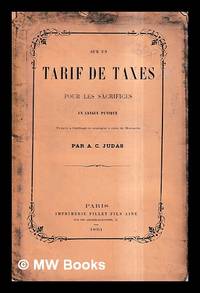
1861437885Paris 1861. Edition Unstated. Softcover. Very good pamphlet copy; wrappers slightly edge-dulled. Pages tanned as with age. Remains particularly well-preserved overall. Subject; Semitic languages and literatures. Paris paperback
1843303281843. unknown
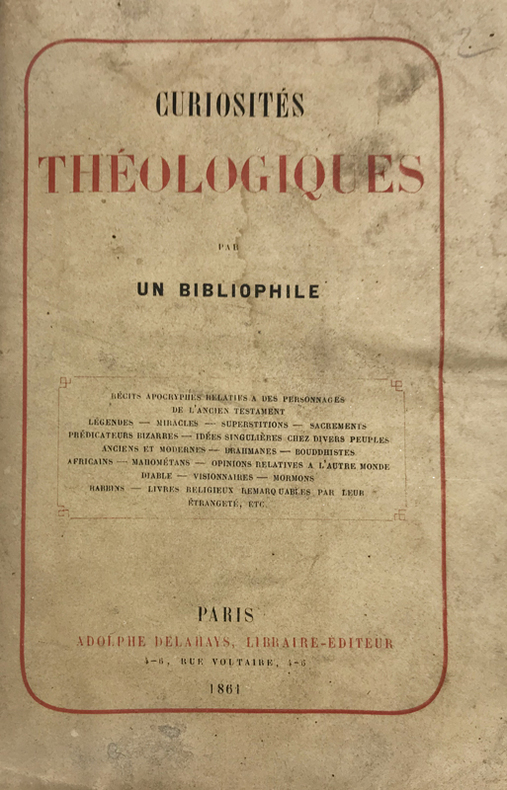
186110901Paris, Adolphe Delahays, 1861 ; in-16, broché ; (4), II, 358 pp., (6) pp. de catalogue du libraire, couverture beige imprimée en rouge et noir.
181623538Salzburg: Manrischen Buchhandlung. Very Good. 1816. First Edition. Hardcover. Bound in three-quarter leather. Text is in Old German. Not a new binding but certainly does not appear to be contemporary with the book. The endpapers appear to be newer than the binding. Happily the book does not appear to have been trimmed when rebound. The title page has a repair at the top where something was cut off. There are charts but no plates. ; 7 1/2"; 588 pages . Manrischen Buchhandlung hardcover
1842RO80207388Duriez Ch.. 1842. In-8. Relié demi-cuir. Etat d'usage, Coins frottés, Dos satisfaisant, Rousseurs. 93 pages.Quelques planches de figures en noir et blanc. Dos à nerfs avec titre, auteur et filets dorés. Plats jaspés rouge et contre plats jaspés vert. 2 photos disponibles. Très bon état pour l'année.. . . . Classification Dewey : 844-Essais
18250198-B1825. Kreidelithographie 1825, auf cremefarbenem Bütten. 40,1:28,6 cm. Literatur: Giordani S. 30.
185789743Klincksieck | Paris 1857 | 22.7 x 28.2 cm | Broché
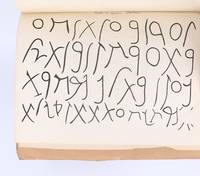
185789743Paris: Klincksieck 1857. Fine. Klincksieck Paris 1857 22.7 x 28.2 cm Broché First edition illustrated at the close of the volume with six plates printed out of text.Only three copies recorded in the CCF BnF Institut Strasbourg.Our copy is preserved in its original state issued in a temporary paper wrapper.Spine restored at head with small losses; marginal losses to the soiled covers; two small adhesive strips along the right margins of the final plate; authors name and title pencilled on the upper cover.The study of Phoenician languages was the speciality of Auguste-Célestin Judas 18051873. Klincksieck unknown
184743864Reliure demi-veau vert avec décoloration sur la coiffe supérieure. Dos lisse orné. Tranches mouchetées. Illustré de 32 planches hors texte. Rousseurs claires. Dos passé. Frottements à la reliure.
1860054605Istanbul: Ceridehâne Matbaasi. AH 1277 1860. 2nd Edition . Leather. Very Good. 8vo - over 7¾ - 9¾" tall. Original fine 1/4 leather bound in Ottoman lettered gilt. Demy 8vo. 22 x 14 cm. In Ottoman script Old Turkish with Arabic letters. 174 p. Hegira: 1277 = Gregorian: 1860. Rare early second edition of this eye witness and first-hand account and one of the most important chronicles describing the history of late Safavid Iran in the 18th century the Iranian invasion of Afghanistan and the siege and the fall of Isfahan in 1722 written by Kruzinski who was a Polish Jesuit missionary served in the Persia in the early 18th century. In 1720 he was nominated advocate general of the mission in Persia and became the secretary to the Bishop of Isfahan. Krusinski himself however claimed later on that he is not only the author but also the translator of this work. As a chronicle this is a history of Iran under the Safavids from 1499 up to 1727 with a special focus on the 1722 Afghan invasion that terminated the Safavid dynasty. "His account of the conditions and events preceding and during the siege and the subsequent demise of the Safavids is unique. It also offers key insights into the workings of the late Safavid state and government as well as the functions of the royal harem." Bloomsbury. Translated and expanded by Ibrahim Müteferrika of Kruzinski's Latin manuscript written in 1726 in Istanbul and entitled "Historia revolutionis monarchia Persica". The book was first published in Italian French and English translations in Rome 1727 Paris 1728 and London 1728. The founder of the legendary first printing house in the Islamic world Ibrahim Müteferrika 1674-1745 was the editor of this book. Ceridehâne i.e. Journal House Printing House is the successor of the Müteferrika Press in the early 19th century. "The book is a Turkish translation of the history of Iran written in Latin by the Jesuit missionary Judas Jan Tadeusz Krusinski 1675-1751. The work whose title can be translated as 'A voyager's description on the apparition of the Afghans and on the reasons of the Safavid Empire being undermined' focuses on the Afghan invasion of 1722 which led to the fall of the Safavid dynasty but also offers an overview on the historical processes of early 18th-century Safavid Iran. The publication of this work was made actual not only by the vicinity of Iran to the Ottoman Empire but also by the historical turn reorganizing the relations of power in the region and triggering the intervention of the Ottomans as well. This may have been the reason that among the first Turkish incunabula this was the work published in the highest number of copies. This publication also offers an early example of copyright disputes as Krusinski considered the Turkish translation as his own work while Müteferrika who does not mention his name in the printed version suggests himself to be the translator". Source: The Mysterious Printer Ibrahim Muteferrika and the Beginnings of Turkish Book Printing: Library of Hungarian Academy of Sciences Online. Özege: 19897. <br/> <br/> Ceridehâne Matbaasi., [AH 1277] hardcover