Toussaint, FV F VBiblio.com
65 résultats
17480127351748 Book. Good. Hardcover. xxxii 547 1 pages frontispiece. With 2 additional title pages to parts 2 and 3 which are not included in the pagination. In old full leather binding some wear especially to the spine and corners. Author not named information from online library catalogues. hardcover
1751704672 blank title 14 dedication and contents 5 vi-xxiv preface and prelim. 1-262 4 blank pages a8 A12-M12 Published by W. Johnston and W. Owen hardcover
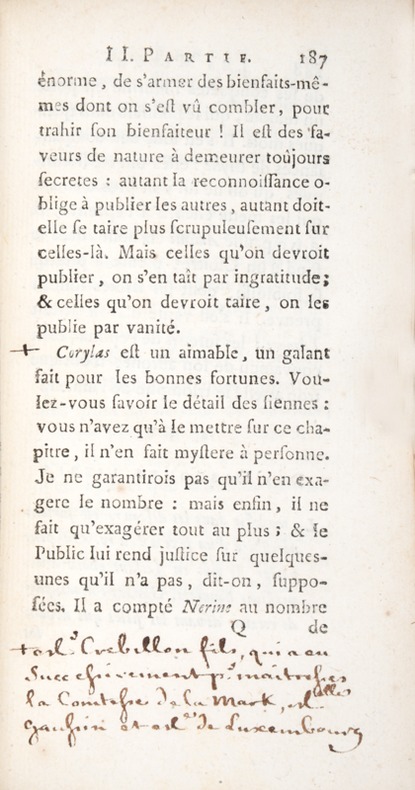
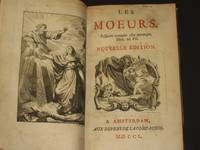
17482305728S.N 1748. First Edition. First Edition. Very Good/No Jacket. Corners slightly exposed. 1748 Full-Leather. 32 106; 107-334; 335-474 pp. Contemporary mottled calf marbled endpapers spine gilt with red leather label red edges. Frontispiece engraved vignette on title and on first page of each of the three parts as called for this copy bound without the separate titles to the 2nd and 3rd parts found in some copies. An immensely popular which was banned upon its release and burned by the French court of justice. The scandal it caused would follow the author for the rest of his life eventually it became thought that the work advocated regicide. Nonetheless it became an influential work that went through at least 15 editions in 1748 and elicited a number of replies. Parts of it were later reused in Denis Diderot's Encyclopedie. This 474 page printing which was also issued in a large-paper 4to. format is generally considered the first. The book was banned by the French parlement on May 6 1748 and the author was subsequently forced to seek asylum in the Low Countries. The present volume is enhanced by having two additional items bound in: a printed copy of that Arrest de la Cour du Parlement S.N unknown books
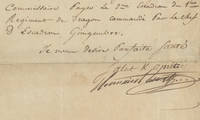
17983421524/05/1798. <div></div><div><div class=""yj6qo""><p>At the time of the outset of the French Revolution Haiti was the French colony of Saint Domingue. The colony featured large slave plantations that generated the cash crops of sugar coffee and cotton. This was a very profitable colony to the French owing largely to the sugar plantations. By the 1780s nearly two-thirds of French trade flowed through Saint Domingue and the island supplied nearly half of Europe with sugar.</p><p>The Haitian Revolution was a complex web of affairs. At one point there were over a half dozen parties involved all fighting for different purposes. Alliances were fickle as entities changed allegiance based on who was offering the best deal. The revolution began not only as a slave revolt but also as a class struggle among white landowners non-landowners and the free black landowners. The French military became involved as did the British and Spanish forces.</p><p>In August 1791 a full-fledged slave revolt began. In March 1793 the French assembly granted full rights and French citizenship to free black people and those of mixed race. The white planter class however objected and further violence erupted. The French sent military forces and a new governor to enact these measures. At this point England and Spain joined the fight. While the English sought to restore order and sided with the white social class the Spanish who controlled the other side of the island saw an opportunity in the dysfunction. When the French in 1794 ordered all slaves freed the ire turned against the English who now sent more forces to quell the revolt. In 1795 the Spanish signed a deal with the French and exited the conflict.</p><p>Toussaint Louverture a former slave emerged as the leader of the slaves seeking their freedom in the Haitian Revolution. He drew inspiration from the ongoing French Revolution and previous American Revolution to evolve his group’s demands and ultimate goals.</p><p>At the same time the French Directoire government which now ruled France was considerably less revolutionary than it had been. Suspicions began to brew that it might reconsider the abolition of slavery. In November 1797 Louverture wrote again to the Directoire assuring them of his loyalty but reminding them firmly that abolition must be maintained.</p><p>And for the British the benefit began to be outweighed by the cost an enormous loss of life. On April 30 1798 Louverture signed a treaty with British Army officer Thomas Maitland exchanging the withdrawal of British troops from western Saint-Domingue Haiti in return for a general amnesty for the French counter-revolutionaries in those areas. In May Port-au-Prince was returned to French rule in an atmosphere of order and celebration.</p><p>Gingembre-Trop-Fort also a former slave was one of Louverture's loyal officers. He was described with exaggerated uniform accoutrements a sword almost as tall as he was wearing “large and heavy rings†and with a pillow to his saddle already “covered in velours with gold fringes.†Interestingly his name in French means ""too strong ginger.""</p><p><strong>Letter signed</strong> May 24 1798 Port Republicain former name of Port-au-Prince to <em>""Citizen Deneyve Commissary Quartermaster of Wars for the Army of the Northwest Coast""</em> with integral address leaf. <em>""Citoyen Commissary please pay the 2nd Squadron of the 1st Regiment of Dragoons Commanded by the Squadron Chief Gingembre.""</em></p><p>Letters of Louverture are very uncommon. This is a particularly early one having been signed before he took control over the entire country.</p><p>This was not the end of the conflict as tensions with France were about to increase and would test Louverture.</p><p><img class=""alignnone wp-image-25018 size-post-window"" src=""https://cdn.raabcollection.com/wp-content/uploads/20231204144051/Folder-site-11-1600x1327.jpg"" alt="""" width=""1600"" height=""1327"" /></p></div></div> unknown
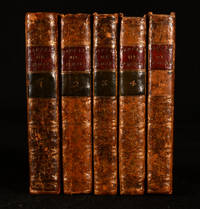
1749681P23Amsterdam: Pierre Mortier 1749-50. Leather. Very Good. 5.5" by 3.5". Not Stated. A nicerly bound oeuvre of the French Epicurean author Toussaint Remond de Saint-Mard illustrated with frontispieces. Complete in five volumes. A collection of the works of Toussaint Remond de Saint-Mard the noted Epicurean French author. His works include 'Reflexions sur la Poesis en General' and 'Nouveaux Dialogues des Dieux'. This oeuvre contains his letters philosophical works and poetry. Frontispiece to Volumes I II and IV. With an engraved title page to each volume. Saint-Mard wrote on aesthetics and opera and was a canon of the Notre-Dame. In a full mottled calf binding. Externally generally smart. Volume V is lacking the second spine label. Some rubbing to the spines. Some loss to the head of the spines. Minor bumping to the extremities. Very light marks to the boards. Internally firmly bound. Pages are lightly age-toned and generally clean with the odd spot. Very Good Pierre Mortier hardcover
176250571762 Amsterdam M.-M. Rey 1762 1 vol. in-12, demi-veau du temps, dos à 5 nerfs orné de compartiments à fleurons dorés, pièce de titre en mar. rouge, gardes au tourniquet. Bandeaux (dont un gravé par Caron), lettre ornée, cul-de-lampe.
17482052Couverture rigide 1748 16x10 cm
17482672Essai de philosophie en trois parties : De la piété, de la sagesse et des vertus sociales.Beau frontispice.Édition originale. Pleine basane mouchetée, dos à nerfs orné, pièce de titre rouge, tranches mouchetées. Reliure de l'époque. Très bon s.l. s.n. 1748 1 volume in-8°.
174825873Amsterdam Marc-Michel Rey 1748
17634711763 Amsterdam, Aux dépens de la compagnie, 1763, 3 parties en 1 vol. in 12, rel. XIXe demi-veau glacé havane à coins, dos orné, tête dorée, mouillures aux premières pages, sinon bon ex.
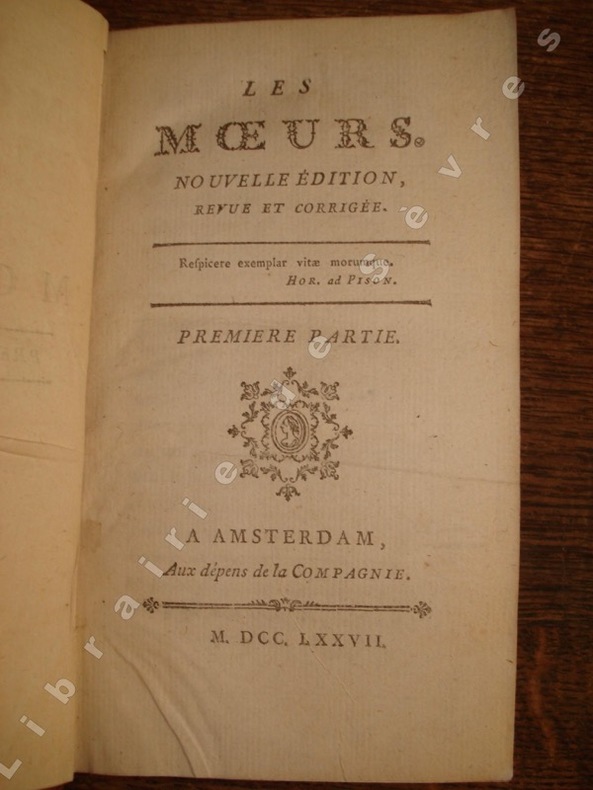
1777123541777 Amsterdam, Aux dépens de la compagnie, 1777, 3 parties en 1 vol. in 12 de XLVIII-84 pp. ; 235 pp. ; 141-(1) pp., rel. d'ép. plein veau brun moucheté, dos lisse richement orné de fers dorés, tranches mouchetées, bon ex.
1748136497S. n. l. 1748 In-16 16,5 x 10 cm. Reliure de l’époque veau havane raciné glacé, dos à nerfs encadrés de fers dorés, pièce de titre maroquin grenat, [30]-474 pp., frontispice, vignette au titre, 3 vignettes, table des chapitres et des articles. Ex-libris collé sur la page de garde, marque de possession manuscrite en page de titre, .Exemplaire en très bon état. édition originale.
175013060Genève 1750 1 vol. In-12 de 396 pp., basane fauve racinée de l'époque, dos à nerfs orné, pièce de titre, tranches rouge.
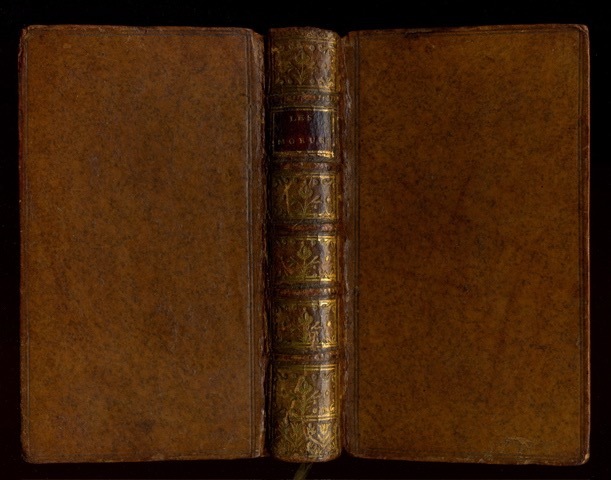
174855311748 Sans lieu ni éditeur, 1748, volume in-12 relié plein veau marbré de l'époque, XXXII (non paginé, épitre, avertissement, table, explication du frontispice, du fleuron et des vignettes)-528 pages, dos à 5 nerfs orné de caissons à fleurons dorés, pièce de titre bordeaux (les moeurs), roulette à froid encadrant les plats, sans défaut notable, très bon état
174839757, , 1748. 3 tomes en 1 vol. in-8 à pagination continue de 1 frontispice gravé, (32)-122 pp. ; (2)-123-386 pp. ; (2)-387-547 pp., maroquin vert, dos lisse orné à froid, filet à froid sur les plats, tranches dorées (reliure de l'époque).
1749227061749 A Amsterdam chez Pierre Mortier, 1749. Reliure plein-veau, dos lisse, decors dore, au format 9x15 cm, 260 pages. Gravures allegoriques en frontispice et page de titre.Tres bon etat.
1772011114COLOGNE & PARIS CHEZ NYON 1772 Un volume grand in-12 de XLIV + 436 pages , dans une reliure d' époque plein veau marbré , dos à 5 nerfs avec caissons ornés , bien complet du portrait gravé en frontispice , les coins sont rognés , la coiffe inférieure est élimée , bon exemplaire avec un très bon état intérieur . " L' auteur est né à Amiens en 1716 et décédé en 1786 , fut un temps prêtre du diocèse , écrivain , prédicateur , il créa en 1760 le " Journal Ecclesiastique " . Bon Couverture rigide
175037258Amsterdam, Pierre Mortier, 1749 1750 5 volumes in-16, plein veau blond marbré, dos à nerfs, caissons ornés, pièces de titre et de tomaison volume 2 dans une reliure différente : veau brun marbré, dos lisse orné. Frontispice et titre gravé à chaque volume. Dos passés et frottés, coins usés, deux mors fendillés. Brunissure d’hum. en tête au second volume, marquée aux 3 premiers ff. puis lég.
174943195o.Ort 1749. Titelrückenschildchen Rücken geprägt. Besitzerverm.Sprecher de Bernegg.Flecken a.Vors. Quatrième Edition Kl.-8°. Ldr. Philosophie unknown
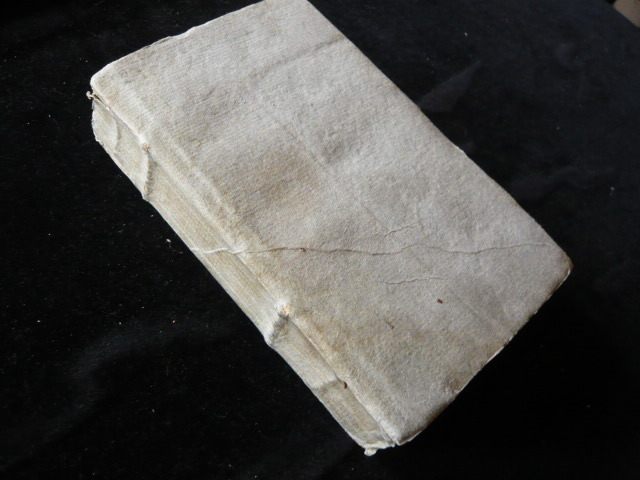
17501176E212Amsterdam 1750. New Edition . Hardback. Printed pages: xxxviii 391. Good Plus. 4.25 x 6.5 inches 10.5 x 16.5 cm. Later simple paper covered boards with handwritten title to spine. Light staining to rear board. Speckled page edges a few occasional spots of foxing to text. Good solid binding with no loose pages. Neat notes to leading blanks in old ink. Engraved frontis. Title page printed in red and black with engraved vignette. Early Dutch edition published two years after the first edition. . Overall condition is Good Plus. International postage will be less than the stated rate. Actual costs are Europe £11.00; USA £15.00; Oceania £16.00; Rest of World £18.00. A postage refund will be made after the order has been placed. Size: 4.25 x 6.5 inches 10.5 x 16.5 cm. hardcover
1749127616S.n., s. l., MDCCXLIX 1749 In-16 16 x 9 cm. Reliure de l’époque veau havane marbré, dos à nerfs encadrés de fers dorés, XXXVIII-390 pp., illustrée d'un frontispice, une vignette de titre, table des chapitres. Exemplaire en bon état.
175274616Paris, Marc-Michel Bousquet, 1752, 105x170mm, Exemplaire sous couverture d'attente. , 390 Mention de 5ème édition. Fontispice et vignette sur la page de titre.
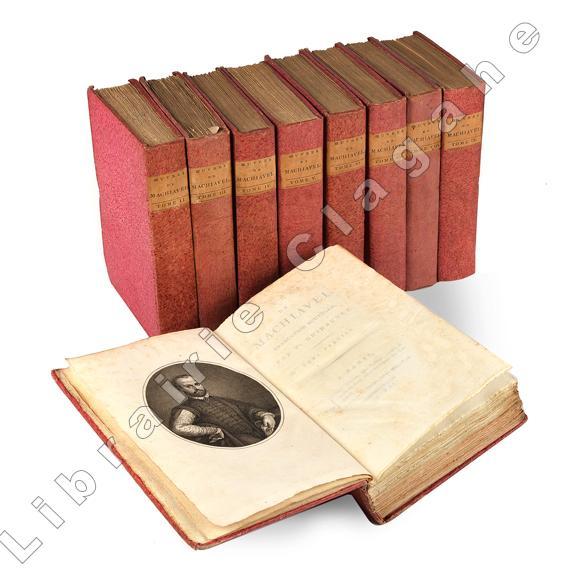
179920337Paris, Potey, Pochard, (imprimerie de Laran), an VII (1799) ; 9 tomes in-8 (210 mm), cartonnage rigide de papier rose à l’éponge, pièce de titre imprimée au dos, non rogné (reliure strictement d’époque) ; CXVII, [1 bl.], [2], 408 ; 384 ; 403 ; 416 ; 448 ; 455 ; 394 pp., [1] ff. bl. ; 370 pp, [1] ff. bl. ; 524 pp., portrait ovale en frontispice ; 7 planches dans “l’Art de la Guerre”, dont deux dépliantes et 2 doubles.
179922911Paris Potey et Pichard 1799 -in-8 plein-veau 9 volumes, reliure plein veau glacé vert olive marbré in-octavo (binding full calfskin in-8)(20,2 x 13 cm), SUPERBE RELIURE EMPIRE D'EPOQUE, dos long (spine without raised bands), décoré or (gilt decoration), titre et tomaison frappés "or", pièce de titre et de tomaison sur fond maroquin cerise, avec un filet "or" de part et d'autre, entre nerfs à fleuron "or" avec 4 doubles filets perlés "or" croisés autour du fleuron en losange avec une étoile "or" aux angles, roulette "chainette" "or" en place des nerfs avec un filet "or" de part et d'autre et en tête et en pied, plats décorés "or" d'une roulette feuillage "or", un filet "or" et une roulette fine "or" en encadrement, roulette "or" sur les coupes, toutes tranches lisses rouges, ornés d'un portrait de Machiavel en frontispice en noir peint par A. Brunzino et gravé par Levasseur (Tome I) + 7 planches hors-texte en noir Pour L'Art de la Guerre (dont 2 dépliantes et 2 planches doubles)(les planches V et VI de l'Art de la Guerre ont été mis par erreur au Tome I aux pages correspondantes, au lieu de les mettre au Tome V), (CXVII + 408) + 384 + 403 + 416 + 448 + 455 + 394 + 370 + 524 pages, An VII (1799) Paris: Potey et Pichard Editeur,
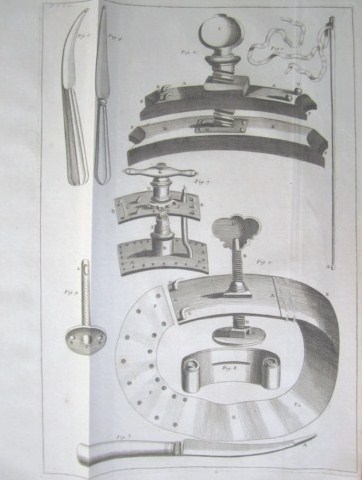
174627385Précédé d'un Discours Historique sur l'origine et les progrès de la Médecine, traduit de l'anglois de M. James, par Mrs Diderot, Eidous & Toussaint, revu, corrigé & augmenté par M. Julien Busson, Docteur-Régent de la Faculté de Médecine de Paris, 1 vol. in-folio reliure d'époque pleine basane marbrée marron, dos à 6 nerfs orné, Chez Briasson, David l'aîné, Durand, Paris, 1746, 8 ff. n. ch., cxxxvj-1400 pp. et 12 planches dépliantes hors texte