BALZAC, Honoré de - PICASSO, Pablo - BONET, PaulLivre Rare Book
6 397 résultats
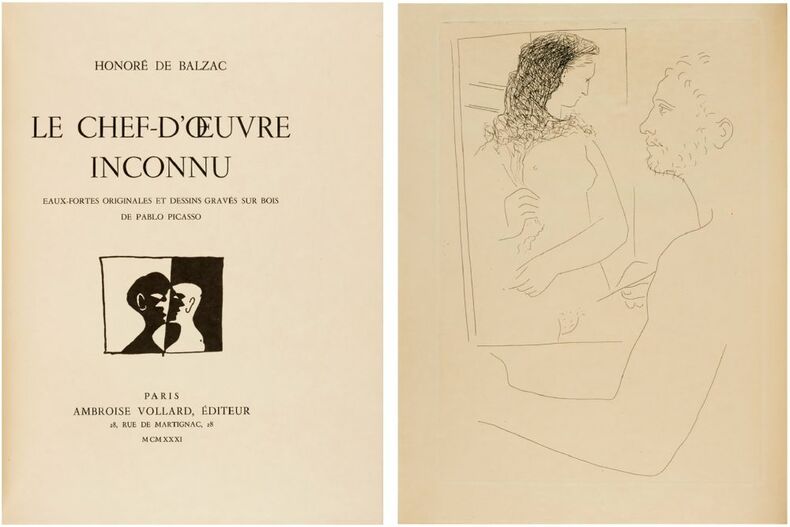
19313114Paris, Ambroise Vollard Éditeur, 1931. Un volume in-4 (32 x 24 cm). Remarquable reliure "sculptéee de Paul Bonet en plein box bleu nuit et décor polychome en relief, chemise et étui (signée et datée de 1944). - 12 EAUX-FORTES ORIGINALES EN HORS-TEXTE et 1 EAU-FORTE pour la "table des eaux-fortes" GRAVÉES PAR PABLO PICASSO. - UNE SUITE COMPLÈTE DES 12 GRAVURES HORS-TEXTE SUR VÉLIN DE RIVES. - Dessins de l'artiste gravés sur bois par Georges Aubert et tirés en in-texte. Une "préface" de 16 pages de dessins composés de points et de traits dessinés par Picasso en 1924 également gravés sur bois par Aubert. Tirage : 340 exemplaires (65 Japon + 240 vélin de Rives + 35 H.C.). Celui-ci 1 DES 65 EXEMPLAIRES SUR JAPON IMPÉRIAL, LES SEULS SIGNÉS AU PINCEAU PAR PICASSO et monogramés à la plume par Vollard, avec UNE SUITE COMPLÈTE DES 12 GRAVURES HORS-TEXTE SUR VÉLIN DE RIVES. - Dans une extraordinaire reliure "sculptée" de Paul Bonet, datée 1944 : "box bleu corbeau, un grand caisson ovale occupe presque chaque plat, encadrant un grand motif abstrait sculpté et couvert de veau de différentes couleurs vives" (Carnets, n°692), couverture conservée, chemise, étui. Bonet n'a réalisé qu'une poignée de ces fameuses reliures sculptées qui sont très recherchées. Celle-ci étant l'une des plus réussies et des plus élégantes. —— ENGLISH DESCRIPTION: Paris, Ambroise Vollard Éditeur, 1931. Illustrated with 12 original etchings by Pablo Picasso (and 1 for the plate "Table des eaux-fortes") and numerous woodcuts by G. Aubert after the drawings by Picasso. One of 65 NUMBERED ON JAPAN PAPER SIGNED BY PICASSO AND VOLLARD with an EXTRA SUITE of the 12 original etchings on Rives paper. Only the 65 numbered on japan paper are signed by Picasso and Vollard. Mint condition. Outstanding "sculptural" binding by Paul Bonet, dated 1944: "raven blue box, a large oval box occupies almost each cover, framing a large abstract motif carved and covered with calfskin in different bright colors" (Carnets, n°692), cover preserved, folder, case.
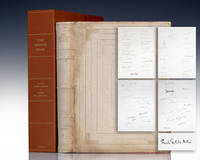
1990324836New York: The Limited Editions Club 1990. Number 27 of 50 copies. 8 large colour silkscreen studies Signed by the Artist. 2 text leaves. All loose as issued. Printed by George Drexel Osiris Screen Printing New York on Whatman Print Matte paper. Folio 25 x 19 inches. Laid into black cloth clamshell dropbox with red morocco label inset on upper cover. Fine. Number 27 of 50 copies. 8 large colour silkscreen studies Signed by the Artist. 2 text leaves. All loose as issued. Printed by George Drexel Osiris Screen Printing New York on Whatman Print Matte paper. Folio 25 x 19 inches. The prints illustrate the King James version of the Book of Genesis. Bearing captions lithographed from mylars handwritten by the artist this "exhibition portfolio" format is much larger than the regular edition of Eight Studies for the Book of Genesis. <br /> <br /> Each print signed and inscribed "HC" in pencil lower margin. Printed by Stone Press Editions Seattle with the blind stamp lower right. Published by the Limited Editions Club New York. With the title and colophon pages. Superb clean impressions with bright and vibrant colors. Nesbett L90-2 The Limited Editions Club unknown
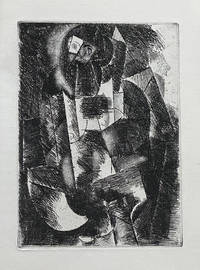
1914N - 2024 - 115<p>Max Jacob. Illustrated with three cubist etchings by Picasso in full page from 1913. Max Jacob three-act play reflect the author mystic quest and his research into the cabala and astrology Picasso completed the illustrations during the winter of 1913/14 making three etchings and dry points one for each act to which he gave the titles: Femme Nue plate 1 Nature Morte au Crâne plate 2 and Femme plate 3. This book is second illustrated book published by Daniel-Henry Kahnweiler created in collaboration with Picasso. Signed by the Picasso and Jacob in the justification page and marked as number "40" of 85 copies on "Holland van Gelder" total edition 106 copies. The book is complete in the original glassine light offsetting is present in the text page near the first illustration. Ref Cramer #3. Very good conditions.</p> Daniel- Henry Kahnweiler, Editeur hardcover
1929149534London: Privately printed by The Curwen Press for H.R.H. The Prince of Wales 1929. First and limited deluxe edition of the monumental Legion Book; one of only one hundred numbered copies printed for private distribution by the Prince of Wales and signed by a remarkable array of British writers and artists as well as four prime ministers. Quarto original publisher's full deluxe pigskin over boards elaborately decorated in blind and gilt top edge gilt tissue-guarded color frontispiece engraved title-page vignette illustrated with 16 captioned tissued-guarded plates in various techniques some signed by the artist and 32 collotypes. One of one hundred numbered copies printed for private distribution by the Prince of Wales and with five pages signed by each of the 89 contributing writers and illustrators as well as four prime ministers three British Prime Ministers: David Lloyd George Stanley Baldwin and Ramsay MacDonald and French Prime Minister Georges Clemenceau including: Winston Churchill who was not yet a Prime Minister Rudyard Kipling P.G. Wodehouse Eric Gill Stanley Spencer Charles Ricketts W. Heath Robinson Laura Knight William Nicholson Paul Nash David Low Rebecca West John Lavery Max Beerbohm Vita Sackville-West Hilaire Belloc Mark Gertler Edith Sitwell Jacob Epstein W.H. Davies and Aldous Huxley among others. This is number 84. The Legion Book was created at the request of H.R.H. The Prince of Wales—who would later become King Edward VIII and following his abdication the Duke of Windsor—as a fundraising initiative for the British Legion. All profits from its sales were intended to support the organization. The book features contributions from 85 distinguished British writers and artists including Winston Churchill Rudyard Kipling P.G. Wodehouse Aldous Huxley Vita Sackville-West G.K. Chesterton Hilaire Belloc Augustus John Eric Kennington and John Nash. It was compiled and edited by James Humphrey Cotton Minchin 1894–1966 a veteran who served with the Cameronians and the Royal Flying Corps during the First World War. While the trade version saw several reprints a special edition of 600 numbered copies was also produced. Of these 500 bore the editor’s signature but “the first 100 were reserved for H.R.H. the Prince of Wales sponsor of the volume in his gift.†According to the note at the conclusion of the Table of Contents “Five pages of contributors’ signatures appear after the Dedication with additional signed pages opposite Collotype No. 3 and Collotype No. 20.†Every contributor signed the book with the sole exception of John Singer Sargent who died in 1925 before the project was completed. In near fine condition with toning to the extremities of the front panel and front hinge. Housed in the original publisher's custom folding cloth clamshell box. An exceptional example of this rare signed limited edition. Formed in the aftermath of a war that had shattered a generation the Royal British Legion emerged in May 1921 as a unified voice for the countless veterans left wounded—physically mentally and economically—by the First World War. The staggering cost of the conflict with nearly 3.2 million British Empire casualties exposed the inadequacy of postwar support. A fully disabled veteran received just 30 shillings a week and any claim had to be made within seven years of discharge. In response to such injustice several ex-servicemen’s groups came together to create the Legion not merely as a charity but as an advocate for those who had borne the brunt of industrialized warfare. From its inception the Legion fought for fair pensions better employment opportunities and meaningful support for both former service members and their families—laying the groundwork for a broader movement of remembrance welfare and national responsibility that continues to this day. Privately printed by The Curwen Press for H.R.H. The Prince of Wales hardcover
1904014375New York: The Outlook Company 1904. First Edition. Hardcover. Hinges cracked and neatly repaired. Still Near Fine. Second Printing in publisher's original decorated cloth. Illustrated with plates. This copy virtually unique as it is INSCRIBED and SIGNED by both the author and the subject as President. Riis's inscription is dated 5 August 1908. Roosevelt writes: "with the best wishes of/Theodore Roosevelt/The White House/Jan. 18th 1909." The addition of "The White House" by Roosevelt is notable as prior to his administration the residence was known as the "President's Palace" the "President's House" and the "Executive Mansion." It was Roosevelt who officially named it "The White House" in 1901. Of the many books signed by Roosevelt we have both handled and seen we have never before encountered one in which he has noted his official residence along with his signature. <br/><br/>Jacob Riis among the most dedicated advocates for America's oppressed and downtrodden arrived in New York from his native Denmark at the age of 21 in 1870. A pioneer in photojournalism Riis photographed and wrote about the slums and tenements of a New York in the dawn of a new century. Riis came to Roosevelt's attention through his 1890 book HOW THE OTHER HALF LIVES. As Commissioner of the New York City Police Department Roosevelt accompanied Riis on his evening travels through the slums and witnessed firsthand the inhumane conditions endured by many of New York's inhabitants. In his 1901 book MAKING OF AN AMERICAN Riis wrote of Roosevelt: "It could not have been long after I wrote HOW THE OTHER HALF LIVES that he came to the Evening Sun office one day looking for me. I was out and he left his card merely writing on the back of it that he had read my book and had 'come to help.' That was all and it tells the whole story of the man. I loved him from the day I first saw him; nor ever in all the years that have passed has he failed of the promise made then. No one ever helped as he did. For two years we were brothers on Mulberry Street." Roosevelt in turn wrote of Riis after his death: "It is difficult for me to write of Jacob Riis only from the public standpoint. He was one of my truest and closest friends. I have ever prized the fact that once in speaking of me he said 'since I met him he has been my brother.' I have not only admired and respected him beyond measure but I have loved him dearly . and I mourn him as if he were one of my own family." The Outlook Company hardcover
196444629Vietnam Thailand and elsewhere in Asia as well as the United States Europe and the Middle East ca. 1964-1974: Compiled by Jacob Harris an American who served as a Senior Police Advisor in Vietnam and Thailand during the Vietnam War 1964 - 1974. 1964 - 1974. First edition. A large and remarkable archive of images from Vietnam and Thailand covering the decade from the Gulf of Tonkin incident and the beginning of the buildup of American forces in Vietnam to a year before the evacuation of the American embassy. Most notable are the many images showing the training of local security forces by American civil and military advisors. The collection was compiled by Jacob Harris an employee of the United States Agency for International Development USAID Office of Public Safety OPS whose task was to train Vietnamese and Thai police and counterinsurgency forces. Most of the images in the form of photographs and photographic slides were created by Harris his wife or his associates and illustrate all aspects of life in those countries at the time. Harris traveled widely throughout the region and the collection includes images from not only Vietnam and Thailand but also from Laos Singapore Hong Kong Macao Malaysia India and elsewhere. The images also document Harris' lengthy career as a New Jersey State Trooper and his travels in other parts of the world. Jacob Joseph Harris ca. 1910-2005 also known as "Jack" and "Jake" served for thirty-six years 1928-64 with the New Jersey State Police eventually attaining the rank of major. Included herein is a printed card dated Dec. 31 1960 marking thirty years of Harris' service to the state of New Jersey. In 1964 he began what he called his "second career" taking a position with the U.S. Agency for International Development and was stationed first in Vietnam and then in Thailand. As his postings permitted he was joined by his wife of many years Virginia and she appears in a great number of the photographs. Harris was associated mostly with USAID's Office of Public Safety which was established in 1957 to train the police forces of America's overseas allies. The OPS was often used by the Central Intelligence Agency as a cover for its agents abroad and operated in Europe the Middle East Africa and Asia until it was shut down by Congress in 1974. At other times Harris was a part of the State Department's Office of Missions. Whether or not Harris was directly employed by the CIA has not been ascertained and it seems that his actual role in Vietnam and Thailand was in fact the training of local police and paramilitary forces. However Harris' proximity to high ranking officials in the governments of South Vietnam and Thailand as well as the nature of many of the photographs in this collection show that he played an active and important role in training local forces to fight the Vietcong and Thai insurgents. And it is certainly true that the various departments and agencies of the U.S. government in southeast Asia at that time those operating overtly or covertly worked together toward their common goal. Jacob Harris ended his career at the State Department in Washington and retired to Florida in 1975. A slide included as part of the collection explains the "Objective of U.S. Assistance to Civil Police Programs & Paramilitary Forces Overseas." Among these are "encourage humane responsible police administration; enforce the law & maintain public order with minimum use of force; counter subversion & terrorism; improve the character and image of civil police & paramilitary forces binding them more closely to the community." A large percentage of the photographs and slides in this collection show Jacob Harris with the Vietnamese and Thai officials and officers with whom he worked trained and advised during his decade of service. Included are images of military and political leaders members of the Thai royal family and members of military and police forces. A number of the photographs show police operations against members of the Vietcong or other subversive organizations several of them showing dead bodies. One album is devoted to photographs showing a Thai operation against revolutionaries with pictures of soldiers dead and mangled bodies of the enemy and members of the Thai forces recuperating and being commended at their hospital beds. This same album contains a number of typescripts in Thai that appear to describe the actions depicted. A few other photographs have manuscript ink notes apparently in Jacob Harris' hand identifying the scene. One showing a dead body is captioned "Vietcong" while another dated April 2 1969 shows a Thai military force with some members identified with a caption explaining that they were "assigned to eliminate Durae Gang." Some photographs are quite chilling in their juxtaposition as in one album where pictures of the Harrises and their friends at the beach are displayed beside photographs of dead Vietcong soldiers. The photographs and slides show Harris and his American colleagues and often their wives interacting with Vietnamese and Thai officials the local citizenry and each other. One group of images shows a party thrown for Harris and his wife when they were reassigned from Vietnam to Thailand in 1968 in the wake of the Battle of Hue. Several images show Harris visiting villages and interacting with locals and the difficulty of lives of Thai and Vietnamese villagers is clearly evident. Many of these images show villages populated mostly by the elderly women and small children. The absence of most men speaks volumes; they may have left to fight for the Army of the Republic of Vietnam or the Vietcong or they may have lost their lives. It is clear from the images in this collection that despite the hardships encountered by American troops in Vietnam USAID officials lived comfortable lives. Many of the photographs show them at parties vacationing at beach resorts lounging by swimming pools etc. As mentioned though stationed in Vietnam and then Thailand Harris traveled widely throughout Asia including to Hong Kong Singapore Macao Malaysia and Laos. He also traveled throughout the countries he was stationed in and there are images in this archive of Saigon the Vietnamese provincial capital of Dalat Danang Bangkok Ayutthaya Angkor Wat and much more. Many of the images of Vietnam show a country that still bears a heavy French influence before the Communist takeover of the 1970s. Other images show trips taken by the Harrises to Europe and the Middle East as well as photographs documenting Harris' life in New Jersey and his earlier career with the state police. The more than 1700 photographs are a mixture of black and white and color ranging in size from 2 3/4 by 3 1/2 inches to 3 1/2 by 5 1/2 inches though a handful are larger. Included are more than fifty boxes of slides some 2000 original slides in all. The images in the slides appear to have been taken by Harris or his wife and are in color. As with the photographic prints the slides are a mixture of military and nonmilitary scenes: parades assemblies featuring police and military officials pictures of village life aerial views of the Vietnamese and Thai countryside etc. There are many images of American military airplanes and equipment training exercises aerial views of the countryside several images of the demilitarized zone and much more. One group of slides shows an anti-American parade in Vietnam featuring signs reading "Kick out Taylor" protesting the 1964 appointment of General Maxwell Taylor as ambassador to South Vietnam. As a military advisor to President Kennedy Taylor had enthusiastically supported sending more American combat troops to Vietnam. Other slides show Jacob Harris accompanying a Vietnamese delegation on a visit to the United States during which they went to Washington and to New Jersey where they met with his old colleagues in the New Jersey State Police. Yet another box of slides is labeled "Hong Kong" and "Red Chinese border" containing a number of views of Hong Kong in the late 1960s as well as views of mainland China. Other images document visits by American dignitaries to Thailand and Vietnam and there is a series of slides featuring Harris with Army of the Republic of Vietnam general Nguyen Chanh Thi and others showing Harris and police officers at the strategically important Hai Van Pass near Danang. One group of thirty-five slides housed in a box labeled "DMZ bombing" shows the aftermath of an air raid presumably by U.S. forces with bombed-out buildings and ruined villages and countryside. Other images show bombed out buildings in a more urban setting. In all a massive archive of images documenting American activities at the local and police levels in Vietnam and Thailand over the course of a crucial decade. The Harris archive is a wealth of views of all aspects of life in the region during this period which help deepen our understanding of the effects of the American presence in southeast Asia during the era of the Vietnam War. More than 1700 original photographic prints and 2000 original photographic slides plus fourteen audio recordings and miscellaneous documents. Most of the slides preserved in their original Kodak processing boxes. Some photographs loose but most bound into albums. On the whole in near fine condition. Compiled by Jacob Harris, an American who served as a Senior Police Advisor in Vietnam and Thailand during the Vietnam War, 1964 unknown
1968387331968. <p>Jacob Francois 1920- ; Monod Jacques 1910-75; Lwoff Andre 1902-94; & Brenner Sydney 1927- . Group of 22 offprints mimeographs etc. on molecular biology and bacterial genetics together with 2 related papers by other authors. Various sizes. 1947-1968. Together in one volume cloth "Institut Pasteur" in gilt on the spine. Overall good to very good; see detailed condition descriptions below. From the library of G. G. and Elinor Meynell authors of Theory and Practice in Experimental Biology 1970 with their address label on the front endpaper and ownership signatures on several of the offprints.</p> <p>First / First Separate Editions. Jacob Monod and Lwoff all colleagues at the Institut Pasteur received the 1965 Nobel Prize in physiology / medicine for their discoveries concerning genetic control of enzyme and virus synthesis-discoveries that "opened up a new field of research that deserved to be called 'molecular biology'" Magill The Nobel Prize Winners: Physiology or Medicine II p. 921. Their work answered the fundamental question of how the hereditary information contained in DNA can be translated into the chemical processes that synthesize cellular proteins this question had been posed most succinctly and explicitly in Francis Crick's theoretical paper "On protein synthesis" 1957 which laid the groundwork for over a decade's worth of research in this area. Brenner another key figure in this field worked with Jacob and Matthew Meselson on providing experimental evidence for messenger RNA; he was awarded a share of the 2002 Nobel Prize for his discoveries concerning genetic regulation of organ development and programmed cell death.</p> <p>The collection we are offering here focuses largely on the Nobel Prize-winning work done by the Institut Pasteur group-Lwoff Jacob and Monod-in the 1950s and 1960s. The work can be divided into four sections: </p> <p>1 lysogeny and bacterial conjugation</p> <p> 2 expression of the genetic material via messenger RNA</p> <p> 3 the regulation of the genetic activity of bacterial cells by operons</p> <p>4 the organization of bacterial genetic material.</p> <p> In the following paragraphs we will attempt to highlight the more important papers in this remarkable collection; however all the papers here touch upon these central questions of molecular biology.</p> <p>Lysogeny defined as the hereditary ability to produce the bacteriophage virus is a peculiar type of infection in which the phage becomes part of the genetic material of a bacterial cell; in this non-infective form prophage it can then be inherited by succeeding generations of cells becoming virulent only when some environmental stimulus causes the bacterium to produce and release phage.</p> <p> "Lysogeny brought a model for the interrelation between a virus and a cell. And also a model for the possible mode of action of carcinogenic agents which could disturb something in this balance" Judson p. 368. Lwoff studied this phenomenon intensively in the late 1940s and early 1950s successfully demonstrating the genetic nature of lysogeny which was disputed by several scientists including Delbruck and discovering how it is induced. In 1953 he published an important review of the subject "Lysogeny" Bacteriological Review 17; see no. 2 below. Lysogeny was also studied by Jacob and Elie Wollman whose paper "Induction of phage development in lysogenic bacteria" CSH Symposia on Quant. Biol. 18 1953; see no. 5 below summarizes what had been learned about lysogeny as of that date.</p> <p>Lwoff's work on lysogeny inspired Jacob and Wollman to investigate the phenomenon of bacterial conjugation the transfer of genetic information from a male donor bacterium to a female recipient resulting in genetic recombination to see if they could discover where in the bacterium's genetic material the prophage was located. In 1955 working with a highly recombinant strain of E. coli K12 discovered by William Hayes Jacob and Wollman performed what came to be known as their "coitus interruptus" experiment in which they used a Waring blender to interrupt the mating bacteria at various stages of their conjugation. They found that the donor cell's genetic characteristics were not transferred all at once but rather sequentially over time-a discovery of great importance. </p> <p>"Wollman and Jacob had stumbled upon a way to measure off the genes on the bacterial chromosome as directly and physically as a child squeezes toothpaste onto a brush or a carpenter unrolls a coiled steel tape measure. As they saw instantly and reported in a note in mid-June 1955 in the weekly Comptes rendus of the Academie des Sciences "Sur le mecanisme du transfert de materiel genetique au cours de la recombinaison chez E. coli K12"; see no. 6 below they had the means to make a genetic map of biochemical characteristics expressed in units of time" Judson p. 385.</p> <p> In 1956 Wollman and Jacob published the first albeit rudimentary timed map of the K12 strain of E. coli in a paper published in France. This map was printed again in their English-language paper "Conjugation and genetic recombination in E. coli K-12" CSH Symposia on Quant. Biol. 21 1956; see no. 8 below which also contained the first publication of Thomas Anderson's famous electron micrograph of two conjugated bacteria.</p> <p>In 1958 Jacob delivered his paper "Transfer and expression of genetic information in E. coli K12" see no. 9 below at a symposium in Brussels; this paper together with one given by Jacob's sometime colleague Arthur Pardee "ranged over the whole matter of transfer of genes between bacteria and the regulation of their expression" Judson p. 400. Jacob and Wollman had originally represented the hereditary material in linear form while stating that the genetic map could be formally represented as a circle. In 1963 at a Cold Spring Harbor conference the researcher J. Cairns provided physical evidence that the E. coli chromosome was circular; at this same conference Jacob Brenner and co-author Francois Cuzin presented their paper "On the regulation of DNA replication in bacteria" CSH Symposia on Quant. Biol. 28; see no. 16 below containing their "replicon model of chromosome replication in bacteria a model that almost required circularity of chromosomal and F factor DNA" Brock p. 103.</p> <p>Experimental proof of the existence of messenger RNA the substance responsible for coding protein synthesis was announced in Brenner Jacob and Meselson's landmark paper "An unstable intermediate carrying information from genes to ribosomes for protein synthesis" Nature 190 1961; see no. 1 below. The theoretical groundwork for messenger RNA had been laid in Crick's "On protein synthesis" 1957; demonstration of the substance's existence had been foreshadowed by Volkin and Astrachan's discovery of a high-turnover unstable RNA distinct from the ribosomal and transfer varieties 1956 and by the famous "PaJaMo" experiment demonstrating the negative control mechanism of enzyme induction 1958. However it was not until the spring of 1960 that these previous findings were combined by Brenner Jacob and Francis Crick into a biological model setting forth the exact means of communication between gene and cytoplasm while eliminating the various problems associated with earlier ribosome-based theories of gene expression. As Brock puts it the ribosome was now seen as "simply a nonspecific translation machine something like a computer whose behavior depended on what software it contained" Brock p. 306.</p> <p> Working with Matthew Meselson who had developed experimental techniques for tagging and separating ribosomes Brenner and Jacob performed the critical experiment described in their paper which provided direct evidence for the existence of an unstable rapidly turning over messenger RNA.</p> <p>The concept of the operon-a group of adjacent genes functioning as a unit under the control of another gene the operator gene-developed between 1958 and 1960 on the basis of work done by Monod and Jacob who were investigating the repressor model of gene regulation. Jacob developed the idea that gene regulation was based on a repression system that operated like an on-off switch and that "genetic units of a higher order existed . . . that contained several genes subject to unitary expression. . . . On the basis of these ideas and observations Jacob and Monod developed the concept of two kinds of genes structural which coded for the synthesis of proteins and regulatory which did not" Brock p. 300. In October 1959 Jacob and Monod published the theoretical basis for the operon in "Genes de structure et genes de regulation dans la biosynthese des proteines" C. r. Acad. Sci. 249; see no. 11 below. Their paper "established the sharp distinction between the familiar genes that determined protein structures and the new class of genes that regulated. It even looked to them then as though the product of the regulatory gene were not a protein by RNA. But the fact to be underlined they said was that in every known case when several structural genes had their expression controlled by the same regulatory gene-'that is to say in all probability by a unique repressor'-the structural genes were grouped tightly together. . . . The best fit to the evidence was that the group of genes had among them a single element: the operator target of the repressor" Judson p. 410. </p> <p>The Jacob/Monod operon model of gene expression was further explored in their 1961 paper "On the regulation of gene activity CSH Symposia on Quant. Biol. 26; see no. 14 below which presented a more detailed examination of the mechanics of protein synthesis. For further information see Judson The Eighth Day of Creation 2nd ed. and Brock The Emergence of Bacterial Genetics; specific references are given below.</p> <p>1. Brenner Sydney; Jacob Francois; & Meselson Matthew. An unstable intermediate carrying information from genes to ribosomes for protein synthesis. Offprint from Nature 190 May 13 1961. 576-581pp. Diagrams. Without wrappers as issued. Light toning. Ownership signature of E. W. Meynell on the first page. Garrson-Morton 256.10. Brock ch. 10.12. Judson pp. 414-27.</p> <p>2. Lwoff Andre. Lysogeny. Offprint from Bacteriological Review 17 1953. 269-337pp. Without wrappers. Small stamp on first page. Brock ch. 7.4.</p> <p>3. Monod Jacques. Inhibition de l'adaptation enzymatique chez une bacterie E. coli infectee par un bacteriophage. Offprint from C. r. Acad. Sci. 224 1947. 2 2 blankpp. Without wrappers. Light browning creased horizontally with small tear along crease. Ownership stamp and ms. annotations of A. A. Miles.</p> <p>4. Lwoff & Siminovitch Louis. Induction de la lyse d'une bacterie lysogene sans production de bactÈrophage. Offprint from C. r. Acad. Sci. 233 1951. 3pp. Fore-edge frayed marginal tear affecting a few words. A. A. Miles's signature.</p> <p>5. Jacob Francois & Wollman Elie. Induction of phage development in lysogenic bacteria. Offprint from CSH Symposia on Quant. Biol. 18 1953. 101-121pp. Without wrappers. Light soiling a few annotations. Owner's name on first page. Judson p. 382.</p> <p>6. Wollman & Jacob. Sur le mecanisme du transfert de materiel genetique au cours de la recombinaison chez E. coli K12. Offprint from C. r. Acad. Sci. 240 1955. 3pp. Without wrappers. Creased horizontally light toning. Ownership signature of Elinor Meynell. Brock ch. 5.7.</p> <p>7. Jacob; Alfoldi Lajos; & Wollman Elie. Zygose letale dans des croisements entre souches colicinogenes et non colicinogËnes d'E. coli. Offprint from C. r. Acad. Sci. 244 1957. 3pp. Without wrappers. Small marginal tears. Elinor Meynell signature.</p> <p>8. Wollman; Jacob & Hayes W. Conjugation and genetic recombination in E. coli K-12. Offprint from CSH Symposia on Quant. Biol. 21 1956. 141-162pp. Without wrappers. Brock ch. 5.11.</p> <p>9. Jacob. Transfer and expression of genetic information in E. coli K12. Manuscript for the Symposium of the Society for Cell Biology Brussels 1958. 29 3pp. Dittoed table. Mimeographed. Without wrappers. Edges a bit frayed. E. Meynell signature. Judson p. 400.</p> <p>10. Jacob & Fuerst Clarence R. The mechanism of lysis by phage studied with defective lysogenic bacteria. Offprint from J. Gen. Microbiol. 18 1958. 518-526pp. Without wrappers. E. Meynell signature.</p> <p>11. Jacob & Monod. Genes de structure et genes de regulation dans la biosynthese des proteines. Offprint from C. r. Acad. Sci. 249 1959. 3pp. Without wrappers. Creased horizontally. E. Meynell signature. Brock ch. 10.10. Judson p. 410.</p> <p>12. Changeux Jean-Pierre. Sur l'expression biochimique de determinants genetiques d'E. coli introduits chez Salmonella typhimurium. Offprint from C. r. Acad. Sci. 250 1960. 3pp. Creased horizontally. Meynell signature.</p> <p>13. Jacob. Comments. Offprint from Cancer Research 20 1960. 695-697pp. Without wrappers.</p> <p>14. Jacob & Monod. On the regulation of gene activity. Offprint from CSH Symposia on Quant. Biol. 26 1961. 193-211pp. Without wrappers. Meynell signature. Brock ch. 10.13.</p> <p>15. Jacob & Monod. Elements of regulatory circuits in bacteria. Unesco Symposium on Biological Organization. Paris 1962. Mimeographed. 27pp. plus tables and figures. Without wrappers. Light browning.</p> <p>16. Jacob; Brenner Sydney; & Cuzin Francois. On the regulation of DNA replication in bacteria. Offprint from CSH Symposia on Quant. Biol. 28 1963. 329-348pp. Without wrappers. Meynell signature. Brock ch. 5.11.</p> <p>17. Jacob & Ryter Antoinette. Etude au microscope Èlectronique des relations entre mÈsosomes et noyaux chez Bacillus subtilis. Offprint from C. r. Acad. Sci. 257 1963. 4pp. Plate. Without wrappers. Meynell signature.</p> <p>18. Lennox Edwin S. ; Novick Aaron; & Jacob. Relation between repression level and rate of enzyme synthesis. Offprint from Colloques Internationaux du Centre Nat. de la Recherche Scientifique. No. 124. Mecanismes de regulation des activites cellulaires chez les microorganisms 1965. 209-219pp. Orig. wrappers. Meynell signature.</p> <p>19. Sebald Madeleine & Schaeffer Pierre. Toxinogenese et sporulation chez Clostridium histolyticum. Offprint from C. r. Acad. Sci. 260 1965. 3pp. Without wrappers.</p> <p>20. Jacob & Ryter. Segregation des noyaux chez Bacillus subtilis au cours de la germination des spores. Offprint from C. r. Acad. Sci. 263 1966. 4pp. Plate. Without wrappers. Meynell signature.</p> <p>21. Jacob & Ryter. Segregation des noyaux pendant la croissance et la germination de B. subtilis. Offprint from C. r. Acad. Sci. 264 1967. 3pp. Plate. Without wrappers.</p> <p>22. Jacob. Genetics of the bacterial cell. Offprint from Science 152 1966. 9pp. Orig. printed self-wrappers. Nobel address. Meynell signature.</p> <p>23. Jacob; Pereira da Silva Luiz; & Eisen Harvey. Sur la rÈplication du bacteriophage l. Offprint from C. r. Acad. Sci. 266 1968. 3pp. Without wrappers.</p> <p>24. Ryter A.; Hirota Y.; & Jacob. DNA-Membrane complex and nuclear segregation in bacteria. Offprint from CSH Symposia on Quant. Biol. 33 1968. 669-676pp.</p> . unknown books
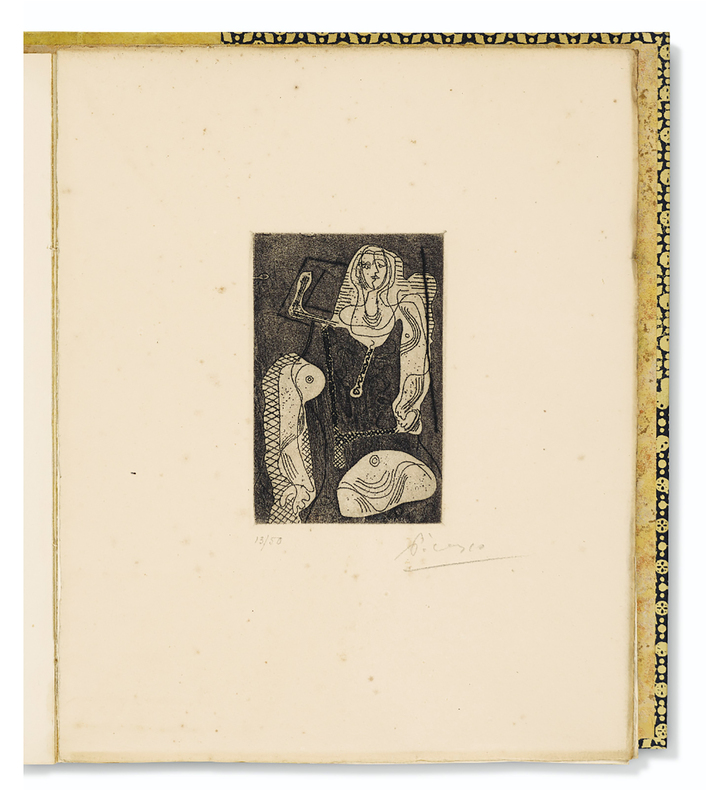
19262112Paris : Éditions « Cahiers d’Art », 1926 In-4 (283 x 228 mm), broché, non rogné, sous couverture rempliée de papier Japon. Encartée dans l’exemplaire: 1 EAU-FORTE ORIGINALE DE PABLO PICASSO TIRÉE SUR HOLLANDE, SIGNÉE AU CRAYON PAR L' ARTISTE ET JUSTIFIÉE 13/50. Note historique: Un des premiers livres sur Picasso, publié par la galerie "Cahiers d'Art" fondée cette même année. L'ouvrage est illustré de 4 reproductions de dessins dans le texte et de 42 planches, dont 2 en couleurs, reproduisant des œuvres de Picasso des années 1920-1926. La gravure accompagnant ce tirage de luxe, "Femme au fauteuil", fait partie d'une série réalisée en 1922-1923 dans laquelle les lignes superposées donnent à voir les figures à la fois de face et de profil. Le zinc est perdu. Un des 50 exemplaires sur Hollande van Gelder, les seuls avec les 6 sur Japon à comprendre la gravure originale, celui-ci le n°13 (quelques piqûres à la gravure et à la couverture). Chemise et étui d l'époque. ENGLISH DESCRIPTION: PABLO PICASSO (1881-1973) et CHRISTIAN ZERVOS (1889-1970) Picasso. Œuvres 1920-1926. Paris : Éditions « Cahiers d’Art », 1926 Deluxe copy, with the signed original etching. 4to (283 x 228 mm). Untrimmed, Japan wrappers. 1 etching on zinc by Pablo Picasso, on van Gelder Holland wove, signed in pencil by the artist and numbered 13/50. Several black and white reproductions of works by Picasso, 2 plates in color. One of 50 copies on van Gelder Holland wove, the only copies with the first 6 on imperial Japan to contain the etching, this copy numbered 13 (some spotting on the etching and the wrappers). Jacket and slipcase of the time. Référence: Goeppert-Cramer, Picasso, n°15 - Bloch, 56 - Baer-Geiser, 99/II.
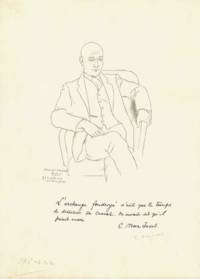
191033635Montrouge Paris: 1910 1910. Original Litho. Original Litho. PICASSO. MAX JACOB. Double Signed Litho. Montrouge Paris Seine. 1910. 14" 7/8 X 10" 3/4 on plain paper stock with the lithograph printed in two tones: Greenish grey for Picasso's drawing and handwriting and black for Max Jacob. Number 17 of only 30 copies. A rare early illustration of Picasso's close friend Max Jacob done in celebration of Jacob's conversion to Christianity. Jacob who had Jewish origins claimed to have had a vision of Christ in 1909 causing his conversion. The illustration of Jacob the first of Picasso's drawings of Max Jacob seated comfortably in a fine armchair dressed in his three piece suit. The printed text: Top A mon ami Max Jacob / Picasso .10 / 22 R. Victor Hugo / Montrouge Seine - Middle L'archange foudroyé n'eut que le temps / de desserrer sa cravate . On aurait sit qu'il / priait encore./ C. Max Jacob. Signed in pencil with his new Christian name: "C. Max Jacob" and by "Picasso" at the bottom. A very good or better example of this rare piece - Max Jacob is regarded as an important link between the symbolists and the surrealists as can be seen in his prose poems Le cornet à dés The Dice Box 1917. Throughout the year of 1901 Picasso traveled to Barcelona & Paris for art exhibitions. During an exhibition in Paris Picasso met Max Jacob. Max Jacob was a poet painter & art critic with connections in the Parisian cultural scene. The two artists developed a friendship after Jacob left an admiring note for Picasso at the art gallery displaying Picasso's work Richardson Vol. I 203. Jacob introduced Picasso to the French language and to French theatre; Jacob was also an actor. Jacob took Picasso to see operas which possibly included I Pagliacci & La Bohème Richardson Vol. I 338. "At night there were frequent visits to the cabarets of Montmartre such as the Chat Noir and when tickets could be found to the Moulin Rouge" Penrose Picasso 76. Picasso & his friends also enjoyed the artistic atmosphere of Le Lapin Agile. Artists & writers would congregate at the small café to listen to recitals exchange ideas & celebrate special occasions such as the opening of an exhibition Penrose Picasso 117. The walls of the café were lined with work by artists that were used as payment for debts. Theatrical entertainment was a prominent part of Picasso's social life in Paris. By 1904 Picasso had established a foothold in Paris and would remain in the cultural center of Europe for the rest of his life. Picasso & Max Jacob cultivated their talents in a dwelling known as the Bateau Lavoir. According to Penrose this place was ". . . composed it seemed of nothing but lofts & cellars all in such a sad state of repair. . . " Picasso 96. Artists of all endeavors were attracted to this bohemian style of living. Picasso's neighbors included painters sculptors writers & actors Penrose Picasso 102. One of Picasso's most influential friends entered his life in 1905: Guillaume Apollinaire. "From the first encounter Pablo Picasso and Guillaume Apollinaire established a creative dialogue that fostered and inspired some of their finest art & poetry". Apollinaire was a poet & playwright identified as a Surrealist who kept close connections with literary & artistic figures in Paris including Max Jacob & André Salmon. He was a great source for Picasso to meet writers & theatre artists. Many of Picasso's friends encouraged him to frequent the theatre with artists & poets from Paris Picasso Penrose 177. Even though Picasso was not in Paris he managed to find groups of artistic individuals to stay abreast of cultural gossip & happenings. Picasso's connections with writers led him to create several illustrations for books of poetry for friends. For example during summer 1910 in Cadaques Catalonia painting with Derain Picasso was commissioned to illustrate a poetic novel written by Max Jacob titled Saint Matorel issued by Daniel-Henry Kahnweiler in 1911. Penrose Picasso 179. This was only the first of a collections of poetry they collaborated on. 1910 unknown
191678127Paris 12 août 1916 | 6.30 x 8.60 cm | une feuille
1987671BASTEI-LÜBBE 1987-07/89. 1.-2. softcover. Inkarnation der Unsterblichkeit Die 2209822104241022411424119 BASTEI-LÜBBE paperback
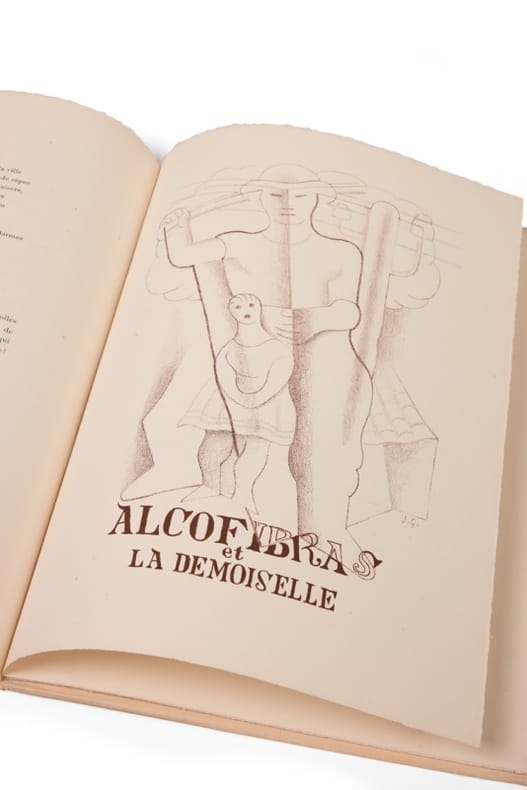
192129047Premier livre illustré par Juan Gris Paris, Editions Galerie Simon, 1921. 1 vol. (235 x 325 mm). Broché. Édition originale. Illustré de quatre lithographies hors-texte par Juan Gris. Un des 90 exemplaires sur hollande signé au colophon par l'auteur et l'artiste. Premier livre illustré de gravures originales par Juan Gris, et première apparition de la couleur dans la production éditoriale de Kahnweiler : le bleu, le vert, le bistre et l’ocre sont utilisés. C'est également la première fois que les illustrations portent clairement un titre ou une légende.
19331668891933. CHERNYKOV Iakov. Arkhitekturniie Fantazii Architectural Fictions. 102 pp. Illustrated with numerous textual illustrations and 101 colour plates. Small folio 300 x 200 mm bound in original blue embossed cloth. Leningrad: "Meshdunarodnaja Kniga" Leningrad Section 1933. First Edition of this landmark work of Soviet architectural fantasies lavishly illustrated with dramatic designs of possible cities factories monumental buildings and more. This is the best and most important publication by Chernykov and one of the most exciting books on architecture issued in the twentieth century "an amazing compendium of one hundred and one coloured inventions which still excite the imagination today. The verdict must surely be that Tchernykov's almost unlimited imagination for architectural forms provides a pattern book for modernist architecture rather than a repertoire of viable designs" Compton Russian Avant-Garde Books 143-4. Published in collaboration with D. Kopanitzin and E. Pavlova this first edition was limited to 3000 copies although very few now exist in permanent or private collections. Binding with some minor professional restoration overall in excellent condition. Senkevitch Soviet Architecture 1917-1967 Charlottesville 1974 205. Centre Pompidou Paris-Moscou 1900-1930 Paris 1979 567. Andel Avant Garde Page Design 301-302. hardcover books
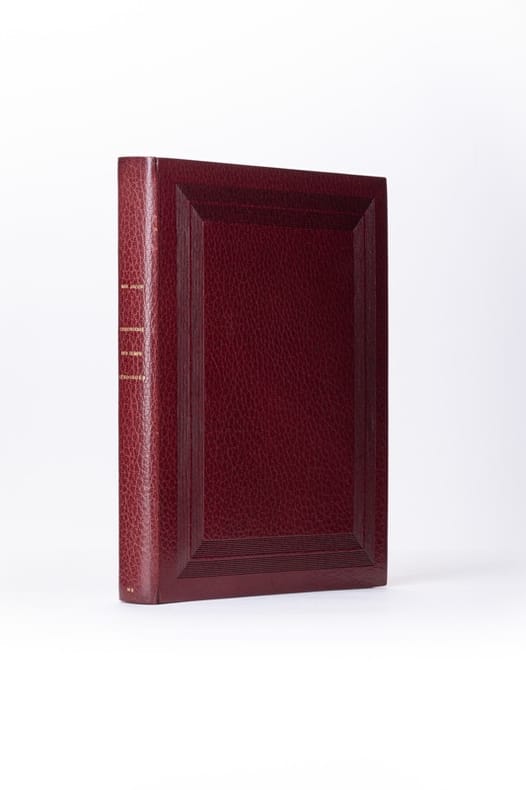
193628110Manuscrit autographe complet. Exemplaire Broder [Saint-Benoît-sur-Loire, vers 1936-1937]. Manuscrit autographe à l'encre noire de 70 feuillets in-4, numérotés 23-92 [avec un f. 74 bis, f. 70 manquant], montés sur onglets. Maroquin bordeaux, dos lisse, double encadrement de filets à froid sur les plats, encadrement intérieur de même maroquin orné de filets à froid, tranches dorées (Semet et Plumelle). Important manuscrit autographe de travail, avec corrections, ratures, ainsi que variantes et passages inédits, et ayant appartenu à Louis Broder, premier éditeur du texte. Monté en tête : portrait photographique de Max Jacob, le montrant dans sa chambre de la rue Gabrielle en 1917, selon la légende manuscrite au dos (tirage argentique, 239 x 180 mm). Il a servi à l’établissement du texte pour la version publiée en 1956.
1902021995New York: The Macmillan Company 1902. First Edition. Hardcover. Minor wear to covers. Near Fine. Second Printing in publisher's original decorated blue cloth. Illustrated. This copy is SIGNED "with the best wishes of/Theodore Roosevelt/Dec 1906." Jacob Riis a significant contributor to the cause of urban reform in the United States of America at the turn of the twentieth century was among the most dedicated advocates for America's oppressed and downtrodden. He arrived in New York from his native Denmark at the age of 21 in 1870. A pioneer in photojournalism Riis photographed and wrote about the slums and tenements of a New York in the dawn of a new century. Riis came to Roosevelt's attention through his 1890 book HOW THE OTHER HALF LIVES. As Commissioner of the New York City Police Department Roosevelt accompanied Riis on his evening travels through the slums and witnessed firsthand the inhumane conditions endured by many of New York's inhabitants. In his 1901 book MAKING OF AN AMERICAN Riis wrote of Roosevelt: "It could not have been long after I wrote HOW THE OTHER HALF LIVES that he came to the Evening Sun office one day looking for me. I was out and he left his card merely writing on the back of it that he had read my book and had 'come to help.' That was all and it tells the whole story of the man. I loved him from the day I first saw him; nor ever in all the years that have passed has he failed of the promise made then. No one ever helped as he did. For two years we were brothers on Mulberry Street." Roosevelt in turn wrote of Riis after his death: "It is difficult for me to write of Jacob Riis only from the public standpoint. He was one of my truest and closest friends. I have ever prized the fact that once in speaking of me he said 'since I met him he has been my brother.' I have not only admired and respected him beyond measure but I have loved him dearly . and I mourn him as if he were one of my own family." <br/><br/> The Macmillan Company hardcover
1973BB012PRESENTATION COPY the first volume inscribed by the artist on the half-title: "For dear Judy - with all my love! Maurice Sendak Dec. '73" which was actually the earliest month the book was available. ALSO INCLUDED is a folded paper chemise inscribed by the artist "For Judy from her loving friend Maurice / Oct. 2002." Inside is a complete set of all 27 page illustrations as individual prints handsome impressions on large paper each sheet measuring 8-3/4 x 6-5/8 inches compared to the published sheet size in the book of 6-7/8 x 5-1/2 inches.<br />The recipient of these two inscriptions is Sendak's close friend Judy Taylor his British editor The Bodley Head from 1960 onwards who is largely credited with having helped to promote and popularize Sendak's illustration art in Europe. Farrar, Straus & Giroux hardcover books
195629341Trois lithographies et 24 dessins de Picasso Paris, Louis Broder, coll. « Écrits et Gravures », n° 2, (24 octobre) 1956. 1 vol. (185 x 250 mm) de 126 p., [8] f. En feuilles, sous couverture illustrée, chemise illustrée et étui de l'éditeur. Édition originale, posthume, du texte de Max Jacob considéré comme ses « Mémoires ». Elle est illustrée par Pablo Picasso de 3 lithographies originales en couleurs et en noir (étui, couverture et portrait-frontispice), 3 pointes-sèches originales et 24 dessins inédits gravés sur bois par Georges Aubert qui rappellent les illustrations du Chef-d’œuvre inconnu. Tirage unique à 170 exemplaires sur vergé de Montval, celui-ci un des 30 numérotés en chiffres romains, auxquels sont joints 2 états de la lithographie pour l’étui (exemplaire n° II), signé par Picasso.
1909187099London: Constable and Company 1909. Bound with an onlay design in homage to Briar Rose Signed limited edition number 327 of 750 signed by Rackham this copy in a fine Bayntun-Rivière binding. Rackham's first version of Grimm's Fairy Tales published in 1900 had no signed limited edition. This is a revised and enlarged edition with some new illustrations as well as others redrawn and coloured. As noted by Rodney Engen "Rackham greatly loved fairy tales and had collected his many favourites over the years. The Brothers Grimm held a special place in his collections since they represented his love of all things German and contained the elements of the grotesque which fascinated him throughout his career". Quarto 274 x 219 mm. Colour frontispiece and 39 plates all tipped in and with tissue guard captioned in red black and white illustrations to text illustrated title page printed in red and black. Finely bound by Bayntun-Rivière in later 20th-century dark blue crushed morocco spine lettered in gilt compartments decorated and boards framed with gilt briar and red morocco onlay roses gilt rose and briar detail to turn-ins marbled endpapers edges gilt. Gift inscription contemporaneous to binding to first blank. Binder's blanks foxed else fine. Riall p. 97. Engen Arthur Rackham 2002. hardcover
19311717561931. CHERNIKHOV Yakov. Osnovy sovremennoj architektury: eksperimental'no-issledovatel'skie raboty / J.G. Tchernikhov - Les bases de l'architecture contemporaine: essai de recherches expérimentales / J.G.Tschérnikhow - Die Grundlagen der modernen Architektur: erfahrungsmässige - experimentelle Forschungen / J.G. Tschernichow. 96 pp. illustrated with 46 photographically reproduced colour plates and numerous black and white designs. Folio 304 x 206 mm. bound in original boards. Leningrad: Izdanie Leningradskogo Obscestva Architektorov 1931. Second enlarged edition the first edition had only 5 plates. A fine copy of this rare treatise by the legendary Soviet architect Yakov Chernikhov whose books are among the most visually striking of all Russian avant-garde books. One of the few copies we have seen that has not needed to be rebacked. Incredibly rare with OCLC listing no copies in the U.S. Getty Research Institute Russian Modernism 129. hardcover
198385437Limited Editions Club. As New. 1983. Hardcover. FREE UPGRADE to Courier/Priority Shipping Upon Request - IN STOCK AND IMMEDIATELY AVAILABLE FOR SHIPMENT - AS NEW THE TEXT BLOCK IS PRISTINE CLEAN UNMARKED AND IN EXCELLENT CONDITION - - Corresponds to ASIN: B002FKB6RE. SIGNED BY AUTHOR ILLUSTRATOR AND BY ROBERT PENN WARREN WHOSE POEM IS INCLUDED. LIMITED EDITION; NUMBERED COPY. -- with a bonus offer-- . Limited Editions Club hardcover
19571839Louis Broder, Paris 1957. Collection "Miroir du poète" n° VI. Un volume in-12 carré (167 x 136 mm), en feuilles, 42 pages, sous couverture de papier japon à rabats titrée en rouge sur le premier plat. Chemise et étui de l'éditeur noir et gris titré en rouge sur le dos. Édition originale de ce recueil de 7 poèmes de Robert Desnos inédits en volume. 4 GRAVURES ORIGINALES À L'EAU-FORTE ET AQUATINTE EN COULEURS (150 x 120 mm). La typographie est dûe à l'imprimerie Union et le tirage de la gravure à Robert Dutrou. Édition : 120 exemplaires numérotés sur vélin de Rives BFK. Celui-ci, l'exemplaire n°2 est signé par André Masson au colophon. Il comporte UNE SUITE COMPLÈTE DES GRAVURES ET DE LA DÉCOMPOSITION DES COULEURS : chaque épreuve de l'état final est justifiée 5/7 et signée au crayon par l'artiste, chaque épreuve de la décomposition des couleurs est justifiée 5/7 et monogrammée au crayon par l'artiste. 16 planches signées au total. Sixième volume de la collection "Miroir du poète" qui en comporte 7. Un huitième volume prévu n'a jamais vu le jour, mais la maquette existe. Le volume en parfait état, l'emboîtage de même (Saphire-Cramer 42). ENGLISH : André Masson - Robert Desnos, : Mines de Rien, Collection Miroir du Poète VI, Louis Broder, Paris, 1957. 4 aquatints printed in colours, 1957, on BFK Rives, title, text, list of contents, justification and the set of four, the justification signed in pencil by André Masson. copy numbered on vélin de Rives paper, from the total edition of 130. This one, copy no. 2, includes A COMPLETE SUITE OF THE ENGRAVINGS AND DECOMPOSITION OF COLORS: each proof of the final state is justified 5/7 and signed in pencil by the artist, each proof of the decomposition of colors is justified 5/7 and monogrammed in pencil by the artist. There is 16 signed plates in total. The set is in mint++ condition in its original slipcase, perfect. overall S. 177 x 153mm. (Cramer 42).
19842846PABEL/MOEWIG VERLAGSUNION 1984-89. 1. softcover. Doppelwelt 36403662367936963876 PABEL/MOEWIG VERLAGSUNION paperback
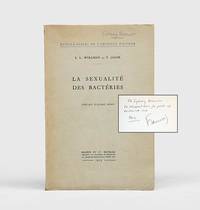
1959150141Paris: Masson et Cie Libraires de l'Académie de Médecine 1959. The meeting of two Nobel laureates prior to their discovery of mRNA First edition first printing presentation copy humorously inscribed by Wollman on the first blank "To Sydney Brenner to disgust him / a good of bacterial sex Élie" likely missing the word "dose" after "good". Wollman's co-author François Jacob has signed beneath. Brenner's signature is on the front cover in pencil. After receiving his doctorate from Oxford in 1954 Brenner 1927-2019 joined Francis Crick's laboratory focusing his research on how DNA is decoded by cells. He met Élie Léo Wollman 1917-2008 and François Jacob 1920-2013 both well-established bacteriologists at the Institut Pasteur at a symposium on microbial genetics in Copenhagen in 1959. An uncommon monograph on bacterial genetics this work was possibly presented to Brenner on this occasion or shortly thereafter. Though nothing concrete came of the Copenhagen conference Jacob met with Brenner Crick and other biochemists at Cambridge the following spring. As Jacob recalled when he pointed out recent experimental results suggesting that the DNA messenger molecule was unstable "Francis and Sydney leaped to their feet. Began to gesticulate. To argue at top speed in great agitation. A red-faced Francis. A Sydney with bristling eyebrows. The two talked at once all but shouting. Each trying to anticipate the other. To explain to the other what had suddenly come to mind" Jacob p. 312. Brenner and Jacob used their overlapping time as visiting scholars at Caltech to prove that the intermediary in the DNA decoding process was the newly discovered unstable RNA. They partnered with the American molecular biologist Matthew Meselson who had just developed a method for marking bacterial macromolecules with heavy isotopes. During the summer of 1960 the trio finally proved that short-lived RNA molecules - which they called messenger RNA mRNA - carry the genetic instructions from DNA to ribosomes. This feat is considered one of the most elegant experiments in the history of biochemistry. Jacob shared the Nobel Prize in Medicine with Jacques Monod and André Lwoff in 1965; Brenner received the Nobel Prize in 2002. Octavo. With 3 double-sided photographic plates. Original buff wrappers printed in black. Extremities rubbed and a little creased a few small spots and marks faint marginal crease in first half of contents: a very good copy. François Jacob The Statue Within: An Autobiography trans. Franklin Philip 1987. unknown
198639495BERTELSMANN CARL 1986. 1. hardcover. Kinder- und Hausmärchen der Brüder Grimm BERTELSMANN, CARL hardcover
194877759Sous coffret en moire vert pâle. Reliure plein maroquin grenat. Belle composition courant sur les plats et le dos de motifs géométriques mosaïqués en veau, box et maroquin vert, tilleul, turquoise, rouge, saumon, jaune, vert émeraude, sertis de filets à froid et de filets dorés. Dos lisse avec auteur et illustrateur en lettres dorées. Gardes en agneau velours grenat et vert émeraude avec listels de veau vert et orange. Toutes tranches dorées. Couverture et dos conservés. Reliure signée Nicole FOURNIER, médaille d'Or des Métiers de France, dorure par Pierre Marseleix. Illustré de 113 gouaches de Jean HUGO gravées sur bois en couleurs.