Stahl, Georg Ernst & Reich, Johann JacobBiblio.com
730 résultats
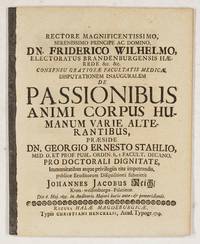
1719418171719. Zweite Auflage. - Halae Magdeb. Literis Christiani Henckelii 1719 Kl.4° 16 6 pp. orig. Broschur. Klassiker der Medizin Begründungsschrift der Psychosomatik! Die hier vorliegende zweite Auflage der "Disputatio de passionibus animi" "Über den mannigfaltigen Einfluß von Gemütsbewegungen auf den menschlichen Körper" zeigt daß es Stahl schon zum Beginn seines Wirkens in Halle seit 1694 also um das Problem der psychophysischen Wechselwirkung gegangen ist. Er hat seine Bedeutung seine Auswirkung in der Praxis beobachtet. Man findet hier die Grundlagen der medizinischen Psychologie. Es werden Beispiele für den Einfluß seelischer Erregungen auf den menschlichen Organismus angeführt. In der Einleitung wird hervor gehoben: "So leiten sich von den Leidenschaften des Gemütes in ihrer vielfältigen Bestimmung Leitung oder Änderungen der Bewegungen des menschlichen Körpers auch viele Krankheitsanzeichen her." Die Mehrschichtigkeit seelischer Alterationsstufen das Unverlierbare besonders tiefe Eindrücke wird in der Vorahnung späterer Erkenntnisse Freud ausgesprochen: Zugegeben sei "daß der im Erbgang geprägte Prototyp der Leidenschaften und Neigungen des Gemüthes in gewohnheitsmäßiger Festigung nicht ganz umgekehrt werden kann" so vermag doch "die domminierendende Leidenschaft durch eine ihr entgegengesetzte Gewohnheit an die zweite oder gar dritte Stelle verdrängt werden wo sie zwar noch innerhalb der Ordnungen steht gleichwohl ihre Rangstufe wechselt." Es liegt dem in nuce die Idee von der Verdrängung zugrunde. Es wird schließlich empfohlen die psychologischen Beobachtungen bei der Behandlung der Patienten nützlich anzuwenden und zu verwerten indem man den Kranken "viele Ausbrüche des Erschreckens der Furcht des Zornes anhebender Ängstlichkeit durch guten Zuspruch und durch vertrauenserweckende Sicherheit" benimmt. So zieht die Arbeit die Folgerung: "Seelenleiden die von Verletzungen des Körpers herrühren sind oft mit schwerwiegenden und dauernden Folgen verbunden. Doch sie sind zu vertreiben mit der Heilung der Körperschäden." Die Lehre von den symptomatischen Psychosen wird im Ansatz vorweggenommen wenn auch die Terminologie auf einen noch neuen Begriffsterain vortastet. Es sind Gehversuche auf einem noch dunklem Gebiet in der ärztlichen Praxis. Man kann die "Disputatio" als eine frühe Arbeit bezeichnen die sich aus der Sicht des Arztes mit dem Problem psychisch verursachter Störungen von Krankheitsabläufen beschäftigt. Es handelt sich hierbei nicht um Geisteskrankheiten. Es geht vor allem um die körperlichen Einflüsse transitorischer Seelenzustände die man heute in der Lehre von den Neurosen und ihren verschiedenen Erscheinungsformen zusammenfassen würde. Die seit der Antike bekannte Verbindung zwischen Konstitution und Charakter wird auch nach der therapeutischen Seite hin erwogen und berücksichtigt. Es ist der Geist einer naturwissenschaftlichen Betrachtungsweise der sich durch diese Arbeit hindurchzieht. Es zeigt wie vorbeitreffend die Annahme war den STAHL'schen Animismus nur religiös zu interpretieren." "In dem an zweiter Stelle stehenden "Propempticon inaugurale" - es ist eine dem Doktoranden JOHANN JACOB REICH gewidmete Abschiedsrede STAHLS mit angeschlossener Vita REICHS - nimmt STAHL zu dem Thema "De synergeia naturae in medendo" Stellung. Man findet hier alle Merkmale des STAHLschen Systems und erkennt wie sehr der aus der Erfahrung schöpfende Psychologe den Vorrang gehabt hat. So wird eine tiefe Kenntnis des Eigenrhythmus biologischer Abläufe in dem Gedanken ausgesprochen: "Die Natur hat ihr eigenes Zeitmaß und verwendet dieses bei den rhythmischen Vorgängen des Lebens von längerer Zeitdauer so bei der Embryonalentwicklung bei der Geburt Zahnung Pubertät". Die Synergie der Organe unter der Direktion der Lebenskraft enthält im Krankheitsfalle das ärztliche Problem die nützlichen Bewegungen der Naturheilkraft von den eigentlichen Krankheitsbewegungen zu unterscheiden. Der Arzt muß vor allem die Bewegungen erkennen die auf einen nützlichen Zweck abzielen. Theoretische Fragen werden aus dieser Sicht kurzerhand beiseite geschoben und in der für STAHL typischen Art das Leib-Seele-Problem zu einem biologischen Postulat'gemacht : "Es handelt sich nicht um eine Annahme sondern wir beweisen a priori mit der Vernunft daß im Menschen von einer einzigen Seele alle diese Akte und Bewegungen vollzogen werden können. Erfahrung und Vernunft zeigen a posteriori daß diese Zusammenhänge zwischen Leib und Seele in der Tat vorliegen." In diesem Problem sieht STAHL den Inhalt seiner Lebensarbeit: "Darauf werfe ich mich mit ganzer Seele. Dem gilt meine ganze Arbeit. Weder Mühe noch Neid können mich dabei verdrießlich machen. Ich hoffe vielmehr mit dem Problem in würdiger Weise fertig zu werden. Möge die Medizin dann wieder auf ihr rechtes Fundament gestellt sein"!" Diese beiden Texte "vermitteln so ein interessantes Bild der ärztlichen Persönlichkeit STAHLS ihres Temperamentes und ihrer Suche nach den biologischen und psychologischen Gesetzen einer wirksamen Therapie. Er gibt sich mit der Vorstellung einer nur mechanistischen Arzneiwirkung nicht zufrieden. Er nennt die besondere "Chronometrie" biologischer Abläufe das Gesetz der Ganzheit den Begriff des allen Einzelerscheinungen übergeordneten Organismus den Einfluß seelischer Erregungen auf die Vitalbewegungen desselben. Die psychophysische Wechselwirkung wird dem Arzt als praktisch wichtiges Problem gestellt. Jedenfalls hat STAHL bereits im Jahre 1695 alle wesentlichen Gedanken seines medizinischen Systems dargelegt. Die Ansicht er habe erst durch CHRISTIAN WOLF gewichtige Anregungen erhalten ist nicht mehr haltbar. Bereits 12 Jahre vor dem Erscheinen seiner "Theoria medica vera" hat die Forschungsrichtung STAHLS ihr wesentliches Ziel gehabt. Wenn man die Geschichte der medizinischen Psychologie überdenkt so wird man GEORG ERNST STAHL auf Grund der Einsichten in die ärztliche Bedeutung des Psychischen wie schon KORNFELD mit Recht ausgeführt hat an den Anfang einer Erschließung dieses Fachgebietes stellen dürfen. Die Leitsätze am Schluß der "Disputatio" enthalten das historische Fundament dieser neuen erst in unserer Zeit zur Anerkennung gekommenen Wissenschaft." B.J. Gottlieb G.E.Stahl Sudhoffs Klassiker der Medizin pp.18-21 23-47 siehe - A.W.Bauer Der Körper als Marionette Georg Entst Stahl und das wagnis einer psychosomatischen Medizin. Acta historica Leopoldina Nr. 30 2000 pp.81-95 unknown
1758479211758. Disp. morborum 4/140. - Hrsg. v. Albrecht v. Haller. - Lausanne Marc Michael Bousquet & Socior 1758 4° 2 pp.633-655 Rückenbroschur. Polycarp Gottlieb Schacher 1674-1737 "geb. im Jan. 1674 zu Leipzig widmete sich daselbst dem Studium der Med. und wurde 169S zum Doctor promovirt. Nach einer längeren wissenschaftlichen Reise durch Deutschland Holland England und Frankreich erhielt er 1701 eine a. o. Professur der Anatomie und Chirurgie rückte bis zum J. 1723 in die ord. Professuren der Physiologie der Anatomie und Chirurgie sowie der Pathologie auf wurde 1724 zum Decan der med. Facultät ernannt und starb als solcher 4. März 1737. Die zahlreichen von ihm zum grössten Theile als Gelegenheitsschriften veröffentlichten und mit einer Ausnahme sämmtlich zu Leipzig erschienenen Abhandlungen beziehen sich auf die verschiedensten Gegenstände aus dem Gebiete der inneren Medicin der Geburtshilfe zum Theil auch der Chirurgie. Vorzüglich sind dieselben der Anatomie gewidmet welcher Schacher den höchsten Werth beilegte wie schon aus seiner Abhandlung "De anatomia praestantissimo totius medicinae fundamento" 1705 hervorgeht. Ein vollständiges Verzeichniss derselben bat ROSENMUELLER gegeben; sie sind jedoch nur von historischer Bedeutung. Erwähnt sei dass Schacher in seiner Abhandlung "De cataracta" Leipzig 1705 nach HALLER H. BOEKHAAYE Methodus studii med. emaculata etc. Amsterdam 1751 pag. 462 zuerst das Ganglion ophthalmicum "ciliare" als Knoten bei TH. WILLIS nur Plexus beschrieben hat." Hirsch-H. V p.48 siehe - Ind. Catal. 1. ser. XII pp. 623-024; ADB XXX p.480; G. Bihlmeyer Entdeckungsgeschichte der Hirnnervenganglien Tübingen Dissert. 1916 p.9. unknown
1741667301741. Altdorfii : Typis Ioh. Georgii Meyeri Acad. Typographi 1741 kl.-4° 32 pp. florale Vignette florale Initiale florale Schlussvignette oberer Rand durchgehend mit kleiner Vignette Rückenbroschur. Erstdruck der Medizinischen Inaugural-Dissertation 'Über die Beschaffenheit des Blutes zur Ernährung des menschlichen Körpers'. Titel: "Dissertatio Inavgvralis Medica De Praecipvis Sangvinis Qvalitatibvs Ad Nvtritionem Corporis Hvmani Facientibus / Qvam . In Celeberrima Vniversitate Altorfina Pro Licentia Svmmos In Medicina Honores Et Privilegia Doctoralia . Examini Pvblico Svbiicit D. Ivnii A.O.R. MDCCXXXXI. Wolfgangvs Iacob. Lochnervs Heroldsberg. Noric." Lochner Wolfgang Jakob Verfasser Meyer Johann Georg Drucker Deutsche Gedichte auf den Seiten 30-32 von I.F. Fleischmann Gustav Georg Zeltner Johann Conrad Wittwer 1720-1775 und Wolfgang Friederich Schmidt. unknown
1743ZB546030Tubingae: Roebel 1743. square octavo 16 pp light extraction roughness at spine and imprint trimmed off bottom margin of title but no other loss light age staining overall good and now in self wrappers. - If you are reading this this item is actually physically in our stock and ready for shipment once ordered. We are not bookjackers. Buyer is responsible for any additional duties taxes or fees required by recipient's country. Tubingae: Roebel, unknown
178038564Oxonii Oxford: printed at the Clarendon Press for J. & J. Fletcher D. Prince & J. Cooke 1780. FIRST EDITION OF THIS EXCERPT OF THE CHRONICON SYRIACUM DEALING WITH RICHARD THE LION-HEART'S DEEDS IN THE HOLY LAND often involving Saladin WRITTEN BY GREGORY BAR HEBRAEUS widely regarded as a highly reliable source. 20 XI pp. Syriac text and Latin translation. BEAUTIFULLY PRINTED AT THE CLARENDON PRESS WITH ELEGANT SYRIAC AND ROMAN TYPES ON EXTREMELY FINE THICK LAID PAPER WITH HUGE MARGINS. Bruns published this text in part as a specimen of his full edition of the Chronicon published in 1789 see Gentleman's Magazine 1781 pp. 131-132. Also 1789 second part pp. 1109-10. 4to. Sewn into plain wraps as issued. A bit of wear and tear to wraps else A PRISTINE COPY ENTIRELY UNCUT BRIGHT AND FINE. EXTREMELY RARE IF NOT UNIQUE IN THIS STATE. <br/><br/> printed at the Clarendon Press for J. & J. Fletcher, D. Prince & J. Cooke paperback
1745583841745. Disp. chir. 3/83. - Hrsg. v. Albrecht v. Haller. - Lausannae Sumptibus Marci-Michael Bousquet & Socior 1755 4° pp.489-524 Rückenbroschur. Zweiter Abdruck "Diss. med. sistens casum rarissimum uteri in partu rupti. Basileæ ex off. viduæ J. Christ 1745." unknown
1701EBS100400Basil: Konig 1701. 1st Edition. Hardcover. Very Good/No Jacket. A book of miscellaneous secrets drawn from a variety of named authorities which had a great vogue" Duveen. BOOK DETAILS AND CONDITION: Earlier calf raised boards spine richly gilt morocco title label : 2 blk lvs 6 lvs final 3 pp a complex organizational chart 764 pp 16 lvs Index 4 blk lvs; fig. p 88 Liber III; p 484 Liber X; Numerous figures especially in Liber XII and Liber XV. Int VG- w/occasional stains and darkening. Some tearing bottom 1/8 of spine. PROVENANCE: From Arthur C. Greenberg History of Chemistry Library. Also inside front board bookplate of Dr. William Sargant FRCP. Sargant was an important figure in psychiatry in the 20th century and is remembered for the evangelical zeal with which he promoted treatments such as psychosurgery deep sleep treatment electroconvulsive therapy and insulin shock therapy. REFERENCES: Blake 483 - Neu 4294 - Duveen 613 - Ferchl 569 - Ferguson Books of Secrets I 13-16 - Rosenthal 891. Basil: Konig hardcover
1791T96240Haerlem [Haarlem], by C. Plaat 1791 202 + [2] pp., met mooi titelvignet (W. Hendriks inv. et fecit, Cardon sculpsit), blinde lichtgecart. omslag, met ex-libris met wapenschild van F.H.M. Ouwerling, 23cm., tekst helder en in goede staat, T96240
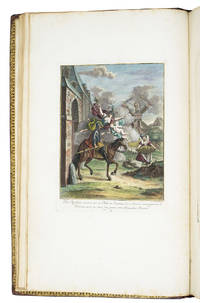
1746M2HB4ES5PXB4The Hague: Pieter de Hondt 1746. Contemporary richly gold-tooled dark red morocco by the so-called Van Damme bindery in Amsterdam sewn on 7 supports each board with Van Dammes typical hourglass- or vase- or flask-shaped central cartouche with a starry sky on a black ground here showing a short-stemmed chalice or goblet with fire or flame-like leaves like a snake plant Dracaena trifasciata in the cartouche and a basket of flowers topping the cartouche the whole in an elaborate frame built up from hundreds of impressions of numerous small tools the spine-title in gold on a black ground in the 2nd of 8 compartments each of the other 7 with flowers other decorations and a small flower in a pot gilt edges. With a tissue guard-leaf before each plate. Large folio 42 x 27 cm. Title in red and black with an engraved vignette Quixote and the windmill and 31 engraved illustration plates all coloured by a contemporary hand heightened with gold and set in in a gilt frame. Further with large woodcut initials and tailpieces and each text page in an ornamental frame built up from typographic ornaments the frames not in the 4to issue. Very rare large-paper copy of the first and only edition of a "free and joyous" Dutch translation of Cervantes's Don Quixote with 31 rococo style plates in spectacular contemporary hand colouring and with gold highlights. The plates have been engraved by leading Dutch artists Bernard Picart 12 Jacob van der Schley 13 Pierre Tanjé 5 and Simon Fokke 1 after paintings by leading French artists Antoine Coypel 25 Charles-Nicolas Cochin 2 Pierre-Charles Trémolières 2 François Boucher 1 and Jacques-Philippe le Bas 1. The impressions are crisp and the hand colouring is bright and of the highest quality with subtly graded tones and highlights in gold. Antoine Coypel 1694-1752 responsible for the design of most of the illustrations was one of the most important French history painters of the early 18th century. His Don Quixote paintings are highlights in his oeuvre and can be found in several museum collections.The Dutch edition was translated by Jacob Campo Weyerman 1677-1747 one of the foremost Dutch authors of the Enlightenment who was known for his merry style. He added to this edition a Dutch translation of the biography of Cervantes by Gregorio Mayans 1737 and explanatory texts to the plates. De Hondt issued the present edition in at least three formats: 4to folio on ordinary paper and folio on large paper. The present copy is the large-paper folio issue which is indeed very rare: several libraries have folio editions on ordinary paper usually about 35 cm tall but we have not located a copy of the large folio issue in any library. The only other large-paper copy we have been able to trace is slightly smaller.Cervantes's Don Quixote first published in Spanish 1605-1615 was first translated into Dutch in the early 17th century and went through several editions until 1732. Engraved prints after Coypel's famous Don Quixote paintings started circulating in 1734. De Hondt took this opportunity to publish a new Dutch translation with the Coypel illustrations and some others. He asked Weyerman who was already a famous writer but was imprisoned for slander to translate the text. He also commissioned new plates after Coypels paintings from the leading Dutch engravers. This came together in what became a masterpiece of rococo book production and the present hand-coloured copy of the large folio issue is the outstanding result.The Van Damme bindery was the "most important Amsterdam workshop of the 18th century" and is praised for the "high quality of its work" Storm van Leeuwen: 89 bindings are attributed to it. Although its earliest dated binding is from 1747 the present work and two others in similar Van Damme bindings in the British Library were printed in 1746 so these bindings may be among Van Dammes earliest work made in or soon after that year. Three of the six Van Damme bindings in the British Library as well as several examples in Storm van Leeuwen have a similar cartouche with a black interior but none includes the present vase or goblet of flames or flame-like leaves: we have not identified the patron.The boards are very slightly rubbed the corners and head and foot of the spine have been reinforced. A few small spots in the foot margin of the title page and slight browning of the paper of 2 quires. Otherwise in very good condition.l Arents Cervantes in het Nederlands 27: "Kneppelhout nr. 2587 gr. fol. rood verg. marok. verg. op sn. Zeer fraai ex. op gr. papier. Het titelvignet en de 30 prtn. allen alleruitmuntendst uit de hand gekl. en met goud afgezet. In oud-Holl. prachtbd. van rood marokyn. De rug verg. in afdeel. De platten met een zeer breed verguldsel randwerk en verg. middenfig. op zwart leder. Verg. op sn. Gekocht door Hr. Elte voor fl. 420."; Cohen & De Ricci 216 "superbes illustrations; livre tres recherche"; Van Gorp pp. 161-162; Mededelingen van de Stichting Jacob Campo Weyerman 18 1995 passim; Rius I 806; STCN 197115810 8 copies; Marleen de Vries Aanzet tot een bibliografie van Jacob Campo Weyerman 1990; cf. for the binding: Storm van Leeuwen I pp. 460-499. Pieter de Hondt, unknown
172412372Amsterdam Jacobus Borstius 1724. 30 311 1 p. Origineel Perkament 8° wat slordig exemplaar Amsterdam, Jacobus Borstius unknown
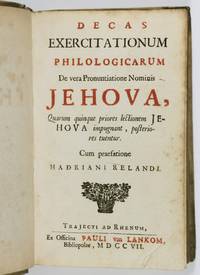
170753206Utrecht: P. van Lankom 1707. Hardcover. Very good. Eight parts octavo: asterisk8 A-2M8 2N4 K5 signed K3 292 leaves pp. 16 416 413-564 i.e. 568. Title in red and black; separate half-titles for each part. Woodcut lettrines; printed side notes. Numerous citations in Hebrew and Greek. Contemporary vellum soiled slight separation at upper joint. Mild embrowning at the edges. Text fine and crisp throughout. Overall a very good copy.<br /> <br /> First edition of this compendium one of two issues the other published by Johann Coster in which nine celebrated early modern Christian hebraists advance their views on the original pronunciation of the Tetragrammaton YHWH. The celebrated hebraist and Old Testament scholar Adriaan Reland 1676-1718 judged by Bayle to be one of the most learned writers of the eighteenth century is best remembered for his works on Jewish antiquities. He edited various other collections of essays and dissertations including Analecta Rabbinica 1702; Dissertationes miscellaneae 1706-1708; Dissertationes de nummis veterum Hebraeorum 1709. His opinion on the proper pronunciation of YHWY agrees with the first five hebraists in the present collection as well as the current scholarly consensus.<br /> <br /> I.- Johannes Drusius the elder 1550-1615 Tetragrammaton sive de nomine Dei proprio.<br /> <br /> II. - Sixtinus Amama 1593-1629 De nomine tetragrammato. with a response to Fuller. <br /> <br /> III. - Louis Cappel 1585-1658 Oratio de SS. Dei nomine tetragammato YHWH ac genuina ejus pronunciatione -- see Burnett Buxtorf 229: “Shortly after his appointment ot Saumur in 1613 he began his studies in biblical philology and textual criticism. His lecture on the Tetragrammaton delivered on June 22 1614 attests to a preoccupation with methodology which would distinguish his later work.†This was later printed in the Arcanum punctationis 1624 and here in our volume. <br /> <br /> IV. - Johann Buxtorf the elder 1565-1629 Dissertatio de nomine YHWH -- see Burnett Buxtorf 124: “For the Tetragrammaton alone Buxtorf devoted ten pages of discussion in his 1615 Lexicon Hebraicum et Chaldaicum.†<br /> <br /> V. - Jacob Alting 1618-1679 Exercitatio grammatica De punctis ac pronunciatione tetragrammati YHWH.<br /> <br /> VI. - Nicolus Fuller 1557-1626 Dissertatio de nomine YHWH -- see Orme and his note on Drusius’ charge of plagiarism against.<br /> <br /> VII. - Thomas Gataker 1574-1654 De nomine tetragrammato dissertatio. London 1645 - Gataker later defended himself against Cappel in Thomae Gatakeri . Dissertationis de Tetragrammato suæ a D. Ludovici Cappelli in diatribæ de eodem suæ defensione nuperâ adversus eandem objectis Vindicatio London 1652.<br /> <br /> VIII-X. - Johannes Leusden 1624-1699 Dissertationes tres de vera lectione nominis Jehova. P. van Lankom hardcover
17961395Antwerpen: Gimblet 1796. 2 dln. in 1 vol. in-8°. Voorrede 248 pp voorrede 328 pp. Titels in rood en zwart. Gebonden in vol kalfslederen band met titelvignet in marokijn. Wat schade op het voorplat. Gimblet, unknown
172263082[Basel], Drucktens Em. und Joh. Rud. Thurneysen, Gebrüdere, (1722). 4°. Mit einer Holzschn.-Anfangsvignette. 36 S., Geheftet (ausgebunden).
176575960Leipzig, bey Jacob Christoph Posch, Buchhändl. in Anspach 1765. 363, (1) Seiten. Mit 1 gestochenen Titelvignette sowie zahlreichen Holzschnittvignetten. 8° (17,5-22,5 cm). Halblederband der Zeit mit goldgeprägtem Rückentitel auf zweifarbigen Rückenschildern und marmoriertem Schnitt. [Hardcover / fest gebunden].
173711025Ulm Daniel Bartholomé 1737 -in-12 argent ciselé sur peau de requin un volume, reliure allemande d'époque en argent sur peau de requin noir avec plats avec encadrement merveilleusement et finement ciselé : thème floral et fermoirs tout aussi finements travaillés en argent (une petite merveille) in-douze (duodecimo), dos à nerfs (spine with raised bands) muet (without title), toutes tranches dorées (all edges gilt) avec dessins à froid réalisés par le relieur sur les tranches, orné d'une gravure en frontispice (frontispiece) et 4 gravures hors-texte (full page engraving) de scènes Bibliques gravées sur cuivre en noir par FRIDRICH Jacob Andreas " le vieux" 1684-1751 ( graveur allemand, Graveur à Nuremberg, mort à Augsbourg, père de Bernhard Gottlieb et de Jacob Andreas le Jeune) , 407 pages, 1737 Ulm Daniel Bartholomé Editeur,
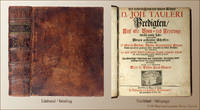
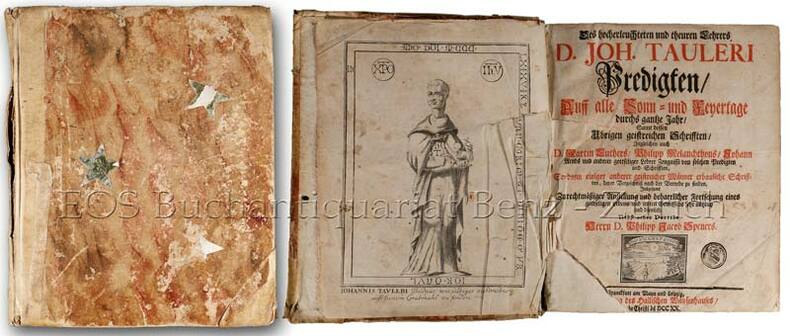
17205246BB1720. Teil I v. 2 Teilen. Frankfurt a. M. u. Lepizig Hallisches Waysenhaus 1720. Lex-8°. 46 1735 recte 1736 Sp. 52 S. Mit 1 gest. Titelvignette und einem Porträt. Halbpergamentband der Zeit. Vgl. Bautz X Spalten 909-939 für Spener. Das von Philipp Jacob Spener 1635-1705 evang. Theologe u. Begründer des lutherischen Pietismus Genealoge u. wissenschaftlicher Begründer der Heraldik herausgegebene Werk enthält von den im Titel erwähnten Schriften die Predigten über die Evangelien auf alle Sonn- u. Feiertage des ganzen Jahres des Mystikers Johannes Tauler um 1300. Mit stärkeren Gebrauchsspuren. unknown
17205246BBTeil I (v. 2 Teilen). Frankfurt a. M. u. Lepizig, Hallisches Waysenhaus, 1720. Lex-8°. (46), 1735 (recte 1736) Sp., (52) S. Mit 1 gest. Titelvignette und einem Porträt. Halbpergamentband der Zeit.
1729041022Leipzig Johann Heinrich Zedler/Register: Leipzig Bernhard Christoph Breitkopf 1729-1733/1740 1729. Hardcover. Very Good. Des Theuren Mannes Gottes D. Martin Luthers Sämtliche Theils von Ihm selbst Deutsch verfertigte theils aus dessen Lateinischen ins Deutsche übersetzte Schriften und Werke Welche aus allen vorhin Ausgegangenen Sammlungen zusammen getragen Und Anietzo in eine bequemere und nach denen Materien eingerichtete Ordnung gebracht nach denen ältesten und besten Exemplarien mit Fleisz übersehen und verbessert mit verschiedenen in denen Altenburgischen und andern Tomis ermangelnden Schrifften vermehret und mit nöthigen Vorberichten versehen. WITH in Volume XXII: M. Johann Jacob Greiffs Pastoris in Mölbis Vollständige Register über die XXII Leipziger Theile der gesammten Schriften Des seligen D. Martin Luthers Nebst einem auf die Wittenbergischen Jenischen 1740. 22 volumes in 22 bound vellum bindings. Marble endpapers. Interior very good pages evenly browned. Leipzig Johann Heinrich Zedler/Register: Leipzig, Bernhard Christoph Breitkopf 1729-1733/1740 hardcover
172910151Leipzig Johann Heinrich Zedler/Register: Leipzig Bernhard Christoph Breitkopf 1729-1733/1740. 12 bindings containing 22 volumes and a register 10 16 588 8 834 8 4 674 14 608 10 16 640 8 674 10 4 548 8 636 14 744 12 576 10 32 664 6 8 651 8 16 742 8 680 6 8 620 6 621 10 720 6 534 6 708 2 380 8 736 2 592 4 224 26 144 882 280 p. Contemporary Vellum Folio H. 345 x L. 225 x W. 7-85 cm. -the complete set is ca. 90 cm. wide- A single wormhole in the bottom margin of volume 13 top of the back covers of volume 19/20 21/22 and the register lack a small piece of vellum the text blocks are slightly browned at some places but not nearly as browned as usual page 451/452 of volume 9 is present a second time in volume 8 all 22 volumes are illustrated with a large engraved head-piece depicting Luther at the beginning of the main text. Firm and complete set of the works of Martin Luther 1484-1546. Included is a useful register which was specially made for this edition by Johann Jacob Greiff 1699-1767. The set is uniformly bound in firm vellum bindings which are in very good condition and surprisingly clean. Altogether a beautiful set of the life's work of the renowned Martin Luther. Leipzig Johann Heinrich Zedler/Register: Leipzig, Bernhard Christoph Breitkopf hardcover
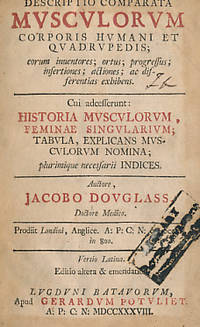
1738ABE-1745523021106Lugduni Batavorum Leiden: Gerardum Potvliet 1738. Hardcover. Very Good. Jacob Douglas’s Descriptio Comparata Musculorum Corporis Humani et Quadrupedis 1738 is a specialized anatomical treatise devoted to the comparative study of muscles in humans and quadrupeds. Douglas provides an early 18th-century expansion of comparative anatomy as a discipline that not only informed veterinary medicine but also deepened understanding of human musculature through cross-species analysis. <br /> <br /> Douglas arranges his work in a systematic fashion describing muscles by region and function beginning with the head and neck then proceeding through the trunk and limbs. Each muscle is presented with its name anatomical origin and insertion action and—where relevant—differences or analogues found in quadrupeds. This side-by-side structure offered a practical resource for anatomists physicians and veterinary surgeons at a time when animal dissection often preceded or supplemented access to human cadavers. <br /> <br /> The book’s comparative approach was part of a broader intellectual movement in early modern anatomy influenced by the works of Borelli Bidloo Albinus and other Continental anatomists but with a distinctive British contribution through authors like Douglas. The emphasis on both similarity and variation between humans and quadrupeds served not only a pedagogical role—training students to identify structures across species—but also had implications for understanding biomechanics evolutionary relationships long before Darwinian theory and functional anatomy in relation to different modes of locomotion and posture. The work demonstrates a meticulous descriptive style relying on direct observation and dissection with terminology consistent with contemporary anatomical nomenclature. <br /> <br /> BOOK DESCRIPTION AND CONDITION:<br /> <br /> Physically the 1738 edition is a handsome quarto bound in period calf with a red morocco title label to the spine. The title page is printed in red and black. This book is in very good condition for its age with the calf binding intact and only light wear to extremities. The gilt lettering on the red title label remains clear and the pages though showing expected toning are generally clean and free from major defects. Some damage to spine. Gerardum Potvliet hardcover
1738e5809Lugduni Batavorum Leiden: Gerardum Potvliet. Worn condition. Upper board detached. Content in overall good condition. Ex Royal College of Surgeons Ireland Library. 1738. Editio altera & emendation. Brown hardback leather cover. 180mm x 100mm 7" x 4". 211pp. '. Plurimique Necessarii Indices.'. . Gerardum Potvliet hardcover
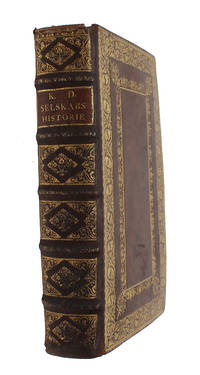
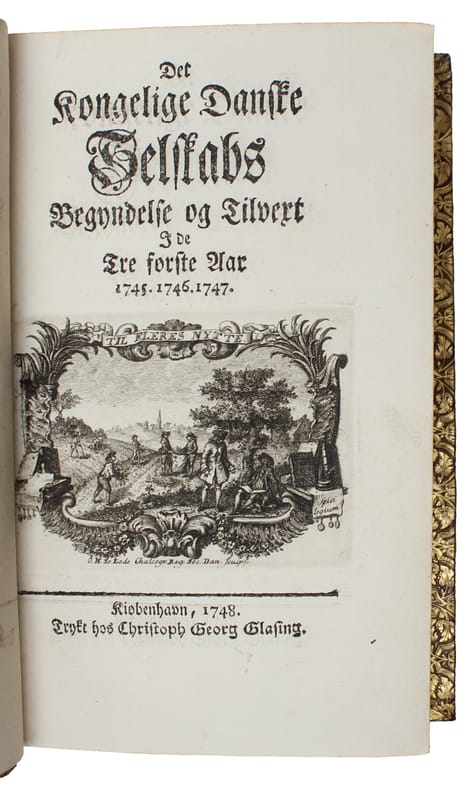
174860987Kiøbenhavn Copenhagen Georg Glasing 1748. 8vo. Bound in a very beautiful Cambridge-style mirror binding with richly gilt spines elaborate gilt borders to boards inner gilt dentelles and gilt ornamentation to edges of boards. All edges gilt. Light wear to extremities. Some of gilting to spine worn off. With a bit of loss of leather to head of spine showing headband. Internally very fine and clean - a magnificent copy printed on good paper. 16360 pp. <br/><br/><em>First edition of this work containing the history of "Det Kgl. Danske Selskab for Fædrelandets Historie og Sprog" i.e. â€Royal Danish Society for Fatherland History†its foundational history laws and constitution and a cataglogue of its library. The society is publishing “Danske Magazin†– the oldest existing Danish periodical. It is published irregularly but has been issued since January 1745. Biblioteca Danica II 973. </em> hardcover
174860987Kiøbenhavn (Copenhagen), Georg Glasing, 1748. 8vo. Bound in a very beautiful Cambridge-style mirror binding with richly gilt spines, elaborate gilt borders to boards, inner gilt dentelles and gilt ornamentation to edges of boards. All edges gilt. Light wear to extremities. Some of gilting to spine worn off. With a bit of loss of leather to head of spine, showing headband. Internally very fine and clean - a magnificent copy printed on good paper. (16),360 pp.
173442907Hamburgi: Rudolphum Beneken 1734. 4to pp. 8 35 1 unpaginated lexicon in double column one folding plate wood cut head-pieces; full contemporary sheep blind-tooled spine in 7 compartments contemporary printed paper spine label cracked; illegible contemporary notes on front pastedown lacking front free endpaper else very good and sound. Serenius was chaplain to the Swedish embassy in London 1725-35 where he tried to strengthen the relations between Sweden and Great Britain. It was during this time that he began work on his dictionary. The preliminary essay "De veterum Sveo-gothorum cum Anglis usu et commercio dessertatio" by Ericus Benzelius highlights the parallels between Anglo-Saxon and Swedish and he acknowledges in his Preface the work of George Hickes John Hudson Henry Dodwell Thomas Smith and Sir Humfrey Wanley. Kennedy 2724; this edition not in Vancil or Zaunmüller. Rudolphum Beneken unknown
173442907Hamburgi: Rudolphum Beneken 1734. 4to pp. 8 35 1 unpaginated lexicon in double column one folding plate wood cut head-pieces; full contemporary sheep blind-tooled spine in 7 compartments contemporary printed paper spine label cracked; illegible contemporary notes on front pastedown lacking front free endpaper else very good and sound. Serenius was chaplin to the Swedish embassy in London 1725-35 where he tried to strengthen the relations between Sweden and Great Britain. It was during this time that he began work on his dictionary. The preliminary essay "De veterum Sveo-gothorum cum Anglis usu et commercio dessertatio" by Ericus Benzelius highlights the parallels between Anglo-Saxon and Swedish and he acknowledges in his Preface the work of George Hickes John Hudson Henry Dodwell Thomas Smith and Sir Humfrey Wanley. Kennedy 2724; this edition not in Vancil or Zaunmüller. <br/><br/> Rudolphum Beneken unknown books