CERVANTES SAAVEDRA, Miguel de (Jacob Campo WEYERMAN translator; Antoine COYPEL illustrator).Biblio.com
731 résultats
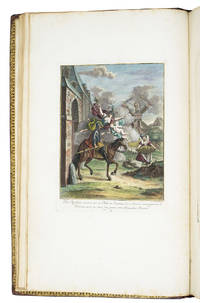
1746M2HB4ES5PXB4The Hague: Pieter de Hondt 1746. Contemporary richly gold-tooled dark red morocco by the so-called Van Damme bindery in Amsterdam sewn on 7 supports each board with Van Dammes typical hourglass- or vase- or flask-shaped central cartouche with a starry sky on a black ground here showing a short-stemmed chalice or goblet with fire or flame-like leaves like a snake plant Dracaena trifasciata in the cartouche and a basket of flowers topping the cartouche the whole in an elaborate frame built up from hundreds of impressions of numerous small tools the spine-title in gold on a black ground in the 2nd of 8 compartments each of the other 7 with flowers other decorations and a small flower in a pot gilt edges. With a tissue guard-leaf before each plate. Large folio 42 x 27 cm. Title in red and black with an engraved vignette Quixote and the windmill and 31 engraved illustration plates all coloured by a contemporary hand heightened with gold and set in in a gilt frame. Further with large woodcut initials and tailpieces and each text page in an ornamental frame built up from typographic ornaments the frames not in the 4to issue. Very rare large-paper copy of the first and only edition of a "free and joyous" Dutch translation of Cervantes's Don Quixote with 31 rococo style plates in spectacular contemporary hand colouring and with gold highlights. The plates have been engraved by leading Dutch artists Bernard Picart 12 Jacob van der Schley 13 Pierre Tanjé 5 and Simon Fokke 1 after paintings by leading French artists Antoine Coypel 25 Charles-Nicolas Cochin 2 Pierre-Charles Trémolières 2 François Boucher 1 and Jacques-Philippe le Bas 1. The impressions are crisp and the hand colouring is bright and of the highest quality with subtly graded tones and highlights in gold. Antoine Coypel 1694-1752 responsible for the design of most of the illustrations was one of the most important French history painters of the early 18th century. His Don Quixote paintings are highlights in his oeuvre and can be found in several museum collections.The Dutch edition was translated by Jacob Campo Weyerman 1677-1747 one of the foremost Dutch authors of the Enlightenment who was known for his merry style. He added to this edition a Dutch translation of the biography of Cervantes by Gregorio Mayans 1737 and explanatory texts to the plates. De Hondt issued the present edition in at least three formats: 4to folio on ordinary paper and folio on large paper. The present copy is the large-paper folio issue which is indeed very rare: several libraries have folio editions on ordinary paper usually about 35 cm tall but we have not located a copy of the large folio issue in any library. The only other large-paper copy we have been able to trace is slightly smaller.Cervantes's Don Quixote first published in Spanish 1605-1615 was first translated into Dutch in the early 17th century and went through several editions until 1732. Engraved prints after Coypel's famous Don Quixote paintings started circulating in 1734. De Hondt took this opportunity to publish a new Dutch translation with the Coypel illustrations and some others. He asked Weyerman who was already a famous writer but was imprisoned for slander to translate the text. He also commissioned new plates after Coypels paintings from the leading Dutch engravers. This came together in what became a masterpiece of rococo book production and the present hand-coloured copy of the large folio issue is the outstanding result.The Van Damme bindery was the "most important Amsterdam workshop of the 18th century" and is praised for the "high quality of its work" Storm van Leeuwen: 89 bindings are attributed to it. Although its earliest dated binding is from 1747 the present work and two others in similar Van Damme bindings in the British Library were printed in 1746 so these bindings may be among Van Dammes earliest work made in or soon after that year. Three of the six Van Damme bindings in the British Library as well as several examples in Storm van Leeuwen have a similar cartouche with a black interior but none includes the present vase or goblet of flames or flame-like leaves: we have not identified the patron.The boards are very slightly rubbed the corners and head and foot of the spine have been reinforced. A few small spots in the foot margin of the title page and slight browning of the paper of 2 quires. Otherwise in very good condition.l Arents Cervantes in het Nederlands 27: "Kneppelhout nr. 2587 gr. fol. rood verg. marok. verg. op sn. Zeer fraai ex. op gr. papier. Het titelvignet en de 30 prtn. allen alleruitmuntendst uit de hand gekl. en met goud afgezet. In oud-Holl. prachtbd. van rood marokyn. De rug verg. in afdeel. De platten met een zeer breed verguldsel randwerk en verg. middenfig. op zwart leder. Verg. op sn. Gekocht door Hr. Elte voor fl. 420."; Cohen & De Ricci 216 "superbes illustrations; livre tres recherche"; Van Gorp pp. 161-162; Mededelingen van de Stichting Jacob Campo Weyerman 18 1995 passim; Rius I 806; STCN 197115810 8 copies; Marleen de Vries Aanzet tot een bibliografie van Jacob Campo Weyerman 1990; cf. for the binding: Storm van Leeuwen I pp. 460-499. Pieter de Hondt, unknown
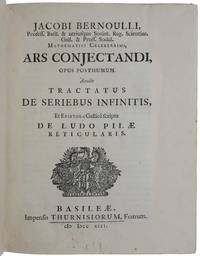
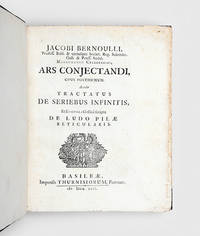
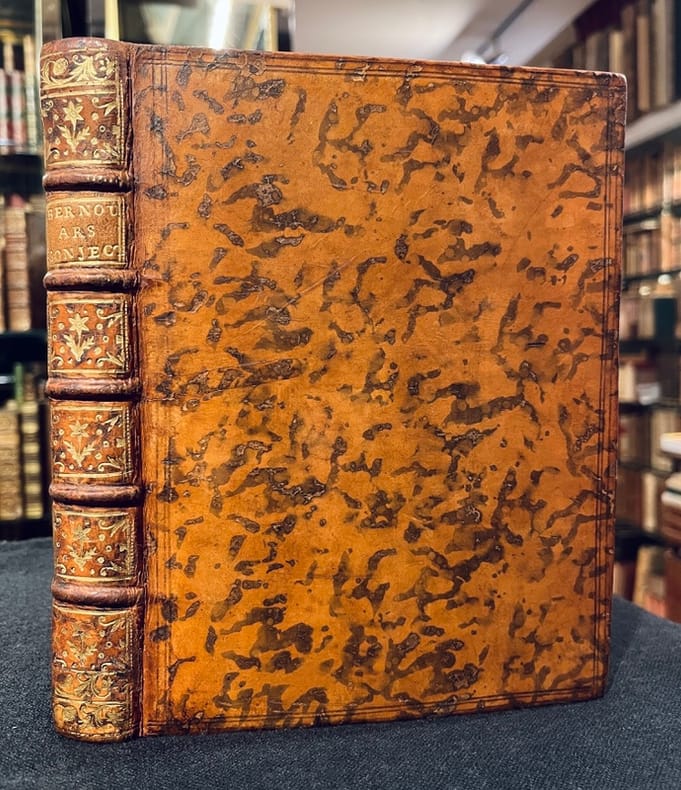
17134063Basel: Impensis Thurnisiorum Fratum 1713. First edition. First edition of the most significant early book on probability theory: it set forth the fundamental principles of the calculus of probabilities and contained the first suggestion that the theory could extend beyond the boundaries of mathematics to apply to civic moral and economic affairs. It also contained the first statement but not the proof of the law of large numbers. Hardcover. EVANS 8 - ESTABLISHED THE FUNDAMENTAL PRINCIPLES OF THE CALCULUS OF PROBABILITIES. <p>First edition an exceptionally fine copy rare in this condition. "Jakob 1 Bernoulli's posthumous treatise edited by his nephew Nicholas I Bernoulli the title literally means "the art of dice throwing" was the first significant book on probability theory: it set forth the fundamental principles of the calculus of probabilities and contained the first suggestion that the theory could extend beyond the boundaries of mathematics to apply to civic moral and economic affairs. The work is divided into four parts the first a commentary on Huygens's De ratiociniis in ludo aleae 1657 the second a treatise on permutations a term Bernoulli invented and combinations containing the Bernoulli numbers and the third an application of the theory of combinations to various games of chance. The fourth and most important part contains Bernoulli's philosophical thoughts on probability: probability as a measurable degree of certainty necessity and chance moral versus mathematical expectation a priori and a posteriori probability etc. It also contains his attempt to prove what is still called Bernoulli's Theorem: that if the number of trials is made large enough then the probability that the result will lie between certain limits will be as great as desired" Norman. This was the first statement of the law of large numbers.</p> <br /> <p>"In the first Part pp. 2-71 Jakob Bernoulli complemented his reprint of Huygens's tract by extensive annotations which contained important modifications and generalisations. Bernoulli's additions to Huygens's tract are about four times as long as the original text. The central concept in Huygens's tract is expectation. The expectation of a player A engaged in a game of chance in a certain situation is identified by Huygens with his share of the stakes if the game is not played or not continued in a 'just' game. For the determination of expectation Huygens had given three propositions which constitute the 'theory' of his calculus of games of chance. Huygens's central proposition III maintains:</p> <br /> <p>"If the number of cases I have for gaining a is p and if the number of cases I have for gaining b is q then assuming that all cases can happen equally easily my expectation is worth pa qb/p q."</p> <br /> <p>"Bernoulli not only gives a new proof for this proposition but also generalizes it in several ways .</p> <br /> <p>"Huygens's propositions IV to VII treat the problem of points also called the problem of the division of stakes for two players; propositions VIII and IX treat three and more players. Bernoulli returns to these problems in Part II of the Ars Conjectandi. In his annotations to Huygens's proposition IV he generalised Huygens's concept of expectation . This is the only instance in the annotations and commentaries to Huygens's tract where Bernoulli uses the word 'probabilitas' or probability as understood in everyday life. Later in Part IV of the Ars Conjectandi Bernoulli replaced Huygens's main concept expectation by the concept of probability for which he introduced the classical measure of favourable to all possible cases. The remaining propositions X to XIV of Huygens's tract deal with dicing problems of the kind: What are the odds to throw a given number of points with two or three dice or: With how many throws of a die can one undertake it to throw a six or a double six . The meaning of Huygens's result of proposition X that the expectation of a player who contends to throw a six with four throws of a die is greater than that of his adversary is explained by Bernoulli in a way which relates to the law of large numbers proved in Part IV of the Ars Conjectandi .</p> <br /> <p>"In the second Part pp. 72-137 Bernoulli deals with combinatorial analysis based on contributions of van Schooten Leibniz Wallis and Jean Prestet . It consists of nine chapters dealing with permutations the number of combinations of all classes the number of combinations of a particular class figurate numbers and their properties especially the multiplicative property sums of powers of integers the hypergeometric distribution the problem of points for two players with equal chances to win a single game combinations with repetitions and with restricted repetitions and variations with repetitions and with restricted repetitions.</p> <br /> <p>"Evidently Bernoulli did not know Blaise Pascal's Triangle arithmétique published posthumously in 1665 though Leibniz had alluded to it in his last letter to him in 1705. Not only does Bernoulli not mention Pascal in the list of authors that he had consulted concerning combinatorial analysis except for Pascal's letter to Fermat of 24 July 1654; it would also be difficult to explain why he repeated results already published by Pascal in the Triangle arithmétique such as the multiplicative property for binomial coefficients for which Bernoulli claims the first proof for himself. His arrangement differs completely from that of Pascal whose proof for the multiplicative property of the binomial coefficients has been judged to be clearer than Bernoulli's. It is fair to add that in the Ars Conjectandi which Bernoulli left as an unpublished manuscript he was much more honest concerning the achievements of his predecessors than Pascal in the Triangle arithmétique. It is also true that Bernoulli was concerned with combinatorial analysis in the Ars Conjectandi first of all because it constituted for him a most useful and indispensable universal instrument for dealing numerically with conjectures since 'every conjecture is founded upon combinations of the effective causes' p. 73 .</p> <br /> <p>"In the third Part pp. 138-209 Bernoulli gives 24 problems concerning the determination of the modified Huygenian concept of expectation in various games. Here he uses extensively conditional expectations without however distinguishing them from unconditional expectations. All the games are games of chance with dice and cards including games en vogue at the French court of the time like Cinque et neuf Trijaques or Basette. He solves these problems mainly by combinatorial methods as introduced in Part II and by recursion .</p> <br /> <p>"The fourth Part pp. 210-239 is the most interesting and original Part; but it is the one that Bernoulli was not able to complete. In the first three of its five chapters it deals with the new central concept of the art of conjecturing probability its relation to certainty necessity and chance and ways of estimating and measuring probability" Schneider pp. 92-100. "The relevant point for our analysis is his introduction in the fourth part of Ars Conjectandi of what has come to be regarded as the first law of large numbers. Bernoulli began the discussion leading up to his theorem by noting that in games employing homogeneous dice with similar faces or urns with equally accessible tickets of different colors the a priori determination of chances was straightforward. One would simply enumerate the possible cases and take the ratio of the number of 'fertile' cases to the total number of cases whether 'fertile' or 'sterile.' But Bernoulli asked what about problems such as those involving disease weather or games of skill where the causes are hidden and the enumeration of equally likely cases impossible In such situations Bernoulli wrote "It would be a sign of insanity to attempt to learn anything in this manner." Instead Bernoulli proposed to determine the probability of a fertile case a posteriori: "For it should be presumed that a particular thing will occur or not occur in the future as many times as it has been observed in similar circumstances to have occurred or not occurred in the past" p. 224. The proportion of favorable or fertile cases could thus be determined empirically. Now this empirical approach to the determination of chances was not new with Bernoulli nor did he consider it to be new. What was new was Bernoulli's attempt to give formal treatment to the vague notion that the greater the accumulation of evidence about the unknown proportion of cases the closer we are to certain knowledge about that proportion.</p> <br /> <p>"Bernoulli took it as commonly known that uncertainty decreased as the number of observations increased: "For even the most stupid of men by some instinct of nature by himself and without any instruction which is a remarkable thing is convinced that the more observations have been made the less danger there is of wandering from one's goal" p. 225. Bernoulli sought both to provide a proof of this principle and to show that there was no natural lower bound to the residual uncertainty: By multiplying the observations 'moral certainty' about the unknown proportion could be approached arbitrarily closely" Stigler pp. 64-5.</p> <br /> <p>The main work concludes with Tractatus de seriebus infinitis earumque summa finite et usu in quadraturis spatiorum & rectificationibus curvarum pp. 241-306 which had first appeared as a series of five extremely rare pamphlets entitled Positiones arithmeticae de seriebus infinitis earumque summa finita. "The five dissertations in the Theory of Series 1682-1704 contain sixty consecutively numbered propositions. These dissertations show how Bernoulli at first in close cooperation with his brother had thoroughly familiarized himself with the appropriate formulations of questions to which he had been led by the conclusions of Leibniz in 1682 series for pi/4 and log 2 and 1683 questions dealing with compound interest. Out of this there also came the treatise in which Bernoulli took into account short-term compound interest and was thus led to the exponential series. He thought that there had been nothing printed concerning the theory of series up until that time but he was mistaken: most conclusions of the first two dissertations 1689 1692 were already to be found in Pietro Mengoli Novae quadraturae arithmeticae seu de additione fractionum 1650 as were the divergence of the harmonic series Prop. 16 and the sum of the reciprocals of infinitely many figurate numbers Props. 17-20 . At the end of the first dissertation Bernoulli acknowledged that he could not yet sum the inverse squares of the integers in closed form Euler succeeded in doing so first in 1737 . Informative theses based on Bernoulli's earlier studies were added to the dissertations: and theses 2 and 3 of the second dissertation are based on the still incomplete classification of curves of the third degree according to their shapes into thirty-three different types.</p> <br /> <p>"The third dissertation was defended by Jakob Hermann who wrote Bernoulli's obituary notice in Acta eruditorum 1706. In the introduction L'Hospital's Analyse is praised. After some introductory propositions there appear the logarithmic series for the hyperbola quadrature Prop. 42 the exponential series as the inverse of the logarithmic series Prop. 43 . and the series for the arc of the circle and the sector of conic sections Props. 45 46. All of these are carefully and completely presented with reference to the pertinent results of Leibniz 1682; 1691. In 1698 previous work was supplemented by Bernoulli's reflections on the catenary Prop. 49 and related problems on the rectification of the parabola Prop. 41 and on the rectification of the logarithmic curve Prop. 52.</p> <br /> <p>"The last dissertation 1704 was defended by Bernoulli's nephew Nikolaus I who helped in the publication of the Ars conjectandi 1713 and the reprint of the dissertation on series 1713 and became a prominent authority in the theory of series. In the dissertation Bernoulli first Prop. 53 praises Wallis' interpolation through incomplete induction. In Proposition 54 the binomial theorem is presented with examples of fractional exponents as an already generally known theorem. Probably for this reason there is no reference to Newton's presentation in his letters to Leibniz of 23 June and 3 November 1676 which were made accessible to Bernoulli when they were published in Wallis' Opera Vol. III 1699" DSB.</p> <br /> <p>The volume concludes with a separately-paginated 35-page Lettre à un Amy sur les Parties du Jeu de Paume in French. "In his Letter to a Friend on the Game of Tennis Bernoulli begins with a summary of his considerations in the Ars Conjectandi on the difference between games of chance and games that depend on the skill of the players on the corresponding determination of probabilities a priori and a posteriori and on the law of large numbers which justifies the use of the relative frequency of winning as a measure of the probability of winning. Apart from this short introduction the letter is really an exercise in probability theory and could well have been included in Part 3 of the Ars Conjectand. "Bernoulli writes that he will not explain the rules of the game because they are well known. The game is more complicated than tennis but with the same scoring rules . Bernoulli analyzes many problems of tennis. There are however no new methods used in his analysis; he keeps strictly to the methods used by Huygens solving most of the problems by recursion between expectations. The letter is an imposing work demonstrating Bernoulli's pedagogical qualities his ability to systematize and his thoroughness" Hald p. 241.</p> <br /> <p>"Important sections of the Ars Conjectandi were sketched out in Jakob Bernoulli's scientific diary the 'Meditationes' from the mid 1680s onwards. When he died in 1705 the Ars Conjectandi was not finished especially lacking good examples for the applications of his 'art of conjecturing' to what he described as civil and moral affairs. Concerning the time that it would have needed to complete it opinions differ from a few weeks to quite a few years depending on assumptions about his own understanding of completeness. His heirs did not want his brother Johann the leading mathematician in Europe at this time to complete and edit the manuscript fearing that Johann would exploit his brother's work. Only after Pierre Rémond de Montmort 1678-1719 himself a pioneer of the theory of probability had sent an offer via Johann to print the manuscript at his own expense in 1710 and after some admonitions that the Ars conjectandi soon would become obsolete if not published Jakob's son a painter agreed to have the unaltered manuscript printed. It appeared in August 1713 . A short preface was contributed by Nikolaus Bernoulli 1687-1759 Jakob's nephew. He had read the manuscript when his uncle was still alive and had made considerable use of it in his thesis of 1709 De usu artis conjectandi in jure and in his correspondence with Montmort. He was asked twice to complete and edit the manuscript. The first time he excused himself by his absence when he travelled in 1712 to Holland England and France. After his return Nikolaus Bernoulli declared himself as too inexperienced to do the job and in his preface he asked Montmort the anonymous author of the Essay sur les jeux de hazard and Abraham de Moivre 1667-1754 to complete his uncle's work" Schneider p. 90.</p> <br /> <p>PMM 179; Dibner 110; Evans 8; Grolier/Horblit 12; Sparrow 21; Norman 216.</p> <br /> <p>Hald History of Probability and Statistics and their Applications before 1750 2003. Schneider 'Jakob Bernoulli Ars Conjectandi 1713' pp. 88-104 in Landmark Writings in Western Mathematics 1640-1940 I. Grattan-Guinness ed. 2005. Stigler The History of Statistics 1986. </p> <br/> <br/> 4to 202 x 155 mm contemporary vellum red spine label with gilt lettering 4 1-306 1-35 1 printed folding tables between pp. 24-25 and 172-173 folding woodcut diagram after p. 306. An outstanding copy in entirely unrestored binding very fresh and crisp internally. Very rare in such fine condition. / Hardcover. Impensis Thurnisiorum Fratum unknown
1713180566Basel: Johann Rudolph & Emanuel Thurneysen 1713. The subject of the first published computer programme First edition of the first systematic treatment of probability theory the source of the law of large numbers binomial distribution and Bernoulli numbers. The Ars Conjectandi was the first work to suggest that probability could be applied in civil moral and economic matters and it remains the foundation of much modern practice in such fields as insurance and statistics. Jacob Bernoulli 1655-1705 was the first of the famed Bernoulli family to study mathematics: Johann 1667-1748 was his brother while Nicolaus 1687-1759 and Daniel 1700-1782 were his nephews. Nicolaus revised his uncle's manuscripts for this publication and provided his own two-page preface. The Bernoulli numbers in the Ars Conjectandi inspired the first published computer programme as devised by Ada Lovelace in 1843. Looking to demonstrate the potential of Babbage's analytical engine Lovelace wrote an algorithm with which the machine could calculate the Bernoulli sequence each generated recursively from previous values. The algorithm was published in Taylor's Scientific Memoirs in August 1843. Amusingly the final section includes several comments on jeu de paume - a ball game having much in common with modern tennis and very little in common with the rest of the work. Quarto 215 x 170 mm pp. iv 35 1; 306. Folding engraved plate 2 folding engraved tables woodcut vignette to title page head- and tailpieces and initials tables in the text. Nineteenth-century marbled boards outer and lower edges uncut. Front free endpaper and initial two leaves remounted on stub. Late 19th-century "Wirtz" signature. Recent pencil annotation to N3. Light rubbing faint sunning to spine minor browning and foxing to content extremities closed tear to outer margin of D1 professionally repaired plates crisp: a very good copy. Dibner 110; Horblit 12; Norman 216; Printing and the Mind of Man 179; Tomash & Williams B143. hardcover
170932891709. Woodcut device on title two folding printed tables & one folding woodcut plate. Diagrams in the text. 2 p.l. 306 35 1 pp. 4to cont. speckled sheep upper joint with short crack bookplate on blank portion of title patched minor foxing spine gilt red leather lettering piece on spine. Basel: impensis Thurnisiorum Fratrum 1713. <br/> <br/> bound with:<br/> <br/> BERNOULLI Nicolaus I. Dissertatio Inauguralis Mathematico-Juridica. De Usu Artis Conjectandi in Jure. 56 pp. 4to. Basel: J.C. Mechel 1709.<br/> <br/> A most attractive sammelband. <br/> <br/> I. First edition of “the first systematic attempt to place the theory of probability on a firm basis and is still the foundation of much modern practice in all fields where probability is concerned — insurance statistics and mathematical heredity tables.â€â€“Printing & the Mind of Man 179. <br/> <br/> II. First edition. Nicolaus I 1687-1759 nephew of Jacob I and Johann I and editor of the Ars Conjectandi obtained the degree of doctor of jurisprudence with this dissertation on the application of the calculus of probability to questions of law. I believe this to be an important contribution to probability. <br/> <br/> Very good copies. <br/> <br/> ⧠I. Dibner Heralds of Science 110. D.S.B. II pp. 46-51. Evans Epochal Achievements 8. Horblit 12. Sparrow Milestones of Science 21. II. D.S.B. II pp. 56-57. Keynes “Bibliography†in A Treatise on Probability p. 435. unknown
171321804Basilea, Impensis Thurnisiorum Fratum, 1713. Petit in-4 de [4]-306-35-[1] pages, plein veau moucheté brun, dos à nerfs, pièce de titre en maroquin beige, filet doré sur les coupes, tranches rouges.
17616853Copenhagen: Johan Jacob Bruun 1761. Contemporary Danish mottled sheepskin richly gold-tooled spine with red morocco title-label marbled pastedowns red sprinkled edges. Oblong folio 26.5 x 40 cm preliminaries upright folio bound with foot folded in. With 60 engraved views including one folding plate with a view of the Royal Castle near Copenhagen engraved by Jonas Haas and Hans Quist after designs by Johan Jacob Bruun. Enlarged issue of a very rare series of engraved views of Danish castles mansions houses gardens and city views by the Danish landscape painter Johan Jacob Bruun 1715-1789. It was first published in 1761 containing 50 views of buildings on the Danish island Zealand as the first volume of a planned series covering whole Denmark. The other volumes never appeared but 10 additional views were already engraved dated 1760-1762 and included in the present issue with all plates on the same French paperstocks.With plate numbers in manuscript on the back of the plates and some occasional faint thumbing in the margins. Binding rubbed. Very good copy of a very rare series of views of Denmark.l WorldCat 4 copies of all issues; cf. Thieme & Becker V p. 152; Weilbach Dansk Kustnerlex. I 1896; not in BAL; Fowler. Johan Jacob Bruun, unknown
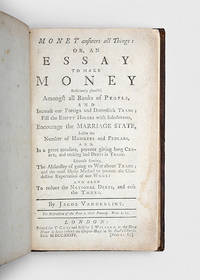
1734170795London: for T. Cox; and sold by J. Wilford 1734. The first scientific study of the question of distribution First edition of "the first scientific study of the question of distribution" Foxwell anticipating the Physiocratic positions on single tax land rents and free trade. "Stewart compared Vanderlint also with David Hume. McCulloch used Stewart's opinions on several occasions and may have provided the basis for Marx's charge that 'Hume follows step by step and often even in his personal idiosyncracies' Vanderlint's work" New Palgrave. "Like Barbon and North Vanderlint had a global vision of international trade and pleaded for free trade. He recognized the mutual benefits that flowed from free trading referring to 'an invincible argument for free and unrestrained trade'" Murphy. Octavo 196 x 121 mm pp. iv ii 170. Contemporary sprinkled calf rebacked spine ruled in gilt in compartments red morocco label. Engraved armorial bookplate of Maurice Fitzgerlad Knight of Kerry Corners. Spine and board edges lightly rubbed light surface wear to sides. Pale dampmark to fore-edge upper outer corner of title page chipped; a very good copy. Goldsmiths' 7227; Kress 4201; McCulloch p. 162; Sraffa 6080. Antoin Murphy Monetary Theory 1601-1758 1996 pp. 46-7. unknown
1776WRCAM47955London: Sayer & Bennett 1776. Single sheet 29 x 22 inches. Some light toning and offsetting. Very good. A highly important chart of the entrance into the St. Mary's River showing the soundings shoals and navigational details as well as Tiger Island Marteirs Islands part of Amelia and Cumberland Islands and the ruins of Fort William which was built by James Oglethorpe. It shows settlements and named plantations including that of the Countess Dowager of Egmont with the slave quarters labeled in the map key. The map also includes a key to the rivers buildings etc. indicated on the map and sailing directions into the harbor. This chart was originally published in the second part of THE NORTH- AMERICAN PILOT. In 1776 shortly after news of American Independence reached Great Britain publishers Sayer & Bennett issued a second part to their previously published THE NORTH-AMERICAN PILOT to encompass the coastline of the American colonies. The maps issued here include famed cartographic productions by John Gascoigne Joshua Fisher Anthony Smith and others. Many maps include additions reflecting the early battles of the war such as the plan of Charlestown showing the attack on Fort Sullivan. This second part of THE NORTH-AMERICAN PILOT was first published in 1776 and subsequently reissued with additional maps in 1777. SELLERS & VAN EE 1632. Sayer & Bennett unknown books
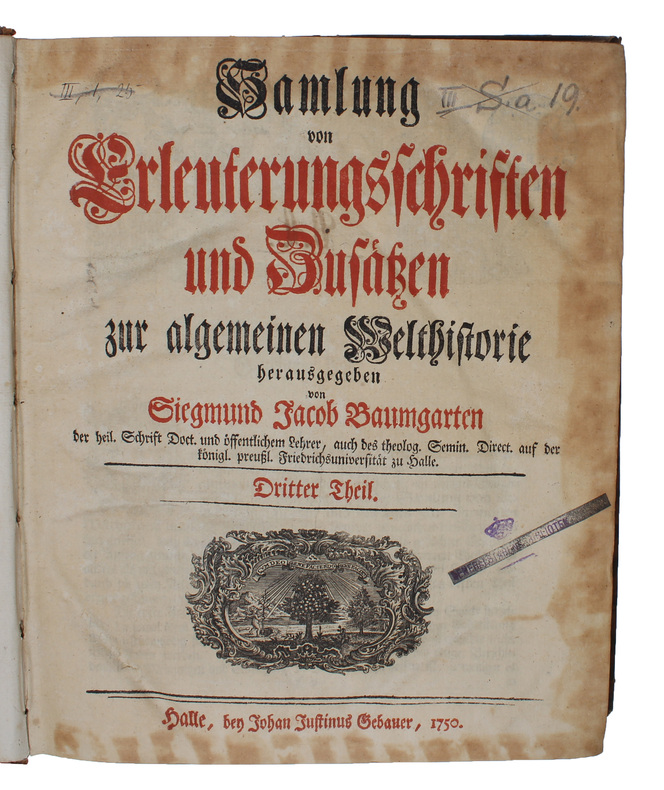
174456102Halle, Johann Justinus Gebauer. 1744-1793 4to. Bound in 65 (Theil 48 in 3 volumes) nice contemporary full calf with raised bands and richly gilt spines. A few volumes have some wear to upper spines. With 58 frontispices, 124 engraved plates, and 103 engraved folded maps. Internally nice and clean.
174456102Halle Johann Justinus Gebauer. 1744-1793 4to. Bound in 65 Theil 48 in 3 volumes nice contemporary full calf with raised bands and richly gilt spines. A few volumes have some wear to upper spines. With 58 frontispices 124 engraved plates and 103 engraved folded maps. Internally nice and clean. <br/><br/><em>Brunet III: p. 233 - Graesse III: 309 Both bibliographies erroneously state that the first part was printed in 1746. </em> hardcover
172910151Leipzig Johann Heinrich Zedler/Register: Leipzig Bernhard Christoph Breitkopf 1729-1733/1740. 12 bindings containing 22 volumes and a register 10 16 588 8 834 8 4 674 14 608 10 16 640 8 674 10 4 548 8 636 14 744 12 576 10 32 664 6 8 651 8 16 742 8 680 6 8 620 6 621 10 720 6 534 6 708 2 380 8 736 2 592 4 224 26 144 882 280 p. Contemporary Vellum Folio H. 345 x L. 225 x W. 7-85 cm. -the complete set is ca. 90 cm. wide- A single wormhole in the bottom margin of volume 13 top of the back covers of volume 19/20 21/22 and the register lack a small piece of vellum the text blocks are slightly browned at some places but not nearly as browned as usual page 451/452 of volume 9 is present a second time in volume 8 all 22 volumes are illustrated with a large engraved head-piece depicting Luther at the beginning of the main text. Firm and complete set of the works of Martin Luther 1484-1546. Included is a useful register which was specially made for this edition by Johann Jacob Greiff 1699-1767. The set is uniformly bound in firm vellum bindings which are in very good condition and surprisingly clean. Altogether a beautiful set of the life's work of the renowned Martin Luther. Leipzig Johann Heinrich Zedler/Register: Leipzig, Bernhard Christoph Breitkopf hardcover
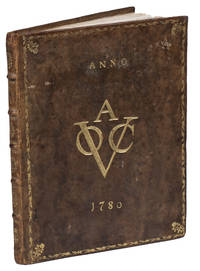
1780ABC_48891The Netherlands 1780. Late 18th-century gold-tooled brown mottled calf sewn on 5 supports bound by the so-called Acorn-and-Foliage Tool Bindery in Amsterdam Storm van Leeuwen. Both boards show the large gold-tooled monogram of the Amsterdam chamber of the VOC as a centre piece sandwiched between the gold-tooled date Anno 1780 all within a gold-tooled floral frame with floral corner pieces in the inside corners spine gold-tooled in six compartments red sprinkled edges. 4to ca. 19 x 15 cm. Manuscript in French written in black ink on paper in a neat cursive script by one hand. With chapter divisions numbered 39-75 and headings. The text is written upside down in relation to the binding. Most leaves show an identical watermark depicting a lion rampant on a pedestal with Vryheyt in a crowned ring with Pro Patria Eiusque Libertate and the letters CR below which is very close to Heawood 3149 date: 1753. Late 18th-century manuscript copy of a French childrens catechism by the Swiss theologian Jacob Vernet 1698-1789 bound in a remarkable late 18th-century binding originally produced for the Amsterdam Chamber of the Dutch East India Company VOC by the so-called Acorn-and-Foliage Tool Bindery which was active between ca. 1760 and ca. 1784 Storm van Leeuwen.It shows the large monogram of the Amsterdam Chamber of the VOC sandwiched between the date "Anno 1780" on both boards. These bindings were usually commissioned as gifts to persons important to the VOC often containing an almanac for the relevant year but possibly also produced as blank notebooks. The present work comprises chapters 39-49 and 58-75 of Vernet's work which form almost the second half of printed editions. The chapters included in the present work are complete and exactly follow the order of the printed text in the Geneva 1742 edition pp. 75-140 checked using a digital copy with a slightly different spelling and replacing some words. For unclear reasons chapters 50-57 dealing with the fourth through tenth commandment have not been copied and several leaves between the end of chapter 49 and the beginning of chapter 58 have been left blank.Vernets religious text was first published in 1741 under the title Instruction chrétienne ou catechisme familier; avec quelques prières a lusage des petits enfans . In 1742 a revised edition appeared with a slightly different title Instruction crhetienne ! ou catechisme familier. Avec quelques passages de lEcriture Sainte & quelques prières à lusage des petits enfans. Nouvelle edition. Revuë corrigée & augmentée. Both works were printed in Geneva for the Swiss bookseller Emanuel Du Villard Emmanuel Duvillard 1693-1776 and subsequently reprinted several more times until 1769. With the book block showing the remnants of 12 removed leaves probably already removed before the manuscript was finished. Both pastedowns partly detached an old annotation Ao. 44305 in black ink on the lower pastedown some foxing. Otherwise in good condition.l For the binding: Landwehr/Van der Krogt VOC pp. XXVII-XXVIII; Storm van Leeuwen I p. 175 p. 196 VOC A-stamp and pp. 612-616 the bindery; for Vernet's work: Google Books digital copy of the 1742 ed. title: Instruction crhetienne ! ou Catechisme familier; physical copy at the Biblioteca Universitaria di Torino; WorldCat 951908419 1 copy 1767 ed.; WorldCat 1040828976 1 copy 1769 ed. no author noted; for the watermark: Heawood 3149. hardcover
1772WRCAM46993Mannheim: Churfurstl. Hof-und Academie-Buchdruckerey 1772. 163581pp. plus two engraved plates on one sheet and folding map. Small octavo. Modern half vellum and marbled boards spine gilt. A bit of light age toning an occasional light fox mark. Three small purple ink spots in lower portion of map. Near fine. First printing of this rare and important account of Lower California by the German Jesuit Jacob Baegert. Baegert lived in Baja California for seventeen years 1751-68 and spent most of his time at the Mission of San Luis Gonzaga leaving after the expulsion of the Jesuits in 1767. He provides some important details on the culture of the Indians of Baja California including the Pericues Guiacuras and Cochiemes. Part one is an overview of California its climate and products; part two describes the inhabitants; and the third part contains an account of the introduction of Christianity to California. Wagner states that the German Jesuits were especially dissatisfied toward the end of the Jesuit regime in California and Baegert's bitterness is evident in his book: ".it was a land full of ferocious beasts and even more ferocious Indians the soil was poor the water undrinkable and there was no fuel to be had." <br> <br> The fine and important map was made by fellow Jesuit Ferdinand Consak and is described by Streeter as "most helpful in giving the location of the many Jesuit missions in Lower California. It also shows the route along the west coast of Mexico followed by Baegert in going to California in 1751 and his route out in 1768 after the expulsion of the Jesuits." The top right corner of the territory present-day Arizona is labeled rather ominously "Los Apaches Barbari." The excellent plates which were apparently not issued with all copies depict male and female California Indians. <br> <br> A prime early account of Baja California with an important map and plates of the region. HOWES B29 "b." HILL 46. COWAN p.27. SABIN 4363. BELL B5. STREETER SALE 2442. BARRETT 129. WAGNER SPANISH SOUTHWEST 157. WAGNER NORTHWEST COAST pp.154-155 & item 631. MEADOWS BAJA CALIFORNIA 1. GRAFF 137. PILLING PROOF SHEETS 203. PALAU 358393. Churfurstl. Hof-und Academie-Buchdruckerey hardcover books
1729041022Leipzig Johann Heinrich Zedler/Register: Leipzig Bernhard Christoph Breitkopf 1729-1733/1740 1729. Hardcover. Very Good. Des Theuren Mannes Gottes D. Martin Luthers Sämtliche Theils von Ihm selbst Deutsch verfertigte theils aus dessen Lateinischen ins Deutsche übersetzte Schriften und Werke Welche aus allen vorhin Ausgegangenen Sammlungen zusammen getragen Und Anietzo in eine bequemere und nach denen Materien eingerichtete Ordnung gebracht nach denen ältesten und besten Exemplarien mit Fleisz übersehen und verbessert mit verschiedenen in denen Altenburgischen und andern Tomis ermangelnden Schrifften vermehret und mit nöthigen Vorberichten versehen. WITH in Volume XXII: M. Johann Jacob Greiffs Pastoris in Mölbis Vollständige Register über die XXII Leipziger Theile der gesammten Schriften Des seligen D. Martin Luthers Nebst einem auf die Wittenbergischen Jenischen 1740. 22 volumes in 22 bound vellum bindings. Marble endpapers. Interior very good pages evenly browned. Leipzig Johann Heinrich Zedler/Register: Leipzig, Bernhard Christoph Breitkopf 1729-1733/1740 hardcover
175232978-1197Zurich Heidegger and Comp. 1752. With engr. frontispiece in part 1 woodcut title-vignette repeated and 32 engravings of which 25 are foldings 1 with a over-slip including views town plans and maps by Joh. Meyer Joh. Melchior Füssli and J. G. Seiller. 4 268 pp. 4 leaves; 16 480 6 pp.; 16 336 pp. 4to. Contemp. half calf gilt lettering on spine. Engraved bookplate Joh. Kaspar Weyss owner's entry Hermann Werdmüller Elgg on inner from cover. Title-pages printed in red and black. Zurich Heidegger and Comp. 1752. The first edition was published in 1716-18. This present second edition of J. J. Scheuchzer's 1672-1733 scientific description of Switzerland is greatly enlarged and much rarer. The plates are mainly views and maps although there are also plates of geological profiles and samples scientific equipment and regional flora and fauna. From 1702 until 1711 Scheuchzer undertook yearly expeditions accompanied by friends and pupils. He was the first to systematically explore the Alps and became a pioneer in the fields of geology palaeontology and glaziology. The work offers historical details and together with Tschudi's chronicle it became one of the main sources for Schiller's "Wilhelm Tell". - A few tears in the folds of some maps and plates repaired. Otherwise a fine and clean copy. - Nissen ZBI 3655; Haller I 1047; Barth 17218. SCIENCE: GEOLOGY / MINERALOGY ; HELVETICA ; Zurich, Heidegger and Comp. unknown
1773WRCAM48817AMannheim: Churfurstl. Hof-und Academie-Buchdruckerey 1773. 16358pp. plus two engraved plates and folding map. Contemporary black half calf and marbled boards spine gilt. Extremities lightly worn small paper label at foot of spine. Small ink stamp on titlepage and verso of map. Minor scattered foxing. Very good. Second issue with some corrections after the first printing of the previous year of this rare account of Lower California by the German Jesuit Jacob Baegert. Baegert lived in Baja California for seventeen years 1751- 68 and spent most of his time at the Mission of San Luis Gonzaga leaving after the expulsion of the Jesuits in 1767. He provides some important details on the culture of the Indians of Baja California including the Pericues Guiacuras and Cochiemes. Wagner states that the German Jesuits were especially dissatisfied toward the end of the Jesuit regime in California and Baegert's bitterness is evident in his book: ".it was a land full of ferocious beasts and even more ferocious Indians the soil was poor the water undrinkable and there was no fuel to be had." The fine and important map was made by the fellow Jesuit Ferdinand Consak and is described by Streeter as "most helpful in giving the location of the many Jesuit missions in Lower California. It also shows the route along the west coast of Mexico followed by Baegert in going to California in 1751 and his route out in 1768 after the expulsion of the Jesuits." The top right corner of the territory present-day Arizona is labeled rather ominously "Los Apaches Barbari." The excellent plates which were apparently not issued with all copies depict male and female California Indians. The NUC locates only three copies of this second issue. <br> <br> A prime early account of Baja California with an important map and plates of the region. HOWES B29. HILL 46. COWAN p.27. SABIN 4363. BELL B5 1772 ed. STREETER SALE 2442. BARRETT 129. WAGNER SPANISH SOUTHWEST 157. MEADOWS BAJA CALIFORNIA 1. GRAFF 137 1772 ed. Churfurstl. Hof-und Academie-Buchdruckerey hardcover books
1773WRCAM48817Mannheim: Churfurstl. Hof-und Academie-Buchdruckerey 1773. 16358pp. plus two engraved plates and folding map. Contemporary patterned paper boards expertly rebacked and recornered to style preserving original leather label. Internally clean. Very good plus. Second issue with some corrections after the first printing of the previous year of this rare account of Lower California by the German Jesuit Jacob Baegert. Baegert lived in Baja California from 1751 to 1768 and spent most of his time at the Mission of San Luis Gonzaga leaving after the expulsion of the Jesuits in 1767. He provides some important details on the culture of the Indians of Baja California including the Pericues Guiacuras and Cochiemes. Wagner states that the German Jesuits were especially dissatisfied toward the end of the Jesuit regime in California and Baegert's bitterness is evident in his book: ".it was a land full of ferocious beasts and even more ferocious Indians the soil was poor the water undrinkable and there was no fuel to be had." The fine and important map was made by the fellow Jesuit Ferdinand Consak and is described by Streeter as "most helpful in giving the location of the many Jesuit missions in Lower California. It also shows the route along the west coast of Mexico followed by Baegert in going to California in 1751 and his route out in 1768 after the expulsion of the Jesuits." The top right corner of the territory present-day Arizona is labeled rather ominously "Los Apaches Barbari." The excellent plates which were apparently not issued with all copies depict male and female California Indians. The NUC locates only three copies of this second issue. <br> <br> A prime early account of Baja California with an important map and plates of the region. <br> <br> The Streeter copy sold to Dawson's Book Shop of Los Angeles for $150 in 1968. HOWES B29. HILL 46. COWAN p.27. SABIN 4363. BELL B5 1772 ed. STREETER SALE 2442. BARRETT 129. WAGNER SPANISH SOUTHWEST 157. MEADOWS BAJA CALIFORNIA 1. GRAFF 137 1772 ed. Churfurstl. Hof-und Academie-Buchdruckerey hardcover books
177328630Mannheim: Churfurstl. Hof-und Academie-Buchdruckerey 1773. 12mo. 16 358pp. Two engraved plates folding map. Contemporary patterned paper boards expertly rebacked and recornered to style preserving original leather label.<br/> <br/>Rare early account of Lower California by a German Jesuit.<br/> <br/>Second issue with some corrections after the first printing of the previous year. Baegert lived in Baja California for a period of seventeen years 1751-68 and spent most of his time at the Mission of San Luis Gonzaga leaving after the expulsion of the Jesuits in 1767. He provides some important details on the culture of the Indians of Baja California including the Pericues Guiacuras and Cochiemes. Wagner states that the German Jesuits were especially dissatisfied toward the end of the Jesuit regime in California and Baegert's bitterness is evident in his book: ".it was a land full of ferocious beasts and even more ferocious Indians the soil was poor the water undrinkable and there was no fuel to be had." The fine and important map was made by the fellow Jesuit Ferdinand Consak and is described by Streeter as "most helpful in giving the location of the many Jesuit missions in Lower California. It also shows the route along the west coast of Mexico followed by Baegert in going to California in 1751 and his route out in 1768 after the expulsion of the Jesuits." The top right corner of the territory present day Arizona is labeled rather ominously "Los Apaches Barbari." The excellent plates which were apparently not issued with all copies depict male and female California Indians. The NUC locates only three copies of this second issue. A prime early account of Baja California with an important map and plates of the region.<br/> <br/>Howes B29; Hill p.12; Cowan p.27; Sabin 4363; Bell B5; Streeter Sale 2442; Barrett 129; Wagner Spanish Southwest 157; Meadows Baja California 1; Graff 137; Pilling Proof Sheets 203. Churfurstl. Hof-und Academie-Buchdruckerey unknown books
17080000284TiguriZurich: Sumptibus authoris typis Gessnerianis 1708. <br/><br/>First unequivocal demonstration that images contained in rock were from prehistoric animals mainly fish. Sumptibus authoris, typis Gessnerianis unknown books
1773822371773. BAEGERT JACOB. Nachrichten von der Amerikanischen Halbinsel Californien. Mannheim: Churfurstl Hof-und Academie-Buchdruckerey 1773. 2nd issue. 12mo. 16 358pp. 2 engraved folding plates and 1 engraved folding map. Three-quarter tan morocco over contemporary paper-covered boards rebacked and recornered in period-style leather morocco spine label stamped in gilt. One leather tab in margin marking the folding map; stain marking where a tab once was at the folding plates. Very good or better. Howes B-29; Hill p. 12; Cowan p. 27; Sabin 4363; Bell B5; Streeter Sale 2442; Barrett 129; Wagner Spanish Southwest 157; Meadows Baja California 1; Graff 137; Pilling Proof Sheets 203. Second printing with some corrections after the first printing of the previous year of an early account of Lower California by the Jesuit Jacob Baegert. Baegert lived in Baja California from 1751 to 1768 and spent most of his time at the Mission of San Luis Gonzaga leaving after the expulsion of the Jesuits in 1767. He provides important details on the culture of the Native Americans of the region including the Pericues Guiacuras and Cochiemes. Wagner states that the German Jesuits were especially dissatisfied toward the end of the Jesuit regime in California and Baegert's bitterness is evident in his book: ".it was a land full of ferocious beasts and even more ferocious Indians the soil was poor the water undrinkable and there was no fuel to be had." The fine and important map was made by a fellow Jesuit Ferdinand Consak and is described by Streeter as "most helpful in giving the location of the many Jesuit missions in Lower California. It also shows the route along the west coast of Mexico followed by Baegert in going to California in 1751 and his route out in 1768 after the expulsion of the Jesuits." The two plates apparently not issued with all copies depict male and female Californian Native Americans. Rare. The National Union Catalogue locates only three copies of the second issue. unknown
1789247021Paris: Chez Barrois 1789. First edition in French. Avec trente-quatre planches. 34 finely etched plates by Copia EXQUISITELY COLORED by a contemporary hand. 4 324; 4 295 pp. 2 vols. 8vo. Contemporary tan polished calf triple gilt-filet borders smooth spines richly gilt with 2 black leather spine label by Bozerien jeune. First edition in French. Avec trente-quatre planches. 34 finely etched plates by Copia EXQUISITELY COLORED by a contemporary hand. 4 324; 4 295 pp. 2 vols. 8vo. Extremely Rare with Hand-colored Plates. An extremely rare if not unique copy of Engel's classic treatise on acting with the plates colored by hand. This is the very scarce first French edition of Engel's famous Ideen Zu Einer Mimik first printed in German in 1785-86 and one of the most important works on the theory and psycho-physiology of acting. Engel 1741-1802 was a German philosopher who was professor of moral philosophy in the Joachimstal Gymnasium in Berlin and following that tutor to the crown prince of Prussia the future Frederik William III. In 1787 he became director of the Royal Theater in Berlin where he wrote many plays which enjoyed considerable success as well as many essays on aesthetic subjects<br/><br/>ONE OF A VERY FEW COPIES WITH HAND-COLORED PLATES. Cohen-De Ricci 346-347; Brunet III 982; Magriel p. 179 Chez Barrois unknown books
1789247021Paris: Chez Barrois 1789. First edition in French. Avec trente-quatre planches. 34 finely etched plates by Copia EXQUISITELY COLORED by a contemporary hand. 4 324; 4 295 pp. 2 vols. 8vo. Contemporary tan polished calf triple gilt-filet borders smooth spines richly gilt with 2 black leather spine label by Bozerien jeune. First edition in French. Avec trente-quatre planches. 34 finely etched plates by Copia EXQUISITELY COLORED by a contemporary hand. 4 324; 4 295 pp. 2 vols. 8vo. An extremely rare if not unique copy of Engel's classic treatise on acting with the plates colored by hand. This is the very scarce first French edition of Engel's famous Ideen Zu Einer Mimik first printed in German in 1785-86 and one of the most important works on the theory and psycho-physiology of acting. Engel 1741-1802 was a German philosopher who was professor of moral philosophy in the Joachimstal Gymnasium in Berlin and following that tutor to the crown prince of Prussia the future Frederik William III. In 1787 he became director of the Royal Theater in Berlin where he wrote many plays which enjoyed considerable success as well as many essays on aesthetic subjects<br /> <br /> ONE OF A VERY FEW COPIES WITH HAND-COLORED PLATES. Cohen-De Ricci 346-347; Brunet III 982; Magriel p. 179 Chez Barrois unknown
17502420Augsburg: Johann Jacob Haid & son 1750. Six tall narrow folio-sized engravings with etching platemarks 400 x 207 mm. sheets 435 x 277 mm. deckle edges numbered 1-6 in the plate at lower right imprint at lower right I. Haid et filius excudit A. V. Augustae Vindelicorum. Upper edges archivally tipped to mats. Fine. Rare suite of six rococo engravings reproducing Watteau's designs for a folding screen. This apparently unrecorded issue bearing the imprint of the Augsburg print-publisher Johan Jakob Haid and his son Johann Elias Haid is a re-issue of the plates which first appeared in 1729 with the signature of Jacob Wangner and the imprint of the heirs of Jeremias Wolff. OCLC locates a single copy of the Wolff issue at the Bibliothèque nationale de France photographs of the engravings are reproduced in the BnF online catalogue which misspells the artist's name as "Wagner". Wangner's engravings were based on the almost equally rare suite of six plates after Watteau commissioned by Jean Julienne and engraved by Crépy fils Louis Crépy in 1728. For the present issue the engraver's signatures barely visible in the BnF images were removed. The title appears at the foot of the first plate. Each engraving presents a central figure or scene set within a frame of delicate rococo allegorical and ornamental design. Three show the Comédie italienne figures of Pierrot/Gilles Harlequin and Columbina a woman playing the lute on a rug-bedecked stage a pair of allegorical figures flanking an awning above and at bottom the smiling visage of a Commedia dell'Arte character of the opposite sex. The remaining pastoral scenes of courtship or douceur de vie are set within naturalistic elements two with streams flowing over a dripping shell-shaped basin or ledge under which a ghostly face can be dimly discerned. Two painted screens based on these designs were sold at Sotheby's London on Feb. 12 2008 and again on 28 Oct. 2010 with the addition of a third painting from the series. I locate no other copies of the issue with the Haid imprint. On the Wolff issue cf. W. Augustyn "Augsburger Buchillustration im 18. Jahrhundert" in Augsburger Buchdruck und Verlagswesen 1997 p. 820 citing E. Isphording Gottfried Bernhard Göz 1708-1774 1997 pp. 35 ff. On the Crépy engravings cf. Guilmard Maitres ornemanistes p.145; Dacier & Vauflart 159-163; E. de Goncourt Catalogue Raisonné de l'Oeuvre . d'Antoine Watteau 1875 p. 224 nos. 309-314; G. Glorieux À l'enseigne de Gersaint: Edme-François Gersaint marchand d'art sur le Pont Notre Dame 1694-1750 2002 pp. 190 & 192; Mark Millard Collection: French Books no. 170.35 5 of the 6 plates. Johann Jacob Haid & son unknown books
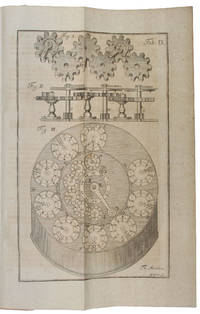
172735955Leipzig: Christoph Zunkel and Bernhard Christoph Breitkopf, 1727-1739. Folio. (372x239mm). Two parts in one volume. Contemporary vellum, two cuts in spine, modern slip case. Provenance: Book plates of Arnaud de Vitry and Andras Gedeon. Stamps to half-title and title-page, from Stadtbibliothek Augsburg - sold as duplicate. First part: (14], 200, (4) pp. and 45 plates, numbered I-XLIII (plate III with volvelle). Second part: (12), 100, (94) pp. and 40 plates on 36 sheets, numbered I-XL. All plates intact. An exceptionally fine copy.
172735955Leipzig: Christoph Zunkel and Bernhard Christoph Breitkopf 1727-1739. Folio. 372x239mm. Two parts in one volume. Contemporary vellum two cuts in spine modern slip case. Provenance: Book plates of Arnaud de Vitry and Andras Gedeon. Stamps to half-title and title-page from Stadtbibliothek Augsburg - sold as duplicate. First part: 14 200 4 pp. and 45 plates numbered I-XLIII plate III with volvelle. Second part: 12 100 94 pp. and 40 plates on 36 sheets numbered I-XL. All plates intact. An exceptionally fine copy. <br/><br/><em>The scarce first edition of the of the eighth and tenth volumes each volume being a complete work in itself of Leupold's magnificent ten-volume "Theatrum Machinarum" - one of the first encyclopedias of technology being the most complete and the most extensively illustrated work on mechanical engineering published hitherto. Complete sets of Leupold's Theatrum are virtually never found and Ferguson stated in his bibliography of technology that he had never seen a complete set. Each volume is complete in itself. The eighth volume is of particular interest in the history of computers as it deals mainly with calculating machines. This volume contains detailed descriptions of the calculating machines of Schott 1668 Grillet 1673 Leibniz 1674 Poleni 1709 and Leupold himself. The tenth volume is a supplement to the series published after Leupold's death by Ernst Scheffler. It deals with odometers gyrometers step counters and other devices for the measurement of distances. This volume is furthermore of importance because it contains the 90 page general index to the entire series. Hook & Norman: Origins of Cyberspace no. 6 volume 8 only.Honeyman Sale lot 1997 volume 7 and 8.Macclesfield Sale lot 1242 volume 8 only.Ferguson: Bibliography of the History of Technology pp.45-46.Wolf: A History of Science Technology & Philosophy in the 18th Century pp.657-8. </em> hardcover