734 résultats
17579016510Harg and Stenbro Sweden: Printed by Pet. Momma director of His Majesty's Printing-House 1757. 2nd . Overall very good condition despite needing to be rebound. Disbound and needs rebinding. The text bloc is clean tight and sound. The fore and bottom edges are uncut. Some inoffensive ink notations on title page of former owners. <br/><br/> Printed by Pet. Momma, director of His Majesty's Printing-House unknown books
1720LTH9-B-2London: E Curll 1720. First edition. Leather. Fair. 9" by 5.5". None. The first edition of this biographical work. This work discusses several English poets and demonstrates a selection of their work. With a frontispiece and five plates. Lacking the plates of Mr Croxall and Mr John Philips therefore lacking two plates in total. With an introductory essay on the Rise Progress and Beauty of Poetry. With the errata leaf to the rear. This work discusses a large selection of poets such as Sir Philip Sidney Sir Richard Steele William Shakespeare Abraham Cowley and more. From the antiquarian library of Christopher Rowe. Christopher Rowe was a schoolmaster in Norwich and then in Bristol. Throughout his career he inspired many to love literature history and music. He was a specialist on 17th century printer and bookseller Humphrey Moseley and began his unfortunately unfinished PhD dissertation on him. No author to title page although this work has been attributed to Giles Jacob. Giles Jacob's main literary reputation was for his legal writings. However he also dabbled in satire with his The Rape of the Smock a satire on Pope's Rape of the Lock. In a full calf binding with gilt stamping to the boards and spine. Externally worn particularly to the joints and extremities. Loss to the head and tail of spine and cracks to the head of joints. Front board is detached but present with endpapers and frontispiece bound to pastedown. Internally binding is strained in places. Evidence of repair to the binding between pastedown and frontispiece. Blackburn Public Library Reference Department stamp to the verso of front endpaper. Shelf number stamp to the title page as well as library stamp . Repair to the title page leaf at top outer corner the same to the dedication leaf. Pages are age toned with instances of spotting throughout. Fair E Curll hardcover

1745715P1Cambridge: R. Walker and T. James 1745. Leather. Very Good. 7" by 4.5". None. A scarce work discussing the English Civil War of the seventeenth century written here in great detail by Jacob Hooper. A scarce work.This is the edition with Volume I ending on page 716.ESTC citation number T154531.Undated dated from ESTC.Signature Y4 is not a cancel in this copy.In a signed binding by Temple Bindery. Rebound in a quarter calf binding with cloth to the boards rebound with new endpapers.Incomplete in one volume being Volume I of a total of II volumes.An extensive history on the English Civil War in the seventeenth century up until the restoration of Charles II to the throne.The English Civil War was a bloody period in British history with the Parliamentarians and Royalists fighting each other.Written by Jacob Hooper. This is his only known work. Rebound in a quarter calf binding with cloth to the boards. Externally smart. Internally firmly bound. Pages are age-toned with the odd spot and handling mark. A small amount of wear to the fore edge of the title page to page six with a small closed tear to the edge of the title page not affecting text. Small tidemark tot he margin of some pages. Small closed tear to the margin of page 37/38 not affecting text. Chip to the margin of leaf 4I1 not affecting text. A little fading to some pages. A small amount of worming to leaves 4P3 to 4Y2 with no loss of text. Very Good R. Walker, and T. James hardcover
17381204100089London Printed and sold by all the Book sellers 1738. Hardcover. Good. 4to. 628 p. plates port. 31 cm. Rebound in modern red buckram. Good binding and cover. Minimal shelfwear. Missing title page and last two pages. Clean unmarked pages with minimal toning. Some pages have tape. Please feel free to view our photographs. London, Printed and sold by all the Book sellers hardcover
170144002Leipzig Gross & Fritsch 1701. 4to. Contemporary full vellum. Handwritten title on spine. A small stamp to title page and page . Pasted library label to pasted down front free end-paper. In: "Nova Actorum Eruditorum Anno MDCCI". Pp 213-228 1 engraved plate. Entire volume: 2 581 pp. 8 engraved plates. <br/><br/><em>First publication of Jacob Bernoulli influential dissertation in which he published the first correct solution to the isoperimetric problem both Johann Bernoulli and Leibniz had been seeking without success. The paper influenced both Leonhard Euler in writing his first research paper and British mathematician Brook Taylor to begin a dispute which has later been referred to as Taylor versus Continental mathematicians. "It the dissertation was considered as a prodigy of sagacity and invention: and indeed if the time be considered it will not be too much to assert that a more difficult problem never was solved." Bossut. A general history of mathematics. 341 p.The isoperimetric problem is an ancient problem which dates back to antiquity and can be described as which curve if any maximizes or minimizes the area of its enclosed regionEuler who had been taught by Johann Bernoulli published his first paper in 1726 which was a note on the construction of isochronous curves in a resistant medium.DSB II 48b.The following papers by Johann Bernoulli are also contained in the present volume:1. Disquisitio Catoptrico-Dioptrica exhibens Reflexionis et Refractionis naturam ex aequilibrii fundamento deductam. Pp 19-26.2. Novaratio construendi radios osculi seu curvanturae in Curvis quibusvis etc. Pp. 136-40.3. Multisectio Anguli vel Arcus duplici aequatione universali exhibita. Pp. 170-75. </em> hardcover
170144002Leipzig, Gross & Fritsch, 1701. 4to. Contemporary full vellum. Handwritten title on spine. A small stamp to title page and page . Pasted library label to pasted down front free end-paper. In: ""Nova Actorum Eruditorum Anno MDCCI"". Pp 213-228 + 1 engraved plate. [Entire volume: (2), 581 pp. + 8 engraved plates].
176655647BBFrankfurt und Leipzig, zu finden bey Joh. Paul Krauss, Buchhändler in Wien, 1766. 17x10,5 cm Frontispiz, 11 n.n. Bl., 738 S., 51 n.n. Bl. Register, 88 S. Fragen zur Wiederholung. Halblederband der Zeit mit Rückenschild und etwas Rückenvergoldung.
1800110708Paris, Le Bibliophile Jacob, Libairie des Bibliophiles, impr. Jouaust 1800 In-12 relié demi cuir rouge à coins 17 cm sur 11. XIII+178 pages, 7ff. Orné d’une eau-forte par Ad. Lalauze en frontispice protégée par une serpente. Couverture originelle conservée. Dos à cinq nerfs réhaussés par traits noirs, lettrage doré. Jolis petits bandeaux et culs-de-lampe. Papier de qualité. Dos légèrement insolé, menus frottements. Couverture originale avec traces de papier adhésif et auréoles d’humidité sur la quatrième. Quelques brunissures sur la page de gravure sans atteinte à l’image. Feuillets 137-139 coupés légèrement plus courts sur la largeur. Intérieur frais, bon état d’occasion.
178659187Stockholm. 1786. 4to. Nyere enkelt skinnryggbind med marmorerte dekler. 8 102 1 1 blank. Tryckt hos Peter Hesselberg Svensk. <br/><br/><em>Lite navn på tittelbladet. Klipp i siste blad. </em> unknown
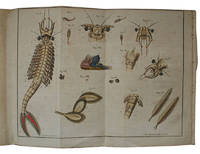
1757AQ10760Ratisbonae i.e. Regensburg: Typis Christ. Gott. Seiffarti Viduae 1757. 24pp. With an engraved hand-coloured folding plate of anatomical diagrams of numerous specimens. Disbound. All leaves a trifle toned A2 and A3 detached from text block short tear to head of title small paper repair to margin of same occasional spots of light foxing pen trial to verso of plate. The second edition of a treatise by Bavarian botanist and zoologist Jacob Christian Schaeffer 1718-90 first printed in Nuremberg in 1752 on a newly discovered species of water dwelling insect. Rare with COPAC recording only four copies; BL Kings Royal College of Surgeons of England Zoological Society of London. . Editio secunda i.e. second edition. Quarto. Typis Christ. Gott. Seiffarti Viduae unknown
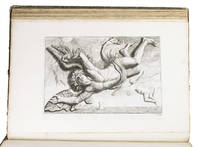
1719ABC_48483Amsterdam: David Mortier 1719. Contemporary quarter brown sheepskin sewn on 5 supports with the corresponding raised bands on the spine the title lettered in gold on the spine sprinkled paper sides red sprinkled edges. Royal folio. With a title-page in red and black with an engraved device a portrait of Erasmus in an elaborate cartouche with allegorical figures and 124 engraved architectural and sculptural illustrations on 109 numbered plates 6 double-page 103 full-page. First French edition of Van Campen's famous description of the Amsterdam City Hall the present day Royal Palace with more than a hundred plates of the architectural features and sculptures of the building including ground plans elevations and sections of the interior and exterior. Particularly impressive are the giant plates of the tympana which are more than 160 cm wide when fully unfolded. The work also includes the famous plate of the extraordinary cartographic mosaic floor of the Burgerzaal which shows the zodiac signs that were originally painted on the celestial map in the middle but are now no longer visible on the floor itself due to fading.The City Hall is the most famous and last major work by Jacob van Campen 1595-1657 the greatest Dutch architect of the 17th century. He began work on the design in 1640 and though the building opened in 1655 it was not actually completed until 1665. It was called "the eighth wonder of the world" at the time and is still considered the most important Dutch monument from the 17th century. It was designed to show off Amsterdam's wealth and magnificence. This is especially visible in the Burgerzaal the heart of the building which depicts Amsterdam as the centre of the world. The impressive mosaic floor with a celestial map in the centre and the two maps of both hemispheres of the world on either side symbolises that the world was at Amsterdam's feet. These maps are the largest ever made. They show Abel Tasman's then recent discoveries in Australia and Tasmania. Many discoveries from his second voyage remained otherwise unpublished until the end of the 17th century.The present work is the French edition of Van Campen's Afbeelding van 't stadt huys van Amsterdam 1664. The plates were drawn by Hubert Quiellinus 1619-1687 and Danckert Danckertsz. 1634-1666 and his father after drawings by Jacob Vennekool 17th century and were first published in Quiellinus' Prima et secunda pars praecipuarum . curiae Amstelrodamenis 1655-1663 and Afbeelding van 't stadt huys van Amsterdam in dartigh coopere plaaten . geteeckent door Jacob Vennekool 1661. As such most of the present engravings were published before the building was completed and may therefore reflect Van Campen's plan more closely than the finished building itself. The edges and corners of the boards are scuffed the spine has been rubbed with loss material old restoration at the head and foot of the spine. The text leaves are lightly browned the plates are very clean.l BAL 132; Berlin Kat. 2235; STCN 182312917 5 copies of which 1 incomplete; cf. Fowler 77 & 274 1661 Danckerts eds.; for the map see also: Schilder Australia Unveiled map 66; Shirley 423. David Mortier, hardcover
179256118BB2 Bände. Frankfurt und Leipzig, (s.n.), 1792. 8°. VI S., 366 S.; Titel, 318 S. Rote Halblederbände um 1840 mit reicher Romantikervergoldung und goldgeprägten Rückentiteln.
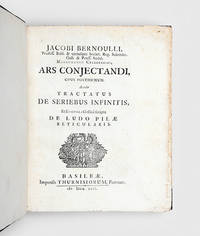
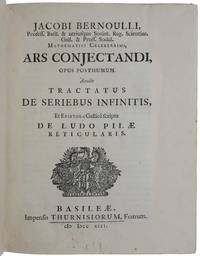
1713180566Basel: Johann Rudolph & Emanuel Thurneysen 1713. The subject of the first published computer programme First edition of the first systematic treatment of probability theory the source of the law of large numbers binomial distribution and Bernoulli numbers. The Ars Conjectandi was the first work to suggest that probability could be applied in civil moral and economic matters and it remains the foundation of much modern practice in such fields as insurance and statistics. Jacob Bernoulli 1655-1705 was the first of the famed Bernoulli family to study mathematics: Johann 1667-1748 was his brother while Nicolaus 1687-1759 and Daniel 1700-1782 were his nephews. Nicolaus revised his uncle's manuscripts for this publication and provided his own two-page preface. The Bernoulli numbers in the Ars Conjectandi inspired the first published computer programme as devised by Ada Lovelace in 1843. Looking to demonstrate the potential of Babbage's analytical engine Lovelace wrote an algorithm with which the machine could calculate the Bernoulli sequence each generated recursively from previous values. The algorithm was published in Taylor's Scientific Memoirs in August 1843. Amusingly the final section includes several comments on jeu de paume - a ball game having much in common with modern tennis and very little in common with the rest of the work. Quarto 215 x 170 mm pp. iv 35 1; 306. Folding engraved plate 2 folding engraved tables woodcut vignette to title page head- and tailpieces and initials tables in the text. Nineteenth-century marbled boards outer and lower edges uncut. Front free endpaper and initial two leaves remounted on stub. Late 19th-century "Wirtz" signature. Recent pencil annotation to N3. Light rubbing faint sunning to spine minor browning and foxing to content extremities closed tear to outer margin of D1 professionally repaired plates crisp: a very good copy. Dibner 110; Horblit 12; Norman 216; Printing and the Mind of Man 179; Tomash & Williams B143. hardcover
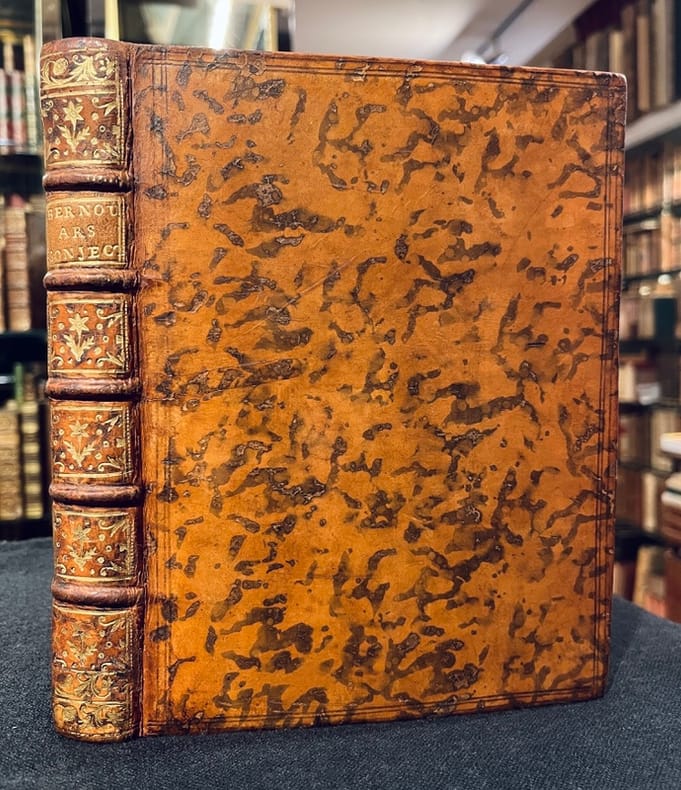
170932891709. Woodcut device on title two folding printed tables & one folding woodcut plate. Diagrams in the text. 2 p.l. 306 35 1 pp. 4to cont. speckled sheep upper joint with short crack bookplate on blank portion of title patched minor foxing spine gilt red leather lettering piece on spine. Basel: impensis Thurnisiorum Fratrum 1713. <br/> <br/> bound with:<br/> <br/> BERNOULLI Nicolaus I. Dissertatio Inauguralis Mathematico-Juridica. De Usu Artis Conjectandi in Jure. 56 pp. 4to. Basel: J.C. Mechel 1709.<br/> <br/> A most attractive sammelband. <br/> <br/> I. First edition of “the first systematic attempt to place the theory of probability on a firm basis and is still the foundation of much modern practice in all fields where probability is concerned — insurance statistics and mathematical heredity tables.â€â€“Printing & the Mind of Man 179. <br/> <br/> II. First edition. Nicolaus I 1687-1759 nephew of Jacob I and Johann I and editor of the Ars Conjectandi obtained the degree of doctor of jurisprudence with this dissertation on the application of the calculus of probability to questions of law. I believe this to be an important contribution to probability. <br/> <br/> Very good copies. <br/> <br/> â§ I. Dibner Heralds of Science 110. D.S.B. II pp. 46-51. Evans Epochal Achievements 8. Horblit 12. Sparrow Milestones of Science 21. II. D.S.B. II pp. 56-57. Keynes “Bibliography†in A Treatise on Probability p. 435. unknown
17134063Basel: Impensis Thurnisiorum Fratum 1713. First edition. First edition of the most significant early book on probability theory: it set forth the fundamental principles of the calculus of probabilities and contained the first suggestion that the theory could extend beyond the boundaries of mathematics to apply to civic moral and economic affairs. It also contained the first statement but not the proof of the law of large numbers. Hardcover. EVANS 8 - ESTABLISHED THE FUNDAMENTAL PRINCIPLES OF THE CALCULUS OF PROBABILITIES. <p>First edition an exceptionally fine copy rare in this condition. "Jakob 1 Bernoulli's posthumous treatise edited by his nephew Nicholas I Bernoulli the title literally means "the art of dice throwing" was the first significant book on probability theory: it set forth the fundamental principles of the calculus of probabilities and contained the first suggestion that the theory could extend beyond the boundaries of mathematics to apply to civic moral and economic affairs. The work is divided into four parts the first a commentary on Huygens's De ratiociniis in ludo aleae 1657 the second a treatise on permutations a term Bernoulli invented and combinations containing the Bernoulli numbers and the third an application of the theory of combinations to various games of chance. The fourth and most important part contains Bernoulli's philosophical thoughts on probability: probability as a measurable degree of certainty necessity and chance moral versus mathematical expectation a priori and a posteriori probability etc. It also contains his attempt to prove what is still called Bernoulli's Theorem: that if the number of trials is made large enough then the probability that the result will lie between certain limits will be as great as desired" Norman. This was the first statement of the law of large numbers.</p> <br /> <p>"In the first Part pp. 2-71 Jakob Bernoulli complemented his reprint of Huygens's tract by extensive annotations which contained important modifications and generalisations. Bernoulli's additions to Huygens's tract are about four times as long as the original text. The central concept in Huygens's tract is expectation. The expectation of a player A engaged in a game of chance in a certain situation is identified by Huygens with his share of the stakes if the game is not played or not continued in a 'just' game. For the determination of expectation Huygens had given three propositions which constitute the 'theory' of his calculus of games of chance. Huygens's central proposition III maintains:</p> <br /> <p>"If the number of cases I have for gaining a is p and if the number of cases I have for gaining b is q then assuming that all cases can happen equally easily my expectation is worth pa qb/p q."</p> <br /> <p>"Bernoulli not only gives a new proof for this proposition but also generalizes it in several ways .</p> <br /> <p>"Huygens's propositions IV to VII treat the problem of points also called the problem of the division of stakes for two players; propositions VIII and IX treat three and more players. Bernoulli returns to these problems in Part II of the Ars Conjectandi. In his annotations to Huygens's proposition IV he generalised Huygens's concept of expectation . This is the only instance in the annotations and commentaries to Huygens's tract where Bernoulli uses the word 'probabilitas' or probability as understood in everyday life. Later in Part IV of the Ars Conjectandi Bernoulli replaced Huygens's main concept expectation by the concept of probability for which he introduced the classical measure of favourable to all possible cases. The remaining propositions X to XIV of Huygens's tract deal with dicing problems of the kind: What are the odds to throw a given number of points with two or three dice or: With how many throws of a die can one undertake it to throw a six or a double six . The meaning of Huygens's result of proposition X that the expectation of a player who contends to throw a six with four throws of a die is greater than that of his adversary is explained by Bernoulli in a way which relates to the law of large numbers proved in Part IV of the Ars Conjectandi .</p> <br /> <p>"In the second Part pp. 72-137 Bernoulli deals with combinatorial analysis based on contributions of van Schooten Leibniz Wallis and Jean Prestet . It consists of nine chapters dealing with permutations the number of combinations of all classes the number of combinations of a particular class figurate numbers and their properties especially the multiplicative property sums of powers of integers the hypergeometric distribution the problem of points for two players with equal chances to win a single game combinations with repetitions and with restricted repetitions and variations with repetitions and with restricted repetitions.</p> <br /> <p>"Evidently Bernoulli did not know Blaise Pascal's Triangle arithmétique published posthumously in 1665 though Leibniz had alluded to it in his last letter to him in 1705. Not only does Bernoulli not mention Pascal in the list of authors that he had consulted concerning combinatorial analysis except for Pascal's letter to Fermat of 24 July 1654; it would also be difficult to explain why he repeated results already published by Pascal in the Triangle arithmétique such as the multiplicative property for binomial coefficients for which Bernoulli claims the first proof for himself. His arrangement differs completely from that of Pascal whose proof for the multiplicative property of the binomial coefficients has been judged to be clearer than Bernoulli's. It is fair to add that in the Ars Conjectandi which Bernoulli left as an unpublished manuscript he was much more honest concerning the achievements of his predecessors than Pascal in the Triangle arithmétique. It is also true that Bernoulli was concerned with combinatorial analysis in the Ars Conjectandi first of all because it constituted for him a most useful and indispensable universal instrument for dealing numerically with conjectures since 'every conjecture is founded upon combinations of the effective causes' p. 73 .</p> <br /> <p>"In the third Part pp. 138-209 Bernoulli gives 24 problems concerning the determination of the modified Huygenian concept of expectation in various games. Here he uses extensively conditional expectations without however distinguishing them from unconditional expectations. All the games are games of chance with dice and cards including games en vogue at the French court of the time like Cinque et neuf Trijaques or Basette. He solves these problems mainly by combinatorial methods as introduced in Part II and by recursion .</p> <br /> <p>"The fourth Part pp. 210-239 is the most interesting and original Part; but it is the one that Bernoulli was not able to complete. In the first three of its five chapters it deals with the new central concept of the art of conjecturing probability its relation to certainty necessity and chance and ways of estimating and measuring probability" Schneider pp. 92-100. "The relevant point for our analysis is his introduction in the fourth part of Ars Conjectandi of what has come to be regarded as the first law of large numbers. Bernoulli began the discussion leading up to his theorem by noting that in games employing homogeneous dice with similar faces or urns with equally accessible tickets of different colors the a priori determination of chances was straightforward. One would simply enumerate the possible cases and take the ratio of the number of 'fertile' cases to the total number of cases whether 'fertile' or 'sterile.' But Bernoulli asked what about problems such as those involving disease weather or games of skill where the causes are hidden and the enumeration of equally likely cases impossible In such situations Bernoulli wrote "It would be a sign of insanity to attempt to learn anything in this manner." Instead Bernoulli proposed to determine the probability of a fertile case a posteriori: "For it should be presumed that a particular thing will occur or not occur in the future as many times as it has been observed in similar circumstances to have occurred or not occurred in the past" p. 224. The proportion of favorable or fertile cases could thus be determined empirically. Now this empirical approach to the determination of chances was not new with Bernoulli nor did he consider it to be new. What was new was Bernoulli's attempt to give formal treatment to the vague notion that the greater the accumulation of evidence about the unknown proportion of cases the closer we are to certain knowledge about that proportion.</p> <br /> <p>"Bernoulli took it as commonly known that uncertainty decreased as the number of observations increased: "For even the most stupid of men by some instinct of nature by himself and without any instruction which is a remarkable thing is convinced that the more observations have been made the less danger there is of wandering from one's goal" p. 225. Bernoulli sought both to provide a proof of this principle and to show that there was no natural lower bound to the residual uncertainty: By multiplying the observations 'moral certainty' about the unknown proportion could be approached arbitrarily closely" Stigler pp. 64-5.</p> <br /> <p>The main work concludes with Tractatus de seriebus infinitis earumque summa finite et usu in quadraturis spatiorum & rectificationibus curvarum pp. 241-306 which had first appeared as a series of five extremely rare pamphlets entitled Positiones arithmeticae de seriebus infinitis earumque summa finita. "The five dissertations in the Theory of Series 1682-1704 contain sixty consecutively numbered propositions. These dissertations show how Bernoulli at first in close cooperation with his brother had thoroughly familiarized himself with the appropriate formulations of questions to which he had been led by the conclusions of Leibniz in 1682 series for pi/4 and log 2 and 1683 questions dealing with compound interest. Out of this there also came the treatise in which Bernoulli took into account short-term compound interest and was thus led to the exponential series. He thought that there had been nothing printed concerning the theory of series up until that time but he was mistaken: most conclusions of the first two dissertations 1689 1692 were already to be found in Pietro Mengoli Novae quadraturae arithmeticae seu de additione fractionum 1650 as were the divergence of the harmonic series Prop. 16 and the sum of the reciprocals of infinitely many figurate numbers Props. 17-20 . At the end of the first dissertation Bernoulli acknowledged that he could not yet sum the inverse squares of the integers in closed form Euler succeeded in doing so first in 1737 . Informative theses based on Bernoulli's earlier studies were added to the dissertations: and theses 2 and 3 of the second dissertation are based on the still incomplete classification of curves of the third degree according to their shapes into thirty-three different types.</p> <br /> <p>"The third dissertation was defended by Jakob Hermann who wrote Bernoulli's obituary notice in Acta eruditorum 1706. In the introduction L'Hospital's Analyse is praised. After some introductory propositions there appear the logarithmic series for the hyperbola quadrature Prop. 42 the exponential series as the inverse of the logarithmic series Prop. 43 . and the series for the arc of the circle and the sector of conic sections Props. 45 46. All of these are carefully and completely presented with reference to the pertinent results of Leibniz 1682; 1691. In 1698 previous work was supplemented by Bernoulli's reflections on the catenary Prop. 49 and related problems on the rectification of the parabola Prop. 41 and on the rectification of the logarithmic curve Prop. 52.</p> <br /> <p>"The last dissertation 1704 was defended by Bernoulli's nephew Nikolaus I who helped in the publication of the Ars conjectandi 1713 and the reprint of the dissertation on series 1713 and became a prominent authority in the theory of series. In the dissertation Bernoulli first Prop. 53 praises Wallis' interpolation through incomplete induction. In Proposition 54 the binomial theorem is presented with examples of fractional exponents as an already generally known theorem. Probably for this reason there is no reference to Newton's presentation in his letters to Leibniz of 23 June and 3 November 1676 which were made accessible to Bernoulli when they were published in Wallis' Opera Vol. III 1699" DSB.</p> <br /> <p>The volume concludes with a separately-paginated 35-page Lettre à un Amy sur les Parties du Jeu de Paume in French. "In his Letter to a Friend on the Game of Tennis Bernoulli begins with a summary of his considerations in the Ars Conjectandi on the difference between games of chance and games that depend on the skill of the players on the corresponding determination of probabilities a priori and a posteriori and on the law of large numbers which justifies the use of the relative frequency of winning as a measure of the probability of winning. Apart from this short introduction the letter is really an exercise in probability theory and could well have been included in Part 3 of the Ars Conjectand. "Bernoulli writes that he will not explain the rules of the game because they are well known. The game is more complicated than tennis but with the same scoring rules . Bernoulli analyzes many problems of tennis. There are however no new methods used in his analysis; he keeps strictly to the methods used by Huygens solving most of the problems by recursion between expectations. The letter is an imposing work demonstrating Bernoulli's pedagogical qualities his ability to systematize and his thoroughness" Hald p. 241.</p> <br /> <p>"Important sections of the Ars Conjectandi were sketched out in Jakob Bernoulli's scientific diary the 'Meditationes' from the mid 1680s onwards. When he died in 1705 the Ars Conjectandi was not finished especially lacking good examples for the applications of his 'art of conjecturing' to what he described as civil and moral affairs. Concerning the time that it would have needed to complete it opinions differ from a few weeks to quite a few years depending on assumptions about his own understanding of completeness. His heirs did not want his brother Johann the leading mathematician in Europe at this time to complete and edit the manuscript fearing that Johann would exploit his brother's work. Only after Pierre Rémond de Montmort 1678-1719 himself a pioneer of the theory of probability had sent an offer via Johann to print the manuscript at his own expense in 1710 and after some admonitions that the Ars conjectandi soon would become obsolete if not published Jakob's son a painter agreed to have the unaltered manuscript printed. It appeared in August 1713 . A short preface was contributed by Nikolaus Bernoulli 1687-1759 Jakob's nephew. He had read the manuscript when his uncle was still alive and had made considerable use of it in his thesis of 1709 De usu artis conjectandi in jure and in his correspondence with Montmort. He was asked twice to complete and edit the manuscript. The first time he excused himself by his absence when he travelled in 1712 to Holland England and France. After his return Nikolaus Bernoulli declared himself as too inexperienced to do the job and in his preface he asked Montmort the anonymous author of the Essay sur les jeux de hazard and Abraham de Moivre 1667-1754 to complete his uncle's work" Schneider p. 90.</p> <br /> <p>PMM 179; Dibner 110; Evans 8; Grolier/Horblit 12; Sparrow 21; Norman 216.</p> <br /> <p>Hald History of Probability and Statistics and their Applications before 1750 2003. Schneider 'Jakob Bernoulli Ars Conjectandi 1713' pp. 88-104 in Landmark Writings in Western Mathematics 1640-1940 I. Grattan-Guinness ed. 2005. Stigler The History of Statistics 1986. </p> <br/> <br/> 4to 202 x 155 mm contemporary vellum red spine label with gilt lettering 4 1-306 1-35 1 printed folding tables between pp. 24-25 and 172-173 folding woodcut diagram after p. 306. An outstanding copy in entirely unrestored binding very fresh and crisp internally. Very rare in such fine condition. / Hardcover. Impensis Thurnisiorum Fratum unknown
171321804Basilea, Impensis Thurnisiorum Fratum, 1713. Petit in-4 de [4]-306-35-[1] pages, plein veau moucheté brun, dos à nerfs, pièce de titre en maroquin beige, filet doré sur les coupes, tranches rouges.
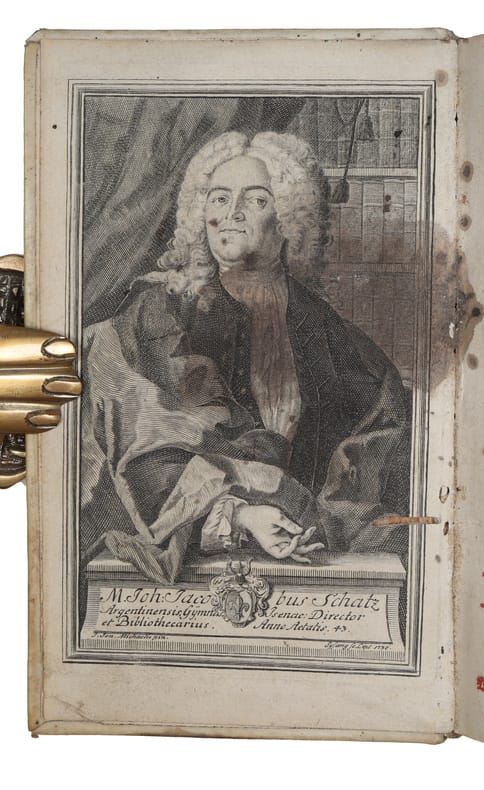
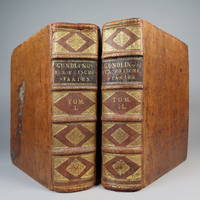
173761442Eisenach Griessbach 1737. 8vo. Three volumes uniformly bound in three contemporary full vellum bindings with title in contemporary hand to spine. Wear and soiling to extremities. Stain to inner margin of title-page and frontispiece in vol. 1 otherwise internally nice and clean. 26 435 1 pp. frontispiece; 2 490 1 pp. 2 442 pp. <br/><br/><em>Rare second edition published the year after the original of Schatz’ comprehensive geographical work providing detailed explanations and interpretations of various maps produced by the famous cartographer Johann Baptist Homann and his publishing house. “Johann Jacob Schatz a German philologist geographer educator and librarian; student in Strasbourg in 1706 received his master's degree in 1709 in Jena in 1715 and in Halle Saale in 1716; from 1716 to 1720 tutor at the Pädagogium in Halle; from 1720 to 1726 director of the Gymnasium in Trarbach; in 1728 director of the Gymnasium in Eisenach and librarian until 1737; from 1737 to 1760 head of the Protestant Gymnasium and librarian in Strasbourg.†See CERL Thesaurus. </em> hardcover
173761442Eisenach, Griessbach, 1737. 8vo. Three volumes uniformly bound in three contemporary full vellum bindings with title in contemporary hand to spine. Wear and soiling to extremities. Stain to inner margin of title-page and frontispiece in vol. 1, otherwise internally nice and clean. (26), 435, (1) pp. + frontispiece (2), 490, (1) pp. (2), 442 pp.
176355805Frankfurt a. M. / Leipzig 1763. des weiland ehrwürdigen Herrn Jacob Hervey . Nebst einer Nachricht von seinem Leben und Tode. Aus dem Englischen übersetzt. Als der IV. Theil seiner Betrachtungen Als der IV. Theil seiner Betrachtungen Gute Erhaltung 8°. Hldr. d. Zt. Religion unknown
17335814Hansdome matched set in original full calf. Bookplate of UCLA professor to front pastedowns. 185 x 225 mm; 40 884 40; 18 948 50 pp. hardcover
1750GM18312Hulle: Jos. Justinus Gebauers 1750. Text in German; 3/4 brown leather & marbled paper over boards gilt spine title raised bands all edges darkened & device to title page; A good copy in a fair solid binding; 246 pages Registers Variantium Lectionus- LV pages Index page. Size: 6.5"x8.5". Hardcover. Jos. Justinus Gebauers Hardcover
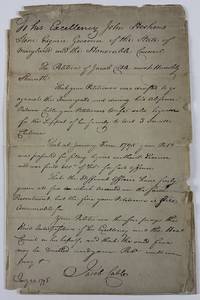
179513033N.p. likely Maryland: January 20 1795. 2pp. with integral leaf addressed and docketed. Old mailing folds minor unobtrusive chipping to edges some old tape repairs some toning. Margins of address leaf reinforced with later sheet. Overall good condition. A document of almost pure irony in which a Maryland militia member who served for the government during the Whiskey Rebellion petitions the governor of Maryland for relief from a fine of 600 pounds of tobacco levied on him and his wife for.selling whiskey without a license. Apparently during the time in which Cable "was drafted to go against the insurgents and during his absence" Cable's wife "sold liquor for the support of her family to wit 3 small children." Upon his return from service and during the January 1795 term of the Baltimore County court Cable "was presented for selling liquors without license and was fined 600 lbs of Toba for said offence." Here Cable asks Governor Stone and the "Home Council" for forgiveness of the fine. <br /> <br /> It worked. According to a note on the verso signed by three "Justices of Baltimore County Court" they found "compassion" for Cable "in remitting the fine imposed as stated in the within Petition." Though the central issue of the Whiskey Rebellion was the 1791 excise tax on whiskey which angered farmers in western Pennsylvania enough to violently resist it it is some level of irony that Cable asks for mercy from the court for selling liquor without a license incurred while he was fighting the farmers resisting the whiskey tax. January 20 unknown
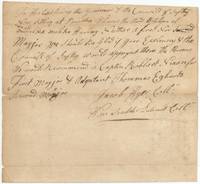
1777413501Princeton 1777. Unbound. Very Good. Laid paper. Approximately 7.5" x 7". Old folds with small tears at the edges ink has burned through in one small spot general age-toning very good. Docketed on the verso. In full:<br /> <br /> "To His Excelensy the Governor & the Council of Saftey sitting at Princeton. Whearas the third Batalyn of Middlesex militia Having Neither a first Nor second Mayjor We should be glad if your Exelensey & the Council of Saftey would appoynt there the persons we would recommend is Captin Robbert Nixon Robert Nixon for First Mayjor & Adjutant Thommas Egburts Thomas Egbert Second Mayjor.<br /> <br /> Jacob Hyer Coll.<br /> Wm. Scudder Lietenant Coll"<br /> <br /> Col. Jacob Hyer was the proprietor of Sign of the Hudibras a Princeton inn that was a center of Revolutionary foment where students and patriots would meet. He was close to the upper echelons of the Continental command and hosted John Adams and the New England delegation to the First Continental Congress. He was entrusted by Washington to bail out John Honeyman a double agent who was perhaps Washington's most reliable spy when he was arrested for high treason as a Tory. The taverns of New Jersey were central as meeting places for the Revolutionary effort. Hyer and Scudder were appointed to their positions in 1776. Hyer commanded the Third Middlesex Militia at both the Battle of Princeton on January 3rd 1777 and at the Battle of Monmouth in June of 1778.<br /> <br /> William Scudder was a prosperous Princeton miller who served in the Army throughout the War. Robert Nixon was a tanner from New Brunswick who distinguished himself as the Captain of Nixon's Troop of Light-Horse of Middlesex when he was indeed promoted to Major in the 3rd Middlesex. It appears that Thomas Egbert was promoted as well although less seems to be known of him.<br /> <br /> Interesting Revolutionary War document centered around Princeton which in itself was at the epicenter of the action at that time during the Revolutionary War. unknown
179819505Mauritius August 3 1798. Some slight loss from the seals; a little browned and soiled; in very good condition. 3 pages on a folded sheet plus integral address 12.5 x 8 inches approx. 480 words. Scandal and affairs of the heart from the remote outposts of American commerce. The American consul to the French colony in the Indian Ocean here writes back to New York "I have to inform you of having dispatched your Ship Huron Capt. Brown for Newport R. Island she left this Colony on 26 May for Bourbon to complete her chargement & sailed from thence about 15 days after for America ñ I must add the malconduct of your Capt. here has been very injurious to the Voyage by forming a connection with a bad woman who came passenger with him from Bordeaut sic ñ with the greatest difficulty he was made to sail without taking this person with him however the whole Island interfered against it & prevented her leaving the Colony because she was a favourite Actress & much wanted on the Stage however she is placed here at the expence of Capt. Brown who has placed funds in the hands of Mr. Roussell Manssell to be appropriated for her benefit and althoà Mr. Roussell is not ignorant that he has a family near Boston in the town of Marblehead he has become the confident & friend in this vile business. Capt. Brown on his arrival addressed himself to me & after finishing a part of his business because I declined the propositions made me respecting the Woman I explained to him with candour his Faults he after placed his property with Mr. Roussell who has engaged to pay her expences until Capt. B. returns to marry her. . . . This favourite woman in question was bound jointly with the other players in the sum of Ten Thousand dollars that she would tarry three years in the Colony in that Company of course these persons opposed her departure. Capt. Brown in order to effect it in my presence offered to destroy a bill of exchange of Ten Thousand dollars which was the amount of the passage money for the same persons. Since that transaction I have been kept in the dark for having found fault with Capt. BÃs conduct & threatening to put him in prison therefor - he did not choose to consult me thereafter." Lewis a Boston merchant had been appointed consul to Å’le de France by Adams and arrived in February 1798--but owing to the Quasi-War and the interruption of commerce betwen the United States and France arrived back in Boston with his family in June 1799. See the National Archives annotation to the summary memorial of Lewis to Thomas Jefferson March 20 1801. Captain Brown of the Huron is certainly Elias Brown; a notice in the Halifax N.C. Journal of October 15 1798 dated Newport September 15 reports the arrival of Brown and the Huron and news that he had prior to his adventures in love been boarded somewhere east of the Cape by the British frigate Garland on June 28--seven of his seamen were impressed and Brown was detained before escaping under cover of a squall. Brown further reports "that the national soldiers were all sent from the Isle de France but that the reports of it being declared independent are false." The first theatre troupe had been established in Port Louis in 1790 by a M. Laglaine though there was a hiatus after the smallpox epidemic of 1792 and one presumes the colonists were not likely to take kindly to seeing a keystone of their local entertainment whisked away by a Yankee merchant captain. For a glance at theatre in Mauritius and some sense of the upheavals on the island in 1798--though this affair does not seem to merit mention--see the 1840 memoir by Andre Maure Souvenirs d'un vieux colon de Maurice. Samuel Ward 1756-1832 the owner of the merchant brig Huron was a Revolutionary War veteran from a prominent Rhode Island family. Neat contemporary arithmetic problems in contemporary ink on the cover page. August 3, unknown books
17940156-B1794. Radierung, Rom 1794, auf Bütten. 28:37,8 cm.-Leicht braunfleckig. Literatur: Andresen 19, II (von II) mit der endgültigen Schrift. Sehr guter Abdruck mit Rändchen um die Plattenkante. Aus der in Zusammenarbeit mit J.Chr. Reinhart (1761-1847) und J. Mechau (1745-1808) entstandenen Folge ?Mahlerisch radirte Prospecte von Italien?, zu der jeder Künstler 24 Blätter beitrug. Provenienz: Sammlung J.N. Seiler, München, nicht bei Lugt.