2 791 résultats
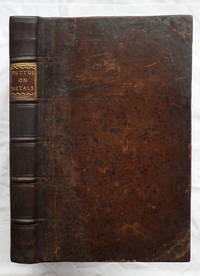
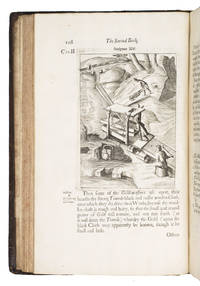
16833497London: printed for the author by Thomas Dawks 1683. Contemporary mottled calf rebacked with lighter brown calf spine elaborately gold-tooled and with a red morocco title label lettered in gold gold-tooled board edges red sprinkled edges. Folio. With an engraved portrait of the author as a frontispiece a separate title-page for part 2 and 43 large engravings in text on mining distilling and working metals 41 in part 1 and 2 in part 2. Further with elaborately decorated woodcut initials throughout. 2 parts in 1 volume. First edition of the English translation and adaptation of an important work by one of the foremost metallurgists of the 17th century. The first part is the first English adaption of the celebrated practical manual on mining and metals by Lazarus Ercker ca. 1530-1594 Bohemian metallurgist courier for mining affairs under Emperor Maximilian II and under Rudolf II he was assay master of the mint in Prague. Ecker's work was first published in 1574 and went through several subsequent editions 8th ed. 1672 was retitled Aula subterranea alias Probierbuch. Pettus translated and adapted Ecker's original work. The title Pettus chose for the work Fleta Minor hinted to his imprisonment in the Fleet having fought for Charles I in the Civil War. The illustrations to the work were re-drawn on copper after Ercker's original woodcuts but all workmen were put into contemporary English costume. The second part also is of great importance as it is the first edition of the first English dictionary of mining terms.Sir John Pettus 1613-1690 was an English royalist politician and natural philosopher. Pettus was an expert on metallurgy and became a deputy governor of the royal mines in England and Wales under Charles I and II. He is known for the first English translation of the work of the German metallurgist Lazarus Ercker.With the large book plate of R.C. Sticht depicting a mining scene mounted on the front pastedown and some occasional manuscript annotations in pencil in the margins. Binding rebacked showing minor signs of wear along the edges corners and joints of the boards internally with some minor foxing in the margins. Otherwise in very good condition.l Duveen 468; Ferguson II pp. 185-186 first part in the ed. of 1686; Honeyman 2461; USTC 3107029; Wing P 1907. printed, for the author, by Thomas Dawks, unknown
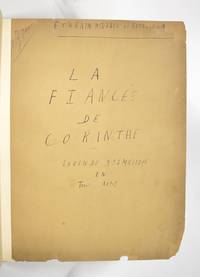
188869140s. l.: S. n. 1888. Fine. S. n. s. l. 1888 24.50 x 31.50 cm relié Gilbert Lély ""Ephraïm Mikhaël"" Nos Poètes 15 Feb. 1925 cited in Ephraïm Mikhaël Poèmes en vers et en prose edited by Matthew Screech Droz 1994 S. n. unknown
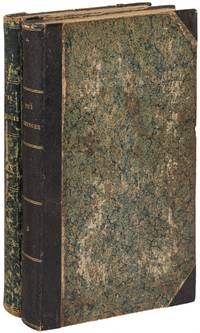
1846450418Published by the Brook Farm Phalanx. New York: Burgess Stringer and Company. Boston: Redding and Company 1846. Hardcover. Very Good. Two volumes. Quartos 8¼" x 11¼". Both volumes are complete with 26 weekly issues. Vol. II: pp. iv 412 December 13 1845 – June 6 1846; Vol. III: pp. iv 412 June 13 1846 – December 5 1846. Bound in contemporary half morocco and marbled paper over boards gilt spines edges lightly sprinkled. Contemporary ownership signature of “W.B. Brown†on the front free endpaper of each volume. <br /> <br /> Both volumes are in very good condition with overall rubbing and some scuffing on the spine of vol. II scattered foxing and two early stitched repairs: on the lower corner of one leaf in vol. II pp. 201-202 and diagonally across one leaf in vol. III pp. 399-400.<br /> <br /> Two well-preserved volumes of George Ripley’s pioneering and important radical magazine. Published and printed at the utopian Brook Farm community in West Roxbury Massachusetts the magazine was well ahead of its time particularly in its advocacy of women's rights and featured in its pages many of the country's best critical and literary figures.<br /> <br /> As noted in a recent exhibition at Yale University America and the Utopian Dream the Brook Farm community was founded by George and Sophia Ripley in 1841 and “began as a product of the transcendentalist movement and a showplace for Christian socialism. The commune had more than 120 members at its highest point†including a young Nathaniel Hawthorne “and was widely regarded as an intellectual center. After four years of existence however the members changed its purpose to that of a Fourierist phalanx. When the headquarters of Fourierism moved from New York City to Brook Farm in 1845 the Fourierist Magazine the Phalanx was renamed the Harbinger to be published on the Brook Farm printing press.â€<br /> <br /> The Harbinger received the full-time attention of Ripley and his associates Charles A. Dana and John S. Dwight. Dana later achieved celebrity as editor of the New York Sun and Dwight went on to become one of the earliest and foremost music critics in the United States. The magazine offered an alternative to transcendentalists who admired Emerson’s romantic perfectionism but rejected his belief in renovation through individualism and self-culture. The contributors to the Harbinger instead emphasized social reform and cooperation which would elevate the individual while benefiting the entire community; the magazine quickly became the most important "Associationist" journal in America.<br /> <br /> Also included among the many notable contributors in addition to Ripley Dana and Dwight are Albert Brisbane who first introduced the theories of Charles Fourier in the United States; William H. Channing a key figure in the early years of the woman's rights movement; and M.E. Lazarus an important American individualist anarchist who advocated for free love.<br /> <br /> The original owner of both volumes “W.B. Brown" was related to John Stillman Brown a Unitarian minister and member of Brook Farm who acted as instructor in Theosophical and Practical Agriculture. J.S. Brown was the husband of Mary Ripley George Ripley's cousin. Volume three has two additional small owner's signatures written in light pencil on the outer margin of p. 70: "Mary G. Brown"; and p. 68: "E.H. Brown".<br /> <br /> An attractive scarce set of two consecutive volumes in the original bindings. Published by the Brook Farm Phalanx. New York: Burgess, Stringer, and Company. Boston: Redding and Company hardcover
1539495Lyon 1539. 8vo. Sebastian Gryphius Later vellum with a brown morocco label on the spine with the author and title lettered in gold red sprinkled edges. With a woodcut printer's device on the title-page and final page of the first 3 works each work with a decorated woodcut initial. 4 works in 1 volume. 65 11 3 blank 1; 54 7 2 blank 1; 97 15 pp.; 18 119 1 blank ll. Early edition of one of the first children's books ever published together with the second and third part of the series. Charles Estienne 1504-1564 served as private tutor to Jan Antoine de Baïf son of the humanist and diplomat Lazare de Baïf ca. 1496-1547. He planned a series of books that were to be instructive but also specially written to entertain children and give them pleasure in learning. This was a radical Renaissance notion at a time when most school books merely contained standard texts often from classical antiquity that children were to memorise and recite. The first two parts of the series were abridged adaptations for children with French glossaries of the popular works on classical antiquity by De Baïf respectively on Roman dress and Roman vessels. The third part of the series was from Estienne's own hand. It gives the names and descriptions of plants and trees with French translations of all botanical terms. First published at Paris by Robert Estienne in 1535 all three children's books were first published at Lyon by the scholarly publisher Sebastian Gryphius in 1536. The present copies are the second Lyon editions.The final work is first edition of a scholarly text book on weights and measures including weights of money based on information drawn from written sources throughout history. It was compiled by Robert Ceneau 1583-1560 who was the bishop of Vence Riets and Avranches respectively.With ink annotations on the front end papers. The vellum is somewhat soiled. The work is somewhat browned throughout occasionally foxed and water stained. Otherwise in good condition.l Ad 1: Adams B 44; Pettegree & Walsby 2529; USTC 79950 11 copies; ad 2: Adams B 56; Pettegree & Walsby 2530; USTC 79830 7 copies; ad 3: Adams S1732; Durling 1395; Hunt 45; USTC 79951 15 copies; ad 4: Adams C 1253; STC French p. 97; USTC 146886 23 copies. hardcover
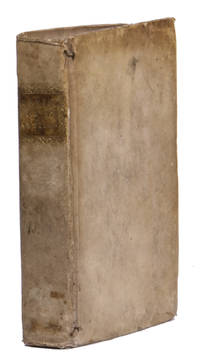
16722295<p>WITH 41 WOODCUTS OF MINING AND METALLURGICAL APPARATUS</p><p>Frankfurt Paul Hummen for Johann David Zunners 1672.</p><p>Small folio 18 x 29.5 cm. Engraved frontispiece signed P. Kilian 6 ff. 332 pp. 2 ff.; Appendix: 2 ff. 47 pp. Bound in contemporary stiff vellum covers and spine ruled. Ownership inscription of frontispiece shaved in right and lower margin as often; some waterstain on frontispiece title and scattered leaves strictly in margin; a single word scored on p. 143 i.e. 145r and replaced in pen at an early date; a burn affecting partial letters on pp. 157/58; p. 45 in appendix torn in blank gutter and re-margined. Generally good.</p><p>Scarce augmented edition of this illustrated technological classic "second only to Agricola in the number of original contributions to the literature of mining and metallurgy and the beauty of the graphic treatment of the crafts" Dibner 89 1574. It is testimony to the work's usefulness as a practical handbook that it continued to be used well into the 18th century.</p><p>"It presents a systematic review of the methods of testing alloys and minerals of silver gold copper antimony mercury bismuth and lead; of obtaining and refining these metals as well as of obtaining acids salts and other compounds. The last chapter is devoted to saltpeter. Ercker described laboratory procedures and equipment gave an account of preparing the cupel of constructing furnaces and of the assaying balance and the method of operating it" DSB.</p><p>"Ercker's treatise is the most authoritative contemporary work on 16th-century metallurgy and assaying. Ercker gave a systematic review of methods of testing alloys and minerals and of obtaining and refining various metals as well as methods of manufacturing acids salts and other chemical compounds including saltpeter. He described the apparatus and laboratory equipment used in metallurgy and assaying and gave a detailed account of laboratory methods all of which he himself had used" Norman.</p><p>First published in 1574 in Prague this is a work of considerable rarity which when it appears on the market commands a daunting price. It had a number of 16th- and 17th-century reprints though the present edition is the first augmented edition augmented with Berward's lexicon. It has the same number of woodcuts as the 1598 edition 41.</p><p> Ferguson I.243-4; Hoover 283 misreporting prelims: 7 including frontispiece is correct.</p> Paul Hummen for Johann David Zunners
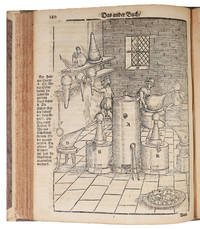
168461343Franckfurt Zunner 1684 Franckfurt am Mayn Zunner 1684. 4to 215 x 185 mm. Recently bound in a magnificent pastiche-binding of brown half calf with five raised bands and gilt red leather title-label to elaborately gilt spine. Vellum corners. The frontispiece/engraved half title trimmed with loss to upper and lower part of the plate. Closed tear to outer margin. Title-page closely trimmed with loss to first line of title. A few leaves with marginal repairs. Light occassional browning throughout otherwise internally nice and clean. 14 220 123 5 68 pp. folded frontispiece/engraved half title. 41 woodcut in text depicting various processes of mining and metallurgy. <br/><br/><em>Second edition including Berward’s lexicon of mining terms of Ercker’s seminal and beautifully illustrated work on mining and metallurgy – of immense importance to and influence upon the subject throughout the 16th and 17th centuries. Its detailed approach has made it a key reference in the history of science and technology and its practical focus contributed to the economic development of mining regions. "Ercker's treatise is the most authoritative contemporary work on 16th-century metallurgy and assaying. Ercker gave a systematic review of methods of testing alloys and minerals and of obtaining and refining various metals as well as methods of manufacturing acids salts and other chemical compounds including saltpeter. He described the apparatus and laboratory equipment used in metallurgy and assaying and gave a detailed account of laboratory methods all of which he himself had used." Norman "Erker's Beschreibung may be regarded as the first manual of analytical and metallurgical chemistry. The only one of Ercker’s works to contain many drawings it presents a systematic review of the methods of testing alloys and minerals of silver gold copper antimony mercury bismuth and lead; of obtaining and refining these metals as well as of obtaining acids salts and other compounds. The last chapter is devoted to saltpeter. Ercker's account of the fact that zinc precipitates other metals from solutions is to be found only in the 1684 and later editions" DSB. “Considering the importance of Ercker’s tratise it is remarkable how little is on record about him. He was inspector-general of the mine of Hungary Transylvania and the Tyrol which position he held under three consecutive emperors in the sixteenth century. He book was highly prized at the time for it was a record of practical experiences and was not burdened with theories and hypotheses. Ferguson. Ferguson 1 244. The 1736-edition.Duveen p. 195. </em> hardcover
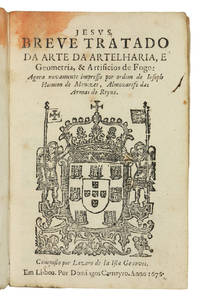
1676ABC_47162Lisbon 1676. Small 8vo. Domingos Carneyro Contemporary limp vellum with manuscript title on spine lacking ties. With woodcut arms of Portugal on the title-page. 96 pp. Extremely rare first Portuguese translation of a brief treatise on the "art of artillery" by the Genovese artillerist De la Isla who served in the Spanish Armada. First published in Spanish in 1595/96 by Madrigal in Madrid Breve tratado del arte de artillería geometría y artificios de fuego. Although Vicente Alvarez published a Spanish-language edition at Lisbon in 1609 the present edition appears to be the first in the Portuguese language. The present translation by José Homem de Menezes provided a textbook for the training of engineers and artillerymen in Portugal. We have located only one other copies at the Portuguese National Library in Lisbon and have found no record of an other copy in auction catalogues.With the bookplate of the Portuguese architect and collector José Maria Nepomuceno 1836-95 on the front paste-down; his stamp to verso of title-page. Later in the collection of Thomas Fremantle 3rd Baron Cottesloe 1862-1956 commander of the Territorial Army and president of the Society for Army History Research. Light water-stains throughout with some red discoloration of the head margin from the red top edge.l Carvalho Dic. bibl. militar Portuguez p. 172 under "Menezes José Homem de" note: "é muito raro"; Catalogo .dos Marquezes de Castello Melhor 1878 1655 2 copies; Inocêncio vol 5 1860 169; Trindade Catalogo da livraria do José Maria Nepomuceno Lisbon 1897 p. 123 no. 898 this copy "muito raro"; Pinto de Matos Manual bibliographico Portuguez p. 360 under "Homem de Menezes"; Porbase 1 copy and 1 microfilm copy at the BNP; cf. Cockle 670 1595 ed.; Palau 121967 Spanish 1595 and 1603 eds. does note the Portuguese ed. in the Catalogo . dos Marquezes. see above.; WorldCat eds. in Spanish also very rare: 4 copies. hardcover
1655B6712London: Peter-Cole. Translated by Nicholas Culpeper Abdiah Cole and William Rowland. 1655. A very good example of one of Riviere’s most noted works on early medicine. General age toning. Interior is clean. . Binding: Full contemporary speckled calf boards expert 19th century rebacking. Spine with 5 raised bands in 6 compartments. Title in gilt lettering in red label in 2. Compartments with gilt rules and motifs. Marbled paste-in and free endpapers. All edges cut. Notes: Lazare Riviere 1589 – 1655 was a prominent French physician credited with making influential contributions to early medicine. His Praxis Medica Cum Theoria was a series of 17 books discussing different fields of medicine and medical theories of the time. Size: Quarto276x181mm. Illustration: Elaborate half-title. With frontispiece of translators’ portraits. Title printer’s notice author’s note contents from 1 – 645 physical dictionary. Category: Book Medical; Peter-Cole. Translated by Nicholas Culpeper, Abdiah Cole, and William Rowland. hardcover
188869138Paris: Camille Dalou 1888. Fine. Camille Dalou Paris 1888 20 x 27.50 cm relié Gilbert Lély ""Ephraïm Mikhaël"" Nos Poètes 15 Feb. 1925 cited in Ephraïm Mikhaël Poèmes en vers et en prose edited by Matthew Screech Droz 1994 Camille Dalou unknown
1683006801London West-end of Thames-street.: Published for the Author by Thomas Dawks 1683. 1st Edition . Hardcover. Very Good. Folio - over 12 - 15" tall. A landmark English translation of Lazarus Ercker's metallurgical treatise expanded by Sir John Pettus. Uncommon. VG 1st ed 1683 43 Sculptures. Two parts bound as 1 re-spined to style raised bands blind tooling gilt title to red morocco label over contemporary calf boards tips repaired. Internally 12 4 preface 18 9 1 errata 345 pp 1. 2 A2-Z 81-133 pp 43 of 44 copper-engraved illustrations lacks the portrait frontis 173 ornate initial letters bookplate to fpd Arthur Dalrymple occasional light spotting and edge browning text block edges sprinkled red. 352217 mm. ESTC R5570. Ferguson I pp.185-186; Wellcome II p.527; Wing P1906; cf. Hoover 633. The first part is the first edition in English of Lazarus Ercker's 1574 treatise on ores. The second part is a dictionary of metallurgical terms compiled by Pettus. Having spent more than £20000 on the royalist cause during the Civil War Pettus appears to have been imprisoned for debt several times in later life and it has been suggested that Fleta Minor was composed in Fleet Prison. Title continues: in two parts : the first contains assays of Lazarus Erckern chief prover or assay-master general of the empire of Germany in V. books originally written by him in the Teutonick language and now translated into English ; the second contains essays on metallick words as a dictionary to many pleasing discourses by Sir John Pettus . ; One of the earliest comprehensive manuals on metallurgy available in English bridging alchemy and modern chemistry. <br/> <br/> Published for the Author, by Thomas Dawks, hardcover
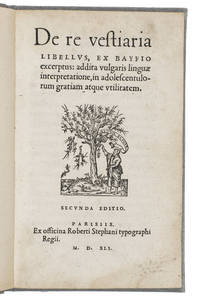
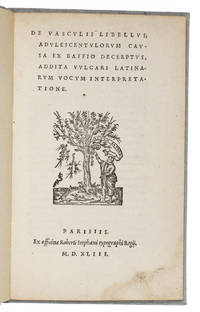
1541734Paris 1541. Small 8vo ca. 16.5 x 10.5 cm. Roberti Stephani Robert Estienne Modern blueish-grey paper over boards with the title printed in black on the spine red sprinkled edges. With a woodcut printer's device on the title-page. 68 11 1 blank pp. Early edition of one of the very first children's books ever printed. The work contains a description of textiles and ancient Roman dress and was specifically meant for the entertainment and edification of children. Although the title page states that it is the second edition it is actually the third printed by Estienne. It is nearly identical to the second but uses small caps for the first word of every chapter to make the structure of the text clearer.The work is the first part of a series on Roman antiquities written by Lazare de Baïf 1496-1547 in the late 1520s. It discusses ancient Roman hats and shoes carpets and rugs and the colours of wool and other textiles with French translations of many of the terms. De Baïf's work was edited and abridged by Charles Estienne 1505-1564 scholar physician and younger brother of printer Robert Estienne 1503-1559. It was a huge success with more than a dozen editions recorded for the first ten years and was followed up by the Estiennes with several other similar children's books.De Baïf was a humanist poet and wealthy diplomat. He was the French ambassador in Venice and Germany. He hired Charles Estienne as a Latin tutor for his son Jean-Antoine de Baïf 1532-1589 who later became a poet. Estienne initially abridged De Baïf's works to provide simplified Latin readings for his student but soon published it for the enjoyment of other children as well. He was an elegant writer of Latin verse and is commended by poet Joachim du Bellay as having introduced a few valuable words into the French language.A water stain in the lower outer corner of the leaves and a small hole in the lower margin of page 6-8. Otherwise in good condition.l Adams B45; Renouard p. 52 no. 14; Pettegree & Walsby 2532; USTC 88432 5 copies; WorldCat 13027853 22013234 490273577 1138872963 404265647 165959673 954853987 1015429473; cf. BM Catalogue of French books p. 39 other ed.; Schreiber 50 other ed. ABE CAT Costumes & Uniforms hardcover
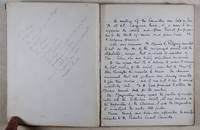
193639319London: NP 1936. Manuscript. Hardcover. g to vg. Rare collection of two Minute-Books from the North London Zionist Society 1917/18 and the Council of the British Section of the World Jewish Congress 1936-37: <br /> <br /> - Minute-Book from the North London Zionist Society 1917/18 SIGNED. Quarto. Unpaginated. 68 leaves. Original half decorative cloth over moire covered boards. This minute-book contains the manuscript notes pertaining to the meetings 34 held by the North London Zionist Society between January 7 1917 and December 31 1918. The notes are written on the first 39 leaves. Affiliated to the English Zionist Federation EZF the North London Zionist Society supported the reestablishment of a Jewish homeland in Palestine then an area controlled by the Ottoman Empire. This minute-book is particularly interesting in the sense that it was written at a turning point in the history of Zionism. World War I was in its fourth year and the conflict raised hopes among Zionists that the crumbling Ottoman Empire will eventually break up. They hoped to attain support from one of the Great Powers for increased Jewish immigration and eventual sovereignty in Palestine and they eventually succeeded thanks to their chief spokesman Chaim Weizmann a bright statesman and a scientist highly respected in Great Britain and well versed in European diplomacy. In support of the Zionist cause his skillful negotiations with the Foreign Office were climaxed on November 2 1917 by the letter from the foreign secretary to Lord Rothschild which became known as the Balfour Declaration. This document declared the British government's "sympathy with Jewish Zionist aspirations" viewed with favor "the establishment in Palestine of a National Home for the Jewish People" and announced an intent to facilitate the achievement of this objective. The Balfour Declaration radically changed the status of the Zionist movement. It promised support from a major world power and gave the Zionists international recognition. That day Zionism was transformed by the British pledge from an utopy into a legitimate and achievable undertaking. <br /> <br /> The minutes of the 34 meetings featured in this manuscript indicate this event see the entry for November 25 1917 and discuss the following projects and resolutions: decision to reorganize the Society and place Zionist propaganda in the North of London on a firmer basis 1/7/1917; the announcement that Mr. Nahum Sokolow Zionist leader author translator and a pioneer of Hebrew journalism has agreed to address the first public meeting of the Society 1/31/1917; the announcement that Dr. Weizmann has agreed to address the next public meeting of the Society 3/28/17. followed by a protest made at the London Council in connection with the non-appearance of Dr. Weizmann 4/25/1917; Proposal to obtain Mr. Israel Zangwill's services as lecturer at a public meeting 4/11/1917; the question of Jewish military action in Palestine 6/13/1917 and the question of raising a Jewish Legion 12/23/1917; the appointment of Nathan Lazarus and Maurice L. Perlzweig as delegates to the special conference of the EZF 10/1918 etc. Each entry is dated and hand-signed by Chairman Nathan Lazarus. By order of appearance the following members' names are mentioned in the minute-book: Nathan Lazarus Chairman; Maurice L. Perlzweig; Miss Cohen; Mr. B. Grad; Mr. Morgenstern; Mr. Kersch; Mr. Scher; Miss P. Slowe; Mr. Ginsburg; Mr. Benson; Mr. L. Wainstein; Mr. Traub; Mr. A. Levine warden of the New Synagogue Stamford Hill; and Mr. Charles Kauffman. Some rubbing and abrasion to moire. Sporadic smudges to endpapers. Minor age-toning throughout. Binding in overall fair to good- interior in very good condition. <br /> <br /> Notes: <br /> <br /> After almost two millennia of existence of the Jewish diaspora without a national state the Zionist movement was founded in the late 19th century by secular Jews largely as a response by Ashkenazi Jews to rising antisemitism in Europe exemplified by the Dreyfus affair in France and the anti-Jewish pogroms in the Russian Empire. The political movement was formally established by the Austro-Hungarian journalist Theodor Herzl in 1897 following the publication of his book "Der Judenstaat." At that time the movement sought to encourage Jewish migration to the Ottoman Palestine. <br /> <br /> Rabbi Maurice Perlzweig 1895-1985 was a founder of the World Jewish Congress and served as the first chairman of the British Section. He was born in Poland and was educated in England where he received acclaim for his oratorical skills and his athletic abilities as a world-class runner at Cambridge. He was founder and chairman of the University Labor Federation of Great Britain and president of the World Union of Jewish Students. After receiving his ordination he officiated at the Liberal Synagogue in London. Joining Nahum Goldmann and Stephen Wise at the founding assembly of the WJC in Geneva in 1936 Perlzweig shortly thereafter was elected chairman of the British Section. During the critical war years Perlzweig was appointed director of the WJC international affairs department in New York. In the post-war years he represented the WJC at the Economic and Social Council of the UN drafting many documents submitted to the Commission on Human Rights. Notably he served as a chief spokesman and negotiator at the UN on behalf of the rights of the North African Jewish communities during the turbulent period in the 1950’s when the Maghreb states were achieving independence. <br /> <br /> WITH <br /> <br /> - Minute-Book from the Council of the British Section of the World Jewish Congress 1936-37 SIGNED. Folio. Unpaginated. 30 leaves. Original half red cloth over moire covered boards with hand-written title label pasted on front board. This minute-book contains the typed notes pertaining to the meetings 6 held by the Council of the British Section of the World Jewish Congress between December 8 1936 and March 8 1937. The typed notes are pasted on the first 11 leaves. They all deal with difficult issues regarding the condition of Jews in pre-WWII Europe such as: the desperate situation of the Jews in Danzig; the desperate position of the Jews in Spain under Franco Jews in constant danger and those living within the jurisdiction of the Government held as hostages on account of their German nationality see page 3 of the entry for Dec. 8 1936; conditions affecting the Jews in Tripoli and Silesia 1/5/1937; proposal to take strong measures to protect the Polish Jews against the anti-Jewish attitude of the Polish government; withdrawal of the Uruguayan legislation against the Jewish cultural rights 1/25/1937; call for a political action for the defense of Polish Jewry 2/8/1937; mass meeting against Hitlerism in New York; statement made by the Franco government in the Anglo-Jewish press that it was not anti-Jewish 2/22/1937; proposed resolution on the rapid deterioration of the political and economic status of Polish Jewry resulting from the failure of the Polish government to afford adequate protection to Polish Jews against physical outrage 3/8/1937. Each entry is dated and hand-signed by Chairman Rabbi Maurice L. Perlzweig. By order of appearance the following members' names are mentioned in the minute-book: Rabbi Maurice L. Perlzweig Chairman; Mrssrs. B. A. Bagnari L. Bakstansky Dr. N. Barou Councillor M. H. Davis Barnett Janner J. Podrushnik and Gabriel Cohen; Morris Myer; W. N. Williams; Councillor J. L. Fine; Rabbi Unterman; J. Letchinsky; Mr. Schupakevitch; Mr. Rollin; P. Horowitz; J. Makower; Dr. Levinson; Mr. Nathan etc. Rubbing along edges of binding. Front hinge starting. Leaves age-toned not affecting the typed notes. Binding in overall fair interior in good- to good typed-notes in very good condition. <br /> <br /> Notes: <br /> <br /> The World Jewish Congress WJC was founded in Geneva Switzerland in August 1936 as an international federation of Jewish communities and organizations in reaction to the rise of Nazism and the growing wave of European anti-Semitism. The main aims of the organization were “to mobilize the Jewish people and the democratic forces against the Nazi onslaught†to “fight for equal political and economic rights everywhere and particularly for the Jewish minorities in Central and Eastern Europe†to support the establishment of a “Jewish National Home in Palestine†and to create “a worldwide Jewish representative body based on the concept of the unity of the Jewish people democratically organized and able to act on matters of common concern.â€. NP hardcover
1968145489Cuba: OSPAAAL 1968. Striking original poster by Cuban designer Lazaro Abreu appropriated from an image by Emory Douglas the Black Panther Minister of Culture and the party's in-house artist demonstrating the solidarity between the Black Panthers and the Fidel Castro-founded Organisation in Solidarity with the People of Africa Asia and Latin America OSPAAAL the aim of which was to combat US imperialism and promote Pan-Africanism. OSPAAAL was born out of the Tricontinental Conference hosted in Havana in 1966. Formed with the intention of facilitating the union of liberation movements across the three continents OSPAAAL's primary work was accomplished through its publishing arm. Although multiple Tricontinental conferences were planned they were never realised and the quarterly Tricontinental magazine that was born of the 1966 conference became an important method for those involved to maintain contact and share information. Vivid posters now considered examples of the "golden age" of Cuban poster design were often included in issues of the magazine with messages printed in English French Spanish and Arabic: "The posters were designed to galvanise and unite liberation struggles around the world - from civil rights and anti-apartheid movements to protests against the Vietnam war and Portuguese rule in Angola." FT. OSPAAAL's strong affinity with the Black Panther Party in the US led to several unofficial collaborations. Stokely Carmichael described Tricontinental magazine as "a bible in revolutionary circles" FT. In this particular poster Cuban designer Abreu demonstrates visual solidarity with the Black Panthers by appropriating one of Emory Douglas's images. When discussing his influences in a 2015 interview Emory Douglas explained the circle of inspiration solidarity and informal collaboration between himself and OSPAAAL: "I was influenced more not by artists but more by revolutionary art of that time like the political art that came out of Vietnam and Cuba amazing political posters by - Tri-Continental posters OSPAAAL posters out of Cuba". In reference to his own artistic involvement with OSPAAAL Douglas went on to explain ". what happened is they used to remix them with the images that I did and send them back out into the world in solidarity with the people's struggle around the world. So in that context we were linked together by our solidarity in relationship to fighting against the oppression that was going on around the world in our very different ways. So that was the connection not that of one directly working with them in any way that what would be considered a formal way but in a more like indirect informal way where they would see art that I'd done in the The Black Panther paper and they would remix them into posters and redesign them and send them out to the world. We used to get them in the mail and stuff like that so it was a good thing then; it wasn't like plagiarising because it was solidarity in the context of the struggle and highlighting the contradictions in the struggle and sharing those kinds of images. So in that connection the artwork was linked and there was that connection." This poster appears in a number of exhibitions and catalogues including 'Black Panther: The Revolutionary Art of Emory Douglas' NY: Rizzoli 2014 and 'You Say You Want a Revolution Records and Rebels 1966-1970' London: V&A 2016. Original poster 530 x 355 mm mounted and framed 672 x 493 mm. 3 horizontal creases from folding as is usual else near-fine. Presented in a black wooden frame with conservation acrylic glazing. Angelica McKinley and Giovanni Russonello "Fifty Years Later Black Panthers' Art Still Resonates" New York Times 15 October 2016. Anny Shaw "The art behind Cuban propaganda" Financial Times 26 September 2019. Dhruv Shah "Interview With Revolutionary Artist Emory Douglas" I am Hip Hop 20 January 2015. Available online. unknown
153758410Basil:: Apud H. Frobenium et N. Episcopium 1537. contemporary limp vellum. Some scattered marginal worming; vellum soiled; a very attractive copy. 8vo. Printer's device; 12 woodcut initials; 23 large woodcuts of ships; 3 of costumes; 6 of vases; and one small woodcut of a vase. Jessen 5266; Brunet I 711. Text in Latin and Greek. [Apud H. Frobenium et N. Episcopium], hardcover
1672D20310London: F. Streater 1672. Hardcover. Very Good. Folio. Contemporary calf rebacked. Some ink notations including a recipe for 'plague water' ! on rear blank. Wing R 1563. With the rare engraved frontispiece. This engraving has the portraits of Riverius Culpepper Cole and Fernel. 8;645;110;463;32;. Small folio in contemporary calf newly rebacked. Foxing in parts. Worming of inner margins of first few leaves. Interesting associatlon item with a presentation note cn front blank "Samuel J. Mixter from L. Vernon Briggs 1912" then represented to "S.J. Mixter to Wm Jason Mixter 1921". Mixter is best remembered for his description of the herniated lumbar disc and its association with sciatia done with Joseph S. Barr in 1934 See Garrison Morton 4435. Lazare Riverius 1589-1655 was a celebrated French plysician who served the court of the King of France. A native medicine at Montpellier in 1622 and although late invited to teach at Toulouse and Bologna remained at description of aortic stenosis correction of many of the errors of Caien. rie was early end strong proponent of the works William Harvey on blood circulation. The pesent work contains transiations of his Praxis mieuieu and Observationum medicarum centuriae quatuor as well as a translation of Fernel's Constliorium medicinalium libr one of the most orderly study of Fernel's writings. <br /> <br/><br/> F. Streater hardcover
1683127964London: Printed by Thomas Dawks 1683. First Edition. Hardcover. Very Good. Original full panelled calf covered boards with matching spine renewed. Firm and square strong joints. Contents tight and clean. No pen-marks no worming just some very mild age toning and occasional browning. Not from a library so no such stamps or labels. Collation: pp. 44 345 89 81-133 1 complete with 43 engravings as per book list illustrating equipment procedures and assorted workers in contemporary English costume lacks portrait frontis. Thus a scarce work in better than very good condition. The earliest illustrated book on metallurgy in English. Bibliographic References: Cole 1032; Hoover 633; ESTC R498473. Printed by Thomas Dawks hardcover
15378022Basileae apud Hier. Frobenium et Nic. Episcopium MDXXXVII 1537. 1537 4to. 323 9 p. Many wood engraved plates some full page. Later vellum over boards the spine titled in ink. There is a small meniscus of mouse damage on the fore edge of both boards otherwise the binding is in good condition. The title page has a small paper fault which affects four letters of text with evidence of a larger fault in the blank margin of the lower corner. The text is generally clean and crisp with occasional early underlinings and marginalia. There is an old water stain visible on the fore edge of leaves in signatures g - i. Basileae apud Hier. Frobenium et Nic. Episcopium, MDXXXVII hardcover
1543ABC_47685Paris 1543. Small 8vo ca. 16.5 x 10.5 cm. Roberti Stephani Robert Estienne Modern blueish-grey paper over boards with the title printed in black on the spine. With a woodcut printer's device on the title-page. 52 3 1 blank pp. Second instalment of the first children's books series ever printed. The work contains a description of ancient Roman vessels and was specifically printed for the entertainment and edification of children. This second edition by Estienne is very rare. It was not known to some of the early bibliographers and has not been on the market since 1947.The work is part of a series on Roman antiquities written by Lazare de Baïf 1496-1547 around 1530. The present work is the second title in the three-part series. It discusses ancient Roman vessels containers dishes vases and receptacles complete with an index in alphabetical order at the end. De Baïf's work was edited and abridged by Charles Estienne 1505-1564 scholar physician and younger brother of printer Robert Estienne 1503-1559. His work met great success and many editions of the different parts of the series were printed in the 1530s and 40s.De Baïf was a humanist poet and wealthy diplomat. He was the French ambassador in Venice and Germany. He hired Charles Estienne as a Latin tutor for his son Jean-Antoine de Baïf 1532-1589 who later became a poet. Estienne initially abridged De Baïf's works to provide simplified Latin readings for his student but soon published it for the enjoyment of other children as well. He was an elegant writer of Latin verse and is commended by poet Joachim du Bellay as having introduced a few valuable words into the French language.With a small water-stain in the outer corner of the leaves throughout not affecting the text. Otherwise in very good condition.l Adams B58; Pettegree & Walsby 55639/2535; USTC 88431 2 copies; WorldCat 1167140378 165546844 493360701 643845533 912652768 1190942118 17 copies; cf. Schreiber F. The Estiennes 51 other ed.; this edition not in BM Catalogue of French books; Renouard. hardcover
175289853Lisbon: Sans nom d'éditeur 1752. Fine. Sans nom d'éditeur Lisbon 1752 14.7 x 15.7 cm Broché First edition illustrated on the title page with a small woodcut showing a bull and a mounted horseman charging and at the end of the volume with a curious wood-engraved vignette depicting the poet wearing spectacles and his muse.Rare and engaging bullfighting pamphlet containing a verse account of a mounted bullfight held in Lisbon on 26 September 1752.Pleasing copy preserved in its original sewing with later plain marbled paper wrappers. Sans nom d'éditeur unknown
1541253975Basel: Johann Froben 1541. Second edition first printed 1537. 299 305-323 8 pp. a-r4 s6 t-z A-E4 F6 G-M4. Prnter's device on title-page and verso of final leaf; profusely illustrated with woodcuts many full-page. 1 vols. Small 4to. Modern half calf and marbled boards red morocco spine label. Institutional bookplate and earlier library stamp on title-page and p. 100. Second edition first printed 1537. 299 305-323 8 pp. a-r4 s6 t-z A-E4 F6 G-M4. Prnter's device on title-page and verso of final leaf; profusely illustrated with woodcuts many full-page. 1 vols. Small 4to. Lazare de Baïf 1496-1547 was a French humanist classical scholar translator of Sophocles' Electra and ambassador to Venice who flourished in the enlightened reign of François I to whom his delightfully illustrated book on captivities and the naval science of the ancients is dedicated; the book is edited by Charles Estienne. His close connection to the classical humanists in François I's circle has led some to speculate that the fine woocuts herein came from the worshop of Geoffroy Tory. In addition two other works are included: one also by Baïf on costumes and urns; and one by Antonio Telesion "De coloribus" Adams B36 Johann Froben unknown
1683106794London: Printed for the Author by Thomas Dawks 1683. First edition. Leatherbound. Very good. 44 345 1 8 133 p. 36.5 cm. 43 engravings 41 in first part and 2 in second. Full leather. Rebacked with repaired edges and corners. New endpapers. Frontispiece portrait missing. Repairs to title and dedicatory. <br/><br/>Title continues: "In Two Parts. The First contains Assays of Lazarus Erckern Chief Prover or Assay-Master General of the Empire of Germany in V. Books: originally written by him in the Teutonick Language and now translated into English. The Second contains Essays on Metallick Words as a Dictionary to many pleasing Discourses." The earliest illustrated work on metallurgy in English. The first part is Pettus' translation of Lazarus Ercker's work on mining and metals. Ercker 1530-1594 Inspector General of Mines in the Austro-Hungarian Empire who first published his study in 1574 discusses lab procedures equipment and how to construct furnaces. Sir John Pettus of Suffolk Kt. of the Society for the Mines Royal 1613-1690 was deputy Governor of the royal mines for over 35 years. His lexicography of metals is the first dictionary of metalurgy and metals in English. Pettus fell into debt and finished this work in the Fleet debtors' prison - hence the odd title Fleta Minor. 43 large engravings illustrate the equipment and procedures being described with workmen wearing contemporary English costume. Printed for the Author by Thomas Dawks hardcover
1897020699Berlin: S. Calvary & Co. 1897. 1st Edition . Hardcover. Very Good. Hardcover books in very good condition. Appear to have been rebound in half-leather. All in Hebrew fully translated to German by Lazarus Goldschmidt. All 9 volumes seemingly mixed editions published between 1897 and 1935. Handsome editions. Each volume is oversized this order will require additional shipping costs. Questions welcome. We ship internationally from the United States and Canada every week. If buying internationally please be aware that additional charges may apply for heavier books. We guarantee a safe quick and secure transaction. 10 years in online bookselling experience. The Babylonian Talmud Including the Complete Misnah. Edited after Bomberg's first censorship-free edition Venice 1520-23 together with variants of the later editions revised by S. Lorja J. Berlin J. Sirkes and others and the Munich Talmud manuscript translated as faithfully as possible and verbatim and provided with brief explanations . 9 volumes. <br/> <br/> S. Calvary & Co. hardcover
196138504New York: American Book- Prices Current. As New. 1961. Hardcover. FREE UPGRADE to Courier/Priority Shipping Upon Request IN STOCK AND IMMEDIATELY AVAILABLE FOR SHIPMENT - - -- with a bonus offer-- . American Book- Prices Current hardcover
195138503New York: R. R. Bowker Co. As New. 1951. Hardcover. FREE UPGRADE to Courier/Priority Shipping Upon Request IN STOCK AND IMMEDIATELY AVAILABLE FOR SHIPMENT - - -- with a bonus offer-- . R. R. Bowker Co. hardcover
198336941Pittsburgh PA: University Art Gallery of the University of Pittsburgh. New. 1983. Paperback. FREE UPGRADE to Courier/Priority Shipping Upon Request IN STOCK AND IMMEDIATELY AVAILABLE FOR SHIPMENT - FLAWLESS COPY BRAND NEW PRISTINE NEVER OPENED 24 pages; 31 works catalogued; many black and white illustrations. Among the artists represented: Alberto Collie Alphonse Legros Charles Meryon Jules Dupre and others. -- with a bonus offer-- . University Art Gallery of the University of Pittsburgh paperback