GREENLEAF, MosesBiblio.com
331 résultats
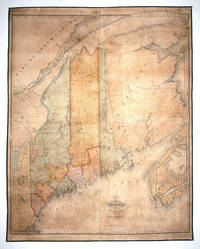
18298887Portland 1829. No Binding. Very Good. 50 ¾ x 40 ¼ inches. Steel engraving. Original wash color refreshed; expertly conserved re-mounted on new linen; a few cracks & marginal mends but fine for this kind. The very rare three copies cited in OCLC first edition of this excellent map of Maine by the state's first mapmaker. An exceptionally well-preserved example. Unlike many early American state maps that struggled to get completed Greenleaf's received a warm commendation from the state legislature even before it was published and the mapmaker was granted $1000 to aid him in finishing the map. Greenleaf later received $640 from the legislature for 40 copies of the map that were obtained for state use a remarkable $16 per copy. Perhaps the large number of copies sold for official rather than private use helps account for the map's present rarity. The map was originally intended to accompany an atlas and survey of the state that Greenleaf published the same year but very few complete sets of the three items are known to have survived. Greenleaf appears to have taken special care in the production of this map. Although published in Portland Maine Greenleaf employed as engravers for this work the estimable J. H. Young and F. Dankworth both of whom produced major works for the firms of S. A. Mitchell and others. This precisely detailed map which shows ten counties in different colors provides state county town and township boundary lines. The state's many rivers lakes ponds and even falls are shown as are roads and elevations. The map was re-published in 1844 by Greenleaf's son and namesake from the same plates but with emendations and several times thereafter. Greenleaf published two earlier maps of the state in 1815 and 1820 but the present work was by far his finest. Ristow W. American Maps and Mapmakers pp. 95-96; Catalogue Raisonne Important Maine Maps. Auction Catalogue for Thompson Collection Auction Robert E. Croul 2003 lot 119. unknown
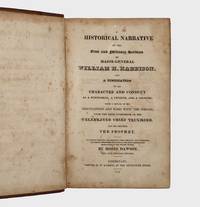
1824376921Cincinnati: Printed by M. Dawson at the Advertiser Office 1824. First edition first issue. viii4648pp. plus 15-line errata slip. 1 vols. 8vo. Contemporary sheep black morocco label. Foxing. First edition first issue. viii4648pp. plus 15-line errata slip. 1 vols. 8vo. A rare early biography of William Henry Harrison focussed on the border wars in the west. "Not only the principal authority on Harrison but also one of the most exhaustive and dependable sources on events of the War of 1812 in the western country Tecumseh's uprising etc." Howes.Thomas adds: "One of the most thorough complete and authentic treatises relating to the Border Wars of the West ever printed."<br /> <br /> Scarce on the market the present example includes the first state of the errata slip.<br /> <br /> "This is certainly one of the most thorough complete and authentic treatises relating to the Border Wars of the West ever printed. The fine portraiture of aboriginal character the narration of the minutest incidents of camp treaty and war and the style of simple candor adopted by a scholarly mind all commend the narrative to our judgment and attract our interest in its progress" Field. Field 407; Howes D158; Learned 1789; Rusk I p. 252; Sabin 18956; Thomson 312; Streeter sale 1333; Graff 1026 Printed by M. Dawson at the Advertiser Office unknown
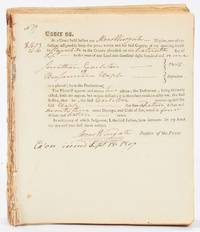
1810413795Haverhill Massachusetts 1810. Softcover. Near Fine. Partially printed letterpress documents. 154 documents p. 5 28-177 all but the first five documents are hand-numbered by Wingate. Each document is filled out in the hand of Moses Wingate in his capacity as Justice of the Peace of Haverhill. Formerly bound with sewing and glue marks along the spine otherwise the documents themselves are mostly near fine or better with a few of them exhibiting small chips or tears. Each document contains the names of the adversaries and usually the decision by default which is filled out and Signed by Moses Wingate. A few have extensive notes on the verso but most are straightforward defaults. We suspect most of the plaintiffs were businessmen or shopkeepers and most of the defendants were defaulters on small accounts.<br /> <br /> Wingate born in 1769 was a distinguished resident of Haverhill in Essex County near the New Hampshire border who lived to more than 100 dying in 1870 and who cast a vote in every presidential election from Washington to Grant. He was at various times a member of the Massachusetts State House of Representatives and Senate and Justice of the Peace of Haverhill for nearly half a century.<br /> <br /> Among the plaintiffs here represented is publisher and printer Daniel Appleton founder of the important publisher D. Appleton and Company; as well as members of the locally prominent Carlton Minot Emerson Ingersoll and Whittier families John Greenleaf Whittier was born in Haverhill in 1807; at least three different Whittiers are named here presumably relatives.<br /> <br /> An interesting historical insight into business and justice in the early days of the Republic. unknown
1852266899Boston 1852. unbound. Partial unsigned manuscript consisting of four pages 9.75 x 7.75 inches labeled "2" through "5" of a more extensive document all in the hand of Moses G. Farmer from 1852-1853 discussing the earliest trial-runs of the first ever Electric Fire Alarm System implemented in Boston. Though placed into service on April 28th 1852 Farmer's notes in diary form start on June 21st assessing the system while constantly citing ways to improve his new invention in very small part: ".Wednesday June 23 an alarm at 2:15.could not be easily read and caused a delay of 8 or 10 minutes.Saturday July 9th the circuit wheel of the key board needed repairs - the connector melted off by strong battery. July 10th Great Fire in Fort Hill. Alarm first came from Lower Boston plain. They tried to give it from Fort Hill & Persshar St. but both turned together turned too fast while ringing for So. Boston alarm came from Broad St. a delay in the time alarm of about 7 minutes.Friday Aug 6th Wanted! A Battery! Easy of manipulation. Constant & enduring in its operation. Powerful & certain in its effects & of small.cost! Sunday Aug 8th An alarm from D-7 at 12M. The operator did not understand it being the first one from that box & did not strike till the alarm came from I-4 at 12:15 P.M.Says he will recognize it next time. Oct 17th tried to raise an alarm from D-3 - S-3 4 & 5 but could not the lightning assertors were the cause of the difficulty.Friday Oct. 29th Put my newly invented battery on the South Boston signal circuit first time. Nov. 22nd Proceeded to try experiments on the velocity of sound for Captain C Wilkes.put my new battery on all signal circuit. Monday Dec. 20th Bad luck within two days at Three alarms. At one alarm the operator forgot to connect the South circuit. At Another the South end bells struck all sorts of ways on account of the key board running too fast. Atmospheric electricity probably had something to do with raising a false alarm at South End yesterday. Note: this is possibly the earliest recorded false alarm! Jan 11th 1853 Patent for my battery granted today. Sat. Jan. 15th 1853 Key board out of order. Made a substitute & had I repaired. Monday Jan. 17th Found wire broken at So. Williams St. did not intercept the circuit." This item has natural folds but is still in near fine condition.<br/> <br/> American electrical engineer and inventor of the Electric Fire Alarm System and several forms of the Incandescent Electric Light. He also patented an early light bulb which was later bought by Thomas Edison. Though a true pioneer of many aspects of 19th century electrical invention he and his wife were Spiritualists and felt that their talents were God-given and that they shouldn't take credit for any of his inventions. As a result he failed to carry his ideas to commercial success.<br/> <br/> unknown
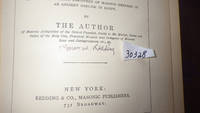
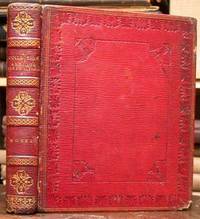
188030328<p>HARDBACK NODJ ISSUED 1880 ON COPYRITE PG 1ST Edition THICK Embossed boards with gilt lettering and decoration. Spine cover ends and corners show very little wear. Spine cover is faded SLITELY.Text block is clean and unmarked. All OUTER edges are red stained with lettered Gold Gilt Titles Interior VG/ VG AS-IS WITH RED THIN STAIN TO OUTER EDGE FEW PGS NOJACKET THICK BROWN PURPLE embossed Cover with Bright Gold Gilt DECORATIONS CVR LITE rub wear Scuffing 517 pgs Interior nice condition light Wear FOX Interior nice tight Clean light Fox OUTER PGS EDGES LITE RED</p><p>.</p><p>& Tragic Death of Philosopher Pythagoras. Roman Catholic Church has relentlessly persecuted Tortured & Burnt them at the Stake. Recent remarkable discovery of Masonic emblems on an ancient obelisk in Egypt."</p> Redding & Co. Publ, NY, Masonic publishers hardcover
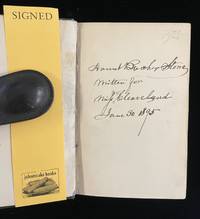
1894013411Boston: Houghton Mifflin 1894. Later Edition. Hardcover. Very Good. A later printing 1894 of "A New Edition with Illustrations and a Bibliography of the Work by George Bullen" 1878. 8vo publishers plain green cloth black-endpapers with evidence of past reinforcement of hinges front and rear. Hartford bookstore ticket rear pastedown. Inscribed: "Harriet Beecher Stowe/ written for/ Miss Cleaveland/ June 30 1895" PROVENANCE: Heirs of the Cleaveland family whose genealogy goes back to colonial Connecticut. Penciled in the inscription before "Miss Cleaveland" are the letters "EW" which identifies the inscribee as Elizabeth Whittlesey Cleaveland one of Elisha Whittlesey Cleaveland's daughters and great great granddaughter of Moses Cleaveland 1754 - 1806 Connecticut lawyer politician soldier and surveyor who founded the city of Cleveland Ohio while surveying the Connecticut Western Reserve in 1796. During the American Revolution he served as the brigadier general of the Connecticut militia. Both Stowe and the inscribee were born in Connecticut where they both died Stowe's inscription here is in a shaky hand and dated a year and a day before her death on July 1 1896 at the age of 85. Houghton, Mifflin hardcover
1879024517Portland ME: Chisholm Brothers 1879 1879. Hardcover. VG. 8vo - over 7¾" - 9¾" tall. VIEWS in THE WHITE MOUNTAINS 1st Folio Format 1879. PREFACE CONTENTS; Mount Kearsarge Mount Washington from Intervale The Frankenstein Trestle The Old Willey House The Willey-Brook Bridge The Great Railway Cut The White-Mountain Notch from Elephant's Head The Crawford House from Elephant's Head The Fabyan House Jacob's Ladder on the Mount-Washington Railway Lizzie Bourne's Monument The Summit House Mount Washington The Presidential Range from the Glen House The Glen-Ellis Falls The Crystal Cascade. The Glen House View from Bethlehem Echo Lake Franconia Notch The Franconia Notch Echo Lake and the Profile House The Profile or Old Man of the Mountains The Flume. SCARCE: 50 pages with 22 Photo Illustrations each followed by a lengthy description by Francis Moses Sweetser . This is the coveted Deluxe Folio size Largest of 4 Editions 24mo. 16 mo. 8vo. & Folio published in this scarce series with 10-22 Photo Illustrations in each. Also included are the 1 2 & 3 star Editions/Variants these all have 11 views each. Each of these Star Edition corresponded to a different area of the White Mountains with different views but also having a few in common List is available to concerned buyer. Dark Green Cloth Gilt Titles with black decorations and rules. Very Good overall Spine and covers are mildly worn. NOTE: 3 books are bound in dark green cloth while the 3-Star edition is in light green cloth. Many photos available please ask. <br/> <br/> Portland, ME: Chisholm Brothers, 1879 hardcover
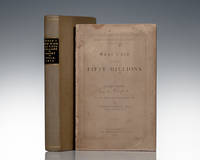
1874147740Philadelphia: J.B. Lippincott & Co 1874. Rare first edition of this satirical novel from popular Virginia physician essayist and author George W. Bagby. Sextodecimo original wrappers. In very good condition. Toning to the wrappers with rubbing to the extremities small losses to the bottom right corner of the front wrapper losses to the spine. Ownership signature and annotation to the front wrapper of P.V. Daniel Jr. son of the Virginia jurist and cousin of John M. Daniel who is the subject of a Bagby essay. Housed in a custom folding chemise and cloth slipcase. George W. Bagby was an American writer humorist and physician best known for his satirical works and his contributions to 19th-century American literature. Born in Virginia Bagby practiced medicine but became more widely recognized for his wit and humor which he often incorporated into his literary output. His most famous work What I Did with My Fifty Millions humorously critiques the nature of sudden wealth and the moral dilemmas associated with it. In addition to his novels Bagby wrote numerous essays short stories and columns often focusing on social and cultural issues of the time. His style is characterized by light-hearted satire and a keen eye for the absurdities of contemporary life. J.B. Lippincott & Co hardcover
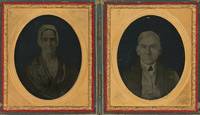
1854List1708Philadelphia 1854. Ninth plate ambrotypes in a union case measuring 2 ½ x 2 ⅛ inches visible in larger case. With the identification of Isaac Rehn with his imprint and “Patented July 4 & 11 1854†imprinted on the case. A fine pair. A striking pair of ambrotypes of Mary and Moses Pennock who were members of the Kennett Square Underground Railroad network as well as active members of the Kennett Square abolitionist and Quaker community. Moses was one of the founders of the Longwood Progressive Meeting. In R.C. Smedley’s History of the Underground Railroad in Chester and Neighboring Counties of Pennsylvania Lancaster Office of the Journal 1883 the Pennocks are mentioned on p. 301 as working as part of the network surrounding Isaac and Thamazine Meredity. Their son Samuel who would go on to secure important agricultural patents is also mentioned twice. <br /> <br /> The images are notable from a photographic history perspective as well as being early examples of the ambrotype process that had been patented in part by fellow Quaker and spiritualist Isaac Rehn. Rehn held a partial patent on ambrotypes along with James Ambrose Cutting of Boston and became unpopular among other photographers for his efforts to extend his patent. He later practiced spiritual photography and was a Professor of Chemistry at Pennsylvania Medical University in Philadelphia. Rehn was also involved in radical politics as a founder and leader of the Philadelphia section of the International Workingmen’s Association which was later disenfranchised by Karl Marx along with several other American sections. Examples of Rehn’s work are held at the National Gallery of Art the Library Company of Philadelphia and Yale’s Sterling Memorial Library. <br /> <br /> Overall a very fine and significant pair of images. unknown
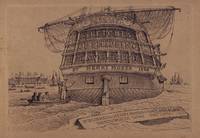
1830elala1667London: 1830. 1830. oblong folio. 6 aquatint plates. original wrs. front wr. with engraved title some soiling & creases to wrs. short tears at spine edge some light foxing. First Edition. Experimental squadrons were trials conducted of the sea-worthiness and performance of sailing vessels in various types of seas and winds which often led to improvements or alterations in ship design. The Columbine an 18-gun corvette constructed by Sir William Symonds 1782-1856 by the end of 1825 "proved a decided success during the experimental cruise of 1827" DNB. As surveyor of the navy from 1832 to 1847 Symonds built over 200 ships and introduced important innovations in ship design including elliptical sterns. In 1836 he was knighted for his services. 1st Edition. [London: 1830]. unknown
1825000613Tompkins Delaware DE. Good in Fair dust jacket. 1825. Full-Leather. On offer is a remarkable historical journal with many dates the earliest of which is 1825. It begins with the heading: "A bill of the Delawrae River" and lists what research suggests to be stops and business along the the Delaware River waterway. There are hundreds of names with the dates and amounts collected from each individual. Some coded references. There are also mentions of loans the nature of the loans and when satisfied. Though a primitive work there are numerous references to Moses L. Ogden as his family was prominent to the Delaware area from pre-Revolutionary times. We believe besides some mentions of the lumber purchases and sales that Mr. Ogden collected taxes. Delaware historians will have a grand time completing the research on this journal. Book measures 4" x 6.5" is leatherbound very dry and the inner pages are linen. Overall condition is good. Most of the 34 leaves are clean and clear some age-toning. ; Manuscript; 24mo - over 5" - 5¾" tall; HANDWRITTEN MANUSCRIPT DOCUMENT LETTER AUTOGRAPH DIARY JOURNAL LOG KEEPSAKE WRITER HAND WRITTEN DOCUMENTS SIGNED LETTERS MANUSCRIPTS HISTORICAL HOLOGRAPH WRITERS DIARIES JOURNALS LOGS AUTOGRAPHS PERSONAL MEMOIR MEMORIAL PERSONAL HISTORY AMERICANA CANALS CANAL LIFTS LOCKS NAVAL WATER RIVERS PORTS BOATING TIDES MARYLAND DELAWARE RIVER DE MD TAXES LEDGER . hardcover
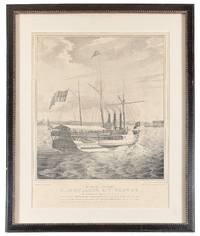
182842606Boston: Pendleton's Lithography 1828. Uncoloured lithograph. Framed size: 19 1/4 x 15 5/8 inches. An early American marine lithograph depicting the steam packet Chancellor Livingston entering Newport Harbor issued at the outset of steam navigation on the New England coast.<br/> <br/> Published in Boston by Pendleton's Lithography after a design by Moses Swett this print presents the Chancellor Livingston under way as it enters Newport Harbor with passengers visible along the decks and flags flying from the rigging. The composition combines a detailed vessel portrait with a wider harbour view situating the steamer within a recognizable coastal setting and emphasizing both its scale and activity. The vessel itself held a prominent place in early American steam navigation. Originally associated with Robert Fulton's Hudson River operations the Chancellor Livingston was rebuilt in 1827 for service between New York and Providence. The lithograph records this later phase of its career when coastal steam travel was expanding rapidly and such vessels were becoming a familiar presence along the northeastern seaboard. The printed text beneath the image reinforces the promotional aspect of the print listing the vessel's dimensions horsepower boilers and fittings as well as its passenger capacity and accommodations. This combination of technical specification and visual representation places the image at the intersection of ship portraiture and commercial advertisement reflecting the contemporary interest in steam technology and its practical advantages. As a product of Pendleton's Lithography the print also belongs to the earliest phase of lithographic production in the United States. Established in Boston in the 1820s the firm was among the first to adopt the medium on a sustained basis and works such as this illustrate both the technical possibilities of lithography and its application to subjects of current interest. The present impression reflects that early moment when lithography was emerging as a flexible and effective means of producing images of modern life and technology. Pendleton's Lithography unknown
186436882np 1864. 4to. Written in ink and signed at the end by Royce on the verso of a single leaf. Several small holes text unaffected a few closed tears two archival tape repairs. Very Good. <br /> <br /> This unusual insightful document illuminates the laws of war applicable to the Civil War. Royce's Petition seeks justice for Confederate Captain Frank R. Gurley. Royce sent it to the Confederate Commission of Exchange. Its author Confederate Captain Moses Strong Royce was captured in Tennessee and imprisoned at Nashville. Gurley Royce's cell-mate had killed Union General Robert McCook of Ohio near Huntsville Alabama in August 1862. <br /> In October 1863 Union forces captured Gurley and charged him with murdering McCook. Gurley Union officials claimed was a guerrilla who shot McCook while the General was lying in an ambulance. Southerners claimed that Gurley was not a guerrilla but a regular soldier in the Confederacy's 4th Alabama Cavalry; and that he killed McCook according to the laws of war. <br /> Harper's Weekly and Frank Leslie's Illustrated Newspaper fanned the flames claiming that lawless Confederate guerrillas murdered the general; feelings ran high. "US General Grant wrote CS General Hardee in December of 1863 and said that although Gurley was a member of the Confederate army that did not preclude him from being tried for having committed a foul murder" online Huntsville-Madison County Public Library essay 'Frank B. Gurley's 1866 Diary'.<br /> Having escaped from prison in March 1864 Royce pleads Gurley's case. "He was confined in a cell for sixty-eight days and allowed only about one hour a day for exercise and was put upon trial for the killing of Genl. McCook. He was obliged to employ counsel to defend himself at an expense of 2500 dollars in greenbacks. The evidence produced completely exonerated him of anything like murder and the argument of his counsel was a complete vindication of his right as a soldier and an officer to do all that he did in bringing Genl. McCook to his death. <br /> "When the trial was nearly ended four communications by flag of truce were sent to the court and were there read - one from Lt. Col. Hambrick one from Genl. Forrest one from Genl. Hardee and one from Genl. Johnston" assuring that Gurley was not a guerrilla but a duly enrolled member of the Confederate military forces. Nevertheless Gurley was found guilty and sentenced to death.<br /> "The undersigned believes that if an effort were to be made by the Confederate Commission of Exchange to have Capt. Gurley exchanged the Federal authorities would immediately send him forward for that purpose and as a friend of Capt. Gurley the undersigned respectfully requests General Johnston to use his influence in procuring the exchange of Capt. Gurley. Respectfully submitted M. S. Royce." <br /> Even after War's end the dispute continued. Gurley having been released from prison in an administrative snafu was re-arrested charged but finally released and placed on parole in April 1866. unknown
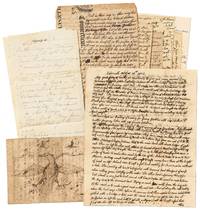
1834436962Connecticut New York Ohio 1834. Very Good. A small archive consisting of one two-page narrative letter and 10 loose sheets about 20 holograph pages of miscellaneous writings by Moses Kimball including one page with pen and ink illustrations. Modest toning and a few tiny tears three manuscript sheets are partially split at the folds including one with a neat Japanese paper tape repair about very good overall.<br /> <br /> Born in Connecticut in 1741 Moses Kimball served in the Revolutionary War as a soldier under Brigadier General Samuel McClellan 1781-82. A devout Universalist he taught navigation and civil engineering and was a prosperous land owner in Norwich Connecticut. The letter and miscellaneous writings of poetry and short sermons retained here date from the last two years of his life when he left Connecticut to live with a grandson in Norwalk Ohio.<br /> <br /> In the letter written to a friend in Connecticut Kimball describes in detail his 15-day journey undertaken in May 1835 from Poquetanuck to Norwalk: He left via sloop for Albany then traveled along the Erie Canal and completed the last leg of the trip by steamer on Lake Erie. In his verse and short sermons he lays out his strong Universalist beliefs and philosophy of life. He died happy at the age of 93 in December 1835 just a few weeks after his arrival in Norwalk.<br /> <br /> A few extracts from the letter together with a sample of his verse follows:<br /> <br /> 1. ALS. 2pp. Small quarto. Norwalk October 14th 1835. Addressed to John Harkness at Preston Connecticut:<br /> <br /> “My good friend having an opportunity to give you some account of my journey to this place I gladly embrace it. It is a beautiful country suitable for farming a rich soil … We have an academy of learning for young gentlemen with 108 scholars and another for young ladies with 98 female scholars . We left Poquetanuck the 11 day of May & arrived at my Grandson Moses Kimball’s the 25 of May. We went in a sloop … to Albany there I saw great improvements … They have made an Island in the river half a mile long … forming a basin between that & the main land with draw bridges at each end. There we left the sloop and entered on board a canal boat and past on our way drawn by horses day and night. Thus we past on up to Little Falls … and so on to Fort Stanwix … there at the height of land we left the Mohawk River and past a flat level country for 60 or 70 miles without a lock. The country all low and intersected with drowned land … and all along this wet country where the land rose a little … there would be some inhabitants settled with a bridge or two over the canal … when we got to Lake Erie at Buffalo we left the canal boat and got into a steam boat the largest vessel that I ever saw … this boat that cost thirty-five thousand dollars my grandson Moses owns one-tenth part … When we came over the lake … there were seven hundred passengers in her … So you see it is no wonder she earns money … .â€<br /> <br /> 2. Miscellaneous Verses and Short Sermons 1834-35:<br /> 10 octavo sheets/about 20 holograph pages including one page with pen and ink illustrations. The following is quoted from a poem written by Kimball on his ninety-third birthday “May 17 A.D. 1834â€:<br /> <br /> This day my years are Ninety-three<br /> The time is past & gone from me<br /> Brought into being here to stay<br /> To wait for time to pass away<br /> … <br /> And when my earthly body dies<br /> To God my spirit will arise<br /> And live with him and there remain<br /> Till Souls to bodies join again …<br /> <br /> A compelling and historically important small archive of writings that also serve as a testament to Kimball’s remarkable physical health and mental acuity. unknown
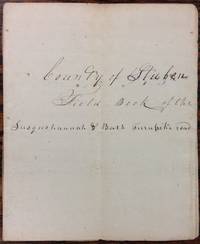
1805BOOKS288628--/No Dustjacket. 1805. 8vo. self wraps 6 leaves. A survey beginning at an oak tree on the line of Tioga County. This is for mile 82 going west to mile 104 and to a post in Morris Street in Bath. The ink records on 6 pages show Bearings Distance and Remarks. Most of the remarks are from trees. This is certified by Moses Van Campen and T. N. Miller Commissioners on August 30th. 1805. . paperback
182455402London: Henry Moses 1824. First edition. Hardcover. Very good to fine condition. Oblong Octavo. 20 etchings plus original illustrated wrappers. Bound in Royal blue leather retaining original wraps; gilt lettering and ruling on leather label mounted to spine. Cream endpapers. Tan wrappers with etching and brown lettering on front back cover plain.<br /> <br /> Our collection of "Sketches of Shipping" on the River Thames appears to be the earliest state published by Henry Moses with front wrappers dated Dec. 1 1824 and all twenty etchings dated in plates Oct. 1 1824. An 1826 advertisement in the Quarterly Review indicated that six parts of the Sketches with five engravings each had been published up to that time and announces the publication of two additional issues. The front wrapper stating publication date as Dec. 1 1824 as in our copy appears to have been used in various editions including some containing eleven plates dated March 1 1825 in plates or lettered in ink "Nos. 5 & 6" corresponding to the 1826 Quarterly Review advertisement.<br /> <br /> The irregularities and/or contradictions in tracing the publication of these Moses etchings suggest that due to the constrictions of the medium these popular etchings were published in limited numbers in variant editions as identified by the dates in these plates to satisfy the public demand of the time. <br /> <br /> In our copy all 20 etchings are dated in plates Oct. 1 1824 with two of the plates containing additional dates etched into the plates as indicated below:<br /> <br /> 1. Sailing Match Aug. 16 1824<br /> 2. An Indianian in Barnard's Yard Deptford<br /> 3. Trafalgar 120 G 125<br /> 4. Midway<br /> 5. Midway Aug. 9 1824<br /> 6. Blackwall. Dutches of M.<br /> 7. Blackwall Basin<br /> 8. Trafalgar P - 120 Guns<br /> 9. Sheerness Yard from a Window of the Fountain Inn<br /> 10. Sheerness<br /> 11. Sheerness Yard from a window of the Fountain Inn variant motif<br /> 12. Trafalgar 120 Guns<br /> 13. Trafalgar in the Basin Sheerness<br /> 14. Hulks at Sheerness<br /> 15. Blackwall<br /> 16. Untitled<br /> 17. City Canal<br /> 18. Basin at Blackwall<br /> 19. Blackwall - Wellington Indiaman<br /> 20. Surat Castle<br /> <br /> All etchings but plate 12 with H. Moses printed to plate. Plate twelve with Henry Moses. Printed by Chatfield and Coleman. Inked name and date on front free endpaper. "12/." inked to upper foredge corner of cover; this with a few small damp stains on front and back covers. OCLC lists an 1837 copy with 57 plates incl. 2 engraved title pages published in London by Ackermann a 1824 copy with nineteen plates 1825 and 1837 copies with thirty plates the latter published by Ackermann an 1837 copy titled "The Marine Sketch Book" with twenty-eight plates an 1826 copy with nine plates titled Sketches of Shipping: View in Portsmouth Harbour" and an 1827 copy with thirty plates titled "Shipping at Portsmouth and Spithead" publisher W. B. Cooke. Henry Moses hardcover
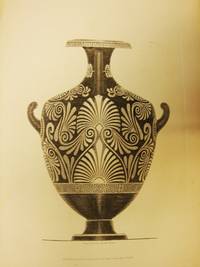
1820B2235London: Rodwell and Martin 1820. Plates and text are clean and crisp an excellent copy. Binding: recent ½ calf with marbled boards. Spine with 6 compartments of raised bands gilt lettering on two. Notes: Henry Englefield was an antiquary and scientific writer. He was a made a fellow of the Society of Antiquites in 1779 and also served as the president for a brief period. National Bibliography Size: Large 4to Illustration: 39 beautifully engraved plates of ancient Roman and Greek vases 1 of which is hand coloured not including frontis and engraved title page. Pages: P. Frontis engraved title 1-7 Plates and descriptions unpaginated Category: ; Book Plate Books General; Book Antiquities; Book Art Architecture & Design; Rodwell and Martin hardcover
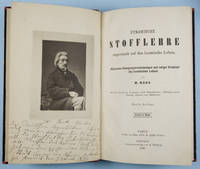
188015524Paris: Privately Printed Sybille Hess 1880. Second edition. Hardcover. g. Scarce Only two libraries worldwide own this book according to OCLC. 8vo. 182 1 pp. Half maroon leather over marbled paper covered boards with gilt lettering to spine. Raised bands. Modern endpapers. Inscribed by Sybille Hess post mortem to original free front endpaper. Gravure frontispiece. Lithographic illustrated throughout. Fold-out map. Rare second edition of of this scientific work by the "father of modern socialist Zionism" Moses Hess 1812-1875. A philosophic work on science the cosmos and mankind. It draws upon scientific and philosophical ideas with influence from Hegel and Feuerbach. Hess had worked in this field most of his life and it was posthumously published by his devoted wife in 1877 as a pious monument to his memory. He is best known as the Zionist author of "Rome and Jerusalem." Head of spine corners worn. Minor scuffing and rubbing to boards. In German. In overall good condition. Privately Printed [Sybille Hess] hardcover
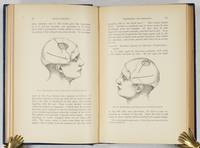
1893665411893. New York: William Wood & Company 1893 8° XII 295 pp. 55 Figs. orig. cloth; rebacked; with stamp of "Worchester State Hospital Medical Library". First Edition! Embossed stamp on title a stamp on the head of the first page ex-libris of the Worchester Hospital and Arthur Edwards Lyons on the front endpaper. Moses Allen Starr's "Brain surgery" was the first American book on neurosurgery published the same year as Macewen's pioneering neurosurgical classic. Moses Allen Starr 1854-1932 'Professor of Neurology in the College pf Physician and Surgeons at Columbia University New York City' "had plans for a career in classical culture when he graduated from Princeton and embarked for Germany to study Greek and Roman history. In Berlin however several visits to Helmholtz's laboratory revived a latent interest in natural science. He returned to his native New York graduated from the College of Physicians and Surgeons P&S Columbia University did a residency at Bellevue Hospital then returned to Europe to work at Heidelberg Vienna and Paris. On return to New York he set up a laboratory in his home and in 1884 published an essay on the sensory tracts of the central nervous system elucidating some of the then-current questions of myelination. Starr's regard as an American pioneer in the field of cerebral localization stemmed from his participation in a symposium on that subject with the famous English neurologist David Ferrier and neurosurgeon Victor Horsley who were delegates to the 1888 Congress of American Physicians and Surgeons in Washington D.C. He became professor of nervous diseases at the Montreal Neurological Institute. During neurosurgical operations they electrically stimulated the surface of the exposed unanesthetized brains of patients who were talking. On-going speech was blocked by excitation of the parietal-temporal area the inferior frontal area and the supplemental motor area of the left hemisphere Penfield & Roberts 1959. Those experimental protocols were a continuation of Penfield's long quest to add to the knowledge of body representations on the neocortex." H.W. Magoun & L. Marshall; American Neuroscience in the Twentieth Century 2005 pp.383-384 Garrison & Morton No.9637 hardcover
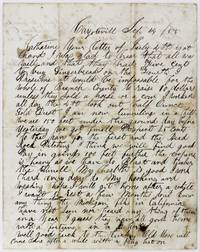
18553206Coyoteville: September 12 1855. Very good. 2pp. plus integral blank. Original mailing folds moderate toning staining and ink spotting but still easily readable. Bottom fourth of integral blank excised. An informative Gold Rush letter about mining in the long-vanished ghost town of Coyoteville which was an extraordinarily rich gold area for a couple of years in the early 1850s. A noted tunneling method nicknamed "coyoteing" was developed in the town and subsequently inspired the name of the town. In the present letter Moses Pine writes to "Catherine" in Branch County Michigan and signs his name simply as "Mose Esq" at the conclusion. The author informs Catherine presumably his wife or sister of his activities some of the economic realities and some of the practical details of prospecting for gold in California. Presuming that "it would be impossible for the whole of Branch County to raise $10 unless they sell a horse" Pine comments that he had ginger bread on the Fourth of July after working all day and yielding a "half Ounce Gold Dust." He then provides a detailed description of his mining: "I am now tunneling in a hill. We are 150 feet under the ground. Day before yesterday we got small respect 25 cents to the pan for the first and the bed rock pitching. I think we will find good pay in the going 100 feet further the expense is heavy as we have to blast and timber the tunnel." Pine also talks of his health and that "I work hard every day do my cooking and baking." He then expresses his hope to get back to Michigan to "rest a few months" but knows nothing of other Michigan folks in California: "Have not seen nor heard anything of them in a year. I guess they have all gone home with a fortune in a horn. Well good luck to the lucky. Old Mose will come home after a while with a pretty hat on." A nicely-detailed letter from an unusual and obscure Gold Rush location. September 12 unknown
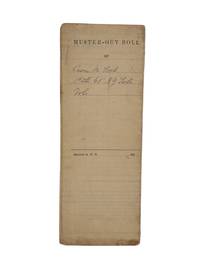
1863215941863. Medal of Honor Recipient Moses Veale Signed Civil War muster out roll dated June 8 1863 documents the discharge of 1st Lieutenant Orson Foot of the 60th New York Volunteer Infantry so he could accept a commission as Captain during the opening phase of the Gettysburg campaign. Issued at Aquia Creek Virginia the document bears the signature of Captain Moses Veale as mustering officer a Union officer later awarded the Medal of Honor for extraordinary gallantry during the Civil War. Veale's citation records that during the Battle of Wauhatchie Tennessee he continued directing his men after being struck by four enemy bullets and having his horse shot from under him. The presence of Veale's signature transforms the document from routine military administration into a signed record connected to one of the war's most decorated acts of battlefield courage. At the same time the roll records Foot's discharge to accept promotion during the Gettysburg Campaign. <br /> Foot Orson. Civil War muster out roll. Aquia Creek Virginia June 8 1863. One manuscript sheet completed in official Union Army muster format and signed by Captain Moses Veale as mustering officer. The document certifies that the officer "carefully examined this Roll. and mustered the said Orson Foot for discharge; and I hereby honorably discharge him from the service of the United States." It records Foot's enrollment at Ogdensburg New York on September 16 1861 identifies his rank as 1st Lieutenant in the 60th New York Volunteer Infantry and notes in the remarks that he was mustered out "to accept Commission of Captain." The sheet therefore documents the administrative transition by which an officer left one commission to assume another within the wartime command structure.<br /> <br /> The document's date and place situate it at the evacuation of Aquia Creek Landing one of the Army of the Potomac's principal logistical bases. Established during earlier campaigns in northern Virginia Aquia Creek served as a major supply depot linking Washington with Union forces in the field. As Robert E. Lee advanced north in June 1863 the Union command dismantled and abandoned the installation to support the army's rapid movement toward Pennsylvania. By the very day this roll was issued June 8 Federal forces were evacuating and destroying the depot to prevent its use by Confederate troops. Foot's promotion therefore occurred amid the redeployment that would culminate at the Battle of Gettysburg. Single manuscript sheet measuring approximately 32 x 11 inches when unfolded. Some age toning scattered ink staining and edge wear consistent with large-format wartime administrative documents; overall good condition. A substantial Civil War military document combining Gettysburg campaign context with the signature of Medal of Honor recipient Moses Veale whose later battlefield heroism makes his autograph particularly desirable within Civil War military manuscripts. A substantial Civil War military document produced during the evacuation of Aquia Creek and the opening phase of the Gettysburg campaign. unknown
184537452Leipzig: F. A. Brockhaus 1845. First edition. Hardcover. g. Small Octavo ca. 4200pp. Original half leather over dark green pebbled cloth. Marbled endpapers and edges. Portrait lithograph of Mendelssohn by Frisch with tissue guard. Edited by Prof. Dr. G. B. Mendelssohn based on original prints and handwritings in seven volumes. Vol. 1: Biography and philosophical writings Vol. 2: Metaphysical writings Vol. 3: Correspondence and smaller writings Vol. 4.1: Smaller writings and correspondence Vol. 4.2: Correspondence. Vol. 5: Correspondence. Vol. 6: Ritual Laws of the Jews and various translations. Vol. 7: Mendelssohn's translation of the Five Books of Moses. Moses Mendelssohn was a German Jewish philosopher and practicing orthodox Jew. His ideas are credited with contributing significantly to the 'Jewish enlightenment' of the 18th and 19th centuries the Haskalah. Text in German fracture. Binding rubbed. Some volumes with professional repair at gutters starting a back gutter of volume 2 and 3. Volumes dusty and marbled edges faded. Moderate sporadic foxing of book blocks. Bindings and interior in overall good condition. F. A. Brockhaus hardcover
180255778Saloniki Thessaloniki: Mordekhai Nahman and David Yisraeliga 1802. Second edition. Modern cloth. Very good-. Quarto 25 by 16.5 cm. 2 136 leaves. Hebrew text in rabbinic font arranged in two columns. Title within elaborate letterpress borders with textual quotations; woodcut printer's device verso title approbations page; publication date in chronogram. Recent royal blue cloth; text block with speckled edges. Title leaf reinforced with tissue along fore-edge; title with tear along gutter 7 cm and small mostly marginal worm traces; worming vanishes by the sixth leaf with very minimal text loss; slightest marginal worm tracing at final 20 leaves; entry at bottom margins of the title and four other pages excised in black marker not affecting text; several leaves lightly toned else a very good copy with crisp clean text.<br /> <br /> Very scarce second edition of this collection of rabbinic responsa issued by Moses ben Isaac Segal Mintz 15th century. First published at Krakow in 1617 this is the author's only published work. Born in Mainz between 1420 and 1430 Moses Mintz studied with Jacob Weil and Israel Isserlein and while still quite young was appointed rabbi of Würzburg. Mintz led a peripatetic life which allowed him to investigate Jewish customs and communal regulations in many towns. After the 1453 expulsion of the Jews from Würzburg he returned to Mainz until the expulsion of 1462. He subsequently went to Landau and Ulm. In 1469 he was appointed rabbi of Bamberg. Four years later he was in Nürnberg and the following year in Posen. There he made preparations to emigrate to Palestine but for unknown reasons decided to remain in Posen until the end of his life.<br /> <br /> "Mintz's prominence and recognized authority resulted in may other rabbis turning to him with halakhic queries on such issues as issur ve-heter dietary laws and communal customs" Heller. His circle of correspondents included Israel Isserlein Joseph Colon Eliezer Treves and his cousin Judah Mintz. As the present collection notably deals with practical issues of contemporary importance especially civil and matrimonial law -- including customs and the enactments of Rabbenu Gershom -- they provide insight into Jewish life in fifteenth-century Germany. Issues of some notable responsa include taxes placed on Jews by local rulers; obligations of a wealthy man to his wife's poor relatives; a woman who committed adultery repented and swears the child is from her husband; if a person blind in one eye can be a judge in a case of halitzah when a man is released from the general obligation to marry his deceased brother's widow; and if one should mourn for a murderer. "Of special value are three responsa in manuscript entitled 'The Three Branches' which are an important source for the history of the yeshivot rabbinic schools of Germany in the 15th century. They depict the woeful condition of pupil-teacher relations which had broken down as a result of the arrogance of the teachers and their exaggerated concern for their dignity as well as because of the pupils' desire for greater freedom of activity and the acquisition of social status" EJ.<br /> <br /> Approbations of Istanbul rabbis: Ezekiel Refael Chaim Alfandari; Michael Ashkenazi; Moshe Frishko<br /> <br /> Provenance: Ink stamps of the Yeshiva Ha-Metivta ha-Gedolah Jerusalem at approbation page and bottom margin of one text page. References: Enc. Jud. 1st ed. 12: 65-66; M. J. Heller The Seventeenth Century Hebrew Book pp. 346-347 first ed. 1617; Vinograd Salonica 515; Cf. Steinschneider 6529.1 ed. Krakow 1617 - but not noting the present edition!<br /> <br /> Title and imprint Hebrew: תשובות ×ž×”×¨×³×³× ×ž×™× ×¥ × ×“×¤×¡ פה ש××œ×•× ×™×§×™ ×™×¢×³×³× ×‘×“×¤×•×¡ מרדכי × ×—×ž×Ÿ וחברו דוד ישר×ליג׳ה<br /> <br /> Date chronogram: 5562 = ×•×™×¨× ×ž×©×”<br /> <br /> Yeshiva stamp: ×”×ž×ª×™×‘×ª× ×”×’×“×•×œ× ×‘×™×ª הר×ש׳׳ל ישיבה תיכון. Mordekhai Nahman and David Yisraeliga unknown
1814ASECoMOS75London: J.Taylor 1814. 1814. small 4o. pp. 1 p.l. xii 63 1. engraved title 151 engraved plates 9 hand-coloured & 18 engraved head & tailpieces. contemporary straight-grained deep red morocco sides with blind-tooled border & central panel stamp gilt back inside dentelles gilt edges slight chipping to spine ends & corners worn scattered light foxing dampstain in upper margin of some plates. First Edition. Most of the vases and other antiquities depicted were selected from authentic public and private collections which included the British Museum the Musée Napoleon the Museo Pio Clementino the Libreria di San Marco the Museum Capitolinum and those belonging to Thomas Hope William Hamilton as well as to himself. Others are copied from Piranesi Bartoli and Millin. Nineteen plates in the section on tombs "may not at first appear connected with the principal object of the work: yet as they represent some of the vast and superb sepulchral chambers in which Vases Cinerary Urns and Sarcophagi were deposited and are taken from Bartoli and other celebrated authorities it is hoped that they will be considered as an useful addition."p. v These include the mausoleum of Hadrian and the tombs of Caius Cestius Cecilia Metella Alexander Severus and Julia Mammea &c. The engraver Moses "enoyed a great reputation for his outline plates which are distinguished for the purity and correctness of the drawing. His art was peculiarly suited to the representation of sculpture and antiquities and he published many sets of plates of that class." DNB. 1st Edition. Hardcover. London: J.Taylor, [1814]. Hardcover
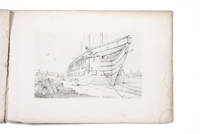
18244504491London 1 Portland Place Wandsworth Road: by Henry Moses 1824. Slight staining and creasing some wear at edges spine neatly strengthened. 11 etched plates 193 x 282 mm; original illustrated brown paper wrappers. <p><p>A scarce series of privately-published etchings of shipping in the London Dockyards. This section of Henry Moses' publication comprises his complete series on London's Docklands. An advertisement in the Quarterly Review 1826 shows that he had then published altogether six parts of his Sketches of Shippng by that date with a further two announced. The six parts contained five engravings each. The first ten etchings depicted shipping on the Thames the second ten showed Sheerness and the Medway while the final ten depicted life on London's docks.</p> <p>The present copy lettered in ink "Nos 5 & 6" actually contains 11 plates although the advertisement in fact only calls for nine plates in the these two parts. There are five with the shared title "London Docks" as against four called for in the advertisement while the eleventh plate differing in style to the others probably comes from an earlier part. </p> <p>1. Vessels off the Tower Two-masted ship with numerous sightseers in rowed boats in the foreground</p> <p>2. Limehouse Sailing ship being unloaded by crane at pier. A sailing barge is on the river. In the foreground a rowing boat and anchor are visible on the shore. </p> <p>3. Blackwall Reach with the Columbus in the Distance A cutter in Blackwall Reach with another beyond on the right. The four-masted barque Columbus a vast 300-foot Canadian-built experimental timber carrier is seen as a long grey hull in the distance stretching from the centre or the image to the right edge.</p> <p>4. Limehouse Sailing ship moored at Limehouse with rowing boats and barges unloading barrels.</p> <p>5. A West Indiaman in Cox & Curlin's Yard Limehouse the substantial docks later known as Limehouse Yard where very large vessels could be built</p> <p>6. London Docks Men sitting on timber slabs ship with sails hanging loose behind in dock</p> <p>7. London Docks Barge in front of stern of ship at dock sails up and catching the wind two ships to left one making way</p> <p>8. London Docks Numerous ships at anchor sails drying tender at centre with barrels being rowed by two men</p> <p>9. London Docks Large three-master in dock. tender with barrels in front dockside showing a sluicegate</p> <p>10. London Docks Two ladies in a boat rowed by a man three ships behind wiht sails loose</p> <p>11. Trafalgar 120 Guns Different in style to the other plates close-up view of the hull of recently launched Trafalgar at dock.</p> <p>Henry Moses c.1782-1870 was prolific and "worked throughout the first half of the present century enjoying a great reputation for his outline plates which are distinguished for the purity and correctness of the drawing. His art was peculiarly suited to the representation of sculpture and antiquities and he published many sets of plates of that class; he was one of the engravers employed upon the official publication Ancient Marbles in the British Museum 1812-1845" DNB. This delightful series was one that he produced on his own account. It is very scarce on the market. The British Museum's set for example comprises just the first four parts bound together. Only a reissued version by Ackermann of 1837 is recorded in Australian libraries and that only held by the National Library and the Vaughan Evans Library at the Australian National Maritime Museum.</p> <p>Appendix 1:</p> <p>Quarterly Review ad in 1826:</p> <p>Sketches of Shipping on the Thames the Medway and in the Dockyards drawn and engraved by Henry Moses.</p> <p>Nos. 1. to 6. containing the following plates: </p> <p>Parts 1-2</p> <p>1 A Sailing Match near Vauxhall Bridge. </p> <p>2 An India-man in Barnard's Yard Deptford. </p> <p>3 The City Canal. </p> <p>4 Wellington Indiaman in Blackwall Basin. </p> <p>5 Another View of the same. </p> <p>6 Stern View of ditto. </p> <p>7 The Basin at Blackwall </p> <p>8 Surat Castle Indiaman in the Basin. </p> <p>9 A Dance on Board an Indiaman in the Basin. </p> <p>10 Part of Blackwall Yard with View of the River. </p> <p>Parts 3-4</p> <p>11 Waterman in his Boat in the Medwuy. </p> <p>12 View on the Medway. </p> <p>13 Shipping off Sheerness. </p> <p>14 Hulks at Sheerness. </p> <p>15 The Trafalgar of 120 guns in the Basin Sheerness. </p> <p>16 Bow View of the same. </p> <p>17 Stern View of ditto. </p> <p>18 Entrance to the Basin Sheerness. </p> <p>19 Part of Sheerness Yard from a Window of the Fountain Inn. </p> <p>20 Another View of the same. </p> <p>Parts 5-6</p> <p>Vessels off the Tower. </p> <p>Limehouse. </p> <p>Another View of the same. </p> <p>Blackwall Reach with the Columbus in the distance. </p> <p>A West Indiaman in Cox and Curlin's Yard Limehouse. </p> <p>London Docks. Four Views of the same. </p> <p>Price on Imperial 8vo. 18s. A few Copies are printed on Imperial 4to. price 1L. 4s.</p> <p>### Nos. 7. and 8. just published containing 10 Views in Portsmouth Harbour.</p> <p>Appendix 2:</p> <p>Other works by Moses</p> <p>The Decision of the Flower by Henry Moses after Moritz Retzsch illustration to Goethe's Faust I</p> <p>The Gallery of Pictures painted by Benjamin West 12 plates 1811 patronage of Thomas Hope2;</p> <p>A Collection of Antique Vases Altars &c. from various Museums and Collections 170 plates 1814;</p> <p>Select Greek and Roman Antiquities 36 plates 1817;</p> <p>Vases from the Collection of Sir Henry Englefield 40 plates 1819;</p> <p>Examples of Ornamental Sculpture in Architecture drawn by L. Vulliamy 36 plates 1823;</p> <p>Illustrations to Goethe's Faust after Moritz Retzsch 26 plates 1821;</p> <p>Illustrations to Schiller's Fridolin and Fight with the Dragon 1824 and 1825;</p> <p>Georg Heinrich Noehden's Specimens of Ancient Coins of Magna Graecia and Sicily 24 stipple plates 1826;</p> <p>Works of Canova with text by Countess Albrizzi 3 vols. 1824-8; and</p> <p>Selections of Ornamental Sculpture from the Louvre 9 plates 1828.</p> <p>Moses contributed many of the illustrations to James Hakewill's Tour of Italy 1820 and Woburn Abbey Marbles 1822. He etched from his own designs Picturesque Views of Ramsgate 23 plates 1817; Sketches of Shipping and Marine Sketch Book 1824 reissued by Ackermann 1837; and Visit of William IV when Duke of Clarence to Portsmouth in 1827 17 plates 1830. Moses's final work was a set of twenty-two illustrations to Pilgrim's Progress after Henry Courtney Selous executed for the Art Union of London 1844.1</p> <p>Appendix 3:</p> <p>DNB: </p> <p>MOSES HENRY 1782P-1870 engraver worked throughout the first half of the present century enjoying a great reputation for his outline plates which are distinguished for the purity and correctness of the drawing. His art was peculiarly suited to the representation of sculpture and antiquities and he published many sets of plates of that class ; he was one of the engravers employed upon the official publication ' Ancient Marbles in the British Museum' 1812-1845. Of the works wholly executed by himself the most important are : ' The Gallery of Pictures painted by Benjamin West' 12 plates 1811 ; ' A Collection of Antique Vases Altars &c. from various Museums and Collections' 170 plates 1814 ; ' Select Greek and Roman Antiquities' 36 plates 1817 ; ' Vases from the Collection of Sir Henry Englefield' 40 plates 1819 ; ' Examples of Ornamental Sculpture in Architecture drawn by L. Vulliamy' 36 plates 1823 ; illustrations to Goethe's ' Faust' after Retzsch 26 plates 1821; illustrations to Schiller's 'Fridolin' and 'Fight with the Dragon' 1824 and 1825 ; Noehden's 'Specimens of Ancient Coins of Magna Graecia and Sicily' 24 stipple plates 1826 ; ' Works of Canova' with text by Countess Albrizzi 3 vols. 1824-8 ; and ' Selections of Ornamental Sculpture from the Louvre' 9 plates 1828. Moses also contributed many of the illustrations to Hakewill's ' Tour of Italy' 1820 and ' Woburn Abbey Marbles' 1822 ; he etched from his own designs ' Picturesque Views of Ramsgate' 23 plates 1817 ; ' Sketches of Shipping ' and ' Marine Sketch Book' 1824 reissued by Ackermann 1837; and ' Visit of William IV when Duke of Clarence to Portsmouth in 1827' 17 plates 1830. Moses's latest work was a set of twenty-two illustrations to ' Pilgrim's Progress' after H. C. Selous executed for the Art Union of London 1844. He died at Cowley Middlesex 28 Feb. 1870. Redgrave's Diet of Artists ; Dodd's Collections in British Museum Add. MS. 33403 ; Universal Cat. of Books on Art. F. M. O'D.</p> </p> . by Henry Moses unknown