DANTE, Alighieri - DALI, SalvadorLivre Rare Book
10 051 résultats
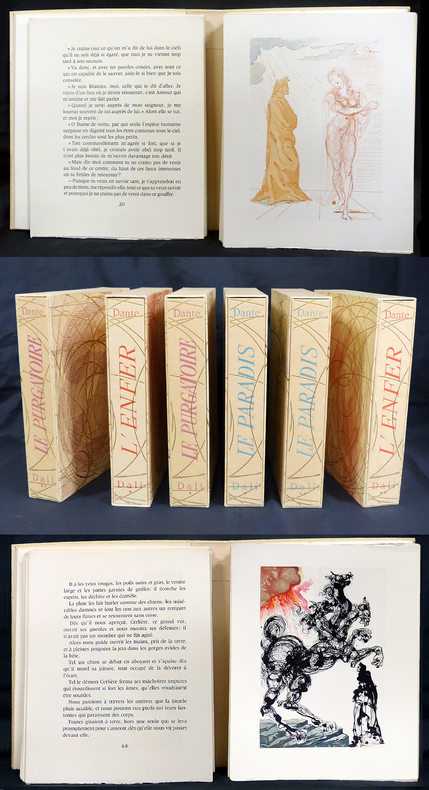
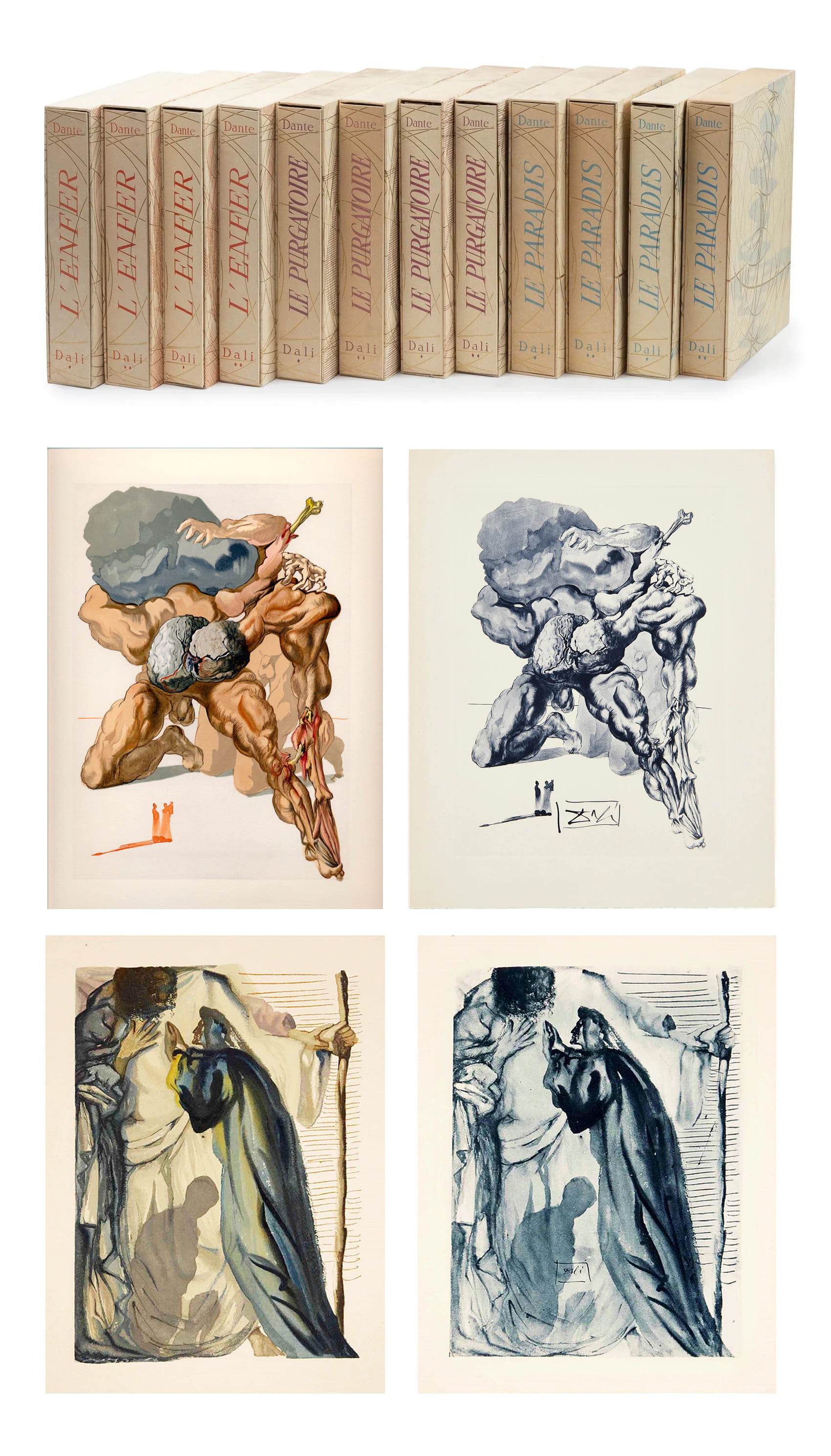
19633909Les Heures Claires, Paris 1959-1963. 12 volumes in-folio en feuilles (34 x 26 cm) sous couvertures imprimées rempliées, chemises et étuis décorés de l'éditeur. - 100 AQUARELLES ORIGINALES HORS-TEXTE DE SALVADOR DALI GRAVÉES SUR BOIS EN COULEURS par Raymond Jacquet. Exemplaire de grand luxe : 1 des 150 ex. numérotés sur pur chiffon de Rives filigrané comprenant : Les 6 volumes du texte illustré des 100 aquarelles gravées sur bois en couleurs en hors-texte + LA SUITE COMPLÈTE DES 100 BOIS EN COULEURS.+ LA SUITE COMPLÈTE DU TRAIT GRAVÉ SUR CUIVRE TIRÉ EN BLEU + UNE SUITE DE LA DÉCOMPOSITION DES COULEURS D'UNE PLANCHE POUR CHAQUE VOLUME. Les 6 ouvrages sont en parfait état et bien complets des 100 gravures et des 3 doubles-feuillets de justification numérotés. Les 6 volumes de suites sont collationnés et bien complets en parfaite condition. Les planches belles aux couleurs lumineuses. Les 12 emboîtages sont en parfait état de conservation. Très bel exemplaire du tirage de luxe de cette monumentale et célèbre édition. ÉTAT DE NEUF. (Références : Michler & Lopsinger, 1039 à 1138 ; Field pages 189 à 200). Provenance : acquise en 1963 directement auprès de Joseph Foret et conservée dans la même famille jusqu'à aujourd'hui. Photographies supplémentaires sur demande. - ENGLISH DESCRIPTION: Dante : LA DIVINE COMÉDIE. 100 wood-engraved plates in color. Les Heures Claires, Paris 1959-1963. 12 folio volumes in loose sheets (34 x 26 cm), under folded printed covers, original decorated slipcases of the publisher. Including THE 100 WATERCOLORS OUT OF TEXT BY SALVADOR DALI ENGRAVED ON WOOD IN COLORS by Raymond Jacquet. This one is 1 of 150 deluxe copies numbered on Rives with watermark : The 6 volumes with the Dante's text illustrated with 100 color wood engravings + THE COMPLETE SUITE OF THE 100 COLOR WOOD ENGRAVINGS + THE COMPLETE SUITE OF THE COPPER ENGRAVED LINE ART PRINTED IN BLUE + A SUITE OF THE COLOR "DECOMPOSITIONS" OF ONE PLATE FOR EACH VOLUME. The 6 volumes are in perfect condition and complete with all 100 engravings and the 3 numbered double-page justifications. The 6 volumes of suites have been collated and are complete and in perfect condition. The plates are beautiful with luminous colors. The 12 slipcases are in perfect condition. A very fine and scarce deluxe copy of this monumental and celebrated edition. MINT CONDITION. (References: Michler & Lopsinger, 1039 to 1138; Field pages 189 to 200). More pictures on request.
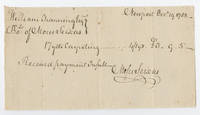
178825418<p>Seixas' 1790 letter of welcome elicited the first president's most compelling statement on religious liberty "to bigotry no sanction." In this 1788 receipt Seixas signs a receipt documenting payment for carpet by William Channing the state's new attorney general.</p><p><strong>MOSES SEIXAS.</strong> Manuscript Document Signed to William Channing December 18 1788. Receipt for carpeting. 1 p. 7¼ x 4 in.</p><p><strong>Complete Transcript</strong></p><p><em>Newport Dec<u>r</u> 19 1788</em></p><p><em>William Channing Esq</em></p><p><em>Bo<u>t</u></em> Bought <em>of Moses Seixas / 17 yds Carpeting . . . . . . . . . . .4/1 yd. £3.9. 5.</em></p><p><em>Received payment In full /</em></p><p><em>Moses Seixas</em></p><p>Docketing on verso in another hand: <em>Moses Seixas</em></p><p><strong>Moses Mendes Seixas</strong> 1744-1809 was born in New York into a Jewish family. His father immigrated from Portugal to New York about 1730 and became a merchant. The family moved to Newport Rhode Island in 1765. Moses Seixas married Jochebed Levy in 1770 and they had eight children. He was one of the organizers and first cashier of the Bank of Rhode Island which conducted business in his house until 1818. After the British occupied Newport during the Revolutionary War Seixas remained in Newport but was among the signers of a document supporting the patriot cause. In 1790 he was the president of the Congregation Yeshuat Israel later Touro Synagogue in Newport. He was also a charter member and first grand master of St. John's Lodge of Free and Accepted Masons in Newport.</p><p><strong>William Channing</strong> 1751-1793 was born in Newport Rhode Island and graduated from the College of New Jersey Princeton in 1769. In 1773 he married Lucy Ellery daughter of William Ellery a Newport lawyer who signed the Declaration of Independence and they had nine children. Channing was elected Attorney General of Rhode Island in 1777 and when Rhode Island ratified the U.S. Constitution in 1790 Channing became the first federal District Attorney. One of his sons was the famous Unitarian preacher William Ellery Channing 1780-1742.</p><p><strong>Historical Background</strong></p><p>From 15 Sephardic families who arrived in 1658 Newport Rhode Island's Jewish community grew to be the largest in the colonies. Many Jews left during the Revolutionary War when Newport was occupied by the British. A significant number returned when the British left in 1779. By the time Rhode Island became a state there were approximately 300 Jews in the thriving Newport community.</p><p>Starting while on his way to New York to assume the presidency in April of 1789 George Washington received many messages from civic fraternal and religious organizations offering congratulations praise of his deeds in war peace and politics prayers on behalf of congregations or constituents. Washington's replies justly count among his most famous pronouncements setting a boldly inclusive tone that helped our new nation survive and expand.</p><p>After the first session of the first Congress Washington set out on a tour of the New England states except for Rhode Island which had yet to ratify the Constitution. It finally did so in May of 1790 and three days after the second session of Congress adjourned Washington Jefferson and others set out to visit Newport. On August 18 Washington and his entourage were greeted with four addresses written as open letters and read in a public ceremony. First the town then from all the Christian clergy then the Masonic order and finally from the Hebrew Congregation.</p><p>Moses Seixas on behalf of the Congregation Kahal Kadosh Yeshuat Israel congratulated Washington on his ascendancy to the Presidency. He invoked the language of the Revolution in arguing that Jews should be entitled to the same privileges as an American of any other religious denomination. Having been previously "deprived…of the invaluable rights of free Citizens" Seixas expressed his hopes for the success of the new "government erected by the majesty of the people a government which to bigotry gives no sanction—to persecution no assistance; but generously affording to all liberty of conscience."</p><p>Seixas' letter moved President Washington who echoed Seixas' words and built on them to make his most celebrated statement on religious freedom. He responded as soon as he returned to the capital New York assuring the Hebrew congregation that "happily the Government of the United States which gives to bigotry no sanction to persecution no assistance requires only that they who live under its protection should demean themselves as good citizens in giving it on all occasions their effectual support. It would be inconsistent with the frankness of my character not to avow that I am pleased with your favorable opinion of my Administration and fervent wishes for my felicity. May the Children of the Stock of Abraham who dwell in this land continue to merit and enjoy the good will of the other Inhabitants; while every one shall sit in safety under his own vine and fig tree and there shall be none to make him afraid."</p><p>Washington's addresses responding to religious congregations included those of Baptist Congregational Dutch Reformed Episcopalian German Lutheran German Reformed Jewish Protestant Presbyterian Quaker Roman Catholic and other denominations.</p><p>Today we understand that Washington and his fellow Founding Fathers were oblivious to the realities of other kinds of oppression. Knowing what we know now how can we still value these slave-owners' declamations on freedom While acknowledging Washington's ownership of his full share of the universal biases of his age we can and should still treasure his "to bigotry no sanction" letter as a powerful testament to the promise of America. In the 218 years since Washington responded to Seixas' address has anyone come up with a better definition of the benefits and responsibilities of American citizenship</p><p>Washington's original letter was acquired by the Morris Morgenstern Foundation in 1948 and is on long-term loan to the National Museum of American Jewish History in Philadelphia. Seixas' letter to Washington is in the Library of Congress and Seixas' retained copy was acquired by the Morgenstern Foundation in 1949 and is with Washington's letter.</p><p><strong>Condition</strong></p><p>Fine condition with intersecting folds and slight bit of foxing.</p>
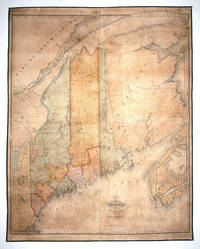
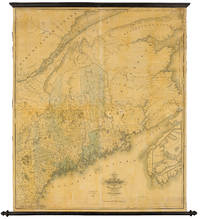
18298887Portland 1829. No Binding. Very Good. 50 ¾ x 40 ¼ inches. Steel engraving. Original wash color refreshed; expertly conserved re-mounted on new linen; a few cracks & marginal mends but fine for this kind. The very rare three copies cited in OCLC first edition of this excellent map of Maine by the state's first mapmaker. An exceptionally well-preserved example. Unlike many early American state maps that struggled to get completed Greenleaf's received a warm commendation from the state legislature even before it was published and the mapmaker was granted $1000 to aid him in finishing the map. Greenleaf later received $640 from the legislature for 40 copies of the map that were obtained for state use a remarkable $16 per copy. Perhaps the large number of copies sold for official rather than private use helps account for the map's present rarity. The map was originally intended to accompany an atlas and survey of the state that Greenleaf published the same year but very few complete sets of the three items are known to have survived. Greenleaf appears to have taken special care in the production of this map. Although published in Portland Maine Greenleaf employed as engravers for this work the estimable J. H. Young and F. Dankworth both of whom produced major works for the firms of S. A. Mitchell and others. This precisely detailed map which shows ten counties in different colors provides state county town and township boundary lines. The state's many rivers lakes ponds and even falls are shown as are roads and elevations. The map was re-published in 1844 by Greenleaf's son and namesake from the same plates but with emendations and several times thereafter. Greenleaf published two earlier maps of the state in 1815 and 1820 but the present work was by far his finest. Ristow W. American Maps and Mapmakers pp. 95-96; Catalogue Raisonne Important Maine Maps. Auction Catalogue for Thompson Collection Auction Robert E. Croul 2003 lot 119. unknown
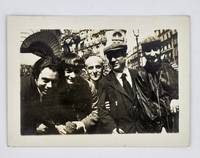
191678127Paris 1916. Fine. Paris 12 août 1916 6.30 x 8.60 cm une feuille Original photograph likely unique taken by Jean Cocteau showing Pablo Picasso and Co in Montparnasse in front of the café La Rotonde the 12 August 1916 Paris 12 august 1916 63 x 86 cm one photograph Original photograph by Jean Cocteau taken on 12 August 1916 showing Manuel Ortiz de Zárate Moïse Kisling Max Jacob Pablo Picasso and the model Pâquerette his girlfriend at the time posing in front of the famous café La Rotonde on Boulevard du Montparnasse in Paris. Contemporary silver print probably unique from Jean Cocteau's personal archives then the Maurice Sachs collection. This image was published in Billy Klüver's book entitled A day with Picasso: twenty-four photographs by Jean Cocteau 1997. However Klüver states that he didn't know the original photograph and used a modern reprint from the negative in the Cocteau archives for his work. We have not found any other copy of our original photograph in international public collections. Billy Klüver has assembled and commented on the twenty-one photographs taken by Jean Cocteau on 12 August 1916 in Montparnasse close to this intersection of the Boulevard Raspail and the Boulevard du Montparnasse which was named Place Pablo-Picasso in 1994. They take us to the café La Rotonde before which a beaming Picasso in a cap speaks with Max Jacob whose baldness shines in the sun behind them Henri-Pierre Roché in uniform and Manuel Ortiz de Zarate sit at a table on the terrace of the same café where Pablo is next to the glowing Pâquerette and the young Polish painter Moïse Kisling. Pâquerette with her hair in a headband a chic dress is the queen of the encounter. . It's the relaxed life at the back. Pâquerette or rather Émilienne Pâquerette Geslot was then a star model of the fashion designer Poiret who was all the rage at the time. A real one-day film of Picasso outside of his studio. Pierre Daix Picasso In his book Klüver questions the presence of all these artistic authorities in the making in a Paris that is deserted by war. The answer is according to him to search in the direction of the Salon d'Antin an exhibition organized by André Salmon in July 1916 in which all the protagonists of our photograph took part with the exception of Pâquerette. It is also on this occasion that Picasso reveals his Demoiselles d'Avignon to the public. This extremely rare image taken by Jean Cocteau with his mother's Kodak camera immortalizes a moment of joy that depicts the artistic all-Montparnasse of the early 20th century. Provenance: Jean Cocteau's personal archives then the Maurice Sachs collection and Max-Philippe Delatte. unknown
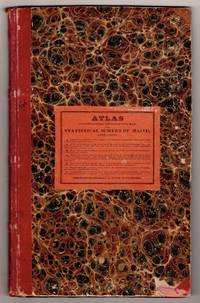
7874Portland: Shirley & Hyde 1829. 4to original half calf and marbled paper over boards original paper title label affixed to upper cover. 6 folding hand-colored engraved maps one folding diagram. Bookplate of “Gary Woolson†at top of front paste-down. CONDITION: Very good covers rubbed occasional separations along map folds expertly reinforced on verso with Japanese tissue occasional minor stains but generally clean throughout. <p>First and only edition of the first atlas of the state of Maine. </p> <br /> <p>Moses Greenleaf 1777–1834 is renowned as Maine’s first map-maker. His maps appeared between 1815 and 1846 and neatly coincide with the period covering Maine’s achievement of statehood 1820 to the final resolution of its present day boundaries and are thoroughly bound up with the formative stages of state’s identity. His atlas published in conjunction with his second expanded wall map of the state as well as a valuable statistical survey is important both as the first atlas of the state and as the third published atlas of an individual state being preceded only by Robert Mills’s Atlas of the State of South Carolina 1825 and David Burr’s Atlas of the State of New York 1829. </p> <br /> <p>“Greenleaf’s atlas is especially important because it’s much more than just a compilation of geographical maps. Greenleaf was an ardent supporter of Maine’s claim in the Northeastern Boundary Controversy with Great Britain and the first four maps in the atlas relate to this issue. These are the only maps concerning the dispute to be published in Maine before John Deane’s maps of 1840 and 1842.â€â€”Thompson.</p> <br /> <p>The maps and diagrams included in order of their appearance are: </p> <br /> <p>1. Map of the Principal Rivers Mountains and Highland Ranges of the State of Maine </p> <br /> <p>2. Sketch From Bouchette’s Maps of Upper and Lower Canada and the District of Gaspe Exhibiting the True Range of Highlands Dividing the Waters of the St. Lawrence & the Atlantic and the Imaginary Ranges claimed by the British for the Boundary of the State of Maine </p> <br /> <p>3. Sketch of the Imaginary Ranges of Highlands Reported by the British Surveyors Under the Treaty of Ghent </p> <br /> <p>4. Vertical Sections Exhibiting the Comparative Altitudes of the Principal Highlands and Rivers of the State of Maine </p> <br /> <p>5. Map Exhibiting the Principal Original Grants & Sales of lands in the State of Maine </p> <br /> <p>6. Map of the Inhabited part of the State of Maine Exhibiting the Progress of its Settlement Since the Year 1778… </p> <br /> <p>7. Meteorological Diagrams. Monthly Means & Extremes of Temperature at Brunswick & Williamsburgh in the State Of Maine. </p> <br /> <p>A very appealing example of this scarce and important state atlas.</p> <br /> <p>REFERENCES: Williamson 3918; Thompson Important Maine Maps Books 118; Thompson Printed Maps of the District and State of Maine 30; Smith 58–63; MacDougall 4. </p> Portland: Shirley & Hyde, 1829 unknown
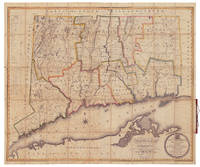
3387Hartford: Published under the Authority of The General Assembly By Hudson & Goodwin 1812 or 1813. Engraved By Abner Reed E. Windsor. Hand-colored engraving 36.5" x 44.25" plus margins dissected and mounted on linen folding into original 8vo covers half red leather and marbled paper boards gilt title "Connecticut" and gilt rules at spine. CONDITION: Good spotting mainly in the lower left quadrant which seems to be endemic to case map examples as evident in copies at Harvard and the Library of Congress which can be viewed online. <p>The first state of this scarce important and very fine map of Connecticut offered here in desirable case map form with beautiful original color.</p> <p>This large and impressive map depicts the entire state of Connecticut as well as narrow portions of adjacent states the whole of Long Island Sound and part of Long Island. A circular cartouche incorporating the Connecticut coat-of-arms appears in the lower right corner along with a fine calligraphic dedication to Governor Roger Griswold. A handsome compass rose with a fleur-de-lis directional is situated in Long Island Sound near New Haven. A key in the upper left margin identifies some thirty-five points of interest including churches academies court houses gun & pistol factories paper mills distilleries glass works ore beds light houses etc. The last item listed is "Humphrysville - The first extensive successful woolen mill in the country." According to Thompson there is an apparently later state of the map in which this note had been transferred to the site of present day Seymour. Also noted by Thompson are the turnpike roads a recent development and apparently the first to appear on an American map.</p> <p>Warren & Gillett undertook the first survey of the state since William Blodget's map of 1792 carrying out much of the field work themselves but also as Ristow points out likely incorporating manuscript maps from local surveyors as well as other locally provided data. "Though the publication of this map was a private venture the survey had an official sanction. At the May session 1811 of the Connecticut legislature a resolution was passed authorizing Hudson & Goodwin 'at their own expense to prepare and publish from actual survey a map of this state and for that purpose the petitioners are authorised.to pass over the land of individuals in the state.and empowered to examine the records of the state'" Thompson. As the authoritative map of the state the Warren & Gillet map served as the prototype for other maps of Connecticut into the 1840s.</p> <p>Although cataloged by Thompson and others as 1812 the date of publication of this map is somewhat unclear. The inscription to Governor Griswold reads in part "Respectfully Inscribed By the Publishers. Hartford February 1812" but the copyright date is 1813. Also the last governor listed is John Cotton Smith who succeeded Griswold in 1813.</p> <p>Moses Warren 1762-1835 was born in Hopkinton Rhode Island but soon moved with his family to East Lyme Connecticut. He served as a sergeant in the Revolutionary War and surveyed the Western Reserve in 1796. Warren's partner George Gillet 1771-1853 was born in Hebron Connecticut. He was appointed surveyor general of Connecticut following publication of this map.</p> <p>A splendid early map of Connecticut.</p> <p>REFERENCES: Thompson Maps of Connecticut 52; Ristow American Maps & Mapmakers pp. 96-98.</p> Hartford: Published under the Authority of The General Assembly, By Hudson & Goodwin, 1812 [or 1813]. Engraved By Abner Reed, E. unknown
191678127Paris 12 août 1916 | 6.30 x 8.60 cm | une feuille
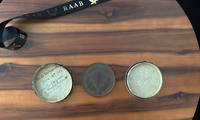
15093366415/09/1866. <blockquote><p>Acquired from the direct descendants of the commander of the vessel that received the medal in Russia it was not known to have survived and has never before been offered for sale</p></blockquote><p>Emperor Alexander II issued the Emancipation Manifesto on March 3 1861 which granted freedom to over 23 million serfs. This reform is known as the Emancipation Edict. The Emancipation Proclamation was issued by President Abraham Lincoln on January 1 1863. It declared that all persons held as slaves within the rebellious Confederate states ""are and henceforward shall be free."" The Union victory in the Civil War finalized in 1865 ensured this would become the law of the land.</p><p>Lincoln and Alexander had something else in common. Lincoln was assassinated in April 1865 by John Wilkes Booth in an act of political violence. The attempted assassination of Alexander II in 1866 was a failed act of political violence by Dmitry Karakozov a young revolutionary. Karakozov's aim was to kill the Tsar and spark a revolution believing the Emperor had betrayed the people's expectations after his emancipation of serfs in 1861. Another attempt around 20 years later would be successful.</p><p>In 1866 President Andrew Johnson sent Assistant Secretary of the Navy Gustavus Vasa Fox who had played a leading role in the expedition to relieve Fort Sumter in April 1861 on a mission to Russia primarily to deliver a resolution from Congress congratulating Emperor Alexander II on his survival of the assassination attempt. The mission also aimed to gather information on European naval capabilities and explore potential trade opportunities including the sale of the ironclad monitor USS Miantonomoh. The mission was a major event marking a high point in Russian-American friendship and was met with grand receptions in St. Petersburg and Moscow.</p><p>In the process Johnson sent the ironclad Miantonomoh itself on a world tour with the destination of Russia - first across the Atlantic and through the North Sea the Baltic and then through the Mediterranean in 1866 and 1867. The commander of this vessel was Moses Stuyvesant graduate of the Naval Academy and hero of the Civil War. He had been on two sunk vessels including one taken down by a Confederate Ironclad.</p><p>But the mission had two messages: to congratulate Russia on the freeing of the serfs and the Tsar on surviving the assassination attempt. The resolution read: “JOINT RESOLUTION relative to the attempted assassination of the Emperor of Russia.</p><p>“Be it resolved by the Senate and House of Representatives of the United States of America in Congress assembled That the Congress of the United States of America has learned with deep regret of the attempt made upon the life of the Emperor of Russia by an enemy of emancipation. The Congress sends greeting to his Imperial Majesty and to the Russian nation and congratulates the twenty millions of serfs upon the providential escape from danger of the sovereign to whose head and heart they owe the blessings of their freedom.</p><p>“Sec. 2. And be it further resolved That the President of the United States be requested to forward a copy of this resolution to the Emperor of Russia.</p><p>“Approved May 16 1866.â€</p><p>In mid Summer the Miantonomoh arrived in the harbor of Cronstadt on the 17th of August and the Tsar sent an address acknowledging the visit of Mr Fox. On Saturday September 15 the fleet went to push off from Russia. Mr. Fox left Petersburg after a farewell breakfast given on Russian yacht Rurik at which the Russian Lieutenant Greig presented the Americans with a symbol of their newly instituted freedoms from slavery in both countries: a medal struck in memory of the enfranchisement of the serfs in Russia. Grieg said ""The friendship of the two nations. among the causes to which is due this mutual spirit is the great event emancipation which has been accomplished almost simultaneously in the two countries - there by a sanguinary struggle here by the path of peace."" He then presents the ""medal struck in memory of the enfranchisement of the peasants.He will see on it the likeness of our sovereign and the effigy of a nobleman and of peasant.""</p><p>This is that very <strong>medal</strong> given by the Russians to the Americans to commemorate the freedom of their former slaves presented to the Americans depicting the scene of Alexander II on one side as Grieg says in a case on the inside of which Stuyvesant as commander of the expedition has signed his name and dated it September 15 1866 the day of the presentation of the medal and Grieg's speech and written <em>""From the Emperor of Russia Alex III""</em> instead of II. The bronze medal reads: <em>""FEBRUARY 19 1861 Cut to N. Kozin from the model of count F. Tolstoy. Engraver: Nikolai Kozin""</em> It is not known how many were made. A small number have reached the market but none akin to this: with the important symbolism of a state gift congratulating a nation on emancipation.</p><p>This was a gift of one slave-freeing nation to another in the immediate aftermath of those actions. This medal was not known to have survived and comes from the direct descendants of Stuyvesant who received it September 5 1866.</p><p><img class=""alignnone wp-image-25018 size-post-window"" src=""https://cdn.raabcollection.com/wp-content/uploads/20231204144051/Folder-site-11-1600x1327.jpg"" alt="""" width=""1600"" height=""1327"" /></p> unknown
52511New York City 1808. Fine. Folio 16 by 10 in. - lightly folded once horizontally and twice vertically. 4pp; approx. 1000 words of text on first three pages with address at final page; ruled in light brown ink. A few oxidation spots small tear along central fold at final page above dress no loss of text else clean and fine written in a strong neat hand.<br /> <br /> Dated November 2 1808 New York City: Moses Gomez 1744/45-1826 son of Rebecca Gomez née De Lucena; the second wife of Mordecai Gomez and a manufacturer of chocolate here acknowledges receipt of $1852.17 from the executors of his mother's estate thereby releasing any additional claim on the estate. This payment was prompted by the death two months earlier of Moses' brother Abraham the eldest living son of Rebecca. The proceeds from the sale of her Nassau property are to be equally divided with Moses' half-sister Rachel Waage the daughter of Mordecai Gomez by his first wife. Moses Gomez refers to the death of his widowed mother Rebecca who in her lifetime had published a last will and testament dated July 21 1798 and died in 1801. In her will she appointed her grandsons Abraham Gomez Jr. and Herman Henricks and friend attorney Henry Kermit executors. Her property on Nassau Street was to be divided among her heirs. Moses Gomez states that according to Rebecca's will during the lifetime of her eldest son Abraham the Nassau property should be leased out from year to year with the monies going to his support and ultimately to pay his funeral expenses. Upon his death the house was be sold. One of the executors of Rebecca's estate Herman Harmon Henricks 1771-1838 was Moses' nephew the son of his sister Eve and was a prominent member of the Henricks copper mining family.<br /> <br /> Signatures: Moses Gomez twice the second after a brief addendum; Witnesses: John Severidge jun.; Daniel Mack jun. for the addendum. J.R. Rosenbloom A Biographical Dictionary of Early American Jews Univ. Kentucky 1960 p.46; cf. L. Hershkowitz Wills of Early New York Jews pp. 84-91 the will of Mordecai Gomez. unknown
048-Ao.J. Folge von 5 Blatt Kupferstichen, 1606, auf Bütten, Blatt 3 mit Wasserzeichen: Lilienwappen und anhängendem HP (ligiert). Je ca. 26,1:36,6 cm. Literatur: Bartsch 2-6; Wurzbach 2-6 ; Hollstein 30, III (von III): mit Saenredams Adresse. Schöne kontrastreiche Drucke, meist knapp auf die Einfassungslinie geschnitten oder mit winzigem Rändchen um diese. - Kleine Fehlstellen und Einrisse sorgfältig restauriert, vertikale Falten geglättet.
151831810Augsburg: S. Grimm and M. Wirsung 1518. Hardcover. Very good. Five parts small quarto 19.5 by 14 cm: a-d4 = 16 leaves. 32 pp. Text in Latin. Title within elaborate woodcut borders; woodcut initials. Modern marbled boards. Lightly toned with occasional faint smudges mostly marginal. Three discreet worm holes 1mm and less throughout sometimes obscuring a letter else a very good copy with crisp text.<br /> <br /> Early printing of the first Latin edition of Maimonides' Fi Tadbir al-Sihha On the Regimen of Health. Like his other medical and philosophical works it was composed in Arabic. The present translation however was likely based upon the 13th-century Hebrew version Sefer Hanhagat ha-Bri'ut attributed to Moses ibn Tibbon. The editio princeps first printed edition of this Latin version appeared at the monastic press of Sanctum Jacobum de Ripoli in Florence under the direction of Fra Domenico da Pistoia in an undated edition sometime between 1477 and 1481. In 1501 it appeared at Pavia as an appendix to a general treatise on the medical arts the Tabula Consiliorum of Giovanni Matteo Ferrari court physician to Francesco Sforza. The later editions of the Tabula which appeared at Venice in 1514 and again at Pavia in 1517 also include this Latin version of On the Regimen of Health. The present edition thus appears to be the first separate printing of this Latin translation to appear after the rare Florentine incunable.<br /> <br /> A philosopher physician rabbinic authority and codifier of Jewish law Maimonides Moses ben Maimon the Rambam; 1135 or 1138-1204 was the most illustrious Jewish scholar of the post-talmudic era. At the age of thirteen he and his family fled Cordoba to escape the Almohad persecutions and later settled in Fustat an ancient district of Cairo. "It was here that Maimonides started to practice and teach medicine. and became the physician of al-Qadi al-Fadil the famous counsellor and secretary to Saladin" Bos.<br /> <br /> On the Regimen of Health was composed at an unknown date for al-Malik al-Afdal Nur al-Din Ali ca.1169-1225 Saladin's eldest son. He was appointed by his father as governor of Damascus while still a youth and ascended to the throne as Sultan of the Ayyubid Empire in the winter of 1198/1199. Maimonides later served him in that capacity as court physician. In the Latin version of On the Regimen of Health al Malik al-Afdal is described as The Great Sultan of Babylon Magnifico Soldano Babylonie. In his preface Maimonides describes his work as divided into four tracts the first and last providing general medical advice suitable for all persons. The second treatise provides a regimen for the sick who are unable to consult a physician. The third is specifically intended for the Sultan who has informed Maimonides about his medical complaints -- constipation indigestion and depression -- through his emissary per suum nuncium significavit. There is a fifth part not mentioned in the preface which appears in the Florentine editio princeps as well in which Maimonides criticizes the treatment of the Sultan by other physicians.<br /> <br /> The "regimen of health" tadbir al-sihha genre has a long history in Islamic medical literature. Rooted in ancient Greek medical theory it was reinforced with the ritualistic hygiene of the Qur'an and the later Hadith traditions. "Maimonides teaches that physical convalescence is dependent on psychological well-being and rest. He stresses the necessity of hygienic conditions in the care of the body physical exercise and proper breathing work family sexual life and diet and suggests that music poetry paintings and walks in pleasant surroundings all have a part to play toward a happy person and the maintenance of good health" EJ.<br /> <br /> "On the Regimen of Health is frequently mentioned consulted and quoted in Hebrew literature; in the thirteenth century by Judah ben Samuel ibn Abbas and Shem Tov ibn Falaquera; in the fourteenth century by Israel ben Joseph Caslari Joseph ben Abba Mari ibn Kaspi Menahem ben Aaron ibn Zerah and Meir Aldabi. The physician Tobias ben Moses Cohn 1652-1729 quotes from Maimonides' On the Regimen of Health in his MaÊ¿aseh Tuviyyah which was 'the most influential Hebrew textbook of the sciences especially medicine'" Bos.<br /> <br /> Provenance: early 20th-century bookplate of Jan Kok at front pastedown. References: G. Bos Maimonides On the Regimen of Health: A New Parallel Arabic-English Translation Brill 2019 preface and intro; Durling NLM 16th 3304; Enc. Jud. 1st ed. 11: 779; Fürst vol. 2 p. 314; Proctor German 1501-1520 10875; Steinschneider 6513.145; VD16 M6423 providing imprint information: Sigmund Grimm and Marx Wirsung. For the first printed edition see British Museum 15th Century part VI Florence p. 623 IA. 27063; Hain 10525.<br /> <br /> Full title and imprint: Tractatus Rabbi Moysi de regimine sanitatis ad Soldanum Regem from colophon: Augustae Vindelicorum. Anno virginei partus. M.D.XVIII. die. ix Iulii.<br /> <br /> Opening line of text: Tractatus Rabbi Moysi quem domino et Magnifico Soldano Babilonie transmisit.<br /> <br /> Uniform titles: ספר ×”× ×”×’×ª הברי×ות Sefer Hanhagat ha-Bri'ut / FÄ« tadbÄ«r al-á¹£iḥḥah. S. Grimm and M. Wirsung hardcover
037-Ao.J. Kupferstich, auf Bütten mit Fragment eines nicht identifizierbaren Wasserzeichens. 21,7:17,9 cm. Literatur: Bartsch: Catalogue raisonné de toutes les Estampes, qui forment l'?uvre de Rembrandt, et ceux de ses principaux Imitateurs.... Bd. II, Nr. 74 (dort als Radierung im Geschmack Rembrandts); Nagler, Monogrammisten IV, 1253, Nr. 1; Hollstein 1, II. - Mit winzigem Rändchen um die Plattenkante und wenigen schwachen Stockfleckchen. Kleiner Einriß im Oberrand restauriert, im rechten Rand leicht wellig.
81390Berlin Christian Friedrich Voss beides 1755. Kl.8° 1 Bl. Titelvignette 108 S.; Titelvignette 210 S. Paginierungssprung von Seite 143 auf 145 3 Bl. HPerg. d. Zeit Berieben mit handschriftlichem verblasstem Schild a. Rücken. Auf Vorsatz Bibliothekskleber Bibliotheksstempel Bibliothek des Rabbiner-Seminars Berlin a. Titelblatt verso. Etwas angeschmutzt u. fingerfleckig min. wasserrändig u. stockfleckig. Der Band umfasst die ersten beiden Schriften des jüdisch-deutschen Philosophen. «Philosophische Gespräche» Goed. IV/1 488 6. Meyer Mendelssohn 112; «Ueber die Empfindungen» Goed. IV/1 487 1. Meyer Mendelssohn 79Auf dem Vorsatz zwei hübsche Marginalien von alter Hand: «Der Verfasser Herr Moses solle ein gelehrter Jude und Buchhalter bey einem jüdischen Kaufmann in Berlin seyn.»Und von anderer Hand: «Zustehende Bücher sind von Herrn Moses Mendelssohn.»«Ueber die Empfindungen» Erste Ausgabe der zweiten Veröffentlichung Mendelssohns ein theoretisches Hauptwerk zur Ästhetik der Aufklärungsepoche. Bekannt geworden ist vor allem die ausführliche Diskussion des Selbstmordes und die Problematik seiner theatralischen Inszenierung auf der "Schaubühne". - Moses Mendelssohn 1729 in Dessau; gestorben 1786 in Berlin deutscher Philosoph der Aufklärung und gilt als Wegbereiter der jüdischen Aufklärung - Haskala. 010 Berlin, Christian Friedrich Voss, beides 1755 unknown
486-Eo.J. Feder in Schwarz, mit reicher Deckweißhöhung, auf braunem festem Papier, rechts unten Nachlaßstempel (nicht bei Lugt). 39,7:46,6 cm. - Mehrere kleinere Einrissen in den Rändern sorgfältig restauriert. Das alttestamentarische Motiv der Auffindung des Mosesknaben gehört zu den Wandmalereien, die Raffael für die Loggien im Vatikan ausgeführt hat. Sie wurden von zahlreichen Künstlern durch die Jahrhunderte kopiert.
1971C129893Jean Kisling. As New. 1971. Hardcover. - IN STOCK AND IMMEDIATELY AVAILABLE FOR SHIPMENT - AS NEW THE TEXT BLOCK IS PRISTINE CLEAN UNMARKED AND IN EXCELLENT CONDITION - - .Catalogue Raisonné Catalogue Raisonne Catalog Raisonnee Complete Works -- with a bonus offer-- - May be EITHER: out of print OOP and extremely rare in this pristine condition; signed by author or contributor; or a first or special edition; inquire for details . Jean Kisling hardcover
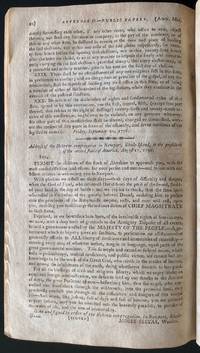
179143202Philadelphia: Mathew Carey; Carey Stewart and Co. No. 188 Market-street 1791. Original Sewn Binding without outer wrappers or boards 8vo pages 285-344 1-48 1-40 1-48 total 196 pages with different sections correctly paginated for this issue.<br> With Moses Seixas’ famous letter to President George Washington<br> Seixas wrote to President Washington on behalf of the Newport congregation whose home is the Touro Synagogue the oldest synagogue still standing in America. This letter which appears on p 40 of Appendix II and Washington's reply comprise one of the most famous statements on religious freedom of this period. <br> Here published in America’s first literary magazine George Washington’s famous phrase describing a government that "gives to bigotry no sanction and to persecution no assistance" was originally coined by Seixas in this very letter. It is a moving Biblically toned greeting to the president and was repeated by Washington in his reply assuring it a place among the most cherished in the American historical vocabulary.<br> George Washington's visit to Newport Rhode Island August 17-18 1790 ranks among the seminal episodes in the history of American Jewish religious liberty. Washington left Rhode Island off his travel itinerary the previous year in response to the state's failure to ratify the Constitution. By 1790 after becoming the last state to ratify Washington visited Newport along with members of his administration including Thomas Jefferson. <br> Moses Seixas 1744-1809 a Newport merchant warden of Kaal Kadosh Yeshuat Israel Newport Hebrew Congregation and a prominent Mason was one of the civic leaders who met with Washington. Seixas had a long history as a revolutionary patriot: he remained in the city after it was occupied by the British during the war and signed a document during the occupation pledging loyalty to the patriotic cause. <br> Additionally his brother Rabbi Gershon Mendes Seixas minister of New York's Shearith Israel Congregation known as the "patriot rabbi" was one of fourteen clerygymen officiating at Washington's 1789 Presidential inauguration. <br> Finally as a fellow Mason he and Washington would have had a natural connection. Seixas' eloquent message reads in part: <br> "Deprived as we heretofore have been of the invaluable rights of free Citizens we now with a deep sense of gratitude to the Almighty Disposer of all events behold a Government erected by the MAJESTY OF THE PEOPLE – a Government which to bigotry gives no sanction to persecution no assistance – but generously affording to ALL Liberty of conscience and immunities of Citizenship: – deeming every one of whatever Nation tongue or language equal parts of the great governmental Machine: – This so ample and extensive Federal Union whose basis is Philanthropy Mutual confidence and Public Virtue we cannot but acknowledge to be the work of the Great God who ruleth in the Armies of Heaven and among the Inhabitants of the Earth doing whatever seemeth him good." <br> Grounding religious freedom in natural rights and echoing Seixas' words Washington later replied with an echo of Seixas' language regarding religious freedom: <br> "The Citizens of the United States of America have a right to applaud themselves for having given to mankind examples of an enlarged and liberal policy: a policy worthy of imitation. All possess alike liberty of conscience and immunities of citizenship. It is now no more that toleration is spoken of as if it was by the indulgence of one class of people that another enjoyed the exercise of their inherent natural rights. For happily the Government of the United States which gives to bigotry no sanction to persecution no assistance requires only that they who live under its protection should demean themselves as good citizens in giving it on all occasions their effectual support."<br> See JE Vol. IX pp. 294-295; EJ. Vol. XIV p. 1117; J.L. Blau and S.W. Baron The Jews of the United States 1790-1840 A Documentary History Vol. 1 1963 pp. 8-10.<br> Other pieces of interest include notes on the slave trade by Benjamin Franklin and notes on the Revolutionary War. <br> “The American Museum or Repository of Ancient and Modern Fugutive Pieces &c. Prose and Poetical “title changed to “The American Museum or Universal Magazine†in January 1790 was America's first literary magazine featuring early printings of the US Constitution the Bill of Rights various State constitutions Alexander Hamilton's Report on Manufactures and parts of the Federalist Papers. <br> Complete issue in original sewn binding. Overall condition is very good with scattered darkening and foxing though paper and binding remain nice and strong with clean crisp edges including the notable page containing the address to Washington<br> A Cornerstone of American Judaica. BAMR-69-7A. Philadelphia: Mathew Carey; Carey, Stewart, and Co. No. 188 Market-street unknown
1782395221782 In-12 (162 x 95 mm), demi-basane brune à petits coins, dos lisse orné dune roulette dorée en place des nerfs, titre doré, tranches mouchetées (reliure de lépoque), xii, 255 pages, (2) feuillets derrata. Dessau, dans la librairie des auteurs et des artistes [colophon: à Hale, de l'Imprimerie de Chr. Gottl. Taeubel], 1782.
1782PHO-1140Dessau, Librairie des auteurs et des artistes, 1782, XII-255pp.-2ff, relié demi basane postérieure, dos à nerfs avec auteur, titre et date en pied.
197186513Abrams. As New. 1971. Hardcover. FREE UPGRADE to Courier/Priority Shipping Upon Request - IN STOCK AND IMMEDIATELY AVAILABLE FOR SHIPMENT - AS NEW THE TEXT BLOCK IS PRISTINE CLEAN UNMARKED AND IN EXCELLENT CONDITION - - 323 pages; 656 plates. Catalogue Raisonné Catalogue Raisonne Catalog Raisonnee Complete Works Abrams hardcover
19631371Les Heures Claires, Paris 1959-1963. 6 volumes in-folio (34 x 26 cm) en feuilles sous couvertures imprimées rempliées, chemises et étuis décorés de l'éditeur. 100 AQUARELLES ORIGINALES HORS-TEXTE DE SALVADOR DALI GRAVÉES SUR BOIS EN COULEURS par Raymond Jacquet. - Exemplaire : 1 des 3900 ex. numérotés sur pur chiffon de Rives filigrané. Les 6 ouvrages sont en excellent état et bien complets des 100 gravures et des 3 doubles-feuillets de justification numérotés. Les planches belles aux couleurs lumineuses. Les emboîtages sont en excellent état de conservation.
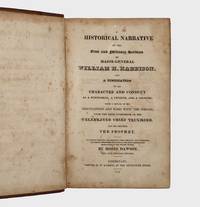
1824376921Cincinnati: Printed by M. Dawson at the Advertiser Office 1824. First edition first issue. viii4648pp. plus 15-line errata slip. 1 vols. 8vo. Contemporary sheep black morocco label. Foxing. First edition first issue. viii4648pp. plus 15-line errata slip. 1 vols. 8vo. A rare early biography of William Henry Harrison focussed on the border wars in the west. "Not only the principal authority on Harrison but also one of the most exhaustive and dependable sources on events of the War of 1812 in the western country Tecumseh's uprising etc." Howes.Thomas adds: "One of the most thorough complete and authentic treatises relating to the Border Wars of the West ever printed."<br /> <br /> Scarce on the market the present example includes the first state of the errata slip.<br /> <br /> "This is certainly one of the most thorough complete and authentic treatises relating to the Border Wars of the West ever printed. The fine portraiture of aboriginal character the narration of the minutest incidents of camp treaty and war and the style of simple candor adopted by a scholarly mind all commend the narrative to our judgment and attract our interest in its progress" Field. Field 407; Howes D158; Learned 1789; Rusk I p. 252; Sabin 18956; Thomson 312; Streeter sale 1333; Graff 1026 Printed by M. Dawson at the Advertiser Office unknown
6889Portland: Moses Greenleaf III 1843. J. H. Young & F. Dankworth Engravers Philadelphia. Hand-colored engraved four-sheet wall map mounted on original linen affixed to original black wooden rods. 50.25†x 40.75†plus margins. CONDITION: Very good silk selvage largely perished light rubbing a few minor stains; an attractive un-restored example with a pleasing golden tone. <p>The exceptionally rare third state of Moses Greenleaf's second map of Maine the stated “Second Edition†the first of his maps to show the recently resolved final boundary with Canada.</p> <br /> <p>The map shows the entire state of Maine as well as New Brunswick and a portion of Quebec and includes an inset map at lower right depicting Nova Scotia Prince Edward Island most of New Brunswick part of Cape Breton Island and the Gulf of St. Lawrence. The coastal portion of the state with its myriad islands and peninsulas is very carefully delineated as is the interior of the state with its multitude of lakes ponds streams and rivers. Thirteen counties are identified and the boundaries of all the organized towns as well the many unorganized townships in the northern part of the state are shown. </p> <br /> <p>The maps of Moses Greenleaf published between 1815 and 1846 coincide neatly with the period covering Maine’s achievement of statehood 1820 to the final resolution of its present day boundaries and are thoroughly bound up with the formative stages of the state’s identity. Greenleaf was an ardent supporter of Maine’s drive for statehood its claims in the Northeastern Boundary Controversy and the settlement of its interior regions. The two wall maps he produced served as instruments for achieving these ends providing far more accurate representations of Maine than were previously available. </p> <br /> <p>Following the success of his Map of the District of Maine published in 1815 and re-issued in 1820 the first of Maine as a state and again in 1822 Greenleaf compiled an improved and expanded map of the state including the aforementioned portions of Quebec and all of New Brunswick. It was accompanied by his Survey of the State of Maine and an atlas of the state. All three were published by Shirley & Hyde of Portland in 1829 although the map was engraved by Young and Dankworth of Philadelphia. </p> <br /> <p>The map was issued again in 1832 and then posthumously by Greenleaf’s son Moses Greenleaf III in the present stated second edition of 1843 with over 110 additions deletions and changes to the plate including the addition of three new counties Franklin Piscataquis and Aroostook which were “incorporated in 1838 1838 and 1839 respectively.†The most important change however is the addition of the new boundary with Canada as defined by the Webster-Ashburton Treaty of 1842. A significant error appears along the new boundary in the upper-left quadrant where a note reads “Boundary as fixed by the Treaty of 1843.†Apparently the engraver confused the date of publication with the date of the Treaty. Thompson suggests that it was probably due to this error that a “third edition†state IV with the date corrected was published so soon thereafter January of 1844. Also of particular interest is “the boundary shown for Aroostook County which is intermediate between the original boundary of 1839 and the final boundary of 1844…Originally Aroostook County was formed from the northern part of Washington County and the northeastern part of Penobscot County. In 1843 Aroostook County was enlarged with the addition of the remaining northern part of Penobscot County as shown here…Finally in 1844 Aroostook County was further enlarged with the addition of the northern parts of both Piscataquis and Somerset Counties†Thompson.</p> <br /> <p>State III is rare and it seems likely that copies were suppressed once the incorrect treaty date was discovered. Thompson locates only two examples at Maine Historical Society and the Osher Map Library. None are recorded in OCLC.</p> <br /> <p>A seldom-seen example of the first of Greenleaf’s maps to show the state in its final form.</p> <br /> <p>REFERENCES: Smith Edgar Crosby. Moses Greenleaf : Maine’s First Map-Maker p. 79; MacDougall Walter M. Settling the Maine Wilderness p. 127; Thompson Edward. Important Maine Maps Books Prints and Ephemera pp. 182–185; Thompson Edward. Printed Maps of the District and State of Maine 1793-1860 #34.</p> [Portland: Moses Greenleaf III], 1843. J. H. Young & F. Dankworth, Engravers, Philadelphia unknown
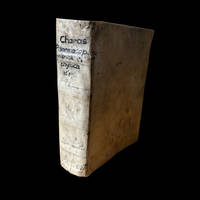
168352<p>Early Latin Edition of Charas' Pharmacopoea Regia</p><p>Charas Moses. Pharmacopoea Regia Galenica et Chymica. Books 1 and 2. Joannis Ludovici Du-Four. Geneve. 1683.</p><p>Collected pharmacopeia of noted French pharmacist Moses Charas 1618 – 98 who worked at the Jardin Royal du Plantes Medicinal today's Jardin des Plantes when its original purpose was to supply the medical needs of the French royal family. A protestant Charas ended up in England by way of the Netherlands and served as Royal Pharmacist to King Charles II. Eventually converting to Catholicism to escape persecution in Spain Charas was appointed as a member of the Royal Academy of Science in 1692 following his return to France in recognition of the importance of his pharmacological formulations.</p><p>An interesting figure in the history of science and medicine Charas' recipes include instructions for alchemically derived elixirs including laudanum with attention to the astrological rulerships as well as the possible extractions of useful substances from plants animals and minerals as well as human blood and urine.</p><p>Originally published in French in 1672 with a second edition in 1682 this early Latin edition predates the collected complete works of Charas also published by Du-Four in 1684. It contains numerous misprints such as numbering many pages in the 400s of Book I as in the 300s and repeating the numbering for pg 200 as 199 in Book 2. Also the final five plates depicting and explaining various distillation apparatuses are printed in the wrong order.</p><p>The last auction sale of this edition was through Sotheby-Parke-Bernet in 1980 per RBH.</p><p>12 copies OCLC as of March 2025.</p><p>4 496 404 28 index 5 plates. Vellum bound. Front board bowed. Back board vellum repaired peeling at spine. Some soiling and toning to boards. Title inked to spine. Text block dyed. Pages toned. Top fore corner of title pg missing with text unaffected. Some wear to edges. Includes five illustrated plates of distillation apparatuses. Good.</p><p>$4500</p> Joannis Ludovici Du-Four hardcover
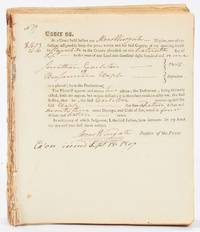
1810413795Haverhill Massachusetts 1810. Softcover. Near Fine. Partially printed letterpress documents. 154 documents p. 5 28-177 all but the first five documents are hand-numbered by Wingate. Each document is filled out in the hand of Moses Wingate in his capacity as Justice of the Peace of Haverhill. Formerly bound with sewing and glue marks along the spine otherwise the documents themselves are mostly near fine or better with a few of them exhibiting small chips or tears. Each document contains the names of the adversaries and usually the decision by default which is filled out and Signed by Moses Wingate. A few have extensive notes on the verso but most are straightforward defaults. We suspect most of the plaintiffs were businessmen or shopkeepers and most of the defendants were defaulters on small accounts.<br /> <br /> Wingate born in 1769 was a distinguished resident of Haverhill in Essex County near the New Hampshire border who lived to more than 100 dying in 1870 and who cast a vote in every presidential election from Washington to Grant. He was at various times a member of the Massachusetts State House of Representatives and Senate and Justice of the Peace of Haverhill for nearly half a century.<br /> <br /> Among the plaintiffs here represented is publisher and printer Daniel Appleton founder of the important publisher D. Appleton and Company; as well as members of the locally prominent Carlton Minot Emerson Ingersoll and Whittier families John Greenleaf Whittier was born in Haverhill in 1807; at least three different Whittiers are named here presumably relatives.<br /> <br /> An interesting historical insight into business and justice in the early days of the Republic. unknown
#[61010]Austrian Empire Vienna d.d. 10 November 1867. Full purple velvet decorated with the gilt coat-of-arms of the Emperor on the front cover 38x18 cm. 7 pages. Handwritten caligraphic text on vellum and gold embossed lavishly decorated printed margins. With a hand painted coat-of-arms in colour and the original signature of Franz Joseph I. The imperial wax seal is attached by the gold binding rope in a disc shaped copper case. Seal in mint condition. Charter and wax seal are encased in a large flat contemporary metal box. All in excellent condition. The patent explains that Moise started his military career in 1836 with the 17th Infantry Regiment. He became "unter-lieutenant " in the 4th "Grenz-Infanterie-Regimente" in 1843 he became "ober-lieutenant" in 1848 and was transferred to the 11nd Infantry-Regiment. In 1849 he was appointed "hauptmann" and in 1859 to Major with the 16th Infantry Regiment and in 1865 he finally became "oberst-lieutenant". In 1848 he was active at the Commando of the Operations Corps at Pfonzo later at the 3rd Army Corps Commando as adjudant. He participated in the move of the Corps from Roveredo to Verona. He proved his worth when he lead the attack against the height of Val Fredda and in battles around Rivoli. For these activities and his service for the headquarters of the Reserve-Corps in Hungary he recieved the "Militär-Verdienstkreuz mit der Kriegsdekoration". He furthermore served as General-Commando-Adjudant in Graz as Gouvernements-Adjudant in Triest and finally as part of the ministry of war where he was active in the war year of 1866 in which year the Austrian-Prussian war Seven Weeks war took place. H164 hardcover