774 résultats
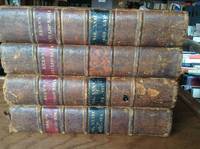
18345037<p>Half brown morocco; ruled raised bands marbled boards. Mouradgea d'Ohsson was a Swedish historian and diplomat of Armenian descent. This important work is a large expansion of his 1824 publication which was the first serious study of Genghis Khan. Kenneth Meyer Setton A History of the Crusades notes "among the general histories of the Mongols d'Ohsson remains unequaled. Avowedly or tacitly most later works rely on it." Two folding genealogical charts; large 1824 folding map of Asia in the thirteenth century to rear of volume four. Previous owner's bookplates removed from front pastedowns. A nice wide-margined set many pages yet uncut in a sound period binding.; lxviii452; 651; 6241; 774.; 8vo 22 x 15 cm; All shipments through USPS insured Priority Mail.</p> Freres van Cleff hardcover
18345037Half brown morocco; ruled raised bands marbled boards. Mouradgea d'Ohsson was a Swedish historian and diplomat of Armenian descent. This important work is a large expansion of his 1824 publication which was the first serious study of Genghis Khan. Kenneth Meyer Setton A History of the Crusades notes "among the general histories of the Mongols d'Ohsson remains unequaled. Avowedly or tacitly most later works rely on it." Two folding genealogical charts; large 1824 folding map of Asia in the thirteenth century to rear of volume four. Previous owner's bookplates removed from front pastedowns. A nice wide-margined set many pages yet uncut in a sound period binding.; lxviii452; 651; 6241; 774.; 8vo 22 x 15 cm; All shipments through USPS insured Priority Mail. Freres van Cleff hardcover books
186425614<p>The second in a series of four racist political cartoons published in 1864 by Bromley & Company which was closely affiliated with the Copperhead New York <i>World</i> newspaper. These prints sought to undermine Abraham Lincoln's chances for reelection by branding him as a "miscegenationist" and playing on white fears of "race-mixing." The cartoon scene pictures several interracial couples enjoying a day at the park eating ice cream discussing wedding plans and a woman's upcoming lecture. Two African American families have white employees a carriage driver and footmen and a babysitter.</p><p>The only other example traced at auction brought $7800 in 2010.</p> <b>ABRAHAM LINCOLN. RACISM.</b>Print. "Miscegenation or the Millennium of Abolitionism." Political Cartoon. New York: Bromley & Co. 1864. 1 p. 20¾ x 13â… in.<p><br /></p><p>American politics had long played on fears of sexual relationships between races. A powerful new word for "race-mixing" was coined in an anonymous December 1863 pamphlet entitled <i>Miscegenation: The Theory of the Blending of the Races Applied to the American White Man and Negro</i> published in New York. Purporting to advocate the virtues of the "blending of the white and black races on this continent" it was a literary forgery prepared by <i>The World</i> managing editor David Goodman Croly and reporter George Wakeman. The authors were unsuccessful in their attempt to trick President Lincoln into endorsing the work.</p><p>At the far left of the image Abraham Lincoln declares "<i>I shall be proud to number among my intimate friends any member of the Squash family especially the little Squashes.</i>" The African American woman to whom he is speaking replies "<i>I'se 'quainted wid Missus Linkum I is washed far her 'fore de hebenly Miscegenation times was cum. Dont do nuffin now but gallevant 'round wid de white gem'men! he-ah! he-ah! he-ah!</i>"</p><p>Senator Charles Sumner says "<i>Mr. President! Allow me the honor of introducing my very dear friend Miss Dinah Arabella Aramintha Squash.</i>" A white carriage driver complains in the background "<i>Gla-a-ang there 240t! White driver white footmen niggers inside my heys! I wanted a situation when I took this one</i>" while a black man in the carriage tells his companion "<i>Phillis de_ah dars Sumner. We must not cut him if he is walking.</i>" A black woman at a table tells a white man with her "<i>Ah! Horace its-its-its-bully 'specially de cream</i>" and he replies "<i>Ah! my dear Miss Snowball we have at last reached our political and social Paradise. Isn't it extatic</i>"</p><p>To the right are two couples embracing each a white woman and an African American man. The first white women tells her partner "<i>Oh! You dear creature. I am so agitated! Go and ask Pa</i>" to which he replies "<i>Lubly Julia Anna name de day when Brodder Beecher shall make us one!</i>" The second white woman says "<i>Adolphus now you'll be sure to come to my lecture to morrow night won't you</i>" to which he answers "<i>I'll be there Honey on de front seat sure!</i>" In the background are various immigrant minorities viewing the scene. One exclaims "<i>Most hextwadinary! Aw neva witnessed the like in all me life if I did dem me!</i>" and another adds "<i>Mine Got vat a guntry vat a beebles!</i>" An Irish girl complains "<i>And is it to drag nagur babies that I left old Ireland Bad luck to me.</i>"</p><p>Manton Marble the editor of <i>The World</i> collaborated with printmaker Bromley & Company to issue a series of four anti-Lincoln "Political Caricatures." The present example was the No. 2 in that series. No. 1 was "The Grave of the Union or Major Jack Downing's Dream"; No. 3 "The Abolition Catastrophe Or the November Smash-up"; and No. 4 "The Miscegenation Ball."</p><p>Republicans responded by trying to turn the "miscegenation" charge against the Democrats. A Republican print "The Political "Siamese" Twins: The Offspring of Chicago Miscegenation" pictures McClellan and Pendleton joined together despite their very different ideas on ending the war.</p><p>Although Abraham Lincoln won New York states' electoral votes in 1860 Stephen Douglas had carried New York City and its environs. Financial elites fearing that civil war would ruin business and recent immigrants fearing competition with free black labor supported Douglas. Lincoln's unpopularity in New York City during the Civil War was a factor in the deadly 1863 Draft Riots.</p><p>In 1864 Lincoln again won the states' electoral votes while New York City favored his Democratic opponent McClellan. In fact Lincoln's majority dropped from 50136 votes in 1860 to only 7373 votes in 1864 with approximately 50000 more total votes cast than in 1860.</p><p>Bromley and Company continued to sell the caricatures after the election as this January 1865 advertisement from an Ohio newspaper makes clear. Another advertisement assured purchasers that the set of four prints available for $1 were "sent on wooden rollers to insure safe carriage."</p><p><b><i>The World</i></b> 1860-1931 a daily independent newspaper was published in New York City. Alexander Cummings founded it as a religious Republican outlet in 1860. August Belmont and others purchased it in 1862 changing the editorial focus. With editor Manton Marble 1834-1917 <i>The World</i> soon became the country's leading Democratic newspaper. In 1864 Union authorities shut down <i>The World</i>and another paper for three days after they published forged documents purportedly written by Lincoln that were really part of a hoax to manipulate the price of gold. The paper actively supported George B. McClellan against Lincoln in 1864.</p><p><b>Condition</b></p><p>Fine for exhibit despite flaws. Cropped with loss of "Political Caricature No. 2" from top edge and part of printed pricing information from bottom edge publisher's name rubbed out from the copyright statement lacking ½" from lower left corners a few short tape repairs by the edges a 2" closed tear through the second dialogue bubble along the top edge and a 3" closed tear parallel to the right edge. Mount remnants on verso.</p> books
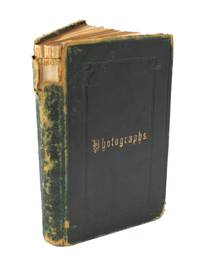
1864175101864. Abraham Lincoln and Civil War Figures Album of pasted oval portraits with signatures underneath each image. 1861. Features most notably Abraham Lincoln with a pasted signature below his image. This mid-nineteenth-century photographic album assembles oval portraits of political and military figures during the Civil War era including a pasted signature beneath an engraved portrait of Abraham Lincoln on the 15th page. Dated inscriptions from 1861 situate the compilation at the outset of national conflict. The inclusion of Lincoln Henry Clay and numerous uniformed figures reflects contemporary practices of collecting and memorializing political leadership through photographic reproduction and autograph acquisition.<br /> <br /> Photographic album measuring approximately 4.5 x 7 inches. Dark green morocco boards with gilt "Photographs" title. Contains 93 black-and-white and sepia portraits most approximately 2.5 x 2.25 inches mounted on pages. Lincoln portrait with separate pasted signature "A. Lincoln"; Henry Clay portrait with pasted signature; additional signatures written directly on album leaves. Spine chipped at head with separation; rubbing along margins; binding intact; photographs generally clear with minor age toning. Overall condition very good. he album reflects nineteenth-century commemorative culture preserving images and autographs of national figures during a transformative political moment. unknown
18602444New York: New York Tribune 1860. First edition. Original wrappers. Very Good. FIRST EDITION of Lincoln's historic Cooper Union Address delivered on February 27 1860 at the Cooper Institute in New York. The speech is largely credited to having launched Lincoln's Presidential bid. In the fall of 1859 James A. Briggs who served on the lecture committee of the Plymouth Church in Brooklyn invited presidential candidate hopeful Abraham Lincoln to speak to a New York audience on any subject of his choosing. Lincoln accepted the invitation choosing to speak of the current political climate in America. William O. Stoddard an Illinois journalist who worked for President Lincoln during his administration noted that "No previous effort of his life cost him so much hard work as did that Cooper Institute speech" and that the resulting speech "was a masterly review of the history of the slavery question from the foundation of the government with a clear bold statesmanlike presentation of the then present attitude of parties and of sections. It exhibited a careful research a thorough knowledge and understanding of political movements and developments that staggered even the most laborious and painstaking students. It showed a grasp a breadth a mental training and a depth of penetration which compelled the admiration of critical scholars" Stoddard Abraham Lincoln: The True Story of a Great Life. <br /> <br /> "Horace Greeley had rushed out the speech in pamphlet form as 'Tribune Tract' Number 4 under the headline: National Politics. Speech of Abraham Lincoln of Illinois Delivered at the Cooper Institute Monday Feb. 27 1860. The pamphlet was ready March 6 while Lincoln was still traveling through Connecticut. When he returned to New York he found it already available to the public. <br /> <br /> "Greeley marketed the eleven-page Tribune edition aggressively. As a bonus the publication included Wisconsin Republican senator James Doolittle's February 24 speech attaching 'the new doctrine of judicial infallibility' as did Lincoln's address at Cooper Union just three days later and also like Cooper Union railing agains 'the headstrong zeal pursued by the other party to force slavery into Territories'.<br /> <br /> "It was as if Republicans were now speaking with one voice: identifying with the founders attacking the Dred Scott decision rebuking John Brown and drawing their own 'dividing line' on slavery extension. Lincoln did not say it alone; but he said it best. 'Mr. Lincoln's is probably the most systematic and complete defense yet made of the Republican position with regard to Slavery' the Tribune declared in its initial advertisement for the reprints. 'We believe no speech has yet been made better calculated to win the intelligent minds over to our standard. Will the friends of the Cause everywhere aid us to circulate it'<br /> <br /> "The answer was yes. The Tribune Tract edition proved enormously popular going through at least five additional editions. Lincoln's New York oration was enjoying a new and sustained life in pamphlet form and was being purchased individually and in bulk alike by admirers and groups across the North.<br /> <br /> "The Cooper Union address tested whether Lincoln's appeal could extend from the podium to the page and from the rollicking campaigns of the rural West to the urban East. Cooper Union held the promise of transforming Lincoln from a regional phenomenon to a national figure. Lincoln knew it and rose to the occasion." Harold Holzer Lincoln at the Copper Union: The Speech That Made Abraham Lincoln President.<br /> <br /> New York: New York Tribune Tribune Tracts No. 4 1860. Octavo original wrappers; custom box. Lincoln's speech comprises pages 1-11 out of a total of 16 pages. With New York Tribune ads and subscription terms on rear wrapper. Only a spot of soiling in the bottom margin of the rear wrapper creeping lightly into preceding leaves. A beautiful copy in a remarkable state of preservation. RARE. New York Tribune unknown books
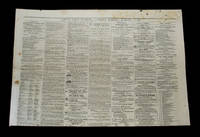
186369186Boston: Boston Daily Courier 1863. Full Description:<br> <br> LINCOLN Abraham. Emancipation Proclamation."President's Proclamation. Emancipation of Slaves in Rebellious States." Boston. Published in: Boston Daily Courier Volume LXXVIII no. 2. Friday Morning January 2 1863.<br> <br> The publication of Lincoln's Emancipation Proclamation in the Boston Daily Courier and one of if not the first official public announcements of the Final Emancipation Proclamation once it was signed and in effect as of January 1 1863. The Proclamation is featured at the top of the center column of page 3.<br> <br> We could find no other copies of this or any other January 2nd edition at auction and it is not mentioned in Eberstadt. Eberstadt's entry for the second edition of the "Final Proclamation" Eberstadt 9 states "Second edition. Apparently the only separate newspaper edition of the final proclamation and the earliest non-official edition. Printed on Friday evening January 2 1863 this Extra in point of chronological sequence was preceded only by the first official edition." Our present copy although not a separate newspaper edition was rushed to press and published in the Friday Morning edition of the Courier placing it's publication prior to Eberstadt 9.<br> <br> According to Eberstadt "A number of newspapers did not issue on January 2nd because of the previous day's holiday but most of those that did carried the final proclamation. Many of the others printed it on January 3rd." pg. 17.<br> <br> Broadsheet folio one large leaf folded along side to make four pages two leaves printed on recto and verso. Seven-column format. 26 x 19 inches; 655 x 490 mm. Light creases down the middle in both directions. A few minor closed tears. A large old ink signature along top margin of front page causing some bleed-through and foxing but not affecting text. Still a very good copy of this important declaration.<br> <br> Abraham Lincoln issued the preliminary Emancipation Proclamation on September 22 1862 stating that if the rebelling states did not cease fighting and rejoin the Union by January 1 1863 the slaves in those states would be set free. Once January 1st 1863 arrived President Lincoln signs and issues the final Emancipation Proclamation freeing the slaves in the Confederate states. The Boston Courier issued this early printing of Lincoln's Proclamation the very next morning January 2 1863. "<br> <br> HBS 69186.<br> <br> $8500. Boston Daily Courier unknown
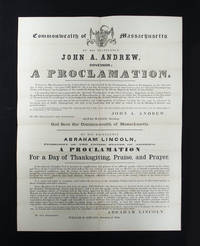
186368373Massachusetts 1863. LINCOLN Abraham. Massachusetts: 1863.<br> <br> Letterpress broadside 27 3/4 x 20 in.; 708 x 508 mm on paper incorporating several display and ornamental fonts as well as the seal of Massachusetts docketed on the verso "Post Office Hanover.' Some light offsetting. Nearly invisible professional repairs to the verso along the folds. A very nice example of this rare and important broadside<br> <br> This original broadside produced in Massachusetts is formatted in two halves with the top half being Governor John A. Andrew's announcement of Lincoln's Proclamation endorsing the observation of this day of Thanksgiving in his state dated July 27 1863 and the bottom half being Lincoln's actual proclamation dated July 15th 1863 and announcing that August 6th shall be set aside as a National Day of Thanksgiving. Though the exact printing date is unknown it can be assumed that it was printed within the week following July 27th.<br> <br> Thanksgiving was observed as a Holiday since colonial times and each state would set aside its own day for celebration. This proclamation was the first time that the Holiday would be celebrated on a set day nation wide making it the first observed Thanksgiving as a National Holiday.<br> <br> Though later the same year on October 3rd 1863 Lincoln made a second proclamation again announcing Thanksgiving as a Holiday but this time in November a date closer to the time most states had been celebrating it in the past. This earlier proclamation is actually the first time Thanksgiving was given national status but because the second proclamation was widely accepted the knowledge of this earlier one has been somewhat forgotten making this piece a rare and important document in the annals of American history.<br> <br> Though this broadside is for the State of Massachusetts no other broadsides from any other states that announce this date are known to exist and only three other copies of this rare document are located through OCLC.<br> <br> HBS 68373.<br> <br> $8500. Massachusetts unknown
18841562Various places in South Africa Botswana 1884. Overall very good. 295pp. plus five additional letters totaling 60pp. altogether more than 38000 words. Composed mostly on small octavo sheets. Some wear to edges of initial and final few leaves slightly affecting text. Light even tanning. Written in a consistent legible script. An extensive and outstanding manuscript account of travel and exploration in southern Africa during late 1883 and early 1884 by Abraham Anscher a Polish Jewish immigrant to Chicago. The manuscript is composed in the form of a letter addressed to Edith Delia Rogalski but really comprises a travelogue or diary with entries written from September 1883 to mid-January 1884. Five additional letters accompany this account addressed to Edith's later husband Israel Jackson Roe; her parents Samuel and Sarah Rogalski; and her brother Benny. <br/><br/>Anscher's descriptions of his experiences in Africa cover a wide variety of topics including big game hunting; interactions with local indigenous peoples and their rulers; encounters with white missionaries traders and other hunters; ethnographic botanical geological and zoological observations and much more. His account is by turns dramatic and amusing interspersed with personal recollections of family and home cultural and religious notes his addressee was also a Polish-speaking Jewish immigrant to Chicago and reminiscences of earlier adventures in Colorado Utah the California gold fields and elsewhere.<br/><br/>Little can be readily discerned of the details of Anscher's biography beyond the pages of this manuscript. He was born in Mariampol then a part of Poland and today in Lithuania but clearly came to the United States at an early age and was well-educated. He was an adventurer at heart and spent several years in the West perhaps in the U.S. Army for part of this time and partly as a solo fortune seeker. At some point during the mid- to late-1870s he decided to take his adventuring talents to South Africa in order to satisfy his own wanderlust and to create a business of organizing guided African exploration and hunting. The stakes of his chosen profession are mentioned several times throughout his narrative such as when a party member dies of an unspecified illness "My lot is a very hard one just now and my position as promoter and chief adventurer is anything but enviable". From the additional letters present it is apparent that the young Ms. Rogalski was a former love interest of Anscher who spurned his affections and became engaged to a mutual friend. Indeed a letter here addressed to the fiancé offers an apology for presumption of writing to Edith in such a lengthy and cordial manner; at one time all of the individuals addressed by Anscher were a part of the same immigrant community in Chicago.<br/><br/>This absorbing account follows a lengthy excursion organized and led by Anscher across the Transvaal through Bechuanaland Matabeleland and beyond to a settlement he calls Tatti probably Francistown on the Tati River traveling through parts of modern-day South Africa and Botswana. They contain many details of great interest and his vignettes are well-written and dramatically delivered. An immense boa constrictor drops out of the treetops strangling a springbok before his eyes. He finds a five-year-old girl with a broken leg the only survivor of a village massacre; he sets her leg nurses her for a month and eventually conveys her to a missionary station. A young zebra joins the traveling party incurring the jealousy of the team's dogs. A large lizard is trained to sleep in a tent but only after his teeth are removed for safety. <br/><br/>His missive begins in medias res with his party already underway in South Africa near the Orange River in what he calls the "Tarka bush" during mid-September 1883. Anscher decides having missed his last opportunity to send mail "Now to put myself on guard against mischance and not be like the traditional foolish virgins who did not keep their lamps properly trimmed.to have a so-called running letter always open and ready" for his recipient. The group first traveled northeast near and along the Orange allowing Anscher to wax discursive concerning the river's wildlife:<br/><br/>"The wanderings of the river sometimes flowed through immense chasms over hung with stupendous precipices and then like a translucent lake with beautiful towering mimosas and willows reflected from its bosom and a rich variety of fine plumage though without a song; wild geese ducks snipes flamingoes in perfect security feeding on the banks beneath the green shade or basking in the sun's rays on the verdant islands far from the fowler's snare. The swallows also mounting aloft or skimming the surface of the mirror of the stream; while the ravens with their hoarse note might be seen seeking their daily food among the watery tribe or cawing on the bending tops of the weeping willows."<br/><br/>The party leaves the river and skirts the southern edge of the Kalahari to reach Lattakoo modern-day Dithakong a traditional departure point for excursions deeper into the interior of Africa during the 19th century. Thence they headed north again stopping often to hunt for food and sport:<br/><br/>"When on the Kama plains I went one night accompanied by Tytler and Winsloe and one native to a pool of water about two miles from camp. We did not wait more than about half an hour when we heard loud lapping at the water. The natives told me 'Ronimala ' be silent 'There is a lion.' Our next visitors were two buffaloes but we did not fire lest we attract the attention of the lions. Next came three giraffes and one we knocked over on the spot and wounded another but who got away. I have seen plenty of game in my time. I saw and hunted antelope and elk on the Laramie plains and in the Meek Mountains in America before the Union Pacific RR was built. I saw quite enough of buffalo in the Smokey Hills and Montana as well as south of the Green Horn Mountains between California and Arizona but such a variety of game big game and in such number as I saw some years ago in the Transvaal & Swaziland and hereabouts now I never saw anywhere."<br/><br/>As the excursion proceeds further into the interior their encounters with native tribes increases and Anscher observes them keenly and reports with a detailed if somewhat jaded 19th-century eye:<br/><br/>"The town of Kalabeg is already in the Matabele country. Of course they have no religion of any kind for there is no such thing as natural religion. Men acquire knowledge good or bad from instruction of men with more fertile brains. This holds good all the world over. The rainmakers here hold the position of prophets and divines of the so-called civilized countries. These rainmakers who are also the doctors and sextons have great influence over the minds of the people and are held in great estimation by them superior to that of their king who is likewise compelled to yield to the dictates of this personage the rainmaker. Nothing can exceed the freaks of fancy and the adroitness with which the rainmaker can awe the public mind and lead thousands captive at his will. Each tribe has one or more of them and they generally come from other countries for a prophet is seldom honored in his own country."<br/><br/>Arriving in Shoshong in what is now central Botswana Anscher meets some missionaries and witnesses a tribal gathering which leads him to remember the religious theories of a familial acquaintance back home:<br/><br/>"Was present at a Pitsoh or native congress this forenoon held by the natives about some tribe affairs. About 12000 natives present and wound up the proceedings with a war dance. As these tribes are considered by some religious enthusiasts to be of the lost tribes of Israel not your own but ours and as your uncle once spoke to me about them while at Chicago I would therefore request you to kindly tell him to disabuse his mind on this point and that the only peg whereon the so-called lost tribe maniacs hang their argument in favor of their hobby is that the natives practice a certain custom which history attributes to our father Abraham. But this ceremony takes place instead of at the age of 7 days old when they are about fourteen years old and even when older. But they have no tradition as to why it is done. If this simple custom entitles them to be call Jews why for my part they are quite welcome to the honor. But this is about all there is to build the theory on." <br/><br/>Despite his occasionally sarcastic and somewhat disparaging demeanor toward the natives he encounters Anchser seems overall to have a decent connection with them at a personal level and to understand a basic sense of shared humanity. In one particularly poignant episode Anscher meets a mother and father who have walked 300 miles to ransom their two teenaged sons enslaved by a local chief: <br/><br/>"Neither the man's looks nor ornaments excited the smallest emotion in the bosom of the chief and when he was solicited by one who felt something of a father's love to pity the old man who had walked so far and brought his all to purchase his own children he at last replied with a sneer that one of the boys died last year and for the other he wants an ox at least. 'But I have not even a goat' pleaded the old man 'the Matabele have taken all I had and destroyed my hut.' A sigh it was a heavy sigh burst from his bosom one dead and the other not permitted to see anymore. The chief walked off while the man sat leaning his head on the palm of his hand and his eye fixed on the ground apparently lost to everything but his grief. On taking up his trinkets to retire I told him to keep up a good heart that I would try to get him his boy. He started at the sound of my voice kneeled before me and laid down his trinket saying 'take all this but get me back my boy.' I got him his boy for a colored blanket and 1 lb. of tobacco."<br/><br/>When sad and homesick Anscher recalls his time in Chicago and in the West but it is often insufficient comfort. After departing Shoshong for Tatti Anscher must leave his group to "pioneer" a trail to the settlement:<br/><br/>"On the evening of my first day's journey I had to off-saddle a term used here on a waterless plain picketed my horse and went to bed minus my supper or dinner. I awoke suddenly by something touching me on my forehead like the cold nose of a dog but I could see nothing in the dark except my horse who was laying down poor fellow. After this occurrence I could sleep no longer. My head was hot my lips parched and had no taste even for a cigarette. I daresay some of you have experienced waiting for a train early in the morning in some out of the way small RR station where moments appear like days. Well waiting there is not a patch to lying in the dark in Africa's solitude waiting for daylight to come. I tried to divert my mind and think of anything but water but I could not do it! I tried to cool myself by thinking of Chicago in the month of Feb. but that only led me to snow and from snow to water. One may as well try Ovid's 'Remedia Amoris' to cure him from hankering after the girl he loves as to try Chicago in my case as a remedy when thirsty." <br/><br/>The difficulties of obtaining food and water establishing safe camp and finding routes through minimally charted territory evident in this final passage are an ever-present theme of the expedition but Anscher eventually guided his group to their destination where they intended to stay for a month or two before heading further north to Victoria Falls on the Zambezi River. The final entries describe life at the settlement and how a Portuguese colonial explorer and administrator Alexandre de Serpo Pinto whom they met in camp would be entrusted with the present manuscript as he traveled to Namaqualand on the west coast of Africa in the hopes that it would eventually find its way aboard a ship bound for America. Pinto was a fascinating figure in his own right -- he explored the interior of Africa for Portugal in the 1860s and 1870s and after this meeting with our author became the Portuguese Consul in Zanzibar.<br/><br/>Anscher's trail goes somewhat cold after January 1884 when he relinquished control of this massive "running letter." An additional fragment of a later letter to Edith Rogalski included here forwarded via a mining acquaintance in Kimberly contains a few tantalizing details of his onward expedition including an attack on their party near Victoria Falls by a group of slavers led by "an American Negro." He was also working on a journal and taking photographs which are mentioned several times throughout this account but the survival of this other material as well as the ultimate conclusion of this expedition are not known. A wonderful unpublished account of African exploration by a seemingly unlikely and apparently otherwise unknown American character. A complete transcription of the manuscript is available upon request. unknown books
18843195451884. 295pp. plus five additional letters totaling 60pp. altogether more than 38000 words. Composed mostly on small octavo sheets. Some wear to edges of initial and final few leaves slightly affecting text. Light even tanning. Written in a consistent legible script. Overall very good. 295pp. plus five additional letters totaling 60pp. altogether more than 38000 words. Composed mostly on small octavo sheets. An extensive and outstanding manuscript account of travel and exploration in southern Africa during late 1883 and early 1884 by Abraham Anscher a Polish Jewish immigrant to Chicago. The manuscript is composed in the form of a letter addressed to Edith Delia Rogalski but really comprises a travelogue or diary with entries written from September 1883 to mid-January 1884. Five additional letters accompany this account addressed to Edith's later husband Israel Jackson Roe; her parents Samuel and Sarah Rogalski; and her brother Benny. <br/> <br/>Anscher's descriptions of his experiences in Africa cover a wide variety of topics including big game hunting; interactions with local indigenous peoples and their rulers; encounters with white missionaries traders and other hunters; ethnographic botanical geological and zoological observations and much more. His account is by turns dramatic and amusing interspersed with personal recollections of family and home cultural and religious notes his addressee was also a Polish-speaking Jewish immigrant to Chicago and reminiscences of earlier adventures in Colorado Utah the California gold fields and elsewhere.<br/> <br/>Little can be readily discerned of the details of Anscher's biography beyond the pages of this manuscript. He was born in Mariampol then a part of Poland and today in Lithuania but clearly came to the United States at an early age and was well-educated. He was an adventurer at heart and spent several years in the West perhaps in the U.S. Army for part of this time and partly as a solo fortune seeker. At some point during the mid- to late-1870s he decided to take his adventuring talents to South Africa in order to satisfy his own wanderlust and to create a business of organizing guided African exploration and hunting. The stakes of his chosen profession are mentioned several times throughout his narrative such as when a party member dies of an unspecified illness "My lot is a very hard one just now and my position as promoter and chief adventurer is anything but enviable". From the additional letters present it is apparent that the young Ms. Rogalski was a former love interest of Anscher who spurned his affections and became engaged to a mutual friend. Indeed a letter here addressed to the fiancé offers an apology for the presumption of writing to Edith in such a lengthy and cordial manner; at one time all of the individuals addressed by Anscher were a part of the same immigrant community in Chicago.<br/> <br/>This absorbing account follows a lengthy excursion organized and led by Anscher across the Transvaal through Bechuanaland Matabeleland and beyond to a settlement he calls Tatti probably Francistown on the Tati River traveling through parts of modern-day South Africa and Botswana. They contain many details of great interest and his vignettes are well-written and dramatically delivered. An immense boa constrictor drops out of the treetops strangling a springbok before his eyes. He finds a five-year-old girl with a broken leg the only survivor of a village massacre; he sets her leg nurses her for a month and eventually conveys her to a missionary station. A young zebra joins the traveling party incurring the jealousy of the team's dogs. A large lizard is trained to sleep in a tent but only after his teeth are removed for safety. <br/> <br/>His missive begins in medias res with his party already underway in South Africa near the Orange River in what he calls the "Tarka bush" during mid-September 1883. Anscher decides having missed his last opportunity to send mail "Now to put myself on guard against mischance and not be like the traditional foolish virgins who did not keep their lamps properly trimmed.to have a so-called running letter always open and ready" for his recipient. The group first traveled northeast near and along the Orange allowing Anscher to wax discursive concerning the river's wildlife:<br/> <br/>"The wanderings of the river sometimes flowed through immense chasms over hung with stupendous precipices and then like a translucent lake with beautiful towering mimosas and willows reflected from its bosom and a rich variety of fine plumage though without a song; wild geese ducks snipes flamingoes in perfect security feeding on the banks beneath the green shade or basking in the sun's rays on the verdant islands far from the fowler's snare. The swallows also mounting aloft or skimming the surface of the mirror of the stream; while the ravens with their hoarse note might be seen seeking their daily food among the watery tribe or cawing on the bending tops of the weeping willows."<br/> <br/>The party leaves the river and skirts the southern edge of the Kalahari to reach Lattakoo modern-day Dithakong a traditional departure point for excursions deeper into the interior of Africa during the 19th century. Thence they headed north again stopping often to hunt for food and sport:<br/> <br/>"When on the Kama plains I went one night accompanied by Tytler and Winsloe and one native to a pool of water about two miles from camp. We did not wait more than about half an hour when we heard loud lapping at the water. The natives told me 'Ronimala ' be silent 'There is a lion." Our next visitors were two buffaloes but we did not fire lest we attract the attention of the lions. Next came three giraffes and one we knocked over on the spot and wounded another but who got away. I have seen plenty of game in my time. I saw and hunted antelope and elk on the Laramie plains and in the Meek Mountains in America before the Union Pacific RR was built. I saw quite enough of buffalo in the Smokey Hills and Montana as well as south of the Green Horn Mountains between California and Arizona but such a variety of game big game and in such number as I saw some years ago in the Transvaal & Swaziland and hereabouts now I never saw anywhere."<br/> <br/>As the excursion proceeds further into the interior their encounters with native tribes increases and Anscher observes them keenly and reports with a detailed if somewhat jaded 19th-century eye:<br/> <br/>"The town of Kalabeg is already in the Matabele country. Of course they have no religion of any kind for there is no such thing as natural religion. Men acquire knowledge good or bad from instruction of men with more fertile brains. This holds good all the world over. The rainmakers here hold the position of prophets and divines of the so-called civilized countries. These rainmakers who are also the doctors and sextons have great influence over the minds of the people and are held in great estimation by them superior to that of their king who is likewise compelled to yield to the dictates of this personage the rainmaker. Nothing can exceed the freaks of fancy and the adroitness with which the rainmaker can awe the public mind and lead thousands captive at his will. Each tribe has one or more of them and they generally come from other countries for a prophet is seldom honored in his own country."<br/> <br/>Arriving in Shoshong in what is now central Botswana Anscher meets some missionaries and witnesses a tribal gathering which leads him to remember the religious theories of a familial acquaintance back home:<br/> <br/>"Was present at a Pitsoh or native congress this forenoon held by the natives about some tribe affairs. About 12000 natives present and wound up the proceedings with a war dance. As these tribes are considered by some religious enthusiasts to be of the lost tribes of Israel not your own but ours and as your uncle once spoke to me about them while at Chicago I would therefore request you to kindly tell him to disabuse his mind on this point and that the only peg whereon the so-called lost tribe maniacs hang their argument in favor of their hobby is that the natives practice a certain custom which history attributes to our father Abraham. But this ceremony takes place instead of at the age of 7 days old when they are about fourteen years old and even when older. But they have no tradition as to why it is done. If this simple custom entitles them to be call Jews why for my part they are quite welcome to the honor. But this is about all there is to build the theory on." <br/> <br/>Despite his occasionally sarcastic and somewhat disparaging demeanor toward the natives he encounters Anchser seems overall to have a decent connection with them at a personal level and to understand a basic sense of shared humanity. In one particularly poignant episode Anscher meets a mother and father who have walked 300 miles to ransom their two teenaged sons enslaved by a local chief: <br/> <br/>"Neither the man's looks nor ornaments excited the smallest emotion in the bosom of the chief and when he was solicited by one who felt something of a father's love to pity the old man who had walked so far and brought his all to purchase his own children he at last replied with a sneer that one of the boys died last year and for the other he wants an ox at least. 'But I have not even a goat' pleaded the old man 'the Matabele have taken all I had and destroyed my hut.' A sigh it was a heavy sigh burst from his bosom one dead and the other not permitted to see anymore. The chief walked off while the man sat leaning his head on the palm of his hand and his eye fixed on the ground apparently lost to everything but his grief. On taking up his trinkets to retire I told him to keep up a good heart that I would try to get him his boy. He started at the sound of my voice kneeled before me and laid down his trinket saying 'take all this but get me back my boy.' I got him his boy for a colored blanket and 1 lb. of tobacco."<br/> <br/>When sad and homesick Anscher recalls his time in Chicago and in the West but it is often insufficient comfort. After departing Shoshong for Tatti Anscher must leave his group to "pioneer" a trail to the settlement:<br/> <br/>"On the evening of my first day's journey I had to off-saddle a term used here on a waterless plain picketed my horse and went to bed minus my supper or dinner. I awoke suddenly by something touching me on my forehead like the cold nose of a dog but I could see nothing in the dark except my horse who was laying down poor fellow. After this occurrence I could sleep no longer. My head was hot my lips parched and had no taste even for a cigarette. I daresay some of you have experienced waiting for a train early in the morning in some out of the way small RR station where moments appear like days. Well waiting there is not a patch to lying in the dark in Africa's solitude waiting for daylight to come. I tried to divert my mind and think of anything but water but I could not do it! I tried to cool myself by thinking of Chicago in the month of Feb. but that only led me to snow and from snow to water. One may as well try Ovid's 'Remedia Amoris' to cure him from hankering after the girl he loves as to try Chicago in my case as a remedy when thirsty." <br/> <br/>The difficulties of obtaining food and water establishing safe camp and finding routes through minimally charted territory evident in this final passage are an ever-present theme of the expedition but Anscher eventually guided his group to their destination where they intended to stay for a month or two before heading further north to Victoria Falls on the Zambezi River. The final entries describe life at the settlement and how a Portuguese colonial explorer and administrator Alexandre de Serpo Pinto whom they met in camp would be entrusted with the present manuscript as he traveled to Namaqualand on the west coast of Africa in the hopes that it would eventually find its way aboard a ship bound for America. Pinto was a fascinating figure in his own right -- he explored the interior of Africa for Portugal in the 1860s and 1870s and after this meeting with our author became the Portuguese Consul in Zanzibar.<br/> <br/>Anscher's trail goes somewhat cold after January 1884 when he relinquished control of this massive "running letter." An additional fragment of a later letter to Edith Rogalski included here forwarded via a mining acquaintance in Kimberly contains a few tantalizing details of his onward expedition including an attack on their party near Victoria Falls by a group of slavers led by "an American Negro." He was also working on a journal and taking photographs which are mentioned several times throughout this account but the survival of this other material as well as the ultimate conclusion of this expedition are not known. A wonderful unpublished account of African exploration by a seemingly unlikely and apparently otherwise unknown American character. unknown books
18065649Philadelphia: Samuel F. Bradford and Murray Fairman and Co. Fair. 1806. Leather Bound. Complete set of 41 volumes plus 6 illustrated volumes published between 1806 and 1820 in half-volume jobs. This is the US edition of the British original published between 1802 and 1820. All books appear to be complete except for some blank endpages of Illustrated Volume I. Covers are quite worn and four front covers are detached Volumes I VI X and Illustrated I and two more noticeably loose Volume VIII and Illustrated II. Illustrated I has tapemarks from poor repair work and the title page is torn. On most volumes the title pastedowns on spine have fallen off. Three volumes have a little water damage most extensively on Volume XV -- but even that is isolated mainly to cover and endpages. Volume XVI has child's drawings on one blank endsheet. On Illustrated III the foldouts are worn on the edges but still intact. Some foxing but no mold. Occasional creases and waviness. Ex-owner plate in each volume "The property of Phineas J. Miller bequeathed to him by his uncle Phineas Janney and his aunt Sarah S. Janney. 1852-3." All in all despite the wear to the covers the set is nicely preserved. ; Vol. 1/1/2047 . Samuel F. Bradford, and Murray, Fairman and Co. hardcover
18641142051864. Rare Civil War era military endorsement signed by Abraham Lincoln as President. Two pages the appointment is dated July 26th 1864 addressed to Secretary of War Edward M. Stanton and contains a request from J.M. Francis of Hudson County New Jersey that Edward Z. Laurence be appointed Secretary of Subsistence in the Volunteer Army of the United States. The request is approved and endorsed at the conclusion by Lincoln "Let the appointment be made if his service can be made useful A. Lincoln Aug. 17 1864." Framed. The entire piece measures 27 inches by 9.5 inches. In very good condition with a bold inscription from Lincoln. Abraham Lincoln served as the 16th President of the United States from March 1861 until his assassination in April 1865. He led the United States through its Civil War and in doing so preserved the Union of the United States of America abolished slavery and strengthened the federal government. Lincoln began constructing his cabinet on election night and sought to create a cabinet that would unite the Republican party. His eventual cabinet would include his primary rivals for the Republican nomination and although his appointees held differing views on economic issues all were opposed to the expansion of slavery into the territories of the United States. The most senior cabinet post of Secretary of State was appointed to William Seward who had recently failed to win the 1860 Republican presidential nomination and Lincoln's choice for Secretary of the Treasury was Ohio Senator Salmon P. Chase Seward's primary political rival and the leader of a radical faction of the Republican party that sought the immediate abolition of slavery. unknown books
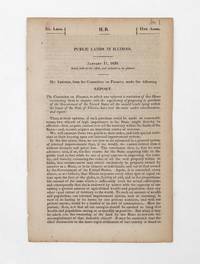
1839373003Vandalia Illinois 1839. First edition. 3 1pp. 8vo. Disbound. Housed in a morocco backed slipcase. First edition. 3 1pp. 8vo. Abraham Lincoln had yet to join the bar when he began his first stint in politics in the Illinois legislature in 1834 serving four consecutive terms in the Assembly through 1841. "This rare printing has the prestige of being the first occurrence of Lincoln's name as the sole author of a work. As a Whig lawmaker he was devoted to his party's program of public works through government financing. After the Panic of 18376 the spending he had advocated for had resulted in massive state debts. To relieve the budgetary burden Lincoln proposed that Illinois acquire land within its borders which the federal government still possessed and then sell the land at a fourfold profit to settlers and speculators resulting in both increased revenues and self-determined land ownership" Boroujerdi. Very rarethoma. Monaghan 1; Boroujerdi et. al. Abraham Lincoln: His Life in Print p. 29 unknown
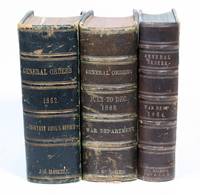
18622923Washington D.C.: War Department 1862. Calf marbled boards. Very Good. FIRST OBTAINABLE PRINTING OF THE PRELIMINARY EMANCIPATION PROCLAMATION setting a date for the freedom of more than three million enslaved in the United States and reframing the Civil War as a fight against slavery. Issued by the War Department to regimental commanders in the field during the Civil War in the week after the completion of President Lincoln’s official manuscript version. Contained is a set of three volumes of General Orders covering the full year 1862 July-Dec 1863 and the full year 1864. History of the Emancipation Proclamation:<br /> <br /> “The proclamation has been called by responsible persons one of the three great<br /> documents of world history ranking with Magna Carta and the Declaration of<br /> Independence†– Eberstadt<br /> <br /> “From the first days of the Civil War slaves had acted to secure their own liberty. The Emancipation Proclamation confirmed their insistence that the war for the Union must become a war for freedom. It added moral force to the Union cause and strengthened the Union both militarily and politically. As a milestone along the road to slavery’s final destruction the Emancipation Proclamation has assumed a place among the great documents of human freedom†– National Archives<br /> <br /> Following the Seven Days Battle and General McClellan’s retreat from the Peninsula at the end of June 1862 President Lincoln realized that there would be no early end to the war and found himself “as inconsolable as it was possible for a human to be and yet live.†Anxious for news from the army and needing to escape the constant interruptions at the White House he frequently visited the telegraph office in the War Department building to await dispatches. It was during one such visit early in July that he asked the chief of the telegraph staff Major Thomas Thompson Eckert for some paper to “write something special†and began the first draft of the Emancipation Proclamation completing it in a few weeks. Lincoln had long hoped to resolve the slavery issue through a congressional act of emancipation compensating slave owners for their loss of “property†but that approach was roundly rejected by representatives from the border states leaving the President who had decided upon the necessity of emancipation with a presidential proclamation as the only option. The extraordinary document he conceived would announce the liberation on January 1 1863 of all slaves in those states still in rebellion against the Union and promised compensation to slave owners in those states that returned to the fold before that time if they adopted “immediate or gradual abolishment of slavery.†This proclamation would be followed by a final proclamation issued on the 1st of January identifying those states still in rebellion and confirming the liberation of all slaves therein.<br /> <br /> On Tuesday July 22 Lincoln presented his draft to the Cabinet telling them that he had resolved firmly upon the course of action it specified and asking them not for advice but suggestions. The only observation he had not anticipated came from Secretary of State Seward who proposed that it might be best to wait for a military victory before issuing the Proclamation as it could otherwise seem like “the last measure of an exhausted government.†Immediately recognizing the wisdom of the suggestion Lincoln held back. On September 17 after an anxious wait of nearly two months he received the victory he needed at the bloody Battle of Antietam. Completing his final draft Lincoln presented it to his cabinet for refinement on September 22. Following the meeting Seward took the amended draft with him to the State Department where a formal manuscript copy was made then signed by Lincoln and Seward. The formal official “Emancipation Proclamation†was of course issued on January 1 1863 the day it became the law of the land.<br /> <br /> Printing History:<br /> <br /> This printing in the War Department’s official “General Orders†is the fourth printing overall but realistically the first obtainable printing. It is preceded by:<br /> <br /> -The first printing Eberstadt #1 a small three-page circular intended for distribution within the government and to the local press likely printed on September 22. At the time that Charles Eberstadt published his study of the Proclamation 1950 he was able to locate only one copy which he himself owned and as nearly as we have been able to determine no other copies have come to light since then.<br /> <br /> -The second printing Eberstadt #2 may be a phantom printing. Charles Eberstadt was not able to locate a copy but he inferred its existence from the standard State Department practice of printing a folio edition consisting solely of the text of the proclamation followed by another printing consisting of the text of a letter of transmittal from the Secretary of State as well as the text of the proclamation. While there may be a copy of Eberstadt #2 in the National Archives as he speculated it is not recorded in their online catalogue nor have we been able to find a copy in any other online catalogue including OCLC the Library of Congress and the Abraham Lincoln Library.<br /> <br /> -Eberstadt’s third printing is of legendary rarity. It consists of Secretary of State Seward’s one-page letter of transmittal addressed “To the Diplomatic and Consular Officers of the United States in foreign countries†and the text of the proclamation. Eberstadt located a total of only five copies in institutions at the Library of Congress the National Archives Yale the Clements Library and Brown. OCLC does not record any additional copies nor is it recorded in Monaghan. There has been one copy at auction $400000 in 2021 and that was described as the only copy in private hands. <br /> <br /> -The present copy General Orders No. 139 is Eberstadt’s fourth printing of the Preliminary Emancipation Proclamation dated in print on September 24. Eberstadt surmises that this field order printing could have been accomplished as late as September 29 or 30. Although it may have been printed in as many as 15000 copies it is very rare in commerce likely due to the ephemeral nature of the printing and distribution.<br /> <br /> Additional General Orders and Provenance:
<br /> <br /> The three volumes once belonged to John G. Haskell A.Q.M. Chief Quartermaster and contain the General Orders for the year 1862 July-December only for the year 1863 and for the full year 1864. John Gideon Haskell 1832-1907 was a resident of Kansas and joined the Union Army when the war broke out. He enlisted with the 14th Kansas Volunteer Cavalry Regiment and later served as Assistant Quartermaster General of Kansas as quartermaster of the Third Kansas and the Tenth Kansas Volunteers as Captain and Assistant Quartermaster on the staff of General James G. Blunt and as Chief Quartermaster of the Army of the Frontier. After the war Haskell was named official state architect and worked on the state house the capitol the State University and more.<br /> <br /> In addition to the preliminary Emancipation Proclamation the three volumes also contain the Acts of Congress on many other subjects including pay discharge recruitment handling of troops etc.<br /> <br /> Washington D.C.: War Department Adjutant General’s Office 1862-64. Three volumes. Small octavo contemporary three-quarter brown morocco two volumes with cloth boards one with marbled boards. Some rubbing and wear to bindings pencil notations on endpapers with collation and highlighting certain orders and some internal pages. Dampstaining to general title of 1862 volume; internal text and Emancipation Proclamation generally fine. RARE AND IMPORTANT.<br /> <br /> References:<br /> <br /> Charles Eberstadt. “Lincoln’s Emancipation Proclamation.†New York: 1950. War Department unknown
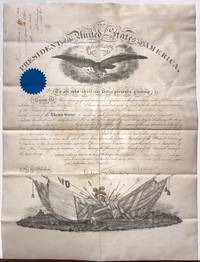
18638703<p>One partly-printed military commisssion on vellum signed by Lincoln as president and countersigned by Edwin M. Stanton as Secretary of War dated May 16th 1863. The document commissions Benjamin H. Geary as Second Lieutenant to the 13th Infantry Regiment on August 13th 1862. Accession note to top left.</p><p>The document measures 14.75 x 19.5 in</p>
1864WRCAM55254N.p. perhaps Virginia 1864. 3pp. on a single folded sheet. with: OATH OF ALLEGIANCE. N.p. perhaps Harper's Ferry Va. 1864. Single sheet 3 x 7 3/4 inches. The OATH affixed to a partial manuscript ledger report recording lost military stores for an unidentified unit in 1863 which is itself glued to the verso of the last blank page of the Amnesty Proclamation. Minor toning light foxing some wrinkling. Overall very good. In a cloth chemise and green half morocco and cloth slipcase spine gilt. An exceedingly rare separate printing - perhaps by a military field press - of President Abraham Lincoln's December 1863 presidential proclamation offering amnesty to citizens of the Confederacy providing they take an oath that they "will abide by and faithfully support all proclamations of the President made during the existing rebellion having reference to slaves" i.e. the Emancipation Proclamation. When the number of persons in any state taking the oath reached ten percent of the number of voters in 1860 this group of loyal voters could form a state government that could be recognized by the President. The Amnesty Proclamation was issued with President Lincoln's third Annual Message to Congress i.e. State of the Union Address on December 8 1863. It was appended per the language in the title here to the official printing of that address but also printed separately. <br> <br> The present printing almost certainly executed in the weeks after Lincoln's State of the Union was likely hastily composed from the text of the official printing of the proclamation. The work carries no imprint information of any kind and bears the hallmarks of a military field press printing. <br> <br> Toward the close of 1863 with the Confederate Army in full retreat discussions in Congress centered on how to restore the Southern states to the Union. "The crisis which threatened to divide the friends of the Union is past" announced Lincoln. Now it was the duty of Congress to ensure that all citizens in the South regardless of race were guaranteed the equal protection of the law. A number of competing proposals emerged from deliberations but in the end during his message to Congress on Dec. 8 1863 Lincoln declared reconstruction of the South a wholly executive responsibility and "offered 'full pardon.with restoration of all rights of property except as to slaves' to all rebels who would take an oath of future loyalty to the Constitution and pledge to obey acts of Congress and presidential proclamations relating to slavery" Donald p.471. <br> <br> Those excluded from taking the oath were the highest ranking members of the Confederacy - government officials judges military and naval officers above the rank of army colonel or navy lieutenant former congressmen and "all who have engaged in treating colored persons or white persons otherwise than lawfully as prisoners of war." Lincoln further encouraged the southern states to make provisions "in relation to the freed people of such State which shall recognize and declare their permanent freedom provide for their education and which may yet be consistent as a temporary arrangement with their present condition as a laboring landless and homeless class." <br> <br> "Lincoln indicated that this was only one plan for reconstructing the rebel South and while it was the best he could think of for now he would gladly consider others and possibly adopt them. He might even modify his own classes of pardons if that seemed warrantable. Afterward almost everybody but die-hard Democrats seemed happy with the plan" Oates p.371. <br> <br> The proclamation is accompanied by a partially-printed OATH OF ALLEGIANCE dated 1864 and datelined Harper's Ferry Virginia. The oath requires the taker to "solemnly swear that I will support protect and defend the Constitution and Government of the United States against all enemies." It is signed in type by Henry A. Urban Lieutenant and A.D.C. Aide-de-Camp. The oath is printed with a blank space for the name of the person taking the oath and the date. There is also a space for people who know the oath-taker and "certify on honor that we know Mr. blank to be a true and loyal man to the Federal Government." The OATH is affixed to a partial manuscript ledger report recording lost military stores for an unidentified unit in 1863 <br> <br> This printing of the Amnesty Proclamation is just as interesting as the government broadside printing or the first pamphlet printing as this edition would have also been used in the field by Union troops encountering Confederate rebels. The composition of the beginning of the seventh paragraph is consistent with the first pamphlet printing of the Amnesty Proclamation Monaghan 191 and not the broadside printing. The text here begins "Therefore I Abraham Lincoln."; in the broadside printing the "Therefore" is present at the end of the preceding paragraph. The simple and somewhat loose execution of the composition seen here is consistent with field press printings as is the lack of an imprint of any kind. Perhaps this simple production was intended for Union troops to literally hand to Confederate soldiers to read. The presence of the portion of the ledger and the Oath of Allegiance lends credence to the notion that this edition of the Amnesty Proclamation was produced for use by the military. <br> <br> This printing of the Amnesty Proclamation is not in Monaghan OCLC nor in any reference work we could find. In fact we could find no other three-page editions of the Amnesty Proclamation at all. Surely printed in small numbers to begin with it is perhaps a unique surviving example. MONAGHAN 191 ref. SABIN 41162 note. David Herbert Donald: LINCOLN New York. 1995 p.471. Stephen B. Oates: WITH MALICE TOWARD NONE: A LIFE OF ABRAHAM LINCOLN New York. 1977 p.371. hardcover books
1865WRCAM53482Washington D.C. 1865. Broadside 13 x 8 1/4 inches. Faint dust-soiling minor edge wear with a few short marginal tears repaired on verso. Very good. A rare first broadside printing announcing two of President Lincoln's three final proclamations "Closing Certain Ports" and "Port of Key West to Remain Open" both issued on April 11 1865. President Lincoln issued these proclamations just three days before he was cut down by assassin John Wilkes Booth. Both proclamations are signed in type by Lincoln and Secretary of State William H. Seward. <br> <br> The first proclamation "Closing Certain Ports" shut down a large number of Confederate ports all listed on the proclamation and indicates that "all rights of importation warehousing and other privileges shall in respect to the ports aforesaid cease until they have again been opened by order of the President; and if while said ports are closed any ship or vessel from beyond the United States or having on board any articles subject to duties shall attempt to enter any such port the same together with its tackle apparel furniture and cargo shall be forfeited to the United States." It was President Lincoln's 126th proclamation. <br> <br> The second proclamation "Port of Key West to Remain Open" was issued to amend the previous proclamation. It states that "the port of Key West in the state of Florida was inadvertently included among those which are not open to commerce" and declares that "said port of Key West is and shall remain open to foreign and domestic commerce." It was President Lincoln's 127th proclamation. <br> <br> These two documents constitute the antepenultimate and penultimate proclamations issued by President Lincoln; his last entitled "Claiming Equality of Rights with All Maritime Nations" was promulgated the same day. An important pair of proclamations among the last acts of the Great Emancipator before his untimely demise. unknown books
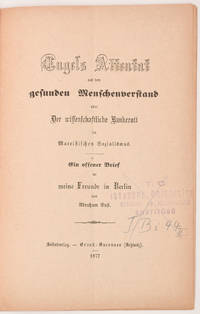
18771812Grand-Saconnex Schweiz: Selbstverlag 1877. First edition. In publisher’s wrappers. Collection stamp and shelfmarks written in ink and pencil on the cover and the title-page. Distributor’s stamp on the cover. With traces of folding. Cover slightly dusted. Pages yellowed due to ageing. First five leaves with minor damage to the lower corners. Overall in fine condition. First edition. In publisher’s wrappers. 24 p. <p><br /> Scarce pamphlet reflecting on the debate on early Marxist communism countering Engels for Anti-Dühring.<br /> <p><p><br /> First and only edition of the socialist theorist Abraham Enss’ pamphlet in which he criticises Marx and his followers for “doing humbug with socialism†and virulently defending Dühring from Engels’ “pseudoscientific†diatribes on him. Since the editors of Berliner Freie Presse refused to accept his writing Enss self-published his open letter dated to February 4 1877 and supplemented by two postscripts dated to March 1 and March 18 respectively in the present pamphlet in Switzerland. In response to the appearance of his writings Engels called Enss the “Sancho Panza†of Dühring who he referred to as “modern Don Quixote†while Liebknecht wrote in his letters to Engels that “Enß is stupid and will soon go to the madhouse†and that he is “generally regarded as a donkey even an idiotâ€.<br /> <p><p><br /> Abraham Enss was a follower and friend of Eugen Dühring. From 1887 he edited Der Antikrat a Dühringian paper with anti-Semitic tendencies which appeared with the subtitle Gegen Parteigewalt und Hebräer-Einfluß. Für selbständige Geistesführung und sociale Gerechtigkeit. Against Party Violence and Hebrew Influence. For Independent Spiritual Leadership and Social Justice.<br /> <p><p><br /> Scarce WorldCat locates only one copy in institutional holding in the US in the Columbia University Library in New York. <br /> <p><p><br /> Literature: Engels F.; Marx K.: Marx & Engels Collected Works. Volume 25. London: Lawrence & Wishart 1987. p. 298.; Firedlaender B.: Der freiheitliche Sozialismus: im Gegensatz zum Staatsknechtsthum der Marxisten. Mit besonderere Berücksichtigung der Werke und Schicksale Eugen Dühring’s. Berlin: Freie Verlagsanschaft 1892. p. 71; Gay J.: The Blind Prometheus of German Social Science. Eugen Dühring as Philosopher Economist and Controversial Social Critic. Universität Erfurt 2012.; Liebknecht W.: Briefwechsel mit Karl Marx und Friedrich Engels. Berlin: Walter de Gruyter 2020. pp. 212–214.; Nettlau M.: Bibliographie de l’anarchie. Année 1897. — N° 8. Bruxelles: Bibliothèque des Temps Nouveaux 1897. p. 41.<br /> <p>. Selbstverlag unknown
186421191.99<p>President Lincoln endorses a manuscript petition from border-state Unionists seeking the establishment of a permanent military post at Hickman Kentucky. "<i>Submitted to the Sec. of War who is requested to see the bearer. A Lincoln.</i>"</p> <b>ABRAHAM LINCOLN.</b>Autograph Endorsement Signed as President ca. December 1864 on a manuscript petition with two endorsements from Brigadier General Solomon Meredith. 2 pp. 7 x 9â…› in.<p><b><br /></b></p><p><b>Complete Transcript</b></p><p> <i>Hickman Ky Decr. 6th 1864</i></p><p><i>To the Honr. Abraham Lincoln.</i></p><p><i>President of the United States</i></p><p> <i>Sir</i></p><p> <i>We after an interview with our mutual Friend Brig Genl Meredith commanding the Western district of Kentucky have concluded to commission and empower our friend and fellow citizen Parson N.N. Cowgill to represent our interest before your august presence!</i></p><p> <i>We are suffering from the invatian of the Enemy upon us every day and have no power to repell them we ask of you to instruct our commander Brig Genl Meredith to make a permanant military post at this place</i></p><p> <i>We don't ask it for our protection exclusively but for the great benefit it will be to the Federal Army; We have a district of Country composing some 6 or 8 counties in area about two hundred miles! It being varied in its products offers every inducement to the Federal government to have it protected and let all of its resources be brought forward to</i> 2 <i>sustain our army. Our worthey and truly Union friend Parson N.N. Cowgill can give you a correct topography of our place and country. We would ask of you to extend our most appreciable Commander's district to the Hatchie River as this point is the natural outlet for all the cotton and tobacco raised in that section of the Country!</i></p><p> <i>We trust in Divine Providence you may be awakened to our great necessities and grant us the humble request we have made of you!</i></p><p> <i>Very Respectfully yours.</i></p><p> <i>Many Citizens of Loyalty</i></p><p>on verso in hand of Solomon Meredith: <i>I strongly recomend that a military post may be established at Hickman Ky. by the Secy of War. S Meredith Brig. Genl.</i></p><p><i>Head Qrs Dist of Westn Ky Paducah Ky. Dec 9th 1864</i></p><p><i>I am personally acquainted with Parson NN Cowgill and know him to be an honest patriotic and loyal man. The petition of which he is the bearer asking that Hickman be made a permanent military post I would most earnestly recommend to be granted knowing as I do that it will be of great benefit to the Union cause in this state. The Citizens of Hickman and Fulton Co gave a decided majority for the Union ticker at the late election which gives them a very powerful argument if not a claim for the protection of the government they serve. The government will be benefitted equally with the citizens by adopting the course proposed and the benefit both receive will be so much taken from the enemy who now occupy in little squads of guerrillas the whole country in that vicinity and run off every thing of value to their army which the can lay hands on. S Meridith Brig Genl.</i></p><p>on verso in hand of President Lincoln: <i>Submitted to the / Sec. of War who is / requested to see the / bearer. / A Lincoln</i></p><p><b>Historical Background</b></p><p>Border-state loyalists implore President Lincoln to establish a permanent military post at Hickman. Because of daily raids by rebel forces which the Unionists have no power to repel the citizens of Hickman file their request with the endorsement of General Solomon Meredith commander of the District of Western Kentucky based in Paducah. Meredith who had led the "Iron Brigade" was transferred to a desk command because of a bad shrapnel wound suffered at Gettysburg.</p><p>The town of Hickman is located in extreme southwestern Kentucky near the Mississippi River. Though Unionist in orientation it was a center of cotton cultivation. Even after the Confederate Army of Tennessee commanded by Braxton Bragg retreated from Kentucky in October 1862 the state was beset by guerrilla warfare for the remainder of the conflict. There were famous raids conducted by Confederate cavalrymen John Hunt Morgan and Nathan Bedford Forrest. President Lincoln declared martial law in August 1864 suspending the writ of habeas corpus to empower Union commanders such as Meredith unilaterally to arrest Confederate spies sympathizers and bandits.</p> books
18636046011863. "A. Lincoln" in black ink Washington DC May 12 1863 being 7 lines on the verso of the second leaf of an autograph letter to Lincoln from Robert Chester Buffalo May 9 1863 2 pages; 7 7/8" x 12 3/4" on a bifolium of blue-ruled paper neatly reinforced at folds. Lincoln deals with an officer seeking "An Honorable Discharge & to Avoid a Dishonorable One." Robert Chester who identifies himself as "late Capt. 17th Infantry US Army" petitions the President: "I would most respectfully request a suspension of Special Orders No. 201 Extract 4 by which I am dismissed the service of the United States. The reasons for such request are that my case has not been properly submitted to Your Excellency. I would respectfully ask that the order my be suspended until a Court of Inquiry or Court Martial; can be convened when I may have the opportunity to defend myself." Chester's appeal is joined by ten other prominent citizens of Buffalo including her postmaster one the justices of the city's Superior Court and three Union officers hailing from the Bison City. Lincoln forwarded Chester's petition to Judge Advocate General Joseph Holt directing him to "please examine & report on this case. The officer only seeks an honorable discharge & to avoid a dishonorable one." Nothing further on the case is recorded and Holt - influenced perhaps by the President's none-too-subtle insinuation - evidently found no merit to Chester's claim. See "The Collected Works of Abraham Lincoln" ed. Basler Supplement: 187. Signed by Authors. No Binding. Very Good/No Jacket. unknown books
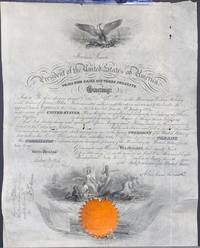
1861690201861. Military commission signed by Abraham Lincoln Washington August 1861. Folio on vellum with vignettes. Light wear along the folds. Countersigned by Simon Cameron. Matted and framed. Abraham Lincoln served as the 16th President of the United States from March 1861 until his assassination in April 1865. He led the United States through its Civil War and in doing so preserved the Union of the United States of America abolished slavery and strengthened the federal government. hardcover books
1863601017in black ink as President Washington D.C. December 23 1863. Six lines plus signature and date on verso of the integral blank of an Autograph Letter Signed from General John M. Schofield Washington D.C. December 23 1863. Octavo. 2 pages. Fine fresh example dark and clean. In his letter Schofield addresses his commander in chief deferentially: "Mr. President I desire simply to ask you if I may be absent from Washington a few days pending the settlement of my affairs I wish to spend Christmas day with my relatives at West Point. If there is any reason for my remaining here of course I do not wish to go." On verso Lincoln writes: "Not the slightest objection to Gen. Schofield's visiting West Point so that he be in call by Telegraph." This letter serves as an interesting footnote to the long-simmering problem in Missouri where Schofield had been in command. A slave state Missouri had seethed with pro and anti-slavery conflicts and was terrorized by armed bands of southern sympathizers. Schofield and the provisional governor had engaged in bitter jurisdictional quarrels until all factions finally united to criticize Schofield for his "high-handed" administration and demand his removal. In early December 1863 a congressman who had visited Missouri told Lincoln first hand of Schofield's increasing difficulties prompting the President on December 11 to telegraph a simple order to Schofield: "Please come see me at once." After his White House interview Lincoln recommended that Schofield be promoted to major general transferred and Rosecrans appointed to take his place. Lincoln's recommendation was quickly approved by the Senate. Schofield 1831-1906 Graduated West Point 1853. In Missouri at the outbreak of the Civil War he became chief of staff to Gen. Nathaniel Lyon and served until Lyon’s death at the battle of Wilson's Creek August 1861. Promoted brigadier-general of volunteers in November he was engaged in field operations in Missouri and later commanded the Department of the Missouri as major-general. Assuming command of XXIII Corps in February 1864 he took part in Sherman's Atlanta campaign as one of the three army commanders and badly shattered Hool's confederate force at the fierce battle of Franlklin Tenn. Moving the XXIII Corps to the mouth of the Cape Fear river He occupied Wilmington N.C. and effected a junction with Sherman at Goldsboro March 23 1865 for the final moves against Gen. J.E. Johnston. In the spring of 1868 served briefly as U.S. secretary of war. Promoted major-general regular army 1869 he commanded several departments successively and made the recommendations that led to the acquisition of Pearl Harbor Hawaii as a naval base. Superintendent at West Point 1876-81. Lincoln 1809-65 16th President of the United States 1861-65 and one of the most important figures in American history. Signed by Authors. F. Soft cover. unknown books
1863WRCAM55251Washington 1863. 20pp. Original printed wrappers. Light toning. A near fine copy in wonderful condition. In a cloth chemise and green half morocco and cloth slipcase spine gilt. The rare pamphlet printing of Lincoln's December 8 1863 proclamation read before Congress the next day offering amnesty to citizens of the Confederacy providing they take an oath that they "will abide by and faithfully support all proclamations of the President made during the existing rebellion having reference to slaves" i.e. the Emancipation Proclamation. When the number of persons in any state taking the oath reached ten percent of the number of voters in 1860 this group of loyal voters could form a state government that could be recognized by the President. The Amnesty Proclamation was issued with President Lincoln's third Annual Message to Congress i.e. State of the Union Address on December 8 1863; the State of the Union Address follows the Amnesty Proclamation here. <br> <br> Toward the close of 1863 with the Confederate Army in full retreat discussions in Congress centered on how to restore the southern states to the Union. "The crisis which threatened to divide the friends of the Union is past" announced Lincoln. Now it was the duty of Congress to ensure that all citizens in the South regardless of race were guaranteed the equal protection of the law. A number of competing proposals emerged from deliberations but in the end during his message to Congress on December 8 1863 Lincoln declared reconstruction of the South a wholly executive responsibility and "offered 'full pardon.with restoration of all rights of property except as to slaves' to all rebels who would take an oath of future loyalty to the Constitution and pledge to obey acts of Congress and presidential proclamations relating to slavery" Donald p.471. <br> <br> Those excluded from taking the oath were the highest ranking members of the Confederacy - government officials judges military and naval officers above the rank of army colonel or navy lieutenant former congressmen and "all who have engaged in treating colored persons or white persons otherwise than lawfully as prisoners of war." Lincoln further encouraged the southern states to make provisions "in relation to the freed people of such State which shall recognize and declare their permanent freedom provide for their education and which may yet be consistent as a temporary arrangement with their present condition as a laboring landless and homeless class." <br> <br> "Lincoln indicated that this was only one plan for reconstructing the rebel South and while it was the best he could think of for now he would gladly consider others and possibly adopt them. He might even modify his own classes of pardons if that seemed warrantable.Afterward almost everybody but die-hard Democrats seemed happy with the plan" Oates p.371. <br> <br> A lovely copy of Lincoln's hugely important Amnesty Proclamation. MONAGHAN 191. SABIN 41162 note. David Herbert Donald LINCOLN New York 1995 p.471. Stephen B. Oates WITH MALICE TOWARD NONE: A LIFE OF ABRAHAM LINCOLN New York 1977 p.371. hardcover books
1865WRCAM55213N.p. but almost certainly Springfield Il 1865. Broadside 12 x 9 inches. Printed in three columns edged with a printed black border. Old folds center vertical fold with some separation. Moderate staining. Still very good. Framed. Likely a proof copy of the exceedingly rare broadside announcing the funeral procession for President Abraham Lincoln in Springfield in early May 1865. Struck down by assassin John Wilkes Booth on April 15 1865 Lincoln's body lay in state in the White House on April 18 and a ceremonial funeral service took place in Washington D.C. around noon on April 19. Two days later President Lincoln's casket was loaded on a funeral train headed for Springfield Illinois stopping at Baltimore Harrisburg Philadelphia New York City Albany Buffalo Cleveland Columbus Indianapolis Michigan City and Chicago before arriving in Lincoln's adopted hometown early on the morning of May 3. At this time Springfield's population numbered around 15000 but Lincoln's funeral train pulled into a town swollen with over 100000 visiting mourners. Immediately upon arrival Lincoln's coffin was transferred by hearse to Representatives' Hall inside the Illinois Old State Capitol. For the next twenty-four hours from about ten o'clock in the morning on May 3 to the same time the next day about 75000 mourners were allowed to pass by the open coffin of the slain president to pay last respects. <br> <br> According to the present broadside President Lincoln's funeral procession left the Old State Capitol "on Thursday the 4th Inst. at 10 o'clock a.m. precisely." The funeral party of over 10000 people then turned right on 7th Street to pass by the Lincoln family home and then right up Cook Street to proceed past the Governor's Mansion before heading north to Oak Ridge Cemetery. <br> <br> This broadside printing of the order of the procession for Lincoln's Springfield funeral was probably printed the afternoon of May 3 or possibly even the morning of May 4 the day of the funeral. Surrounded by a heavy black band the broadside lists all the persons and units involved in the procession along with their places and the rules for the day. The entire procession was divided into eight divisions with Gen. Joseph Hooker acting as Marshal in Chief. The first three divisions of the military escort represented all the elements of the Army and Navy. After them came the attending clergy and Lincoln's attending physicians. Next was the casket itself the only wheeled vehicle in the procession with the pall bearers to each side followed by Lincoln's horse and then the immediate family. Three more military divisions followed interspersed with government officials ambassadors and state officials followed by delegations from Springfield and other Illinois towns. Next were representatives of various organizations delegations from colleges lawyers doctors and the press Masons Odd Fellows and firemen all interspersed with two more military divisions. The final segment of the funeral procession was designated for "Citizens at large" and "Colored Persons." <br> <br> The broadside gives directions for locations for the forming up of each group. Only marshals were allowed to be on horseback; all others walked. Bands were under the direction of the Committee on Music. Other particular directions follow including regulations for the colors of the various scarves worn by the marshals. The text of the document ends with directions to keep the streets through which the procession passes "clear from sidewalk to sidewalk." <br> <br> This broadside must have been widely distributed to assist the mourners in Springfield but like all such ephemeral pieces few copies have survived. OCLC locates only six at Indiana University the Abraham Lincoln Memorial Library the Boston Athenaeum the Chapin Library at Williams College the John Hay Library at Brown University and the Library Company of Philadelphia. The latter location also attributes the place of printing to Springfield. There is also a copy at the Library of Congress and a copy formerly owned by noted collector James Copley and previously sold by this firm. <br> <br> The present copy is likely an early printer's proof of the broadside as it lacks the first three letters of the word "FUNERAL" in the title. The Library of Congress copy is also likely a proof with its variant title omitting the words "ORDER OF." Both copies also lack the letter "e" in "Order" in the first sentence of text. These errors speak to the haste and stress under which this broadside was surely produced perhaps the day before or the very morning of the day when America's greatest president the Savior of the Union and Illinois' favorite son was laid to rest in a city teeming with seven times its own population in attendance. <br> <br> A remarkable and moving document reflecting a moment of national grief perhaps only approached by the John F. Kennedy funeral and memorializing the day when America's first assassinated president was solemnly committed to the earth. OCLC 5023077 79462381. unknown books
18638667<p>One partially printed vellum leaf dated February 21 1863 of the appointment of James Alden Jr. as a Captain in the Navy. Signed by President Abraham Lincoln and the Secretary of the Navy Gideon Welles. Orange embossed seal of the Department of the Navy to bottom. Previous owner's repair to upper right corner see image. Loses at folds see image. James Alden Jr. had an impressive career in the United States Navy having been appointed by Lincoln in aiding to split the Confederacy apart along the Mississippi River ultimately helping in the Battle of Vicksburg. Alden whose direct descendant came to America on the Mayflower assisted in the Mexican-American War before joining the Union during the Civil War.</p><p>The paper measures approximately 14.5 x 17.75 in 37 x 45 cm.</p>
18573563230/10/1857. <p>John V. Drake and John C. Moses practiced law in Danville Illinois. They worked on cases appearing before the Vermilion County Circuit Court. When Abraham Lincoln had a case appearing in that court he would sometimes affiliate himself with Drake and Moses. Lincoln was before that court in October and November 1857.</p><p>Hezekiah Ballah sued John Deck and Zachariah Deck in a case heard in the Vermilion County Circuit Court. This was an action of trespass for castrating seventeen buck sheep and cutting up eight other ewes wethers and lambs. The Decks retained Lincoln who worked together with Drake and Moses in the case in October 1857. The Decks pleaded not guilty. Moreover John Deck also pleaded that he had been acquitted of the charge in Justice of the Peace court. The jury found the Decks not guilty. Hearing the case was Judge David Davis who Lincoln would one day name to the U.S. Supreme Court.</p><p><strong>Autograph document signed</strong> a draft pleading completely in Lincoln’s hand Vermilion County Circuit Court October 1857 being the pleading informing the Court that Deck had previously been acquitted of the same offense. The name of the case was John Deck impleaded with Zachariah Deck ads vs Hezekiah Ballah and it was filed In Trespass. <em>“And the said defendant John Deck comes and defends the force and injury…and says plaintiff actio non fails to act when there is a duty to act because he defendant says he is not guilty in manner and form as is in the declaration alleged; and of this he puts himself upon the country etc. citizens in a court or jury. Moses & Drake & Lincoln p.d.â€</em></p><p>Lincoln adds below: <em>“And for further plea in this behalf defendant John Deck says plaintiff actio non because he says that heretofore to wit on the __ day of __ in the year of our Lord one thousand eight hundred and fifty seven at the county of Vermillion in the state of Illinois before Joseph Peters a Justice of the Peace of said county and before commencement of this suit said defendant John Deck in a suit against him by the plaintiff herein was lawfully judged to be not guilty of the same identical supposed trespass in this declaration mentioned and this he is ready to verify therefore he prays judgment etc. Moses & Drake & Lincoln p.d.â€</em> The case is listed at lawofficeofabrahamlincoln.org.</p><p>An interesting pleading where Lincoln’s client has already been acquitted of the same offense.</p><p><img class=""alignnone wp-image-25018 size-post-window"" src=""https://cdn.raabcollection.com/wp-content/uploads/20231204144051/Folder-site-11-1600x1327.jpg"" alt="""" width=""1600"" height=""1327"" /></p> unknown