Abraham RexABAA

987 résultats
1828009569This ciphering book measures 8" x 12.5". It contains 92 pages of ciphering work. There is also an additional 36 pages of text in a different hand perhaps by a sister copied from Timothy Shay Arthur's <i>Advice to Young Ladies</i> and the American Tract Society's <i>Helps for Every Hour</i>. Quarter-bound with marbled boards. The owner's label reads "Abraham Rex / Philadelphia / 1828." An 8.5" x 4" pencil drawing copied from <i>The Tours of Dr. Syntax</i> is laid in. <br /><br />Ciphering books were prepared as part of the basic mathematical training of relatively well-off American students usually boys. Most like this one contain examples of the Numeration Addition Subtraction Compound Multiplication Reduction Compound Reduction Rule of Three Indirect Proportion Vulgar Fractions Compound Proportions The Double Rule of Three Avoirdupois Weight Troy Weight Long and Land Measure etc. <br /><br />In addition to providing mathematical basics boys venturing into trades or businesses needed advanced or specialized training in mathematics. In this case Abraham's book includes some work that would prepare him for mercantile positions including Tare and Tret calculating weight adjustments for packing and shipping materials Insurance Commissions and Brokerage Compound Interest Rebate or Discount Equation calculating combined payments Barter Loss and Gain Fellowship calculating complicated partnership percentages etc. <br /><br />Abraham was a member of a prominent and prosperous Pennsylvania Dutch family. Online genealogical records show that the Rüx anglicized to Rex family immigrated to the United States sometime prior to 1720 and settled in Germantown north of Philadelphia. The family soon moved westward to Schaefferston in Lancaster County where it proliferated and prospered with members becoming merchants innkeepers informal bankers brokers pharmacists and physicians. <br /><br />For more information about the Rexes of Schaefferstown see Wenger's <i>Delivering the Goods: The Country Storekeeper and Inland Commerce in the Md-Atlantic</i>. An archive of Rex family business papers is held by the Winterthur Library. <br /><br />For more information about ciphering books see Kilpatrick's <i>Rewriting the History of School Mathematics in North America . . . The Central Role of the Cyphering Books</i> Doer's master's thesis: <i>Cipher Books in the Southern Historical Collection of the University of North Carolina</i> and Andries's "Learning Mathematics in North America" at the University of Pennsylvania's Kaplan Collection of Early American Judaica. <br /><br />18th-century American ciphering books are scarce as the overwhelming majority of extant examples date from the early 1800s into the mid-1850s. hardcover books
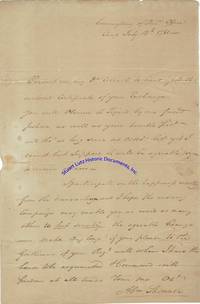
5036AMERICAN REVOLUTION PRISONERS OF WAR. ALS. 1pg. 8 ¼†x 12 ½â€. July 12 1781. Commissary of Prisnrs. Office Phillipsburg New York. An autograph letter signed “Abm Skinner†the American Commissary General of British prisoners of war. He wrote to an unidentified man: “Permit me my Dr. Colonel to hand you the inclosed Certificate of your Exchange. You will observe it Signed by our friend Joshua Loring British commissioner for prisoners as well as your humble Servt. and tho as long since as Octobr. Last I cannot but Suppose it will be agreeable to you to receive it now. I participate in the happiness resulting from the transaction and I hope the ensuing Campaign may enable you as well as many others to feel sensibly the agreeable Change - make my Compts. if you please to the Gentlemen of your Regt. with whom I have the honor to be acquainted…â€. The letter is docketed in an unknown hand on a stub remnant most likely by the gratified Colonel. The letter is tanned there are some spots and there is a minor repair to the verso. unknown books
171025803Amsterdam 1710. Copper-engraved map period hand-colouring in outline. Tables upper left and along the right side. Attractive map of North America based upon De L'Isle's highly influential map of North America published in 1700.<br/> <br/>By combining a wealth of information and geographical observation with delicate engraving and an uncomplicated composition this elegant map is a superb example from the golden age of French mapmaking and was published in Chatelain's Atlas Historique an important encyclopaedic historical atlas. California is shown as a peninsula with a number of villages and mountains; the Mississippi River extends far north of its true source. The table along the right side details the various native tribes from each region with lettered references for locating on the map.<br/> <br/>Lowery 263; Phillips 579. unknown books
553031 vols. 9 x 6 inches framed to 17 x 14-1/2. Two chips lightly scratched. Glued in wood frame. 1 vols. 9 x 6 inches framed to 17 x 14-1/2. unknown books
1872WRCAM31184Washington 1872. 4pp. of manuscript on a single long ruled sheet of paper folded in half to produce two folio-size leaves. Light fold lines. Minor browning. Very good. A legal manuscript copy of a land patent issued by Abraham Lincoln to John Hicks granting him lands in Missouri set aside by the United States in 1842 for reservation land but unclaimed at the time of the original grant on May 3 1861. The lands in question were ceded back to the United States via a treaty with the Wyandot Nation of the Upper Sandusky in Ohio signed March 17 1872. Includes numerous references to other key treaties made between 1842 and 1872. Good evidence of land transfer issues as the wholesale cession of Indian lands to the United States began in earnest. EBERSTADT 165:363. unknown books
11502Photograph cabinet size albumen print 4" x 6 3 /4 " laid down to larger board of Lincoln's Springfield IL home dated 1889 with imprint of O.H. Oldroyd state custodian on verso. This is a photograph of the only house the Lincoln's ever owned. The house was built in 1839 it was only a story and a half when they purchased it in May of 1844. Between 1844 and 1861 the years the Lincolns lived there the home underwent several additions the last in 1856 when the second story was added. A note on the verso indicates that the original owner of this photograph visited the Lincoln homestead in May of 1889. Some spotting to image mount toned notations in various hands on recto and verso of mount. Provenance from Ostendorf's collection. unknown books
1866238120Washington D.C.: John H. Littlefield; Wm. Terry Printer 1866. Photograph by John Goldin of Littlefield's painting on printed mount. 1 vols. Image 11 1/2 x 18 3/4 in.; mounted to 19 x 24 in. Soiling to image vertical crease large chips to bottom of mount not affecting image or legend; good. Photograph by John Goldin of Littlefield's painting on printed mount. 1 vols. Image 11 1/2 x 18 3/4 in.; mounted to 19 x 24 in. A published photograph of Littlefield's hyper-realistic Lincoln death-bed painting each figure meticulously rendered from photographs. Littlefield studied law under Lincoln in 1858 stumped for him in his Presidential bid and was rewarded with a position in the Treasury Department. After Lincoln's death Littlefield invented this tableau of twenty-five people ranged around the death-bed including Vice-President Johnson Surgeon Chalres Leale and Mrs. Lincoln. "The artist used photographs as models for the twenty-five people gathered in the death room but his profile of the dying Lincoln shows a first-hand acquaintance" Ostendorf LINCOLN'S PHOTOGRAPHS p. 279. Provenance: Harper Family John H. Littlefield; Wm. Terry, Printer unknown books
1866238011Washington D.C.: John H. Littlefield; Wm. Terry Printer 1866. Photograph by John Goldin of Littlefield's painting on printed mount. Image 8 1/2 x 13 3/4 in.; mounted to 13 x 17 in. Faint toning to mount; fine. Photograph by John Goldin of Littlefield's painting on printed mount. Image 8 1/2 x 13 3/4 in.; mounted to 13 x 17 in. A published photograph of Littlefield's hyper-realistic Lincoln death-bed painting each figure meticulously rendered from photographs. <br/>Littlefield studied law under Lincoln in 1858 stumped for him in his Presidential bid and was rewarded with a position in the Treasury Department. After Lincoln's death Littlefield invented this tableau of twenty-five people ranged around the death-bed including Vice-President Johnson Surgeon Charles Leale and Mrs. Lincoln.<br/>"The artist used photographs as models for the twenty-five people gathered in the death room but his profile of the dying Lincoln shows a first-hand acquaintance" Ostendorf LINCOLN'S PHOTOGRAPHS p. 279. John H. Littlefield; Wm. Terry, Printer unknown books
2015274N.P.: by the artist 2015. Original. Framed and matted. Fine. Lucas Richardson. Framed in black wood and matted in charcoal gray: overall size 18 1/2" x 15 1/2" / image displayed: 7 7/8" x 4 7/8". Lucas Richardson graduated valedictorian from DuCret School of Art in 2002. He has a double major in graphic design and fine art illustration. He continued to study with Peter Caras who had been instructed by Frank Reilley James Bama and Norman Rockwell. As a portrait artist Richardson has undertaken commissions in oil & charcoal mediums. He is also actively engaged in digital design. A STRIKING Portrait! by the artist unknown books
1919100988Chromolithograph broadside 16" x 20".Creases where folded slight abrasion at the conjunction of one of the folds some slight chipping to the lower right corner and the left margin which extend a little into image; still a colorful and unusual piece. A scarce early 20th century broadside version of the Emancipation Proclamation in the form of a WWI "uplift" poster. At the center is Abraham Lincoln holding a copy of the Emancipation Proclamation. He is flanked with smaller images of Paul L. Dunbar Frederick Douglas Lt. Col. Franklin A. Dennison and Lt. Col. Otis B. Duncan. Other images include soldiers farmers children at school and a bald eagle perched on top of American Flags. We are reminded in the captions of some of the accomplishments of African American and the promise of the future. A very attractive Broadside even with a few imperfections. Renesch, books
184829488Cincinnati: Robinson & Jones 1848. Original printed wrappers light wear spine reinforced with archival tape three rubberstamps on blank portions with ornamental borders stitched. 49 3 blanks pp. Very Good. <br/><br/> This scarce pamphlet is the address of 'An Israelite to the Christian World' asserting "that Israelites view with as much concern and regret as devout Christians the lamentable attempts to instil disbelief in a Divine revelation." Lindo argues that God's Covenant with the Jews "has never been intermitted but has always been and still continues to be in operation." Through the revelation they received at Sinai "the world is indebted for the civilization it now enjoys and will continue to be indebted for the preservation of that civilization." Christianity he says was "originally a Jewish sect adhering strictly to the monotheism of the Old Testament" but it has "gradually become so perverted as to remove it from what it was originally." <br/>FIRST EDITION. Rosenbach 637. Singerman 1026. Not in Sabin Thomson Eberstadt Decker. Robinson & Jones unknown books
1934163204Garden City: Published for The Crime Club 1934. Octavo pp. 1-10 1 2-301 302: blank original decorated black cloth spine panel stamped in green top edge stained green fore-edge untrimmed bottom edge rough-trimmed. First edition. "Sequel of a sort to BURN WITCH BURN! . A good mystery thriller with even some moments of humor." - Bleiler The Guide to Supernatural Fiction 1162. Clareson Science Fiction in America 1870s-1930s 553. Locke A Spectrum of Fantasy p. 155. Schlobin The Literature of Fantasy 740. In 333. See Barron ed Horror Literature 3-146. Bleiler 1978 p. 138. Reginald 10059. A nearly fine copy in a bright very good pictorial proof dust jacket with "PUBLICATION DATE / OCT 24 1934" stamped at the bottom of the front flap. #163204 Published for The Crime Club unknown books
159037978np 1590. Image area 19 1/2 x 13 1/2 inches in 28 x 23 inch mat. Single crease down center with one 1/2 inch spot worn through otherwise a nice handsome map. Image area 19 1/2 x 13 1/2 inches in 28 x 23 inch mat. Abraham Ortelius 1527-1598 was a Flemish geographer of German origin. His major work Theatrum Orbis Terrarum 1570 with later revisions and addenda was the first modern atlas. It was based on contemporary charts and maps and contained a collection of plates engraved by Franz Hagenberg in a uniform size and format. The Theatrum preceded the first Atlas of Ortelius' good friend Gerardus Mercator. In fact popular and sentimental legend has it that Mercator delayed publication of his own work so that his younger friend's would appear first. although this simply is not true Mercator wasn't ready the legendary cartographer did compliment Ortelius for the "care and elegance" he put into his "Theatrum. unknown books
1909240774New York: Privately Printed by the De Vinne Press 1909. First edition. Frontispiece portrait and 7 other photographs and a colored Jock Scott fly at the end. xii 266 pp. 1 vols. 8vo. Original green cloth t.e.g. Light shelfwear title page foxed else near fine. First edition. Frontispiece portrait and 7 other photographs and a colored Jock Scott fly at the end. xii 266 pp. 1 vols. 8vo. Scarce privately printed work with considerable sporting content.<br/><br/>Pp. 123 to 266 comprise the Logbook of Camp Albany on the Ristigouche River with entries from 1883 to 1898 on angling hunting and social topics. A prefatory note quotes from Dean Sage's classic book and an afterword by Charles H. Raymond offers an appreciation of Abraham Lansing 1835-1899 of Albany New York: "To watch his tall graceful form while casting on the river was to see the exemplar of the accomplished fisherman; the man the rod the line were together but the extension and the completion of artistic and practical perfection".<br/><br/>Inscribed by Mrs. Lansing to the Hon. Hampden Roth November 5 1909. Wetzel p. 174; Bruns L39; Bibliotheca Salmo Salar 107 Privately Printed [by the De Vinne Press] unknown books
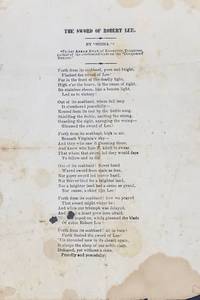
186865220Knoxville TN 1868. Broadside. 21 x 14cm. Six six-line stanzas. Some stains and two small holes one affecting two words. Short break at one fold. See BAL 17099 for two sheet music printings ca. 1866. A famous poem in perhaps the first or only separate non-music printing. OCLC lists only musical scores. <br/><br/> unknown books
186122671<p><b>ABRAHAM LINCOLN.</b>Book. <i>Message of the President of the United States to the Two Houses of Congress. Volume 1</i> Washington: Government Printing Office 1861. 839 pp. 5¾ x 8¾ in. </p><b>Excerpt</b><p><i>"A disloyal portion of the American people have during the whole year been engaged in an attempt to divide and destroy the Union. A nation which endures factious domestic division is exposed to disrespect abroad and one party if not both is sure sooner or later to invoke foreign intervention. </i></p><p><i> Nations thus tempted to interfere are not always able to resist the counsels of seeming expediency and ungenerous ambition although measures adopted under such influences seldom fail to be unfortunate and injurious to those adopting them. </i></p><p><i> The disloyal citizens of the United States who have offered the ruin of our country in return for the aid and comfort which they have invoked abroad have received less patronage and encouragement than they probably expected.</i></p><p><i> It continues to develop that the insurrection is largely if not exclusively a war upon the first principle of popular government--the rights of the people. Conclusive evidence of this is found in the most grave and maturely considered public documents as well as in the general tone of the insurgents. In those documents we find the abridgment of the existing right of suffrage and the denial to the people of all right to participate in the selection of public officers except the legislative boldly advocated with labored arguments to prove that large control of the people in government is the source of all political evil. Monarchy itself is sometimes hinted at as a possible refuge from the power of the people. </i></p><p><i> In my present position I could scarcely be justified were I to omit raising a warning voice against this approach of returning despotism."</i></p><p><b>Historical Background</b></p><p>President Lincoln's first message to Congress in 1861 immediately follows the title page. In the first year of both his presidency and the Civil War Lincoln criticizes disloyal citizens who are trying to ruin the country. He acknowledges that the Confederates firing on Fort Sumter ended hope of a peaceful solution and expresses his confidence in General McClellan. Lincoln also expounds on the foreign affairs the relationship of labor to capital and reports on domestic commerce and other affairs. The remainder of the book is over 400 pages of papers relating to foreign affairs and correspondence with other nations and diplomats. The second half of the book is made up of the Reports of the Secretaries of the Interior War Navy and Postmaster General.</p><p><b>Condition </b></p><p>Good. Original cloth boards with U.S. seal and titled spine some slight chipping and wear to boards and spine binding a little loose and front endpaper almost detached hinges a bit weak but still firm some aging but generally clean internally.</p> hardcover books
186564322Davenport Iowa: Designed by W.H. Pratt and lithographed by A. Hageboeck 1865. Broadside. 38 x 31 cm. Several small tape repairs on verso several untaped tears on edges. A calligraphic portrait memorial of Lincoln using shading to form his likeness with the text of his Emancipation Proclamation. "Designed and written by W. H. Pratt and printed in Iowa the state that sent the most soldiers per capita to the front in the Civil War"- EBERSTADT 40. <br/><br/> Designed by W.H. Pratt and lithographed by A. Hageboeck unknown books
1865WRCAM56487Providence: Salisbury Bro. & Co. 1865. Illustrated broadside 12 1/2 x 8 inches. Old folds. Remnants of a label on verso a few small chips to edges uneven tanning light foxing. Very good. Rare broadside advertising gold jewelry and "Patent Embossed Carte de Visites.of all noted personages." from Salisbury Bro. & Co. of Providence Rhode Island. The text describes a large stock of photographs offered at wholesale prices to retailers across the country. The broadside has a vignette of the Salisbury factory in the top quarter of the sheet with a dense cascade of text in a variety of different fonts below. The lower third of the sheet is devoted to descriptions of images of Lincoln and the Civil War advertising three different Lincoln images and the promise "Our Picture of Lincoln is the best ever taken. All others as good as ever sold by any one." They also offer images of other prominent Civil War personages as well as "Booth the Assassin Robert E. Lee Jeff Davis and other prominent Rebels all at the same price. Also we have the ASSASSIN'S VISION and the ASSASSIN'S DOOM on full Cards." <br> <br> This broadside is primarily directed towards retailers as opposed to private customers and provides costs for bulk orders of up to 1000 cartes de visite. They claim their prices are "500 per cent. less than any dealers ever have." with prices starting at $7 for 100 and up to $100 for 1000 depending on the image. Although Salisbury Bros. & Co.'s cartes de visite and other photographic products are easily accessible in many libraries we could find no record of this broadside. An interesting record of the mass-marketing of photographic images in the post-Civil War era. Salisbury, Bro. & Co. unknown books
16747716London: Henry Herringman pr. by J.M. 1674. Folio 30 cm 11.8". Frontis. 42 41 1 blank 80 4 70 59/60 skipped in pagination text uninterrupted 154 23 1 blank 148 pp. <br><br>Cowley's collected poems in their fourth edition beginning with a good impression of => the frontispiece portrait engraved by Faithorne "an account of the life and writings" of the poet signed by T. Spratt and two odes on Cowley's death by Thomas Higgons and Sir John Denham. Once considered the epitome of his era's wit the author of "The Mistress" verses in honor of love and various women included in this volume suffered a notable decline in popularity in subsequent years prompting Pope's musing "Who now reads Cowley . . . but still I love the language of his heart." And indeed despite the vagaries of reputation he has always had his worthy appreciators.<br>Â Â Â Â Cowley's Pindaric odes are present here as are the "Davideis" and "Davideidos"; also set forth are the "delightful little prose Essays with verse interwoven" for which The Concise Cambridge History of English Literature believes Cowley will most ultimately be remembered. Some sections have separate title-pages bearing the same publisher and date information as the main Provenance: Front pastedown with small armorial bookplate and with bookseller's ticket from Cambridge England. <br>Â Â Â Â <br>Â Â Â Â ESTC R29730; Wing rev. ed. C6652. On Cowley see: Concise Cambridge History of English Literature 35152. 17th-century mottled calf rebacked at some point in the 19th century and again more recently with hinges carefully reinforced inside; spine gilt extra with gilt-stamped leather title label covers showing the predictable acid-etching. Varying degrees of browning to pages; scattered incidents of worming in lower inner and outer margins almost never affecting text.<br>Â Â Â Â => A handsome book in a binding both sturdy and attractive. Henry Herringman (pr. by J.M.) hardcover books
186330001.20<p>Contains Lincoln's entire 1863 Message to Congress where he reaffirmed his commitment to emancipation as well as His Proclamation of Amnesty and Reconstruction which laid out a plan to return the rebellious states to the Union fold. Commonly called the "Ten Percent Plan" it allowed for a state to hold new elections when 10% of its 1860 voters took a loyalty oath to the Union.</p> <b>ABRAHAM LINCOLN.</b>Newspaper. <i>New York Times</i> New York N.Y. Dec. 10 1863 with <i>"Supplement to The New York Times"</i> complete with its own masthead. 12 pp. 14¾ x 21 in.<p><b><br /></b></p><p><b>Excerpt</b></p><p>"<i>To now abandon them would be not only to relinquish a lever of power but would also be a cruel and an astounding breach of faith. I may add at this point that while I remain in my present position I shall not attempt to retract or modify the emancipation proclamation nor shall I return to slavery any person who is free by the terms of that proclamation or by any of the acts of Congress.</i>"</p><p><b>Historical Background</b></p><p>Throughout the fall of 1863 eventual Union victory became increasingly clear and on December 8 1863 Lincoln issued his Proclamation of Amnesty and Reconstruction. This lenient plan that offered citizens of the rebellious states full pardons voting and property rights except possession of slaves encouraged the states to begin addressing the issue of the freedmen and women without compromising their rights and allowed a former Confederate state to hold elections and form a pro-Union government once 10% of the number of voters in the 1860 election swore loyalty oaths. Commonly called the "Ten Percent Plan" it reflected both Lincoln's charitable view of Reconstruction as well as the reality that heavy penalties denial of voting and property rights to rebels and impoverishing the South was no way to rebuild a nation after a war fought at least initially to preserve the Union.</p> books
1877239161877. No binding. Fine. Autograph Quote Signed from Lincoln's Cooper Institute speech given on February 27 1860. Sept 10 1877. Schuyler Colfax U.S. representative from Indiana and vice president under Ulysses S. Grant pens a famous quote from Lincoln's Cooper Institute speech. Transcript""Let us have faith that Right makes Might; and in that faith let us to the end dare to do our Duty."" Lincoln's Cooper Institute speech Feb. '60. Yrs truly Schuyler Colfax / Sept 10 1877Schuyler Colfax 1823-1885 born in New York City moved with his family to Indiana when he was an adolescent. Colfax pursued a career in journalism serving as legislative correspondent for the Indiana State Journal and becoming part-owner of the Whig organ of northern Indiana the South Bend Free Press renamed the St. Joseph Valley Register in 1845. Colfax was a member of the 1850 state constitutional convention and four years later was elected as a Republican to Congress where he served until 1869. An energetic opponent of slavery Colfax's speech attacking the Lecompton Legislature in Kansas became the most widely requested Republican campaign document in the 1858 mid-term election. In 1862 following the electoral defeat of Galusha Grow Colfax was elected Speaker of the House. In that capacity Colfax announced the passage of the Thirteenth Amendment on January 31 1865: ""The constitutional majority of two thirds having voted in the affirmative the Joint Resolution is passed."" Colfax considered February 1 1865 the day he signed the House resolution the happiest day of his life. ""Fourteen years before among a mere handful of kindred spirits in the Constitutional Convention of his State he had said: 'Wherever within my sphere be it narrow or wide oppression treads its iron heel on human rights I will raise my voice in earnest protest.' He had kept his word and well earned his share in the triumph."" Hollister 245. Colfax next served as Vice President under Ulysses S. Grant 1869-1873. He lost a re-nomination bid in 1872 as a result of his involvement in the Crédit Mobilier of America scandal. Hollister Ovando James. Life of Schuyler Colfax 1886. books
186124870<p>"<i>The Sanitary Commission is … of direct practical value to the nation in this time of its trial. It is entitled to the gratitude and confidence of the people… There is no agency through which voluntary offerings of patriotism can be more effectively made. A. Lincoln.</i>"</p> <b>ABRAHAM LINCOLN. HENRY W. BELLOWS.</b>Printed Circular Letter to "<i>the Loyal Women of America</i>." Washington D.C. October 1 1861. 3 pp. 8 x 10 in.<p><b><br /></b></p><p><b>Historical Background</b></p><p>The United States Sanitary Commission USSC was a private relief agency to support sick and wounded Union soldiers and sailors. The idea began at a meeting of the Women's Central Relief Association of New York in April 1861 and was modeled on the British Sanitary Commission which operated during the Crimean War. The USSC set up and staffed hospitals and operated thirty soldiers' homes lodges and rest houses for traveling and disabled Union soldiers.</p><p>This circular urges American women to send contributions to the USSC for distribution to suffering servicemen. "<i>Every woman in the country can at the least knit a pair of woolen stockings</i>" the letter declared "<i>or if not can purchase them.</i>" The USSC sought blankets quilts pillows slippers delicacies such as cocoa and dried fruit checker and backgammon boards and books and magazines for convalescing soldiers and sailors. Before it was printed Frederick Law Olmsted wrote to Lincoln requesting "a line from the President recommending the purpose of the Commission to the confidence of the public." Lincoln's response sent the same day is included at the end.</p><p>7000 affiliated local societies held bazaars concerts raffles and plays to raise money. Beginning in the fall of 1863 major cities—including Chicago Cincinnati Brooklyn New York Pittsburgh Philadelphia St. Louis and Boston—held large sanitary fairs that lasted for weeks. With donations from many famous figures and artifacts for sale such as signed copies of the Emancipation Proclamation over the course of the war the USSC raised an estimated $5 million in cash and $15 million in in-kind contributions.</p><p>At first the Army Medical Bureau resented civilian involvement and questioned the use of women as nurses. Similar groups such as the Christian Commission argued that their counterparts were more interested in providing something for the upper classes to do in the war aside from fighting than they were in sympathizing with the plight of soldiers. But its success silenced most critics over time.</p><p>The USSC did provide significant opportunities for women to participate in the war effort. Dorothea Dix Mary Livermore and Mary Ann Bickerdyke held leadership roles. Novelist Louisa May Alcott was a nurse in a USSC hospital. One of its nurses Clara Barton became a founder of the American Red Cross. Many of the Northern women who were its grass roots workers developed an involvement in philanthropic and public affairs including the Civil Rights and Women's Suffrage movements.</p><p><b>Henry W. Bellows</b> 1814-1882 born in Boston graduated from Harvard College in 1832 and Harvard Divinity School in 1837. In 1839 he became the pastor of the First Congregational church in New York City. Gaining a reputation as a pulpit and lyceum speaker he became a leader of the Unitarian Church in America. From 1847 to 1866 Bellows edited the <i>Christian Inquirer</i> a weekly Unitarian newspaper. Bellows planned the United States Sanitary Commission and served as its only president from 1861 to 1878. In 1877 he became the first president of the first Civil Service Reform Association.</p> books
186424202<p>Two tickets to the Great Central Fair in Philadelphia. One admitted a pupil of the public schools of Philadelphia and was used on Saturday June 11 according to the stamp on the verso. The other is an apparently unused "Season Ticket" that admitted the bearer "<i>To All Parts of the Fair</i>" except the Children's Exhibitions but was "<i>Forfeited if Transferred and Not Good unless Endorsed</i>." The verso includes the oath "<i>I hereby promise that this Ticket shall be used to obtain admission to the Fair by myself only</i>" and a blank line for a signature.</p> <b>CIVIL WAR. ABRAHAM LINCOLN.</b>Great Central Fair Tickets June 1864. Pair of passes for the Great Central Fair held in Philadelphia June 7-28 1864. One ticket is for one day's admission for a public school student. The other is a season ticket. 1 p. each 3½ x 2¼ and 3½ x 2 in.<p><b><br /></b></p><p><b>Historical Background</b></p><p>During the Civil War several northern cities hosted sanitary fairs between 1863 and 1865 to raise money for the care of wounded soldiers. The Great Central Fair held at Logan Square in Philadelphia in June 1864 was a fundraiser for the United States Sanitary Commission and was one of the largest fairs. The main exhibit building constructed in forty working days by local volunteer skilled labor enclosed 200000 square feet. It featured nearly one hundred departments offering a broad range of displays from Arms and Trophies to Fine Arts to Umbrellas and Canes. Curiosities included a $1000 doll house a recreated parlor of William Penn with Penn artifacts the boat used by Arctic explorer Elisha Kent Kane and George Washington's carriage.</p><p>Over three weeks the fair welcomed more than 400000 visitors. The season ticket offered here cost $5 a week's pay for a day laborer or a domestic and several days' wages for skilled workers. The fair served more than 9000 meals per day in its restaurant and had a daily newspaper with descriptions of the various departments. During its existence the fair raised approximately $1 million for the Sanitary Commission second only to New York City in money raised.</p><p>President Abraham Lincoln attended the fair with his family on June 16. He also donated forty-eight signed copies of the Emancipation Proclamation printed under the auspices of George Boker of the Union League which were sold for $10 each.</p><p><b>Condition</b></p><p>Both have glue discolored on the reverse sides. The smaller card has a 1" edge tear on the right side neatly repaired with archival tape.</p><br /> books
1701046917Jena: Birchner 1701. Early Edition. Hardcover Vellum. Good Condition. Contemporary vellum soiled frontis and title page stained and detached with some chipping and old tape marks wear to first few pages a few old marks and notes but very good otherwise. Three works bound in one the first two by Hoping typically found together the last with added engraved title published in 1692 in Frankfurt Illustrated throughout endpapers with notes and a few hand sketches. The Ingeber work is a first edition. 155 7; 183 61; 180 4pp<br/><br/>Three early chiromancy volumes bound up together Size: Octavo 8vo. Quantity Available: 1. Shipped Weight: Under 1 kilo. Category: Science & Technology; Magic Paranormal & Occult. Inventory No: 046917. Birchner hardcover books
1862100336Newspaper folio unbound 8pp. Dampstained browned at edges with some foxing early owner's ink stamp on top margin some small tears and chips along edges and a little creasing. Still in decent shape overall. This is one of the earliest printings of the Emancipation Proclamation which was issued on September 22 1862. The Emancipation Proclamation declared freedom for all slaves in any Confederate state that didn't return to the Union by January 1 1863. Although this executive order did not actually free a large number of slaves it set the stage for the freedom of all slaves. Coverage of the Emancipation in this newspaper begins in the middle of the first page. This newspaper article represents important coverage of a very significant event in American History. archives government exhibits emancipation website books