Lincoln AbrahamABAA

987 résultats
1862WRCAM55729Boston: J.M. Forbes 1862. 7pp. Miniature 3 1/4 x 2 1/8 inches. Original printed salmon wrappers. Slight soiling to wrappers light tanning. Very good. In a cloth chemise and half morocco and cloth slipcase spine gilt. The first and only contemporary printing of Lincoln's historic act in separate pamphlet form the seventh edition overall. The preliminary proclamation of the Emancipation Proclamation was issued on September 22 1862 shortly following the Battle of Antietam and declared the freedom of all slaves in any Confederate state that did not return to Union control by January 1 1863. A quotation by Alexander Stephens "Vice President of the so-called Confederate States" entitled "Slavery the Chief Corner- Stone" is printed on the rear wrapper. This small pamphlet was printed by John Murray Forbes in Boston for distribution by Union soldiers to blacks at the front lines and legend has it that he printed a million copies. Its scarcity in institutions and in the market however would seem to belie that notion; it is among the rarest of editions of the Proclamation no doubt because of its small size. EBERSTADT LINCOLN'S EMANCIPATION PROCLAMATION 7. MONAGHAN 147. J.M. Forbes hardcover books
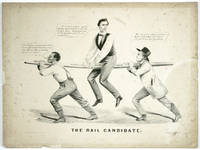
1860WRCAM37633New York: Currier & Ives 1860. Lithograph 13 1/2 x 18 inches. Moderate age-toning foxing and soiling. Moderate browning in margins. Small closed tears and chips in margins one moderate-size closed tear in left margin. A fair copy. A lithographic political cartoon published by Currier & Ives commenting upon the anti- slavery plank of the 1860 Republican platform. "The 'essential' anti-Lincoln cartoon of 1860" - Holzer et al. Abraham Lincoln is shown being carried uncomfortably in the middle of a split wooden rail an allusion to both the platform and to Lincoln's backwoods origins. Supporting the left end of the rail is a black man in simple working clothes who states "Dis N asterisks ours strong and willin' but its awful hard work to carry Old Massa Abe on nothing but dis ere rail!!" Holding the right end of the rail is well-dressed newspaper editor and strong Lincoln supporter Horace Greeley identified by a copy of his NEW YORK TRIBUNE in his coat pocket. Greeley tells Lincoln "We can prove that you have split rails & that will ensure your election to the Presidency." Lincoln replies "It is true I have split rails but I begin to feel as if this rail would split me it's the hardest stick I ever straddled." Lincoln is depicted - visually and thematically - as a straddler at best while the images of Greeley and the African American supporting the rail are derisive. <br> <br> A finely drawn and insightful political cartoon from the 1860 election. REILLY AMERICAN POLITICAL PRINTS 1860-31. WEITENKAMPF p.123. CURRIER & IVES: CATALOGUE RAISONNÉ 5478. Harold Holzer Gabor Borritt & Mark Neely THE LINCOLN IMAGE p.38 figure 18. Currier & Ives hardcover books
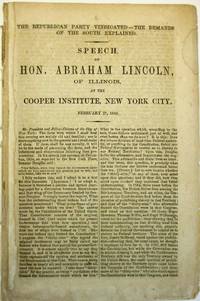
186036919np 1860. 8pp caption title as issued. Disbound with a bit of loosening light inner margin spotting. Good.<br/><br/> Lincoln's great Cooper Union Address argues that the Framers and early Congresses contemplated a narrow and ever-diminishing role for slavery. Examining Constitutional and early Congressional debates he demonstrates that contemporary statesmen viewed slavery "as an evil not to be extended but to be tolerated and protected only because of and so far as its actual presence among us makes that toleration and protection a necessity." <br/> Lincoln's argument fusing the interests of all anti-slavery men whether abolitionists or not ranks among his greatest contributions to American political thought. It received wide press coverage catapulting him into presidential contention for it transported the new Republican Party into the center of American constitutional and legal thinking rather than to an unacceptable extreme. He thus made it easy for moderate Northern Democrats Whigs and Know-Nothings to vote Republican in 1860.<br/>Monaghan 55. LCP 5944. unknown books
15859Lincoln Abraham. The Republican Party Vindicated--The Demands of the South Explained. Speech of Hon. Abraham Lincoln of Illinois at the Cooper Institute New York City February 27 1860. 16 pages caption title as issued. Lincoln's Historic Cooper Union discourse which catapulted him to serious presidential consideration and provided a cogent and widely-publicized argument that slavery was and always had been contrary to American values. <br/><br/>Lincoln's great Cooper Union speech argues that the Framers and early Congresses contemplated a narrow role for slavery. Examining the constitutional and early Congressional debates he demonstrates that contemporary statements viewed slavery "as an evil not to be extended but to be tolerated and protected only because of and so far as its actual presence among us makes that toleration and protection a necessity." Lincoln's argument received wide press coverage; it catapulted him into presidential contention for its great contribution placed the new Republican Party at the center of American constitutional and legal thought rather than an unacceptable extreme paving the way for his 1860 presidential win on the Republican ticket. An unusual 16-page issue of Lincoln's Cooper Union discourse followed at the middle of page 9 by John Hickman's July 24 1860 campaign speech. Page 16 prints Stephen Douglas' endoursement of the Dred Scott Decision and criticisms of his doctrine of Popular Sovereignty. Most copies print Lincoln's speech only in 8 pages. Scattered foxing dusting blank margin chipped not affecting text. Very good copy of this historic speech by Abraham Lincoln presaging his presidential nomination. unknown books
1865WRCAM31216New York 1865. 8pp. Large folio newspaper. Lightly tanned. Split at one fold with loss of a few words. Good unopened. Assassination edition of this weekly version of THE NEW YORK HERALD newspaper dated exactly one week after Lincoln's death. With all the columns bordered in black the paper contains all the news of the previous week from the details of the assassination to the attacks on other government officials and the search for Booth and the conspirators. There is also a long story containing details of Lee's surrender to Grant at Appomattox and a few stories regarding travel abroad. unknown books
160149hardcover. Ed. by Arthur Brooks Lapsley. Introduction by Theodore Roosevelt. many plates. 8 vols. thick 8vo cloth; cloth lightly soiled on all volumes volume I has dampstain on corner of first few pages some spines frayed at tops. N.Y.: Putnam 1905 1906.<br/><br/> One of 1000 sets.<br/><br/> unknown books
19058128New York and London. G.P. Putnam's Sons. 1905. Bound in full publisher's brown buckram. Gilt titled morocco label to spines. t.e.g. Thick 8vo 5.75" x 9". The Constitutional Edition. Portrait gravure frontis to each volume. Some labels mildly rubbed and or lightly chipped. Two spines moderately lightened. Small tiny tear to tail piece of volume 8. A Very Good if not better tight crisp set. G.P. Putnam's Sons. hardcover books
19051330106New York and London: G. P. Putnam's Sons The Knickerbocker Press 1905. Connoisseur's Federal Edition #46/400 1000. Hardcover. Large Octavos 8 volumes; VG-; bound in 3/4 brown calf marbled boards and endpapers paneled spines with gilt ruling and titling; top edges gilt others deckled; some rubbing and wear to bindings primarily at extremities hinges and heads and tails of spines; The Connoisseur's Federal Edition of the Writings of Abraham Lincoln is limited to four hundred signed by publisher and numbered sets of which this is Number 46. Perforated limitation number present; shelved above Civil War. 1330106. Shelved Dupont Bookstore. G. P. Putnam's Sons, The Knickerbocker Press hardcover books
1865851301865. PHOTOGRAPHY 19TH CENTURY - LINCOLN Abraham. UNCOMMON CARTE-DE-VISITE PHOTOGRAPH OF ABRAHAM LINCOLN CA. 1865. Providence RI: Salisbury Bro. & Co. n.d. ca. 1865 "Manufacturers of Gold and Plated Jewelry Also Carte de Visites of all Noted Persons." Pale embossed paper mount is 4 x 2 1/2 inches with 1 3/8 x 1 1/8 inch oval photograph a bust of a bearded Lincoln. Very good light soil to the mount with the photo contour partially cut through from being pressed into the paper mount. The embossed design features an eagle laurel leaves flags shield and cannons. The photo is in excellent condition the President's gaze clear and sharp. Free of the toning often seen on this cdv. unknown books
1938WB14641New York: Philip Duschnes 1938. Limited Edition. Paperback. Fair. Scarce printing one of 500 copies privately printed of Lincoln's second inaugural address. Original wraps defective split chipped and loose. Contents good. Sold as is. <br/><br/> Philip Duschnes paperback books
1864WB163441864. Hardcover. Very Good. Rare broadside tipped into a copy of The Early Life of Abraham Lincoln: Containing many unpublished documents and unpublished reminiscences of Lincoln's early friends. TARBELL Ida M. Assisted by James McCann Davis. Published by McClure New York 1896. The broadside printed in two columns presents the platforms of the Republicans who in June in Baltimore nominated Lincoln and the Democrats who in August in Chicago nominated McClellan. <br/><br/> hardcover books
186085724Chicago: Charles Leib 1860. Very Good. Four-page newspaper. A couple of small holes various brown spots and other bits of minor wear A campaign newspaper for Abraham Lincoln in the Presidential Campaign of 1860. We note a half-column story on the front page of this issue that accuses Senator Douglas of being a Roman Catholic -- a charge based partly on the fact that Mrs. Douglas was a Catholic as were their children -- probably an effective charge in largely Protestant mid-19th century America. Our brief research suggests that Douglas was not a Catholic or a formal member of any other organized religious group. The purpose of another half-column story on the front page was to make it clear that Lincoln had publicly condemned the actions of John Brown and did not object to Brown's execution. Charles Leib the editor was a political operative with a murky background who had previously edited a Democratic campaign newspaper on behalf of the Buchanan campaign in 1856. Leib served briefly as an Assistant Quartermaster in the Union Army before heading to new Mexico probably in 1863 and died there in 1865 at the age of 38. <br/><br/> Charles Leib unknown books
19594641baDetroit MI: Friends of the Detroit Public Library 1959. Book. Very good condition. Paperback. Civil War; slavery; p. 5-8; 22.8cm; light green paper wrapper; facsimile of portion of original manuscript of President's second annual address preserved in Burton Historical Collection Detroit Public Library; comments by James M. Babcock; reproduction of Mathew Brady portrait of U. S. pres. 1861-65; supplement in 1959 spring issue of Among Friends quarterly publication of the Friends. Friends of the Detroit Public Library Paperback books
19598816baDetroit MI: Friends of the Detroit Public Library 1959. Book. Very good condition. Paperback. Civil War; p. 5-8; 22.8cm; light green paper wrapper; facsimile of portion of original manuscript of President's second annual address preserved in the Burton Historical Collection Detroit Public Library; comments by James M. Babcock; reproduction of Mathew Brady portrait of U. S. pres. 1861-65; supplement in 1959 spring issue of Among Friends quarterly publication of the Friends. Friends of the Detroit Public Library Paperback books
19251342baIChicago IL: University of Chicago Press 1925. Book. Hardcover. Americana; politics; 22p; 29.7cm; 1/2 tan cloth paper covered boards soiled; frontis portrait of Lincoln U. S. president 1861-65; 2 illus.; facsimile of speech; introduction by Oliver R. Barrett b. 1873; p. 17-19 "Mr. Lincoln at home" column from Springfield Journal Nov. 1 1858; p. 21-22 printed letter from John H. Morgan. University of Chicago Press Hardcover books
19271327049Boston: Houghton Mifflin Company 1927. Limited edition. Hardcover. Octavo; Limited edition 369/440; G/no DJ; Hardcover w/out DJ; Spine yellow with black print on white label; Black slipcase has edgewear lacks rear panel tears to corners shelfwear; Boards quarter bound with yellow cloth to spine and blue paper to boards slight wear to spine caps soiling to spine and light smudging to boards; Text block has spotting to deckled edges names in ink on front flyleaf slight spotting to endpapers foxing to page 3 and facing plate else clean interior; 70 pages frontispiece illustrated b&w plates Laid in is an offprint from Century Magazine Feb. 1894 pp. 589-608 containing essay by John Coleman Adams and text of Lincoln's Gettysburg Address. 1327049. FP New Rockville Stock. Houghton Mifflin Company hardcover books
3360<p>No publisher no place probably circa 1950. A bifolum of the Gettysburg address on faux aged paper with the text printed in blue and initials in red. Bound nicely in red white and blue crushed morocco with inlaid stars and stripes. The binding is unsigned. Attractive and quite unusual. A copy was located bound in exactly the same manner in the Lincoln Institute in Wayne Indiana. It has a bookplate indicating it was done for the English bookseller John Harkness. Binding done circa 1950. </p> books
1942Embry 196105Heritage Press 1942. Bookplate near fine to fine in near fine slipcase with some sunning to edges. Black blindstamped cloth. Lacking Sunglass Heritage Press, 1942. hardcover books
1959Embry 186136Falcon's Wing Press 1959. Fine in near fine dust jacket in mylar cover. Falcon's Wing Press, 1959. unknown books
186549673Troy N. Y.: A. W. Scribner Book and Job Printer Cannon Place 1865. 1st Printing Monaghan 802. Original printed self-wrappers stiched. Now housed in an archival mylar sleeve. Bit of age-toning & soiling to outer leaves overall VG. 47 1 blank pp. 8vo. 9" x 5-3/4" <br/><br/>"If it be that the South is avenged in his death she will find it to be a vengance that will recoil upon her own head; for in him she has lost her best friend and however little we could afford to spare him she could afford it less still." <br /> <br />One of the many such sermons that were published shortly after the tragic event of April 15th 1865; this particular one uncommon in the trade with RBH showing a 1945 Goodspeed catalogue as their most recent appearance. A. W. Scribner, Book and Job Printer, Cannon Place unknown books
193633264Chicago: The Black Cat Press 1936. 1st edition Monaghan 3515. Limited to 1000 cc. Grey cloth binding. Yellow dust jacket. VG/VG spine a bit darkened/slight chipping at spine ends/pc. 258 2 pp including Index. Frontis of Lincoln after a portrait by John Doctoroff. 8vo. <br/><br/> The Black Cat Press hardcover books
190341285Washington: Government Printing Office 1903. 1st collected edition Monaghan 1402. Original publisher's pebbled brown cloth binding with gilt stamped title lettering to front board. TEG. Cloth somewhat dull. Some extremity wear. A VG copy. 246 pp. Each section prefaced with an engraved image of the slain president. Tissue guards. Small folio: 12-5/8" x 9-5/8" <br/><br/> Government Printing Office hardcover books
1864M13597New York: Derby & Miller 1864. 1864. Volume II. 8vo. xxxi 1 711 1 pp. Subtle waterstain at top margin viewable from pages 500-712. Original full dark blue-green pebbled cloth gilt spine titles; light wear to extremities. Bookplate of the Essex Institute; small rubber stamp on title C.W. Post College Documents Library. The Emancipation Proclamation declared freedom for all slaves by January 1 1863. This proclamation is dated January 2 1863. Lincoln in writing this one of the most important documents in all US history declared "And by virtue of the power and fpr the purpose aforesaid I do order and declare that all persons held as slaves within said designated States and parts of the States are and henceforward shall be free; and that the Executive government of the United States including the military and naval authorities thereof will recognize and maintain the freedom of said persons." / The War Orders of 1863 are among the most historical during the Civil War. The volume includes: General Orders No.1: Emancipation Proclamation Liberty for Slaves. / General Orders No.100: The Lieber Code How soldiers should conduct ethically themselves in wartime. / General Orders No. 143: Order for the creation of the United States Colored Troops. / General Orders No.1. President Abraham Lincoln issued the Emancipation Proclamation on January 1 1863. With this Executive Order. He took a decisive stand on the most contentious issue in American history redefined the Union's goals and strategy and sounded the death knell for slavery. / Lincoln had always believed slavery to be immoral and fought its expansion. The President took the action "sincerely believed to be an act of justice" knowing that it might cost him the election. / With the Emancipation Proclamation Lincoln dramatically tied the Union's war aims to ending slavery. Whether they approved or not after January 1 1863 Americans could no longer deny that emancipation was central to the Union war effort. / Though ready to lay the groundwork for emancipation Lincoln feared that delivering the Proclamation at the wrong time would doom its chances for public acceptance and harm the Union cause. / On September 22 1862 Lincoln issued his preliminary Emancipation Proclamation giving the South 100 days to end the rebellion or face losing their slaves. / His final Proclamation on January 1 1863 further demonstrated his own evolving views by eliminating earlier references to colonizing freed blacks and compensating slave-owners for voluntary emancipation. Lincoln also added provisions for black military enlistment. Pausing before he signed the final Proclamation Lincoln reportedly said: "I NEVER IN MY LIFE FELT MORE CERTAIN THAT I WAS DOING RIGHT THAN I DO IN SIGNING THIS PAPER." Despite the political risks by 1864 he insisted on both reunion and emancipation as preconditions to any peace negotiation. Though the battle for civil rights would have to follow Lincoln rightly regarded the Proclamation as: "THE CENTRAL ACT OF MY ADMINISTRATION AND THE GREAT EVENT OF THE 19TH CENTURY" Derby & Miller, 1864. hardcover books
186332764New York: Baker & Godwin 1863. 8vo. 9 x 5 5/8 inches. 48pp. Publisher's lettered wrappers publisher's ad on rear wrapper. Housed in a blue morocco box.<br/> <br/>"Four score and seven years ago.": the earliest publication of the Gettysburg Address in book form preceded only by the exceptionally rare sixteen-page pamphlet The Gettysburg Solemnities known in only three copies.<br/> <br/>Lincoln made his speech at the dedication of a cemetery on the Gettysburg battlefield some four months after the bloody and pivotal battle that turned the tide of the Civil War in favor of the Union. Lincoln's speech was preceded by an address from Edward Everett the most famous orator of his day. Everett's speech took some ninety minutes to deliver and is largely forgotten. Lincoln's speech delivered in only a few minutes is immortal. It is a supreme distillation of American values and of the sacrifices necessary for the survival of liberty and freedom. "The Washington Chronicle of 18-21 November reported extensively on this ceremony and included a verbatim text of 'Edward Everett's Great Oration.' On the fourth day it noted in passing that the President had also made a speech but gave no details. When it came to the separate publication on 22 November Everett's 'Oration' was reprinted from the standing type but Lincoln's speech had to be set up. It was tucked away as a final paragraph on page 16 of the pamphlet The Gettysburg Solemnities. It was similarly treated when the meanly produced leaflet was replaced by a 48-page booklet published by Baker and Godwin of New York in the same year" PMM. Lincoln's address appears on page 40 and parenthetical notes are added indicating "applause" and "long-continued applause." A diagram on page 32 gives the details of the Soldiers' National Cemetery at Gettysburg. A lovely example in original wrappers.<br/> <br/>Howes E232 "b"; Monaghan 193; Grolier American 100 72 note; Streeter Sale 1747; Sabin 23263; cf. Printing and the Mind of Man 351; Garry Wills Lincoln at Gettysburg pp.191-204. Baker & Godwin unknown books
186331428New York: Baker & Godwin 1863. 8vo. 9 x 5 5/8 inches. 48pp. Publisher's lettered wrappers publisher's ad on rear wrapper. Repair to paper spine. Within a modern box.<br/> <br/>"Four score and seven years ago.": the earliest publication of the Gettysburg Address in book form preceded only by the exceptionally rare sixteen-page pamphlet The Gettysburg Solemnities known in only three copies.<br/> <br/>Lincoln made his speech at the dedication of a cemetery on the Gettysburg battlefield some four months after the bloody and pivotal battle that turned the tide of the Civil War in favor of the Union. Lincoln's speech was preceded by an address from Edward Everett the most famous orator of his day. Everett's speech took some ninety minutes to deliver and is largely forgotten. Lincoln's speech delivered in only a few minutes is immortal. It is a supreme distillation of American values and of the sacrifices necessary for the survival of liberty and freedom. "The Washington Chronicle of 18-21 November reported extensively on this ceremony and included a verbatim text of 'Edward Everett's Great Oration.' On the fourth day it noted in passing that the President had also made a speech but gave no details. When it came to the separate publication on 22 November Everett's 'Oration' was reprinted from the standing type but Lincoln's speech had to be set up. It was tucked away as a final paragraph on page 16 of the pamphlet The Gettysburg Solemnities. It was similarly treated when the meanly produced leaflet was replaced by a 48-page booklet published by Baker and Godwin of New York in the same year" PMM. Lincoln's address appears on page 40 and parenthetical notes are added indicating "applause" and "long-continued applause." A diagram on page 32 gives the details of the Soldiers' National Cemetery at Gettysburg.<br/> <br/>Howes E232 "b"; Monaghan 193; Grolier American 100 72 note; Streeter Sale 1747; Sabin 23263; cf. Printing and the Mind of Man 351; Garry Wills Lincoln at Gettysburg pp.191-204. Baker & Godwin unknown books