Abraham LincolnBiblio.com
699 résultats
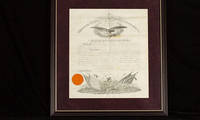
18643560801/08/1864. <blockquote><p>This appointment is listed in War Department General Orders no. 256</p></blockquote><p>According to the National Museum of Civil War Medicine and other sources Lt. Adam Miller of the 2nd Mass. Vols. aged twenty-three years was badly wounded August 9 1862 at the Battle of Cedar Mountain by an elongated musket ball which entered below the right eye socket and traversing the nasal cavity emerged through the left eye socket destroying the globe of the left eye and lacerating the left lower eyelid. He was made a prisoner and taken to a hospital at Charlottesville Va. where his wound ultimately formed a scar with great deformity. After being exchanged he entered the New York Eye Infirmary and on April 10 1863 a plastic surgical operation was performed by Dr. Henry B. Sands for the restoration of the eyelid. The operation was eminently successful and on April 22 1863 the parts were sufficiently healed to permit the insertion of an artificial eye. He thus survived a catastrophic facial wound and underwent pioneering plastic surgery.</p><p>Due to his injuries which made him unfit for active field duty but still capable of light service he was transferred to the Veteran Reserve Corps in August 1863 with his commission dating back to June 27 1863. The Veteran Reserve Corps was a military organization of the Union Army created for partially disabled or otherwise infirm soldiers who could still perform simple duties such as guarding prisoners or patrolling cities. This appointment is listed in War Department General Orders no. 256.</p><p><strong>Document signed</strong> with engravings of an eagle flags and weapons Washington August 1 1864 naming Adam Miller a lieutenant in the Veteran Reserve Corps effective June 27 1863.</p><p>An extraordinary Lincoln appointment of a soldier who made medical history in the Civil War.</p><p><img class=""alignnone wp-image-25018 size-post-window"" src=""https://cdn.raabcollection.com/wp-content/uploads/20231204144051/Folder-site-11-1600x1327.jpg"" alt="""" width=""1600"" height=""1327"" /></p> unknown
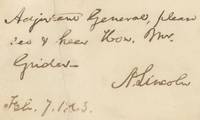
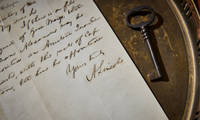
18633619207/02/1863. <blockquote><p>This document has been in a private collection for a generation</p><p> </p><p>Kentucky Unionists were important to Lincoln a Kentucky native as he famously said ""I hope to have God on my side but I must have Kentucky.â€</p><p> </p><p>The Congressman Henry Grider apparently needed to see Thomas to discuss the Act its impact on Kentucky and the details of how the recruitment would be handled</p></blockquote><p>Kentuckian Henry Grider was a Whig who served in Congress from 1843-1847 and then as a Unionist from March 4 1861 until 1865. For the Thirty-ninth Congress 1865–1867 Grider shifted to the Democratic Party but retained his commitment to the Union serving from March 4 1865 until his death in office on September 7 1866. Grider represented a Kentucky pro-slavery but Union-loyal constituency and he retained that point of view throughout the Civil War. Kentucky Unionists like Grider were particularly important to Abraham Lincoln a Kentucky native who had famously said ""I hope to have God on my side but I must have Kentucky.†Lincoln is known to have consulted with Grider about Kentucky affairs and relied on his support and that of the Kentucky delegation to Congress.</p><p>On February 7 1863 Congress passed an Act providing that “the Governor of the State of Kentucky by the consent and under the direction of the President of the United States shall have power to raise and organize into regiments a volunteer force not exceeding twenty thousand rank and file to be raised within the State of Kentucky to serve for the term of twelve months to be employed within the limits of Kentucky in repelling invasion suppressing insurrection and guarding and protecting the public property: Provided That at any time it may be necessary in the discretion of the President of the United States these troops may be employed out of the limits of Kentucky against the enemies of the United States.â€</p><p>Thus the Governor of Kentucky would raise a force of 20000 volunteers to serve in Kentucky but President Lincoln had the authority to order them used outside the state. This Act was received with mixed reviews in Kentucky and on the very day it was enacted Grider’s son Benjamin C. Grider a slave-holding Unionist resigned from the Union Army. From the timing of his resignation one can surmise that he disapproved of the Act. He had commanded the 9th Kentucky Volunteers.</p><p>Lorenzo Thomas was the Adjutant General of the U.S. Army at that time and his job was to maximize operational effectiveness of the army by manning recruiting for and sustaining military operations.</p><p><strong>Autograph note signed</strong> Washington February 7 1863 the day of the Act to Lorenzo Thomas expediting Grider’s ability to see Thomas. <em>“Adjutant General Please see and hear Hon. Mr. Grider. A. Lincoln.â€</em> It seems clear that Grider needed to see Thomas to discuss the Act its impact on Kentucky and the details of how the recruitment would be handled and managed. Not in Basler. A separation running vertically archivally mended.</p><p>This is a very scarce communication involving Lincoln aiding a Kentucky Unionist.</p><p><img class=""alignnone wp-image-25018 size-post-window"" src=""https://cdn.raabcollection.com/wp-content/uploads/20231204144051/Folder-site-11-1600x1327.jpg"" alt=""historical memorabilia dealer"" width=""1600"" height=""1327"" /></p> unknown
18642292021/03/1864. <blockquote><p>“If there is on file a request of Gen. Meigs that William Alexander may be appointed an Assistant Quarter-Master with the rank of Captain let him be appointed.â€</p><p> </p><p>There is no record of the appointment having been made with speculation being that Lincoln possibly sent the appointment to Stanton to die there</p><p> </p><p><img class=""alignnone wp-image-22921 size-post-window"" src=""https://cdn.raabcollection.com/wp-content/uploads/20231204160847/branding-Lincoln-March-21-1864-C-e1640668975889-1600x692.jpg"" alt="""" width=""1600"" height=""692"" /></p></blockquote><p>Lincoln had the rare quality of not taking opposition personally. During the Civil War he was vilified more than any other public figure in American history yet saw the issues as so great that they transcended any personal aspect. He bore no resentments because as he said he “never thought it paid.†He appointed men to high office because he perceived that they would be useful to the war effort. When Gen. George B. McClellan was insufferably rude to him he was willing to suffer the personal indignity if only McClellan would win. His most important civilian appointment shows this management principal in operation. Edwin Stanton had met Lincoln before the war when they had served as co-counsel in a famous lawsuit involving the McCormick reaper. Stanton who had a reputation for being stern imperious hot-tempered and controlling had snubbed him and then ridiculed him publicly as a gorilla and an imbecile. Lincoln also saw him as honest dedicated and extremely competent. Carrying no grudges he appointed Stanton to be Secretary of War and it was a brilliant choice. The two men came to respect and even like each other as they worked together daily to achieve victory.</p><p>Lincoln even used Stanton to deflect criticism from himself. Lincoln was inundated with requests for military positions requests in which he had little if any interest. But these requests often came from members of his administration from Union generals or other notables and the President could not decline them without angering his friends colleagues or other supporters of the Union cause. He shoveled these requests to Stanton with his endorsement. But Stanton would only approve those requests he deemed meritorious.</p><p><img class=""alignnone wp-image-22923 size-post-window"" src=""https://cdn.raabcollection.com/wp-content/uploads/20231204160837/Lincoln-March-21-1864-B-e1640669110694-1600x636.jpg"" alt="""" width=""1600"" height=""636"" /></p><p>Montgomery C. Meigs was a career United States Army officer civil engineer and construction engineer. At the start of the Civil War Lincoln appointed Meigs quartermaster general a crucial post that was perfectly suited to his organizational and management talents. Before the war Meigs played a key role in the extension and dome of the U.S. Capitol. After the war he oversaw much of the design and monument construction at Arlington National Cemetery.</p><p>Meigs had requested that Lincoln make an appointment in his department and the President wrote this letter to accommodate him. <strong>Autograph letter signed</strong> on Executive Mansion letterhead Washington March 21 1864 to <em>“Hon. Secretary of War.â€</em> Lincoln writes <em>“My dear Sir If there is on file a request of Gen. Meigs that William Alexander may be appointed an Assistant Quarter-Master with the rank of Captain let him be appointed. Yours truly A. Lincoln.â€</em></p><p>There is no record of the appointment having been made with speculation being that Lincoln sent the appointment to Stanton to die there. An interesting letter associating the President Secretary of War and Quartermaster General and taking place just eleven days after Grant assumed the role that led to Union victory.</p><p><img class=""alignnone wp-image-22732 size-post-window"" src=""https://cdn.raabcollection.com/wp-content/uploads/20231204162353/Folder-site-1600x1327.jpg"" alt="""" width=""1600"" height=""1327"" /></p> unknown
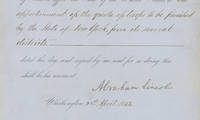
18642373223/04/1864. <blockquote><p>A search of public sale records going back 40 years fails to turn up even one other example of this document</p></blockquote><p>After the firing on Fort Sumter on April 12 1861 enthusiasm for enlisting in military service swept through both the North and South. In remarkable speed two large volunteer armies were created. Except for a tiny number of professional soldiers all expected to be in service for a brief term. Not just soldiers but the public and political leaders had fooled themselves about the war's likely duration. However the patriotic hope on each side that the war would be over in a matter of weeks or months was dashed in the first battle of Bull Run on July 21 1861. By late 1862 no sensible person believed that an early end to the bloody strife was possible and the knowledgeable expected peace to be far off in the future. Facing a protracted war maintaining a sufficiently sizable army became the greatest problem facing both Union leader Abraham Lincoln and Confederate leader Jefferson Davis.</p><p>In 1862 rather than institute a draft President Lincoln requested 300000 more men and assigned each state a quota. The states could meet their quota in any manner they saw fit. Most states offered cash incentives known as bounties to gain recruits. Depending on where one enlisted the combination of local state and federal bounties could exceed $1000. But the 1862 policy also did not recruit enough troops.</p><p><img class=""alignnone wp-image-24611 size-post-window"" src=""https://cdn.raabcollection.com/wp-content/uploads/20231204150003/Lincoln-April-23-1864-2-1600x602.jpg"" alt="""" width=""1600"" height=""602"" /></p><p>As the war dragged on with no end in sight the inflow of volunteers was drying up and the Union needed to keep the ranks filled. The U.S. Congress resorted to the first draft in the country’s history in March 1863. All able-bodied men between ages 20 and 45 were required to be enrolled and available for military service. Draftees were chosen by lottery. Once conscripted a man could avoid service for that particular round of the draft either by paying a $300 commutation fee or by hiring a substitute to take his place. As in the South this raised accusations that the war had become “a rich man’s war but a poor man’s fight.†Nevertheless in both North and South statistics indicate that wealthy men were represented in the service in at least the same proportion as they were in the general population.</p><p>A lot of blood was spilled in 1863 with the battles of Chancellorsville Gettysburg Vicksburg Chickamauga and Chattanooga among others. By year’s end President Lincoln and the Union leadership realized that more men were needed for the army and urgently. On February 1 1864 Lincoln called for 500000 men to serve for three years or for the duration of the war. Then on March 15 he supplemented this with a call for 250000 more. There would be another draft call in December 1864 but it was never completed due to the impending end of the war.</p><p>The March 1864 draft call stated: “Washington March 15 1864. In order to supply the force required to be drafted for the Navy and to provide an adequate reserve force for all contingencies in addition to the 500000 men called for Feb. 1 1864 the call is hereby made and a draft ordered for Two Hundred Thousand men for the military service – Army Navy and Marine corps of the United States. The proportional quotas for the different wards towns townships precincts or election districts or counties will be made known through the Provost Marshall General’s bureau and account will be taken of the credits and deficiencies of former quotas.</p><p>The 15th day of April 1864 is designated as the time up to which the numbers required from each ward of a city town etc. may be raised by voluntary enlistment; and drafts will be made in each ward of a city town etc. which shall not have filled the quota assigned to it within the time designated for the number required to fill said quota. The draft will be commenced as soon after the 15th of April as practicable…†It took little more than a week for everything to be in place.</p><p><img class=""alignnone wp-image-24623 size-full"" src=""https://cdn.raabcollection.com/wp-content/uploads/20231204145931/My-Movie-177ygbhbj.gif"" alt="""" width=""1920"" height=""1080"" /></p><p>The mechanics of the draft were that each state and district within a state were assigned quotas and the President would order that each state’s draft numbers and districts be implemented. This was the actual order for the draft. Then each individual district would receive from the President details of its requirements in a circular letter. One sees these individual district circular letters on the market every now and then. But what one never sees is the order to implement the draft for a state assigning the districts and number of troops being called forth. In fact a search of public sale records going back 40 years fails to turn up another example nor have we seen one before.</p><p><strong>Document signed</strong> as President Washington April 23 1864 being Lincoln’s implementation order for New York. <em>“I hereby authorize and direct the Secretary of State to affix the Seal of the United States to the apportionment of the quota of troops to be furnished by the State of New York from its several districts dated and this day signed by me and for so doing this shall be his warrant.â€</em></p><p>An extremely rare if not unique document showing Lincoln raising troops on the macro level of a state.</p><p><img class=""alignnone wp-image-23729 size-post-window"" src=""https://cdn.raabcollection.com/wp-content/uploads/20231204152429/Folder-site-7-1600x1327.jpg"" alt="""" width=""1600"" height=""1327"" /></p> unknown
18611571129/03/1861. <p>James E. Harrison though born in Virginia served the Union cause during the Civil War. He received his first appointment as a Second Lieutenant to the 2d U. S. Cavalry in June 1856 and was stationed in Texas and various forts in the West until December 1858 when he was assigned to scouting Indians. He returned East and with the Civil War imminent he was promoted to First Lieutenant 2d U.S. Cavalry in March 1861 and then to Captain 5th U.S. Cavalry in May of that year. Harrison was engaged in the Peninsular campaign and commanded a regiment in the Army of the Potomac from September 1862 to June 1863. During that time he served at the battles of Antietem Chancellorsville and Brandy Station among many others. He was Breveted Major U.S. Army for gallant and meritorious services at the battle of Hanover Court House and Brevet Lieutenant Colonel U.S. Army for gallant and meritorious services at the battle of Antietam. In July of 1864 Harrison was assigned to be Inspector-General of Cavalry in the Department of Arkansas and was later appointed as Special Inspector of Cavalry in West Mississippi.</p><p><strong>Document signed</strong> as President Washington March 29 1861 effective retroactively to February 27 1861 an ornate vignetted commission with an eagle cannons and flags appointing Harrison to the rank of “First Lieutenant in the Second Regiment of Cavalry.†The document is countersigned by Secretary of War Simon Cameron.</p> unknown
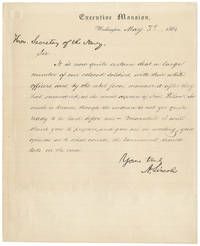
186424088<p>President Abraham Lincoln seeks counsel from his cabinet on the appropriate response to the massacre at Fort Pillow Tennessee three weeks earlier. More than 400 African-American Union troops and their white officers were slain many of them after surrendering.</p><p><strong>ABRAHAM LINCOLN.</strong> Letter Signed to Gideon Welles May 3 1864 Washington D.C. 1 p. 8 x 10 in. With: <strong>FORT PILLOW MASSACRE LYMAN TRUMBULL.</strong> Signed Presentation Copy. <em>Reports of the Committee on the Conduct of the War: Fort Pillow Massacre. Returned Prisoners.</em> 8vo. Illustrated with 8 portraits on 4 pages of woodcut engravings after photographic portraits of Belle Island POWs. Contemporary green cloth gilt with morocco spine label gilt-lettered. First Edition. Washington D.C. 1864. Inscribed on front fly leaf: <em>"Lyman Trumbull to D.J. Ely"</em>. The cover title of sammelband that contains two Senate Reports related to Confederate atrocities: 1. U.S. Congress. May 5 1864. - Ordered to be printed.Joint Resolution directing the Committee on the Conduct of the War to examine into the recent attack on Fort Pillow. Senate Report 38th Congress 1st Session. Senate Rep. Com. No. 63. Nevins I: 204. 2. U.S. Congress. May 9 1864 - Ordered That the report.be printed in connexion with the report of the committee in relation to the Fort Pillow massacre.Joint Resolution directing the Committee on the Conduct and Expenditures of the War. Senate Report 38th Congress 1st Session. Senate Rep. Com. No. 68.</p><p>On April 12 1864 1500 Confederate troops under Nathan Bedford Forrest attacked a Union outpost at Fort Pillow Tennessee. After four hours of intense fighting Forrest demanded the garrison surrender. Although outnumbered almost three to one the Union troops inside the fort at first refused. Confederate forces eventually captured the position. According to survivors Confederate troops motivated by racial hatred proceeded to kill Union prisoners as they pleaded for their lives. It is unclear how many were killed after the surrender but first-hand accounts suggest that the numbers were high. Of 262 black soldiers at Fort Pillow only 58 survived to be taken prisoner; of 395 white soldiers 168 survived as prisoners.</p><p>On May 3 President Lincoln sent a letter like this one to each of the members of his cabinet. Three days later Lincoln held a cabinet meeting at which each cabinet member read his opinion on the appropriate response. All agreed that the U.S. government should demand "an explanation" from the Confederacy. Seward Chase Stanton and Welles advised holding Confederate prisoners equal in numbers to the Union troops massacred as hostages; if the Confederate government avowed the massacre those prisoners would be executed. Usher Bates and Blair strongly disagreed with Blair pointing out that such a response "would not be justified by the rules of civilized warfare." Bates concurred noting that "retaliation is not mere justice. It is avowedly revenge; and it is wholly unjustifiable in law and conscience."</p><p>Little formal action beyond a Congressional investigation took place. Perhaps the greatest impact that Fort Pillow had was on the morale of black troops. Knowing what their fate would be if captured on the field by Confederate soldiers black Union soldiers charged into battle with the war cry "Remember Fort Pillow!"</p><p><strong>Complete Transcript</strong></p><p><em>Executive Mansion<br />Washington May 3d 1864</em></p><p><em>Hon. Secretary of the Navy.</em></p><p><em>Sir:</em></p><p><em>It is now quite certain that a large number of our colored soldiers with their white officers were by the rebel force massacred after they had surrendered at the recent capture of Fort-Pillow. So much is known though the evidence is not quite ready to be laid before me. Meanwhile I will thank you to prepare and give me in writing your opinion as to what course the Government should take in this case.</em></p><p><em>Yours truly<br />A. Lincoln</em></p><p>With abolitionist Senator Lyman Trumbull's signed presentation copy of Congressional reports.</p><p>Condition: very good.</p>
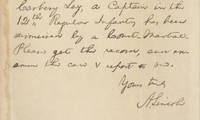
18632972001/09/1863. <blockquote><p>A powerful letter showing Lincoln's direct involvement with the chief judicial military officer showing the merciful Lincoln at work and showing his prioritizing retaining experienced veterans in the service</p></blockquote><p><img class=""alignnone size-post-window wp-image-29790"" src=""https://cdn.raabcollection.com/wp-content/uploads/20240123003955/Lincoln-Sept-1-1863-3-1600x295.jpg"" alt="""" width=""1600"" height=""295"" /></p><p>The Judge Advocate General of the United States Army is the senior officer of the Judge Advocate General's Corps of the United States Army. The position was abolished but then reinstated in 1849. In 1862 Lincoln appointed his first Judge Advocate General Joseph Holt only the second since 1783. He named Joseph Holt. Holt joined the Army as a colonel in 1862. As Judge Advocate General of the Army Holt oversaw the expansion of military law to include the military prosecutions of citizens who were not in the military service. By the time he joined the Army he believed that the only means to prevent treason from occurring again was to ensure that slavery was abolished for all time and eventually equal treatment under the law enforced in the South.</p><p>At the beginning of the Civil War Joseph Carbery Lay had an office in Washington D. C. as an agent for the transaction of all kinds of business including procuring patents pensions back pay purchase and sale of real estate writing of deeds releases and other instruments regarding settlement of accounts with and claims against the Government.</p><p>He quickly enlisted in the 12th Infantry Regiment of the Regular Army as a lieutenant. During the Peninsula Campaign in the spring of 1862 the 12th Infantry distinguished itself in its first combat action at the Battle of Gaines Mill in June 1862 while sustaining fifty percent casualties. Lay was a captain at that time.</p><p><img class=""alignnone size-post-window wp-image-29789"" src=""https://cdn.raabcollection.com/wp-content/uploads/20240123003932/Lincoln-Sept-1-1863-2-1600x746.jpg"" alt="""" width=""1600"" height=""746"" /></p><p>Captain Joseph Carbery Lay was cashiered - dismissed - from the Army on July 21 1862 for being drunk on duty and breach of arrest. Lay felt that an injustice had been done and wanted the dismissal revoked. In 1863 the matter came to the attention of President Lincoln who insisted on seeing the record of the case. He was always anxious to prevent injustice from being done and even a case in which alleged drunkenness was involved was not beneath his notice.</p><p><strong>Autograph letter signed</strong> as President on Executive Mansion letterhead Washington September 1 1863 to the Judge Advocate General insisting that he receive the records in Lay’s case. <em>“Sir: I am told that Carbery Lay a Captain in the 12th. Regular Infantry has been dismissed by a Court-Martial. Please get the record and examine the case & report to me. Yours truly A. Lincoln.â€</em></p><p><img class=""alignnone size-post-window wp-image-29791"" src=""https://cdn.raabcollection.com/wp-content/uploads/20240123004036/Lincoln-Sept-1-1863-4-1600x491.jpg"" alt="""" width=""1600"" height=""491"" /></p><p>Lincoln prioritized retaining experienced veterans in the service and sided with Lay as is indicated by the fact that Lay was reinstated by being appointed a lieutenant in the Seventeenth Infantry on October 30 1863 less than two months after this letter. While Lay was serving in that unit in 1863 it was present in engagements at Rappahannock Station and on Mine Run and marched with it until going into winter camp. In 1864 the regiment took part in the Wilderness Campaign and the operations before Petersburg inscribing on its colors Laurel Hill North Anna Bethesda Church Cold Harbor and Petersburg; while its records show in addition that it was also engaged at Spotsylvania Court House and the battle of the Wilderness.</p><p>Lay’s problems were not over however as in June 1864 he was accused of having returned to his home in Washington without leave. He came back to base soon after and made a statement that he had been ill and sent to hospital and then had a difficult time rejoining his regiment. Perhaps to avoid disciplinary action he resigned from the Army a few months later on September 12 1864.</p><p>Over the years we’ve had just a handful of letters showing the kindly merciful Lincoln at work and none to Holt.</p><p><img class=""alignnone size-post-window wp-image-25018"" src=""https://cdn.raabcollection.com/wp-content/uploads/20231204144051/Folder-site-11-1600x1327.jpg"" alt="""" width=""1600"" height=""1327"" /></p> unknown
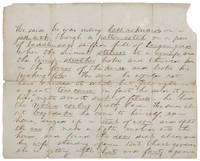
184528226<p>A master storyteller and talented mimic Lincoln's humor was the product of his upbringing in the frontiers of Kentucky Indiana and Illinois where tall tales and exaggeration were key ingredients to good jokes and effective tools in the courtrooms and legislative halls. For some it made him more appealing and approachable to the common man. For others his coarse backwoods humor was undignified reinforcing their belief that he was unfit to be president.</p><p>This manuscript utilizes a series of "spoonerisms" in which the storyteller transposes the first few letters of two adjacent or nearby words for humorous effect. Its namesake Rev. William Archibald Spooner of New College Oxford University was allegedly prone to unintentionally making such mistakes in speaking</p><p><strong>Complete Transcript</strong><br /><em>He said he was riding <u>bass-ackwards</u> on a <u>jass-ack</u> through a <u>patton-cotch</u> on a pair of <u>baddle-sags</u> stuffed full of <u>binger-gred</u> when the animal <u>steered</u> at a <u>scump</u> and the <u>lirrup-steather</u> broke and throwed him in the <u>forner</u> of the <u>kence</u> and broke his <u>pishing-fole</u>. He said he would not have minded it much but </em><em>he</em><em>fell right in a great <u>tow-curd</u>; in fact he said it give him </em><em>a</em><em>right smart <u>sick</u> of <u>fitness</u>he had the <u>molera-corbus</u> pretty bad. He said about <u>bray</u> <u>dake</u> he come to himself ran home seized up a <u>stick</u> of <u>wood</u> and split the <u>axe</u> to make a light rushed into the house and found the <u>door</u> sick abed and his <u>wife</u> standing open. But thank goodness she is getting right <u>hat</u> and <u>farty</u> again.</em></p><p><strong>ABRAHAM LINCOLN.</strong> Autograph Manuscript "Bass-Ackwards" story ca. 1845-1850 Springfield IL. 1 p. 7 x 8.5 in.</p><p><strong>Historical Background</strong><br />C. F. Gunther of Chicago told Jesse W. Weik that Lincoln penned this for a bailiff in the Springfield courts. It was first published by Emanuel Hertz in <em>The Hidden Lincoln</em> in 1938. It once belonged to the Illinois State Historical Library in Springfield which traded it for a first edition of the <em>Book of Mormon</em>. According to auctioneer Charles Hamilton one collector considered it so unworthy of Lincoln's sacred memory he bid intending to burn it! Fortunately he lost.</p><p><strong>Provenance</strong><br />Abraham Lincoln to a bailiff of a Springfield court reportedly Arnold R. Robinson > The Illinois State Historical Library gift of a descendant > Charles Hamilton Galleries May 16 1963. See account in Hamilton <em>Auction Madness</em> 119: "This unsigned bit of Lincolniana was knocked down for $4000 at one of my earliest auctions nearly twenty years ago. What would it fetch today!" > Lindley and Charles Eberstadt > Parke-Bernet Galleries Eberstadt sale October 13 1964 lot 124 described as being "the most intimate and unusual Lincoln document known to survive" and "perhaps the greatest Presidential character piece extant" > Christie's a Western Collector December 9 1994 lot 84 > Louise Taper Beverly Hills California > The Abraham Lincoln Presidential Foundation 2007 > Freeman's/Hindman May 21 2025 lot 21.</p><p><strong>Exhibitions</strong><br /><em>The Last Best Hope of Earth: Abraham Lincoln and the Promise of America</em> at the Huntington Library October 1993-August 1994<br /><em>Abraham Lincoln: A Personal Journey</em> at the Gerald Ford Presidential Museum October 12 2001February 18 2002</p><p><strong>Condition:</strong> Silked; creasing from folds; small losses along folds affecting a few letters; small marginal loss in upper right corner not affecting text; scattered spotting.</p>
183624346.99<p>1836. No binding. Fine. Autograph Letter Signed to Mary S. Owens December 13 1836 2 pp. 9 3/4 x 7 3/4 in. ""Write back as soon as you get this and if possible say something that will please me for really I have not been pleased since I left you.""Here Lincoln perfectly demonstrates what Owens later described as deficiencies ""in those little links which make up the chain of a woman's happiness."" Rather than expressing his feelings for Owens Lincoln complains about his health and discusses political issues swirling in the Illinois General Assembly. Although inept at love the letter offers rare insight into the young representative's thoughts on a variety of political issues. In this highly important letter to Mary Owens a self-absorbed Lincoln complains to his potential spouse of his health both physical and mental and discusses political issues to the point that he describes his own letter as ""dry and stupid."" Perhaps more revealing than he realized it illustrates the tension in Lincoln's early life between matters of the head with which he was comfortable and matters of the heart with which he clearly was not. Complete Transcript Vandalia Decr 13. 1836Mary I have been sick ever since my arrival here or I should have written sooner. It is but little difference however as I have verry little even yet to write. And more the longer I can avoid the mortification of looking in the Post Office for your letter and not finding it the better. You see I am mad about that old letter yet. I dont like verry well to risk you again. I'll try you once more anyhow. The new State House is not yet finished and consequently the legislature is doing little or nothing. The Governor delivered an inflamitory political message and it is expected there will be some sparring between the parties about it as soon as the two Houses get to business. Taylor delivered up his petitions for the New County to one of our members this morning. I am told that he despairs of its success on account of all the members from Morgan County opposing it. There are names enough on the petitions I think to justify the members from our county in going for it; but if the members from Morgan oppose it which they say they will the chance will be bad. Our chance to take the seat of Government to Springfield is better than I expected. An Internal Improvement Convention was held here since we met which recommended a loan of several millions of dollars on the faith of the state to construct Rail Roads. Some of the legislature are for it and some against it; which has the majority I can <2> not tell. There is great strife and struggling for the office of U.S. Senator here at this time. It is probable we shall ease their pains in a few days. The opposition men have no candidate of their own and consequently they smile as complacently at the angry snarls of the contending Van Buren candidates and their respective friends as the Christian does at Satan's rage. You recollect I mentioned in the outset of this letter that I had been unwell. That is the fact though I belive I am about well now; but that with other things I can not account for have conspired and have gotten my spirits so low that I feel that I would rather be any place in the world than here. I really can not endure the thought of staying here ten weeks. Write back as soon as you get this and if possible say something that will please me for really I have not been pleased since I left you. This letter is so dry and stupid that I am ashamed to send it but with my present feelings I can not do any better. Give my respects to Mr & Mrs Abell and family. Your friend LincolnMiss Mary S. OwensHistoric BackgroundThis is one of the ten oldest Lincoln letters known to have survived. Although 11 leaves 9 of which are in institutions from Lincoln's educational sum book a few documents written or signed by Abraham Lincoln in 1832 relating to his service in the Black Hawk War again mos. See website for full description</p>
186530432Boston: Walker Fuller and Company 1865. Hardcover. Early Printing "Third Thousand." 4.25 x 6.5in. viii. 186pp. iv. Publisher's pebbled cloth boards with gilt titling. NEAR FINE. Shows marginal shelf rubbing of the extremities else Fine. An exceptionally maintained copy. As pictured. Walker, Fuller, and Company hardcover
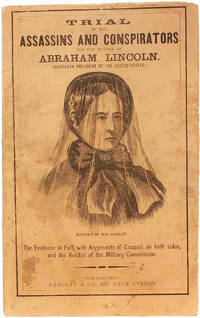
1865005102<p>Philadelphia: Barclay & Co. 1864 1865 1865. FIRST EDITION. 1 vol. 9-1/4" x 5-3/4" original pictorial wrappers illustrated pagination irregular but complete original stitching completely unsophisticated without repairs internally clean and bright mild general handling but surely one of the nicest copies you're going to encounter VERY GOOD. McDade 623 According to RBH only 2 copies have ever appeared at auction. The last one in 2008. Variant issue mentioned by Howes with the illustration of the execution moved to p 96; also with misprint of copyright date as "1864". Featuring engraved portrait of Mary Surratt on cover. The assassination of Lincoln by John Wilkes Booth on the night of April 14 1865 need no retelling. Time however which has its own way with our judgments has raised some doubts about some of these. The unfairness of the military tribunal is now manifest and the guilt of Mrs. Surratt is certainly doubtful. This was amply demonstrated by the fact that only two years after the crime the government could not obtain the conviction of her son John Surratt in the civil courts in Washington.</p> Philadelphia: Barclay & Co., 1864 [1865]
18860002014NORTH OXFORD COUNTY ON EAST NISSOURI WOODSTOCK. Fair. 1886. On offer is an interesting original later 19th Century Municipal Record book from North Oxford Ontario dated 1886-87. Titled: Township of North Oxford Debenture Accounts Henderson Creek Drain under By Law No. 176. 1886 & 1887. The treasurer is an Abraham John Hillsdon and the accounts are written in his hand ~ lists of income received and expenditures for this Henderson Creek Drain project in 1887. There are 29 written pages starting in 1887 with the last entry in 1895. They are sporadic in the book some at the front some in the middle and some right at the end of the book with blank pages in between. There is a small glued in handwritten receipt: 'Received from Mr. Hillsdon Treasurer of North Oxford the Sum of Five dollars and Seventy three cents ~ East Nissouri Township's share of the refund on the Henderson Creek Drain" signed David Lawrence Treasurer East Nissori'. Many names in this book a very interesting piece of south western Ontario history. The back of the book has several pages on the Gravel Account for 1894; Reports from Each Pathmaster of the Gravel Used in their Division; lists of names numbers of loads and pit locations. There is also a copy of By-Law # 176 for the year 1886 inserted ~ By-Law to provide for draining of parts of the first second and third concessions of the Township of North Oxford and for borrowing on the credit of the Municipality the sum of one thousand nine hundred and fifteen dollars for completing the same. Provisionally adopted the twentieth day of October A.D. 1886. Also there is a worn copy of the Seventh Annual Report for the Agricultural Mutual Assurance Association of Canada tucked in. The book itself is in fair shape having a cracked hinge some loose pages and some chipping but overall Fair.; 8vo - over 7¾" - 9¾" tall; KEYWORDS: HISTORY OF NORTH OXFORD COUNTY ABRAHAM JOHN HILLSDON KITCHENER ONTARIO UPPER CANADA GALT WATERLOO HENDERSON CREEK DRAIN DAVID LAWRENCE EAST NISSORI LAKESIDE THAMESFORD ECONOMY FINANCE WOODSTOCK INGERSOLL TILLSONBURG BLANDFORD-BLENHEIM EAST ZORRA-TAVISTOCK NORWICH SOUTH-WEST OXFORD TOWNSHIP OF ZORRA HESSE DISTRICT MENNONITES AMISH CANADIANA CANADIAN HANDWRITTEN MANUSCRIPT DOCUMENT LETTER AUTOGRAPH DIARY JOURNAL LOG KEEPSAKE WRITER HAND WRITTEN DOCUMENTS SIGNED LETTERS MANUSCRIPTS PHOTO ALBUM PHOTOGRAPHIC ALBUM HISTORICAL HOLOGRAPH WRITERS HANDSCHRIFT HANDGESCHRIEBEN MANUSKRIPT DIARIES JOURNALS LOGS AUTOGRAPHS PERSONAL MEMOIR MEMORIAL PERSONAL HISTORY antiquité contrat vélin document manuscrit papier Antike Brief Pergament Dokument Manuskript Papier oggetto d'antiquariato atto velina documento manoscritto carta antigüedad hecho vitela documento manuscrito Papel . unknown
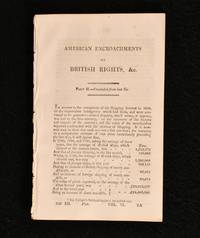
1815725L19London: Gale and Fenner 1815. Disbound. Near Fine. 8" by 5". None. A section from the nineteenth century publication 'The Pamphleteer' regarding American Encroachments of British Rights. Much of this chapter is taken from Nathaniel Atcheson's work 'American Encroachments on British Rights' published in 1808 which is an observation on the importance of the British North American Colonies and looks at the treaties with the United States. This copy is disbound. Lacking the title page as this is one section from this periodical. This work is part II concluded from the last number. This work explores shipping and trade at the turn of the nineteenth century and looks at the relationship of Britain and America following the War of Independence and the Confederation period. A very scarce work which provides an insight into the political state and relationship between Britain its old colonies and the newly formed United States of America. Disbound. Externally very smart with a light spot to the first leaf. Internally firmly bound. Pages are very bright and clean. Near Fine Gale and Fenner unknown
1819805K1London: A. J. Valpy 1819-1830. Hardback. Good. 10" by 7". None. A scarce 136 volume set of the Regent's Edition 'Delphin Classics' based off of a published series used to educate le Grand Dauphin Louis with works by notable thinkers such as Virgil Horace and Cicero. An extensive run of the scarce 'Delphin Classics' very scarce to see a large run of the work like this.This set contains volumes I-CVIII CXIII-CXLI published between 1819 and 1830 a total of 136 volumes.The Regent's Edition of this work.In Latin.'The Delphin Classics' was an extensive series of the Latin classics which reached to 182 volumes this set containing 136 of the volumes.The series printed the prominent works of writers such as Virgil Sallust Pliny the Elder Ovid Horace Cicero and Caesar often printing their complete works in the original Latin.Edited by George Dyer the series was based off a monumental publication of the Latin classics that had been published for the education of le Grand Dauphin Louis the heir to Louis XIV to assist in his education. In fact the title 'Delphin' translates to 'Dauphin'. Le Grand Dauphin was the eldest son of Louis XIV but predeceased him and thus never became the king his grandson succeeding to the throne as Louis XV after the death of Louis XIV.Working off those original Dauphin editions Dyer and the publisher Abraham John Valpy supplemented the texts with the best variorum editions and literary notes from important late eighteenth century editions. These include the Variorum Classics and the Zweibrucken editions.This Georgian edition reached around six hundred subscribers and saw great success. Publisher's adverts to the front of volumes XII XXV XXVII XL and CXXVIII.Subscriber's lists bound in to volumes I and XXXII.With remarks on 'The Review Relative to Stephens' Greek Thesaurus in the Quarterly review No. 48 bound in with vol. XXXI. The Classical Journal No. XLIII bound into the front of no. XX. With 'Delphin Classics with the Variorum Notes' sheet bound in with no. X XXI and LXIV. In the original publisher's paper covered boards. Externally generally sound with shelf wear and bumping to the head and tail of the spine and extremities minor chipping to the extremities of the boards and rubbing to the occasional volume a touch of edge wear; general light soiling to the boards and age toning to the spine. Tears and losses to back strips of XLIV LXXXI XLVII LXXIII and XCIII with back strips of volumes CXLI and LIVII absent. Faint handling mark to the front board of nos. I IV XI XXXIV XXIX XXXII LVI LVII LXIII and LXIV. Minor staining mark to the front board of no. XXXIV. Small library stamps to the front board of the majority of volumes. A little loss to the paper of the front board of volume XLVII LIV and LXXV. Joints to nos. VII XI XXII XXX XXXIII XCIV LXXI and CXXXI starting. Front joint of Volume XI is starting with boards held by cords only. Front joint of volumes CXXXV CXXXIII CXXXVI XLIX starting with boards holding firm. Rear joint is strained to CXIX. Rear joint is starting to Volumes III VI XVIII XXIV XL CXIII and CXV. Rear joint to no. LXXXV strained held by cords only. Rear joint of no. XIX has failed with board held by the front joint. Front joint no. IX XL XXX XXXIX LXXXIV LXXV and CXIX are starting. Front joint of no. LXXXVI cracked binding held by endpapers. Front joints to CXVII CXIII CXX and CXVI have failed front boards are detached but present. CI with cracked joints front and rear board loose but present light soiling to the rear of the text block. Back strip and front board of volume XLVII detached but present both boards and back strip of volumes XCIX LXXXII and LII detached but present. Boards of volumes LIVII and CXXXIX detached. Boards of volumes CXLI and CXXXII loosely held. Minor chipping to the spine of no. II V XIX XI XVII XXXVII XXIX XXXVI LXV LXXXIV LXXXV CI CVI and CVII. Loss to the head and tail of the spine of no. XIX XXI and XXIX. Loss to head of the spine on no. I II IV XIX CXVII CXVIII and CXX and paper to spine is lifting exposing interior of the spine. Tearing to the spines on no. XXV and XL. A few ink marks to the spine of IV and VII. Spine is lifting to XI CXIII CXXI and CXIX. General bumping particularly noticeable to the extremities of XVI XCV CXXX. Volume CXXIV has the odd mark to the front board. Volume CXXIII has some slight loss to the paper of the front board front joint is starting a little to the tail. Volumes LXIX LXVII have slight loss to the paper of the front board. Tidemarks and loss to the front board of volume XCV. Loss to the head of the spine of volumes XIII CXXX XXVII LXXXVI and LXVIII. Small perforation to the tail of the spine of LXXIV. Loss to the tail of the spine of XIV. Loss to the paper of the rear board to volumes LXXXVII and CXXVI. Minor loss to the tail of the spine of no. XXXII minor chipping to the joints holding firm. Backstrip no. LIX laid down. Backstrip is lifting to the tail of volume XCII CXXIV. Backstrip is loose to volumes XXVIII XC. Head of the backstrip of volume XVII is detached but present with the remainder of the backstrip held at the rear board. Backstrips of volumes LXX LXXI LXXXIX are loose. Backstrip lifting to the head of volume LXVII. Front and rear hinges starting to volumes XCIV CXXXVII with boards holding firm. Rear hinge to no. XXV is strained. Rear hinge to II III V VI XXIV starting. Hinges to no. XXX and CXXI have failed and boards are hanging by cords only. Front hinges to no. VIII and XXXIII are starting. Front hinges to no. VII and X are tender. Front hinge of No III XI are weak. Rear hinge to no. III LI and CXV is attached by cords only and may detach with further handling. Hinges to no. XXXIX and CXIV have failed; boards and spine are detached but present. Front hinge to CXVIII has failed front board is detached but present. Rear hinge is held by cords only. Front and rear hinge of volume XCI strained with boards tenderly held. Front hinge strained to volume LXXXVIII and held by two cords only. Front hinge has failed to volumes XC XCIII LXXXIX CXXVII; front boards are loose but present. Textblock is held to the rear board of XC by a cord only. Front board is held by cords only to volume XV XXVIII. Rear hinge starting to LXXXVIII . Rear hinge has failed to XIV XVI XVII with rear boards held by a cord only. Front and rear hinges failed to volumes LXXXIX XCII with rear board held by two cords only paper in the case of XCII. Rear joint starting to CXXVI and LXXXVI. Rear joint starting at the tail of LXVI. Front joint starting to volume LXX and LXVII. Front joint starting at the tail of volume CXII and LXXIII. Front endpaper detached to XCIII. Front free-endpaper of no. CXIV is torn. Tidemark to the head of the front pastedown in no. XL and to rear pastedown of no. XI. Small bookseller sticker to the front pastedown of volumes XVI XVII XIX XX XXII XXIV XXV XXVI XXVII XXVIII XXX XXXII XXXIII XXXIV XXXVI XXXVIII XXXIX LXIII CVIII CXXVIIII and CXXIX. Internally generally firmly bound though some volumes are tender. Binding tender to p. 497 no. LVI holding firm; p. 769 no. LXXXV held by three cords only; p. 3049 of no. CII holding firm; and to p. 5640 no. CVI held by two cords only; p. 5001 no. CV; binding of volume CXLI tender. Binding is tender to LXXXVI noticeably at pages 928 and 929 XCV CXII and LXXII. Binding is tender to Volumes XV XXVIII XIV XVI XVII. Some light spotting or handling marks to the odd leaf particularly to the first and last few otherwise the pages are generally bright and clean throughout. Some leaves unopened. Large mark to top corner of page 1729 of no. XIX. Half title and title page bound in to the rear of no. XXXVII. Half title and title page to vol. I II III IV and V 'Quinti Curtii Rufi' bound in to no. LXXIX. Half title and title page for vols. II - IV of 'P. Papinii Santi' as well as for vol. III 'L. Annaei Flori' and vol. II 'Boethi' vol. III 'Justini' bound in to no. LXIV. Title page to vol. I 'Pub. Terentii Afri' and half titles and title pages for vol. II-IV of 'Pub. Terentii Afri' bound in to no. LXI. Half title and title page for vol. I-III 'D. Magni Ausonii' to no. LVII. With remarks on 'The Review Relative to Stephens' Greek Thesaurus in the Quarterly review No. 48 bound in with vol. XXXI. Subscribers leaflet bound in with no. XXXII. Insert of fifteen pages of the front of No. I with list of 'Subscribers' Names Already Received to the New and Corrected Edition of the Delphin Classics; with the Variorum Notes'. The Classical Journal No. XLIII bound into the front of no. XX. With 'Delphin Classics with the Variorum Notes' sheet bound in with no. X XXI and LXIV. Publisher's advert bound into the front of no. XXV and XL. Publisher's adverts to the front of volumes XII XXVII and CXXVIIII. Good A. J. Valpy hardcover
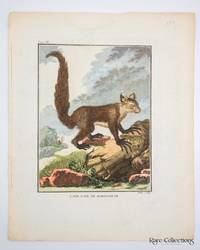
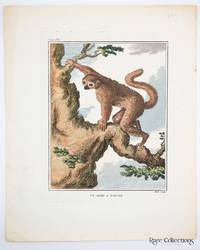
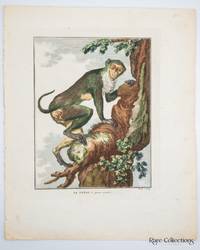
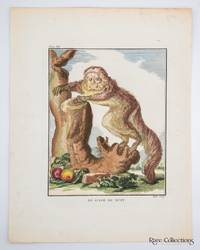
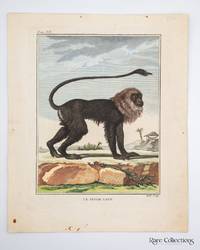
1801321821801. This plate is from the Dutch edition of Georges-Louis Leclerc Comte de Buffon's monumental work Histoire Naturelle engraved by Abraham Hulk after earlier plates. The "Tom. VII" at the top left indicates it belongs to Volume 7 of the Dutch translation De Natuurlyke Historie Printed in Amsterdam by Johannes Allart. Paper Size 290mm x 240mm and Plate size 185mm x 145mm. Hand-coloured copper engraving. unknown
1801321831801. This plate is from the Dutch edition of Georges-Louis Leclerc Comte de Buffon's monumental work Histoire Naturelle engraved by Abraham Hulk after earlier plates. The "Tom. VII" at the top left indicates it belongs to Volume 7 of the Dutch translation De Natuurlyke Historie Printed in Amsterdam by Johannes Allart. Paper Size 290mm x 240mm and Plate size 185mm x 145mm. Hand-coloured copper engraving. unknown
1801321811801. This plate is from the Dutch edition of Georges-Louis Leclerc Comte de Buffon's monumental work Histoire Naturelle engraved by Abraham Hulk after earlier plates.Printed in Amsterdam by Johannes Allart. Paper Size 290mm x 240mm and Plate size 190mm x 145mm. Hand-coloured copper engraving. unknown
1801321851801. This plate is from the Dutch edition of Georges-Louis Leclerc Comte de Buffon's monumental work Histoire Naturelle engraved by Abraham Hulk after earlier plates. The "Tom. VII" at the top left indicates it belongs to Volume 7 of the Dutch translation De Natuurlyke Historie Printed in Amsterdam by Johannes Allart. Paper Size 290mm x 230mm and Plate size 185mm x 145mm. Hand-coloured copper engraving. unknown
1801321841801. This plate is from the Dutch edition of Georges-Louis Leclerc Comte de Buffon's monumental work Histoire Naturelle engraved by Abraham Hulk after earlier plates. The "Tom. VII" at the top left indicates it belongs to Volume 7 of the Dutch translation De Natuurlyke Historie Printed in Amsterdam by Johannes Allart. Paper Size 255mm x 210mm and Plate size 185mm x 145mm. Hand-coloured copper engraving. unknown
1874C92582London: Oxford University Press 1874. Hardcover Hardcover. Very Good. Octavo. x 34 24pp. Blank leaf between each printed page. Black cloth with gilt spine titles. Slight fading and rubbing to corners otherwise very good. Owner details to half title. English and Hebrew text. Oxford University Press, hardcover
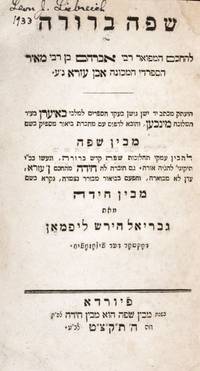
183922720Furth: Fulda and Zumfdorffer 1839. Hardcover. g. 8vo. 52 pages. Rebound in quarter cloth black paper covered boards. A Hebrew grammar book discussing the roles of the letters. Ibn Ezra is considered the father of Hebrew grammar even though he did not create anything new he collected the conclusions of early grammarians and he wrote in Hebrew making Hebrew grammer more accessable. This work not the first grammer book written by Ibn Ezra was the result of a student asking him to do so. This was orginally written between 1146-1147. This editon contains the commentary Mevin Safah by Gabriel Hirsch Lippmann introduction in German and the novella Sha'ar Binyamin published here for the first time a work by Abraham Benjamin Hamburg 1770-1850 German talmudic scholar whose disciples include Moses Sofer and Seligmann-Baer Bamberger. Signature of Leon Liebreich late professor of liturgy at Hebrew Union College on top left margin of title page. Hebrew title page with facing German title page. Slight staining and foxing with small waterstains to few pages. Lacking free rear endpaper. Closed tear on page 46 slightly affecting text. Text in Hebrew in 'Rashi Script.' Overall in good condition. Fulda and Zumfdorffer hardcover
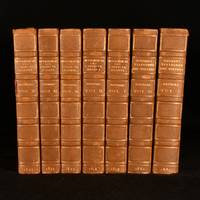
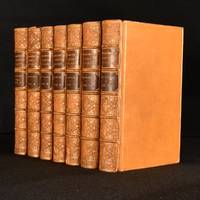
1858840T81London: Longman Brown Green Longmans and Roberts & John Murray 1858-1880. Leather. Very Good. 9" by 6". None. A very neat collection of seven volumes of work by Abraham Hayward. Five volumes of Biographical and Critical Essays Reprinted from Reviews with Additions and Corrections. Two volumes of Sketches of Eminent Statesmen and Writers with Other Essays. This work commemorates to a large extent personal friendships with such men as Dumas Cavour and Thiers whom he knew intimately. Written by Abraham Hayward an English man of letters who was one of the Athenaeum Club's most conspicuous and influential members. Bookplate to the front paste down of each volume showing that this collection once belonged to Sir William Eden 7th and 5th Baronet 1849-1915. Sir William was a British politician former colonel and local magistrate described as eccentric and often foul-tempered. He was also a talented watercolourist who exhibited regularly in London and Paris and a collector of Impressionist art. Rebound in brown half crushed Morocco and cream cloth boards. Marbled endpapers. Externally very smart. Light bumping to the extremities and the odd mark to the board. Internally firmly bound. Pages are bright and clean with minor age toning to the extremities. Previous owner's bookplate to front pastedown in each volume. Very Good Longman, Brown, Green, Longmans, and Roberts & John Murray hardcover
1858845A43London: Longman Brown Green Longmans & Roberts 1858-80. First edition. Leather. Very Good. 8.5" by 5.5". None . A collection of seven volumes in uniform Bowers bindings of the critical and biographical essays of Abraham Hayward. Three series in five volumes of Abraham Hayward's Biographical and Critical Essays reprinted from reviews with additions and corrections first edition of first series; second edition of second series; first edition of third series published from 1858 to 1874.Two volumes of Sketches of Eminent Statesmen and Writers with other essays first edition of 1880. Featuring biographies and critical studies of the likes of Sydney Smith James Smith Lord Melbourne M. de Stendhal Alexander Dumas and many others. Written by Abraham Hayward English man of letters conspicuous and influential member of the Athenaeum Club for nearly fifty years. In uniform full calf bindings signed Bowers & Co. From the library of Esher featuring armorial bookplates to front pastedowns. Half titles to Biographical and Critical Essays; Sketches bound without as called for. In uniform full calf bindings with five raised bands gilt tooling to spine titles in gilt to morocco spine labels marbled edges and endpapers. Externally smart with shelf wear light rubbing to spine joints and extremities. Internally firmly bound. Light minor spotting to first and last few leaves otherwise pages generally bright and clean. Very Good Longman, Brown, Green, Longmans, & Roberts hardcover
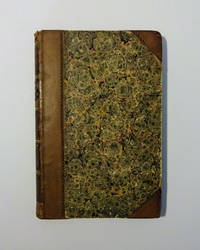
18528155<p>This is a scarce first edition copy of "THE ART OF DINING - or Gastronomy and Gastronomers" by Abraham Hayward. 1852 1st edition; John Murray; London. Nicely bound in three-quarter leather with marbled covers and page edges and gilt lettering on the spine. The book is smaller in size - it measures 6 3/8" tall x 4 1/4" wide.<br /><br />Here are some examples of the contents: History of Cookery from the Earliest Period to 1789 with Illustrative Anecdotes; Gastronomic Effects of the First French Revolution Including the Establishment of Restaurants; Accounts of the Celebrated Cooks of the Empire and the Restoration; Account of the Principal Restaurants of Paris with the Names of the Best Dishes and Wines at Each; Instructions for the Choice and Treatment of Cooks; Anecdotes of Napoleon; Origin of the "Cordon Bleu"; List of Foreign Delicacies; Comparative Merits of Male and Female Cooks; Importance of Punctuality Illustrated; Account of Some Famous Dinners in England; Directions for Simple Dining and for the Choice of Soup Fish Game &c.; Importance of Good Vegetables; Thoughts on Roast Pig; Reflections on Hams and Salads; Speculations Touching Pies and Puddings; Ditto on Wines and Punch.and more - please see the photos for the complete list.<br /><br />Condition:<br />Bits of the top leather layer have peeled from the spine see photo. Light wear to the cover corners. Chipping to the leather at the top edge of the spine. Tight binding with no loose pages. Both covers are firmly attached. Nice interior - the pages are clean with only an ink stamp at the top-right corner of the title page see photo. Book shop label affixed at the bottom edge of the rear pastedown. Overall the book is in Very Good- condition.</p> John Murray hardcover