775 résultats
188834892New York: North American Publishing Company 1888. Early Printing With portrait frontispiece and 27 full-page illustrations throughout including many facsimiles of Lincoln autograph letters and manuscripts. Thick 8vo original polished green cloth gilt lettered on the spine and upper cover and decorated on both covers with gilt emblematic devices. lxix 13656 pp. A handsome copy bright and with little evidence of wear or use with some overall evidence of age the binding tight and strong the text-block clean. Reminiscences of the President by distinguished men of the time. There are contributions by Ulysses S. Grant Frederick Douglas Henry Ward Beecher Walt Whitman Cassius Clay and many others. A touching tribute to the 16th President of the United States. North American Publishing Company hardcover
188832325New York: North American Publishing Company 1888. Early Printing With portrait frontispiece and full-page illustrations throughout including many facsimiles of Lincoln autograph letters and manuscipts. 8vo original polished green cloth gilt lettered and decorated on the spine and covers with emblematic devices. lxix 13656. A good copy with some wear and evidence of age and use to the extremities of the binding. Reminiscences of the President by distinguished men of the time. There are contributions by Ulysses S. Grant Frederick Douglas Henry Ward Beecher Walt Whitman Cassius Clay and many others. A touching tribute to the 16th President of the United States. North American Publishing Company hardcover
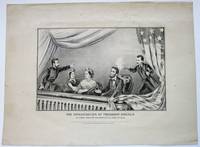
186537441New York: Currier & Ives. 152 Nassau Street 1865. Lithograph print oblong 13-1/2" x 18." Uncolored depicting Booth shooting Lincoln in the back of the head Mrs. Lincoln Miss Harris and Major Rathbone sharing the theater box with him. Minor dusting in the margins. Very Good plus.<br /> <br /> A related print by Currier & Ives lists the names of the occupants in the theater box. See 165 Eberstadt 460. This variant does not list the occupants' names.<br /> "This lithograph records the shocking moment when Abraham Lincoln was shot by John Wilkes Booth. As a famous actor Booth had free access to Ford's Theatre and had gone there to collect his mail on April 14 when he learned of the president's intention to attend a play that evening. Booth was the leader of a group of pro-Confederate conspirators determined to prevent the South's defeat and when Robert E. Lee surrendered to Ulysses S. Grant on April 9 they decided to kill Lincoln and other key Union leaders hoping to destabilize the war effort and allow Confederate armies still in the field to rally. Major Henry Rathbone who rises at left to restrain Booth was subsequently stabbed but survived. Lincoln died the next morning" The MET online.<br /> Currier & Ives Gallery C0291. Not in Reilly. Currier & Ives. 152 Nassau Street unknown
186580642New York:: Derby and Miller 1865. First edition. later 20th c. attractive rebinding in quarter gilt-lettered morocco and cloth sides. Bookplate or pocket removal on rear pastedown; no other institutional indicia; clean tight and sound. 8vo. With a Steep Portrait and other Illustrations. To Which are Added Anecdotes and Personal Reminiscences of President Lincoln by Frank B. Carpenter. Derby and Miller, hardcover
186412446Philadelphia: T.B. Peterson 1864. FIRST EDITION. Original printed wrappers lacking rear wrapper; front wrapper lightly chipped and soiled some occasional scattered foxing. Still a very good uncut copy. First edition of this scarce wrapper issue. Monaghan 366. T.B. Peterson unknown
186680753Springfield MAss.:: Gurdon Bill 1866. First edition. publisher's embossed leather. Spine a bit faded; leather scuffed at extremities; tight and sound. Contents fine. 8vo. Illustrated from engravings. Gurdon Bill, hardcover
1865102320<p> Newspaper 16" x 23" uncut six columns of text 8 pp. Folded at center some tears and a little loss of text at center fold but not significant other chips tears and folds mostly at extremities normal aging and darkening uncut and center pages probably never read; good or better for a newspaper and still very presentable.</p><p>Dated April 21 1865 this paper covers events of the Lincoln assassination Most of the front page and part of the last page are dedicated to Lincoln's death. The Herald discusses the eminent capture of John Wilkes Booth and gives an updat on Secretary Seward"s condition. The paper also carries a story on the conspiracy to kill Lincoln and an arrest made in Baltimore. The Herald gives a clear picture of a nation in mourning and the large crowds that turned out for a final viewing of the late president. An important piece of American History. </p>
1865102321<p> Newspaper 16" x 23" uncut six columns of text 8 pp. Folded at center some tears and a little loss of text at center fold but not significant other chips tears and folds mostly at extremities some aging and browning a little uneven darkening uncut and center pages probably never read; good or better for a newspaper and still very presentable. Dated April 26 1865 this paper covers events relating to the Lincoln funeral. The Herald reports that 750000 stood in silence during the funeral procession and that there were many disappointed mourners who didn't get a chance to join the 150000 that had a chance to make it to view the body. The paper gives details about the funeral procession and the final church services for the slain president. An important piece of American History.</p>
186085724Chicago: Charles Leib 1860. Very Good. Four-page newspaper. A couple of small holes various brown spots and other bits of minor wear A campaign newspaper for Abraham Lincoln in the Presidential Campaign of 1860. We note a half-column story on the front page of this issue that accuses Senator Douglas of being a Roman Catholic -- a charge based partly on the fact that Mrs. Douglas was a Catholic as were their children -- probably an effective charge in largely Protestant mid-19th century America. Our brief research suggests that Douglas was neither a Catholic nor a formal member of any other organized religious group. The purpose of another half-column story on the front page was to make it clear that Lincoln had publicly condemned the actions of John Brown and did not object to Brown's execution. Charles Leib the editor was a political operative with an unclear background who had previously edited a Democratic campaign newspaper on behalf of the Buchanan campaign in 1856. Leib served briefly as an Assistant Quartermaster in the Union Army before heading to New Mexico probably in 1863 and died there in 1865 at the age of 38. Charles Leib unknown
186482099New York:: National Union Executive Committee 1864. Creased where folded vertically and multiple times horizontally; some minor use to edges and a few tiny losses at folds; very attractive. . 11-1/2 x 8-3/4 inches. A Lincoln re-election broadside setting forth in detail and contrasting The Chicago Platform proposing "immediate efforts be made for a cessation of hostilities" and The Baltimore Platform "quelling by force of arms the rebellion." National Union Executive Committee, unknown
186412394Philadelphia: Union League of Philadelphia 1864. FIRST EDITION. Wrappers disbound; light soiling and toning. First edition of this scarce pamphlet published during the 1864 elections in support of re-electing Lincoln as President. Monaghan 359. [Union League of Philadelphia] unknown
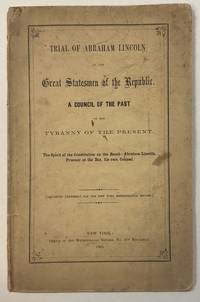
186340887New York: Office of the Metropolitan Record 1863. Original printed wrappers. Stitched. 29 1 blank 1- advertisement for 'The Washington Despotism Dissected' 1 blank pp. Light wear and fox. About Very Good.<br /> <br /> The Metropolitan Record whose Prospectus is printed on the rear wrapper calls itself "an unswerving opponent of fanaticism in every form and an advocate of constitutional liberty and the rights of the citizens against despotic usurpation." <br /> This pamphlet is "A mock trial wherein Lincoln was charged with treasonable intent purposes and designs and of having committed among other unconstitutional acts the following: 'Declared War against Sovereign States under pretence of repossessing himself of certain forts and other property; arresting citizens without process of law; suppressed liberty of speech; stopped publication of certain newspapers; placed the military power above the civil power; overthrown State Sovereignty; forced unconstitutional acts through Congress.' At the conclusion of the trial the Court addressed the 'Criminal' as follows: 'You have been tried and found wanting. You have been given the opportunity of saving a nation but you have stabbed it to the heart. You have converted your country into a despotism'." Eberstadt.<br /> "Quotations from Lincoln and others selected to discredit his administration" Monaghan. A second edition was printed in 1867. Sabin Monaghan and LCP do not collate the advertisement at page 31.<br /> FIRST EDITION. 111 Eberstadt 332. Monaghan 252. Sabin 41234. LCP 10399. Office of the Metropolitan Record unknown
1865106884<p>Newspaper 18 1/2" x 25 1/2" seven columns of text 4 pp. Folded at center another more subtle middle fold probably removed some chips tears and folds mostly at extremities some aging and browning a little uneven darkening ; otherwise about very good. Dated April 21 1865 this paper has several stories on the Lincoln assassination on the second and third pages of the newspaper. The articles include stories on the courage and determination of Secretary Stanton rewards posted for the capture of Booth and a nation in mourning. There is also a short report on the condition of Secretary Seward. Some interesting coverage of a national event in a local newspaper. </p>
1865biblio4<p> Newspaper 18 1/2" x 25 1/2" seven columns of text 4 pp. Folded at center another more subtle middle fold probably removed some chips tears and folds mostly at extremities some aging and browning a little uneven darkening ; otherwise about very good. Dated April 21 1865 this paper has several stories on the Lincoln assassination on the second and third pages of the newspaper. The articles include stories on the courage and determination of Secretary Stanton rewards posted for the capture of Booth and a nation in mourning. There is also a short report on the condition of Secretary Seward. Some interesting coverage of a national event in a local newspaper. </p>
1880771641880 Paris, Hachette, 1875, in 12 broché, 256 pages ; portrait en frontispicecouverture fanée.
1880F0812Paris, Calmann Lévy, Éditeur, ancienne maison Michel Lévy Frères, 1880 ; in-18, 4-324 pp., relié demi-cuir bleu foncé, dos orné à nerfs (intérieur: quelques rousseurs, plusieurs manques qui ne nuisent pas au texte). Anecdotes, sous forme de dialogue, des coulisses du théâtre. Bon état.
180360643Leominster Massachusetts:: by Adams & Wilder for Isaiah Thomas Jun. 1803. old full leather overlaid with an old sheep covering. . Free endpapers lacking front and rear; horizontal tear across the title page repaired with clear tape which has discolored; some moderate staining; binding very worn. 12mo. by Adams & Wilder for Isaiah Thomas, Jun., hardcover
182013545New York: C. S. Van Winkle 1820. First American Edition 1st Printing. Softcover. Good. 12mo 150pp. "From the London edition with alterations." A good copy bound in later 19th century plain card wrappers with yapped edges and inked title and the edges marbled. Some marginal staining. C. S. Van Winkle unknown
1821D19279New York: James Eastburn Literary Rooms 1821. First Edition. Hardcover. Good. 8vo Original plain boards stained printed paper spine label. Bookplate removed. Uncommon. <br /> <br/><br/> James Eastburn, Literary Rooms hardcover
1853293169London.: John Murray. 1853. 2nd Edition. Small 8vo. Finely bound by Hayday in tan calf raised bands gilt spine decorations in six compartments black spine label gilt ruled borders gilt dentelles on turn-ins marbled edges marbled endpapers. Very good spine head chipped otherwise near fine. 16.8x10.3x1.3 cm. A history of gastronomy by the sharp-witted essayist. This finely bound copy will make a nice addition to any gastronomy collection. weight: 0.5 lb. John Murray. hardcover
1808AQ26487Philadelphia: Printed by William Duane 1808. 123pp 1. Recent gilt-tooled half-half marbled paper boards contrasting dark green morocco lettering-piece to spine. Lightly rubbed and marked. Slight browning to title otherwise internally clean and crisp. The second edition of a report on America's roads and canals by Abraham Albert Gallatin 1761-1849 Genevan-American politician often termed 'America's Swiss Founding Father'. Gallatin's tremendous proposals included plans for a $20 million federal infrastructure program which would involve the construction of a canal through Cape Cod the connection of the Hudson River with the Great Lakes and a road linking Maine and Georgia. Ultimately Democratic-Republican pushback prevented his vision from being realised but he was granted the funds to construct the National Road America's first improved highway built by the federal government. . Second edition. 8vo. Printed by William Duane hardcover
1879774951879 Lyon, Brun, 1879, plaquette grand in 8° brochée, 23 pages ; couverture imprimée.
182045432London:: Reprinted for T. and H. Rodd 1820. First separate edition reprinted from the original in the British Museum; noted in Stow in his additions to Holinshed for the year 1577. original drab unprinted wrappers. Tiny chips to wrappers; light soiling; but very nice. 8vo. Reprinted for T. and H. Rodd, unknown
186358199Camp near Brooks Station Saturday April 11 1863. Fine original condition. 15-1/2 x 9-3/4 inches. ".Yesterday I witnessed one of the grandest sights that I ever beheld. Our whole corps was reviewed by the President Generals Hooker McLain Howard Steinway Secretary Seward and an innumerable host of Brigadier Generals and it was a sight that has paid me for coming to war." The spectacle is described in great detail. Private Penfield was soon to be captured at Chancellorsville spending 12 days as a prisoner of war before being exchanged. He survived the war to carry on his father's carriage making business in Monroe Connecticut and later founded a small private academy. unknown
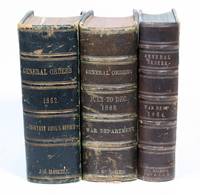
18622923Washington D.C.: War Department 1862. Calf marbled boards. Very Good. FIRST OBTAINABLE PRINTING OF THE PRELIMINARY EMANCIPATION PROCLAMATION setting a date for the freedom of more than three million enslaved in the United States and reframing the Civil War as a fight against slavery. Issued by the War Department to regimental commanders in the field during the Civil War in the week after the completion of President Lincoln’s official manuscript version. Contained is a set of three volumes of General Orders covering the full year 1862 July-Dec 1863 and the full year 1864. History of the Emancipation Proclamation:<br /> <br /> “The proclamation has been called by responsible persons one of the three great<br /> documents of world history ranking with Magna Carta and the Declaration of<br /> Independence†– Eberstadt<br /> <br /> “From the first days of the Civil War slaves had acted to secure their own liberty. The Emancipation Proclamation confirmed their insistence that the war for the Union must become a war for freedom. It added moral force to the Union cause and strengthened the Union both militarily and politically. As a milestone along the road to slavery’s final destruction the Emancipation Proclamation has assumed a place among the great documents of human freedom†– National Archives<br /> <br /> Following the Seven Days Battle and General McClellan’s retreat from the Peninsula at the end of June 1862 President Lincoln realized that there would be no early end to the war and found himself “as inconsolable as it was possible for a human to be and yet live.†Anxious for news from the army and needing to escape the constant interruptions at the White House he frequently visited the telegraph office in the War Department building to await dispatches. It was during one such visit early in July that he asked the chief of the telegraph staff Major Thomas Thompson Eckert for some paper to “write something special†and began the first draft of the Emancipation Proclamation completing it in a few weeks. Lincoln had long hoped to resolve the slavery issue through a congressional act of emancipation compensating slave owners for their loss of “property†but that approach was roundly rejected by representatives from the border states leaving the President who had decided upon the necessity of emancipation with a presidential proclamation as the only option. The extraordinary document he conceived would announce the liberation on January 1 1863 of all slaves in those states still in rebellion against the Union and promised compensation to slave owners in those states that returned to the fold before that time if they adopted “immediate or gradual abolishment of slavery.†This proclamation would be followed by a final proclamation issued on the 1st of January identifying those states still in rebellion and confirming the liberation of all slaves therein.<br /> <br /> On Tuesday July 22 Lincoln presented his draft to the Cabinet telling them that he had resolved firmly upon the course of action it specified and asking them not for advice but suggestions. The only observation he had not anticipated came from Secretary of State Seward who proposed that it might be best to wait for a military victory before issuing the Proclamation as it could otherwise seem like “the last measure of an exhausted government.†Immediately recognizing the wisdom of the suggestion Lincoln held back. On September 17 after an anxious wait of nearly two months he received the victory he needed at the bloody Battle of Antietam. Completing his final draft Lincoln presented it to his cabinet for refinement on September 22. Following the meeting Seward took the amended draft with him to the State Department where a formal manuscript copy was made then signed by Lincoln and Seward. The formal official “Emancipation Proclamation†was of course issued on January 1 1863 the day it became the law of the land.<br /> <br /> Printing History:<br /> <br /> This printing in the War Department’s official “General Orders†is the fourth printing overall but realistically the first obtainable printing. It is preceded by:<br /> <br /> -The first printing Eberstadt #1 a small three-page circular intended for distribution within the government and to the local press likely printed on September 22. At the time that Charles Eberstadt published his study of the Proclamation 1950 he was able to locate only one copy which he himself owned and as nearly as we have been able to determine no other copies have come to light since then.<br /> <br /> -The second printing Eberstadt #2 may be a phantom printing. Charles Eberstadt was not able to locate a copy but he inferred its existence from the standard State Department practice of printing a folio edition consisting solely of the text of the proclamation followed by another printing consisting of the text of a letter of transmittal from the Secretary of State as well as the text of the proclamation. While there may be a copy of Eberstadt #2 in the National Archives as he speculated it is not recorded in their online catalogue nor have we been able to find a copy in any other online catalogue including OCLC the Library of Congress and the Abraham Lincoln Library.<br /> <br /> -Eberstadt’s third printing is of legendary rarity. It consists of Secretary of State Seward’s one-page letter of transmittal addressed “To the Diplomatic and Consular Officers of the United States in foreign countries†and the text of the proclamation. Eberstadt located a total of only five copies in institutions at the Library of Congress the National Archives Yale the Clements Library and Brown. OCLC does not record any additional copies nor is it recorded in Monaghan. There has been one copy at auction $400000 in 2021 and that was described as the only copy in private hands. <br /> <br /> -The present copy General Orders No. 139 is Eberstadt’s fourth printing of the Preliminary Emancipation Proclamation dated in print on September 24. Eberstadt surmises that this field order printing could have been accomplished as late as September 29 or 30. Although it may have been printed in as many as 15000 copies it is very rare in commerce likely due to the ephemeral nature of the printing and distribution.<br /> <br /> Additional General Orders and Provenance:
<br /> <br /> The three volumes once belonged to John G. Haskell A.Q.M. Chief Quartermaster and contain the General Orders for the year 1862 July-December only for the year 1863 and for the full year 1864. John Gideon Haskell 1832-1907 was a resident of Kansas and joined the Union Army when the war broke out. He enlisted with the 14th Kansas Volunteer Cavalry Regiment and later served as Assistant Quartermaster General of Kansas as quartermaster of the Third Kansas and the Tenth Kansas Volunteers as Captain and Assistant Quartermaster on the staff of General James G. Blunt and as Chief Quartermaster of the Army of the Frontier. After the war Haskell was named official state architect and worked on the state house the capitol the State University and more.<br /> <br /> In addition to the preliminary Emancipation Proclamation the three volumes also contain the Acts of Congress on many other subjects including pay discharge recruitment handling of troops etc.<br /> <br /> Washington D.C.: War Department Adjutant General’s Office 1862-64. Three volumes. Small octavo contemporary three-quarter brown morocco two volumes with cloth boards one with marbled boards. Some rubbing and wear to bindings pencil notations on endpapers with collation and highlighting certain orders and some internal pages. Dampstaining to general title of 1862 volume; internal text and Emancipation Proclamation generally fine. RARE AND IMPORTANT.<br /> <br /> References:<br /> <br /> Charles Eberstadt. “Lincoln’s Emancipation Proclamation.†New York: 1950. War Department unknown