Anscher AbrahamABAA

987 résultats
18843195451884. 295pp. plus five additional letters totaling 60pp. altogether more than 38000 words. Composed mostly on small octavo sheets. Some wear to edges of initial and final few leaves slightly affecting text. Light even tanning. Written in a consistent legible script. Overall very good. 295pp. plus five additional letters totaling 60pp. altogether more than 38000 words. Composed mostly on small octavo sheets. An extensive and outstanding manuscript account of travel and exploration in southern Africa during late 1883 and early 1884 by Abraham Anscher a Polish Jewish immigrant to Chicago. The manuscript is composed in the form of a letter addressed to Edith Delia Rogalski but really comprises a travelogue or diary with entries written from September 1883 to mid-January 1884. Five additional letters accompany this account addressed to Edith's later husband Israel Jackson Roe; her parents Samuel and Sarah Rogalski; and her brother Benny. <br/> <br/>Anscher's descriptions of his experiences in Africa cover a wide variety of topics including big game hunting; interactions with local indigenous peoples and their rulers; encounters with white missionaries traders and other hunters; ethnographic botanical geological and zoological observations and much more. His account is by turns dramatic and amusing interspersed with personal recollections of family and home cultural and religious notes his addressee was also a Polish-speaking Jewish immigrant to Chicago and reminiscences of earlier adventures in Colorado Utah the California gold fields and elsewhere.<br/> <br/>Little can be readily discerned of the details of Anscher's biography beyond the pages of this manuscript. He was born in Mariampol then a part of Poland and today in Lithuania but clearly came to the United States at an early age and was well-educated. He was an adventurer at heart and spent several years in the West perhaps in the U.S. Army for part of this time and partly as a solo fortune seeker. At some point during the mid- to late-1870s he decided to take his adventuring talents to South Africa in order to satisfy his own wanderlust and to create a business of organizing guided African exploration and hunting. The stakes of his chosen profession are mentioned several times throughout his narrative such as when a party member dies of an unspecified illness "My lot is a very hard one just now and my position as promoter and chief adventurer is anything but enviable". From the additional letters present it is apparent that the young Ms. Rogalski was a former love interest of Anscher who spurned his affections and became engaged to a mutual friend. Indeed a letter here addressed to the fiancé offers an apology for the presumption of writing to Edith in such a lengthy and cordial manner; at one time all of the individuals addressed by Anscher were a part of the same immigrant community in Chicago.<br/> <br/>This absorbing account follows a lengthy excursion organized and led by Anscher across the Transvaal through Bechuanaland Matabeleland and beyond to a settlement he calls Tatti probably Francistown on the Tati River traveling through parts of modern-day South Africa and Botswana. They contain many details of great interest and his vignettes are well-written and dramatically delivered. An immense boa constrictor drops out of the treetops strangling a springbok before his eyes. He finds a five-year-old girl with a broken leg the only survivor of a village massacre; he sets her leg nurses her for a month and eventually conveys her to a missionary station. A young zebra joins the traveling party incurring the jealousy of the team's dogs. A large lizard is trained to sleep in a tent but only after his teeth are removed for safety. <br/> <br/>His missive begins in medias res with his party already underway in South Africa near the Orange River in what he calls the "Tarka bush" during mid-September 1883. Anscher decides having missed his last opportunity to send mail "Now to put myself on guard against mischance and not be like the traditional foolish virgins who did not keep their lamps properly trimmed.to have a so-called running letter always open and ready" for his recipient. The group first traveled northeast near and along the Orange allowing Anscher to wax discursive concerning the river's wildlife:<br/> <br/>"The wanderings of the river sometimes flowed through immense chasms over hung with stupendous precipices and then like a translucent lake with beautiful towering mimosas and willows reflected from its bosom and a rich variety of fine plumage though without a song; wild geese ducks snipes flamingoes in perfect security feeding on the banks beneath the green shade or basking in the sun's rays on the verdant islands far from the fowler's snare. The swallows also mounting aloft or skimming the surface of the mirror of the stream; while the ravens with their hoarse note might be seen seeking their daily food among the watery tribe or cawing on the bending tops of the weeping willows."<br/> <br/>The party leaves the river and skirts the southern edge of the Kalahari to reach Lattakoo modern-day Dithakong a traditional departure point for excursions deeper into the interior of Africa during the 19th century. Thence they headed north again stopping often to hunt for food and sport:<br/> <br/>"When on the Kama plains I went one night accompanied by Tytler and Winsloe and one native to a pool of water about two miles from camp. We did not wait more than about half an hour when we heard loud lapping at the water. The natives told me 'Ronimala ' be silent 'There is a lion." Our next visitors were two buffaloes but we did not fire lest we attract the attention of the lions. Next came three giraffes and one we knocked over on the spot and wounded another but who got away. I have seen plenty of game in my time. I saw and hunted antelope and elk on the Laramie plains and in the Meek Mountains in America before the Union Pacific RR was built. I saw quite enough of buffalo in the Smokey Hills and Montana as well as south of the Green Horn Mountains between California and Arizona but such a variety of game big game and in such number as I saw some years ago in the Transvaal & Swaziland and hereabouts now I never saw anywhere."<br/> <br/>As the excursion proceeds further into the interior their encounters with native tribes increases and Anscher observes them keenly and reports with a detailed if somewhat jaded 19th-century eye:<br/> <br/>"The town of Kalabeg is already in the Matabele country. Of course they have no religion of any kind for there is no such thing as natural religion. Men acquire knowledge good or bad from instruction of men with more fertile brains. This holds good all the world over. The rainmakers here hold the position of prophets and divines of the so-called civilized countries. These rainmakers who are also the doctors and sextons have great influence over the minds of the people and are held in great estimation by them superior to that of their king who is likewise compelled to yield to the dictates of this personage the rainmaker. Nothing can exceed the freaks of fancy and the adroitness with which the rainmaker can awe the public mind and lead thousands captive at his will. Each tribe has one or more of them and they generally come from other countries for a prophet is seldom honored in his own country."<br/> <br/>Arriving in Shoshong in what is now central Botswana Anscher meets some missionaries and witnesses a tribal gathering which leads him to remember the religious theories of a familial acquaintance back home:<br/> <br/>"Was present at a Pitsoh or native congress this forenoon held by the natives about some tribe affairs. About 12000 natives present and wound up the proceedings with a war dance. As these tribes are considered by some religious enthusiasts to be of the lost tribes of Israel not your own but ours and as your uncle once spoke to me about them while at Chicago I would therefore request you to kindly tell him to disabuse his mind on this point and that the only peg whereon the so-called lost tribe maniacs hang their argument in favor of their hobby is that the natives practice a certain custom which history attributes to our father Abraham. But this ceremony takes place instead of at the age of 7 days old when they are about fourteen years old and even when older. But they have no tradition as to why it is done. If this simple custom entitles them to be call Jews why for my part they are quite welcome to the honor. But this is about all there is to build the theory on." <br/> <br/>Despite his occasionally sarcastic and somewhat disparaging demeanor toward the natives he encounters Anchser seems overall to have a decent connection with them at a personal level and to understand a basic sense of shared humanity. In one particularly poignant episode Anscher meets a mother and father who have walked 300 miles to ransom their two teenaged sons enslaved by a local chief: <br/> <br/>"Neither the man's looks nor ornaments excited the smallest emotion in the bosom of the chief and when he was solicited by one who felt something of a father's love to pity the old man who had walked so far and brought his all to purchase his own children he at last replied with a sneer that one of the boys died last year and for the other he wants an ox at least. 'But I have not even a goat' pleaded the old man 'the Matabele have taken all I had and destroyed my hut.' A sigh it was a heavy sigh burst from his bosom one dead and the other not permitted to see anymore. The chief walked off while the man sat leaning his head on the palm of his hand and his eye fixed on the ground apparently lost to everything but his grief. On taking up his trinkets to retire I told him to keep up a good heart that I would try to get him his boy. He started at the sound of my voice kneeled before me and laid down his trinket saying 'take all this but get me back my boy.' I got him his boy for a colored blanket and 1 lb. of tobacco."<br/> <br/>When sad and homesick Anscher recalls his time in Chicago and in the West but it is often insufficient comfort. After departing Shoshong for Tatti Anscher must leave his group to "pioneer" a trail to the settlement:<br/> <br/>"On the evening of my first day's journey I had to off-saddle a term used here on a waterless plain picketed my horse and went to bed minus my supper or dinner. I awoke suddenly by something touching me on my forehead like the cold nose of a dog but I could see nothing in the dark except my horse who was laying down poor fellow. After this occurrence I could sleep no longer. My head was hot my lips parched and had no taste even for a cigarette. I daresay some of you have experienced waiting for a train early in the morning in some out of the way small RR station where moments appear like days. Well waiting there is not a patch to lying in the dark in Africa's solitude waiting for daylight to come. I tried to divert my mind and think of anything but water but I could not do it! I tried to cool myself by thinking of Chicago in the month of Feb. but that only led me to snow and from snow to water. One may as well try Ovid's 'Remedia Amoris' to cure him from hankering after the girl he loves as to try Chicago in my case as a remedy when thirsty." <br/> <br/>The difficulties of obtaining food and water establishing safe camp and finding routes through minimally charted territory evident in this final passage are an ever-present theme of the expedition but Anscher eventually guided his group to their destination where they intended to stay for a month or two before heading further north to Victoria Falls on the Zambezi River. The final entries describe life at the settlement and how a Portuguese colonial explorer and administrator Alexandre de Serpo Pinto whom they met in camp would be entrusted with the present manuscript as he traveled to Namaqualand on the west coast of Africa in the hopes that it would eventually find its way aboard a ship bound for America. Pinto was a fascinating figure in his own right -- he explored the interior of Africa for Portugal in the 1860s and 1870s and after this meeting with our author became the Portuguese Consul in Zanzibar.<br/> <br/>Anscher's trail goes somewhat cold after January 1884 when he relinquished control of this massive "running letter." An additional fragment of a later letter to Edith Rogalski included here forwarded via a mining acquaintance in Kimberly contains a few tantalizing details of his onward expedition including an attack on their party near Victoria Falls by a group of slavers led by "an American Negro." He was also working on a journal and taking photographs which are mentioned several times throughout this account but the survival of this other material as well as the ultimate conclusion of this expedition are not known. A wonderful unpublished account of African exploration by a seemingly unlikely and apparently otherwise unknown American character. unknown books
191819741Boston: The Stratford Company Publishers 1918. First American Edition. First Printing. Slim octavo 20cm; beige paper-covered boards with titling and rule printed in dark brown on front panel; dustjacket; 58pp 6 ads. Light wear to crown with faint sunning to board edges; Near Fine. Dustjacket shows light edgewear with tiny chips at spine ends and old partial sticker removed from 25c price at base of spine; flaps trimmed presumably as-issued; Very Good. Apparent first appearance of each story in English a joint publication by The Stratford Universal Library. Both Lazarus and The Gentleman from San Francisco are early works in translation for Andreyev and Bunin. Bunin whose style was deeply rooted in the Russian folkloric tradition had the distinction of being the first Russian to win the Nobel Prize in Literature. An especially scarce title in dustjacket. The Stratford Company, Publishers unknown books
167719726Paris: Frederic Leonard 1677. 16mo. Engr. t.-p. 6 1 pp. 7 6 ff. 211 3 pp. 1 f. 550 pp. 19 ff. 237 3 pp. <br><br>The main title-page is engraved with the title printed above the illustration.<br>Â Â Â Â There are special title-pages and paginations for "Examen de la liberté originaire de Venise. Traduit de l'Italien. Avec une Harangue de Louïs Hïlian . Traduite du Latin. Et des Remarques Historiques. Sur la copie a Ratisbonne Chez J. Aubri . 1677"; "Histoire du gouvernement de Venise avec le supplement; par le sieur Amelot de la Houssaie. Et l'examen de la Liberté originaire de Venise. Sur la copie a Paris; Chez Frederic Leonard . 1677"; and "Suplement a l'Histoire du gouvernement de Venise. Par le sieur Amelot de La Houssaie. Sur la copie a Paris chez Frederic Leonard . 1677."<br>Â Â Â Â "Examen de la liberté originaire de Venise" is a translation by Amelot de La "Houssaye of Squitinio della liberta veneta" which is attributed to Marcus Welser Alfonso de la Cueva and others. Contemporary calf modest gilt tooling on covers spine tooled in blind and with raised bands. Leather cracking and with thumbnail-sized chip on spine; some loss of leather on front cover and at head and foot of spine; and front joint starting. Bookplate on front pastedown and a couple of ink notations by an early owner at bottom of engraved title-page. Endpapers with heavy brown stains along edges but pages overall clean. Frederic Leonard hardcover books
1949SFK519-1011New York NY: The Typophiles 1949. Hardcover. Very Good. Series: Typophile Chapbook No. XXII. LIMITED EDITION of 1250 copies designed by W. A. Dwiggins printed and bound at the Plimpton Press Norwood MA. 12mo. 7 1/4 x 4 11/16 inches. vi 41 13 pp. Half-title frontispiece caricature headpiece 4 ff. of printer's marks from the Borzoi Kennel printer's device on colophon; text clean unmarked. Blind- and gilt-stamped red cloth clear plastic dust jacket; binding square and tight jacket lightly toned chipped. Muir Dawson's copy without distinguishing mark. SFK519-1011. Very Good. The text is in Linotype Arcadia a type designed by W. A. Dwiggins and used here for the first time. Alfred Knopf reminisces about some publishing experiences before the AIGA Type Design Exhibit for members of the Grolier Club. REFERENCE: Rathe Bibliography of the Typophile Chapbooks No. 22. The Typophiles hardcover books
1795M3955Jena:: Fiedlerianis 1795. 1795. 232 x 197 mm. Small 4to. iv iv 46 ix pp. Foxed. Self wraps; last few gatherings loose. Ex library rubber stamp on title. Very good. Albers' dissertation on dropsy of the belly. Johann Abraham Albers studied under J. C. von Loder and Chistoph Wilhelm Hufeland 1762-1836. Hirsch I pp. 80. Not in RLIN. Fiedlerianis, 1795. paperback books
1947018797Philadelphia: Dropsie College for Hebrew and Cognate Learning 1947. Rabbi Agus received his Ph. D. from Dropsie based on this massive work. He later served as dean of the Harry Fischel Research in Talmudic Studies in Jerusalem. Vol. I xxxiii 392p Digest of Responsa Text Ora Hayym Yoreh Deah Eben Haezer with details reflecting how the strict observance of the Talmud allowed Jews to maintain their traditions. Volume II 1 395-749 continues with Hoshen Mishpa and has a detailed series of appendices glossary and bibliography. There is also an index to the Responsa. Bound in dark blue cloth spine lettering giltA scarce set in very good condition. Dropsie College for Hebrew and Cognate Learning unknown books
1964163490Baltimore: Murphy Fine Arts Center Gallery 1964. Paperback. VG-. Some shelf wear; some pencil writing on cover and first page. Otherwise contents are clean and tight. Small gray stapled wraps with white lettering. 12 pp. 4 BW illustrations. Catalogue of an exhibition held from November 1-25 1964. Murphy Fine Arts Center Gallery paperback books
1928134096London: John Tiranti & Co 1928. Revised edition. Hardcover. Good only ex-library with expected marks. additionally all plates are marked with a library ink stamp. wear and soiling to cloth including fraying at corners and spine ends. feps slightly chipped at edges. slight dampstain to very outer edge of pages. hinges loosening . Grey cloth. Foreword and table of contents followed by 64 bw plates. Oversize. Selection of reprint plates drawing from Swan's works 1 The British Architect of the Builders Treasury of Staircases 2 A Collection of Designs in Architecture 3 Designs in Carpentry or the Carpenters Complete Instructor and 4 Designs for Chimnies. John Tiranti & Co hardcover books
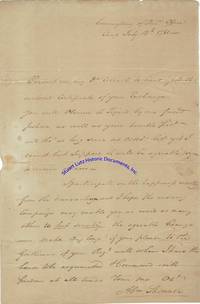
5036AMERICAN REVOLUTION PRISONERS OF WAR. ALS. 1pg. 8 ¼†x 12 ½â€. July 12 1781. Commissary of Prisnrs. Office Phillipsburg New York. An autograph letter signed “Abm Skinner†the American Commissary General of British prisoners of war. He wrote to an unidentified man: “Permit me my Dr. Colonel to hand you the inclosed Certificate of your Exchange. You will observe it Signed by our friend Joshua Loring British commissioner for prisoners as well as your humble Servt. and tho as long since as Octobr. Last I cannot but Suppose it will be agreeable to you to receive it now. I participate in the happiness resulting from the transaction and I hope the ensuing Campaign may enable you as well as many others to feel sensibly the agreeable Change - make my Compts. if you please to the Gentlemen of your Regt. with whom I have the honor to be acquainted…â€. The letter is docketed in an unknown hand on a stub remnant most likely by the gratified Colonel. The letter is tanned there are some spots and there is a minor repair to the verso. unknown books
196743623Baltimore MD: Har Sinai 1967. First Edition. First Edition. Fine with no dust jacket. Har Sinai unknown books
1828009569This ciphering book measures 8" x 12.5". It contains 92 pages of ciphering work. There is also an additional 36 pages of text in a different hand perhaps by a sister copied from Timothy Shay Arthur's <i>Advice to Young Ladies</i> and the American Tract Society's <i>Helps for Every Hour</i>. Quarter-bound with marbled boards. The owner's label reads "Abraham Rex / Philadelphia / 1828." An 8.5" x 4" pencil drawing copied from <i>The Tours of Dr. Syntax</i> is laid in. <br /><br />Ciphering books were prepared as part of the basic mathematical training of relatively well-off American students usually boys. Most like this one contain examples of the Numeration Addition Subtraction Compound Multiplication Reduction Compound Reduction Rule of Three Indirect Proportion Vulgar Fractions Compound Proportions The Double Rule of Three Avoirdupois Weight Troy Weight Long and Land Measure etc. <br /><br />In addition to providing mathematical basics boys venturing into trades or businesses needed advanced or specialized training in mathematics. In this case Abraham's book includes some work that would prepare him for mercantile positions including Tare and Tret calculating weight adjustments for packing and shipping materials Insurance Commissions and Brokerage Compound Interest Rebate or Discount Equation calculating combined payments Barter Loss and Gain Fellowship calculating complicated partnership percentages etc. <br /><br />Abraham was a member of a prominent and prosperous Pennsylvania Dutch family. Online genealogical records show that the Rüx anglicized to Rex family immigrated to the United States sometime prior to 1720 and settled in Germantown north of Philadelphia. The family soon moved westward to Schaefferston in Lancaster County where it proliferated and prospered with members becoming merchants innkeepers informal bankers brokers pharmacists and physicians. <br /><br />For more information about the Rexes of Schaefferstown see Wenger's <i>Delivering the Goods: The Country Storekeeper and Inland Commerce in the Md-Atlantic</i>. An archive of Rex family business papers is held by the Winterthur Library. <br /><br />For more information about ciphering books see Kilpatrick's <i>Rewriting the History of School Mathematics in North America . . . The Central Role of the Cyphering Books</i> Doer's master's thesis: <i>Cipher Books in the Southern Historical Collection of the University of North Carolina</i> and Andries's "Learning Mathematics in North America" at the University of Pennsylvania's Kaplan Collection of Early American Judaica. <br /><br />18th-century American ciphering books are scarce as the overwhelming majority of extant examples date from the early 1800s into the mid-1850s. hardcover books
2006UYIGI-3Oxford etc.:: Oxford University Press 2006. First Edition. Hardcover. Very Good/Very Good. First Printing. With Supplemental Material by Robert P. Crease. 8vo. xxii 353 pp. Black-and-white plates index; text clean unmarked. Quarter cloth gilt-titled spine dust-jacket; binding square and tight the jacket has very minor shelf wear and creasing otherwise appears to be a beautiful unread copy. Very Good plus. This book is the most comprehensive biography of J. Robert Oppenheimer available told with compassion and insight by Oppenheimer's colleague and friend Abraham Pais. Oxford University Press, hardcover books
1705WN63455Amsterdam: Pierre Mortier 1705. Vellum binding with handwritten spine titling. Sprinkled edges. Vellum quite soiled and separating from rear board at the foreedge. Name and neat handwritten notes on preliminaries. Large work in 3 volumes with many plates and foldouts etc. Very controversial in its criticism of the Venetian Republic enough so that its French author was sent to the Bastille albeit briefly. Later Edition. Vellum. Fair/No Dust Jacket. 16mo - over 5¾" - 6¾" tall. Trade. Pierre Mortier Hardcover books
19035344Beautiful full brown leather with gilt detailing and rule to boards and spine; decorative red labels to boards and spine; 5 raised bands. Elaborately designed doublures with gilt dentelles. Silk fly sheets. "The Delphic Edition of The Breviary Treasures consists of 475 copies printed on French hand-made paper of which this copy is Number 94." xii 214 pp. 6 3/4 x 9 1/4 inches. Nathan Haskell Dole hardcover books
1838WN61677XNew York: Robinson and Franklin 1838. Full calf with gilt rules and lettering in red morocco label on spine. All edges sprinkled. Owner name in pencil on ffep. Text block is extensively foxed. Fascinating lectures on a range of subjects pertaining to rhetoric literature etc. Third Edition. Full Leather. Poor/No Dust Jacket. 12mo - over 6¾" - 7¾" tall. Learned. Robinson and Franklin Paperback books
1838WN61677New York: Robinson and Franklin 1838. Full tan calf with gilt spine lettering on red morocco label and gilt rules. Edges sprinkled. Spine edges and corners with moderate wear. Text block has fair amount of browning and foxing. Owner pencil signature on ffep. Unusual combination of technique and criticism regarding writing and literature. Third Edition. Full Leather. Good/No Jacket. 12mo - over 6¾" - 7¾" tall. Trade. Robinson and Franklin Paperback books
186425614<p>The second in a series of four racist political cartoons published in 1864 by Bromley & Company which was closely affiliated with the Copperhead New York <i>World</i> newspaper. These prints sought to undermine Abraham Lincoln's chances for reelection by branding him as a "miscegenationist" and playing on white fears of "race-mixing." The cartoon scene pictures several interracial couples enjoying a day at the park eating ice cream discussing wedding plans and a woman's upcoming lecture. Two African American families have white employees a carriage driver and footmen and a babysitter.</p><p>The only other example traced at auction brought $7800 in 2010.</p> <b>ABRAHAM LINCOLN. RACISM.</b>Print. "Miscegenation or the Millennium of Abolitionism." Political Cartoon. New York: Bromley & Co. 1864. 1 p. 20¾ x 13â… in.<p><br /></p><p>American politics had long played on fears of sexual relationships between races. A powerful new word for "race-mixing" was coined in an anonymous December 1863 pamphlet entitled <i>Miscegenation: The Theory of the Blending of the Races Applied to the American White Man and Negro</i> published in New York. Purporting to advocate the virtues of the "blending of the white and black races on this continent" it was a literary forgery prepared by <i>The World</i> managing editor David Goodman Croly and reporter George Wakeman. The authors were unsuccessful in their attempt to trick President Lincoln into endorsing the work.</p><p>At the far left of the image Abraham Lincoln declares "<i>I shall be proud to number among my intimate friends any member of the Squash family especially the little Squashes.</i>" The African American woman to whom he is speaking replies "<i>I'se 'quainted wid Missus Linkum I is washed far her 'fore de hebenly Miscegenation times was cum. Dont do nuffin now but gallevant 'round wid de white gem'men! he-ah! he-ah! he-ah!</i>"</p><p>Senator Charles Sumner says "<i>Mr. President! Allow me the honor of introducing my very dear friend Miss Dinah Arabella Aramintha Squash.</i>" A white carriage driver complains in the background "<i>Gla-a-ang there 240t! White driver white footmen niggers inside my heys! I wanted a situation when I took this one</i>" while a black man in the carriage tells his companion "<i>Phillis de_ah dars Sumner. We must not cut him if he is walking.</i>" A black woman at a table tells a white man with her "<i>Ah! Horace its-its-its-bully 'specially de cream</i>" and he replies "<i>Ah! my dear Miss Snowball we have at last reached our political and social Paradise. Isn't it extatic</i>"</p><p>To the right are two couples embracing each a white woman and an African American man. The first white women tells her partner "<i>Oh! You dear creature. I am so agitated! Go and ask Pa</i>" to which he replies "<i>Lubly Julia Anna name de day when Brodder Beecher shall make us one!</i>" The second white woman says "<i>Adolphus now you'll be sure to come to my lecture to morrow night won't you</i>" to which he answers "<i>I'll be there Honey on de front seat sure!</i>" In the background are various immigrant minorities viewing the scene. One exclaims "<i>Most hextwadinary! Aw neva witnessed the like in all me life if I did dem me!</i>" and another adds "<i>Mine Got vat a guntry vat a beebles!</i>" An Irish girl complains "<i>And is it to drag nagur babies that I left old Ireland Bad luck to me.</i>"</p><p>Manton Marble the editor of <i>The World</i> collaborated with printmaker Bromley & Company to issue a series of four anti-Lincoln "Political Caricatures." The present example was the No. 2 in that series. No. 1 was "The Grave of the Union or Major Jack Downing's Dream"; No. 3 "The Abolition Catastrophe Or the November Smash-up"; and No. 4 "The Miscegenation Ball."</p><p>Republicans responded by trying to turn the "miscegenation" charge against the Democrats. A Republican print "The Political "Siamese" Twins: The Offspring of Chicago Miscegenation" pictures McClellan and Pendleton joined together despite their very different ideas on ending the war.</p><p>Although Abraham Lincoln won New York states' electoral votes in 1860 Stephen Douglas had carried New York City and its environs. Financial elites fearing that civil war would ruin business and recent immigrants fearing competition with free black labor supported Douglas. Lincoln's unpopularity in New York City during the Civil War was a factor in the deadly 1863 Draft Riots.</p><p>In 1864 Lincoln again won the states' electoral votes while New York City favored his Democratic opponent McClellan. In fact Lincoln's majority dropped from 50136 votes in 1860 to only 7373 votes in 1864 with approximately 50000 more total votes cast than in 1860.</p><p>Bromley and Company continued to sell the caricatures after the election as this January 1865 advertisement from an Ohio newspaper makes clear. Another advertisement assured purchasers that the set of four prints available for $1 were "sent on wooden rollers to insure safe carriage."</p><p><b><i>The World</i></b> 1860-1931 a daily independent newspaper was published in New York City. Alexander Cummings founded it as a religious Republican outlet in 1860. August Belmont and others purchased it in 1862 changing the editorial focus. With editor Manton Marble 1834-1917 <i>The World</i> soon became the country's leading Democratic newspaper. In 1864 Union authorities shut down <i>The World</i>and another paper for three days after they published forged documents purportedly written by Lincoln that were really part of a hoax to manipulate the price of gold. The paper actively supported George B. McClellan against Lincoln in 1864.</p><p><b>Condition</b></p><p>Fine for exhibit despite flaws. Cropped with loss of "Political Caricature No. 2" from top edge and part of printed pricing information from bottom edge publisher's name rubbed out from the copyright statement lacking ½" from lower left corners a few short tape repairs by the edges a 2" closed tear through the second dialogue bubble along the top edge and a 3" closed tear parallel to the right edge. Mount remnants on verso.</p> books
186124870<p>"<i>The Sanitary Commission is … of direct practical value to the nation in this time of its trial. It is entitled to the gratitude and confidence of the people… There is no agency through which voluntary offerings of patriotism can be more effectively made. A. Lincoln.</i>"</p> <b>ABRAHAM LINCOLN. HENRY W. BELLOWS.</b>Printed Circular Letter to "<i>the Loyal Women of America</i>." Washington D.C. October 1 1861. 3 pp. 8 x 10 in.<p><b><br /></b></p><p><b>Historical Background</b></p><p>The United States Sanitary Commission USSC was a private relief agency to support sick and wounded Union soldiers and sailors. The idea began at a meeting of the Women's Central Relief Association of New York in April 1861 and was modeled on the British Sanitary Commission which operated during the Crimean War. The USSC set up and staffed hospitals and operated thirty soldiers' homes lodges and rest houses for traveling and disabled Union soldiers.</p><p>This circular urges American women to send contributions to the USSC for distribution to suffering servicemen. "<i>Every woman in the country can at the least knit a pair of woolen stockings</i>" the letter declared "<i>or if not can purchase them.</i>" The USSC sought blankets quilts pillows slippers delicacies such as cocoa and dried fruit checker and backgammon boards and books and magazines for convalescing soldiers and sailors. Before it was printed Frederick Law Olmsted wrote to Lincoln requesting "a line from the President recommending the purpose of the Commission to the confidence of the public." Lincoln's response sent the same day is included at the end.</p><p>7000 affiliated local societies held bazaars concerts raffles and plays to raise money. Beginning in the fall of 1863 major cities—including Chicago Cincinnati Brooklyn New York Pittsburgh Philadelphia St. Louis and Boston—held large sanitary fairs that lasted for weeks. With donations from many famous figures and artifacts for sale such as signed copies of the Emancipation Proclamation over the course of the war the USSC raised an estimated $5 million in cash and $15 million in in-kind contributions.</p><p>At first the Army Medical Bureau resented civilian involvement and questioned the use of women as nurses. Similar groups such as the Christian Commission argued that their counterparts were more interested in providing something for the upper classes to do in the war aside from fighting than they were in sympathizing with the plight of soldiers. But its success silenced most critics over time.</p><p>The USSC did provide significant opportunities for women to participate in the war effort. Dorothea Dix Mary Livermore and Mary Ann Bickerdyke held leadership roles. Novelist Louisa May Alcott was a nurse in a USSC hospital. One of its nurses Clara Barton became a founder of the American Red Cross. Many of the Northern women who were its grass roots workers developed an involvement in philanthropic and public affairs including the Civil Rights and Women's Suffrage movements.</p><p><b>Henry W. Bellows</b> 1814-1882 born in Boston graduated from Harvard College in 1832 and Harvard Divinity School in 1837. In 1839 he became the pastor of the First Congregational church in New York City. Gaining a reputation as a pulpit and lyceum speaker he became a leader of the Unitarian Church in America. From 1847 to 1866 Bellows edited the <i>Christian Inquirer</i> a weekly Unitarian newspaper. Bellows planned the United States Sanitary Commission and served as its only president from 1861 to 1878. In 1877 he became the first president of the first Civil Service Reform Association.</p> books
186424899<p>"<i>The will of the people is supreme.</i>"</p><p>"<i>The vital principle of</i> Lincoln's <i>whole administration has been his recognition of the fact that our Government is simply a machine for carrying into effect THE WILL OF THE PEOPLE.</i>"</p> <b>ABRAHAM LINCOLN. HENRY CHARLES LEA.</b>Printed Pamphlet. <i>No. 18: The Will of the People</i> January – April 1864. 8 pp. 5½ x 8½ in.<p><b><br /></b></p><p><b>Excerpts:</b></p><p>"<i>It has been generally assumed that the acts of the President have been the exponents of his own individual convictions. Democrats have censured him for converting the 'war against disunion' into a 'war against slavery.' Radical Republicans have been equally prone to condemn him as a half-hearted Abolitionist who required perpetual stimulation to perform his duty and who is not to be trusted because he did not immediately on his inauguration carry out the views which he had previously expressed of opposition to slavery.</i></p><p>"<i>Both parties seem to have forgotten that our form of government is as purely democratic as can be reduced to a practical system. Our whole political machinery is devised for the purpose of allowing the people to regulate the national policy. The will of the people is supreme.</i>" p3</p><p>"<i>For twenty years prior to his election he had on all fitting occasions expressed his disapprobation of slavery and his desire that it could be constitutionally done away with. Yet in the popular vote which made him President he saw the expression simply of a determination to resist the aggressions of slavery and not the condemnation of the system itself.</i>" p4</p><p>"<i>As the nation changed its views so he was ready to change his policy. When therefore the Emancipation Proclamation made its appearance the people was prepared to welcome that which a year earlier would have aroused a tempest of disapprobation.</i>" p5</p><p>"<i>The next step was the arming of negro troops. In July 1862 Congress authorized the employment of 'persons of African descent' in our armies. The public mind was not yet prepared to accept the assistance of the despised race. The administration accordingly did not press the matter.</i>" p5-6</p><p>"<i>Those who have witnessed the marvellous revolution in public opinion on this subject cannot but admire the manner in which Mr. Lincoln's honest deference to public opinion has produced results which the tact of the cunning statesman might have failed to secure. Taking each step as the voice of the people demanded it he has never been forced to retrace his position. Supported by and supporting the popular feeling he has moved onward in unison with it and each new development has afforded sure foothold for further progress.</i>" p6</p><p>"<i>His Proclamation of Amnesty puts into practical shape the wishes which have long been silently forming themselves in every loyal heart. Again has he divined the will of the people and at the fitting time his acts have responded making as far as his competence extends that will the law of the land. To this intuitive perception of public opinion and this skill in translating it into action Mr. Lincoln owes much of the success of his administration. He is at once the leader and the led.</i>" p7</p><p>"<i>The transitory passions of the multitude are very different from the slowly formed convictions of the people. The President has known to distinguish between them and he has at times shown as lofty a firmness to resist the former as he has ever manifested alacrity to respect the latter. The vital principle of his whole administration has been his recognition of the fact that our Government is simply a machine for carrying into effect THE WILL OF THE PEOPLE.</i>" p8</p><p><b>Excerpts from Resolutions Passed January 11 1864:</b></p><p>"<i>And Whereas The Union League of Philadelphia composed as it is of those who having formerly belonged to various parties in this juncture recognize no party but their country; and representing as it does all the industrial mechanical manufacturing commercial financial and professional interests of the city is especially qualified to give in this behalf an unbiased authentic utterance to the public sentiment. Therefore</i>" p2</p><p>"<i>Resolved That we cordially approve of the policy which Mr. Lincoln has adopted and pursued as well as the principles he has announced as the acts he has performed: and that we shall continue to give an earnest and energetic support to the doctrines and measures by which his administration has thus far been directed and illustrated.</i>" p2</p><p><b>Historical Background</b></p><p>Loyal Leagues also often known as Union Leagues were men's clubs established during the Civil War largely to support the war effort and the policies of the Lincoln administration. They usually consisted of the professional merchant and artisan classes in northern cities. The first such club formed in Philadelphia in 1862.</p><p>This pamphlet written by Henry C. Lea as director of the Union League of Philadelphia's Board of Publication insisted that Lincoln's policies reflected the will of the people. Six years earlier in his first debate with Stephen A. Douglas in August 1858 Lincoln famously said "In this and like communities public sentiment is everything. With public sentiment nothing can fail; without it nothing can succeed. Consequently he who moulds public sentiment goes deeper than he who enacts statutes or pronounces decisions. He makes statutes and decisions possible or impossible to be executed."</p><p>On April 15 1864 Lea met with Lincoln in Washington and three days later he wrote to Lincoln including two pamphlets he had recently written including this one. He informed Lincoln "I was much gratified to find from your remarks that in one of them—'The Will of the People'—I had to some extent indirectly appreciated the motives which have guided your policy. It appeared to me to present a line of argument likely to be effective before the people & I confess to surprise that it should not have been long since brought more prominently into notice to repel the attacks of radicals & Copperheads." <br /></p><p><b>Henry Charles Lea</b> 1825-1909 was born in Philadelphia and received a classical education from Irish American tutor Eugenius Nulty. Lea showed particular promise in natural history. He joined his father in the publishing business in 1843 but had a nervous breakdown in 1847. While recuperating he read medieval French history and decided to become a historian rather than a scientist. In 1850 he married his first cousin Anna Caroline Jaudon 1824-1912 who was of French Huguenot descent and they had four children between 1851 and 1859. Over the next fifty years Lea produced ten books and numerous articles on medieval institutional legal and ecclesiastical history. During the Civil War Lea was a member of the Union League of Philadelphia and led its Board of Publication. In that role he wrote many of the League's published pamphlets. From 1863 to 1865 he served as a Bounty Commissioner and aided the provost marshal in recruiting soldiers including African Americans. He continued in the publishing business until 1880 when his sons took over the firm. He continued to write and assemble an extensive medieval manuscript collection. He received honorary degrees from both American universities like Harvard Princeton and Pennsylvania and foreign universities in Giessen and Moscow.</p><p><b>Condition</b></p><p>Good with light foxing and toning.</p> books
186424898<p>"<i>As a MAN OF THE PEOPLE understanding them and trusted by them he has proved himself the man for the time.</i>"</p> <b>ABRAHAM LINCOLN. HENRY CHARLES LEA.</b>Printed Pamphlet. <i>No. 17: Abraham Lincoln</i> March 1864. 12 pp. 5¾ x 8¾ in.<p><b><br /></b></p><p><b>Excerpts:</b></p><p>"<i>What will be the place assigned by history to Abraham Lincoln</i>" p3</p><p>"<i>Few of us can forget the feelings of doubt and distrust with which we regarded his advent to the Presidential chair. That his native energy had elevated him from a youth of poverty and labor was reassuring and yet the narrow sphere in which his life had mostly been passed seemed to deprive him of the opportunities of familiarity with the great principles and details of statesmanship requisite for the perilous contingencies of the future.</i>" p3-4</p><p>"<i>Thus with doubt confusion and demoralization around him with no landmarks in the past to serve as a guide for the present or as a precedent for the future did Mr. Lincoln undertake the awful responsibilities of his high position. Thus relying on himself and on the people he boldly set to work to restore the Republic.</i>" p5</p><p>"<i>The country was saved so soon as the people recognized in their President a man who believed that he could save it and who honestly intended to do so. Had Abraham Lincoln done no more than this he would have merited a place between Washington and Jackson. It is a great thing to lift a nation to the highest level of its duties and responsibilities and few men to whom in the world's history the opportunity has been vouchsafed have accomplished the task so thoroughly.</i>" p6</p><p>"<i>And now the momentous question arises before the American people—to whose hands shall be confided the delicate trust of restoring the Union of our fathers</i>" p7</p><p>"<i>The great duty to which Mr. Lincoln has dedicated himself with rare singleness of purpose is the one thought which engrosses every true American heart—the re-establishment of the Union on a permanent basis.</i>" p7</p><p>"<i>The results of the war during the last twelve-month have not shown that the Proclamation was a mistake in military policy.</i>" p9</p><p>"<i>When Mr. Lincoln recommended the plan of compensated emancipation which was adopted by Congress he showed that he recognized fully how great an element of future strife lay in the institution of slavery and how beneficial to the whole country its abolition would be. Moderate in all his opinions he wanted a gradual not a violent change and long after his Emancipation Proclamation was issued he provoked the wrath of the radical emancipationists in Missouri by lending what aid he constitutionally could to the 'conservatives' in that State who desired that the extinction of slavery should be brought about gradually. Possibly in this Mr. Lincoln was mistaken yet if so the error arose from the desire which he has constantly manifested to harmonize the conflicting interests of the country even at the expense of temporary popularity.</i>" p9-10</p><p>"<i>The wisest statesman does not disdain to profit by experience nor can the head of a popular government adopt measures of fundamental change before the people are ripe for them. It is probable that Mr. Lincoln learned much as the war wore on; at all events the people did.</i>" p10</p><p>"<i>There are many who have richly earned the gratitude of the people for eminent services rendered to the Republic in the hour of her trials. There is no one who has so signally centered upon himself the confidence of all. There have been mistakes of detail in military naval and financial matters—mistakes inseparable from the sudden transition from profound and prolonged peace to civil war upon the largest scale. Yet in the general policy of the administration in its principles of statesmanship there have been few errors save those arising from a too generous disbelief in the sincerity of Southern madness.</i>" p11</p><p>"<i>Had Mr. Lincoln moved faster than he has done he would have left the people behind him and lost the support without which no popular government can conduct an exhausting war.</i>" p11</p><p>"<i>As a MAN OF THE PEOPLE understanding them and trusted by them he has proved himself the man for the time.</i>" p12</p><p>"<i>no one can be named who unites like Abraham Lincoln the kindliness and firmness the skill and experience the native sagacity and honesty to bring about an harmonious settlement and to extort from repentant rebels the implicit confidence which those high qualities have won from all loyal men.</i>" p12</p><p><b>Historical Background</b></p><p>The Union League Club of Philadelphia formed in 1862 as a patriotic society to support the Union and the policies of the Lincoln administration. The members of this private club represented the Philadelphia region's elite in business education and religion.</p><p>On April 15 1864 Lea met with Lincoln in Washington and three days later he wrote to Lincoln including two pamphlets he had recently written for the Union League Club including this one. He informed Lincoln "To prevent misconstruction perhaps I should add that I am a man of independent position with nothing to ask at your hands except the preservation of our institutions."<br /></p><p><b>Henry Charles Lea</b> 1825-1909 was born in Philadelphia and received a classical education from a private tutor. He showed particular promise in natural history. He joined his father in the publishing business in 1843 but had a nervous breakdown in 1847. While recuperating he read medieval French history and decided to become a historian rather than a scientist. Over the next fifty years Lea produced ten books and numerous articles on medieval institutional legal and ecclesiastical history. During the Civil War Lea was a member of the Union League of Philadelphia and led its Board of Publication. In that role he wrote many of the League's published pamphlets including this one. From 1863 to 1865 he served as a Bounty Commissioner and aided the provost marshal in recruiting soldiers including African Americans.</p> books
186323577.01<p>"<i>and that Government of the people for the people and for all people shall not perish from earth.</i>"</p><p>As printing technology advanced through the middle decades of the nineteenth century illustrated newspapers grew in popularity even though their engravings added a few weeks to press time. <i>Leslie's</i>printing—from December 5—includes an article containing the full text of Lincoln's timeless speech page 11. Illustrations include a centerfold spread with the formal dedication ceremony prominently placed and smaller views of Union and rebel graves defensive works Meade's headquarters and a view of the town centerfold. A large illustration of "<i>The War in Tennessee—Lookout Mountain and Its Vicinity</i>" appears on the front page.</p><p>There is no definitive text that captures exactly how Lincoln spoke that day though the AP reporter's text is most familiar. <i>Leslie's</i> printing following the <i>Philadelphia Enquirer</i>version contains variations most notably in the final two sentences regarding the nation's unfinished work and closing phrase of "<i>Government of the people for the people and for all people</i>" rather than "<i>of the people by the people and for the people.</i>"</p> <b>ABRAHAM LINCOLN. GETTYSBURG ADDRESS.</b>Newspaper <i>Frank Leslie's Illustrated Newspaper</i> New York December 5 1863. 16 pp. complete.<p><b><br /></b></p><p><b>Excerpt:</b></p><p>"<i>Fourscore and seven years ago our fathers brought forth upon this Continent a new nation conceived in liberty and dedicated to the proposition that all men are created equal. Now we are engaged in a great civil war testing the question whether this nation or any nation so conceived so dedicated can long endure. We are met on the great battle-field of that war. We are met to dedicate it on a portion of the field set apart as the final resting place of those who gave their lives for the nation's life; but the nation must live and it is altogether fitting and proper that we should do this. In a larger sense we cannot dedicate we cannot consecrate we cannot hallow this ground in reality. The number of men living and dead who struggled here have consecrated it far above our poor attempts to add to its consecration. The world will little know and nothing remember of what we see here but we cannot forget what these brave men did here. We own this offering to our dead. We imbibe increased devotion to that cause for which they here gave the last full measure of devotion; we here might resolve that they shall not have died in vain; that the nation shall under God have a new birth of freedom and that Government of the people for the people and for all people shall not perish from earth.</i>"</p><p><b>Historical Background</b></p><p>Though November 20th imprints are the most valuable newspaper publications of the Gettysburg Address none are as lavish as this issue of <i>Leslie's</i> and none show the cemetery or provide images of the ceremony. It is also interesting to note that the leading illustrated newspaper <i>Harper's Weekly</i> did not publish the Address or illustrate the ceremony. This <i>Leslie's</i> issue published in far smaller quantities than <i>Harper's</i> is quite scarce.</p><p><i>Frank Leslie's Illustrated Newspaper</i> was founded in 1852 and published until 1922. Originally established by <i>Illustrated London News</i>owner Frank Leslie 1821-1880 the weekly continued under the guidance of his widow suffragette Miriam Florence Leslie from 1880 until 1902 when she sold the highly recognizable brand. Specializing in patriotic topics and heavily reporting war efforts from the Civil War to World War I the newspaper also covered Arctic exploration the Klondike Gold Rush strikes and sporting events. Civil War reporting and illustration was among the paper's most successful ventures.</p><p><b>Historical Background</b></p><p>Lincoln's speech delivered at Gettysburg National Cemetery on November 19 1863 has endured as a supreme distillation of American values. Over the past 150 years it has become a compelling testament to the sacrifices required to achieve freedom for all Americans. Lincoln made his speech at the cemetery's dedication some four months after the bloody and pivotal battle that turned the tide of the Civil War in favor of the Union. Edward Everett the most famous orator of his day spoke first and his address took some ninety minutes to deliver. He evoked the ancient Greeks who save their society by defeating the Persians at Marathon drew upon Wellington's victory over Napoleon at Waterloo and then moved to a history of the Battle of Gettysburg—America's decisive victory in the struggle to save the nation. Though a masterpiece of period it has been largely forgotten.</p><p>Lincoln's speech delivered in only a few minutes has persisted despite his assertion that "the world will little note nor long remember what we say here." Much has been written about Lincoln's famous speech from whether he read it or memorized it to when and where he wrote it. Many Americans believe Lincoln wrote the speech on the back of an envelope while riding the train to Gettysburg. This charming piece of fiction originated in Mary Shipman Andrews's 1906 book <i>The Perfect Tribute</i>. The real Address's writing is more complex. When Secretary of State William Seward gave a prepared speech on the evening of November 18 he gave a copy to the Associated Press. Reporters then repeatedly harassed John Hay one of Lincoln's personal secretaries for a copy of the President's speech. Hay demurred having neither the text nor any idea when it would be available. Based on the paper Lincoln used for his two drafts one page of Executive Mansion stationery and a page of lined paper then 2 identical pages of lined paper historian Gabor Boritt has concluded that the "likelihood remains that having written the first part of his speech in Washington Lincoln finished his First Draft in the evening in Gettysburg and then hurriedly wrote his Second Draft the next morning" Boritt 273. The text of the second draft is closest to the words recorded by reporters at the scene and is generally considered to be Lincoln's reading copy.</p><p>Newspaper copies and reports are another story one complicated by the fact that most witnesses to the dedication ceremony and speech outlived Lincoln by decades. But the words he spoke at Gettysburg only gained traction as his seminal contribution in the 1880s. As both the Lincoln legend and the speech's significance grew following the Civil War Reconstruction the Centennial and the rise of Jim Crow many more people than could have been possibly involved in the event have staked their claims to a Gettysburg Address connection.</p><p>With the advent of the telegraph news reporting had become big business and Lincoln surrounded himself with the press corps. Roy Basler editor of the <i>Collected Works of Abraham Lincoln</i> noted four reporters making shorthand notes of the speech: Associated Press and <i>New York Herald</i> reporter Joseph Gilbert <i>Boston Daily Advertiser</i> reporter Charles Hale and reporters from the <i>Chicago Tribune</i> and <i>Philadelphia Enquirer</i>. Gabor Boritt author of the definitive <i>The Gettysburg Gospel</i> adds John Hay one of Lincoln's personal secretaries to the list and refers to at least 23 additional reporters on the scene including many of Lincoln's allies in the Republican press. Known as "Lincoln's dog" <i>Philadelphia Press</i>owner John Forney offered a drunken pro-Lincoln rant on the evening before the speech but he was sober enough to wait for a slew of correspondents to arrive to take down his words.</p><p>What has come down as the standard version of the Address was compiled from Lincoln's drafts reports of what he spoke at the time and later revisions made by Lincoln himself. What is certain however is that "variations of the AP version reached more Americans in 1863 than any other" Boritt 239. The <i>New York Herald</i> received the text by telegraph and published it the next day. Later when Lincoln penned copies of his speech he is said to have referenced the AP report. A longtime story credits Joseph I. Gilbertof the Associated Press as having had "actually consulted Lincoln's delivery text briefly after the ceremony." This noted Garry Wills in 1992 "makes his version more authoritative for some scholars." Wills correctly credits the AP text as authoritative and in terms of cultural significance no other version had the reach of the AP's wording. The AP version and its slight variants usually comma placement and capitalization are easily identifiable because of the phrase "dedicated here to the refinished work…" rather than the correct "unfinished work."</p><p>However Gilbert's claim to be the reporter who delivered the AP's text does not withstand scrutiny. Gilbert did work for the AP at the time of the speech but he only made his assertion in 1914. In the ensuing fifty-four years the event's stature had grown to near-Biblical proportions. Gilbert recalled being so taken with Lincoln's words that he stopped recording the speech in shorthand. He claimed the President fortuitously allowed him to look at the manuscript copy and Gilbert insisted that "the press report was made from the copy no transcription from shorthand notes was necessary Boritt 371. However the AP version missed the word "poor" which other reporters caught and was present in the second draft; it also contained the phrase "under God" which was absent from the draft and notes five interruptions for applause followed by sustained applause at the speech's conclusion. When asked in 1917 Gilbert denied hearing any applause at all. These and other critical elements of the AP text cast serious doubt on Gilbert's claims.</p><p>Gabor Boritt writes that <i>Boston Daily Advertiser</i> reporter Charles Hale's eyewitness handwritten version should be preferred since it relied only on what Lincoln said; although one could counter-argue that he may not have captured Lincoln's words exactly. Both Boritt and Wills agree that while many other reporters' transcripts are generally inferior they nevertheless captured the word "poor" that both the AP and Hale missed. Interestingly when Hale's paper the <i>Boston Daily Advertiser</i> first published the Address on November 20 the paper incorrectly printed "The world will note nor long remember what we say here but it can never forbid what they did here" omitting the word "little" before "note" and changing "forget" to "forbid" —an odd discontinuity for a claim to the authoritative text though the reporter lamented that the speech had "suffered somewhat at the hands of telegraphers."</p><p>Versions printed on November 20 1863 are the Address's first appearance anywhere and are highly desirable as are other early printings. The <i>Washington Daily Chronicle</i> also owned by John Forney published Edward Everett's speech in its entirety but failed to include Lincoln's words in their November 20 edition so the paper published a 16-page pamphlet entitled "The Gettysburg Solemnities" dated November 22. It contained a number of the day's speeches and was the first time Lincoln's speech was printed separately. There are only three known copies a fourth disappeared from a library the last one on the market having sold at auction and then resold privately for approximately $650000. The first publication in book form printed by Baker and Godwin of New York was entitled <i>An Oration Delivered on The Battlefield of Gettysburg November 19 1863 at the Consecration of the Cemetery Prepared for the Interment of the Remains of Those Who Fell in the Battles of July 1st 2d and 3d 1863</i> also appeared within the week. Copies have sold privately for over $30000.</p><p><b>Gettysburg Address Manuscripts</b></p><p>Five manuscript versions written in Lincoln's hand are known. Library of Congress.</p><p>1. First draft the Nicolay copy after Lincoln's personal secretary John Nicolay. Library of Congress.</p><p>2. Second draft the Hay copy after Lincoln's personal secretary John Hay.</p><p>Much ink has been spilled over which of the first two was the copy Lincoln read; the answer is probably neither.</p><p>Three more versions were written later for charitable purposes and more closely approximate the words that Lincoln actually spoke.</p><p>3. The copy given to Edward Everett was intended as a fundraiser for the New York Metropolitan Fair; it is now at the Abraham Lincoln Presidential Library in Springfield Illinois.</p><p>4. George Bancroft requested a copy to be lithographed and sold at the Baltimore Sanitary Fair to support the troops. Lincoln agreed but did not pen a title or signature and ran into the margins. Cornell University.</p><p>5. Because the Bancroft copy was impractical to reproduce Lincoln penned another adding the title and his signature. This known as the Bliss copy after Bancroft's stepson is at the White House.</p><p><b>Condition</b></p><p>Some loss to the gutter margin; the only text/engravings affected are along the vertical fold of the center spread on pages 8-9 168-69. The majority of the issue including the text of Lincoln's Address is in good or better condition.</p> books
186325971<p>"<i>The brave men living and dead who struggled here have consecrated it far above our poor power to add or detract…</i>"</p><p>Lincoln's Gettysburg Address is on page 2 along with Edward Everett's entire speech and a report on the ceremonies. Printed in an important newspaper owned by John Forney this version is in some ways more accurate than the more widely spread Associated Press report.</p> <b>ABRAHAM LINCOLN. GETTYSBURG ADDRESS.</b>Newspaper <i>Philadelphia Press</i> Philadelphia November 20 1863. Complete 4 pp. approx. 20¼ x 28 in.<p><b><br /></b></p><p><b>John Wien Forney</b> 1817-1881 had been a Democrat whose support for President James Buchanan brought appointment as clerk of the House of Representatives and lucrative printing contracts. However after Forney lost his election bid for the U.S. Senate he started the anti-Buchanan Philadelphia <i>Press</i> and switched to the Republican Party in 1860 becoming a key Lincoln supporter. Forney again served as House clerk and then secretary of the Senate until 1868. In that position he was one of only four men to sign the official 13th Amendment Resolution: President Lincoln Vice President Hamlin Speaker of the House Schuyler Colfax and Forney writing "I certify that this Resolution originated in the Senate." At the same time he maintained his editorial "Letter from Occasional" column in the <i>Press</i> and established the Washington <i>Chronicle</i> aimed at the public and to soldiers in the Army of the Potomac. He interviewed the President on issues such as freedom of the press and the probable effects of the Emancipation Proclamation and was invited to consult about cabinet appointments. His White House access caused opponents to call him "Lincoln's dog."</p><p>The night before the Gettysburg Cemetery Forney got "roaring drunk and gave a violently pro-Lincoln speech" Boritt. Given that history he probably should not have been chosen to chaperone newly-elected vice president Andrew Johnson at the March 4 1865 inauguration; Johnson was widely criticized for his drunken performance there. After Lincoln's assassination and Johnson's veto of the Freedman's Bureau Act in 1868 Forney changed positions and campaigned for impeachment. Selling the <i>Chronicle</i> and returning to Philadelphia the chameleon-like editor switched back to the Democrats and started a weekly magazine <i>The Progress</i>. In addition he served as a director of the Texas & Pacific Railway.</p><p><b>Partial Transcript:</b></p><p>"<i>Four score and seven years ago our fathers brought forth upon this continent a new nation conceived in liberty and dedicated to the proposition that all men are created equal. Applause Now we are engaged in a great civil war testing whether that nation or any nation so conceived and so dedicated can long endure. We are met on a general battle-field of that war; we are met to dedicate a portion of it as the final resting place of those who here gave their lives that that nation might live. It is altogether fitting and proper that we should do this but in a larger sense we cannot dedicate we cannot consecrate we cannot hallow this ground. The brave men living and dead who struggled here have consecrated it far above our poor power to add or detract. Applause The world will note nor long remember what we say here but it can never forget what they did here. Applause. It is for us the living rather to be dedicated here to the unfinished work that they have thus far so nobly carried on. Applause. It is rather for us here to be here dedicated to the great task remaining before us that from these honored dead we take increased devotion to that cause for which they here gave the last full measure of devotion. That we here highly resolve that the dead shall not have died in vain. Applause That the nation shall under God have a new birth of freedom and that the Government of the people by the people and for the people shall not perish from the earth. Long applause. Three cheers given for the President of the United States and the Governors of the States…</i>"</p><p><b>Textual Differences</b></p><p>The speed with which printings were produced given 19th century communication issues and the lack of any official manuscript or text produced questions about Lincoln's exact words. This version includes the word "poor" in the line "<i>far above our <b>poor</b> power to add or detract.</i>" This was heard by some reporters and is present in both of Lincoln's drafts though is lost in most other contemporary printings. This version correctly quotes Lincoln's "<i>unfinished work</i>" which the AP incorrectly transcribed as "refinished work." The applause notations also differentiates the <i>Philadelphia Press</i> version from the AP report especially with the three cheers at the speech's conclusion.</p><p>Additional differences:</p><p>- The "<i>general battle-field of that war</i>" is the "great battle-field of that war" in the AP text.</p><p>- "<i>We are met to dedicate</i>" is "We have come to dedicate" in Lincoln's written copies.</p><p>- "<i>carried on</i>" is found here and in Lincoln's second draft but Lincoln used "advanced" in subsequent versions: "<i>have thus so far</i> so <i>nobly</i> carried on advanced"</p><p><b>Other Contents of the Paper</b></p><p>Page 1 starts with a column of advertising ie "<i>Cotton is not king yet.-I am selling linen sheetings at prices that are cheaper than cotton.</i>" The news begins with a report from Chattanooga: "<i>We lost 100 a fourth of whom were killed. The enemy had completely invested the place but Gen. Burnside will defend it to the last man … Our troops are in the best spirits. Every import point is fortified and confidence prevails that we shall whip the enemy out.</i>" Also reports from Charleston Atlanta Cumberland MD Harpers' Ferry VA Texas etc. A report via Baltimore on November 19th carries "most gloomy" news from Union prisoners at Richmond ending "these men must not be permitted to starve." A New York bank was rumored to have been robbed of $20000.</p><p>From Europe there's notice of a speech of Emperor Napolean III the differing interpretations as to whether it called for peace or war. There are reports of war like preparations in Russia.</p><p>An interesting notice: "<i>A slander on Mr. Lincoln refuted.-The remark said to have been ascribed to President Lincoln by Wendall Phillips to the affect that 'the greatest folly of his life was the issuing of the Emancipation Proclamation' out of which such Copperhead journals as The World and The National Intelligencer are attempting to make political capital is emphatically pronounced in high quarters to be all together untrue.</i>"</p><p>Column 4 starts the extensive reporting on the National Cemetery at Gettysburg dedication including a "documentary history on the battles of July" and General Meade's letter sending his official report on the battle.</p><p>Column 5 discusses the grounds of the cemetery and starts Edward Everett's two hour oration which on page 2. Transcriptions include the prayer the dirge after the dedication the consecration speech by Charles Henry Brock and more.</p><p>Page 2 column 5 has more foreign news re Japan Britain Napoleon III's war with Mexico etc. Column 8 includes lengthy reports on battles in Tennessee and Virginia "half of Lee's army reported to be falling back to Richmond." At the bottom a <i>Boston Journal</i> description of some of Confederate firebrand Robert Toombs' slaves is republished.</p><p>Page 3 includes advertisements list of arrivals at hotels the offering of about 200 million dollars in treasury notes and the "five-twenty" six percent loan with Jay Cooke as subscription agent.</p><p>Page 4 includes a report from New York on the raising of colored troops and a notice about Professor McCulloh "who recently left a professorship in Columbia College … suddenly turned up in the south as Confederate brigadier general. He's said to be a native of Baltimore and a graduate of Princeton College. The <i>Pittsburgh Commercial</i> says that several years ago he was a professor of mathematics and natural sciences in Jefferson College Pennsylvania and was subsequently connected with the Coast Survey and the Philadelphia Mint."</p><p>More political news includes from a Western newspaper a platform "said to have been adopted by Ohio and others elsewhere since the elections: "<b>Resolved That we air in favur uv subjoogashen emansipashen confiscashen taxashen conscripshen exterminashen nigger enlistments and f there is anything else the peeple desire let em write post-pade and weel pass the necessary resolushen.</b>"</p><p>Reports from Philadelphia including police account of an attempted murder by a deserter who was passing counterfeit money a case of concealed deadly weapons and an arraignment of a women for running a "disorderly house". Plus Philadelphia financial reports "gold was much excited today and rose to 153 ½" p 4 col 3.</p><p>This is a scarce large format paper.</p><p><b>Condition</b></p><p>Some archival tape repairs on front page which we will have removed by a conservator.</p> books
186125613<p>An unusual and possibly unique Lincoln portrait above patriotic banners and a quotation from his first inaugural address.</p> <b>ABRAHAM LINCOLN. GABRIEL KAEHRLE.</b>Print. "Abraham Lincoln" with excerpt from First Inaugural Address ca. 1861-1864. 9¾ x 12 in.<p><b><br /></b></p><p><b>Complete Transcript</b></p><p> <i>ABRAHAM LINCOLN</i></p><p><i> SIXTEENTH PRESIDENT OF THE UNITED STATES</i></p><p><i>"In your hands my dissatisfied fellow-countrymen and not in mine is the momentous issue of Civil War. You have no oath registered in heaven to destroy the Government while I have the most solemn one to 'preserve protect and defend it.' The mystic chords of memory stretching from every battle-field and patriot-grave to every living heart in this broad land will swell the chorus of the Union when again touched as surely they will be by the better angels of our nature."</i></p><p><i>Extract from the closing paragraph of Lincoln's Inaugural Message March 4 1861.</i></p><p>A lithograph of this same Lincoln image retaining Kaehrle's signature was used in a jugate 1864 campaign illustration of Lincoln and Andrew Johnson published by H. H. Lloyd & Co. in New York.</p><p><b>Gabriel Kaehrle</b> is listed in an 1857 New York directory as an engraver and he illustrated books which were published in New York in 1860 and 1862.</p><p>Very rare and possibly unique. None in OCLC and no other examples traced.</p><p><b>Condition</b></p><p>Staining to edges shadow of former matting; professionally conserved.<br /></p> books
186322448.01New York N.Y. 1863. No binding. Fine. New York Journal of Commerce. Newspaper. New York Journal of Commerce. New York N.Y. January 3 1863. 4 pp. 24 x 32 1/2 in. An early report of the Emancipation Proclamation where the editors describe Lincoln's bold move as ""a farce coming in after a long tragedy.Most of the people regard it as a very foolish piece of business."" Historical BackgroundThe Emancipation Proclamation was the single most important act of Lincoln's presidency. Its text reveals the major themes of the Civil War: the importance of slavery to the war effort on both sides; the courting of border states; Lincoln's hopes that the rebellious states could somehow be convinced to reenter the Union; the role of black soldiers; Constitutional and popular constraints on emancipation; the place of African Americans in the United States and America's place in a worldwide movement toward the abolition of slavery. In sounding the death knell for slavery and the ""Slave power"" the President took a decisive stand on the most contentious issue in American history and the United States joined other western nations in embracing a future of free labor.In addition to the moral impact of this ""sincerely believed.act of justice"" the Proclamation aided the Union cause tangibly and decisively. Because it focused on territory still held by the Confederacy only small numbers of slaves compared to the total slave population were immediately freed. However the Proclamation deprived the South of essential labor by giving all slaves a reason to escape to Union lines. Failing that it freed slaves immediately upon the Union Army's occupation of Confederate territory. The Proclamation also encouraged the enlistment of black soldiers who made a crucial contribution to the Union war effort. Moreover England and France who had already abolished slavery were restrained from supporting the Confederacy which would have been in their own economic interests. Lincoln summed up the Proclamation's importance in 1864: ""no human power can subdue this rebellion without using the Emancipation lever as I have done.""Nonetheless the editors of the Journal of Commerce disagreed and their opinion reflects the truly controversial nature of the act for many contemporary Americans. books
1877239161877. No binding. Fine. Autograph Quote Signed from Lincoln's Cooper Institute speech given on February 27 1860. Sept 10 1877. Schuyler Colfax U.S. representative from Indiana and vice president under Ulysses S. Grant pens a famous quote from Lincoln's Cooper Institute speech. Transcript""Let us have faith that Right makes Might; and in that faith let us to the end dare to do our Duty."" Lincoln's Cooper Institute speech Feb. '60. Yrs truly Schuyler Colfax / Sept 10 1877Schuyler Colfax 1823-1885 born in New York City moved with his family to Indiana when he was an adolescent. Colfax pursued a career in journalism serving as legislative correspondent for the Indiana State Journal and becoming part-owner of the Whig organ of northern Indiana the South Bend Free Press renamed the St. Joseph Valley Register in 1845. Colfax was a member of the 1850 state constitutional convention and four years later was elected as a Republican to Congress where he served until 1869. An energetic opponent of slavery Colfax's speech attacking the Lecompton Legislature in Kansas became the most widely requested Republican campaign document in the 1858 mid-term election. In 1862 following the electoral defeat of Galusha Grow Colfax was elected Speaker of the House. In that capacity Colfax announced the passage of the Thirteenth Amendment on January 31 1865: ""The constitutional majority of two thirds having voted in the affirmative the Joint Resolution is passed."" Colfax considered February 1 1865 the day he signed the House resolution the happiest day of his life. ""Fourteen years before among a mere handful of kindred spirits in the Constitutional Convention of his State he had said: 'Wherever within my sphere be it narrow or wide oppression treads its iron heel on human rights I will raise my voice in earnest protest.' He had kept his word and well earned his share in the triumph."" Hollister 245. Colfax next served as Vice President under Ulysses S. Grant 1869-1873. He lost a re-nomination bid in 1872 as a result of his involvement in the Crédit Mobilier of America scandal. Hollister Ovando James. Life of Schuyler Colfax 1886. books