987 résultats
198287054New York: Oxford University Press 1982. First printing of this edition. Very Good plus in brown and yellow glossy wrappers. Fourth Edition. Oxford University Press unknown books
82076hardcover. 8vo cloth d.w. N.Y.: Oxford UP 1967. vg<br/><br/> unknown books
1763WRCLIT65699London: Printed for R. and J. Dodsley 1763. xxxi1 errata268pp. Octavo. Modern half calf and marbled boards raised bands gilt label. Old divinity school stamp on title minor foxing but a very good copy very neatly bound. First edition. The pseudonymously published prelude to Tucker's magnum opus THE LIGHT OF NATURE PURSUED. This "1763 fragment was strongly criticized in the MONTHLY REVIEW to which Tucker provided a humorous reply MAN IN QUEST OF HIMSELF under the new pseudonym Cuthbert Comment. In 1768 again using the pseudonym Edward Search he published the first four volumes of his book; the last three volumes were posthumously published under the editorship of his daughter Judith in 1778 . Although an occasionally eccentric and digressive text THE LIGHT OF NATURE PURSUED enjoyed a high reputation from its first appearance. In the introduction to his MORAL AND POLITICAL PHILOSOPHY 1785 William Paley emphasized his deep indebtedness to Tucker in expounding his ethical theory. Paley considered Tucker to be a very original thinker. His work was also highly praised by Sir James MacIntosh who had used his ideas in his lectures on ethics ." - DNB. Tucker's writings were also read and admired by among others Coleridge Godwin and Hazlett and the latter undertook an abridgement of the full work published in 1807. ESTC locates ten copies in North America and OCLC adds a few more but this work is uncommon in the trade. ESTC T117455. NCBEL II: 1893. Printed for R. and J. Dodsley hardcover books
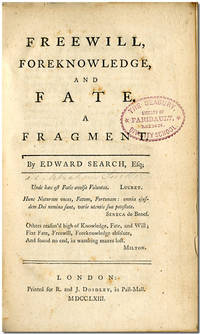
1990014116Bristol: Thoemmes 1990. xxxii 268p. original cloth. Reprint of the 1763 London edition which Tucker wrote under the pesudonym of Edward Search. Thoemmes unknown books
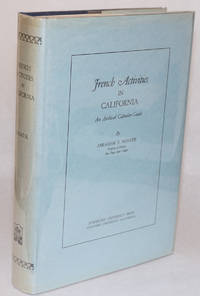
194553091Stanford University California: Stanford University Press 1945. First edition. Hardcover. Fine/Very Good. This calendar-guide with its ample summaries and extracts shows that French officials were active in the region and adds a relatively unknown chapter to the history of California from the earliest days through the Gold Rush period. Original blue cloth binding with gilt stamping. The dust jacket is browned along the spine and extremities. Better than very good. Stanford University Press hardcover books
1945262582Stanford: Stanford University Press 1945. First. hardcover. very good-/very good-. 559pp. 4to blue cloth d.w. and cloth lightly soiled d.w. chipped corners of cloth bumped. Stanford: Stanford University Press 1945.<br/><br/> Stanford University Press unknown books
19459558Stanford: Stanford University Press 1945. xiii 559p. reproduced from typed ms a large stately hardbound in 10x7 inch dark blue cloth boards in a plain printed skyblue dust jacket. Age has mildly toned the text paperstock and to lesser extent the dj. Sound unmarked clean a very good copy. Stanford University Press unknown books
192442386Cleveland: J.H. Jansen 1924. Hardcover. Very good. 173pp. Gilt lettering dulled edges of boards sunned with some wear to the extremities scattered foxing throughout six in chip to top of front free endpaper blindstamp on half title page else an about very good example in publisher's blue cloth. <br/><br/> J.H. Jansen hardcover books
1865235590Boston: Oliver Ditson & Co 1865. First edition front wrapper without portrait of Lincoln appearing in later issues. Engraved title and piano score; 5 pp. 1 vols. Folio. Loose as issued; split along spine with some chipping to extremities. First edition front wrapper without portrait of Lincoln appearing in later issues. Engraved title and piano score; 5 pp. 1 vols. Folio. Donizetti died 17 years before Lincoln having gone mad from syphilis. His Funeral March gained a measure of recognition in America after it was performed during Lincoln's funeral ceremonies. It is a heavy solemn piece in a minor with droning octaves in the bass a haunting chromatic figure in the middle register and a lyrical upper voice. see Barret Sale Lot 693; Stern Collection of Lincolniana Oliver Ditson & Co unknown books
199289363Boca Raton:: CRC Press. Very Good. 1992. Hardcover. 084934297X . First printing. Boards are slightly splayed else very good in glossy illustrated boards. No dust jacket as issued. . CRC Press, hardcover books
1603299305Antwerp: Abraham Ortelius 1603. unbound. Map. Engraving with beautiful original hand color. Image measures 14" x 18 3/4". Staining and toning repair to margins but otherwise is good condition.<br/><br/> Old color example of this lovely map of 16th c. France by Ortelius. Abraham Ortelius 1527-1598 a Flemish cartographer and geographer is widely regarded as one of the important and influential cartographers in history. He is known for his "Theatrum Orbis Terrarum" which was the first modern atlas. Van den Broecke #34<br/><br/> Abraham Ortelius unknown books
1862WRCAM11943Washington 1862. Small broadside 5 x 7 1/2 inches. Very good. Lincoln appoints Henry Halleck as general-in- chief of all of the Union armies. unknown books
1862WRCAM54585Washington D.C.: War Department Adjutant General's Office 1862. Three volumes with over 300 individual imprints. 12mo. Uniformly bound in contemporary three- quarter roan and marbled boards gilt leather labels. Wear to leather and edges boards somewhat rubbed front hinges tender. Contemporary ownership inscriptions and binder's tickets on front endpapers of second and third volumes; later bookplate on front pastedown of first volume. Light toning in places otherwise internally clean. Very good. A uniformly-bound set of General Orders issued by the Adjutant General's Office of the War Department in Washington D.C. previously owned by Brig. Gen. John Pope Cook. The orders cover 1861 and 1862 and comprise a nearly complete run of orders for the Union Army during the first two years of the Civil War. Undoubtedly the most significant General Order in this collection is a preliminary printing of the Emancipation Proclamation. <br> <br> A handful of the orders are signed in ink by the various adjutant generals. The Emancipation Proclamation bound in the third volume is as follows: <br> <br> GENERAL ORDERS No. 139. THE FOLLOWING PROCLAMATION BY THE PRESIDENT IS PUBLISHED FOR THE INFORMATION AND GOVERNMENT OF THE ARMY AND ALL CONCERNED: BY THE PRESIDENT OF THE UNITED STATES OF AMERICA A PROCLAMATION caption title. Washington D.C.: War Department Adjutant General's Office ca. September 24 1862. 3pp. This work is one of the earliest printings of the Preliminary Emancipation Proclamation issued to regimental commanders in the field during the Civil War in the week after President Lincoln's official manuscript version was finished. Here the third paragraph rings out with Lincoln's timeless words: "That on the first day of January in the year of our Lord one thousand eight hundred and sixty- three all persons held as slaves within any State or designated area of a State the people whereof shall then be in rebellion against the United States shall be then thenceforward and forever free." <br> <br> Following the Seven Days Battle and Gen. McClellan's retreat from the Peninsula at the end of June 1862 President Lincoln realized that there would be no early end to the war and found himself "as inconsolable as it was possible for a human to be and yet live." Anxious for news from the army and needing to escape the constant interruptions at the White House he frequently visited the telegraph office in the War Department building to await dispatches. It was during one such visit early in July that he asked the chief of the telegraph staff Maj. Thomas Thompson Eckert for some paper to "write something special" and began the first draft of the Emancipation Proclamation completing it in a few weeks. <br> <br> Lincoln had long hoped to resolve the slavery issue through a congressional act of emancipation compensating slave owners for their loss of "property" but that approach was roundly rejected by representatives from the border states leaving the President who had decided upon the necessity of emancipation with a presidential proclamation as the only option. The extraordinary document he conceived would announce the liberation on January 1 1863 of all slaves in those states still in rebellion against the Union and promised compensation to slave owners in those states that returned to the fold before that time if they adopted "immediate or gradual abolishment of slavery." This proclamation would be followed by a final proclamation issued on the 1st of January identifying those states still in rebellion and confirming the liberation of all slaves therein. <br> <br> On Tuesday July 22 Lincoln presented his draft to the Cabinet telling them that he had resolved firmly upon the course of action it specified and asking them not for advice but suggestions. The only observation he had not anticipated came from Secretary of State Seward who proposed that it might be best to wait for a military victory before issuing the Proclamation as it could otherwise seem like "the last measure of an exhausted government." Immediately recognizing the wisdom of the suggestion Lincoln held back. On September 17 after an anxious wait of nearly two months he received the victory he needed at the bloody Battle of Antietam. Completing his final draft Lincoln presented it to his cabinet for refinement on September 22. Following the meeting Seward took the amended draft with him to the State Department where a formal manuscript copy was made then signed by Lincoln and Seward. <br> <br> The first edition of the Preliminary Emancipation Proclamation Eberstadt #1 a small three-page circular intended for distribution within the government and to the local press was likely printed on September 22. At the time that Charles Eberstadt published his study of the Proclamation 1950 he was able to locate only one copy which he himself owned and as nearly as we have been able to determine no other copies have come to light since then. <br> <br> Eberstadt #2 is a supposed second edition no copy of which Charles Eberstadt was able to locate whose existence he inferred from the standard State Department practice of printing a folio edition consisting solely of the text of the proclamation followed by another printing consisting of the text of a letter of transmittal from the Secretary of State as well as the text of the proclamation. While there may be a copy of Eberstadt #2 in the National Archives as he speculated it is not recorded in their online catalogue nor have we been able to find a copy in any other online catalogue including OCLC the Library of Congress and the Abraham Lincoln Library. <br> <br> Eberstadt's third printing of the Preliminary Emancipation Proclamation is without a doubt the earliest obtainable printing. It consists of Secretary of State Seward's one-page letter of transmittal addressed "To the Diplomatic and Consular Officers of the United States in foreign countries" and the text of the proclamation. Eberstadt located a total of only five copies in institutions at the Library of Congress the National Archives Yale the Clements Library and Brown. OCLC does not record any additional copies nor is it recorded in Monaghan. This firm sold a copy several years ago. <br> <br> The present copy of GENERAL ORDERS No. 139 is Eberstadt's fourth printing of the Preliminary Emancipation Proclamation dated in print on September 24. Charles Eberstadt surmises that this field order printing could have been accomplished as late as September 29 or 30 and produced in as many as 15000 copies. It is however rather uncommon in the market and this is the first copy of this printing of the Preliminary Emancipation Proclamation offered by this firm. <br> <br> "From the first days of the Civil War slaves had acted to secure their own liberty. The Emancipation Proclamation confirmed their insistence that the war for the Union must become a war for freedom. It added moral force to the Union cause and strengthened the Union both militarily and politically. As a milestone along the road to slavery's final destruction the Emancipation Proclamation has assumed a place among the great documents of human freedom" - National Archives. "The proclamation has been called by responsible persons one of the three great documents of world history ranking with Magna Carta and the Declaration of Independence" - Eberstadt. <br> <br> Besides including about 300 orders on all manner of Union military activity at the outset of the Civil War the present collection also contains the 1861 printing of REGULATIONS FOR THE UNIFORM AND DRESS FOR THE ARMY OF THE UNITED STATES. Set out in GENERAL ORDERS No. 6 this twenty-four-page printing of the Army dress regulations was the first to set out uniform requirements for the Union during the conflict. The first sentence of the first section requires officers to "wear a frock coat of dark blue cloth." Thus the Blue and the Gray begins. <br> <br> This set was collected and bound by John Pope Cook who began the Civil War as a colonel in command of the 7th Illinois Volunteer Regiment. He was promoted to brigadier general after his troops played a key role in the Union victory at Fort Donelson early in 1862. After his promotion he was transferred to a command in the Department of Iowa and Dakota Territory where he remained until early 1863 conducting campaigns against the Sioux from his base in Sioux City Iowa. These orders must have been bound near the end of this period since contemporary labels note the binder one William F. Kiter as being from relatively close by Council Bluffs. <br> <br> A very early printing of one of the most important political acts in the Civil War and indeed in American history contained in a set of General Orders contemporaneously assembled by a significant Union Army commander. EBERSTADT LINCOLN'S EMANCIPATION PROCLAMATION 4. War Department, Adjutant General's Office hardcover books
18661009808vo one sheet printed on both sides. Even toning and aging small closed tear to the upper margin; otherwise very good. This is a rather scarce government document that informs the military that the "Thirteenth Amendment" has passed and slavery is officially abolished. Article XIII states "Neither slavery nor involuntary servitude except as a punishment for a crime whereby the party shall have been duly convicted shall exist within the United States or any place subject to their jurisdiction." This document is signed in type by William H. Seward 1801-1872 as the Secretary of State. Congress would follow with a Civil Rights Act of 1866 to give African Americans the same rights as all citizens but this small printed document presenting the essence of the "Thirteenth Amendment" is an important piece of history. ANB. books
186521167Washington: War Department Adjutant General's Office 1865. Very good. Single leaf 5 1/4 x 7 1/8 inches possibly originally issued with two leaves the second being blank. 1.5 pages of text signed in print by Lincoln William Seward and E.D. Townsend. Faint folding creases; near fine. Issued March 11 1865 this was the second of two general amnesties issued by the President during the Civil War. These proclamations were intended to bring deserters and draft evaders back into the fold and encourage loyalty to the Union. The first issued on March 10 1863 gave all deserters a full pardon with no consequences if they returned to their units by April 1. Those who did not would have their citizenship revoked and were subject to court-martial with penalties as severe as death. This second proclamation offered the same basic terms but allowed deserters 60 days to return to duty. War Department, Adjutant General's Office unknown books
1966283997Readex Microprint 1966. hardcover. fine. 39pp. 8vo green cloth. N.p.: Readex Microprint 1966. Fine<br/><br/> History of the Yazoo Act of 1795 and the land speculation in Alabama and Mississippi which resulted from the act's enactment. Facsimile of the Hartford 1797 edition.<br/><br/> Readex Microprint unknown books
19669414Usa: Readex Microprint. Very Good. 1966. Hardcover. Very Good . Readex Microprint hardcover books
196637242Readex Microprint 1966. First Edition. 8vo pp. 39. Two articles first published in 1797 about the infamous Georgia Yazoo Act which enabled one of the largest land speculation operations in U. S. history. Great Americana. Fine. Readex Microprint unknown books
1973011291Zurich Switzerland: Flamberg Verlag/Benziger Verlag 1973. Book. Very good condition. Hardcover. First Edition. Quarto 4to. 241 pages of text. Hardcover binding with minimal shelfwear including slight bumping to corners. Unclipped dustjacket slightly rubbed and soiled with several small creases and tears; protected in archival mylar. Contains 230 color illustrations. Text is in German. Flamberg Verlag/Benziger Verlag Hardcover books
RLINFAC00TMLincoln National Life Insurance Company. Very Good. Lincoln Abraham. Gettysburg Address. Fort Wayne Indiana: Lincoln National Life Insurance Company ND. 12.5 x 5.5 inch folded facsimile in envelope. Book condition: Very good. Facsimile is crisp with light rubbing and discoloration. Envelope is lightly bumped and rubbed on edges with a few subtle creases. Lincoln National Life Insurance Company unknown books
1963019217Los Angeles CA: Dawson's Book Shop. Good with no dust jacket. 1963. First Edition. Miniature. Red leather boards with gilt title on front board and spine. Wear along the spine and edges of boards. Illustrated with black and white portrait of Abraham Lincoln. Limited to 1000 copies printed and bound by Bela Blau. 1 5/8" x 1 3/8". Bradbury - Dawson's Book Shop 3. ; 17 pp . Dawson's Book Shop unknown books
186423516Boston: Wright & Potter 1864. First Thus. Octavo 23.5cm.; publisher's drab printed wrappers; 88cxpp.; large folding map of Gettysburg bound in. Some shallow chipping and small losses to wrapper extremities none approaching text dampstaining most heavily so to rear cover title page and preliminary leaves else Near Very Good. Includes the third or fourth earliest appearance in book-form of Lincoln's Gettysburg Address printed here on p. lxxii simply as "Dedicatory Speech." See MONAGHAN p. 48. Wright & Potter unknown books
1863021633New York City: New York Daily Tribune. Good with no dust jacket. 1863. Newspaper. Original issue of the New York Daily Tribune November 21 1863 featuring a very early printing of Abraham Lincoln's Gettysburg Address. Paper measures 15 5/8 x 19 7/8 inches. Typical disbound tears to spine not intruding into text save for a couple tears to final leaf but no loss of text. Uneven trimming to bottom edge with loss of a line of text on several pages. Front page headlines include "Entire Success of the Rio Grande Expedition" "Siege of Charleston" and "From the Army of the Ohio". The report from the Gettysburg Ceremonies and Consecration of the National Cemetery fill three columns on page 2. Lincoln's short speech was preceded by several other orators including Edward Everett's ninety minute speech. Lincoln's 271 word speech remains one of America's best known and memorable speeches soon to be published in newspapers throughout the United States. Some Eastern papers published the speech on November 20th. Versions printed on the 20th are the Addresss first appearance and are highly desirable as are other early printings such as this copy. ; 12 pp . New York Daily Tribune unknown books
199586261Boston:: Houghton Mifflin. Near Fine in Very Good dust jacket. 1995. Hardcover. 0395698243 . Fourth printing. SIGNED by the illustrator on the half-title page. Near fine in a very good dust jacket.; Signed by Illustrator . Houghton Mifflin, hardcover books
199577945Boston:: Houghton Mifflin. Fine in Near Fine dust jacket. 1995. Hardcover. 0395698243 . Second printing. SIGNED by the illustrator on the title page. Fine in a near fine dust jacket. . Houghton Mifflin, hardcover books