774 résultats
184098615Zürich & Frauenfeld: Beyel 1840. 365, (3) Seiten. Frakturdruck. Gr. 8° (23 x 16,5 cm). Grüner, strukturierter Pappband mit goldgeprägtem Rückentitel. [Hardcover / fest gebunden].
1888250201888 Paris, Paul Ollendorff, 1888, 13 cm x19cm, 25 pp; plaquette,
1865851301865. PHOTOGRAPHY 19TH CENTURY - LINCOLN Abraham. UNCOMMON CARTE-DE-VISITE PHOTOGRAPH OF ABRAHAM LINCOLN CA. 1865. Providence RI: Salisbury Bro. & Co. n.d. ca. 1865 "Manufacturers of Gold and Plated Jewelry Also Carte de Visites of all Noted Persons." Pale embossed paper mount is 4 x 2 1/2 inches with 1 3/8 x 1 1/8 inch oval photograph a bust of a bearded Lincoln. Very good light soil to the mount with the photo contour partially cut through from being pressed into the paper mount. The embossed design features an eagle laurel leaves flags shield and cannons. The photo is in excellent condition the President's gaze clear and sharp. Free of the toning often seen on this cdv. unknown
1865851301865. PHOTOGRAPHY 19TH CENTURY - LINCOLN Abraham. UNCOMMON CARTE-DE-VISITE PHOTOGRAPH OF ABRAHAM LINCOLN CA. 1865. Providence RI: Salisbury Bro. & Co. n.d. ca. 1865 "Manufacturers of Gold and Plated Jewelry Also Carte de Visites of all Noted Persons." Pale embossed paper mount is 4 x 2 1/2 inches with 1 3/8 x 1 1/8 inch oval photograph a bust of a bearded Lincoln. Very good light soil to the mount with the photo contour partially cut through from being pressed into the paper mount. The embossed design features an eagle laurel leaves flags shield and cannons. The photo is in excellent condition the President's gaze clear and sharp. Free of the toning often seen on this cdv. unknown books
1885300561 vol. in-12 br., Calmann Lévy, Paris, 1885, 2 ff. et 56 pp.
186424899<p>"<i>The will of the people is supreme.</i>"</p><p>"<i>The vital principle of</i> Lincoln's <i>whole administration has been his recognition of the fact that our Government is simply a machine for carrying into effect THE WILL OF THE PEOPLE.</i>"</p> <b>ABRAHAM LINCOLN. HENRY CHARLES LEA.</b>Printed Pamphlet. <i>No. 18: The Will of the People</i> January – April 1864. 8 pp. 5½ x 8½ in.<p><b><br /></b></p><p><b>Excerpts:</b></p><p>"<i>It has been generally assumed that the acts of the President have been the exponents of his own individual convictions. Democrats have censured him for converting the 'war against disunion' into a 'war against slavery.' Radical Republicans have been equally prone to condemn him as a half-hearted Abolitionist who required perpetual stimulation to perform his duty and who is not to be trusted because he did not immediately on his inauguration carry out the views which he had previously expressed of opposition to slavery.</i></p><p>"<i>Both parties seem to have forgotten that our form of government is as purely democratic as can be reduced to a practical system. Our whole political machinery is devised for the purpose of allowing the people to regulate the national policy. The will of the people is supreme.</i>" p3</p><p>"<i>For twenty years prior to his election he had on all fitting occasions expressed his disapprobation of slavery and his desire that it could be constitutionally done away with. Yet in the popular vote which made him President he saw the expression simply of a determination to resist the aggressions of slavery and not the condemnation of the system itself.</i>" p4</p><p>"<i>As the nation changed its views so he was ready to change his policy. When therefore the Emancipation Proclamation made its appearance the people was prepared to welcome that which a year earlier would have aroused a tempest of disapprobation.</i>" p5</p><p>"<i>The next step was the arming of negro troops. In July 1862 Congress authorized the employment of 'persons of African descent' in our armies. The public mind was not yet prepared to accept the assistance of the despised race. The administration accordingly did not press the matter.</i>" p5-6</p><p>"<i>Those who have witnessed the marvellous revolution in public opinion on this subject cannot but admire the manner in which Mr. Lincoln's honest deference to public opinion has produced results which the tact of the cunning statesman might have failed to secure. Taking each step as the voice of the people demanded it he has never been forced to retrace his position. Supported by and supporting the popular feeling he has moved onward in unison with it and each new development has afforded sure foothold for further progress.</i>" p6</p><p>"<i>His Proclamation of Amnesty puts into practical shape the wishes which have long been silently forming themselves in every loyal heart. Again has he divined the will of the people and at the fitting time his acts have responded making as far as his competence extends that will the law of the land. To this intuitive perception of public opinion and this skill in translating it into action Mr. Lincoln owes much of the success of his administration. He is at once the leader and the led.</i>" p7</p><p>"<i>The transitory passions of the multitude are very different from the slowly formed convictions of the people. The President has known to distinguish between them and he has at times shown as lofty a firmness to resist the former as he has ever manifested alacrity to respect the latter. The vital principle of his whole administration has been his recognition of the fact that our Government is simply a machine for carrying into effect THE WILL OF THE PEOPLE.</i>" p8</p><p><b>Excerpts from Resolutions Passed January 11 1864:</b></p><p>"<i>And Whereas The Union League of Philadelphia composed as it is of those who having formerly belonged to various parties in this juncture recognize no party but their country; and representing as it does all the industrial mechanical manufacturing commercial financial and professional interests of the city is especially qualified to give in this behalf an unbiased authentic utterance to the public sentiment. Therefore</i>" p2</p><p>"<i>Resolved That we cordially approve of the policy which Mr. Lincoln has adopted and pursued as well as the principles he has announced as the acts he has performed: and that we shall continue to give an earnest and energetic support to the doctrines and measures by which his administration has thus far been directed and illustrated.</i>" p2</p><p><b>Historical Background</b></p><p>Loyal Leagues also often known as Union Leagues were men's clubs established during the Civil War largely to support the war effort and the policies of the Lincoln administration. They usually consisted of the professional merchant and artisan classes in northern cities. The first such club formed in Philadelphia in 1862.</p><p>This pamphlet written by Henry C. Lea as director of the Union League of Philadelphia's Board of Publication insisted that Lincoln's policies reflected the will of the people. Six years earlier in his first debate with Stephen A. Douglas in August 1858 Lincoln famously said "In this and like communities public sentiment is everything. With public sentiment nothing can fail; without it nothing can succeed. Consequently he who moulds public sentiment goes deeper than he who enacts statutes or pronounces decisions. He makes statutes and decisions possible or impossible to be executed."</p><p>On April 15 1864 Lea met with Lincoln in Washington and three days later he wrote to Lincoln including two pamphlets he had recently written including this one. He informed Lincoln "I was much gratified to find from your remarks that in one of them—'The Will of the People'—I had to some extent indirectly appreciated the motives which have guided your policy. It appeared to me to present a line of argument likely to be effective before the people & I confess to surprise that it should not have been long since brought more prominently into notice to repel the attacks of radicals & Copperheads." <br /></p><p><b>Henry Charles Lea</b> 1825-1909 was born in Philadelphia and received a classical education from Irish American tutor Eugenius Nulty. Lea showed particular promise in natural history. He joined his father in the publishing business in 1843 but had a nervous breakdown in 1847. While recuperating he read medieval French history and decided to become a historian rather than a scientist. In 1850 he married his first cousin Anna Caroline Jaudon 1824-1912 who was of French Huguenot descent and they had four children between 1851 and 1859. Over the next fifty years Lea produced ten books and numerous articles on medieval institutional legal and ecclesiastical history. During the Civil War Lea was a member of the Union League of Philadelphia and led its Board of Publication. In that role he wrote many of the League's published pamphlets. From 1863 to 1865 he served as a Bounty Commissioner and aided the provost marshal in recruiting soldiers including African Americans. He continued in the publishing business until 1880 when his sons took over the firm. He continued to write and assemble an extensive medieval manuscript collection. He received honorary degrees from both American universities like Harvard Princeton and Pennsylvania and foreign universities in Giessen and Moscow.</p><p><b>Condition</b></p><p>Good with light foxing and toning.</p> books
186424898<p>"<i>As a MAN OF THE PEOPLE understanding them and trusted by them he has proved himself the man for the time.</i>"</p> <b>ABRAHAM LINCOLN. HENRY CHARLES LEA.</b>Printed Pamphlet. <i>No. 17: Abraham Lincoln</i> March 1864. 12 pp. 5¾ x 8¾ in.<p><b><br /></b></p><p><b>Excerpts:</b></p><p>"<i>What will be the place assigned by history to Abraham Lincoln</i>" p3</p><p>"<i>Few of us can forget the feelings of doubt and distrust with which we regarded his advent to the Presidential chair. That his native energy had elevated him from a youth of poverty and labor was reassuring and yet the narrow sphere in which his life had mostly been passed seemed to deprive him of the opportunities of familiarity with the great principles and details of statesmanship requisite for the perilous contingencies of the future.</i>" p3-4</p><p>"<i>Thus with doubt confusion and demoralization around him with no landmarks in the past to serve as a guide for the present or as a precedent for the future did Mr. Lincoln undertake the awful responsibilities of his high position. Thus relying on himself and on the people he boldly set to work to restore the Republic.</i>" p5</p><p>"<i>The country was saved so soon as the people recognized in their President a man who believed that he could save it and who honestly intended to do so. Had Abraham Lincoln done no more than this he would have merited a place between Washington and Jackson. It is a great thing to lift a nation to the highest level of its duties and responsibilities and few men to whom in the world's history the opportunity has been vouchsafed have accomplished the task so thoroughly.</i>" p6</p><p>"<i>And now the momentous question arises before the American people—to whose hands shall be confided the delicate trust of restoring the Union of our fathers</i>" p7</p><p>"<i>The great duty to which Mr. Lincoln has dedicated himself with rare singleness of purpose is the one thought which engrosses every true American heart—the re-establishment of the Union on a permanent basis.</i>" p7</p><p>"<i>The results of the war during the last twelve-month have not shown that the Proclamation was a mistake in military policy.</i>" p9</p><p>"<i>When Mr. Lincoln recommended the plan of compensated emancipation which was adopted by Congress he showed that he recognized fully how great an element of future strife lay in the institution of slavery and how beneficial to the whole country its abolition would be. Moderate in all his opinions he wanted a gradual not a violent change and long after his Emancipation Proclamation was issued he provoked the wrath of the radical emancipationists in Missouri by lending what aid he constitutionally could to the 'conservatives' in that State who desired that the extinction of slavery should be brought about gradually. Possibly in this Mr. Lincoln was mistaken yet if so the error arose from the desire which he has constantly manifested to harmonize the conflicting interests of the country even at the expense of temporary popularity.</i>" p9-10</p><p>"<i>The wisest statesman does not disdain to profit by experience nor can the head of a popular government adopt measures of fundamental change before the people are ripe for them. It is probable that Mr. Lincoln learned much as the war wore on; at all events the people did.</i>" p10</p><p>"<i>There are many who have richly earned the gratitude of the people for eminent services rendered to the Republic in the hour of her trials. There is no one who has so signally centered upon himself the confidence of all. There have been mistakes of detail in military naval and financial matters—mistakes inseparable from the sudden transition from profound and prolonged peace to civil war upon the largest scale. Yet in the general policy of the administration in its principles of statesmanship there have been few errors save those arising from a too generous disbelief in the sincerity of Southern madness.</i>" p11</p><p>"<i>Had Mr. Lincoln moved faster than he has done he would have left the people behind him and lost the support without which no popular government can conduct an exhausting war.</i>" p11</p><p>"<i>As a MAN OF THE PEOPLE understanding them and trusted by them he has proved himself the man for the time.</i>" p12</p><p>"<i>no one can be named who unites like Abraham Lincoln the kindliness and firmness the skill and experience the native sagacity and honesty to bring about an harmonious settlement and to extort from repentant rebels the implicit confidence which those high qualities have won from all loyal men.</i>" p12</p><p><b>Historical Background</b></p><p>The Union League Club of Philadelphia formed in 1862 as a patriotic society to support the Union and the policies of the Lincoln administration. The members of this private club represented the Philadelphia region's elite in business education and religion.</p><p>On April 15 1864 Lea met with Lincoln in Washington and three days later he wrote to Lincoln including two pamphlets he had recently written for the Union League Club including this one. He informed Lincoln "To prevent misconstruction perhaps I should add that I am a man of independent position with nothing to ask at your hands except the preservation of our institutions."<br /></p><p><b>Henry Charles Lea</b> 1825-1909 was born in Philadelphia and received a classical education from a private tutor. He showed particular promise in natural history. He joined his father in the publishing business in 1843 but had a nervous breakdown in 1847. While recuperating he read medieval French history and decided to become a historian rather than a scientist. Over the next fifty years Lea produced ten books and numerous articles on medieval institutional legal and ecclesiastical history. During the Civil War Lea was a member of the Union League of Philadelphia and led its Board of Publication. In that role he wrote many of the League's published pamphlets including this one. From 1863 to 1865 he served as a Bounty Commissioner and aided the provost marshal in recruiting soldiers including African Americans.</p> books
184114100St.Gallen 1841. Erster Jahrgang Gr.-8°. Hldr. Helvetica unknown
188543225HB1885. Braunschweig 1885. 7 gef. Tafeln S. 9-120. Interimsbroschur der Zeit leicht angeschmutzt und angerändert Rücken oben leicht eingerissen. Umschlag mit handschriftlicher Widmung des Verfassers an Prof. von Bruns. Seiten durchgehend geringfügig fleckig und mit leicht bestoßenen Ecken. Sonst in guter Erhaltung. Separat-Abdruck aus Archiv für Anthropologie Band 15 Supplement. unknown
1865106884<p>Newspaper 18 1/2" x 25 1/2" seven columns of text 4 pp. Folded at center another more subtle middle fold probably removed some chips tears and folds mostly at extremities some aging and browning a little uneven darkening ; otherwise about very good. Dated April 21 1865 this paper has several stories on the Lincoln assassination on the second and third pages of the newspaper. The articles include stories on the courage and determination of Secretary Stanton rewards posted for the capture of Booth and a nation in mourning. There is also a short report on the condition of Secretary Seward. Some interesting coverage of a national event in a local newspaper. </p>
1865biblio4<p> Newspaper 18 1/2" x 25 1/2" seven columns of text 4 pp. Folded at center another more subtle middle fold probably removed some chips tears and folds mostly at extremities some aging and browning a little uneven darkening ; otherwise about very good. Dated April 21 1865 this paper has several stories on the Lincoln assassination on the second and third pages of the newspaper. The articles include stories on the courage and determination of Secretary Stanton rewards posted for the capture of Booth and a nation in mourning. There is also a short report on the condition of Secretary Seward. Some interesting coverage of a national event in a local newspaper. </p>
1865biblio4<p> Newspaper 18 1/2" x 25 1/2" seven columns of text 4 pp. Folded at center another more subtle middle fold probably removed some chips tears and folds mostly at extremities some aging and browning a little uneven darkening ; otherwise about very good. Dated April 21 1865 this paper has several stories on the Lincoln assassination on the second and third pages of the newspaper. The articles include stories on the courage and determination of Secretary Stanton rewards posted for the capture of Booth and a nation in mourning. There is also a short report on the condition of Secretary Seward. Some interesting coverage of a national event in a local newspaper. </p> books
182858567BBBern, L.A. Haller, 1828. 8°. 112 S. Broschur der Zeit.
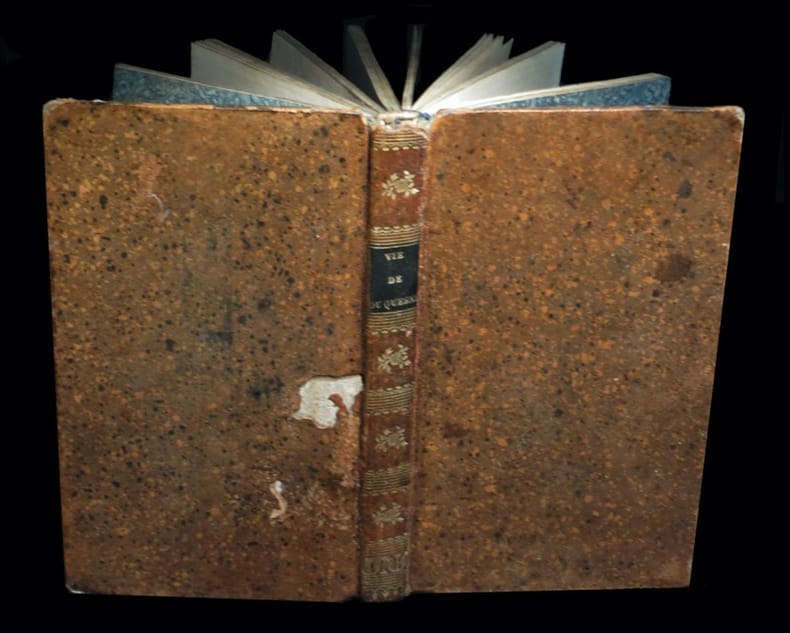
1817266391817. A Paris chez Volland / Coll. ''Vies des plus cÂŽlÂbres marins'' 1817. Un vol. au format pt in-12 178 x 103 mm de xii - 204 pp. Reliure de l'ÂŽpoque de pleine basane glacÂŽe et cailloutÂŽe brune plats jansÂŽnistes dos lisse richement ornÂŽ de quintuples filets dorÂŽs roulettes dorÂŽes larges fleurons dorÂŽs piÂce de titre de maroquin ÂŽbÂne titre dorÂŽ palette dorÂŽe en tÂte et queue filet dorÂŽ sur les coupes tranches jaspÂŽes. Abraham du Quesne sert tout d'abord sous Louis XIII pendant la guerre de Trente Ans et se distingue en plusieurs occasions notamment aux combats de Tarragone et du cap de Gata mais doit quitter la marine en 1644 aprÂs avoir perdu un navire. Pendant les troubles de la minoritÂŽ de Louis XIV il obtient de Mazarin l'autorisation de servir dans la marine royale suÂŽdoise en compagnie de son frÂre. Il prend part ˆ la guerre de Torstenson qui oppose le royaume de SuÂde au Danemark et se distingue au combat de Fehmarn en prenant le navire amiral du commandant de la flotte danois Pros Mund. RentrÂŽ en France il rÂŽintÂgre la Marine royale et est envoyÂŽ en 1669 au secours de Candie assiÂŽgÂŽe par les Turcs. Il prend part ˆ la guerre de Hollande 1672-1678 et combat ˆ la bataille de Sol 1672 et ˆ Alicudi janvier 1676 mais c'est ˆ la bataille d'Agosta avril 1676 et ˆ celle de Palerme qu'il se distingue tout particuliÂrement. Il termine sa carriÂre avec le grade de lieutenant gÂŽnÂŽral des armÂŽes navales. Polak Bibliographie maritime franÂaise 8229. Angles et coiffe supÂŽrieure ÂŽlimÂŽs. DÂŽbut de fente - sans consÂŽquence - affectant le mors supÂŽrieur. Petit manque superficiel en marge du second plat. Rares rousseurs dans le texte. Infime dÂŽchirure affectant un feuillet. Quelques autres prÂŽsentent une petite plissure angulaire. Du reste bonne condition. b42961 unknown
181726639A Paris, chez Volland / Coll. ''Vies des plus célèbres marins'', 1817. Un vol. au format pt in-12 (178 x 103 mm) de xii - 204 pp. Reliure de l'époque de pleine basane glacée et cailloutée brune, plats jansénistes, dos lisse richement orné de quintuples filets dorés, roulettes dorées, larges fleurons dorés, pièce de titre de maroquin ébène, titre doré, palette dorée en tête et queue, filet doré sur les coupes, tranches jaspées.
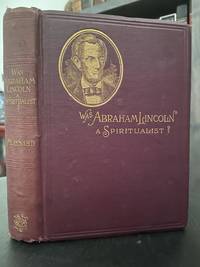
1891428<p><strong>12mo 7" - 7½" tall; 264 pages . Very Good with No dust jacket as issued. 1891. First Edition. Hardcover. Brown cloth with gilt title and decoration Lincoln image on cover. Light fading to spine and a faint line of dulllness loss of sizing on back cover. Internally clean -- no names or other markings. Book discusses how Abraham Lincoln and his wife Mary Todd Lincoln held seances at the White House. Also discusses Spiritualist mediums that were in contact with the President as well as seances he attended throughout Washington DC. Book includes several engravings and images of Lincoln the seances and more.</strong></p> Rufus C. Hartranft hardcover
1865WRCAM48848Olympia 1865. 4; 4pp. Large folio. Folded with some loss at folds. Chipping and small tears at edges light soiling and wear. Good. Washington state newspaper issue reporting on the assassination of President Abraham Lincoln. The interior two pages are both column-edged in black the lead headline reading: "President Lincoln Murdered!! Mr. Seward Stabbed." The newspaper likewise reports on the surrender of Gen. Lee at Appomattox and the end of the Civil War. The issue for April 1st reports a small column on the unconstitutionality of the Emancipation Proclamation. The WASHINGTON DEMOCRAT was published from Oct. 17 1864 to July 15 1865. Scarce. unknown books
186926729Philadelphia: J.B. Lippincott & Co 1869. 12mo. 407 pp. <br><br>First edition. Southern literature. Author was born in Mobile died in Natchez and similarly spent portions of his adult life in both states. <br>Â Â Â Â <br>Â Â Â Â Wright II 1252. Publisher's green cloth small area of discoloration at top of spine. Exsocial club library: call number on front fly-leaf rubber-stamp on title- and two other pages no other markings. Stray stains. One leaf cleanly torn and repaired. A good copy of an uncommon title. J.B. Lippincott & Co hardcover books
18666114no place given: William E. Marshall 1866. Very good . Lithograph measuring about 17." x 22.5" full margins; likely untrimmed. The image measures about 15.75" x 20.5". Matted and framed and has not been examined out of frame. Offsetting/age-toning affects the right half of the print although this is only visible at the margin not within the image. Important 1866 engraving of the recently deceased 16th president; Marshall sent copies to many of Lincoln's closest friends and colleagues and the response was one of unanimous praise. Highly detailed and dignified it presents the statesman as a figure of great worth; even of immortailty. This example handsomely presented in a double matte and deep brown wooden frame. William E. Marshall unknown
186734315Lemberg: Micheal Wolf 1867. Hardcover. fair. Octavo. 31 110 pp. Rebound brown cardboard with black adhesive on spine. Title page in Hebrew and German. A critical examination of the most important passages of the Talmud yerushalmi. Abraham Krochmal the son of the philosopher Nahman Krochmal greatly influenced Hebrew reading public as perhaps the most eminent Biblical critic in that language. Includes an acrostic poem that features Abraham Korchmal's name. Edgewear and slight tearing on binding. Bumped corners. Remnants of white sticker on spine. Front endpaper slightly stained and rippled. Slight foxing and toning throughout interior. Binding in fair condition interior in good condition. Text in Hebrew. Micheal Wolf hardcover
1877239161877. No binding. Fine. Autograph Quote Signed from Lincoln's Cooper Institute speech given on February 27 1860. Sept 10 1877. Schuyler Colfax U.S. representative from Indiana and vice president under Ulysses S. Grant pens a famous quote from Lincoln's Cooper Institute speech. Transcript""Let us have faith that Right makes Might; and in that faith let us to the end dare to do our Duty."" Lincoln's Cooper Institute speech Feb. '60. Yrs truly Schuyler Colfax / Sept 10 1877Schuyler Colfax 1823-1885 born in New York City moved with his family to Indiana when he was an adolescent. Colfax pursued a career in journalism serving as legislative correspondent for the Indiana State Journal and becoming part-owner of the Whig organ of northern Indiana the South Bend Free Press renamed the St. Joseph Valley Register in 1845. Colfax was a member of the 1850 state constitutional convention and four years later was elected as a Republican to Congress where he served until 1869. An energetic opponent of slavery Colfax's speech attacking the Lecompton Legislature in Kansas became the most widely requested Republican campaign document in the 1858 mid-term election. In 1862 following the electoral defeat of Galusha Grow Colfax was elected Speaker of the House. In that capacity Colfax announced the passage of the Thirteenth Amendment on January 31 1865: ""The constitutional majority of two thirds having voted in the affirmative the Joint Resolution is passed."" Colfax considered February 1 1865 the day he signed the House resolution the happiest day of his life. ""Fourteen years before among a mere handful of kindred spirits in the Constitutional Convention of his State he had said: 'Wherever within my sphere be it narrow or wide oppression treads its iron heel on human rights I will raise my voice in earnest protest.' He had kept his word and well earned his share in the triumph."" Hollister 245. Colfax next served as Vice President under Ulysses S. Grant 1869-1873. He lost a re-nomination bid in 1872 as a result of his involvement in the Crédit Mobilier of America scandal. Hollister Ovando James. Life of Schuyler Colfax 1886. books
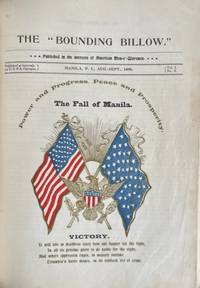
189959607San Francisco & USFS Olympia: The Bounding Billow Printed by Whittaker & Ray Co. Inc. 1899. Eleven parts in one vol. 4to. 2 138 6 pp. With text photos illustrations 2 colour illustrations map photo plates at rear. Original blue publisher’s cloth embossed gilt lettering & shield on front cover edgewear rubbing wear to corners some spotting & wear a few occasional minor closed tears still a G copy from library of Chief Petty Officer William E. Bates 1871-1941 who served in the U.S. Navy for 30 years beginning with the Asiatic Squadron under Admiral Dewey and later during World War I w/ ownership marking on 2nd flyleaf a couple spelling corrections in manuscript. First edition thus of this “cruise book†for the U.S.S. Olympia which served as Admiral Dewey’s flagship during the Spanish-American War and had served as the flagship from 1895 three years prior as flagship of the Asiatic Squadron. This volume opens with an illustrated account of the USS Olympia’s cruises and experiences visiting China Japan Siberia and The Philippines. Included here as well is a reissue including photos colour illustrations and map Vol. 1 Nos. 1-7 of the shipboard periodical published by the seamen of the USS Olympia with place imprints of Nagasaki Hong Kong and Manila. Incorporated are firsthand accounts of shipboard life battle accounts contemporary photos and map prepared by L.C. Passano using sail needles. Of particular interest is the appendix listing the crews of the U.S. Asiatic Squadron including the USS Olympia USS Raleigh USS Boston USS Baltimore USS Concord USS Petrel USS McCulloch. The Bounding Billow, Printed by Whittaker & Ray Co., Inc.], hardcover
185818195Lpz.: Otto Wigand 1858. Softcover. Angestaubt und mit kleineren Randeinrissen. Nicht beschnitten. kl.8°. Original-Broschur Deutschland; 19. Jahrhundert; jüdische Glaubenwelt; jüdische Philosophie Otto Wigand, paperback
1866122948Wien. Hof- u. Staatsdruckerei 1866. 15 Seiten. Breitrandiges Exemplar. Originalbroschur. (Umschlag fleckig). 20x13 cm