987 résultats
1932WRCLIT28415Jamaica NY.: The ARRA Printers 1932. Small octavo. Oversized stapled printed wrappers. First separate printing of this story reprinted from its 1917 periodical appearance. Wraps a bit soiled at edges shallow spot on top edge toward end a couple small chips to overlap lower edge but a near very good copy of a cheaply produced pamphlet. CURREY p.366. BLEILER p.138. The ARRA Printers paperback books
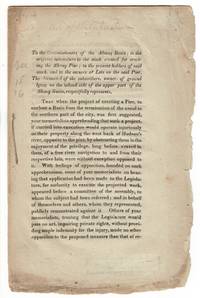
182855054Albany NY 1828. First edition 8vo pp. 16; self-wrappers unopened and uncut very light rubberstamp in the bottom margin of the first leaf a few pencil marks and edgewear all else very good. A complaint that the erection of the Albany Pier was effectively a deprivation of property against the subscribers who's access to the canal became limited. American Imprints 35521; NYPL only in OCLC. <br/><br/> unknown books
186323743<p>In this creative pamphlet Lincoln stands trial before a jury of his "peers" former presidents and statesmen from American history including Stephen A. Douglas Daniel Webster Henry Clay John Hancock Patrick Henry Gouverneur Morris Alexander Hamilton John C. Calhoun James Madison George Mason Elbridge Gerry Andrew Jackson Thomas Jefferson George Washington and William Gaston. The author compiles passages from their speeches in mock dialogue with the defendant Lincoln as they contradict his defenses against their charges.</p> <b>ABRAHAM LINCOLN.</b>Pamphlet. <i>Trial of Abraham Lincoln by the Great Statesmen of the Republic. A Council of the Past on the Tyranny of the Present. The Spirit of the Constitution on the Bench—Abraham Lincoln Prisoner at the Bar his own Counsel.</i> New York: Office of the Metropolitan Record 1863. Original printed wrappers stitched. 29 3 pp. First Edition.<p><b><br /></b></p><p><b>Excerpts:</b></p><p>"<i>George Washington the father of the American Union who was surrounded by the great statesmen of the Revolution and by others of a still later date…had assembled for the trial of the present incumbent … on charges of the gravest and most serious character. the Spirit of the Constitution…occupied the bench of Justice.</i>" 4-5</p><p>"<i>Abraham Lincoln is herein charged with treasonable intent purposes and designs in having committed the following unconstitutional acts in the course of his administration:</i></p><p>"<i>1. In having declared war against independent and sovereign States under the pretence of repossessing himself of certain forts and other property seized and held by said States.</i></p><p>"<i>2. In having arrested citizens of the United States and incarcerated them in Government bastiles without process of law.</i></p><p>"<i>3. In having suppressed the liberty of speech thereby denying to the citizen the Constitutional right of criticizing the acts of his Administration.</i></p><p>"<i>4. In having prohibited and stopped the publication of certain newspapers for the exercise of the same right referred to in the preceding charge.</i></p><p>"<i>5. In having placed the military above the civil power as shown in the establishment of martial law over portions of the country which were not embraced within the theatre of war.</i></p><p>"<i>6. In overthrowing State sovereignty as in the case of Virginia the integrity of which was violated by the erection of the so-called State of Kanawha within its limits.</i></p><p>"<i>7. In having approved indorsed and partially carried into execution the unconstitutional act of Congress known as the Confiscation Bill.</i></p><p>"<i>8. In having approved of the infamous law known as the Conscription Act which was not only subversive of the Constitution but violative of State sovereignty.</i></p><p>"<i>9. <b>In having attempted to carry into execution the Emancipation Act thereby violating the most sacred guarantees of the Constitution.</b></i> 5-6</p><p>"<i>The criminal looked around the court and on the faces of the assembled patriots of the past but as they returned his gaze they shuddering averted their heads. Then the Spirit of the Constitution addressing him spoke as follows:</i></p><p>"<i>'You have been tried and found wanting. You have been given the opportunity of saving a nation but you have stabbed it to the heart. You were born in the freest country under the sun but you have converted it into a despotism. You have violated your oath; you have betrayed the trust reposed in you by the popular will and to the outraged justice of your countrymen I now leave you with the brand of "Tyrant" upon your brow. They will hereafter inflict upon you that penalty which justice demands while history will pronounce its judgment upon the infamous acts of your Administration.'</i>" 28-29</p><p><b>Historical Background</b></p><p>Contemporaries historians and others have criticized Lincoln for violating state sovereignty freedom of speech and freedom of the press for suspending habeas corpus and imposing martial law. All of these charges figure prominently in this ghostly trial of the President.</p><p>The publisher and possibly author of this pamphlet was John Mulally the Irish-born editor and proprietor of the <i>Metropolitan Record</i> a weekly Catholic family newspaper published from 1859 to 1868 in New York City. From 1859 to March 1863 it was the official organ of the Archbishop John Hughes of New York. Catholic critics accused it of taking an "open and avowedly treasonable course…since the war broke out; but more especially since the President issued his Emancipation Proclamation" and of forcing Archbishop Hughes to withdraw his support.</p><p><i>The Indiana State Sentinel</i> a Democratic newspaper published in Indianapolis printed much of the pamphlet on its front page declaring it "perhaps the most thorough and effective exposition of the terrible character and extent of the departure of the present Administration from the word and spirit of the fathers of the Constitution that has yet been put in print."</p><p>In 1863 authorities arrested Baltimore booksellers Michael J. Kelly and John B. Piet publishers of the <i>Catholic Mirror</i> for printing works of a "treasonable character." On May 23 1864 Provost Marshal detectives again arrested Kelly and Piet and searched their store. Among the "inflammable matter" found were 97 copies of <u>this</u>pamphlet envelopes with rebel flags 57 packs of playing cards with Confederate officers and some 212 Confederate photographs. The authorities imprisoned Kelly and Piet in Fort McHenry. On May 28 Kelly's son received permission to reopen the store and authorities allowed the press to resume publication of the <i>Catholic Mirror</i> on May 30 while Kelly and Piet awaited trial. On June 1 and 2 Major General Lew Wallace ordered Kelly and Piet released if they each posted a $5000 security bond not to violate any departmental regulations.</p><p>In March 1864 Major General William S. Rosecrans a Catholic commander of the Department of the Missouri ordered the Provost Marshal General in St. Louis to seize all issues of the <i>Metropolitan Record</i> to prohibit further distribution of the newspaper in that department and to punish all vendors who sold or distributed issues of the newspaper knowing their "traitorous contents." Rosecrans had read enough in the <i>Metropolitan Record</i> to satisfy himself that "no reasonable freedom nor even license of the press suffice for the traitorous utterances in those articles" and that they were "a libel on the Catholics who as a body are loyal and national." In November 1864 Major General Hugh Ewing commanding the District of Kentucky likewise banned the circulation of the <i>Metropolitan Record</i> and seven other newspapers in his district.</p><p>In the midst of the 1864 presidential election campaign the <i>Metropolitan Record</i>advertised for canvassers to sell this as "the great campaign pamphlet of the day." Mulally later reportedly repudiated McClellan as the Democratic nominee favoring a peace candidate instead.</p><p>111 Eberstadt 332. Monaghan 252. Sabin 41234. LCP 10399.</p><p><b>Condition</b></p><p>Margin dusting to the front wrapper Very Good.</p> Office of the Metropolitan Record paperback books
182434668New York: Printed for the Publisher and Sold at the Book-Stores 1824. 48pp. Light rubberstamp faint blindstamps. Modern plain wrappers light scattered foxing. Good.<br/><br/> Abraham Paul was a successful busy New York publisher and printer. "William and Peter C. Smith publishers were charged with conspiracy to ruin the business of another publisher Abraham Paul. They placed fictitious orders with him and cut the price of their edition of a Bible commentary which was also published by Paul" Cohen. This trial pamphlet prints the indictment and summarizes statements of counsel the testimony the charge of the court to the jury. <br/> William Smith had "made unfriendly declarations against Paul as to his business." He had also made statements of his intention to "take every advantage of Paul he could." Other circumstances and declarations indicated his guilt; but the evidence against Peter Smith was very shaky. The court indicated that a verdict of 'Not Guilty' was appropriate and the jury agreed. Since the defendants had been charged with conspiracy and the involvement of Peter was doubtful no conspiracy existed. Hence the acquittal.<br/>Cohen 12219. Sabin 103189. OCLC records eight locations under four accession numbers as of February 2018. Printed for the Publisher, and Sold at the Book-Stores unknown books
197869984Washington: Library of Congress 1978. Hardcover. Very Good. index vii 156p. Red cloth. 26cm. No Jacket. <br/><br/> Library of Congress hardcover books
1956008837Urbana IL: University of Illinois Press 1956. Book. Very good condition. Paperback. First Edition. Folio. 20 page booklet with color front cover illustration with text printed and illustrated in red an black. Booklet is signed and inscribed by Rattner "To Herbert L. Sterrett my best wishes and compliments signed Abraham Rattner." Twenty four loose folio plates are included of which six are printed in color plates are not signed by the artist. Booklet and plates measure 16.75 inches in height and are in excellent condition with only minor offsetting to verso of plates not affecting images and are protected in the original clamshell box. The box is illustrated in red and black and is moderately to heavily worn rubbed and soiled with minor splitting at several seams remaining intact attractive and functional. University of Illinois Press Paperback books
194969953New York: Hendricks House- Farrar Straus. Very Good-. 1949. Hardcover. 683 pages turquoise boards with gilt printing. Covers show some soiling rubbed spine ends and corners. The contents are bright complete and nice. Near Very Good in a slightly toned and edge chipped dust jacket. . Hendricks House- Farrar Straus hardcover books
16556641Leyden: Apud Franciscum Hackium 1655. Full vellum. Very Good. 12mo. 860527pp. Index. Copper engraved title-page by Cornelis Cl. Dusand. Cont. vellum with yapped fore-edge a bit soiled. Repaired paper flaw on final text leaf and one leaf of index partially obscuring a few words. Ownership signature at top of front free endpaper dated 16 July 1703. See Willems 1185. Half of this edition was printed for Elzevir and has their imprint the other half was printed for Hackium. Apud Franciscum Hackium hardcover books
1631183832Lugduni Batav. Leiden. : Ex Officina Elzeviriana. 1631. 1st edition. Later early 19th century full red textured calf gilt title gilt ruled borders all edges gilt marbled endpapers ribbon marker. . Light shelfwear bookplates on endpapers otherwise a very good copy. 12mo. 12.7x7 cm. . Latin text. A travelogue through France in 1624-1626. Bookplate of Syston Park with the Thorold coat-of-arms on the pastedown. Small gilt and black label of Robert Hoe printing-press maker and book collector on the ffep. weight: 0.6 lb. Ex Officina Elzeviriana. unknown books
1865851301865. PHOTOGRAPHY 19TH CENTURY - LINCOLN Abraham. UNCOMMON CARTE-DE-VISITE PHOTOGRAPH OF ABRAHAM LINCOLN CA. 1865. Providence RI: Salisbury Bro. & Co. n.d. ca. 1865 "Manufacturers of Gold and Plated Jewelry Also Carte de Visites of all Noted Persons." Pale embossed paper mount is 4 x 2 1/2 inches with 1 3/8 x 1 1/8 inch oval photograph a bust of a bearded Lincoln. Very good light soil to the mount with the photo contour partially cut through from being pressed into the paper mount. The embossed design features an eagle laurel leaves flags shield and cannons. The photo is in excellent condition the President's gaze clear and sharp. Free of the toning often seen on this cdv. unknown books
2008UWOLUND00CCWCitadel Press 2008. Fine. Wolinetz Geoff Nick Jezarian and Josh Abraham. Under Rated : The Yankee Pot Roast Book af Awesome Underappreciated Stuff. New York: Citadel Press 2008. 205pp. 8vo. Paperback. Book condition: Near fine. Citadel Press paperback books
1934WRCLIT64359Paris: NRF 1934. Large octavo. Printed wrappers. Photographs. Wrappers tanned and a bit dust darkened several leaves carelessly opened at extreme fore-margin; just a good sound copy. First edition. Copy #37 of an unspecified number of copies. Inscribed and signed by the author. A very curious exploration of physical symmetry and asymmetry in the human visage. NRF unknown books
186424899<p>"<i>The will of the people is supreme.</i>"</p><p>"<i>The vital principle of</i> Lincoln's <i>whole administration has been his recognition of the fact that our Government is simply a machine for carrying into effect THE WILL OF THE PEOPLE.</i>"</p> <b>ABRAHAM LINCOLN. HENRY CHARLES LEA.</b>Printed Pamphlet. <i>No. 18: The Will of the People</i> January – April 1864. 8 pp. 5½ x 8½ in.<p><b><br /></b></p><p><b>Excerpts:</b></p><p>"<i>It has been generally assumed that the acts of the President have been the exponents of his own individual convictions. Democrats have censured him for converting the 'war against disunion' into a 'war against slavery.' Radical Republicans have been equally prone to condemn him as a half-hearted Abolitionist who required perpetual stimulation to perform his duty and who is not to be trusted because he did not immediately on his inauguration carry out the views which he had previously expressed of opposition to slavery.</i></p><p>"<i>Both parties seem to have forgotten that our form of government is as purely democratic as can be reduced to a practical system. Our whole political machinery is devised for the purpose of allowing the people to regulate the national policy. The will of the people is supreme.</i>" p3</p><p>"<i>For twenty years prior to his election he had on all fitting occasions expressed his disapprobation of slavery and his desire that it could be constitutionally done away with. Yet in the popular vote which made him President he saw the expression simply of a determination to resist the aggressions of slavery and not the condemnation of the system itself.</i>" p4</p><p>"<i>As the nation changed its views so he was ready to change his policy. When therefore the Emancipation Proclamation made its appearance the people was prepared to welcome that which a year earlier would have aroused a tempest of disapprobation.</i>" p5</p><p>"<i>The next step was the arming of negro troops. In July 1862 Congress authorized the employment of 'persons of African descent' in our armies. The public mind was not yet prepared to accept the assistance of the despised race. The administration accordingly did not press the matter.</i>" p5-6</p><p>"<i>Those who have witnessed the marvellous revolution in public opinion on this subject cannot but admire the manner in which Mr. Lincoln's honest deference to public opinion has produced results which the tact of the cunning statesman might have failed to secure. Taking each step as the voice of the people demanded it he has never been forced to retrace his position. Supported by and supporting the popular feeling he has moved onward in unison with it and each new development has afforded sure foothold for further progress.</i>" p6</p><p>"<i>His Proclamation of Amnesty puts into practical shape the wishes which have long been silently forming themselves in every loyal heart. Again has he divined the will of the people and at the fitting time his acts have responded making as far as his competence extends that will the law of the land. To this intuitive perception of public opinion and this skill in translating it into action Mr. Lincoln owes much of the success of his administration. He is at once the leader and the led.</i>" p7</p><p>"<i>The transitory passions of the multitude are very different from the slowly formed convictions of the people. The President has known to distinguish between them and he has at times shown as lofty a firmness to resist the former as he has ever manifested alacrity to respect the latter. The vital principle of his whole administration has been his recognition of the fact that our Government is simply a machine for carrying into effect THE WILL OF THE PEOPLE.</i>" p8</p><p><b>Excerpts from Resolutions Passed January 11 1864:</b></p><p>"<i>And Whereas The Union League of Philadelphia composed as it is of those who having formerly belonged to various parties in this juncture recognize no party but their country; and representing as it does all the industrial mechanical manufacturing commercial financial and professional interests of the city is especially qualified to give in this behalf an unbiased authentic utterance to the public sentiment. Therefore</i>" p2</p><p>"<i>Resolved That we cordially approve of the policy which Mr. Lincoln has adopted and pursued as well as the principles he has announced as the acts he has performed: and that we shall continue to give an earnest and energetic support to the doctrines and measures by which his administration has thus far been directed and illustrated.</i>" p2</p><p><b>Historical Background</b></p><p>Loyal Leagues also often known as Union Leagues were men's clubs established during the Civil War largely to support the war effort and the policies of the Lincoln administration. They usually consisted of the professional merchant and artisan classes in northern cities. The first such club formed in Philadelphia in 1862.</p><p>This pamphlet written by Henry C. Lea as director of the Union League of Philadelphia's Board of Publication insisted that Lincoln's policies reflected the will of the people. Six years earlier in his first debate with Stephen A. Douglas in August 1858 Lincoln famously said "In this and like communities public sentiment is everything. With public sentiment nothing can fail; without it nothing can succeed. Consequently he who moulds public sentiment goes deeper than he who enacts statutes or pronounces decisions. He makes statutes and decisions possible or impossible to be executed."</p><p>On April 15 1864 Lea met with Lincoln in Washington and three days later he wrote to Lincoln including two pamphlets he had recently written including this one. He informed Lincoln "I was much gratified to find from your remarks that in one of them—'The Will of the People'—I had to some extent indirectly appreciated the motives which have guided your policy. It appeared to me to present a line of argument likely to be effective before the people & I confess to surprise that it should not have been long since brought more prominently into notice to repel the attacks of radicals & Copperheads." <br /></p><p><b>Henry Charles Lea</b> 1825-1909 was born in Philadelphia and received a classical education from Irish American tutor Eugenius Nulty. Lea showed particular promise in natural history. He joined his father in the publishing business in 1843 but had a nervous breakdown in 1847. While recuperating he read medieval French history and decided to become a historian rather than a scientist. In 1850 he married his first cousin Anna Caroline Jaudon 1824-1912 who was of French Huguenot descent and they had four children between 1851 and 1859. Over the next fifty years Lea produced ten books and numerous articles on medieval institutional legal and ecclesiastical history. During the Civil War Lea was a member of the Union League of Philadelphia and led its Board of Publication. In that role he wrote many of the League's published pamphlets. From 1863 to 1865 he served as a Bounty Commissioner and aided the provost marshal in recruiting soldiers including African Americans. He continued in the publishing business until 1880 when his sons took over the firm. He continued to write and assemble an extensive medieval manuscript collection. He received honorary degrees from both American universities like Harvard Princeton and Pennsylvania and foreign universities in Giessen and Moscow.</p><p><b>Condition</b></p><p>Good with light foxing and toning.</p> books
186424898<p>"<i>As a MAN OF THE PEOPLE understanding them and trusted by them he has proved himself the man for the time.</i>"</p> <b>ABRAHAM LINCOLN. HENRY CHARLES LEA.</b>Printed Pamphlet. <i>No. 17: Abraham Lincoln</i> March 1864. 12 pp. 5¾ x 8¾ in.<p><b><br /></b></p><p><b>Excerpts:</b></p><p>"<i>What will be the place assigned by history to Abraham Lincoln</i>" p3</p><p>"<i>Few of us can forget the feelings of doubt and distrust with which we regarded his advent to the Presidential chair. That his native energy had elevated him from a youth of poverty and labor was reassuring and yet the narrow sphere in which his life had mostly been passed seemed to deprive him of the opportunities of familiarity with the great principles and details of statesmanship requisite for the perilous contingencies of the future.</i>" p3-4</p><p>"<i>Thus with doubt confusion and demoralization around him with no landmarks in the past to serve as a guide for the present or as a precedent for the future did Mr. Lincoln undertake the awful responsibilities of his high position. Thus relying on himself and on the people he boldly set to work to restore the Republic.</i>" p5</p><p>"<i>The country was saved so soon as the people recognized in their President a man who believed that he could save it and who honestly intended to do so. Had Abraham Lincoln done no more than this he would have merited a place between Washington and Jackson. It is a great thing to lift a nation to the highest level of its duties and responsibilities and few men to whom in the world's history the opportunity has been vouchsafed have accomplished the task so thoroughly.</i>" p6</p><p>"<i>And now the momentous question arises before the American people—to whose hands shall be confided the delicate trust of restoring the Union of our fathers</i>" p7</p><p>"<i>The great duty to which Mr. Lincoln has dedicated himself with rare singleness of purpose is the one thought which engrosses every true American heart—the re-establishment of the Union on a permanent basis.</i>" p7</p><p>"<i>The results of the war during the last twelve-month have not shown that the Proclamation was a mistake in military policy.</i>" p9</p><p>"<i>When Mr. Lincoln recommended the plan of compensated emancipation which was adopted by Congress he showed that he recognized fully how great an element of future strife lay in the institution of slavery and how beneficial to the whole country its abolition would be. Moderate in all his opinions he wanted a gradual not a violent change and long after his Emancipation Proclamation was issued he provoked the wrath of the radical emancipationists in Missouri by lending what aid he constitutionally could to the 'conservatives' in that State who desired that the extinction of slavery should be brought about gradually. Possibly in this Mr. Lincoln was mistaken yet if so the error arose from the desire which he has constantly manifested to harmonize the conflicting interests of the country even at the expense of temporary popularity.</i>" p9-10</p><p>"<i>The wisest statesman does not disdain to profit by experience nor can the head of a popular government adopt measures of fundamental change before the people are ripe for them. It is probable that Mr. Lincoln learned much as the war wore on; at all events the people did.</i>" p10</p><p>"<i>There are many who have richly earned the gratitude of the people for eminent services rendered to the Republic in the hour of her trials. There is no one who has so signally centered upon himself the confidence of all. There have been mistakes of detail in military naval and financial matters—mistakes inseparable from the sudden transition from profound and prolonged peace to civil war upon the largest scale. Yet in the general policy of the administration in its principles of statesmanship there have been few errors save those arising from a too generous disbelief in the sincerity of Southern madness.</i>" p11</p><p>"<i>Had Mr. Lincoln moved faster than he has done he would have left the people behind him and lost the support without which no popular government can conduct an exhausting war.</i>" p11</p><p>"<i>As a MAN OF THE PEOPLE understanding them and trusted by them he has proved himself the man for the time.</i>" p12</p><p>"<i>no one can be named who unites like Abraham Lincoln the kindliness and firmness the skill and experience the native sagacity and honesty to bring about an harmonious settlement and to extort from repentant rebels the implicit confidence which those high qualities have won from all loyal men.</i>" p12</p><p><b>Historical Background</b></p><p>The Union League Club of Philadelphia formed in 1862 as a patriotic society to support the Union and the policies of the Lincoln administration. The members of this private club represented the Philadelphia region's elite in business education and religion.</p><p>On April 15 1864 Lea met with Lincoln in Washington and three days later he wrote to Lincoln including two pamphlets he had recently written for the Union League Club including this one. He informed Lincoln "To prevent misconstruction perhaps I should add that I am a man of independent position with nothing to ask at your hands except the preservation of our institutions."<br /></p><p><b>Henry Charles Lea</b> 1825-1909 was born in Philadelphia and received a classical education from a private tutor. He showed particular promise in natural history. He joined his father in the publishing business in 1843 but had a nervous breakdown in 1847. While recuperating he read medieval French history and decided to become a historian rather than a scientist. Over the next fifty years Lea produced ten books and numerous articles on medieval institutional legal and ecclesiastical history. During the Civil War Lea was a member of the Union League of Philadelphia and led its Board of Publication. In that role he wrote many of the League's published pamphlets including this one. From 1863 to 1865 he served as a Bounty Commissioner and aided the provost marshal in recruiting soldiers including African Americans.</p> books
19673798Madison: The University of Wisconsin Press 1967. Hardcover. xvii i 244p. very good condition in a worn and chipped dj with an old tape repair. The University of Wisconsin Press hardcover books
005247Cernauti: By the Author 1928. First American. Very Good/No Dust Jacket as Issued. Pamphlet. 16mo - over 5¾" - 6¾" tall. 14 pp. German text. Given on 31 October 1928 in protest against action against the Jewish community on the Klagemauer. Cernauti: By the Author, 1928 unknown books
1865biblio4<p> Newspaper 18 1/2" x 25 1/2" seven columns of text 4 pp. Folded at center another more subtle middle fold probably removed some chips tears and folds mostly at extremities some aging and browning a little uneven darkening ; otherwise about very good. Dated April 21 1865 this paper has several stories on the Lincoln assassination on the second and third pages of the newspaper. The articles include stories on the courage and determination of Secretary Stanton rewards posted for the capture of Booth and a nation in mourning. There is also a short report on the condition of Secretary Seward. Some interesting coverage of a national event in a local newspaper. </p> books
1978022189Amsterdam: John Benjamins 1978. Papers prepared for the Working Group "Valence and Semantic Case" 12th International Congress of Linguists University of Vienna Austria August 29 to September 3 1977. xiv 729 original cloth Studies in language companion series 1. John Benjamins unknown books
1601299086Antwerp: Abraham Ortelius 1601. unbound. Map. Engraving with beautiful original hand color. Image measures 14" x 18 3/4". Staining and toning to margins repair to lower centerfold but otherwise is good condition.<br/><br/> Old color example of this lovely map of Valencia by Ortelius. The map extends from Murcia and Orihuella to the Cenia River and extending inland to include Aragon and Castilla. North is oriented to the right. Includes a beautifully designed strapwork cartouche and two large sailing vessels. Abraham Ortelius 1527-1598 a Flemish cartographer and geographer is widely regarded as one of the important and influential cartographers in history. He is known for his "Theatrum Orbis Terrarum" which was the first modern atlas. Van den Broecke #30<br/><br/> Abraham Ortelius unknown books
215169Antwerp: Abraham Ortelius. unbound. very good. Map. Uncolored engraving. Image measures 12.75" x 17 15/16".<br/><br/> Beautiful map of Verona and its environs including Mantua and Lake Garda circa 1579. Latin text on verso. From "Theatrum Orbis Terrarum". Minor aging and light scattered stains in margins. Page number in manuscript in top margin. Full original margins. Abraham Ortelius 1527--1598 a Flemish cartographer and geographer is widely regarded as one of the important and influential cartographers in history. He is known for his "Theatrum Orbis Terrarum" which was the first modern atlas.<br/><br/> Abraham Ortelius unknown books
19241337916Leipzig Wein Zurich: Internationaler Psychoanalytischer Verlag 1924. Hardcover. Octavo; G-; dark tanned spine with black text; no jacket; cloth has noticeable age toning toward exterior edges; ex-library text to spine; some chipping to spine edges; intact panels; text block exterior edges show age toning; ex-library plate to front pastedown; ex-library pouch to rear pastedown; good binding; other slight ex-library markings inside; pp 96; text in German<br /> <br /> <p>NOTE: Shelved in 15's ephemera box 10 in Netdesk office. Attempt to develop a history of the development of the libido on the basis of psychoanalysis of mental disorders. 1337916. FP New Rockville Stock. Internationaler Psychoanalytischer Verlag hardcover books
1948M12429New York:: Froben Press 1948. 1948. One of 350 copies. 8vo. xiv 15-22 23-447 pp. Frontispiece. Single-ruled gilt-stamped black leatherette. SIGNED AND INSCRIBED in ink from editor Friedman to former UCLA physiologist Dr. Ralph Sonnenschein with Sonnenschein's address label. Near fine. Robinson was a prolific Ukranian-born American physician who authored numerous works including An Essay on Hasheesh in 1910. He founded the journal Medical Life and helped organize the History of Science Society. Froben Press, 1948. hardcover books
197135299New York: Association Press 1971. First edition 16mo pp. 127 2; near fine in original pictorial wrappers. "The war in Vietnam is 'impossible to justify'. An appeal of moral urgency rallying Catholic Jew and Protestant to join in blood steps to end the conflict." upper cover. <br/><br/> Association Press unknown books
16421661642. Etching and engraving. Duplessis 1386; Blum 204 only state. Image: 10 x 12 with small margins. Foxing traces of old fold in the legend. books
172730277Amsterdam: Michel Charles le Céne 1727. 2 volumes in 1 small folio. 12 1/8 x 7 5/8 inches. Titles printed in red and black. Engraved portrait frontispiece 44 engraved maps plans and views 31 folding 19 in-text engraved illustrations. Contemporary calf spine with raised bands in seven compartments red and green morocco lettering pieces in the second and third the others with a repeat decoration in gilt marbled endpapers and edges.<br/> <br/>A lovely copy of a noted illustrated work on Asia including maps and views of India China and Japan.<br/> <br/>"Johann von Mandelslo was a friend of Adam Olearius and a former page of the Duke of Holstein-Gottorp. Together Mandelslo and Olearius were sent by the Duke on an embassy to the Russian Czar and to the Shah of Persia for the purpose of initiating trade relations with Russia Tartary and Persia. Mandelslo was authorized to leave the embassy in Persia and to continue his travels to the Far East. He went to Surat Agra and Goa in India where he received great kindness from the English merchants and he also visited Ceylon. He gives long accounts of the other parts of the Far East which he did not visit personally. His return was made to England by sea via the Cape of Good Hope which he visited in 1639" Hill. Mandelslo's narrative contains substantial information on the Far East. "Before his death Mandelslo had entrusted his rough notes to Olearius who subsequently published them bound with his numerous official accounts of the embassy" Howgego. Following the first publication Olearius added additional information to subsequent editions. A new edition in French translated by Wicquefort included still more additional material including an account of the travels of Henri de Feynes to China Formosa and Japan. The present edition published in Amsterdam in 1727 is a re-issue of the Van der Aa edition of 1719 published in Leiden; both are celebrated as the best editions being the most complete and with the largest number of illustrations. The plates include views and plans of London Amsterdam Brussels Antwerp Capetown Goa Surat Jedo Tokyo St. Helena Mauritius Madagascar the Canary Islands Java Congo and elsewhere.<br/> <br/>Brunet IV 178; Cordier Japonica 367-368; Cordier Indosinica 883; Cordier Sinica 2076-77; cf. Hill 1073; Howgego M-38; Lust 342. Michel Charles le Céne unknown books