773 résultats
1865WRCAM42946New York 1865. Card measuring 5 x 3 1/2 inches. Small closed tear at top edge. Minor wear to front of card; heavier wear to back of card where it has been removed from a later mount. Good. In a blue half morocco and cloth folder spine gilt. A mourning memento card commemorating the life of Abraham Lincoln. The card features a white embossed headstone on a black background and reads: "In memory of Abraham Lincoln President of the United States of America. Born Feb. 12 1809. Died April 15 1865. 'With malice toward none with charity for all.' - Second inaugural address. Requiescat in pace!" Printed on the verso is "Lincoln Tablet Cards. .50 per 100" and the name of the company partially perished. An interesting and macabre souvenir. hardcover books
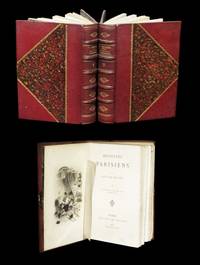
188331220Paris, chez tous les Libraires, 1883. 10 tomes reliés en 2 vol. au format gd in-16 (141 x 98 mm) de 1 f. bl., 2 ff. n.fol., 1 frontispice gravé n.fol., 242 pp. et 1 f. bl. ; 1 f. bl.? 1 f. n.fol., 1 frontispice gravé n.fol., 232 pp. et 1 f. bl. Reliures uniformes de l'époque de demi-chagrin maroquiné lie-de-vin à coins, roulettes et filets dorés portés sur chacun des plats, dos à nerfs ornés de filets gras en noir, roulette dorée portée sur les nerfs, filets dorés, larges fleurons dorés, titre doré, tomaison dorée, filet en pointillés dorés en tête et queue, tranches mouchetées.
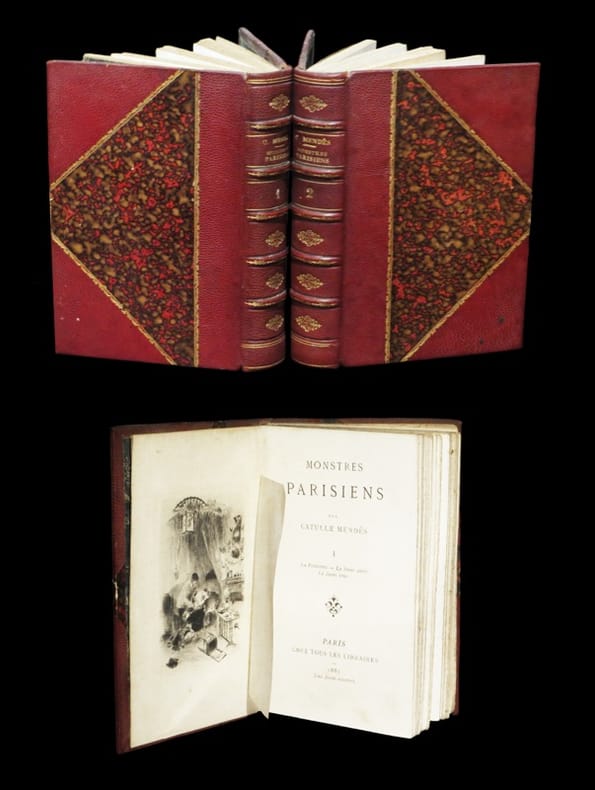
1883312201883. Paris chez tous les Libraires 1883. 10 tomes reliÂŽs en 2 vol. au format gd in-16 141 x 98 mm de 1 f. bl. 2 ff. n.fol. 1 frontispice gravÂŽ n.fol. 242 pp. et 1 f. bl. ; 1 f. bl. 1 f. n.fol. 1 frontispice gravÂŽ n.fol. 232 pp. et 1 f. bl. Reliures uniformes de l'ÂŽpoque de demi-chagrin maroquinÂŽ lie-de-vin ˆ coins roulettes et filets dorÂŽs portÂŽs sur chacun des plats dos ˆ nerfs ornÂŽs de filets gras en noir roulette dorÂŽe portÂŽe sur les nerfs filets dorÂŽs larges fleurons dorÂŽs titre dorÂŽ tomaison dorÂŽe filet en pointillÂŽs dorÂŽs en tÂte et queue tranches mouchetÂŽes. Edition originale. Ensemble complet de ses 10 livraisons ; ici reliÂŽes en 2 volumes. Belle impression sur vergÂŽ de Hollande d'ÂŽdition. L'ouvrage s'orne de 10 dÂŽlicats frontispices gravÂŽs ˆ l'eau-forte montÂŽs sous serpentes et signÂŽs dans la plaque Fernand Besnier. Lequel ''exposa au Salon des Artistes indÂŽpendants de 1912 ˆ sa moer en 1927''. in BÂŽnÂŽzit. ''Fleuron de son abondante production de nouvelliste Les Monstres parisiens sÕimpose comme une Ãuvre essentielle de la littÂŽrature fin-de-siÂcle dont elle condense les obsessions et les thÂmes fondamentaux en peignant diverses monstruositÂŽs morales.'' Thierry Santurenne. Vicaire V Manuel de l'amateur de livres du XIXÂme 674 - ThiÂme Bibliographie de la littÂŽrature franÂaise contemporaine p. 273 - Osterwalder I Dictionnaire des illustrateurs p. 131 citant la prÂŽsente contribution de l'artiste - BÂŽnÂŽzit I Dictionnaire des peintres p. 711. Quelques cahiers lÂŽgÂrement dÂŽrÂŽglÂŽs. Papier des gravures oxydÂŽ. PrÂŽsence de quelques claires rousseurs dans les corps d'ouvrages ; davantage marquÂŽes sur quelques feuillets. Nonobstant bonne condition. b42961 unknown
1882H21417Warsaw: R. Shmiuel Bar R. Chjaim Argelbrand 1882. Hardcover. Good. 9.25 x 8 inches bound in modern dark blue cloth title page is a photocopy appears to be complete but not sure if there are any pages lacking at the end. About 250 pp. Text good and clean in Hebrew withdrawn stamp from Hebrew Union College in NY. Ovadiah ben Abraham of Bertinoro was a 15th century Italian rabbi. R. Shmiuel Bar R. Chjaim Argelbrand hardcover
186425614<p>The second in a series of four racist political cartoons published in 1864 by Bromley & Company which was closely affiliated with the Copperhead New York <i>World</i> newspaper. These prints sought to undermine Abraham Lincoln's chances for reelection by branding him as a "miscegenationist" and playing on white fears of "race-mixing." The cartoon scene pictures several interracial couples enjoying a day at the park eating ice cream discussing wedding plans and a woman's upcoming lecture. Two African American families have white employees a carriage driver and footmen and a babysitter.</p><p>The only other example traced at auction brought $7800 in 2010.</p> <b>ABRAHAM LINCOLN. RACISM.</b>Print. "Miscegenation or the Millennium of Abolitionism." Political Cartoon. New York: Bromley & Co. 1864. 1 p. 20¾ x 13â… in.<p><br /></p><p>American politics had long played on fears of sexual relationships between races. A powerful new word for "race-mixing" was coined in an anonymous December 1863 pamphlet entitled <i>Miscegenation: The Theory of the Blending of the Races Applied to the American White Man and Negro</i> published in New York. Purporting to advocate the virtues of the "blending of the white and black races on this continent" it was a literary forgery prepared by <i>The World</i> managing editor David Goodman Croly and reporter George Wakeman. The authors were unsuccessful in their attempt to trick President Lincoln into endorsing the work.</p><p>At the far left of the image Abraham Lincoln declares "<i>I shall be proud to number among my intimate friends any member of the Squash family especially the little Squashes.</i>" The African American woman to whom he is speaking replies "<i>I'se 'quainted wid Missus Linkum I is washed far her 'fore de hebenly Miscegenation times was cum. Dont do nuffin now but gallevant 'round wid de white gem'men! he-ah! he-ah! he-ah!</i>"</p><p>Senator Charles Sumner says "<i>Mr. President! Allow me the honor of introducing my very dear friend Miss Dinah Arabella Aramintha Squash.</i>" A white carriage driver complains in the background "<i>Gla-a-ang there 240t! White driver white footmen niggers inside my heys! I wanted a situation when I took this one</i>" while a black man in the carriage tells his companion "<i>Phillis de_ah dars Sumner. We must not cut him if he is walking.</i>" A black woman at a table tells a white man with her "<i>Ah! Horace its-its-its-bully 'specially de cream</i>" and he replies "<i>Ah! my dear Miss Snowball we have at last reached our political and social Paradise. Isn't it extatic</i>"</p><p>To the right are two couples embracing each a white woman and an African American man. The first white women tells her partner "<i>Oh! You dear creature. I am so agitated! Go and ask Pa</i>" to which he replies "<i>Lubly Julia Anna name de day when Brodder Beecher shall make us one!</i>" The second white woman says "<i>Adolphus now you'll be sure to come to my lecture to morrow night won't you</i>" to which he answers "<i>I'll be there Honey on de front seat sure!</i>" In the background are various immigrant minorities viewing the scene. One exclaims "<i>Most hextwadinary! Aw neva witnessed the like in all me life if I did dem me!</i>" and another adds "<i>Mine Got vat a guntry vat a beebles!</i>" An Irish girl complains "<i>And is it to drag nagur babies that I left old Ireland Bad luck to me.</i>"</p><p>Manton Marble the editor of <i>The World</i> collaborated with printmaker Bromley & Company to issue a series of four anti-Lincoln "Political Caricatures." The present example was the No. 2 in that series. No. 1 was "The Grave of the Union or Major Jack Downing's Dream"; No. 3 "The Abolition Catastrophe Or the November Smash-up"; and No. 4 "The Miscegenation Ball."</p><p>Republicans responded by trying to turn the "miscegenation" charge against the Democrats. A Republican print "The Political "Siamese" Twins: The Offspring of Chicago Miscegenation" pictures McClellan and Pendleton joined together despite their very different ideas on ending the war.</p><p>Although Abraham Lincoln won New York states' electoral votes in 1860 Stephen Douglas had carried New York City and its environs. Financial elites fearing that civil war would ruin business and recent immigrants fearing competition with free black labor supported Douglas. Lincoln's unpopularity in New York City during the Civil War was a factor in the deadly 1863 Draft Riots.</p><p>In 1864 Lincoln again won the states' electoral votes while New York City favored his Democratic opponent McClellan. In fact Lincoln's majority dropped from 50136 votes in 1860 to only 7373 votes in 1864 with approximately 50000 more total votes cast than in 1860.</p><p>Bromley and Company continued to sell the caricatures after the election as this January 1865 advertisement from an Ohio newspaper makes clear. Another advertisement assured purchasers that the set of four prints available for $1 were "sent on wooden rollers to insure safe carriage."</p><p><b><i>The World</i></b> 1860-1931 a daily independent newspaper was published in New York City. Alexander Cummings founded it as a religious Republican outlet in 1860. August Belmont and others purchased it in 1862 changing the editorial focus. With editor Manton Marble 1834-1917 <i>The World</i> soon became the country's leading Democratic newspaper. In 1864 Union authorities shut down <i>The World</i>and another paper for three days after they published forged documents purportedly written by Lincoln that were really part of a hoax to manipulate the price of gold. The paper actively supported George B. McClellan against Lincoln in 1864.</p><p><b>Condition</b></p><p>Fine for exhibit despite flaws. Cropped with loss of "Political Caricature No. 2" from top edge and part of printed pricing information from bottom edge publisher's name rubbed out from the copyright statement lacking ½" from lower left corners a few short tape repairs by the edges a 2" closed tear through the second dialogue bubble along the top edge and a 3" closed tear parallel to the right edge. Mount remnants on verso.</p> books
186425614<p>The second in a series of four racist political cartoons published in 1864 by Bromley & Company which was closely affiliated with the Copperhead New York <i>World</i> newspaper. These prints sought to undermine Abraham Lincoln's chances for reelection by branding him as a "miscegenationist" and playing on white fears of "race-mixing." The cartoon scene pictures several interracial couples enjoying a day at the park eating ice cream discussing wedding plans and a woman's upcoming lecture. Two African American families have white employees a carriage driver and footmen and a babysitter.</p><p>The only other example traced at auction brought $7800 in 2010.</p> <b>ABRAHAM LINCOLN. RACISM.</b>Print. "Miscegenation or the Millennium of Abolitionism." Political Cartoon. New York: Bromley & Co. 1864. 1 p. 20¾ x 13â… in.<p><br /></p><p>American politics had long played on fears of sexual relationships between races. A powerful new word for "race-mixing" was coined in an anonymous December 1863 pamphlet entitled <i>Miscegenation: The Theory of the Blending of the Races Applied to the American White Man and Negro</i> published in New York. Purporting to advocate the virtues of the "blending of the white and black races on this continent" it was a literary forgery prepared by <i>The World</i> managing editor David Goodman Croly and reporter George Wakeman. The authors were unsuccessful in their attempt to trick President Lincoln into endorsing the work.</p><p>At the far left of the image Abraham Lincoln declares "<i>I shall be proud to number among my intimate friends any member of the Squash family especially the little Squashes.</i>" The African American woman to whom he is speaking replies "<i>I'se 'quainted wid Missus Linkum I is washed far her 'fore de hebenly Miscegenation times was cum. Dont do nuffin now but gallevant 'round wid de white gem'men! he-ah! he-ah! he-ah!</i>"</p><p>Senator Charles Sumner says "<i>Mr. President! Allow me the honor of introducing my very dear friend Miss Dinah Arabella Aramintha Squash.</i>" A white carriage driver complains in the background "<i>Gla-a-ang there 240t! White driver white footmen niggers inside my heys! I wanted a situation when I took this one</i>" while a black man in the carriage tells his companion "<i>Phillis de_ah dars Sumner. We must not cut him if he is walking.</i>" A black woman at a table tells a white man with her "<i>Ah! Horace its-its-its-bully 'specially de cream</i>" and he replies "<i>Ah! my dear Miss Snowball we have at last reached our political and social Paradise. Isn't it extatic</i>"</p><p>To the right are two couples embracing each a white woman and an African American man. The first white women tells her partner "<i>Oh! You dear creature. I am so agitated! Go and ask Pa</i>" to which he replies "<i>Lubly Julia Anna name de day when Brodder Beecher shall make us one!</i>" The second white woman says "<i>Adolphus now you'll be sure to come to my lecture to morrow night won't you</i>" to which he answers "<i>I'll be there Honey on de front seat sure!</i>" In the background are various immigrant minorities viewing the scene. One exclaims "<i>Most hextwadinary! Aw neva witnessed the like in all me life if I did dem me!</i>" and another adds "<i>Mine Got vat a guntry vat a beebles!</i>" An Irish girl complains "<i>And is it to drag nagur babies that I left old Ireland Bad luck to me.</i>"</p><p>Manton Marble the editor of <i>The World</i> collaborated with printmaker Bromley & Company to issue a series of four anti-Lincoln "Political Caricatures." The present example was the No. 2 in that series. No. 1 was "The Grave of the Union or Major Jack Downing's Dream"; No. 3 "The Abolition Catastrophe Or the November Smash-up"; and No. 4 "The Miscegenation Ball."</p><p>Republicans responded by trying to turn the "miscegenation" charge against the Democrats. A Republican print "The Political "Siamese" Twins: The Offspring of Chicago Miscegenation" pictures McClellan and Pendleton joined together despite their very different ideas on ending the war.</p><p>Although Abraham Lincoln won New York states' electoral votes in 1860 Stephen Douglas had carried New York City and its environs. Financial elites fearing that civil war would ruin business and recent immigrants fearing competition with free black labor supported Douglas. Lincoln's unpopularity in New York City during the Civil War was a factor in the deadly 1863 Draft Riots.</p><p>In 1864 Lincoln again won the states' electoral votes while New York City favored his Democratic opponent McClellan. In fact Lincoln's majority dropped from 50136 votes in 1860 to only 7373 votes in 1864 with approximately 50000 more total votes cast than in 1860.</p><p>Bromley and Company continued to sell the caricatures after the election as this January 1865 advertisement from an Ohio newspaper makes clear. Another advertisement assured purchasers that the set of four prints available for $1 were "sent on wooden rollers to insure safe carriage."</p><p><b><i>The World</i></b> 1860-1931 a daily independent newspaper was published in New York City. Alexander Cummings founded it as a religious Republican outlet in 1860. August Belmont and others purchased it in 1862 changing the editorial focus. With editor Manton Marble 1834-1917 <i>The World</i> soon became the country's leading Democratic newspaper. In 1864 Union authorities shut down <i>The World</i>and another paper for three days after they published forged documents purportedly written by Lincoln that were really part of a hoax to manipulate the price of gold. The paper actively supported George B. McClellan against Lincoln in 1864.</p><p><b>Condition</b></p><p>Fine for exhibit despite flaws. Cropped with loss of "Political Caricature No. 2" from top edge and part of printed pricing information from bottom edge publisher's name rubbed out from the copyright statement lacking ½" from lower left corners a few short tape repairs by the edges a 2" closed tear through the second dialogue bubble along the top edge and a 3" closed tear parallel to the right edge. Mount remnants on verso.</p>
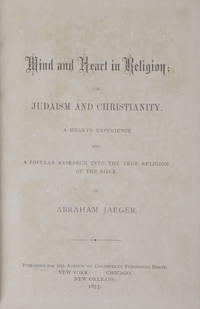
187341051New York: Goodspeed's Publishing House 1873. First edition. Hardcover. g- to g. 8vo. vii 205pp. Brown cloth with blind-stamped title on cover and gilt lettering on spine. Christian missionary work by the Jewish convert Abraham Jaeger. Includes the text of a published letter responding to Rabbi Isaac M. Wise. Binding with some smudging and staining to front and back covers. Head and tail of spine bumped and slightly frayed. Bottom front hinge of spine slightly loose. Light rubbing to some corners and along edges. Interior with sporadic light foxing throughout. Binding in overall good- interior in good condition. Singerman #2397. Goodspeed's Publishing House hardcover
185511141855. TOMLINSON Abraham ed. The Military Journals of Two Private Soldiers 1758-1775 With Numerous Illustrative Notes to Which Is Added a Supplement Containing Official Papers on the Skirmishes at Lexington and Concord. Poughkeepsie: Abraham Tomlinson 1855. 1st ed. Engraved frontis. 128pp. Wear to spine ends else very good in orig. decorated cloth. Howes T-289. Sabin 42860. The journals of Lemuel Lyons and S. Haws are annotated by Benson J. Lossing. unknown
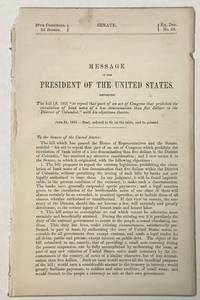
186236662Washington 1862. 37th Cong. 2d Sess. SED65. Broadsheet octavo. 2pp. Disbound else Very Good.<br/><br/> Lincoln refuses to mess with the currency believing that the proposed legislation would result in "the serious injury of honest trade and honest labor."<br/>Not in Monaghan. unknown books
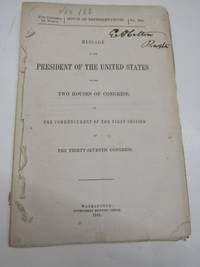
18611391Washington: Government Printing Office 1861. 111 pp. Good condition and removed from a bound volume. Lincoln's speech of July 4 1861. Between the fall of Fort Sumter and July of 1861 President Lincoln Made decisions in response to secession of the southern states without seeking Congressional approval. Lincoln asks Congress to authorize his actions and explains why there is a need to fight the Civil War. This pamphlet is surprising scarce. Government Printing Office unknown
186236662Washington 1862. 37th Cong. 2d Sess. SED65. Broadsheet octavo. 2pp. Disbound else Very Good.<br /> <br /> Lincoln refuses to mess with the currency believing that the proposed legislation would result in "the serious injury of honest trade and honest labor."<br /> Not in Monaghan. unknown
186120908Washington D. C.: Gpo. Good. 1861. First Edition. Hardcover. In the fragile original black cloth. Covers are worn and chipped at the edges with the bottom 1/3 of the spine missing. Contents are very good with some bumping to the lower back corner. ; 9"; 839 pages . Gpo hardcover
18642201110018Washington D.C. : G.P.O 1864. First Edition. Hardcover. Acceptable. Includes the Homestead Act and Indian Affairs Bound in publisher's cloth. Tear with chip missing from spine cloth. Binding sound but somewhat worn. Hardcover. 688 pages ; 23 cm. Includes President's message and reports of the Secretaries of the Treasury War Navy and Interior Postmaster General and Commissioner of Agriculture. Washington [D.C.] : G.P.O hardcover
186349929Washington: Government Printing Office 1863. 1863. First edition. First Edition. Disbound. 41pp. House of Representatives. 37th Congress 3rd Session. Ex. Doc. No. 68. "Indian Tribes In The Northwest." First detailed government report of the Sioux Uprising of 1862. First and last pages tanned else Fine. [Government Printing Office], 1863. unknown
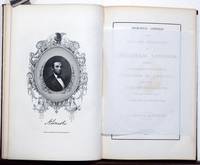
18661007628vo original dark brown pebbled and blindstamped cloth front cover decoratively lettered in gilt steel engraved frontispiece portrait of Lincoln 69 pp. Binding with some edge wear and chipping to spine missing about two inches of lower spine hinges a little weak but still firm ends and corners bumped a little soiling pencil signature of previous owner; else very good. George Bancroft who at one time was Secretary of the Navy deliverd this memorial address to both houses of Congress on February 12 1866. This pamphlet was also published in New York but that issue lacked the portrait. Sabin 3132 Government Printing Office hardcover books
186645134Washington DC: Government Printing Office 1866. Original pebbled dark brown cloth with oval gilt titled and decorated front cover. Engraved portrait frontispiece of Lincoln with tissue-guard engraved and printed at the Treasury Department . With Oration and Appendix 69 pages. Some modest corner rubbing else very good or better with bright and clean text. A nice copy. See photos. First Edition. Hard Cover. Very Good. Government Printing Office Hardcover
18661007628vo original dark brown pebbled and blindstamped cloth front cover decoratively lettered in gilt steel engraved frontispiece portrait of Lincoln 69 pp. Binding with some edge wear and chipping to spine missing about two inches of lower spine hinges a little weak but still firm ends and corners bumped a little soiling pencil signature of previous owner; else very good. George Bancroft who at one time was Secretary of the Navy deliverd this memorial address to both houses of Congress on February 12 1866. This pamphlet was also published in New York but that issue lacked the portrait. Sabin 3132 Government Printing Office hardcover
183057572Philadelphia: American Sunday School Union. 1830. Hardcover. Very Good. Original quarter calf with paper-covered boards. Copyright page and advertisement preface dated 1830. Dampstaining to cover corner and corner of early pages. Frontis portrait plus two other plates. Foldout plan has a 4cm closed tear near base. The American Sunday School Union address 146 Chesnut Street indicate this was printed 1830-1831. ; 24mo 5" - 6" tall; xxii 7-185 pages . American Sunday School Union hardcover
1830009798Philadelphia: American Sunday School Union 1830. Book. Very Good. Hardcover. First Edition. 16mo - over 5¾" - 6¾" tall. 6" x 3 5/8" . xxii 7-185 pages : portrait illustrations. Very Good in quarter calf over paper covered boards spine sunned light wear at corners boards soiled moderate toning plate at xix mostly torn out early pencil numbers at blank rear end pages. Augustus Hermann Francke 1663-1727 was a German Lutheran theologian religious leader and Biblical scholar. American Sunday School Union Hardcover
1899625583Leipzig: Teubner. 1899. IV, 600 S. 23,5 cm. Zustand: Gut leicht gebräunt (Innen); Besitzerstempel (Innen); Einband Außen hat geringe Gebrauchsspuren; Archivex. mit Klebestreifenrest (Außen); Oberer Kapital ist min. bestoßen; Besitzerstempel auf Schnitt, oben gering angestaubt; Buch wurde wahrscheinlich nachgebunden; Gewebe (Blau)
1899625582Leipzig: Teubner. 1899. IV, 600 S. 23,5 cm. Zustand: Gut leicht gebräunt (Innen); Besitzerstempel (Innen); Einband Außen hat geringe Gebrauchsspuren; Archivex. mit Klebestreifenrest (Außen); Oberer Kapital ist min. bestoßen; Besitzerstempel auf Schnitt, oben gering angestaubt; Buch wurde wahrscheinlich nachgebunden; Gewebe (Blau)
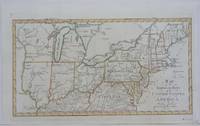
1804M5103Boston 1804. Very Good lower right margin has been extended. Notes: A facinating map of the Old North West. Connecticut's extravagant claims to territory in the west are reflected in the portion of northern Ohio called New Connecticut. Size : 235x400 mm 9.25x15.75 Inches Coloring: Original Hand Coloring Category: ; Maps North America Great Lakes; Maps United States East; Maps United States Mid-West unknown
187710391877 extrait de l'itinéraire en France et en Belgique d'Abraham GOLNITZ. traduit et publié avec notes et éclaircissements par André Vachez.(extrait des mémoires de la Société littéraire , historique et archéologique de Lyon.) 1877.1 volume in 8. pleine toile bleue ciel avec une pièce de titre collée sur le premier plat (reproduction de la page de titre du voyage de Golnitz - édition de 1655 ). étiquette de titre au dos. Plan de lyon au XVII ème en double page de la page 367 à 501.préface de l'auteur et une étude étymologique par le baron Ravérat.Au début du XVIIème , alors que la France ,pacifiée après les guerres de religions, offrait aux voyageurs une sécurité jusqu'alors , on vit accourir une foule de visiteurs étrangers qui parcoururent en tout sens nos diverses provinces.A tous ces voyageurs les guides ne manquèrent pas , mais le plus curieux et le plus complet de ces anciens itinéraires est celui que nous a laissé Abraham GOLNITZ , érudit et observateur intelligent. Il nous a laissé de son voyage un livre qu'il publia à 2 reprises en 1632 et 1655 format Elzevir.( Ulysses Belgico-Gallium)malgré cette double édition , ce livre est devenu rare , en outre il est écrit en latin et il est apparu utile d'en faire une traduction concernant Lyon.Une traduction de la partie dauphiné a également été faite par Antonin Macé.Arrivé dans la ville de Lyon au commencement du mois de décembre 1630 , Golnitz y séjourna jusqu'au 14 janvier suivant , aussi il a pû la visiter à loisir et en faire une description détaillée. cette description remplit 60 pages de son livre et renferme des renseignements d'un grand intérêt sur l'état de la ville de Lyon sous le règne de Louis XIII.
18282123385Berlin: bei G. Reimer 1828. (6), 359 Seiten. Frakturdruck. Unbeschnitten. 8° (20 x 13,5 cm). Spätere Interims-Kartonage. [Softcover / Paperback].
183435602Rochester Boston MA 1834. A collection of six letters ranging in size from 8-1/2" x 11" to 8-1/2" x 12-3/4" five complete and one partial letter. All in ink manuscript on unlined paper. Old folds light toning occasional light foxing two on untrimmed paper. Most are addressed on final blank page and have wax seal remnants with the usual tear where wax was torn open occasional loss to a few letters. Overall Very Good. <br/><br/> Abraham Holmes was a Massachusetts legislator and attorney. Opposing ratification of the Constitution he was allied with the Anti-Federalist Otis family of Barnstable and Freeman family of Sandwich. He was an Anti-Federalist delegate from Rochester MA to the Massachusetts Ratifying Convention of 1788. He served as Sergeant in Capt. Barnabas Doty's company Col. Ebenezer Sproat's regiment during the Revolutionary War. He was admitted to the Plymouth County Bar in April 1800 at the age of forty-six. Though he had no formal legal education his admission to the Bar was permitted in consideration of his respectable official character learning and abilities and on the condition that he study three months in an attorney's office. He served as president of the Court of Sessions prior to his bar admission practiced law in Rochester until the early 1830s was a member of the State Constitutional Convention of 1820 and a member of the Executive Council from 1821 to 1823. Davis William T.: BENCH AND BAR OF THE COMMONWEALTH OF MASSACHUSETTS IN TWO VOLUMES VOLUME II. Boston: 1895. Page 235; Daughters of the American Revolution: LINEAGE BOOK VOLUME 12 1900 Page 15. <br/> William Baylies 1776-1865 and Francis Baylies 1783-1852 were brothers and partners in a Massachusetts law firm. William served as a U.S. Representative from Massachusetts in 1809 1813-1817 and 1833-1835; was a member of the Massachusetts House of Representatives from 1808-1809 1812-1813 and 1820-1821; and a member of the Massachusetts Senate from 1825-1826 and 1830-1831. Francis was a Congressman from 1821-1827; a member of the Massachusetts House of Representatives from 1827-1832 and in 1835; and the United States Charge d'Affaires Argentina in 1832. <br/> Holmes's Letters are as follows:<br/> 1 Letter to Francis Baylies Member of Congress dated at Boston January 19 1822. Holmes then member of the Massachusetts Executive Council awaits reports of the State legislative committees the incorporation of Boston "which will serve to procrastinate the session" the "suspense of the acceptance of office of the Judge of the Municipal Court" and issues such as criminal trials and the death sentence. "We pass our time here in Boston. the frequent application for appointments of both proper and improper candidates is rather an uncomfortable circumstance; but not so distressing as in affixing the time when convicts shall live no longer. to determine whether a convict shall die or not. It is probable we shall have the trial of both soon as there has been three capital convictions since I was here; one for murder and two for highway robbery. Those trials I attended; a Mr. Simmons formerly of Taunton as I am told managed the Defence; I can not record him as possessing great oratorical abilities but for integrity of arrangement and strength and argument perhaps no man of his years stands higher." Boston was incorporated March 4 1822 and the same year the Boston Police Court for criminal cases and Justice's Court for the County of Suffolk for civil claims were established. <br/> 2 Holmes's Letter to Francis Baylies dated at Boston March 28 1822. Holmes notes that the State legislative session is coming to a close. He anticipates orations which would "cause Tully to wish that he hadn't ever learned to speak; and all this for the good of the Nation."<br/> 3 Letter to William Baylies Counsellor at Law dated at Rochester MA October 24 1828 docketed October 25. An interesting three pages for lawyers anyway written in small yet legible hand on legal size paper. Holmes discusses with "great anxiety" and detail strategies and implications of the case entitled Rounseville Spooner versus Davis et ux. presentation of which had just concluded in the Massachusetts Supreme Court. Holmes and Baylies had represented Rounseville. Judge Wilde issued his decision on the following day October 25th. <br/> The case involved land in Fairhaven conveyed by Alden Spooner to Walter Spooner which later descended to Humphrey Davis's wife; but Alden Spooner later conveyed it again to Rounseville Spooner. What will be done in the case Holmes says "God only knows." Judge Wilde's Opinion reported at page 147 of Pickering's Reports Boston: 1830 gives the victory to Holmes and Baylies. <br/> 4 Letter to William Baylies Nov. 21 1828. Holmes discusses his excitement over a favorable verdict. "I rode into the yard. Mr. Bassett's son met me and informed me that the verdict of the jury was in favour of our client. Do you think I was sorry My heart jumped to my throat and with some difficulty I prevented my immortal spirit from bursting thro' the clay tenement. I am glad now that we did not use Joshua Vincent's Deposition for they would have objected and the point next word illegible for the Whole Court./ The next enquiry is Compensation. But I must stop with my hearty congratulations." Docketed on final page in part "Thomas v. D. & wife Nov. 21 1828."<br/> 5 Letter to William Baylies dated Rochester MA April 11 1834. A lengthy poignant letter discussing his advanced age and retirement. He no longer views political issues with the same interest; despite his overall good health he is troubled with lameness and currently lives with his son and his son's wife. "Some of my old customers are not willing to apply to anyone else."<br/> 6 Partial Letter to Francis Baylies December 1821. ". I dread the power of some of your colleagues. Mr. Saltonstall whose abilities are competent to make white and black synonymous terms I understand -which God forbid is strongly intrenched in a. Battery of Bankruptcy. unknown books